SECULAR RITES OF PASSAGE
Practice
Unbound
Melanie Wilson
A Study
of Secular Spiritual
and
Religious
Activities
in Work
with
Adolescents
A Study
of Secular Spiritual
and
Religious
Activities
in Work
with
Adolescents
Practice
Unbound
3
AAcckknnoowwlleeddggmmeennttss .........................................................................................................................................4
EExxeeccuuttiivvee SSuummmmaarryy......................................................................................................................................5
IInnttrroodduuccttiioonn .....................................................................................................................................................7
LLiitteerraattuurree RReevviieeww...........................................................................................................................................9
Religion.........................................................................................................................................................9
Secular Spirituality...............................................................................................................................11
MMeetthhooddoollooggyy..................................................................................................................................................15
Survey Instrument ...............................................................................................................................15
The Sample...............................................................................................................................................16
Data Collection and Analysis.........................................................................................................17
KKeeyy FFiinnddiinnggss ..................................................................................................................................................18
Trends and Variations in Use: Secular Spiritual and Religious Activities................19
Prevalence and Details of Use: Secular Spiritual Activities.............................................23
Education About the Spiritual Self .......................................................................................23
Meditation .........................................................................................................................................25
Self-Reflection Through Guided Relaxation/Visualization ......................................27
Yoga.......................................................................................................................................................28
Musical Expression ........................................................................................................................29
Martial Arts.......................................................................................................................................32
12-Step Groups................................................................................................................................34
Secular Rites-of-Passage Programs.........................................................................................36
Other Secular Spiritual Activities...........................................................................................38
The Problem with Secular Spiritual Programming.......................................................39
The Outlook for Secular Spiritual Programming ..........................................................41
Prevalence and Details of Use: Religious Activities.............................................................44
Offer Rides to Worship................................................................................................................44
Accompanying Staff to Worship .............................................................................................45
Staff Initiating Religious Discussions ...................................................................................45
Bible/Prayer Groups.................................................................................................................... 46
Clergy Programs..............................................................................................................................47
Religious Counseling ....................................................................................................................49
Religious Instruction.....................................................................................................................50
Religious Rites-of-Passage Rituals...........................................................................................51
Other Religious Activities...........................................................................................................52
The Problem with Religious Programming.......................................................................53
The Outlook for Religious Programming...........................................................................56
LLiimmiittaattiioonnss ....................................................................................................................................................57
CCoonncclluussiioonn......................................................................................................................................................58
Secular Spiritual Activities................................................................................................................59
Religious Activities................................................................................................................................59
GGlloossssaarryy ooff TTeerrmmss.......................................................................................................................................60
TThhee RReeggiioonnss....................................................................................................................................................61
AAppppeennddiixx:: TThhee SSuurrvveeyy IInnssttrruummeenntt.....................................................................................................62
RReeffeerreenncceess.......................................................................................................................................................73
Table of Contents
4
SECULAR SPIRITUAL AND RELIGIOUS ACTIVITIES IN WORK WITH ADOLESCENTS
More than a dozen organizations made invaluable contributions to the
production of this report. We gratefully acknowledge the generous
assistance of the Southeastern Network of Youth & Family Services, which
conducted interviews and provided financial support. For their help in
providing membership lists, we also thank the Child Welfare League of
America/Northeast Region, Empire State Coalition of Youth & Family
Services, Illinois Collaboration on Youth, Mid-Atlantic Network of Youth &
Family Services, M.I.N.K. Network of Youth Services, Mountain Plains
Network for Youth, Northwest Network for Youth, Texas Network of Youth
Services, and Western States Youth Services Network.
We also recognize the work of the following individuals, who graciously
contacted and helped arrange interviews with agencies in our sample:
Sherry Allen, Shirley Dwyer, Lisa Eisenbud, Nancy Fastenau, Linda Garding,
Rebecca Hamm, Gary Hammons, Margo Hirsch, Nancy Johnson, Karin
Koch, Gail Kurtz, Denis Murstein, Steve Pollock, Patti Skorupka, Theresa
Tod and Adrienne Williams. Of special note are the contributions of Karen
Lyndel, Kristen Spangler, Donna Stern, Myla Platt and Nancy Robinson,
who conducted numerous, often lengthy interviews with great skill.
For their generous donations of time and expertise in survey design, we
thank Francine Jacobs, Ph.D., of Tufts University; David Kurtz, Ph.D., of the
University of Georgia; Hugo Kamya, Ph.D., and John McNutt, Ph.D., both
of Boston College; and Gretchen Noll of the National Network for Youth.
Jack Weldon, Sarah Irland and Jo Mestelle also offered helpful feedback on
the survey, and Peter Perkins was an invaluable source of information
about adolescence and spirituality. Charlotte Fitzgerald supplied much-
appreciated help in copy editing.
To the 191 agencies we interviewed for this study, we reserve our warmest
thanks. The executives and direct-care workers with whom we spoke were
without exception kind, patient, interested, and generous with their time.
Learning about these agencies was a privilege.
Finally, New England Network expresses gratitude to the Family and Youth
Services Bureau of the Administration for Child, Youth and Families, US
Department of Health and Human Services, which funded the printing of
this report.
Melanie Wilson, M.S.W., is Director of Research and Public Policy at New
England Network for Child, Youth & Family Services.
Copyright ©2002 by New England Network for Child, Youth & Family
Services. All rights reserved.
Acknowledgments
5
EXECUTIVE SUMMARY
Spirituality, and the therapeutic use of spiritual practices, is a topic of
increasing interest in society. It is thus not surprising that spiritually ori-
ented activities have been adopted by many social service providers as a
means of helping troubled individuals cope effectively with their prob-
lems. However, a lack of knowledge about the use of such activities in
treatment settings has stymied the development of this emerging area of
practice. This study seeks to identify and measure the kinds of spiritually
oriented activities, both secular and religious, social service providers use
with adolescent clients ages 12 to 21. In lengthy interviews with 191
agencies throughout the United States working with a variety of youth
populations, the study asked about the use of sixteen activities defined as
spiritual in orientation.
For the purposes of this study, spiritual activities were those that were
explicitly intended to enhance clients’ sense of awareness, wholeness and
well-being, and help them tap into sources of inner strength. Spiritual
activities in this study encompass both secular and religious practices. The
secular activities measured were: education about spirituality; meditation;
guided relaxation/visualization; yoga; musical expression; martial arts;
12-step groups; and secular rites-of-passage programming. The religious
activities measured were: prayer/Bible groups; clergy programs; religious
counseling; religious instruction; and religious rites-of-passage rituals. The
study also asked about agencies’ policies on offering clients rides to wor-
ship services, allowing clients to attend church with staff members, and
allowing staff to initiate conversations about religion with clients.
Detailed information was collected on each activity that interviewees
named. Analysis of the data shows that over half of youth-serving agen-
cies use one or more secular activities with clients, and a smaller percent-
age use one or more religious activities. Secular activities tend to be newer
to agencies than religious ones, and tend also to have been adopted for
clinical reasons; religious activities have generally been offered longer, and
in many cases were adopted primarily because they accorded with the
religious mission of the agency. Faith-based agencies are more likely to
offer religious activities, but less likely to offer secular activities, than non-
faith-based agencies. Regions of the country showed marked differences in
the use of secular activities, with lowest rates of use in the Midwest and
South. Differences between regions were not as apparent in the use of
religious activities. Executive-level and direct-service staff tend to be highly
supportive of the activities their agencies offer, whether those activities
are religious or secular, though some resistance to religious activities was
evident among direct-service staff.
Agencies offered remarkably consistent testimony about the benefits of
Executive Summary
6
SECULAR SPIRITUAL AND RELIGIOUS ACTIVITIES IN WORK WITH ADOLESCENTS
the activities for their clients: almost regardless of the particular activity in
question, spiritually oriented practices were thought to help youth relax,
manage their anger, and think constructively about their lives. Agencies gen-
erally reported high levels of interest in developing or expanding spiritual
programming, but only of the type – secular or religious – that they already
offer or philosophically endorse. Agencies indicated that their two greatest
needs in developing such programming were training and funding.
7
INTRODUCTION
In July 2000, New England Network for Child, Youth & Family Services
convened a focus group of youth-service providers to talk about a topic of
increasing interest to our field: spirituality. As a training and research
organization deeply interested in the intersection of practice and policy,
we had attended workshops on spiritual practice, heard endorsements
(and some denunciations) of it, watched as a national debate unfolded
about its role in social services. Obviously some change was underway in
the field’s collective thinking on this topic – but what change, exactly? We
hoped our focus group could help us find some answers.
And so we simply asked. What, we wanted to know, were they – a dozen
professionals, all working with troubled teenagers – doing with spiritual
programming in their agencies? We didn’t define our terms, letting “spiri-
tuality” mean whatever they interpreted it to mean. And perhaps for that
reason, they said nothing. There was only confused silence.
Finally, with a bit of prompting and a few examples of what might consti-
tute spiritual programming, they warmed to the topic. One program
director described a drumming group his agency had begun the year
before; another talked about the yoga classes her program organizes for
adolescent clients. Feeling emboldened to broach religion, one administra-
tor offered that his secular agency had started a weekly prayer group led
by a volunteer pastor. Another participant said that his independent living
program didn’t offer religious instruction per se, but taught comparative
religion as social knowledge that its teen clients could take into adulthood.
But as the group became animated and talkative, two women hung back.
When questioned, they responded that their agencies didn’t like the
whole topic of spirituality. It suggested the potential for abuse, or at least
for the imposition of personal belief systems on teenagers too vulnerable
and needy to make up their own minds. Religious or secular, spiritual
activities were strictly taboo in their programs. “The word ‘spirituality’ isn’t
even something we let people use,” said one of the women, a director of a
shelter for runaway and homeless youth. The other woman, director of a
teen drop-in center, nodded. “This spirituality stuff is just the latest fad,”
she said. “It’ll pass like everything else.”
Would it pass? Should it? If within such a small group there was both
great enthusiasm and great skepticism about the topic, what was the field
as a whole thinking and doing about spirituality? If there was indeed a
trend, what exactly did it look like? Who was doing what, where, and why?
And how, and to whom? There were plenty of questions, but no readily
available answers. Indeed, as we scouted around for information, we
found that no one – neither academics nor colleagues – seemed to know
Introduction
8
SECULAR SPIRITUAL AND RELIGIOUS ACTIVITIES IN WORK WITH ADOLESCENTS
anything about the scope of spiritual practice beyond what they had heard.
It was true that an emerging body of research had suggested the benefits of
some spiritually oriented activities with certain adolescent subpopulations,
and there was plenty of research on the impact of religious faith on both
teenagers and adults. But there was nothing on the prevalence of spiritual
programming in youth agencies, on staff or client attitudes toward various
spiritual activities, or on best practices and models for agencies that did
want to develop such programming. The trend toward spiritual activities – if
indeed there was a trend – hadn’t been explored or quantified.
The answers to these questions are what this study was designed to provide.
Through interviews with nearly 200 youth-serving agencies around the
United States, we gathered information on the use and implementation of a
broad range of secular and religious activities that are generally thought to
enhance spiritual health, and that have been embraced by many agencies
for that very reason.
If the concepts at hand seem murky, they are. There is no universal defini-
tion of spirituality, as the scores of researchers who have ventured into this
area of study can, and do, attest. Though we have done our best to strictly
adhere to a commonsense definition of “spirituality” – defined in this study
as those activities explicitly intended to enhance clients’ sense of awareness,
wholeness and well-being, and help them tap into sources of inner strength
– we intend neither to identify all activities that might lead to spiritual
development in troubled adolescents, nor to suggest that the specific
activities we studied have themselves any particular benefit, spiritual or oth-
erwise, for the adolescents who use them. Though, as we have noted, a
growing body of research indicates that at least some practices have benefits
for some populations of youth, questions of clinical efficacy can only be
answered over time, and with more research. Our goal in this study was sim-
ply to take a baseline measure of the current state of practice – to under-
stand the basics, as it were – so that professionals working with adolescents
have a context for their discussions in this area, and so that future
researchers have solid data against which they can measure growth or
decline in spiritual practice.
9
LITERATURE REVIEW
The 1990s saw a small boom in research on the impact of spiritual and
religious practices on health and emotional well-being, but little of it
focused on children or adolescents. Some of the reasons are obvious: spir-
itual and religious experiences are difficult in themselves to define or
quantify, and little practical research on spiritual development in children
has existed upon which to build. Almost no research has evaluated
whether spiritual activities of any sort “work” with troubled children, or
how, if any are found to work, they could be implemented to maximize
their benefit. Indeed, many researchers begin their studies of the relation-
ship of spirituality to health by bemoaning the lack of previous research
that might yield even so much as standard, usable definitions.
Considered most broadly, spirituality is that which gives a transcendent
meaning to life (Puchalski, 2000). Yet traditionally spirituality has tended
to be categorized as either religious or nonreligious, or drawing on ele-
ments of both (Saunders, 1998). Thus religion exists along the spectrum of
spirituality, but as a more or less distinct discipline or set of practices.
That separation is emphasized by the common notion that spirituality
refers to a personal experience of the sacred; in this scenario, every indi-
vidual may design his or her own system of beliefs, which in turn must be
respected as legitimate by others. Religion, by contrast, involves subscrip-
tion to a set of institutionalized beliefs that are practiced by many others
as well (Holder, 2000). Whatever one believes about the relationship of
traditional religious faith to spirituality, some common themes can never-
theless be found between the two: “spirituality,” religious or not, is univer-
sal; is concerned with values, perspective, belief and affect; relates self,
others and a higher being in some overall framework; and involves beliefs
about transcendence (Shapiro, 1999).
Religion
With the relatively recent interest of clinicians and researchers in using
spiritual and religious practices as therapeutic tools, new research has
begun to emerge, most of it focusing on the impact of religion on health
and behavior. A great deal of controversy has attended the question of
whether religious faith itself can prevent some of the harmful behaviors
associated with adolescence. That controversy continues regardless of
ample evidence that children who grow up believing in God do indeed
experience fewer of the problems typical of adolescence than children who
do not. In an analysis of data from the National Longitudinal Study of
Adolescent Health, Resnick et al. (1997) found that almost 90% of
American teenagers claim to “have” a religion. This rather surprising find-
ing is supported by numerous other studies, including one by Donahue
and Benson (1995) that reviews the literature and finds that American
Literature Review
10
SECULAR SPIRITUAL AND RELIGIOUS ACTIVITIES IN WORK WITH ADOLESCENTS
adolescents are religious, that the percentage of teenage participation in reli-
gion tends to be stable from year to year, but that overall religiosity tends to
diminish as youth grow older.
The impact of religiousness on particular self-destructive or “at-risk” behav-
iors varies, and in some cases is still in question. But a plethora of research
has firmly established that religion tends to discourage two of the most
consequential problems teens face: use of illegal drugs and alcohol, and
engagement in early sex. In a Wayne State University study including both
housed and homeless adolescents, researchers found that religiosity has a
“significant stress-buffering effect” that protects against drug and alcohol use
by teens (Ahmed, et al., 2001) The researchers concluded that “religiosity
should be encouraged” in adolescents experiencing a high number of stress-
ful events, and may be particularly important in reducing the likelihood of
drug use among male adolescents. Resnick’s study found that teens who con-
sidered religion important had later sexual debuts and were less likely to use
drugs. Within religions, Catholics and conservative Protestants had later first
intercourse than mainstream Protestants, and Muslim, Buddhist and Jewish
girls were much less likely to get pregnant than mainstream Protestants
(Bearman & Bruckner, 1999).
There is also evidence that religion helps adolescents adapt constructively to
the adult world. A study of 4,000 tenth-graders in Iceland found that
teenagers who participated in religious services and other religious activities
were more likely to view the world as a predictable and logical place and
were more willing to abide by the rules and expectations of society. The
author found it particularly striking that the more supportive parents were,
the more religiously active the teenagers were, and thus the greater the ben-
efits of religious participation (Bjarnason, 1998).
A study in the UK found a significant positive relationship between frequen-
cy of prayer and perceived purpose in life among both churchgoing and
non-churchgoing 12- to 15-year-olds (Francis & Evan, 1996). In a qualitative
study of college students, frequency of prayer was shown to be related to
identity status, with the authors concluding that prayer might offer reveal-
ing glimpses into the psychosocial lives of older adolescents, yielding infor-
mation about their central concerns and definition of self (McKinney &
McKinney, 1999).
For all ages, the health benefits of religion seem to be unequivocal. A meta-
analysis of 42 studies on religion and health found that active religious
involvement substantially increased the chance of living longer, even when
factors such as race, income, education, obesity and mental health were
taken into account (McCullough, et al., 2000).
11
LITERATURE REVIEW
An important proviso is in order, however, and it goes to the heart of the
debate over religion and troubled adolescents. While the physical and emo-
tional benefits of religious belief would seem to be firmly established, stud-
ies have not shown that encouraging faith in adolescents with no religious
background is helpful in ameliorating their problems, or even in preventing
problems from emerging. Studies show only that adolescents already indoc-
trinated in religious belief reap protective benefits from it. (Even in these
studies, the directness of the link must be questioned. It could be that chil-
dren become religious precisely because they are willing to conform to social
expectations, a quality that would also make them unlikely candidates for
drug use and other behavioral problems.) In any case, after-the-fact religious
conversion as a tactic to solve behavioral or social problems is a somewhat
dubious proposition; at the very least, its usefulness is unproven.
Secular Spirituality
The topic of secular spirituality – that is, spirituality not rooted in traditional
religion – has received far less attention. Though many measures of spiritual-
ity have been devised, one of the most promising appears to be the Spiritual
Orientation Inventory (SOI), which measures spirituality broadly, using nine
subscales that focus on various aspects of interior development such as mis-
sion in life, material values, altruism, meaning and purpose, and sense of the
sacredness of life. In a study of 183 teenagers aged 16 to 21, those who scored
high on the SOI were more likely to report healthy ways of coping with crisis;
in particular, they were likely to be proactive, hopeful and introspective, and
less likely to engage in destructive behavior (Saunders, 1998). In another
study of 141 teenagers at an urban, hospital-based adolescent clinic, those
who scored high in “spiritual interconnectedness” on another scale were less
likely to engage in voluntary sexual activity, especially if they reported strong
spiritual connections with friends (Holder, 2000).
A qualitative study of 12 formerly runaway or homeless youth indicates that
spirituality is also a personal asset for youth in trouble, and that the agen-
cies that work with such youth should take spirituality seriously (Lindsey et
al., 2000). “Over half of the young people in this study indicated that a rela-
tionship with a higher power was a significant factor in turning their lives
around,” the study’s authors wrote. “Yet, only one participant said that the
treatment program she was involved with addressed this issue…. Exploring
and working with spiritual beliefs, which may not be religious in a tradition-
al sense, can be a way of tapping into a youth’s existing resources.”
The studies with the most practical application, however, may be the ones
that seek to evaluate the impact of specific secular spiritual practices on
undesirable behaviors. Below are summaries of current research on the
activities considered in this study.
12
SECULAR SPIRITUAL AND RELIGIOUS ACTIVITIES IN WORK WITH ADOLESCENTS
Meditation
Among the various practices that might reasonably be considered to be spir-
itual in nature, transcendental meditation, or TM, is one of the best studied,
though thus far, most researchers have focused on adults. Among research
on children, a study in Iowa found that students in grades three to eight
improved their standardized test scores significantly after practicing TM dur-
ing school for a period of several months (Nidich et al., 1986). In another
study, a small sample of 13- to 16-year-old boys on probation in Atlanta
showed that those who learned TM scored significantly lower on pre- and
post-test anxiety measures, while those who did not practice TM actually
showed increases in their anxiety scores.
Several studies exploring the potential benefits of TM in prison populations
find it a promising therapeutic tool, leading to “consistent and rehabilitative
effects” on prisoners, with outcomes that include higher psychological and
ego development, lower psychopathology, reduction in disciplinary reports
and reduction in recidivism (Dillbeck and Abrams, 1987). Indeed, in a large
study of inmates aged 19 to 62, TM was found to more consistently reduce
recidivism than prison education, vocational training or psychotherapy
(Bleick and Abrams, 1987). To date, however, TM’s potential value for juve-
nile offenders has not been sufficiently studied to draw conclusions about
its usefulness with them.
Martial Arts
Martial arts, with its ready appeal for many youth, is another area of
increasing interest to researchers and clinicians. Here again, the activity
seems promising as a therapeutic tool, with participating youth showing sig-
nificant improvements in self-control and a variety of social skills. Karate,
for instance, has been found to lower aggression (Layton, et al., 1993) and
increase levels of self-reliance and optimism. Further, the longer the student
studies and the more proficient he becomes, the greater those effects
(Kurian et al., 1994).
In another study, high suspension rates and bullying in a Kansas City school
were addressed through an intervention that included a martial arts pro-
gram called “Gentle Warriors.” The program taught martial arts techniques
and philosophies, coping skills, meditation, and self-control. The martial arts
instructor also read stories relating to the Bushido Code, which emphasizes
respect and compassion. Mentorship programs, parenting classes and hall-
way posters were used as well. After 18 months, suspension at the school
dropped 50% (Smith et al., 1999).
Not all forms of martial arts appear to have equal benefits, however; several
studies have attempted to differentiate the impact of traditional martial arts,
13
LITERATURE REVIEW
with its emphasis on respect and self-discipline, from newer forms stripped
of that philosophical focus. In Minnesota, for instance, three groups of juve-
nile delinquents participated in a study of the impact of martial arts on
delinquent behavior. The first group received traditional taekwondo train-
ing, the second a “modern” version of martial arts training with no empha-
sis on psychological or philosophical dimensions, and the third a control
group. On two personality measures done before and after, the group
receiving traditional taekwondo training showed decreased aggressiveness
and anxiety, and increases in self-esteem, self-adroitness and value ortho-
doxy. By contrast, the group receiving modern training actually showed an
increase in aggressiveness. The control group showed no differences
(Trulson, 1986).
Yoga
Adjudicated youth were the subjects of another study, this one a first-time
examination of the effects of yoga and meditation on adolescent sexual offend-
ers. In this study, 14 adolescent offenders were trained in yoga, breathing and
meditation. After nine months of practice, subjects reported that the program
had had a calming effect on their minds and made them feel safe and rested,
and that the program helped them to recognize and control their feelings.
Most boys in the sample said they thought the training would help them avoid
re-offending, and all said that they had continued to use yoga techniques on
their own, even after the program had ended (Derezotes, 2000). In a controlled
three-group study, Wolf (1999) found that mantra-chanting, a yogic technique,
was useful in alleviating stress and depression, and other researchers have
found that yoga promotes motivational change in substance abusers (Lohman,
1999). Yoga has been found to improve attitude and behavior, enhance com-
munication skills, and decrease impulsivity in adolescent inpatients at a mental
health center; it may also be of particular benefit to children with psychomotor
deficits (Zipkin, 1985).
Guided Visualization
Guided visualization, an introspective technique in which individuals are direct-
ed to imagine themselves in a particular scenario, has been known for decades
to improve certain physical and psychological conditions, including post-trau-
matic stress disorder, obsessive-compulsive disorders, childhood anorexia, drug
addiction, and academic problems. Less studied as an intervention for troubled
adolescents, guided visualization was nevertheless the subject of a well-con-
trolled California study examining its effect on clinically depressed teenagers.
Here a control group of teens hospitalized for depression received standard
treatment – occupational, recreational, group and individual therapy – while
subjects in an experimental group received the same treatment but also partici-
pated in guided visualization sessions. (The sessions were held twice a week and,
in them, subjects were asked to visualize a variety of standard scenes, including
14
SECULAR SPIRITUAL AND RELIGIOUS ACTIVITIES IN WORK WITH ADOLESCENTS
one in which they were to picture themselves climbing a mountain, another in
which they followed a stream to its source.) At the end of a month, analysis of
pre- and post-test depression scores revealed that the adolescents who received
guided visualization along with standard treatment had significantly improved,
whereas teens receiving standard treatment alone had not (Briscoe, 1990).
Musical Expression
Music is finding increasing acceptance as a therapeutic tool in work with a
variety of populations, including senior citizens, Alzheimer’s patients, heart
patients and prison inmates. Indeed, its seemingly powerful effects on
mood, memory, anxiety and other dimensions of well-being have prompted
scientists to investigate the impact of music at the biological level. New evi-
dence, for instance, suggests that music increases blood flow to areas of the
brain linked to motivation, emotion and arousal, accounting for the state of
euphoria a favorite piece of music can sometimes induce (Blood et al., 2001).
In the first controlled experiment of its kind, another recent study found
that group drumming stimulates the immune system to fight cancer
(Bittman, 2001). Still another study compared levels of energy and depres-
sion among individuals engaged in group drumming and those engaged in
other group activities. The drummers were found to be more energetic, con-
fident and elated, and more willing to take part in meaningful discussions
with their peers (Segall, 2000). The effect of music on adolescents’ behavior
has not been well-studied, but some benefits have been reported. Michel
(1985) describes using music – in this case, the promise of guitar lessons – as
a way to build constructive therapeutic relationships with juvenile delin-
quents, and Darrow (1994) discovered that adolescents in an intergenera-
tional choir developed more positive attitudes toward senior citizens.
Rites-of-Passage Programs
Rites-of-passage ceremonies or rituals, generally meant to mark the transi-
tion from one stage of development to another, often weave strands of reli-
gion and culture together, and can be potent transmitters of meaning as
well as mediators of personal and community problems. While not yet well-
studied in adolescent populations, research does suggest that, among other
uses, they can be effective in helping teenagers overcome addiction. An eval-
uation of an adolescent substance abuse treatment program in the
Northwest found that a rites-of-passage program that included gender-
based rituals, myths, storytelling, and initiation rites had a positive impact
on the coping skills and self-esteem of participants (Mason et al., 1995).
Transmission of cultural values through rites-of-passage rituals plays an
important though difficult-to-quantify role in reducing alcohol and drug use
in minority youth. While more research needs to be done, studies to date
have yielded promising results. In the mid-1990s more than 200 middle-
school students on an Indian reservation in the Southwest participated in a
15
METHODOLOGY
drug prevention program, one component of which involved storytelling
and cultural symbols. The program was successful in lowering drug use, par-
ticularly among Native American males. Another study in Rhode Island
found that strengthening cultural identification of Native American youth
also led to decreased use of substances (Sanchez-Way et al., 2001).
Methodology
Spirituality and religion are controversial topics – at least insofar as their clini-
cal uses are concerned – not only because people cannot agree on what the
terms mean, but also because, used as separate terms, they imply mutual
exclusivity. Many people believe, indeed insist, that one has nothing to do
with the other, and that the two concepts operate on different levels and in
different ways. This study does not take a position on that question. Instead it
seeks to define the two areas in ways generally accepted by other researchers
and then to identify common activities that fall into each category. The cate-
gories, as such, are not all-inclusive, nor are they meant to be. They simply
satisfy the needs of the project by providing a framework for dialogue about
the kinds of practices currently in use, by which agencies, and with what
youth. This study is an attempt to profile an emerging trend, not to promote
or defend any particular type of activity, either secular or religious.
Survey Instrument
As shown in Appendix A, the survey defines “spiritual activities” as those
activities that are explicitly intended to enhance clients’ sense of awareness,
wholeness and well-being, and help them tap into sources of inner strength.
The secular spiritual activities we asked about were: routine education
about the spiritual self; meditation; yoga; self-reflection through guid-
ed visualization/relaxation; musical expression; traditional martial
arts; 12-step groups; and secular rites-of-passage programs. The reli-
gious activities we asked about were: Bible or prayer groups; clergy pro-
grams; curriculum-based religious instruction; religious counseling;
and religious rites-of-passage rituals. We also asked about agencies’ poli-
cies on proactively offering clients rides to places of worship; allowing
clients to accompany staff to staff’s own place of worship; and allow-
ing staff to initiate conversations about religion with clients. (For defi-
nitions of each of these activities, see Glossary, p. 60.) The selection of these
particular activities was informed by the research literature and by a com-
mon understanding of the state of spiritual practice in the youth-service
field. As the literature review indicates, many of these activities have been
found, to one degree or another, to be clinically useful with adolescents. In
addition, the activities are generally well-known to agencies working with
youth, and, in agencies that have embraced spiritual activities, are certainly
among the most common and best accepted.
16
SECULAR SPIRITUAL AND RELIGIOUS ACTIVITIES IN WORK WITH ADOLESCENTS
Study participants were asked a series of questions about each activity that
their agencies made available to clients. Specific questions concerned the
length of time the agency had used the activity; the primary reason the
agency had adopted it; the percentage of eligible youth participating in it; the
perceived importance of the activity to the program’s overall goals; and the
reactions to the activity of youth, direct-service staff and executive-level staff.
Agencies were also asked to name any other activities offered to youth that
were, in the agency’s view, spiritual or religious in nature. Notes were taken
about these additional activities, but the standard follow-up questions were
not asked. Follow-up questions also were not asked about policies on rides to
worship, staff initiating religious talk, and clients accompanying staff to staff’s
worship. Since these policies do not represent “activities” in the usual sense,
agencies that allow them but offer no other religious activities on the list
were not considered to have developed religious programming.
The Sample
Interviews were conducted with 191 randomly selected youth-serving agen-
cies in 47 states, Washington, DC, and Guam. The sample was selected from
1,100 agencies on the combined membership lists of the Child Welfare
League of America; Empire State Coalition of Youth & Family Services;
Illinois Collaboration on Youth; Mid-Atlantic Network of Youth & Family
Services; M.I.N.K.
Network of Youth
Services; Mountain
Plains Network for
Youth; New England
Network for Child, Youth
& Family Services;
Northwest Network for
Youth; Southeastern
Network of Youth &
Family Services;
Southwest Network of
Youth Services; and
Western States Youth
Services Network.
Determined efforts were made to secure the participation of all agencies on
the original sample list, and about 90% ultimately agreed to interviews.
Replacements for the remaining agencies were randomly selected according
to region. Public agencies were excluded from the study, as were those serv-
ing only children under age 12. All other agencies, regardless of specific ado-
lescent client population and type of service, were included. All participating
Fig. 1.
Number of Agencies
in Sample by Region
New England
(n=28)
Mid-Atlantic
(n=34)
Midwest
(n=41)
South
(n=42)
West
(n=46)
17
METHODOLOGY
agencies were promised confidentiality. Although there was, as might be
expected, considerable overlap in the kinds of populations being served
within and between agencies, about 19% of agencies reported abused or
neglected children as their primary client population; 18% runaway or
homeless youth; 15% at-risk youth and families; and 26% emotionally or
behaviorally disturbed youth. The sample was skewed slightly in favor of
agencies serving runaway and homeless youth because the regional organi-
zations providing membership lists tend, to varying degrees, to concentrate
on those agencies. (The deci-
sion to draw a sample from a
diverse range of agencies
rather than a narrowly
defined subcategory was
based on the assumption that,
though adolescents may
receive services in a variety of
different settings, the youth
themselves are substantially
similar, with a core set of
problems that are common to
most. For the advantages and
disadvantages of this
approach, see Limitations,
p. 57.)
The agencies in the sample were well-distributed throughout the country,
with highest numerical concentrations in the West, South and Midwest.
They were almost evenly divided between urban and nonurban settings, and
both faith-based and secular agencies were represented. In this study, faith-
based agencies are those that reported a formal religious affiliation with a
church. Agencies with a tradition of religious programming but without a
church affiliation were not considered to be faith-based. Details of the
demographic characteristics of the sample appear in Figs. 1, 2 and 3. For a
description of the regions by state, see p. 61.
Data Collection and Analysis
The survey was implemented between January and July 2001. Information
was gathered by six paid interviewers, all of whom were experienced social
service practitioners, trainers or researchers. Interviews were conducted by
phone using a script, though interviewers were instructed to probe for addi-
tional information when warranted. Interviews typically lasted between 30
and 60 minutes. Follow-up calls were made as needed to fill in missing data
and collect additional details. Data was then analyzed via SPSS using
Fig. 2.
Agency Settings by Region
(n=191)
New England
Mid-Atlantic
Midwest
South
West
100%
90%
80%
70%
60%
50%
40%
30%
20%
10%
PercentageofAgencies
Rural Suburban Urban Mixed
18
SECULAR SPIRITUAL AND RELIGIOUS ACTIVITIES IN WORK WITH ADOLESCENTS
descriptive statistical methods. Where noted, statistics are based on the total
number of programs, not agencies, offering an activity (many agencies offer
the same activity in more than one program). Data was collected from up to
three programs per activity per agency.
Key Findings
This study was designed to answer questions about the use of secular and
religious spiritual activities in agencies serving troubled adolescents. It seeks
to measure the prevalence of certain activities, and to discover details about
their use: why and when agencies adopted them, with which clients they use
them, and how both clients and staff have responded to them. It also seeks
to describe agencies’ plans about implementing such programming in the
future.
The first set of findings presented below, “Trends and Variations in Use:
Secular Spiritual and Religious Activities,” looks at differences in the way
secular and faith-based agencies use spiritual programming; differences in
use between large and small agencies; and differences in use among regions
of the country. The next two
sections offer a detailed
examination of the nature
and prevalence of the 16
particular activities being
studied, and provides illustra-
tions of how various agencies
have utilized those activities.
The section ends with a con-
sideration of the future of
both secular spiritual and
religious programming, focus-
ing in particular on what
agencies say they plan to do,
and on what they say they
must have if they are to
achieve their goals.
An important proviso is in order. Most descriptions of spiritual program-
ming that appear in this section are positive in tone. In a sense, this should
not be surprising; agencies might be expected to be enthusiastic about any
activity, spiritual or otherwise, they choose to offer their clients. Examples
were not, however, chosen on the basis of agency enthusiasm. Rather, we
selected vignettes for the wide variety of client populations and geographical
Fig. 3.
Number of Secular and Faith-based Agencies
in Sample by Region (n=191)
Faith-based
Secular
Mid-Atlantic
Midwest
South
West
50
40
30
20
10
New England
NumberofAgencies
19
TRENDS AND VARIATIONS OF USE: SECULAR SPIRITUAL AND RELIGIOUS ACTIVITIES
settings they represented, and for the richness of detail they provided. It
should be remembered that, though many agencies are almost passionately
committed to spiritual programming, others remain highly resistant to it.
Those agencies’ views are presented in “The Problem with Secular Spiritual
Programming” and “The Problem with Religious Programming,” both of
which also appear in this section.
Trends and Variations in Use:
Secular Spiritual and Religious Activities
Both secular and religious spiritual activities are common in youth-
serving agencies, and are becoming more so. About 60% of all agencies
offered at least one secular spiritual activity included on our list; 34% of
agencies offered at least one religious activity. The majority of agencies
already offering secular activities planned to offer more of them in the
future. Fifty percent of agencies already offering religious activities plan
more of them. (See “Outlook for Secular Spiritual Programming” and
“Outlook for Religious Programming,” p. 56.)
Secular and faith-based agencies differ in their use of secular and
religious activities. Secular agencies are more likely than faith-based ones
to offer secular spiritual activities, though, depending on the activity, differ-
ences are often small. The use of religious activities is far less balanced. They
are common, though by no means universal, in faith-based agencies, but
much more limited in secular ones (see Figs. 4 and 5).
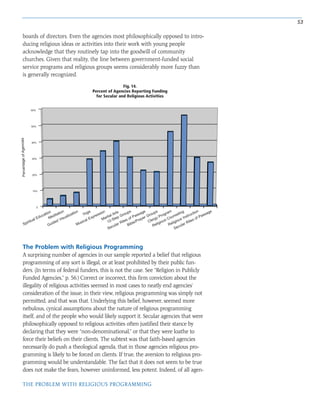
A trend toward the use of at least some secular activities can be clearly
established, but the trend is not apparent for religious activities. Many
secular spiritual activities are clearly new to the agencies using them. For
example, 71% of pro-
grams offering musical
expression introduced
the activity in the last
four years; 93% of pro-
grams offering yoga like-
wise began doing so in
the last four years. By
contrast, only 26% of
agencies offering reli-
gious counseling began
the activity within that
period; 50% have been
offering it more than 10
years. The same pattern
holds true for clergy pro-
of total sample
at least one
religious activity
100%
90%
80%
70%
60%
50%
40%
30%
20%
10%
Faith-based Secular
PercentageofAgencies
Fig. 4.
Percent of Agencies Offering Secular and
Religious Spiritual Activities, by Religious Status (n=191)
at least one
secular spiritual
activity
grams and religious instruction: they tend to be old and well-established activ-
ities, part of the standard repertoire of the agencies that use them.
Secular activities are usually adopted for clinical reasons, but reli-
gious ones are adopted because of agency mission. Agencies tend to
adopt secular spiritual activities – meditation or musical expression, for
example – for the clinical benefits clients may derive from them. But agen-
cies that offer religious activities – and particularly faith-based agencies – do
so primarily out of a sense of historical mission. Nearly 75% of all programs
offering guided visualization did so for clinical reasons; 86% of all programs
offering 12-step groups did the same. Conversely, only 31% of programs
offering religious counseling adopted the activity for therapeutic benefits;
most agencies offering them do so for reasons of religious tradition. It
should be noted that often activities are adopted for neither reason, but
instead because either staff or clients themselves simply wanted to try them.
Thirty percent of programs using musical expression launched activity
because of staff or client interest; 35% of programs offering prayer or Bible
groups did the same.
Regions show wide variations in the use of secular spiritual activities.
In a breakdown by region, differences in the use of secular activities were
20
SECULAR SPIRITUAL AND RELIGIOUS ACTIVITIES IN WORK WITH ADOLESCENTS
Fig. 5.
Percent of Agencies Offering Secular and
Religious Spiritual Activities, by Activity (n=191)
Faith-based
Secular
PercentageofAgencies
90%
80%
70%
60%
50%
40%
30%
20%
10%
0
Meditation
Guided Visualization
Yoga
Musical Expression
Martial Arts
12-Step Groups
Secular Rites of Passage
Rides to Worship
Accompany Staff to Staff’s Worship
Staff Initiates Religious Talk
Bible/Prayer Groups
Clergy Program
Religious Counseling
Religious Instruction
Religious Rites of Passage
Spiritual Education
21
TRENDS AND VARIATIONS OF USE: SECULAR SPIRITUAL AND RELIGIOUS ACTIVITIES
sometimes extreme. For instance, 47% of agencies surveyed in New England
offered guided visualization to adolescent clients; only 14% of agencies in
the South did so. Twenty-four percent of agencies in the West offered medi-
tation, while just 2% of Midwestern agencies did. Most secular activities, in
fact, were more prevalent in the Northeast, Mid-Atlantic and West, and least
prevalent in the Midwest and South. An exception was 12-step groups,
which were offered in about 32% of Midwestern agencies (see Fig. 6). For a
breakdown of regions by state, see “The Regions,” p. 61.
Regional variations in the use of religious activities were generally
slight. Agencies showed less difference by region in the degree to which
they offered religious activities to clients. The two exceptions concerned
policies on offering clients rides to worship services, and on allowing clients
to accompany staff to worship services. Both were far more common in the
South than in other regions. All religious activities were least prevalent in
New England and the West (see Fig. 7).
Religious activities, where offered, were voluntary for clients. Despite
frequently voiced fears among secular providers that religious programming
is almost by nature coercive, this study finds that religious activities in fact
are almost always optional for clients. In a few agencies, the local culture so
strongly supports certain activities that youth and agency staff accept them
Spiritual Education
Meditation
Guided Visualization
Yoga
Musical Expression
Martial Arts
12-Step Groups
Secular Rites of Passage
Fig. 6.
Regional Variations in Use of Secular Spiritual Activities
Among All Agencies (n=191)
PercentageofAgencies
New England
Mid-Atlantic
Midwest
South
West
50%
45%
40%
35%
30%
25%
20%
15%
10%
5%
0
without question; all adolescents in a Texas agency, for instance, go to
church on Sunday, and do so as a matter of course, according to the agency.
But no agency in our survey, this one included, made any religious activity
mandatory. In fact, most agencies readily acknowledged that only a minority
of teen clients eligible to participate in a given religious activity actually did.
The percentage of teens opting to participate in prayer or Bible groups, for
instance, was typically under 25%. The same was true for the percentage of
teens who request religious counseling.
Direct-service and executive-level staff tend to be highly receptive to
most activities, both secular and religious, though some resistance to
religious activities is evident. The vast majority of programs offering sec-
ular activities reported that executive-level staff were very receptive to them.
Direct-service staff – the workers actually implementing or supervising the
activities – were only slightly less receptive. For religious activities, receptivity
was still high for executive-level staff, but sometimes markedly lower for line
staff. For instance, 86% of programs offering clergy services said their execu-
tive-level staff were very receptive to the idea; only 46% said direct-service
staff were very receptive.
22
SECULAR SPIRITUAL AND RELIGIOUS ACTIVITIES IN WORK WITH ADOLESCENTS
Fig. 7.
Regional Variations in Use of Religious Activities
Among All Agencies (n=191)
Rides to Worship
Accompany Staff to
Staff’s Worship
Staff Initiates Religious Talk
Bible/Prayer Groups
Clergy Program
Religious Instruction
Religious Counseling
Religious Rites of Passage
80 %
70%
60%
50%
40%
30%
20%
10%
0
New England
Mid-Atlantic
Midwest
South
West
PercentageofAgencies
23
Religious programming is more common in large agencies. In this
study, the likelihood that an agency provided religious activities for clients
increased with its size, with at least one religious activity offered by 22% of
small agencies (budgets under $3 million), 34% of midsized agencies (budg-
ets of $3-$10 million), and 55% of large agencies (budgets of over $10 mil-
lion). The difference does not hold true for secular spiritual activities, which
were offered in about 60% of both large and midsized agencies, and 51% of
small ones. Fig. 8 shows differences in the uses of specific activities in large
and small agencies.
Fig. 8.
Percent of Agencies Offering Secular and Religious Activities, by FY 1999 Budget
(Small n=78 Large n=47)
70%
60%
50%
40%
30%
20%
10%
0
Rides to Worship
Accompany Staff to Staff’s Worship
Staff Initiates Religious Talk
Bible/Prayer Groups
Religious Instruction
Religious Counseling
Religious Rites of Passage
Spiritual Education
Meditation
Guided Visualization
Yoga
Musical Expression
Martial Arts
12-Step Groups
Secular Rites of Passage
PercentageofAgencies
*Statistics appearing in the sections “Prevalence and Details of Use: Secular Spiritual Activities” and “Prevalence and
Details of Use: Religious Activities” are drawn from a sample of 191 agencies in 47 states, Washington, DC and Guam.
Within each section, statistics from “How Long Offered” through “Funded” are drawn from all programs, not agen-
cies, offering the activity in question. (Many agencies offer the same activity in more than one program.) Data was
collected from up to three programs per activity per agency. Due to missing data and rounding of statistics, some
charts do not total 100.
Prevalence and Details of Use:
Secular Spiritual Activities*
Education About the Spiritual Self
For the purposes of this study, education about the spiritual self is defined as
any educational activity, presented either one-on-one or in a group format,
that is offered routinely to almost every client. What agencies meant by spiritu-
al education varied, of course. Some agencies ran several-session groups to
Over $10m
Annual Budget
Under $3m
Annual Budget
24
SECULAR SPIRITUAL AND RELIGIOUS ACTIVITIES IN WORK WITH ADOLESCENTS
General Prevalence
Of all agencies .............................11%
Of secular agencies......................12%
Of faith-based agencies ................6%
Prevalence in Regions
Mid-Atlantic .................................12%
Midwest........................................10%
New England................................11%
South ..............................................7%
West..............................................15%
How Long Offered
Four years or less .........................33%
More than 10 years .....................22%
Reason for Adopting
Clinical/youth
development benefits ........70%
Interest of staff or youth ............15%
Organizational mission ...............11%
Response of Youth
How many participate:
70% of programs attract over
75% of eligible youth
4% of programs attract less than
25% of eligible youth
What youth think:
67% of programs say most youth
find it beneficial
Receptivity of Staff
Line staff..............63% very receptive
Executive staff.....74% very receptive
Importance to Overall Program
Indispensable ...............................44%
Very important.............................22%
Moderately important.................26%
Occasionally produces
positive results.......................4%
Funded...........................................4%
• In Minnesota, one midsized urban agency launched a spiritual education
program after conducting a research project designed to identify the factors
that make families strong. The study looked at families of different configu-
rations and ethnic backgrounds, but one of the indicators of strength that
held true across the board was spiritual faith - clearly religious in nature for
most families, but secular for some. The agency took its findings and used
them as the underpinning of its “Family Strengths Program,” which brings at-
risk parents and their children into group settings to work on a variety of
issues, including spiritual beliefs. Now the agency is making inroads into its
local faith community by collaborating with churches in new ways; the
agency has found that partners and funding are readily available.
• A 20-staff agency serving foster-care and at-risk youth in Idaho does spiritual
education in a group context in its long- and short-term programs. The cur-
riculum for the groups draws on the 40 assets for healthy youth develop-
ment created by the Search Institute. The agency calls the groups very
An Oklahoma
agency uses spiritual
education in the
leadership
development
program it runs for
gay and lesbian
youth, saying it
helps program
participants to
center themselves
and reduce their
stress.
explore concepts of wholeness and spiritual wellness, while others had adopted
overall clinical approaches that themselves tended toward spirituality. One
agency with sites in four states has incorporated Nicholas Hobbs’s spiritually
oriented philosophy of care into its standard clinical approach and written new
language into its client-rights handbook emphasizing client well-being and
wholeness. A small Colorado foster-care agency relies on the theories of family
therapy pioneer Virginia Satir to inform its work. For this study, though, we
included only those efforts that were discreet, formal programmatic elements.
Agencies that said they sought to create a spiritual environment, or that a spir-
itual element was always present but hard to define, were not included.
Agencies: 21
Programs: 27
25
A Pennsylvania
school for ‘socially
needy’ children
requires all clients
to attend daily
student-led
‘devotions’ that
focus on a range of
topics, from
community life
to the self.
MEDITATION
General Prevalence
Of all agencies .............................18%
Of secular agencies......................20%
Of faith-based agencies ................9%
Prevalence in Regions
Mid-Atlantic .................................27%
Midwest..........................................2%
New England................................39%
South ..............................................5%
West..............................................24%
How Long Offered
Four years or less .........................58%
More than 10 years .....................19%
Reason for Adopting
Clinical/youth
development benefits ........69%
Interest of staff or youth ............22%
Funding became available ............3%
Other ..............................................5%
Response of Youth
How many participate:
56% of programs attract over
75% of eligible youth
14% of programs attract less than
25% of eligible youth
What youth think:
91% of programs say most youth
find it beneficial
Receptivity of Staff
Line staff..............72% very receptive
Executive staff.....83% very receptive
Importance to Overall Program
Indispensable .................................8%
Very important.............................39%
Moderately important.................42%
Occasionally produces
positive results.......................8%
Funded...........................................6%
Meditation
Meditation is challenging for agencies, which probably explains why it is less
popular than guided relaxation/visualization, a practice that is also meant
to produce calmness and enhanced awareness. Unlike guided visualization,
which uses tapes or scripts and thus requires little training to implement,
meditation must be practiced and perfected over time; both teacher and
students must be relatively good at it for its benefits to emerge.
Nevertheless, many agencies do indeed offer meditation to adolescent
clients.
Agencies: 34
Programs: 36
important for its long-term clients and indispensable for its short-term ones.
• A large and well-funded Pennsylvania school providing free education and
room and board to “socially needy” children between the ages of 4 and 15
requires all of its clients to attend student-led morning “devotions” in which
students focus on issues ranging from community life to the self. Students
are required to participate, and the agency believes that most of them find it
useful. “It’s a non-threatening way for kids to air their concerns or struggles.”
• An Oklahoma agency uses spiritual education in the youth leadership devel-
opment program it runs for gay and lesbian youth, saying it helps program
participants to center themselves and reduce stress.
• A small faith-based agency in upstate New York serving runaway and home-
less adolescents and teen parents has offered meditation for more than 10
years in its shelter and long-term residential program. Most teens are willing
to participate, and the agency says the activity has proven useful in teaching
26
SECULAR SPIRITUAL AND RELIGIOUS ACTIVITIES IN WORK WITH ADOLESCENTS
introspection and helping clients manage their anger and impulsivity.
• A large multi-service agency in western Massachusetts offers meditation
almost every day to women substance abusers and their teenage children.
According to an agency executive, meditation is a “very important” piece
of an overall program emphasizing wholeness and wellness, the thrust of
which is to help clients “find out ways to relax that aren’t drinking or
drugging.” The program’s staff is trained in meditation, but they offer it
because they want to and not because the agency encourages it. Indeed,
of the many programs the agency operates, the one for substance-abusing
mothers is the only one offering the activity.
• A faith-based agency in southern California providing shelter to runaway
and homeless adolescents offers meditation tapes to youth who are griev-
ing; the tapes help them relax and fall asleep more easily. Fewer than half
the agency’s youth choose to use the tapes, but the agency finds it so
helpful for those who do that it considers the tapes indispensable to its
program. A small foster-care agency in Colorado has observed the same
benefit, saying its clients with histories of molestation also sleep better
after meditating.
• A few years ago, an agency in Massachusetts began offering meditation to
adolescent girls who were cutting themselves or who had attempted suicide.
Although the agency did not adopt the activity for clinical reasons, and
fewer than 25% of the girls take part, the agency nevertheless considers it
indispensable for its ability to help teenage clients “feel more at peace.”
• A small Nevada agency uses meditation in its residential programs for
emotionally disturbed youth. According to an agency executive, the activi-
ty, which is offered a few times a month and is popular among the teens,
helps clients gain control and “be more aware of their inner lives.” A small
family and youth crisis center in Wyoming also has begun offering
meditation to emotionally disturbed youth, and considers it moderately
important as a way to build compassion and self-esteem, and to boost the
long-term success of clinical interventions.
• A community-counseling center in southern California offers meditation
every day to adolescents being treated for mental illness and substance
addiction. The agency launched the activity a few years ago when it
learned it could collaborate with a meditation teacher from the commu-
nity, and says that outcomes include increased concentration, self-
awareness and self-esteem.
• A large school for mentally disturbed and neglected children in
Pennsylvania uses meditation with its most acutely disordered teenage
population. Over 75% of youth eligible for the activity choose to partici-
pate; indeed, the activity is so popular that youth actually ask to join in.
Meditation in a
Massachusetts
agency augments an
overall program that
aims to help clients
‘find ways to relax
that aren’t drinking
or drugging.’
27
SELF-REFLECTION THROUGH GUIDED RELAXATION/VISUALIZATION
Staff believe that the activity helps the teens calm themselves, and the
agency is seeking funding to continue it. As clients’ needs grow, the agency
says that its commitment to spiritual activities will grow as well.
• A large Boston agency offers meditation in its program for teens with long histo-
ries of emotional disturbance and delinquency. It adopted meditation for clini-
cal reasons, and finds that its primary benefit is in “getting young clients
involved and engaged.” It has also had positive impacts on anger and stress.
• A midsized community agency in Harlem offers meditation stressing
breathing, positive thinking and progressive relaxation in its group for 13-
to 16-year-olds who have been sexually abused or are in foster care. The
agency started meditation because of a staff member’s expertise, and says
it has observed clinical benefits, especially in teens with panic disorders.
General Prevalence
Of all agencies .............................30%
Of secular agencies......................32%
Of faith-based agencies ..............15%
Prevalence in Regions
Mid-Atlantic .................................32%
Midwest........................................22%
New England................................47%
South ............................................14%
West..............................................37%
How Long Offered
Four years or less .........................47%
More than 10 years .....................14%
Reason for Adopting
Clinical/youth
development benefits ........73%
Interest of staff or youth ............20%
Other ..............................................2%
Response of Youth
How many participate:
56% of programs attract over
75% of eligible youth
21% of programs attract less than
25% of eligible youth
What youth think:
75% of programs say most youth
find it beneficial
Receptivity of Staff
Line staff..............74% very receptive
Executive staff.....83% very receptive
Importance to Overall Program
Indispensable .................................8%
Very important.............................59%
Moderately important.................15%
Occasionally produces
positive results.....................14%
Funded...........................................8%
Self-Reflection Through Guided Relaxation/Visualization
Of all the activities we asked about, self-reflection through guided
relaxation/visualization is one of the easiest to do, which probably accounts for
its relative popularity. It requires no practice, only a willingness to follow instruc-
tions and concentrate on the images and scenes suggested by the narrator, who
in most cases is either a group leader or therapist. Some agencies also use cas-
sette tapes that clients can listen to individually.
Agencies: 56
Programs: 65
A Harlem agency
offers meditation to
teenage girls who
have been sexually
abused or are in
foster care, and
finds the practice
especially helpful
for girls with
panic disorders.
• A midsized agency for boys in northwestern Indiana does both meditation
and guided relaxation/visualization in the psycho-educational group it runs
for its long-term residents. In this case, the two activities work in tandem, with
guided visualization giving the boys a focal point for their meditation. Of the
Yoga
Yoga is a relatively uncommon offering in agencies working with adolescents,
probably because it can be a demanding and physically difficult activity – and
one that also requires a trained instructor. Along with martial arts, it frequently
28
SECULAR SPIRITUAL AND RELIGIOUS ACTIVITIES IN WORK WITH ADOLESCENTS
two, however, the agency considers guided visualization both more popular
and more important, helping the boys understand that they have control over
their lives.
• A Boys & Girls Club in Massachusetts uses guided relaxation/visualization in
five groups it runs for youth experiencing problems with peers, families and
substance abuse. The agency considers the activity indispensable for its power
to help teens develop better coping skills.
• A small Colorado agency teaches guided visualization to all of its foster par-
ents so they in turn can practice the technique with the children in their care,
most of whom have experienced domestic violence or molestation, or been
delinquent. “It’s utilized differently by foster parents; some do it regularly,
some seldom. If the parents aren’t very interested in it, it doesn’t happen,” the
agency director said. For those foster parents who practice it, though, the ben-
efits to the youth are important: empowerment and an improved ability to
reflect on life issues.
• A Pittsburgh agency providing programs for African-American families and
children uses guided visualization not with its clients, but with the teenagers it
trains to be counselors at the summer camp it runs. The camp is open to chil-
dren from both regular and foster homes, and requires counselors who under-
stand clients whose backgrounds are different from their own. In two training
sessions, counselors are asked to visualize “the story of living in poverty, of
moving, of getting evicted.” The goal is to “develop empathy in a population of
kids who are not always empathetic, and to help other kids come to terms
with their own backgrounds.”
• Though it is generally leery of secular spiritual activities, an agency in an
Alabama city serving abused and neglected youth has recently begun guided
visualization in two of its programs, including one for teen mothers and their
babies. The mothers are young – one became pregnant at age 11 – and have a
great deal to worry about, which often leads to friction in the group. Guided
visualization helps reduce that friction. “It works well with kids if you can get
them to stop, relax, and look at what’s going on. None have homes, and they
transfer their anxiety about that to others in the group. That’s when you hear:
‘She wore my blue jeans,’ and things like that.”
• A small agency for runaway and homeless youth in North Dakota uses guided
visualization in a support group it runs for high school teens, saying it gives
them “silence, and a way to get in touch with their inner selves.”
A Pennsylvania
agency uses guided
visualization to train
summer-camp
counselors, saying it
‘helps develop
empathy in a
population of kids
who are not always
empathetic.’
29
MUSICAL EXPRESSION
• A Connecticut agency began using yoga with its pregnant teens when a
volunteer teacher from the community stepped forward. All girls are
required to participate, and according to the agency, most find it benefi-
cial. The program believes the bending and slow stretching helps to phys-
ically prepare them for labor and delivery.
• A midsized community agency in New York City offers yoga to clients in
its all-girl after-school youth development program. The program, which
typically attracts about a quarter of the girls eligible, finds that yoga fosters
a spirit of “sisterhood” and a “sense of community” among participants.
• A Colorado agency makes yoga mandatory for its abused, neglected and
runaway youth: it is a “calming factor” for teens “who are beyond the
control of their parents.” In fact, yoga has been so well-received by the
youth that the agency intends to introduce other spiritually oriented
activities soon.
General Prevalence
Of all agencies ...............................7%
Of secular agencies........................7%
Of faith-based agencies ................3%
Prevalence in Regions
Mid-Atlantic ...................................6%
Midwest..........................................2%
New England................................11%
South ..............................................5%
West..............................................11%
How Long Offered
Four years or less .........................93%
More than 10 years .......................0%
Receptivity of Staff
Line staff..............79% very receptive
Executive staff.....72% very receptive
Funded.........................................29%
was offered to adolescents cyclically, as part of a rotating program of recreational
activities. Yoga and martial arts share another characteristic as well: both tend to
be new to the agencies using them. Yoga in particular is a recent arrival; our
study found only 14 programs offering it and almost all of them had adopted it
within the last four years. No program had offered it for more than 10 years.
Agencies: 13
Programs: 14
(numbers were too small to provide all information)
A community center
in New York City
offers yoga in its all-
girl after-school
program. Yoga
fosters a spirit of
‘sisterhood’ and a
‘sense of community’
among participants,
a staffer says.
Musical Expression
Agencies reported organizing a wide range of musical activities for teenage
clients, including drumming, religious dancing, humming, even drum-and-bugle
corps. In this activity more than in many others, programming was sometimes
sporadic; drumming circles, for instance, are often held once or twice a year, or
restricted to special events or trainings.
Agencies: 34
Programs: 38
30
SECULAR SPIRITUAL AND RELIGIOUS ACTIVITIES IN WORK WITH ADOLESCENTS
‘Our population
can’t afford weekly
music lessons and a
variety of violins as
they grow. So we
teach them to make
percussion and
string instruments
from recycled
materials.
’
• A large Massachusetts agency uses group drumming for adolescents with
emotional/mental illness and behavior problems. Staff find it increases
self-awareness, manages stress, and is a useful alternative to aggression
and a channel for self-expression.
• A large agency in southern California working with developmentally dis-
abled children and teenagers enthusiastically offers a drumming class
once a week that is open to clients from all nine of its programs. The class
usually totals about 40, and kids are broken into smaller groups of eight
or fewer, with a staff member supervising each group. The agency hires an
outside drummer to do the teaching. The agency began the classes only
because a staff member was interested in it, but now considers it a critical
program element. “It’s great for nonverbal clients, clients with language
deficits, and for anger management,” said a program director.
• At an urban New England Boys & Girls Club, youth from the community
– both those with identified problems and those without – have access to
a variety of instruments and play together. “They’re energized by it; we
see a rise in their self-confidence,” said the club’s director.
• Because of staff interest, a small Idaho agency began organizing drum-
ming circles for its adolescent clients, most of whom are abused, neglect-
ed, or addicted to substances. The agency’s enthusiasm for drumming
was sparked by a training led by “a guy who goes around the world
teaching it; the trainer taught different rhythms, some that mimicked
heartbeats.” The groups take place about every two weeks from spring to
fall, when the youth can go outside and make all the noise they want.
“The sound is incredible – trash can lids, paint buckets, everything you
can imagine, are used.”
• A large West Coast agency doing a wide range of work with gay and les-
General Prevalence
Of all agencies .............................18%
Of secular agencies......................20%
Of faith-based agencies ................9%
Prevalence in Regions
Mid-Atlantic .................................18%
Midwest........................................10%
New England................................25%
South ............................................10%
West..............................................28%
How Long Offered
Four years or less .........................71%
More than 10 years .......................3%
Reason for Adopting
Clinical/youth
development benefits ........66%
Interest of staff or youth ............29%
Other ..............................................3%
Response of Youth
How many participate:
40% of programs attract over
75% of eligible youth
16% of programs attract less than
25% of eligible youth
What youth think:
82% of programs say most youth
find it beneficial
Receptivity of Staff
Line staff..............74% very receptive
Executive staff.....84% very receptive
Importance to Overall Program
Indispensable ...............................16%
Very important.............................37%
Moderately important.................34%
Occasionally produces
positive results .............................11%
Funded.........................................34%
Musical Expression, cont.
31
MUSICAL EXPRESSION
bian youth runs a music program for runaway, homeless and at-risk
teenagers. The program, which the agency calls indispensable, is super-
vised by volunteers and culminates in an annual talent show that works
to build self-esteem and courage.
• Boys at a Hawaii agency perform prayer-like native chants before nearly
every activity. Chanting is a critical component of the program because it
instills cultural pride in youth who, with their histories of psychiatric dis-
orders and adjudication, are the highest-risk adolescents outside of
secure institutional settings.
• For four to seven months every year, the long-term adolescent residents
at a large New Hampshire agency rehearse for a musical variety show
that the agency produces annually. Performing before an audience gives
the youth “a sense of mastery they didn’t think possible.” The agency has
funding for its music program, and considers it moderately important to
its overall work with adolescents.
• A small agency in rural Wyoming serving tribal youth runs a native
drumming and dancing group for its long- and short-term adolescents,
most of whom have been abused or neglected. The drumming, which is
taught weekly by a tribal instructor, calms the youth, “makes them more
interested in learning,” and “helps them not be embarrassed about who
they are.” Agency staff occasionally take the teens to sun dances and
bear dances as well – all, like the drumming, are a way of teaching them
about a culture from which they have become estranged.
• An eight-staff agency in Philadelphia that provides a wide range of non-
residential programming for African-American families has developed a
cultural arts program called “Nia” (Swahili for “purpose”), a component of
which has children and teenagers construct their own instruments. The
program has given birth to a youth steel drum ensemble that travels
widely for performances. The idea of focusing on music came from the
agency’s conviction that musical instruction is critical for children, but
that clients like theirs are often left out of such standard childhood
education. “Kids who can make their own music turn out to be very
well-rounded people,” the agency’s executive director said. “But our pop-
ulation can’t afford weekly music lessons and a variety of violins as they
grow. So we teach them to make percussion and string instruments from
recycled material.” But teaching their youth, who range in age from 8 to
18, was harder than they thought. “We were hoping that by 16 they
could make their own drums, but we were off. Kids don’t have hammers,
nails, or saws at home, and don’t know how to use them.” Thus the
instruments the young people make vary in complexity with their age,
but all require some facility with math to construct. The results have
been astounding. “Kids who never thought about college before are
doing it. Kids are thinking they could repair instruments for a living.”
Tribal drumming
calms youth, ‘makes
them more interested
in learning,’ and
‘helps them not be
embarrassed about
who they are,’ says a
Montana director.
Martial Arts
In our sample, martial arts instruction was used in a wide variety of pro-
gram settings and with diverse populations, including youth in state child
welfare systems and court diversion programs, teens in afterschool pro-
grams, youth aging out of foster care, and emotionally or behaviorally dis-
turbed youth. Even so, agency executives seem to be conflicted about the
value, or even wisdom, of using martial arts with the troubled adolescents
they serve. Those who use it are by and large sold on it as a way of building
confidence and self-esteem; some others, however, laughed out loud at the
very suggestion that martial arts could be appropriate for their adolescents.
Typical was one program director at a small Indiana agency: “These kids are
already dangerous,” she declared.
Agencies: 19
Programs: 26
• A Hawaii agency calls martial arts classes an indispensable part of the
youth development program it runs in a low-income housing project. The
volunteer instructor, who teaches classes of about 20 youth once a week,
also acts as a mentor, following up on students who get in trouble. “I look
at two of our high-risk boys, and they’d gone through some rough periods
– early adolescent stuff. Now we see strong, confident young men, and I
think it’s a direct result of Matt [the instructor] being there for them. One
of our boys was starting to fight, and Matt was just on his case. It’s the
whole package: He’s on call to go to school, talk with teachers, anything.”
Now the agency says it will likely adopt other spiritually oriented activities
for its teens. “We see the need to not impose control, but give kids a
means to control themselves,” the program director said, “and spiritual
things can help with that.”
32
SECULAR SPIRITUAL AND RELIGIOUS ACTIVITIES IN WORK WITH ADOLESCENTS
General Prevalence
Of all agencies .............................10%
Of secular agencies........................9%
Of faith-based agencies ..............14%
Prevalence in Regions
Mid-Atlantic .................................18%
Midwest..........................................7%
New England................................18%
South ..............................................5%
West................................................7%
How Long Offered
Four years or less .........................48%
More than 10 years .......................8%
Reason for Adopting
Clinical/youth
development benefits ........56%
Interest of staff or youth ............32%
Other ..............................................8%
Response of Youth
How many participate:
20% of programs attract over
75% of eligible youth
32% of programs attract less than
25% of eligible youth
What youth think:
92% of programs say most youth
find it beneficial
Receptivity of Staff
Line staff..............88% very receptive
Executive staff.....88% very receptive
Importance to Overall Program
Indispensable .................................4%
Very important.............................40%
Moderately important.................36%
Occasionally produces
positive results....................16%
Funded.........................................40%
A Kansas City
agency offers martial
arts to nonviolent
male sex offenders
and female
delinquents in its
long-term residential
program. ‘They love
it!’ the director says.
33
MARTIAL ARTS
• A large faith-based agency in Chicago working with emotionally disturbed
children and adolescents offers martial arts to clients in its short-term and
non-residential programs. The agency adopted the activity for its clinical
value, and considers it an important component of both programs, though
– as in many other agencies – its residential clients participate in higher
numbers than do its non-residential ones. It also echoes other agencies’
observations that the classes promote “self-control and focus.”
• A faith-based agency in Kansas City has recently begun offering martial
arts to nonviolent male sex offenders and female delinquents in its long-
term residential program. The agency launched the classes, which are
offered in cycles four to five times a year, when a volunteer teacher from
the community came forward. Initially the agency was worried about the
appropriateness of the activity. “There was a concern that kids would
become more aggressive, but that hasn’t happened,” said the agency’s exec-
utive director. More than 75% of eligible youth participate, and the activity
is extremely popular among those who do. “They love it!” the director said.
However, some staff members are still resistant to the classes, and the
agency believes the activity only occasionally produces positive results.
• At a large agency in western Massachusetts, boys aged 12 to 21 in a state
youth corrections program have been offered martial arts for over 10
years. Typically, all eligible boys choose to participate, and the agency
believes that over 75% find it beneficial. The agency considers the classes
moderately important – valuable in the same way that any other construc-
tive, interesting activity might be – and not at all dangerous. “Nobody
walks out of here with a black belt, busting bricks. The focus is on disci-
pline,” said one executive.
• A small shelter for runaways in rural Georgia recently launched a class in
taekwondo. The class is taught cyclically by a volunteer instructor from the
community, but the agency’s executive director considers it so valuable
that she would like to make it a regular, funded program component.
Youth wear their own clothing for the classes, prompting the agency to add
martial arts uniforms to its wish list. “We deal with a lot of kids who need
a release of energy – positive energy. We thought it might develop aggres-
sion, but it went the other way.”
• A small runaway and homeless youth agency in Maine has an arrange-
ment with a local martial arts studio that allows its teenage clients to go to
classes whenever they wish. Fewer than 25% of the youth who could par-
ticipate do, but for those, the classes teach self-discipline.
• A community center in Harlem hires a martial arts teacher to work with
youth in its after-school program. “They learn to focus,” said an agency
executive. “They’re proud of their belts and look up to the instructor.”
‘Nobody walks out
of here with a black
belt, busting bricks.
The focus in on
discipline,’ says
one executive.
34
SECULAR SPIRITUAL AND RELIGIOUS ACTIVITIES IN WORK WITH ADOLESCENTS
At a central
Massachusetts
agency, 12-step lan-
guage was originally
‘very problematic for
the kids to get their
minds around’ and
thus was modified
with the teens’ help.
General Prevalence
Of all agencies .............................30%
Of secular agencies......................32%
Of faith-based agencies ..............21%
Prevalence in Regions
Mid-Atlantic .................................29%
Midwest........................................32%
New England................................29%
South ............................................14%
West..............................................44%
How Long Offered
Four years or less .........................36%
More than 10 years .....................27%
Reason for Adopting
Clinical/youth
development benefits ........86%
Interest of staff or youth ..............8%
Other ..............................................6%
• An agency in Rhode Island contracts with an instructor to teach martial arts
to 9- to 17-year-old boys referred by a local court for truancy and delin-
quency. Boys take the classes several times a week, and the agency says it
has made a difference. “Kids do better across the board – academically, at
home, in the community.” Because the agency is unable to provide trans-
portation for youth in outlying areas, the martial arts program is limited to
one county.
12-Step Groups
The spiritual basis of 12-step groups, which require as a prerequisite that
participants acknowledge their own helplessness against addiction and sur-
render to a higher power, is well-known, and the groups themselves are gen-
erally respected as a successful therapy for alcoholics and other substance
abusers. In this study, 12-step groups were widely used for substance-
abusing youth, and were far more likely to be mandatory for youth than
any other spiritual activity, either secular or religious. In all, over a quarter
of the programs providing 12-step groups made them mandatory, and
although youth were reported to be less enthusiastic about the groups than
some other activities we asked about, agencies themselves considered the
groups to be among the most effective of all activities. The 12-step groups
that youth agencies run are often adapted from the traditional Alcoholics
Anonymous framework, with a special youth focus, adult speakers, or other
features that represent departures from the standard model. Referral to out-
side 12-step groups is a common practice in most agencies, and does not in
itself constitute actual provision of the service. For that reason, in this study
we counted only those agencies that were committed enough to the 12-step
approach to either host groups on-site or take affirmative steps to get youth
to meetings off-site. Several agencies said that 12-step groups were particu-
larly valuable for youth in care because the groups provide a safety net for
clients after they leave treatment: the groups are easy to find in the com-
munity, provide ready support, and are free.
Agencies: 57
Programs: 64
• A small agency in Montana for runaway and homeless teenagers makes
twice-a-week 12-step groups mandatory for clients with alcohol prob-
lems. The groups become springboards for therapeutic talk within the
program. “Most of the kids are dealing with alcohol or drugs, either with
themselves or with family or friends,” the agency’s executive director
said. “These kids love their parents – they have to learn how to detach
with love. We talk about changing themselves, not others. We read
through the steps and traditions, and talk about how we can make our
lives better…. If they’re having a problem with their attitude, we’ll take
the ‘One Day at a Time’ book, and we’ll look up ‘attitude’ in the back.”
Despite her almost fervent belief in the value of 12-step work, she said
she sees “no huge changes” in her agency’s youth as a result of it, gener-
ally because of their limited length of stay. “In a short-term program,
we’re like farmers – we never get to see the harvest,” she said.
• A faith-based agency in upstate New York has a new 12-step group for
substance abusers and teens who have experienced violence. The pro-
gram director says the group, which he calls indispensable, is adapted
from the standard 12-step model. “It’s not totally focused on an adult
leader. The group runs itself. That’s beneficial for the kids.”
• A large agency in central Massachusetts makes 12-step groups optional for
its substance-abusing adolescents, but for teens in its court-diversion pro-
gram, attendance is mandatory. The 12-step language was originally “very
problematic for the kids to get their minds around” and thus was modified
with the teens’ help, a program director said. Every group begins with a
speaker – often someone from one of the local sober houses who is fulfill-
ing a community service requirement. Before the group gathers, the speak-
er has dinner with the youth; inevitably, a dialogue ensues. “If that person
is interesting, and the kids don’t have other big distractions, they’re very
into it,” the director said.
• A large, multi-service Boston agency offers 12-step groups to its long-term
delinquent youth who have histories of serious violence. The groups
“reduce recidivism with addictive behaviors and enhance social skills,” and
teach “self-control and discipline.” For those reasons, the groups, which
35
12-STEP GROUPS
Response of Youth
How many participate:
46% of programs attract over
75% of eligible youth
19% of programs attract less than
25% of eligible youth
What youth think:
75% of programs say most youth
find it beneficial
Receptivity of Staff
Line staff..............87% very receptive
Executive staff.....91% very receptive
Importance to Overall Program
Indispensable ...............................28%
Very important.............................42%
Moderately important.................22%
Occasionally produces
positive results.......................5%
Funded.........................................30%
‘We read through
the steps and tradi-
tions, and talk about
how we can make
our lives better.
If they’re having
a problem with
their attitude, we’ll
take the ‘One Day
at a Time’ book,
and we’ll look up
‘attitude’ in the
back.
’
36
SECULAR SPIRITUAL AND RELIGIOUS ACTIVITIES IN WORK WITH ADOLESCENTS
Fig. 9.
Importance of Secular Spiritual and Religious Activities
Among Agencies Offering Them, as Reported by Staff
Secular Rites of Passage
Spiritual Education
12-Step Groups
Religious Counseling
Religious Instruction
Clergy Program
Guided Visualization
Musical Expression
Religious Instruction
Bible/Prayer Groups
Meditation
Martial Arts
Yoga
5
4.5
4
3.5
3
2.5
2
1.5
1
0.5
0
Indispensable
Very important
Moderately
important
Occasionally
produces
positive results
Could easily do
without
Secular Rites-of-Passage Programs
Some rites-of-passage programs are oriented around a curriculum: adven-
ture-based programs that last six weeks, for instance, or groups for young
men that meet for several months and culminate in a planned celebration.
Often, however, agencies celebrate transitions in teenage clients’ lives more
informally, with parties marking a first prom, a first job, a new driver’s
license. Only particularly elaborate celebrations, or ones that were a
planned and integral part of a program, were included in this study.
Agencies: 23
Programs: 23
attract over 75% of eligible youth, are considered indispensable.
• Instead of taking a traditional 12-step approach, a midsized Tucson
agency offers the “Seven Challenges” program, which, like the 12-step
program, focuses on personal responsibility, but drops the “higher power”
language in favor of an emphasis on rationality and decision-making.
The program’s curriculum was written by a pediatrician with the input of
adolescents, and asks youth to open up and talk honestly about their
drug use, and to examine the relationship between drug use and prob-
lems in other areas of their lives. Even though the groups are voluntary
for the agency’s substance-abusing youth, staff nonetheless consider
them critically important.
37
SECULAR RITES-OF-PASSAGE PROGRAMS
• The New Hampshire campus of a multi-site regional agency has devel-
oped a rites-of-passage program based on normative culture philosophy,
which recognizes that individuals need to belong to groups. In the shel-
ter, youth can achieve senior resident status, and thereby assume a
leadership role. “Ace of the Week” is an award granted to the youth
doing particularly well in work/chore groups. Winners get their names
posted, are allowed to request special items on the menu, and take a
role in co-facilitating groups. The rites-of-passage program is a way of
providing goals and rewarding those who achieve them, and is indispen-
sable to the agency’s work.
• A suburban Pennsylvania agency for adjudicated foster care youth
makes its elaborate rites-of-passage program mandatory for all clients.
The program, which is fully integrated into the agency’s overall work,
provides a ladder for advancement toward an ultimate goal: independ-
ence. Indeed, everything the agency does in all programs is designed to
lead up to a point – called “the career phase” - where clients can begin
to do activities on their own. From a youth’s entry into the program, a
developmental plan is outlined and all work, whether in school or in a
group context, is kept in a book. When the youth feels he or she is
ready, and the group and developmental team agree, an enormous cele-
bration takes place in which the entire agency recognizes the youth’s
ascendance to a new level of maturity. The program is considered indis-
pensable for youth, helping them “monitor their own growth, take
responsibility for themselves, and give them something concrete to hold
onto.”
• A midsized Chicago agency works in dozens of public schools, where it
focuses on youth in gangs and on teens having academic or family
problems. The program’s rites-of-passage work is integrated into its
As the boys in a
Hawaii agency
move through the
program, they also
move physcially
closer to the sea, to
‘voyaging houses’
where they can earn
the right to
participate in
canoe or sailing
trips between
islands.
General Prevalence
Of all agencies ...............................9%
Of secular agencies......................13%
Of faith-based agencies ................6%
Prevalence in Regions
Mid-Atlantic ...................................3%
Midwest........................................12%
New England................................14%
South ............................................12%
West..............................................17%
How Long Offered
Four years or less .........................29%
More than 10 years .....................17%
Reason for Adopting
Clinical/youth
development benefits ........65%
Interest of staff or youth ............17%
Response of Youth
How many participate:
78% of programs attract over
75% of eligible youth
Receptivity of Staff
Line staff..............78% very receptive
Executive staff.....78% very receptive
Importance to Overall Program
Indispensable ...............................30%
Very important.............................39%
Moderately important.................13%
Funded.........................................22%
youth leadership and community service programs. The passages com-
ponent has youth talking about family history and cultural identity, and
recognizing benchmarks in their own lives.
• A midsized agency in Miami recently was awarded a grant to continue
running the rites-of-passage component of its after-school program. The
program, which serves 25 youth at a time, draws on African-American
heritage, and includes drumming and arts.
• A small Texas agency offers an elaborate version of a common rites-of-
passage ritual: a ceremony for youth exiting the program. There youth
can “express their feelings and hug each other,” the agency’s director
said. “They’ve moved on so many times without having the chance to
grieve, forgive and be forgiven.” The ceremony is mandatory for youth,
and is a key component of the program. A Minnesota agency has a simi-
lar idea: when a teenager is ready to transition out of its drop-in pro-
gram for at-risk youth, the agency throws a big party with food, live
music and testimonials. Most eligible teens choose to have the party,
and the agency calls the celebrations very important to its overall pro-
gram.
• A Hawaii agency for boys has designed a program – called Kailana, or
“calm seas” – that is structured as a series of challenges that clients must
meet on their way to graduation. As the boys – they are between 14 and
18 years old, and typically are receiving comprehensive treatment for
mental health and education issues – move through the program, they
also move physically closer to the sea, to “voyaging houses” at which
they can earn the right to participate in canoe or sailing trips between
islands. At the end of the program they move again, this time to the
“House of Change,” where they work toward reintegration into the com-
munity.
Other Secular Spiritual Activities
Some of the most interesting spiritually oriented activities agencies offered
their teenage clients, and the ones they themselves felt most proud of, fell
outside the categories we had established. Some of these efforts included
dance/music/poetry programs, journaling, mentorship programs and animal
companion programs. Many agencies turn to geographic or cultural assets to
help their adolescent clients develop a sense of spiritual strength: An agency
in California incorporates Aztec teachings into its work with Hispanic
clients; others tap into the richness of African-American history through
cultural celebrations. Some other activities are described below.
• A community center in New York hosts “dream fairs” in schools as a foil
to traditional science fairs. “In large school districts kids are intimidated
38
SECULAR SPIRITUAL AND RELIGIOUS ACTIVITIES IN WORK WITH ADOLESCENTS
Secular Spiritual
Programming: One
Agency’s Experience
Of all the agencies inter-
viewed for this study, those
offering residential services
with schools on site were
the most likely to have
developed spiritual pro-
gramming. One such
agency in rural
Pennsylvania – founded in
the early 1900s as an
orphanage for girls, but
now serving youth of both
sexes who are emotionally
disturbed or who have
been abused or neglected –
offers an unusually
elaborate smorgasbord of
spiritually oriented activi-
ties. Youth in its residential
and day treatment pro-
grams get education about
spirituality as part of the
standard curriculum. Teens
in three long-term residen-
tial programs – the most
disturbed youth the agency
treats – are offered medita-
tion several times a week,
and many find the experi-
ence so beneficial that they
ask to take part. Those
teens also may attend 12-
step groups, which the
agency says helps them see
the negative consequences
of drug use and provides
them with the support of
Continued on next page
39
THE PROBLEM WITH SECULAR SPIRITUAL PROGRAMMING
by science fairs,” the agency’s executive director said. “In dream fairs, kids
express their dreams through crafts or exhibits – you see a sense of ener-
gy and light in their eyes when their secret dreams can be expressed.
Maybe one kid wants to be a trucker, the other a bricklayer.” Showing off
their dreams gives them the courage to try to attain them, she said.
• In addition to an unusually rich repertoire of secular spiritual activities, a
community center in New York offers a spiritual mentorship program
wherein mentors – there are five altogether, all volunteers from the com-
munity – work one-on-one with first-time offenders referred by the dis-
trict attorney’s office.
• A small agency near Chicago organizes “family circles” before meals and
in the evening in its shelter program. In the circles, youth and staff hold
hands and participate in a call-and-response technique that helps set off
the activity as a time of sharing. For instance, one teen may turn to
another and say, “It was a good day,” cueing that teen to repeat the
phrase, then turn to the next person and continue the cycle. The circles,
which the program launched several years ago, are also helpful when the
day has been particularly stressful, or when a new youth comes into the
program.
• The pernicious influence of colonization has stripped many adolescents
in Guam of their sense of cultural uniqueness; one agency there
attempts to counter it by introducing teens to indigenous crafts such as
weaving, dying, and carving. As part of its arts workshops, it also organiz-
es field trips to ancient sites, where the adult leader begins by saying a
chant or prayer to elders.
The Problem with Secular Spiritual Programming
Agencies that offer no secular spiritual activities cite many reasons, some
philosophical, others practical, for why they don’t (see Fig. 10). Many agen-
cies lack the expertise to offer activities such as meditation, yoga, or guid-
ed visualization; others fear that staff, board, or families would object to
them as too “New Age-y.” Still other agencies point out that among all the
techniques at their disposal, spiritual ones rarely leap to mind as the most
important or efficacious for treating troubled youth.
A large California agency that places and oversees foster-care children is
an example. There, if a problem arises with a foster child or family, agency
workers always choose a more targeted intervention; a school problem, for
example, would suggest a need for tutoring, not for some spiritually based
activity that might only help indirectly. The agency prefers such no-non-
sense solutions because of time constraints, but also because more gener-
alized interventions – such as meditation, for instance – have a tendency
peers. Youth in all programs
are offered guided visuali-
zation and martial arts, and
one program for girls offers
yoga: it helps them “feel
better and relax more easi-
ly,” an executive said. Youth
in residential programs also
may take part in music and
dance led by a staff mem-
ber. Though the agency is
more conflicted about its
religious programming, all
clients are assessed upon
intake for their religious
needs, and the agency both
offers its residents rides to
worship and allows clients
to accompany staff to wor-
ship. It will also provide reli-
gious instruction to youth
who ask for it, though
fewer than 25% do. Staff
are only “slightly receptive”
to such instruction in any
case, and the agency, which
calls itself “non-sectarian,”
plans to make no further
religious activities available
in the future. On the other
hand, it is enthusiastic
about its secular spiritual
work, and says it very likely
will do more. Why? Three
reasons: The agency consid-
ers the activities successful
as clinical interventions; the
needs of its clients are
growing; and staff members
themselves are becoming
more interested in using the
techniques.
40
SECULAR SPIRITUAL AND RELIGIOUS ACTIVITIES IN WORK WITH ADOLESCENTS
to leave out foster families. “When families aren’t involved in kids’ activi-
ties, they can’t make use of it,” a program director said. Despite its lack of
interest in spiritual activities, the agency does have a strong moral orienta-
tion, and seeks to transmit its values to its clients, the director said. If
chronic problems arise that can’t be addressed in any other way, the
agency organizes a group of caring adults to confront the child, to in
essence exert its moral authority over him or her. “The fundamental issue
for anyone who works with kids is what can you give them in skills and
information that will make it more likely that they’ll administer their lives
well? In terms of behavior, this agency has a strong position on what does-
n’t work well: lying, stealing, self-deception. Also, if you don’t do the work,
you’re not going to get what you want.”
Clinical priorities were also cited by a Michigan agency to explain its lack
of spiritual pro-
gramming. The
executive director
there said that in
the absence of
compelling evidence
that spiritually ori-
ented activities are
beneficial, he can-
not justify asking
his staff to spend
time on them. After
all, the agency’s
homeless adolescent
clients have half a
dozen urgent needs,
and during their
brief stay in the agency’s shelter, a lot has to happen quickly. “My staff
would be saying to me, ‘Why are we doing relaxation, when we should be
doing crisis intervention?’ ”
Still others are interested in the topic but simply have not moved on it yet.
A New Hampshire agency working with emotionally and behaviorally dis-
turbed adolescents is waiting for evaluation literature on spiritual prac-
tices, and would need training to understand “how to integrate them into
the life of the program.” But even if that information were available,
adopting spiritual practices still could prove to be a hard sell to the
agency’s direct-care staff. Despite the executive director’s enthusiasm for
the idea, a staffer said, “Our kids aren’t emotionally stable enough for
these techniques. Sometimes it’s best if kids don’t go down that road (of
Staff might
impose beliefs
17%
No funding
14%
Families
would object
Staff/board
would object
Other
Activities
illegal
4% No time
Staff
lacks
expertise
12%
6%
26%
16% 5%
Fig. 10.
Reasons Agencies Give for
Not Offering Secular Spiritual Activities
(n=78)
41
THE PROBLEM WITH SECULAR SPIRITUAL PROGRAMMING
introspection). We use attachment theory, and our philosophy is that as
they develop healthy attachments, they begin to give back to the commu-
nity, and be more focused on getting help from others.” The director of a
small program in Illinois for runaway and homeless teens voiced a similar
sentiment. “I’d say we’re moving away from spirituality, though we might
be swimming upstream. We’re using cognitive-behavioral techniques in
our work. Research shows that’s what’s most effective.”
For a minority of agencies in our study, religion is the primary obstacle to
the development of secular spiritual programming. A small faith-based
agency in rural Texas working with at-risk, abused/neglected, and preg-
nant and parenting teens eschews secular spiritual practices because
“we’re a Christian-based agency and these things are sometimes viewed as
contradictory.” Some other faith-based agencies, all of them in the South,
indicated the same, reporting that their religious worldview was antitheti-
cal to secular practices. “We don’t do them because they don’t fit with our
mission, our focus, or our religious beliefs,” said another Texas program
director, adding that his agency had already investigated the potential ben-
efit of such activities and rejected them. Other religious agencies, however,
weren’t so much opposed to secular practices as ignorant of how they
might be used. Like secular agencies, they simply wanted to learn more
about them. “If we could be taught how they might be beneficial, we
would use them,” said the director of spiritual programming at a Catholic
agency in New York. The director of a highly religious agency in Illinois
expressed a similar view. “The kids have profound needs and are here all
the time, so it’s just a matter of reviewing what the options are and how
we could incorporate them.”
Perhaps the most common reason, though, for the absence of secular spir-
itual programming in youth-serving agencies concerned the conservatism
of board members, executive-level staff, or direct-service staff. One agency
worker in San Francisco lamented that her executive director was so con-
servative that no spiritual activities could take hold at the agency, but
hoped the bias would change as the agency moved toward more long-term
programming. An agency executive in Las Vegas said both the community
and agency were so traditional in their views that such activities would
never fly, unless, perhaps, the agency could raise the funds to have an out-
side expert come in to implement them on a piecemeal basis.
The Outlook for Secular Spiritual Programming
Social service agencies are clearly interested in using secular spiritual activities
with their adolescent clients, but does that necessarily mean that more of
them will be doing it? More than half of the agencies not currently doing such
programming say they are very or somewhat interested in doing so in the
42
SECULAR SPIRITUAL AND RELIGIOUS ACTIVITIES IN WORK WITH ADOLESCENTS
future. Well over half of those already offering at least one secular spiritual
activity say they will certainly or very likely do more (see Figs. 11 and 12).
Still, the trend toward such programming might easily falter. Difficulties
peculiar to spiritually oriented activities make this so. More than with other
therapeutic interventions, spiritual activities tend to be initiated by staff
members with either special interest or expertise in them; when the workers
leave the agency, so do the activities. This is true even when the agency has
come to see the activity as worthwhile in a clinical sense. “In our communi-
ty-based programs, the person who did meditation and guided relaxation
left us,” said a Massachusetts program director wistfully. “That was his big
interest. It was excellent, but at this point we haven’t had a staff person who
has this as a talent. I do intend to reintroduce these, though, in the future.”
Interestingly, the same agency runs a school for special-needs students that
has made yoga, guided relaxation, and musical expression a foundation of
its curriculum.
Such unevenness
in spiritual pro-
gramming is typ-
ical in agencies,
because the
champions of
such activities are
often concentrat-
ed in a single pro-
gram. A Michigan
agency is an
extreme example.
It runs programs
for teen parents,
grieving families,
sex offenders,
substance abusers
and many other populations, but offers secular spiritual activities in only
one program: a group for mentally/emotionally impaired youth, and there
only because staff want to. Youth in that group practice yoga and guided
visualization, and are taught to play drums by a specialist in African percus-
sion. Even though those activities are valuable, the agency says it does not
know if it will do more – mostly because it cannot get reimbursed for them.
In order for Medicaid to cover spiritual activities, their clinical benefits
would have to be more widely accepted, a program director said. In other
words, spiritual activities, so long on the fringe of acceptable clinical prac-
tice, “need to be legitimized.”
Still, enthusiasm abounds in many organizations. “It’s become more recog-
Fig. 11.
Interest in Secular Spiritual Activities Among
Agencies Currently Doing None
(n=78)
Somewhat
interested
33%
Not at all
interested
Slightly
interested
Very
interested 31%
8%
28%
43
THE OUTLOOK FOR SECULAR SPIRITUAL PROGRAMMING
nized by the agency and by professionals that the spirituality of youth is one
of the pillars that their lives are resting on,” said a program director at a
New York agency. An executive director in Connecticut said his agency,
which already
offers yoga and
guided visualiza-
tion, will depend
even more on
spiritually orient-
ed techniques in
the future. “I
think it’s an arena
that transcends
age, authority,
limits – all the
issues adolescents
struggle with. Kids
who are initially
resistant find
[spiritual activities] rewarding. It’s an area that’s been neglected in their per-
sonal lives. It helps them deal with the pain and hurt they’ve experienced
since childhood.”
Indeed, of all agencies, the ones already offering secular spiritual activities
are the most enthusiastic about doing more. Typical was a rural Wyoming
agency working with emotionally disturbed teenagers. It uses meditation,
guided relaxation,
education about
the spiritual self,
and 12-step
groups, all of
which “comple-
ment the overall
program” by help-
ing build compas-
sion and self-
esteem. The
agency is likely to
adopt more such
practices.
“Spirituality is
part of a healthy,
whole being, and the agency is committed to looking at and integrating this
aspect of the person,” a staffer said. A New Jersey program director agreed,
saying simply, “It’s the trend of the future.”
Fig. 12.
Likelihood of Offering More Secular Spiritual
Activities Among Agencies Currently Offering at Least One
(n=111)
Unsure
24%
Probably not
2% Almost
certainly
not
Almost
certainly
Very
likely
9%
47% 18%
Fig. 13.
Primary Need of Agencies Not Currently Offering
Secular Spiritual Activities That Are Somewhat or Very
Interesting in Doing So
(n=43)
Understanding
benefits
4% Funders’
acceptance
More time in
schedule
Other
Funding
Training
8%
8%
49%
22%
11%
44
But what do even the most interested youth-serving agencies need in order
to further develop their programming? The answer is unequivocal: money
and training. Of all agencies doing some secular spiritual programming that
intend to do more, 53% said they need funding to hire extra staff – some-
times a spiritual director to organize a range of extracurricular spiritual
activities, sometimes an outside expert who could come teach a specific
activity. About a quarter of these agencies said their primary need is train-
ing: generally, training in how to choose appropriate spiritual activities, how
to lead them, and how to integrate them into their clients’ crowded sched-
ules. This last is not a small point, agencies said. Their clients go to school,
work part-time jobs, see therapists, sometimes have their own babies to care
for. In short, they are busy, and shoehorning one more activity into the
schedule – however worthwhile that activity might seem – is a chore for
everyone. “These programs are busy. Doing another thing means selling it to
staff, so I don’t push it,” said one New Hampshire director.
For those agencies that don’t do such programming but hope to, the pri-
mary needs are the same, but in reverse order: half said their most urgent
need is training – often to better understand the benefits they assume can
be attained – and about a quarter cited funding. With these agencies, there
is an additional twist: they also need a way to overcome the resistance of
staff, the board, the community, or parents.
Prevalence and Details of Use:
Religious Activities*
Offer Rides to Worship
Almost all agencies give adolescent clients rides to worship services upon
request. The question here concerns how actively agencies pursue the issue
with clients. Does the agency ask teenage clients up front whether they
want a ride to worship services, thus seeking to facilitate attendance for
interested youth, or must youth take the initiative to arrange a ride? The
answer to this question likely has an impact on whether or not youth actu-
ally get to worship services; it is almost certainly a measure of an agency’s
feelings about the importance of religion to their clients.
General Prevalence
Of all agencies .............................58%
Of secular agencies......................52%
Of faith-based agencies ..............85%
Prevalence in Regions
Mid-Atlantic .................................65%
Midwest........................................63%
New England................................36%
South ............................................79%
West..............................................44%
*Statistics appearing in the sections “Prevalence and Details of Use: Secular Spiritual Activities” and “Prevalence and
Details of Use: Religious Activities” are drawn from a sample of 191 agencies in 47 states, Washington, DC and Guam.
Within each section, statistics from “How Long Offered” through “Funded” are drawn from all programs, not agen-
cies, offering the activity in question. (Many agencies offer the same activity in more than one program.) Data was
collected from up to three programs per activity per agency. Due to missing data and rounding of statistics, some
charts do not total 100.
‘Around here, if it’s
Sunday, you scrub
up, put on your
good clothes, and go
to church.
’
Accompanying Staff to Worship
This question relates to agencies’ policies on allowing teen clients to accom-
pany a staff member to that staff’s worship services. In some agencies the
very idea raises some eyebrows, suggesting violations of the boundaries staff
are supposed to carefully draw between themselves and their clients. A few
agencies in our sample said the issue had never come up; a few more said it
monitored such requests carefully. But in most parts of the country, it was a
fairly common practice.
General Prevalence
Of all agencies .............................56%
Of secular agencies......................55%
Of faith-based agencies ..............62%
Prevalence in Regions
Mid-Atlantic .................................65%
Midwest........................................56%
New England................................37%
South ............................................79%
West..............................................39%
Staff Initiating Religious Discussions
Are staff in youth-serving agencies allowed to initiate conversations about
religion with clients? At most faith-based agencies, yes, at most secular agen-
cies, no. But many agencies in our sample, including faith-based ones, said
they recognize the potential for proselytizing in such conversations, and
expressly forbid it.
General Prevalence
Of all agencies .............................38%
Of secular agencies......................31%
Of faith-based agencies ..............68%
Prevalence in Regions
Mid-Atlantic .................................41%
Midwest........................................49%
New England................................37%
South ............................................36%
West..............................................27%
45
STAFF INITIATING RELIGIOUS DISCUSSIONS
• Every Sunday a large, well-funded agency in Pennsylvania transports half its
clients to 25 different places of worship in surrounding communities; mid-
week it transports clients to youth services at local churches.
• Though it is not affiliated with a particular church, a rural Kentucky agency
has a strong religious tradition and thus considers worship vitally important
for its clients. Each week it provides Sunday school for its youth, and then
transports them to one of 175 local churches, a different one each week. The
agency’s residential clients – all teens between the ages of 14 and 18 – are
expected to go, and do. It is not that church-going is mandatory, per se; it’s
that no one has ever objected to it. “Around here, if it’s Sunday, you scrub
up, put on your good clothes, and go to church,” an agency executive said.
• One agency in the urban Midwest was so concerned that church-going
would become a norm in its shelter program – therefore making all clients
feel they should attend, whether or not they really wanted to – that it creat-
ed an attractive counter-opportunity in the form of a Sunday-morning
brunch available only to youth not going to church. “We didn’t want staying
home to be a penalty,” the agency’s clinical director said.
One agency was so
concerned that
church-going would
become a norm that
it created an
attractive counter-
opportunity in the
form of a Sunday-
morning brunch
available only to
youth not going to
church. ‘We didn’t
want staying home
to be a penalty.’
46
SECULAR SPIRITUAL AND RELIGIOUS ACTIVITIES IN WORK WITH ADOLESCENTS
Many agencies,
including
faith-based ones,
say they recognize
the potential for
proselytizing in
religious
conversations,
and expressly
forbid it.
• A large religious agency in Texas offers Bible study once a week led by local
church volunteers who bring their own curricula. Over half the youth in
the agency – most come from the child welfare or juvenile justice system –
choose to participate in the groups, and according to the agency, most find
them beneficial.
• A midsized agency in urban New Jersey arranges prayer groups for its long-
term youth with serious emotional disturbances and for its “no eject-no
reject” shelter population. The groups are led by volunteer clergy from the
community, one a white pastor who comes once a month, the other a
Hispanic minister who comes once a week.
• Though it is strictly secular in its other programs, a Massachusetts agency
organizes a once-weekly prayer group for clients in a program it runs for
youth offenders. The agency calls the groups very important for these teens,
but acknowledges that they exist for one reason only: because prison
accreditation standards require that all offenders, including adolescents, be
General Prevalence
Of all agencies .............................22%
Of secular agencies......................15%
Of faith-based agencies ..............50%
Prevalence in Regions
Mid-Atlantic .................................29%
Midwest........................................32%
New England................................18%
South ............................................26%
West................................................4%
How Long Offered
Four years or less .........................46%
More than 10 years .....................35%
Reason for Adopting
Clinical/youth
development benefits ........25%
Interest of staff or youth ............35%
Historic mission............................29%
Other ..............................................8%
Response of Youth
How many participate:
33% of programs attract over
75% of eligible youth
15% of programs attract under
25% of eligible youth
What youth think:
89% of programs say most youth
find activity beneficial
Receptivity of Staff
Line staff..............65% very receptive
Executive staff.....81% very receptive
Importance to Overall Program
Indispensable .................................0%
Very important.............................10%
Moderately important.................31%
Occasionally produces
positive results.....................50%
Could easily do without................8%
Funded.........................................21%
Bible/Prayer Groups
This activity encompasses any group that meets, generally with a clergyper-
son as leader but sometimes without, to pray, study a religious text or dis-
cuss theological issues. In this study, such groups were distinct from religious
instruction, church services or religious counseling, though groups may in
fact feature elements of all three. All prayer groups we discovered – even
those in strongly faith-based agencies – were voluntary for clients, and most
attracted only a small minority of the youth eligible to participate. But for
those, the groups were often considered very important.
Agencies: 41
Programs: 48
47
A large religious
agency in Texas
offers Bible study
once a week led by
local church
volunteers who bring
their own curricula.
Over half the youth
in the agency choose
to participate in the
groups.
CLERGY PROGRAMS
Clergy Programs
Clergy programs in youth-serving agencies – defined here as programmatic
efforts by agencies to regularly put their clients in contact with paid or volun-
teer clergy – takes many forms. In some faith-based agencies, staff chaplains
or spiritual directors serve a variety of functions: they offer religious
counseling, run prayer groups, officiate at chapel services, or simply act as
role models and provide an informal religious presence. But increasingly, sec-
ular agencies are hiring spiritual directors as well, and while they may not
perform all the functions of clergy, they nevertheless are charged with devel-
oping and organizing religious activities for youth in the agency’s care.
Sometimes those tasks involve developing supportive relationships with area
churches, or designing religious activities attractive to teenage clients. Though
the tasks vary, agencies in our sample that lacked such a key organizer felt
unable to develop the religious activities they wanted. Indeed, several agen-
cies in our study reported that they could not go further in developing spiri-
tual components – whether it be connecting youth to church-led volunteer
work in the community, finding a way to get youth to worship services, or
organizing volunteer clergy to lead discussion groups with youth – without a
dedicated staff member working on those issues alone.
Agencies: 39
Programs: 44
offered the opportunity for religious expression. Ironically, legal concerns
keep the agency from considering prayer groups in its other programs.
• A large secular agency in Ohio invites volunteers in once a week to lead
prayer groups with both clients and staff, and to offer beginning and
advanced levels of Bible study. The agency’s religious programming is limit-
ed to its short-term program for adjudicated boys, and is only two years old.
The agency adopted the activities for their clinical benefit; it believes they,
in conjunction with some of the secular spiritual activities it has also adopt-
ed in its short-term program, help youth make more successful transitions
to life in the community when they leave.
General Prevalence
Of all agencies .............................20%
Of secular agencies......................14%
Of faith-based agencies ..............50%
Prevalence in Regions
Mid-Atlantic .................................24%
Midwest........................................34%
New England................................11%
South ............................................21%
West..............................................11%
How Long Offered
Four years or less .........................39%
More than 10 years .....................46%
Reason for Adopting
Historic mission............................41%
Clinical/youth
development benefits.........23%
Interest of staff or youth ............23%
Other ..............................................5%
Response of Youth
How many participate:
35% of programs attract over
75% of eligible youth
11% of programs attract under
25% of eligible youth
What youth think:
55% of programs say most youth
find activity beneficial
48
SECULAR SPIRITUAL AND RELIGIOUS ACTIVITIES IN WORK WITH ADOLESCENTS
• The staff chaplain at a large Pennsylvania school for “socially needy” chil-
dren and youth works with a core of 25 students, teaching them a range
of skills from group dynamics to various spiritual disciplines. “These kids
are being trained to be spiritual leaders” who will in turn lead groups
among the broader student body.
• A midsized agency in suburban Indiana meets with local religious lead-
ers on a quarterly basis to describe the agency’s work and issue invita-
tions to talk with teen clients. Those invitations result in guest-speaking
engagements at least four times a year, or more often if clergy approach
the agency. In addition, a church in the area comes in every Wednesday
night to lead non-denominational Bible study with youth offenders in
the agency’s long-term residential program. The group began because of
youth interest, and only 30% of eligible teens attend. Nevertheless, the
agency considers the activity very important. Indeed, although the
agency has strayed from its religious origins in recent years, it is now dis-
cussing ways to be more deliberate about its faith programming.
• Several years ago, a Baptist agency in Texas that offers an array of reli-
gious programming dropped its chaplain and on-site church services,
deciding that because youth won’t stay with the agency forever, integrat-
ing them into the religious life of the community was a priority. “We
want children to be involved in local churches, retreats, youth groups,
seminars,” an agency executive said.
• A secular agency in Colorado working with homeless and runaway
teenagers has found a novel way to make clergy available to youth in a
manner that doesn’t appear to promote religion. Every year the agency
accepts two interns from a local seminary who are seeking experience in
social work. The interns aren’t allowed to initiate conversations about
religion with the agency’s teen clients, but must wait for the teens to ask
questions, which they do. “So you believe in God?” is a common one,
the agency’s executive director said. Rich discussions sometimes follow.
• A midsized agency in upstate New York serving abused and neglected
teenage girls has guest clergy come on campus every other month to visit
the girls in their cottages. The agency, which isn’t officially affiliated with
a church but was founded by nuns and thus has a strong religious tradi-
tion, views the visits as a way to expose girls to a caring religious influ-
ence. When (the pastor) comes, “about half of the cottage will barrage
Secular But Not:
Getting Creative
With Religion
Labels, or lack of them, are
often misleading. Some
church-affiliated youth-serv-
ing organizations offer no
religious activities; some
secular ones offer a wide
variety. An example is a
midsized Tennessee agency
for youth. It has no formal
ties to a church, but never-
theless, it has built an
unusually diverse and cre-
ative religious program.
The array of religious activi-
ties it offers is all the more
unusual because, with only
a shelter and various non-
residential programs, it sees
youth for relatively short
periods of time – a fact that
many agencies use to
explain their lack of such
programming. The agency
offers rides to worship serv-
ices; allows clients to wor-
ship with staff; allows staff
to talk about religion with
clients; offers Bible study
led by clergy from the com-
munity; has “inspirational
Continued on next page
Receptivity of Staff
Line staff..............48% very receptive
Executive staff.....86% very receptive
Importance to Overall Program
Indispensable ...............................18%
Very important.............................41%
Moderately important.................21%
Occasionally produces
positive results.....................11%
Could easily do without................2%
Funded.........................................46%
Clergy Programs, cont.
her,” the agency’s chaplain says. “The staff love it. They love to see the
response of the girls, because it’s always positive. There’s an afterglow
after a presentation; we hear the girls in cottages are treating each other
very nicely afterwards.” Because the agency is committed to creating such
experiences for its clients, it will continue to expand its religious pro-
gramming. But it wants to do it thoughtfully. “We don’t want staff to
change who the children are, but to increase their capacity for faith. If
kids come in with their own religious tradition, we want to build on it; if
they come in with nothing, naturally we want to give them something.
How to do that with integrity is the question.”
49
RELIGIOUS COUNSELING
• Youth in all programs at a faith-based Iowa agency can see staff clergy
for counseling whenever they wish – every day, if need be. The agency
has provided religious counseling for only a few years in its shelter, but
longer elsewhere in the agency. Fewer than 25% of the youth in any
given program take advantage of it, but nevertheless the agency says the
counseling is an important component of its work.
• A Kentucky agency with a strong religious tradition offers faith-based
Religious Counseling
Half of all faith-based agencies offer religious counseling, generally made
available by clergy on staff who offer their services to teenage clients who
want them. Alternatively, a few agencies require therapists on staff to be
trained in religious issues and thus able to counsel youth from a religious per-
spective if desired. Most agencies offering religious counseling acknowledge
that relatively few youth ask for it; on the other hand, they say, for those few
it is a critical service.
Agencies: 29
Programs: 39
General Prevalence
Of all agencies .............................15%
Of secular agencies........................8%
Of faith-based agencies ..............50%
Prevalence in Regions
Mid-Atlantic .................................18%
Midwest........................................22%
New England..................................4%
South ............................................19%
West..............................................11%
How Long Offered
Four years or less .........................26%
More than 10 years .....................49%
Reason for Adopting
Historic mission............................62%
Clinical/youth
development benefits ........31%
Interest of staff or youth ..............3%
Other ..............................................3%
Response of Youth
How many participate:
13% of programs attract over
75% of eligible youth
51% of programs attract under
25% of eligible youth
What youth think:
71% of programs say most youth
find activity beneficial
Receptivity of Staff
Line staff..............64% very receptive
Executive staff.....87% very receptive
Importance to Overall Program
Indispensable ...............................18%
Very important.............................57%
Moderately important.................13%
Occasionally produces
positive results.....................11%
Funded.........................................56%
group time” where youth
study scripture and relate
how it applies to them; and
has a new program in which
local church groups visit to
enact religious drama or per-
form music. New efforts
include a “spiritual host fam-
ilies” program whereby
youth can request to be
partnered with a family who
will provide two to four
hours a week of religious
support; and a “spiritual Big
Brother/Big Sister” program,
modeled on the traditional
program but with a Christian
focus. In another new pro-
gram, the agency asks com-
munity groups to pray in
general for the agency, or
for specific youth and fami-
lies. Youth too may make
prayer requests. The agency
says it will definitely organ-
ize more religious activities
for its clients in the future,
and indeed is already plan-
ning them. As to secular spir-
itual activities, it simply isn’t
interested in them. The
agency doesn’t feel they
have much to offer clients,
and in any case, knows there
would be objections from
staff and clients’ families.
counseling in residential and non-residential programs, and has always
done so. Like many agencies providing religious counseling, this one
adopted the practice because of its historical mission, but staff also
believe that the counseling has discernable clinical benefits for youth. It
is available every day to teens in all programs, though the agency has
difficulty getting non-residential clients, whose lives are invariably
chaotic, to take advantage of it.
50
SECULAR SPIRITUAL AND RELIGIOUS ACTIVITIES IN WORK WITH ADOLESCENTS
Religious Instruction
Though the phrase can be variously interpreted, in this study religious
instruction meant something very specific: a curriculum-based course of
study intended either to teach about religion generally, as in comparative
religion courses, or to teach the doctrines of a specific religion. We did not
include prayer groups or Bible discussion groups in this category, though
instruction may indeed take place in those venues.
Agencies: 24
Programs: 30
General Prevalence
Of all agencies .............................13%
Of secular agencies......................10%
Of faith-based agencies ..............27%
Prevalence in Regions
Mid-Atlantic .................................18%
Midwest........................................15%
New England................................14%
South ............................................14%
West................................................4%
How Long Offered
Four years or less .........................37%
More than 10 years .....................40%
Reason for Adopting
Historic mission............................44%
Clinical/youth
development benefits.........33%
Interest of staff or youth ..............9%
Other ..............................................4%
Response of Youth
How many participate:
31% of programs attract over
75% of eligible youth
21% of programs attract under
25% of eligible youth
(21% cases missing)
What youth think:
62% of programs say most
youth find activity beneficial
(24% cases missing)
Receptivity of Staff
Line staff..............47% very receptive
Executive staff.....63% very receptive
Importance to Overall Program
Indispensable ...............................20%
Very important.............................37%
Moderately important.................27%
Occasionally produces
positive results.......................3%
Funded.........................................30%
• A Catholic agency in New York offers Catholic, Protestant and Lutheran
religious instruction to its clients, most of whom are court-adjudicated boys.
Students may be released early from school to attend.
• An upstate New York agency working with teenage girls invites a volunteer
Catholic educator to instruct clients in Catholic doctrine. Fewer than 25% of
eligible girls attend, but for those, the agency calls the instruction important.
• A midsized Catholic agency in California working with runaway and home-
less adolescents offers religious instruction in the form of weekly interfaith
Religious Programming:
Grace Upon Grace
A midsized Lutheran agency
in an Ohio city offers a
range of religious program-
ming, including two “spiri-
tual life” groups a week
that focus on the Bible and
other Judeo-Christian
teachings. Like the agency’s
other religious activities,
the groups are voluntary,
and tend to attract only a
minority of youth. But
among those who attend
most consistently are
teenage sex offenders. They
are smart – “you’ve got to
be smart to pull off some of
the things they've done,”
says the agency's pastor –
and for that very reason are
eager partners in the dis-
cussions he wants to have
with them.
The groups are not an
opportunity for a religious
hard-sell, the pastor says;
indeed, he is so aware of
the potential abuses of reli-
gion that he will not allow
evangelical groups on cam-
pus, fearing they might end
up shaming the agency’s
youth. In the spiritual life
groups, his intent is to use
Biblical stories as a lens
through which the teens
can see their problems
more clearly.
“For me, the creation story
is a parable and the parable
is, the serpent talks to Eve
who in turns talks to Adam,
and says you can have your
cake and eat it too. That is
to say, you can have this
wonderful garden,
Continued on next page
51
RELIGIOUS RITES-OF-PASSAGE RITUALS
study groups and Bible studies that follow a “very fluid curriculum.” The
agency has offered the groups for just a few years, and says it started them
because of the interest of the youth themselves. Though only a minority of
youth attend, the agency said the instruction is nevertheless valuable to its
overall program.
• A Jewish agency in the Midwest caring for emotionally disturbed boys
would like to begin a yeshiva program, but so far lacks the funding to do so.
A shortage of teaching rabbis is also an issue, an executive said. Another
Midwestern agency – this one secular – offers adjudicated boys in its short-
term residential program once-a-week classes to help them prepare for bar
mitzvahs and confirmation.
• A small secular agency in Michigan has brought on clergy as volunteer staff;
they provide a variety of services, including counseling, prayer, meditation,
and religious instruction. The instruction is non-denominational, and is
provided either one-on-one, or in a group or family context. The instruction
isn’t offered classroom-style; “we can’t afford it,” the executive director said.
Religious Rites-of-Passage Rituals
By religious rites-of-passage we meant those rituals such as confirmation,
baptism, and bar and bat mitzvahs that are arranged by agencies and some-
times held on site as a routine, integrated part of programming. While most
agencies will make arrangements upon request, only a minority pursue the
issue aggressively, accommodate the ceremonies on site, and do follow-up;
those are the agencies that we included in this study.
Agencies: 23
Programs: 23
General Prevalence
Of all agencies ...............................9%
Of secular agencies........................8%
Of faith-based agencies ..............18%
Prevalence in Regions
Mid-Atlantic .................................18%
Midwest........................................12%
New England..................................4%
South ..............................................7%
West................................................7%
How Long Offered
Four years or less .........................23%
More than 10 years .....................59%
Reason for Adopting
Historic mission............................55%
Clinical/youth
development benefits ........27%
Interest of staff or youth ..............9%
Other ..............................................9%
Response of Youth
How many participate:
5% of programs attract over
75% of eligible youth
31% of programs attract under
25% of eligible youth
What youth think:
59% of programs say most youth
find activity beneficial
Receptivity of Staff
Line staff..............55% very receptive
Executive staff.....68% very receptive
Importance to Overall Program
Indispensable ...............................14%
Very important.............................27%
Moderately important.................14%
Occasionally produces
positive results.....................18%
Too new..........................................9%
Funded.........................................27%
you can be in this relation
with God, and you can do
what you want as well. You
do not have to subject your
behavior to any limits.
“You have no way to decide
upon what's right or wrong,
evil or good, without funda-
mentally getting into a kind
of system that typically is
religious. The group discus-
sion is wide-ranging, free-
ranging, and the closing
prayer in a session like this
[has] the kids saying, ‘Dear
Lord, give me strength to
understand that my victims
are people, and that you
want us to live together in
harmony and care for peo-
ple, and something like sin
intervenes in my life and
makes me want to take
advantage of people.’ ”
The agency also offers short
chapel services four times a
week, during lunch hour.
Youth may each attend one
service. Rituals are
observed, with one teen
lighting a candle, another
reading a lesson from
Scripture. The pastor then
stands with them to lead a
discussion focusing not on
abstract ideals, but “on
these kids in this place.”
They might discuss the
meaning of peace – peace
at school, peace in their cot-
tages, peace in the gym.
They might discuss what
Jesus wants of them, and
can give to them. No matter
what the topic, for the pas-
tor, the bottom line is
always “grace upon grace
upon grace. God loves you,
God loves you, God loves
you.“
52
SECULAR SPIRITUAL AND RELIGIOUS ACTIVITIES IN WORK WITH ADOLESCENTS
• An agency in Kentucky plans to build a chapel on campus where it will
perform a variety of religious rituals upon the request of adolescent
clients. For now, it arranges any requested rituals off site, and follows up
to make sure clients connect to appropriate worship services.
• A large Jewish agency in a Midwestern city routinely arranges bar and bat
mitzvahs for the emotionally disturbed youth in its care, and also has rab-
bis available for Orthodox Jewish youth who want religious counseling.
Other Religious Activities
Many religious offerings fell outside the categories we established for this
study. They included obvious and common activities such as observing holi-
day rituals, saying prayers before meals, making Bibles and rosaries avail-
able, holding church services on site either regularly or occasionally, and
connecting youth to local church groups. Other programs sent youth to
local church choirs or to religious summer camps, hosted church retreats or
required therapists to be trained in religion. But other activities were more
unusual. One religious agency in Illinois has posted religious “drop-boxes”
around the agency for youth with special prayer requests; staffers there par-
ticipate in their own prayer chain e-mail and ask nearby churches to pray
for them when they must make major hiring decisions. A secular agency in
Texas gives youth in its residential program incentive points for watching
“Touched by an Angel” on television; one in Minnesota that works with
Native American youth is considering setting up a smudging room for its
clients who want to perform the ritual, which involves the burning of sweet-
grass or sage. Other agencies take Indian youth to sun dances, bear dances
and sweat lodges. A program in Vermont even runs goddess groups.
The variations go on. A foster care agency in California gives its youth the
option of being placed in a religious home, with churchgoing an expected
part of the routine. A Connecticut agency hosts a community-wide ecu-
menical prayer breakfast once a month, and has a large rock on its property
that has become known among staff and clients as a place of prayer. An
agency in upstate New York with a strong religious tradition has begun to
offer “spiritual dance,” which is taught to abused/neglected girls once a week
by a group of women who come in from an area church. The dance can be
either meditative or jazzy, but focuses on prayer and motion. “It’s a gentle
form of religious expression,” the agency’s chaplain said.
But the relationship of youth agencies to churches is more complex and
subtle than the above list suggests. Given the fears of so many youth agen-
cies about religion, it is ironic that most agencies, secular or not, committed
to religious activities or not, tend to rely heavily on local churches for sup-
port. Agencies reported getting free recreational and meeting space from
churches, turning to them for donations of gifts at holiday time, working
through congregations to recruit foster parents, and naming clergy to their
A faith-based agency
in Illinois has posted
drop-boxes around
the agency for youth
with special prayer
requests.
53
THE PROBLEM WITH RELIGIOUS PROGRAMMING
The Problem with Religious Programming
A surprising number of agencies in our sample reported a belief that religious
programming of any sort is illegal, or at least prohibited by their public fun-
ders. (In terms of federal funders, this is not the case. See “Religion in Publicly
Funded Agencies,” p. 56.) Correct or incorrect, this firm conviction about the
illegality of religious activities seemed in most cases to neatly end agencies’
consideration of the issue; in their view, religious programming was simply not
permitted, and that was that. Underlying this belief, however, seemed more
nebulous, cynical assumptions about the nature of religious programming
itself, and of the people who would likely support it. Secular agencies that were
philosophically opposed to religious activities often justified their stance by
declaring that they were “non-denominational,” or that they were loathe to
force their beliefs on their clients. The subtext was that faith-based agencies
necessarily do push a theological agenda, that in those agencies religious pro-
gramming is likely to be forced on clients. If true, the aversion to religious pro-
gramming would be understandable. The fact that it does not seem to be true
does not make the fears, however uninformed, less potent. Indeed, of all agen-
Fig. 14.
Percent of Agencies Reporting Funding
for Secular and Religious Activities
PercentageofAgencies
60%
50%
40%
30%
20%
10%
0
Meditation
Guided Visualization
Yoga
Musical Expression
Martial Arts
12-Step Groups
Secular Rites of Passage
Bible/Prayer Groups
Clergy Program
Religious Counseling
Religious Instruction
Secular Rites of Passage
Spiritual Education
boards of directors. Even the agencies most philosophically opposed to intro-
ducing religious ideas or activities into their work with young people
acknowledge that they routinely tap into the goodwill of community
churches. Given that reality, the line between government-funded social
service programs and religious groups seems considerably more fuzzy than
is generally recognized.
54
SECULAR SPIRITUAL AND RELIGIOUS ACTIVITIES IN WORK WITH ADOLESCENTS
cies surveyed, the ones not currently offering any religious activities were the
ones opposed to offering them in the future, suggesting, in many cases, an
unwillingness to even consider the topic (see Fig. 15).
Though anxiety about the insidious influence of religion is deeply ingrained,
the majority of secular agencies in our study seemed to believe that religion,
and especially religious institutions, can be valuable resources. Occasionally
the internal conflicts over the issue were painful. A vivid example can be
seen in the comments of a woman who runs a shelter for runaway and
homeless teenagers in a small town near the coast of Georgia. A northerner
who is relatively new
to the Bible Belt, she
has become known,
to her chagrin, as
the “heathen execu-
tive director” for her
refusal to allow local
church groups to
proselytize her
clients. She made
the decision one day
after discovering a
visiting Baptist group
literally laying hands
on youth staying at
the agency’s shelter.
She was stunned, then furious. “I thought, ‘I’m going to get arrested,’ ” she
recalled. “I went into my office to calm down, and later I quietly spoke to
the group’s leader, and they left. The kids never knew what happened.”
Now, despite the new no-proselytizing rule, the staff “sits on the edge of
their seats” when church groups visit, waiting for a problem to arise.
“Spirituality is an important part of life, but religion is a choice,” the director
said. “So when groups come, we tell them, ‘Live your faith, and if your faith
is being loving and giving, do that, but you don’t have to tell the kids how
you got there.’ ” If this had been the end of the issue, the agency’s relation-
ship with local churches might at least be clear. But it is not the end. The
churches, burdensome to the agency in one way, are exceedingly valuable in
another. They give important donations of money, time and materials; the
agency holds meetings in a church, and two of its board members are minis-
ters. And so, for better or worse, no clear line of demarcation is possible. “It’s
been very hard to strike a balance,” the director said. “It’s been stressful.”
Not so for a small Montana agency. It doesn’t do any religious programming,
and sees an upside to the policy. “Saying no to talking about religion means
saying no to the couple of kids a month we get who are Satanists,” the direc-
Fig. 15.
Agencies Currently Offering No Religious Activities:
Plans to Do So in Future
(n=126)
2% Almost certainly
Very likely
Unsure
Probably not
Almost
certainly not
42%
19%
7%
30%
55
THE PROBLEM WITH RELIGIOUS PROGRAMMING
tor said. Unlike some agencies, the Montana program has refused to allow
teens to put up Satan posters in their bedrooms.
Although more than 95% of its clients are African-American, an urban
Pennsylvania agency utterly rejects the notion of doing religious program-
ming – or doing much of it, in any case. Via a partnership with the local
Unitarian church, the agency arranges for younger children and a few ado-
lescent counselors to participate in a weekly discussion group, led by a lay
person, about the overlapping principles of Kwanzaa and Unitarianism. But
there the agency draws the line, suggesting that religious hypocrisy is one
reason why. “We share a building with religious and spiritual-based pro-
grams,” the executive director said. “We don’t present ourselves as either, but
there are days when we seem more like them than they do.” That is because
her agency accepts everyone, regardless of religious affiliation, she said;
those other agencies do not.
Some staff in a faith-based agency in an Ohio city feel tyrannized by the
agency chaplain, who demands that his programming – worship services,
prayer groups and religious counseling – take priority on the schedule. “The
chaplain doesn’t realize that therapeutic needs are more important than his
services,” an executive said. But, while the staff is only “somewhat receptive”
to the chaplain’s presence, and only a minority of clients take advantage of
him, the decision makers at the executive level remain enthusiastic about
religious programming. The chaplain is apparently not the only source of
friction over religion, either. The agency has also run into trouble with vol-
unteers from local churches, who have “good intentions” but are untrained
and therefore unequipped to supervise emotionally disturbed youth on trips
outside the agency. Aside from those concerns, though, he finds the whole
idea of extensive contact between the agency and the religious world to be
potentially exploitative. “A lot of churches want to bring their youth groups
here. Why would you want to do that? Our kids are not here to be on dis-
play – they’re not here to show what happens to bad kids, or kids who have
become mentally ill.”
56
SECULAR SPIRITUAL AND RELIGIOUS ACTIVITIES IN WORK WITH ADOLESCENTS
The Outlook for Religious Programming
Secular and faith-based agencies that already offer their clients religious
activities tend to be deeply committed to such programming, and half of
them intend to do more (see Fig. 16). A program director in Texas explains
why his agency, which already offers a wide range of religious activities,
plans to increase the number further. “Our relationship with (our clients)
won’t continue, but their relationship with God will,” he said.
It remains to be seen what influence, if any, the federal government’s new
interest in faith-based services will have on religious youth-serving agencies.
What seems clear, at least in this study, is that most agencies that want to
offer prayer groups, religious counseling, or other religious services already
do so; they do not feel restrained by funders, and therefore are not waiting
to be unleashed by them. An executive at a faith-based organization in New
York emphasized that his agency simply assures public funders of two things:
that the Bible study groups his agency arranges for teenage clients are vol-
untary, and that
all youth – the
tiny fraction who
attend and the
majority who do
not – receive the
same housing
and clinical serv-
ices regardless.
And those assur-
ances have
always been
enough, he said.
A director at a
Texas agency
agreed. Though his agency is widely known for its religious orientation, it
has always received state and federal money, and has never had to compro-
mise or explain. The social climate of the state partly explains the ease with
which the agency wins public contracts, but not entirely. The truth seems to
be that many agencies all over the country simply find religious program-
ming a rather mundane matter, easy to establish and sustain. If government
funders have not actually encouraged such programming, they have at least
acquiesced to it. The new mood in Washington toward faith-based program-
ming virtually assures that, unless aggressively challenged by citizens’ groups
seeking to draw a bright line between church and state, that line will
become less distinct than ever. Indeed, according to one federal official,
faith-based programming may begin to be seen as a plus by government
funders; in any case, it will never hurt an agency’s chance to win a grant, or
cause an agency to lose one.
Religion in Publicly
Funded Agencies:
Legal or Not?
There is, unhelpfully, no set
of guidelines telling pub-
licly funded social service
agencies precisely how to
legally develop religious
programming. Rules on
church/state separation
tend to be established as a
result of legal challenges,
and court decisions in this
area are situation-specific.
The bottom line is that if
tested in court, some reli-
gious activities would be
permitted while others
would be considered
unconstitutional. The ver-
dict would turn on the
details.
Nevertheless, agencies get-
ting public money are prob-
ably on safe ground offer-
ing religious activities if the
activities are optional for
clients (meaning truly
optional, with no special
rewards for those who par-
ticipate), and if the activity
itself is not funded by pub-
lic money. For instance, if
possible, clergy or religious
educators should be paid
with private funds. If there
is no money involved – if
the activity is done by vol-
unteers – then, according to
one source, the question of
legality begins to fade.
While lawsuits by citizens’
groups can always be filed,
agencies’ biggest fear – of
Continued on next page
Fig. 16.
Likelihood of Offering More Religious Activities
Among Agencies Currently Offering at Least One
(n=64)
Almost
certainly
Very likely
Unsure
Probably
not
2% Almost
certainly not
19%
14%
33%
30%
57
LIMITATIONS
Limitations
The purpose of any research project is to advance knowledge in a given
area; by nature, research is an incremental process, with each study build-
ing on a previous one until a solid body of data – reliable if not unassail-
able – exists. This study, which attempts to establish a baseline measure-
ment of spiritual practice among youth-service providers, is something of
an exception. By its very definition, it has very little upon which to build,
and therefore the questions it does not answer are far more numerous
than the ones it does. This is perhaps to be expected from such an
exploratory effort, but nonetheless the problems involved with such a
broad survey are real.
The most serious limitation of this study concerns its breadth. We chose to
survey many different types of youth agencies – from long-term residential
programs for mentally ill youth to short-term shelters for runaways –
because troubled adolescents are not neatly divided into clinical categories,
but instead tend to bounce from one type of program to another as their
custody status changes, or their needs become more or less acute. Teenagers
in foster care one day can, and do, land in programs for homeless youth the
next; substance abusers in outpatient programs spiral down to inpatient
psychiatric programs and back up, sometimes to the street. Troubled youth
have so much in common – the same sad histories, the same predictable
problems – that, for the purposes of this study, we treated them as one large
pool rather than as separate subpopulations. Yet this approach introduces
its own problems, the greatest being that the resulting data is useful for
drawing only the most general conclusions. In some cases, numbers are so
small that they are not useful at all. So while we can say with certainty, for
instance, that youth-serving agencies are increasingly interested in secular
spiritual activities, we cannot say which activities are most favored in long-
term residential settings, or with dual-diagnosed adolescents, or with teen
mothers. For that information, additional studies must be conducted focus-
ing only on such groups.
But more important than the trend toward the use of spiritually oriented
activities is the question of whether such activities work in any clinical
sense. And, as the literature review indicates, while that evidence is
beginning to trickle in, it is far from conclusive and, in any case, cannot
answer the practical how-to questions that agencies say they want and
need: who, precisely, can benefit from any given activity, and how must it
be implemented to derive that benefit? This study asks only what the
agency – or, more specifically, the executive-level staff member giving the
interview – has observed about clinical benefits. Such impressions almost
certainly have some validity, but unless they are backed up by true evalu-
ation data, they remain unreliable in any scientific sense.
losing their government
funding – is entirely
unfounded. “You cannot
lose money for that,” says
Bobby Polito, the federal
Administration for Children
and Families’ faith-based
liaison. “That’s a false read
of the law.“
He suggests that agencies
interested in offering
prayer groups or other reli-
gious programming run the
idea by their government
contract manager
beforehand. Because the
Bush administration’s pro-
faith policies have estab-
lished a climate friendly to
such programming, the
response should be positive.
But if it is not, there are
other ways to go about
implementing religious
activities. “If you get a ‘no’
and you still want to do it,
research the faith-friendly
foundations in your neigh-
borhood that would appre-
ciate that kind of proposal.
Say, ‘We want $15,000 for a
minister to come in one day
a week; would you supple-
ment our government
funds that way?’”
In any case, agencies should
not worry about govern-
ment disapproval of such
activities. ”No way” will
agencies be
penalized, he said.
For more information on
faith-based programming,
Polito can be reached at
bpolito@acf.dhhs.gov.
58
SECULAR SPIRITUAL AND RELIGIOUS ACTIVITIES IN WORK WITH ADOLESCENTS
Conclusion
Secular Spiritual Activities
There is no doubt that most agencies working with troubled adolescents are
intrigued by the notion of using spiritually oriented activities to help their
clients. Such techniques are attractive for many reasons: they are generally
inexpensive and easy to implement, they carry almost no identifiable risk,
and they can, at least to some degree, help manage the chronic mood and
behavior problems that can make teenage clients particularly difficult to
treat. And, despite the obvious differences in client populations, agencies
already using spiritually oriented activities offer remarkably similar testimo-
ny about their benefits, consistently claiming that they calm youth, help
them focus, help them think more clearly about their lives, and help them
let go of bad memories and painful relationships.
Yet it is also true that, while most agencies using such activities believe in
their clinical benefits for youth, many initially adopted them only because a
staff member wanted to. No body of scientific knowledge informed their
decision to use the techniques, and very little evaluation has taken place
within these agencies to measure their actual success. The implications of
this knowledge vacuum are profound. Interventions that cannot be legit-
imized through outcome evaluations will likely never gain the acceptance
they need to become true mainstream practices. Agencies heavily invested
in them will to some extent remain on the fringe, while agencies in socially
conservative areas may never try them at all. As long as such activities
remain outside the mainstream, studies that could refine them will not take
place, and curricula that could provide much-needed training to agencies
will not be written. Needless to say, unproven interventions will also remain
unreimbursable ones, and the cry of agencies for more funding to provide
them will go unanswered.
This Catch-22 can be broken only by more, and more specific, research. As
our literature review attests, such work is taking place, but slowly, and some-
times by organizations seeking to promote a particular practice. These stud-
ies, while hardly worthless, are obviously no substitute for well-controlled
studies by credible, objective researchers. Until a body of such work emerges,
spiritual practice will continue to be driven by anecdote, guesswork and per-
sonal zeal – hardly the basis on which to build a multifaceted and complex
therapeutic approach.
Religious Activities
Most agencies not currently providing religious activities show no great
eagerness to do so in the near future; on the other hand, those already pro-
viding them want to provide more. As the government launches its plan to
make more faith-based organizations eligible for funding, it is unclear to
59
CONCLUSION
what extent these agencies – already in many cases the recipients of public
money – will benefit. It is conceivable that they will not benefit at all, or
that they will even be hurt by new competition from religious groups that
will take advantage of the government’s new largesse by getting into the
youth-serving business themselves. The risks inherent in that scenario are
outside the scope of this study, but, needless to say, must be taken seriously.
The agencies considered in this study are already established providers of
services to teenagers, and have in many cases either developed the kind of
religious programming that the government wants to encourage, or would
like to develop such programming. Therefore they, and not churches or
other inexperienced religious groups, would seem to be more appropriate
beneficiaries of targeted government support. With more money for faith-
based programming, these agencies could begin or expand responsible reli-
gious services, and also evaluate them for the outcomes that could inform
intelligent social policy on the issue. That data, which must necessarily be
gathered by agencies with sufficient infrastructure and internal controls, are
urgently needed; without it, empirical evidence of the value of religious
activities in clinical work with adolescents simply will not exist.
60
SECULAR SPIRITUAL AND RELIGIOUS ACTIVITIES IN WORK WITH ADOLESCENTS
Glossary of Terms
Education About the Spiritual Self: Refers to any consistent and routine
effort on the part of an agency to educate adolescent clients, usually in
group presentation format, about the spiritual dimension of their lives.
Meditation: A method of relaxation in which an individual focuses on a
single thought, vision, sound or movement in order to quiet the mind.
Self-Reflection Through Guided Relaxation/Visualization: A technique,
generally designed to enhance self-understanding, in which a therapist or
leader narrates a relaxation exercise and then directs participants in the
elaborate visualization of particular images or scenarios.
Yoga: A system of exercises, ultimately meant to lead to spiritual enlighten-
ment, that incorporate physical postures, breath control, mental concentra-
tion and deep relaxation.
Musical Expression: Musical activities, such as chanting, drumming or the
playing of other instruments, that are explicitly meant to enhance a sense of
awareness, wholeness and well-being.
12-Step Groups: Using the model developed by Alcoholics Anonymous,
these support groups stress surrender to a higher power as a necessary com-
ponent in overcoming addiction.
Secular Rites-of-Passage Programs: In this study, ceremonies and rituals
designed to mark specific nonreligious transitions occurring in the lives of
youth between the ages of 12 and 21.
Offer Rides to Worship: Refers to whether agencies, as matter of policy,
proactively offer rides to worship services to youth living in residential pro-
grams.
Accompany Staff to Worship: Refers to whether clients may, as a matter of
policy, accompany a staff worker to that staff’s worship services.
Staff Initiating Religious Discussions: Most agencies will allow staff to
engage in discussions about religion with clients. This question refers to
whether staff are allowed, as a matter of policy or practice, to initiate such
conversations.
Bible/Prayer Groups: Any group that routinely meets, often with a clergy
or lay leader, to pray, study religious texts or discuss theological issues. In
this study, Bible or prayer groups are distinct from religious instruction,
church services or religious counseling, although the groups may in fact fea-
ture elements of all three.
Clergy Programs: Any programmatic effort by an agency to regularly put
adolescent clients in contact with a clergyperson, either volunteer or paid.
Clergy may offer religious counseling, prayer groups, religious services, or
religious instruction, or simply provide an informal religious presence.
Religious Counseling: Refers to the availability of counseling by clergy, or
by secular therapists trained in religious perspectives.
Religious Instruction: A curriculum-based course of study intended either
to teach about religion generally, as comparative religion courses do, or
teach the doctrines of a specific religion.
Religious Rites-of-Passage Rituals: Refers to ceremonies and rituals –
confirmation, baptism, bar/bat mitzvahs, and some Native American rites –
that are arranged by agencies for clients and sometimes held on site as a
routine, integrated part of programming.
61
THE REGIONS
The Regions
The geographical regions of the United States to which this study refers are
defined below:
New England
Connecticut, Maine, Massachusetts, New Hampshire, Rhode Island, Vermont
Mid-Atlantic
Delaware, Maryland, New Jersey, New York, Pennsylvania, Washington, DC
Midwest
Illinois, Indiana, Iowa, Kansas, Nebraska, Michigan, Minnesota, Missouri,
Ohio, Wisconsin
South
Alabama, Arkansas, Florida, Georgia, Kentucky, Louisiana, Mississippi, North
Carolina, Oklahoma, South Carolina, Tennessee, Texas, Virginia, West
Virginia
West
Alaska, Arizona, California, Colorado, Guam, Hawaii, Idaho, Montana,
Nevada, New Mexico, North Dakota, South Dakota, Oregon, Utah,
Washington, Wyoming
62
SECULAR SPIRITUAL AND RELIGIOUS ACTIVITIES IN WORK WITH ADOLESCENTS
Appendix: The Survey Instrument
63
APPENDIX
64
SECULAR SPIRITUAL AND RELIGIOUS ACTIVITIES IN WORK WITH ADOLESCENTS
65
APPENDIX
66
SECULAR SPIRITUAL AND RELIGIOUS ACTIVITIES IN WORK WITH ADOLESCENTS
67
APPENDIX
68
SECULAR SPIRITUAL AND RELIGIOUS ACTIVITIES IN WORK WITH ADOLESCENTS
69
APPENDIX
70
SECULAR SPIRITUAL AND RELIGIOUS ACTIVITIES IN WORK WITH ADOLESCENTS
71
APPENDIX
72
SECULAR SPIRITUAL AND RELIGIOUS ACTIVITIES IN WORK WITH ADOLESCENTS
AGENCY PROFILE
Agency __________________________________________
Address __________________________________________
Phone _______________________
Your name _________________________
What year was your agency founded? ___________
How many full-time staff did you have in 1999? ____________
In 1999, what was your total agency budget? (circle one)
1. Under $3 million
2. Between $3 and $10 million
3. Over $10 million
What primary population(s) does your agency serve (name basic presenting issue):
____________________________
Approximately what percentage of your total budget is devoted exclusively to youth
services? ___________
Is your agency in a: (circle one)
1. Rural setting
2. Urban setting
3. Suburban setting
4. Different programs/mixed settings
In 1999, approximately what percentage of your clients were:
1. White (non-Hispanic) __________
2. African-American _________
3. Asian _________
4. Hispanic __________
5. Native-American ___________
6. Other ________________
Does your agency have a religious affiliation? (circle one) Yes No
73
References
Ahmed, S., Toro, P., & Jaeger, J. (2001). Race and Religiosity as Mediators of
Substance Abuse in At-risk Adolescents. Presentation outline. Retrieved April
2, 2002 from the World Wide Web:
http://sun.science.wayne.edu/~ptoro/halosamhsa.htm
Bearman, P.S., & Brückner, H. (1999). Power in numbers: Peer effects on adoles-
cent girls’ sexual debut and pregnancy. Washington, DC: National Campaign
to Prevent Teen Pregnancy.
Bittman, B., Berk, L., Lee S., Felten, D. & Westengard, J. (2001). Composite
Effects of Group Drumming Music Therapy on Modulation of
Neuroendocrine-Immune Parameters in Normal Subjects. Alternative
Therapies in Health & Medicine, 7(1), 38-47.
Bjarnason, T. (1998). Parents, religion and perceived social coherence: A
Durkheimian framework of adolescent anomie. Journal for the Scientific
Study of Religion, 37(4), 742-754.
Bleick, C.R., & Abrams, A.I. (1987). The transcendental meditation program and
criminal recidivism in California. Journal of Criminal Justice, 15, 211-230.
Blood, A.J. & Zatorre, R.J. (2001). Intensely pleasurable responses to music cor-
relate with activity in brain regions implicated with reward and emotion.
Proceedings of the National Academy of Sciences, 98, 11818-11823.
Briscoe, J.E. (1990). Guided Imagery to Affect Depression and Self-esteem in
Hospitalized Adolescents. Ann Arbor, Mich.: Dissertation, United States
International University.
Darrow, A., Johnson, C. & Ollenberger, T. (1994). The effect of participation in
an intergenerational choir on teens’ and older persons’ cross-age attitudes.
Journal of Music Therapy, 31 (2), 119-134.
Derezotes, D. (2000). Evaluation of yoga and meditation trainings with adoles-
cent sex offenders. Child and Adolescent Social Work Journal, 17(2), 97-112.
Dillbeck, M.C., & Abrams, A.I. (1987). The application of the transcendental
meditation program to corrections. International Journal of Comparative
and Applied Criminal Justice, 11(1), 111-132.
Donahue, M.J., & Benson, P.L. (1995). Religion and well-being of adolescents.
Journal of Social Issues, 51(2), 145-160.
Holder, D.W., Durant, R.H., Harris, T.L., Daniel, J.H., Obeidallah, D., &
Goodman, E. (2000). The association between adolescent spirituality and
voluntary sexual activity. Journal of Adolescent Health, 26, 295-302.
Kurian, M., Verdi, M.P., Caterino, L.C., & Kulhavy, R.W. (1994). Relating scales
on the children’s personality questionnaire to training time and belt rank
in ATA taekwondo. Perceptual and Motor Skills, 79(2), 904-906.
Layton, C., Higaonna, M., & Arneil, S. (1993). Karate for self-defense: An analy-
sis of goju-ryu and kyokushinkai kata. Perceptual and Motor Skills, 77(3, Pt.
1), 829-830.
Lindsey, E.W., Kurtz, D.P., Jarvis, S., Williams, N.R., & Nackerud, L. (2000). How
runaway and homeless youth navigate troubled waters: Personal strengths
and resources. Child and Adolescent Social Work Journal, 17(2), 115-140
74
SECULAR SPIRITUAL AND RELIGIOUS ACTIVITIES IN WORK WITH ADOLESCENTS
Lohman, R. (1999). Yoga techniques applicable within drug and alcohol reha-
bilitation programmes. Therapeutic Communities, 20(1) 61-72.
Mason, M.J. & Collison, B. (1995) Adolescent substance abuse treatment incor-
porating “rites of passage”. Alcoholism Treatment Quarterly, 13(3), 69-79.
McCullough, M.E., Larson, D.B., Hoyt, W.T., Koenig, H.G., & Thoresen, C.
(2000). Religious involvement and mortality: A meta-analytic review. Health
Psychology, 19(3): in press.
McKinney, J.P., & McKinney, K.G. (1999). Prayer in the lives of late adolescents.
Journal of Adolescence, 22, 279-290.
Nidich, S., Nidich, R. J., & Rainforth, M. (1986). School effectiveness:
Achievement gains at the maharishi school of the age of enlightenment.
Education, 107(1), 49-54.
Puchalski, C.M. (2000). Role of spirituality in health and Illness. Boston, MA:
Spirituality & Healing in Medicine, Mainstreaming Spirituality: The Next
Step, Harvard Medical School, Department of Continuing Education and
Mind/Body Medical Institute, Caregroup, Beth Israel Deaconess Medical
Center.
Resnick, M.D., Bearman, P.S., Blum, R.Wm., Bauman, K.E., Harris, K.M., Jones, J.,
Tabor, J, Beuhring, T., Sieving, R.E., Shew, M., Ireland, M., Bearinger, L.H., &
Udry, J.R. (1997). Protecting adolescents from harm: Findings from the
national longitudinal study on adolescent health. JAMA, 278(10), 823-832.
Sanchez-Way, R., & Johnson, S. (2000). Cultural Practices in American Indian
Prevention Programs. Juvenile Justice, v7 n2, 20-30. Retrieved December 24,
2001 from the World Wide Web: http://ncjrs.org/pdffilies1/172854.pdf.
Saunders, G.P. (1998). The relationship of spirituality to adolescents’ responses to
loss. Milwaukee, Wis.: Dissertation, The Wisconsin School of Professional
Psychology.
Schwebel, R. (1995). The Seven Challenges: Challenging Ourselves to Make
Wise Decisions About Alcohol and Other Drugs, Viva Press, Tucson, Ariz.
Segall, R. (2000). Catch the beat. Psychology Today, July 2000 33(4), 10.
Shapiro, S. (1999). Spiritual education: An assessment of Jewish adolescents.
Philadelphia, Penn.: Dissertation, Temple University Graduate Board.
Smith, J., Twemlow, S.W., & Hoover, D.W. (1999). Bullies, victims and
bystanders: A method of in-school intervention and possible parental con-
tributions. Child Psychiatry and Human Development, 30(1), 29-37.
Trulson, M.E. (1986). Martial Arts Training: A novel “cure” for juvenile delin-
quency. Human Relations, 39(12), 1131-1140.
Wolf, D.B. (1999). Effects of Hare Krsna maha mantra on stress, depression and
the three gunas. Ann Arbor, Mich.: Dissertation, Florida State University
School of Social Work.
Zipkin, D. (1985). Relaxation techniques for handicapped children: A review of
literature. The Journal of Special Education, 19(3), 283-289.
YolandaMcCollumn,TeenImages-BostonPhotoCollaborative,©2000
New England Network for Child,
Youth & Family Services is a training,
advocacy and research organization
serving 125 public and private
social service agencies throughout
New England.
NEN provides training and
support services; strengthens
interagency collaborations;
influences public policy;
conducts research on issues
related to children and adolescents;
and shares resources and expertise.
New England Network
for Child, Youth & Family Services
25 Stow Road
Boxboro, MA 01719
(978) 266-1998
www.nenetwork.org
10% Total recovered fiber
all post-consumer fiberT
b

Nen practice unbound

  • 1.
    SECULAR RITES OFPASSAGE Practice Unbound Melanie Wilson A Study of Secular Spiritual and Religious Activities in Work with Adolescents A Study of Secular Spiritual and Religious Activities in Work with Adolescents Practice Unbound
  • 2.
    3 AAcckknnoowwlleeddggmmeennttss .........................................................................................................................................4 EExxeeccuuttiivvee SSuummmmaarryy......................................................................................................................................5 IInnttrroodduuccttiioonn.....................................................................................................................................................7 LLiitteerraattuurree RReevviieeww...........................................................................................................................................9 Religion.........................................................................................................................................................9 Secular Spirituality...............................................................................................................................11 MMeetthhooddoollooggyy..................................................................................................................................................15 Survey Instrument ...............................................................................................................................15 The Sample...............................................................................................................................................16 Data Collection and Analysis.........................................................................................................17 KKeeyy FFiinnddiinnggss ..................................................................................................................................................18 Trends and Variations in Use: Secular Spiritual and Religious Activities................19 Prevalence and Details of Use: Secular Spiritual Activities.............................................23 Education About the Spiritual Self .......................................................................................23 Meditation .........................................................................................................................................25 Self-Reflection Through Guided Relaxation/Visualization ......................................27 Yoga.......................................................................................................................................................28 Musical Expression ........................................................................................................................29 Martial Arts.......................................................................................................................................32 12-Step Groups................................................................................................................................34 Secular Rites-of-Passage Programs.........................................................................................36 Other Secular Spiritual Activities...........................................................................................38 The Problem with Secular Spiritual Programming.......................................................39 The Outlook for Secular Spiritual Programming ..........................................................41 Prevalence and Details of Use: Religious Activities.............................................................44 Offer Rides to Worship................................................................................................................44 Accompanying Staff to Worship .............................................................................................45 Staff Initiating Religious Discussions ...................................................................................45 Bible/Prayer Groups.................................................................................................................... 46 Clergy Programs..............................................................................................................................47 Religious Counseling ....................................................................................................................49 Religious Instruction.....................................................................................................................50 Religious Rites-of-Passage Rituals...........................................................................................51 Other Religious Activities...........................................................................................................52 The Problem with Religious Programming.......................................................................53 The Outlook for Religious Programming...........................................................................56 LLiimmiittaattiioonnss ....................................................................................................................................................57 CCoonncclluussiioonn......................................................................................................................................................58 Secular Spiritual Activities................................................................................................................59 Religious Activities................................................................................................................................59 GGlloossssaarryy ooff TTeerrmmss.......................................................................................................................................60 TThhee RReeggiioonnss....................................................................................................................................................61 AAppppeennddiixx:: TThhee SSuurrvveeyy IInnssttrruummeenntt.....................................................................................................62 RReeffeerreenncceess.......................................................................................................................................................73 Table of Contents
  • 3.
    4 SECULAR SPIRITUAL ANDRELIGIOUS ACTIVITIES IN WORK WITH ADOLESCENTS More than a dozen organizations made invaluable contributions to the production of this report. We gratefully acknowledge the generous assistance of the Southeastern Network of Youth & Family Services, which conducted interviews and provided financial support. For their help in providing membership lists, we also thank the Child Welfare League of America/Northeast Region, Empire State Coalition of Youth & Family Services, Illinois Collaboration on Youth, Mid-Atlantic Network of Youth & Family Services, M.I.N.K. Network of Youth Services, Mountain Plains Network for Youth, Northwest Network for Youth, Texas Network of Youth Services, and Western States Youth Services Network. We also recognize the work of the following individuals, who graciously contacted and helped arrange interviews with agencies in our sample: Sherry Allen, Shirley Dwyer, Lisa Eisenbud, Nancy Fastenau, Linda Garding, Rebecca Hamm, Gary Hammons, Margo Hirsch, Nancy Johnson, Karin Koch, Gail Kurtz, Denis Murstein, Steve Pollock, Patti Skorupka, Theresa Tod and Adrienne Williams. Of special note are the contributions of Karen Lyndel, Kristen Spangler, Donna Stern, Myla Platt and Nancy Robinson, who conducted numerous, often lengthy interviews with great skill. For their generous donations of time and expertise in survey design, we thank Francine Jacobs, Ph.D., of Tufts University; David Kurtz, Ph.D., of the University of Georgia; Hugo Kamya, Ph.D., and John McNutt, Ph.D., both of Boston College; and Gretchen Noll of the National Network for Youth. Jack Weldon, Sarah Irland and Jo Mestelle also offered helpful feedback on the survey, and Peter Perkins was an invaluable source of information about adolescence and spirituality. Charlotte Fitzgerald supplied much- appreciated help in copy editing. To the 191 agencies we interviewed for this study, we reserve our warmest thanks. The executives and direct-care workers with whom we spoke were without exception kind, patient, interested, and generous with their time. Learning about these agencies was a privilege. Finally, New England Network expresses gratitude to the Family and Youth Services Bureau of the Administration for Child, Youth and Families, US Department of Health and Human Services, which funded the printing of this report. Melanie Wilson, M.S.W., is Director of Research and Public Policy at New England Network for Child, Youth & Family Services. Copyright ©2002 by New England Network for Child, Youth & Family Services. All rights reserved. Acknowledgments
  • 4.
    5 EXECUTIVE SUMMARY Spirituality, andthe therapeutic use of spiritual practices, is a topic of increasing interest in society. It is thus not surprising that spiritually ori- ented activities have been adopted by many social service providers as a means of helping troubled individuals cope effectively with their prob- lems. However, a lack of knowledge about the use of such activities in treatment settings has stymied the development of this emerging area of practice. This study seeks to identify and measure the kinds of spiritually oriented activities, both secular and religious, social service providers use with adolescent clients ages 12 to 21. In lengthy interviews with 191 agencies throughout the United States working with a variety of youth populations, the study asked about the use of sixteen activities defined as spiritual in orientation. For the purposes of this study, spiritual activities were those that were explicitly intended to enhance clients’ sense of awareness, wholeness and well-being, and help them tap into sources of inner strength. Spiritual activities in this study encompass both secular and religious practices. The secular activities measured were: education about spirituality; meditation; guided relaxation/visualization; yoga; musical expression; martial arts; 12-step groups; and secular rites-of-passage programming. The religious activities measured were: prayer/Bible groups; clergy programs; religious counseling; religious instruction; and religious rites-of-passage rituals. The study also asked about agencies’ policies on offering clients rides to wor- ship services, allowing clients to attend church with staff members, and allowing staff to initiate conversations about religion with clients. Detailed information was collected on each activity that interviewees named. Analysis of the data shows that over half of youth-serving agen- cies use one or more secular activities with clients, and a smaller percent- age use one or more religious activities. Secular activities tend to be newer to agencies than religious ones, and tend also to have been adopted for clinical reasons; religious activities have generally been offered longer, and in many cases were adopted primarily because they accorded with the religious mission of the agency. Faith-based agencies are more likely to offer religious activities, but less likely to offer secular activities, than non- faith-based agencies. Regions of the country showed marked differences in the use of secular activities, with lowest rates of use in the Midwest and South. Differences between regions were not as apparent in the use of religious activities. Executive-level and direct-service staff tend to be highly supportive of the activities their agencies offer, whether those activities are religious or secular, though some resistance to religious activities was evident among direct-service staff. Agencies offered remarkably consistent testimony about the benefits of Executive Summary
  • 5.
    6 SECULAR SPIRITUAL ANDRELIGIOUS ACTIVITIES IN WORK WITH ADOLESCENTS the activities for their clients: almost regardless of the particular activity in question, spiritually oriented practices were thought to help youth relax, manage their anger, and think constructively about their lives. Agencies gen- erally reported high levels of interest in developing or expanding spiritual programming, but only of the type – secular or religious – that they already offer or philosophically endorse. Agencies indicated that their two greatest needs in developing such programming were training and funding.
  • 6.
    7 INTRODUCTION In July 2000,New England Network for Child, Youth & Family Services convened a focus group of youth-service providers to talk about a topic of increasing interest to our field: spirituality. As a training and research organization deeply interested in the intersection of practice and policy, we had attended workshops on spiritual practice, heard endorsements (and some denunciations) of it, watched as a national debate unfolded about its role in social services. Obviously some change was underway in the field’s collective thinking on this topic – but what change, exactly? We hoped our focus group could help us find some answers. And so we simply asked. What, we wanted to know, were they – a dozen professionals, all working with troubled teenagers – doing with spiritual programming in their agencies? We didn’t define our terms, letting “spiri- tuality” mean whatever they interpreted it to mean. And perhaps for that reason, they said nothing. There was only confused silence. Finally, with a bit of prompting and a few examples of what might consti- tute spiritual programming, they warmed to the topic. One program director described a drumming group his agency had begun the year before; another talked about the yoga classes her program organizes for adolescent clients. Feeling emboldened to broach religion, one administra- tor offered that his secular agency had started a weekly prayer group led by a volunteer pastor. Another participant said that his independent living program didn’t offer religious instruction per se, but taught comparative religion as social knowledge that its teen clients could take into adulthood. But as the group became animated and talkative, two women hung back. When questioned, they responded that their agencies didn’t like the whole topic of spirituality. It suggested the potential for abuse, or at least for the imposition of personal belief systems on teenagers too vulnerable and needy to make up their own minds. Religious or secular, spiritual activities were strictly taboo in their programs. “The word ‘spirituality’ isn’t even something we let people use,” said one of the women, a director of a shelter for runaway and homeless youth. The other woman, director of a teen drop-in center, nodded. “This spirituality stuff is just the latest fad,” she said. “It’ll pass like everything else.” Would it pass? Should it? If within such a small group there was both great enthusiasm and great skepticism about the topic, what was the field as a whole thinking and doing about spirituality? If there was indeed a trend, what exactly did it look like? Who was doing what, where, and why? And how, and to whom? There were plenty of questions, but no readily available answers. Indeed, as we scouted around for information, we found that no one – neither academics nor colleagues – seemed to know Introduction
  • 7.
    8 SECULAR SPIRITUAL ANDRELIGIOUS ACTIVITIES IN WORK WITH ADOLESCENTS anything about the scope of spiritual practice beyond what they had heard. It was true that an emerging body of research had suggested the benefits of some spiritually oriented activities with certain adolescent subpopulations, and there was plenty of research on the impact of religious faith on both teenagers and adults. But there was nothing on the prevalence of spiritual programming in youth agencies, on staff or client attitudes toward various spiritual activities, or on best practices and models for agencies that did want to develop such programming. The trend toward spiritual activities – if indeed there was a trend – hadn’t been explored or quantified. The answers to these questions are what this study was designed to provide. Through interviews with nearly 200 youth-serving agencies around the United States, we gathered information on the use and implementation of a broad range of secular and religious activities that are generally thought to enhance spiritual health, and that have been embraced by many agencies for that very reason. If the concepts at hand seem murky, they are. There is no universal defini- tion of spirituality, as the scores of researchers who have ventured into this area of study can, and do, attest. Though we have done our best to strictly adhere to a commonsense definition of “spirituality” – defined in this study as those activities explicitly intended to enhance clients’ sense of awareness, wholeness and well-being, and help them tap into sources of inner strength – we intend neither to identify all activities that might lead to spiritual development in troubled adolescents, nor to suggest that the specific activities we studied have themselves any particular benefit, spiritual or oth- erwise, for the adolescents who use them. Though, as we have noted, a growing body of research indicates that at least some practices have benefits for some populations of youth, questions of clinical efficacy can only be answered over time, and with more research. Our goal in this study was sim- ply to take a baseline measure of the current state of practice – to under- stand the basics, as it were – so that professionals working with adolescents have a context for their discussions in this area, and so that future researchers have solid data against which they can measure growth or decline in spiritual practice.
  • 8.
    9 LITERATURE REVIEW The 1990ssaw a small boom in research on the impact of spiritual and religious practices on health and emotional well-being, but little of it focused on children or adolescents. Some of the reasons are obvious: spir- itual and religious experiences are difficult in themselves to define or quantify, and little practical research on spiritual development in children has existed upon which to build. Almost no research has evaluated whether spiritual activities of any sort “work” with troubled children, or how, if any are found to work, they could be implemented to maximize their benefit. Indeed, many researchers begin their studies of the relation- ship of spirituality to health by bemoaning the lack of previous research that might yield even so much as standard, usable definitions. Considered most broadly, spirituality is that which gives a transcendent meaning to life (Puchalski, 2000). Yet traditionally spirituality has tended to be categorized as either religious or nonreligious, or drawing on ele- ments of both (Saunders, 1998). Thus religion exists along the spectrum of spirituality, but as a more or less distinct discipline or set of practices. That separation is emphasized by the common notion that spirituality refers to a personal experience of the sacred; in this scenario, every indi- vidual may design his or her own system of beliefs, which in turn must be respected as legitimate by others. Religion, by contrast, involves subscrip- tion to a set of institutionalized beliefs that are practiced by many others as well (Holder, 2000). Whatever one believes about the relationship of traditional religious faith to spirituality, some common themes can never- theless be found between the two: “spirituality,” religious or not, is univer- sal; is concerned with values, perspective, belief and affect; relates self, others and a higher being in some overall framework; and involves beliefs about transcendence (Shapiro, 1999). Religion With the relatively recent interest of clinicians and researchers in using spiritual and religious practices as therapeutic tools, new research has begun to emerge, most of it focusing on the impact of religion on health and behavior. A great deal of controversy has attended the question of whether religious faith itself can prevent some of the harmful behaviors associated with adolescence. That controversy continues regardless of ample evidence that children who grow up believing in God do indeed experience fewer of the problems typical of adolescence than children who do not. In an analysis of data from the National Longitudinal Study of Adolescent Health, Resnick et al. (1997) found that almost 90% of American teenagers claim to “have” a religion. This rather surprising find- ing is supported by numerous other studies, including one by Donahue and Benson (1995) that reviews the literature and finds that American Literature Review
  • 9.
    10 SECULAR SPIRITUAL ANDRELIGIOUS ACTIVITIES IN WORK WITH ADOLESCENTS adolescents are religious, that the percentage of teenage participation in reli- gion tends to be stable from year to year, but that overall religiosity tends to diminish as youth grow older. The impact of religiousness on particular self-destructive or “at-risk” behav- iors varies, and in some cases is still in question. But a plethora of research has firmly established that religion tends to discourage two of the most consequential problems teens face: use of illegal drugs and alcohol, and engagement in early sex. In a Wayne State University study including both housed and homeless adolescents, researchers found that religiosity has a “significant stress-buffering effect” that protects against drug and alcohol use by teens (Ahmed, et al., 2001) The researchers concluded that “religiosity should be encouraged” in adolescents experiencing a high number of stress- ful events, and may be particularly important in reducing the likelihood of drug use among male adolescents. Resnick’s study found that teens who con- sidered religion important had later sexual debuts and were less likely to use drugs. Within religions, Catholics and conservative Protestants had later first intercourse than mainstream Protestants, and Muslim, Buddhist and Jewish girls were much less likely to get pregnant than mainstream Protestants (Bearman & Bruckner, 1999). There is also evidence that religion helps adolescents adapt constructively to the adult world. A study of 4,000 tenth-graders in Iceland found that teenagers who participated in religious services and other religious activities were more likely to view the world as a predictable and logical place and were more willing to abide by the rules and expectations of society. The author found it particularly striking that the more supportive parents were, the more religiously active the teenagers were, and thus the greater the ben- efits of religious participation (Bjarnason, 1998). A study in the UK found a significant positive relationship between frequen- cy of prayer and perceived purpose in life among both churchgoing and non-churchgoing 12- to 15-year-olds (Francis & Evan, 1996). In a qualitative study of college students, frequency of prayer was shown to be related to identity status, with the authors concluding that prayer might offer reveal- ing glimpses into the psychosocial lives of older adolescents, yielding infor- mation about their central concerns and definition of self (McKinney & McKinney, 1999). For all ages, the health benefits of religion seem to be unequivocal. A meta- analysis of 42 studies on religion and health found that active religious involvement substantially increased the chance of living longer, even when factors such as race, income, education, obesity and mental health were taken into account (McCullough, et al., 2000).
  • 10.
    11 LITERATURE REVIEW An importantproviso is in order, however, and it goes to the heart of the debate over religion and troubled adolescents. While the physical and emo- tional benefits of religious belief would seem to be firmly established, stud- ies have not shown that encouraging faith in adolescents with no religious background is helpful in ameliorating their problems, or even in preventing problems from emerging. Studies show only that adolescents already indoc- trinated in religious belief reap protective benefits from it. (Even in these studies, the directness of the link must be questioned. It could be that chil- dren become religious precisely because they are willing to conform to social expectations, a quality that would also make them unlikely candidates for drug use and other behavioral problems.) In any case, after-the-fact religious conversion as a tactic to solve behavioral or social problems is a somewhat dubious proposition; at the very least, its usefulness is unproven. Secular Spirituality The topic of secular spirituality – that is, spirituality not rooted in traditional religion – has received far less attention. Though many measures of spiritual- ity have been devised, one of the most promising appears to be the Spiritual Orientation Inventory (SOI), which measures spirituality broadly, using nine subscales that focus on various aspects of interior development such as mis- sion in life, material values, altruism, meaning and purpose, and sense of the sacredness of life. In a study of 183 teenagers aged 16 to 21, those who scored high on the SOI were more likely to report healthy ways of coping with crisis; in particular, they were likely to be proactive, hopeful and introspective, and less likely to engage in destructive behavior (Saunders, 1998). In another study of 141 teenagers at an urban, hospital-based adolescent clinic, those who scored high in “spiritual interconnectedness” on another scale were less likely to engage in voluntary sexual activity, especially if they reported strong spiritual connections with friends (Holder, 2000). A qualitative study of 12 formerly runaway or homeless youth indicates that spirituality is also a personal asset for youth in trouble, and that the agen- cies that work with such youth should take spirituality seriously (Lindsey et al., 2000). “Over half of the young people in this study indicated that a rela- tionship with a higher power was a significant factor in turning their lives around,” the study’s authors wrote. “Yet, only one participant said that the treatment program she was involved with addressed this issue…. Exploring and working with spiritual beliefs, which may not be religious in a tradition- al sense, can be a way of tapping into a youth’s existing resources.” The studies with the most practical application, however, may be the ones that seek to evaluate the impact of specific secular spiritual practices on undesirable behaviors. Below are summaries of current research on the activities considered in this study.
  • 11.
    12 SECULAR SPIRITUAL ANDRELIGIOUS ACTIVITIES IN WORK WITH ADOLESCENTS Meditation Among the various practices that might reasonably be considered to be spir- itual in nature, transcendental meditation, or TM, is one of the best studied, though thus far, most researchers have focused on adults. Among research on children, a study in Iowa found that students in grades three to eight improved their standardized test scores significantly after practicing TM dur- ing school for a period of several months (Nidich et al., 1986). In another study, a small sample of 13- to 16-year-old boys on probation in Atlanta showed that those who learned TM scored significantly lower on pre- and post-test anxiety measures, while those who did not practice TM actually showed increases in their anxiety scores. Several studies exploring the potential benefits of TM in prison populations find it a promising therapeutic tool, leading to “consistent and rehabilitative effects” on prisoners, with outcomes that include higher psychological and ego development, lower psychopathology, reduction in disciplinary reports and reduction in recidivism (Dillbeck and Abrams, 1987). Indeed, in a large study of inmates aged 19 to 62, TM was found to more consistently reduce recidivism than prison education, vocational training or psychotherapy (Bleick and Abrams, 1987). To date, however, TM’s potential value for juve- nile offenders has not been sufficiently studied to draw conclusions about its usefulness with them. Martial Arts Martial arts, with its ready appeal for many youth, is another area of increasing interest to researchers and clinicians. Here again, the activity seems promising as a therapeutic tool, with participating youth showing sig- nificant improvements in self-control and a variety of social skills. Karate, for instance, has been found to lower aggression (Layton, et al., 1993) and increase levels of self-reliance and optimism. Further, the longer the student studies and the more proficient he becomes, the greater those effects (Kurian et al., 1994). In another study, high suspension rates and bullying in a Kansas City school were addressed through an intervention that included a martial arts pro- gram called “Gentle Warriors.” The program taught martial arts techniques and philosophies, coping skills, meditation, and self-control. The martial arts instructor also read stories relating to the Bushido Code, which emphasizes respect and compassion. Mentorship programs, parenting classes and hall- way posters were used as well. After 18 months, suspension at the school dropped 50% (Smith et al., 1999). Not all forms of martial arts appear to have equal benefits, however; several studies have attempted to differentiate the impact of traditional martial arts,
  • 12.
    13 LITERATURE REVIEW with itsemphasis on respect and self-discipline, from newer forms stripped of that philosophical focus. In Minnesota, for instance, three groups of juve- nile delinquents participated in a study of the impact of martial arts on delinquent behavior. The first group received traditional taekwondo train- ing, the second a “modern” version of martial arts training with no empha- sis on psychological or philosophical dimensions, and the third a control group. On two personality measures done before and after, the group receiving traditional taekwondo training showed decreased aggressiveness and anxiety, and increases in self-esteem, self-adroitness and value ortho- doxy. By contrast, the group receiving modern training actually showed an increase in aggressiveness. The control group showed no differences (Trulson, 1986). Yoga Adjudicated youth were the subjects of another study, this one a first-time examination of the effects of yoga and meditation on adolescent sexual offend- ers. In this study, 14 adolescent offenders were trained in yoga, breathing and meditation. After nine months of practice, subjects reported that the program had had a calming effect on their minds and made them feel safe and rested, and that the program helped them to recognize and control their feelings. Most boys in the sample said they thought the training would help them avoid re-offending, and all said that they had continued to use yoga techniques on their own, even after the program had ended (Derezotes, 2000). In a controlled three-group study, Wolf (1999) found that mantra-chanting, a yogic technique, was useful in alleviating stress and depression, and other researchers have found that yoga promotes motivational change in substance abusers (Lohman, 1999). Yoga has been found to improve attitude and behavior, enhance com- munication skills, and decrease impulsivity in adolescent inpatients at a mental health center; it may also be of particular benefit to children with psychomotor deficits (Zipkin, 1985). Guided Visualization Guided visualization, an introspective technique in which individuals are direct- ed to imagine themselves in a particular scenario, has been known for decades to improve certain physical and psychological conditions, including post-trau- matic stress disorder, obsessive-compulsive disorders, childhood anorexia, drug addiction, and academic problems. Less studied as an intervention for troubled adolescents, guided visualization was nevertheless the subject of a well-con- trolled California study examining its effect on clinically depressed teenagers. Here a control group of teens hospitalized for depression received standard treatment – occupational, recreational, group and individual therapy – while subjects in an experimental group received the same treatment but also partici- pated in guided visualization sessions. (The sessions were held twice a week and, in them, subjects were asked to visualize a variety of standard scenes, including
  • 13.
    14 SECULAR SPIRITUAL ANDRELIGIOUS ACTIVITIES IN WORK WITH ADOLESCENTS one in which they were to picture themselves climbing a mountain, another in which they followed a stream to its source.) At the end of a month, analysis of pre- and post-test depression scores revealed that the adolescents who received guided visualization along with standard treatment had significantly improved, whereas teens receiving standard treatment alone had not (Briscoe, 1990). Musical Expression Music is finding increasing acceptance as a therapeutic tool in work with a variety of populations, including senior citizens, Alzheimer’s patients, heart patients and prison inmates. Indeed, its seemingly powerful effects on mood, memory, anxiety and other dimensions of well-being have prompted scientists to investigate the impact of music at the biological level. New evi- dence, for instance, suggests that music increases blood flow to areas of the brain linked to motivation, emotion and arousal, accounting for the state of euphoria a favorite piece of music can sometimes induce (Blood et al., 2001). In the first controlled experiment of its kind, another recent study found that group drumming stimulates the immune system to fight cancer (Bittman, 2001). Still another study compared levels of energy and depres- sion among individuals engaged in group drumming and those engaged in other group activities. The drummers were found to be more energetic, con- fident and elated, and more willing to take part in meaningful discussions with their peers (Segall, 2000). The effect of music on adolescents’ behavior has not been well-studied, but some benefits have been reported. Michel (1985) describes using music – in this case, the promise of guitar lessons – as a way to build constructive therapeutic relationships with juvenile delin- quents, and Darrow (1994) discovered that adolescents in an intergenera- tional choir developed more positive attitudes toward senior citizens. Rites-of-Passage Programs Rites-of-passage ceremonies or rituals, generally meant to mark the transi- tion from one stage of development to another, often weave strands of reli- gion and culture together, and can be potent transmitters of meaning as well as mediators of personal and community problems. While not yet well- studied in adolescent populations, research does suggest that, among other uses, they can be effective in helping teenagers overcome addiction. An eval- uation of an adolescent substance abuse treatment program in the Northwest found that a rites-of-passage program that included gender- based rituals, myths, storytelling, and initiation rites had a positive impact on the coping skills and self-esteem of participants (Mason et al., 1995). Transmission of cultural values through rites-of-passage rituals plays an important though difficult-to-quantify role in reducing alcohol and drug use in minority youth. While more research needs to be done, studies to date have yielded promising results. In the mid-1990s more than 200 middle- school students on an Indian reservation in the Southwest participated in a
  • 14.
    15 METHODOLOGY drug prevention program,one component of which involved storytelling and cultural symbols. The program was successful in lowering drug use, par- ticularly among Native American males. Another study in Rhode Island found that strengthening cultural identification of Native American youth also led to decreased use of substances (Sanchez-Way et al., 2001). Methodology Spirituality and religion are controversial topics – at least insofar as their clini- cal uses are concerned – not only because people cannot agree on what the terms mean, but also because, used as separate terms, they imply mutual exclusivity. Many people believe, indeed insist, that one has nothing to do with the other, and that the two concepts operate on different levels and in different ways. This study does not take a position on that question. Instead it seeks to define the two areas in ways generally accepted by other researchers and then to identify common activities that fall into each category. The cate- gories, as such, are not all-inclusive, nor are they meant to be. They simply satisfy the needs of the project by providing a framework for dialogue about the kinds of practices currently in use, by which agencies, and with what youth. This study is an attempt to profile an emerging trend, not to promote or defend any particular type of activity, either secular or religious. Survey Instrument As shown in Appendix A, the survey defines “spiritual activities” as those activities that are explicitly intended to enhance clients’ sense of awareness, wholeness and well-being, and help them tap into sources of inner strength. The secular spiritual activities we asked about were: routine education about the spiritual self; meditation; yoga; self-reflection through guid- ed visualization/relaxation; musical expression; traditional martial arts; 12-step groups; and secular rites-of-passage programs. The reli- gious activities we asked about were: Bible or prayer groups; clergy pro- grams; curriculum-based religious instruction; religious counseling; and religious rites-of-passage rituals. We also asked about agencies’ poli- cies on proactively offering clients rides to places of worship; allowing clients to accompany staff to staff’s own place of worship; and allow- ing staff to initiate conversations about religion with clients. (For defi- nitions of each of these activities, see Glossary, p. 60.) The selection of these particular activities was informed by the research literature and by a com- mon understanding of the state of spiritual practice in the youth-service field. As the literature review indicates, many of these activities have been found, to one degree or another, to be clinically useful with adolescents. In addition, the activities are generally well-known to agencies working with youth, and, in agencies that have embraced spiritual activities, are certainly among the most common and best accepted.
  • 15.
    16 SECULAR SPIRITUAL ANDRELIGIOUS ACTIVITIES IN WORK WITH ADOLESCENTS Study participants were asked a series of questions about each activity that their agencies made available to clients. Specific questions concerned the length of time the agency had used the activity; the primary reason the agency had adopted it; the percentage of eligible youth participating in it; the perceived importance of the activity to the program’s overall goals; and the reactions to the activity of youth, direct-service staff and executive-level staff. Agencies were also asked to name any other activities offered to youth that were, in the agency’s view, spiritual or religious in nature. Notes were taken about these additional activities, but the standard follow-up questions were not asked. Follow-up questions also were not asked about policies on rides to worship, staff initiating religious talk, and clients accompanying staff to staff’s worship. Since these policies do not represent “activities” in the usual sense, agencies that allow them but offer no other religious activities on the list were not considered to have developed religious programming. The Sample Interviews were conducted with 191 randomly selected youth-serving agen- cies in 47 states, Washington, DC, and Guam. The sample was selected from 1,100 agencies on the combined membership lists of the Child Welfare League of America; Empire State Coalition of Youth & Family Services; Illinois Collaboration on Youth; Mid-Atlantic Network of Youth & Family Services; M.I.N.K. Network of Youth Services; Mountain Plains Network for Youth; New England Network for Child, Youth & Family Services; Northwest Network for Youth; Southeastern Network of Youth & Family Services; Southwest Network of Youth Services; and Western States Youth Services Network. Determined efforts were made to secure the participation of all agencies on the original sample list, and about 90% ultimately agreed to interviews. Replacements for the remaining agencies were randomly selected according to region. Public agencies were excluded from the study, as were those serv- ing only children under age 12. All other agencies, regardless of specific ado- lescent client population and type of service, were included. All participating Fig. 1. Number of Agencies in Sample by Region New England (n=28) Mid-Atlantic (n=34) Midwest (n=41) South (n=42) West (n=46)
  • 16.
    17 METHODOLOGY agencies were promisedconfidentiality. Although there was, as might be expected, considerable overlap in the kinds of populations being served within and between agencies, about 19% of agencies reported abused or neglected children as their primary client population; 18% runaway or homeless youth; 15% at-risk youth and families; and 26% emotionally or behaviorally disturbed youth. The sample was skewed slightly in favor of agencies serving runaway and homeless youth because the regional organi- zations providing membership lists tend, to varying degrees, to concentrate on those agencies. (The deci- sion to draw a sample from a diverse range of agencies rather than a narrowly defined subcategory was based on the assumption that, though adolescents may receive services in a variety of different settings, the youth themselves are substantially similar, with a core set of problems that are common to most. For the advantages and disadvantages of this approach, see Limitations, p. 57.) The agencies in the sample were well-distributed throughout the country, with highest numerical concentrations in the West, South and Midwest. They were almost evenly divided between urban and nonurban settings, and both faith-based and secular agencies were represented. In this study, faith- based agencies are those that reported a formal religious affiliation with a church. Agencies with a tradition of religious programming but without a church affiliation were not considered to be faith-based. Details of the demographic characteristics of the sample appear in Figs. 1, 2 and 3. For a description of the regions by state, see p. 61. Data Collection and Analysis The survey was implemented between January and July 2001. Information was gathered by six paid interviewers, all of whom were experienced social service practitioners, trainers or researchers. Interviews were conducted by phone using a script, though interviewers were instructed to probe for addi- tional information when warranted. Interviews typically lasted between 30 and 60 minutes. Follow-up calls were made as needed to fill in missing data and collect additional details. Data was then analyzed via SPSS using Fig. 2. Agency Settings by Region (n=191) New England Mid-Atlantic Midwest South West 100% 90% 80% 70% 60% 50% 40% 30% 20% 10% PercentageofAgencies Rural Suburban Urban Mixed
  • 17.
    18 SECULAR SPIRITUAL ANDRELIGIOUS ACTIVITIES IN WORK WITH ADOLESCENTS descriptive statistical methods. Where noted, statistics are based on the total number of programs, not agencies, offering an activity (many agencies offer the same activity in more than one program). Data was collected from up to three programs per activity per agency. Key Findings This study was designed to answer questions about the use of secular and religious spiritual activities in agencies serving troubled adolescents. It seeks to measure the prevalence of certain activities, and to discover details about their use: why and when agencies adopted them, with which clients they use them, and how both clients and staff have responded to them. It also seeks to describe agencies’ plans about implementing such programming in the future. The first set of findings presented below, “Trends and Variations in Use: Secular Spiritual and Religious Activities,” looks at differences in the way secular and faith-based agencies use spiritual programming; differences in use between large and small agencies; and differences in use among regions of the country. The next two sections offer a detailed examination of the nature and prevalence of the 16 particular activities being studied, and provides illustra- tions of how various agencies have utilized those activities. The section ends with a con- sideration of the future of both secular spiritual and religious programming, focus- ing in particular on what agencies say they plan to do, and on what they say they must have if they are to achieve their goals. An important proviso is in order. Most descriptions of spiritual program- ming that appear in this section are positive in tone. In a sense, this should not be surprising; agencies might be expected to be enthusiastic about any activity, spiritual or otherwise, they choose to offer their clients. Examples were not, however, chosen on the basis of agency enthusiasm. Rather, we selected vignettes for the wide variety of client populations and geographical Fig. 3. Number of Secular and Faith-based Agencies in Sample by Region (n=191) Faith-based Secular Mid-Atlantic Midwest South West 50 40 30 20 10 New England NumberofAgencies
  • 18.
    19 TRENDS AND VARIATIONSOF USE: SECULAR SPIRITUAL AND RELIGIOUS ACTIVITIES settings they represented, and for the richness of detail they provided. It should be remembered that, though many agencies are almost passionately committed to spiritual programming, others remain highly resistant to it. Those agencies’ views are presented in “The Problem with Secular Spiritual Programming” and “The Problem with Religious Programming,” both of which also appear in this section. Trends and Variations in Use: Secular Spiritual and Religious Activities Both secular and religious spiritual activities are common in youth- serving agencies, and are becoming more so. About 60% of all agencies offered at least one secular spiritual activity included on our list; 34% of agencies offered at least one religious activity. The majority of agencies already offering secular activities planned to offer more of them in the future. Fifty percent of agencies already offering religious activities plan more of them. (See “Outlook for Secular Spiritual Programming” and “Outlook for Religious Programming,” p. 56.) Secular and faith-based agencies differ in their use of secular and religious activities. Secular agencies are more likely than faith-based ones to offer secular spiritual activities, though, depending on the activity, differ- ences are often small. The use of religious activities is far less balanced. They are common, though by no means universal, in faith-based agencies, but much more limited in secular ones (see Figs. 4 and 5). A trend toward the use of at least some secular activities can be clearly established, but the trend is not apparent for religious activities. Many secular spiritual activities are clearly new to the agencies using them. For example, 71% of pro- grams offering musical expression introduced the activity in the last four years; 93% of pro- grams offering yoga like- wise began doing so in the last four years. By contrast, only 26% of agencies offering reli- gious counseling began the activity within that period; 50% have been offering it more than 10 years. The same pattern holds true for clergy pro- of total sample at least one religious activity 100% 90% 80% 70% 60% 50% 40% 30% 20% 10% Faith-based Secular PercentageofAgencies Fig. 4. Percent of Agencies Offering Secular and Religious Spiritual Activities, by Religious Status (n=191) at least one secular spiritual activity
  • 19.
    grams and religiousinstruction: they tend to be old and well-established activ- ities, part of the standard repertoire of the agencies that use them. Secular activities are usually adopted for clinical reasons, but reli- gious ones are adopted because of agency mission. Agencies tend to adopt secular spiritual activities – meditation or musical expression, for example – for the clinical benefits clients may derive from them. But agen- cies that offer religious activities – and particularly faith-based agencies – do so primarily out of a sense of historical mission. Nearly 75% of all programs offering guided visualization did so for clinical reasons; 86% of all programs offering 12-step groups did the same. Conversely, only 31% of programs offering religious counseling adopted the activity for therapeutic benefits; most agencies offering them do so for reasons of religious tradition. It should be noted that often activities are adopted for neither reason, but instead because either staff or clients themselves simply wanted to try them. Thirty percent of programs using musical expression launched activity because of staff or client interest; 35% of programs offering prayer or Bible groups did the same. Regions show wide variations in the use of secular spiritual activities. In a breakdown by region, differences in the use of secular activities were 20 SECULAR SPIRITUAL AND RELIGIOUS ACTIVITIES IN WORK WITH ADOLESCENTS Fig. 5. Percent of Agencies Offering Secular and Religious Spiritual Activities, by Activity (n=191) Faith-based Secular PercentageofAgencies 90% 80% 70% 60% 50% 40% 30% 20% 10% 0 Meditation Guided Visualization Yoga Musical Expression Martial Arts 12-Step Groups Secular Rites of Passage Rides to Worship Accompany Staff to Staff’s Worship Staff Initiates Religious Talk Bible/Prayer Groups Clergy Program Religious Counseling Religious Instruction Religious Rites of Passage Spiritual Education
  • 20.
    21 TRENDS AND VARIATIONSOF USE: SECULAR SPIRITUAL AND RELIGIOUS ACTIVITIES sometimes extreme. For instance, 47% of agencies surveyed in New England offered guided visualization to adolescent clients; only 14% of agencies in the South did so. Twenty-four percent of agencies in the West offered medi- tation, while just 2% of Midwestern agencies did. Most secular activities, in fact, were more prevalent in the Northeast, Mid-Atlantic and West, and least prevalent in the Midwest and South. An exception was 12-step groups, which were offered in about 32% of Midwestern agencies (see Fig. 6). For a breakdown of regions by state, see “The Regions,” p. 61. Regional variations in the use of religious activities were generally slight. Agencies showed less difference by region in the degree to which they offered religious activities to clients. The two exceptions concerned policies on offering clients rides to worship services, and on allowing clients to accompany staff to worship services. Both were far more common in the South than in other regions. All religious activities were least prevalent in New England and the West (see Fig. 7). Religious activities, where offered, were voluntary for clients. Despite frequently voiced fears among secular providers that religious programming is almost by nature coercive, this study finds that religious activities in fact are almost always optional for clients. In a few agencies, the local culture so strongly supports certain activities that youth and agency staff accept them Spiritual Education Meditation Guided Visualization Yoga Musical Expression Martial Arts 12-Step Groups Secular Rites of Passage Fig. 6. Regional Variations in Use of Secular Spiritual Activities Among All Agencies (n=191) PercentageofAgencies New England Mid-Atlantic Midwest South West 50% 45% 40% 35% 30% 25% 20% 15% 10% 5% 0
  • 21.
    without question; alladolescents in a Texas agency, for instance, go to church on Sunday, and do so as a matter of course, according to the agency. But no agency in our survey, this one included, made any religious activity mandatory. In fact, most agencies readily acknowledged that only a minority of teen clients eligible to participate in a given religious activity actually did. The percentage of teens opting to participate in prayer or Bible groups, for instance, was typically under 25%. The same was true for the percentage of teens who request religious counseling. Direct-service and executive-level staff tend to be highly receptive to most activities, both secular and religious, though some resistance to religious activities is evident. The vast majority of programs offering sec- ular activities reported that executive-level staff were very receptive to them. Direct-service staff – the workers actually implementing or supervising the activities – were only slightly less receptive. For religious activities, receptivity was still high for executive-level staff, but sometimes markedly lower for line staff. For instance, 86% of programs offering clergy services said their execu- tive-level staff were very receptive to the idea; only 46% said direct-service staff were very receptive. 22 SECULAR SPIRITUAL AND RELIGIOUS ACTIVITIES IN WORK WITH ADOLESCENTS Fig. 7. Regional Variations in Use of Religious Activities Among All Agencies (n=191) Rides to Worship Accompany Staff to Staff’s Worship Staff Initiates Religious Talk Bible/Prayer Groups Clergy Program Religious Instruction Religious Counseling Religious Rites of Passage 80 % 70% 60% 50% 40% 30% 20% 10% 0 New England Mid-Atlantic Midwest South West PercentageofAgencies
  • 22.
    23 Religious programming ismore common in large agencies. In this study, the likelihood that an agency provided religious activities for clients increased with its size, with at least one religious activity offered by 22% of small agencies (budgets under $3 million), 34% of midsized agencies (budg- ets of $3-$10 million), and 55% of large agencies (budgets of over $10 mil- lion). The difference does not hold true for secular spiritual activities, which were offered in about 60% of both large and midsized agencies, and 51% of small ones. Fig. 8 shows differences in the uses of specific activities in large and small agencies. Fig. 8. Percent of Agencies Offering Secular and Religious Activities, by FY 1999 Budget (Small n=78 Large n=47) 70% 60% 50% 40% 30% 20% 10% 0 Rides to Worship Accompany Staff to Staff’s Worship Staff Initiates Religious Talk Bible/Prayer Groups Religious Instruction Religious Counseling Religious Rites of Passage Spiritual Education Meditation Guided Visualization Yoga Musical Expression Martial Arts 12-Step Groups Secular Rites of Passage PercentageofAgencies *Statistics appearing in the sections “Prevalence and Details of Use: Secular Spiritual Activities” and “Prevalence and Details of Use: Religious Activities” are drawn from a sample of 191 agencies in 47 states, Washington, DC and Guam. Within each section, statistics from “How Long Offered” through “Funded” are drawn from all programs, not agen- cies, offering the activity in question. (Many agencies offer the same activity in more than one program.) Data was collected from up to three programs per activity per agency. Due to missing data and rounding of statistics, some charts do not total 100. Prevalence and Details of Use: Secular Spiritual Activities* Education About the Spiritual Self For the purposes of this study, education about the spiritual self is defined as any educational activity, presented either one-on-one or in a group format, that is offered routinely to almost every client. What agencies meant by spiritu- al education varied, of course. Some agencies ran several-session groups to Over $10m Annual Budget Under $3m Annual Budget
  • 23.
    24 SECULAR SPIRITUAL ANDRELIGIOUS ACTIVITIES IN WORK WITH ADOLESCENTS General Prevalence Of all agencies .............................11% Of secular agencies......................12% Of faith-based agencies ................6% Prevalence in Regions Mid-Atlantic .................................12% Midwest........................................10% New England................................11% South ..............................................7% West..............................................15% How Long Offered Four years or less .........................33% More than 10 years .....................22% Reason for Adopting Clinical/youth development benefits ........70% Interest of staff or youth ............15% Organizational mission ...............11% Response of Youth How many participate: 70% of programs attract over 75% of eligible youth 4% of programs attract less than 25% of eligible youth What youth think: 67% of programs say most youth find it beneficial Receptivity of Staff Line staff..............63% very receptive Executive staff.....74% very receptive Importance to Overall Program Indispensable ...............................44% Very important.............................22% Moderately important.................26% Occasionally produces positive results.......................4% Funded...........................................4% • In Minnesota, one midsized urban agency launched a spiritual education program after conducting a research project designed to identify the factors that make families strong. The study looked at families of different configu- rations and ethnic backgrounds, but one of the indicators of strength that held true across the board was spiritual faith - clearly religious in nature for most families, but secular for some. The agency took its findings and used them as the underpinning of its “Family Strengths Program,” which brings at- risk parents and their children into group settings to work on a variety of issues, including spiritual beliefs. Now the agency is making inroads into its local faith community by collaborating with churches in new ways; the agency has found that partners and funding are readily available. • A 20-staff agency serving foster-care and at-risk youth in Idaho does spiritual education in a group context in its long- and short-term programs. The cur- riculum for the groups draws on the 40 assets for healthy youth develop- ment created by the Search Institute. The agency calls the groups very An Oklahoma agency uses spiritual education in the leadership development program it runs for gay and lesbian youth, saying it helps program participants to center themselves and reduce their stress. explore concepts of wholeness and spiritual wellness, while others had adopted overall clinical approaches that themselves tended toward spirituality. One agency with sites in four states has incorporated Nicholas Hobbs’s spiritually oriented philosophy of care into its standard clinical approach and written new language into its client-rights handbook emphasizing client well-being and wholeness. A small Colorado foster-care agency relies on the theories of family therapy pioneer Virginia Satir to inform its work. For this study, though, we included only those efforts that were discreet, formal programmatic elements. Agencies that said they sought to create a spiritual environment, or that a spir- itual element was always present but hard to define, were not included. Agencies: 21 Programs: 27
  • 24.
    25 A Pennsylvania school for‘socially needy’ children requires all clients to attend daily student-led ‘devotions’ that focus on a range of topics, from community life to the self. MEDITATION General Prevalence Of all agencies .............................18% Of secular agencies......................20% Of faith-based agencies ................9% Prevalence in Regions Mid-Atlantic .................................27% Midwest..........................................2% New England................................39% South ..............................................5% West..............................................24% How Long Offered Four years or less .........................58% More than 10 years .....................19% Reason for Adopting Clinical/youth development benefits ........69% Interest of staff or youth ............22% Funding became available ............3% Other ..............................................5% Response of Youth How many participate: 56% of programs attract over 75% of eligible youth 14% of programs attract less than 25% of eligible youth What youth think: 91% of programs say most youth find it beneficial Receptivity of Staff Line staff..............72% very receptive Executive staff.....83% very receptive Importance to Overall Program Indispensable .................................8% Very important.............................39% Moderately important.................42% Occasionally produces positive results.......................8% Funded...........................................6% Meditation Meditation is challenging for agencies, which probably explains why it is less popular than guided relaxation/visualization, a practice that is also meant to produce calmness and enhanced awareness. Unlike guided visualization, which uses tapes or scripts and thus requires little training to implement, meditation must be practiced and perfected over time; both teacher and students must be relatively good at it for its benefits to emerge. Nevertheless, many agencies do indeed offer meditation to adolescent clients. Agencies: 34 Programs: 36 important for its long-term clients and indispensable for its short-term ones. • A large and well-funded Pennsylvania school providing free education and room and board to “socially needy” children between the ages of 4 and 15 requires all of its clients to attend student-led morning “devotions” in which students focus on issues ranging from community life to the self. Students are required to participate, and the agency believes that most of them find it useful. “It’s a non-threatening way for kids to air their concerns or struggles.” • An Oklahoma agency uses spiritual education in the youth leadership devel- opment program it runs for gay and lesbian youth, saying it helps program participants to center themselves and reduce stress. • A small faith-based agency in upstate New York serving runaway and home- less adolescents and teen parents has offered meditation for more than 10 years in its shelter and long-term residential program. Most teens are willing to participate, and the agency says the activity has proven useful in teaching
  • 25.
    26 SECULAR SPIRITUAL ANDRELIGIOUS ACTIVITIES IN WORK WITH ADOLESCENTS introspection and helping clients manage their anger and impulsivity. • A large multi-service agency in western Massachusetts offers meditation almost every day to women substance abusers and their teenage children. According to an agency executive, meditation is a “very important” piece of an overall program emphasizing wholeness and wellness, the thrust of which is to help clients “find out ways to relax that aren’t drinking or drugging.” The program’s staff is trained in meditation, but they offer it because they want to and not because the agency encourages it. Indeed, of the many programs the agency operates, the one for substance-abusing mothers is the only one offering the activity. • A faith-based agency in southern California providing shelter to runaway and homeless adolescents offers meditation tapes to youth who are griev- ing; the tapes help them relax and fall asleep more easily. Fewer than half the agency’s youth choose to use the tapes, but the agency finds it so helpful for those who do that it considers the tapes indispensable to its program. A small foster-care agency in Colorado has observed the same benefit, saying its clients with histories of molestation also sleep better after meditating. • A few years ago, an agency in Massachusetts began offering meditation to adolescent girls who were cutting themselves or who had attempted suicide. Although the agency did not adopt the activity for clinical reasons, and fewer than 25% of the girls take part, the agency nevertheless considers it indispensable for its ability to help teenage clients “feel more at peace.” • A small Nevada agency uses meditation in its residential programs for emotionally disturbed youth. According to an agency executive, the activi- ty, which is offered a few times a month and is popular among the teens, helps clients gain control and “be more aware of their inner lives.” A small family and youth crisis center in Wyoming also has begun offering meditation to emotionally disturbed youth, and considers it moderately important as a way to build compassion and self-esteem, and to boost the long-term success of clinical interventions. • A community-counseling center in southern California offers meditation every day to adolescents being treated for mental illness and substance addiction. The agency launched the activity a few years ago when it learned it could collaborate with a meditation teacher from the commu- nity, and says that outcomes include increased concentration, self- awareness and self-esteem. • A large school for mentally disturbed and neglected children in Pennsylvania uses meditation with its most acutely disordered teenage population. Over 75% of youth eligible for the activity choose to partici- pate; indeed, the activity is so popular that youth actually ask to join in. Meditation in a Massachusetts agency augments an overall program that aims to help clients ‘find ways to relax that aren’t drinking or drugging.’
  • 26.
    27 SELF-REFLECTION THROUGH GUIDEDRELAXATION/VISUALIZATION Staff believe that the activity helps the teens calm themselves, and the agency is seeking funding to continue it. As clients’ needs grow, the agency says that its commitment to spiritual activities will grow as well. • A large Boston agency offers meditation in its program for teens with long histo- ries of emotional disturbance and delinquency. It adopted meditation for clini- cal reasons, and finds that its primary benefit is in “getting young clients involved and engaged.” It has also had positive impacts on anger and stress. • A midsized community agency in Harlem offers meditation stressing breathing, positive thinking and progressive relaxation in its group for 13- to 16-year-olds who have been sexually abused or are in foster care. The agency started meditation because of a staff member’s expertise, and says it has observed clinical benefits, especially in teens with panic disorders. General Prevalence Of all agencies .............................30% Of secular agencies......................32% Of faith-based agencies ..............15% Prevalence in Regions Mid-Atlantic .................................32% Midwest........................................22% New England................................47% South ............................................14% West..............................................37% How Long Offered Four years or less .........................47% More than 10 years .....................14% Reason for Adopting Clinical/youth development benefits ........73% Interest of staff or youth ............20% Other ..............................................2% Response of Youth How many participate: 56% of programs attract over 75% of eligible youth 21% of programs attract less than 25% of eligible youth What youth think: 75% of programs say most youth find it beneficial Receptivity of Staff Line staff..............74% very receptive Executive staff.....83% very receptive Importance to Overall Program Indispensable .................................8% Very important.............................59% Moderately important.................15% Occasionally produces positive results.....................14% Funded...........................................8% Self-Reflection Through Guided Relaxation/Visualization Of all the activities we asked about, self-reflection through guided relaxation/visualization is one of the easiest to do, which probably accounts for its relative popularity. It requires no practice, only a willingness to follow instruc- tions and concentrate on the images and scenes suggested by the narrator, who in most cases is either a group leader or therapist. Some agencies also use cas- sette tapes that clients can listen to individually. Agencies: 56 Programs: 65 A Harlem agency offers meditation to teenage girls who have been sexually abused or are in foster care, and finds the practice especially helpful for girls with panic disorders. • A midsized agency for boys in northwestern Indiana does both meditation and guided relaxation/visualization in the psycho-educational group it runs for its long-term residents. In this case, the two activities work in tandem, with guided visualization giving the boys a focal point for their meditation. Of the
  • 27.
    Yoga Yoga is arelatively uncommon offering in agencies working with adolescents, probably because it can be a demanding and physically difficult activity – and one that also requires a trained instructor. Along with martial arts, it frequently 28 SECULAR SPIRITUAL AND RELIGIOUS ACTIVITIES IN WORK WITH ADOLESCENTS two, however, the agency considers guided visualization both more popular and more important, helping the boys understand that they have control over their lives. • A Boys & Girls Club in Massachusetts uses guided relaxation/visualization in five groups it runs for youth experiencing problems with peers, families and substance abuse. The agency considers the activity indispensable for its power to help teens develop better coping skills. • A small Colorado agency teaches guided visualization to all of its foster par- ents so they in turn can practice the technique with the children in their care, most of whom have experienced domestic violence or molestation, or been delinquent. “It’s utilized differently by foster parents; some do it regularly, some seldom. If the parents aren’t very interested in it, it doesn’t happen,” the agency director said. For those foster parents who practice it, though, the ben- efits to the youth are important: empowerment and an improved ability to reflect on life issues. • A Pittsburgh agency providing programs for African-American families and children uses guided visualization not with its clients, but with the teenagers it trains to be counselors at the summer camp it runs. The camp is open to chil- dren from both regular and foster homes, and requires counselors who under- stand clients whose backgrounds are different from their own. In two training sessions, counselors are asked to visualize “the story of living in poverty, of moving, of getting evicted.” The goal is to “develop empathy in a population of kids who are not always empathetic, and to help other kids come to terms with their own backgrounds.” • Though it is generally leery of secular spiritual activities, an agency in an Alabama city serving abused and neglected youth has recently begun guided visualization in two of its programs, including one for teen mothers and their babies. The mothers are young – one became pregnant at age 11 – and have a great deal to worry about, which often leads to friction in the group. Guided visualization helps reduce that friction. “It works well with kids if you can get them to stop, relax, and look at what’s going on. None have homes, and they transfer their anxiety about that to others in the group. That’s when you hear: ‘She wore my blue jeans,’ and things like that.” • A small agency for runaway and homeless youth in North Dakota uses guided visualization in a support group it runs for high school teens, saying it gives them “silence, and a way to get in touch with their inner selves.” A Pennsylvania agency uses guided visualization to train summer-camp counselors, saying it ‘helps develop empathy in a population of kids who are not always empathetic.’
  • 28.
    29 MUSICAL EXPRESSION • AConnecticut agency began using yoga with its pregnant teens when a volunteer teacher from the community stepped forward. All girls are required to participate, and according to the agency, most find it benefi- cial. The program believes the bending and slow stretching helps to phys- ically prepare them for labor and delivery. • A midsized community agency in New York City offers yoga to clients in its all-girl after-school youth development program. The program, which typically attracts about a quarter of the girls eligible, finds that yoga fosters a spirit of “sisterhood” and a “sense of community” among participants. • A Colorado agency makes yoga mandatory for its abused, neglected and runaway youth: it is a “calming factor” for teens “who are beyond the control of their parents.” In fact, yoga has been so well-received by the youth that the agency intends to introduce other spiritually oriented activities soon. General Prevalence Of all agencies ...............................7% Of secular agencies........................7% Of faith-based agencies ................3% Prevalence in Regions Mid-Atlantic ...................................6% Midwest..........................................2% New England................................11% South ..............................................5% West..............................................11% How Long Offered Four years or less .........................93% More than 10 years .......................0% Receptivity of Staff Line staff..............79% very receptive Executive staff.....72% very receptive Funded.........................................29% was offered to adolescents cyclically, as part of a rotating program of recreational activities. Yoga and martial arts share another characteristic as well: both tend to be new to the agencies using them. Yoga in particular is a recent arrival; our study found only 14 programs offering it and almost all of them had adopted it within the last four years. No program had offered it for more than 10 years. Agencies: 13 Programs: 14 (numbers were too small to provide all information) A community center in New York City offers yoga in its all- girl after-school program. Yoga fosters a spirit of ‘sisterhood’ and a ‘sense of community’ among participants, a staffer says. Musical Expression Agencies reported organizing a wide range of musical activities for teenage clients, including drumming, religious dancing, humming, even drum-and-bugle corps. In this activity more than in many others, programming was sometimes sporadic; drumming circles, for instance, are often held once or twice a year, or restricted to special events or trainings. Agencies: 34 Programs: 38
  • 29.
    30 SECULAR SPIRITUAL ANDRELIGIOUS ACTIVITIES IN WORK WITH ADOLESCENTS ‘Our population can’t afford weekly music lessons and a variety of violins as they grow. So we teach them to make percussion and string instruments from recycled materials. ’ • A large Massachusetts agency uses group drumming for adolescents with emotional/mental illness and behavior problems. Staff find it increases self-awareness, manages stress, and is a useful alternative to aggression and a channel for self-expression. • A large agency in southern California working with developmentally dis- abled children and teenagers enthusiastically offers a drumming class once a week that is open to clients from all nine of its programs. The class usually totals about 40, and kids are broken into smaller groups of eight or fewer, with a staff member supervising each group. The agency hires an outside drummer to do the teaching. The agency began the classes only because a staff member was interested in it, but now considers it a critical program element. “It’s great for nonverbal clients, clients with language deficits, and for anger management,” said a program director. • At an urban New England Boys & Girls Club, youth from the community – both those with identified problems and those without – have access to a variety of instruments and play together. “They’re energized by it; we see a rise in their self-confidence,” said the club’s director. • Because of staff interest, a small Idaho agency began organizing drum- ming circles for its adolescent clients, most of whom are abused, neglect- ed, or addicted to substances. The agency’s enthusiasm for drumming was sparked by a training led by “a guy who goes around the world teaching it; the trainer taught different rhythms, some that mimicked heartbeats.” The groups take place about every two weeks from spring to fall, when the youth can go outside and make all the noise they want. “The sound is incredible – trash can lids, paint buckets, everything you can imagine, are used.” • A large West Coast agency doing a wide range of work with gay and les- General Prevalence Of all agencies .............................18% Of secular agencies......................20% Of faith-based agencies ................9% Prevalence in Regions Mid-Atlantic .................................18% Midwest........................................10% New England................................25% South ............................................10% West..............................................28% How Long Offered Four years or less .........................71% More than 10 years .......................3% Reason for Adopting Clinical/youth development benefits ........66% Interest of staff or youth ............29% Other ..............................................3% Response of Youth How many participate: 40% of programs attract over 75% of eligible youth 16% of programs attract less than 25% of eligible youth What youth think: 82% of programs say most youth find it beneficial Receptivity of Staff Line staff..............74% very receptive Executive staff.....84% very receptive Importance to Overall Program Indispensable ...............................16% Very important.............................37% Moderately important.................34% Occasionally produces positive results .............................11% Funded.........................................34% Musical Expression, cont.
  • 30.
    31 MUSICAL EXPRESSION bian youthruns a music program for runaway, homeless and at-risk teenagers. The program, which the agency calls indispensable, is super- vised by volunteers and culminates in an annual talent show that works to build self-esteem and courage. • Boys at a Hawaii agency perform prayer-like native chants before nearly every activity. Chanting is a critical component of the program because it instills cultural pride in youth who, with their histories of psychiatric dis- orders and adjudication, are the highest-risk adolescents outside of secure institutional settings. • For four to seven months every year, the long-term adolescent residents at a large New Hampshire agency rehearse for a musical variety show that the agency produces annually. Performing before an audience gives the youth “a sense of mastery they didn’t think possible.” The agency has funding for its music program, and considers it moderately important to its overall work with adolescents. • A small agency in rural Wyoming serving tribal youth runs a native drumming and dancing group for its long- and short-term adolescents, most of whom have been abused or neglected. The drumming, which is taught weekly by a tribal instructor, calms the youth, “makes them more interested in learning,” and “helps them not be embarrassed about who they are.” Agency staff occasionally take the teens to sun dances and bear dances as well – all, like the drumming, are a way of teaching them about a culture from which they have become estranged. • An eight-staff agency in Philadelphia that provides a wide range of non- residential programming for African-American families has developed a cultural arts program called “Nia” (Swahili for “purpose”), a component of which has children and teenagers construct their own instruments. The program has given birth to a youth steel drum ensemble that travels widely for performances. The idea of focusing on music came from the agency’s conviction that musical instruction is critical for children, but that clients like theirs are often left out of such standard childhood education. “Kids who can make their own music turn out to be very well-rounded people,” the agency’s executive director said. “But our pop- ulation can’t afford weekly music lessons and a variety of violins as they grow. So we teach them to make percussion and string instruments from recycled material.” But teaching their youth, who range in age from 8 to 18, was harder than they thought. “We were hoping that by 16 they could make their own drums, but we were off. Kids don’t have hammers, nails, or saws at home, and don’t know how to use them.” Thus the instruments the young people make vary in complexity with their age, but all require some facility with math to construct. The results have been astounding. “Kids who never thought about college before are doing it. Kids are thinking they could repair instruments for a living.” Tribal drumming calms youth, ‘makes them more interested in learning,’ and ‘helps them not be embarrassed about who they are,’ says a Montana director.
  • 31.
    Martial Arts In oursample, martial arts instruction was used in a wide variety of pro- gram settings and with diverse populations, including youth in state child welfare systems and court diversion programs, teens in afterschool pro- grams, youth aging out of foster care, and emotionally or behaviorally dis- turbed youth. Even so, agency executives seem to be conflicted about the value, or even wisdom, of using martial arts with the troubled adolescents they serve. Those who use it are by and large sold on it as a way of building confidence and self-esteem; some others, however, laughed out loud at the very suggestion that martial arts could be appropriate for their adolescents. Typical was one program director at a small Indiana agency: “These kids are already dangerous,” she declared. Agencies: 19 Programs: 26 • A Hawaii agency calls martial arts classes an indispensable part of the youth development program it runs in a low-income housing project. The volunteer instructor, who teaches classes of about 20 youth once a week, also acts as a mentor, following up on students who get in trouble. “I look at two of our high-risk boys, and they’d gone through some rough periods – early adolescent stuff. Now we see strong, confident young men, and I think it’s a direct result of Matt [the instructor] being there for them. One of our boys was starting to fight, and Matt was just on his case. It’s the whole package: He’s on call to go to school, talk with teachers, anything.” Now the agency says it will likely adopt other spiritually oriented activities for its teens. “We see the need to not impose control, but give kids a means to control themselves,” the program director said, “and spiritual things can help with that.” 32 SECULAR SPIRITUAL AND RELIGIOUS ACTIVITIES IN WORK WITH ADOLESCENTS General Prevalence Of all agencies .............................10% Of secular agencies........................9% Of faith-based agencies ..............14% Prevalence in Regions Mid-Atlantic .................................18% Midwest..........................................7% New England................................18% South ..............................................5% West................................................7% How Long Offered Four years or less .........................48% More than 10 years .......................8% Reason for Adopting Clinical/youth development benefits ........56% Interest of staff or youth ............32% Other ..............................................8% Response of Youth How many participate: 20% of programs attract over 75% of eligible youth 32% of programs attract less than 25% of eligible youth What youth think: 92% of programs say most youth find it beneficial Receptivity of Staff Line staff..............88% very receptive Executive staff.....88% very receptive Importance to Overall Program Indispensable .................................4% Very important.............................40% Moderately important.................36% Occasionally produces positive results....................16% Funded.........................................40% A Kansas City agency offers martial arts to nonviolent male sex offenders and female delinquents in its long-term residential program. ‘They love it!’ the director says.
  • 32.
    33 MARTIAL ARTS • Alarge faith-based agency in Chicago working with emotionally disturbed children and adolescents offers martial arts to clients in its short-term and non-residential programs. The agency adopted the activity for its clinical value, and considers it an important component of both programs, though – as in many other agencies – its residential clients participate in higher numbers than do its non-residential ones. It also echoes other agencies’ observations that the classes promote “self-control and focus.” • A faith-based agency in Kansas City has recently begun offering martial arts to nonviolent male sex offenders and female delinquents in its long- term residential program. The agency launched the classes, which are offered in cycles four to five times a year, when a volunteer teacher from the community came forward. Initially the agency was worried about the appropriateness of the activity. “There was a concern that kids would become more aggressive, but that hasn’t happened,” said the agency’s exec- utive director. More than 75% of eligible youth participate, and the activity is extremely popular among those who do. “They love it!” the director said. However, some staff members are still resistant to the classes, and the agency believes the activity only occasionally produces positive results. • At a large agency in western Massachusetts, boys aged 12 to 21 in a state youth corrections program have been offered martial arts for over 10 years. Typically, all eligible boys choose to participate, and the agency believes that over 75% find it beneficial. The agency considers the classes moderately important – valuable in the same way that any other construc- tive, interesting activity might be – and not at all dangerous. “Nobody walks out of here with a black belt, busting bricks. The focus is on disci- pline,” said one executive. • A small shelter for runaways in rural Georgia recently launched a class in taekwondo. The class is taught cyclically by a volunteer instructor from the community, but the agency’s executive director considers it so valuable that she would like to make it a regular, funded program component. Youth wear their own clothing for the classes, prompting the agency to add martial arts uniforms to its wish list. “We deal with a lot of kids who need a release of energy – positive energy. We thought it might develop aggres- sion, but it went the other way.” • A small runaway and homeless youth agency in Maine has an arrange- ment with a local martial arts studio that allows its teenage clients to go to classes whenever they wish. Fewer than 25% of the youth who could par- ticipate do, but for those, the classes teach self-discipline. • A community center in Harlem hires a martial arts teacher to work with youth in its after-school program. “They learn to focus,” said an agency executive. “They’re proud of their belts and look up to the instructor.” ‘Nobody walks out of here with a black belt, busting bricks. The focus in on discipline,’ says one executive.
  • 33.
    34 SECULAR SPIRITUAL ANDRELIGIOUS ACTIVITIES IN WORK WITH ADOLESCENTS At a central Massachusetts agency, 12-step lan- guage was originally ‘very problematic for the kids to get their minds around’ and thus was modified with the teens’ help. General Prevalence Of all agencies .............................30% Of secular agencies......................32% Of faith-based agencies ..............21% Prevalence in Regions Mid-Atlantic .................................29% Midwest........................................32% New England................................29% South ............................................14% West..............................................44% How Long Offered Four years or less .........................36% More than 10 years .....................27% Reason for Adopting Clinical/youth development benefits ........86% Interest of staff or youth ..............8% Other ..............................................6% • An agency in Rhode Island contracts with an instructor to teach martial arts to 9- to 17-year-old boys referred by a local court for truancy and delin- quency. Boys take the classes several times a week, and the agency says it has made a difference. “Kids do better across the board – academically, at home, in the community.” Because the agency is unable to provide trans- portation for youth in outlying areas, the martial arts program is limited to one county. 12-Step Groups The spiritual basis of 12-step groups, which require as a prerequisite that participants acknowledge their own helplessness against addiction and sur- render to a higher power, is well-known, and the groups themselves are gen- erally respected as a successful therapy for alcoholics and other substance abusers. In this study, 12-step groups were widely used for substance- abusing youth, and were far more likely to be mandatory for youth than any other spiritual activity, either secular or religious. In all, over a quarter of the programs providing 12-step groups made them mandatory, and although youth were reported to be less enthusiastic about the groups than some other activities we asked about, agencies themselves considered the groups to be among the most effective of all activities. The 12-step groups that youth agencies run are often adapted from the traditional Alcoholics Anonymous framework, with a special youth focus, adult speakers, or other features that represent departures from the standard model. Referral to out- side 12-step groups is a common practice in most agencies, and does not in itself constitute actual provision of the service. For that reason, in this study we counted only those agencies that were committed enough to the 12-step approach to either host groups on-site or take affirmative steps to get youth to meetings off-site. Several agencies said that 12-step groups were particu- larly valuable for youth in care because the groups provide a safety net for clients after they leave treatment: the groups are easy to find in the com- munity, provide ready support, and are free. Agencies: 57 Programs: 64
  • 34.
    • A smallagency in Montana for runaway and homeless teenagers makes twice-a-week 12-step groups mandatory for clients with alcohol prob- lems. The groups become springboards for therapeutic talk within the program. “Most of the kids are dealing with alcohol or drugs, either with themselves or with family or friends,” the agency’s executive director said. “These kids love their parents – they have to learn how to detach with love. We talk about changing themselves, not others. We read through the steps and traditions, and talk about how we can make our lives better…. If they’re having a problem with their attitude, we’ll take the ‘One Day at a Time’ book, and we’ll look up ‘attitude’ in the back.” Despite her almost fervent belief in the value of 12-step work, she said she sees “no huge changes” in her agency’s youth as a result of it, gener- ally because of their limited length of stay. “In a short-term program, we’re like farmers – we never get to see the harvest,” she said. • A faith-based agency in upstate New York has a new 12-step group for substance abusers and teens who have experienced violence. The pro- gram director says the group, which he calls indispensable, is adapted from the standard 12-step model. “It’s not totally focused on an adult leader. The group runs itself. That’s beneficial for the kids.” • A large agency in central Massachusetts makes 12-step groups optional for its substance-abusing adolescents, but for teens in its court-diversion pro- gram, attendance is mandatory. The 12-step language was originally “very problematic for the kids to get their minds around” and thus was modified with the teens’ help, a program director said. Every group begins with a speaker – often someone from one of the local sober houses who is fulfill- ing a community service requirement. Before the group gathers, the speak- er has dinner with the youth; inevitably, a dialogue ensues. “If that person is interesting, and the kids don’t have other big distractions, they’re very into it,” the director said. • A large, multi-service Boston agency offers 12-step groups to its long-term delinquent youth who have histories of serious violence. The groups “reduce recidivism with addictive behaviors and enhance social skills,” and teach “self-control and discipline.” For those reasons, the groups, which 35 12-STEP GROUPS Response of Youth How many participate: 46% of programs attract over 75% of eligible youth 19% of programs attract less than 25% of eligible youth What youth think: 75% of programs say most youth find it beneficial Receptivity of Staff Line staff..............87% very receptive Executive staff.....91% very receptive Importance to Overall Program Indispensable ...............................28% Very important.............................42% Moderately important.................22% Occasionally produces positive results.......................5% Funded.........................................30% ‘We read through the steps and tradi- tions, and talk about how we can make our lives better. If they’re having a problem with their attitude, we’ll take the ‘One Day at a Time’ book, and we’ll look up ‘attitude’ in the back. ’
  • 35.
    36 SECULAR SPIRITUAL ANDRELIGIOUS ACTIVITIES IN WORK WITH ADOLESCENTS Fig. 9. Importance of Secular Spiritual and Religious Activities Among Agencies Offering Them, as Reported by Staff Secular Rites of Passage Spiritual Education 12-Step Groups Religious Counseling Religious Instruction Clergy Program Guided Visualization Musical Expression Religious Instruction Bible/Prayer Groups Meditation Martial Arts Yoga 5 4.5 4 3.5 3 2.5 2 1.5 1 0.5 0 Indispensable Very important Moderately important Occasionally produces positive results Could easily do without Secular Rites-of-Passage Programs Some rites-of-passage programs are oriented around a curriculum: adven- ture-based programs that last six weeks, for instance, or groups for young men that meet for several months and culminate in a planned celebration. Often, however, agencies celebrate transitions in teenage clients’ lives more informally, with parties marking a first prom, a first job, a new driver’s license. Only particularly elaborate celebrations, or ones that were a planned and integral part of a program, were included in this study. Agencies: 23 Programs: 23 attract over 75% of eligible youth, are considered indispensable. • Instead of taking a traditional 12-step approach, a midsized Tucson agency offers the “Seven Challenges” program, which, like the 12-step program, focuses on personal responsibility, but drops the “higher power” language in favor of an emphasis on rationality and decision-making. The program’s curriculum was written by a pediatrician with the input of adolescents, and asks youth to open up and talk honestly about their drug use, and to examine the relationship between drug use and prob- lems in other areas of their lives. Even though the groups are voluntary for the agency’s substance-abusing youth, staff nonetheless consider them critically important.
  • 36.
    37 SECULAR RITES-OF-PASSAGE PROGRAMS •The New Hampshire campus of a multi-site regional agency has devel- oped a rites-of-passage program based on normative culture philosophy, which recognizes that individuals need to belong to groups. In the shel- ter, youth can achieve senior resident status, and thereby assume a leadership role. “Ace of the Week” is an award granted to the youth doing particularly well in work/chore groups. Winners get their names posted, are allowed to request special items on the menu, and take a role in co-facilitating groups. The rites-of-passage program is a way of providing goals and rewarding those who achieve them, and is indispen- sable to the agency’s work. • A suburban Pennsylvania agency for adjudicated foster care youth makes its elaborate rites-of-passage program mandatory for all clients. The program, which is fully integrated into the agency’s overall work, provides a ladder for advancement toward an ultimate goal: independ- ence. Indeed, everything the agency does in all programs is designed to lead up to a point – called “the career phase” - where clients can begin to do activities on their own. From a youth’s entry into the program, a developmental plan is outlined and all work, whether in school or in a group context, is kept in a book. When the youth feels he or she is ready, and the group and developmental team agree, an enormous cele- bration takes place in which the entire agency recognizes the youth’s ascendance to a new level of maturity. The program is considered indis- pensable for youth, helping them “monitor their own growth, take responsibility for themselves, and give them something concrete to hold onto.” • A midsized Chicago agency works in dozens of public schools, where it focuses on youth in gangs and on teens having academic or family problems. The program’s rites-of-passage work is integrated into its As the boys in a Hawaii agency move through the program, they also move physcially closer to the sea, to ‘voyaging houses’ where they can earn the right to participate in canoe or sailing trips between islands. General Prevalence Of all agencies ...............................9% Of secular agencies......................13% Of faith-based agencies ................6% Prevalence in Regions Mid-Atlantic ...................................3% Midwest........................................12% New England................................14% South ............................................12% West..............................................17% How Long Offered Four years or less .........................29% More than 10 years .....................17% Reason for Adopting Clinical/youth development benefits ........65% Interest of staff or youth ............17% Response of Youth How many participate: 78% of programs attract over 75% of eligible youth Receptivity of Staff Line staff..............78% very receptive Executive staff.....78% very receptive Importance to Overall Program Indispensable ...............................30% Very important.............................39% Moderately important.................13% Funded.........................................22%
  • 37.
    youth leadership andcommunity service programs. The passages com- ponent has youth talking about family history and cultural identity, and recognizing benchmarks in their own lives. • A midsized agency in Miami recently was awarded a grant to continue running the rites-of-passage component of its after-school program. The program, which serves 25 youth at a time, draws on African-American heritage, and includes drumming and arts. • A small Texas agency offers an elaborate version of a common rites-of- passage ritual: a ceremony for youth exiting the program. There youth can “express their feelings and hug each other,” the agency’s director said. “They’ve moved on so many times without having the chance to grieve, forgive and be forgiven.” The ceremony is mandatory for youth, and is a key component of the program. A Minnesota agency has a simi- lar idea: when a teenager is ready to transition out of its drop-in pro- gram for at-risk youth, the agency throws a big party with food, live music and testimonials. Most eligible teens choose to have the party, and the agency calls the celebrations very important to its overall pro- gram. • A Hawaii agency for boys has designed a program – called Kailana, or “calm seas” – that is structured as a series of challenges that clients must meet on their way to graduation. As the boys – they are between 14 and 18 years old, and typically are receiving comprehensive treatment for mental health and education issues – move through the program, they also move physically closer to the sea, to “voyaging houses” at which they can earn the right to participate in canoe or sailing trips between islands. At the end of the program they move again, this time to the “House of Change,” where they work toward reintegration into the com- munity. Other Secular Spiritual Activities Some of the most interesting spiritually oriented activities agencies offered their teenage clients, and the ones they themselves felt most proud of, fell outside the categories we had established. Some of these efforts included dance/music/poetry programs, journaling, mentorship programs and animal companion programs. Many agencies turn to geographic or cultural assets to help their adolescent clients develop a sense of spiritual strength: An agency in California incorporates Aztec teachings into its work with Hispanic clients; others tap into the richness of African-American history through cultural celebrations. Some other activities are described below. • A community center in New York hosts “dream fairs” in schools as a foil to traditional science fairs. “In large school districts kids are intimidated 38 SECULAR SPIRITUAL AND RELIGIOUS ACTIVITIES IN WORK WITH ADOLESCENTS Secular Spiritual Programming: One Agency’s Experience Of all the agencies inter- viewed for this study, those offering residential services with schools on site were the most likely to have developed spiritual pro- gramming. One such agency in rural Pennsylvania – founded in the early 1900s as an orphanage for girls, but now serving youth of both sexes who are emotionally disturbed or who have been abused or neglected – offers an unusually elaborate smorgasbord of spiritually oriented activi- ties. Youth in its residential and day treatment pro- grams get education about spirituality as part of the standard curriculum. Teens in three long-term residen- tial programs – the most disturbed youth the agency treats – are offered medita- tion several times a week, and many find the experi- ence so beneficial that they ask to take part. Those teens also may attend 12- step groups, which the agency says helps them see the negative consequences of drug use and provides them with the support of Continued on next page
  • 38.
    39 THE PROBLEM WITHSECULAR SPIRITUAL PROGRAMMING by science fairs,” the agency’s executive director said. “In dream fairs, kids express their dreams through crafts or exhibits – you see a sense of ener- gy and light in their eyes when their secret dreams can be expressed. Maybe one kid wants to be a trucker, the other a bricklayer.” Showing off their dreams gives them the courage to try to attain them, she said. • In addition to an unusually rich repertoire of secular spiritual activities, a community center in New York offers a spiritual mentorship program wherein mentors – there are five altogether, all volunteers from the com- munity – work one-on-one with first-time offenders referred by the dis- trict attorney’s office. • A small agency near Chicago organizes “family circles” before meals and in the evening in its shelter program. In the circles, youth and staff hold hands and participate in a call-and-response technique that helps set off the activity as a time of sharing. For instance, one teen may turn to another and say, “It was a good day,” cueing that teen to repeat the phrase, then turn to the next person and continue the cycle. The circles, which the program launched several years ago, are also helpful when the day has been particularly stressful, or when a new youth comes into the program. • The pernicious influence of colonization has stripped many adolescents in Guam of their sense of cultural uniqueness; one agency there attempts to counter it by introducing teens to indigenous crafts such as weaving, dying, and carving. As part of its arts workshops, it also organiz- es field trips to ancient sites, where the adult leader begins by saying a chant or prayer to elders. The Problem with Secular Spiritual Programming Agencies that offer no secular spiritual activities cite many reasons, some philosophical, others practical, for why they don’t (see Fig. 10). Many agen- cies lack the expertise to offer activities such as meditation, yoga, or guid- ed visualization; others fear that staff, board, or families would object to them as too “New Age-y.” Still other agencies point out that among all the techniques at their disposal, spiritual ones rarely leap to mind as the most important or efficacious for treating troubled youth. A large California agency that places and oversees foster-care children is an example. There, if a problem arises with a foster child or family, agency workers always choose a more targeted intervention; a school problem, for example, would suggest a need for tutoring, not for some spiritually based activity that might only help indirectly. The agency prefers such no-non- sense solutions because of time constraints, but also because more gener- alized interventions – such as meditation, for instance – have a tendency peers. Youth in all programs are offered guided visuali- zation and martial arts, and one program for girls offers yoga: it helps them “feel better and relax more easi- ly,” an executive said. Youth in residential programs also may take part in music and dance led by a staff mem- ber. Though the agency is more conflicted about its religious programming, all clients are assessed upon intake for their religious needs, and the agency both offers its residents rides to worship and allows clients to accompany staff to wor- ship. It will also provide reli- gious instruction to youth who ask for it, though fewer than 25% do. Staff are only “slightly receptive” to such instruction in any case, and the agency, which calls itself “non-sectarian,” plans to make no further religious activities available in the future. On the other hand, it is enthusiastic about its secular spiritual work, and says it very likely will do more. Why? Three reasons: The agency consid- ers the activities successful as clinical interventions; the needs of its clients are growing; and staff members themselves are becoming more interested in using the techniques.
  • 39.
    40 SECULAR SPIRITUAL ANDRELIGIOUS ACTIVITIES IN WORK WITH ADOLESCENTS to leave out foster families. “When families aren’t involved in kids’ activi- ties, they can’t make use of it,” a program director said. Despite its lack of interest in spiritual activities, the agency does have a strong moral orienta- tion, and seeks to transmit its values to its clients, the director said. If chronic problems arise that can’t be addressed in any other way, the agency organizes a group of caring adults to confront the child, to in essence exert its moral authority over him or her. “The fundamental issue for anyone who works with kids is what can you give them in skills and information that will make it more likely that they’ll administer their lives well? In terms of behavior, this agency has a strong position on what does- n’t work well: lying, stealing, self-deception. Also, if you don’t do the work, you’re not going to get what you want.” Clinical priorities were also cited by a Michigan agency to explain its lack of spiritual pro- gramming. The executive director there said that in the absence of compelling evidence that spiritually ori- ented activities are beneficial, he can- not justify asking his staff to spend time on them. After all, the agency’s homeless adolescent clients have half a dozen urgent needs, and during their brief stay in the agency’s shelter, a lot has to happen quickly. “My staff would be saying to me, ‘Why are we doing relaxation, when we should be doing crisis intervention?’ ” Still others are interested in the topic but simply have not moved on it yet. A New Hampshire agency working with emotionally and behaviorally dis- turbed adolescents is waiting for evaluation literature on spiritual prac- tices, and would need training to understand “how to integrate them into the life of the program.” But even if that information were available, adopting spiritual practices still could prove to be a hard sell to the agency’s direct-care staff. Despite the executive director’s enthusiasm for the idea, a staffer said, “Our kids aren’t emotionally stable enough for these techniques. Sometimes it’s best if kids don’t go down that road (of Staff might impose beliefs 17% No funding 14% Families would object Staff/board would object Other Activities illegal 4% No time Staff lacks expertise 12% 6% 26% 16% 5% Fig. 10. Reasons Agencies Give for Not Offering Secular Spiritual Activities (n=78)
  • 40.
    41 THE PROBLEM WITHSECULAR SPIRITUAL PROGRAMMING introspection). We use attachment theory, and our philosophy is that as they develop healthy attachments, they begin to give back to the commu- nity, and be more focused on getting help from others.” The director of a small program in Illinois for runaway and homeless teens voiced a similar sentiment. “I’d say we’re moving away from spirituality, though we might be swimming upstream. We’re using cognitive-behavioral techniques in our work. Research shows that’s what’s most effective.” For a minority of agencies in our study, religion is the primary obstacle to the development of secular spiritual programming. A small faith-based agency in rural Texas working with at-risk, abused/neglected, and preg- nant and parenting teens eschews secular spiritual practices because “we’re a Christian-based agency and these things are sometimes viewed as contradictory.” Some other faith-based agencies, all of them in the South, indicated the same, reporting that their religious worldview was antitheti- cal to secular practices. “We don’t do them because they don’t fit with our mission, our focus, or our religious beliefs,” said another Texas program director, adding that his agency had already investigated the potential ben- efit of such activities and rejected them. Other religious agencies, however, weren’t so much opposed to secular practices as ignorant of how they might be used. Like secular agencies, they simply wanted to learn more about them. “If we could be taught how they might be beneficial, we would use them,” said the director of spiritual programming at a Catholic agency in New York. The director of a highly religious agency in Illinois expressed a similar view. “The kids have profound needs and are here all the time, so it’s just a matter of reviewing what the options are and how we could incorporate them.” Perhaps the most common reason, though, for the absence of secular spir- itual programming in youth-serving agencies concerned the conservatism of board members, executive-level staff, or direct-service staff. One agency worker in San Francisco lamented that her executive director was so con- servative that no spiritual activities could take hold at the agency, but hoped the bias would change as the agency moved toward more long-term programming. An agency executive in Las Vegas said both the community and agency were so traditional in their views that such activities would never fly, unless, perhaps, the agency could raise the funds to have an out- side expert come in to implement them on a piecemeal basis. The Outlook for Secular Spiritual Programming Social service agencies are clearly interested in using secular spiritual activities with their adolescent clients, but does that necessarily mean that more of them will be doing it? More than half of the agencies not currently doing such programming say they are very or somewhat interested in doing so in the
  • 41.
    42 SECULAR SPIRITUAL ANDRELIGIOUS ACTIVITIES IN WORK WITH ADOLESCENTS future. Well over half of those already offering at least one secular spiritual activity say they will certainly or very likely do more (see Figs. 11 and 12). Still, the trend toward such programming might easily falter. Difficulties peculiar to spiritually oriented activities make this so. More than with other therapeutic interventions, spiritual activities tend to be initiated by staff members with either special interest or expertise in them; when the workers leave the agency, so do the activities. This is true even when the agency has come to see the activity as worthwhile in a clinical sense. “In our communi- ty-based programs, the person who did meditation and guided relaxation left us,” said a Massachusetts program director wistfully. “That was his big interest. It was excellent, but at this point we haven’t had a staff person who has this as a talent. I do intend to reintroduce these, though, in the future.” Interestingly, the same agency runs a school for special-needs students that has made yoga, guided relaxation, and musical expression a foundation of its curriculum. Such unevenness in spiritual pro- gramming is typ- ical in agencies, because the champions of such activities are often concentrat- ed in a single pro- gram. A Michigan agency is an extreme example. It runs programs for teen parents, grieving families, sex offenders, substance abusers and many other populations, but offers secular spiritual activities in only one program: a group for mentally/emotionally impaired youth, and there only because staff want to. Youth in that group practice yoga and guided visualization, and are taught to play drums by a specialist in African percus- sion. Even though those activities are valuable, the agency says it does not know if it will do more – mostly because it cannot get reimbursed for them. In order for Medicaid to cover spiritual activities, their clinical benefits would have to be more widely accepted, a program director said. In other words, spiritual activities, so long on the fringe of acceptable clinical prac- tice, “need to be legitimized.” Still, enthusiasm abounds in many organizations. “It’s become more recog- Fig. 11. Interest in Secular Spiritual Activities Among Agencies Currently Doing None (n=78) Somewhat interested 33% Not at all interested Slightly interested Very interested 31% 8% 28%
  • 42.
    43 THE OUTLOOK FORSECULAR SPIRITUAL PROGRAMMING nized by the agency and by professionals that the spirituality of youth is one of the pillars that their lives are resting on,” said a program director at a New York agency. An executive director in Connecticut said his agency, which already offers yoga and guided visualiza- tion, will depend even more on spiritually orient- ed techniques in the future. “I think it’s an arena that transcends age, authority, limits – all the issues adolescents struggle with. Kids who are initially resistant find [spiritual activities] rewarding. It’s an area that’s been neglected in their per- sonal lives. It helps them deal with the pain and hurt they’ve experienced since childhood.” Indeed, of all agencies, the ones already offering secular spiritual activities are the most enthusiastic about doing more. Typical was a rural Wyoming agency working with emotionally disturbed teenagers. It uses meditation, guided relaxation, education about the spiritual self, and 12-step groups, all of which “comple- ment the overall program” by help- ing build compas- sion and self- esteem. The agency is likely to adopt more such practices. “Spirituality is part of a healthy, whole being, and the agency is committed to looking at and integrating this aspect of the person,” a staffer said. A New Jersey program director agreed, saying simply, “It’s the trend of the future.” Fig. 12. Likelihood of Offering More Secular Spiritual Activities Among Agencies Currently Offering at Least One (n=111) Unsure 24% Probably not 2% Almost certainly not Almost certainly Very likely 9% 47% 18% Fig. 13. Primary Need of Agencies Not Currently Offering Secular Spiritual Activities That Are Somewhat or Very Interesting in Doing So (n=43) Understanding benefits 4% Funders’ acceptance More time in schedule Other Funding Training 8% 8% 49% 22% 11%
  • 43.
    44 But what doeven the most interested youth-serving agencies need in order to further develop their programming? The answer is unequivocal: money and training. Of all agencies doing some secular spiritual programming that intend to do more, 53% said they need funding to hire extra staff – some- times a spiritual director to organize a range of extracurricular spiritual activities, sometimes an outside expert who could come teach a specific activity. About a quarter of these agencies said their primary need is train- ing: generally, training in how to choose appropriate spiritual activities, how to lead them, and how to integrate them into their clients’ crowded sched- ules. This last is not a small point, agencies said. Their clients go to school, work part-time jobs, see therapists, sometimes have their own babies to care for. In short, they are busy, and shoehorning one more activity into the schedule – however worthwhile that activity might seem – is a chore for everyone. “These programs are busy. Doing another thing means selling it to staff, so I don’t push it,” said one New Hampshire director. For those agencies that don’t do such programming but hope to, the pri- mary needs are the same, but in reverse order: half said their most urgent need is training – often to better understand the benefits they assume can be attained – and about a quarter cited funding. With these agencies, there is an additional twist: they also need a way to overcome the resistance of staff, the board, the community, or parents. Prevalence and Details of Use: Religious Activities* Offer Rides to Worship Almost all agencies give adolescent clients rides to worship services upon request. The question here concerns how actively agencies pursue the issue with clients. Does the agency ask teenage clients up front whether they want a ride to worship services, thus seeking to facilitate attendance for interested youth, or must youth take the initiative to arrange a ride? The answer to this question likely has an impact on whether or not youth actu- ally get to worship services; it is almost certainly a measure of an agency’s feelings about the importance of religion to their clients. General Prevalence Of all agencies .............................58% Of secular agencies......................52% Of faith-based agencies ..............85% Prevalence in Regions Mid-Atlantic .................................65% Midwest........................................63% New England................................36% South ............................................79% West..............................................44% *Statistics appearing in the sections “Prevalence and Details of Use: Secular Spiritual Activities” and “Prevalence and Details of Use: Religious Activities” are drawn from a sample of 191 agencies in 47 states, Washington, DC and Guam. Within each section, statistics from “How Long Offered” through “Funded” are drawn from all programs, not agen- cies, offering the activity in question. (Many agencies offer the same activity in more than one program.) Data was collected from up to three programs per activity per agency. Due to missing data and rounding of statistics, some charts do not total 100. ‘Around here, if it’s Sunday, you scrub up, put on your good clothes, and go to church. ’
  • 44.
    Accompanying Staff toWorship This question relates to agencies’ policies on allowing teen clients to accom- pany a staff member to that staff’s worship services. In some agencies the very idea raises some eyebrows, suggesting violations of the boundaries staff are supposed to carefully draw between themselves and their clients. A few agencies in our sample said the issue had never come up; a few more said it monitored such requests carefully. But in most parts of the country, it was a fairly common practice. General Prevalence Of all agencies .............................56% Of secular agencies......................55% Of faith-based agencies ..............62% Prevalence in Regions Mid-Atlantic .................................65% Midwest........................................56% New England................................37% South ............................................79% West..............................................39% Staff Initiating Religious Discussions Are staff in youth-serving agencies allowed to initiate conversations about religion with clients? At most faith-based agencies, yes, at most secular agen- cies, no. But many agencies in our sample, including faith-based ones, said they recognize the potential for proselytizing in such conversations, and expressly forbid it. General Prevalence Of all agencies .............................38% Of secular agencies......................31% Of faith-based agencies ..............68% Prevalence in Regions Mid-Atlantic .................................41% Midwest........................................49% New England................................37% South ............................................36% West..............................................27% 45 STAFF INITIATING RELIGIOUS DISCUSSIONS • Every Sunday a large, well-funded agency in Pennsylvania transports half its clients to 25 different places of worship in surrounding communities; mid- week it transports clients to youth services at local churches. • Though it is not affiliated with a particular church, a rural Kentucky agency has a strong religious tradition and thus considers worship vitally important for its clients. Each week it provides Sunday school for its youth, and then transports them to one of 175 local churches, a different one each week. The agency’s residential clients – all teens between the ages of 14 and 18 – are expected to go, and do. It is not that church-going is mandatory, per se; it’s that no one has ever objected to it. “Around here, if it’s Sunday, you scrub up, put on your good clothes, and go to church,” an agency executive said. • One agency in the urban Midwest was so concerned that church-going would become a norm in its shelter program – therefore making all clients feel they should attend, whether or not they really wanted to – that it creat- ed an attractive counter-opportunity in the form of a Sunday-morning brunch available only to youth not going to church. “We didn’t want staying home to be a penalty,” the agency’s clinical director said. One agency was so concerned that church-going would become a norm that it created an attractive counter- opportunity in the form of a Sunday- morning brunch available only to youth not going to church. ‘We didn’t want staying home to be a penalty.’
  • 45.
    46 SECULAR SPIRITUAL ANDRELIGIOUS ACTIVITIES IN WORK WITH ADOLESCENTS Many agencies, including faith-based ones, say they recognize the potential for proselytizing in religious conversations, and expressly forbid it. • A large religious agency in Texas offers Bible study once a week led by local church volunteers who bring their own curricula. Over half the youth in the agency – most come from the child welfare or juvenile justice system – choose to participate in the groups, and according to the agency, most find them beneficial. • A midsized agency in urban New Jersey arranges prayer groups for its long- term youth with serious emotional disturbances and for its “no eject-no reject” shelter population. The groups are led by volunteer clergy from the community, one a white pastor who comes once a month, the other a Hispanic minister who comes once a week. • Though it is strictly secular in its other programs, a Massachusetts agency organizes a once-weekly prayer group for clients in a program it runs for youth offenders. The agency calls the groups very important for these teens, but acknowledges that they exist for one reason only: because prison accreditation standards require that all offenders, including adolescents, be General Prevalence Of all agencies .............................22% Of secular agencies......................15% Of faith-based agencies ..............50% Prevalence in Regions Mid-Atlantic .................................29% Midwest........................................32% New England................................18% South ............................................26% West................................................4% How Long Offered Four years or less .........................46% More than 10 years .....................35% Reason for Adopting Clinical/youth development benefits ........25% Interest of staff or youth ............35% Historic mission............................29% Other ..............................................8% Response of Youth How many participate: 33% of programs attract over 75% of eligible youth 15% of programs attract under 25% of eligible youth What youth think: 89% of programs say most youth find activity beneficial Receptivity of Staff Line staff..............65% very receptive Executive staff.....81% very receptive Importance to Overall Program Indispensable .................................0% Very important.............................10% Moderately important.................31% Occasionally produces positive results.....................50% Could easily do without................8% Funded.........................................21% Bible/Prayer Groups This activity encompasses any group that meets, generally with a clergyper- son as leader but sometimes without, to pray, study a religious text or dis- cuss theological issues. In this study, such groups were distinct from religious instruction, church services or religious counseling, though groups may in fact feature elements of all three. All prayer groups we discovered – even those in strongly faith-based agencies – were voluntary for clients, and most attracted only a small minority of the youth eligible to participate. But for those, the groups were often considered very important. Agencies: 41 Programs: 48
  • 46.
    47 A large religious agencyin Texas offers Bible study once a week led by local church volunteers who bring their own curricula. Over half the youth in the agency choose to participate in the groups. CLERGY PROGRAMS Clergy Programs Clergy programs in youth-serving agencies – defined here as programmatic efforts by agencies to regularly put their clients in contact with paid or volun- teer clergy – takes many forms. In some faith-based agencies, staff chaplains or spiritual directors serve a variety of functions: they offer religious counseling, run prayer groups, officiate at chapel services, or simply act as role models and provide an informal religious presence. But increasingly, sec- ular agencies are hiring spiritual directors as well, and while they may not perform all the functions of clergy, they nevertheless are charged with devel- oping and organizing religious activities for youth in the agency’s care. Sometimes those tasks involve developing supportive relationships with area churches, or designing religious activities attractive to teenage clients. Though the tasks vary, agencies in our sample that lacked such a key organizer felt unable to develop the religious activities they wanted. Indeed, several agen- cies in our study reported that they could not go further in developing spiri- tual components – whether it be connecting youth to church-led volunteer work in the community, finding a way to get youth to worship services, or organizing volunteer clergy to lead discussion groups with youth – without a dedicated staff member working on those issues alone. Agencies: 39 Programs: 44 offered the opportunity for religious expression. Ironically, legal concerns keep the agency from considering prayer groups in its other programs. • A large secular agency in Ohio invites volunteers in once a week to lead prayer groups with both clients and staff, and to offer beginning and advanced levels of Bible study. The agency’s religious programming is limit- ed to its short-term program for adjudicated boys, and is only two years old. The agency adopted the activities for their clinical benefit; it believes they, in conjunction with some of the secular spiritual activities it has also adopt- ed in its short-term program, help youth make more successful transitions to life in the community when they leave. General Prevalence Of all agencies .............................20% Of secular agencies......................14% Of faith-based agencies ..............50% Prevalence in Regions Mid-Atlantic .................................24% Midwest........................................34% New England................................11% South ............................................21% West..............................................11% How Long Offered Four years or less .........................39% More than 10 years .....................46% Reason for Adopting Historic mission............................41% Clinical/youth development benefits.........23% Interest of staff or youth ............23% Other ..............................................5% Response of Youth How many participate: 35% of programs attract over 75% of eligible youth 11% of programs attract under 25% of eligible youth What youth think: 55% of programs say most youth find activity beneficial
  • 47.
    48 SECULAR SPIRITUAL ANDRELIGIOUS ACTIVITIES IN WORK WITH ADOLESCENTS • The staff chaplain at a large Pennsylvania school for “socially needy” chil- dren and youth works with a core of 25 students, teaching them a range of skills from group dynamics to various spiritual disciplines. “These kids are being trained to be spiritual leaders” who will in turn lead groups among the broader student body. • A midsized agency in suburban Indiana meets with local religious lead- ers on a quarterly basis to describe the agency’s work and issue invita- tions to talk with teen clients. Those invitations result in guest-speaking engagements at least four times a year, or more often if clergy approach the agency. In addition, a church in the area comes in every Wednesday night to lead non-denominational Bible study with youth offenders in the agency’s long-term residential program. The group began because of youth interest, and only 30% of eligible teens attend. Nevertheless, the agency considers the activity very important. Indeed, although the agency has strayed from its religious origins in recent years, it is now dis- cussing ways to be more deliberate about its faith programming. • Several years ago, a Baptist agency in Texas that offers an array of reli- gious programming dropped its chaplain and on-site church services, deciding that because youth won’t stay with the agency forever, integrat- ing them into the religious life of the community was a priority. “We want children to be involved in local churches, retreats, youth groups, seminars,” an agency executive said. • A secular agency in Colorado working with homeless and runaway teenagers has found a novel way to make clergy available to youth in a manner that doesn’t appear to promote religion. Every year the agency accepts two interns from a local seminary who are seeking experience in social work. The interns aren’t allowed to initiate conversations about religion with the agency’s teen clients, but must wait for the teens to ask questions, which they do. “So you believe in God?” is a common one, the agency’s executive director said. Rich discussions sometimes follow. • A midsized agency in upstate New York serving abused and neglected teenage girls has guest clergy come on campus every other month to visit the girls in their cottages. The agency, which isn’t officially affiliated with a church but was founded by nuns and thus has a strong religious tradi- tion, views the visits as a way to expose girls to a caring religious influ- ence. When (the pastor) comes, “about half of the cottage will barrage Secular But Not: Getting Creative With Religion Labels, or lack of them, are often misleading. Some church-affiliated youth-serv- ing organizations offer no religious activities; some secular ones offer a wide variety. An example is a midsized Tennessee agency for youth. It has no formal ties to a church, but never- theless, it has built an unusually diverse and cre- ative religious program. The array of religious activi- ties it offers is all the more unusual because, with only a shelter and various non- residential programs, it sees youth for relatively short periods of time – a fact that many agencies use to explain their lack of such programming. The agency offers rides to worship serv- ices; allows clients to wor- ship with staff; allows staff to talk about religion with clients; offers Bible study led by clergy from the com- munity; has “inspirational Continued on next page Receptivity of Staff Line staff..............48% very receptive Executive staff.....86% very receptive Importance to Overall Program Indispensable ...............................18% Very important.............................41% Moderately important.................21% Occasionally produces positive results.....................11% Could easily do without................2% Funded.........................................46% Clergy Programs, cont.
  • 48.
    her,” the agency’schaplain says. “The staff love it. They love to see the response of the girls, because it’s always positive. There’s an afterglow after a presentation; we hear the girls in cottages are treating each other very nicely afterwards.” Because the agency is committed to creating such experiences for its clients, it will continue to expand its religious pro- gramming. But it wants to do it thoughtfully. “We don’t want staff to change who the children are, but to increase their capacity for faith. If kids come in with their own religious tradition, we want to build on it; if they come in with nothing, naturally we want to give them something. How to do that with integrity is the question.” 49 RELIGIOUS COUNSELING • Youth in all programs at a faith-based Iowa agency can see staff clergy for counseling whenever they wish – every day, if need be. The agency has provided religious counseling for only a few years in its shelter, but longer elsewhere in the agency. Fewer than 25% of the youth in any given program take advantage of it, but nevertheless the agency says the counseling is an important component of its work. • A Kentucky agency with a strong religious tradition offers faith-based Religious Counseling Half of all faith-based agencies offer religious counseling, generally made available by clergy on staff who offer their services to teenage clients who want them. Alternatively, a few agencies require therapists on staff to be trained in religious issues and thus able to counsel youth from a religious per- spective if desired. Most agencies offering religious counseling acknowledge that relatively few youth ask for it; on the other hand, they say, for those few it is a critical service. Agencies: 29 Programs: 39 General Prevalence Of all agencies .............................15% Of secular agencies........................8% Of faith-based agencies ..............50% Prevalence in Regions Mid-Atlantic .................................18% Midwest........................................22% New England..................................4% South ............................................19% West..............................................11% How Long Offered Four years or less .........................26% More than 10 years .....................49% Reason for Adopting Historic mission............................62% Clinical/youth development benefits ........31% Interest of staff or youth ..............3% Other ..............................................3% Response of Youth How many participate: 13% of programs attract over 75% of eligible youth 51% of programs attract under 25% of eligible youth What youth think: 71% of programs say most youth find activity beneficial Receptivity of Staff Line staff..............64% very receptive Executive staff.....87% very receptive Importance to Overall Program Indispensable ...............................18% Very important.............................57% Moderately important.................13% Occasionally produces positive results.....................11% Funded.........................................56% group time” where youth study scripture and relate how it applies to them; and has a new program in which local church groups visit to enact religious drama or per- form music. New efforts include a “spiritual host fam- ilies” program whereby youth can request to be partnered with a family who will provide two to four hours a week of religious support; and a “spiritual Big Brother/Big Sister” program, modeled on the traditional program but with a Christian focus. In another new pro- gram, the agency asks com- munity groups to pray in general for the agency, or for specific youth and fami- lies. Youth too may make prayer requests. The agency says it will definitely organ- ize more religious activities for its clients in the future, and indeed is already plan- ning them. As to secular spir- itual activities, it simply isn’t interested in them. The agency doesn’t feel they have much to offer clients, and in any case, knows there would be objections from staff and clients’ families.
  • 49.
    counseling in residentialand non-residential programs, and has always done so. Like many agencies providing religious counseling, this one adopted the practice because of its historical mission, but staff also believe that the counseling has discernable clinical benefits for youth. It is available every day to teens in all programs, though the agency has difficulty getting non-residential clients, whose lives are invariably chaotic, to take advantage of it. 50 SECULAR SPIRITUAL AND RELIGIOUS ACTIVITIES IN WORK WITH ADOLESCENTS Religious Instruction Though the phrase can be variously interpreted, in this study religious instruction meant something very specific: a curriculum-based course of study intended either to teach about religion generally, as in comparative religion courses, or to teach the doctrines of a specific religion. We did not include prayer groups or Bible discussion groups in this category, though instruction may indeed take place in those venues. Agencies: 24 Programs: 30 General Prevalence Of all agencies .............................13% Of secular agencies......................10% Of faith-based agencies ..............27% Prevalence in Regions Mid-Atlantic .................................18% Midwest........................................15% New England................................14% South ............................................14% West................................................4% How Long Offered Four years or less .........................37% More than 10 years .....................40% Reason for Adopting Historic mission............................44% Clinical/youth development benefits.........33% Interest of staff or youth ..............9% Other ..............................................4% Response of Youth How many participate: 31% of programs attract over 75% of eligible youth 21% of programs attract under 25% of eligible youth (21% cases missing) What youth think: 62% of programs say most youth find activity beneficial (24% cases missing) Receptivity of Staff Line staff..............47% very receptive Executive staff.....63% very receptive Importance to Overall Program Indispensable ...............................20% Very important.............................37% Moderately important.................27% Occasionally produces positive results.......................3% Funded.........................................30% • A Catholic agency in New York offers Catholic, Protestant and Lutheran religious instruction to its clients, most of whom are court-adjudicated boys. Students may be released early from school to attend. • An upstate New York agency working with teenage girls invites a volunteer Catholic educator to instruct clients in Catholic doctrine. Fewer than 25% of eligible girls attend, but for those, the agency calls the instruction important. • A midsized Catholic agency in California working with runaway and home- less adolescents offers religious instruction in the form of weekly interfaith Religious Programming: Grace Upon Grace A midsized Lutheran agency in an Ohio city offers a range of religious program- ming, including two “spiri- tual life” groups a week that focus on the Bible and other Judeo-Christian teachings. Like the agency’s other religious activities, the groups are voluntary, and tend to attract only a minority of youth. But among those who attend most consistently are teenage sex offenders. They are smart – “you’ve got to be smart to pull off some of the things they've done,” says the agency's pastor – and for that very reason are eager partners in the dis- cussions he wants to have with them. The groups are not an opportunity for a religious hard-sell, the pastor says; indeed, he is so aware of the potential abuses of reli- gion that he will not allow evangelical groups on cam- pus, fearing they might end up shaming the agency’s youth. In the spiritual life groups, his intent is to use Biblical stories as a lens through which the teens can see their problems more clearly. “For me, the creation story is a parable and the parable is, the serpent talks to Eve who in turns talks to Adam, and says you can have your cake and eat it too. That is to say, you can have this wonderful garden, Continued on next page
  • 50.
    51 RELIGIOUS RITES-OF-PASSAGE RITUALS studygroups and Bible studies that follow a “very fluid curriculum.” The agency has offered the groups for just a few years, and says it started them because of the interest of the youth themselves. Though only a minority of youth attend, the agency said the instruction is nevertheless valuable to its overall program. • A Jewish agency in the Midwest caring for emotionally disturbed boys would like to begin a yeshiva program, but so far lacks the funding to do so. A shortage of teaching rabbis is also an issue, an executive said. Another Midwestern agency – this one secular – offers adjudicated boys in its short- term residential program once-a-week classes to help them prepare for bar mitzvahs and confirmation. • A small secular agency in Michigan has brought on clergy as volunteer staff; they provide a variety of services, including counseling, prayer, meditation, and religious instruction. The instruction is non-denominational, and is provided either one-on-one, or in a group or family context. The instruction isn’t offered classroom-style; “we can’t afford it,” the executive director said. Religious Rites-of-Passage Rituals By religious rites-of-passage we meant those rituals such as confirmation, baptism, and bar and bat mitzvahs that are arranged by agencies and some- times held on site as a routine, integrated part of programming. While most agencies will make arrangements upon request, only a minority pursue the issue aggressively, accommodate the ceremonies on site, and do follow-up; those are the agencies that we included in this study. Agencies: 23 Programs: 23 General Prevalence Of all agencies ...............................9% Of secular agencies........................8% Of faith-based agencies ..............18% Prevalence in Regions Mid-Atlantic .................................18% Midwest........................................12% New England..................................4% South ..............................................7% West................................................7% How Long Offered Four years or less .........................23% More than 10 years .....................59% Reason for Adopting Historic mission............................55% Clinical/youth development benefits ........27% Interest of staff or youth ..............9% Other ..............................................9% Response of Youth How many participate: 5% of programs attract over 75% of eligible youth 31% of programs attract under 25% of eligible youth What youth think: 59% of programs say most youth find activity beneficial Receptivity of Staff Line staff..............55% very receptive Executive staff.....68% very receptive Importance to Overall Program Indispensable ...............................14% Very important.............................27% Moderately important.................14% Occasionally produces positive results.....................18% Too new..........................................9% Funded.........................................27% you can be in this relation with God, and you can do what you want as well. You do not have to subject your behavior to any limits. “You have no way to decide upon what's right or wrong, evil or good, without funda- mentally getting into a kind of system that typically is religious. The group discus- sion is wide-ranging, free- ranging, and the closing prayer in a session like this [has] the kids saying, ‘Dear Lord, give me strength to understand that my victims are people, and that you want us to live together in harmony and care for peo- ple, and something like sin intervenes in my life and makes me want to take advantage of people.’ ” The agency also offers short chapel services four times a week, during lunch hour. Youth may each attend one service. Rituals are observed, with one teen lighting a candle, another reading a lesson from Scripture. The pastor then stands with them to lead a discussion focusing not on abstract ideals, but “on these kids in this place.” They might discuss the meaning of peace – peace at school, peace in their cot- tages, peace in the gym. They might discuss what Jesus wants of them, and can give to them. No matter what the topic, for the pas- tor, the bottom line is always “grace upon grace upon grace. God loves you, God loves you, God loves you.“
  • 51.
    52 SECULAR SPIRITUAL ANDRELIGIOUS ACTIVITIES IN WORK WITH ADOLESCENTS • An agency in Kentucky plans to build a chapel on campus where it will perform a variety of religious rituals upon the request of adolescent clients. For now, it arranges any requested rituals off site, and follows up to make sure clients connect to appropriate worship services. • A large Jewish agency in a Midwestern city routinely arranges bar and bat mitzvahs for the emotionally disturbed youth in its care, and also has rab- bis available for Orthodox Jewish youth who want religious counseling. Other Religious Activities Many religious offerings fell outside the categories we established for this study. They included obvious and common activities such as observing holi- day rituals, saying prayers before meals, making Bibles and rosaries avail- able, holding church services on site either regularly or occasionally, and connecting youth to local church groups. Other programs sent youth to local church choirs or to religious summer camps, hosted church retreats or required therapists to be trained in religion. But other activities were more unusual. One religious agency in Illinois has posted religious “drop-boxes” around the agency for youth with special prayer requests; staffers there par- ticipate in their own prayer chain e-mail and ask nearby churches to pray for them when they must make major hiring decisions. A secular agency in Texas gives youth in its residential program incentive points for watching “Touched by an Angel” on television; one in Minnesota that works with Native American youth is considering setting up a smudging room for its clients who want to perform the ritual, which involves the burning of sweet- grass or sage. Other agencies take Indian youth to sun dances, bear dances and sweat lodges. A program in Vermont even runs goddess groups. The variations go on. A foster care agency in California gives its youth the option of being placed in a religious home, with churchgoing an expected part of the routine. A Connecticut agency hosts a community-wide ecu- menical prayer breakfast once a month, and has a large rock on its property that has become known among staff and clients as a place of prayer. An agency in upstate New York with a strong religious tradition has begun to offer “spiritual dance,” which is taught to abused/neglected girls once a week by a group of women who come in from an area church. The dance can be either meditative or jazzy, but focuses on prayer and motion. “It’s a gentle form of religious expression,” the agency’s chaplain said. But the relationship of youth agencies to churches is more complex and subtle than the above list suggests. Given the fears of so many youth agen- cies about religion, it is ironic that most agencies, secular or not, committed to religious activities or not, tend to rely heavily on local churches for sup- port. Agencies reported getting free recreational and meeting space from churches, turning to them for donations of gifts at holiday time, working through congregations to recruit foster parents, and naming clergy to their A faith-based agency in Illinois has posted drop-boxes around the agency for youth with special prayer requests.
  • 52.
    53 THE PROBLEM WITHRELIGIOUS PROGRAMMING The Problem with Religious Programming A surprising number of agencies in our sample reported a belief that religious programming of any sort is illegal, or at least prohibited by their public fun- ders. (In terms of federal funders, this is not the case. See “Religion in Publicly Funded Agencies,” p. 56.) Correct or incorrect, this firm conviction about the illegality of religious activities seemed in most cases to neatly end agencies’ consideration of the issue; in their view, religious programming was simply not permitted, and that was that. Underlying this belief, however, seemed more nebulous, cynical assumptions about the nature of religious programming itself, and of the people who would likely support it. Secular agencies that were philosophically opposed to religious activities often justified their stance by declaring that they were “non-denominational,” or that they were loathe to force their beliefs on their clients. The subtext was that faith-based agencies necessarily do push a theological agenda, that in those agencies religious pro- gramming is likely to be forced on clients. If true, the aversion to religious pro- gramming would be understandable. The fact that it does not seem to be true does not make the fears, however uninformed, less potent. Indeed, of all agen- Fig. 14. Percent of Agencies Reporting Funding for Secular and Religious Activities PercentageofAgencies 60% 50% 40% 30% 20% 10% 0 Meditation Guided Visualization Yoga Musical Expression Martial Arts 12-Step Groups Secular Rites of Passage Bible/Prayer Groups Clergy Program Religious Counseling Religious Instruction Secular Rites of Passage Spiritual Education boards of directors. Even the agencies most philosophically opposed to intro- ducing religious ideas or activities into their work with young people acknowledge that they routinely tap into the goodwill of community churches. Given that reality, the line between government-funded social service programs and religious groups seems considerably more fuzzy than is generally recognized.
  • 53.
    54 SECULAR SPIRITUAL ANDRELIGIOUS ACTIVITIES IN WORK WITH ADOLESCENTS cies surveyed, the ones not currently offering any religious activities were the ones opposed to offering them in the future, suggesting, in many cases, an unwillingness to even consider the topic (see Fig. 15). Though anxiety about the insidious influence of religion is deeply ingrained, the majority of secular agencies in our study seemed to believe that religion, and especially religious institutions, can be valuable resources. Occasionally the internal conflicts over the issue were painful. A vivid example can be seen in the comments of a woman who runs a shelter for runaway and homeless teenagers in a small town near the coast of Georgia. A northerner who is relatively new to the Bible Belt, she has become known, to her chagrin, as the “heathen execu- tive director” for her refusal to allow local church groups to proselytize her clients. She made the decision one day after discovering a visiting Baptist group literally laying hands on youth staying at the agency’s shelter. She was stunned, then furious. “I thought, ‘I’m going to get arrested,’ ” she recalled. “I went into my office to calm down, and later I quietly spoke to the group’s leader, and they left. The kids never knew what happened.” Now, despite the new no-proselytizing rule, the staff “sits on the edge of their seats” when church groups visit, waiting for a problem to arise. “Spirituality is an important part of life, but religion is a choice,” the director said. “So when groups come, we tell them, ‘Live your faith, and if your faith is being loving and giving, do that, but you don’t have to tell the kids how you got there.’ ” If this had been the end of the issue, the agency’s relation- ship with local churches might at least be clear. But it is not the end. The churches, burdensome to the agency in one way, are exceedingly valuable in another. They give important donations of money, time and materials; the agency holds meetings in a church, and two of its board members are minis- ters. And so, for better or worse, no clear line of demarcation is possible. “It’s been very hard to strike a balance,” the director said. “It’s been stressful.” Not so for a small Montana agency. It doesn’t do any religious programming, and sees an upside to the policy. “Saying no to talking about religion means saying no to the couple of kids a month we get who are Satanists,” the direc- Fig. 15. Agencies Currently Offering No Religious Activities: Plans to Do So in Future (n=126) 2% Almost certainly Very likely Unsure Probably not Almost certainly not 42% 19% 7% 30%
  • 54.
    55 THE PROBLEM WITHRELIGIOUS PROGRAMMING tor said. Unlike some agencies, the Montana program has refused to allow teens to put up Satan posters in their bedrooms. Although more than 95% of its clients are African-American, an urban Pennsylvania agency utterly rejects the notion of doing religious program- ming – or doing much of it, in any case. Via a partnership with the local Unitarian church, the agency arranges for younger children and a few ado- lescent counselors to participate in a weekly discussion group, led by a lay person, about the overlapping principles of Kwanzaa and Unitarianism. But there the agency draws the line, suggesting that religious hypocrisy is one reason why. “We share a building with religious and spiritual-based pro- grams,” the executive director said. “We don’t present ourselves as either, but there are days when we seem more like them than they do.” That is because her agency accepts everyone, regardless of religious affiliation, she said; those other agencies do not. Some staff in a faith-based agency in an Ohio city feel tyrannized by the agency chaplain, who demands that his programming – worship services, prayer groups and religious counseling – take priority on the schedule. “The chaplain doesn’t realize that therapeutic needs are more important than his services,” an executive said. But, while the staff is only “somewhat receptive” to the chaplain’s presence, and only a minority of clients take advantage of him, the decision makers at the executive level remain enthusiastic about religious programming. The chaplain is apparently not the only source of friction over religion, either. The agency has also run into trouble with vol- unteers from local churches, who have “good intentions” but are untrained and therefore unequipped to supervise emotionally disturbed youth on trips outside the agency. Aside from those concerns, though, he finds the whole idea of extensive contact between the agency and the religious world to be potentially exploitative. “A lot of churches want to bring their youth groups here. Why would you want to do that? Our kids are not here to be on dis- play – they’re not here to show what happens to bad kids, or kids who have become mentally ill.”
  • 55.
    56 SECULAR SPIRITUAL ANDRELIGIOUS ACTIVITIES IN WORK WITH ADOLESCENTS The Outlook for Religious Programming Secular and faith-based agencies that already offer their clients religious activities tend to be deeply committed to such programming, and half of them intend to do more (see Fig. 16). A program director in Texas explains why his agency, which already offers a wide range of religious activities, plans to increase the number further. “Our relationship with (our clients) won’t continue, but their relationship with God will,” he said. It remains to be seen what influence, if any, the federal government’s new interest in faith-based services will have on religious youth-serving agencies. What seems clear, at least in this study, is that most agencies that want to offer prayer groups, religious counseling, or other religious services already do so; they do not feel restrained by funders, and therefore are not waiting to be unleashed by them. An executive at a faith-based organization in New York emphasized that his agency simply assures public funders of two things: that the Bible study groups his agency arranges for teenage clients are vol- untary, and that all youth – the tiny fraction who attend and the majority who do not – receive the same housing and clinical serv- ices regardless. And those assur- ances have always been enough, he said. A director at a Texas agency agreed. Though his agency is widely known for its religious orientation, it has always received state and federal money, and has never had to compro- mise or explain. The social climate of the state partly explains the ease with which the agency wins public contracts, but not entirely. The truth seems to be that many agencies all over the country simply find religious program- ming a rather mundane matter, easy to establish and sustain. If government funders have not actually encouraged such programming, they have at least acquiesced to it. The new mood in Washington toward faith-based program- ming virtually assures that, unless aggressively challenged by citizens’ groups seeking to draw a bright line between church and state, that line will become less distinct than ever. Indeed, according to one federal official, faith-based programming may begin to be seen as a plus by government funders; in any case, it will never hurt an agency’s chance to win a grant, or cause an agency to lose one. Religion in Publicly Funded Agencies: Legal or Not? There is, unhelpfully, no set of guidelines telling pub- licly funded social service agencies precisely how to legally develop religious programming. Rules on church/state separation tend to be established as a result of legal challenges, and court decisions in this area are situation-specific. The bottom line is that if tested in court, some reli- gious activities would be permitted while others would be considered unconstitutional. The ver- dict would turn on the details. Nevertheless, agencies get- ting public money are prob- ably on safe ground offer- ing religious activities if the activities are optional for clients (meaning truly optional, with no special rewards for those who par- ticipate), and if the activity itself is not funded by pub- lic money. For instance, if possible, clergy or religious educators should be paid with private funds. If there is no money involved – if the activity is done by vol- unteers – then, according to one source, the question of legality begins to fade. While lawsuits by citizens’ groups can always be filed, agencies’ biggest fear – of Continued on next page Fig. 16. Likelihood of Offering More Religious Activities Among Agencies Currently Offering at Least One (n=64) Almost certainly Very likely Unsure Probably not 2% Almost certainly not 19% 14% 33% 30%
  • 56.
    57 LIMITATIONS Limitations The purpose ofany research project is to advance knowledge in a given area; by nature, research is an incremental process, with each study build- ing on a previous one until a solid body of data – reliable if not unassail- able – exists. This study, which attempts to establish a baseline measure- ment of spiritual practice among youth-service providers, is something of an exception. By its very definition, it has very little upon which to build, and therefore the questions it does not answer are far more numerous than the ones it does. This is perhaps to be expected from such an exploratory effort, but nonetheless the problems involved with such a broad survey are real. The most serious limitation of this study concerns its breadth. We chose to survey many different types of youth agencies – from long-term residential programs for mentally ill youth to short-term shelters for runaways – because troubled adolescents are not neatly divided into clinical categories, but instead tend to bounce from one type of program to another as their custody status changes, or their needs become more or less acute. Teenagers in foster care one day can, and do, land in programs for homeless youth the next; substance abusers in outpatient programs spiral down to inpatient psychiatric programs and back up, sometimes to the street. Troubled youth have so much in common – the same sad histories, the same predictable problems – that, for the purposes of this study, we treated them as one large pool rather than as separate subpopulations. Yet this approach introduces its own problems, the greatest being that the resulting data is useful for drawing only the most general conclusions. In some cases, numbers are so small that they are not useful at all. So while we can say with certainty, for instance, that youth-serving agencies are increasingly interested in secular spiritual activities, we cannot say which activities are most favored in long- term residential settings, or with dual-diagnosed adolescents, or with teen mothers. For that information, additional studies must be conducted focus- ing only on such groups. But more important than the trend toward the use of spiritually oriented activities is the question of whether such activities work in any clinical sense. And, as the literature review indicates, while that evidence is beginning to trickle in, it is far from conclusive and, in any case, cannot answer the practical how-to questions that agencies say they want and need: who, precisely, can benefit from any given activity, and how must it be implemented to derive that benefit? This study asks only what the agency – or, more specifically, the executive-level staff member giving the interview – has observed about clinical benefits. Such impressions almost certainly have some validity, but unless they are backed up by true evalu- ation data, they remain unreliable in any scientific sense. losing their government funding – is entirely unfounded. “You cannot lose money for that,” says Bobby Polito, the federal Administration for Children and Families’ faith-based liaison. “That’s a false read of the law.“ He suggests that agencies interested in offering prayer groups or other reli- gious programming run the idea by their government contract manager beforehand. Because the Bush administration’s pro- faith policies have estab- lished a climate friendly to such programming, the response should be positive. But if it is not, there are other ways to go about implementing religious activities. “If you get a ‘no’ and you still want to do it, research the faith-friendly foundations in your neigh- borhood that would appre- ciate that kind of proposal. Say, ‘We want $15,000 for a minister to come in one day a week; would you supple- ment our government funds that way?’” In any case, agencies should not worry about govern- ment disapproval of such activities. ”No way” will agencies be penalized, he said. For more information on faith-based programming, Polito can be reached at bpolito@acf.dhhs.gov.
  • 57.
    58 SECULAR SPIRITUAL ANDRELIGIOUS ACTIVITIES IN WORK WITH ADOLESCENTS Conclusion Secular Spiritual Activities There is no doubt that most agencies working with troubled adolescents are intrigued by the notion of using spiritually oriented activities to help their clients. Such techniques are attractive for many reasons: they are generally inexpensive and easy to implement, they carry almost no identifiable risk, and they can, at least to some degree, help manage the chronic mood and behavior problems that can make teenage clients particularly difficult to treat. And, despite the obvious differences in client populations, agencies already using spiritually oriented activities offer remarkably similar testimo- ny about their benefits, consistently claiming that they calm youth, help them focus, help them think more clearly about their lives, and help them let go of bad memories and painful relationships. Yet it is also true that, while most agencies using such activities believe in their clinical benefits for youth, many initially adopted them only because a staff member wanted to. No body of scientific knowledge informed their decision to use the techniques, and very little evaluation has taken place within these agencies to measure their actual success. The implications of this knowledge vacuum are profound. Interventions that cannot be legit- imized through outcome evaluations will likely never gain the acceptance they need to become true mainstream practices. Agencies heavily invested in them will to some extent remain on the fringe, while agencies in socially conservative areas may never try them at all. As long as such activities remain outside the mainstream, studies that could refine them will not take place, and curricula that could provide much-needed training to agencies will not be written. Needless to say, unproven interventions will also remain unreimbursable ones, and the cry of agencies for more funding to provide them will go unanswered. This Catch-22 can be broken only by more, and more specific, research. As our literature review attests, such work is taking place, but slowly, and some- times by organizations seeking to promote a particular practice. These stud- ies, while hardly worthless, are obviously no substitute for well-controlled studies by credible, objective researchers. Until a body of such work emerges, spiritual practice will continue to be driven by anecdote, guesswork and per- sonal zeal – hardly the basis on which to build a multifaceted and complex therapeutic approach. Religious Activities Most agencies not currently providing religious activities show no great eagerness to do so in the near future; on the other hand, those already pro- viding them want to provide more. As the government launches its plan to make more faith-based organizations eligible for funding, it is unclear to
  • 58.
    59 CONCLUSION what extent theseagencies – already in many cases the recipients of public money – will benefit. It is conceivable that they will not benefit at all, or that they will even be hurt by new competition from religious groups that will take advantage of the government’s new largesse by getting into the youth-serving business themselves. The risks inherent in that scenario are outside the scope of this study, but, needless to say, must be taken seriously. The agencies considered in this study are already established providers of services to teenagers, and have in many cases either developed the kind of religious programming that the government wants to encourage, or would like to develop such programming. Therefore they, and not churches or other inexperienced religious groups, would seem to be more appropriate beneficiaries of targeted government support. With more money for faith- based programming, these agencies could begin or expand responsible reli- gious services, and also evaluate them for the outcomes that could inform intelligent social policy on the issue. That data, which must necessarily be gathered by agencies with sufficient infrastructure and internal controls, are urgently needed; without it, empirical evidence of the value of religious activities in clinical work with adolescents simply will not exist.
  • 59.
    60 SECULAR SPIRITUAL ANDRELIGIOUS ACTIVITIES IN WORK WITH ADOLESCENTS Glossary of Terms Education About the Spiritual Self: Refers to any consistent and routine effort on the part of an agency to educate adolescent clients, usually in group presentation format, about the spiritual dimension of their lives. Meditation: A method of relaxation in which an individual focuses on a single thought, vision, sound or movement in order to quiet the mind. Self-Reflection Through Guided Relaxation/Visualization: A technique, generally designed to enhance self-understanding, in which a therapist or leader narrates a relaxation exercise and then directs participants in the elaborate visualization of particular images or scenarios. Yoga: A system of exercises, ultimately meant to lead to spiritual enlighten- ment, that incorporate physical postures, breath control, mental concentra- tion and deep relaxation. Musical Expression: Musical activities, such as chanting, drumming or the playing of other instruments, that are explicitly meant to enhance a sense of awareness, wholeness and well-being. 12-Step Groups: Using the model developed by Alcoholics Anonymous, these support groups stress surrender to a higher power as a necessary com- ponent in overcoming addiction. Secular Rites-of-Passage Programs: In this study, ceremonies and rituals designed to mark specific nonreligious transitions occurring in the lives of youth between the ages of 12 and 21. Offer Rides to Worship: Refers to whether agencies, as matter of policy, proactively offer rides to worship services to youth living in residential pro- grams. Accompany Staff to Worship: Refers to whether clients may, as a matter of policy, accompany a staff worker to that staff’s worship services. Staff Initiating Religious Discussions: Most agencies will allow staff to engage in discussions about religion with clients. This question refers to whether staff are allowed, as a matter of policy or practice, to initiate such conversations. Bible/Prayer Groups: Any group that routinely meets, often with a clergy or lay leader, to pray, study religious texts or discuss theological issues. In this study, Bible or prayer groups are distinct from religious instruction, church services or religious counseling, although the groups may in fact fea- ture elements of all three.
  • 60.
    Clergy Programs: Anyprogrammatic effort by an agency to regularly put adolescent clients in contact with a clergyperson, either volunteer or paid. Clergy may offer religious counseling, prayer groups, religious services, or religious instruction, or simply provide an informal religious presence. Religious Counseling: Refers to the availability of counseling by clergy, or by secular therapists trained in religious perspectives. Religious Instruction: A curriculum-based course of study intended either to teach about religion generally, as comparative religion courses do, or teach the doctrines of a specific religion. Religious Rites-of-Passage Rituals: Refers to ceremonies and rituals – confirmation, baptism, bar/bat mitzvahs, and some Native American rites – that are arranged by agencies for clients and sometimes held on site as a routine, integrated part of programming. 61 THE REGIONS The Regions The geographical regions of the United States to which this study refers are defined below: New England Connecticut, Maine, Massachusetts, New Hampshire, Rhode Island, Vermont Mid-Atlantic Delaware, Maryland, New Jersey, New York, Pennsylvania, Washington, DC Midwest Illinois, Indiana, Iowa, Kansas, Nebraska, Michigan, Minnesota, Missouri, Ohio, Wisconsin South Alabama, Arkansas, Florida, Georgia, Kentucky, Louisiana, Mississippi, North Carolina, Oklahoma, South Carolina, Tennessee, Texas, Virginia, West Virginia West Alaska, Arizona, California, Colorado, Guam, Hawaii, Idaho, Montana, Nevada, New Mexico, North Dakota, South Dakota, Oregon, Utah, Washington, Wyoming
  • 61.
    62 SECULAR SPIRITUAL ANDRELIGIOUS ACTIVITIES IN WORK WITH ADOLESCENTS Appendix: The Survey Instrument
  • 62.
  • 63.
    64 SECULAR SPIRITUAL ANDRELIGIOUS ACTIVITIES IN WORK WITH ADOLESCENTS
  • 64.
  • 65.
    66 SECULAR SPIRITUAL ANDRELIGIOUS ACTIVITIES IN WORK WITH ADOLESCENTS
  • 66.
  • 67.
    68 SECULAR SPIRITUAL ANDRELIGIOUS ACTIVITIES IN WORK WITH ADOLESCENTS
  • 68.
  • 69.
    70 SECULAR SPIRITUAL ANDRELIGIOUS ACTIVITIES IN WORK WITH ADOLESCENTS
  • 70.
  • 71.
    72 SECULAR SPIRITUAL ANDRELIGIOUS ACTIVITIES IN WORK WITH ADOLESCENTS AGENCY PROFILE Agency __________________________________________ Address __________________________________________ Phone _______________________ Your name _________________________ What year was your agency founded? ___________ How many full-time staff did you have in 1999? ____________ In 1999, what was your total agency budget? (circle one) 1. Under $3 million 2. Between $3 and $10 million 3. Over $10 million What primary population(s) does your agency serve (name basic presenting issue): ____________________________ Approximately what percentage of your total budget is devoted exclusively to youth services? ___________ Is your agency in a: (circle one) 1. Rural setting 2. Urban setting 3. Suburban setting 4. Different programs/mixed settings In 1999, approximately what percentage of your clients were: 1. White (non-Hispanic) __________ 2. African-American _________ 3. Asian _________ 4. Hispanic __________ 5. Native-American ___________ 6. Other ________________ Does your agency have a religious affiliation? (circle one) Yes No
  • 72.
    73 References Ahmed, S., Toro,P., & Jaeger, J. (2001). Race and Religiosity as Mediators of Substance Abuse in At-risk Adolescents. Presentation outline. Retrieved April 2, 2002 from the World Wide Web: http://sun.science.wayne.edu/~ptoro/halosamhsa.htm Bearman, P.S., & Brückner, H. (1999). Power in numbers: Peer effects on adoles- cent girls’ sexual debut and pregnancy. Washington, DC: National Campaign to Prevent Teen Pregnancy. Bittman, B., Berk, L., Lee S., Felten, D. & Westengard, J. (2001). Composite Effects of Group Drumming Music Therapy on Modulation of Neuroendocrine-Immune Parameters in Normal Subjects. Alternative Therapies in Health & Medicine, 7(1), 38-47. Bjarnason, T. (1998). Parents, religion and perceived social coherence: A Durkheimian framework of adolescent anomie. Journal for the Scientific Study of Religion, 37(4), 742-754. Bleick, C.R., & Abrams, A.I. (1987). The transcendental meditation program and criminal recidivism in California. Journal of Criminal Justice, 15, 211-230. Blood, A.J. & Zatorre, R.J. (2001). Intensely pleasurable responses to music cor- relate with activity in brain regions implicated with reward and emotion. Proceedings of the National Academy of Sciences, 98, 11818-11823. Briscoe, J.E. (1990). Guided Imagery to Affect Depression and Self-esteem in Hospitalized Adolescents. Ann Arbor, Mich.: Dissertation, United States International University. Darrow, A., Johnson, C. & Ollenberger, T. (1994). The effect of participation in an intergenerational choir on teens’ and older persons’ cross-age attitudes. Journal of Music Therapy, 31 (2), 119-134. Derezotes, D. (2000). Evaluation of yoga and meditation trainings with adoles- cent sex offenders. Child and Adolescent Social Work Journal, 17(2), 97-112. Dillbeck, M.C., & Abrams, A.I. (1987). The application of the transcendental meditation program to corrections. International Journal of Comparative and Applied Criminal Justice, 11(1), 111-132. Donahue, M.J., & Benson, P.L. (1995). Religion and well-being of adolescents. Journal of Social Issues, 51(2), 145-160. Holder, D.W., Durant, R.H., Harris, T.L., Daniel, J.H., Obeidallah, D., & Goodman, E. (2000). The association between adolescent spirituality and voluntary sexual activity. Journal of Adolescent Health, 26, 295-302. Kurian, M., Verdi, M.P., Caterino, L.C., & Kulhavy, R.W. (1994). Relating scales on the children’s personality questionnaire to training time and belt rank in ATA taekwondo. Perceptual and Motor Skills, 79(2), 904-906. Layton, C., Higaonna, M., & Arneil, S. (1993). Karate for self-defense: An analy- sis of goju-ryu and kyokushinkai kata. Perceptual and Motor Skills, 77(3, Pt. 1), 829-830. Lindsey, E.W., Kurtz, D.P., Jarvis, S., Williams, N.R., & Nackerud, L. (2000). How runaway and homeless youth navigate troubled waters: Personal strengths and resources. Child and Adolescent Social Work Journal, 17(2), 115-140
  • 73.
    74 SECULAR SPIRITUAL ANDRELIGIOUS ACTIVITIES IN WORK WITH ADOLESCENTS Lohman, R. (1999). Yoga techniques applicable within drug and alcohol reha- bilitation programmes. Therapeutic Communities, 20(1) 61-72. Mason, M.J. & Collison, B. (1995) Adolescent substance abuse treatment incor- porating “rites of passage”. Alcoholism Treatment Quarterly, 13(3), 69-79. McCullough, M.E., Larson, D.B., Hoyt, W.T., Koenig, H.G., & Thoresen, C. (2000). Religious involvement and mortality: A meta-analytic review. Health Psychology, 19(3): in press. McKinney, J.P., & McKinney, K.G. (1999). Prayer in the lives of late adolescents. Journal of Adolescence, 22, 279-290. Nidich, S., Nidich, R. J., & Rainforth, M. (1986). School effectiveness: Achievement gains at the maharishi school of the age of enlightenment. Education, 107(1), 49-54. Puchalski, C.M. (2000). Role of spirituality in health and Illness. Boston, MA: Spirituality & Healing in Medicine, Mainstreaming Spirituality: The Next Step, Harvard Medical School, Department of Continuing Education and Mind/Body Medical Institute, Caregroup, Beth Israel Deaconess Medical Center. Resnick, M.D., Bearman, P.S., Blum, R.Wm., Bauman, K.E., Harris, K.M., Jones, J., Tabor, J, Beuhring, T., Sieving, R.E., Shew, M., Ireland, M., Bearinger, L.H., & Udry, J.R. (1997). Protecting adolescents from harm: Findings from the national longitudinal study on adolescent health. JAMA, 278(10), 823-832. Sanchez-Way, R., & Johnson, S. (2000). Cultural Practices in American Indian Prevention Programs. Juvenile Justice, v7 n2, 20-30. Retrieved December 24, 2001 from the World Wide Web: http://ncjrs.org/pdffilies1/172854.pdf. Saunders, G.P. (1998). The relationship of spirituality to adolescents’ responses to loss. Milwaukee, Wis.: Dissertation, The Wisconsin School of Professional Psychology. Schwebel, R. (1995). The Seven Challenges: Challenging Ourselves to Make Wise Decisions About Alcohol and Other Drugs, Viva Press, Tucson, Ariz. Segall, R. (2000). Catch the beat. Psychology Today, July 2000 33(4), 10. Shapiro, S. (1999). Spiritual education: An assessment of Jewish adolescents. Philadelphia, Penn.: Dissertation, Temple University Graduate Board. Smith, J., Twemlow, S.W., & Hoover, D.W. (1999). Bullies, victims and bystanders: A method of in-school intervention and possible parental con- tributions. Child Psychiatry and Human Development, 30(1), 29-37. Trulson, M.E. (1986). Martial Arts Training: A novel “cure” for juvenile delin- quency. Human Relations, 39(12), 1131-1140. Wolf, D.B. (1999). Effects of Hare Krsna maha mantra on stress, depression and the three gunas. Ann Arbor, Mich.: Dissertation, Florida State University School of Social Work. Zipkin, D. (1985). Relaxation techniques for handicapped children: A review of literature. The Journal of Special Education, 19(3), 283-289.
  • 74.
    YolandaMcCollumn,TeenImages-BostonPhotoCollaborative,©2000 New England Networkfor Child, Youth & Family Services is a training, advocacy and research organization serving 125 public and private social service agencies throughout New England. NEN provides training and support services; strengthens interagency collaborations; influences public policy; conducts research on issues related to children and adolescents; and shares resources and expertise. New England Network for Child, Youth & Family Services 25 Stow Road Boxboro, MA 01719 (978) 266-1998 www.nenetwork.org 10% Total recovered fiber all post-consumer fiberT b