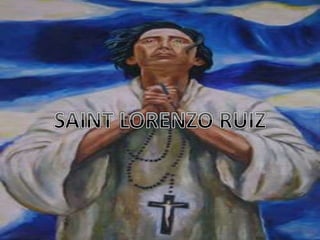
Saint Lorenzo Ruiz (ca. 1600 – 29 September
1637), also known as Laurentius Ruiz de Manila
or San Lorenzo Ruiz de Manila, is the
first Filipino saint venerated in the Roman
Catholic Church; he is thus the protomartyr of
the Philippines.He was killed for refusing to
leave Japan and renounce his Roman
Catholic beliefs during the persecution
of Japanese Christians under the Tokugawa
Shogunate in the 17th century.Saint Lorenzo
is patron saint of, among others, the Philippines
and Filipinos.
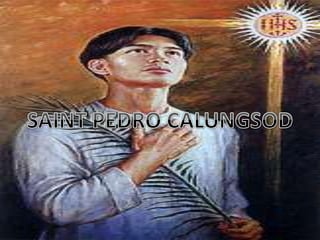
Saint Pedro Calungsod (c. 1654 – April 2, 1672) is a
Filipino Roman Catholic martyr who was killed while doing
missionary work in Guam in 1672. He was beatified on March
5, 2000, by Pope John Paul II. As a skilled sacristan and
teacher of cathecism, he was a companion of Blessed Diego
Luis de San Vitores to the Marianas Islands. Through their
efforts, many receive the sacraments especially that of
baptism. A plot to kill Pedro and San Vitores started when a
certain Choco, a Chinese who gained influence over the
Macanas of Marianas Island, circulated false accusations that
the missionaries were spreading poison through the ritual of
the pouring of water (i.e. baptism), and through the ritual of
Catholic Masses. Calungsod and Diego San Vitores were both
murdered after baptizing an infant and mother who
converted to the Roman Catholic faith.Calungsod is the
second Filipino saint after San Lorenzo Ruiz if approved by the
Pope and the Holy See.
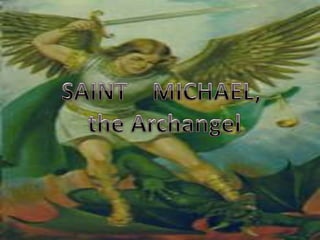
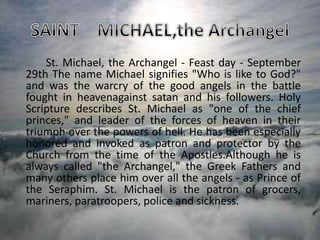
St. Michael, the Archangel - Feast day - September
29th The name Michael signifies "Who is like to God?"
and was the warcry of the good angels in the battle
fought in heavenagainst satan and his followers. Holy
Scripture describes St. Michael as "one of the chief
princes," and leader of the forces of heaven in their
triumph over the powers of hell. He has been especially
honored and invoked as patron and protector by the
Church from the time of the Apostles.Although he is
always called "the Archangel," the Greek Fathers and
many others place him over all the angels - as Prince of
the Seraphim. St. Michael is the patron of grocers,
mariners, paratroopers, police and sickness.
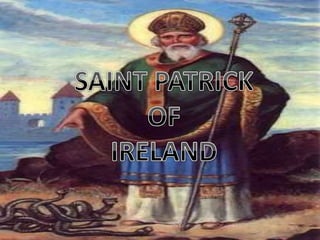
Saint Patrick was a 5th
century RomanoBritish Christian missionary and bishop in Ireland.
Known as the "Apostle of Ireland", he is the primary patron saint of
the island along with Saints Brigid and Columba.The dates of
Patrick's life cannot be fixed with certainty but, on a widespread
interpretation, he was active as a missionary in Ireland during the
second half of the fifth century. He is generally credited with being
the first bishop of Armagh, Primate of All Ireland.When he was
about 16, he was captured from his home and taken as a slave to
Ireland, where he lived for six years before escaping and returning
to his family. After becoming a cleric, he returned to northern and
western Ireland as an ordained bishop, but little is known about the
places where he worked. By the seventh century, he had already
come to be revered as the patron saint of Ireland.Saint Patrick's
Day is observed on March 17, the date of his death. It is celebrated
both inside and outside Ireland, as both a religious and, especially
outside Ireland, secular holiday. In the dioceses of Ireland, it is both
a solemnity and a holy day of obligation; outside Ireland, it can be a
celebration of Ireland itself.
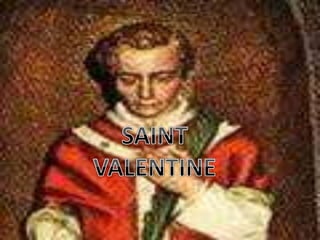
Saint Valentine is a widely recognized third-century
Roman saintcommemorated on February 14 and associated since the High
Middle Ages with a tradition of courtly love. Nothing is reliably known of
St. Valentine except his name and the fact that he died on February 14
on Via Flaminia in the north of Rome. It is uncertain whether St. Valentine
is to be identified as one saint or two saints of the same name. Several
differing martyrologies have been added to later hagiographies that are
unreliable. For these reasons this liturgical commemoration was not kept
in the Catholic calendar of saints for universal liturgical veneration as
revised in 1969. But the "Martyr Valentinus who died on the 14th of
February on the Via Flaminia close to the Milvian bridge in Rome" still
remains in the list of officially recognized saints for local veneration. Saint
Valentine's Church in Rome, built in 1960 for the needs of the Olympic
Village, continues as a modern, well-visited parish church.Today, Saint
Valentine's Day, also known as the Feast of Saint Valentine, is an
official feast day in theAnglican Communion,as well as in the Lutheran
Church. In the Eastern Orthodox Church, Saint Valentine the Presbyter is
celebrated on July 6 and Hieromartyr Saint Valentine (Bishop of
Interamna, Terni in Italy) is celebrated on July 30. Notwithstanding,
because of the relative obscurity of this western saint in the East,
members of the Greek Orthodox Church named Valentinos (male) or
Valentina (female) may celebrate their name day on the Western
ecclesiastical calendar date of February 14.
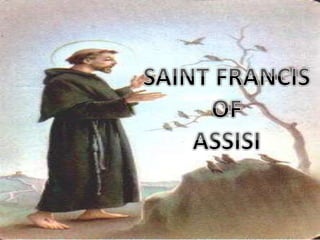
St. Francis of Assisi (Italian: San Francesco d'Assisi, born Giovanni di
Pietro di Bernardone, but nicknamed Francesco ("the Frenchman") by his
father, 1181/1182 – October 3, 1226) was
anItalian Catholic friar and preacher. He founded the men's Order of Friars
Minor, the women’s Order of St. Clare, and the Third Order of Saint
Francis for men and women not able to live the lives of itinerant preachers
followed by the early members of the Order of Friars Minor or the
monastic lives of the Poor Clares. Though he was never ordained to
the Catholic priesthood, Francis is one of the most venerated religious
figures in history. On July 16, 1228, he was pronounced a saint by Pope
Gregory IX. He is known as the patron saint ofanimals, the environment,
and is one of the two patron saints of Italy (with Catherine of Siena). It is
customary for Catholic and Anglican churches to hold ceremonies blessing
animals on his feast day of October 4.He is also known for his love of
the Eucharist,his sorrow during the Stations of the Cross, and for the
creation of the Christmas creche or Nativity Scene.
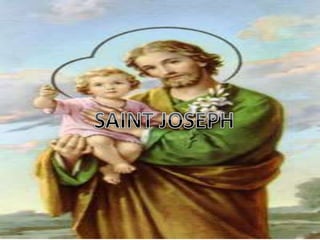
Joseph (Hebrew ‫ף‬ֵ‫יֹוס‬," Yosef"; Greek: Ἰωσήφ) is a figure
in the Gospels, the husband of Mary, the mother of
Jesus and the earthly father of Jesus. In Roman
Catholic, Eastern Orthodox and Anglican Christian
traditions, he is regarded as Saint Joseph. Joseph is
venerated as a saint in the Catholic, Eastern
Orthodox, Oriental Orthodox, Anglican, andLutheran faiths.
In Catholic and other traditions, Joseph is the patron
saint of workers and has several feast days. He was also
declared to be the patron saint and protector of the
Catholic Church by Pope Pius IX in 1870, and is the patron
of several countries and regions. With the growth
ofMariology, the theological field of Josephology has also
grown and since the 1950s centres for studying it have
been formed.
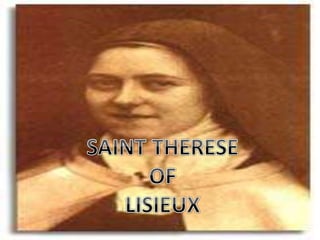
Saint Thérèse of Lisieux (January 2, 1873 –
September 30, 1897), or Saint Thérèse of
the Child Jesus and the Holy Face, O.C.D., was a
French Discalced Carmelite nun. She is popularly
known as "The Little Flower of Jesus" or simply,
"The Little Flower".Thérèse has been a highly
influential model of sanctity for Roman Catholics
and for others because of the "simplicity and
practicality of her approach to the spiritual life."
Together with St. Francis of Assisi, she is one of
the most popular saints in the history of the
church.Pope Pius X called her "the greatest saint
of modern times."
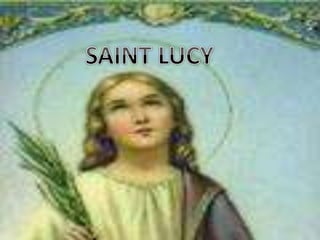
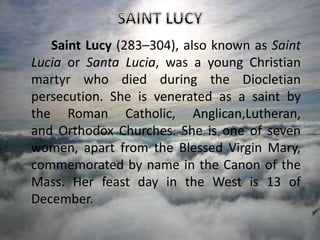
Saint Lucy (283–304), also known as Saint
Lucia or Santa Lucia, was a young Christian
martyr who died during the Diocletian
persecution. She is venerated as a saint by
the Roman Catholic, Anglican,Lutheran,
and Orthodox Churches. She is one of seven
women, apart from the Blessed Virgin Mary,
commemorated by name in the Canon of the
Mass. Her feast day in the West is 13 of
December.
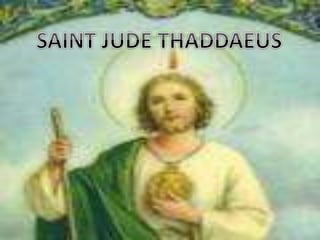
Jude was one of the Twelve Apostles of Jesus. He is
generally identified with Thaddeus, and is also variously
called Jude of James, Jude Thaddaeus, Judas
Thaddaeus or Lebbaeus. He is sometimes identified
with Jude, "brother of Jesus", but is clearly distinguished
from Judas Iscariot, another apostle, the betrayer of
Jesus.The Armenian Apostolic Church honors Thaddeus along
with Saint Bartholomew as its patron saints. In the Roman
Catholic Church he is the patron saint of desperate cases and
lost causes.Saint Jude's attribute is a club. He is also often
shown in icons with a flame around his head. This represents
his presence at Pentecost, when he received the Holy
Spirit with the other apostles. Another common attribute is
Jude holding an image of Jesus Christ, in the image of Edessa.
In some instances he may be shown with a scroll or a book
(the Epistle of Jude) or holding a carpenter's rule.
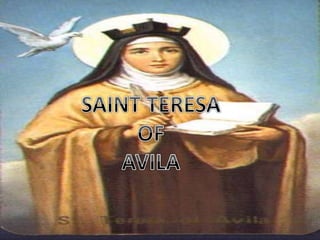
Teresa of Ávila, also called Saint Teresa of Jesus, baptized
as Teresa Sánchez de Cepeda y Ahumada, (March 28, 1515 –
October 4, 1582) was a prominent Spanish mystic, Roman
Catholic saint,Carmelite nun, writer of the Counter
Reformation, and theologian of contemplative life
through mental prayer. She was a reformer of the Carmelite
Order and is considered to be a founder of the Discalced
Carmelites along with John of the Cross.In 1622, forty years
after her death, she was canonized by Pope Gregory XV and in
September 27, 1970 was named a Doctor of the
Church by Pope Paul VI.[6] Her books, which include her
autobiography (The Life of Teresa of Jesus) and her seminal
work El Castillo Interior (trans.: The Interior Castle) are an
integral part of Spanish Renaissance literature as well
as Christian mysticism and Christian meditationpractices as
she entails in her other important work, Camino de
Perfección (trans.: The Way of Perfection).
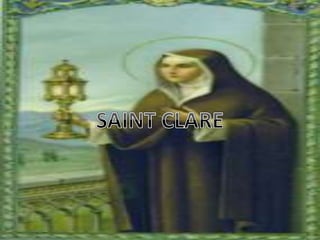
Saint Clare of Assisi (sometimes
spelled Clair, Claire, etc.) (July 16, 1194 – August
11, 1253), bornChiara Offreduccio, is
an Italian saint and one of the first followers
of Saint Francis of Assisi. She founded the Order
of Poor Ladies, a monastic religious order for
women in the Franciscan tradition, and wrote
their Rule of Life—the first monastic rule known
to have been written by a woman. Following her
death, the order she founded was renamed in her
honor as the Order of Saint Clare, commonly
referred to today as the Poor Clares.
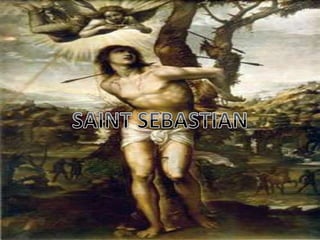
Saint Sebastian (died c. 288) was an
early Christian saint and martyr. It is said that he was killed
during the Roman emperor Diocletian's persecution of
Christians. He is commonly depicted in art and literature tied
to a post or tree and shot with arrows. This is the most
common artistic depiction of Sebastian; however, according to
legend, he was rescued and healed by Irene of Rome. Shortly
afterwards he criticized Diocletian in person and as a result
was clubbed to death.He is venerated in the Catholic and
Orthodox Churches.The details of Saint Sebastian's
martyrdom were first spoken of by 4th-century
bishop Ambrose of Milan (Saint Ambrose), in his sermon
(number 22) on Psalm 118. Ambrose stated that Sebastian
came fromMilan and that he was already venerated there in
the 4th century. Saint Sebastian is a popular male saint,
especially among soldiers and athletes who often wear his
medal as a pious sacramental. He is commonly known as the
"Patron Saint of Sports”.
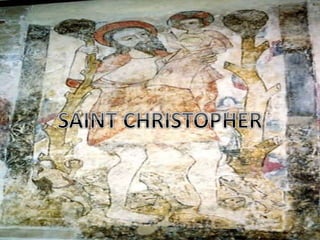
Before the 1969 reform of the Roman
calendar, Christopher was listed as a martyr who
died under Decius. Nothing else is known about
him. There are several legends about him
including the one in which he was crossing a river
when a child asked to be carried across. When
Christopher put the child on his shoulders he
found the child was unbelievably heavy. The
child, according to the legend, was Christcarrying
the weight of the whole world. This was what
made Christopher patron saint of travelers and is
invoked against storms, plagues, etc.. His
former feast day is July 25
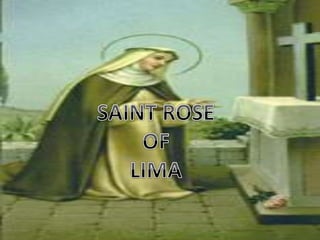
Virgin, born at Lima, Peru 20 April, 1586; died there the 24 of
August, 1617.St. Rose of Lima is the patroness of Latin America and the
Philippines. This South American Saint's real name was Isabel, but she
was such a beautiful baby that she was called Rose, and that name
remained. As she grew older, she became more and more beautiful,
and one day, her mother put a wreath of flowers on her head to show
off her loveliness to friends. But Rose had no desire to be admired, for
her heart had been given to Jesus. So she put a long pin into that
wreath and it pierced her so deeply, that she had a hard time getting
the wreath off afterward. Another timeshe became afraid that her
beauty might be a temptation to someone, since people could not take
their eyes off her. Therefore, she rubbed her face with pepper until it
was all red and blistered.
Rose of Lima, T.O.S.D. a Spanish colonist in Lima, Peru, who
became known for both her life of severe asceticism and her care of
the needy of the city through her own private efforts. A lay member of
the Dominican Order, she was the first person born in the Americasto
be canonized by the Catholic Church.
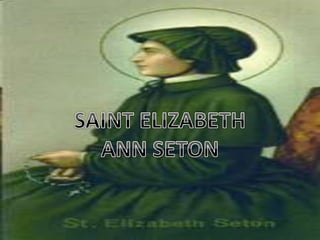
Elizabeth Bayley Seton was the first native
born American to be canonized by
the Catholic Church.Born two years before the
American Revolution,Elizabeth grew up in the
"cream" of New York society. She was a prolific
reader, and read everything from the Bible to
contemporary novels.In spite of her
high society background, Elizabeth's early life was
quiet, simple, and often lonely. As she grew a
little older, the bible was to become her continual
instruction, support and comfort; she would
continue to love the Scriptures for the rest of her
life.
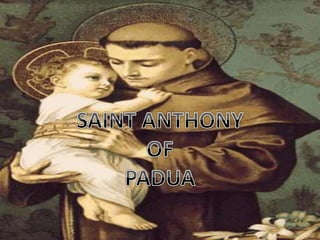
Anthony of Padua, O.F.M. (born Fernando
Martins de Bulhões; 15 August 1195 – 13 June
1231),also known as Anthony of Lisbon, was
a Portuguese Catholic priest and friar of the
Franciscan Order. Though he died in Padua, Italy,
he was born and raised in a wealthy family
in Lisbon. Noted by his contemporaries for his
forceful preaching and expert knowledge of
scripture, he was the second-
fastestcanonized saint (after St. Peter of Verona)
and proclaimed a Doctor of the Church on 16
January 1946. He is also the saint of finding
things or lost people.
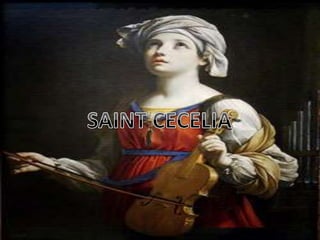
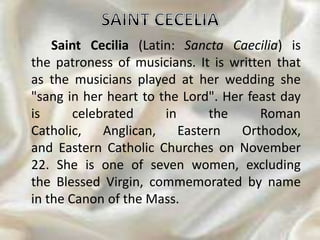
Saint Cecilia (Latin: Sancta Caecilia) is
the patroness of musicians. It is written that
as the musicians played at her wedding she
"sang in her heart to the Lord". Her feast day
is celebrated in the Roman
Catholic, Anglican, Eastern Orthodox,
and Eastern Catholic Churches on November
22. She is one of seven women, excluding
the Blessed Virgin, commemorated by name
in the Canon of the Mass.
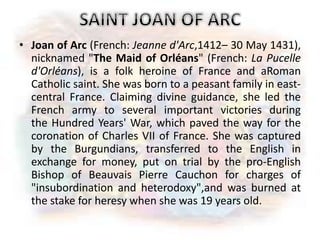
• Joan of Arc (French: Jeanne d'Arc,1412– 30 May 1431),
nicknamed "The Maid of Orléans" (French: La Pucelle
d'Orléans), is a folk heroine of France and aRoman
Catholic saint. She was born to a peasant family in east-
central France. Claiming divine guidance, she led the
French army to several important victories during
the Hundred Years' War, which paved the way for the
coronation of Charles VII of France. She was captured
by the Burgundians, transferred to the English in
exchange for money, put on trial by the pro-English
Bishop of Beauvais Pierre Cauchon for charges of
"insubordination and heterodoxy",and was burned at
the stake for heresy when she was 19 years old.
St. Paul, the indefatigableApostle of the
Gentiles, was converted from judaism on the
road to Damascus. He remained some days
in Damascus after his Baptism, and then went to
Arabia, possibly for a year or two to prepare
himself for his future missionary activity. Having
returned to Damascus, he stayed there for a time,
preaching in the synagogues that Jesus is the
Christ, the Son of God. For this he incurred
the hatred of the Jews and had to flee from the
city. He then went to Jerusalem to see Peter and
pay his homage to the head of the Church.
In Abrahamic religions, Gabriel is an angel who typically
serves as a messenger sent from God to certain people.In
the Bible, Gabriel is mentioned in both the Old and New
Testament. In the Old Testament, he appeared to the
prophet Daniel, delivering explanations of Daniel's visions
(Daniel 8:15–26, 9:21–27). In theGospel of Luke, Gabriel
appeared to Zecharias, and to the virgin Mary foretelling the
births of John the Baptist and Jesus, respectively (Luke 1:11–
38). In the Book of Daniel, he is referred to as "the man
Gabriel", while in the Book of Luke, Gabriel is referred to as
"an angel of the Lord" (Luke 1:11). Gabriel is not called
an archangel in the Bible, but is so called in Intertestamental
period sources like the Book of Enoch. In the Roman Catholic,
Anglican, Lutheran, Eastern and Oriental Orthodox churches,
the archangels Michael, Raphael, and Gabriel are
considered saints.In Islam, Gabriel (Jibra'il) is considered one
of the four archangels whom God sent with His divine
message to various prophets, including last
prophet Muhammad.
Agnes of Rome (c. 291 – c. 304) is a virgin–martyr,
venerated as a saint in the Roman Catholic Church, Eastern
Orthodox Church, the Anglican Communion,
and Lutheranism. She is one of seven women, excluding
the Blessed Virgin, commemorated by name in the Canon
of the Mass. She is thepatron saint of chastity, gardeners,
girls, engaged couples, rape victims, and virgins.She is also
known as Saint Agnes and Saint Ines. Her memorial, which
commemorates her martyrdom, is 21 January in both
the Roman Catholic calendar of saints and in the General
Roman Calendar of 1962.,The 1962 calendar includes a
second feast on 28 January, which commemorates her
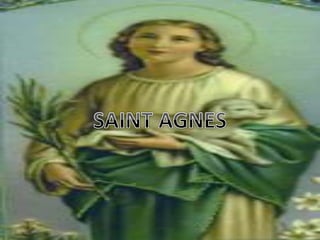
birthday. Agnes is depicted in art with a lamb, as her name
resembles the Latin word for "lamb",agnus. The
name "Agnes" is actually derived from the feminine Greek
adjective "hagnē" meaning "chaste, pure, sacred".
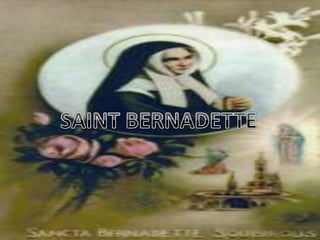
Bernadette (Marie Bernarde Soubirous) was a miller's daughter
born in Lourdes, France, and is venerated as a Christian mysticand Saint in
the Catholic Church.Soubirous is best known for her participation in
the Marian apparitions of "a small young lady" who asked for a chapel to
be built at a cave-grotto in Massabielle where the apparitions occurred
between 11 February and 16 July 1858. She would later receive
recognition when the lady who appeared to her identified herself as
the Immaculate Conception.Despite initial skepticism from the Catholic
Church, Soubirous's claims were eventually declared "worthy of belief"
after a canonical investigation, and the Marian apparition is now known
as Our Lady of Lourdes. Since her death, Soubirous's body has apparently
remained internally incorrupt, but it is not without blemish; during her
third exhumation in 1925, the firm of Pierre Imans made light wax
coverings for her face and her hands due to the discoloration that her skin
had undergone. These masks were placed on her face and hands before
she was moved to her crystal reliquary in June 1925.The Marian shrine
at Nevers (Bourgogne, France) went on to become a major pilgrimage site,
attracting over five million Christian pilgrims of all denominations each
year.On 8 December 1933, she was canonized by Pope Pius XI as a Saint of
the Roman Catholic Church; her Feast Day is observed on April 16. She is
considered a Christian mystic.
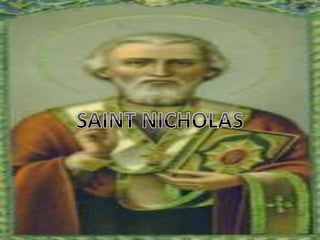
• St. Nicholas, called "of Bari", Bishop of Myra (Fourth Century) 6
Dec. Feast day. The great veneration with which this saint has been
honored for many ages and the number of altars and churches
which have been everywhere dedicated in his memory are
testimonials to his holiness and of the glory which he enjoys with
God. He is said to have been born atPatara in Lycia, a province
of Asia Minor. Myra, the capital, not far from the sea, was an
episcopal see, and this church falling vacant, the holy Nicholas was
chosen bishop, and in that station became famous by his
extraordinary piety and zeal and many astonishing miracles. The
Greek histories of his life agree that he suffered imprisonment of
the faith and made a glorious confession in the latter part of the
persecution raised by Dioletian, and that he was present at the
Council of Nicaea and there condemned Arianism. The silence of
other authors makes many justly suspect these circumstances. He
died at Myra, and was buried in his cathedral.
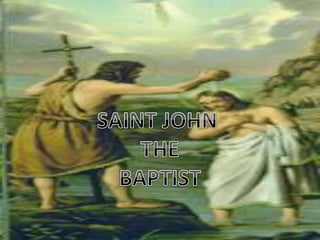
John the Baptist wasan itinerant preacher and a major
religious figure mentioned in the Canonical gospels and the Qur'an.
He is described in the Gospel of Luke as a relative of Jesus who led a
movement of baptism at the Jordan River.Some scholars maintain
that he was influenced by the semi-ascetic Essenes, who expected
an apocalypse and practiced rituals corresponding strongly with
baptism, although no direct evidence substantiates this. John is
regarded as a prophet inChristianity, Islam,the Bahá'í
Faith, and Mandaeism.
According to the New Testament, John anticipated
a messianic figure greater than himself,and Jesus was the one
whose coming John foretold. Christians commonly refer to John as
the precursor or forerunner of Jesus,since John announces Jesus'
coming. John is also identified with the prophetElijah.Jesus was
probably a disciple of John and some of Jesus's early followers had
previously been followers of John.
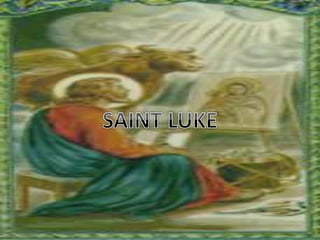
Luke the Evangelist (Ancient Greek: Λουκᾶς, Loukás) is
one of the Four Evangelists or authors
ofcanonical Gospels of Jesus Christ. Luke was a native of the
Hellenistic city of Antioch in Syria. The early church fathers
ascribed to him authorship of both the Gospel according to
Luke and the book of Acts of the Apostles, which originally
formed a single literary work. Such authorship was later
reaffirmed by prominent figures in early Christianity such
as Jerome and Eusebius, although within scholarly circles,
both secular and religious, discussions have been held due to
the lack of evidence as to the real identity of the author of the
works.
In the New Testament, Luke is mentioned briefly a few
times, and referred to as a doctor in the Pauline epistle to the
Colossians; thus he is thought to have been both a physician
and a disciple of Paul. Considered by early Christians as
a saint, he is believed to have died a martyr, although
accounts of the events do vary.
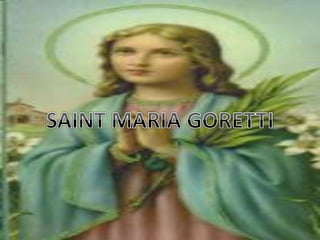
Patron of youth, young women, purity, and victims
of rape.
Born in Corinaldo, Ancona, Italy, on October 16
1890; her farmworker father moved his family to
Ferrier di Conca, near Anzio. Her father died of malaria
and her mother had to struggle to feed her children.
Maria Goretti (October 16, 1890 – July 6, 1902) is
an Italian virgin-martyr of the Roman Catholic Church,
and she is one of the youngest canonized saints. She
died from multiple stab wounds inflicted by her
attempted rapist after she refused to submit to him.
Marlon m. estrada

Marlon m. estrada

  • 3.
    Saint Lorenzo Ruiz(ca. 1600 – 29 September 1637), also known as Laurentius Ruiz de Manila or San Lorenzo Ruiz de Manila, is the first Filipino saint venerated in the Roman Catholic Church; he is thus the protomartyr of the Philippines.He was killed for refusing to leave Japan and renounce his Roman Catholic beliefs during the persecution of Japanese Christians under the Tokugawa Shogunate in the 17th century.Saint Lorenzo is patron saint of, among others, the Philippines and Filipinos.
  • 5.
    Saint Pedro Calungsod(c. 1654 – April 2, 1672) is a Filipino Roman Catholic martyr who was killed while doing missionary work in Guam in 1672. He was beatified on March 5, 2000, by Pope John Paul II. As a skilled sacristan and teacher of cathecism, he was a companion of Blessed Diego Luis de San Vitores to the Marianas Islands. Through their efforts, many receive the sacraments especially that of baptism. A plot to kill Pedro and San Vitores started when a certain Choco, a Chinese who gained influence over the Macanas of Marianas Island, circulated false accusations that the missionaries were spreading poison through the ritual of the pouring of water (i.e. baptism), and through the ritual of Catholic Masses. Calungsod and Diego San Vitores were both murdered after baptizing an infant and mother who converted to the Roman Catholic faith.Calungsod is the second Filipino saint after San Lorenzo Ruiz if approved by the Pope and the Holy See.
  • 7.
    St. Michael, theArchangel - Feast day - September 29th The name Michael signifies "Who is like to God?" and was the warcry of the good angels in the battle fought in heavenagainst satan and his followers. Holy Scripture describes St. Michael as "one of the chief princes," and leader of the forces of heaven in their triumph over the powers of hell. He has been especially honored and invoked as patron and protector by the Church from the time of the Apostles.Although he is always called "the Archangel," the Greek Fathers and many others place him over all the angels - as Prince of the Seraphim. St. Michael is the patron of grocers, mariners, paratroopers, police and sickness.
  • 9.
    Saint Patrick wasa 5th century RomanoBritish Christian missionary and bishop in Ireland. Known as the "Apostle of Ireland", he is the primary patron saint of the island along with Saints Brigid and Columba.The dates of Patrick's life cannot be fixed with certainty but, on a widespread interpretation, he was active as a missionary in Ireland during the second half of the fifth century. He is generally credited with being the first bishop of Armagh, Primate of All Ireland.When he was about 16, he was captured from his home and taken as a slave to Ireland, where he lived for six years before escaping and returning to his family. After becoming a cleric, he returned to northern and western Ireland as an ordained bishop, but little is known about the places where he worked. By the seventh century, he had already come to be revered as the patron saint of Ireland.Saint Patrick's Day is observed on March 17, the date of his death. It is celebrated both inside and outside Ireland, as both a religious and, especially outside Ireland, secular holiday. In the dioceses of Ireland, it is both a solemnity and a holy day of obligation; outside Ireland, it can be a celebration of Ireland itself.
  • 11.
    Saint Valentine isa widely recognized third-century Roman saintcommemorated on February 14 and associated since the High Middle Ages with a tradition of courtly love. Nothing is reliably known of St. Valentine except his name and the fact that he died on February 14 on Via Flaminia in the north of Rome. It is uncertain whether St. Valentine is to be identified as one saint or two saints of the same name. Several differing martyrologies have been added to later hagiographies that are unreliable. For these reasons this liturgical commemoration was not kept in the Catholic calendar of saints for universal liturgical veneration as revised in 1969. But the "Martyr Valentinus who died on the 14th of February on the Via Flaminia close to the Milvian bridge in Rome" still remains in the list of officially recognized saints for local veneration. Saint Valentine's Church in Rome, built in 1960 for the needs of the Olympic Village, continues as a modern, well-visited parish church.Today, Saint Valentine's Day, also known as the Feast of Saint Valentine, is an official feast day in theAnglican Communion,as well as in the Lutheran Church. In the Eastern Orthodox Church, Saint Valentine the Presbyter is celebrated on July 6 and Hieromartyr Saint Valentine (Bishop of Interamna, Terni in Italy) is celebrated on July 30. Notwithstanding, because of the relative obscurity of this western saint in the East, members of the Greek Orthodox Church named Valentinos (male) or Valentina (female) may celebrate their name day on the Western ecclesiastical calendar date of February 14.
  • 13.
    St. Francis ofAssisi (Italian: San Francesco d'Assisi, born Giovanni di Pietro di Bernardone, but nicknamed Francesco ("the Frenchman") by his father, 1181/1182 – October 3, 1226) was anItalian Catholic friar and preacher. He founded the men's Order of Friars Minor, the women’s Order of St. Clare, and the Third Order of Saint Francis for men and women not able to live the lives of itinerant preachers followed by the early members of the Order of Friars Minor or the monastic lives of the Poor Clares. Though he was never ordained to the Catholic priesthood, Francis is one of the most venerated religious figures in history. On July 16, 1228, he was pronounced a saint by Pope Gregory IX. He is known as the patron saint ofanimals, the environment, and is one of the two patron saints of Italy (with Catherine of Siena). It is customary for Catholic and Anglican churches to hold ceremonies blessing animals on his feast day of October 4.He is also known for his love of the Eucharist,his sorrow during the Stations of the Cross, and for the creation of the Christmas creche or Nativity Scene.
  • 15.
    Joseph (Hebrew ‫ף‬ֵ‫יֹוס‬,"Yosef"; Greek: Ἰωσήφ) is a figure in the Gospels, the husband of Mary, the mother of Jesus and the earthly father of Jesus. In Roman Catholic, Eastern Orthodox and Anglican Christian traditions, he is regarded as Saint Joseph. Joseph is venerated as a saint in the Catholic, Eastern Orthodox, Oriental Orthodox, Anglican, andLutheran faiths. In Catholic and other traditions, Joseph is the patron saint of workers and has several feast days. He was also declared to be the patron saint and protector of the Catholic Church by Pope Pius IX in 1870, and is the patron of several countries and regions. With the growth ofMariology, the theological field of Josephology has also grown and since the 1950s centres for studying it have been formed.
  • 17.
    Saint Thérèse ofLisieux (January 2, 1873 – September 30, 1897), or Saint Thérèse of the Child Jesus and the Holy Face, O.C.D., was a French Discalced Carmelite nun. She is popularly known as "The Little Flower of Jesus" or simply, "The Little Flower".Thérèse has been a highly influential model of sanctity for Roman Catholics and for others because of the "simplicity and practicality of her approach to the spiritual life." Together with St. Francis of Assisi, she is one of the most popular saints in the history of the church.Pope Pius X called her "the greatest saint of modern times."
  • 19.
    Saint Lucy (283–304),also known as Saint Lucia or Santa Lucia, was a young Christian martyr who died during the Diocletian persecution. She is venerated as a saint by the Roman Catholic, Anglican,Lutheran, and Orthodox Churches. She is one of seven women, apart from the Blessed Virgin Mary, commemorated by name in the Canon of the Mass. Her feast day in the West is 13 of December.
  • 21.
    Jude was oneof the Twelve Apostles of Jesus. He is generally identified with Thaddeus, and is also variously called Jude of James, Jude Thaddaeus, Judas Thaddaeus or Lebbaeus. He is sometimes identified with Jude, "brother of Jesus", but is clearly distinguished from Judas Iscariot, another apostle, the betrayer of Jesus.The Armenian Apostolic Church honors Thaddeus along with Saint Bartholomew as its patron saints. In the Roman Catholic Church he is the patron saint of desperate cases and lost causes.Saint Jude's attribute is a club. He is also often shown in icons with a flame around his head. This represents his presence at Pentecost, when he received the Holy Spirit with the other apostles. Another common attribute is Jude holding an image of Jesus Christ, in the image of Edessa. In some instances he may be shown with a scroll or a book (the Epistle of Jude) or holding a carpenter's rule.
  • 23.
    Teresa of Ávila,also called Saint Teresa of Jesus, baptized as Teresa Sánchez de Cepeda y Ahumada, (March 28, 1515 – October 4, 1582) was a prominent Spanish mystic, Roman Catholic saint,Carmelite nun, writer of the Counter Reformation, and theologian of contemplative life through mental prayer. She was a reformer of the Carmelite Order and is considered to be a founder of the Discalced Carmelites along with John of the Cross.In 1622, forty years after her death, she was canonized by Pope Gregory XV and in September 27, 1970 was named a Doctor of the Church by Pope Paul VI.[6] Her books, which include her autobiography (The Life of Teresa of Jesus) and her seminal work El Castillo Interior (trans.: The Interior Castle) are an integral part of Spanish Renaissance literature as well as Christian mysticism and Christian meditationpractices as she entails in her other important work, Camino de Perfección (trans.: The Way of Perfection).
  • 25.
    Saint Clare ofAssisi (sometimes spelled Clair, Claire, etc.) (July 16, 1194 – August 11, 1253), bornChiara Offreduccio, is an Italian saint and one of the first followers of Saint Francis of Assisi. She founded the Order of Poor Ladies, a monastic religious order for women in the Franciscan tradition, and wrote their Rule of Life—the first monastic rule known to have been written by a woman. Following her death, the order she founded was renamed in her honor as the Order of Saint Clare, commonly referred to today as the Poor Clares.
  • 27.
    Saint Sebastian (diedc. 288) was an early Christian saint and martyr. It is said that he was killed during the Roman emperor Diocletian's persecution of Christians. He is commonly depicted in art and literature tied to a post or tree and shot with arrows. This is the most common artistic depiction of Sebastian; however, according to legend, he was rescued and healed by Irene of Rome. Shortly afterwards he criticized Diocletian in person and as a result was clubbed to death.He is venerated in the Catholic and Orthodox Churches.The details of Saint Sebastian's martyrdom were first spoken of by 4th-century bishop Ambrose of Milan (Saint Ambrose), in his sermon (number 22) on Psalm 118. Ambrose stated that Sebastian came fromMilan and that he was already venerated there in the 4th century. Saint Sebastian is a popular male saint, especially among soldiers and athletes who often wear his medal as a pious sacramental. He is commonly known as the "Patron Saint of Sports”.
  • 29.
    Before the 1969reform of the Roman calendar, Christopher was listed as a martyr who died under Decius. Nothing else is known about him. There are several legends about him including the one in which he was crossing a river when a child asked to be carried across. When Christopher put the child on his shoulders he found the child was unbelievably heavy. The child, according to the legend, was Christcarrying the weight of the whole world. This was what made Christopher patron saint of travelers and is invoked against storms, plagues, etc.. His former feast day is July 25
  • 31.
    Virgin, born atLima, Peru 20 April, 1586; died there the 24 of August, 1617.St. Rose of Lima is the patroness of Latin America and the Philippines. This South American Saint's real name was Isabel, but she was such a beautiful baby that she was called Rose, and that name remained. As she grew older, she became more and more beautiful, and one day, her mother put a wreath of flowers on her head to show off her loveliness to friends. But Rose had no desire to be admired, for her heart had been given to Jesus. So she put a long pin into that wreath and it pierced her so deeply, that she had a hard time getting the wreath off afterward. Another timeshe became afraid that her beauty might be a temptation to someone, since people could not take their eyes off her. Therefore, she rubbed her face with pepper until it was all red and blistered. Rose of Lima, T.O.S.D. a Spanish colonist in Lima, Peru, who became known for both her life of severe asceticism and her care of the needy of the city through her own private efforts. A lay member of the Dominican Order, she was the first person born in the Americasto be canonized by the Catholic Church.
  • 33.
    Elizabeth Bayley Setonwas the first native born American to be canonized by the Catholic Church.Born two years before the American Revolution,Elizabeth grew up in the "cream" of New York society. She was a prolific reader, and read everything from the Bible to contemporary novels.In spite of her high society background, Elizabeth's early life was quiet, simple, and often lonely. As she grew a little older, the bible was to become her continual instruction, support and comfort; she would continue to love the Scriptures for the rest of her life.
  • 35.
    Anthony of Padua,O.F.M. (born Fernando Martins de Bulhões; 15 August 1195 – 13 June 1231),also known as Anthony of Lisbon, was a Portuguese Catholic priest and friar of the Franciscan Order. Though he died in Padua, Italy, he was born and raised in a wealthy family in Lisbon. Noted by his contemporaries for his forceful preaching and expert knowledge of scripture, he was the second- fastestcanonized saint (after St. Peter of Verona) and proclaimed a Doctor of the Church on 16 January 1946. He is also the saint of finding things or lost people.
  • 37.
    Saint Cecilia (Latin:Sancta Caecilia) is the patroness of musicians. It is written that as the musicians played at her wedding she "sang in her heart to the Lord". Her feast day is celebrated in the Roman Catholic, Anglican, Eastern Orthodox, and Eastern Catholic Churches on November 22. She is one of seven women, excluding the Blessed Virgin, commemorated by name in the Canon of the Mass.
  • 39.
    • Joan ofArc (French: Jeanne d'Arc,1412– 30 May 1431), nicknamed "The Maid of Orléans" (French: La Pucelle d'Orléans), is a folk heroine of France and aRoman Catholic saint. She was born to a peasant family in east- central France. Claiming divine guidance, she led the French army to several important victories during the Hundred Years' War, which paved the way for the coronation of Charles VII of France. She was captured by the Burgundians, transferred to the English in exchange for money, put on trial by the pro-English Bishop of Beauvais Pierre Cauchon for charges of "insubordination and heterodoxy",and was burned at the stake for heresy when she was 19 years old.
  • 41.
    St. Paul, theindefatigableApostle of the Gentiles, was converted from judaism on the road to Damascus. He remained some days in Damascus after his Baptism, and then went to Arabia, possibly for a year or two to prepare himself for his future missionary activity. Having returned to Damascus, he stayed there for a time, preaching in the synagogues that Jesus is the Christ, the Son of God. For this he incurred the hatred of the Jews and had to flee from the city. He then went to Jerusalem to see Peter and pay his homage to the head of the Church.
  • 43.
    In Abrahamic religions,Gabriel is an angel who typically serves as a messenger sent from God to certain people.In the Bible, Gabriel is mentioned in both the Old and New Testament. In the Old Testament, he appeared to the prophet Daniel, delivering explanations of Daniel's visions (Daniel 8:15–26, 9:21–27). In theGospel of Luke, Gabriel appeared to Zecharias, and to the virgin Mary foretelling the births of John the Baptist and Jesus, respectively (Luke 1:11– 38). In the Book of Daniel, he is referred to as "the man Gabriel", while in the Book of Luke, Gabriel is referred to as "an angel of the Lord" (Luke 1:11). Gabriel is not called an archangel in the Bible, but is so called in Intertestamental period sources like the Book of Enoch. In the Roman Catholic, Anglican, Lutheran, Eastern and Oriental Orthodox churches, the archangels Michael, Raphael, and Gabriel are considered saints.In Islam, Gabriel (Jibra'il) is considered one of the four archangels whom God sent with His divine message to various prophets, including last prophet Muhammad.
  • 45.
    Agnes of Rome(c. 291 – c. 304) is a virgin–martyr, venerated as a saint in the Roman Catholic Church, Eastern Orthodox Church, the Anglican Communion, and Lutheranism. She is one of seven women, excluding the Blessed Virgin, commemorated by name in the Canon of the Mass. She is thepatron saint of chastity, gardeners, girls, engaged couples, rape victims, and virgins.She is also known as Saint Agnes and Saint Ines. Her memorial, which commemorates her martyrdom, is 21 January in both the Roman Catholic calendar of saints and in the General Roman Calendar of 1962.,The 1962 calendar includes a second feast on 28 January, which commemorates her birthday. Agnes is depicted in art with a lamb, as her name resembles the Latin word for "lamb",agnus. The name "Agnes" is actually derived from the feminine Greek adjective "hagnē" meaning "chaste, pure, sacred".
  • 47.
    Bernadette (Marie BernardeSoubirous) was a miller's daughter born in Lourdes, France, and is venerated as a Christian mysticand Saint in the Catholic Church.Soubirous is best known for her participation in the Marian apparitions of "a small young lady" who asked for a chapel to be built at a cave-grotto in Massabielle where the apparitions occurred between 11 February and 16 July 1858. She would later receive recognition when the lady who appeared to her identified herself as the Immaculate Conception.Despite initial skepticism from the Catholic Church, Soubirous's claims were eventually declared "worthy of belief" after a canonical investigation, and the Marian apparition is now known as Our Lady of Lourdes. Since her death, Soubirous's body has apparently remained internally incorrupt, but it is not without blemish; during her third exhumation in 1925, the firm of Pierre Imans made light wax coverings for her face and her hands due to the discoloration that her skin had undergone. These masks were placed on her face and hands before she was moved to her crystal reliquary in June 1925.The Marian shrine at Nevers (Bourgogne, France) went on to become a major pilgrimage site, attracting over five million Christian pilgrims of all denominations each year.On 8 December 1933, she was canonized by Pope Pius XI as a Saint of the Roman Catholic Church; her Feast Day is observed on April 16. She is considered a Christian mystic.
  • 49.
    • St. Nicholas,called "of Bari", Bishop of Myra (Fourth Century) 6 Dec. Feast day. The great veneration with which this saint has been honored for many ages and the number of altars and churches which have been everywhere dedicated in his memory are testimonials to his holiness and of the glory which he enjoys with God. He is said to have been born atPatara in Lycia, a province of Asia Minor. Myra, the capital, not far from the sea, was an episcopal see, and this church falling vacant, the holy Nicholas was chosen bishop, and in that station became famous by his extraordinary piety and zeal and many astonishing miracles. The Greek histories of his life agree that he suffered imprisonment of the faith and made a glorious confession in the latter part of the persecution raised by Dioletian, and that he was present at the Council of Nicaea and there condemned Arianism. The silence of other authors makes many justly suspect these circumstances. He died at Myra, and was buried in his cathedral.
  • 51.
    John the Baptistwasan itinerant preacher and a major religious figure mentioned in the Canonical gospels and the Qur'an. He is described in the Gospel of Luke as a relative of Jesus who led a movement of baptism at the Jordan River.Some scholars maintain that he was influenced by the semi-ascetic Essenes, who expected an apocalypse and practiced rituals corresponding strongly with baptism, although no direct evidence substantiates this. John is regarded as a prophet inChristianity, Islam,the Bahá'í Faith, and Mandaeism. According to the New Testament, John anticipated a messianic figure greater than himself,and Jesus was the one whose coming John foretold. Christians commonly refer to John as the precursor or forerunner of Jesus,since John announces Jesus' coming. John is also identified with the prophetElijah.Jesus was probably a disciple of John and some of Jesus's early followers had previously been followers of John.
  • 53.
    Luke the Evangelist(Ancient Greek: Λουκᾶς, Loukás) is one of the Four Evangelists or authors ofcanonical Gospels of Jesus Christ. Luke was a native of the Hellenistic city of Antioch in Syria. The early church fathers ascribed to him authorship of both the Gospel according to Luke and the book of Acts of the Apostles, which originally formed a single literary work. Such authorship was later reaffirmed by prominent figures in early Christianity such as Jerome and Eusebius, although within scholarly circles, both secular and religious, discussions have been held due to the lack of evidence as to the real identity of the author of the works. In the New Testament, Luke is mentioned briefly a few times, and referred to as a doctor in the Pauline epistle to the Colossians; thus he is thought to have been both a physician and a disciple of Paul. Considered by early Christians as a saint, he is believed to have died a martyr, although accounts of the events do vary.
  • 55.
    Patron of youth,young women, purity, and victims of rape. Born in Corinaldo, Ancona, Italy, on October 16 1890; her farmworker father moved his family to Ferrier di Conca, near Anzio. Her father died of malaria and her mother had to struggle to feed her children. Maria Goretti (October 16, 1890 – July 6, 1902) is an Italian virgin-martyr of the Roman Catholic Church, and she is one of the youngest canonized saints. She died from multiple stab wounds inflicted by her attempted rapist after she refused to submit to him.