Poor Reasoning and Fallacies Cheat Sheet
Appeal to the People (Bandwagon) - Claiming that something is
true just because many people
believe it is. Example: Everybody buys this product, so it must
be the best one.
Faulty Appeal to Authority - Using research without naming the
source, such as, "Many researchers
say..." or answering questions one is not qualified to answer.
Example: I asked my dentist if he thought
this mole was cancerous. He said “No” so I do not need to get it
checked out.
Proof by Lack of Evidence (Burden of Proof) - Asserting
something is true just because there is no
evidence it's false. Example: UFO’s exist because no one has
ever been able to prove they don’t.
Innuendo – Making a claim without actually making the claim.
Example:
Non Sequitur - It doesn't follow logically. Samantha lives in a
large building; therefore she must have a
large home.
Fake Dilemma (Black and White) – Presenting two alternative
states as the only possibilities, when in
fact there are more. Example: "You are either for the U.S. or
against the U.S." doesn't allow for neutral
countries.
Naturalistic Fallacy (Appeal to Nature) - Making the argument
because something is “natural”, it is
therefore valid, good or the way it’s supposed to be. Example:
This product uses all natural ingredients
therefore it’s the only one on the market you should buy.
Circular Reasoning (Begging the Question) – Using the
statement to prove the conclusion and the
conclusion to prove the statement. Example: The word of Zorbo
the Great is flawless and perfect. We know this
because it says so in The Great and Infallible Book of Zorbo's
Best and Most Truest Things that are Definitely True and
Should Not Ever Be Questioned.
Overgeneralization – Asserting something is an entire class of
things when it may not be true for all
members of the class. Example: Beth is a Psychology student
and shy is shy, therefore all psychology
students are shy.
False Analogy (Slippery Slope) – Making a false or misleading
analogy. Example: Colin Closet asserts
that if we allow same-sex couples to marry, then the next thing
we know we'll be allowing people to marry their
parents, their cars and even monkeys.
Jumping to Conclusions – Drawing conclusions with little
evidence. Example: My son is crying, you
must have taken his toy.
Being Unrealistic – Using only information in an unrealistic
manner. Example: The candidates just all
graduated from college… therefore they should not take a job
for less than 6 figures.
Verbal Fallacies (Ambiguity) – Accenting, omitting, or
misusing certain words to influence or mislead
the reader or listener. Example: After the team lost, Susan
became mad. (upset, angry, insane, happy…
who knows)
Using only information that supports your argument (Texas
Sharpshooter) - Example: Research
says a glass of wine a day is good for my heart. So drinking is
good for my heart!
Source: Jesse Richardson, Andy Smith and Som Meaden,
www.fallacydetective.com, and HU260 Strategies for Decision
Making - W6
Lecture "Critical Thinking"
http://au.linkedin.com/in/jesserichardsonaustralia
http://espadav8.co.uk/
http://theprojectsomething.com/
http://www.fallacydetective.com/
HU260 Week 6 Lecture
Welcome to critical thinking, week six! We will discuss
fallacies and other types of ways the critical thinking process is
thwarted.
A fallacy is an argument that uses poor reasoning. An argument
can be fallacious whether or not its conclusion is true. A fallacy
can be either formal or informal. An error that stems from a
poor logical form is sometimes called a formal fallacy or simply
an invalid argument. An informal fallacy is an error in
reasoning that does not originate in improper logical form.
Arguments committing informal fallacies may be formally valid
but still fallacious.
It’s all about the type of reasoning that is being used.
Arguments may be valid but there may be fallacious elements to
it caused by using poor reasoning in it. The argument itself can
or cannot still be valid as a result. It depends on the points
made in your thesis. You have your main points other sub
points, Illustrations, examples, etc. any of those may not be
coming from true valid reasoning or argument. The worst would
be to have the main points of your thesis be invalid or have
errors in reasoning. The main points are really what the whole
argument is standing on. It really depends on what elements of
the argument are falling under the fallacy. Poor reasoning takes
away the logical flow of everything. It takes away the authority
of the author. A lot of the facts and examples and things that are
used to support the thesis are just resting on something that is
not very validated not very strong so the whole paper or
presentation can just fall apart. If it's something that most
people know and can recognize then it really can make the
speaker or writer feel like they don’t know what they're talking
about. So it really depends on the level of reasoning and what
pieces or components of the argument it rests on how much of
the argument will fall apart under certain elements of fallacies.
Another issue can be circular reasoning. This is using a
statement to prove the conclusion and the conclusion to prove
the statement. You don't want to have the whole premise of the
thesis depend on the conclusion that you're building. And you
don’t want to have the conclusion depend upon the thesis. For
example, you say you shouldn’t take medication because it's bad
for you. But in the end you say you should take medication
because it's something that you need to do. It’s almost
contradicting and it's giving you a circle of reasoning that
leaves the reader wondering what the right thing to do is. Or it
might leave them wondering if a valid point was even made. It’s
almost like you're getting to you the end of the paper and then
your finding the thesis. The thesis should always be in the
beginning; state exactly what you will discuss in the paper and
it should make a statement of declaration. It should take a
stance. Everything else should work up and support it and in the
end you can reiterate, restate certain things and tie it all
together. if the author is kind of unsure of what they're writing
and they're presenting and the author their self doesn't figure it
out until the very end when they make an a declarative
statement, that may be somewhat dependent upon the opening
premise, it's almost as if the entire paper didn't really mean
much because the thesis comes at the very end and then you're
waiting for all the information that's going to follow to support
that new thesis that was presented. It is like the opening and
closing are working off of each other and they're giving
somewhat conflicting information or presenting a whole new
thesis.
Next we have overgeneralization. This is asserting something of
an entire class of things when it may not be true for all members
of the class. For example: Beth is a psychology student and she
is shy. Psychology students are shy. We know that this is not
true. This is overgeneralizing based on one incident. So you
want to make sure that your facts and your overall conclusion
and closing statement and what you have just presented does not
overgeneralize. You don’t want to take certain select facts and
points that you are feeding into your paper and then use that to
come up with your own overgeneralization by the end of the
paper. People may be very well aware of other facts and
information that prove that that's not true. For example they
may say, “well I know a lot of psychology students and most of
them actually are not shy.” There’s a lot of evidence out there.
In theory you could pick and choose all the shy psychology
students and then come to that overgeneralization at the end of
your paper. But it's not going to work out too well because
people know that that is overgeneralization. Most of us have the
type of experience to know that it is a false conclusion. So you
want to be very careful depending on what type of field you
working in, especially when it's a topic or industry that you
don't know that well. It can be much easier to come up with an
overgeneralization and not realize at all that that's what you're
doing because the topic is somewhat new to you. So you need to
really dissect and take apart all of your facts and information
and see what kind of conclusion you are including your paper or
speech. Make sure that you're not overgeneralizing at all,
especially when using words such as all, everyone, etc. you
want to be very careful about using that kind of terminology
especially at the end of the paper.
Now let’s look at false analogy. This is making a false or
misleading analogy is jumping to a conclusion. For example,
“my son is crying so you must've taken his toy.” It’s just
jumping to an analysis, a critique or an answer for whatever the
situation is without having all the facts or taking the time to
really understand what is going on. Whatever your argument is,
this whole process of clinical thinking is not something that you
can just rush through and spit out at the end. you really need to
take a lot of time in considering everything that you are
including, everything you are excluding, all of your
assumptions, all your generalizations, all of your analogies and
examples that you are using. I said before it's very easy when
you don't know the topic well to make these kinds of mistakes.
So you want to try and pull from sources that you really respect.
Find sources that have examples and analogies that you can use
or might perhaps spark your creativity and that you can kind of
get a feeling for, “this is the analogy they are using, maybe I
can use something more general that more people would
understand, but I get the format of how respected people in
those fields create analogies.” And just sort of switch the
subject a little here and there on what they have done. But you
want to make sure that you are not jumping to any conclusions
about what is right or wrong and it's using that terminology of
right or wrong, the must haves, the must bee’s and has to be
kind of thinking in terminology, especially within the paper.
This is not just about the conclusion. It is about assumptions
that are made and can be made throughout your work. So you
want to be sure you're not jumping to any conclusion with any
fact or example or piece of the paper. You want to stick to
supporting your thesis and make sure your thesis itself is not
jumping to a conclusion. Sometimes a thesis can seem like it’s
jumping to conclusions but the rest of the paper is presenting
facts and examples that support it. So it no longer is a
conclusion or has that feel of jumping to conclusion because
you spent the whole paper supporting the thesis.
Finally, we have being unrealistic. An example would be, “I just
graduated high school and I am ready to enter the workforce. I
will not take a job that pays less than six figures.” Yes, people
have been able to manifest some pretty interesting things,
especially if your father owns his own business. But in general
you want to make sure that you are being realistic in your
thinking and expectations. A lot of the expectations of research
or of what people can do with research falls in line again
assumptions and jumping to conclusions. You want to strive to
be realistic about what your expectations are with the work
you're doing.
Be careful not to answer questions one is not competent to
answer. For example, “I asked my dentist if he thought this
mole was cancerous he said no so I don’t need to get it checked
out.” you're not going to a reliable source for your information,
you don't have the information or you may be answering
questions for other people without having all the facts. When
dealing with critical thinking in academia, you want to make
sure you are answering questions from a place of authority. If
you're not you need to just tell people that it’s something you’ll
have to research. Just tell them that you don't have all the
answers. There’s nothing wrong with saying things like that.
You are presenting yourself as an expert and you have a certain
responsibility to make sure you are conveying information that
you can feel good about. Whether it's 100% true or not you want
to know you're doing the best to your abilities.
Use only the information that supports your point of view. for
example, “ research says a glass of wine a day is good for my
heart.” There is lot of other research that may conflict with that
and you need to be sure that you investigate that. It doesn't
mean your whole thesis is wrong. But it may be that you need to
tweak it a little. For example, “drinking one glass of wine a day
is good for my heart.” so it's not necessarily that you will be
proven wrong by looking at the opposite side; it just may show
that you need to tweak your thesis a little bit. A lot of times
when you say blanket statements like “drinking is good for my
heart” there will be a lot of people in the field who will call you
on such a broad strong statement without considering the other
side. By saying “drinking one glass of wine a day” is good for
my heart you’re showing that you have done your research to
see what the opposing side thinks.
Here is a little bit on verbal fallacies. Aristotle was the first to
systematize fallacy into a list. On this was his listing of verbal
policies that we all can make without realizing it.
· Accenting or giving emphasis to certain words or certain
findings. This can lead someone to give unconscious credence
to certain words, beliefs or certain facts because they've been
said with more authority and power behind them.
· Amphibology is ambiguous connections between things. It’s
usually two short sentences strung together that can have
different meanings depending upon the way it reads or is heard.
For example, saying one shouldn’t drive. It’s dangerous on the
streets. It brings into question the reasoning behind those
statements. Is it because of their age that they shouldn't? Is it
because there is construction or potholes? Is there chaos? It’s
somewhat of an ambiguous statement that could lead to people
making certain assumptions based on their experiences. That
would have them then infer different things about what was
said.
· Equivocation which is using a term that can be taken and in
several ways or have several different meanings. You’re leaving
it up to you the reader or the person listening to make up their
own minds as far as picking which meaning they're going to
ascribe certain word.
· Composition is all about how you are structuring the pieces
from the point you're starting with to where you're leading
people. It’s about how you’re structuring paragraphs and
sentences. And even how you use terms that are more pleasing
or more positive around certain facts that you want to be well
received and remembered. It’s all about the choice of language
and how things are fit together and compose together.
· Division in fallacy is when you're leading people to think that
if something is true of one thing it must be true of all things
around it or related to it that you are presenting. It’s almost
getting the reader or the audience to make a conclusion based
on how you're presenting one part of the argument and inferring
that all other things must be true as well.
· Figure of speech is using common everyday things that may
have a lot of experience and meaning behind them in general for
people because it’s something that they use a lot in their
conversation and their lives. So all of the meaning experience
and behind certain figures of speech come with it when you use
it. So you’re drawing on the emotions and experiences and
applying it to the fact or topic that you're using. So you can
really emphasize a certain area and make it stand out more and
seem more believable based on calling upon the figure of speech
and the emotional responses and experiences that come with
them.
Fallacies
There are several common fallacies in thinking. There are also
fallacies in reasoning. As a student it is important that you
identify fallacies but you identify bad reasoning. Fallacies can
come from illogical pieces of information or from false
information. You can use your knowledge of fallacies to help
you use your critical thinking skills and to help you argue
against points of view that do not make sense or are faulty.
Here are several common fallacies:
1. Circular reasoning: Using a statement (premise) to prove the
conclusion and the conclusion to prove the statement (premise).
Example: One should not take medication because it is against
Scientology and one must follow Scientology because it is
human nature.
2. Overgeneralization: asserting something of an entire class of
things when it may not be true for all members of the class.
Example: Beth is a psychology student and she is shy.
Psychology students are shy.
3. False analogy: making a false or misleading
analogy. Example
4. Jumping to conclusions. Example: My son is crying, you
must have taken his toy.
5. Being unrealistic. Example: I just graduate high school and I
am ready to enter the workforce. I will not take a job that pays
less than six figures.
6. Answering questions one is not competent to answer.
Example: I asked my dentist if he thought this mole was
cancerous. He said “No” so I do not need to get it checked out.
7. Use only the information that supports my view point.
Example: Research says a glass of wine a day is good for my
heart. So drinking is good for my heart!
Media Bias and Propaganda
All tv media, newspapers, radio talk shows, etc has its own
unique view of the world, society, and culture, which colors
how they see the world and report it to the public. The reality is
the stories they are reporting are much more complex than what
they can report. The reader must know this when they are
reading, listening, and processing the news.
· Points of view
· Objectivity
· Perception
Propaganda: Webster’s Dictionary (2012) defines propaganda as
“any systematic widespread dissemination or promotion of
particular ideas, doctrines, practices, etc. to further one’s own
cause or to damage an opposing one.” The word propaganda has
a negative connotation because it implies deception or
distortion. If you consider that most of what we read or watch
on tv is going to come from one world view (the world view we
most identify with) then it is likely to contain propaganda as it
is considered by other cultures and/or nationalities. This does
not mean that the world view you identify with is unvaried.
There are likely many variations within each world view. Not
everyone within the world view is going to agree or even share
the same view point. As you know not every American agrees
with every American. Just as not every Italian will agree with
every Italian. However, there is a difference in perspective a
worldview from an American and an Italian. It should also be
considered that the differences in viewpoint carry insight, how
this does not necessarily equate to EQUAL insight.
Review a world event, such as the recent attack on the U.S.
embassy in Libya. First read a U.S. article on the attack.
Identify the point of view in the article. Next, choose an article
from a different country on the same attack. Consider reviewing
an article written from a Chinese, Egyptian, or United Kingdom
source, other interesting sources will come from Iran and North
Korea. Identify the writer’s point of view. Consider the
differences in the world views for each of the articles.
We could spend a great deal of time reviewing the different
types of propaganda throughout our American history. You can
probably identify many different pieces of propaganda from the
WWII era. Propaganda served many purposes for many different
cultures/countries during this time. Review the following
website http://www.calvin.edu/academic/cas/gpa/ww2era.htm an
d identify one piece of propaganda that you found to be most
effective in its message.
IDENTIFYING FALLACIES 1
HU260 Week 6 Reflection: Identifying Logical Fallacies
Click Here to Type Your Name…
Running Head: IDENTIFYING FALLACIES
Running head: CRITICAL THINKING 1
Grantham University
Identifying Logical Fallacies
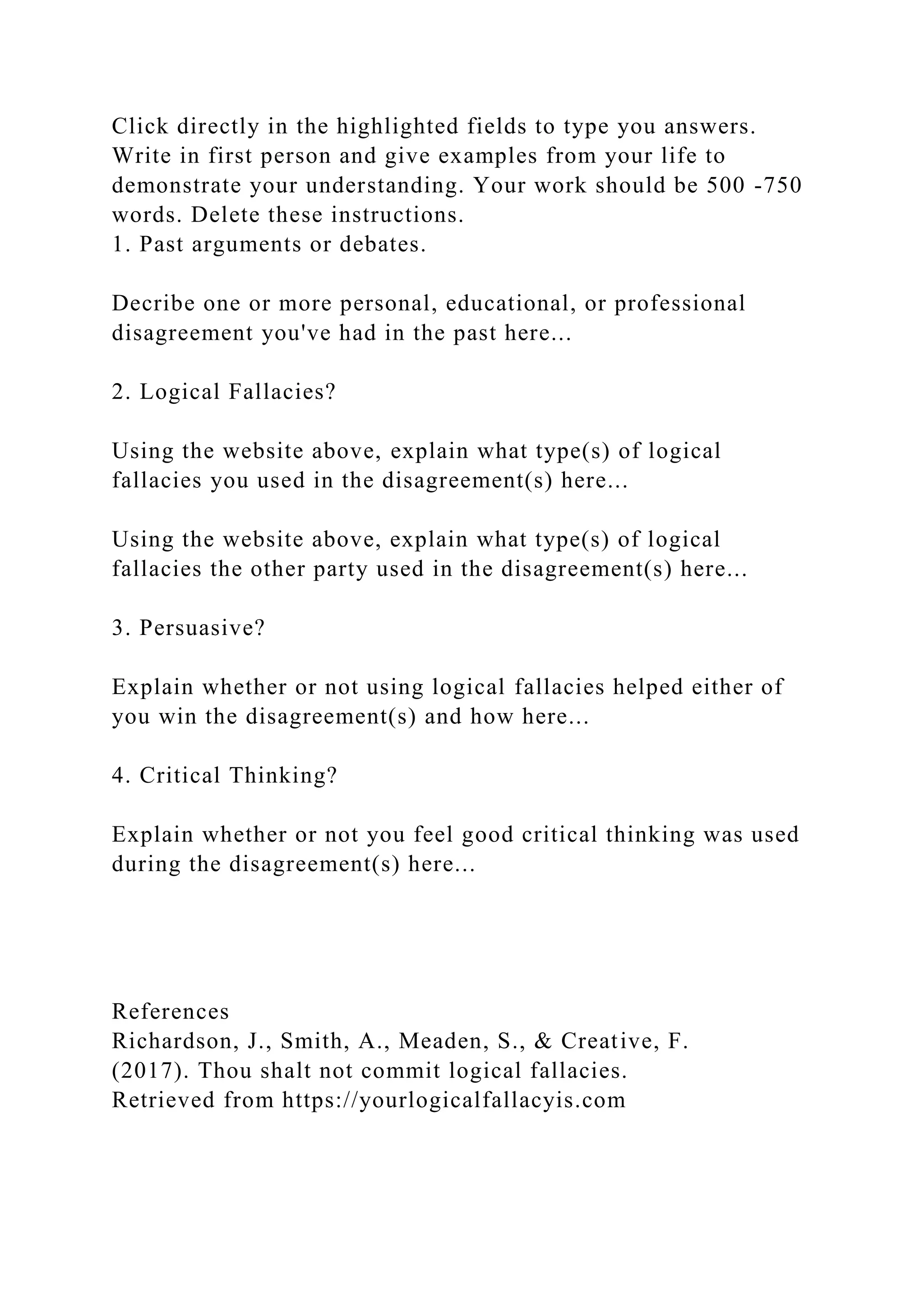
Directions: After reading this week’s materials and learning
about different kinds of logical fallacies at https://youtu.be/q-
Y-z6HmRgI , answer the following prompts in your own words.
Click directly in the highlighted fields to type you answers.
Write in first person and give examples from your life to
demonstrate your understanding. Your work should be 500 -750
words. Delete these instructions.
1. Past arguments or debates.
Decribe one or more personal, educational, or professional
disagreement you've had in the past here...
2. Logical Fallacies?
Using the website above, explain what type(s) of logical
fallacies you used in the disagreement(s) here...
Using the website above, explain what type(s) of logical
fallacies the other party used in the disagreement(s) here...
3. Persuasive?
Explain whether or not using logical fallacies helped either of
you win the disagreement(s) and how here...
4. Critical Thinking?
Explain whether or not you feel good critical thinking was used
during the disagreement(s) here...
References
Richardson, J., Smith, A., Meaden, S., & Creative, F.
(2017). Thou shalt not commit logical fallacies.
Retrieved from https://yourlogicalfallacyis.com
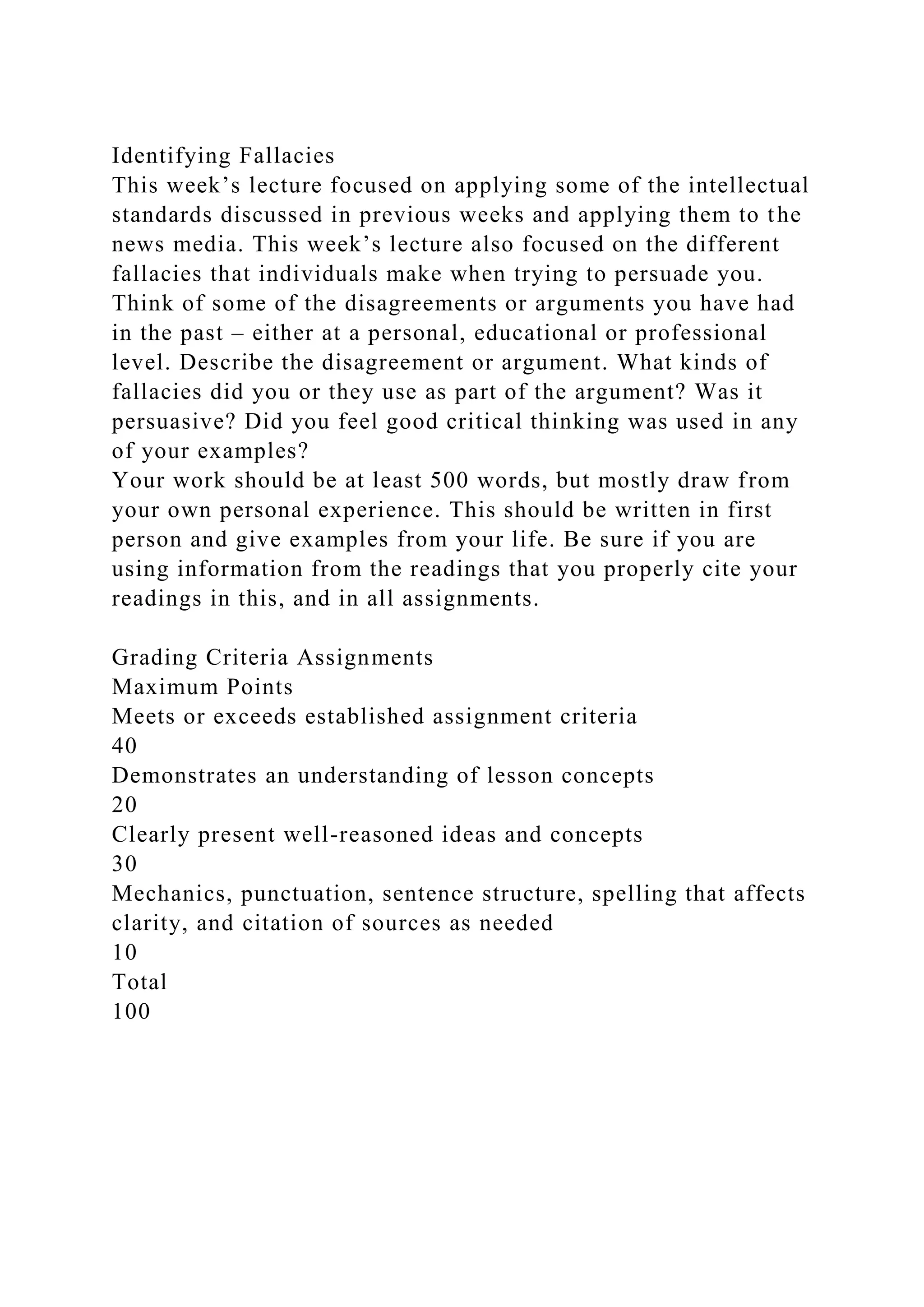
Identifying Fallacies
This week’s lecture focused on applying some of the intellectual
standards discussed in previous weeks and applying them to the
news media. This week’s lecture also focused on the different
fallacies that individuals make when trying to persuade you.
Think of some of the disagreements or arguments you have had
in the past – either at a personal, educational or professional
level. Describe the disagreement or argument. What kinds of
fallacies did you or they use as part of the argument? Was it
persuasive? Did you feel good critical thinking was used in any
of your examples?
Your work should be at least 500 words, but mostly draw from
your own personal experience. This should be written in first
person and give examples from your life. Be sure if you are
using information from the readings that you properly cite your
readings in this, and in all assignments.
Grading Criteria Assignments
Maximum Points
Meets or exceeds established assignment criteria
40
Demonstrates an understanding of lesson concepts
20
Clearly present well-reasoned ideas and concepts
30
Mechanics, punctuation, sentence structure, spelling that affects
clarity, and citation of sources as needed
10
Total
100
Poor Reasoning and Fallacies Cheat Sheet  Appeal to the Pe.docx

Poor Reasoning and Fallacies Cheat Sheet Appeal to the Pe.docx

  • 1.
    Poor Reasoning andFallacies Cheat Sheet Appeal to the People (Bandwagon) - Claiming that something is true just because many people believe it is. Example: Everybody buys this product, so it must be the best one. Faulty Appeal to Authority - Using research without naming the source, such as, "Many researchers say..." or answering questions one is not qualified to answer. Example: I asked my dentist if he thought this mole was cancerous. He said “No” so I do not need to get it checked out. Proof by Lack of Evidence (Burden of Proof) - Asserting something is true just because there is no evidence it's false. Example: UFO’s exist because no one has ever been able to prove they don’t. Innuendo – Making a claim without actually making the claim. Example: Non Sequitur - It doesn't follow logically. Samantha lives in a large building; therefore she must have a large home. Fake Dilemma (Black and White) – Presenting two alternative
  • 2.
    states as theonly possibilities, when in fact there are more. Example: "You are either for the U.S. or against the U.S." doesn't allow for neutral countries. Naturalistic Fallacy (Appeal to Nature) - Making the argument because something is “natural”, it is therefore valid, good or the way it’s supposed to be. Example: This product uses all natural ingredients therefore it’s the only one on the market you should buy. Circular Reasoning (Begging the Question) – Using the statement to prove the conclusion and the conclusion to prove the statement. Example: The word of Zorbo the Great is flawless and perfect. We know this because it says so in The Great and Infallible Book of Zorbo's Best and Most Truest Things that are Definitely True and Should Not Ever Be Questioned. Overgeneralization – Asserting something is an entire class of things when it may not be true for all members of the class. Example: Beth is a Psychology student and shy is shy, therefore all psychology students are shy. False Analogy (Slippery Slope) – Making a false or misleading analogy. Example: Colin Closet asserts
  • 3.
    that if weallow same-sex couples to marry, then the next thing we know we'll be allowing people to marry their parents, their cars and even monkeys. Jumping to Conclusions – Drawing conclusions with little evidence. Example: My son is crying, you must have taken his toy. Being Unrealistic – Using only information in an unrealistic manner. Example: The candidates just all graduated from college… therefore they should not take a job for less than 6 figures. Verbal Fallacies (Ambiguity) – Accenting, omitting, or misusing certain words to influence or mislead the reader or listener. Example: After the team lost, Susan became mad. (upset, angry, insane, happy… who knows) Using only information that supports your argument (Texas Sharpshooter) - Example: Research says a glass of wine a day is good for my heart. So drinking is good for my heart! Source: Jesse Richardson, Andy Smith and Som Meaden, www.fallacydetective.com, and HU260 Strategies for Decision Making - W6
  • 4.
    Lecture "Critical Thinking" http://au.linkedin.com/in/jesserichardsonaustralia http://espadav8.co.uk/ http://theprojectsomething.com/ http://www.fallacydetective.com/ HU260Week 6 Lecture Welcome to critical thinking, week six! We will discuss fallacies and other types of ways the critical thinking process is thwarted. A fallacy is an argument that uses poor reasoning. An argument can be fallacious whether or not its conclusion is true. A fallacy can be either formal or informal. An error that stems from a poor logical form is sometimes called a formal fallacy or simply an invalid argument. An informal fallacy is an error in reasoning that does not originate in improper logical form. Arguments committing informal fallacies may be formally valid but still fallacious. It’s all about the type of reasoning that is being used. Arguments may be valid but there may be fallacious elements to it caused by using poor reasoning in it. The argument itself can or cannot still be valid as a result. It depends on the points made in your thesis. You have your main points other sub points, Illustrations, examples, etc. any of those may not be coming from true valid reasoning or argument. The worst would be to have the main points of your thesis be invalid or have errors in reasoning. The main points are really what the whole argument is standing on. It really depends on what elements of the argument are falling under the fallacy. Poor reasoning takes away the logical flow of everything. It takes away the authority of the author. A lot of the facts and examples and things that are used to support the thesis are just resting on something that is not very validated not very strong so the whole paper or
  • 5.
    presentation can justfall apart. If it's something that most people know and can recognize then it really can make the speaker or writer feel like they don’t know what they're talking about. So it really depends on the level of reasoning and what pieces or components of the argument it rests on how much of the argument will fall apart under certain elements of fallacies. Another issue can be circular reasoning. This is using a statement to prove the conclusion and the conclusion to prove the statement. You don't want to have the whole premise of the thesis depend on the conclusion that you're building. And you don’t want to have the conclusion depend upon the thesis. For example, you say you shouldn’t take medication because it's bad for you. But in the end you say you should take medication because it's something that you need to do. It’s almost contradicting and it's giving you a circle of reasoning that leaves the reader wondering what the right thing to do is. Or it might leave them wondering if a valid point was even made. It’s almost like you're getting to you the end of the paper and then your finding the thesis. The thesis should always be in the beginning; state exactly what you will discuss in the paper and it should make a statement of declaration. It should take a stance. Everything else should work up and support it and in the end you can reiterate, restate certain things and tie it all together. if the author is kind of unsure of what they're writing and they're presenting and the author their self doesn't figure it out until the very end when they make an a declarative statement, that may be somewhat dependent upon the opening premise, it's almost as if the entire paper didn't really mean much because the thesis comes at the very end and then you're waiting for all the information that's going to follow to support that new thesis that was presented. It is like the opening and closing are working off of each other and they're giving somewhat conflicting information or presenting a whole new thesis.
  • 6.
    Next we haveovergeneralization. This is asserting something of an entire class of things when it may not be true for all members of the class. For example: Beth is a psychology student and she is shy. Psychology students are shy. We know that this is not true. This is overgeneralizing based on one incident. So you want to make sure that your facts and your overall conclusion and closing statement and what you have just presented does not overgeneralize. You don’t want to take certain select facts and points that you are feeding into your paper and then use that to come up with your own overgeneralization by the end of the paper. People may be very well aware of other facts and information that prove that that's not true. For example they may say, “well I know a lot of psychology students and most of them actually are not shy.” There’s a lot of evidence out there. In theory you could pick and choose all the shy psychology students and then come to that overgeneralization at the end of your paper. But it's not going to work out too well because people know that that is overgeneralization. Most of us have the type of experience to know that it is a false conclusion. So you want to be very careful depending on what type of field you working in, especially when it's a topic or industry that you don't know that well. It can be much easier to come up with an overgeneralization and not realize at all that that's what you're doing because the topic is somewhat new to you. So you need to really dissect and take apart all of your facts and information and see what kind of conclusion you are including your paper or speech. Make sure that you're not overgeneralizing at all, especially when using words such as all, everyone, etc. you want to be very careful about using that kind of terminology especially at the end of the paper. Now let’s look at false analogy. This is making a false or misleading analogy is jumping to a conclusion. For example, “my son is crying so you must've taken his toy.” It’s just jumping to an analysis, a critique or an answer for whatever the situation is without having all the facts or taking the time to
  • 7.
    really understand whatis going on. Whatever your argument is, this whole process of clinical thinking is not something that you can just rush through and spit out at the end. you really need to take a lot of time in considering everything that you are including, everything you are excluding, all of your assumptions, all your generalizations, all of your analogies and examples that you are using. I said before it's very easy when you don't know the topic well to make these kinds of mistakes. So you want to try and pull from sources that you really respect. Find sources that have examples and analogies that you can use or might perhaps spark your creativity and that you can kind of get a feeling for, “this is the analogy they are using, maybe I can use something more general that more people would understand, but I get the format of how respected people in those fields create analogies.” And just sort of switch the subject a little here and there on what they have done. But you want to make sure that you are not jumping to any conclusions about what is right or wrong and it's using that terminology of right or wrong, the must haves, the must bee’s and has to be kind of thinking in terminology, especially within the paper. This is not just about the conclusion. It is about assumptions that are made and can be made throughout your work. So you want to be sure you're not jumping to any conclusion with any fact or example or piece of the paper. You want to stick to supporting your thesis and make sure your thesis itself is not jumping to a conclusion. Sometimes a thesis can seem like it’s jumping to conclusions but the rest of the paper is presenting facts and examples that support it. So it no longer is a conclusion or has that feel of jumping to conclusion because you spent the whole paper supporting the thesis. Finally, we have being unrealistic. An example would be, “I just graduated high school and I am ready to enter the workforce. I will not take a job that pays less than six figures.” Yes, people have been able to manifest some pretty interesting things, especially if your father owns his own business. But in general
  • 8.
    you want tomake sure that you are being realistic in your thinking and expectations. A lot of the expectations of research or of what people can do with research falls in line again assumptions and jumping to conclusions. You want to strive to be realistic about what your expectations are with the work you're doing. Be careful not to answer questions one is not competent to answer. For example, “I asked my dentist if he thought this mole was cancerous he said no so I don’t need to get it checked out.” you're not going to a reliable source for your information, you don't have the information or you may be answering questions for other people without having all the facts. When dealing with critical thinking in academia, you want to make sure you are answering questions from a place of authority. If you're not you need to just tell people that it’s something you’ll have to research. Just tell them that you don't have all the answers. There’s nothing wrong with saying things like that. You are presenting yourself as an expert and you have a certain responsibility to make sure you are conveying information that you can feel good about. Whether it's 100% true or not you want to know you're doing the best to your abilities. Use only the information that supports your point of view. for example, “ research says a glass of wine a day is good for my heart.” There is lot of other research that may conflict with that and you need to be sure that you investigate that. It doesn't mean your whole thesis is wrong. But it may be that you need to tweak it a little. For example, “drinking one glass of wine a day is good for my heart.” so it's not necessarily that you will be proven wrong by looking at the opposite side; it just may show that you need to tweak your thesis a little bit. A lot of times when you say blanket statements like “drinking is good for my heart” there will be a lot of people in the field who will call you on such a broad strong statement without considering the other side. By saying “drinking one glass of wine a day” is good for
  • 9.
    my heart you’reshowing that you have done your research to see what the opposing side thinks. Here is a little bit on verbal fallacies. Aristotle was the first to systematize fallacy into a list. On this was his listing of verbal policies that we all can make without realizing it. · Accenting or giving emphasis to certain words or certain findings. This can lead someone to give unconscious credence to certain words, beliefs or certain facts because they've been said with more authority and power behind them. · Amphibology is ambiguous connections between things. It’s usually two short sentences strung together that can have different meanings depending upon the way it reads or is heard. For example, saying one shouldn’t drive. It’s dangerous on the streets. It brings into question the reasoning behind those statements. Is it because of their age that they shouldn't? Is it because there is construction or potholes? Is there chaos? It’s somewhat of an ambiguous statement that could lead to people making certain assumptions based on their experiences. That would have them then infer different things about what was said. · Equivocation which is using a term that can be taken and in several ways or have several different meanings. You’re leaving it up to you the reader or the person listening to make up their own minds as far as picking which meaning they're going to ascribe certain word. · Composition is all about how you are structuring the pieces from the point you're starting with to where you're leading people. It’s about how you’re structuring paragraphs and sentences. And even how you use terms that are more pleasing or more positive around certain facts that you want to be well received and remembered. It’s all about the choice of language and how things are fit together and compose together. · Division in fallacy is when you're leading people to think that if something is true of one thing it must be true of all things
  • 10.
    around it orrelated to it that you are presenting. It’s almost getting the reader or the audience to make a conclusion based on how you're presenting one part of the argument and inferring that all other things must be true as well. · Figure of speech is using common everyday things that may have a lot of experience and meaning behind them in general for people because it’s something that they use a lot in their conversation and their lives. So all of the meaning experience and behind certain figures of speech come with it when you use it. So you’re drawing on the emotions and experiences and applying it to the fact or topic that you're using. So you can really emphasize a certain area and make it stand out more and seem more believable based on calling upon the figure of speech and the emotional responses and experiences that come with them. Fallacies There are several common fallacies in thinking. There are also fallacies in reasoning. As a student it is important that you identify fallacies but you identify bad reasoning. Fallacies can come from illogical pieces of information or from false information. You can use your knowledge of fallacies to help you use your critical thinking skills and to help you argue against points of view that do not make sense or are faulty. Here are several common fallacies: 1. Circular reasoning: Using a statement (premise) to prove the conclusion and the conclusion to prove the statement (premise). Example: One should not take medication because it is against Scientology and one must follow Scientology because it is human nature. 2. Overgeneralization: asserting something of an entire class of things when it may not be true for all members of the class. Example: Beth is a psychology student and she is shy. Psychology students are shy.
  • 11.
    3. False analogy:making a false or misleading analogy. Example 4. Jumping to conclusions. Example: My son is crying, you must have taken his toy. 5. Being unrealistic. Example: I just graduate high school and I am ready to enter the workforce. I will not take a job that pays less than six figures. 6. Answering questions one is not competent to answer. Example: I asked my dentist if he thought this mole was cancerous. He said “No” so I do not need to get it checked out. 7. Use only the information that supports my view point. Example: Research says a glass of wine a day is good for my heart. So drinking is good for my heart! Media Bias and Propaganda All tv media, newspapers, radio talk shows, etc has its own unique view of the world, society, and culture, which colors how they see the world and report it to the public. The reality is the stories they are reporting are much more complex than what they can report. The reader must know this when they are reading, listening, and processing the news. · Points of view · Objectivity · Perception Propaganda: Webster’s Dictionary (2012) defines propaganda as “any systematic widespread dissemination or promotion of particular ideas, doctrines, practices, etc. to further one’s own cause or to damage an opposing one.” The word propaganda has a negative connotation because it implies deception or distortion. If you consider that most of what we read or watch on tv is going to come from one world view (the world view we most identify with) then it is likely to contain propaganda as it is considered by other cultures and/or nationalities. This does not mean that the world view you identify with is unvaried. There are likely many variations within each world view. Not
  • 12.
    everyone within theworld view is going to agree or even share the same view point. As you know not every American agrees with every American. Just as not every Italian will agree with every Italian. However, there is a difference in perspective a worldview from an American and an Italian. It should also be considered that the differences in viewpoint carry insight, how this does not necessarily equate to EQUAL insight. Review a world event, such as the recent attack on the U.S. embassy in Libya. First read a U.S. article on the attack. Identify the point of view in the article. Next, choose an article from a different country on the same attack. Consider reviewing an article written from a Chinese, Egyptian, or United Kingdom source, other interesting sources will come from Iran and North Korea. Identify the writer’s point of view. Consider the differences in the world views for each of the articles. We could spend a great deal of time reviewing the different types of propaganda throughout our American history. You can probably identify many different pieces of propaganda from the WWII era. Propaganda served many purposes for many different cultures/countries during this time. Review the following website http://www.calvin.edu/academic/cas/gpa/ww2era.htm an d identify one piece of propaganda that you found to be most effective in its message. IDENTIFYING FALLACIES 1 HU260 Week 6 Reflection: Identifying Logical Fallacies Click Here to Type Your Name… Running Head: IDENTIFYING FALLACIES Running head: CRITICAL THINKING 1 Grantham University Identifying Logical Fallacies Directions: After reading this week’s materials and learning about different kinds of logical fallacies at https://youtu.be/q- Y-z6HmRgI , answer the following prompts in your own words.
  • 13.
    Click directly inthe highlighted fields to type you answers. Write in first person and give examples from your life to demonstrate your understanding. Your work should be 500 -750 words. Delete these instructions. 1. Past arguments or debates. Decribe one or more personal, educational, or professional disagreement you've had in the past here... 2. Logical Fallacies? Using the website above, explain what type(s) of logical fallacies you used in the disagreement(s) here... Using the website above, explain what type(s) of logical fallacies the other party used in the disagreement(s) here... 3. Persuasive? Explain whether or not using logical fallacies helped either of you win the disagreement(s) and how here... 4. Critical Thinking? Explain whether or not you feel good critical thinking was used during the disagreement(s) here... References Richardson, J., Smith, A., Meaden, S., & Creative, F. (2017). Thou shalt not commit logical fallacies. Retrieved from https://yourlogicalfallacyis.com
  • 14.
    Identifying Fallacies This week’slecture focused on applying some of the intellectual standards discussed in previous weeks and applying them to the news media. This week’s lecture also focused on the different fallacies that individuals make when trying to persuade you. Think of some of the disagreements or arguments you have had in the past – either at a personal, educational or professional level. Describe the disagreement or argument. What kinds of fallacies did you or they use as part of the argument? Was it persuasive? Did you feel good critical thinking was used in any of your examples? Your work should be at least 500 words, but mostly draw from your own personal experience. This should be written in first person and give examples from your life. Be sure if you are using information from the readings that you properly cite your readings in this, and in all assignments. Grading Criteria Assignments Maximum Points Meets or exceeds established assignment criteria 40 Demonstrates an understanding of lesson concepts 20 Clearly present well-reasoned ideas and concepts 30 Mechanics, punctuation, sentence structure, spelling that affects clarity, and citation of sources as needed 10 Total 100