Induction and augmentation of Labor
1
 General
Induction is indicated when the benefits to either
the mother or the fetus out weighs those of
continuing the pregnancy.
Induction is associated with increased
complications as compared to spontaneous labor.
Definition
2
Induction – Induction of labor is the artificial
stimulation of uterine contractions before the
spontaneous onset of true labor at 28 or more
weeks of gestation to achieve vaginal delivery.
Augmentations
- Augmentation of labor is stimulation of the uterus
to increase its frequency, duration and/or strength
of spontaneously initiated labor.
Prerequisites
3
− Valid indication
− No contraindication
− Elective induction (Assess Bishop Score & fetal
lung maturity )
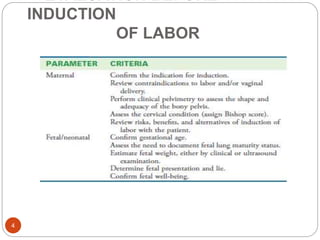
EVALUATION BEFORE
INDUCTION
OF LABOR
4
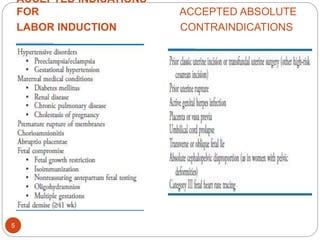
ACCEPTED INDICATIONS
FOR
LABOR INDUCTION
ACCEPTED ABSOLUTE
CONTRAINDICATIONS
5
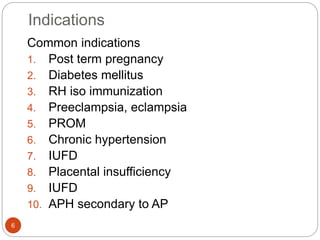
Indications
6
Common indications
1. Post term pregnancy
2. Diabetes mellitus
3. RH iso immunization
4. Preeclampsia, eclampsia
5. PROM
6. Chronic hypertension
7. IUFD
8. Placental insufficiency
9. IUFD
10. APH secondary to AP
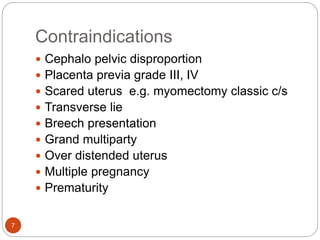
Contraindications
7
 Cephalo pelvic disproportion
 Placenta previa grade III, IV
 Scared uterus e.g. myomectomy classic c/s
 Transverse lie
 Breech presentation
 Grand multiparty
 Over distended uterus
 Multiple pregnancy
 Prematurity
Pre induction cervical Ripening
8
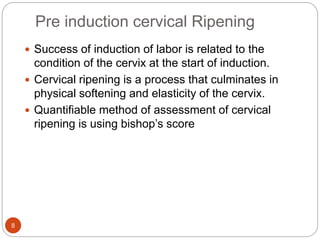
 Success of induction of labor is related to the
condition of the cervix at the start of induction.
 Cervical ripening is a process that culminates in
physical softening and elasticity of the cervix.
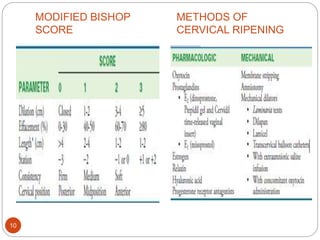
 Quantifiable method of assessment of cervical
ripening is using bishop’s score
9
MODIFIED BISHOP
SCORE
METHODS OF
CERVICAL RIPENING
10
Methods of cervical ripening
11
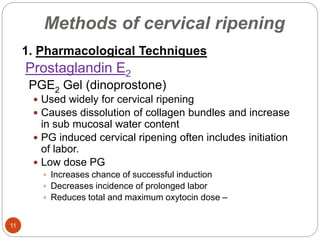
1. Pharmacological Techniques
Prostaglandin E2
PGE2 Gel (dinoprostone)
 Used widely for cervical ripening
 Causes dissolution of collagen bundles and increase
in sub mucosal water content
 PG induced cervical ripening often includes initiation
of labor.
 Low dose PG
 Increases chance of successful induction
 Decreases incidence of prolonged labor
 Reduces total and maximum oxytocin dose –
Contd …
12
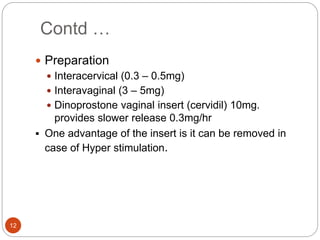
 Preparation
 Interacervical (0.3 – 0.5mg)
 Interavaginal (3 – 5mg)
 Dinoprostone vaginal insert (cervidil) 10mg.
provides slower release 0.3mg/hr
 One advantage of the insert is it can be removed in
case of Hyper stimulation.
Contd …
13
 Administration
 Administer at or near labor ward
 The woman remains recumbent for at least 30
minutes
 Observe the patient from 30min to 2hrs
 Monitor FHB and contraction
 If no contraction transfer or discharge the patient .
 Discontinue PG and begin oxytocin infusion if
 Membranes rupture
 Cervical ripening has been achieved
 Labor has started
 Or 12 hours has passed
Contd …
14
 Side effects
 Hyper stimulation > 6 cont. 10min
 Fever
 Vomiting
 Diarrhea
 Precaution should be taken when using it in patients
with
 Glaucoma
 B-Asthma
 Hepatic or renal failure
Contd …
15
Prostaglandin E1(misoprostol)
 Available as 100ug tab for prevention of peptic ulcer
 Less expensive from dinoprostone
 Intra vaginal administration of 25ug not more
frequent than every 3-6hrs is effective in women with
unfavorable cervix
Contd …
16
2. Mechanical techniques
1.Foley catheter
1. Inflation of the balloon
2. Inflation of the balloon with extra amniotic saline
infusion.
This results in:-
• Rapid improvement of bishops score and shorter
labor
Contd ….
17
2. Hygroscopic cervical Dilators (Laminaria)
 Osmotic cervical dilators
 Improve cervical status rapidly
 Low cost
 Ease of placement
 Can be removed quickly
Contd ……
18
3. Membrane Stripping
 Commonly practiced
 Increased PG synthesis occurs after stripping the
membrane
Induction procedures
19
1. Amniotomy. (Artificial Rupture of
Membranes)
 Also referred as surgical induction
 Is a recommended practice in both induction and
augmentation.
 Prerequisites:-
− Appropriate indication
− Engaged fetal head (relative)
− No contraindications such as cord presentation, vasa
previa
− No fetal distress (unless immediate vaginal delivery
is possible)
 Indications:-
 Induce labor
 Use of internal fetal monitoring
Contd ….
20
Contraindications:-
- Cord presentations
- Placenta previa
- Vasa previa
- Active genital herpes(intact fetal membranes or < 4 hrs
of rupture
- Presenting part above the pelvic inlet (relative)
Risks :-
- cord prolapse
- Increased risk of infection
- Increase perinatal HIV transmission
Contd ….
21
2. Oxytocin infusion
 Oxytocin is the first polypeptide hormone
synthesized
 Record maternal & fetal conditions and progress
of labor..
 The goal is to achieve effective uterine
contraction that’s sufficient to produce cervical
change and fetal descent while avoiding uterine
hyper stimulation and /or non reassuring FHB .
Contd ….
22
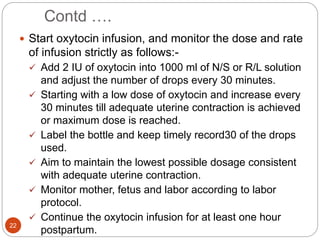
 Start oxytocin infusion, and monitor the dose and rate
of infusion strictly as follows:-
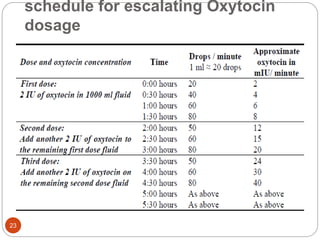
 Add 2 IU of oxytocin into 1000 ml of N/S or R/L solution
and adjust the number of drops every 30 minutes.
 Starting with a low dose of oxytocin and increase every
30 minutes till adequate uterine contraction is achieved
or maximum dose is reached.
 Label the bottle and keep timely record30 of the drops
used.
 Aim to maintain the lowest possible dosage consistent
with adequate uterine contraction.
 Monitor mother, fetus and labor according to labor
protocol.
 Continue the oxytocin infusion for at least one hour
postpartum.
schedule for escalating Oxytocin
dosage
23
Contd …
24
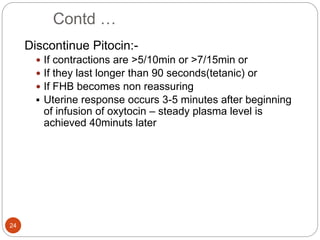
Discontinue Pitocin:-
 If contractions are >5/10min or >7/15min or
 If they last longer than 90 seconds(tetanic) or
 If FHB becomes non reassuring
 Uterine response occurs 3-5 minutes after beginning
of infusion of oxytocin – steady plasma level is
achieved 40minuts later
Contd ….
25
 Response depends on : -
 Previous uterine activity
 Uterine sensitivity
 Cervical status
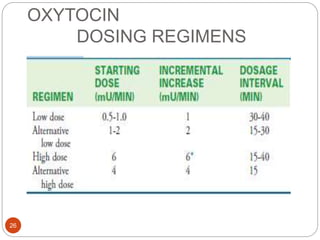
 Different regimens are used for oxytocin infusion .
 Low dose
 High dose
OXYTOCIN
DOSING REGIMENS
26
Complications of induction of
labor
27
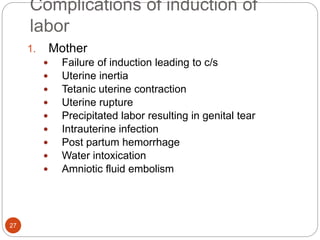
1. Mother
 Failure of induction leading to c/s
 Uterine inertia
 Tetanic uterine contraction
 Uterine rupture
 Precipitated labor resulting in genital tear
 Intrauterine infection
 Post partum hemorrhage
 Water intoxication
 Amniotic fluid embolism
Contd ….
28
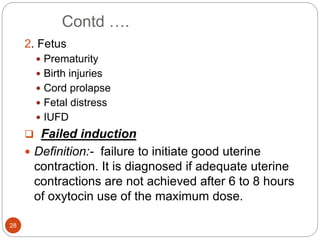
2. Fetus
 Prematurity
 Birth injuries
 Cord prolapse
 Fetal distress
 IUFD
 Failed induction
 Definition:- failure to initiate good uterine
contraction. It is diagnosed if adequate uterine
contractions are not achieved after 6 to 8 hours
of oxytocin use of the maximum dose.
Contd …
29
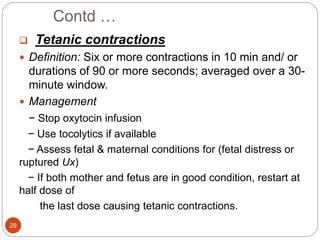
 Tetanic contractions
 Definition: Six or more contractions in 10 min and/ or
durations of 90 or more seconds; averaged over a 30-
minute window.
 Management
− Stop oxytocin infusion
− Use tocolytics if available
− Assess fetal & maternal conditions for (fetal distress or
ruptured Ux)
− If both mother and fetus are in good condition, restart at
half dose of
the last dose causing tetanic contractions.
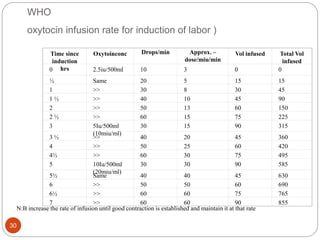
WHO
oxytocin infusion rate for induction of labor )
30
Time since
induction
hrs
Oxytoinconc Drops/min Approx. –
dose/miu/min
Vol infused Total Vol
infused
0 2.5iu/500ml 10 3 0 0
½ Same 20 5 15 15
1 >> 30 8 30 45
1 ½ >> 40 10 45 90
2 >> 50 13 60 150
2 ½ >> 60 15 75 225
3 5Iu/500ml
(10miu/ml)
30 15 90 315
3 ½ >> 40 20 45 360
4 >> 50 25 60 420
4½ >> 60 30 75 495
5 10Iu/500ml
(20miu/ml)
30 30 90 585
5½ Same 40 40 45 630
6 >> 50 50 60 690
6½ >> 60 60 75 765
7 >> 60 60 90 855
N:B increase the rate of infusion until good contraction is established and maintain it at that rate
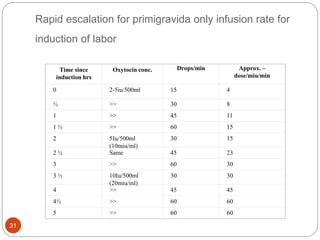
Rapid escalation for primigravida only infusion rate for
induction of labor
31
Time since
induction hrs
Oxytocin conc. Drops/min Approx. –
dose/miu/min
0 2-5iu/500ml 15 4
½ >> 30 8
1 >> 45 11
1 ½ >> 60 15
2 5Iu/500ml
(10miu/ml)
30 15
2 ½ Same 45 23
3 >> 60 30
3 ½ 10Iu/500ml
(20miu/ml)
30 30
4 >> 45 45
4½ >> 60 60
5 >> 60 60

Induction and augmentation of Labor.ppt

  • 1.
    Induction and augmentationof Labor 1  General Induction is indicated when the benefits to either the mother or the fetus out weighs those of continuing the pregnancy. Induction is associated with increased complications as compared to spontaneous labor.
  • 2.
    Definition 2 Induction – Inductionof labor is the artificial stimulation of uterine contractions before the spontaneous onset of true labor at 28 or more weeks of gestation to achieve vaginal delivery. Augmentations - Augmentation of labor is stimulation of the uterus to increase its frequency, duration and/or strength of spontaneously initiated labor.
  • 3.
    Prerequisites 3 − Valid indication −No contraindication − Elective induction (Assess Bishop Score & fetal lung maturity )
  • 4.
  • 5.
  • 6.
    Indications 6 Common indications 1. Postterm pregnancy 2. Diabetes mellitus 3. RH iso immunization 4. Preeclampsia, eclampsia 5. PROM 6. Chronic hypertension 7. IUFD 8. Placental insufficiency 9. IUFD 10. APH secondary to AP
  • 7.
    Contraindications 7  Cephalo pelvicdisproportion  Placenta previa grade III, IV  Scared uterus e.g. myomectomy classic c/s  Transverse lie  Breech presentation  Grand multiparty  Over distended uterus  Multiple pregnancy  Prematurity
  • 8.
    Pre induction cervicalRipening 8  Success of induction of labor is related to the condition of the cervix at the start of induction.  Cervical ripening is a process that culminates in physical softening and elasticity of the cervix.  Quantifiable method of assessment of cervical ripening is using bishop’s score
  • 9.
  • 10.
  • 11.
    Methods of cervicalripening 11 1. Pharmacological Techniques Prostaglandin E2 PGE2 Gel (dinoprostone)  Used widely for cervical ripening  Causes dissolution of collagen bundles and increase in sub mucosal water content  PG induced cervical ripening often includes initiation of labor.  Low dose PG  Increases chance of successful induction  Decreases incidence of prolonged labor  Reduces total and maximum oxytocin dose –
  • 12.
    Contd … 12  Preparation Interacervical (0.3 – 0.5mg)  Interavaginal (3 – 5mg)  Dinoprostone vaginal insert (cervidil) 10mg. provides slower release 0.3mg/hr  One advantage of the insert is it can be removed in case of Hyper stimulation.
  • 13.
    Contd … 13  Administration Administer at or near labor ward  The woman remains recumbent for at least 30 minutes  Observe the patient from 30min to 2hrs  Monitor FHB and contraction  If no contraction transfer or discharge the patient .  Discontinue PG and begin oxytocin infusion if  Membranes rupture  Cervical ripening has been achieved  Labor has started  Or 12 hours has passed
  • 14.
    Contd … 14  Sideeffects  Hyper stimulation > 6 cont. 10min  Fever  Vomiting  Diarrhea  Precaution should be taken when using it in patients with  Glaucoma  B-Asthma  Hepatic or renal failure
  • 15.
    Contd … 15 Prostaglandin E1(misoprostol) Available as 100ug tab for prevention of peptic ulcer  Less expensive from dinoprostone  Intra vaginal administration of 25ug not more frequent than every 3-6hrs is effective in women with unfavorable cervix
  • 16.
    Contd … 16 2. Mechanicaltechniques 1.Foley catheter 1. Inflation of the balloon 2. Inflation of the balloon with extra amniotic saline infusion. This results in:- • Rapid improvement of bishops score and shorter labor
  • 17.
    Contd …. 17 2. Hygroscopiccervical Dilators (Laminaria)  Osmotic cervical dilators  Improve cervical status rapidly  Low cost  Ease of placement  Can be removed quickly
  • 18.
    Contd …… 18 3. MembraneStripping  Commonly practiced  Increased PG synthesis occurs after stripping the membrane
  • 19.
    Induction procedures 19 1. Amniotomy.(Artificial Rupture of Membranes)  Also referred as surgical induction  Is a recommended practice in both induction and augmentation.  Prerequisites:- − Appropriate indication − Engaged fetal head (relative) − No contraindications such as cord presentation, vasa previa − No fetal distress (unless immediate vaginal delivery is possible)  Indications:-  Induce labor  Use of internal fetal monitoring
  • 20.
    Contd …. 20 Contraindications:- - Cordpresentations - Placenta previa - Vasa previa - Active genital herpes(intact fetal membranes or < 4 hrs of rupture - Presenting part above the pelvic inlet (relative) Risks :- - cord prolapse - Increased risk of infection - Increase perinatal HIV transmission
  • 21.
    Contd …. 21 2. Oxytocininfusion  Oxytocin is the first polypeptide hormone synthesized  Record maternal & fetal conditions and progress of labor..  The goal is to achieve effective uterine contraction that’s sufficient to produce cervical change and fetal descent while avoiding uterine hyper stimulation and /or non reassuring FHB .
  • 22.
    Contd …. 22  Startoxytocin infusion, and monitor the dose and rate of infusion strictly as follows:-  Add 2 IU of oxytocin into 1000 ml of N/S or R/L solution and adjust the number of drops every 30 minutes.  Starting with a low dose of oxytocin and increase every 30 minutes till adequate uterine contraction is achieved or maximum dose is reached.  Label the bottle and keep timely record30 of the drops used.  Aim to maintain the lowest possible dosage consistent with adequate uterine contraction.  Monitor mother, fetus and labor according to labor protocol.  Continue the oxytocin infusion for at least one hour postpartum.
  • 23.
    schedule for escalatingOxytocin dosage 23
  • 24.
    Contd … 24 Discontinue Pitocin:- If contractions are >5/10min or >7/15min or  If they last longer than 90 seconds(tetanic) or  If FHB becomes non reassuring  Uterine response occurs 3-5 minutes after beginning of infusion of oxytocin – steady plasma level is achieved 40minuts later
  • 25.
    Contd …. 25  Responsedepends on : -  Previous uterine activity  Uterine sensitivity  Cervical status  Different regimens are used for oxytocin infusion .  Low dose  High dose
  • 26.
  • 27.
    Complications of inductionof labor 27 1. Mother  Failure of induction leading to c/s  Uterine inertia  Tetanic uterine contraction  Uterine rupture  Precipitated labor resulting in genital tear  Intrauterine infection  Post partum hemorrhage  Water intoxication  Amniotic fluid embolism
  • 28.
    Contd …. 28 2. Fetus Prematurity  Birth injuries  Cord prolapse  Fetal distress  IUFD  Failed induction  Definition:- failure to initiate good uterine contraction. It is diagnosed if adequate uterine contractions are not achieved after 6 to 8 hours of oxytocin use of the maximum dose.
  • 29.
    Contd … 29  Tetaniccontractions  Definition: Six or more contractions in 10 min and/ or durations of 90 or more seconds; averaged over a 30- minute window.  Management − Stop oxytocin infusion − Use tocolytics if available − Assess fetal & maternal conditions for (fetal distress or ruptured Ux) − If both mother and fetus are in good condition, restart at half dose of the last dose causing tetanic contractions.
  • 30.
    WHO oxytocin infusion ratefor induction of labor ) 30 Time since induction hrs Oxytoinconc Drops/min Approx. – dose/miu/min Vol infused Total Vol infused 0 2.5iu/500ml 10 3 0 0 ½ Same 20 5 15 15 1 >> 30 8 30 45 1 ½ >> 40 10 45 90 2 >> 50 13 60 150 2 ½ >> 60 15 75 225 3 5Iu/500ml (10miu/ml) 30 15 90 315 3 ½ >> 40 20 45 360 4 >> 50 25 60 420 4½ >> 60 30 75 495 5 10Iu/500ml (20miu/ml) 30 30 90 585 5½ Same 40 40 45 630 6 >> 50 50 60 690 6½ >> 60 60 75 765 7 >> 60 60 90 855 N:B increase the rate of infusion until good contraction is established and maintain it at that rate
  • 31.
    Rapid escalation forprimigravida only infusion rate for induction of labor 31 Time since induction hrs Oxytocin conc. Drops/min Approx. – dose/miu/min 0 2-5iu/500ml 15 4 ½ >> 30 8 1 >> 45 11 1 ½ >> 60 15 2 5Iu/500ml (10miu/ml) 30 15 2 ½ Same 45 23 3 >> 60 30 3 ½ 10Iu/500ml (20miu/ml) 30 30 4 >> 45 45 4½ >> 60 60 5 >> 60 60