Production & Operations
Management
(Code-MBT206)
By
Dr. H. L. Bhaskar
(Ph.D., MBA-HR & Marketing, UGC-NET/JRF)
Roorkee Institute of Technology,
Uttarakhand
Reference: https://cft.vanderbilt.edu/guides-sub-pages/blooms-taxonomy/
Background
• In 1956, Benjamin Bloom with collaborators Max Englehart, Edward Furst, Walter Hill, and David
Krathwohl published a framework for categorizing educational goals: Taxonomy of Educational
Objectives. Familiarly known as Bloom’s Taxonomy, this framework has been applied by generations
of K-12 teachers and college instructors in their teaching.
• The framework elaborated by Bloom and his collaborators consisted of six major categories:
Knowledge, Comprehension, Application, Analysis, Synthesis, and Evaluation.
• The categories after Knowledge were presented as “skills and abilities,” with the understanding that
knowledge was the necessary precondition for putting these skills and abilities into practice.
• The Original Taxonomy (1956)
 Here are the authors’ brief explanations of these main categories in from the appendix of Taxonomy
of Educational Objectives (Handbook One, pp. 201-207):
1. Knowledge: “involves the recall of specifics and universals, the recall of methods and processes, or
the recall of a pattern, structure, or setting.”
2. Comprehension: “refers to a type of understanding
3. Application: refers to the “use of abstractions in particular and concrete situations.”
4. Analysis: represents the “breakdown of a communication into its constituent elements
5. Synthesis: involves the “putting together of elements and parts so as to form a whole.”
6. Evaluation: produces “judgments about the value of material and methods for given purposes.”
The Revised Taxonomy (2001)
• A group of cognitive psychologists, curriculum theorists and instructional researchers, and testing
and assessment specialists published in 2001 a revision of Bloom’s Taxonomy with the title A
Taxonomy for Teaching, Learning, and Assessment.
• The authors of the revised taxonomy highlight this dynamism, using verbs to label their categories
and subcategories (rather than the nouns of the original taxonomy). These “action words”
describe the cognitive processes by which thinkers encounter and work with knowledge:
Remember
•Recognizing
•Recalling
Understand
•Interpreting
•Exemplifying
•Classifying
•Summarizing
•Inferring
•Comparing
•Explaining
Apply
•Executing
•Implementing
Analyze
•Differentiating
•Organizing
•Attributing
Evaluate
•Checking
•Critiquing
Create
•Generating
•Planning
•Producing
Continue…..
• In the revised taxonomy, knowledge is at the basis of these six cognitive processes, but its
authors created a separate taxonomy of the types of knowledge used in cognition:
•Factual Knowledge
• Knowledge of terminology
• Knowledge of specific details and elements
•Conceptual Knowledge
• Knowledge of classifications and categories
• Knowledge of principles and generalizations
• Knowledge of theories, models, and structures
•Procedural Knowledge
• Knowledge of subject-specific skills and algorithms
• Knowledge of subject-specific techniques and methods
• Knowledge of criteria for determining when to use appropriate procedures
•Metacognitive Knowledge
• Strategic Knowledge
• Knowledge about cognitive tasks, including appropriate contextual and
conditional knowledge
• Self-knowledge
Mary Forehand from the University of Georgia provides a guide to the revised version
giving a brief summary of the revised taxonomy and a helpful table of the six cognitive
processes and four types of knowledge.
Course Outcomes(CO’s)
1. Analyze the basics of production management and
the relevant and responsible factors.
2. Demonstrate & apply the various types of production
processes, the essentialities of a product such as its
selection, various procedures and its stocking.
3. Create the various activities relating to scheduling
and measuring of production take place and how
control can be obtained on both product and quality.
4. Develop various models that deal with inventory, its
control, safety and security management in
production process.
5. Create supply and logistics, distribution networks and
its management.
4/8/2023
Suggested Books & Journals
Books:
1. Aswathappa, K, Production and Operations Management,
TMH, Delhi
2. Garg, Ajay-Production and Operations Management, TMH,
Delhi
3. Charry SN, Production and Operation Management-Concepts
Methods and Strategy, PHI New Delhi 2005.
Journals:
1. International Journal of Production Research- Taylor &
Francis
2. Production and Operations Management- Wiley
3. International Journal of Production Economics- Elsevier
4/8/2023
Contents
Unit-1 Introduction
• Basic concepts of production and operations
management
• Nature and scope of Production & operations
management
• Relationship with other systems in the organization
• Factor affecting system & concept of POM
• Facility locations
• Types of manufacturing systems
• Lean manufacturing
• Planning & analysis
4/8/2023
Basic concepts of production and
operations management
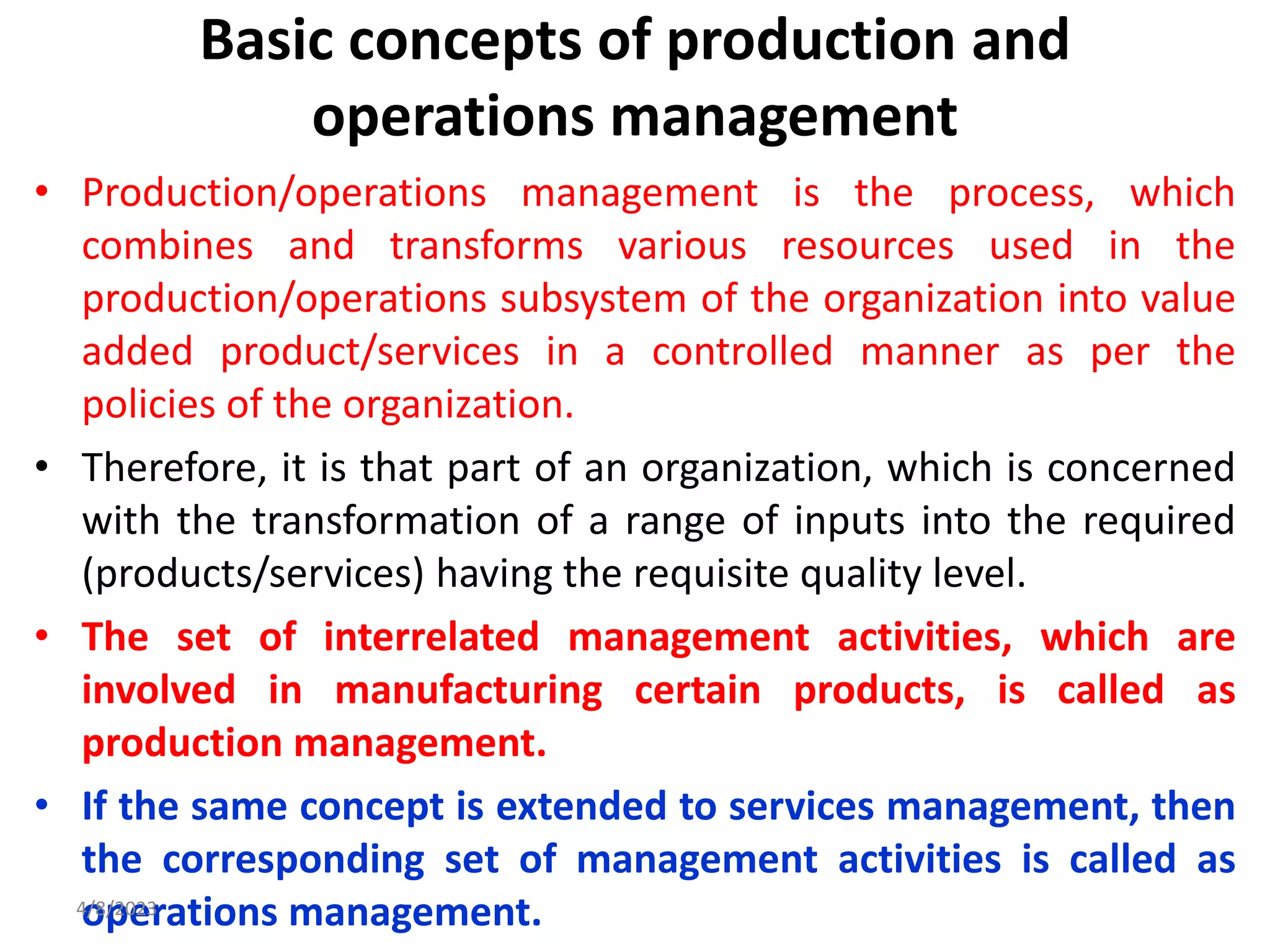
• Production/operations management is the process, which
combines and transforms various resources used in the
production/operations subsystem of the organization into value
added product/services in a controlled manner as per the
policies of the organization.
• Therefore, it is that part of an organization, which is concerned
with the transformation of a range of inputs into the required
(products/services) having the requisite quality level.
• The set of interrelated management activities, which are
involved in manufacturing certain products, is called as
production management.
• If the same concept is extended to services management, then
the corresponding set of management activities is called as
operations management.
4/8/2023
4/8/2023
What is Production/Operation
Management actually?
4/8/2023
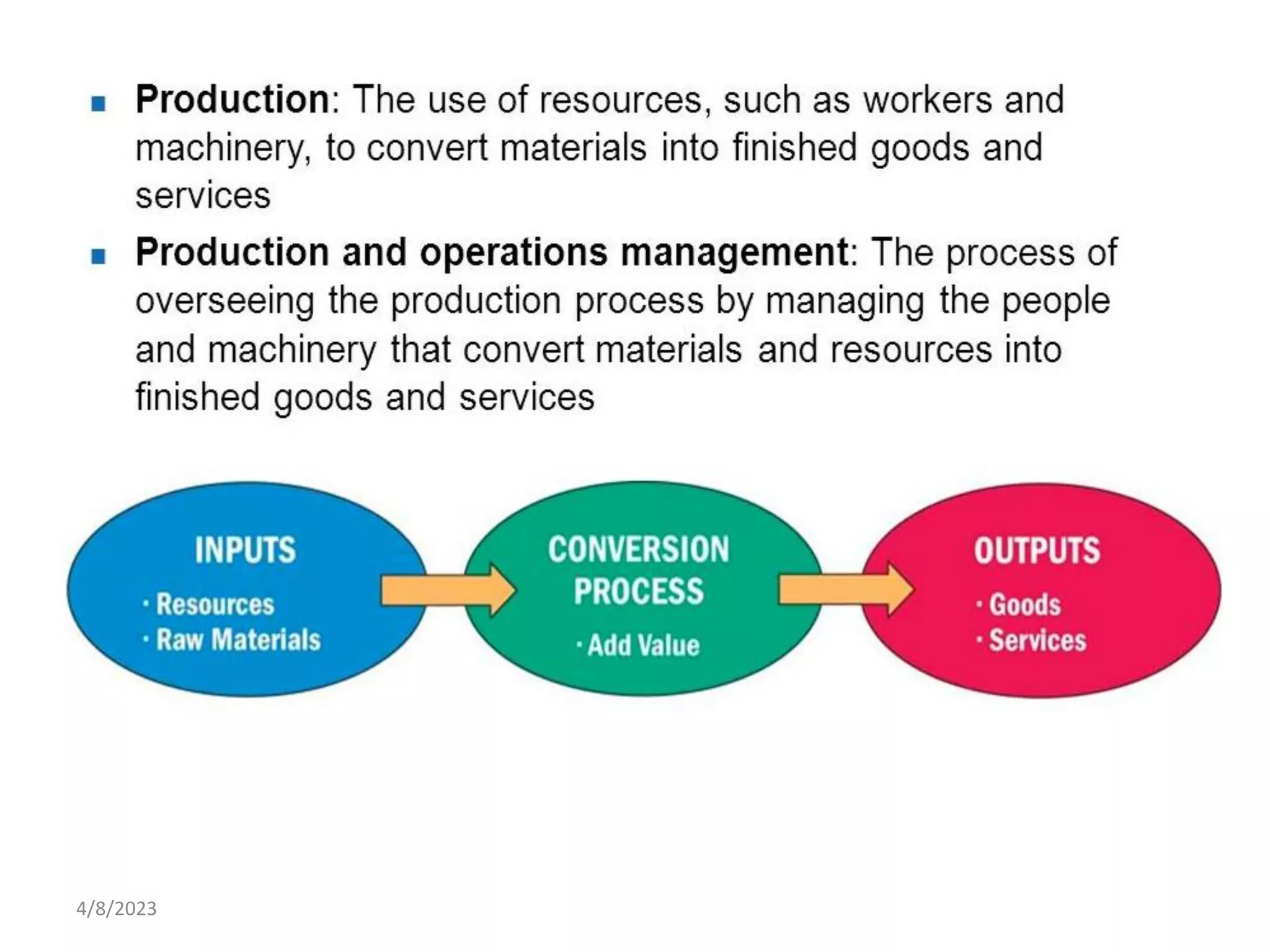
• Production: referring to the activities of
manufacturing goods.
• Operations: referring to the activities of not
manufacturing physical goods. It is usually
relevant to the service organization.
• Production & Operation: The creation of
goods & services.
4/8/2023
Figure: Various activities in production and operation management
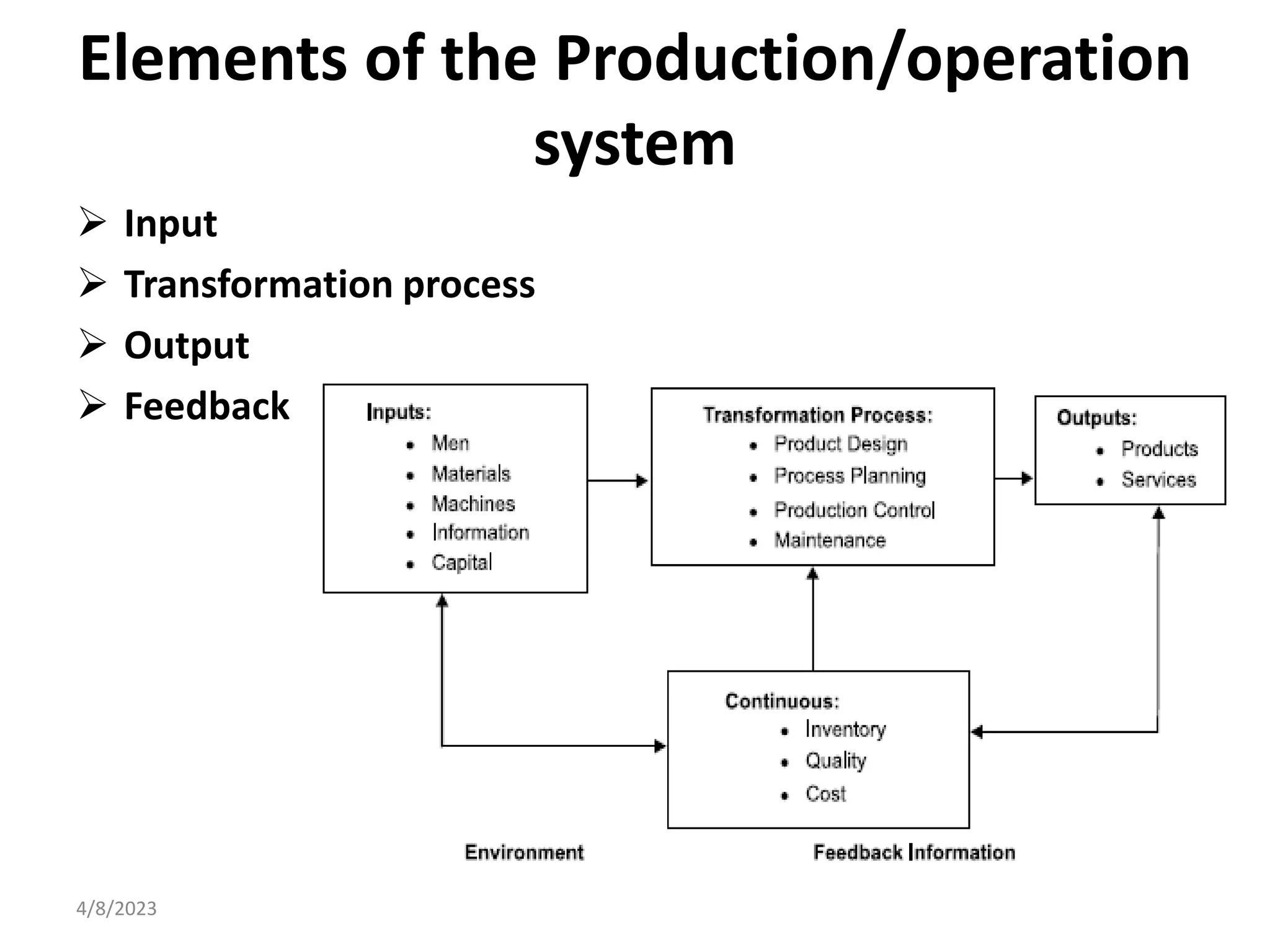
Elements of the Production/operation
system
 Input
 Transformation process
 Output
 Feedback
4/8/2023
4/8/2023
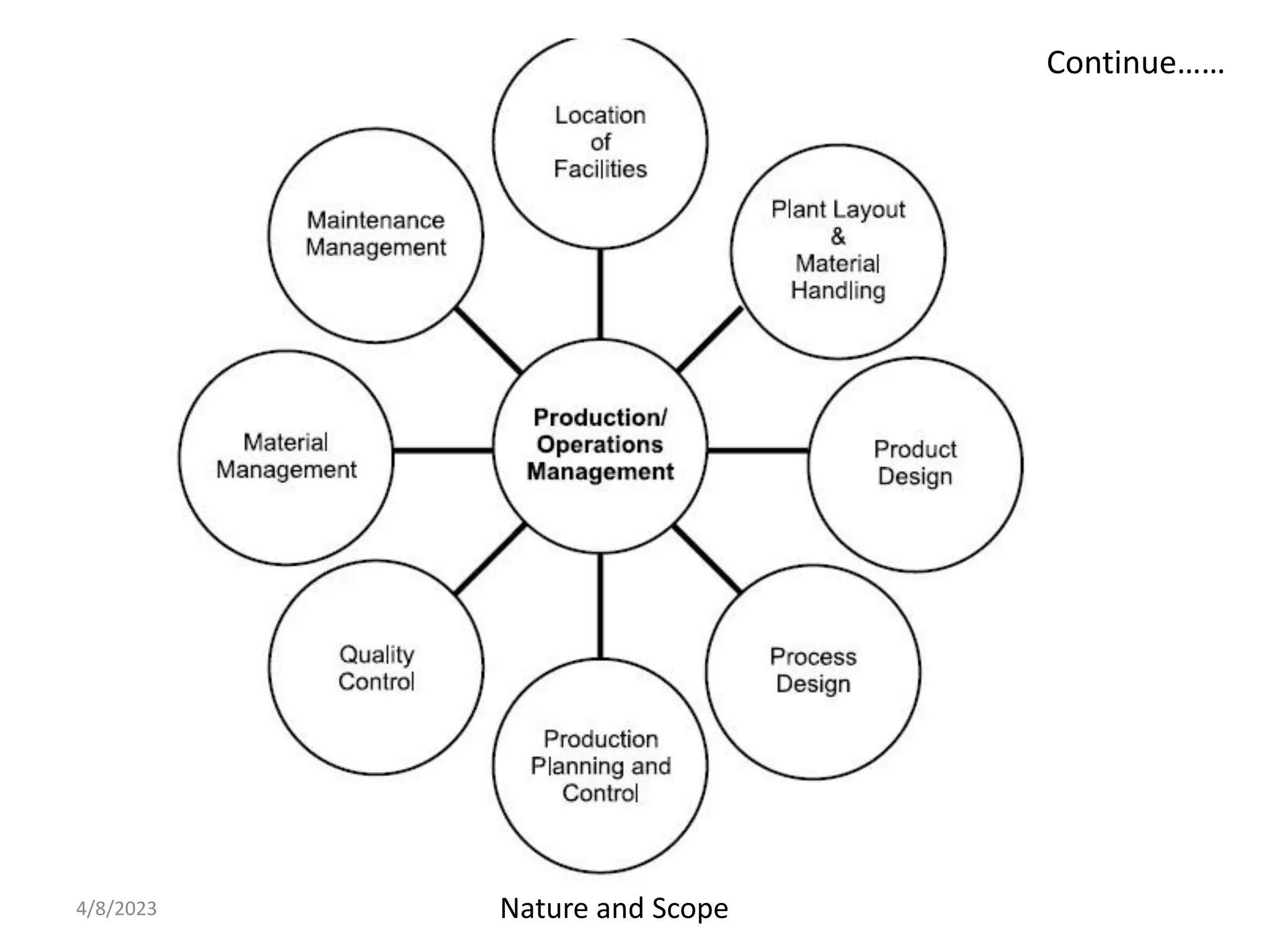
Nature and scope of Production &
Operations management
• Production management’s responsibilities are
summarized by the “five M’s”: men,
machines, methods, materials, and money.
“Men” refers to the human element in
operating systems. Since the vast majority of
manufacturing personnel work in the physical
production of goods, “people management” is
one of the production manager’s most
important responsibilities.
4/8/2023
Continue……
4/8/2023 Nature and Scope
Objectives of production/operation
management
• Maximum customer satisfaction through quality,
reliability, cost and delivery time
• Minimum rework/scrap resulting in better product
quality
• Minimum possible inventory level (i.e. optimum
inventory levels)
• Maximum utilization of all kind of recourses
• Minimum cash outflow
• Maximum employees satisfaction
4/8/2023
Continue…..
• Maximum possible production (i.e. output)
• Higher operating efficiency
• Minimum production cycle time
• Maximum profit or return of investment
• Concern for protection of environment
4/8/2023
Basic Natures
The nature of production and operation
management can be understood by viewing
the manufacturing functions as:
1. Production/operation as a system:
2. Production/operation as a organizational
function:
3. Production/operation as a conversion of
process:
4. Production/operation as a means of creating
utility:
4/8/2023
General Model for Managing Operation
4/8/2023 Figure: General model for managing operations
Continue….
• Managing operations can be enclosed in a frame of
general management function as shown in the above
Fig.
• Operation managers are concerned with planning,
organizing, and controlling the activities which affect
human behaviour through models.
• PLANNING: Activities that establishes a course of
action and guide future decision-making is planning.
 The operations manager defines the objectives for the
operations subsystem of the organization, and the
policies, and procedures for achieving the objectives.
 This stage includes clarifying the role and focus of
operations in the organization’s overall strategy. It also
involves product planning, facility designing and using
the conversion process.
4/8/2023
• ORGANIZING: Activities that establishes a
structure of tasks and authority.
Operation managers establish a structure of roles
and the flow of information within the operations
subsystem.
They determine the activities required to achieve
the goals and assign authority and responsibility
for carrying them out.
• CONTROLLING: Activities that assure the actual
performance in accordance with planned
performance.
Controlling costs, quality, and schedules are the
important functions here.
4/8/2023
Continue….
• BEHAVIOUR: Operation managers are
concerned with how their efforts to plan,
organize, and control affect human behaviour.
They also want to know how the behaviour of
subordinates can affect management’s
planning, organizing, and controlling actions.
• MODELS: operation managers encounter
many problems and make many decisions by
using models like aggregate planning models,
linear programming, computer simulation,
decision tree etc.
4/8/2023
Continue….
Relationship with other systems in
the organization
4/8/2023
4/8/2023
Continue….
Relationship with other commercial operation management areas
5 Elements/Factors Affecting
Production Management
 There are many internal factors affecting production
management that can cause negative impact on
teams and product output.
 Know these 5 factors that could be affecting your
production strategy, including best practices to
prevent risks and protect the bottom line.
1. Productivity & Retention of People
2. Maintenance of Equipment & Assets
3. Production Planning & Scheduling
4/8/2023
• Quality Control & Compliance
• Continuous Improvement – Lean Production
Approach
4/8/2023
Continue….
Factor affecting system & concept of
POM
Factors Affecting Operation Management
• Global Competition. ...
• Material and Capital Security. ...
• Quality, Customer Care, and Expenditure
Challenge. ...
• Social Responsibilities. ...
• Expansion of Technology Advancement. ...
• Legal Considerations. ...
• Business Ethics.
4/8/2023
Facility locations OR Plant Locations
• Facility location is the process of identifying
the best geographic location for a service or
production facility.
• Selecting suitable location for economic and
effective operations.
• It is a branch of operations research with the
optimal placement of facilities to minimize
transportation costs .
• Facility Location is the right location for the
manufacturing facility, it will have sufficient
access to the customers, workers,
transportation.
4/8/2023
• Wrong location of facility may lead to failure of the
complete project.
• When starting a new factory, plant location decisions
are very important because they have direct bearing
on factors like, financial, employment and
distribution patterns.
• In the long run, relocation of plant may even benefit
the organization. But, the relocation of the plant
involves stoppage of production, and also cost for
shifting the facilities to a new location
• Factors affecting location planning are Availability of
power supply, Government Policy, Environment and
Community, Easy availability of cheap land, Low
construction, cost Availability of cheap labor, Good
Transport location facilities etc.
4/8/2023
Continue….
Factors affecting Facility location
decision in Operations Management
• on the basis of the nature of the organization,
there are 2 type of factors that affect location.
1. General locational factors, which include
controllable and uncontrollable factors for all
type of organizations.
2. Specific locational factors specifically
required for manufacturing and service
organizations.
4/8/2023
4/8/2023
Continue…
Location factors can be further divided into two
categories:
1. General Locational Factors: Following are the
general factors required for location of plant in
case of all types of organizations.
CONTROLLABLE FACTORS
a) Proximity to markets.
b) Supply of materials
c) Transportation facilities
d) Infrastructure availability
e) Labour and wages
f) External economies
g) Capital
4/8/2023
UNCONTROLLABLE FACTORS
a) Government policy
b) Climate conditions
c) Supporting industries and services
d) Community and labor attitudes
e) Community Infrastructure
2. Specific Locational Factors
DOMINANT FACTORS
a) Favorable labor climate
b) Proximity to markets
c) Quality of life
d) Proximity to suppliers and resources
e) Utilities, taxes, and real estate costs
4/8/2023
Continue…
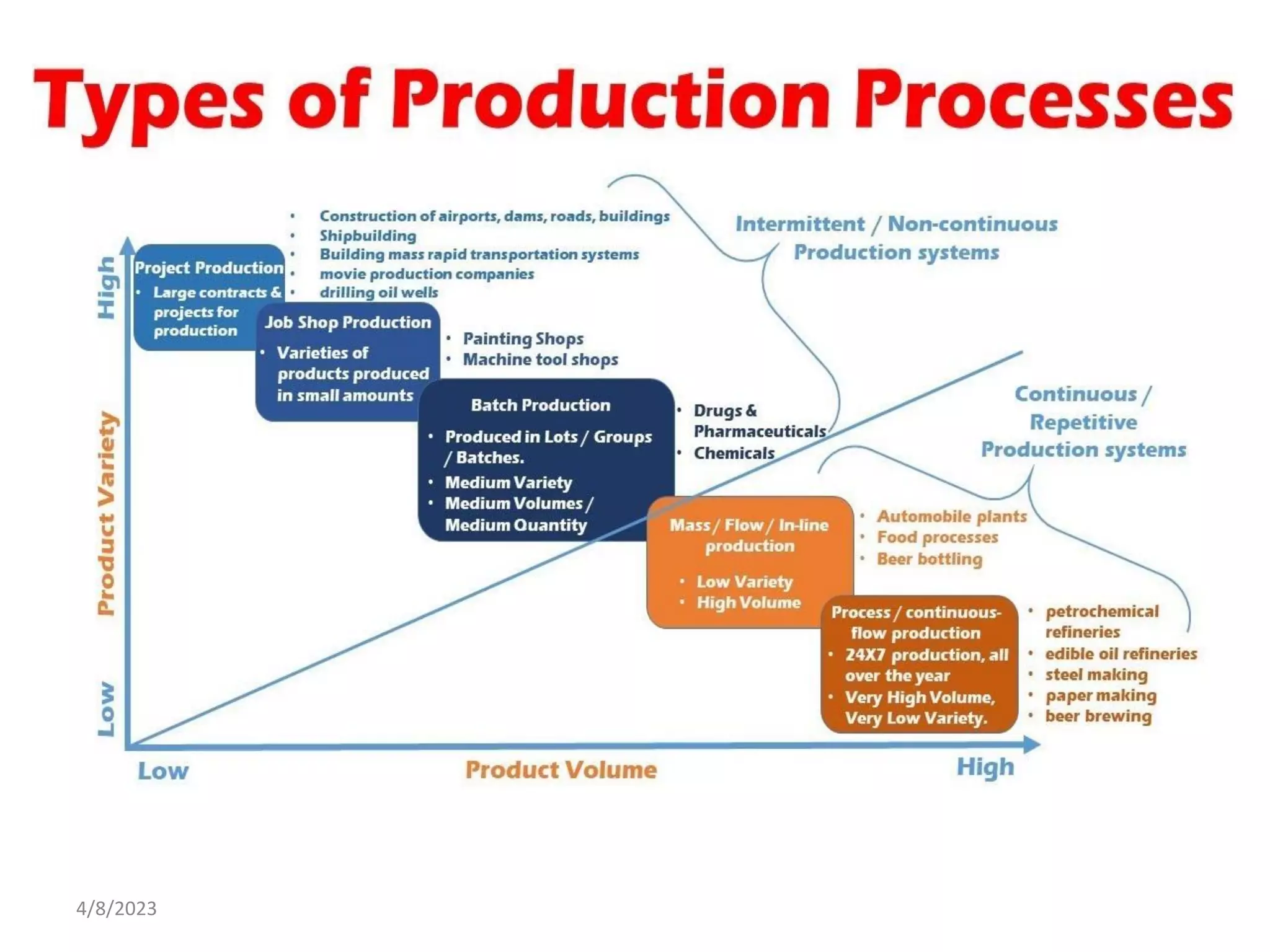
Types of manufacturing systems
Manufacturing system varies from factory to
factory and product to product. However, the
most important issue is production volume.
Most common type of manufacturing systems
are:
1. Job Shop Production
2. Batch Production
3. Mass Production
4/8/2023
4/8/2023
4/8/2023
Variety of production with examples
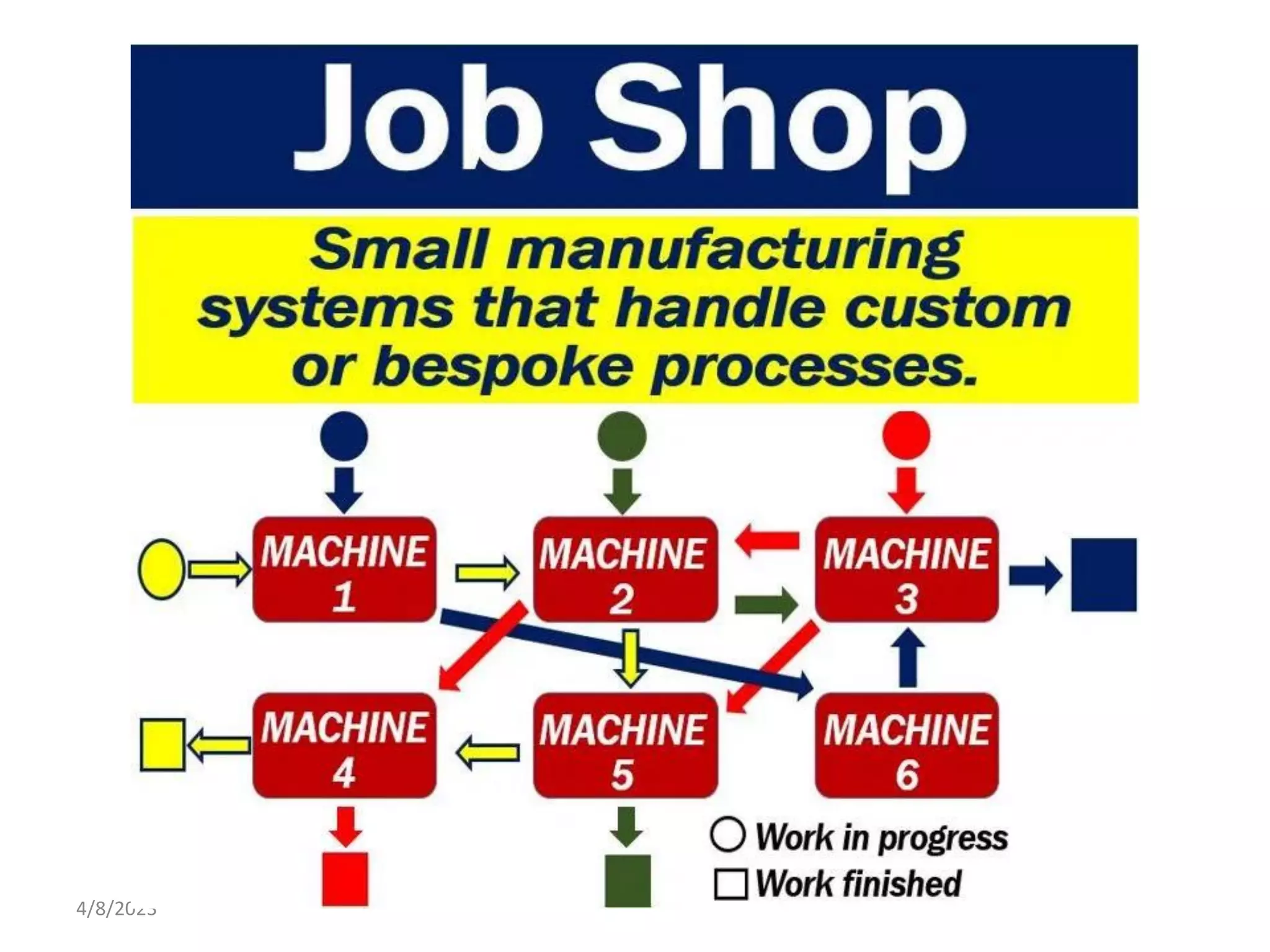
1. Job Shop Production
• Commonly used to meet a particular customer
need.
• Production lot size is generally small.
• Product variety is very high.
• Production equipment are general purpose and
flexible to meet specific customer need.
• Highly skilled labor is needed to handle the
equipment as variety and product range are high.
“Job shop production is applicable where custom-
made products are to be produced on a small scale.
e.g., Ship, metro etc.”
4/8/2023
4/8/2023
MERITS
• It involves small investment in machinery and
equipment.
• It is flexible and can be adapted easily to changes in
product design.
• A fault in one operation does not result into complete
stoppage of the entire process.
DEMERITS
• Raw materials and work in progress inventories are
high due to uneven and irregular flow of work.
Therefore, large storage space is required and material
handling cost are high.
• Speed of work is slow and units costs are high.
• Complex schedule of activities is required to ensure
smooth flow of work without any bottlenecks.
4/8/2023
2. BATCH PRODUCTION
• It is defined as the manufacture of a product in small or
large batches or lots at intervals by a series of operations,
each operation being carried out on the whole batch
before any subsequent operation is performed.
• Suited of medium volume lot of same variety.
• Moderate product variety.
• Production equipment are general purpose but suitable
for higher production volume.
• Springs and Fixtures are used to reduce set up time and
increase the production rate.
• Skill of labors is high but less as compared to job shop
production.
• Machines and equipment arranged according to the
sequence of operations.
• A particular operation on a batch is performed by one
group and then it is passed for subsequent operations.
4/8/2023
4/8/2023
Batch processing systems
4/8/2023
MERITS
• Products can be produced in mass quantities, reducing
the overall cost per unit.
• Companies only focus on a small group of products,
leading to greater quality control and product
expertise.
• Cost of labor is reduced, as workers only focus on a
particular task or set of tasks.
• Cost of machinery is reduced, as one machine can
handle several different product configurations.
• Lends itself to repeat orders, meaning a smoother,
more consistent production flow over time.
• Capital investment is low.
• It combines the features of both flow production and
job production.
4/8/2023
DEMERITS
• Work in progress inventory is high so large space
is required.
• Due to frequent change in product design no
standard sequence of operations can be used.
• Machine setups and tooling arrangements have
to be changed frequently.
• Idle time between operations is more.
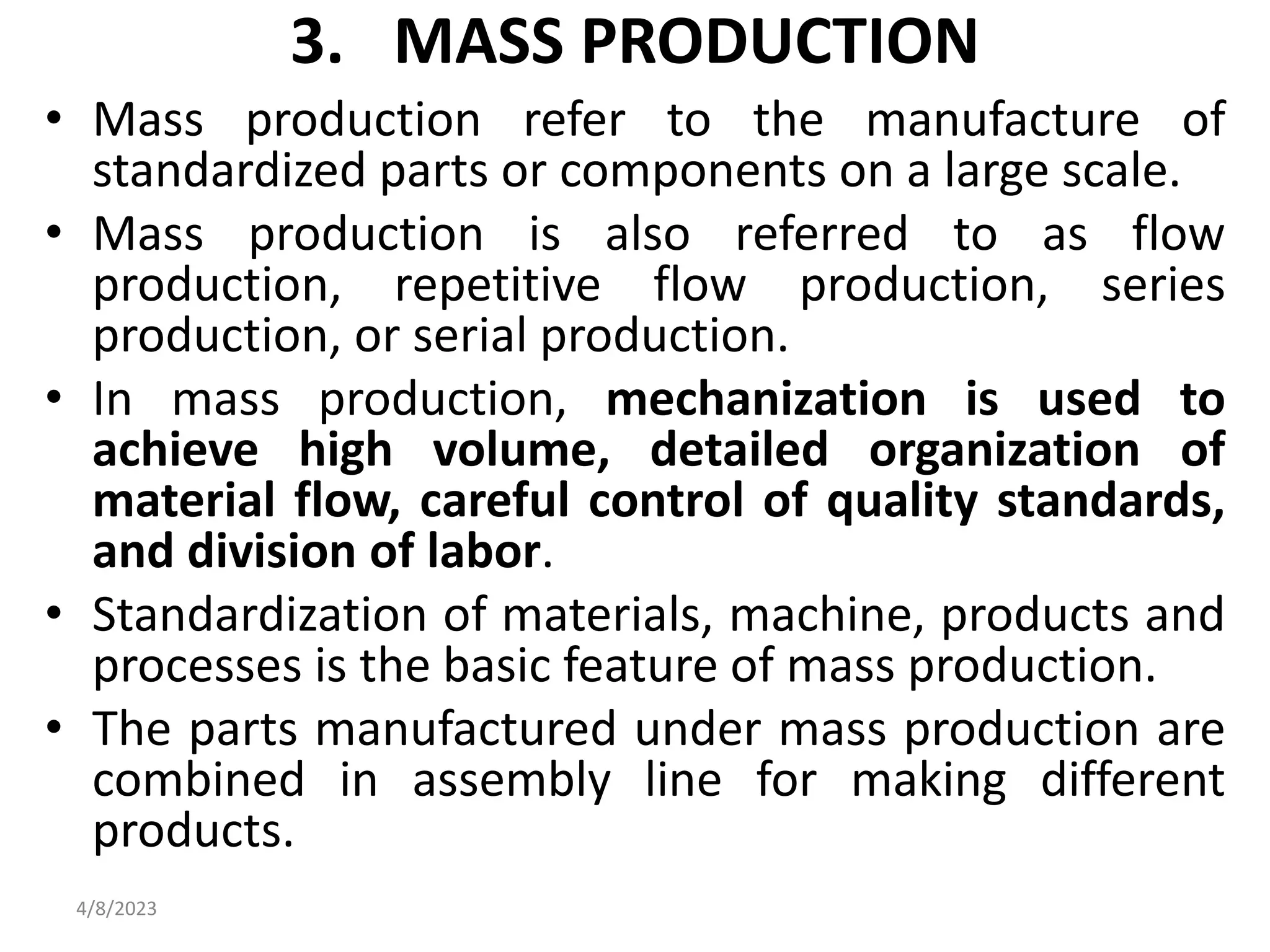
“Batch production is applied when either the
volume of output increase resulting in some
repetitiveness or the market demand is not uniform
throughout the year”
4/8/2023
3. MASS PRODUCTION
• Mass production refer to the manufacture of
standardized parts or components on a large scale.
• Mass production is also referred to as flow
production, repetitive flow production, series
production, or serial production.
• In mass production, mechanization is used to
achieve high volume, detailed organization of
material flow, careful control of quality standards,
and division of labor.
• Standardization of materials, machine, products and
processes is the basic feature of mass production.
• The parts manufactured under mass production are
combined in assembly line for making different
products.
4/8/2023
• Generally the degree of computerization and
automation is high.
Suited for continuous identical parts.
Suited for high demand items.
Production lot size is very high.
Production rate is continuous.
Product rate is continuous.
Product variety is low.
Special purpose tools and equipment may be
needed.
Skill level of workers is low.
High investment in machinery is needed due to
specialized machines and special purpose
operations.
4/8/2023
Mass Production in the Fashion Industry
4/8/2023 Cloths manufacturing in mass
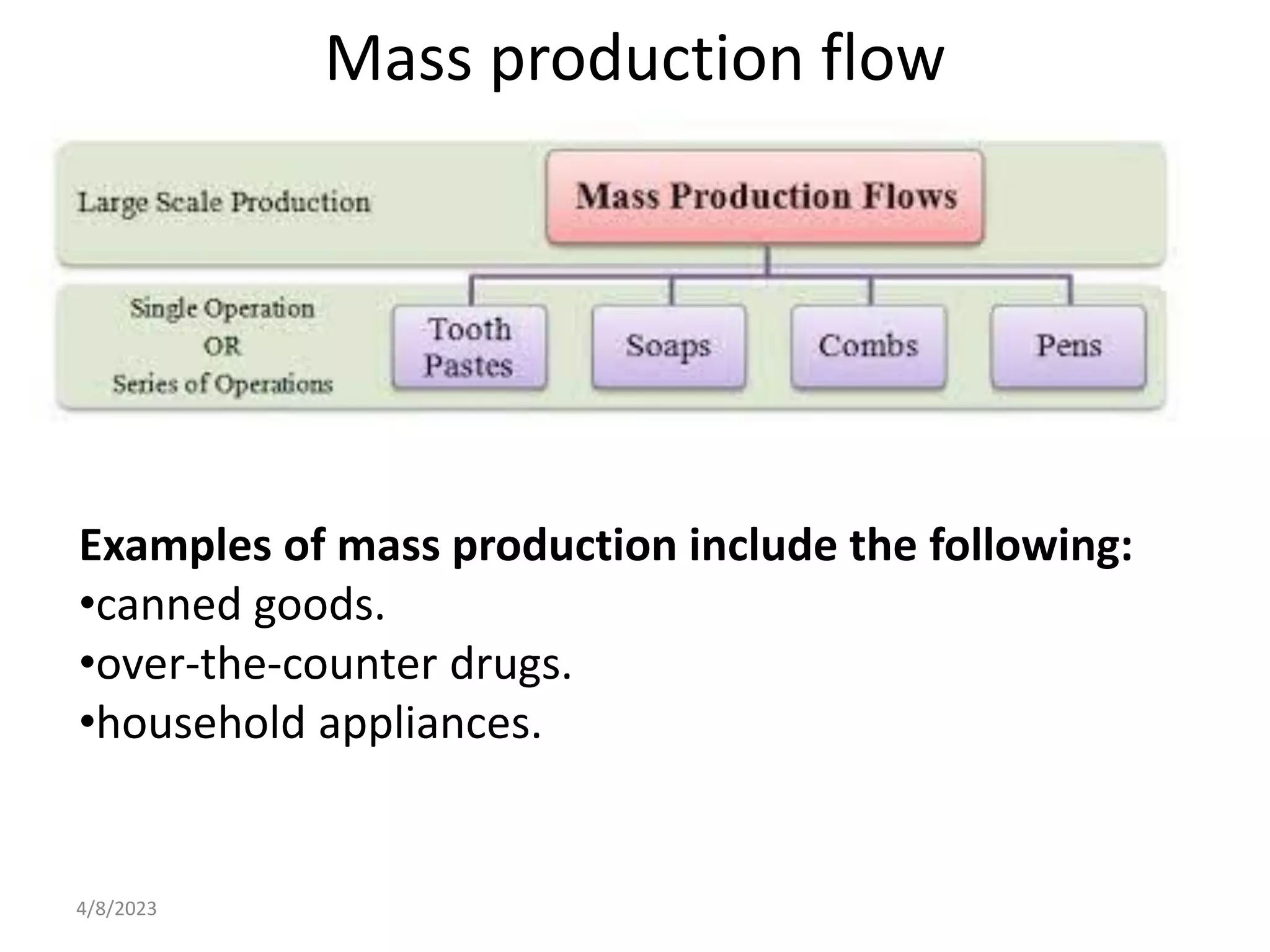
Mass production flow
4/8/2023
Examples of mass production include the following:
•canned goods.
•over-the-counter drugs.
•household appliances.
MERITS
• It is usually ‘automated’ to the highest extent possible.
• Fewer labor costs.
• Faster rate of production.
• Capital and energy are increased while total expenditure
per unit of product is decreased.
• Faster rate of production.
DEMERITS
• Machinery is very expensive to buy, so production lines are
very expensive to set up.
• Workers are not very motivated, since their work is very
repetitive.
• Not very flexible, as a production line is difficult to adapt.
• If one part of the line breaks, the whole production process
will have to stop until it is repaired.
4/8/2023
Videos link
Different types of Manufacturing Systems
https://www.youtube.com/watch?v=G5eJZcY_R3g
Types and Characteristics of Manufacturing
Systems
https://www.youtube.com/watch?v=2OBKUR5cjI
M
Types of Production - Explained with Example
https://www.youtube.com/watch?v=ZmkuD9fcOP
M&t=1s
4/8/2023
Lean Manufacturing
• Lean manufacturing is a production process
based on an ideology of maximising productivity
while simultaneously minimising waste within a
manufacturing operation. The lean principle sees
waste is anything that doesn't add value that the
customers are willing to pay for.
• Lean manufacturing is a production method
aimed primarily at reducing times within the
production system as well as response times from
suppliers and to customers. It is derived from
Toyota's 1930 operating model "The Toyota Way".
4/8/2023
7 Examples of Lean Manufacturing in
Action
• Cable Manufacturing: A cable manufacturing
company wanted to reduce set-up times and
shorten lead time to market. ...
• Truck Manufacturing. ...
• Printing Industry. ...
• Automotive Parts Manufacturing. ...
• Warehouse Management. ...
• Customer Service. ...
• Heating and Air-Conditioning Manufacturing.
4/8/2023
Examples
• Nike: The famous shoe and clothing giant has also
adopted lean manufacturing techniques.
• Intel: Known for their computer processors
• Toyota: The automobile manufacturers
• Kimberley-Clark Corporation: outsourced logistics
• Caterpillar Inc.: The US machinery manufacturers
• Illinois Tool Works: Engineering manufacturer
• Textron: The American industrial conglomerate that
includes Bell Helicopter, Cessna Aircraftand Textron
Systems
• John Deere: The world’s largest manufacturer of
agricultural machinery
• Ford
4/8/2023
Production planning and analysis
• Production planning is the process of deciding
how a product or service will be manufactured
before the manufacturing process begins.
• It is the act of developing a guide for the design
and production of a given product or service.
• Production planning helps organizations make the
production process as efficient as possible.
• Production planning is the planning of production
and manufacturing modules in a company or
industry.
• It utilizes the resource allocation of activities of
employees, materials and production capacity, in
order to serve different customers.
4/8/2023
Production planning
4/8/2023
4/8/2023
Production Analysis
• Production Analysis provides a visual
representation of production output and
allows you to quantify production losses and
the cost associated with them.
• With regular use of Production Analysis, your
company can determine where you are losing
the most money and then take corrective
actions that will help yield higher production
and earn greater profits.
• Production Analysis allows you to evaluate
the reliability of manufacturing processes.
4/8/2023
Within a Production Analysis, you can plot production
output data and then:
• Define the observed production output with a
Demonstrated Line.
• Determine the reliability of the production process
by defining a Process Reliability Line.
• Define the ideal production output with a
Nameplate Line.
• Draw one or more Custom Lines to exhibit losses
and gains compared to other observed production
output or based on theoretical scenarios.
• Compare the observed output to the ideal output to
calculate the efficiency and utilization costs.
4/8/2023
Thank You
4/8/2023

POM_Unit 1_Introduction-to-production-and-operation-management-concepts.pdf

  • 1.
    Production & Operations Management (Code-MBT206) By Dr.H. L. Bhaskar (Ph.D., MBA-HR & Marketing, UGC-NET/JRF) Roorkee Institute of Technology, Uttarakhand
  • 2.
  • 3.
    Background • In 1956,Benjamin Bloom with collaborators Max Englehart, Edward Furst, Walter Hill, and David Krathwohl published a framework for categorizing educational goals: Taxonomy of Educational Objectives. Familiarly known as Bloom’s Taxonomy, this framework has been applied by generations of K-12 teachers and college instructors in their teaching. • The framework elaborated by Bloom and his collaborators consisted of six major categories: Knowledge, Comprehension, Application, Analysis, Synthesis, and Evaluation. • The categories after Knowledge were presented as “skills and abilities,” with the understanding that knowledge was the necessary precondition for putting these skills and abilities into practice. • The Original Taxonomy (1956)  Here are the authors’ brief explanations of these main categories in from the appendix of Taxonomy of Educational Objectives (Handbook One, pp. 201-207): 1. Knowledge: “involves the recall of specifics and universals, the recall of methods and processes, or the recall of a pattern, structure, or setting.” 2. Comprehension: “refers to a type of understanding 3. Application: refers to the “use of abstractions in particular and concrete situations.” 4. Analysis: represents the “breakdown of a communication into its constituent elements 5. Synthesis: involves the “putting together of elements and parts so as to form a whole.” 6. Evaluation: produces “judgments about the value of material and methods for given purposes.”
  • 4.
    The Revised Taxonomy(2001) • A group of cognitive psychologists, curriculum theorists and instructional researchers, and testing and assessment specialists published in 2001 a revision of Bloom’s Taxonomy with the title A Taxonomy for Teaching, Learning, and Assessment. • The authors of the revised taxonomy highlight this dynamism, using verbs to label their categories and subcategories (rather than the nouns of the original taxonomy). These “action words” describe the cognitive processes by which thinkers encounter and work with knowledge: Remember •Recognizing •Recalling Understand •Interpreting •Exemplifying •Classifying •Summarizing •Inferring •Comparing •Explaining Apply •Executing •Implementing Analyze •Differentiating •Organizing •Attributing Evaluate •Checking •Critiquing Create •Generating •Planning •Producing
  • 5.
    Continue….. • In therevised taxonomy, knowledge is at the basis of these six cognitive processes, but its authors created a separate taxonomy of the types of knowledge used in cognition: •Factual Knowledge • Knowledge of terminology • Knowledge of specific details and elements •Conceptual Knowledge • Knowledge of classifications and categories • Knowledge of principles and generalizations • Knowledge of theories, models, and structures •Procedural Knowledge • Knowledge of subject-specific skills and algorithms • Knowledge of subject-specific techniques and methods • Knowledge of criteria for determining when to use appropriate procedures •Metacognitive Knowledge • Strategic Knowledge • Knowledge about cognitive tasks, including appropriate contextual and conditional knowledge • Self-knowledge Mary Forehand from the University of Georgia provides a guide to the revised version giving a brief summary of the revised taxonomy and a helpful table of the six cognitive processes and four types of knowledge.
  • 6.
    Course Outcomes(CO’s) 1. Analyzethe basics of production management and the relevant and responsible factors. 2. Demonstrate & apply the various types of production processes, the essentialities of a product such as its selection, various procedures and its stocking. 3. Create the various activities relating to scheduling and measuring of production take place and how control can be obtained on both product and quality. 4. Develop various models that deal with inventory, its control, safety and security management in production process. 5. Create supply and logistics, distribution networks and its management. 4/8/2023
  • 7.
    Suggested Books &Journals Books: 1. Aswathappa, K, Production and Operations Management, TMH, Delhi 2. Garg, Ajay-Production and Operations Management, TMH, Delhi 3. Charry SN, Production and Operation Management-Concepts Methods and Strategy, PHI New Delhi 2005. Journals: 1. International Journal of Production Research- Taylor & Francis 2. Production and Operations Management- Wiley 3. International Journal of Production Economics- Elsevier 4/8/2023
  • 8.
    Contents Unit-1 Introduction • Basicconcepts of production and operations management • Nature and scope of Production & operations management • Relationship with other systems in the organization • Factor affecting system & concept of POM • Facility locations • Types of manufacturing systems • Lean manufacturing • Planning & analysis 4/8/2023
  • 9.
    Basic concepts ofproduction and operations management • Production/operations management is the process, which combines and transforms various resources used in the production/operations subsystem of the organization into value added product/services in a controlled manner as per the policies of the organization. • Therefore, it is that part of an organization, which is concerned with the transformation of a range of inputs into the required (products/services) having the requisite quality level. • The set of interrelated management activities, which are involved in manufacturing certain products, is called as production management. • If the same concept is extended to services management, then the corresponding set of management activities is called as operations management. 4/8/2023
  • 10.
  • 11.
    What is Production/Operation Managementactually? 4/8/2023 • Production: referring to the activities of manufacturing goods. • Operations: referring to the activities of not manufacturing physical goods. It is usually relevant to the service organization. • Production & Operation: The creation of goods & services.
  • 12.
    4/8/2023 Figure: Various activitiesin production and operation management
  • 13.
    Elements of theProduction/operation system  Input  Transformation process  Output  Feedback 4/8/2023
  • 14.
  • 15.
    Nature and scopeof Production & Operations management • Production management’s responsibilities are summarized by the “five M’s”: men, machines, methods, materials, and money. “Men” refers to the human element in operating systems. Since the vast majority of manufacturing personnel work in the physical production of goods, “people management” is one of the production manager’s most important responsibilities. 4/8/2023
  • 16.
  • 17.
    Objectives of production/operation management •Maximum customer satisfaction through quality, reliability, cost and delivery time • Minimum rework/scrap resulting in better product quality • Minimum possible inventory level (i.e. optimum inventory levels) • Maximum utilization of all kind of recourses • Minimum cash outflow • Maximum employees satisfaction 4/8/2023
  • 18.
    Continue….. • Maximum possibleproduction (i.e. output) • Higher operating efficiency • Minimum production cycle time • Maximum profit or return of investment • Concern for protection of environment 4/8/2023
  • 19.
    Basic Natures The natureof production and operation management can be understood by viewing the manufacturing functions as: 1. Production/operation as a system: 2. Production/operation as a organizational function: 3. Production/operation as a conversion of process: 4. Production/operation as a means of creating utility: 4/8/2023
  • 20.
    General Model forManaging Operation 4/8/2023 Figure: General model for managing operations
  • 21.
    Continue…. • Managing operationscan be enclosed in a frame of general management function as shown in the above Fig. • Operation managers are concerned with planning, organizing, and controlling the activities which affect human behaviour through models. • PLANNING: Activities that establishes a course of action and guide future decision-making is planning.  The operations manager defines the objectives for the operations subsystem of the organization, and the policies, and procedures for achieving the objectives.  This stage includes clarifying the role and focus of operations in the organization’s overall strategy. It also involves product planning, facility designing and using the conversion process. 4/8/2023
  • 22.
    • ORGANIZING: Activitiesthat establishes a structure of tasks and authority. Operation managers establish a structure of roles and the flow of information within the operations subsystem. They determine the activities required to achieve the goals and assign authority and responsibility for carrying them out. • CONTROLLING: Activities that assure the actual performance in accordance with planned performance. Controlling costs, quality, and schedules are the important functions here. 4/8/2023 Continue….
  • 23.
    • BEHAVIOUR: Operationmanagers are concerned with how their efforts to plan, organize, and control affect human behaviour. They also want to know how the behaviour of subordinates can affect management’s planning, organizing, and controlling actions. • MODELS: operation managers encounter many problems and make many decisions by using models like aggregate planning models, linear programming, computer simulation, decision tree etc. 4/8/2023 Continue….
  • 24.
    Relationship with othersystems in the organization 4/8/2023
  • 25.
    4/8/2023 Continue…. Relationship with othercommercial operation management areas
  • 26.
    5 Elements/Factors Affecting ProductionManagement  There are many internal factors affecting production management that can cause negative impact on teams and product output.  Know these 5 factors that could be affecting your production strategy, including best practices to prevent risks and protect the bottom line. 1. Productivity & Retention of People 2. Maintenance of Equipment & Assets 3. Production Planning & Scheduling 4/8/2023
  • 27.
    • Quality Control& Compliance • Continuous Improvement – Lean Production Approach 4/8/2023 Continue….
  • 28.
    Factor affecting system& concept of POM Factors Affecting Operation Management • Global Competition. ... • Material and Capital Security. ... • Quality, Customer Care, and Expenditure Challenge. ... • Social Responsibilities. ... • Expansion of Technology Advancement. ... • Legal Considerations. ... • Business Ethics. 4/8/2023
  • 29.
    Facility locations ORPlant Locations • Facility location is the process of identifying the best geographic location for a service or production facility. • Selecting suitable location for economic and effective operations. • It is a branch of operations research with the optimal placement of facilities to minimize transportation costs . • Facility Location is the right location for the manufacturing facility, it will have sufficient access to the customers, workers, transportation. 4/8/2023
  • 30.
    • Wrong locationof facility may lead to failure of the complete project. • When starting a new factory, plant location decisions are very important because they have direct bearing on factors like, financial, employment and distribution patterns. • In the long run, relocation of plant may even benefit the organization. But, the relocation of the plant involves stoppage of production, and also cost for shifting the facilities to a new location • Factors affecting location planning are Availability of power supply, Government Policy, Environment and Community, Easy availability of cheap land, Low construction, cost Availability of cheap labor, Good Transport location facilities etc. 4/8/2023 Continue….
  • 31.
    Factors affecting Facilitylocation decision in Operations Management • on the basis of the nature of the organization, there are 2 type of factors that affect location. 1. General locational factors, which include controllable and uncontrollable factors for all type of organizations. 2. Specific locational factors specifically required for manufacturing and service organizations. 4/8/2023
  • 32.
  • 33.
    Continue… Location factors canbe further divided into two categories: 1. General Locational Factors: Following are the general factors required for location of plant in case of all types of organizations. CONTROLLABLE FACTORS a) Proximity to markets. b) Supply of materials c) Transportation facilities d) Infrastructure availability e) Labour and wages f) External economies g) Capital 4/8/2023
  • 34.
    UNCONTROLLABLE FACTORS a) Governmentpolicy b) Climate conditions c) Supporting industries and services d) Community and labor attitudes e) Community Infrastructure 2. Specific Locational Factors DOMINANT FACTORS a) Favorable labor climate b) Proximity to markets c) Quality of life d) Proximity to suppliers and resources e) Utilities, taxes, and real estate costs 4/8/2023 Continue…
  • 35.
    Types of manufacturingsystems Manufacturing system varies from factory to factory and product to product. However, the most important issue is production volume. Most common type of manufacturing systems are: 1. Job Shop Production 2. Batch Production 3. Mass Production 4/8/2023
  • 36.
  • 37.
  • 38.
    1. Job ShopProduction • Commonly used to meet a particular customer need. • Production lot size is generally small. • Product variety is very high. • Production equipment are general purpose and flexible to meet specific customer need. • Highly skilled labor is needed to handle the equipment as variety and product range are high. “Job shop production is applicable where custom- made products are to be produced on a small scale. e.g., Ship, metro etc.” 4/8/2023
  • 39.
  • 40.
    MERITS • It involvessmall investment in machinery and equipment. • It is flexible and can be adapted easily to changes in product design. • A fault in one operation does not result into complete stoppage of the entire process. DEMERITS • Raw materials and work in progress inventories are high due to uneven and irregular flow of work. Therefore, large storage space is required and material handling cost are high. • Speed of work is slow and units costs are high. • Complex schedule of activities is required to ensure smooth flow of work without any bottlenecks. 4/8/2023
  • 41.
    2. BATCH PRODUCTION •It is defined as the manufacture of a product in small or large batches or lots at intervals by a series of operations, each operation being carried out on the whole batch before any subsequent operation is performed. • Suited of medium volume lot of same variety. • Moderate product variety. • Production equipment are general purpose but suitable for higher production volume. • Springs and Fixtures are used to reduce set up time and increase the production rate. • Skill of labors is high but less as compared to job shop production. • Machines and equipment arranged according to the sequence of operations. • A particular operation on a batch is performed by one group and then it is passed for subsequent operations. 4/8/2023
  • 42.
  • 43.
  • 44.
    MERITS • Products canbe produced in mass quantities, reducing the overall cost per unit. • Companies only focus on a small group of products, leading to greater quality control and product expertise. • Cost of labor is reduced, as workers only focus on a particular task or set of tasks. • Cost of machinery is reduced, as one machine can handle several different product configurations. • Lends itself to repeat orders, meaning a smoother, more consistent production flow over time. • Capital investment is low. • It combines the features of both flow production and job production. 4/8/2023
  • 45.
    DEMERITS • Work inprogress inventory is high so large space is required. • Due to frequent change in product design no standard sequence of operations can be used. • Machine setups and tooling arrangements have to be changed frequently. • Idle time between operations is more. “Batch production is applied when either the volume of output increase resulting in some repetitiveness or the market demand is not uniform throughout the year” 4/8/2023
  • 46.
    3. MASS PRODUCTION •Mass production refer to the manufacture of standardized parts or components on a large scale. • Mass production is also referred to as flow production, repetitive flow production, series production, or serial production. • In mass production, mechanization is used to achieve high volume, detailed organization of material flow, careful control of quality standards, and division of labor. • Standardization of materials, machine, products and processes is the basic feature of mass production. • The parts manufactured under mass production are combined in assembly line for making different products. 4/8/2023
  • 47.
    • Generally thedegree of computerization and automation is high. Suited for continuous identical parts. Suited for high demand items. Production lot size is very high. Production rate is continuous. Product rate is continuous. Product variety is low. Special purpose tools and equipment may be needed. Skill level of workers is low. High investment in machinery is needed due to specialized machines and special purpose operations. 4/8/2023
  • 48.
    Mass Production inthe Fashion Industry 4/8/2023 Cloths manufacturing in mass
  • 49.
    Mass production flow 4/8/2023 Examplesof mass production include the following: •canned goods. •over-the-counter drugs. •household appliances.
  • 50.
    MERITS • It isusually ‘automated’ to the highest extent possible. • Fewer labor costs. • Faster rate of production. • Capital and energy are increased while total expenditure per unit of product is decreased. • Faster rate of production. DEMERITS • Machinery is very expensive to buy, so production lines are very expensive to set up. • Workers are not very motivated, since their work is very repetitive. • Not very flexible, as a production line is difficult to adapt. • If one part of the line breaks, the whole production process will have to stop until it is repaired. 4/8/2023
  • 51.
    Videos link Different typesof Manufacturing Systems https://www.youtube.com/watch?v=G5eJZcY_R3g Types and Characteristics of Manufacturing Systems https://www.youtube.com/watch?v=2OBKUR5cjI M Types of Production - Explained with Example https://www.youtube.com/watch?v=ZmkuD9fcOP M&t=1s 4/8/2023
  • 52.
    Lean Manufacturing • Leanmanufacturing is a production process based on an ideology of maximising productivity while simultaneously minimising waste within a manufacturing operation. The lean principle sees waste is anything that doesn't add value that the customers are willing to pay for. • Lean manufacturing is a production method aimed primarily at reducing times within the production system as well as response times from suppliers and to customers. It is derived from Toyota's 1930 operating model "The Toyota Way". 4/8/2023
  • 53.
    7 Examples ofLean Manufacturing in Action • Cable Manufacturing: A cable manufacturing company wanted to reduce set-up times and shorten lead time to market. ... • Truck Manufacturing. ... • Printing Industry. ... • Automotive Parts Manufacturing. ... • Warehouse Management. ... • Customer Service. ... • Heating and Air-Conditioning Manufacturing. 4/8/2023
  • 54.
    Examples • Nike: Thefamous shoe and clothing giant has also adopted lean manufacturing techniques. • Intel: Known for their computer processors • Toyota: The automobile manufacturers • Kimberley-Clark Corporation: outsourced logistics • Caterpillar Inc.: The US machinery manufacturers • Illinois Tool Works: Engineering manufacturer • Textron: The American industrial conglomerate that includes Bell Helicopter, Cessna Aircraftand Textron Systems • John Deere: The world’s largest manufacturer of agricultural machinery • Ford 4/8/2023
  • 55.
    Production planning andanalysis • Production planning is the process of deciding how a product or service will be manufactured before the manufacturing process begins. • It is the act of developing a guide for the design and production of a given product or service. • Production planning helps organizations make the production process as efficient as possible. • Production planning is the planning of production and manufacturing modules in a company or industry. • It utilizes the resource allocation of activities of employees, materials and production capacity, in order to serve different customers. 4/8/2023
  • 56.
  • 57.
  • 58.
    Production Analysis • ProductionAnalysis provides a visual representation of production output and allows you to quantify production losses and the cost associated with them. • With regular use of Production Analysis, your company can determine where you are losing the most money and then take corrective actions that will help yield higher production and earn greater profits. • Production Analysis allows you to evaluate the reliability of manufacturing processes. 4/8/2023
  • 59.
    Within a ProductionAnalysis, you can plot production output data and then: • Define the observed production output with a Demonstrated Line. • Determine the reliability of the production process by defining a Process Reliability Line. • Define the ideal production output with a Nameplate Line. • Draw one or more Custom Lines to exhibit losses and gains compared to other observed production output or based on theoretical scenarios. • Compare the observed output to the ideal output to calculate the efficiency and utilization costs. 4/8/2023
  • 60.