Human Resource Development
Lecture for the Students of MBA National University of Modern Language (NUML)
By
Mubarak Hussain
PhD Scholar
Capital University of Science and
Technology
(CUST)
MEANING OF HUMAN RESOURCE
DEVELOPMENT (HRD)
Human resource development is the process of helping people to
acquire expertise.
 acquire or sharpen the abilities required to perform various functions
associated with their present or expected future roles;
develop their general skills as individuals, discover and utilize their inner
potential for their own and/or organizational development purposes;
 develop an organizational culture in which supervisor-subordinate
relationships, teamwork and collaboration among sub-units are strong
and contribute to the professional well-being, motivation, and pride of
employees.
How HRD works
performance appraisal
 training,
 organizational development (OD)
 feedback and counseling,
 career development,
Potential development,
 job rotation and
 rewards.
The concept of Human Resource
Development
The concept of human resource development was introduced by
Nadler (1984) in a conference organized by the American society
for training and development.
Nadler (1984) defines human
resource development as "Those learning experiences, which are
organized for a specific time and designed to bring about the
possibility of behavioural and attitudinal change.
There are three aspects in
human resource development
:
i) Helps and motivates organizational employees
ii) Helps acquisition, development and moulding of
various aspects of human resources
iii) Contributes to the organizational, group,
individual and social goals.
These three aspects can further be
classified into the following
factors:
1. Enabling factors
a) Organizational structure and climate,
b) Human resource development climate,
c) Human resource development knowledge and skills of
management
d) Resource planning, recruitment and selection
2. Techniques or methods, to acquire, develop and mould human
resources.
a) Performance appraisal and potential appraisal
b) Career planning and development, training
c) Management development
d) Social and cultural programmes
e) Workers participation in management
f) Quality circles
3. The resultant contribution of the HRD process
to the goals of the organization, group, individuals and society.
HUMAN RESOURCE
DEVELOPMENT COMPONENTS
Manpower Planning
Recruitment, Selection and Placement
Training and Development
Performance Appraisal
Job Rotation
Wage and Salary Administration
Career Planning and Development
Organization Development
Quality Circle
HUMAN RESOURCE
DEVELOPMENT CLIMATE
Baumgartel (1971) viewed organizational climate as a product of
leadership practices, communication practices and enduring and
systematic characteristics of the working relationships among
persons and divisions of any particular organization.
Hellriegel and Slocum (1974) define organizational climate as a
"set of attributes which can be perceived about a particular
organization and/or its subsystems, and that may be induced in the
way that organization and/ or its subsystems deal with their
members and environment".
HR developmental climate will have the
following characteristics
(Rao and Abraham, 1986):
(1) a tendency at all levels starting from top management to the lowest level to treat people as the most
important resource
(2) perception that developing the competencies in the employees is the job of every
manager/supervisor
(3) faith in the capability of employees to change and acquire new competencies at any stage of life
(4) a tendency to be open in communications and discussions rather than being secretive (fairly free
expression of feelings)
(5) encouraging risk-taking and experimentation
(6) making efforts to help employees reorganize their strengths and weaknesses through feedback
(7) a general climate of trust
(8) a tendency on the part of employees to be generally helpful to each other and collaborate with each
other; (team spirit)
(9) tendency to discourage stereotypes and favouritism
(10) supportive personnel policies
(11) supportive human resource development practices including performance appraisal, training,
reward management, potential development, job-rotation career planning etc.
ELEMENTS OF HUMAN RESOURCE
DEVELOPMENT CLIMATE
The elements of HRD climate can be grouped
into three broad categories:
(1) General climate
(2) HRD (OCTAPACE) culture, and
(3) Human Resource Development mechanisms.
The general climate items, focus on the importance
given to human resources development by the top
management and line managers, in
general.
The OCTAPACE items deal with the extent to which
Openness, Confrontation, Trust, Autonomy,
Proactivity, Authenticity, Collaboration and
Experimentation are valued and promoted in the
organization.
The items dealing with human resource development
mechanisms measure the extent to which human
resource development mechanisms are implemented
seriously.
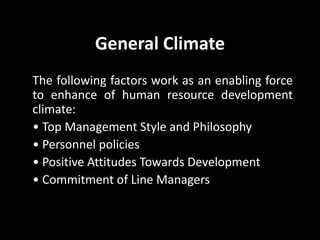
General Climate
The following factors work as an enabling force
to enhance of human resource development
climate:
• Top Management Style and Philosophy
• Personnel policies
• Positive Attitudes Towards Development
• Commitment of Line Managers
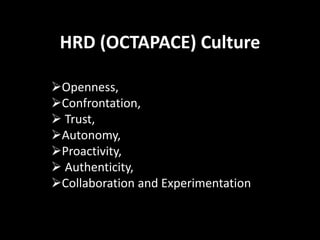
HRD (OCTAPACE) Culture
Openness,
Confrontation,
 Trust,
Autonomy,
Proactivity,
 Authenticity,
Collaboration and Experimentation
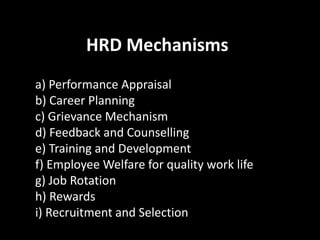
HRD Mechanisms
a) Performance Appraisal
b) Career Planning
c) Grievance Mechanism
d) Feedback and Counselling
e) Training and Development
f) Employee Welfare for quality work life
g) Job Rotation
h) Rewards
i) Recruitment and Selection
Discussion in real scenerio

Hrd lecture

  • 1.
    Human Resource Development Lecturefor the Students of MBA National University of Modern Language (NUML) By Mubarak Hussain PhD Scholar Capital University of Science and Technology (CUST)
  • 2.
    MEANING OF HUMANRESOURCE DEVELOPMENT (HRD) Human resource development is the process of helping people to acquire expertise.  acquire or sharpen the abilities required to perform various functions associated with their present or expected future roles; develop their general skills as individuals, discover and utilize their inner potential for their own and/or organizational development purposes;  develop an organizational culture in which supervisor-subordinate relationships, teamwork and collaboration among sub-units are strong and contribute to the professional well-being, motivation, and pride of employees.
  • 3.
    How HRD works performanceappraisal  training,  organizational development (OD)  feedback and counseling,  career development, Potential development,  job rotation and  rewards.
  • 4.
    The concept ofHuman Resource Development The concept of human resource development was introduced by Nadler (1984) in a conference organized by the American society for training and development. Nadler (1984) defines human resource development as "Those learning experiences, which are organized for a specific time and designed to bring about the possibility of behavioural and attitudinal change.
  • 5.
    There are threeaspects in human resource development : i) Helps and motivates organizational employees ii) Helps acquisition, development and moulding of various aspects of human resources iii) Contributes to the organizational, group, individual and social goals.
  • 6.
    These three aspectscan further be classified into the following factors: 1. Enabling factors a) Organizational structure and climate, b) Human resource development climate, c) Human resource development knowledge and skills of management d) Resource planning, recruitment and selection 2. Techniques or methods, to acquire, develop and mould human resources. a) Performance appraisal and potential appraisal b) Career planning and development, training c) Management development d) Social and cultural programmes e) Workers participation in management f) Quality circles 3. The resultant contribution of the HRD process to the goals of the organization, group, individuals and society.
  • 7.
    HUMAN RESOURCE DEVELOPMENT COMPONENTS ManpowerPlanning Recruitment, Selection and Placement Training and Development Performance Appraisal Job Rotation Wage and Salary Administration Career Planning and Development Organization Development Quality Circle
  • 8.
    HUMAN RESOURCE DEVELOPMENT CLIMATE Baumgartel(1971) viewed organizational climate as a product of leadership practices, communication practices and enduring and systematic characteristics of the working relationships among persons and divisions of any particular organization. Hellriegel and Slocum (1974) define organizational climate as a "set of attributes which can be perceived about a particular organization and/or its subsystems, and that may be induced in the way that organization and/ or its subsystems deal with their members and environment".
  • 9.
    HR developmental climatewill have the following characteristics (Rao and Abraham, 1986): (1) a tendency at all levels starting from top management to the lowest level to treat people as the most important resource (2) perception that developing the competencies in the employees is the job of every manager/supervisor (3) faith in the capability of employees to change and acquire new competencies at any stage of life (4) a tendency to be open in communications and discussions rather than being secretive (fairly free expression of feelings) (5) encouraging risk-taking and experimentation (6) making efforts to help employees reorganize their strengths and weaknesses through feedback (7) a general climate of trust (8) a tendency on the part of employees to be generally helpful to each other and collaborate with each other; (team spirit) (9) tendency to discourage stereotypes and favouritism (10) supportive personnel policies (11) supportive human resource development practices including performance appraisal, training, reward management, potential development, job-rotation career planning etc.
  • 10.
    ELEMENTS OF HUMANRESOURCE DEVELOPMENT CLIMATE The elements of HRD climate can be grouped into three broad categories: (1) General climate (2) HRD (OCTAPACE) culture, and (3) Human Resource Development mechanisms.
  • 11.
    The general climateitems, focus on the importance given to human resources development by the top management and line managers, in general. The OCTAPACE items deal with the extent to which Openness, Confrontation, Trust, Autonomy, Proactivity, Authenticity, Collaboration and Experimentation are valued and promoted in the organization. The items dealing with human resource development mechanisms measure the extent to which human resource development mechanisms are implemented seriously.
  • 12.
    General Climate The followingfactors work as an enabling force to enhance of human resource development climate: • Top Management Style and Philosophy • Personnel policies • Positive Attitudes Towards Development • Commitment of Line Managers
  • 13.
    HRD (OCTAPACE) Culture Openness, Confrontation, Trust, Autonomy, Proactivity,  Authenticity, Collaboration and Experimentation
  • 14.
    HRD Mechanisms a) PerformanceAppraisal b) Career Planning c) Grievance Mechanism d) Feedback and Counselling e) Training and Development f) Employee Welfare for quality work life g) Job Rotation h) Rewards i) Recruitment and Selection
  • 15.