POLYMER
SCIENCE
By Manjeet Singh Ramgadiya
History Of Polymers
Polymers are commonly referred to as “Plastics”
The first semi-synthetic polymer ever made was
Guncotton (cellulose nitrate)-by Christian F.Schonbein in
1845.
The manufacturing process for this polymer was
changed over the years due its poor solubility,
processability & explosivity resulting in a variety of
polymers such as celluloid(plasticized cellulose nitrate),
cellulose acetate & hydrolyzed cellulose acetate soluble
in acetone.
Contd…
In 1872, Bakelite, a strong &durable synthetic
polymer based on phenol & formaldehyde was
invented.
Other synthetic polymers were invented later
including Polyethylene-1933, Poly(vinyl
chloride)-1933, Polysterene-1933, Polyamide-
1933, Teflon-1938,& synthetic rubbers-1942.
Applications
They are used as wire insulation coating or as
insulating housings.
Conductive polymers are used as compact capacitors,
in antistatic coating, as electromagnetic shielding for
computers, transistors, light emitting diode, solar cells.
They are extensively used in automobile industry. The
major aim of the industry is to decrease the weight of
the automobile in order to reduce fuel consumption &
consequently emission of CO2.
Replacement of steel rods by polymeric fibers is very
effective to eliminate the problems of corrosion of
steel rods in concrete.
Footballs are made from polymethane.
PharmaceuticalApplication Of
Polymers
• Polymers are used in manufacturing of polyolefin
bottles, polystyrene vials, rubber closures, rubber
& plastic tubing for injection sets & flexible bags
of plasticized polyvinyl chloride to hold blood
&intravenous solutions.
• Unit –dose packaging make use of unplasticized
polyvinyl chloride for cups &trays
• Polyester film for strip-package or blister
package containers.
Contd..
• Water soluble polymers are used to coat tablets.
• Some polymers such as hydroxypropyl
methylcellulose(HPMC),& hydroxy
propylcellulose(HPC), NaCMC, are used as binders for
tableting granulation .
• Ethylcellulose(EC) being insoluble in water, is combined
with water soluble polymers to influence the dissolution
rate of the coating film.
• Synthetic &natural polymers are to thicken suspension
&ophthalmic solutions.
Contd..
• They are used to stabilize emulsion
&suspension.
• They are used to form water soluble jellies &
ointment bases.
• Polymers are employed in sustained release
dosage forms as shells for microencapsulated
drugs.
• Polymers used as coatings, binders, taste
maskers, protective agents, drug carriers
&release controlling agents.
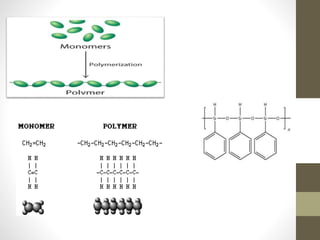
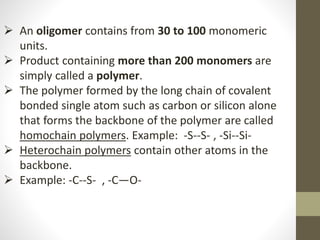
DEFINITION: A polymer is a large molecule made up of
many repeating units.
 The word “polymer” means “many parts.”
 Monomers bond together to form polymers.
 A monomer is a small molecule that combines with
other molecules of the same or different types to form
a polymer.
 The structure of a polymer is displayed by showing the
“repeating unit”(monomer) or “mer” and an “n”
number that shows how many monomers are
participating in the reaction.
 If two, three, four, or five monomers are attached to
each other, the product is known as a dimer, trimer,
tetramer, or pentamer, resp.
POLYMERS IN GENERAL
 An oligomer contains from 30 to 100 monomeric
units.
 Product containing more than 200 monomers are
simply called a polymer.
 The polymer formed by the long chain of covalent
bonded single atom such as carbon or silicon alone
that forms the backbone of the polymer are called
homochain polymers. Example: -S--S- , -Si--Si-
 Heterochain polymers contain other atoms in the
backbone.
 Example: -C--S- , -C—O-
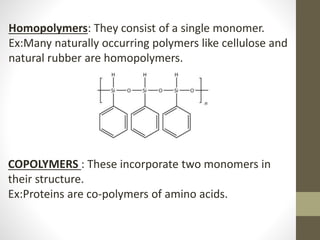
Homopolymers: They consist of a single monomer.
Ex:Many naturally occurring polymers like cellulose and
natural rubber are homopolymers.
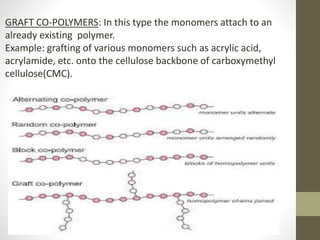
COPOLYMERS : These incorporate two monomers in
their structure.
Ex:Proteins are co-polymers of amino acids.
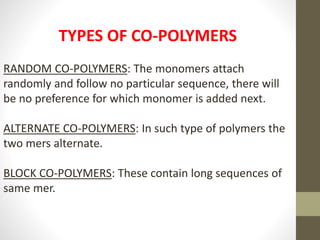
TYPES OF CO-POLYMERS
RANDOM CO-POLYMERS: The monomers attach
randomly and follow no particular sequence, there will
be no preference for which monomer is added next.
ALTERNATE CO-POLYMERS: In such type of polymers the
two mers alternate.
BLOCK CO-POLYMERS: These contain long sequences of
same mer.
GRAFT CO-POLYMERS: In this type the monomers attach to an
already existing polymer.
Example: grafting of various monomers such as acrylic acid,
acrylamide, etc. onto the cellulose backbone of carboxymethyl
cellulose(CMC).
TYPES OF POLYMERS
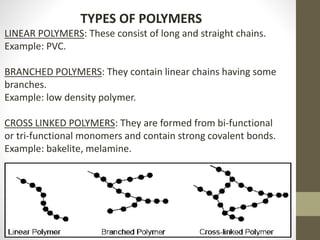
LINEAR POLYMERS: These consist of long and straight chains.
Example: PVC.
BRANCHED POLYMERS: They contain linear chains having some
branches.
Example: low density polymer.
CROSS LINKED POLYMERS: They are formed from bi-functional
or tri-functional monomers and contain strong covalent bonds.
Example: bakelite, melamine.
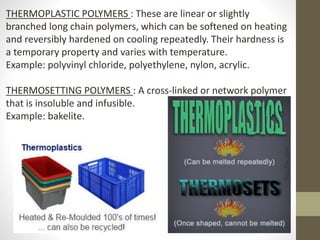
THERMOPLASTIC POLYMERS : These are linear or slightly
branched long chain polymers, which can be softened on heating
and reversibly hardened on cooling repeatedly. Their hardness is
a temporary property and varies with temperature.
Example: polyvinyl chloride, polyethylene, nylon, acrylic.
THERMOSETTING POLYMERS : A cross-linked or network polymer
that is insoluble and infusible.
Example: bakelite.
POLYMERISATION
• THE PROCESS BY WHICH MONOMERS BOND IS CALLED
POLYMERISATION.
• THE NUMBER “n” OF REPEAT UNITS OR MERS PER
MACROMOLECULE IS CALLED DEGREE OF
POLYMERISATION(DP).
TYPES:
CONDENSATION POLYMERISATION: It is also called step-wise
polymerisation.
Two or more monomers carrying different reactive functional
groups interact with each other. There are no radicals
involved in this polymerisation.
Example: Nylon is prepared via condensation polymerisation
of diamine and diacid chloride.
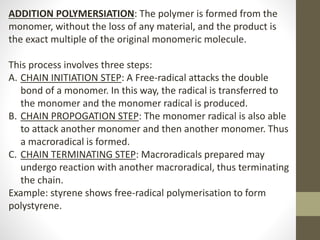
ADDITION POLYMERSIATION: The polymer is formed from the
monomer, without the loss of any material, and the product is
the exact multiple of the original monomeric molecule.
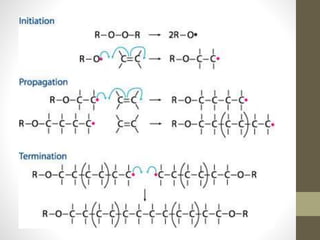
This process involves three steps:
A. CHAIN INITIATION STEP: A Free-radical attacks the double
bond of a monomer. In this way, the radical is transferred to
the monomer and the monomer radical is produced.
B. CHAIN PROPOGATION STEP: The monomer radical is also able
to attack another monomer and then another monomer. Thus
a macroradical is formed.
C. CHAIN TERMINATING STEP: Macroradicals prepared may
undergo reaction with another macroradical, thus terminating
the chain.
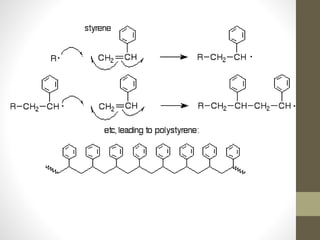
Example: styrene shows free-radical polymerisation to form
polystyrene.
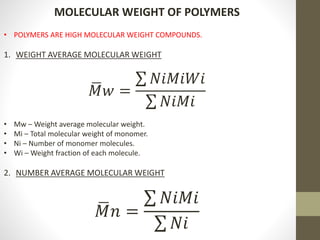
MOLECULAR WEIGHT OF POLYMERS
• POLYMERS ARE HIGH MOLECULAR WEIGHT COMPOUNDS.
1. WEIGHT AVERAGE MOLECULAR WEIGHT
𝑀𝑤 =
𝑁𝑖𝑀𝑖𝑊𝑖
𝑁𝑖𝑀𝑖
• Mw – Weight average molecular weight.
• Mi – Total molecular weight of monomer.
• Ni – Number of monomer molecules.
• Wi – Weight fraction of each molecule.
2. NUMBER AVERAGE MOLECULAR WEIGHT
𝑀𝑛 =
𝑁𝑖𝑀𝑖
𝑁𝑖
REFERENCES:
MARTIN’S PHYSICAL PHARMACY 4TH AND 6TH EDITION.
‘POLYMER SCIENCE’ BY GOVARIKAR.

Polymer science

  • 1.
  • 2.
    History Of Polymers Polymersare commonly referred to as “Plastics” The first semi-synthetic polymer ever made was Guncotton (cellulose nitrate)-by Christian F.Schonbein in 1845. The manufacturing process for this polymer was changed over the years due its poor solubility, processability & explosivity resulting in a variety of polymers such as celluloid(plasticized cellulose nitrate), cellulose acetate & hydrolyzed cellulose acetate soluble in acetone.
  • 3.
    Contd… In 1872, Bakelite,a strong &durable synthetic polymer based on phenol & formaldehyde was invented. Other synthetic polymers were invented later including Polyethylene-1933, Poly(vinyl chloride)-1933, Polysterene-1933, Polyamide- 1933, Teflon-1938,& synthetic rubbers-1942.
  • 4.
    Applications They are usedas wire insulation coating or as insulating housings. Conductive polymers are used as compact capacitors, in antistatic coating, as electromagnetic shielding for computers, transistors, light emitting diode, solar cells. They are extensively used in automobile industry. The major aim of the industry is to decrease the weight of the automobile in order to reduce fuel consumption & consequently emission of CO2. Replacement of steel rods by polymeric fibers is very effective to eliminate the problems of corrosion of steel rods in concrete. Footballs are made from polymethane.
  • 5.
    PharmaceuticalApplication Of Polymers • Polymersare used in manufacturing of polyolefin bottles, polystyrene vials, rubber closures, rubber & plastic tubing for injection sets & flexible bags of plasticized polyvinyl chloride to hold blood &intravenous solutions. • Unit –dose packaging make use of unplasticized polyvinyl chloride for cups &trays • Polyester film for strip-package or blister package containers.
  • 6.
    Contd.. • Water solublepolymers are used to coat tablets. • Some polymers such as hydroxypropyl methylcellulose(HPMC),& hydroxy propylcellulose(HPC), NaCMC, are used as binders for tableting granulation . • Ethylcellulose(EC) being insoluble in water, is combined with water soluble polymers to influence the dissolution rate of the coating film. • Synthetic &natural polymers are to thicken suspension &ophthalmic solutions.
  • 7.
    Contd.. • They areused to stabilize emulsion &suspension. • They are used to form water soluble jellies & ointment bases. • Polymers are employed in sustained release dosage forms as shells for microencapsulated drugs. • Polymers used as coatings, binders, taste maskers, protective agents, drug carriers &release controlling agents.
  • 8.
    DEFINITION: A polymeris a large molecule made up of many repeating units.  The word “polymer” means “many parts.”  Monomers bond together to form polymers.  A monomer is a small molecule that combines with other molecules of the same or different types to form a polymer.  The structure of a polymer is displayed by showing the “repeating unit”(monomer) or “mer” and an “n” number that shows how many monomers are participating in the reaction.  If two, three, four, or five monomers are attached to each other, the product is known as a dimer, trimer, tetramer, or pentamer, resp. POLYMERS IN GENERAL
  • 10.
     An oligomercontains from 30 to 100 monomeric units.  Product containing more than 200 monomers are simply called a polymer.  The polymer formed by the long chain of covalent bonded single atom such as carbon or silicon alone that forms the backbone of the polymer are called homochain polymers. Example: -S--S- , -Si--Si-  Heterochain polymers contain other atoms in the backbone.  Example: -C--S- , -C—O-
  • 11.
    Homopolymers: They consistof a single monomer. Ex:Many naturally occurring polymers like cellulose and natural rubber are homopolymers. COPOLYMERS : These incorporate two monomers in their structure. Ex:Proteins are co-polymers of amino acids.
  • 12.
    TYPES OF CO-POLYMERS RANDOMCO-POLYMERS: The monomers attach randomly and follow no particular sequence, there will be no preference for which monomer is added next. ALTERNATE CO-POLYMERS: In such type of polymers the two mers alternate. BLOCK CO-POLYMERS: These contain long sequences of same mer.
  • 13.
    GRAFT CO-POLYMERS: Inthis type the monomers attach to an already existing polymer. Example: grafting of various monomers such as acrylic acid, acrylamide, etc. onto the cellulose backbone of carboxymethyl cellulose(CMC).
  • 14.
    TYPES OF POLYMERS LINEARPOLYMERS: These consist of long and straight chains. Example: PVC. BRANCHED POLYMERS: They contain linear chains having some branches. Example: low density polymer. CROSS LINKED POLYMERS: They are formed from bi-functional or tri-functional monomers and contain strong covalent bonds. Example: bakelite, melamine.
  • 15.
    THERMOPLASTIC POLYMERS :These are linear or slightly branched long chain polymers, which can be softened on heating and reversibly hardened on cooling repeatedly. Their hardness is a temporary property and varies with temperature. Example: polyvinyl chloride, polyethylene, nylon, acrylic. THERMOSETTING POLYMERS : A cross-linked or network polymer that is insoluble and infusible. Example: bakelite.
  • 16.
    POLYMERISATION • THE PROCESSBY WHICH MONOMERS BOND IS CALLED POLYMERISATION. • THE NUMBER “n” OF REPEAT UNITS OR MERS PER MACROMOLECULE IS CALLED DEGREE OF POLYMERISATION(DP). TYPES: CONDENSATION POLYMERISATION: It is also called step-wise polymerisation. Two or more monomers carrying different reactive functional groups interact with each other. There are no radicals involved in this polymerisation. Example: Nylon is prepared via condensation polymerisation of diamine and diacid chloride.
  • 17.
    ADDITION POLYMERSIATION: Thepolymer is formed from the monomer, without the loss of any material, and the product is the exact multiple of the original monomeric molecule. This process involves three steps: A. CHAIN INITIATION STEP: A Free-radical attacks the double bond of a monomer. In this way, the radical is transferred to the monomer and the monomer radical is produced. B. CHAIN PROPOGATION STEP: The monomer radical is also able to attack another monomer and then another monomer. Thus a macroradical is formed. C. CHAIN TERMINATING STEP: Macroradicals prepared may undergo reaction with another macroradical, thus terminating the chain. Example: styrene shows free-radical polymerisation to form polystyrene.
  • 20.
    MOLECULAR WEIGHT OFPOLYMERS • POLYMERS ARE HIGH MOLECULAR WEIGHT COMPOUNDS. 1. WEIGHT AVERAGE MOLECULAR WEIGHT 𝑀𝑤 = 𝑁𝑖𝑀𝑖𝑊𝑖 𝑁𝑖𝑀𝑖 • Mw – Weight average molecular weight. • Mi – Total molecular weight of monomer. • Ni – Number of monomer molecules. • Wi – Weight fraction of each molecule. 2. NUMBER AVERAGE MOLECULAR WEIGHT 𝑀𝑛 = 𝑁𝑖𝑀𝑖 𝑁𝑖
  • 21.
    REFERENCES: MARTIN’S PHYSICAL PHARMACY4TH AND 6TH EDITION. ‘POLYMER SCIENCE’ BY GOVARIKAR.