.
19th c. textbooks to
20th c. pulp-fiction,
magazines to blogs,readers face
linear sequences of words, sections,
ideas. We can be excused for
assuming this is natural. It’s actually
our species adapting to printing
technology.
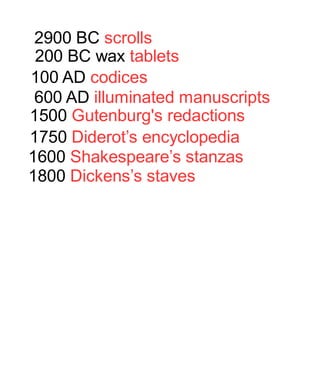
1750 Diderot’s encyclopedia,
1500 Gutenburg's redactions to
600 AD illuminated manuscripts
200 BC wax tablets
100 AD codices to
From 2900 BC scrolls to
1600 Shakespeare’s stanzas to
1800 Dickens’s staves,
For
click-
able
links
go to
the
last
page
Prior to all that, Homer’s Odyssey,
like other oral traditions, cycled
motifs and repeated actions. The
same event is retold in different light,
as the teller’s mind radiates. Printed
words precipitate cognitive wave-
lengths onto 2D surfaces, where
linear sequence becomes the
organizing principal. Printing presses
disgorge books strictly paginated.
But by the 20th century, linear, 2D
processes seemed limiting.
Scientists and artists demonstrated
reality, knowledge, communcation
have fractal, multidimensional,
relativistic attributes. Photographs,
then film and video, eroded print’s
hegemony. New generations felt the
changes, and found conventional
print technology restrictive. Fewer
and fewer stick around to watch
writers unveil novel work-arounds, as
Proust and James Joyce managed.
Since 1900, the public rings hands
over the new generation’s reading
habits. But only century before,
Samuel Johnson was admired for
reading without moving his lips.
People adapted silent reading in the
1800s because high-speed printing
enabled mass consumption. If
reading habits peaked among 19th
c.
literati, it was peculiar: end to end
and wordy. The world is faster, more
complex and less directional.
An alternative to linearity has long
existed: broadsheet newspapers.
Stories are (were) written in cyclical
chunks, each fleshing out essentials
in different detail. This lets printers
cut articles between chunks during
layout. Also, users survey multiple
stories on the front page, and select
one, then another, to follow inside.
Inside they read further, or jump to a
different story. Each user constructs
their version of the paper by their
selective reading.
Digital documents provided writers a
tech breakthrough. Early killer-apps,
MacWrite and MS Word, let them cut
and paste, to move parts around with
a mouse click. 30 years on, word
processors look much the same, if
laden with bells and whistles. The
internet took texts one step back, to
the scroll era, but hyperlinks took two
forward, in a narrow dimension.
Until now.  Let there be Polyfoils.
Polyfoil documents fit electronic
media, the internet, knowledge
workers, and international audiences.
Cyclical, branching, helical, gear-like,
compound, and complex, Polyfoil
formats put linear sequences in their
place. Linearity retains an essential
role, but not a limiting one.
The 20th century’s rivalry between
text and image, which ended in visual
media’s favor, is now a contest
between long- and short-form texts,
digital and physical documents, multi-
media and simple ones. Computer
displays change the document
landscape, and only the fit survive.
Polyfoil documents advance the
partisan interests of those who value
full-bodied texts, not skinny, child-
-length ones. Polyfoil documents
promote writer development, and
permit readers to construct versions
they prefer, without dumbing-down or
adding distraction. Hyperlinks permit
bikini knowledge: expose a lot, but
barely covered. Polyfoils promote
new document fashions that fit
genuine knowledge.
Polyfoils are not baby-steps. The
Patent Office finds giant leaps an
athema. They may encourage
monopolies over new platforms. This
invention does the heavy lifting
necessary to specify its advance in
concrete terms that discourage
monopolization. Entirely original,
Polyfoil documents will trigger other
peoples’ imaginations, and some
may find new document sequences
and production systems that this
invention has not contemplated,
illustrated, or specified.
On the other hand, without patent
protection, I will lack the means to
promote an important, compelling,
and probably commercial idea.
Patentability enables important
innovations to spread, instead of
remaining dormant. Polyfoils are an
important innovation to spread, and
patent protection allows it.
1750 Diderot’s encyclopedia
1500 Gutenburg's redactions
600 AD illuminated manuscripts
200 BC wax tablets
100 AD codices
2900 BC scrolls
1600 Shakespeare’s stanzas
1800 Dickens’s staves
By Brian Coyle

Polyfoils: a brief history

  • 1.
  • 2.
    19th c. textbooksto 20th c. pulp-fiction, magazines to blogs,readers face linear sequences of words, sections, ideas. We can be excused for assuming this is natural. It’s actually our species adapting to printing technology. 1750 Diderot’s encyclopedia, 1500 Gutenburg's redactions to 600 AD illuminated manuscripts 200 BC wax tablets 100 AD codices to From 2900 BC scrolls to 1600 Shakespeare’s stanzas to 1800 Dickens’s staves, For click- able links go to the last page
  • 3.
    Prior to allthat, Homer’s Odyssey, like other oral traditions, cycled motifs and repeated actions. The same event is retold in different light, as the teller’s mind radiates. Printed words precipitate cognitive wave- lengths onto 2D surfaces, where linear sequence becomes the organizing principal. Printing presses disgorge books strictly paginated. But by the 20th century, linear, 2D processes seemed limiting. Scientists and artists demonstrated reality, knowledge, communcation have fractal, multidimensional, relativistic attributes. Photographs,
  • 4.
    then film andvideo, eroded print’s hegemony. New generations felt the changes, and found conventional print technology restrictive. Fewer and fewer stick around to watch writers unveil novel work-arounds, as Proust and James Joyce managed. Since 1900, the public rings hands over the new generation’s reading habits. But only century before, Samuel Johnson was admired for reading without moving his lips. People adapted silent reading in the 1800s because high-speed printing enabled mass consumption. If reading habits peaked among 19th c.
  • 5.
    literati, it waspeculiar: end to end and wordy. The world is faster, more complex and less directional. An alternative to linearity has long existed: broadsheet newspapers. Stories are (were) written in cyclical chunks, each fleshing out essentials in different detail. This lets printers cut articles between chunks during layout. Also, users survey multiple stories on the front page, and select one, then another, to follow inside. Inside they read further, or jump to a different story. Each user constructs their version of the paper by their selective reading.
  • 6.
    Digital documents providedwriters a tech breakthrough. Early killer-apps, MacWrite and MS Word, let them cut and paste, to move parts around with a mouse click. 30 years on, word processors look much the same, if laden with bells and whistles. The internet took texts one step back, to the scroll era, but hyperlinks took two forward, in a narrow dimension. Until now.  Let there be Polyfoils. Polyfoil documents fit electronic media, the internet, knowledge workers, and international audiences. Cyclical, branching, helical, gear-like,
  • 7.
    compound, and complex,Polyfoil formats put linear sequences in their place. Linearity retains an essential role, but not a limiting one. The 20th century’s rivalry between text and image, which ended in visual media’s favor, is now a contest between long- and short-form texts, digital and physical documents, multi- media and simple ones. Computer displays change the document landscape, and only the fit survive. Polyfoil documents advance the partisan interests of those who value full-bodied texts, not skinny, child-
  • 8.
    -length ones. Polyfoildocuments promote writer development, and permit readers to construct versions they prefer, without dumbing-down or adding distraction. Hyperlinks permit bikini knowledge: expose a lot, but barely covered. Polyfoils promote new document fashions that fit genuine knowledge. Polyfoils are not baby-steps. The Patent Office finds giant leaps an athema. They may encourage monopolies over new platforms. This invention does the heavy lifting necessary to specify its advance in concrete terms that discourage
  • 9.
    monopolization. Entirely original, Polyfoildocuments will trigger other peoples’ imaginations, and some may find new document sequences and production systems that this invention has not contemplated, illustrated, or specified. On the other hand, without patent protection, I will lack the means to promote an important, compelling, and probably commercial idea. Patentability enables important innovations to spread, instead of remaining dormant. Polyfoils are an important innovation to spread, and patent protection allows it.
  • 10.
    1750 Diderot’s encyclopedia 1500Gutenburg's redactions 600 AD illuminated manuscripts 200 BC wax tablets 100 AD codices 2900 BC scrolls 1600 Shakespeare’s stanzas 1800 Dickens’s staves
  • 11.