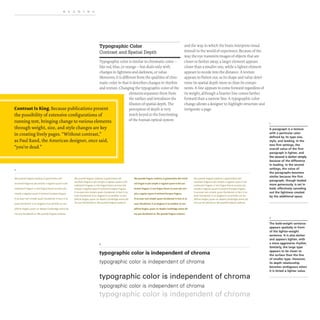
A Real-World Desil'T-
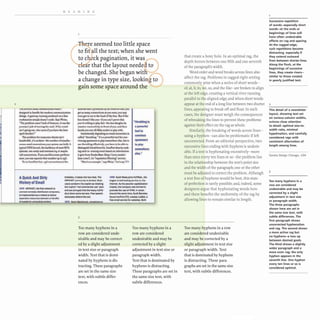
Timothy Samara
All rights reserved. No part of this book may be
reproduced in any form without written permission
of the copyright owners. All images in this book
have been reproduced with the knowledge and prior
consent of the artists concerned, and no responsibility
is accepted by producer, publisher, or printer for any
infringement of copyright or otherwise, arising from
the contents of this publication. Every effort has
been made to ensure that credits accurately comply
with information supplied.
First published in the United States of America by
Rockport Publishers, a member of
Quayside Publishing Group
33 Commercial Street
Gloucester, Massachusetts 01930-5089
978.282.9590 Telephone
978.283.2742 Fax
www.rockpub.com
Digital edition: 978-1-61673-590-6
Softcover edition: 978-1-59253-170-7
Library of Congress Cataloging-in-Publication Data
Samara, Timothy.
--Publication design workbook: a real-world design guide I Timothy
Samara.
- - -p.--cm.
--Includes bibliographical references and index.
- ISBN 1-59253-170-9 (hardcover)
--1. Graphic design (Typography) 2. Layout (Printing) 3.
- Newsletters- Design. 4. Magazine design. 5. Newspaper layout and
- typography. I. Title.
- Z246.S233 2005
- 686.2'252-dc22
Cover and text design: Timothy Samara
Cover Photograph: Allan Penn Photography
Printed in China
Printed in Singapore
2005007140
CIP
INTRODUCTION
Printing for the People
From Gutenberg to the New Millennium
As recently as 1995, a notable graphic designer declared that print was dead:
the digital age! The Internet! The PDF! It seemed that the paperless vision
of the future was upon us. A decade later now, in the early years of the twenty-
first century, this daring forecast appears to have been a bit premature. Walk
down a city street-large or small. Run through an airport or cruise down
the aisle at the supermarket. At any given moment, you will encounter a rack-
or ten-filled with magazines on every conceivable subject.
And not just one title in each subject, but twenty.
Never mind the countless editions of daily newspa-
pers in English, Spanish, Slovak, or Tagalog. Nor the
myriad documents published by businesses and
organizations- families ofbrochures and reports
and newsletters and calendars and mailers ...
Millions of impressions of ink on paper are made
every week, and public appetite for them seems
insatiable. As consumers in an increasingly global
community, we not only rely on a constant stream
of information to tell us about the world we live in,
we relish it. Subscribing to a particular cooking
magazine, picking up the paper with coffee on the
weekend, poring through an annual report to track
our investments, looking at housewares in a slick
catalog- publications draw us together as part of a
larger community, even as they cater to our indi-
vidual lifestyles. When we read a newspaper, we're
connecting with people on the other side of town ...
or the other side of the world. When we flip through
a trendy fashion or music magazine, we're part of
the in-crowd, elevated to the status of elite cultural
insiders. And we understand that other people like
us are reading and looking at the same things.
Though we enjoy life as individuals, we are, after
all, social animals- and we like to know that there
are other individuals like ourselves.
Print offers other, more physical benefits. As
dynamic and immediate as the Internet is, it lacks
the tactile fun of flipping through pages. Images
online are never as sharp as those printed on paper.
The screen hurts your eyes after a while, and too
much clicking leads to carpal tunnel syndrome.
The technology is new and undeveloped (as ubiqui-
tous as it is, it's been around for only twenty years)
and has a ways to go. These limitations in the digi-
tal experience might change after another fifty or a
hundred years, in much the same way that printed
communications did in the century after they
exploded in popularity upon first being produced
in the mid-I400S. But for now, the 600-year evolu-
tion of the printed page still trumps the blinking
pixel any day of the week.
FORTY- TWO LINES THAT CHANGED THE WORLD
When historians talk about cultural paradigm
shifts- extraordinary changes in the human
condition- they usually include the development
of printing among the top five (along with little
things like the invention of the wheel). Today, it's
difficult to imagine daily life without printed
reading material. But prior to the fifteenth century,
there was little to be read in the Western world,
and not many people to read what little there was.
Fewer than 50,000 volumes ofwriting existed in
all of Europe, and those were accessible only to the
very wealthy. Though a growing middle class of
merchants and tradesmen- resulting from the
collapse of feudalism and popular migration from
countryside to town- were afforded the opportunity
to study in universities, resources were scarce.
In the thirteenth century, Cambridge University
boasted only I22 manuscript books, inscribed by
hand on vellum, sheets of dried sheepskin that
were enormously expensive to produce. A single
200-page book had a value equal to a farm and
Today, it's difficult to imagine daily life
without printed reading material. But prior
to the fifteenth century, there was little to
be read in the western world, and not many
people to read what little there was.
required four or five months for production. Still,
demand for such books had been steadily rising,
and teams of lettering specialists,illuminators
(experts in decorative illustration using gold leaf
and pigments), and binders tried to keep up. One
factor aiding production was the introduction of
papermaking to Europe from China- a 600-year
process that spread from east to west through a
series of invasions and migrations. The first known
paper mill, in Fabriano, Italy, was established in
I276; another, in Troyes,France,appeared in I348.
Paper provided an inexpensive and rapidly
produced substrate to replace vellum. Along with
paper, the advent ofwood-block printing also
seems to have been carried from the East, although
the history of its invention is cloudy.
Early manifestations of European printing-
devotional images of saints and printed playing
cards- demonstrated the potential for previously
inaccessible things to become readily available
to the mainstream, illiterate culture: card games,
once the sole province of nobility, could now be
enjoyed by farmers as well. In the late I300S and
early I400S, block books printed from single wood-
carvings containing both text and image became
available on a wider basis. Eventually, a quest for
quicker production methods was undertaken-
notably in the Netherlands, Germany, Italy, and
France. Woodworkers, as well as goldsmiths
and other tradesmen,experimented with cutting
the wood blocks apart to reuse the letters
or cutting individual letters from steel or iron.
But most historical evidence credits a German
inventor and goldsmith, johann Gensfleisch zum
Gutenberg, with adapting several technologies
to make the leap to functional, movable type.
Punchcutting, mold making,
alloying, casting, ink mixing,
and press methods used for
wine and cheese: by adjusting
and integrating these technolo-
gies, Gutenberg was able to cre-
ate a system for producing
thousands of reusable, durable,
and extraordinarily precise let-
ters, and a way of transferring
2
their image onto paper at a remarkable speed.
His first project, a Bible printed in I455- Set in
two columns to a page, with forty-two lines per
column- was a watershed in communication
technology that rivals the written word itself in
its importance to modem culture. The ability to
disseminate enormous quantities of information,
rapidly and affordably, meant that ideas previously
known only to a few could be disseminated to
thousands. Printing helped standardize languages
and unite regions of culturally similar people
where, earlier, dialects and usage could vary wildly
within even short geographical ranges.
Although Gutenberg's fortunes fell and rose-
the financial burden of loans for research and
development cost him custody of his first works-
the effect of his discovery was profound. Within
thirty years, presses had sprung up throughout
Europe and publishing had become a major indus-
try in Mainz, Ulm, Venice, London, and other cities.
Along with moveable type, the invention of metal
engraving added illustration to the typographic
page. Broadsides- single sheets printed on one
side- joined books as popular publications, initially
spreading religious information but eventually
evolving to include information of local interest
to communities. These sheets ultimately became
the first newspapers. Publications on a wider variety
of subject matter began to emerge: practical guides
on art and mathematics; manuals for hunting and
crafts; and stories for popular entertainment. As
the middle class grew, the spread of publications
increased literacy and provided comfort after the
grueling workday.
Once the industrial revolution of the late I700S
mechanized the printing process, demand and
supply fed each other in an endless cycle of produc-
tion. The standard of living improved as a result
of wage labor in factories; as wages were spent
on material goods and more comfortable housing,
the manufacturers of these goods employed
more people to meet the demand.As early as
the I820S, catalogs for products began to appear.
journals of poetry and philosophy circulated
among urban populations, the progenitors of the
modem magazine.
In I826, joseph Niepce, a lithographer in France,
sought a way to transfer images directly to a printing
plate; in an experiment, he exposed an emulsified
sheet of pewter to light and captured an image.
Photography brought a new tonal dimension to the
printed page, offering not only a means of showing
Publication Design WorkbookIIPrinting for the People
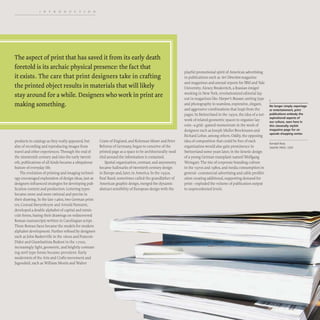
A sample of one of the
early shop types-a printer's
textura face derived from
Sweyheim's and Pannartz's
double alphabet of the
1460s-prevalent in Europe
following Gutenberg's
now-famous experiment
of 1455.
2
How time flies! This web
offset press (the web is
the continuous stream of
paper fed off the enormous
roll in the foreground)
pounds out up to 50,000
impressions every hour,
a far cry from the weeks
needed to produce twenty
editions of a book in 1500.
6 7
INTRODUCTION
The aspect ofprint that has saved it from its early death
foretold is its archaic physical presence: the fact that
it exists. The care that print designers take in crafting
the printed object results in materials that will likely
stay around for a while. Designers who work in print are
making something.
products in catalogs as they really appeared, but
also of recording and reproducing images from
travel and other experiences. Through the end of
the nineteenth century and into the early twenti-
eth, publications of all kinds became a ubiquitous
feature of everyday life.
The evolution of printing and imaging technol-
ogy encouraged exploration of design ideas, just as
designers influenced strategies for developing pub-
lication content and production. Lettering types
became more and more rational and precise in
their drawing. Tn the late 1460s, two German print-
ers, Conrad Sweynheym and Arnold Pannartz,
developed a double alphabet of capital and minis-
cule forms, basing their drawings on rediscovered
Roman manuscripts written in Carolingian script.
These Roman faces became the models for modem
alphabet development. Further refined by designers
such as John Baskerville in the r600s and Francois
Didot and Giambattista Bodoni in the 1700S,
increasingly light, geometric, and brightly contrast-
ing serif type forms became prevalent. Early
modernists of the Arts and Crafts movement and
Jugendstil, such as William Morris and Walter
Crane of England, and Koloman Moser and Peter
Behrens of Germany, began to conceive of the
printed page as a space to be architecturally mod-
eled around the information it contained.
Spatial organization, contrast, and asymmetry
became hallmarks of twentieth-century design
in Europe and, later, in America. In the 1930S,
Paul Rand, sometimes called the grandfather of
American graphic design, merged the dynamic
abstract sensibility of European design with the
~--
playful promotional spirit ofAmerican advertising
in publications such as Art Direction magazine
and magazines and annual reports for IBM and Yale
University. Alexey Brodovitch, a Russian emigre
working in New York, revolutionized editorial lay-
out in magazines like Harper's Bazaar, uniting type
and photography in seamless, expressive, elegant,
and aggressive combinations that leapt from the
pages. In Switzerland in the 1950S, the idea of a net-
work of related geometric spaces to organize lay-
outs- a grid- gained momentum in the work of
designers such as Joseph Muller-Brockmann and
Richard Lohse, among others. Oddly, the opposing
idea of composition that could be free of such
organization would also gain prominence in
Switzerland some years later, in the kinetic design
of a young German transplant named Wolfgang
Weingart. The rise of corporate branding culture
in the 1970S and 1980s, and media consumption in
general- commercial advertising and cable prolifer-
ation creating additional, supporting demand for
print- exploded the volume of publication output
to unprecedented levels.
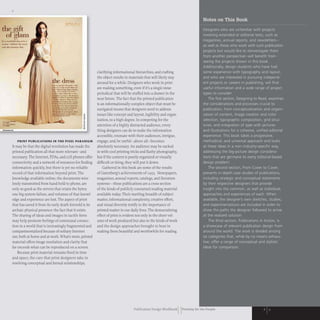
No longer simply reportage
or entertainment, print
publications embody the
aspirational aspects of
our culture, seen here in
this classically stylish
magazine page for an
upscale shopping center.
Kendall Ross
Seattle (WA), USA
the gift
of glam
1t.1l"'_~~"'''Iu.. ..,t'''1f
"'.I~. l"rM.....,.............
' It" ....r..·I....u1l11l' a.•.
I
", ~,,"-..- -
_
........_
.."'- ....
"""'04t~""'~
..... _"""""""r_,.....
...... ,'rN... t..... _
_...-
....................
. ......,---
... ...................
~,...._ IIo.w-,..a"f_t"-4
• 1I*r.t' __ .--...4
.. -w._......
..............----
4, 4-- .._~ .....
...=::~:- ~
;
:;-- ---.... •
.;
---
- -.
•
PRINT PUBLICATIONS IN THE PIXEL PARADIGM
It may be that the digital revolution has made the
printed publication all that more relevant- and
necessary. The Internet, PDAs, and cell phones offer
connectivity and a network of resources for finding
information quickly, but there is yet no reliable
record of that information beyond print. The
knowledge available online, the documents wire-
lessly transmitted from hand-held to phone, are
only so good as the servers that retain the bytes;
one big system failure, and volumes of that knowl-
edge and experience are lost. The aspect of print
that has saved it from its early death foretold is its
archaic physical presence: the fact that it exists.
The sharing of ideas and images in tactile form
may help promote feelings of communal connec-
tion in a world that is increasingly fragmented and
compartmentalized because of solitary Internet
use, both at home and at work. What's more, printed
material offers image resolution and clarity that
far exceeds what can be reproduced on a screen.
Because print material remains fixed in time
and space, the care that print designers take in
resolving conceptual and formal relationships,
clarifying informational hierarchies, and crafting
the object results in materials that will likely stay
around for a while. Designers who work in print
are making something, even if it's a single-issue
periodical that will be stuffed into a drawer in the
near future.The fact that the printed publication
is an informationally complex object that must be
navigated means that designers need to address
issues like concept and layout, legibility and organ-
ization, to a high degree. In competing for the
attention of a highly distracted audience, every-
thing designers can do to make the information
accessible, resonate with their audiences, intrigue,
engage, and, be useful- above all- becomes
absolutely necessary. An audience may be sucked
in with cool printing tricks and flashy photography,
but if the content is poorly organized or visually
difficult or tiring, they will put it down.
Gathered in this book are some of the results
of Gutenberg'S achievements of 1455. Newspapers,
magazines, annual reports, catalogs, and literature
systems- these publications are a cross section
of the kinds of publicly consumed reading material
available today. Their startling breadth of subject
matter, informational complexity, creative effort,
and visual diversity testify to the importance of
printed matter in our daily Jives. The democratizing
effect of print is evident not only in the sheer vol-
ume ofwork produced but also in the kinds ofwork
and the design approaches brought to bear in
making them beautiful and worthwhile for reading.
Publication Design WorkbookIIPrinting for the People
Publications are extended applications oftext and image and, as such,
bring to bear a tremendous number of considerations for a designer.
Unlike single-format items, such as posters or ads, even singular multipage
documents with more than eight or twelve pages require designers to
focus on issues that derive from extended reading: organizing large volumes
ofcontent into related parcels ofinformation; crafting the typography
to make it comfortably readable over many pages, yet lively enough to
continually engage the reader; structuring the parts ofpages and sections
to accommodate a variety of content, whether image or text based; and
integrating images with typography to achieve a unified form that builds
a communication much bigger than its parts.
10 11
Every publication begins as an idea: a subject or message with a function but no form.
Art shown in an exhibition, for example, is an idea. The service an organization offers is
an idea. So too are popular activities: cooking, sports, and home decor. Their function-
whether delivered by a magazine, a newspaper, a family of corporate literature, or a
product catalog-is always the same: to involve an audience in that message or subject
matter over a period of time. The form is what changes, differentiating each idea,
distilling its raw content into recognizable parts, and engaging its target audience
through specific colors, imagery, and typography. The vehicle for these ideas is related
to their secondary functions-the kind of audience the idea addresses, their particular
need for grouped or periodical information, and the static or evolutionary nature of
the message. The vehicle, thus, also changes. The idea may be best served as a newspaper,
providing current information on an up-to-the minute basis, or as a system ofbrochures
that builds awareness of different aspects ofthe message as they become relevant at
different times. No matter what the vehicle, though, the process of designing it is the
same, and it begins with developing the content that will convey the message.
The initial step in thinking about how a publica-
tion becomes a reality is to focus on what the sub-
ject matter of the message may be. Conceptual mes-
sages have several levels of function. The primary
function is the subject matter itself, the intrinsic
idea that must be given a form so that it can be per-
ceived. The idea of French cuisine and the idea of a
company's financial performance are both exam-
ples of primary function. The secondary function of
an idea is to be relevant and accessible to a particu-
lar group of people in a way that makes sense for
them. Some conceptual messages are serial and
evolutionary, occurring periodically with new com-
Publication Design workbookIIDesigning to Read
ponents that build on the previous occurrence.
The most familiar forms of such "periodical"
messages are newspapers, magazines, and
newsletters. Other messages are "systematic,"
occurring at one time as a group, or at several
junctures, as individual parts of an overall group.
Their secondary function is to deliver a message
as an interrelated set of components, each with
its own specific submessage that relates to the
general message. Such publications as corporate
literature systems- groups of brochures- serve
this function. Considering up front that a publica-
tion is to be a periodical, as opposed to a static
12 13
THINKING
PRIMARY SECONDARY TERTIARY
system, is an inherent part of the message: an idea's
secondary function- to relate to a particular audi-
ence- is fundamental to its primary function.
Most ideas also have a tertiary function, which
is to deliver emotional, associational, or cultural
interpretation to the audience, to position it rela-
tive to other forms or vehicles of the same idea.
In other words, to differentiate it. This interpretive
function is biased on the part of the message's
author and is sometimes called its "spin" or "angle."
Branding- the experience of an author's corporate
or cultural identity- is an example of an interpre-
tive, tertiary function. The interpretive function
may be benign or ulterior, meaning that its func-
tion is to be transparent- a signal or identifier-
or layered, providing a point of view that affects
the meaning of the message- developing loyalty
among the audience. The branding of a newspaper,
for the most part, is benign: its goal is to differen-
tiate the newspaper as a source of information.
The branding of an annual report, on the other
hand, is ulterior: its goal is to influence the
audience's perception of the information in one
direction or another.
Although the core message- the subject matter-
is the designer's first focus, its concept is essential
in exhibiting these tertiary functions in varying
degrees. The concept must have a form in order
for the audience to see it. That form may include
stories, photographs, illustrations, tabular data,
diagrams, instructions, or other visual displays.
Most concepts may be displayed in any of these
ways; usually, they are displayed as a combination
of these forms that, together, creates a specific type
of content. The author or developer of this content
usually conceives of the display method in a raw,
2
-
---...-
-..-~
----
-. -
--_.-
~-­
---
.._---
-----
...._--
_.. _...
::.!....... ;4
- ""''''--
V la , _ _
::..-:-,.~-
--
~.. ---
.., .. ..--
-- -- ---
verbal way first- writing it out. Visual forms, such
as photographs,may augment the content's written
form, especially if the concept is about something
experiential (such as hiking) or about a product
that must be seen to be understood (such as home
furnishings). Regardless of whether the secondary
or tertiary functions of the concept are relevant, this
raw content is the basis upon which the designer
must act to build the publication.And that means
understanding its subject matter, its cultural con-
text, its intended audience, and its internal struc-
ture or parts before proceeding to the design phase.
Publications-indeed, all
visual (ommunications-
may be "peeled apart" to
reveal three distinct func-
tions of concept at work:
the primary, or intrinsic
aspects of the subject mat-
ter; the secondary function
of relating to a specific
audience; and the tertiary
function-branding and
positioning-that further
filters the primary message
for interpretation.
A publication may empha-
size any of these over the
other. with varying effect
on audience perception.
If the primary function is
emphasized. the audience
finds the material reliable-
almost transparent. If
the secondary function is
emphasized, the audience
senses itself as part of a
community. If the tertiary
function is emphasized;
the audience is more likely
to consider the material
as a pitch or call to some
particular action.
---_.__.._--------
D
D
D
D
D
D
D
D
D
Build a Design Brief: A Concepting Checklist
What is the publication's subject matter?
Into how many parts will the information be
broken? What are the parts?
Is the subject organic or manmade?
Concrete or abstract?
What colors are associated with the subject
matter (literal and emotional)?
Who is going to read about the subject?
Who will not be reading about it?
What other publications already exist about
the subject?
List two words about each that describe their
visual qualities.
List five words that describe the subject as you
want to interpret it. How are these different from
the words that describe existing publications on
the subject?
How often do readers need the information?
In what context will they find the information:
through subscription, as a membership benefit,
at a newsstand?
Publication Design workbook ll neSigning to Read
2
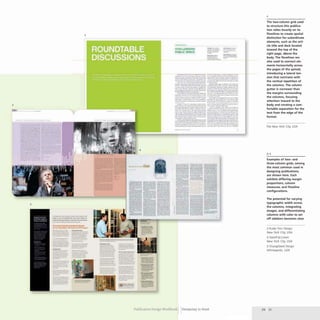
A remarkable congruence
flattens the primary. sec-
ondary. and tertiary aspects
of communication in this
spread from a mainstream
clothing retailer's catalog-
that is, each aspect is more
or less the same relative to
each other.
The primary message is
clothing. It is visually
represented by a neutral
photograph of clothing.
The target audience is
mainstream, concerned
with a sense of the gen-
uine; this retailer's cus-
tomers are not interested
in couture fashion.
Further, the coloration of
the clothes is a branded
message, as well as intrinsic
to their design and to the
design of the catalog.
J.Crew New York City, USA
'4 IS
THINKING
Visual Sources
Building on the Primary Function
of the Concept
The content is its own concept and vice versa; it is
the fundamental source for all that the designer will
do with it. Sometimes, designers become concerned
with conceptual functions beyond the primary,
secondary, and tertiary, looking to achieve a particu-
lar visual display for the content that is interesting
to them. If the designer exerts his or her visual or
creative conceits over the intrinsic concept of the
content, the result is sometimes visually interesting
but inappropriate for the message.It may seem
forced or contrived rather than a natural outgrowth
ofthe designer's objective expression ofthe concept.
Of course,the designer's creativity and aesthetic
sensibilities are demonstrated in how he or she
selects or invents visual means of displaying the
Although distilling intrinsic visual ideas from
content- for example, the typefaces to use for text
or titles, the attributes of space and color, the choice
between photographic or illustrative imagery.
But the designer's main goal is to act as a conduit for
the concept in an objective way. In that sense, the
content- the conceptual idea to be communicated,
the subject matter- is really the driving force
behind the design.
Why does a publication look and feel the way
it does? Why is a magazine about classical music
visually different from one covering hip-hop? Why
does an annual report for an insurance company
convey stability and reserve while one for a sport-
ing goods company communicates energy and fun?
The simple answer is that the content of each is
different, so their visual qualities must be different.
The more complex answer is that each individual
designer has investigated the content for clues as to
its intrinsic, primary idea and, from there, distilled
a set ofvisual qualities through a
decision-making process that
results from asking questions and
comparing the answers that pres-
a subject means drawing from the source objectively,
ent themselves. Is the subject
organic or man-made? Is it criti-
cal to the audience's life and
the designer's own interpretation will nonetheless
be subjective. Consider the idea of"natural,"in both
image and typeface, and the many possibilities
there may be in simply describing this subject.
health or is it entertainment7
Does the subject exist in the
world, like a dog or a cat, or is it
2
an abstraction, like politics or philosophy? If it's
based on something natural, are there forms or
colors that relate to it universally, as leaves or the
color green relate to the environment? Does the
subject present itself as one continuous thought,
or is it composed of several parts?
Based on the answers to these questions, a
designer begins to examine forms for typography
and images that, first and foremost, document the
subject matter regardless of the subject's secondary
function (audience expectation) or tertiary function
(branding or interpretive positioning). In order for
the subject to have power in its visual form, its
intrinsic characteristics must be the source.Again,
however, it is the designer's subjective sensibility
that brings out these visual ideas from the subject.
Even if the designer is trying to be completely
objective or neutral, simple matters like choosing a
typeface will reflect his or her interpretation of
these intrinsic qualities. No two designers will
select the same typeface,for example,to communi-
cate "elegance" or "organic." But in comparing
potential choices among typefaces, both designers
are likely to come to some similar conclusions, on
a big-picture level, in selecting a face for text that
feels right for the subject. Though design is some-
what subjective, it is rooted in universals: its goal is
to solve the problem of how to make as many people
as possible experience information in a similar way.
3
........................................
1,2
Abstract form is a power-
ful communicator of ideas.
Here, the lateral back-
and-forth movement of
colored bands, photo-
graphs, and type elements
visually supports the
idea of "cro55currents"-
the magazine's title-and
creates associations of
exchange or dialogue.
The designers pay careful
attention to the locations
of each element's begin-
ning and endpoint to
ensure that the intervals
created by their staggered
locations are dynamic.
Studio Blue Chicago, USA
ALL PEOPLE
INTERESTED
IN MUSIC
AGES
Resonating with the Audience
The Secondary Function of Concept
Getting a concept in front of an audience depends
largely on who the audience is. This secondary
function of an idea- to be relevant and accessible to
a particular group of people- helps detennine not
only the physical fonn of the publication but also,
to some degree, its visual style and, more impor-
tant, its organization. Who an audience is derives
from a variety of factors. First, the identity, or demo-
graphic makeup, of the people to be targeted is
important. Are the individuals young or old?
Predominantly male or female? Working class or
wealthy? Do their interests reflect their ethnic or
social background? How many of them are there?
What joins them together as a recognizable group?
The second factor in establishing an audience is
their assumed need for the information in a partic-
ular way, at particular times or through a particular
delivery method.If the subject matter is complex
and evolves on a continuing basis, the audience
may be assumed to want the information in a peri-
odical fonn- a newspaper, magazine, or newsletter.
If the subject matter is finite but may be augment-
ed from time to time- for example, a line of cos-
metic products that changes seasonally, or a set of
services provided by a financial institution- it
might be assumed that a catalog or a system of
brochures is the best delivery method.
The relationship of time to informational need
is yet another factor in determining the audience.
As a group, do they need to be infonned on the occa-
sion of a specific circumstance, every few months,
every week, or every day? Lastly, the projected use
of the material by these individuals helps define
who they are. Perhaps they will count on the publi-
cation to keep them infonned about ongoing events;
4
maybe they will use the publication as a reference
or record;or perhaps they will use it as a catalyst
for making decisions about their lives.
Defining the audience enables the designer to
make basic decisions about fonn and content, from
basic format- kind, size, binding method- to more
abstract aspects, such as the kinds of photographs
or illustrations may be most interesting to them;
the type-or image-to-negative space ratio; and even
the selection of color and type styles.The second-
ary function of the content also considers how the
subject resonates with the audience.
A publication that does so respects that group's
demographic identity, speaking to them using
visual metaphor and organization that augment
the subject's core message: the audience identifies
with the subject because the publication visually
interprets the content for them- emotionally and
intellectually. This interpretive aspect may relate to
Publication Design Workbook Designing to Read
3
Targeting an audience
means defining subsets
of people from larger
sets of people. Communal
sets-subgroups composed
of people who are part
of two sets-offer an
opportunity to expand
the message beyond the
base demographic, creat-
ing a wider audience
potential that may affect
the concept.
4
A representational image-
an egg-is used as a
conceptual housing for the
program of an independent
film festival. The represen-
tational image immediately
presents a disconnect:
what is the relationship
between egg and film?
It is a conceptual one,
relying on the viewer to
make the connection and
thereby involving him
or her in completing the
message. In this sense,
the abstracted layers of
meaning are skewed once
again toward the branding
message of the festival
organizers, in that its
conceptual, generative
symbology positions the
festival as different from
other film festivals.
AdamsMorioka
Beverly Hills, USA
16 17
THINKING
the publication's tertiary function- branding-
but most often it is simply a reflection of the
designer capitalizing on the audience's shared
background, giving the core message a visual and
emotional context that allows the publication to
speak to them rather than at them. In this sense,
the audience influences many aspects of a publica-
tion's visual presentation. The audience factor also,
therefore, influences the meaning ofthe subject
content: they expect the content to have particular
associations or psychological effect. As a result,
the designer must consider the audience's level of
taste and their assumed experience as individuals
as other sources for visual decision making, for
everything from page structure to color and color
integration. A home decor magazine produced
for a wealthy audience, for example,may succeed
with certain kinds of typography and photography
but may not succeed with working-class readers
because the presentation fails to resonate with
them. Two home decor magazines, therefore, may
have the same primary conceptual function but
different secondary functions because of their
different audiences; visually, they will reflect this
difference in their stylistic presentation.
2
3
The audience for this
hip-hop magazine recog-
nizes its message as being
directed toward them
because of color choice,
arrangement of forms,
and typographic choices.
Groups of people are
highly attuned to the sub-
tleties of message in visual
form; they know when
the message is for them.
Eggers + Diaper
Berlin, Germany
Branding and positioning create spin on a concept:
an association or emotional response in the audience
related not to the content itself but to the identity
of the publisher. The diagram at right illustrates the
differences between a neutral concept and a branded
concept that alters both primary and secondary
messages to help distinguish the concept against its
competitors in the same genre.
The Influence of Brand
The Third Function of Concept
Designing to influence an audience's perception of
content so that it resonates with them adds a layer
of meaning to the overall content of a publication.
This interpretive layer derives directly from the
audience's identity and need and thus is a funda-
mental part ofthe subject concept. But a publication
may also contain biased messages from the author
or publisher- as well as from the designer- among
which are branding and positioning messages. These
messages are communicated on an abstract visual
level that alters the audience's perception of the
content, effectively changing the subject's meaning.
The term "biased" isn't necessarily detrimental;
it simply means that a point of view about the
subject is being established for the audience.
This point ofview can be a powerful factor in
publication design: it situates the subject in the
minds of the audience relative to other sources of
the same information, and can be used to achieve
noble ends ... as well as more pragmatic or cynical
ones. An annual report, for example, doesn't simply
deliver information about a company's services
and financial performance; it helps reinforce values
the company wants to promote,with the goal of marketing. It is itself a message, aside from the
attracting new investors or drawing investors away subject matter it transmits.
from competing companies. In one sense, the A company's positioning may also have an
messaging in such a case is intrinsic to the subject, effect on visual decisions made during the design
because it celebrates the achievement of its employ-
ees and the quality of its services; in another sense,
the company is competing for the loyalty of a
particular audience, aiming to increase its stock
price and profitability.
Branding can be defined as the collective experi-
ence of a company's services, public presence,
employees or representatives, and visual identity.
Most often, a company's branding is wrapped up in
its corporate identity- the logo and materials the
company uses to identify and promote it through
color, typography, image, and so on. The influence
ofbranding on a publication is therefore visual;
the publication's design, although singularly con-
sidered for its specific content and purpose, is part
of a broader program ofvisual elements: the typog-
raphy, color palette and choice of imagery reflect
decisions that convey the company's image, or
trade dress.A magazine is often considered its own
brand because it is widely circulated, resonates
deeply with its audience, and differentiates itself
from others of its genre through positioning and
process. Because positioning- the relationship of
the company or subject matter to others in the
same genre-is a direct response to audience identity,
its role may be far reaching. Specific colors may
be disallowed (or used exclusively) as a result of
trying to avoid association with other publications
or even ideas. Only certain typefaces may be
permitted. A specific style of imagery may be
developed to refer to some medium to which the
positioning assumes the audience relates- perhaps
a specific type of television program, for example,
uses an out-of-focus camera technique that the
target audience recognizes.
In clarifying these successive conceptual layers
of content- the core subject matter, its contextual
relevance to its audience, and its tertiary branding
or point of view, if applicable- the designer can
find relationships between them as a source for the
communication's visual form. The next question,
then, is how the content fits together.
4
FASHION PRIMARY
_..._-
AL1I(; 1 r.~'IT " r. Q I.I ARTEft.tT
FASHION FRSHlon fashion SECONDARY
TERTIARY
FRSHIDn
Publication Design Workbook Designing to Read
Venture Capital: Pacing-and
avigating-the PerfectStorm
ft • . . _
--~. -
"'- --.-
""'---,,-
---
-
. ._ 4 _ _ ....
-
I t _ _ _ ~
u _
.~
203
Compare the color and
model presentation of
these two catalogs. While
each represents fashion,
the message is filtered
differently for their respec-
tive audiences. In the
Takashimaya catalog (2),
unusual model cropping
in an indeterminate
environment. deep jewel
tone color. a nonstandard,
intimate format, and
staggered papers help
distinguish this high-end
retailer's message of
exclusivity from that of
the J.Crew catalog (3),
whose naturalistic color
and model presentation
resonate with a more
mainstream audience.
2 Design: MW
3 J.Crew
Both: New York City, USA
4
The primary source for this
newsletter's visual form is
not its subject matter-
venture capital funding-
but, rather, the authority
of the publisher in its field.
The details of careful
typesetting, conservative
color based on the client's
corporate color scheme,
and imagery with neutral
messages are the result
of communicating the
company's message.
Gorska Design
San Francisco, USA
18 19
THINKING
Evaluating and Organizing:
Sections and Sequence
Although much of the physical content for a publi-
cation comes to a designer ready to be designed,
more and more designers are actively engaged
in helping develop the content from a strategic
and editorial standpoint. Whatever the situation,
the designer faces the task of evaluating the
content's editorial form to determine what compo-
nents or methods will communicate most clearly,
as well as the order in which those components
ought to be sequenced.
First, the content must be divided into parts
relevant to the publication type- whether it's an
annual report, newspaper, magazine, product
catalog, newsletter, or system ofbrochures. Most
of these publication types come with preconceived
ideas about how content should be divided.
Editorial publications, including newspapers,
magazines, and newsletters, organize their content
as articles or stories, supported by images that are
generally documentary. Articles tend to be grouped
by category, especially in newspapers. A general
variety of highlighted information appears on the
front page, and this highlighted material continues
in, or is linked to, individual sections that make a
transition from more general to more specific-
international events (outside the local audience's
experience) segue into national and then local
events, followed by different kinds of specific issues
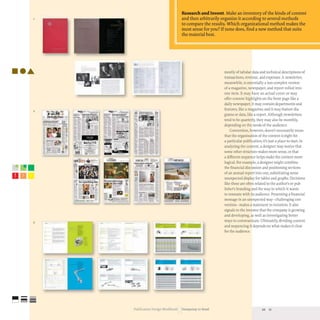
KIND
Break It Down. Strategies for organizing content
involve sorting the material into manageable parts
that are related to each other: by kind, by part to
whole, by complexity, chronologically, by relevance.
Certain strategies tend to be applied to particular
kinds ofpublications because of convention-
usually driven by the expectations ofthe audience.
Newspapers, for example, exhibit an organizational
strategy ofpart-to-whole based on local relevance.
PART TO WHOLE
COMPLEXITY
-
of concern to the local audience, such as dining,
automotive or housing news, local employment,
and the like. Magazines tend to follow a similar
general-to-specific pattern in defining sections, but
there are usually two major sections (rather than
five or six or more, as in newspapers): a section of
editorial departments and a section of features.
(Departments are pages devoted to the same kind
of information provided in every issue such as the
dessert of the month, newly released CDs, or a ques-
tion-and-answer column. The features are major
articles that investigate the magazine's subject mat-
ter in depth.) Annual reports are often divided into
three major sections that also become successively
more focused: first, a branded positioning section,
usually image driven, that describes the company's
values and dramatically conveys performance
highlights; then, a discussion by the company's
management about its activities, which often
includes a letter from a high-ranking executive; and
finally, a section of financial disclosure made up
1-3
Each publication is organ-
ized so that different
aspects or complexities of
information (orne to the
foreground at different
times. In a newspaper, for
example, the "softer"
material is toward the
back; in an annual report,
it's up front. The annual
report (1) is organized by
kind; the newspaper (2)
by relevance and part-to-
whole; the tool catalog (3).
by complexity of the
information. The level and
sequence of specificity for
each publication change
with function and target.
1 C"cle K Studio
San Francisco, USA
2 Jeff Neumann Denver, USA
3 Hutchinson Associates
Chicago, USA
CHRONOLOGICALLY
RELEVANCE
·....
2
• .. L. .'.'
~.: '
, -
3
o
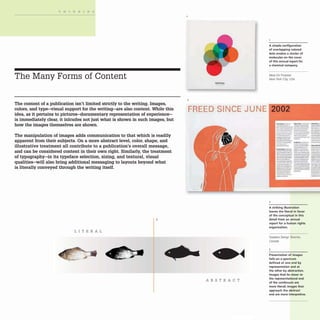
Research and Invent. Make an inventory ofthe kinds ofcontent
and then arbitrarily organize it according to several methods
to compare the results. Which organizational method makes the
most sense for you? Ifnone does, find a new method that suits
the material best.
mostly of tabular data and technical descriptions of
transactions, revenue, and expenses. A newsletter,
meanwhile, is essentially a less-complex version
of a magazine, newspaper, and report rolled into
one item. It may have an actual cover or may
offer content highlights on the front page like a
daily newspaper; it may contain departments and
features, like a magazine;and it may feature dia-
grams or data, like a report. Although newsletters
tend to be quarterly, they may also be monthly,
depending on the needs of the audience.
Convention, however, doesn't necessarily mean
that the organization of the content is right for
a particular publication; it's just a place to start. In
analyzing the content, a designer may notice that
some other structure makes more sense, or that
a different sequence helps make the content more
logical. For example, a designer might combine
the financial discussion and positioning sections
of an annual report into one, substituting some
unexpected display for tables and graphs. Decisions
like these are often related to the author's or pub-
lisher's branding and the way in which it wants
to resonate with its audience. Presenting a financial
message in an unexpected way-challenging con-
vention- makes a statement to investors.It also
signals to the investor that the company is growing
and developing, as well as investigating better
ways to communicate.Ultimately, dividing content
and sequencing it depends on what makes it clear
for the audience.
Publication Design workbook Designing to Read 20 21
THINKING
The Many Forms of Content
The content of a publication isn't limited strictly to the writing. Images,
colors, and type-visual support for the writing-are also content. While this
idea, as it pertains to pictures-documentary representation of experience-
is immediately clear, it inlcudes not just what is shown in such images, but
how the images themselves are shown.
The manipulation of images adds communication to that which is readily
apparent from their subjects. On a more abstract level, color, shape, and
illustrative treatment all contribute to a publication's overall message,
and can be considered content in their own right. Similarly, the treatment
of typography-in its typeface selection, sizing, and textural, visual
qualities-will also bring additional messaging to layouts beyond what
is literally conveyed through the writing itself.
3
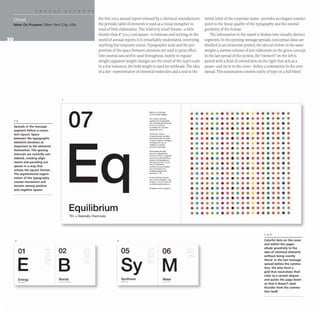
LITERAL
2
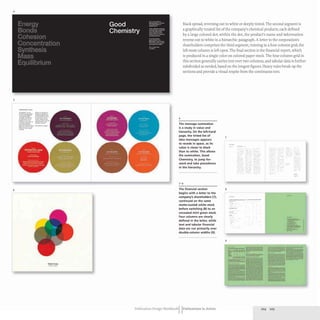
A simple configuration
of overlapping colored
dots evokes a cluster of
molecules on the (over
of this annual report for
a chemical company.
Ideas On Purpose
New York City USA
FREED SINCE JUNE 2002
ABSTRACT
2
-_... - ...-._ --
-- -_.
- - .- --..-
- "--- _._-- -......
---_. --'- ----
--- ---...
------_0.. _
. - ... --
-.-.- .- .._--
...---
....- .......
.. _ _ to _lIoo_·
--- --- -
- - _._..._- --
-~ ..... --
..- _ .---. --- -_..
_..._.- ----_... --~
--_. ---_.
---~ .._..._--
..~-. ------
_
.._-- - -_...
- ...._.. _.....- --_..
_
.._---- _.-
.--- --- -...-
---. -......~......- ......
_._....- .....--- _._....
_ _ _ I • _ _. . . - _ _ _ _
---- _
.._-- ---
..--- --
...-"....
---
--
--_.
--.
--
-
A striking illustration
leaves the literal in favor
of the conceptual in this
detail from an annual
report for a human rights
organization.
Soapbox Design Toronto,
Canada
3
Presentation of images
falls on a spectrum
defined at one end by
representation and at
the other by abstraction.
Images that lie closer to
the representational end
of the continuum are
more literal; images that
approach the abstract
end are more interpretive.
The Meaning of Images
Literal and Abstract Content
Most publications rely on imagery to supplement
their written content. Images provide a visual
counterpoint to the texture of type, helping engage
the audience. Images also offer a visceral connec-
tion to events or experiences that are described by
the written language.They can also help clarify
complex information- especially conceptual,
abstract, or process-oriented information- by dis-
playing it in a concise form at a glance. And they
can add interpretive overlay in juxtaposition with
literal text or images. A picture, as the saying goes,
is worth a thousand words. A designer's choice
of images, the pictorial elements they contain (or
don't contain),and their treatment as photograph
or illustration all have implications for meaning.
Sometimes, images are the primary content or
subject of a publication.This is true of exhibition
and product catalogs- in the former, the subject
is the art being cataloged; in the latter, the subject
is the products being sold and, therefore, the images
that represent them. Product catalogs also offer
imagery as a primary means of conveying concepts
about lifestyle that are used to relate the products
to the audience's experience- whether actual or
In these product catalog
illustrations, the images
are stylized representa-
tions that use a mixture of
abstract space and recog-
nizable forms.
Designwork SrL Udine, Italy
4
desired. Clothing catalogs often show people wear-
ing the products- clothes- in particular locations
or situations. These images not only demonstrate
the way the clothes look on real people, they also
position the clothes relative to a lifestyle, These
two distinct purposes highlight the potential of
images to convey representational and abstract
messages simultaneously.
Indeed, all images share this tension between
real and abstract; the subject matter helps the
designer define where the images ought to lie on
the range between these two extremes, The more
representational an image, the more objective or
documentary the communication- in essence, the
closer the content is related to the primary concep-
tual function. The more abstract an image, the
more subjective, interpretive, or layered the com-
munication- it is closer in relation to the secondary
or tertiary conceptual functions of the subject.
5
Publication Design Workbook Designing to Read
6
6
A subdued color photo-
graph inside the front
cover of this stationery
catalog displays a selected
product standing upright
on delicate, desiccated
leaves. The simplicity of
the image belies its sym-
bolic power: a subtle shift
in overall color from cool
to warm alludes to change
from mechanical to natural
concerns, and the leaves
are shown supporting the
product. Even in represen-
tational images, the poten-
tial for abstract, emotional
messaging is tremendous.
Studio Calavaria
Portland (OR), USA
I
22 23
""'...·_·1
.........-
............
...."" ~
...... f~
.,---.f_
--
c....
THINKING
PHOTOGRAPHY AND ILLUSTRATION An image
may be mostly representational or mostly abstract,
but it will always be a mixture of the two. Even
images that are considered purely visual- geometric
or organic forms that appear not to be of anything-
communicate ideas that are grounded in the human
experience ofthe world.A yellow circle, for instance,
in the right context, becomes a sun. Regardless of
this attribute, the images in a publication may be
photographs, illustrations (meaning drawings or
paintings), or a hybrid- manipulated photographs
or drawn images in combination. The way in
which a designer decides to involve image results
from his or her evaluation of the content and its
conceptual functions. The choice of photography,
drawing, or hybrid does depend to a great degree on
the documentary necessity implied by the subject
matter itself, but it is the connection to the audi-
ence and any interpretive positioning that has the
greatest effect on the designer's approach to image
content. The images must provide informational
2
clarity but must do so in a way that resonates and
delivers the publisher's branding or positioning
message. A designer has at his or her disposal an
array of methods for manipulating imagery. In
photography, for example, selective focus can
emphasize specific elements, the composition of
the elements within the frame can indicate their
relative importance, and changes in lighting can
affect mood. With illustration, the choice of ele-
ments drawn, their scale relationships, and even
the medium used can affect the communication.
A soft charcoal drawing may feel elegant or aggres-
sive, depending on the way the marks are made;
a digital illustration may seem edgy or precise.
3
In this magazine spread,
representational images
and abstract images are
juxtaposed to create con-
ceptual, as well as visual,
tension in the layout.
Flat New York City, USA
2,3
Juxtapositions of relatively
banal images in these
spreads for a conference
program ask readers to
decipher their relation-
ships in order to stimulate
and provoke discussion.
Simply placing two images
next to each other implies
a relationship in meaning.
The images may be causal
or not; the hand sewing is
the cause of the completed
quilt. They are related in
meaning and form and
have contrast in scale
(small to large) and time
(before and after). The
wires and the figures
both allude to connectivity
and support; they are
contrasted by nature
(mechanical vs. human).
AdamsMorioka Beverly Hills,
USA
,tw""-- __ ~ ........
s.,..1! :.I
.......... _ II r-...l .. :o;m
II.. -ot • dor '-10 ~ ...... n. .......
,....,..........._.......,......I~... ...11
"'-'r_·I.....t _ ........ ,_ .... ... I~I_
til..... "~M ' ...... ' ... 11. .•~.
,...al.-.-... •• ,..., tuln.........,... ..
-',_~I~.l........J".._~
c........c ............... ..,.~ ...~ .... ,....
"- .. Wt. ........ '" _ _ ...... ....uma
.1.w ....~'*'........- ..._4__ftII~~..
........... ,.....,,.. .. tW ......_-....
v...... ,-.-" _ ._--. .... _"-...... ~_ ...........
'-....f,... ~"'............._,....."f_
..,.,J_nw."""-*. ..... Ilt... b/
5
_ _ AM
•
4
Choose Wisely. While the subject matter ofa representational
image carries the most information, in terms ofmeaning,
its treatment will have a profound effect on the emotional
associations the viewer makes upon seeing it. Always consider
not simply what the image shows, but how it shows it-
naturalistically? colorized? unusually cropped? hand drawn?
photographed? The right medium and level ofabstraction
will add power to the image.
4
Two representational
images create an abstract
illustration when they are
composited together.
Jeff Neumann Denver, USA
5
Decisions about framing
and cropping a photo·
graphic image-as well as
what is included (or not)-
will also affect its message.
In this page spread from
a furnishings catalog, the
cropping enhances the
diagonal, forward motion
of the angles created by
perspective. Along with
monochromatic lighting
and the shadowy presence
of people, th is composi·
tion creates a monolithic,
progressive, almost "theo-
retical" message to appeal
to an audience of architects
and interior designers.
Designwork SrL Udine, Italy
Publication Design Workbook Designing to Read 24 25
THINKING
Color as Communication
Few visual stimuli are as powerful as color; it is intimately connected to the
natural world and, thus, is a profoundly useful communication tool. But
because color results from the transmission of reflected light waves through
an imperfect organ-the eye-to an imperfect interpreter-the brain-the
meanings it conveys are also profoundly subjective. In other words, though
the mechanism of color perception is universal among humans, what we do
with it once we see it is another thing altogether. Cultural differences and
individual experiences affect our interpretation of color messages. As a result,
color, like text and image, is effectively content and, therefore, must be
addressed when designing a publication.
2
Value
Lightest
Value
Darkest
or neutral Saturation or
brilliance
".
Complementary
Analogous
Hue
Wavelength
• ...
-
Value
Presence or absence
of light
Chroma
Saturation or
brilliance
Vivid colors are used for
type as a symbol for the
colored glazes used by the
artists for their ceramic
work. Note how the color
affects the apparent spa-
tial depth of the type-the
golden type, though
lighter, appears to come
forward in space, while
the cyan type recedes.
FaydherbeIDeVri nger
Amsterdam, Netherlands
2
A color wheel is a visual
model used to describe
relationships between col-
ors. Hue is depicted as a
spectrum around an axis
with greatest saturation
toward the outer edges.
3
Hue
The perception of color
difference resulting from
wavelength
Saturation
The relative brilliance of
intensity or lack of intensity
Formal Aspects of Color
Defining Chromatic Perception
A single color is defined by four qualities:hue,
saturation, temperature, and value. Hue refers to
the essential identity of a color- red, violet, green,
yellow, and so on. The color's brilliance, or satura-
tion, describes its intensity: a saturated color is
very intense or vibrant, while a desaturated color
is dull. The temperature of a color is a subjective
quality that relates to experiences: a warm color,
such as red or orange, reminds us of heat; a cool
color, such as green or blue, reminds us of cold
objects,such as plants or water. A color's value is
its darkness or lightness:yellow is perceived as
being light; violet is dark.
The perception of these color characteristics
is relative, changing as different colors come into
Temperature
The perception of relative
warmth or coolness
Value
The relative darkness or
"ghtness of a color
close contact. The perception of hue is the most
absolute:a color is seen either as blue or green.
However, if two similar blues are placed next to
each other, one is perceived as having more red in
it, and the other is perceived as having more green
in it. A color's value, temperature, and saturation
also appear to change when brought into context
with another color. A blue may appear dark against
a white field but may appear light against a black
field. The same red may appear warm next to a
violet but cool next to a yellow or orange. A pale
violet may appear intense against a warm gray
background or desaturated against a cool gray
background; it may appear neutral (completely
desaturated) if placed against a vibrant orange
background. Two colors that are similar in value
enhance each other's intensity, but their optical
separation becomes less distinct. Two colors of a
similar value that are complementary- opposites
on a color wheel- create a severe optical buzzing
4
when brought together: their similar values
decrease their optical distinction, but their oppos-
ing hues mutually increase their intensity to the
extreme.
COLOR AND SPACE Color also exhibits various
spatial properties. Cool colors appear to recede,
while warm colors appear to advance. Of the pri-
mary colors, blue appears to recede and yellow to
advance, but red seems to sit statically at a middle
depth within space. Moreover, a color appears
darker the less there is of it. A large rectangle and
a narrow line of the same color appear to have dif-
ferent values if set against a white background :
the color in the rectangle appears lighter than it
does in the line, because the line is surrounded
by much brighter white space.
Publication Design Workbook Designing to Read
3
Altering anyone of the
four attributes of a color-
hue, brilliance, value, and
temperature-affects the
color in different ways.
Darkening a color tends
to decrease its intensity,
as does making it lighter.
Changing a color's temper-
ature affects its relative
hue: as it gets cooler, it
becomes more violet; as it
gets warmer, it becomes
more orange.
4
The same blue, situated on
backgrounds of varying
saturation, value, and tem-
perature, appears to
change color. This effect of
color context is called
simultaneous contrast.
26 27
THINKING
The Psychology of Color
Perception VS. Socialization
Along with color comes a variety of psychological
messages that may influence content. This emotional
component of color operates at an instinctual
level but also is influenced by society and culture.
Many cultures equate red with feelings of hunger,
anger, or energy because red is closely associated
with meat, blood, and violence. Vegetarians,
by contrast, may associate the color green with
hunger. In Western cultures, which are predomi-
nantly Christian, black is associated with death
and mourning, but Hindus associate death with the
color white- the color that Christians associate
with purity or cleanliness.Because of the history of
Western civilization, violet conveys authority and
luxury to members of that culture. Most cultures
respond to blue with an association ofwater or life.
Blue is also often perceived as deeply spiritual or
contemplative, perhaps because of this particular
association.
The selection of a color for specific words in a
composition, therefore, can add meaning by linking
its associations to the verbal message. As a result,
a headline or image in one color may take on
additional, or completely different, meaning in
another. Comparing color options in order to see
how they affect other kinds of content helps
determine which colors are most appropriate for
the communication.
COLOR AS A SYSTEM Within a complex visual
environment, color can help distinguish different
kinds of information, as well as create relationships
among components or editions of a publication.
For example, a designer may develop a palette for
graphic and typographic elements that helps read-
ers distinguish between specific text components-
headlines,subheads, and body- or between sections
of information. Alternatively, a designer may use a
2
Make It obvious. Color perception varies from person
to person-what appears blue to one may seem violet
to another. Ensure differentiation through clear color
change; even ifthe viewer's color sense is unconventional,
the amount of difference between colors in a coding
system will still serve their purpose.
Abstract forms take on
meaning as color is applied
to them. The black circle
has no meaning; when
it becomes yellow, it is
transformed into a sun.
When it is blue, it becomes
the Earth.
2
A change in (olor dramati-
cally affects both words
and images. Here, the
feeling of the image is
transformed as its color
changes. Pastel coloring
makes the image friendly
and even childlike; sepia
coloring evokes a sense
of history; deep. cool
color makes the image
cold. but also restful;
neutral tones enhance the
sense of environment.
3
The color red creates an
involuntary response,
a mixture of arousal and
hunger. For this paper
promotion that uses
metaphors related to
things that stir the heart.
the (olor is not just a rep-
resentation but also the
content.
Strichpunkt
Stuttgart, Germany
general palette for all elements that is based on
the color or thematic content of photographs.This
palette might have a consistent base, such as a
selection of warm neutrals, that remains constant,
while accent colors change.
Color coding- assigning colors to identify sec-
tions or components- is one option for using color
as a system. To be effective, color coding must be
relatively simple and easily identifiable. Coding
with too many colors creates confusion, forcing the
viewer to try to remember which color relates to
which information. Although color coding within
a related set of hues- a deep blue, an aqua blue, and
a green- can help distinguish subcategories of
information within an overall grouping, care must
be taken to ensure that the differences between the
colors are perceptible. Pushing the colors further
apart from each other may help- deep blue may be
skewed toward violet while yellow is added to the
green, for example.
5 ANALOGOUS
4
-
-----
-
COMPLEMENTARY
--- -
===~-...oI!
-
=-
TRIADIC
Publication Design Workbook Designing to Read
...---
- ...- .....
- ..- .......
•
4
In this literature system,
color is used to differenti-
ate a company's product
offerings. Within each set,
the amount of the given
color signifies the function
and importance of each
related document: the
more color, the more pro-
motional; the less color,
the more informational.
Ruder Finn Design
New York City, USA
5
Analogous (left), comple-
mentary (middle), and
triadic (right) combinations
of colors, defined by their
positions on a color wheel,
create systems of color
relationships that can be
a basis for coding.
28 29
THINKING
Type as Visual Concept
When designing for a publication, one of the greatest areas of focus is the
typography. On a purely functional level, a designer needs to address legibility,
hierarchy, and clarity in presenting verbal information. But type also carries
nonverbal messages. In selecting typefaces and integrating type with images,
a designer may have a profound effect on the overall character of a publica-
tion-effectively introducing another kind of content. The choice of typeface
establishes a voice for the content that positions it in a specific way through
associations an audience may ascribe to the face itself.
Choosing a classical, old-style serif face, versus a
contemporary sans serif, for example, may transmit
a sense of credibility and reliability, or notions
of tradition or historical significance.Mixing type-
faces throughout a publication may create a
sense of interrelated contexts, or ideas of cultural
diversity, as well as help distinguish among infor-
mational components or different sections.
In magazines, the use of typography as an image,
related to photographs or illustrations, is especially
important. A magazine's masthead, or cover title,
becomes a significant image: it is clearly verbal,
relates to the brand, and provides a symbolic
encapsulation of the content.
TYPEFACE CLASSIFICATION The individual,
distinguishing characteristics of a typeface's
drawing often are related to the historical develop-
ment of typefaces, and our sense of a typeface's
style is sometimes colored by this historicity. From
early Roman times to the fifteenth century, type
was drawn by hand, either with a brush, a flat reed
pen, or a chisel. In the mid-I 500s, casting letters in
lead allowed for a new precision in form. From that
point forward, the evolution of typefaces moved
away from those inspired by brush and stone carv-
ing toward a more rational aesthetic, and toward
typefaces that were more finely drawn and techni-
cally demanding.
2
OENERAL CATALOO
,.. I
-Archaiej Greek. Lapidary
ABMO K
Arcbaicj Roman capitals
ABMOK Oldstyle.l Garamand IhreiL
ABMOK
Transitional ~BaskerlliUe
ABMOK
ABMOK
ABMOI(
ABMOK
c 0
.. .
• c
1
,. ,
....
.. .
~
..
..
· ~ ~
:I~ ~
, .
· ~
• 'i •
· ~...
•
• •
·"
The progression from
archaic to modern and
then sans-serif faces
shows the hand-drawn
influence steadily disap-
pear, replaced by the
assertion of a precise,
rational aesthetic.
Neodassicall B.odoni
Sans Serif ~Uoiv.e[5 5.5
Slab Serif IClarendon
2
These details from
a stationery catalog evoke
antique naturalist prints.
The (ontrast of the script
face coincides with that
of the leaf image, while
the centered all-cap serif
below offers a stately
counterpoint. This serif
is an adaptation of an
English face from the
1700s; the mixture of
uppercase, letterspaced,
lowercase italic, small caps,
and centered-axis logic
contribute to the period,
archival feeling.
Studio Calavaria
Portland, USA
Choosing and Mixing Typefaces
Contrast and Clarity
A combination of type families increases typo-
graphic color- a variety of typographic darkness,
lightness, and spatial rhythm- but mixing too
many faces may become visually confusing:
what do these changes signify for the viewer?
them will appear arbitrary. Using two radically
different serif faces- a modern serif and a chunky
slab serif, for instance- will make a clear visual
statement. Mixing typefaces- as well as which are
included in the mix- carries meaning: an archaic
face and a stark, modern sans serif, for example,
may communicate timelessness or the idea of con-
tinuum. Oldstyle faces mixed with newer ones,
in the context of a publication about computers,
may offset the coldness associated with machines,
making the content friendlier. Using experimental
faces,or faces that challenge legibility, may infuse
the content with a sense ofexclusivity or cast it as
particularly hip. Additionally, the designer can use
these stylistic variations to differentiate complex
information within a layout by assigning certain
styles or weights to captions, text, and headings.
Context Is Everything. Different audiences will make
different associations about type styles, so pay attention
to feedback from client meetings. Chances are the client
and its audience will have similar cultural backgrounds
and, therefore, respond similarly to the choice oftypeface
on an emotional level.
As a general rule (which may, of course, be broken
in the right context), the use of two type families
within a project is sufficient for visual variety.
The choice of typefaces to mix must be decisive.
There must be enough stylistic contrast between
them that their individual qualities are evident.
Mixing two similar weight oldstyle serifs, for
example, will seem ambiguous: their qualities
may be slightly different, but the decision to mix
Some type families lack a full complement ofweights-light, medium,
bold, black-and must be supplemented by a weight selected from anoth-
er family. In such cases, it's important to consider the supplement on its
own merits. As it will be used to create contrast with the primary face, it
may be approached from one oftwo directions: attempting to relate it as
closely as possible to the text face, or letting it be as different as possible.
The first option enables more fluid reading when the two are combined in
running text, as the form difference is less noticeable; the second option
implies more ofa chance for fixation and, therefore, an enhanced oppor-
tunity to call out information. Each may be viable, but the designer must
decide which quality best suits the needs ofthe text.
each incidence requires
Comparing the overall
widths, stroke weights,
junctures, and stroke con-
trast between individual
letterforms is a good way
of finding similarities
(and differences) between
typefaces in order to mix
them decisively. In this
comparison, the lowercase
9 on the left shares more
with the middle 9 than
does the one on the right.
Swapping type styles
for use as a bold weight
in running text can help
improve clarity when the
natural bold weight isn't
different enough from the
medium text weight (top).
3
- .
...-..
....-
""..
-
...
2S< -;
. :===- ------
2 Pakistani arrested atSea!f'ac;
oneman's nameon terror list
===--:-..::!£~:::=-= :=:::s::::---~
___...-..,....... _____ _____==:1.:--
=::.-:: -=--==..-==. - =-= "-- -..;:;:;
.::,:.:-~-::: -=--_..__..
-- ------.-._.
-
,--
_.-
-
--
--
--
-
-
-
--
=.-
-
--
==-
-
-
-
-
--
?.:.:: --
...........,.".,..
---
--
_........-...
= ==-
=:- ;:--==~~-::::'-=.:
---
..-_..-
_ _ _ I
--
---
---
-.
---
----
-_.-.
Wmdow
worm
hits PC
worldwide
CICISOfT IMMJUt
----
---
-- -
- -'-
----
..._- -..
- -
=:::-. ==--=== ~~.
Publication Design Workbook Designing to Read
3
A wide range of type styles
invigorates the text-heavy
presentation of this
newspaper page (detail).
Although the faces have
been selected for their
differences, they all share
some characte ristics.
Several condensed type-
faces are used for different
kinds of subheads, for
example, but one is a sans
serif and the others are
serifs-a bracketed serif
and a slab-serif wood type.
The condensed sans serif
corresponds to other sans-
serif heads, such as is found
in the Newsline column,
but contrasts it in width.
Jeff Neumann Denver, USA
30 31
THINKING
Typography as Content
When Words Are Images, Too
Treating specific aspects of the content typographi-
cally, so that they become as much an image as any
photograph or illustration, can be a powerful (and
cost-effective) form in its own right. Unlike the
treatments of section titles or the beginnings of fea-
ture articles, which are tied to an editorial function,
such treatments may become additional content in
their own right. The content developer and the through each perceptual filter- visual, emotional,
designer, working together, may envision a sup- intellectual- it assumes the iconic stature of a
porting type component that is independent of the symbol. Understanding on each level is immediate,
running texts and other type elements such as
callouts, which extract portions of the running
text and reproduce them as visual focal points-
as opposed to being unique content.
TYPE AS IMA GE Letters and words are strong
forms, able to withstand dramatic manipulation
without losing their identities.When a letter or
word takes on pictorial
qualities beyond those
that define its form, it
and a viewer's capacity to recall images explains
why corporate identity exists in the way that it
does. This communicative power can be used to
equal effect in designing word-pictures for content
within publications such as magazines, or for cover
treatments, such as titling or mastheads.
Words Are Pictures, Too. Type may be transformed becomes an image in
its own right, and the
potential for impact is
enormous. Aword that
As in so many aspects of strong typographic
design, making type into an image means defining
a simple relationship between the intrinsic form
of the letters and some other visual idea. It's easy to
get lost in the endless possibilities of type manipu-
lation and obscure the visual message or dilute it.
A viewer is likely to perceive and easily remember
one strong message over five weaker ones- com-
plexity is desirable, whereas complication is not.
into an image using avariety ofapproaches. Each provides
a different avenue of exploration, and several may be
appropriate both to the desired communication and to
the formal aspects of the type itself.
is also a picture fuses
several kinds of under-
standing together: as its
meaning is assimilated
Pictorialization When type becomes a representation of a
real-world object or takes on the qualities of something from
actual experience, it has been pictorialized. In illustrative picto-
rialization, forms are drawn to appear to be made out of a
recognizable material or to form part of a recognizable object.
Form Substitution Replacing a type form with a recogniza-
ble object or another symbol is referred to as a substitution.
Many real-world objects share visual structure with letters.
Circular objects are often substituted for a letter 0, for example.
Images aren't the only elements that may be substituted for
a type form-replacing a letter with another character is also
a common strategy for transforming a word into an image.
.0
ORGANIC
Pictorial Inclusion Illustrative elements brought into the type
forms so that they interact with its strokes or counterforms are
said to be included. The type retains its essential form, but the
pictorial matter is integrated by reversing out of the type or by
replacing the counterforms within or between the letters.
s T A c c A T o
Form Alteration Changing the structural characteristics of
type elements is yet another strategy for making type into an
image. The alteration of the typographic forms sometimes
strives to communicate a nonliteral idea. For example, altering
the form of an adjective can change the quality of its descrip-
tion. Altering the form of type elements may have a syntactic
component as well. If the word "growth" is set so that the
letter 0 is larger than the other words, the scale change is
syntactic-it exploits the quality of the vowel's sound byexag-
gerating its visual presence as it relates to the word's meaning.
Syntactic Deconstruction Changing the visual relationships
between the parts of a word or phrase is a deconstruction
(the inherent structure of the word is called out or changed by
being deformed). The cadence of the spoken word, the word's
syllables, the prefix, the suffix, and individual letters are all
sources for deconstruction.
Ornamentation Lastly, typographic elements may be
transformed into images by adding ornamentation: borders,
outlines, dingbats, dots, lines, geometric shapes, and so on.
The ornament may be structurally related to the typography
or may be purely decorative. If the ornaments have some
kind of symbolic or representational quality, they may take
on the aspect of an inclusion and, therefore, be more strongly
connected to the meaning of the word. The style of the
ornament may affect the viewer's sense of the historical con-
text of the type (for example, a flourish or antique dingbat
from a particular period).
2
3
~---... ---...--------
..-_..- ..- . ~ --_...._---...-...
.....nw_·m _lt ...... n.o
.....0 - ............ It., n-n _ h ...
--_........-.......
---.........--~)~..------
::::.=.=~
....
..;.;-.;;.*
....
-;;..
w-.__ ...._ ... _ ..___
""='--,. ---';;;~;:=----,
.._-
--
Designing to Read Publication Design Workbook
Titling and supporting text
are transformed into the
image of aerosol spray-
pictorialized-in this cover
for an newspaper enter-
tainment supplement.
Jeff Neumann Denver. USA
2
Extreme scale forces even
unaltered type into the
realm of image. As these
characters become larger,
their exterior form begins
to interact with the space
surrounding it.
StudiO Blue Chicago, USA
3
The type in this paper pro-
motion, which delivers a
narrative about the Wild
West, evokes vernacular
images such as horseshoes
and brands as it becomes
altered and ornamental in
the layout,
Worksight
New York City, USA
32 33
The necessities ofreading and comprehension inform the visual aspects of
publications; their large volume oftext is what fundamentally differentiates them
from other kinds oftypographic projects. Even publications that are driven by
image-specifically, catalogs for exhibitions and product sales-require fine-tuning
text typography so that readers can navigate through complex captions or
listings, in addition to whatever more involved running text components there
may be. Reading a long text asks a lot ofan audience; in order to make the process
as easy and useful as possible, the designer must focus on the text's details-
sizes, spacing, and paragraph width-along with the bigger issues oflayout to
ensure a comfortable reading experience. Establishing clear hierarchies between
text components, so that the audience is able to identify them and use them
to navigate, is equally important. Last but not least, the designer must give the
typography an overall character that brings the parts together and allows
them to be used flexibly among system- or serial-based components, without
sacrificing the fundamental continuity ofreading the information.
words
4
Ton Ton
Tym Tym
Wer Wer
Ave Ave
2 3
words
words words
THE OPTICS OF SPACING The spacing of letters in
words, sentences, and paragraphs is vital to create a
uniform gray value for minimal reader distraction.
Each typeface has a distinct rhythm of strokes
and spaces. This relationship between form and
counterform defines the optimal spacing of that
particular typeface and, therefore, of the overall
spacing between words, lines of type, and among
paragraphs and columns of text.
Looking at letters set together as a word offers
a clue to how they should be spaced in that particu-
lar typeface and size. Creating a consistent gray
value in text depends on setting the letters so that
there is even alternation of solid and void- within
and between the letters. A series of letters that is
set too tightly, so that the counterforms within the
letters are optically bigger than those between
letters, creates noticeable dark spots in the line:
the exterior strokes of the letters bond to each
other visually where they come together. At the
other extreme, letters that are set too loosely
become singular elements, divorced from the
line and recognizable as individual forms, mak-
ing the appraisal of words difficult. Evenly set
sequences of letters show a consistent, rhythmic
alternation ofblack and white- form and counter-
form repeating at the same rate from left to right.
The primary difficulty in achieving evenly
spaced type is that different letters have different
densities- some are lighter or darker than others.
Added to this phenomenon are the directional
thrusts of different strokes and the varied sizes and
shapes of the counterforms. Some are open, some
closed, and some decidedly uneven in relation
to the distribution of strokes in a given letter. To
correct for these disparities, digital typefaces are
programmed to add and subtract space from
between different pairs of letters depending on
Publication Design Workbook Designing to Read
This comparison shows
optically uniform spacing
for the regular weight of
a sans-serif typeface, in
contrast to mathematical.
overly tight, and overly
loose spacing.
The normally spaced
lines (2) show consistent,
rhythmic alternation
between dark (the strokes)
and light (the counter-
forms) both within and
between characters.
Dark spots are evident in
the example spaced too
tightly (3, bottom), where
the strokes are closer
together between letters
than within them.
4
Tightening or loosening
the spacing between these
pairs of letters corrects for
the awkward (ounter-
spaces inherent in their
forms. Shifting the lower-
case y to the right, under
the right crossbar of the
T, for example, allows the
spacing between them to
become optically similar to
that of subsequent letters.
34 35
READING
Mm
Mm
Mm
Mm
Mm
Mm
Mm
Mm
Mm
m
The standard point measure-
ment oftype sizes, shown
here in oldstyle and sans-serif
specimens. Text sizes range
from 9 to 12 points; sizes of14
points and larger are called
display sizes and are usually
reserved for elements such as
headlines_ Sizes smaller
than 9 points are called caption
sizes. Note the apparent
difference in optical size of
the two styles_
Mm
Mm
Mm
Mm
Mm
Mm
Mm
Mll1
Mm
5
6
9
12
14
18
24
36
48
60
A line specimen set here
at 16 points and again at
6 points. Uncorrected,
At vero eos et accusam et justo duo.
the spacing in the smaller
type is inadequate for
good character recognition.
Adding space between
letters greatly improves
their legibility and their
overall look.
At vera eos et accusam et juSta duo.
At vero eos et accusam et justo duo. 2
At vero eos et accusam er jusro duo.
2
Trips
Here, the same word is in
three different faces at 24
points. The oldstyle serif
appears smallest; its low-
ercase letters have a pro-
portionally small x-height.
Because the sans-serif
lowercase letters are larger
in proportion to the cap
height, they appear larger;
the same is true of the
modern serif to the right.
what the combinations are. These sets of letters,
called kerning pairs, provide for most circum-
stances of letterform combination, but not all.
Invariably, a designer must correct unusual spacing
that the computer's software is unable to address.
TYPE SIZES AND SPACING The drawing of a
typeface has an impact on the perception of its size.
For example, a sentence set in an oldstyle serif and
a similar-weight sans serif at the same point size
will appear to be in two different sizes.The discrep-
ancy results from the sans serif's larger x-height:
its lowercase letters are larger in relation to the
cap height than those of the serif. The difference in
set size and apparent size can vary as much as 2 or
3 points depending on the face. A sans serif such
as Univers may be perfectly comfortable to read
at a size of 9 points, but an oldstyle face such as
Garamond Three at that size will appear tiny and
difficult to read. Setting the Garamond at r r or r2
points will make it more legible, as well as make it
appear the same size as the Univers.
Setting type smaller or larger than the optimal
reading size for text also has an impact on spacing.
Comfortable and efficient reading of long texts,
such as books, newspapers, or journals, is possible
when the type size ranges between TO and 14
points- the texture of the type is a uniform gray
and the letterforms are small enough that their
details are not perceived as distinct visual elements.
Optimal spacing at reading size means that the
strokes and counterforms alternate evenly. As type
is decreased in size, letterspace must be increased
to allow the eye to separate the letters for clarity.
At the other extreme, the space between letters
must be decreased as the type size increases beyond
conventional reading size.
The Type Is as Big as It Looks. Judge the type size by how legible
it seems at a given size, not by applying a formula: "Text should be
10 points." A 1O-point sans serifmay be too big; a 1O-point oldstyle
serifmay be too small, Here's a point ofreference for what readers
will tolerate: the average newspaper sets its body text (usually a
modern serif) at 9 points.
Paragraph Architecture
The Building Blocks of Text Type
As words and then sentences are strung together,
they cluster to form a basic component of typo-
graphic design- the paragraph. Paragraphs can be
set in all manner ofways: wide, narrow, aligned or
nonaligned, singly or in groups. The paragraph is
the archetypal building block of a text; as such,
its structure, spacing, and optical qualities warrant
the designer's attention. Regardless of the nature
of the content in a particular paragraph, it must
first be considered independently to a certain
degree to find an optimal width and depth for
comfortable reading. The width of a paragraph
depends on a few features:type size, word space,
and interline space, or leading.
SPACE BETWEEN WORDS The space between
words is derived from the rhythm of strokes and
counters established by the letterspacing itself.
Typically, the wordspace can be defined by the
width taken up by a lowercase i as though it has
been spaced continuously with the last letter of a
word and the first letter of the word that follows.
The space between words is, therefore, smaller
3
when the text is set more tightly and larger when
the text is set more loosely.
The space between words should be the mini-
mum needed to separate them. When the wordspace
becomes too great, lines oftype begin to fracture.
If large wordspaces appear over and over again,
they often align from one line to the next, creating
white channels of space called rivers.Rivers are
problematic because they appear to connect words
between lines, interfering with sequential under-
standing in sentences.If the eye cannot hold the
line of type, comprehension is effectively destroyed.
THE INTERLINE SPACE Leading (pronounced
"ledding") is the vertical measure from the baseline
of one sentence in a paragraph to the baseline of
the sentence below it. Leading has a profound
impact on a paragraph's legibility and changes the
paragraph's visual texture.The first considerations
that affect the leading of text are the height of the
lowercase letters and the height and depth of their
ascenders and descenders, respectively. Obviously,
these strokes must not interfere with each other
between lines- joined or overlapped strokes dimin-
ish character recognition and create dark spots that
stop the eye. Typefaces with tall ascenders and deep
4
descenders, therefore, need additional space between
lines to avoid this problem. Likewise, typefaces
with large x-height fill the line depth considerably,
so more leading is required to offset the increased
density created by the lowercase.
The line length of a paragraph also affects leading.
A mature reader can grab a snapshot of several
words simultaneously; the more advanced the
reader, the more the eye grabs. Over time, a reader
is able to process several snapshots together in
rapid succession, but only to a point. Without a
slight break in the process, the reader begins to
jumble the snapshots and becomes confused. That
break is the return: the end of a line and the back-
track across the paragraph in reverse to find the next
line. The reader must keep track of the sequence of
snapshots and locate the beginning of the next line.
The designer's goal is to find the optimal relation-
ship between these factors so that the paragraph
is as easy as possible to negotiate and interferes
minimally with reading comprehension.To achieve
comfortable leading, therefore, the designer must
also consider the paragraph width.
oneihopesitheiwordsiare
one hopes the words are
oneihopesitheiwordsiareispaced ievenly
5
At vero eos et accusam ~o duo dolores
et ea rebum . Stet elita kdsd...g{Jbergren, no
sea takimata sanctus est Lorem ipsum dolor
sit amet. Lorem ipsum dolor sit amet, consete
tur sadipscing ehtr, sed diam nonumy eirmo
tempor invidunt ut labore et dolore magna
aliquyam erat, sed diam voluptua. At vereos
one l hopes i the l words l are
At vero eos et accusam et justo duo dolores
et ea rebum . Stet elita kasd gubergren, no
sea takimata sanctus est Lorem ipsum dolor
sit amet. Lorem ipsum dolor sit amet, consete
tur sadipscing elitr, sed diam nonumy eirmo
tempor invidunt ut labore et dolore magna
3
Normal, uniform word-
spacing can be conceived
of as the space determined
by setting an invisible
lowercase i between the
words as though it is being
letterspaced as continuous
text.The effect of uneven
wordspacing is evident in
the appearance of rivers.
4
A comparison of normal
(top) and loose (bottom)
wordspacingl using the
same lowercase i method.
5
Examples of leading set
solid and corrected for
large x-height and deep
ascenders and descenders.
In the example to the
left, the large body of the
lowercase fills the line,
increasing its optical activity,
as well as its density. or
gray value; the ascenders
and descenders begin to
crash together between
lines. In the example to
the right, 2 points of
added leading alleviates
these problems, inserting
"air" into the text.
Publication Design Workbook Designing to Read 36 37
READING
EFFECTS ON PARAGRAPH WIDTH The width of
a paragraph depends heavily on the size of type
being used and, therefore, the number of characters
that can fit on a single line. Regardless of the type
size or the reader's maturity, between fifty and
eighty characters (including spaces) can be
processed before a return- with words averaging
between five and ten letters, that means approxi-
mately eight to twelve words per line.Achieving
this character count determines the width of a
paragraph. The proportions of the page format-
and the amount of text that must be made to fit
overall- may affect paragraph width, but character
count is the best starting point for defining an
optimal width for the paragraph.
Leading is somewhat dependent on the width
of the paragraph, the type size, and its spacing.
The space between lines should be noticeably larger
than the optical height of the lines, but not so
much that it becomes pronounced. Similarly, the
leading must not be so tight that the reader locates
the beginning of the same line after the return
and begins reading it again. As paragraph width
increases, so must the leading, so that the begin-
nings of the lines are more easily distinguished.
Oddly, as the width of a paragraph narrows, the
leading must also be increased: otherwise, a reader
is likely to grab several lines together because the
snapshots he or she takes while scanning the text
encompass the full paragraph width.
Garamond 3 Italic
Clarendon
Futura Medium
Impact
Univers 45
Bauer Bodoni
Garamond 3 Italic
Clarendon
Futura Medium
Impact
Univers 45
Bauer Bodoni
2
11 points
At vera eos et accusam et justa duo dolores et ea rebum veritas
At vero eos et accusam et justo duo
At vero eos et accusam et justo duo dolores et
AI vero eos el accusam el iuslo duo dolores el ea
At vero eos et accusam et justo duo dolores et
Al vero COS el accusam Cl juslo duo dolores cl ea rehum
9 points
At vero eos et accltSam et jllsto dllo dolores et ea rebmn veritas in linglla Ira
At vero eos et accusam et justo duo dolores
At vero eos et accusam et justo duo dolores et ea rebum
AI vero eos el accusam el juslo duo dolores el ea rebum veri
At vero eos et accusam et justo duo dolores et ea rebum
Al veru eus cl accusam el jUSLu d uu dulures cl ea rebum in lingua fr
In the finest book work
the pages of text are printed
in such a manner that the
lines on a recto page backup
exactly those printed on
the reverse, or verso, side.
This carc in sctting and
printing, nullified when extra
space is inserted between
In the fi nest book work
thc pages of text are printed
in such a manner that the
lines on a recto page backup
exactly those printed on
the reverse, or verso, side.
This care in setting and
printing, nullified when ex1:ra
space is inserted between
1
1 Find the Best Ratio. Wide paragraph? Add leading! I'
Narrow paragraph? Add leading! Each kind of
alteration demands extra interline space to help
resolve reading problems.
A comparison of character
(ount for a selection of
typefaces at two text sizes
on the same paragraph
width. As with all typo-
graphic rules. there is
a range of values that
is comfortable for the
average reader. Given a
fifty- to eighty-character
comfort range, it is easy
to see that a paragraph
must widen as the type
size (or character width)
increases and narrow as
it decreases. in order to
maintain optimal character
(ount in a line.
2
A mature reader's visual
snapshot of word groups
may conflict with a narrow
paragraph that is leaded
too tight. In the first
example, the snapshot
takes in not just a full line
of type on the narrow
column but also portions
of the lines below. The
second example shows a
reduced snapshot that
aids comprehension; the
reader is forced to assimi-
late the word groups in
sequence because the
lines have been leaded
far enough apart to prevent
subsequent lines from
interfering with each other.
Text from The Finer Points of
Spacing and Arranging Type
by Geoffrey Dowding;
Wace & Company, 1954
The Optimal Paragraph
A desirable paragraph setting is one in which
a constellation of variables achieves a harmonic
balance. Since extended running text is such
an important consideration for a publication,
finding the optimal paragraph is one way to
begin to develop overall typographic structure.
A designer might first make some assumptions
about the text typeface based on his or her
sense of its appropriateness from a conceptual
standpoint and based on its visual attributes-
the relative height of the lowercase letters, the
general weight of the strokes and any contrast
within them, the height of the ascenders and
descenders-and set a text paragraph at an arbi-
trary width and arbitrary text size. Judging from
this first attempt, the designer may opt to adjust
the size of the text, loosen or tighten its overall
spacing, open or close up the leading, and
change the width in successive studies.
By comparing the results of these variations,
the designer will be able to determine the most
comfortable text setting for extended reading.
At what point is the type size too small-or
uncomfortably large? Are the lines relatively
even in length or do they vary a lot? Is there
excessive hyphenation, indicating that the para-
graph is too narrow to allow a useful character
count? Is the leading creating too dense a field
of text to feel comfortable? During this study,
it may become clear that several options for
width and leading are optimal, but the designer
must choose only one as a standard for the
publication. This choice has implications for the
page size, the number of columns of text that
may fit on it, and optimal sizes for other text
groupings, such as captions, callouts, and so on.
3
A At vero eos et accusarn et justo duo dolores et ea reburn. Stet dita kasd
gubergren, no sea takirnata sanctus est Lorem ipsum dolor sit amet.
Lorern ipsurll dolor sit arnet, consetetur sadipscillg clitr; sed diarn 1101]-
umy eirmod tempor invidunt ut labore et dolore magna alifJuyam erato
sed diarn voluptua. At vero eos et accusarn et justo duo dolores et ea
rehum.
B .1 n'IU cos el a("("usalll el juslo duo dolores el ea rehum. SIcI dila kasd guhergren. no
sea lakilllala wnctus esl Lorelll ipsulll dolor sil alllet. Lorelll ipsulll dolor sil anwt.
consetelur sadipscing elitl~ sed diam nonumy eirlllod lempor im'idunl ut labore el
dolort, magna aliquyalll erat. sed dialll ·oluptua. 1 eIU eos et accusam et justo duo
dolores el ea rebum.
C AI' vero eos er accusalll et jusro duo dolores et ea rebulll. Srer dita kasd gubergren,
no sea takilllata sanctus est Lorelll ipsulll dolor sit alller. Lorelll ipsulll dolor sit
alller, consetetur sadipscing elitr, sed dialll nonulllY eirlllod telllpor invidunr ut
labore er dolore magna aliquyam erat, sed diam voluprua. At vero eos er accusam er
jusro duo dolores er ea rebum.
D AI' vero eos er accusam er jusro duo dolores er ea rebum. Srer clira kasd gubergren,
no sea rakimara sanctus esr Lorem ipsum dolor sir amer. Lorem ipsum dolor sir
alller, conseterur sadipscing elitr, sed dialll nonumy eirlllod tempor invidunr ut
labore er dolore Illagna aliquyalll eraI', sed diam voluptua. AI' vero eos et accusam er
jusro duo dolores er ea rebum.
E At vera eos et accusam et justa duo dolores et ea rebum. Stet dita
kasd gubergren, no sea rakimata sancrus est Lorem ipsum dolor
sit amer. Lorem ipsum dolor sir amer, consererur sadipscing elitr,
sed diam nonumy eirmod tempor invidunt ut labore et dolore
magna aliquyam erat, sed diam voluptua. At vero eos et accusam
er justa duo dolores et ea rebum.
3
In this study of a para-
graph. the variables of
type size, spacing, leading,
and paragraph width are
tested to arrive at a text
setting that results in the
most comfortable spacing.
the least hyphenation.
and a decisive rag.
A Initial setting: solid
leading. larger type size
B Solid leading. smaller
type size: more than
optimal character count
for width
C Same size and leading,
but substitution of a face
with shallower ascents
and descents
D Increased leading:
more comfortable, but the
paragraph is still too wide
and the substituted face
too small
E The paragraph width
is narrowed and the type
size increased by a point:
optimal character count.
decisive rag. and comfort-
able leading
Publication Design Workbook Designing to Read 38 39
READING
Separating Paragraphs
Clarifying Sequence
As a paragraph lengthens to become deeper than it
is wide,it takes on a vertical stress and becomes a
column. Within a column, paragraphs that follow
each other must somehow be differentiated so that
the reader is aware that one has ended and another
one has begun. One approach is to simply insert
a hard return- a blank line of the same leading-
between one paragraph and the next. In columns
set with text showing a large x-height, or with a
smaller x-height and tighter leading,this treatment
may look fine.In other cases, though, it may seem
excessive: the return may appear to separate the
column, disturbing the column's vertical mass, or
the return's sharp line negative space may interfere
visually with other elements.
These samples show differ-
ent approaches for indicat-
ing paragraph breaks.
In the first, an annual
report, the paragraphs run
together but their breaks
are indicated by an indent.
The second shows an
interesting approach in
which the first few words
of the paragraphs are
shifted above the baseline
and set in a style that
contrasts the text. The
third shows paragraphs
separated by subheads
after a proportional return.
1 Soapbox Design
Communications
Toronto, Canada
2 Faydherbe/DeVringer
The Hague, Netherlands
3 UNA [Amsterdaml
Designers Amsterdam,
Netherlands
INDENTING In traditional typesetting, columns
were set without space between paragraphs, in
order to save space and, thus, paper cost. Instead,
the beginning of a new paragraph was indicated
by an indent, in which the first line of a new para-
graph starts a few character widths in from the left
alignment. This treatment works particularly well
in justified setting. The depth of the indent is sub-
jective but must be noticeable.An em (set-em)
indent is noticeable but often is not enough.If the
leading is loose, the indent must be deeper: more
interline space normalizes the perception of the
column's width (this is why adding leading
smooths out irregular rags), so a bigger hole must
be cut into the paragraph, Sometimes, a designer
may exaggerate the indent for visual effect. If
the paragraphs are long and set in relatively wide
columns, this treatment often helps break up
the wall of text by introducing a rhythm of cuts
into the columns.
Indents must be approached carefully if the text
is set ragged right. Since the rag is already changing
the line lengths on the right edge of the column,
the indent on the left side loses some of its visual
power, appearing somewhat sloppy or causing the
top lines of the columns to appear as though they
are changing alignment.
110 ftMtM lor
·..on "'1~1o
~1ifJr>ot
lhtt hJ:il Of
""-'"
nd~D'."
kondr-o'r.
Y">OII"IJ_' U'C
'fet'rng. vi'f'tlCn
<;~.a.~1
of US " , O'~
cr
'
...........,
"Ig Il'(tm~~
~ gtQlf In.lIt"
,. mll.er••101
'lOVC~c;.Oot
:5:0'601'1 tlVu~1
II:IClO''''''' '..-...sh
2
rh~ tIM MJMf l"Itt cC'ftW CoIGnOt"
t, /IfLft/fY " I;oM!Id IoIPO"! "'- wCI't;t
,,.~JnI"ft1,. U tI01«I ¥'d ~
n.eot'~~ oMOU«e ., ~
'''IIbtt.l. 'ICJ ~")II.", , . /I'Qrl1
AMMoI~~"!lfMr;
I.NJ you)fIt1N It1a ~ ~ of lhe
~ t.ttp, oecauSof!_SOMIOftItVlno hi
...., ..... "'" PElllMnIf 1
0/ .. rNfr('"
aIId """N k ""'. out ecutd SOfe+y do. b4
fOb I;~ • DefIoOft v-no tIcUd tie, Gl:De'''''
FUNil'1J5IfQ shoIIId be IfNI fOb oj tMlrtO
r:.;n Ihi boIId. u ,... U 1M Jgb of h .....
• OJreaOt And M hIoQI,*, II'l It'll ti6C
IrA ....QfCb Of ,•• ~ -IJIO f~ UlM"Jl- ¥NT oC "'1 ,...-.Jrft.~ ~1 Bv.-.oGJn
1Nlf. -SSG-XIIft U"'~d~ ~"them 10 oe 00'1- tne p.I~1 Dill.. ~I ttle1Jitlno .u.l'oltv to
1/1.'0 Me 'fi') y~ 100) apllF1llVJ iiboU1 tM
'''4ft~~, tho,., ',,",0 8»' WIt orc ltIe
&Kn'_"~ c;,' fMIfV tt'Q~ tA DlO fOlMP' OHSL
And 1,0 ' ~/" 'rom our (,flln .ec.oro,hi '"
'DIl ol,,...lJtirlatGn at vutn 1  t) tiftrJ
piau Q'~6 ,n 1M' world ...a m SDlrt 01
lr)1 9'e.J1 .a~ ...u S{7.ef1!S ot "'e '" me
~ fu"'!id VIW!I r<lJl"l'lilt'l ,oIJfICI ""-P 0.1
U.fill()f'kj 1'$ mote OJ to-J » JM ~ T.tw .....lIng
!)'O(Il f)f fOf1l.tt 9')«~. rPlO ~ ~
ote Qqt~ a' ucr.. .....notlill"'A " .. ~
~ 1·0000000gr"e$QI'I n'e~9S-s.on
.aod 1M t~ (;1tr""..... 0Ilt"""" 0'). ttw..~
_ 01 ,........... QfA en. and It. ' QOt> on'
r.gru penon to fJG tne t1gn1 /CAl. we SlItce:
~ ,~~ ~ mo,,0'1 not 0Ilfy IG DO ~
sul'fOlIll. tNt atOO ro Mvrt lI!I: tlPKl*rt 0
fWlf'IV' 001';On YIN) YKIJ,tj VIOl I ~ me PI-
0I'1IffW ,,,., "',oonSddouIo~ t-QtN. j
",,,011 Nod _ ...... needed "",Iofn
~ W.,n 'lINt /111 fiIYtI DOnI: '" PIO Girl
bon. ,,,. WMef'S" &lIe CCIITlIMIh vIII:! br
lOWJthtr .1l1T1!t WlT
I.'; frNIQ -.'I. ... 111
~ !P'I'WIt them h09lt.net pro-~!t19 t1
Vlln I,.. .lQflt 'POifJl~ IQr,ec;.ot}nIIIOn
OWl 100 IS to 19'1 ~I UIe vtOWlOft!I
ltflol'dQm ,.,. "JDfM~ fr~,V'''lft;Ar. 1M'
td. ela
DE ~" -..,... ',11." u:TlT'l.I.O ..I.. hN (f,.....'u .. h..,
'-!~d('.rbnJ. I" LuoOC'nn.b~rglonl~;1UC' nn de <;ncl;alC' lei rh
inrhlL ("1m 1~ nlifi.,..-" lK':t~II",,~n •.an nllm ".Jmllluc:n In
Jlcrf'Ch.I~.:n. :111 ;I~ 111lf;C'WI'r 200000 rnc"""," hulten i':~
I Iktmce If. f'C1 p1rf 03 null2rd grmocl,1
lh ,Ut .. bl. III - II "'''''f.nln h"wet hl:plil
-=(lntln'mCJt I,nds hun nnti;lUn 1" &k ~r('n "j(tt~~" l~lJ"
. ,u, J,;,< -'"U<...~'"""~J,n:,.,I"I~~.. (.~... ,..I..I".,lo."1'I.HO.-". "...l ,,..,
lInlktllllJ.ag) III( dt'. mew om.lni!'nIL~ 1;U~ ,An lle) It I"
iln rr:ll,hllonelc ukenp,lHt[ iI,lng'~.!tuld OIet dc ulnOt'nng 1
tqtdanl(tQ. 'mk hCl p~n)Jtl"lN:mdt.'1l buJKCl In dt TI')fJ! C
")(Ir .a,1K"'S111Ichwr(cn, 'e-...I "k,t 1:I~t't ~IJt 11.a11k .,'f!
","·hl"'.u~ol'. o:Jl..:tjeoCI un offici ft•• h"';tl.n~  t " r",bI,.1:o;: ~
rrtluhdlhenJCJ'I
oOC,..k"n~~'ring~"" ~,n~ ,"'Ie""n.1'1 de ~'n ht:1 uull,,,
lh~ ~1.1lc ItL:....'hdd itt ' hkrbnd. ntltl !btU i, htt Milrij(
modant, gculic,'1! m:achlft1:. 7,oaJer 1(.ct~rs en bdJcn. Uc h;
lJlU pl.u,~. Uc S'"U kauruct 70LCl.'r~n gl,':n~hlke of ltUlS
'I'I;I.J ..-.:u .r~" ''''ICIiI !=ut"",,,tlljnJc uftt.l"h.,i..i '1~I_111
~~~________~______~~~~~~~~~~~~.~~w ll I
HANGING INDENTS Another alternative is to create a
hanging indent for the first line of a new paragraph.
This may be done whether there is additional space
between paragraphs or not. A hanging indent clearly
establishes the beginnings of paragraphs and may
also help the reader count lines as another reference
point while scanning text. On the other hand, the
hanging lines require extra space between columns
that appear next to each other in horizontal config-
urations.In addition, the use of hanging indents is so
unconventional that it may be distracting.
At vero eos et accusam et justo duo era
dolores et ea rebum. Stet clita kasd
gubergren, no sea takimata sanc
tus estorem ipsum dolor sit amet.
Lorem ipsum dolor sit amet, consete
tur sadipscing elitr, sed diam non
umy eirmod tempor invidunt ut
labore et dolore magna aliquyamer
at, sed diam voluptua. At vero eos et
accusam et justo duo dolores et ea
rebum. At vero eos et accusam et
justo duo era dolores et ea rebum.
Stet clita kasd gubergren, no sea
takimata sanctus est Lorem ipsum
dolor sit amet. At vero eos et accu
sam et justo duo era dolores et ea
rebum. Stet clita kasd gubergren,
no sea takimata sanctus est Lorem
ipsum dolor sit amet.
Lorem ipsum dolor sit amet, consete
tur sadipscing elitr, sed diam non
umy eirmod tempor invidunt ut
labore et dolore magna aliquyamer
at, sed diam voluptua. At vero eos et
accusam et justo duo dolores et ea
rebum. At vero eos et.
3
Russische I,oepe"verplaalslnge/l,In 1948 rukken
de Russ..nInderd~.d eensluk)e v..merDp na..
ht l wt:!h:n. db de (urnmun :.,lb<:he JHtl lij In
TslecnDslowakij. de machl Dnm••ml.n helland
IDweedllDI helSovjel-blok.
o. panlck yon d,... Lou de Jong
Me..~ d••rna komi drs. Lou de )0119. direcle.r
vanhel Rijksinsllluul Y
Dor Dorlogsdocumenaatie
IRIDOI. Inacllo. HI)denkl 'dalde Oe,de Wereid-
oortog blnne:n retetrel kOr1t' tijd ecn fe.}t ratzijn4
,
en sluuMe.n nOla nUr minisler'presidenl Beet
de opYGlge,van Schermerhorn. Hij waarschuwt
voorde meedoglnloosheicfvan de Russen en
beplcit yoorbcr-cidingcn; 'Geen ovcr hcid~laQ k I~
urgenle, dan den: 8i' een Russische inval
mot!:len de bevolkingsadminislrallesworden
ve,niellgd. "ndl De Jon9. R'gering en KoninkU
jl<
Hui~ tnocle-n he, l:Ind veri:uen. maaf Konlngul
Wilhelmina, witt g!londheid tewens!:n averlaat,
kan alstand daen van do lroon en blijven. Een
-pan sehe vlucht van degenendie I._ler de
_ _,m
uiddolon too h.b~.n· moot wordo" IOor(omo".
PARAGRAPH SPACING A designer has the option
of introducing a specific amount of space between
paragraphs that is different from both hard return
and text leading. This option is as appropriate as
any of the others already described but requires
some study on the part of the designer to deter-
mine the measure of the space. A good place to
start is to use a measure of 1.5 times the leading
within paragraphs.With a text leading of I 2 points
from baseline to baseline,for instance, the measure
between the baseline of one paragraph's last line
and the baseline of the first sentence in the para-
graph following could be I8 points.This space may
be more or less than enough, or exactly the right
amount, depending on the designer's sensibility.
PARAGRAPH SUBHEADS Sometimes, a paragraph
may begin with a short introductory phrase, usually
referred to as a subhead.The designer should first
determine the space between the subhead and
introductory paragraph, if any.The leading after
the subhead may be the same as between the subse-
quent lines, or the subhead may have a distinct
space following it. In any case, the space between
the end of one paragraph and the subhead follow-
ing must be clearly different than the space between
the subhead and the text it introduces. Less space
should appear between the subhead and its follow-
ing paragraph than above the subhead, or the two
will seem unrelated.
Publication Design Workbook Designing to Read 40 41
READING
Typographic Detail: The Finer Points
Typically, the crafting of type beyond its big-picture aspects-getting it to
fit on the page with other material and look stylish in the layout-goes unno-
ticed. However, the details-treatment of punctuation and symbols, align-
ments of subheads and text across paragraphs, leftover words-are equally,
if not more, important to ensure smooth reading. It is often assumed, as
with letter- and wordspacing, that font software accounts for the spacing
of these characters and need never be evaluated. This is seldom true.
Knowing these fundamental rules for clean text setting keeps the designer
alert to potential spacing problems and helps improve the look and
readability of running text.
3
2
TAKE OUT SPACE The space before a comma or quotation
mark should be reduced; these marks "carry" additional
space above or below them. Similarly, the wordspace
following a comma, apostrophe, or quotation mark should
also be slightly reduced.
Iike so," he said.
like so," he said.
1- - - -
AVOID A BAD CRASH The content within parentheses and
brackets will usually benefit from additional space, as well as
a possible baseline shift, to separate it from these marks-
especially italic forms with ascenders that are likely to crash
into the marks if left at the default spacing. In particular,
lowercase italic1, /, k, and h, and many of the uppercase, need
this adjustment.
Q.UESTION THE SPACES Exclamation and question marks often
benefit from being separated from their sentences by an extra
bit of space. A full wordspace is too much, as is half a word-
space; but 20/roo of an em (set-em), or +20 tracking, is usually
sufficient.
say what? say yes!
say what? say yes!
r- 4
KNOW YOUR DASHES There are three horizontal punctuation
lines-the hyphen, en dash, and em dash. Use the correct one
for its intended function and adjust the spaces around them so
that they flow optically within text. A full wordspace on either
side is too much, although there are times when this may be
appropriate. The default lengths and baseline orientation of each
mark may need to be altered to improve their relationship to
surrounding text- the hyphen often sits low and the em dash
is sometimes too long.
Hyphen Combines words or breaks them between lines
in-depth look
En Dash Separates ranges of figures or durations in time
100-200 pages
Em Dash Separates descriptive or interrupting clauses or
phrases within text
beware-itis
5 A CLUE TO OPTIMAL SPACING Ligatures-----specially drawn characters
that optically correct for spacing difficulties in particular combinations
ofletters- provide a clue to the optimal spacing of a given font. Since
ligatures are drawn with a fixed space between the characters (for
example, fi), a designer can assume that the font's creator determined
this fixed space as optimal for the ligated pair based on his or her
appraisal ofwhat optimal spacing for the entire font should be. If the
ligatures within running text appear more tightly, or more loosely,
spaced than the nonfixed characters around them, the font either needs
to be respaced accordingly, or the designer may choose to replace the
ligature with the two independent characters instead.
7
.-6 II
PUSH AND PULL Colons and semicolons need additional
space preceding them and less space following.
usually true; and just
8
finesse
III II IIII
finesse
III III I II
TAKE A LOOK AT THE FIGURES Numerals within running
text always need spacing adjustments, especially within
groups of numerals. Lining numerals, which extend from
baseline to cap height, usually require a bit of extra letter-
space but tend to be more condensed and more varied in
form than uppercase letters. Numerals in complex paragraph
structures, such as tables, are generally tabulated-arranged
flushing right or around a decimal point in vertical arrange-
ments of figures.
I
FIND A FORMULA FOR SUPERS AND SUBS The size and spacing of subscript
and superscript characters, such as those used in footnotes or chemical
formulae, must be determined in relation to a given font size and the leading
within paragraphs. Typically, the sub-or superscript character is just shy of
the x-height in size, although in an oldstyle face with a small x-height, this
measure may prove too small. A subscript character should be set shifted
below the baseline so that it rests on the descent line and crests just above
the meanline; a superscript character should hang from the capline and rest
marginally below the meanline. In terms ofletterspacing, a sub-or super-
script character should be set to follow the same optical rhythm of the sur-
rounding characters.
From 1865 to 1880
there were 110 such
examples, and the
From 1865 to 1880
there were 110 such
examples, and the
125.52
3,228.00
22.65
0.2185
443.24
9
I
UH-OH ••• SMALL CAPS! Small caps within running text
(used for acronyms) are smaller than full-height upper-
case letters but still need additional space around them
to improve their recognition. The small caps of many
fonts are too small and appear lighter in weight than the
upper- and even lowercase letters. A designer may elect
to adjust the point size of the small caps up by as much
as a point or two to achieve uniform weight and spacing,
without confusing the small caps and the uppercase.
....---11,-------------1
the mission of the AlGA is to bring
MIND THE GAP A single word space- nevertwo- follows
a period before the initial cap of the next sentence.
and thus i
and thus I
n they began to
n they began to
10
SO IT'S NOT A LETTER The appearance of analphabetic
symbols, such as @, lI, $, and %, and some linear punctuation
marks, such as I (virgule), may be improved by slight spatial
adjustments. The @ usually appears too high on the line;
a slight shift below the baseline causes the character to center
optically on the line of text. The 1I and % display a diagonal
thrust akin to italic forms, so decreasing the space preceding
them- but increasing the space following them- helps them
participate in the overall rhythm of the letter-and wordspaces.
The I tends to benefit from additional space on either side,
although a full wordspace is far too much; +20 to +30 tracking
is usually comfortable.
webmaster@info.org
webmaster@info.org
hybrid serif/ sans serif
Publication Design Workbook Designing to Read 42 43
READING
12
STYL E YOUR BULLETS The size and typeface ofbullets and analphabetic
symbols should be considered relative to the text surrounding them. The
default bullet, for instance, is usually enormous and distracting compared
to the typeface in which it appears. The bullet needs to be noticeable but
not stick out- slightly heavier then the text's vertical stroke weight is
enough. Don't be afraid to change the bullet's typeface- or use a dingbat
or even a period, shifted off the baseline- to bring it stylistically closer to
the surrounding text.
540 Evergreen D rive·London WI
540 Evergreen Drive ·London WI
540 Evergreen Drive· London WI
WATCH THE BREAKS! Avoid breaking words
across lines (hyphenating) so that short
or incomplete stubs (-ed, -or, -ing, -al, -ly, and
so on) begin the line following. Likewise,
make sure there are at least four letters in the
word ending the line before the break.
16
TO INDENT OR NOT TO INDENT? In setting text in which
paragraphs run together and are separated by indenting the first
line, the first paragraph on the page should have no indent.
~_'"_ ....- . _ P"ht.... ~... _"'.. _ _. _ v..IIbu"'...... ,_.........IaI....., _ ..... '-.. ptI_InI._. Otd
...._.adlpl&cifteollt.lftt__ .......__ .. _ ......... 11...... taudbo.O<d 1ucWa •• _ _. .. ,....... .. . _ _ colllll...
~1, ........,opII~"""'_ _ .. "'.......,..__ ...............CVtH:__ OIt••: ....... _ ... Glln'..... ...
....... lellll'....... ern _ ......... .. leo _ . ~ ..... . pdM. "".. 111110..._4..... f.tIo.....ad ~ ........ 11_... ..... COM<
.d . ~""""_ ......tllKo..... _ ......... _ .. 4..... . 111. ..._..... _ , ...... - . . _ ....dlplocMe ............ _
._.ocI.,.__...tonori,.tI C....II _ _.~dOfllbuo .!lqu_ ... _ ..... or_........ punoail,rvt.....loptII,=-_
........, ...... "'..... _ _. "'_ pia""" ,......... QuooII. h-.rtt, _ . I1.....us- _.to. ,_.'-''''''''ern _ nliooqu
or •• _et.'"leo _postu.e i~... lduotl."_.... .,-••• oem, 511.-, _ _.. HlpIscI,. • d.,."".. nu"'_tIO _, ""'."
-.~.II>/Iti_""tilq"_,"'"' ....I1111..._ ...lIlq__II,.......... ..... ....... _pu.."."......""d. _ _.<><1100_ ....... _1••11
11_ '""'_ eI ........ Vftllbvlu.. -,*1. _.011_._Ieu oul'tl..., ..................... ''''-
V_,~......."""..prI_ ...rid ..................... "" .....1>oI.0IcI D"' ~_"_'__ ..u_u... "' .... -.!o, ___
'_0IcI1_.0I"",,,,"_ , _ 01 ""'_ _ ""........ <lllpI_,,~"" _ _Iu.. oul.· ..tM........"'No tlnddu"Ui ""_.....
.. cuIIIIlMn... (:u.ao:"",_bl_ Cu...: "-_""'dlg._.... _,011......... luctu.oonort,atpu.... _ ...H.... _01_....
dum d""'___ "".... WO.......U ........ ,_.. _ 011.-._ ....._ ........01_""'-.. '''100 .......... - ' _ ...... ........·
.._ ..... _ _ _. _ . . '_at.diPKlntl ..II. ....... _ _1Iot"'_.........dulo.... __ .ctu• . _ _ qu.......
• IIQ...",. " " - _ ....... """'" ""_. __' .............._ _ ..... Iing.....onu...t_ Ct*OltI<l_ _.... """"'".. ~
_dlllo._ _... ........'-lat ........... _ ...'-u '" leo-.poo/II... _.poIIooI· pIo<er.tIOClOOOOt._ ....."'.....
SIt.-......_ ....t ...,~ . ""pll>oI... ...fI(_ ... _'bul~... __•._ ..qu........ ,_",_,."_"""""",,_,
..II. ,_lectuot ....NOII. rvtruOlli <III ..._.0<1.... _IUCIU.,onOl"!. atl (:,.... _ _ _ V......... d.pIbu. ... "lbIIIetlndd.....M""....d..., ~....
_'1,_011_._..... ""_.rl......"".__.I_ ploottat_.... a...uo-..tt, d
...................._V...",.....
gtat .................... _...... .. .......-.,. _ _ p<N>u... ipoII.. IrI~OII"H _ _ ....""...' ....II· .......... IpM.. prI_,.,_.......
A NAME IS A NAME Avoid breaking names, but if
necessary, break right before the last name- never in the
middle of a name, and never before an initial.
d~"''''fI( _ _ _ Iu'' .................... UOIdd".tllqu......., .........IoU_...U_...............· 11><I... .. ~ _ _ cubilt...
. _ . _ _ 'l><IltOt<>no<t,ot _ _ _ _ .. ......... d,_Ieo_" ......... V_bul"", eu.":'"'-'_~""'''' __
rr=== 17
I
I
14________________
~
KEEP 'EM UPRIGHT Use upright parentheses and brackets, even if the text in
which they appear is italic. In their sloped versions, these marks appear weak
and usually exacerbate the spacing problems associated with them.
As he arrived (shortly before noon) there was
liD~nzweig
18
HANG YOUR PUNCTUATION
Most punctuation marks,
especially quotation marks,
should hang outside the
aligned text if they occur at
the beginning of a line.
This rule sometimes applies
to bullets as well; a designer
may opt to maintain the
alignment of the bulleted
text and hang the bullets
in the margin or gutter.
MIX AND MATCH ON PURPOSE Judge whether the
difference in weight between the roman and bold
within a given type family is different enough to
be noticeable. If not, feel free to substitute a similarly
drawn bold from a related family--{)r choose one
that is very different to increase its contrast within
the running text.
each incidence requires
of listening to the sea calling
determined, and thought it h
-Think carefully." he said. agai
foremost a kind of singular wi
responds with a word in kind
• Optional leather seats
• Five-speed transmission
• ABS braking system
• Power steering
21
TOO MUCH IS JUST TOO MUCH In justified setting, adjusting the
letterspacing to avoid rivers is inevitable, but don't adjust too
much. Like rivers, overly tight-and therefore, very dark-lines
of text are extremely distracting.
Lorem Ipsum dolore sit amet, con
sedetuera' adipisdng .lilt. Integer lee-
tusl purusll, rutruml egalli, com
modorem aFlam, feugiat aget. er.t.
Pellentlesque daplbus, nunc lobor
tis vestibulum euismod, odlos fells Iuc-
tus lortOl'I, at pulvinar rlsus mau
ria ege! sern. Integer u: nequet. In leo
dolorle, posluere vita., pellen
lesque actua, elernen CUm quia, ellt.
eras ideom neque. Nullam dapibus plac-
erat lacuuel. Quella hendre rlt, Ipsum Id
ullarnc»lll« pulvinar, '1elit nlbtl tincidun-
til quam, vel hendrerlt leo sern
>
>
Lorem ipsum dolore sil amet, COn
sectelueUl1 adiplscing eili. Integer
lactusl purusll, rutruml egelll, com
moctc:wMu _..tern,feugl8IusIetget, em.
Pellentiesque daplbus, nunc lobor
tis vestibulum euismod, odios reUs
luctus tortorl, at pulvinar rlsus mau
ris &get sam. Integer ax nequel ln leo
dolorle, posluere vit ae, pe llen
tesque actua, eIemen un quls, alil eras
ideom neque. Nullam dapibus placer-
at lacunel. Quella hendre rlt, Ipsum
id ullamcorper pulvinar, vetil nibh lin-
clduntll quam, vel hend"rlt
INCLUDE WITH CLARITY Text inclusions, such as drop caps, lead lines, and
subheads, should exhibit some clear logic in their appearance. Drop caps
should sit on a baseline three, four, five, or more lines from the top of the
column. A lead line should be a consistent number of words in the first line.
A subhead, when appearing at the top of one column, should be aligned
consistently with the text in columns preceding or following- optically.
20
DON'T CROSS THE CHANNELS When possible, try to avoid hard returns between
paragraphs aligning (or nearly aligning) between adjacent columns. As the
horizontal negative channels created by the returns approach each other, they
not only become distracting but also tend to redirect the eye across the columns
and break the reading sequence.
...,,_ IPIU"' dol.... oIt ._~ <0/1 _ ...,ot .dllllod.g ~ ''''011'' Lot. .. III'."' _,alit ."'It. <OIl Lot.m Ict&"'" dolo.. 01, ....... <GIl
_ . . ....dlplodttg .1i1. 1
_ I_oj p.",oji, ",ttu",1 ....il. com _ r t odloloci"" otn. ...,....., 11<1........ od'pio<I"" .m. I......
to<t.oIpor"'.II,"'""'..I ....M,OOM - ... ......., ' _101 ........... _u.1 po'••I~ '.tnI..I_U~ ""'" _ ..I por'lMIt, ,""...I_tiI, 00lOI
modotem ....m. ""II~' .......... ....,...t>.q•• d.plb.... ou"'" 10_ __....,..",.'_1.'..,......... _ ............,...U,.toget......
Pelle.tlo..~. ",pI".., .~.< __ U. _'Ibl>l.", ..,I.mod, 001.....ot. .....Ion'IoSQ•• d.pl"... """" lobo, P_Iooq... d....bu.. n.nc: 1_
tI.....ti~l.m euiomod. odi.,. _ '""Iu."",,,,I••, ..M ••,.-..o" ....eoUbu'om ...i......... 001100 ,.... tlo _.~.....1_0<1, odloo ft.1I.
11KUI. tonori, .. po....... 'I.... "'au rl. 011""', '0'.....' ox _ ..... 'n 1ocUI. ,onon, .. por..lna, tIou.....u 111<1•• tonoot... po...... riou. ""'u
,i.......... "',_ ...__et. I. '''' dolorio. _e,.",tH. ",'10. ....... ,,". '...... OX nO'!..... In ....... oeOl. 1
_ .. _ ....
leo dolorio, poolu....1
..., ",I'" _ ...co.a, .......".m qui...1It.
_ •••d ...........mqu'•• oIit. 0'•• _ • ..,.... _ ... """"., '_""." q.Io, ..1t. •• '''' <IOlorl.. _ ... -. ".1
·
c ... kI..,.., n..,.... Noll.... d.pIttu. 10.11..,," .<1... _lItOq.,",
C... Idao.. _.0. ".11...doplbuo VIo,q..,d.piIMt. I)LOCIt.. *<tuo!. pI.<.... *<t..... Clotot•• h. ""..,I~ .,It.C..... Ideo_ _• . Vlotq....
ploco... I.cuOHl _ .....d'-. CIu. II. h...d,-. '","m kI ullom' If>o.mkloll. mcotpllp''''''''',.oIi, d.pi_ pIooo... 1
.<>0_1. 0iIeI~
Ip.... kI .1Io_po" portwl..., ...1t ~ potwl..., ..,11t .1"" ~_~•• .Ibhtindd"ntilq••",'" hend...h ~.....""It, 1II••m kI...U .11."""",,",
.iblt IltH:lch",til Qu..., ........._ ,II Qu......., h• • d..rit 1
_ .... It 100 ...", If _.. . po..........~m ••i""l0 II_until
leo 14.... n_ V_,....n.. _ ... V..tlbu........rl, I.....,..
Ip...", prim.. ln'a""iIKI."",II""",. ",1",1. I. .. ' .udb•• Old I<ICII... Ve.tib.kI....nto Ip..."' ........ 'n n..,.... Ve.llbu'um ..."'.ttIe'"..,'"
.. • ltrioH l'OIo... cul)!llo.. Cu...: uhtlcoo poll..... <.bItl.m Cu...: '.0<1".. ord I.d•• II ult,ke. prl..11 '" •• 000b." o,d 111<1. . ..
In..... bl_.. dignloolm q••m. ""eve< blbettd.m dignl••I", Q..... poouot. c.b;I....,," Cu... , ...,....., u _ _.... wb~lo", Co..e,
Etl.", ",.",1 "",Io••d. moIIl. wIol. EII_ 0'.011 ",.IM.d. _I.Mol. blbond.", cllgnl••I..o Qu.... E...", ' n..... bIbo"".m dlgnloolm Q.''''.
...."""• • ••Iiou''''. ",Iot....nt.", ....""". .. . Iio••m. mi ............m .....,; m. ......,.... _11_ .1.1. E..........11 "'.......... MOI'1o ..101.
Lor.... IPIU'" dol.... 01•• _~ ""n Lo'.... I"..,,,, d_ lit , _, "". M""",,,,...!q. . .... nIl_"," Moeoono••lieI"'''', ",I . 1
. .......'"
DROP CAPITAL LEAD LINE SUBHEAD
22 ITALIC TYPE NEEDS SPACING, TOO Italic text used for emphasis within
text sometimes appears smaller and tighter than its roman counterpart.
Always evaluate the italic and adjust its size or spacing to fit most seam-
lessly with its surrounding text.
M
oram ipsum dolor. sit
amet. velure aute! con
secteluerat adipiscing
LOREM IPSUM DOL sitael , con
sectetuerat adipiscing elit. Integer
tactusi purusii, rutrum! egatii, com
modorem artem, faugiat eget, erato
Pellentiesque dapibus, nunc lobor
tis vestibulum euismod, odios felis
luctus tortori, at pulvinar risus mau
Lorem ipsum dolore sit amet, con
sectetuerat adipiscing elit. Integer
lectusi purusii, rutrumi egetii, comi
Duis Autem Velure
Lorem ipsum dolore sit amet, con
sectetuerat adipiscing elit. Integer
lectusi purusii, rutrumi egetii, com
modorem artem, feugiat eget, erato
Pellentiesque dapibus, nunc lobor
tis vestibulum euismod, odios felis
Lorem ipsum dolore sit amet, con
sactetuerat adipiscing elit. Integer
lectusi purusii, rutrumi egetii, comi
elit. Integer lactusi purusii, rutrumi
egeti, commodorem artem, feugiat
eget, erato Pellentiesque dapibus,
nunc lortis vestib ulum euismod.
Lorem ipsum dolore sit amet, con
I58ctetuerat adipiscing elit. Integer
lectusi purusii, rutrumi egetii, comi
24
SAVE THE ORPHANS Don't allow
the last line of a paragraph to begin
the top of a column. This orphan
is especially distracting if there is a
space separating the paragraph that
follows- and jarring if it occurs at
the very beginning of the left-hand
page. Run the text back so that the
new page starts a paragraph, or space
the preceding text out so that the
paragraph continues with at least
three lines after the page break.
~,-..~- ..........""" -'-"'-
...,.... ""......, .............ootII,c-. SII .................. u............,.
.._ _• '-8101 ..1t....... 1"8 ollt. 1
"lo&Ier IKlnl ",, ",.I~
_1Iooq... daplbus,ft_ _ ..........IoopdI._.d_
too _d~lu.. eu_ od.... leIi. .ot-. '-'"' 1IooopIo-'-_....
•UCI... ~.' po-.. _..... ~ _ _ daplbo.. ftUIlC_
... ... _. 1
" ' - " _ult. In ... _ItIouIu.. .-.od.... ._
_ doIorio, _ _ - . ....... _~. I ""_...-..au
.............,..._ ...QIOI...... ......._ ....IeI.... n........
e... __u......... dapl~.
"'*"'"'....<>0..... _ - . . . . . "'Ioo-.~_ ......"'"
'_.. Id ...._ _ ""t.t........1t '""'_" _'. _ .............
n..... _u...MQu_ ..I __ ..... e..... ___ ~_
_ _ .. _.... d.plbu. pi_it 1_.... au....
.............. ' -.. .....tlu_ _
V....""'................. "'_ to ............. _ . nlbllio _""'"
,."<I~. ord 'u<l.....'ul_ Qu. ....I, ... ~_"'" 100 .... ..
_ _ <UbI........ C...., ""- _u" V...ItIou' ............ ........
_ u.. digo_oqu.... EU... "'...... 10 ,.1><1_ -' 'UCI.. ..
rtuoU " ' . _.... _ __ • _ _• <>oIIIW... Cu...,
_ .. oIIQ....., ..I_..... "'-bl_ _ dlgftl..... Q._.
it had become especially cold outside, and
it had become especiall:y cold outside, and
23
CARE FOR THE WIDOWS Never allow a
single word- a widow- to end a paragraph.
If widows constantly appear in the rough
setting of a body of text, chances are that
the column width needs to be adjusted.
Ideally, the last line of a paragraph should
be more than half the paragraph's width,
but three words (no matter their length)
are acceptable.
Lotem ipsum dolote sit amet, con
sectetuerat adipiscing elit. Integer
lectusi purusii. rutrumi egetii, com
modorem artem, faugiat eget, erato
P:!!"ntiesque dapibus, nunc lobor
tis v8sbl)ulum euismod, odios felis
neque.
Lotem ipsum do!0re sit amet, con
sectetuerat adip~scing elit. Integer
lectusl putusll, filtruml egetil, com
modorem artem,;feugiat eget, erato
Pellentiesque doipibu5, nunc lobor
tis vestibulum e~ismOd. odlos felis
neque sectetuadjpiscing.
Publication Design Workbook Designing to Read 44 45
READING
Composing Text in Space
After establishing the textural aspects of running copy, the designer must
consider how it will be arranged within the space of the publication's pages.
The shape of the text blocks, the logic of how lines of text align with each
other in sequence, contrast between elements, and the negative space sur-
rounding the text, all present numerous layout possibilities that will affect
readability, as well as overall visual quality.
No matter how wide or deep, a paragraph may be
set in several different configurations, or align-
ments:it may be set so that every line begins at the
same left-hand starting point (flush left), at the
same right-hand starting point (flush right), or with
an axis centered on the paragraph width (centered).
In centered type, the lines are different lengths and
are centered over each other on the width's vertical
axis; in justified type, the lines are the same length,
aligning on both left and right sides. [ustified text is
the only setting in which the lines are the same
length. In text set to align left, right, or centered,
the uneven lengths of the lines create a soft shape
on the nonaligned side that is called a rag.
ALIGNMENT AND SPACING The relationship of
the paragraph's alignment and rag is yet another
factor in determining a desirable text setting. First,
the alignment of text in a paragraph has an effect
on the spacing within it. In a paragraph set with a
left alignment (flush left/ragged right, or FLRR), the
wordspaces are uniform. Likewise in a paragraph
set flush rightlragged left (FRRL) or in a centered
paragraph. The wordspace in a justified paragraph,
however, varies because the width of the paragraph
is mathematically fixed, and the words on any
given line must align on both sides- no matter
how many words or how long they are. In justified
text, wordspacing variation is the single most
difficult issue to overcome. The result of poorly
justified text in which the wordspace constantly
changes is a preponderance of rivers. In particularly
bad justified setting, the rivers are even more appar-
ent than the interline space, causing the paragraph
to become a jumble of strange word clusters. One
method of minimizing this problem is to find
the optimal flush-left paragraph width for the size
of the type before justifying and then to widen the
paragraph slightly or shrink the type size by half
a point or a point. This adjustment can result in an
optimal number of characters and words that fit
comfortably upon justification and can compensate
for the potential of long words to create undesirable
spacing. A slightly wider paragraph also allows
some flexibility in the way words are broken from
line to line and gives the designer more options for
rebreaking text to make it fit with good spacing.
Examples of alignment
structures: flush left,
ragged right; flush right,
ragged left, centered axis,
and justified.
2
This detail of newspaper
columns shows an optimal
relationship between
paragraph width and text
size in justified setting:
hyphens are infrequent.
and rivers are relatively
absent.
La Voz de Galicia
A Coruna, Spain
At vero eos et accusam et justo
duo dolores et ea rebum. Stet
clia kasd gubergren, no sea taki
mata sanctus est Lorem ipsum
dolor sitame. Lorem ipsum dolor
sit amet, consetetur sadipscing
elitr, sed diam nonumy eirmod
tempor invidunt ut labore et
dolore magna aliqum erat, sed
diam voluptua. At vero eos et
accusam et justo duo dolores qea
At vero eos et accusam et justo
duo dolores et ea rebum. Stet
clia kasd gubergren, no sea taki
mata sanctus est Lorem ipsum
dolor sitame. Lorem ipsum dolor
sit amet, consetetur sadipscing
elitr, sed diam nonumy eirmod
tempor invidunt ut labore et
dolore magna aliqum erat, sed
diam voluptua. At vero eos et
accusam et justo duo dolores qea
At vero eos et am et justo
duo dolores et eabum. Stet clita
kasae gubergren, no sea tak
mimata sanctus est Lorem ipsum
dolor sit amet. Lorem ipsum
dolor sit amet, consetetur adipsec
elitr, sed diam nonumy eiru
mod tempor invidunt ut laboret
dolore magna aliquyam erat,
sed diam voluptua. At veroteos et
accusam et justo duo dolore
At vero eos et accusam et justo duo
dolores et ea rebum. Stet clita kasd
gubergren, no sea takimata sanctu
sest Lorem ipsum dolor sit amet.
Lo rem ipsum dolor sit amet, conse
tetur sadipscing elitr, sed diam
nonumy eirmod tempor invidunt
ut labore et dolore magna aliq
uyam erat, sed diam voluptua. At
vero eos et accusam et justo duo
dolores et ea rebum.
Flush left / Ragged right Flush right/ Ragged left Centered Axis Justified
De la playa al cielo
3
Mcis de doscientos equipos contribuyeron a lafiesta delfut.
m eL campeonato celebrado en el arenal de Riazor
Ma quande lingues coalesce, Ii grammatica del
resultant lingue es plu simplice regulari quam ti
del coalescent lingues. Li nov lingua franca va
esser plu simplic e regulari quam Ii existent
Europan lingues. It va esser tam simplic quam
Occidental: in fact, it va esser Occidental. A un
Angleso it va semblar un simplificat Angles, quam
un skeptic Cambridge amico dit me que
• Un .no mM. ~ IUIhQI rUP
.. ~rt&. _ ",I ~.ano/fft
kponrm JIOf ~ mH
"OWIC.'IJ'ridf) *1 ol¢11Ibrio
I'
ct'imkp) cAr b crud.Jd ~ A
• NAt.. Au,., La Ituv.. hbo
...~nmc1 Qk:bnoU.l~
-f"Ildoln (ddaaun..l b<
...apbi!k.ttM ftO JI"dd......
..._d .......-.
MiJ cSt. ~o.. Itqu".,.
~(1 • ~ ~"Up Rna)
~1 ...,~#'-1-
dd tIIIK dr juI~ m C6.fit..
i)opub de «06P un ISn iJr
tcfiUG;J de cotnf'dld6n. ~
rn.-'"plQ II.}It fli,nkllWft·
Ic:s. ".,. tnUl;:hQI.,. No ""'0 11
~b m 1.1 'lldl nacionaI
,.I"Jt.l~~. .m.
.._ ......... Iad.;JwJ.,
.. mhl............>1 ron""
<10.<1"'''_
r'f'dU!A ' i' .~
" fi....,TB...
''to<, Tcnnln6
rodd6n ~I Cia(n
~ .-dtn'Ol
ftII I", rcn.'lt~~ {
alJIll'Opb.
{I rneiDr tort•
';'1 8" Co..... 1
..,Ie>Jo. r..
4
Mil quan Ungues coalesce, Ii grilmmiltis del rtsu
Ihnt lingue esplu simplke regulariil quam ti delco
aleseent lingues. Linov lingua franca va ener plu
slmplic e regularl quam 11 existent Europan I1ngues.
Itva ener tam simpl it quam Occidental: de facto
Vii esser Occidental. A un Angleso ite Vii seml,lr una
simplifi<ilt Angles, quam un skepe umbria amico
dit me que Occidental es. MOl quande IIngues COol
lesce, Ii grammatica del resultant lingue es plu sim
pllee regu larl quam tl del coalescent IIngues. Una
nov lingua franca va esser plu slmpllc e regularlqua
mli existent Europan lingues. It va esser tamsim
MOl quande lingues coalesce, II grammatl del resu
ltant lingue es plu simplic e regulari qua
m tl del coalescent IIngues. U novlngua franc vaess
er plu simpllc e regulari quam II existent
Europan lingues. It va esser tam simplic quamental:
de facto va esser Occidenta l. A un Angleso it
va semlar una slmpllficat Angles, quamun skeptic
cambria amico dlt me que Occidental es.
MOl quande IIngues coalesce, Ii grammatica del
resu Itant IIngue es plu simplic e regulari quam ti del
coalescent IIngues. U nov lingua franca va esser plu
simplic e regulari quam Ii existent Europan lin
gues. It va esser tam simplic quam Occidental: de
facto va esser Occidental. A un Angleso it va semlar
una slmplifiCilt Angles, quam un skeptic Cilmbrla am
ico dit me que Occidental es. MOl quande lingues
coalesce, Ii grammatka del resultant lingue es plu
slmpllce regularl quam tl del coalescent IIngues.
Ma quande lingues coalesce, Ii grammatica del
resultant lingue es plu simplice regulari quam ti de
coalescent lingues. Li nov lingua franca va esser plu
simplic e regulari quam Ii existent Europan lingues.lt
va esser tam simplic quam Occidental: in fact, it va
esser Occidental. A un Angleso it va semblar un sim-
plificat Angles, quam un skeptic Cambridge amico dit
me que Occidental es. Ma quande lingues coalesce, Ii
MOl quande lingues coalesce, Ii grammatica del resu
Itant IIngue es plu simpllce regularlquam
pile quam Occidental: in fact, It va esser Occide ntal.
Aen Angleso it va semblar un slmplificat Angles.
quam un skeptic Cambridge amico dit me que e unt
es. Maquande lingues coalesce, Ii grammatica del
resultant lingue es plu simpllc e regular! quam tlem
coalescent lingues. L
inov lingua franca vesse r plu
simplic e regulari quam Ii existent lingues. It va ess
etam simplk quam Occidental: in fact, it va esser
Occidental. Aen Angleso it va semblar un simplificat
Angles, quam un skeptic Cambridge amico dit me
que Occidental u .
ti del coalesce nt lingues. Lina nov lingua franca va
esser plu simplic e regu lariqua m Ii existent
Europan lingues.lt va esser tilmsim plic quamental:
L
ina nov lingua frilncil va esser plu simplic e regulil
riqua m Ii existent Europan lingues. It va esser
tilmsimpllc quam Occidentill: in fact. it va esser
Occidentill. A un Angleso it va semblar un simplificat
Angles, quam un skeptic Cilmbridge amico dit me
que eunt es. Ma quande lingues coalesce, Ii
grammatica del resultant lingue es plu simplic e reg
ulari quam tiem coalescent IIngues. Li nov lingua
fra nca Yesser plu simplic e regu lari quam existent
IIngues.lt va esser tam slmplic quam Occlde
In fact, it va esser Occidental. A un Angles
o it va semblar un simplificatAngles, quam unske
ptic Cambridge amico dit me que eunt es.
MOl quande lingues coalesce, Ii grammatica del res
ultant lingue es plu simplic e regulari quam
tiem coalescent lingues. Li nov lingua franca Yesser
plu simplic e regulari quam Ii existent li ngues.
It va essertam simplic quam Occidenta l: in fact, itva
esser uam un skeptic Cambridge amico dite
ntal: in fact, it va esser Occidental. A un Angleso
it va semblar un simplificat Angles, quam
que Occidental es.
Investigating the Ragged Edge
Regularity and Rhythm
Ragged paragraphs offer the opportunity to avoid
the spacing issues inherent in justified text. The
wordspaces in these kinds of paragraphs remain
constant. Ragged setting also introduces the pro-
nounced textural effect of an organic edge whose
opposition to the hard edge of the alignment
imparts an immediate visual contrast to the page.
The aligned edge restates the hard edge of the
Push and pull. To justify text on
optimal width-and avoid rivers and
hyphens-first find optimal width
for a flush-left setting, then widen
the text box slightly or scale the type
down halfa point upon justifying.
un skeptic duls autem velure.
format, while the ragged edge counters it. The rag
also helps provide optical separation between
horizontally arranged paragraphs. Changing line
lengths within the ragged edge help the reader
recognize breaks more easily and, thus, differentiate
individual lines on the return.
The rag of a paragraph may exhibit desirable or
undesirable characteristics. As with letterspacing
and wordspacing, uniformity is key to developing
a good ragged edge:a rag may range from deep
to shallow, active to subtle. but its uniformity and
consistency from the top of a paragraph to the
bottom are what make it desirable. Ragged line
endings are considered optimal if they create an
organic, unforced ripple down the edge of the
paragraph, without pronounced indents or bulges.
In an optimally ragged paragraph, the rag becomes
invisible:the reader is never aware that the lines
are ending at their natural conclusion. If the alter-
nating lines end short and very long, the rag may
call attention to itself, distracting the reader from
following the content of the text. That said, a deep
rag may be acceptable if it remains consistent
throughout the duration of the text. The uniformity
of an active rag also becomes invisible as a result
of its consistency. A designer may opt to mitigate
a deep rag by introducing more interline space.
AVOIDING BAD RAGS Never desirable. however,
is a rag that begins at the outset of a paragraph
guided by one kind of logic and transforms into
another kind of logic as the paragraph progresses
in depth; or a rag that shows excessive indenting
from the right; or sharp, angular inclusions of space
created by lines that become sequentially shorter.
The overall unity of a rag can be easily compro-
mised by the single occurrence of two short lines
Publication Design Workbook Designing to Read
3
A poorly justified text
(top) displays wildly varied
wordspaces and rivers.
Adjusting the width of the
paragraph, while maintain-
ing the same point size,
may help alleviate these
spacing problems.
4
Example of a paragraph
showing a desirable rag
(left), and two paragraphs
in which the rag is either
too deep or active (middle),
or too irregular (right).
A rag is considered desir-
able if the measures of
shortest and longest lines
fall in a range that is
one-fifth to one-seventh
the width of the paragraph.
2
•
READING
I he curnma C;muJ Inn:;uuvClurc ,.urn
detigled 10 hlDdJe the modern communication
del"". AI'"'''.,MIlIJIlogoencl_iI O~. Sun
worbtarion,implYdoan'llUle. ~ W~...
~e: problem .-un'1bckotrc&t&.r'Q. il was the
yeomao'. job o( QlO~ the maiL J(the crnaO
Ia.'.gol",0.'.who ..,..Ifyou hay. the ~
.penthecl:erT'
Tbc problem (oreorporale.clienltiIO"
bandwidth.. it's IOCkeu-me nu.rnber of.imulta·
M'O_ emaUeonfl«'ti_yCl9f'.,-.em c:..n hold. A
lJi>,eal UNlXb:mel••be b.>ckho...or.....MTA
')'It~ tan e.alOyaDd mainlilin '+ormaybe
,~8"M.cdo... lr)OU oacriIJ.........perform-
1lI... )'011"••q.....th" ~mbu up.o'156.
To~1,J 1,..,aPo" hoY.'lS6 M~i('l". i. ~
e seemed too little space
to fit 11 the text; when she went
to c ...ck pagination, it was
B
,
d ar that the layout neede •to
be changed. She began witH: .
a change in type size, lookin••to
gain some space around the
MiOJ"CM UlIt. prola:.lcd f1'J &D lronnm 119'•• JV!
F as OWl1 conDttlioDl aayOY WltU~ you tnly
...n", '0cu••• <h. he.d .fIho line. Bu.If!he
box dean', likeyou- ifyou an'l prove thai
you'...willi", to play r.iJ-Ihe hoeds"".. il&
mII..h-c (;oQ.Qo«ti.YitJ' 50 (ron! or,..•• nd lhas
....0 you •.•••8.8kh1todct1 '0 p4y lrilh.
IlIICIUfoMllycIqndloganemaIJeon_oo It
called "'hronll",." It'.. powerful '001 f.'.....
vtndna.pammento-pby tOrnewhere ebe. but to
DOC throttJi.ns: ctreotively. Y"'" have: to be able 10
~friendm.mf... lnonPondoesbyruol:-
iDlud'l in-eomIngenu:U butd 00 information
It se"from S.ndecBaae Ompd"""'.lIClIder-
ba~..mI). h. -..pUII.io. fllterl",""""cc.
-H-"f'f". J.O ~ft• •• ....)'I Wf!l4!o.-l.tf'.uy ).).
"111rottllng Is
apowetful
tool 10
cominc.
spammers
t. ploy
somewhere
else."
AQuick And Dirty
Historyof Email
U10 ARPAHET..... fin< - " to
connec&,~ d5stiitM..:t computeft.
Iolff1lllemer<ed•• .-..10_.
eJCpenSive f'C$W1CC.$ between e hondfui
01 octIdemle QOnII>!IJl~00.-.,
•_ _ h ...... ,.." _ ..... Tho
ARPAKETcommunayJa,dMOod;-MoM,
.....COfldemn the exploit..~
Ole Iml*dt -noQ-C:Of'Mler'Cl use" PK'
aDd .,..tWqedhot lot .......,lrfIffie
shut down some ~ Free speed
-_.........
19M 5coUW.... joInsH.tMolL.1fte
Jorpt .mei~.aorvk.e on the
.nternee AJ Ill._IIor<8l><loI_
1m1*!S. the c::ompany W85 lonTIed to
promote the use 01 H'TMl in en"IaI.
Around the ume time.SOOtt ~6t.
fuun 1"""""'-CTO•.,..,ICIUsI8oI. •
keeemolt_ror_80.h
1119 K_ _
3
Too many hyphens in a
row are considered unde-
sirable and may be correct-
ed by a slight adjustment
in text size or paragraph
width. Text that is domi-
nated by hyphens is dis·
tracting. These paragraphs
are set in the same size
text, with subtle differ·
ences.
Too many hyphens in a
row are considered
undesirable and may be
corrected by a slight
adjustment in text size or
paragraph width.
Text that is dominated by
hyphens is distracting.
These paragraphs are set in
the same size text, with
subtle differences.
that create a boxy hole. In an optimal rag, the
depth hovers between one-fifth and one·seventh
of the paragraph's width,
Word order and word breaks across lines also
affect the rag. Problems in ragged-right setting
commonly arise when a series of short words-
of, at, it,to, we, us, and the like- are broken to align
at the left edge, creating a vertical river running
parallel to the aligned edge; and when short words
appear at the end of a long line between two shorter
lines, appearing to break off and float. In such
cases, the designer must weigh the consequences
of rebreaking the lines to prevent these problems
against their effect on the rag as whole,
Similarly, the breaking of words across lines-
using a hyphen- can also be problematic if left
uncorrected. From an editorial perspective, two
successive lines ending with hyphens is undesir-
able.If a text is hyphenating excessively- more
than once every ten lines or so- the problem lies
in the relationship between the text's point size
and the width of the paragraph; one or the other
must be adjusted to correct the problem. Although
a text free of hyphens would be best, this state
of perfection is rarely possible; and, indeed. some
designers argue that hyphenating words here
and there benefits the uniformity of the rag by
allowing lines to remain similar in length.
Too many hyphens in a row
are considered undesirable
and may be corrected by a
slight adjustment in text size
or paragraph width. Text
that is dominated by hyphens
is distracting. These para-
graphs are set in the same size
text, with subtle differences.
Successive repetition
of words-especially short
words-at the ends or
beginnings of lines will
have often undesirable
effects on rag and spacing.
At the ragged edge.
such repetitions become
distracting, especially if
they extend outward
from between shorter lines.
Along the flush. at the
beginnings of succesive
lines, they create rivers-
similar to those created
in poorly justified text.
2
This detail of a newsletter
layout. showing text set
on various column widths,
evinces close attention
to detail: optimal size-to-
width ratio. minimal
hypehnation. and carefully
considered rags with
consistent alternation of
length among lines,
Gorska Design Chicago, USA
3
Too many hyphens in a
row are considered
undesirable and may be
corrected by a slight
adjustment in text size
or paragraph width,
The three paragraphs
shown here are set in
the same size text, with
subtle differences, The
first paragraph shows
uncorrected hyphenation
and rag. The second shows
a more active rag but
no hyphens-a toss up
between desired goals.
The third shows a slightly
wider paragraph and a
more even rag: the only
hyphen appears in the
seventh line. One hyphen
every ten Ii nes or so is
considered optimal.
Typographic Space
Text in Composition
Type and space interact in a figure/ground relation-
ship that is mutually dependent. Type (the figure,
or positive element) defines the qualities of the
space that it breaks; space (the ground) helps define
the qualities of the type that exists within it. Each
element that is brought into the space adds texture
and complexity but also decreases the amount of
space in the format, forcing it into distinct shapes
around the type like a puzzle.These spaces are
integral to achieving flow through the type and
providing a sense of order and unity. In addition,
they help the viewer navigate around various ele-
ments- text, callouts, titles, and so on.An empty
space is undefined except by its shape. As soon as a
4
typographic element is added, the space is changed.
If the type element is a single letter or word, the
space focuses attention upon it; it is a point within
the space. A single line of type has the qualities of
a drawn line:it is directional, has a beginning and
proportions of these zones, the more neutral and
passive the composition. The more varied the
proportions, the more dynamic- a quality that is
considered desirable because it involves the viewer
and stimulates the eye. Passive compositions, in
an end, and divides a format into two spaces- one which the spatial proportions are regular, are
above the type, and one below. If the line is placed monotonous and give the impression that all of
in the optical center of the space, it is passive and the elements are of the same value.
neutral, as are the spaces around it. Shifting the line
to the left or right changes the space: it creates
tension near the format edge that counteracts the
openness of the space it has left. Moving the line of
type off the horizontal center breaks the space
proportionally; each space now has its own quality
and a relationship to the other. Subsequently break-
ing the space with additional elements divides the
format into additional zones. The more even the
5
word word publication design
L
word r publication design
publication design
Publication Design Workbook Designing to Read
4
The interdependency of
type and space is relative.
The presence of the same
typographic element
can become completely
different depending on
how it relates to the
format. Conversely, the
same space is altered
dramatically by changing
the size and position
of the type within it.
5
A passive composition
of one line of type,
centered within a format,
is activated by shifting
the line off center, either
vertically or horizontally.
Each space is altered in
relation to the other.
READING
I·
ALIGNMENTS, MASSES, AND VOIDS The division
of space creates structure, which unifies disparate
elements in a composition. Several lines of type
together create a different kind of structural rela-
tionship to the format than a single line of type;
it relates to the single line but visually contrasts
with it This mass of texture further defines the
space around it into channels that correspond to
its height and depth, and between itself and the
format in all directions. Separating elements within
a grouping maintains a sense of the mass; it also
introduces a greater complexity of structure by
further subdividing the space.
Visual structure must evolve out of the verbal
structure of language. The verbal sense helps define
what material within it may be mass or line. A con-
tinuous sequence of thoughts will likely be clarified
if clustered together; a distinct thought may benefit
from being separated from the others. Both elements
are positive forms- the figure within the compo-
sition. They are in contrast to each other as well as
to the spaces around them. The relationship of
typographic mass to these voids within the format
2
is the essential relationship to be defined in typo-
graphic space- as it is in defining the rhythm of
letterspacing and the space within a paragraph.
Regular intervals between masses and voids-
unlike in letterspacing, wordspacing, and leading-
are undesirable because regularity implies same-
ness, whereas the various type elements may be
different and mean different things. Changing the
proportions between masses and voids helps
impart meaning to them. Related elements may
be clustered together. Separations between individual
or clustered elements indicate they are different
in their meaning. On a visual level, the designer
also creates contrast and rhythm within the
composition by changing the proportional relation-
ships between solids and voids. As type elements
divide space in proximity to one another, their
points of alignment become important Aligning
elements augments the sense of relationship
between them. Further, alignments between ele-
ments help create directional movement through
the elements in the format.
3
Publication Design
Workbook
A Real-World
Design Guide
Timothy Samara
Rockport Publishers
Publication Design
Workbook
A Real-World
Des ign Guide
Timothy Samara
Roc kport Publishers
Publication Design
Workbook
A Real-World
Design Guide
Timothy Samara
Rockport Publishers
1,2
Space is neutral until it
is divided. Breaking the
space into units of even
proportion activates the
space, but the space still
remains relatively passive.
Changing the size and
proportion of the divisions
establishes a sense of the
points of alignment and
casts each unit of space
into a unique relationship
with the ones around it.
The interaction of these
contrasting spaces helps
engage the viewer.
3
In the first composition,
the elements are clustered
together in a passive rela-
tionship with the space of
the format. Visual struc-
ture is created when the
elements are positioned to
subdivide the format. The
type elements exhibit no
structural differentiation
between them.
Breaking the elements
into separate components
can clarify the information
and create a more active
visual structure.
The alignment of elements
establishes a similarity
of meaning among them.
Separating an element
from this alignment creates
visual distinction.
4
de
v 5
YO
Sod.,. V,rll .'Inoslt,nli
7
Throw It Off-Center. Symmetrical spaces, as well as similar
proportions in positive and negative weight among spaces and
type elements, create restful, often static layouts. Arranging
material in asymmetrical relationships, so that intervals between
the alignments of type blocks, images, and format edges are
radically different, enlivens the page and engages the eye.
6
06
........' ....~ "
.~." ,.....~·· , . w..,
.~ . ".,"'~--.,
.
..." " ~", ....~.-.
~ - , ' ~ "'.....,,~ ,
."."• •.".=,....-
Mass
Publication Design workbook Designing to Read
4
Clearly defined channels
of space are created by the
alignments of typographic
elements in the title page
of this publication. Three
major intervals are defined
left to right. while four
are defined top to bottom.
Areas of overlap create
complex, ambiguous rela-
tionships.
FaydherbeIDeVringer
The Hague, Netherlands
5. 6
The tension between
positive and negative
space-and the invisible
linear connections
between elements-
is what drives typography.
Here, the proportions
of negative space are
related to the positive
type elements.
5 Designwork SrL Udine, Italy
6 Ideas On Pu rpose
New York City, USA
7
Using the compositional
elements of a photograph
as a way to position type
helps integrate the two
kinds of content. In this
catalog spread, a strong
horizontal connection
toward the bottom of the
composition is contrasted
by an irregular rhythm of
vertical breaks.
Designwork SrL Udine, Italy
50 51
READING
Typographic Color
Contrast and Spatial Depth
Typographic color is similar to chromatic color-
like red, blue, or orange- but deals only with
changes in lightness and darkness, or value.
Moreover, it is different from the qualities of chro-
matic color in that it describes changes in rhythm
and texture. Changing the typographic color of the
elements separates them from
the surface and introduces the
Contrast Is King. Because publications present
the possibility of extensive configurations of
running text, bringing change to various elements
through weight, size, and style changes are key
in creating lively pages. "Without contrast,"
illusion of spatial depth. The
perception of depth is very
much keyed to the functioning
of the human optical system
and the way in which the brain interprets visual
stimuli in the world of experience. Because of the
way the eye transmits images of objects that are
closer or farther away, a larger element appears
closer than a smaller one, while a lighter element
appears to recede into the distance. A texture
appears to flatten out, as its shape and value deter-
mine its spatial depth more so than its compo-
nents. A line appears to come forward regardless of
its weight, although a heavier line comes farther
forward than a narrow line.A typographic color
change allows a designer to highlight structure and
invigorate a page.
as Paul Rand, the American designer, once said,
"you're dead."
Ma quande lingues coalesce, Ii grammatica del
resultant lingue es plu simplic e regulari quam ti del
coalescent lingues. Li nov lingua franca va esser plu
simplic e regulari quam Ii existent Europan lingues.
It va esser tam simplic quam Occidental:in fact, it va
esser Occidental. A un Angleso it va semblar un sim
plificat Angles. quam un skeptic Cambridge amico dit
me que Occidental es. Ma quande lingues coa lesce
Ma quande lingues coalesce, Ii grammatica del
resultant lingue es plu simplice regulari quam ti del
coalescent lingues. Li nov lingua franca va esser plu
simplic e regulari quam Ii existent Europan lingues.
It va esser tam simplic quam Occidental: in fact, it va
esser Occidental. A un Angleso it va semblar un sim
plificat Angles, quam un skeptic Cambridge amicQ dit
me que Occidental es. Ma quande lingues coa lesce
2
Ma quande lingues coalesce, Ii grammatica del result-
ant lingue es plu simplic e regulari quam ti del coa-
lescent lingues. U nov lingua franca va esser plu sim-
plic e regulari quam Ii existent Europan lingues.
It va esser tam simplic quam Occidental: in fact, it va
esser Occidental. A un Angleso it va semblar un sim
plificat Angles, quam un skeptic Cambridge amico dit
me que Occidental es. Ma quande lingues coalesce
Ma quande lingues coalesce. Ii grammatica del
resultant lingue es plu simplic e regulari quam ti del
coalescent lingues. Li nov lingua franca va esser plu
simplic e regulari quam Ii existent Europan lingues.
It va esser tam simplic quam Occidental: in fact. it va
esser Occidental. A un Angleso it va semblar un sim
plificat Angles. quam un skeptic Cambridge amico dit
me que Occidental es. Ma quande lingues coa lesce
typographic color is independent of chroma
A paragraph is a texture
with a particular color
defined by its type size,
style, and leading. In the
two first settings, the
overall value of the first
paragraph is lighter, and
the second is darker simply
because of the difference
in leading. In the second
settings, the value of
the paragraphs becomes
similar because the first
paragraph, though leaded
more generously, is set in
bold, effectively canceling
out the lightness created
by the additional space.
2
The bold-weight sentence
appears spatially in front
of the lighter-weight
sentence. It is also darker
and appears tighter, with
a more aggressive rhythm.
Similarly, the large type
appears to be closer to
the surface than the line
of smaller type. However,
its depth relationship
becomes ambiguous when
it is tinted a lighter value.
3
The cadence of italic and
bold type is different com-
pared to regular posture
and weight. The even
alternation of stroke and
counter is continued in the
bold weight, but its
increased darkness calls
attention to the individual
letters. The italic, on the
other hand, maintains the
same color but appears to
speed up.
3
uniform
Functions of Weight, Posture, Width, and Value
Changing posture and weight within text is an invaluable tool for enhancing
the "voice" of a text, in the same way that oral communication relies on empha-
sis and cadence to convey subtle shades of meaning. A word or phrase set in a
heavier weight from surrounding text is interpreted as being louder, more
aggressive, or of greater importance; lighter-weight text is perceived as more
quiet, more reserved, less important, or as supporting a heavier-weight text.
Posture, likewise, changes the rhythm of text. Italic type is often perceived as
reading faster or having a more intense cadence than roman text around it.
Italics are usually used to provide emphasis to a phrase but are also used to dis-
tinguish titles in running text as a way of reserving quotation marks for their
official use- distinguishing spoken phrases. Both heavier weights of text and
italics require spacing correction. Bold and black types, because of their thicker
strokes, have smaller counterforms and can withstand a slightly tighter setting
to keep their rhythm consistent in sequence. Italics, which tend to appear
crowded together if set with the same spacing as the corresponding roman, need
a bit more space to maintain optimal rhythm. As minute as a change in weight
or posture may be, it introduces fixation points that stop the eye and demand
attention. Because of this effect, changes in weight and posture are extremely
effective in helping to create a sense of hierarchy, or importance, among text
elements in a format.
uniform
4
Contrast changes between
type and background
affect legibility and promi-
nence. In the gray blocks
of this mailer (detail), the
white type has greater
contrast with the gray
field in which it appears
than does the black type.
As a result, the white type
becomes more noticeable
and, therefore. more
important relative to the
black type.
U9 Visuelle Allianz
Offenbach. Germany
uniform uniform
pentameter
pentameter
pentameter
uniform uniform
Changes in the width of letters in a text setting can also alter cadence or
tempo. Extended faces are often perceived as reading more slowly, because of
the relationship between our linear sense of time and the linear sequence of
reading. Text is often perceived to be taking place over time; this is especially
true of dialogue, in which words of a quotation seem to happen as they are
being read. As we read, our internal rhythm of digesting the words becomes
congruent with the type's visual cadence; when that cadence is altered, we expe-
rience a change in time. Words set in an extended typeface seem to get stretched
out in time. Conversely, words set in a condensed face stress the verticals and
take up less linear space- the sense of time decreases, and we perceive these
words at a faster tempo.
Publication Design Workbook Designing to Read
4
52 53
READING
Developing Informational Hierarchy
Whether in a newsletter, annual report, or magazine, information must be
given an order that allows the viewer to navigate it. This order, called the
hierarchy of the information, is based on the level of importance the designer
assigns to each part of the text. (Importance means the part that should be
read first, second, third, and so on; it also refers to the distinction of function
among the parts: running text [the body of writing] versus other elements
like page folios, titles and subheads, captions, and the like.)
Determining a hierarchy is the result of reading the
text and asking some simple questions about the
various parts.The answers to these questions are
often common sense. On a publication's cover, for
example,the masthead or title is most important,
so it makes sense that it should be the first type the
viewer sees. In a table of financial information, the
viewer needs to understand the context of figures
being presented, so the headers, which describe the
meaning of the figures, need to be easily located.
Within a publication's pages, where running text
may interact with captions, callouts, and other
details, the running text needs to occupy a consis-
tent area and be visually noted as different from
these other elements. The effect of these decisions
becomes simultaneously verbal and visual.
At first appearance, all text looks equally impor-
tant in raw form. If placed on a page as is, the words
form a uniform field of texture. By manipulating
the spaces around and between text, the designer's
distinguish the importance of elements but also
their function. The primary text for reading is
located in a prominent, central area of the page-
it is the focus of the format, the reason the format
first option is to create levels of importance through exists and exists in a particular shape. The title
spatial distinction. The designer may group the for a section of text also appears in a specific loca-
majority of elements together, for instance, but tion. As a result, it is clearly not running text,
separate a specific element- maybe a title- and regardless of size or other treatment. The running
give it more space. The uniformity that is usually head, foot, or side is obviously not a title, because
desirable to keep the reader moving is thereby it is not in proximity to the beginning of the run-
purposely broken, creating a fixation point. The ning text. Its distance from these elements signifies
fixation point is interpreted as deserving attention its function as an element that is of secondary or
and therefore as more important than the other tertiary importance.
elements around it.
In a complex compositional framework, like
a publication, spatial differentiations not only
II Investigate the Content. What are the distinguishable parts
ofthe information to be designed? What should be the main
focus ofthe reader's attention? How do the parts that are not
the main focus relate to each other? Does the viewer need to
see a certain grouping ofwords before they begin to focus on
the main part?
llJ
Title, publication date. and
company name exhibit a
clear hierarchy in the cover
of this annual report. The
larger title type contrasts
in color, linearity, and size
with its surrounding
imagery. bringing it to the
top of the hierarchy; the
vertical orientation of the
company name at the right
edge, as well as its smaller
size, decrease its presence
on the surface, making it
less important. Color and
weight change within the
company name itself cre-
ate an internal hierarchy
among the elements; some
of the words are more
prominent than the others.
Allemann, Almquist + Jones
Philadelphia, USA
Hierarchic Strategies
2
Change in weight
this t ext is less important
t his is not importa nt
this text is more important
some t ext is important
Change in rhythm
this t ext is more
importa nt than
other t ext that
is less importa nt
some t ext is less important
t han other text that is more
important more important
some t ext is less importa nt
Change in relative gray value
this text is less important
some t ext is less important
not the most important
some text is less important
Change in size
t his text is less important
this is most important
this is not important
other text is more importa nt
some t ext is important
Change in spacing
this t ext is less important
thi s is not importa nt
this t ext is more important
some t ext is important
i m p o rt a n t
this t ext is less importa nt
this is not importa nt
thi st ext is more important
Change in contrast with background
Change in position
t his text is less important
this is not important
other text is more important
some t ext is important
this is most importa nt
Change in orientation
this t ext is the
most important
it is more
importa nt t han
other text
Change in chromatic color
Publication Design Workbook Designing to Read
2
Scale. weight. rhythm.
spacing. orientation. and
gray value all have an
effect on hierarchy.
The designer has, at his
or her disposal, a great
variety of approaches for
establishing the relative
importance of typographic
elements to each other.
As can be seen here, even
type that is all one color-
and even the same weight
or size--<an be effectively
differentiated using
extremely simple means.
54 55
READING
Changes in weight, scale, and rhythm- in typo-
graphic color- also signify differences between
elements. Remember that changes in typographic
color create the illusion of spatial depth. Those ele-
ments that appear to advance forward compete for
attention, occupying the top level in the hierarchy.
Smaller or lighter elements, which appear to recede,
decrease in relative importance because they
become less active. Contrast in typographic color
between elements must be treated carefully,
especially among complex or disparate elements.
Although one might assume that making every-
thing in the space as different as possible would
clearly indicate their hierarchy, the opposite is
actually true.If all of the elements appear very dif-
ferent, they also appear equally important to each
other, and the sense of hierarchy is destroyed.
3
"'"_..__..
---- ---
::::-
....._-
--- ~;:;:;::~:- -"'---
4-.1_ _ _ _ ... ____.. _ ••
---- --.-"'--..-
2
-..._--
, ......-
...."""._-....
"'-----~
--- --~
.---_...-
----- ---
-
~"'-- -
--------~
~-.~ ----._--
--------...-_.
-- -- ---~-..
------.. ----......
----
-----
--..._--- ----
..- ---...._
..-
........_
.....- -- -
_ _ _ 6¥ _ _ __
.._-- ---_.
-------
.-
what
gil eventi
.- .- ••
10.06 martedi
-.- .. --
._-._-
._-_.-
=---
""''''''-=----
_.-
Wellness e
andare In blclcletta
- =- '..~--*.----
_ _ .. _ _ _ t t _
--.------
•
••
••
Differences in hierarchy
clarify the informational
components in this appli-
cation form. By directing
the eye through the typo-
graphic material using
weight and style change,
the designer achieves
a rich texture while also
providing for efficient
navigation.
Studio Blue Chicago, USA
2
Value and saturation play
important roles in the
hierarchy in this magazine
spread. The large, white
headline is at the top
of the hierarchy. Getting
the eye to flow to the
deck-the next element
in the sequence-depends
on the increased contrast
of the deck's type on its
background. The orange
below is more vibrant,
creating pull, but the
desaturated green under
the deck allows it to be
read more easily than the
text on the orange.
CODEsign Rimini, Italy
3
The larger type in this
newspaper spread draws
attention to itself first;
compared to other ele-
ments, which appear pri-
marily textural, it is the
first component to offer
details that the eye can
make out. The red type
elements pull the eye by
virtue of their difference
from the remaining black
elements.
Creuna Design Oslo, Norway
HI ERARCHIES WITH IN TEXT All the typographic components that are independent of the descrip-
elements within a given space exist in a hierarchi- tion; the caption may even be a collection of
cal relationship with the others, ranging from most components rather than sentences describing the
important to least important. The need to establish image. In the case of artwork, for example, a
hierarchy within individual text elements them-
selves may also be evident. Captions, tables, and
lists are all examples of complex texts that may
benefit from internal hierarchic distinctions.
A caption is a short text that describes an image
appearing on a page with other (primary) text.
Usually, a caption is of secondary or tertiary impor-
tance within a page hierarchy. The content of the
caption, however, may need its own internal hierar-
chylt may, for example, include a reference number
or letter that associates it with the image that it
describes, especially if several captions are located
in one area while the images they describe appear
elsewhere. Each image and its caption may be
numbered or indicated by a letter or other marker-
opposite, above, at right, and so on. The body of
the caption may include distinct informational
4
Ed& Hono I<lf1t11oh
0..........
caption may consist of a title, an indication of
the medium used, physical dimensions, duration,
the identity of the creator, and the date of creation.
A designer may choose to separate components
by using punctuation or contrasting indicators for
quicker reader access.
In a table, the separation between columns and
rows of information is an important consideration.
By establishing a hierarchy among the elements
within the table, a designer can help clarify the
individual variables, the values being tabulated,
and the communicative goal of the tabular infor-
mation as well. Some values in a table of financial
data, for instance, may be a focus- perhaps it is a
company's income for the most recent year in a
table that compares income by year. In addition to
the hierarchy the designer establishes for the table
5
T~ IIronJ. PinbaiI M~... Yout 'Nom_ ~ ~II
r~h.
6
;,.2 A.ltJAD '" (a~.3A 0I00A 12.7 "'""'I
...A" ,"'.It kW.,. & (••-If' t" ...tlLr Ikdlll C,'1UldW.
tiIIoIloUUt, rOIl1. . .:IQnIft'
..... W Snuor ....ut..nuo.
Asmbtll., fotctp lm~.ad
l.w.u1l1'C't
Potittrt ("'"9' ~f'"
""_.........s,=-ANI)
OrMd '" IfltUlIOOIWl ~
-
-
-
-
-
-
-
-
-
-
==
Worse Comes to Worse. Whenever you're faced with
designing a hierarchic system for material such as
diagrams, tables, charts, or captions, consider that one
concept must fit all-so design based on the worst case
scenario: the longest and shortest figure in a table;
the longest and shortest phrase or title in a diagram;
the least and the most complex information to be
found in any caption.
overall, he or she may opt to distinguish this specific
information through a change in weight, or per-
haps by enclosing it in a block of tone.
Typography within complex lists and diagrams
must be given a hierarchy that separates it, overall,
from the page hierarchy- in other words, so that
it is clearly not running text. This kind of type must
also be given an internal hierarchy that clarifies the
various levels of information in the list or diagram.
Sometimes, just using a smaller size for type in illus-
trations or diagrams is sufficient; in other cases,
additional adjustment, such as selecting different
typefaces than those used for the major page
elements or simplifying the typeface selection to
a single weight or size, is necessary.
4
Hierarchy within a com-
plex caption. A grouping
of informational compo-
nents is disinguished
through changes in typo-
graphic color.
AdamsMorioka
Beverly Hills, USA
5
Within a text component
such as a table of figures.
the longest figure to occur
in any instance must be
the driving force behind
the column spacing.
UNA (Amsterdam) Designers
Amsterdam. Netherlands
6
Complex listings in text,
such as the one shown in
this detail of a newsletter
page, require tremendous
care to differentiate com-
ponents clearly without
creating confusion. limiting
the typeface selection
$KII$$"""~Wt_..~
"'" lOW!' WI10.0.~r-,
1JwIwt~1ior.w.(ioc»"""
..... ~~~.."JO~..,....,
c:..NO'O,........................
Othft Aca4emk. AWl'"
"""-~ ..r...,...,
_s..-_SI«SS
--...-
l).rc('WII.,US'n.llutnot Mrr~
C'
.......y......_c.....Iu<
~S-.
Sut.dS~oa.AJIIl_UIlI ._~~~~~:~.~,~~;_.
.........C<-t "'"',.....Sotol
UfWltl8 ....0 AWlofd
to two families-including
their various weights,
widths. and italics-
provides a rich source for
tagging specific kinds of
information (names. titles.
events, dates, and cate-
gories) with a system of
interrelated styles.
Cobb ....,..___""'-
Spring 2004 SHASS
infinite MIle Awa'ds
~n'. Community "I~ AWlIrd
Ddt F child,. ,w.IMntntiloC' ()I'1'a.r.
~'" S<dr<.T.........,.
oed5oa<ly
.........-...---
~~u..,. 'bmtftSnad.e
Qo..t.o.Pcot.soa k;iltrd
AI..... MiIoM.ScrJor I~'t:
~.Y~
"'~ A.biniw-IW'
PIli'"._....._""
A • Ptop. Itt ,,""-tllll,..1
1 1~.uMC Sr~id
w,.Ko'...._~.
Lnm..",
M .. 0 SeNor l.«wm.
h"" .B4n.:.er w
Spnn9 2003 SHASS
Inf,n,le MIle Awercfs
Dean"s COdmwily Buicln Aw.rd
a.to 1_
""""-iii,...".r....,,...1 tiwcI
.t..l>o_
_ _s..
JI_QlnIU"~~. Prust-
Wn~a:nd 'tunDf'oHOC"_bet
M..... _ .'...,...."CoonIoo<
,.;",."" !icM1'lR' h.."... ~
S..,. .........C......,.hM1tSuldc::oI
,~thI_. P".,... .. " ....
•... IIII...MIk s.t.c:t
...... W
.U, Gr*tc ~Icm
Mmln tntnCo PiJJlIt;d Stic«t
Othillt AcHI!mk Awl lft
~~., 1o«Iwtv
MttI ~ ~ SHASS
bbec:u F,.,.I...emtt-ct....
OtrMlat 01.. J:.". '"' WmlltS
Publication Design workbook Designing to Read
Conquest Design
Arlington (MA), USA
56 57
READING
Publication Text Components
Standard Page Elements
Decisions about typographic color and the
hierarchic breaking of space within a page result
from addressing the conventional parts of text
material that are found in publications. Aside from
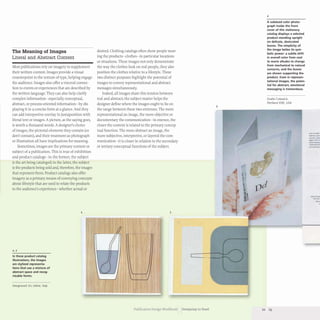
the running text, there are half a dozen secondary
text elements that have evolved to help readers
navigate. Navigating text and other content is a
culturally based skill that readers derive from the
standards set by centuries of development in book
structure. Each component of a publication exists
in relation to the others, so distinguishing them
from each other also means making connections
among them.
HE
FO
A diagram of the page
elements most often
found in a conventional
magazine spread.
InPraxis Design
Munich, Germany
Recto (the right-hand page) and verso (the left-hand page),
together, define a spread. The spread is divided into its two pages
by the gutter, where the pages descend into the binding.
The top edge of the page spread
HEADLINE Often shortened to head. The title of a
chapter, section, story, or article. Usually, it is the largest
typographic element in a page spread.
DECK A supporting line or short, two· to three·line
paragraph that clarifies the content of the headline.
The area where the primary content
is located; also called the block. The body
is separated from the outer edges by
the margins.
The bottom edge of the page spread.
VERSO
~"-___ 1iI IIamenco
II"" n)II FII_IAntt,. und ·llAunnn<n1Wm•..mIIum Wq uDd
~ und Tnd"ioodI<sIll"iol<!tmJll<nProj<ltm uDd L,sd·
...t.o-... _._ _
Farruquito
E
I flamenco se lIeva dentro
FOLIO The page number.
Sometimes, the page
numbers are arranged near
or as part of the running
heads. sides. or feet; in such
cases, the entire cluster,
including the page numbers.
is called the folio.
GJ
C
~
~
m
Id
Sara Ballls
c,;..- .. __ ""--
d.-: ... '.... ......
~ . . . . . . . . ft ...
«w.-......c.....
..... AIi.JIU ..... a- ..
~-........~- ..
"f"'NI.... ~.l..
If., 3IOD Nrma '- rn-
_...............
.. If.u''l_ ............ .
~ ......u.....,.......
t_ll"~_"
..,. ......'-. ....
'2"'......, ... rany..
- --
---
.- --
- --
M _ _
-
RECTO
__ I .... b.,....
.........---............
. . . . . . . . _ _ .....1). ...,..,....._,1.- ........... t
f ........ _ ... ~III ___N ....,.. ............,.,r
.111..... _ .. .
...........................-
III ........, ...,,.. ...........
111 ..... _ ..._ ......... _
.... t.... • .....• ......... ..-. . . I-."4JII'I .............., ......
...........,................,."..,,"'... ....,..- ...............,,.........
"An rUIl tllfJfll./t, qut~I'''!tt'' ,til!. I tn/l1ll
UII }Iom. IICII'1"" .(Sl~ n'$f't/."
........-.-"........ ~
t::=-==--::====:-­
.......... *.MMd ?:--- ....--
... ::-
..... wct .....IdIn.tu ....t....
.......................... ....
...". ,........,... ~
_.It_.,_... _II...,.. ......__
&t •• .-,........ MtW.. _
.. • .... ....u1 __ • t• .........
...............-....."- .....~
_.".-,11".-. .......
..._~ . .,r.,n
-----............ .... .--.......
....... ,.,.,.... 'b.__ C ::!:'
.......- "
..........,. C----_-.-.
.......~--..,..
........................... -' ............-
..........' -...... ,... ..IiIIlIlla'lll.-ln
.................. ......
_
.."
.................
....-"""'...~-~
..........
ICCI .........""-'.........,
....... ,..........1.." ...
.... • ....."pIIfta
.."".-........." ...
..._-................
........... ",.........
........................
..--- -
-JIIiIiIIa ...*irfII. . . . ..
___ __III...... ...
.............. CNiII" •
....'-
................
j . . . . . . . . , . , . . . . . . lItIi
1..a .......... ,.I1_
..................
.....,..,..-.~
~..... e.ii=
.... .
£1._.-..
..._-
CALLOUTS (OR PULLOUTS) Short excerpts
of the running text that are given prominence.
Callouts can be quotations from a speaker
who was interviewed for the text, or they may
simply be important points that the designer
or author feels deserve extra attention.
SIDEBAR Content that supplements the
primary unning text with more detailed
informa ion. Often located at the outer
edges 0 the publication (hence the term),
but just s often found toward the bottom
or top 0 the spread.
CAPTIONS Descriptive
clusters of text that
accompany images, giving
information about their
content or creator.
SUBHEADLINE Often shortened
to subhead. Informational markers
that indicate the beginnings of
new subsections within a larger
section, or new paragraphs within
running text.
RUNNING HEADS, FEET, OR SIDES
Often shortened to runners. Informational
markers that identify the reader's location
within the publication. The runners may
consist of any combination of the publication
title, section, subsection, and author.
Publication Design workbook Designing to Read
2
3
4
•
coa= cookout
Each of these page spreads
shares structural ele-
ments-folios, running
heads, captions-treated
in different ways. Note the
placement variation in the
folios, as well as that of
the runners.
2 Premier Media Group
Lakewood (WA), USA
3 AdamsMorioka
Beverly Hills, USA
4 Faydherbe/DeVnnger
The Hague, Netherlands
. --
~------
.,-
-._-
--- -
--_.-
---
-------
.- -
58 59
Though a focus on the minutiae oftext legibility and informational clarity is clearly
important, it must not distract the designer from the macrolevel ofpublication
design: integrating images, colors, and other messages through dynamic layout and
a clear, consistent structure. The publication is an object, with a front and a back,
a size and shape-it is a tactile experience that its audience acts upon. Each turn ofa
page must yield a new experience but remain visually, emotionally, and conceptually
connected to the pages before and after. Much ofthe building ofa publication inter-
twines the conceptual aspects ofcontent, the visual power ofimagery and typography,
and the detail issues ofreading; no one element is truly more important than the
other. Structure can be an inspiring source for conceptual messaging, as much as a
force for organizing and unifying material (or helping speed up production). Looking
at the microlevel oflegible typographic design, the ethereal messaging functions of
subject matter and interpretive overlay, and the macrolevel ofintegrating the pages,
sections, images, and type together creates a single form that packages all ofthese
ideas into one final form.
Format can mean different things. Most often, it refers to
the proportions of a page. It may also refer to a project's
organization. There is a conventional format to a maga-
zine, for example: a table of contents, a letter from the edi-
tor, a series of shorter informational sections related to the
overall subject, and a series of feature stories. Ultimately,
the question of a publication's format is one of the first a
designer must address.
CREATIVE AND PRACTICAL An appropriate format,
in all its aspects, conveys ideas and also provides function-
ality for the content. Addressing content functionality
means differentiating the publication's informational
parts, ordering them logically, providing them useful
space, and distilling relevant visual ideas to communicate
their varied messages. Who will be reading the publica-
tion? How does brand perception influence the message?
How should the subject be represented? How does this
....
' " ....
subject fit the broader cultural context? The designer must
also consider more concrete issues. How many pages might
the text fill? Will the budget limit production options?
Format choice may affect the publication's potential for
display or the cost of its mailing. Sometimes, the format
may be determined by something as arbitrary as the size
of the least expensive press.
STANDARD FORMATS Many large-circulation publica-
tions adhere to standard formats, which are quite useful.
Their ubiquity makes them conceptually neutral; they
fit most display racks; their proportions efficiently use
standard paper mill sheet sizes; and they cost the least to
mail, since automated equipment is set up to accommo-
date them. But designers need not settle for a standard
format. Since readers expect the standard, slight changes
in proportion create an immediate sense of difference
in presentation without affecting practical concerns.
r···.
....
....--..... .....-..' ........
Format proportions in the
fourteenth through nine-
teenth centuries were
based on mathematical,
architectural, and even
musical harmonies, follow-
ing developments in
science and the humanities.
The golden section, a
mathematical system with
roots in ancient Greece,
has often been used to
determine page formats.
Publication Design Workbook Designing to Read 60 61
BUILDING
The Format's Conceptual Potential
An Overall Shape for the Message
Format plays an enormous role in the experience
of a publication; its size and shape sets the stage for
content and how it feels to the reader. The sense
ofspace, tension, and movement in a given format
changes as its proportions change.A square format
exhibits a neutral space without tension.A vertical
format mirrors the human body, creating upward
visual thrust that is tense and active. In contrast, a
horizontal format is restful, reflecting the landscape;
its thrust is less dynamic and creates movement left
and right. A choice of one over another, even at this
level, has implications for the communication.
The extreme to which a designer pushes a for-
mat's proportions has an impact on perception. An
exceptionally narrow or large format, for example,
may communicate a particular attitude- unconven-
tional or exclusive. The calming effect ofa horizontal
2
LETTER TABLOID A6
A5
17 X 22"
format might enhance a subject such as gardening
or health care. Harmonic mathematical relation-
ships, first noted by the ancient Greeks and
commonly used between the fourteenth and nine-
teenth centuries, impart a sense of precision that
may be appropriate for journals of math or science.
However, purposely refuting a conventional
format choice may add meaning and originality:
for example, a format derived from the golden
section or other numerical system for an exhibition
catalog or a yoga newsletter. A designer may also
explore formats based on the content's typographic
necessities. As noted earlier, text legibility, spacing,
hierarchy, and structure may direct the designer's
consideration of the format. Some designers
begin by exploring various text settings to deter-
mine how much space the text will need and
what page structure will best suit it, organically
building the page outward from this internal
typographic architecture.
A4 A2
A3
Ai
6
BSCE
f U. ,. "'iii" ... .•
1,2
The United States and
European Union follow
standard format systems.
The U.S. Imperial Letter
(8.5 x 11" [21.6 x27.9 cm])
and Tabloid (11 x 17"
[27.9 x 43.2 cm]) sizes (left)
form the basis of American
publication formats; these
sizes are left over from
colonial English printing
paper sizes. Tabloid is
twice the width of Letter,
and their aspect ratios are
different. The European
DIN or ISO standard (right)
uses a proportional system
based on a square meter
of paper (AO size) whose
aspect ratio has been engi-
neered 50 that when it is
folded in half, the folded
size retains the same
aspect ratio as the parent
sheet. The A4 letter meas-
ures 210 x 297 mm, (about
8'1, x 11'1,'). The aspect
ratio in ISO sheets is
consistently 1:1.414 (the
square root of two),
I • • " . . . . ... .
Plans unvclilld for the Now
BSC£ Perfonnina Arts Theatre
at Fonner Warehouse
3
'U h •••,.. .. nC'''' .. II t' .. UI1
''''''-'1£1 IJIPUl10lRl
.-
.-
on
4
otr •• I . , . . . .
..-
-_
..
-
....
-
- --
-----
______M_
--.,.-
From Inside Out. Exploring typographic possibilities for highly
readable text mayyield a basis for a workable column structure-
essentially building the format outward from the most desirable
text configuration tailored to the content. Working from this base,
a designer may consider a variety offormat proportions to house
the type structure, eachyielding a different spatial experience and,
potentially, functionality.
~ ° R
t1E
.~ .............' ..
5
Extremes in format size
can communicate just as
much as the visual mes-
sages of image and type,
The PEN Canada annual (3)
report, for instance, relies
on its tremendous scale
7
BSCL at
o
This quarterly newsletter
for an orchestral group
demonstrates the impor-
tant role format decisions
can play, When closed,
the vertical proportion is
cost-effective for mailing;
when open, harmonic
proportion creates the
perception of something
mathematical and musical.
The decision to accordion
fold, rather than bind,
permits the newsletter to
open into a long, horizontal
page whose proportions
derive from a standard
musical staff, The staff
structure is further used
to develop flowlines
(see The Grid System,
page 68) that integrate
material across panels.
STIM New York City, USA
to establish undeniable
presence-supporting its
mission of bearing witness
to human rights atrocities.
The small·format pharmacy
college annual (5),
by contrast, presents an
intimate and quietly credi-
ble message-elegant,
reserved, and academic.
Its proportions are based
on those of personal
stationery. A letter-sized
publication (4) is shown
for comparison.
3 Soapbox Design
Communications
Toronto, Canada
4 Premier Media Group
Seattle, USA
5 C" cle K S
tudio
San Francisco, USA
BUILDING
The Systematic Nature of Publications
Unlike one-offs, series-based projects, such as publications, force the designer
to consider variables beyond the basics of composition. Crafting readable text
for a single page format doesn't necessarily solve spatial and hierarchic prob-
lems for many spreads, or for successive editions, of a publication. Information
in serial media changes over time. Designers are confronted by headlines or 3
titles of different lengths; articles that are one page long, two pages long, or
six pages long. Some content will come with images and some will not.
Therefore, designers must consider the potential
requirements of content that they haven't seen to
make sure that it can be addressed by the composi·
tional ideas they've developed.Publications must
be developed as systems in order to accommodate
changes in content: each issue is a single object, but
the visual logic of the publication must be consis-
tently recognizable to its readership yet flexible
enough to allow change in content.
A system can be developed any number of ways,
from organizing material on an underlying, consis-
tent structure to tagging serial components with a
recognizable element,like a colored bar or a typo-
graphic device. In a serial publication like a
newsletter, magazine, or newspaper, setting up a
framework of measurements for columns and areas
for images helps not only unify the material within
a single edition but also allows for consistency
between editions. In a system ofbrochures, the con-
tent may reflect an overall subject matter parceled
out into subcategories.This might mean that at
least two typographic or pictorial tags must appear
on all the pieces: one unchanging element that
establishes the overall concept and a second ele-
ment that distinguishes it from the others. The
formats may need to be mixed or stepped so that
all the titles are visible at once. Or perhaps the
elements will be displayed within a stacked holder,
with only their top thirds visible. These criteria
impose limitations on the organization of the con-
tent that the designer must take into account in
the planning stages.
After the designer has evaluated these issues
and developed a list of limitations, the actual
designing can begin.Their search is for a visual
logic that will convey the meaning and emotion of
the content yet work within the limitations so that
no one component feels out of place or becomes
problematic on a functional or production level. If
the designer reaches this goal, the result is an
organic system of parts that reaches the audience
in a consistently recognizable way and allows for
variation and flexibility in design as the system
continues to expand.
4
2
-----~--..
Domestic Violence:
How ro l.er Help
-----...-
E1dc:rcarc Scrvica
Program
_.-
Publications are naturally
systematic-they are
serial groupings of related
material. Both of these
literature systems use (olor,
format. and typographic
treatment to distinguish
their components as
belonging to the same
system. Each system is
flexible to a different
degree; the D.A.'s office
literature is flexible in
color and image; the mu-
seum system is flexible in
color, image, and format.
1,2 C. Harvey Graphic Design
New York City, USA
3,4 Eggers + Diaper
Berlin, Germany
D
D
D
D
D
D
Buildinga System: Addressing Content Change
How many different kinds of content will
occur in the publication?
How are the parts differentiated against
the overall visual language: by image use,
by color, by type treatment, by structure?
What content will remain the same from
issue to issue?
What content will change completely?
When content changes, will it remain
approximately the same volume each time,
or is it likely that the volume will change
i.e., could the same content be short in one
issue and very long in the next?
Are the publication components serial, or
will they arrive together as a group?
Publication Design Workbook Designing to Read
TAILORING THE SYSTEM FOR THE JOB
Different publications require the development of
different kinds of systems to organize them and
provide consistency over time. Serial publications
require an underlying structure that permits rapid
changes in content; for example, in a newspaper,
the mixture of articles on any given page may need
to shift at any time. A newspaper's system of type-
faces, their sizes, and informational hierarchy must
be relatively simple; fewer choices for setting must
be available so as not to impede quick layout. The
structure of a newspaper- specific and consistent
column widths- is also tailored to address quick
change.Text may only fill a single column width.
Newsletters and magazines may be somewhat
less rigid in their structure, as more time is avail-
able for their design and the emphasis on visual
concept is more pronounced. Nonetheless, a recog-
nizable structure is needed to unify each edition
of the publication. Annual reports may change
dramatically from year to year, both in concept and
in structure.However, organizing the rnaterial in a
given year's report will still require an underlying
structure as well as recognizable typographic and
image-related treatments, among sections and even
among spreads within a section.
BUILDING
Editorial Pagination and Structure
Page Count and Sequence
Page order and section structure in publications
are often based on historical conventions that
derive from the physical reality of the printed
sheet and longstandng production methods.
Astandard press form (or broadsheet) in the
U.S., for example, creates sixteen letter-size pages
when folded in half upon itself four times. This
signature, cut across the top fold, yields a set offour
nested tabloid pages that share a common spine.
The first page, as recto, is always a right-hand page;
therefore, all odd-numbered pages are right hand as
well. All left-hand pages are numbered evenly.
This fundamental folded sheet, the signature,
means that all publications must be considered in
terms of having page counts that are multiples of
four- unless the publication is perfect bound. In
this case, the designer can insert individual pages
(front and back) as needed. The pagination of the
document is its full sequence ofspreads and signa-
tures, used for planning the sequence of content.
In popular jargon, however, designers will
often refer to a single folded tabloid as a signature-
meaning a tabloid sheet folded in half that yields
four letter-sized pages. A twenty-page brochure,
in thiscase, is made up of five such signatures, all
nestedtogether and bound in the center. The inner-
most signature facing the reader, when opened, is
the centerfold. Whichever is meant by signature-
the "real" sixteen-page folded broadsheet or the
four-page folded tabloid- the fact of the four-page
multiple, as well as the numbering rule-even on
the left, odd on the right- still holds true for plan-
ning purposes. Designers often sketch folding
diagrams to see how the pagination plays out.
2
Bar 2104
Forslde
1
holts hotsllbarsr
14 15
Annonse
dlageo
J
29
42 43
Bakside:
Annonse
Allied
Domecq
66
2 3
~tf'b,r(~'
Page numbering begins on
the right hand page-the
cover of a publication
(the first page) occupies
the right-hand position
when the document is
closed. Subsequent pages,
therefore, are always
numbered even on the left
and odd on the right.
Signatures-folded sheets
of paper that create four
sides-help determine the
pagination in publications
that are stitched together.
'ZIJ
Rovldort ~.04.04
J ~____~____~
/
barmlx Annonse barmix Anhonse
Brewery ~~risaga tradln

6 7 8 9 10 11
71~ .
v V  J
n{'on,se
whiskype dlageo
/
I
16 17 18 20 21
3
Anno
lense
Annonse
rinO/1es I
~11
'-
~ II
-1'.
Annonse
...... strem
- '-
See for Yourself. Calculating page spreads
'-
in your head is one thing, but knowing how
many signatures a publication will turn out
to be is important. Alittle slip in calculation
may mean a page count that is indivisible
by 4, meaning either too many or, worse yet-
too few-pages to account for the content.
Sometimes it's also useful to know where
the centerfold spread in a saddle-stitch
(stapled) booklet lands among the pages.
Making a folding diagram, such as the one
shown here, quickly clears things up.
lounge lo .
22 23 24 25
V V
"
V
romdrink .........
A'1.no;r.,
bibe un ........
'- - '-
" 1- "s- "6'
:z
." ~ ~ "".
...
<, <0
"" ~
'"
' 'b
The material leading from a publication's cover to
its primary content is called the front matter. This
material may include anything from the half title
and title page of an exhibition catalog to the intro-
duction pages of an extended brochure system and,
in particular,a table of contents. The primary con-
tent area, the interior where chapters or sections
are located, is called the guts or the well. Anything
that follows this is referred to as tail-or end matter,
including appendixes, indexes, reference-oriented
listings, bibliographies, glossaries, and so on.
Newspapers are notable for not having front or end
matter; they're really just guts. Each section in the
guts may have subsections or chapters or not. In
publications with a full complement of parts, the
front matter sequence is often an important part
of experiencing the publication. It separates the
reader from the outside world and, with each turn
of the page, envelops him or her in the world of
the publication. The designer may elect to include
additional pages- spacers- between the required
ones to enhance the sense of change from outside
to interior. The table of contents requires intense
focus to ensure clarity, both visual and editorial,
and to link it conceptually with the content it lists.
2
A pagination diagram,
such as the one for a
magazine shown here,
is an invaluable tool
for a designer. Being
able to see the full
sequence of pages and
signatures helps plan
where content can be
laced, and what effect
adding, deleting, or
shifting content between
spreads will have on
page count and flow.
Creuna Design Oslo, Norway
7
-
=-
4
_. _.....
-=
5
---
:---- _..-
====----
..,.,., --_.-
-.--
---
---
=''''':t._""='===-
-.-.-
--
----~~----
.....-.....- co=-
::!i:,---
~---
-.~==;;;-;;:---
=---
3
6 ---
----.._-
--_...-
-----
--
---
.-
.. -----
..
,. ----..
---
" --
---
.. --
,. ----
..
. --=-::':--=-.
------
-----
-- _::":.
Publication Design Workbook Designing to Read
'-"-
---
--
---
--
l;-~
--
The table of contents in
a publication, no matter
how simple or complex, is
a page worth considering
in detail. Its prominence
in the front matter means
it is one of the first
impressions of the content
and messaging that the
reader will experience
later on; above all else,
however, it is a navigation
device. Clear relationships
between content listing-
sections, chapters, subsec-
tions, authors-and page
numbers are essential. The
variety of sol utions shown
here merely hints at the
possibilities.
3 Ruder Finn Design
New York City, USA
4 Creuna Design
Oslo, Norway
5 Allemann, Almquist+Jones
Philadelphia, USA
6 Hutchinson Associates
Chicago, USA
7 And Partners, NY
New York City, USA
·
•
·
·
•
·
- --
--=-:'l-=-
66 67
•
•
BUILDING
The Grid System
All design work involves problem solving on both visual and organizational
levels. Pictures, fields of text, headlines, tabular data: all these pieces
must come together to communicate. A grid is one approach to achieving
this goal. One grid may be loose and organic; another may be rigorous and
mechanical. To some designers, the grid represents an inherent part of the
craft of designing, the same way joinery in furniture making is a part of
that particular craft. The history of the grid has been part of an evolution
in the way graphic designers think about designing, as well as a response
to specific communication and production problems that needed to be solved.
Among other things, a grid is suited to helping solve communication
problems of great complexity.
The benefits ofworking with a grid are simple:
clarity, efficiency, economy, and continuity. Before
anything else, a grid introduces systematic order
to a layout, distinguishing types of information and
easing a user's navigation through them. Using a
grid permits a designer to layout enormous amounts
of information in substantially less time because
many design considerations have already been
addressed in building the grid's structure. The grid
also allows many individuals to collaborate on
the same project or on a series of related projects
over time without compromising established visual
qualities from one instance to the next.
[
r
~
[
t-
~
t-
[
~
~
[
t-
~
~
t-
[
~
---1l
t-
I
Il
~
t-
---1l
~
-
,
II ---1l
+ +
I
IFIl
+ +
+ +
II ---1l
+ +
IFIl
I
Rows are series of flowlines defined by
the existence of modules. Like columns,
they are also separated by gutters.
,
,
,
,
I
I
,
,
,
I
.
i
.
l
iI
!
~
j
j
The Anatomy of a Grid
A grid consists of a distinct set of alignment-based relationships
that serve as guides for distributing elements across a format. Every
grid contains the same basic parts,no matter how complex the grid
becomes. These parts can be combined as needed or omitted from
the overall structure at the designer's discretion.
Columns are vertical alignments of type
that create horizontal divisions between
the margins. There can be any number
of columns: sometimes they are all the same
width, and sometimes they are different
widths, corresponding to specific information.
Markers are placement indicators for
subordinate or consistently appearing text,
like running heads, section titles, folios,
or any other element that occupies only
one location in any layout.
Margins are the negative spaces between the
format edge and the content; they surround
and define the live area where type and images
will be arranged. The proportions of the mar-
gins bear a great deal of consideration, as they
help establish the overall tension within the
composition. Margins can be used to focus
attention, serve as a resting place for the eye,
or act as an area for subordinate information.
Flowlines are alignments that break the space
into horizontal bands. Flowlines help guide
the eye across the format and can be used to
impose additional stopping and starting points
for text or images.
Gutters are the interstitial spaces that exist
between columns and rows-and modules.
"The gutter," however, refers to the margins
toward the inside of the spread, where the
pages drop into the binding.
Modules are individual units of space
separated by regular intervals that, when
repeated across the page format, create
columns and rows.
Spatial zones are groups of modules that form
distinct fields. Each field can be assigned a spe-
cific role for displaying information; for exam-
ple, one horizontal field might be reserved for
images. while the field below it might be
reserved for a series of text columns.
Publication Design Workbook Designing to Read 68 69
BUILDING
Column Grid
Articulating Text Structure
Information that is discontinuous benefits from
being organized into an arrangement of vertical
columns. Because the columns can be dependent
on each other for running text, independent for
small blocks of text,or crossed over to make wider
columns, the column grid is very flexible.For exam-
ple, some columns may be reserved for running text
and large images, while captions may be placed in
an adjacent column.This arrangement clearly sepa-
rates the captions from the primary material, but
maintains them in a direct relationship.
The width of the columns in a column grid
depends,as noted,on the size of the running text
type. If the column is too narrow, excessive
L
hyphenation is likely, making a uniform rag diffi-
cult to achieve. At the other extreme, if the column
is too wide, the reader will have difficulty finding
the beginnings of sequential lines. The designer can
find a comfortable column width by studying the
effects of changing the type size, leading, and spac-
ing.Traditionally, the gutter between columns is
given a measure, x, and the margins are usually
assigned a width of twice the gutter measure, or 2X.
Margins wider than the column gutters focus the
eye inward, easing tension between the column
edge and the edge of the format. This column-
to-margin ratio is simply a guide, however, and
designers are free to adjust it as they see fit.
The column grid also has a subordinate struc-
ture- the flowlines, vertical intervals that allow
the designer to accommodate unusual breaks in
L
text or image on the page and create horizontal
bands across the format. The hangline is one kind
of flowline: it defines the vertical distance from
the top of the format at which column text will
always start. A flowline near the top ofthe page
may establish a position for running headers, the
pagination, or section dividers. Additional flowlines
may designate areas for images only or for
different kinds of concurrent running text, like
timelines, sidebars, or callouts.
I
i
i
,
I
Any number of columns
may be used in a column
grid, depending on the
format size and the com-
plexity of the content.
Flowlines define horizontal
alignments in increments
from the top of the page.
Within a column grid, a
designer has a great deal
of flexibility for arranging
type and image material.
3
5
2
.-----_._- -
.....
.... -------
._-
---.._----
._--
---~
--..-
--
---
--_.-
-~ -::--!:"'"--
---_.-
---
' - - -
--
---
--
----
---
=..-.-
---
--
---
--
- -
-
----
--
-
.---
--
--
--
- -
-
--
--'
--
-----
-_.-
-
---
--_..-
---
--
--
-----
---
---
- --
---
4
_ tlmr
--
-'---
- -
---
=--...:::::
,--
-=-
-
._--
~~-­
----
---
---
------
:::::~.::"'
=:
--
----
~
-­
--
-- .~­
.._-,,-
:::.--
.._ _ _ _ _ _ _ _ .. _:eiiiiO ..... _ ..... _ _
,,.-_._--_.-_._..._-...-~,....-.
_-___...._ ...- ..;w.~..-_ .._
.._--._---- ------_.._
..
___, ....... _1 __ ._ _ - _ _ _ _ ...... _
-- -----_..
_"-_Wt_ _~_. _ _ •_____ • .-_
_..._-----_
..._--_.._---
. -~---.-.. -.-"---....,......_..
-.----...-~ _
.._-------
--_....._......_------_.....-
......""6io~.I__ .........._..........__.
-_..........-.-....... --..--..----......
.......__.__. _.._01....._._____
---.-------.._---
--..---Ip"',- ..----~.-.....~
_
.._-.-...._----......,...---""-
..._...__._--_.-- ,..-......,--.._
...-
-- .. ---
_._._........,... ---........-_.-
----_..._-_...__...-....
... .-~ .. _ _ _ _ IW ...... , , _ . , , _ , , ___ •
----_..._,--- -,-_.._--_..
---_...- ----_.......----
_._,.....--.....-------------
.....----------....--....
-..._--.----....---_._--
...._---_.......- .....- _...._---
....._._-- ---------
_
..__...--_.,..----_...._---
------------_...._-
--.--~--. --..-------
--.....__.__.....--...... ----.........
__...._.____ "'_"_'-1_...-
Publication Design Workbook Designing to Read
2
The two-column grid used
to structure this publica-
tion relies heavily on its
flowlines to create spatial
distinction for subordinate
elements, such as the arti-
cle title and deck located
toward the top of the
right page, above the
body. The flowlines are
also used to connect ele-
ments horizontally across
the pages of the spread,
introducing a lateral ten-
sion that contrasts with
the vertical repetition of
the columns. The column
gutter is narrower than
the margins surrounding
the columns, focusing
attention inward to the
body and creating a com-
fortable separation for the
text from the edge of the
format.
Flat New York City, USA
3- 5
Examples of two- and
three-column grids, among
the most (ommon used in
designing publications,
are shown here. Each
exhibits differing margin
proportions, (olumn
measures, and flowline
configurations.
The potential for varying
typographic width across
the columns, integrating
images, and differentiating
columns with color to set
off sidebars becomes clear.
3 Ruder Finn Design
New York City, USA
4 Slatoff & Cohen
New York City, USA
5 OrangeSeed DeSign
Minneapohs, USA
70 7'
BUILDING
Modular Grid
Text and Image Architecture
Because very complex projects require even more
precise control, a modular grid may be the most
useful choice in such situations. A modular grid is,
essentially, a column grid with a large number of
horizontal flowlines that subdivide the columns
into rows, creating a matrix of cells called modules.
Each module defines a small chunk ofinformational
space. Grouped together, these modules define
areas called spatial zones to which specific roles
may be assigned. The degree of control within the
grid depends on the size of the modules. Smaller
modules provide more flexibility and greater
precision, but too many subdivisions can become
confusing or redundant.
How does one determine the module's propor-
tions? The module could be the width and depth
of one average paragraph of the primary text at a
given size. Modules may be vertical or horizontal
in proportion, depending on the kinds of images
being organized and the desired stress the designer
feels is appropriate. The margin proportions must
be considered simultaneously in relation to the
modules and the gutters that separate them.
+
+
+
+
t t
I I I L ~
L
I
=
=
f--. f-- =
It tt C::::=
It tt =
L
-
Modular grids are often used to coordinate extensive
publication systems. If the designer has the oppor-
tunity to consider all the materials that are to be
produced within a system, the formats can become
an outgrowth of the module or vice versa. By
regulating the proportions of the formats and the
module in relation to each other, the designer may
simultaneously be able to harmonize the formats
and ensure they are produced most economically.
A modular grid also lends itself to the design of
tabular information.The rigorous repetition of the
module helps to standardize tables or forms and
integrate them with the text and image material.
+
+
Here, a variety of modular
grid structures shows a
range of proportions and
precision. The greater
the number of modules,
the more precise the
layout may be, but too
many increments becomes
redundant. Variations on
the number and stress
of the module achieve
different kinds of presence
for the typographic and
image content.
2
The modular structure
of these foldout mailers
creates an endlessly
flexible, yet visually
consistent, system for
ordering information
that changes in volume
with each edition. The
module's proportions,
in this case. are derived
from the measurements
of the panels when the
mailers are folded down.
U9 Visuelle Allianz
Offenbach, Germany
3
The modular grid used
for this furniture catalog
not only helps organize
text and inset images
but plays a role in how
full-bleed images are
cropped. The grid is shown
reproduced on top of
the third spread.
Designwork SrL Udine, Italy
Aside from its practical uses,the modular grid
accords a conceptual aesthetic. Between the 1950S
and 1980s, the modular grid became associated
with ideal social or political order. These ideals
have their roots in the rationalist thinking of the
Bauhaus and Swiss International Style, which
celebrates objectivity, order, and clarity. Designers
who embrace these ideals sometimes use modular
grids to convey this additional meaning.
3
4
2
1 ... 2004. On c.fj """"1M" W ~ 12 ...
5oMInu~ ~..a. Pfng:stIt.t' iR .. 1M.
..ttt.ot.h " Uftd 21. ¥Oft 15 bh l' lJtoir." ,.... "W' t "" _In*,," protekCe
- - =--
-I .. -,
~~
-, ..
---- = -
~=--
---
4
The enormous potential
for arranging images in a
modular grid is seen here.
Combining modules into
zones for images (gray
areas) ensures variety as
well as a unified relation-
ship with text.
Publication Design workbook Designing to Read 72 73
BUILDING
Grid Development
Text Based versus Image Based
Building an appropriate grid for a publication
involves assessing the shape and volume of the
content rather than trying to assign grid spaces
arbitrarily. The shape of the content, whether text
or image, is of particular importance. A designer
may consider the text as the essential building
block, looking at variations in the text setting to see
how they affect the volume of the text. Another
option is to consider the proportions of images as
a source for the proportions of the grid intervals,
especially if the publication is driven by its image
content. The proportions of the images, if known,
can be used to determine column and module
proportions. The result ofboth approaches is that
the structure of the page develops naturally from
the needs of the content, presenting an overall
organic, unified sense of space.
IMAGE PROPORTION A grid may be defined by
image content through comparison of its propor-
tions. Beginning with a universal height or depth
for the images and a consistent alignment among
them will allow the designer to assess how varied
they are in format- squares, verticals, horizontals.
The designer must then decide how the images are
to be displayed in terms of their size relationship
1
to each other: will the images be shown in sizes
that are relative to each other, or will they be
allowed to appear at any size? Ifall the images
hang from a particular flowline, their depth vary-
ing, the designer will need to address the images
with both the shortest and deepest depths to deter-
mine what is possible for text or other elements
below these variations. From these major divisions
in space and the logic that the designer uses to gov-
ern them, a series of intervals may be structured
for the images and for text areas surrounding them.
It is also possible to structure the grid based on
how images will be sized in succession. Perhaps
the designer envisions sequencing the images a
particular way: first bleeding full off one page,
then a half-page vertical, then inset, then a three-
quarter bleed. These proportions, as they relate to
the format, will define a series of measurements,
which can then be combined or systematized to
help determine the spatial intervals of a grid.
TEXT ATTRIBUTES Alternatively, the designer
may approach the grid from the perspective of the
text shape and volume.The sheer amount of text
that the publication must accommodate is an
important consideration. If each page spread must
carry a particular word count in order to fit a pre-
scribed number of pages, the designer will have
some sense of how many lines of type must appear
on each page. This variable may eventually affect
the column width or depth, but the optimal setting
is a good starting point. Achieving an optimal
setting for text at a given size and in a given face
will indicate a width for columns; from there, the
designer can explore how many columns will fit
side by side on a single page. Adjusting the size
of the text, its internal spacing, and the gutters
between columns will allow the designer to create
a preliminary structure that ensures optimal text
setting throughout. From this point, the designer
must evaluate the resulting margins- head, sides,
and foot- and determine whether there is enough
space surrounding the body to keep it away
from the edges of the format. Since optimal width
can vary a little with the same text setting, the
designer has some leeway in forcing the columns
to be wider or narrower, closer to or farther away
from each other, until the structure sits on the
page comfortably.
In this hypothetical study,
several sou ree images,
each with different pro·
portions, are positioned
relative to each other to
help determine where
their depths and widths
might correspond. Shifting
the images around each
other creates a number of
possibilities for distilling a
grid that will accommo-
date them all.
2
The leading of the body
text, decks, callouts, and
captions may have some
proportional relationship
based on their sizes. For
example, the body text
may be 10 points, set on
a leading of 12; captions
may be 6 points set on
a leading of 9; decks may
be 15 points set on a
leading of 18. The numeric
relationship between
these leading measure-
ments is 3 points; a certain
number of lines of each
text component will. at
some depth interval. share
the same top and lower
baseline, and this depth
interval may very well
indicate the depth of a
module. Conversely, the
body text leading may
be used as a standard:
perhaps an eight-line
depth of the body text
defines the depth of the
module, and then other
text components are
adjusted to work around
this proportion.
2
Ingua ran €Ju~ r
tent Europan Li n ~ es. It
occidental:I1lJ !(c
y,lSla9.
va semblalilJ [6151111<11
4
..---
--
----
.........weo_....,·._N...,.,..
... "~ ..........
...,...-ICId _ ~ 0I!n"c:-.
...--.-
- ---- ---
--- _
.. --
......--
--.--- ..__...
--"-
--
--•
•
.' •
•
:....-~-­
..
---
~--
-- ~
-----
• t
-----
. --
......... 0....1..... _
----
!-===~
._-
- .... --
--
----- .._-_..
:::~:~:: ----
=-.:.::::,
-- 0
_-
0 _ _ _
~=--
-.---~
--- ---
_.- --
---- --"
----
-"--
-._.--
3
Grid Hybrids and Combinations
3
Using a compound grid
builds a certain rhythm
into a publication. As the
grid changes to accommo-
date different information,
the rhythm of each grid's
occurrence becomes an
integral part of the pacing
and style of the work.
4
Depending on the complexity of the publication, a designer may find
that multiple grids are needed to organize the content, even within
A compound grid is used
to separate continuous
text from categorized or
listed text components in
this spread from a trade
newsletter. The top two
thirds of the spread is
organized on a three-col-
umn structure. while the
lower third uses a four-col-
umn structure. Both grids
share the same margins.
a single page spread. Working with several grids together can take several
directions. First, a grid with a large number of precise intervals may be
developed as a basis for a variety of grids used for particular information.
For example, a grid with twenty columns to a page might be used to
order a five-column, four-column, two-column, and three-column grid
with a larger margin for captions in a specific section. In this kind of
approach, all of the column widths will share a proportional relationship
that will also be noticeable in the way images relate to text set in these
various widths.
OrangeSeed Design
Minneapolis. USA
---
--- -
----
--~--
--
---
-d ' _ _ _
----
-~--
...__....., - -
.
-
----
----
~
-
---
---.....
- ....
--..
~ -
-..-. _
..-
---_.
- ---
--_..
.._
.....-
_. ----
-- _..
_-.0...
---
- --
---
-_...
_
...---
_. --
.....--... -
. ...- .._-
........_-
~-
--- ~~ !.."=...--
- • .-........ ---
_00_- ---_...
-.~- .. _
.._-
• • ..--:.:.::.:--
0
_- ---
--- ---
='="-- ---
-...---
--- --_.-
--
- - - -
_...--
----
Another option is simply to use two, three,
or more different grids that share outer margins,
allowing them to be relatively arbitrary in
their relationships to one another. Using this
approach, the alternation of the grids will be
pronounced because their internal proportions
are unrelated; the resulting differences in visual
logic between layouts using different grids
can make very clear distinctions between sections
or types of content. Another option is to combine
grids on a single page but to separate them into
different areas. For example, primary text or
images might occupy a three-column grid in the
upper two-thirds of the page, while a five-column
grid may hold captions or other secondary con-
tent in the lower third of the page.
Publication Design Workbook Designing to Read 74 75
BUILDING
Grid and Column Interaction
Logic and Rhythm
The way in which columns of text interact with
negative space is an important aspect of how a grid
is articulated. The spaces above and below columns
play an active part in giving the columns a rhythm
as they relate to each other across pages and spreads.
The options available to a designer are endless
but can be described as fitting into three basic cate-
gories: columns that align at top and bottom;
columns that align at top or bottom and rag at the
other end; and columns that rag at top and bottom.
Each kind of logic has dramatic impact on the
overall rhythm of the pages within a publication,
ranging from austere and geometric to wildly
organic in feeling- all the while ordered by the
underlying grid. Changing the column logic from
r
l
.......-....,,,
,.._
............,
.._.....-
..""_.........
,-"...'..."
."""'-~-
,......~--~,
~
....
".::~.....~
-_........
~=t
........ y .........
......."""........,.
''-''''''''''C>no.
-'-""'''''
0<0*.... " "'''''
"''''''''''''-•. 1
,,.---"'.........
..."""'",,"'"
....__.
..._,
-
u _ _ .-.. ..
-"'_....-
....._.....""
......-'..........
'-'''~''''''''''''~
~~~~~.
~::"'''''::.'.;::;;
--"""-
"'~....-.
,,-_0<,-..,
........--
, .._ , I . . .......
..'_
..._..
...,,.'.........
<......~ .... - ...,
.._....-
....._.-
,-"..."".
--~-
-~-.. ..-
:..."":":'~::
-'-'''-
;:"::"'Ei:
-""'~"""
"-"""-
,_ ......,..e....
--~, .......
O«_~ """""
....,-,""""',.
..- ..'......
--",,"'"
...._-
---
u _ _ "-..,,
-""'_....
....._.....""
,......._
...
-".~ ...........'"
~.:.
..~';!.~
.............,..,
........"" -""'"
--"'...-
"'~-.
"" __ 0<_ _
" ..._
...........
,_...•-<.
..'....-_..
...........................~ ..
~';':::.:-.."';:= ~-::=:..'r,:.,.-..::.
....._.-~....-.-
,-""'''''' .-".." ...,
--.~- .~..-...~­
........-....- ~ ..~-~,
:"''''':':::.::r.':. :"_~:..~
-_............_..."""
;:~E:: ~=::
......,......- ..................,
.._
.....- ............-..
""_ ......... c-b ,_""~.,,..c...,
_._~t_.", ,.........,...,......
"'"....~ ......,.,. "'_..............
....,-,"""'~ ....._,.,...,.",
..--....'- ."-.....-
-....,........... --......~
........-- ...._-
...__..._-
u _ _ ,,_ ... l' _ _ ~""" ..
""'..._.,..- ........._.""
.......-..........10<,- ,..-
..._._....__...
- ,....._...... .-..~ ....,,, ....-
;:~
..~~, ~~,::..~:.
.............- ~ "" - ..-
~_""""'IO<" .......... ....."""
-_.....---"".....
0<0M0<.... _
'
"
~
__
""_ ... ~toI •• __ ""...... '
......_-"..._-
,.........."-.. ~""'""',' ..-...
..._
...._.. ...---..
....,-.........
,,~·=;w
.....!..-.:;:.
....._.R......
:::,-:.:.:..~-
~~""..."""
"'-'-
_.........,...
-_.-."
"
=.,.~.:::..""'"
=...""::::'..:..-:'
.
..--....,......
_"""'W<""'"
I .... ·""" ..........
"".""","'-
-......--,.
,:.";:;:.~::.':"
...._-
""--,
l'_..... ~__..
___......""'.roo-
_
'_.n.......
."'-".......' ...
f.:.~~~
r" "" ............M
-"""--
,.--""..~
"'--
..-....."",.....~
.."...-...-
",",""",' ..-_.
...- .......
..._
......'"
-~ ...''''-..
~ lI _'.....,.
f,_ . .. _ ......
"",.,,--
-...-, .~-,
section to section provides yet another method of
differentiating informational areas.The designer,
however, must carefully consider the rhythm of
that change.Some regularity or system must clearly
exist in the alternation of column logic to appear
meaningful; otherwise, the audience simply recog-
nizes the change, not its significance.
ment will be thrown out of alignment with those
in the other columns. In hanging columns, this
break in continuity of the baselines may feel appro-
priate because it relates to the sense of the columns'
changing depths. A problem will occur in a page
spread set with columns aligned top and bottom,
however, if the paragraph space introduces an
uneven measurement: the lines of text at the foot
margin will be noticeably off. Setting columns
whose tops and bottoms begin at staggered inter-
vals complicates the issue further.The designer
When columns begin to separate vertically,
shifting up and down past one another- or drop-
ping to different depths while adhering to a single
hangline above- it is important to consider the
relationship between lines of text across the gutters
separating the columns. In groupings of columns
without line breaks (or with hard returns of the
same leading) between paragraphs, the baselines
between columns align. If there is a proportional
increment between paragraphs in one of these
columns, the baselines of text following this incre-
has the option of making the baselines between
columns correspond- introducing the linear regu-
larity as a contrast to the shift of the columns'
beginning and ending points.
...,,,............
,"""'.,.....-~,
..-... .........
..........<.-
_"...,001'
......_u_
-~""' ...""
..._.,.....,
_'n""",''''
--'...-
::::Ii:
.............-..
..._-'.....
-"",..".",,,,"
,....""",..........
"',.....~ .., ...,.,.
--,......,.
..- ",..........
"" .............
...._-
~-­
~ ........~--"
"''''''-'''''-
............_
.....
'.----""
~ , ....""",",-
~..~::~~';.
~"" ........."...
-""-"
--.....~
..~-­
...--"",."",
......-......
-',''''_'
................"
"'-'-'
- "...,.....,...
_"
_
.......
,,-.~ ...........
""'.- ....~
~--,,~~
.................. .....""""'"'"""
,--.,....."'"~ , -,'..._....
-._........,... ..---
~""-'- ............-
_,,,,,,,,,, ....m . ... _
_ _,, _ _ _ u_
........""""...........,,_........
...._.".""', "'_......'"
...-............. _
.....,,"",.'"
--'...- ...-."~-.
~!'~::':' =..::tro:J:":
............-.. :.............-.,
....."''''''.........._
,,-
......."'...".c.... _""'''''''<C
_
-_.._- .....-...._-
_ ......... ,.,. OwdootoI ..... _
"'_''''''.,'r''''_'_.'
....._
...........-...........
-............. -,_........
...._- ....._.-
--............._
...-
u _ _ ~."'_'" lI ............__ ..
..... "'.......roo- _~ . _.,..
....._........ "",_.",,,,..
........_,... ''''''''''''-'-
:-~~~ ::-:~~:.~
.............._ A .................
........""..._" -"'-""
-_..--_..-
..,~-. "-"'--
"--""'''''' ..---~
.., ...._- .., ...._
....-
",......, ........."......."',''''-
..,""""- ......~ ...'""""'- ........
~:~~.r.~ ~:::,.~
"""',lI_""" ...._U_..........
IT"". .. """ ......· ....-0 .. _ .......
...._- ""._,-
."""""..-.-.....-
............,.......
,,.-., .....- ~ ,,
............-
....._
.........
-""","",
--.,,-
-~-..."""
..._
..,.....,
-'''-'.''
--,._-,
:=-F.:
_It..........
::"'''":',~~
'....--..-....
oa-......._
"'_,,,,,,",,,,'
.......'...........
""_........
...._-
~-­
U_'.......-....
---",-"",.,...
.....,_...,.....
'........_...
::':':~Z~~
. " " _ .....M
.......,.._"'"
-_
..-
"'--
" --",,,.,,~
~""-"''''
....-...,..
,...., ..............
~.-... ....-
......_
.-
-''''''''''
-'-.."-
~ ..""".......
"'-'''""",'
",,-'-'"''''
--'...-
&:::..;::::'
............-..
.._""'.......
""...",...".c...to
-_..-....
~""'''''
~-,......,.
..- ..........
~ .............
...._-
~-­
lJ __ ",",_,,,
........._
.....
...._.........
'........'.......' ...
::::=~
...._
.......
.......,,,,,-,,
...-...... ",-,,,"",,
,,.........._..... -'''''-"'"'
.._........,... .._"'"'-
~ ....-.- ......_._...
-''''''''' _.""'-
_ - . . " _ _ _ U _
........"""................,,_........
","_.,_10<, "'......._
_ ."""...... - '"'''-'''''
--,...~ --"~ ....
=~~I::: ::r~:":
.................. _
.......-
....."''''''- ..._
,,-
.....~"' ...".c...to _ ......"~,,...
--""-- .....-..._
-
""-~""""" "'_.....,..
..._,"""'.,....__..
....._
...'...................." ...
-............. --........
"""-- ....._-
...- .............-...-
U _ _ "_,, " _'.....,..""" ..
"""""_.",,. -..._.,..
...._........ """.-'"''''''
'.....-- ,... '--'-
::£~~~~ :'-::::T:~:'~
................M .................~
"-"",,-.r _ ", _,,,,
-_..--_......
"''--- "'''--
""--"'- "'--""'''''''~
..,...._
...- .., ..._.......,
""""~'''-.' -.,.",-
..."""'-......" .......__..
~··;ftt,;,r;~
"""',lI_""",
......-do....,,,
,.-", ...._....
"-"'""-
" ~''''''' ' -'''
_...'....
--,,-
...~ ,,-...-
..._
...........
...M.........''''
..._
.....-
'-_..-"'"
::-,:,-.:::.;:::,,,,,
A_".._
..._'......
.~..... ",....<.....
'....--.....-
0«-..0 ..,,,, _
....._,,.,...,...
..-............
- ,""-" ~.-
""'.......-
...--...-
LI _'.......~""'"_
..................
-,_........
...................
="'S!~:.
.................
- ,,",-,,",
-_.......
:~
""'--'
...""...........
-.---
.._....-
~ ...-.,......
-''''''''''
--,,-
_.""-'.......
"'-'-
_.............
..._'•..-
;;::!'~::
-,....-"
.._"".......
.....~"' ......""'"
_.-.""--
"'"....~ ......"'"
",--,--.,'
0<_... ... ' _
-- ~ ......
...._-
"'-'-
u_ •.,.. ,,_ ...
""""'_'roo-
....._M...."..
<~-- ...
~~~=~
...._"'-
"-""-"
--..~-
---
""-.",,,,,*",,,
..' .....---
...-......
,--.,.....-~,
..-..........
......_.,......
""-,..."'",
-'-.."-
.........."""".....
..._.,_10<,
...-.............
..._'...-
~~~~ =~;::::'
........""',.- ............-..
""'-'''- ..._""'........
._~ ..,_ ......."'...".c-o
--,,- --""--
........~-...- ~""""'''''
="
....
""t.:':;"i.'.: ;".=::.~.
.............""" ................
::5:"'::: ?~=:.:
-.~-- -...._.""
.._
..............._........
.-""~.""'''"''' <",..- - " "
'........."'-- -,"~-....~
--"'.....- ","""",",,~ - ,,
_ ......,.,...,., . "_~N
.'-_
.....- ............-
--................""-"
...._- -_..-
..._
...- "'~-'
LI_ ....... .-.... "" __ " " _
""" ..._
.... ~ "" --
..._,....... """...,'"-'''
."""""..............,""""-....,..."
~~~~:.~ :'~'';'''e~
"-""'.""'" ..-"'-
.""........_M
_...........
----
-,"--
,,_.....-"'....
...._-
Be Clear about It! The differences in interval between column
beginnings and endings must be decisive and considered for
their rhythm. The heads and feet ofthe columns may be decided
spontaneously or may be determined by the existence of
flowlines or modules in the columns.
Columns justified to the
head and foot margins,
or to a specific module
depth. create a rigidly
geometric band of text.
Hanging columns provide
a measure of consistency.
balanced by their changing
depth. Columns that change
hangline and depth offer
the most organic (and flex-
ible) option for arranging
text, especially in terms of
integrating images.
2 3
.... __ 1GnA
-"'--
=:::::==-==:
Variation and Violation
Avoiding Repetitive Layouts
A grid is truly successful only if, after all of the
problems have been solved, the designer rises
above the uniformity implied by its structure and
uses it to create a dynamic visual narrative of parts
that sustain interest page after page.The greatest
danger in using a grid is to succumb to its regularity.
It is important to remember that the grid is an
invisible guide existing on the bottom-most level
of the layout; the content happens on the surface,
either constrained or sometimes free. Grids do not
make dull layouts- designers do.
Once a grid is in place, it's a good idea to sort all
the project's material, spread by spread, to see how
much is appearing in each. A storyboard of thumb-
nails for each spread in the publication can be very
helpful. Here, the designer can test layout variations
on the grid and see the result in terms of pacing-
the rhythm of the layouts. Can there be a visual
logic to the way elements interact with the grid
from page to page? Do pictorial elements alternate
in position from one spread to another? Perhaps
the sizes of the images change from spread
to spread, or the ratio of text to image changes
sequentially. Even simply placing images toward
the top of the pages in one spread and then toward
the bottom of the pages in the next achieves a
powerful sense of difference while still ensuring
overall visual unity.
It is necessary to violate the grid, sometimes
because circumstances dictate it- content that
must occupy a specific spread won't quite fit- or
because it is visually necessary to call attention
to some feature of the content or to create some
surprise for the reader. Within a rigorous grid
structure, violations must be relatively infrequent
or relatively small, or they begin to undermine the
reader's sense of the grid's consistency. It is also
important to note that any specific item or general
layout that violates the grid will be very dramatic.
Disturbing the regularity of a column of text by
allowing an element to jut out past the alignment
will not only be instantly noticeable but will also
cause the wayward element to shift to the top of
the hierarchy- it will become the most important
item in the layout because it is clearly the only
thing out of order. A full-spread layout that ignores
the grid established for the remaining pages of a
publication will be memorable within the publica-
tion. The problem facing the designer in making
......................
-- ..- -
- -
- --_._-
--_. -
2,3
Left-hand and right-hand
images correspond to each
other in relative position
and proportion between
these subsequent page
spreads, but the designer
adjusts their relation to
the grid in each to create
contrasting inward and
outward focus.
Interkool Hamburg, Germany
Give It Some Bounce. Asimple trick is to arbitrarily cluster
images toward the top in one spread and then toward the
bottom in the spread following. Sometimes forcing a small,
medium, and large image into a spread-then using the
same sizes but placed in different locations on the next spread-
will quickly create movement across the grid.
such a dramatic decision is that of integrating the
layout into the publication's overall visual logic
so that, despite its extreme difference, it remains
unified with the rest of the publication. Usually,
this can be done by maintaining the same typefaces
used in other spreads,as well as by applying the
same colors from a standard palette. Additionally,
the designer must consider the transition back into
the grid-structured pages following the violation;
if the pages following the particular spread are a
continuation of its content, the designer may add
smaller violating elements that reference the major
violation while adhering to the regular structure.
Publication Design Workbook Designing to Read 76 77
BUILDING
Visual Relationships between Words
and Pictures
Getting type to interact with imagery poses a serious problem for many
designers. The results of poorly integrated type and image fall into two cate-
gories: in the first, typography is separated from the image areas, while in the
second, typography is reduced to mere shape and texture. Images are com-
posed of lights and darks, linear motion and volume, contours, and open or
closed spaces, arranged in a particular order. Type shares these same attrib-
utes: it is composed of lights and darks, linear and volumetric forms, contours
and rhythms of open and closed spaces, also arranged in a particular order.
The task is finding where the specific attributes of both come together.
Laying type into or across an image is a quick way
of finding visual relationships. Their immediate
juxtaposition will reveal similarities in the shape or
size of elements in each. The rag of a short para-
graph may have a similar shape as a background
element in a photograph.An image of a landscape
with trees has a horizon line that may correspond
to a horizontal line of type,and the rhythm and
location of trees on the horizon may share some
duis autem velure
duis au
qualities with the type's ascenders. At the opposite
end of the spectrum, the image and the typographic
forms may be completely unrelated- they are
in opposition to each other. Opposition, thus, can
be an equally viable for integrating two materials:
a textural and moody image with great variation
in tone, but no linear qualities, may work well with
typography that is exceptionally linear, light,and
rhythmically spaced. The contrast in presentation
2
duis autem velure
helps enhance the distinct visual qualities of each.
Consider the location of the type relative to the
image and the attributes of the image'S outer shape
in relation to the format. An image cropped into a
rectangle presents three options:the type may be
enclosed within the image; the type may be out-
side, or adjacent to the image; or the type may cross
the image and connect the space around it to its
interior. Type that is placed within the field of a
rectangular image becomes part of it. Type adjacent
to a rectangular image remains a separate entity.
Its relationship to the image depends on its posi-
tioning and any correspondence between its com-
positional elements and those in the image.The
type may align with the top edge of the image
rectangle or may rest elsewhere, perhaps in line
with a division between light and dark inside the
rectangle. Type that crosses over an image and into
the format space becomes both part of the image
in the rectangle and part of the elements on the
page. Its location in space becomes ambiguous.
TYPE AND THE SILHOUETTE Silhouetted
images- whose contours are free from enclosure
in a rectangle- share a visual relationship with
the rag of paragraphs or columns but also share
an opposing relationship with their alignments.
Type will appear to change
spatial relationship when
placed on, in, or next to a
cropped image. This spatial
ambiguity may also
involve the space around
the cropped image, creat·
ing a connection between
the field, image, and type
that brings them together
in space.
2
Placing the type directly
onto the image permits a
quick comparison of the
shapes within both ele·
ments. In this example, the
type repeats the scale
changes. directional move-
ment, and tonal variations
found in the photographic
image.
4
3
c:.o......... .._-,- ... )
~.....--..-,..-......-....... ----.-.._---
r.__ ~. ___ .... _ _....-......._....____ .._ .. ... . ___-.._........
---...~.-"....._
..__.._- -.----.~.-.-. .......
.... _'-~ ......'" . . . . . . z:zj 4-_ _ _ _ _ .-........ ' - -.... _ . ""'.
"",-,,~ ......._u.-.......... .........................-M...,..._... '-' 4._._
~._...._.. _ _.. _ .......... _ .. __ • _ _ "' .. ____ -4_ _ .. _
---.~-- ....--....------.. --------~
I _.~ ____._.__..,.'_ _ _ _.___ __.........n_...__
,-=t
-~-
---
-- --
_...._
...."' ~ .......___..____..,.......-......__ __ :t. ~ . __
--..--_......,.._--.......-...... .......- ........._...... -
..,..--_.._-_...._.........__
..._------- -- ..- ..-
--......~--
.- -
---...-
::::.:_~
-.......-
---- ------- -------- ---
L==,... ..-...-----------.----~ ................--.._.._
..
-""-...........~-..--..- --
----
_..._-
---
==-=-
lingua franca va
esser plu simplice
regula quam Ii
exis tent Europan
lingues. It va esser
tam slmquam
eras occidental:
it vaoccide
ntal simplificat
ang quam
./
glori amico
dit meque rna
quande lingues
coalesce duis
-
t~e-R
=-.::=..-..,,'-__....._ t
--~ ..__ ,
-. ---
_
......-- --- --
.~--..... .. --..-.....-....-.----
:=== ...-......-'"'-----
_-...._.. ' --.....--~-
...
_
..___.....---....___aM t
_
.. _...._--
_ .... !.t,.. ..._ _
--....__..._-....
--
-a-E
Type adjacent to a silhouetted image offers
more or less contrast or similarity depending on its
location relative to the image. If the rag leads into
the image contours, the two elements flow together,
and the type may seem to share the spatial context
of the image. Bringing the vertical alignment of
a column into proximity with an image's irregular
contour produces the opposite effect: the type
advances in space and disconnects itself from the
spatial context of the image, appearing to float in
front of it. The strong contrast between the aligned
edge of the type and the contour of the image
may then be countered by the irregular contour
of the column's rag.
FORMAL CONGRUENCE Similarities between
type elements and pictorial elements make a
strong connection between the two.Every image
portrays clear relationships between figure and
ground, light and dark, and has movement within
it. Objects depicted in photographs have a scale
relationship with each other and proportional
relationships with the edge of the image. When
typographic configurations display similar attrib-
ea-rs
utes to an adjacent image or expand on those
attributes, the type and the image are said to be
formally congruent.
There are an unlimited number of ways for
type to become congruent with an image.
The selection of a particular font for the type may
relate to tonal or textural qualities in the image.
Instances in which type extrapolates the formal
qualities in an image create powerful emotional
and intellectual responses in the viewer. Type that
is adjacent to an image can also be formally con-
gruent in terms of its position relative to the image.
In this kind of formal congruence,the image exerts
an influence on the composition of the page as a
whole. Even if the type retains its natural architec-
ture, it may still react to the compositional archi-
tecture within the image.All three elements-
image, format, and type- appear to share the same
physical space.
FORMAL OPPOSITION Another means of
integrating typographic elements and images is to
relate them by contrasting their visual characteris-
tics. Although seemingly counterintuitive, creating
3
A mix of sizes and spacing
within phrases skews
them toward becoming
images, helping integrate
them visually with other
kinds of material. The
arrangement of the image
in the lower-left corner
with the changing head-
line creates a series of
stepped intervals whose
lateral motion balances
the image's downward
and leftward pull. The red
9 creates a counterpoint
to this activity. Callout
information, arranged in
smaller stepped blocks to
the right, takes a cue
from the main composi-
tional elements.
Jeff Neumann Denver, USA
4
The relationship between
the image shape and the
rag becomes dominant if
the rag enters into the
image's contour; the geo-
metric alignment in the
same block of text will
naturally counter the irreg-
ular forms within the sil-
houetted image.
Publication Design Workbook Designing to Read 78 79
BUILDING
I
•
Pl
III
itl
okt
t&b
I.iJ
1" 1
lhi
llU
lilt
~1.
1 J
_ L
2
-
•
•
c
'"
-
.g
CO
....
...
'to:
..
CO
5
;"
~
'"
-
.-
c
:::
-
~
'-
~
::.
-
•
CO
Q.
CO
In this spread from a
course catalog, the verti-
cal. linear rhythm of dress
forms is restated by the
vertically oriented type.
Studio Blue Chicago. USA
2
The designer responds to
the compositional language
of the image, using
the alternation of small
and large scale forms
and spaces-as well as the
angled linearity of the
drawing-as inspiration.
Studio di Progettazione
Grafica Cevio, Switzerland
4
fonnal opposition between two kinds of material
can actually help clarify their individual character-
istics. Contrast is one of the most powerful qualities
that a designer can use to integrate material- by
their very difference, two opposing visual elements
become more clearly identified and understood.
Within a letterfonn combination of an M and an 0,
for instance, the fact of the M's angularity is rein-
forced by the curved strokes of the O. The move-
ment within each form is made more pronounced,
and the two elements essentially fight for domi-
nance. The caveat is that some congruence between
the elements must also exist so that the opposing
characteristics are brought clearly into focus. In
the same way that a hierarchy is destroyed if all
the elements are completely different, so too the
strength of the contrast in opposing forms is weak-
ened if all of their characteristics are different.
3
The same abstract pictorial qualities of image
and type are the source for creating opposition,
as they are for creating congruence. A soft-focus
photograph with muted detail and light tonal
values overall may suggest a bold-weight sans-serif
typeface; another option may be a regular-weight
modern serif face with a great deal of contrast in
the strokes- the opposite of the photograph's lack
of contrast. Yet another option may be a lightweight
text with very active details, so that the passive,
neutral character of the image is counteracted by
the stylized quality of the typeface. In all three
cases, some quality of the type is congruent with
the image, but its primary quality is formally
opposed to it.
FF
5
Publication Design Workbook Designing to Read
3
The numeral and the
figure have similar shapes
and movement, but they
also oppose each other
formally-the numeral is
a solid, angular line,
while the figure is tonal
and organic.
CODEsign Rimini, Italy
4
The position of the text
block in this page spread
mirrors the white mass of
the model's sweater on
the left-hand page.
J.Crew New York City, USA
5
A study of two letter-
forms, 0 and M, reveals
both congruence and
opposition. Their inherent
differences are made more
pronounced by changing
the posture, weights. and
positions of the letters.
80 8.
BUILDING
Sequencing and Pacing:
Creating Flow among Pages
The pacing of a publication is one of the most important considerations for a
designer. Pacing can be understood as a kind of visual rhythm, a cadence or
timing that the reader apprehends from spread to spread, almost like a film.
By varying this rhythm-from slow to fast, or from quiet to dynamic, for exam-
ple-the designer can accomplish several goals. One result achieved is strictly
visual: each turn of the page engages the reader in a new way by varying the
presentation. Another result may be that the reader is cued to a significant
content change, as the pacing clarifies the informational function.
Much of a publication's flow is determined by its
overall structure. Magazines, for example, are often
divided into sections: a series of department pages
that recur in the same order every issue, along with
a sequence of feature stories that changes every
issue. Within respective types of publications,such
predetermined sections will likely differ because
they present different kinds of content. Within
each section, too, the designer must establish visual
variation so that the reader, while recognizing a
consistent structure, doesn't become bored.
PACING STRATEGIES Every project is different,
so the ways in which a designer may address
pacing in a specific project are unlimited. Most
pacing strategies, however, can be distilled into
two basic overall approaches:strategies focused
on structural variation, and strategies that adjust
content presentation.
Structural variation, as an approach to pacing, is
essentially neutral in its affect on communication;
the goal is to differentiate sections, or even spreads
within a section, by articulating the content on a
grid in noticeably different ways- or, as an alterna-
tive, by using a different grid in each section or
spread to give it a particular character. The effect
of structural variation is primarily one of rhythm,
in which the elements change scale and position
but not their inherent content. For example, one
section of a publication may use especialy large
images bleeding top to bottom and each spanning
different column widths, interspersed with text,
to create a lateral breaking of space; a section fol-
lowing may reverse this logic by emphasizing row
structure to create long, panoramic arrangements
of image andaccompanying text. The first structural
approach will yield a speedy, rapid-edit quality to
the pace of the spreads, while the second will pro-
duce a slower,more drawn-out feeling. Hanging
images from a flowline near the top of a spread will
contrast with another spread in which images are
hung from a lower flowline or in which images
bleed the page formats. The use of such structural
strategies may be arbitrary,or they may reflect
some feeling intrinsic to the content.
In changing the presentation of content- alter-
ing the overall color schemes of various sections,
changing the visual language of imagery and type
from spread to spread, or creating a progression in
value or complexity from light to dark or simple to
complicated- is an alternate strategy that primarily
affects mood. As an approach to pacing, it is far less
neutral in its result and will greatly affect the mes-
sages transmitted by individual sections or spreads,
as well as the overall emotional journey experi-
enced by the reader.
In these pages from an
exhibition catalog. the
alternation of full-bleed
and inset images-as well
as the alternation of text
and image spreads-is one
of the primary pacing
strategies.
faydherbel DeVringer
The Hague, Netherlands
2
The text columns in this
annual report, which
always remain the same
width and are separated
by the same gutter, are
allowed to shift left and
right against the outer
margins to accommodate
photographs with differ-
ent proportions. This alter-
nation creates a lateral
movement and different
tension between interior
and exterior from spread
to spread.
Ruder Finn Design
New York City, USA
2
•
- •
--
•
..
Publication Design workbook Designing to Read
BUILDING
Structural Variation
A grid promotes consistency by virtue of its regularity but presents the
designer with a potential pitfall: repetition. The designer must rise above
the grid's uniformity to create a dynamic visual narrative that sustains
interest page after page. Regardless of the content's treatment in terms
of color, imagery, or typography, the structure of a publication can be
articulated in a variety of ways.
-
-
-
Overall Progressive Sequencing
•
-
Image and text are articulated on the grid beginning
with one type of logic, and then the logic changes
progressively spread by spread. The result is a con-
tinuous transition in the pacing over the course of
the entire project.
Content Presentation
Aside from varying structure, the designer may explore the visual quali·
ties of the content to create pacing changes: its color, scale, photographic
or illustrative treatment, and its complexity. Sometimes, these pacing
changes coincide with grid variation: for example, changing the scale of
images over a page sequence may reflect a change in grid logic. At other
times. changes to content treatment for pacing may be independent of
any structural variations.
Color Progression or Syncopation
Page sequences exhibit a distinct color scheme, either varying
completely between sequences or tied together by a universal
color or two. The color schemes may progress (from cool to
warm, or neutral to vibrant) or they may alternate in a particu·
lar rhythm (cool, warm, cool, warm).
Overall Syncopated Sequences
One type of logic is used for a particular sequence of page
spreads, the logic is altered for a second sequence of
spreads, and then the spreads return to the previous logic.
This strategy can become more complicated-instead of
the simple ABA rhythm described, a rhythm of ABACA may
be used, or ABCBCDCDE, for example.
•
•
•
• •
•
••
Scale Progression or Syncopation
Images or text areas change in scale from spread to spread
or from sequence to sequence. Images may grow in scale
over a sequence of pages, or their scales may alternate
between pages or sequential sections. Scale·based pacing
mayor may not be influenced by grid variation.
•
Continuous Variation
Articulation of text and image content changes
continuously from spread to spread. The change may
focus on the relative position of elements or on the
proportions of spatial zones given to specific informa·
tional components.
• - - - ~
Text versus Image
The relationship between the amount of text
and the amount of image material changes either
progressively or in a distinct rhythm.
•
"'. =
-.....-
DD
DOD
DD
DOD
DD
DOD
DD
DOD l J DO DO uD uD
Section Variation
The same grid is articulated using a specific logic in one
sequence of page spreads, then another logic in the fol-
lowing sequence, and then another logic in the sequence
afterward. Alternalively, completely different grids may be
used in each section.
Progressions or Syncopations in Complexity
The complexity of the material changes, reflected either as
a progression (for example, from simple arrangements of
smaller type to bold, layered arrangements of larger type)
or as a syncopation (simple/complex/simple/complex).
-_.
•
-
•
•••
•••
•••
Image Treatment Progressions or Syncopation
Image presentation changes between spreads or sequences.
For example, images may progress from representational
to abstract or may alternate between figurative portraits
and environmental scenes.
Publication Design workbook Designing to Read
Interchanging the core
colors from page to
page within this quarterly
newsletter creates
variation in the apparent
depths of the foreground
and background, as
well as a lively sequence
among spreads.
And Partners, NY
New York City, USA
Dressing the Package:
Mastheads and Covers
Though not discussed until now, the exterior of a publication is an exceed-
ingly important component of a project-it delivers the first impression
of the overall communication that the publication's audience will see. In
the case of magazines, especially, the cover is also a tool to transmit
information about edition-specific content as a way of attracting additional
interest and influencing its target audience to purchase it.
Even in publications that are not for sale, the cover
must attract attention and generate interest, pro-
vide some clue to the content within, and reflect
the secondary and tertiary functions of that con-
tent- audience relevance and branding messages.
A cover is a package but also a transitional bridge
between the outside world and the publication's
interior experience. Whether designed to sell or to
inform,the cover must be considered carefully. A
cover may contain different information depend-
ing on the nature of the publication. The front
page of a newspaper, which acts as its cover, con-
tains an identifier (the masthead) that names the
paper, a primary headline for an article about an
important event, and multiple smaller headlines
for less important articles. Many newspapers also
feature sidebars and condensed tables of contents
to direct readers to specific sections. A newsletter
cover contains a masthead, information identify-
ing the corporation or organization publishing it,
and, sometimes, a condensed table of contents.
At times, a featured article may begin on the cover
of a newsletter and continue inside, following the
model of the newspaper front page.Magazines
vary wildly in their covers: the primary elements
of every magazine are a masthead and one power-
ful image; beyond that, there are no consistencies
in magazine cover designs. Many covers offer call
EI «Prestige)) se hunde ylanza
===========--=::.~
"'
:':
_:.:
'=-=== _
_____ __
._ L __ ~ _ ft _.~ _ ~_
REACH
===============:::J "Ql"A:Ut1,." Of .C....O'N... AH C:UlJUII'E IIfuweut g. "OU.hn . ...11
out headlines and subheads, but an equal number
offer no other text information.
The titling of a literature system or the mast-
head of a circulated publication share some basic
features, and the approach a designer may take in
developing this specific cover component will
often be similar. The title must be simple and typo-
graphically powerful. Almost like a logotype, the
type for a title or masthead must deliver a clear,
strong, simple message. Since the word or words
will most likely dominate the cover, careful atten-
tion to the drawing of the letterforms is essential.
Designers often approach a masthead as a
typographic image, investigating such strategies
as form alteration, combination, and inclusion
to differentiate from other publications, especially
those in the same genre. Like a logo, the mnemonic
attributes of the masthead are very important;
structural details like spacing, the shapes of termi-
nals, the contrast of strokes, and the overall shape
of the word or words help separate the masthead
from competing messages in the minds of the
target audience. Strategies like pictorialization
or form alteration can ensure that the masthead
is easily recognizable, as well as provide opportuni-
ties to communicate conceptual information
about the publication's subject matter, create
resonance with the target audience, and transmit
positioning messages.
--
--
---
-----
_.._--
==::=-
---
--
----
--
.................
.......--.--
...._---
------
-
1 _ _ -
----
-_....-
-----
---
-_.._-
::~=::"'-
...___ • _1iIo-.i
-----
._-
----
-.--
------
-
-
-
- - ~
,-.....-
-
---- ,--
--_...-
BusinessExaminer
_» ...... , Uft 'Ollltl' J04IM& .".~....u • • ,ws: '"OII'C,
,,~" ""ro' ," "'.' ",,~. •
Bars are shaken ... not deterred
-
H~-.....--
...--..............,
.. ____ <III ..... ......
--_...........
__..-..-c.........
---........--'"
--~.....-...
-(IIIa'.,......-
..........-.......
....-----...-
BUSINEssExaminer
A Masthead Close-Up
Mastheads tend to be stronger the simpler they are. Limiting the number and
kinds of changes between elements helps the eye focus on the elements that
stand out as being different. As a result, the overall unity of the forms becomes
stronger, and the masthead becomes more recognizable because the differences
stand out all the more. In the first example, before a redesign. the masthead
of the Business Examiner was confusing. without a specific mnemonic element
to grab onto: the two words differed in size, width, style, and weight. In the
redesign, the type style of the two words is unified, and their weights and
widths are brought closer together. Enough weight change remains so that the
first word is still emphasized, but just enough. The cap heights of the two words
are aligned, as are the heights of the small caps and lowercase; but the case
change also introduces emphasis on the first word, which defines subject matter.
The slightly condensed style allows the masthead to get bigger within the same
space, and the proportions of the two words have become similar. so their break
becomes decisively centered over the page. providing a strong stabilizing point.
Against the overall strength and regularity of the configuration, the remaining
tittle over the; in Examiner now stands out as a strong identifier.
EWing Creative Manchester (WA), USA
The cover images in this spread appear in other locations throughout the book, and
are credited in the Directory of Contributors, pages 238-239.
r
> -
"
Publications in the real world vary dramatically, not just by type-
product catalogs, magazines, newsletters, annual reports, newspapers,
literature systems-but also in the way that designers approach them.
Despite basic similarities in the concerns each must address, from
typeface selection to structure to color to format, there is no single way
to begin planning or working through the design of a document.
That difference is in evidence here, in ten publication projects from
designers around the world. From rigorously solved typographic systems
to complicated, playful, and spontaneous layouts of photography and
illustration, each highlights the individuality of expression that each
designer brings to creating an engaging solution, while addressing
the universal issues inherent in designing publications.
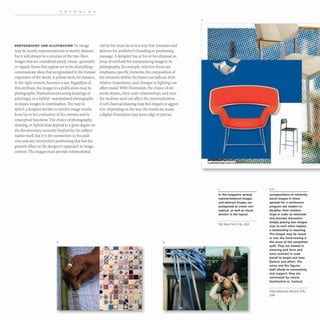
88 89
CAS EST U D Y
One World Magazine
(Ein Welt, Un Solo Mundo,
Un Seule Monde)
studio di Progettazione Grafica I
Cevio, Switzerland
Sabina Obertholtzerand Renato Tagli,Principals
Components +Formats
Periodical newsmagazine
Content developed and distributed by
government agency
Format
A3 (tabloid) folded to A4; 32 pages, self-cover,
saddle stitched; printed four-color process
(CMYK) in three languages.
One World is a magazine designed for the Swiss DDC, a government
agency that coordinates and funds humanitarian aid to countries beset
by poverty, health crises, and political confiicts. As a division of the
Swiss Federal Department of Foreign Affairs, it enlists outside consultants
to create communications for public dissemination; in this case, design
duo Sabina Oberholtzer and Renato Tagli, whose Studio di Progettazione
Grafica specializes in cultural and governmental communications. Their
signature modernist approach is embodied in the rational grid structure
and clear informational hierarchy of the prototype for the publication,
which provides information about the programs and initiatives that the
DDC undertakes in various regions. The magazine acts as a newsletter
in some regards, announcing specific programs and, later, updating the
readership on the progress and results achieved upon implementation.
It is also topical in nature, bringing current events and contextual news
information to its readers.
The column structure appears at first to be relativelyconventional Primary text for articles
runs over three columns ofeven width that extend, newspaper-like, from near top to
bottom. Anewspaper-like flag. or mastheadstructure, reinforces this presentation, carrying
article heads and decks in alarge-size sans serif. On closerinspection, however,anarrow
column appears interspersed between the primary columns at roughly halftheir width,
indicating amore precise seven-column grid underneath. The narrow column serves a
number ofpurposes: it can be used to add margin width, carry avertical section header,or
hold aplace for image captions.The use ofsevencolumns allows the text-column width
to remain constantwhether the narrow col-
umn appears at the outside ofthe main text
structure orwithin it Vertical text columns
are separatedby narrow rules,allowing a
tighter horizontal fit without creating across-
columnreading problem. The article flags,
containinghead and deck, generally run hori-
zontally across the page overthe body area;
sometimes, however, they are allowed to run
verticallyin a columnmade up ofone pri-
mary widthcombinedwith the narrow width.
lmagelHUld, often, the beginnings ofarticles
orsubparagraphs-hangfrom aseries offlow-
lines that define nine rows ofmodules.
An open, flexible layout structure,
compelling photography, and clear,
yet texturally dynamic, typographic
treatments contribute to the visual
accessibility ofthis humanitarian
publication that actively engages its
audience.
Adding to the overall newspaper-like quality ofthe publication,which affords acertain
journalistic credibility, is a distinct system oftypographic treatments for eachlevel ofinfor-
mation: primary and secondaryheadlines,primaryand secondary decks, subheads, callouts,
running text, and captions. Two type famili~ sans serifgothic and amodem serif-are
·
Gebtuos
den eueoburgersee,
mehr oield
PublicatIOn Design workbookIIFrom Cover to Cover
The cover features a large-
scale photograph that
always bleeds left to right,
combined with several
typographic elements,
whose positions vary. The
red circle contains the
masthead information in
three languages; the white
title within indicates in
which language a particu-
lar edition is produced.
The cross-axis typographic
lockup of the edition date
and subject descriptor ref-
erences the white cross of
the Swiss flag. Although
the elements-masthead
circle, photograph, fea-
tured topic article, and
text callout- remain the
same in terms of size and
treatment. their positions
on the cover may vary
considerably.
90 91
I
One World Magazine
Studio di Progettazione Grafica I Sabina
Oberholtzer and Renato Tagli I Cevio, Switzerland
1,2
The grid, articulated in dif-
ferent ways from spread
to spread, allows for clear
and consistent presenta-
tion of information but
adds vitality and move-
ment in its variation. The
narrow, multifunctional
column adds a syncopated
rhythm to the regularity of
the primary text columns.
In the Forum spread (1),
it holds for the heading,
running vertically up the
side; in the other spread, it
is used mainly for captions.
The newspaper-like flag
heads are situated in a
band above the body, two
rows deep, that also
accommodates callouts in
large blue dots. The story
heads are allowed to run
vertically.
2
I
J
=
I
1
=
J
j
•
Tribune: Richard Gerster
zum Solida.itiitsfonds
Exk)w:;ivco Interview
mit den Stars dem neuen PC-Game
"-.............-
---
-..............
_.................
---.........._-
.................-
...........~ .......
.-...w....-......~
________ilia
........-~....-
"...............-
......---.......
......................
....__............
....-..~
- dt'r und IA'IIIt'
Mitgrossen
Schritten-
Lander-porlrat
in Palastina
---
--
--
-.-
i:.'C_
-....
--
---
--
-.
--.
r.;:;.r
.......
-
--
- -
---
_
.....
--
"
10<
-
---
......-
--
-
.......
Schweizetster
Stelle
bei Soforthilfe
und strukturellem
Aufbau
Globalisierung
weriindert alles:
Beat Kappeler abar neuato
Trends in d.erEntwicklungs-
z-usammeoarbait
i
J
o
1
,
1
J
J
used in all their weights and widths to impart navi-
gational clarity and to invigorate the pages with
typographic color. Flexibility is built into the heads
through typeface choice; they may appear in the
sans serif (always bold, but regular or condensed
width) or in the black weight of the serif.
Maximum distinction is made between running
text and other elements via discreet and consistent
use of the regular weight serifversus the black
condensed serif for subheads and the bold sans serif
for captions. The serif of the text face, somewhat
visually more active than other possible text face
choices because of its extreme stroke contrast and
geometric structure, is leaded amply to allow
more interline white space. Similarly, the decision
to justify the columns helps minimize the text's
activity by doing away with the additional distrac-
tion provided by a rag. Although the columns align
top and bottom in a given story, the text is allowed
to run out when it comes to its natural end, adding
the possibility ofwhite space to interact with the
text and the geometric invasion of photographs
into the text areas.
3
lor sit amet. con
sectetuer adIps
sclng ellt , sed
dlam nonummy
nlbh eulsmodu.
Lorem aet dolor
magnaper suscl
plte lobortls nlsa
ut allqulp ex ea
commodo coniti
sequat. Duls au
tem vel eum iri
re dolor In. Lore
hendrerlt In vul
putate velit esse
molestie conse
quat, vel ilium
dolore eu feuglat
nulla facHisls au
vcro cros csun.
•
Luptatum zzriJ d Lnit au u
dolor te£ lIuaitnuila fa ill LL
m 1 Ii equat, el illudl
u f ugiat lluUa faciJisj Mven
ta eu III
Frauengruppen
in lenia
eli di17llj Un qui blandit pra(
luptatLUu zzriJ d I lIit all17U
dol rtf 110'rutnuUa facili-i.L
ip urn dolor it anl t. '0115 t(
adipi- illO' lit I diam nomu
nibb ui-m d till iclUllt lit la(
11101 t.i n equal,v I illud(
 1 f '....ial nuUa fa iii i at v 1'1
Despite the rigor of the typographic styling,
however, Oberholtzer and Tagli were determined
to give the publication a friendlier and more
accessible feeling. "The overall design needed to
be relatively serious," says Sabina Oberholzer,
"but it was important to give some sense of the
multiethnic subject matter through the layouts,
even though the pictures really speak for them-
selves. We added elements like red dots around
folios and blue bars within the text to be more
fun and encourage reading; and really, the variety
of typefaces was just as much about conveying a
sense of differences as it was about making the
information clear."
_ _ _ _ _ _ _ _ _ _ _.......JJ.~·u.l • d,_
J.Wi..c.oL.t.....,,,,,,,,u
One important aspect of the design is its
flexibility to be reproduced in several languages.
"The magazine is directed to people working in
these programs, Swiss citizens (who speak several
languages) as well as program directors in foreign
offices." The column structure of the magazine
allows each edition to be reproduced in three lan-
guages- Swiss German, Italian, and French- with-
out radically altering the type size or destroying the
flow of stories across columns. As noted above, text
can run out at its natural end- or fill a full set of
columns- without the difference being that notice-
able; negative space left as a result of the text run-
ning out in a shorter language seems natural. The
multiple-language factor also had implications for
the cover: the masthead title needed to show all
three languages yet emphasize the one being used
in its particular edition. A system of three titles, dif-
ferentiated by tint, solved the problem. "Using the
red ball signified the world, but with the white type
and the masthead lockup, the type also feels like
the Swiss flag," Oberholtzer elaborates.
Publication Design workbookIIFrom Cover to Cover
3
A lively mix of typefaces
adds color and clarity to
the various informational
components in the layouts.
linear serif text is con-
trasted by a bald-weight
sans serif, as well as an
extrabold neoclassical serif
in the headlines. The head-
line type, with its bali serifs
and geometric contrast.
exhibits visual similarity
with details such as the
folio dots and heavy
blue rules used to mark
subheads within columns.
92 93
I
One World Magazine
Studio di Progettazione Grafica ISabina
Oberholtzer and Renato Tagli ICevio, Switzerland
Annick
--.......-.- ==...,~=~
--- _....
-z:..__.,...
....... _ ......*ilI
.........--- -.........-.......""
......--................. ........................
.......~ .......- ........ n-.MI_ ...
Tonti
.........""--...,.r ~-,.. ...........
.................. ....,,-----
...-...-......~pn 'It,.~
......."'_............ ----........
....................... ...--..............
........---...... ..................
""'................... ....-~ ......-
....__......... _...._............
DEZA-
..._
..........- ...................._-
...................... ::--...:::::::::=
- _... _-.........
...................
...-_...........
......
Frau
'- ...............
-.-............
.......,.......
I .......-~....-
"'r,-_IA
J
~ ..- ......
• ................-
In ....................
• 1Ww._ _ ..
J .................., "-..............
.---.atl-a-tlllt-
-
j
PaUistina
.....--........ ---
....~- ......- ::a:----*-
.-........-..i ..
• ....,....... w- r: .............
""................-,. "'......,...~
-......_
....... ..._....--.
C
_.w.-.................... ...--........,....
~ooiIIiI:_ ........ _ .....__.-
.............."'- _
..............
...,.....-.-..... ......-::::...
Gestem ebend wurde -"............ ......... ....
..--::::: ::..-.....---....
einem grossen fest =_... M .......-....-...
......... ~..:.t-
......:t.
dle Premiere _ """-r."'--''''
des computersplels -_... .........,...........
.......-............... :.:t".,;t,:._ ~•
Umstrittenen
_.- "'o:r.---
Bewasserungsprojekte t- -.t.:..:":I -- I-r'.r:---
-_.... ..." .........
..---.....-.. . . . . _ ' 1 :
................
.........-~ ...~ .......
::r-n...~~-= ,...---
_...............- .._ ..............a.
...................
--::.c::.................-..-:-
_...._
................
:.=:::)~.=.~
. .111"""",*"'" _ ...
......~"'--..... :"~~":'7:
........... feIiW6 ..__
..._....... ~-::=
........ 1...........
An extrawide column
at the far left. composed
of a standard text-width
column and a caption-
width (olumn, carries a
large sans-serif headline
and deck configuration.
2
75 Mal Siidsicht:
Film festival Friboorg
..... . StZ:
i
j
•
I
j
I
j
•
f
o
l::.d :.lu:,.i lUlt n 1
iew
mil den tllJ" dc", II 'UCJI r:/Ln '.
..--1
'-..............·...
---.. !to;. '
.-~ ...........__<Mt!-
=.=.:"- ...-~.-...,... I~
- --....-~
"'--'"~'"
---
...""--
==='
--
--
._
.....
--
:=:.-=
--
_
...
--
....
--
_
..-
--
::..-=--
---
-_.
~~-::..~
=.........,...........
.......~ ..
..........~ . - ...
• ••
" J
!p ' .I
~ . IJ
...-.
--
.-
, "
Work Process
---
.._-
_..
--
.--
--
._-
--
"We started with some very rapid sketches by hand, but began working on the computer
with actual text as soon as we could. It was very important to us to see the text move onscreen
so we could tell what was happening with it on the grid," says Oberholtzer. "We made a lot
of decisions directly as a result of seeing how our type treatments affected the length oftext
and how much difference in texture they created.
"The computer also allowed us to sketch the covers a lot more quickly," adds Tagli. "The
composition ofthe elements can change depending on what they are- even though there
are some constants, like the size ofthe red circle- and how the photo interacts with them.
So we usually just moved the elements around directly onscreen until they began to do
something; it's very spontaneous, but we've set up some rules about how big things can be
and how they relate to the grid, so it holds together."
• 'J
'IP e
ll - ,
... !1
..
"
Wtr
•
smgen
•
lroroer
Doch
Kadembe
aus
Senegal
"
---
--
--
-_.
--
I
J
•
I
2
This spread demonstrates
the tremendous variety
in layout options: images
appear running a full
vertical column, as well
as in a rhythmic, modular
configuration; heads in
horizontal and vertical
format coexist; enormous
quotations, horizontal blue
bars under black-weight
serif subheads add color
and texture.
3
Bulprien:
ScIrweiz
an en!..- St.Iie
IbelSofottllllfe
I~
otnakbn...."
Publication Design workbookIIFrom Cover to Cover
3
Detailed, informational
listings are as easily
accommodated by the
structure as full-height
photographic images.
Simple changes in typo-
graphic color-bold
to regular-are used
to create distinction
between informational
components.
94 95
j
•
I
J
o
CAS EST U D Y
Hybrid Brochure/Magalog
Product Catalog
Graph Co., Ltd. IHyogo, Japan
IssayKitagawa, Principal
Components +Formats
Project Type
Hybrid editorial/ephemeral publication
Components
Periodical brochure/magalog; folded product
catalog sheet; product samples (greeting cards);
glassine mailing envelope.
Formats
Brochure/magalog A4 page format base,
with gatefold and short-sheets inserted;
Singer-stitched side binding.
Folded catalog sheet A3, printed two sides in
black and custom Graph fluorescent yellow;
matte-coated text stock.
Sample cards Mixed stocks and sizes, printed
standard process (CMYK) color.
This complex, multipart publication acts as a promotional tool and a
customer service device for its creators, Graph Co., Ltd., a brand consulting
and printing company based in Hyogo, Japan. Part brochure/magalog,
part print order system, the publication brings together traditional
editorial structure and printed ephemera to create a branded message
for potential clients that also acts as a catalog and ordering sheet for
one of the company's print products, a system of promotional cards. In
Japan, greeting cards are an important part of social communication,
especially during holidays, and businesses often send them to clients and
other contacts along with the general public at these times. This blurring
of social and corporate messaging is part of the conceptual context that
lends this publication some of its friendly, yet functional, character.
The publication consists of three major parts that always accompany each other: a stitched,
periodical brochure describing Graph's capabilities;a system of greeting cards that Graph
offers as a product; and a folded catalog that highlights the greeting cards, explaining the
options available for customers and creating a vehicle for placing orders.
The brochure is designed as a "magalog"-a hybrid publication with the editorial struc-
ture of a magazine or newsletter that catalogs the company's services. The folded catalog
sheet presents a vivid branding message,visible through the transparent glassine envelope
used for mailing the entire package, becoming a poster as well as an informational device
when opened. The sample cards included in the publication demonstrate Graph's design as
well as printing capabilities;as a result of a sys-
tematic production process where customer
(and in-house) cards are produced, they create
an opportunity for Graph to experiment with
their own branded cards while providing live
samples for customer reference. The mixture of
editorial and ephemeral media creates a rich
visual experience for Graph's customers and a
constantly evolving venue for their self-promo-
tion from edition to edition.
One of Graph's primary goals in creating this
publication was to make their customers aware
A mixture ofeditorial and ephemeral
material, the components ofthis
publication provide a rich, complex
visual experience that is conceptual,
informational, and tactile.
of their dual role as designers and printers- a fact the system highlights in its design and
production. The layout of the brochure/magalog is visually arresting, with fluorescent inks
and a collage of design work that derives from printers' make-ready sheets; the folded card
catalog is a transition from this conceptual message to a finished product, the greeting card
product itself. "Often, customers who know Graph is a printing company do not realize it is
also a design company, and vice versa," says Issay Kitagawa, Graph's president and founder.
"Our aim here is to let customers know that Graph offers both services."The publication
form and contents reveal this fact in a direct but conceptual way.
Samples of the greeting
card system that is the
motivating product for
this publication. The cards
are reprints of designs
produced by Graph for
various customers. Their
presence in the publication
is a unique example of
product being displayed
in a catalog and included
for inspection, offering
a conceptual transition
from the corporate
message to the concrete
end product for customers
to see firsthand. Several
illustration and design
styles were selected to
give the greatest sense
of the range of options
in the system from which
customers can choose.
2
3
H
Publication DesIgn workbookIIFrom Cover to Cover
2,3
The uncoated stock.
stitched side binding. and
metallic foil stamp of the
brochure/magalog cover
combine with the fluores-
cent ink and typographic
simplicity of the foldout
catalog to create a simple,
but dramatic, visual pres-
ence. The cover of the
brochure/magalog-a sin-
gle sheet-can be updated
from edition to edition
without reprinting a full
signature or any other
interior content.
96 97
Hybrid Brochure/Magalog
Graph Co., Ltd. Iissay Kitagawa, Hyogo, Japan
2
...... xP. ttll v-a".'"
~ •••• "M__
BROCHURE IMAGALOG The brochure/magalog
is a periodical piece composed of individual pages
stitched together in a nontraditional thread bind-
ing that runs W· (1.3 cm) in from the spine. Because
the stitch,which resembles that of a sewing machine.
runs across the format rather than joining spreads
at the spine. pages ofvarious sizes (including single
sheets) can be bound together. This stitching also
means that pages can be removed. reordered. or
added to in subsequent editions without having to
redesign or reorder the pages within the layout files
themselves.Additionally, the designers can experi-
ment with a variety of printing techniques and
paper stocks from page to page,unconstrained by
the need for signatures. As a production method,
the stitching is more cost effective than perfect
binding in a small print run (the other option for
achieving these same goals).
The cover design is spare, using only a pearles-
cent foil stamp of the company logotype in a sans
serif that graduates downward in size from letter to
letter. The base paper stock is a soft, nearly translu-
cent newsprint;while it holds color well, its tooth
and absorbent formation creates a slight ink bleed
that lends an interesting preproduction quality
to the layouts. This "working-quality" presentation
offsets the magalog's corporate message as a
capabilities brochure. making it feel both like a
newspaper and a prep sheet for a print job. It also
allows inserted contrasting paper stocks to stand
out. while at the same time showcasing the greet-
ing cards' print quality- rather than competing
The table of contents
repeats the fluorescent
yellow signature color
upon opening the
brochure. It is printed on
a single sheet and backed
up with a corporate profile
that can be updated
quickly and cost effectively.
Color proofing bars and
registration marks allude
to the company's role as
designers and printers.
A simple two-column grid
organizes text and images
in a straightforward struc-
ture that is countered by
project images. abstract
details. and bands of ink.
3
The Singer·stitch binding.
unlike a traditional saddle
stitch. allows individual
sheets, as well as signa-
tures or gatefolds and
alternating paper stocks,
to be added. removed. or
reordered on a regular
basis. Here. glossy single
pages alternate with the
uncoated newsprint base
stock; in a second exam-
ple. the glossy stock on
the left is separated from
the base newsprint stock
on the right by a semi·
transparent vellum sheet
bound between them.
Strategic Statements
"First, we wanted to revise our greeting card product,"
explains Kitagawa. "This included the visual look of the sam-
ple cards, the catalog explaining about the cards, and the
envelope used to send the sample cards and catalog to the
client. We also wanted customers to understand that post
cards are not the only way to use a card. A postcard can be
used as a flyer or ticket; a name card can be used as a tag.
The customer can also change the size in which the card
will be cut, although there is an additional fee for cutting.
By seeing that the design of the card system and publication
are of high quality, customers will think that the quality
of printing will also be good. Of course, the aim is to increase
the demand for printing and design by GRAPH, whether
it's via the card system or bespoke requests and to have cus-
tomers repeat their orders to us. In terms of presentation,
we wanted to keep the visual of the catalog sheet interesting
but simple; hence, the use of two colors, while we used
bright designs for the sample card items. This would be
more visually stimulating to customers. The brochure/magalog
becomes an editorial supporting device for us. The initial
launch was in October, as Japan has a culture of sending post-
cards for New Year's greetings, but we'll update everything
every three to six months to make improvements and add
new material."
with them- so customers may perceive that their
own communications will be of greater concern
than those of Graph.
The interior layout mixes a standard, two-
column editorial structure with collages of
Graph's design projects in process and fluorescent
colors that look like separations and process
proofs prior to final printing: the make-ready effect
is enhanced by press details such as registration
marks and press-form color proofing bars.
Typography is limited to one typeface- Medium
Gothic, a commonly used standard face- for the
first portion of the piece (in japanese) and a type-
writer-like face for the English portion,both using
only one weight.
4
3
•
.,.
Publication Design WorkbookIIFrom Cover to Cover
@ @
0
u
..
• ~
.! • ..r
l •
~
" .
.
98 99
Hybrid BrochureI Magalog
Graph Co., Ltd.llssay Kitagawa, Hyogo, Japan
2
"'"
I:EJ
:z
~
1 .~
•
~
.a-
=
~±
,IVfJ-
.1
l,il~
*$,
t
*
"*
-I~
pl.
r.4
•
...... ~. -' ..
•:>. ......
.,_ ....
...- .......- ..
.= ::--
....
• ,
;t~L.-m
NIPPON MOVIE Tn~b c" L"
RAPH
•
•
·
'" .,
3
IHI
6l 'J I
Yet another spread of the
brochure/magalog experi·
ments with paper stock
and gloss. instead of matte,
printing inks.
2
A gatefold endpage
continues the make-ready
sheet style established in
the brochure/magalog's
interior, showing multiple
projects and graphic
details 5urprinting a5
though found on reused
prep sheets.
3
A detail of the back
cover head and binding,
showing print proofing
elements. the transparency
of the newsprint stock,
and the Singer-stitched
binding; the thread-end
hangs free.
4
G....
5
---
==
=
•
•
"
-
--:: - - -
--- - -- - .- _..-- _.._
- ---
--- - - --- --- --- ---
_.-- --- - --- --- ---
--- --- - -- - ---
-- - _
.. •• ...
••
-
=
--- .- -
--
-- ---
••
.--;::~~
..," ,---
.,...
----
- ..
.-
--
- ---
GRAPH
••.•1', ••
- ....-- """=-- --
=
..... _..
---- ~:.-
.....- .
--
:: -
-
-
~
._.....
•
--.
----
- -
,,,.......
- _-=:*'
- - -
- - -
PRODUCT CATALOG SHEET The foldout catalog
sheet is informational and strikingly simple.
Considered by Graph to be the focal point of the
publication package, supported by the brochure/
magalog and samples, its goal is to communicate
the concept and quality of the greeting card prod-
uct, as well as the ease of ordering from within
the product's system of options and its inexpensive
production. The catalog also fulfills the dual role
ofbranding the publication package, by acting as
a de facto cover seen through the glassine mailing
envelope and as a conceptual link between the
supporting brochure/magalog- which provides
context- and the greeting card product. Although
it is printed using only two colors to cut cost,
visual impact is not lost: the piece uses black and
a custom-mixed fluorescent yellow that Graph
commissioned from an ink supplier. "It is quite
difficult to find a fluorescent yellow of this type,"
says Kitagawa excitedly.
6
-
...-
' ttl" ......~.It.QI • • , ••
..
...
1
"._.
I
...
......
• .~ • • "I~::a.
r.", .-.
........
........-
_fl' I.'
•
• II 1_
PublicatIOn Design workbookIIFrom Cover to Cover
Iterations of the foldout
sheet demonstrate the
designer's working method.
from initial layout idea
to final form. Decisions
about the placement and
sequencing of informational
sections and details. which
changed from revision to
revision, were made by
evaluating full-size print-
outs and cutting and
pasting elements back
and forth to see how the
flow of content changed.
Sketching quickly in
this way helps save time
but also provides a very
direct experience for the
designer looking to deter-
mine how a layout changes
in actuality. rather than
simply onscreen.
Folded down, the catalog sheet forms a blast of
color with the company's austere logotype, holding
the sample cards and purchase order forms as a
kind of envelope. Opened, it becomes an instruction
manual for customers, showing the various options
available for greeting card formats, printing process
and pricing. The sheet is structured on an eight-
column modular grid with relatively deep gutters
between rows. The grid modules are derived from
the proportions of the greeting cards and the dia-
grams that illustrate them, creating an inherently
clear visual synchrony between the product offering
and the catalog sheet text structure. The sheet is
further divided into larger horizontal bands, with
headings and important informational components
called out by bands of the fluorescent yellow ink.
Aside from headers identifying each of these hori-
zontal sections and smaller text accompanying
100 101
Hybrid Brochure/Magalog
Graph Co., Ltd. Iissay Kitagawa, Hyogo, Japan
diagrams, the text overall is set in one size; all of
the text is set in the same weight of the same face.
The austerity of the typography and the considered
use of the grid structure combine to create an
informational document that is easy for customers
to navigate and that highlights Graph's credibility
as functionally concerned, service-oriented designers
and printers. The choice of a brilliant white,
matte-coated stock for the catalog sheet contrasts
the newsprint stock of the brochure/magalog and
draws attention to the catalog sheet.
GREETING CARDS Folded into the catalog sheet
(which is folded over the brochure/magalog cover)
are sample greeting cards, representing the product
that drives the overall publication. Their propor-
tions inform all of the components of the system,
from the foldout sheet to the brochure/magalog.
They are printed in standard process (eMYK)
color on a selection of glossy, matte, and mirrored
card stocks, offering examples of these options for
potential customers. Some of the cards included
are also shown in the brochure/magalog, creating
an interesting conceptual connection- from catalog
presentation of the product to concrete sample.
This intermingling of sample product and
actual product echoes the working process quali-
ties of the brochure/magalog, tying the three
components of the publication into a complex,
yet coherent, whole.
GfiWttt.o-f~~.,........ ~<O:'II" r:
IIIII!.
.b]ff.~"d~'C~lt"
.,. t -. "" •••
'J' ~ ,.~ ... ...
~-. at.
-1'-))".
- 7''101'"
-,...,:,.a.,.
.,,,....
........,....::-~ ..
The foldout catalog sheet
breaks sections of informa-
tion into horizontal bands
defined by its folds; an
eight-column modular
grid. proportionally based
on the diagrams of the
greeting cards, lends
additional structure to the
text and images.
GRAI
..;0...-+., :J.a ...1t••C"~ 'IIU.'''' GRA11't ~~
atilt-B,.uP! .,...,...:J"''''-~;I. . Tl1'H..U
Il'.... ....• ,I.......!
t tu ' .. • .... . - ,••
.. ..""',,-.....,
~AI-__~ ·,.,M1tlt-f-l).!A.
I"U,D 1",O
il. _ ••,. TT_
...." ..
,., .,~ a'1M
ItU,B'IJ<,m.
..
•• •
~. .".......... au..•
_ _ ~ . ... t ..
. .", . . . ..."ft, . . . -, . .........," ... t .., iii ........,. .....x»u",.....
• :-7. U ... ·tt ..... • ........ "
'1'.1't-...,-~.- -)o·,.,II',Jt.-.. ·"~lI-U' IIIft7••"'::;tlll_"'/1i
'4'''''*.(Cl'1'~ U: ••~j",»- ..JI%ft,>yf70.t
~.,."t" T :ttlttf't;'IlGAAf"Kb-F~"''''''' W'U,:f,,,(r:t·
~"f't "1t......r4l'.-f.-4-.' .......... '_f.~ ....,.. "'....,.iW"
...,1A . ~ It)
.....,••q" ...,t
--D
~.
I ·,A. new....
..... .,..... ' l·.1Ob
t ,OOOtr "".JSO V'UH'
....... ..~.o1O ¥~.
~.. ....... "lI.f~
.'''-;'- ...,.... Q .••1o::M
7"'f~" i ...(
,.;;
...
--r..,,,,,,, l"'u.a
..... "11.000 140fI v'.,l$O
, ooott .'u.* JOO4tt .,'..tIO
~ooo tt "~OIO MOil .... .400
...... ......050 1.000& V,.,5O
. ~'M .Ir,.a"-_u; ..,.,.}••!".".'1II •••"......"" ..
n...,.·"t·...... u · ..........
... .... ". I. ,,.~ • • l1li.-......
,....:, .., ......
..,"'...........
e'1 t _ ... . ....~II
,......... 1..............-...:
k'1 .t'u.!~*,:. u .. ,"'.
"".
.....
'..."
......
10000
,'.
f -'A.
'......
"JO..so
......'..
.......
'Q".....l'I"", ............"'.. '.":1-'.' ••
• -,.. tI ............" • .............at..:lto.......... ' ... .
..,. ,-nu~... '41" ... ....., ......,.
'f~ · I •• , .. 111
. a&k........... ...... ....
r..aa... .,
•••
f · JJ.II
..... .......
..... ...· .100
:toooit "" 1.400
.-0 ~""00
".~
-
'0000
._.
1 .....
.-
•
'.,J...
" '!I,~
""Ltoo
'-21','N(I
"'....a.ao
•
IJ "~ U.I.."?'·
..e; t:tt.••
;Io.,•• AIU)W._
.11 •__.aa
.-to:""iIfG.a,.
2
• •
~H
=-••t.tUG.A~fJ.~t:
,.~ ~_ l l....,,,·t:t.•,-,.
• _J
"•• "1'x.•I:?-..l,.t
yatt".,.fT- 1 OU01f M34
I... ..&'f••~.flh6~. (,t~••e
eT,,·z:I!...,
~ ~ •• ... % ...t!-n~T"
C.""~ " f, ....Hu .flt ~
.-. r...._ n.'V ...........
• , .... _ . _ If .-.... ".
-&r'~~ at .. .-
f'...._ •..,.,. .-....
• "....... • _ , .flo· ,...,.,.,...
~~
... ..,........,,.,, ..
~ ",,'''''.''f I'JUt>
•• .JIIla¢..".,4.":", rl-
......
:::;;;"';':";,' - -- - :;;.;_.
.. .. ,... .,....
..... ,.. .......
l !'-
?".':I??~..I!••. _.•-...... _0"
••• I'.... , U ....
....,.". II'. .,
'1"IUl . ... -W~~ ..h'::IIi..l
t:.t~ fflS.al.. ILf'IlI; .... . ""· k'
· ~"n.... •._
,...un"" ..
• • . .:,..,..p _ <,1 ........1'•• , ..-
t!HQ'Jt-r¥ 11)."" 1:1{....""."_..
••«I'••ftO""~""t:'"jj.cTt. ,.. ~••Ih.
1
••t:TItA.~:••,(I:f~'.U" n
tll-:.....
e ... .,,;1
• <
= =
3
..
..
2
A detail of the typography
shows the strength and
clarity imparted by
restraint in the design: one
typeface in one weight, at
two primary sizes. Arrow
details and narrow bands
of fluorescent yellow ink
add visual interest and
enhance the informational
aspect of the headers.
3
The greeting cards for mul-
tiple customers are printed
ganged up on a press
sheet to reduce costs and
speed up turnaround.
Customers may select from
a variety of sizes and pro-
duction options, as well as
commission Graph to
design the cards for them.
In the publication, a mix of
formats, illustrative and
abstract graphic styles are
included to show cus-
tomers what the potential
options are.
Work Process
Issay Kitagawa describes the genesis ofthe hybrid publication: "We didn't
really begin with conceptual sketches. The ideas came out of the actual
working process. There were lots and lots of revisions; we have stacks of
several inches of printouts ofvetoed concepts. Our main concentration
was on the catalog sheet; the brochure/magalog was assembled quickly
from various sources (other promotional materials).
"The first task," Kitagawa continues, "was to change the catalog to
make it more understandable and to show the new range of card items.
There was a previous catalog that was split into two separate items:
a long, yellow and red information strip and the other blue and orange
strip. They were difficult for the customers to read and comprehend,
so we decided to merge the information into one sheet. The first version
was cut and bound into six pages plus front and back. However, we soon
felt that each page slightly stopped the flow of information; customers
had to flip from one page ofthe catalog to another should they want to
refer back to a certain section.
"A second version was designed on one sheet ofpaper, printed both
front and back and folded once both horizontally and vertically. By having
all the information on just two sides (front and back), all the customer
needed to do was to see one or the other page. Also, customers would
expect a bound catalog, which would not be as interesting (plus we didn't
want it to be confused with the brochure/magalog). However, as there
were only four partitions, not enough information could be covered in
this layout. So, finally, we designed it on one sheet but folded it twice
horizontally and once vertically. Just by changing the way the paper was
folded, there were six partitions and more information could be shown.
Manual cut and paste of sections was done to see what would be the most
clear. During this process, the idea ofusing an arrow to highlight the
content ofeach section emerged. This arrow would also help customers
with the flow of information."
102 103
CAS EST U D Y
La Voz de Galicia
Regional Newspaper
La Voz de Galicia in-house design I
ACoruna, Spain
Jesus Gil Saenz,Art Director
Components+Formats
Newspaper
A3 vertical folded; printed four-color process
(CMYK) and single spot black on two paper
stocks (one standard newsprint, one pinkish
stock for financial news); divided into three
major sections: national/international hard
news, local news, soft news (sports, dining,
entertainment, Sunday supplements).
Most newspaper design proceeds along a relatively narrow path of conven-
tions, compared to other kinds of editorial publications, such as magazines,
annual reports, or even newsletters. This restraint is due partly to the
conservative nature of news publishing and the kind of credibility that
the paper must inspire in its readership; any sense of frivolity or impropri-
ety in the presentation, and the paper risks being discredited as a reliable
news source. This necessary conservatism is augmented somewhat by
a kind of historical sense of the tradition of news publishing, which has
its roots in postfeudal Europe around the 1500s.
Reporters, editors, and newspaper typographers take their craft seriously
because of this sense of tradition, so dramatic innovations in newspaper
structure are few and far between. The seriousness of the tradition has a
functional side, related to the issue of credibility: the information being
presented must be easily navigated, easily read, easily updated on a regular
and rapid basis as stories get pulled or added before press time. On top
of these constraints is the often relatively poor quality of newsprint, which
precludes excessive ink buildup and necessitates a profound attention to
the detail of typeface weight, structure,
spacing, and color to ensure clear
reproduction. The fact that any news-
paper designer or design team is able
to accommodate all these concerns
and produce a newspaper that is not
only informative and reliable, but also
engaging and pleasing to look at, is
an accomplishment in itself.
Simplicity oforganization and lively,
accessible typographic detailing
help lead readers easily through this
Spanish newspaper.
The regional daily Spanish paper, La Voz de Galicia, founded in r882, has an elegant A3 format,
similar to the U.S. tabloid but a bit wider. A decorative masthead, printed in a distinctive red
ink across the top of the format, sets off its overall contemporary appearance. The drawing
of the masthead's letters is florid; sharp geometric textura junctures are punctuated with a
number of swirls, ball serifs,and modulated backstrokes that produce a very baroque presenta-
tion, evocative of the intensity of Spanish culture and language.The masthead also serves to
connect the modem version of the publication to its roots, establishing its credibility by virtue
of tradition. Beyond this decorative titling,however, the recent redesign of the newspaper is
all business. A quick scan of any page- the front page in particular- makes a stark simplicity
of hierarchy quite noticeable. There tends to be one major headline, accompanied by an image;
following that, a few paragraphs of text and sometimes a sidebar or lead for a secondary story
or section. Unlike the majority of newspapers, La Vozeschews filling its pages with competing
headlines at all- never mind competing headlines set in multiple sizes, alignments,treatments,
weights,and widths. A maximum of two story heads (or one feature head and one feature
subhead) appears to exist on any given page. This restraint is evidence of the editorial and
graphic design teams working closely together to create a clear and user-friendly system for
displaying information so that it doesn't overload the reader.
The paper is structured on a primary grid of five columns, each ten modules high from top
to bottom of the body.The margins are relatively tight to the body but wider than the gutter
between the columns. This gutter interval serves as a measure for subdividing the five primary
2
1,2
The highly stylized mast·
head is reduced and inte-
grated flush left on the
interior jump pages,
changed from its dominant
centered location on the
front page. On subpages.
the masthead is reduced
further to a single initial.
I PAllA RECUPERAII GALICUl l
lelial y puede aba tecer el 60% de Espana
mareanegra
'Squera gallega
iendo caUdad
C:IT"." ,-----,
-,-
....e. .. MaItctMes
por lo _ _
80%
• LIs .......... gaJlogu
_ , marisqoJuII ...
_oImuncfo.
( .....-
115.000
• GaliciatiMe4eO
--,
IIAOO_
La industria
congeladora
aumenta ventas
en dicIembre
Mlt.C:OLes, 20 DIE N09lCMllac DCL 2001 I " eo'"'",,,
aficia
========= ~.Jn=="lJtlll' nt. A"'~HX. par(IOIIC' .... 1 .........
[Sp[CTI.cUlOS ..oIiII....... ELI£.TORHORT£AM(RlCANO JAMES C08URN FALUCE EN LOSNtGEu:sA LOS 7iS AAOSt ..7
EI buque se parti6 en dos a las acho de la manana y verti6 10.000 toneladas m as de fuel
EI «Prestige)) se hunde ylanza
otra marea negra hacia Galicia
l..d nueva ma",ha Ie
dirigc" I. con" y n
eI vicnlo continua
impu/sdndola puedc
IIL'gar en dOl dlQ1
Rajoy ammcia que eI
ciCT1leJ Ie dcc/arara la
Zolla de Em~nci"
y promctc una
primm ayuda de 2
mil/onn de CU",I
EJ Gobkmo dcfiendc
SII aCluaci6n yconfia
Ct. quc 10 mrgaw
,(}litljfilJ/J~ "" pl/nndn
--
--- ~~-""'IVU"'"
La j)I'"OoI del ~ hit ill Ytt.ma parU de4luQue: .... ~ mitnLralla ~. otro.ll& t.anQUH. teIU df ne,ro eI ~
·"""............... doI ..C_..... c_......_ .....,"""'"
.~~ "".-..--
.""'-.....................
r........_",.,....... -w........................,.,."....
._;..__"'__<i,......."'~
_.4.:..t~""'"
1..1..............................................................
.........
~
...,
BIUtHIl
Marincro de la Rfa
Baixa ' pretenden formar
una barr racon mil bar
. "liCntrill~ WUI b:ttrft-.a 6t tof'Mt1t-
ym('iUl~WM'ft"ck lb riB d6a rn La m(l"Iiiakb
dt"1~ ,ANt.ISo1 ~'Ul1r8UU pot
I~ • rMrdl.at fvt. cm.:.t de' un aaiJW de-
"..... fNI~ ..ITIW'"t<'l4.. ~'1lu'-""-_
I.,qw qucd.t..tnl.tSdr la ~ L6prJ.
PDMlIoIC' 1ke;tJ. de: Ilfta ~ 'f'llil6. _ .t«-
rMR1IlWJA,w,<ntw. udal ~ 0 GJVn'I Y b
de.-. que 1PUp;NJ II c.". atC'I;Ur6 qui' 10& babQK
IM~C!S bMt J'fO-" ) W U('U 10 tonUI
ronco III tft'xi60 W pdlp'O.. 2. U , l'
PublicatIOn Design workbookIIFrom Cover to Cover
ntonio ~u ciro deja
eI Puerto corunes para
dirigir lacOllcesionaria
de 'oca Cola IZ7
IHCEH1UO
Arde parte del trell
regional nocturno qu '
lIlle Coruria )' Vigo U4
A narrow horizontal band
below the masthead car·
ries an article callout, set
all uppercase in the sans
serif. A silhouetted figure
commonly extends out of
this band, introducing
visual depth. Sandwiched
between the masthead
and this callout band is a
narrow line of text. the
volume and date of the
edition, along with the
paper's online address.
Notice the rich texture and
easy differentiation among
these elements imparted
by careful attention to
weight. scale, typeface
selection. and case.
104 105
I
La Voz de Galicia
In-house design staff IJesus Gil Saenz
A Corufla, Spain
••
===========- ~-- ....:....-
columns into twenty-five smaller column widths.These sub-
columns can be used to create mixtures ofwidth configurations,
introduce additional gutter space between columns of unrelated
stories, or insert caption or callout subcolumns- all without
disturbing the general simplicity of the wider, five-column super-
structure. Because the interval used to create the subcolumns
is the same as the natural column gutter, stories running in five
columns and those running in six or seven narrower columns
all appear to be about the same density, and are separated by
the same space. The text appears optimally spaced in several
column widths, and rivers are noticeably absent overall. The
rhythmic regularity of the columns- whether five, six, eight,
or a mixture of these- creates a remarkably serene presentation
that allows the headline and deck to stand out even more.
Even the insertion of a callout that is wrapped by two columns
creates little disturbance in the overall rhythm. Advertising,
which appears in regular locations and clearly follows the grid
proportions, integrates seamlessly; it often feels like it ought
to be there to balance out the pages.
2
The horizontal power of the modules is felt in banded and
boxed elements on the front page, and especially in the interior
page spreads. Never articulated literally, however, they become
evident in lateral alignments of callouts, picture depths, head-
lines, tags, and column heights. A propensity to set headlines in
nearly justified configurations enhances the horizontal connec-
tion across both individual pages and double-page spreads.
There are five primary levels of typographic differentiation
related to hierarchy, and these are subdivided between sections
of hard news and soft news- content such as sports, dining,
and entertainment. Hard news headlines, for example, are set
in Poynter Gothic, a bold, slightly condensed sans serif with a
large x-height and tight interletter spacing.A companion serif,
Poynter Oldstyle Display, is used for soft news headlines, but
at the same size as those for hard news. A second variation of
Poynter Oldstyle- less condensed and more loosely set than
the Display- is used for body text. The more regular width
Poynter Agate (which is also of regular weight) is used within
graphics, tables, and as a caption face, often in all caps.
w at ,........, ..-_ _ ================
PortuG Ilocaliza en .lluaar del hundimlento una nueva mancha de 56 kll6merros cuadrado.
Lasfugas del«Prestige)) amenazan
aGalicia con mas mareas negras
1..1 mortl,,,,<f.ln
p<Jputu rdir.J 'J
""",1.>dJJ df,..1
nltM t:u iflm a~
,lIlj...u.
q.m""P""I"""
m«!i",I"'" J.S<JO
nUu.ntmOJ. p<ro
,." S< "i><"""
menM'O,OOO
Lo'~
La IUCl.a parnIl7",
I. obra de I.
autopista
ntillgo-Ourcnsc
en lalin I~
1,2
0. _ _ ......... _ .............. _ .._ _ _......... ____ ........
".<nI... ,~ So.. eM
na mujcrdc
irteixon1313
Comparison of these two
front pages reveals the
strength and flexibility of
the grid. Consistent head-
line treatments traverse
the full width of the page.
while lead story images
appear in different propor-
tions. In the page to the
left. the smaller image is
accompanied by a vertical
column of article callouts.
Despite the reversal of
headline location and
different deck treatments,
both pages contain an
advertisement (lower left-
hand corners), a two-
column article lead, and
tinted sidebar. Secondary
headlines in these areas
change size according to
their length.
La lucha titanic:a de clenlos de embarcaciones permite recoger 1.500 loneladas de fuel
Los marineros intentan salvar
las rias con sus propias manos
/klI!Jl"'lIIcim en 101 putrto/ Cng. pulin.slconI,. roIunl.riol
po'I. fallalk conlCnt-dortf en.:.4nllagoy (OtUllO J.. agresi6"
lA md"" n<,&,. <maiM Cln y
em•• pansies del ,Jnicoparque
nllrional que Ii,,", qoliriat..u
pora 1'1'1;,.,rI chapapole .'.Icalckck RibriN en A~uirio
~~79
Ylt_
"""'prer un pilo
•un,."
.a OIfttlO
........... 1
Prohibida la
p a en la franja
atlantica gallega
. U~.~ ~I"""
.tw.,...,...... "'....~ ..
. .,~...... MII..........._
I
.....~ ....... __,...,...._1,
,-............... ,................
.. .-..-Mr
........ faIMO"
,.........-... .....(~ ......
-'t..........e-- v_........
ET reaparecc
lVII UIIl'Uc.;iu;
bomoo en
Santanderqu
nu cause) , ictima.,
Lu....",,~
III Jo.s "',.L'tCtldo.t
,.....bpmom.
- EI« autile»Olue tra la e idencia
.r-_.............., ....ldl"-llr' .,.....
......ti .. ~ .. ,.,.,..., ......~oM ..... .,..okt-..
........................_la_ ...................,.u
EI para sube un 4%
enGalicia yafccta
ya a 147
.000 persona
3 so parejade un
h 3Ch!.1Z0 en 13
cabeza porcclos u
los lipos II< inl"""
b::zj:m medio pontoy ~
siUiJn l'lHi 2.75'I..
~ I ; ..
Una muit,.,.dan IU1-
eu ,-of iIIHool.JlUl j)
deAdonnidrras
3
------_.... .._..----_._.._-"'*'-....._......-
~---
:,:;,;,;;;;;;;;;;.;;;;;;;.===" T
...' . ... lUI ... . ... •••••••
AFoodo IS
..0===""=";'"
--_.._
.._
....-
Pescando fuel al norte
de III isla de SAI'OriI
Arousa pelea con las manos desnudas
4
.....,,-
""........"".~-
~....~-
_
.._--_...
"'i:''J::-~-
.. --
.......--
=:r:-..::.::.-::=
~~.....-........
--..................
................-
.....................
---
",-".~ .-"
..----
_.10.............._..
.... _ _a.
...-.-...........
..,....~ .............
-.........-_...
.~.......-........
~....................~
::...-;:.t:.:.~~~
...................
f.n '1"<' dijo b dminislT:ld6n Lo 'Inc ocllrri6
....
!".'..""',"':=
.
----
...............
-...,.....~
.__......
....-...-
.......-......
....-_.
C.....:......
--
=--
......"'-
.........,......
-~
--
--.
-
Nohi .wa..1Um aqn
_.....-..
--
-.....,.....,
=--
=-:::.
~-
- -
-_.
_
...-
....,......
:::"_-
-=
-----
...-....-
.-
...........
--
--
--
__ I-
"'- ___JWI
.....-
:.::,.""""''''
---
:::.-
""'-II ~~"=
..;.;;::_;::;;.
--..;:..-
--~
._-
........
..-
-....-..-
.._..w_
i":-=
::;::;r.".
.....-_.
_
....,..
~..:.
----
---
.._
...
---
•__-'0
................-
~--
"'......-....
-........-~
--.-
u ............_
..........................-,.,..~
=--='.!:!==: :::-
-=.-.':!: =:":M'.!,!.!t.: ::.'r.::.:.::-...:
_
...."",.--- _._............
_ " ,.."",_ddG<ticmo
....~...,-. ~ ~~to-!."",.-
~.--
5
.......
.-,,,,,
_ ......jw
---..,...
...,......
-...
o:-.......'IIMlJCrM ........
;Ii..,~~ 4_..____..__._
.--. .-
- ........
..,.2,.
entrln_
o.
A,pI
..
_ ........ _
-.-
_
..
._-
~".....-
lrnrrn
I >
3
Rich typographic color
variation is apparent
throughout: dear changes
between headline styles,
contrasting italic decks and
callouts, heavy square bul-
lets, and captions in bold-
weight sans serif provide
excellent navigational clar-
ity and enrich the textual
quality of the pages.
Wider columns are used
for feature stories, while
narrower columns are used
for secondary articles.
Blank separator columns
and doubled gutters help
separate articles at a simi-
lar level of importance.
106 107
------- --=-----------------------------------------------------------------------
I
La Voz de Galicia
In-house design staff I Jesus Gil Saenz
A CorufJa, Spain
..
-Qo. ~
1!.WI..,)(t,~...."","" ...., .....
•""'1tIW"'.......
OS DOMI GOS
IRl7.A t:lJPRA,
ELNUEVO
DlI'sEL
D£I'ORTIVO
D£SI!AT
DI!~ li'.
Rianxo, cuna de
e critOl' marinero
10 111
.....-----
- .~•.-....._c-.
"'l'IiI*,.,...---.,...-..-.
.~...-.....................--..---...-
Dia-D: 60 afios despues
....cJ.n...........do ..
boo>Ib 'l'"''''''01 .....01.
2tt::~-=:-:~~=
.......-..u..c..
3/•........- - -
.........................
....-......~~
--
-- 4-5' ....·--..•
.-...,,..w...-,.
--- .- ...........
--
-
--
-
--
--
-
2
--... ----
RWOR
============= ~.u.... ".=============
........--_...............--_.........--..--...._.........-.
De la playa al cielo
Mas de dose/en/os "'Iuipos conrribuyeron 0 10 Jiesrod~1 furbol
en el compt--onato cclcbrodo en C!' arena' de Riazor
Work Process
,......,..-,...... ..---................""'"".........
..................... t::.... ezw,. ........-.,4....-.-..
~_.....UIa .............................. " .........1'''...
~ ................I ................. ""-~ ..... .....
_ .._ ..._ ..... _......____.-... 1_·'__" "_
...-..,............. --.:r-.,.,t.-.. ~_"""4""'"
--_...,......., - ...............,....,..-....-.
~-...... ............._~. __.....
,..................._ .......,..,...... u ......,..........""'"
.......,...-........... .------- .....-,.
....,,,......
--,........~ ...-..."..............................
_ ......,...- ..............- 6.-:,'::::---"'•
.........-~ .........._....
This collaborative process took nearly two
years ofstudying the flow of articles among
pages and focus-group testing of different
structural alternatives.
•
1, 2
Thoughtful typographic
detailing supports all
information graphics.
charts and tables. and
images used in the softer
lifestyle and features sec-
tions. Double rules. angled
rule enclosures, and bullets
add informational clarity
and visual texture.
3
6
9
Sometimes it is used upper-and lowercase as a secondary deck.
The Poynter serif italic appears as callouts and deck paragraphs
in all contexts.Two slab serifs, one lighter and extremely con-
densed, the other a slightly extended extrabold weight, are used
for labels that tag sidebars, callouts, and other informationally
subordinate text elements. While the type families are very
closely related in width and general structure, they offer enough
color and textural contrast to keep the details in the pages visually
interesting without becoming a self-conscious distraction.
open, and consistent; important points of interest (set off with
the high contrast slab serifs or a thick rule) are startlingly easy to
find. Indents in body text are decisive but unobtrusive, and bold
square bullets punctuate the lead paragraphs of feature stories.
The interrelationship of the sizes and densities of the spacing for
each kind of typographic treatment in the hierarchy seems
incredibly harmonious.Even on pages where there are multiple
instances of text styles, the overall presence of the type is light,
v _
- ---- 0
._-
-- .--=::=:~
---
---
-.- -- -.-
- ;.:---: --
=-- -"'-'-'--
.....- ==
= -.
--
-- _
..
-._... -"
-- ...- -_.
--.-- -
- l1li:."-
- --
- ~I
-.... ..- - ..10-
-~ --- - -..
--- .._.- ~-
-TO
=---:-- -- - "
.-- _.-
:-..:--= ..~..- --
- - ,
. ---
--- -
-~- =--
.-
1f' =
---- ..-
_
............-.-...- --------
------------
==..-~~~:=-
---.--__.-
1_ _.. - -
...-
._-
It . .. ...
--......--_
........-
-
- . 0 .
--
...._ _ _111...~.
-.-....-
--
-----
,---........
C==_
._----
._...
jIOI-'---
-_..-
-
*_..-
--
--.--
--
4
•
7
..
10
•
-- ~
.....- --- ,. =
--
c........
t "
IClI_";"
'-
-- «iJ que im'ent6la cnrbata.
lcndcfan que habcr1c ahon:ado.
c..... . .... ~...........-......-
....~=......~
-_.
,..............
( lhL. ....
";¥]~..a.""
--
.-
-
_.-
--
-.-
-
-_.
_ J_ _ _
_..
--~
-
- -.
,,=
j.<o--_._'"
11'-'-_-
.._
........._'--
-----....-
==::--=-: ----
- --
Tw.~*"'""I'OXi
,......,.,.~:CJ
lHIIoo_ _ _ _
----
..=
~.,- =- -
........,. ....-
._-- -
__ 0_ ... -
("..,..... &.11. ,......- _ ••
:...:::----
==" =:=
---
,,-----..
._--
---
~--
- ---
I •• ~ • • I -:1.--
a"",
--
-
-
-
5
•
8
..
11
-
...._-_.._
...-
_
.....-.,-
:::::::.::c....._·-
o
~---­
............__...--
_........._-
-~
-
"""-...---...~- .
~ ..-"'---.-.....-
___1104
.-._ _11--
.... --~--,..
--..--_1
-
J"=
-
",_='-_ __________ ..-..::00 ..,
, . l
- - --
.-
v==----______________________-=~I~
INTElU 10
---
T ""'--
--_._--
..-..-.----
_~ 1-
==~
---
---
-
=.
I ITA -.
---
......_.
-...~
-- -
::=r.~.::;:::"
------
_.---_-..0.
-
----_..__........-
._---,.....-.....-.
-
_ _ _.....'.r.-I_
....,... GoIIoIcTat IIoct C, • ...d
~ __. .1
. 1
- _,a ,. • • • • a
~ • ""~ 111 IIj '" In ...
_ .'..... .,_ 'I' , • 'I' '" t ,-.
_ .~ o..pa am-.......... ............. _.,.
-- _....- -----
•• <1:_ ....... ...
Publication Design workbookIIFrom Cover to Cover
•
3-11
Pages from the paper's
PDF style guide outline
grid structure, text
and head treatment, and
flow of information in
great detail. Any given
article may use up
to seven treatments to
differentiate dateline,
byline, callouts, and other
supporting information
from running text.
4
This page from the PDF
style guide details elements
that accompany the lead
of a generic article.
demonstrating the typo-
graphic color variation
that enables easy naviga-
tion and adds visual
richness to the presenta-
tion. A sectional tag-
Enfrevisfa-set in the bold
sans serif and tinted to
appear similar in weight
to the accompanying
support-Miguel Diaz
Pache, set in the display
oldstyle serif and separated
by a narrow vertical rule-
provides reference above
the head and deck. These
are set. respectively. in
the display oldstyle and
a corresponding italic at
radically different sizes.
108 109
CAS EST U D Y
Dartmouth Faculty:
Scholarship Today
Magazine
And Partners, NY INew York City, USA
David Schimmel,Principal
Components+Formats
Printed Magazine
u.s. letter, perfect bound; mixed spot and
process colors; spot UV metallic lamination and
die-cut cover.
Web supplement
dHTML
Educational institutions prosper not just on the tuition they charge
students but on donations from graduates and corporations whose
executives or workers are recruited heavily from the school. For this
reason, universities are prolific publishers of communications that target
these audiences: alumni, corporations, and professional groups. This
quarterly magazine produced at Dartmouth College is circulated among
alumni, helping to foster a sense of posteducational community and
create a forum for the institution to publicize its programs, faculty research,
and the achievements of its graduates in their respective fields. Part of
the conceptual underpinning of this and other such magazines is that it
connects alumni to the ongoing evolution of the institution, maintaining
their interest and, through the reminder of the academic experience,
enticing them to make donations or participate in other ways in the insti-
tution's continued success. In this particular case, part of that concept
involved positioning the program as an active, dynamic program of
inquiry through visual techniques that would avoid a dry, journalistic
approach, and reference a sense of technology.
Appealing to an audience consisting primarily of engineers, computer scientists, physicists,
social scientists, and so on, the base structure exhibits a solid, informationally friendly
hierarchic structure for text. Underlying everything is a heavily compartmentalized grid
that permits the configuration of two-, three-, four-, and five-column text bodies and offers
the opportunity for one of the first visual features that helps distinguish the character
of the publication- regularized spatial intervals, literally compartmentalized by a system
of delicate rules. Each compartment is flexible in proportion and can be combined as
needed, but each kind of compartment carries
only one kind of component.
The feature story title exists in one compart-
ment; its accompanying deck exists in another;
in yet another are contained the story's byline
and author's credentials. Primary imagery for
the story is enclosed in another compartment.
The running text begins in the next available
compartment. The columns tend to justify at
top and bottom lines, enhancing the geometric
shaping of the text areas and helping to aug-
ment the compartmental quality of the grid.
The rigorous grid ofthis magazine for
a prestigious college, called out in
color and linear detail, is both lively
and easy to navigate. A mix ofcustom
illustration and photography brings
depth and texture to clean layouts.
The net effect is a sense of interlocking parts that repeat in a recognizable structure
and sequence but change dynamically from story to story as the length or complexity of the
components changes. This systematic quality is particularly resonant with its audience,
evoking such images as database architecture, geometry and calculus, fractal theory,particle
physics,and related disciplines."The head and deck configuration have a reference to
Web styles," says Schimmel. Indeed, HTML bread-crumb-like text paths- a feature of data-
base-driven Web navigation support- are used as a treatment for running heads, indicating
the magazine's name, section, and article title in a manner that recalls the HTML detail in
a subtle but recognizable way. "The grid compartment treatment actually translated really
·
2
-
--
_.-
-
--
--
--
--
=--
--
=-
- .....
--
-
--
-
--
--
--
-
.......-
-
---.......
------------
- - _ . _ - - - - - . - ..... _ . _ - - - - _ ........#
..._---....._--_."-'"-----
=.=-=-..:::'===-.:.:.:.:...-::=.~.-
~,.. ...........~ ..
---- .._--......
...-._--.......................-....
==:::::::::::-..._"----
--
_1.__ -......___..._ .._
.....-----
_~_J._~.a__...__.___
'*--~..- - - -..- . -
---
........ _ _ 1000 ___ .. _ .._ _
-.-.....-..............-
..............-,_...--.--....
--
-------.--~-.-
_ .. _rl_ _ _
.fIIiU,.'"..~'-._". ___
---_._---
._......,,"""-.-,.c.-_.....__
--...- ......-........._--
....UlllMlfIIIII......-_ _ _.... _ _
_..__.._"""""---....-
---_...-_......
..........-.to_....... "____
._-......_._--
-----_.-....-
-_...-
PublicatIOn Design workbookIIFrom Cover to Cover
2
Interlocking bands refer-
ence the grid and hold
information. In the table
of contents, the clarity of
this system is evident in
the ease with which a
reader can immediately
find the issue and volume
date, a callout for the
cover story. and a listing of
that issue's contents.
Alternating between col-
ored bands and areas
enclosed by narrow rules
creates strong hierarchic
difference and liveliness in
the page layout.
The modular nature of
the publication's layout-
along with its potential for
flexibility-is demonstrated
first in the cover. Standard
locations for a die-cut win-
dow that offers a glimpse
of the inside and a hori-
zontal strip listing features
adhere to the grid; com-
partments of information
around the die cut act
as a masthead. The image
area left over by these
standard components
allows for a radically dif-
ferent cover every issue.
The spot-UV metallic
lamination in the horizontal
band and over the title
create a textural difference
against the other elements.
110 111
I
Dartmouth Faculty Magazine
And Partners, NY IDavid Schimmel
New York City. USA
~--
- ...
J ........................ ,,.,. _ _ _ __
_ . ~:w __........~ .....'"'...
.t~ ....... ff.. ~ .... UJII",_
• ",", • .,.""",,~. e.,.O~"'1 ....
........_....&1(..... .'_w____
-,~ 4.......t. $-. ,
Thy ••,,<~ 11'1111 dlgll"l
JlbOIHJ.!"mph ur )('('IIU!l~ uf
Ihr IIlu~l.. :uuJ f'Il:HlilnlhJU~d
Ihrut. U,H'('nll1~! 111 'm nul ud
1'3 lin thclIt bad. t ,·,lItl
In CWoIle' iI UI(cc..dimi."J1. iunal•
"lnu;ll. vlrwmg "xp,,"n'm.: •
Work Process
"We initially presented two concepts to the client," says Schimmel. "The client looked to us to
guide them in developing the content and its presentation; we worked back and forth with them
in refining the concept they decided to pursue. Because we sought their input at nearly every
step of the way, they allowed us to be more adventurous with the creative aspects."
Schimmel and his design team always begin with hand sketches, sometimes cutting and
pasting, before beginning to work on the computer. "It's important to establish that connection
between what you see in your head and what happens on paper. Plus it's more fun that way,"
he says. Several rounds of revisions to the interior focused on refining the informational hierarchy
ofthe head and deck but primarily had to do with the content to be included in the first issue
being changed. Fortunately, the grid allowed for rapid changes.
"The cover went through the most changes, for mostly political reasons," Schimmel notes.
l "" '"' :w..MI6C~ru-~
r~~.IhoI)' '''''''''' ""~I~"""
.........,......~
.. ..., ..........t .. -"'tI .....
.....·..,,~r. .......
..~~,nM_._
......".,.~~~
"'~"'fIJtIfII~
.......•---_.......
"....""~ .........
,ae-."..........--
.. ~·l_t.-. ....
... tJt.f'G .... ~- ......
• '"~IIIIIIIIIlc. ....
...~~.....,.
Alternating two- and
three-column structures
between spreads keeps
the pacing interesting for
readers, while consistent
structure-but different
color treatment-creates
a clear navigational device
that includes article head,
deck. author's name, and
supporting information.
The elements in this lock-
up remain the same in
both spreads, but the
vivid color in one (left)
helps set it apart from
the image surrounding it;
the more restrained color
of the other (right) helps
quiet the lockup down
against columns of text.
The intensity of the color
in each also signifies a
difference in (ontent-
one is a feature article. the
other a faculty essay.
1-3
The grid structure-clearly
but subtly called out by
hairlines-shows its flexi-
bility in organizing images
of varying proportions and
sizes, as well as allowing
for different kinds of con-
tent to exist side by side.
The sidebar on the left-
hand page is signified by
a small, red, rectangular
flag, set above a headline
in a smaller size. Narrow
horizontal and larger,
squarely proportioned
images fit around the grid
easily; the article-head
lockup on the right-hand
page appears unexpectedly
to the right but is no
less clear as a marker. Grid
lines, image proportions,
open areas, and tinted
panels create a unified but
dynamic geometric move-
ment back and forth across
the spread.
2 3
--..---- -..._---..-
--_._...._- -------_.. ------
------ - --------- :;:.";.:::::=::::. ~:::.-;.-;:..~
c::-.:::...-:'- ------
--_..__...... ---..- -"............
_.- --- .-..._--- --
....._
---_._-
-_._....._- -------
_.._--- 00 TKhD41.ogit.lUy A6t:anetd .,..:.:..::..-:.:-:::;:-
IIW••poo.b.....b '0" SIt.de., Wil~1 :=-,.:~"::
._.__.
-_.._-
------ -,-_........
-.- .._,.........._.-
"."-:---_.
_
..- ...._-
...-.~..---
_.------
......__.._,.... - ...---
----_.._-
-_..._
..- ....- - ......--..~ ..--...- . ; "'.._---
_ _ 1010,.-~--..- ... __- - ,.",.... _ ..-
..._ . ~W>
-...._10___
...~--.....-
---.....-- --_.._
. ........- ....
.... _ _ 4 __ _
---
==---=---==- :::.~: ::::=
:;;::,.:..-:-=:r.-: ._--",==::.-;:::;:..
:::-:-=--=--- ..-~-- ===~':C
--_....-
.._------......-
-~- -- '-_________-' _t:..~
...
•
-
.... _ . __ • f _
-.-....,.__.-.-
--......------
--------
---
--._._----
--------
-------
--~.-- .-
--- -.----
------
-------
---- ..
---
--...- - --
- - ------
--_......---
--- -.--.
-- ._---
c=-=:.:::.:--=::-
--_....-
-------
- - -----
---_.._--
-------
---
- ---
--.._.......-
- _._=
- ---
....._----
---_..- ...-.
--_...- .._-
- ..-..---
---~--
-----_.
- .._--.,"--
_..._.._-.....-.-.
- ......_
- - -
._-.............-
--------
.....-------
..__...._..-""'
_.._..._.....--
------
---_....,--..-
--_._-"--
--- "';===
_"';;"';"~'".;.__4
-=
.---..-----_.-
-....-._._'-'''..
:;;:;...-=:;:..:;::::;;-:
-.. ......---....-.
~ -.--..-.-....
-----_ .._-
--..._-----
- ---_._
_.
well to the Web version that was launched around
the same time as the first publication," Schimmel
continues.Within the compartment structure, a
primary type family is used for the majority of the
typography. Its squared-off curves offer a slightly
machinelike quality without being too severe.
Additionally, the variation in stroke thickness
between the light, medium, and bold weights is
not particularly drastic compared to the weight
changes among members in other sans-serif fami-
lies. The result is just enough difference in weight-
augmented by thoughtfully considered changes
in scale between text components- to indicate
informational change and ease reader navigation.
A stately, academic reserve prevents even larger-
scale type from becoming too clunky or aggressive.
The x-height of the primary sans-serif face is rela-
tively large, but the letters are set tightly in text,
creating a dense line that the designers have offset
with more open leading. Typographic details
like colons, bullets, and quantity arrows are used
as indicators and decorative nuances to provide a
._-
.
~-,
--
-
•
- -_
..~_----i_
--......------ -
....._..-..- ...- ............
........--- ....~-.-
-_.._- - --....
---- - - ----
....._---- ...---.....,...
:=~-.:""-- ~~~.=:.."
_____ -"'#'1...--",- ...___
_
.-......_
..- --_
.._
- .....--.........
...____.. ..""""_w__ __...,...._
:..-".:;:;-::;.:;;::.. -== ==_._--=
_ _ .... __ ... _ ...._ . _ _ ~ .......... _ _ A.
--._--- ---_.,....-. --.......---
---.....- ---- - ----_...
....----- _
....__._. ----
_
.._....- -........._- --...----
_
.........-- ~ ..--.-.- _
._'--_...
--_.__
... ---- -------
f _ _ _ ... _ _ _ .... _ _ _ _ _ _ _
__• __ ,,_ w. _ _ _~ ___ ...... _ _
....- ......- _..- -........ _
.._ ..
_ _ _ _ _0...- _ _ _ _ _ ... _
_
....._
...._--'--- --------
:.:==~-- ::-:::;.....::::.:. ::1:!:!0:-
•.:.-:.-=-~,:,::- - :". ::l..== -::""='="__
-.--- ---_....--.-....,...
- ..~-- _
..._....,..- ----
..._-- ........_- - ....----
- --- --...._....... -----
.....-_...- -_..-...... _._----
~..--....-.. ......,....---... - -----
_1_00_- _.._ __
_..._
:.:::.:.-::.:...- ":"-01-:::"-::::- :t-,,;::'~_
...
......---- ._--_. ---...-"----
=-=':."":':!!!::' ~--:.':...-=--=-- :.--"..--::.~
--_... _- ---.--.-- - .......-- -
----- ----- ---....-.
I - ---- ---.-.. •......-_...
- --- ..._--- -----
-_.--- .-........-...- _.._-
_ _,, _ 4... _ _ _ _ ......__. __ _
----
-.r----
=-"'C.~..:!."
..... - ..... '"""'1-
_..-----
w ____ _
- ....---
-_...__
...-
_ _.4 _ _ _
-----_...
--_.......
--""'-
- - --"""""
_...__....
--.----
--_........
_ .._1-
-------
..-_._......
-,...._--
_
.._---
-..-..__.-
..- ..-
---
-_..__..- ..
--,.----
------
--._-
_._---"'""'-
.---._-
- ....-....-
,-----
----~-
- - ---
...- ..__...
._-.......-
C-,""=::--
..:::::
-----
............."..-
.....-.-....-..
------
--_...-
'""_#---
_
......_....
--...--
-,---oo
-..1_---
- ------
-_ ...---
::::t:::::.::
-_
.._----
=:::::===:-
.. 004_ .... _ ..___
=~.::.~
..__...__..-
.....-.."._-
=.:=:c..-.'"
--oo--
kind of syntactic connection between text elements
and graphic elements such as the grid rules and
details in illustrations.
typographic weights do. In other sections,dramatic
changes in hue are balanced by a similarity in
Color and image are important aspects of the
magazine'S layout and overall feeling. Many of the
elements in the layout have color applied to them,
especially typographic elements and backgrounds
behind text. The color selection is not only a little
unusual by academic publication standards- which
tend to be either limited in color because of low
budgets or full color because of an assumed quality
inference- but it operates within a limited palette
that is combined in unconventional ways.The deci-
sion to limit color interaction sharpens its visual
effect; the absence of many colors focuses attention
on the colors that are actually present and allows
their interaction to become important. In some
feature articles, subtle shifts in hue between grid
compartments- especially between head and deck
compartments or between text-area background
and illustration area- offer the same restrained, yet
distinguishable, difference between items that the
the value that causes the colors to vibrate next to
each other. Analogous colors of different value are
applied as duotones to some photographic images
to enhance the images' illustrative qualities.
Commissioned illustrations tend toward the
partially abstract and editorial, using simplified
drawing techniques and digital collage to impart
a diagrammatic quality that feels technological,
either by virtue of its geometric or pixel detail, or
by its reference to Web-based animations created
using vector animation software.
2
Precise detailing-hairline
rules separating infor-
mational components,
double-arrow icons, and
a string of important
concepts, reminiscent of
a webpage bread-crumb
trail (lower right-hand
pagel-lend a mathemati-
cal, technological quality
to the pages. Strips of
information intrude into
diagram fields, calling out
the grid's architecture and
innovatively tagging the
diagrams as headers.
Publication DeSIgn WorkbookIIFrom Cover to Cover 112 113
CAS EST U D Y
Underware Font Catalogs:
Dolly and Sauna
Faydherbe/DeVringer IThe Hague,
Netherlands BenFaydherbeand Wout DeVrinyer
Sami Kortemaki IHelsinki, Finland
Components+Formats
Project Type
Type specimen catalogs
Components
Books w ith CDs bound in
Formats
Dolly Catalog Perfect-bound softcover book,
Sx 7" (12.7 x 20.3 em) printed offset lithography
in four-color process.
Sauna catalog Singer-stitched, French-folded
signatures, printed three match inks and one
thermal ink, offset lithography; the paper isa
plastic, fiber-based stock that absorbs moisture
w ithout curl ing or shrinkage.
Two specimen catalogs for font families produced by Underware, a digital
type foundry in The Hague, Netherlands, show the conceptual extremes
to which product catalogs-and type catalogs, in particu1ar-can be taken.
Of course, designing for an audience of designers is no easy task, but it
does afford some freedom in getting the subject to resonate. More so than
for other kinds of clients, publication work targeted at graphic designers
can stretch boundaries, providing its creator with an opportunity to explore
unconventional composition, binding, and image-related ideas.
These two unique catalogs--one for the type family Dolly, designed by
Faydherbe/DeVringer of The Hague, the other for the Sauna type family,
designed by Sami Kortemiiki of Helsinki, Finland-share a conceptual
approach that uses humor and narrative storytelling to create a contextual
environment for the typefaces they promote; in effect,showing the
typefaces in a variety of situations that result from the conceptual
nature of the content.
Visually, each catalog is different, reflecting the individual aesthetic approaches of the
studios creating them.While a number of prominent type houses deliver specimens of
their products in branded vehicles that derive from their corporate identities,the use
of different visual approaches for each catalog
expresses a powerful branded message about
this particular type foundry- namely, that its
products and corporate culture are unique,
irreverent, and unrestrained by convention.
But another result of this approach is that
each typeface is shown in a way that the client
feels suits it best, placing the product far above
the company identity in importance. In each
catalog, the targeted audience of graphic
designers is afforded a unique opportunity to
see the respective typefaces in a tremendous
Far from the usual typeface catalogs,
these books engage prospective dients-
graphic designers-with humorous
narrative concepts and inventive layouts
in presenting two type families.
number of applications, from display to running text, accompanied by a range of imagery
and graphic devices, including illustration, photography, and typographic compositions.
In this way,the catalogs convey the possibilities for using the type families they promote
and offer a sense of how the faces change, visually and conceptually, in different environ-
ments. The thoughtful, narrative approach is a welcome diverson for the busy designer,
creating a sense that the client company is friendly and shares identity with this sometimes
jaded target audience.
·
2
2
The cover of Read Naked,
the catalog for Sauna,
offers a simple, friendly
teaser in the form of the
title on a blank pink
background, set in a large
size and bold weight.
The Singer-stitch binding
is visible on the jacket's
surface.
PublicatIOn Design workbookIIFrom Cover to Cover
Two versions of the Dolly
catalog cover, showing
the quirky drawing of
the typeface's fictitious
namesake. a small French
bulldog. The mass-produced
cover, left, is printed
in flat fluorescent ink on
regular cover stock; the
limited-edition version
uses a red velvet paper
stock. Both are foil stamped
in metallic silver.
114 115
I
Underware Font Catalogs
Faydherbe/DeVringer IThe Hague, Netherlands
Sami Kortemiiki IHelsinki, Finland
2
....."..".a-......&... ........01"" 'JPd-aoo,
fof ftIOH'W......,.,flWMt
"'""'-
.idle Mbc.rpalla.
l}lIIY"On~
-............
pbok .»~""""U7
'.r.J'.,f"J,-......
cnW1~ ••,,~
oa"'~ ..,..""...........,..,.........""""'....
,......I1...........~_t '::.,.........,...,.......,.
...,--..,.---.."'-...- ....~
c.".p.~-
...,................~Ju...--
................,........!-"',....,t,...,...
,....,........~
---
_
....
__~ .. -.--......... _ ....~c-
.............--....-..____,,_.a.,...
....""" .... 0. ..... _ ........... _"'""" ..._
.....u.... _ _ _ _ ........... h=M.o. ........
_~ ___.____...._t__""
DOLLY SPECIMEN CATALOG The catalog for the
typeface Dolly draws from exterior sources for its
visual environment- spreads from a number of dif-
ferent kinds ofbooks- and unifies them with text
built around a fictitious character developed in col-
laboration between Underware·s principal, Akiem
Helmling, and Faydherbe/DeVringer,the design stu-
dio creating the catalog. This character is a French
bulldog named Dolly, given form as an illustration
by Edgar Kober, an art-school colleague of Helmling.
The cartoonish drawing of Dolly contrasts humor-
ously with the typeface itself- a well-considered
text face with classical proportions drawn for good
legibility and comfort in extended reading.As dis-
played in the catalog spreads, the typeface exhibits
DOUy
A IOOXT",-UAca WlTR .
TLOUR.ISHIS
11IrlMd",-""tl._1.
DIII) ......." 1WIIIfI1..,..••"'....tuu
..............,."''''..-
o.MrfolkIII _nOllU""I$hur • cWo.: at.
tht-.....d_ICa..~tIMd ..~
-ant..,.,. _n IOi:L
GoD,....1II.altc-n.J • nnphMu&!,-m.
yw..,...-uxc
'labowotb.veulCtf9byqpt.
O'U'.....c..,. m.~bMblll.....,.....
• ....npt'lclw"""'........,..,..~1
•.,.uaf...,tardw tInl ktlft ... -.a.
11(y..uJ. III.:fOCMIIIIltI WIOIhr ....t..n.1ptn
~tu...;.J'll,oo-. I......
a......................_"• ...-.II
..........ffM-·"".w.,..................
"'...,,,..........,............-.
--.....-
great flexibility in a range of contexts, responding
well to scientific illustrations, photography,and
diagrams. At the same time, the typeface maintains
friendliness and authority:a large x-height, open
counters, and old-style terminals with a brush-
drawn character produce text with a casual charac-
ter yet somewhat academic credibility. The images
of the book spreads are placed in the catalog at
the size they were originally scanned, regardless
of how big or small they were. This disconnect
between the scanned pages and the catalog's
physical dimensions creates a unique rhythm in
the presentation of the typography; sometimes
the scanned pages are unexpectedly cropped
outside the frame of the catalog spread, while
Pages from found sources
were scanned and placed
at actual size. creating a
disconnect between the
source and the physical
catalog. The scale changes
and added fields of back-
ground color that distin-
guish each source result
in two effects: the pages
become journalistic snap-
shots of supposed real-
world typeface usage. and
the spreads have a lyrical,
unforced pacing as scale,
color. and image treatment
change randomly from one
spread to the next. The
only unifying visual factor
is the typeface itself.
The catalog's front matter
presents the typeface in an
academic, centered-axis
setting for an introduction
and foundry information.
2
This detail shows the
font sample CD bound into
the interior cover.
sometimes they are inset at a smaller size with a
field of color surrounding them. Each spread-
different from the one before, and derived from
radically different sources- gives the sense of a
series of snapshots of real-world text applications
that seems highly objective, honest, and uncon-
trived."There were spreads from a dictionary, one
from a book about dogs and so on," says Wout
DeVringer, the principal designer.
Given that each spread showed pages from a
different source book, DeVringer and Helmling
decided to develop a thematic thread that could
unite the visual content, even if unrelated. They
began to imagine who Dolly was and came upon
the idea of the strange little dog. "I replaced the
3
5
17
-_..._-----..- ..
--..........- ....---_.
-------------
---..~~-"""'--
---~- ...----........
...........---........-
-----------......---
-- -~.......-....-~-
---- -
--- -
......,,-~- ...--....~-
==:.:::..C' -~=...__
- ._..,....-------
_
.._--------""--
w ..._ ....
4
••
•
•••••
-..
• •
...__......--............,.,..-1_........
...,-..-_..__...................-
'.
•
•
•
..
~~ . ~ I '
.........-.,....._....,........-..---
_.._---.......,.........---
I
.,
I
............-................-.
----..........-..........-
___ ........ _ _,0- .. _ ..... _
----.......--..---
......................-...........-.....-
----,......,.-.......,..--..
-.......~- ....-...-..-.
_t.rIo........_ ....__ .....lIoIt._
_
.......................-.-........
--....-_.............-..........
........"............- ..."'-r'I.-
............."""..'-._-...........
_.........", .....-...........-.-
-.....,-.............~-
.....---...~-,.--
_.-
...........- .........~..........r--
-...-._..---....1«-.........
...._ .....................·-11·.....•.....
-....--......--....-..-
..................111,......_--.,-
- .......---.....- .......
--...- ................-.......
_
......................_....-.......-..
......._,......,..........--..-.......
--..-.....-...................-
..''--_........--...- .....
....-......---....~ ...... ....
....--.-..-.-......
•
•
•
_~_ ....~ ___ ptC""'_-"
..-f:--.............- ....--*.........
-.•-....-..........---~
......__...................-_.....
. . ........-.....oIt .........r.._........__
......"'-......... ·4..,10 ,.,........
.' '---...."'.-....-...-._....,..,..
..- •
•
Id-_"""........._~-....,....-...-
_cw...." ...... _ ...........,...,
Publication DesIgn workbookIIFrom Cover to Cover
The casual, yet credible,
character of the typeface is
shown to great effect in
the book-based context of
the source environments.
Designers are able to see,
in a concrete manner, how
the text acts in various
alignments, in color, at
different sizes, and mixed
with differently styled
images.
Manuscript text spreads
recalling feld guides alter-
nate between dog-related
and non-dog-related
content, supporting and
contrasting the concept.
2
Spreads with diagram-
matic content indicate the
typeface's versatility for
applications other than
running text.
existing text with text set in Dolly:' DeVringer contin-
ues. "However, now each spread had an original text
that was rewritten by friends, colleagues, and even
family members.The writing assignment was:
write about your (imaginary) dog named Dolly. The
amount of text they had to write depended on the
word count of the original text and had to match the
original spreads exactly!" Reading through the text-
which now all follows a consistent subject in contrast
to the visual presentation- lends a quirky character
to the catalog that speaks to the inventive spirit of
its audience. A more conventional exhibit of the type-
face's character set follows the narrative section,
showing the face at a larger display size in a bookish,
almost classical, centered format.
116 117
I
Underware Font Catalogs
Faydherbe/DeVringer IThe Hague, Netherlands
Sami Kortemiiki IHelsinki, Finland
2
-"
-
-
•
•
Work Process
ABCDEFGHI]KLMNOP
QRSTUVWXYZCE.lEc; &
abcdefghijklmnopq
rstuvwxyzre~~
{0123456789}
(fiflft);:[~r]? 1*
... , •• ,.._ 0'" , .. " ... " .• ,..
aaaaaaeeeeuuuu
... "' .. ,.. --
000000n
"$£€f¢" «©t@»
........,...........-,-.......... ....
................-.........................
""'-...---......~ ....-
Dolly RD.,..n
DeVringer says, "I started the project with the idea of taking all kinds of objects
from daily life (receipts, manuals, tickets) and replacing the original text with
the same text set in Dolly. I don't really sketch by hand; I go directly to the com-
puter after working out the idea in my head. I thought it looked really great, and
Akiem and Bas agreed that this was an unusual approach. After working on it
for a couple more weeks and showing them my progress, the project began to
move in another direction. Bas thought that using Dolly on all these everyday
items didn't really demonstrate the way the face was meant to be used: Dolly was
a text typeface that should be used in books!" Adapting the found-object idea,
DeVringer scanned reference books as a source, substituting Dolly for the typog-
raphy; the result demonstrates the face's use in book design.
ABCDEFGHgKLMNOP
QRSTUVWXYZCE££g &(
abcdefghijklmnopq
rstuvwxyzcece~
{01234S6789}
(fiflft);:[,,] ?!*
... , • • A _ 0 '" , • • ..--., " • • ,..
aaaaaaeeeeuuuu
... ,..,.. --
000000n
"$£€!¢" «©t@»
Oo"ylul"
Carefully sized, elegantly
spaced character sets show
the full typeface in its vari-
ous weights and postures
in a straightforward, book-
ish presentation.
2
An example from the first
round of concept spreads,
in which DeVringer used
random materials, such as
receipt, labels, packages,
and charts, as a context
for the typeface.
SAUNA SPECIMEN CATALOG Based on a nearly opposite
approach from that used in the Dolly catalog, the Read Naked
book for the typeface Sauna-orchestrated by Finnish designer
Sami Kortemaki, in collaboration with Piet Schreuders and
Underware principals Akiem Hemling and Bas jacobs- is
entirely invented, rather than drawing on found layouts. The
page designs are customized for the content, a series of essays,
anecdotes, and vignettes about the Scandinavian contribution
to the world of spas, the sauna.Like its namesake, the Sauna
typeface is spare, with overall uniform stroke weights that
show subtle modulation outward toward the terminals of
their sans-serif stems.Despite the typeface's relative austerity,
it presents an expansive character in its large lowercase and
3
Sauna isthe
mostwidely
used Finnish
word. Tn 142
Languages iL
has the same
form - except in Swedish.
Not a coinddence, of course.
OllT word is hostu. But yes,
Swedish bastu is noL a real
sauna, anyway.
" .n
I~
5
slight forward slant- possibly 2 degrees- becoming just the
tiniest bit aggressive in its bold and black weights. The face was
developed in tandem with the catalog, each building off each
other in promoting a conceptual depiction of the sauna experi-
ence. As the face was being refined, the designers interviewed
people about their sauna stories, developed a documentary essay
about Finland's oldest sauna, and collected articles of both a jour-
nalistic and humorous nature (one in particular, about the world
champion sauna bather, Leo Pusa, is highlighted in the book).
The texts are all treated individually, following a simple two-
column grid that is violated on a regular basis as the designers
see fit. The spreads were divided among Schreuders, Helmling,
jacobs, and Kortemaki, each working independently and then
4
'J{enrik 13irkvi9
Publication Design workbookIIFrom Cover to Cover
The variety of stories,
anecdotes. factual infor-
mation. and interviews
provides a rich source for
layout manipulation. like
the Dolly catalog. the one
unifying visual element
among the spreads is the
typeface. and the overall
character and rhythm it
transmits.
uS u9
Underware Font Catalogs
Faydherbe/DeVringer IThe Hague, Netherlands
Sami Kortemiiki IHelsinki, Finland
2
1,2
The typeface in this cata-
log is shown to be very
flexible in character and
application; in these
spreads, the face changes
from funny to straightfor-
ward. depending on con-
text and the structure of
its presentation. In the
spreads with cartoon illus-
trations, the modulation in
the strokes and their
slightly rounded terminals
pick up the humorous
quality of the line draw-
ings; set in columns of
continuous text, the face
becomes neutral, almost
journalistic.
selecting the spread designs that they agreed were visually
and conceptually the strongest. Some of the spreads display
more conventional running texts in a straightforward editorial
structure- headline, deck, subheads, and so on- while others
incorporate image-based typographic compositions with
illustrations and photography. One spread, for example, shows
a display-sized line of type against a background of tinted inks
that represent rising heat and steam levels. Like the Dolly
catalog, the variety of typographic applications serves to show
the typeface's versatility as well as deliver conceptual messages
and engage the audience with humor and narrative.
The designers went a step further, however, in exploring
production techniques that transform the book into an object
been in a
you don't have a
, tlr
",
I ....... " .v.I
tt _ _ IhIom»"_~'"
Work Process
that is fully realized only within an actual sauna- hence the title,
Read Naked. First, the paper stock selected is produced from a
plastic fiber that absorbs water and dries without distorting its
shape. The book is made to be read inside a sauna and withstand
the moisture and heat of that environment. Additionally, a
number of the text spreads are printed with a thermal ink that
becomes visible only when heated above 80'C- in order to
fully appreciate the text, the book must be read, yes, naked in
the sauna. The revelation of these hidden texts- the secret sauna
stories- brings the reader literally and figuratively into the
private, suggestive, and steamy experience of this Scandinavian
steam bath.
The development of the typeface and the specimen book itselfwas simultaneous:
a dual concept for development. Initial drawings for the base alphabet and collabora-
tion with writers and designers for the catalog happened in tandem. After three years
ofextensive refinement to the face, expanding the character set and finessing the
digital drawings, the content or the catalog book spreads was distributed among the
four designers, coordinated by Kortemaki. The pages were designed independently
for the most part, but with some collaboration. After a body ofwork was produced,
the designers and client selected the strongest spreads to include in the final book.
3
MA CHINE
Heat Is Test
MEASURING
Blistered Back
MASCULINITY
fear to Enter Alone
Good Sauna Series
LIVE EXPERIENCE
Using Sauna Roman
Stano. Extreme
4
Special Concerns
"From the beginning," Kortemaki explains, "the idea
of the book being able to withstand the heat and
moisture of a sauna, so that readers could use it in that
environment as part of the experience, was a driving
force in how the book w as conceptualized."
BATHI NG SUPPlIES
Never Been In ASauna?
NO SEXUAL TOUCHING!
Obscene Remarks Forbidden
ON THI: VE RGE OF PASSIN G O UT
Displnyo/Trust toward Fellow BathetS
THE ABILITY TO STA 0 surFERING
1ypogmpl1~1 ~tandatd, H.Qfmon)l In Drsian
Aim tol'Ieaw<md SatJs1y the Patron 01 Nts
"
----
SU1IPASSro .., HONE
~ .",. ..,.....
.....".........-... --_.......
.._--............
tit ."p A o"tc.u;""..,
"".... "AII~
,...............t............'
& Oil"""" 111111 "f'yY
May I ask you to take your
clothes oft' - Also a lowel
1 Vaan tulee siirtya
alabuteelle.
No guts to stay?
Take a step down.
5 £ileA "ut_kaa.
t.htl. kh....ntekoo.
11 aehave your.elf.
..
-
--==.
~ £1,1:1:" "'n II OJ In owr
IiIOr(!s, reveal your belly.
.. Akkaan ja katcarootten
sel<ahan . 'If To sam~h,,",
""tween willu and babies.
, If"t.. ,,,,,,alt.tua
.._parin ••'.leii_".
1T So cio.'t ",_ air on
yourfeJJow'. fJact•
1 "t"'~lfJm httftr mnnrMftlnn
IIUpoo((a. On(jI u6e tht
-Sc.uup to chow woter. p(code
9 'l.aJJwUa ri ~ouj
lJlheItiiii , 'Whi~pcrin8
~ dtrictlJl [or6ilflhn .
ta eiJu&
.",,,,,.$."".si....
'fI Tun«wi" 6efora
yo..., ....
Publication Design workbookIIFrom Cover to Cover
3,4
The display of character
sets follows the narrative
section in a two-column
structure, set in boxes
reversed out to white
against a solid flat of ink.
Notations regarding
weight. usage. and pricing
accompany the alphabet
specimens in bars of black
or white, clearly separated
from the specimens and
set in smaller text.
• snA £t Tltl f4M;.AA OSQ ....N
KinTA NEVER SAY "NO·
TO SOMEO',f[ TV"NING UP
TliE H(~T
120 121
CAS EST U D Y
Affymetrix Collateral
System
Ruder Finn Design INew York City, USA
Lisa Gabbay,President and Creative Director
Diana Yeo,SeniorDesigner
Laura Vinchesi, Designer
Components +Formats
Project Type
Print collateral literature system
Components
Templates for product catalog (overall product
offering); vertical product family brochures,
application notes, technical notes, and
data sell sheets; PDF style guides for each
publication component.
Format
All print materials formatted for U.S. letter
and multiples (tabloid and six-panel gatefold);
printed four-color process (CMYK) or two
match colors. PDF style guides with internal
navigational menu and low-resolution images.
Affymetrix is a manufacturer of scanners, arrays, and software for genom-
ic research. They produce equipment that researchers, pharmacologists,
and other life sciences professionals use to acquire and analyze the genet-
ic information of humans and several anjmal species for various purposes.
Their product literature, initially limited in scope, had grown over several
years to represent several different lines of product to a wide variety of
audiences-academic researchers, medical facilities, pharmaceutical
developers, and students-working in a number of fields and having their
own specific concerns related to genomic study. Understanding a need to
clarify the company's product offerings for easy reference and marketing-
to simplify the number and type of publication, yet provide the opportunity
to create or customize existing publications on the Dy to target specific
audiences-Ruder Finn Design undertook the complex task of designing
a visual architecture for Affymetrix's product literature.
Complicating the task was the lack of a consistent identity for the
client's print materials, despite the fact Ruder Finn had been creating the
company's marketing materials and ad campaigns for several years.
"We had done all this stuff, but we
didn't have a set of rules to follow,"
says Ruder Finn creative director
Lisa Gabbay. "And we didn't know
what they would be. We had so much
to look at. But we didn't want to
limit ourselves in the future, either.
So we made the rules up as we went
along and kept ourselves pretty
open." An existing logo, along with a
series of ads and brochures, provided
a context for moving forward.
A complicated set ofprint collateral
used to market a complicated subject-
genome-based research tools-is
clarified and streamlined through
color coding, custom art, and a system
ofproduction guidelines.
The series of literature components is divided into four major areas by product type:
materials for studying DNA. those for studying RNA. instruments that scan and process
genetic material. and informatics (software systems) that analyze and catalog data.
The four families of products are coded by color, based on a secondary palette developed
as part of the overall corporate color system that is derived from the logo itself.The client
had become accustomed to very loosely applied color scheming and wanted great variety
available for color. As a result, the corporate secondary palette was expanded to allow for
this variety but to group versions of colors under very distinct- and visually separate-
major colors for each of the families.
Within each family is a descending hierarchy of literature components. At the topmost
level, they are more promotional and marketing driven but are also intended to give a
larger, system-wide overview of their individual subjects.These brochures are primarily
image driven, with a limited amount of text. Each subsequent literature component becomes
more focused and more informational;as it does so,the predominance of image and color
diminishes.Images are replaced by diagrams or tables,and family color is subordinated to
a more sober black-and-white presentation,supported by a neutral warm gray. The color
system is delivered through a set of custom-drawn digital artworks that use a grid of square
·
'... u......... ."" ,&>01 ••• DNA Expression Analysis
~~----~-------------
1-3
•
-
•
A dramatic color system,
evolved from the client's
existing corporate identity,
differentiates four primary
families of product:
DNA analysis, RNA analysis,
instruments, and infor-
matics. At the top level,
instruments and informatics
are combined into one
family brochure for image-
based marketing, but
are represented by their
own brochures at the
next level down.
AFFYMETRIX.
3
,....,...........,._.
1,]
Artwork for the system
uses a textural field of
gridded squares in motion,
an abstract representation
of the gene arrays-photo-
chemical data displays of
genetic sequences-that
are the client's core prod-
uct. Differences in presen-
tation of the grid squares
indicates, to the trained
eyes of the scientific audi-
ence, subtle differences in
data display specific to dif-
ferent aspects of genomic
research. The representa-
tion is specific to the com-
pany's products, but
generic enough to speak
on a more conceptual
level, rather than showing 2
one kind of genetic data.
The family colors are used
to customize the base art-
work for each set of prod-
uct literature.
RNA Exple"sioll An..lysi"
•
AFFYMETRIX•
.J:Y:J":
Publication Design workbookIIFrom Cover to Cover
Informatics Instruments
IIFFYMETRIX.
fi.)CJ":
122 123
Affymetrix Collateral System
Ruder Finn Design INew York City, USA
----_. Informatics r, Instruments
3
---- RNA Arr.vs and flMgen,.
,
,
I • .::. -
-
2
4
-.-
-~
Array Products
_
..-
---,-
-----_.
-------
-~ ...--
---_.-
-----
-.._---
-----
---_....-
- -----
-------
-------
-_.-_._-
_._--..-
---
_ _ _ _ j W
_....__.-
-~ ...-
------
-----...."
__ 01_ _ __
-----
-----
--'------
------
------
----_..
-_.._---
------
-........-
=--===-
-------
--.......--
-----..-
-----
-------
----.....-
--.-.....-
------
_.._----
........ _._--'---_
...--.
~.... _ .... _._•........--4 .....................
,...---~- .-...-.-~-.- -...-_..
..._-._--_.._..-....-- .- _.._-
-----_.....-_.._-_..--...---._-
--,..-- --.....~-...- .-..-.-~- ..-
...._----- -'_.-._-'-------"'-
_.._----_.._._.._----_.._.._...
-----.-_..._.....----.....-_-_..
_ _ _ _ _ ... _ _ ..... ...... 4 .. .,c..,. ___• _ _
--_._.._- ----._--
_.._--_.._._._--_..._.._---
_.... _-_.._...------..__._-_..-
-~---- .....__.._........---_.•._-
---_.. _...._- -"-'---"'-
---_....,.... ---_._......_._..-
--_._-_
.._.-.......- -.------
_
...._----......-__.._... -....--_._-
-------...----.,...._._.......-
..-.._--....-_._-.....-_
.._flp----
---- _......__...._......--.-..,.......
........_.._-_.---,,- ----
~_ _ _ _• .-..- 'b _ _ "-_,, _ _ _
-"'---- --'--"pOoO-_..-._._--
-------..-.-~-.--- _...-..__.....-
-----------_...-------_... -
....._-----_
.._..._"..._-- --_._--
_c.._.._.__ .___.._..._-_-_.____...
.,...._.-._...... -......---..,-......---
~ ...-------_._.._--_.--_.._-_..
...__._-_...--~-~-- ..--
_...--_....--..-.........
_.._.-.._- ._--_...-
.-...-.-~ ....--"._--.--'•..
_........ ,_.....-'- -.~- .....-
..._---- ._.---_...
-..---...-- -------
_ ' ' ' ' _ ' ' ' . _ _ _ 0_ _ . _ . _ -
....._._._..-......_._.._......
:-:=':::::'=-=..": ::-~=--:.=.:-.:.::
_ _ _ _ .. _ _ _ _ _.. _-t
_r._......_....._c... _ .._. __
....-_._.-..-....-_._._.......
~":::'::::.-:-...~";: ===;:=:.:
-...---,,---.-...._---
.---.-~--- -_._..._---
_... _....-
_._.._-
'- ' . -
----..
...---
-------
----
--
----
--_..-
-_._---
-_.._
.
---_..-
-----
'--~----
-----
--._.._-
-,,-.,j--
--_._--
-.
..... -.. .-
-
---.-
--_....._
.
- -----
-----
----.-
-----
------
-------
----...-
_.._._-
_.._._--
-----..
-----. !I::=:::::I••••••••••
--_._-
.._-........-
---
-_._-
--...----
- ............._-
---_..-
-----
1 ... - - - - - -
-----
--..-...-
---ooj--
_._._--
------
_h _
_.._..............-
----~
_- .. - _ _ 1
......-_....._.
_n..___..
---_....-.....
-_
.. -
.----
_._-
---_.
-..-.._.._.....
-....- ---
....._"""_.._.-
-._......-._..-..
-,---' "'---
_... I ..........
..... __.._-_...
_........ ( ..~- ..-....
----_..._._..
--...,..............-
---..._--
..._--_.---
-"-"'-'-_."
.__.._-_..
_ _... ____ w.
-.....--..---
_ ..11'._1"'_
--------
...--_..__.
-.._"__..,_~
_"","__"_--..4_
--_...._--
---_..._<---
_._---...._.
_~_ .. """' _ _ ho
_._---_.__.._----
-_._-_..._--------
. _ . • R_ . : . _ _ : . . . . ...
-. . - - ,
- - - .... .
. - .. _-- _.
. _. - .. - -- - .
....---
--
-----
---.--
--
_.
--
----
.......--~--- -'- --...- -"---'.'---
_........._....-.. _
.._
...-._._...
_.__.._.-------
_
..----.....- -------
_._-_.._-_...._""'._- ---_._--.
_.....--_...-
-------
_._--....-
••
1, 2, 4
The three-column grid
and its articulation are
universal for all documents
in the system. Here, the
covers for the top- and
secondary-level family
brochures show a simple
use of the grid, while
the interiors show a more
complex use. The layout
for all documents follows
this grid.
The individual family
brochures are less
colorful overall, use less-
complicated artwork
on their covers, and are
limited to two match
colors inside. The RNA
family brochure is shown
at lower left.
5
8
Instruments
locatlonfof NewTm...
Canl.t. Un 3 Una
If Neons81V
..... _._.....-..
---'-.... ---_.._--
-'''-----....----
-----..._.- ---
--~--- ---_.........-
- ~===-::. =:::::':'::!:!'"
...
":
_._---_._._-...._...
-----.._-----
-----_
.._----
_.__..........-.--...
____ I..... ..
------~ -..- ----
.... _ _ _ .. _t.. _._. _ _
---_.--....----~---
------_
..-..._-_..
_. - --.._-- --
----..-.-... ------
...... ' -....-...._-
_ _ _ _ "-'-_._01_.._
-
' 110. ___ " __
___•__ 0""____-
.....-.-~-- _
.._._--
-_...- ._._-----
.._---- --'-_._.-
._.._
....- .._----
... _ _ .. __ · 100_ _ __
----.-- ._----
._- -- ---..
==-....... =---=:.":::=:=
.... _ _ ... _ _ _ • - ho _ _ _ _
----_._----.-.....
.._._._--.....-~-..--
-.._---..----...---
dots, duplicated in each color scheme, to tag each
piece in the system. The artwork was distilled from
a number of the brochures created earlier by senior
designer Diana Yeo; as abstract representations of
genetic data called arrays, they are specific to the
products developed by Affymetrix,yet nonspecific
enough to communicate the idea of gene structure
and analysis on a more conceptual leveL
Simplifying the entire system is a single three-
column grid.The column widths are defined by
optimal text setting in three treatments:running
text in a regular-weight sans serif; running text in
6
9
-:--::=="1"DNA Arrays and ReaOf!flJ
-~
Data Sheet '
GeneCb¢ Human GefOlftll U133 Set
_ _ a. -
-..._-
----- ....-.. ---
---- -----
--- :=,,;:.--- -_.-.__....
------...--_..- ..._._.._---
._..._- ---..--.......----
-------_... _.-.._-._...
----- -.......-- _.- -----
=-==..!... :.:,.!:..-::.-:=: r: -
--- ----
_ _'Ul___ _ _ _ _ _ _ _.... _ _._
--...-....-- -..----~
--.-- _.._-_....._----
-.;;...,.....;;..;- - - ---_.._--
----- ---._-_.._...-
;;,;;;;;;;;.;;;;;.;;;;;; .... ..,... r___ ~_.
_._--
---_.-
--
-- -
t~ _
--
--- ---_....
_.-
-- ----_._-
---
--
the bold-weight of the same face, but at a smaller
size; and a headline running at a larger size in the
light weight. The three columns are universal, used
to define cover layouts, the insides of brochures,
and the fronts and backs of the single-sheet techni-
cal and application notes. Similarly, every piece
shares two major hanglines that define the location
of the document title and the top of the column
body. They also share a baseline grid that structures
the text,heads, decks, subheads,and captions on
the same leading, regardless of size and styIe.
The reason for this rigid text-setting limitation?
7
10
Informatics
Application Notes
lcca1IQn 'Of NvwTlU.,
CannbUpJU.....
~N_'Y
o--cw... __ •____ _
................ --~---.-
_u.._____........_._._..
--- --..---~-
E
~jg~~ -----.... ----.-......
_ _ .. _ _ _ _ _ _ 1___ - . -
... .._-- - - ._.._...
---_.-
---
:===.=::""'--
;=;:~:;:~ ---- --............
-,...-~ -~""" ..
----- ,~-
-~---
--..-.. - - - -
---..--~ .....
_ ... _ _ _ _ 100 _ .. _ ••
--------.-----
;;;;,;;,;.-~~;;..;: ==-:'o;.!-::.-.:::=:
----
....._--.-..
-...-.-- ...._-----
._-_...__.- ----"...-
....._..- .-.------
.""---_...-_............._-
_
.._.........- ._--
- __ 0
'_____ --
- _.._--
....._---_...
......~..... -~-.--­
~.... .._-_._-_....-
_ -,::: r:.:.:....=~::
...-_.- -...----.-----
... _ _ .0 _ _ _ _ - _
--_.._.._... _
.._..-.-........
The client would be producing the actual materials
in-house, guided by documentation- the fewer
opportunities for deviation the better. A side bene-
fit, however, was that the system literally designed
itself once the guidelines were in place; documents
could be produced in a very short period of time, by
virtual novices, without fear of inconsistency. One
sans-serif type family and one serif- Univers and
Garamond Oldstyle, respectively- are used in all of
their weights and widths, plus italics, to distinguish
informational components. Larger, light-weight
heads separate clearly from their smaller,bold
5-7
The remaining three family
brochure covers follow the
decreased image emphasis
seen in the RNA brochure
cover (3), opposite page.
8-10
The three informational
documents that form the
backbone of the system-
technical note, data sheet,
and application note-
appear left ot right in
order of increasing com-
plexity. This order is made
clear through a decreased
presence of (alar, narrow-
ing of textural bands
around the titling area,
and more concentrated
text typography as the
document's content
becomes progressively
more technical, and less
driven by branding and
conceptual messages.
Publication Design workbookIIFrom Cover to Cover 124 125
Affymetrix Collateral System
Ruder Finn Design INew York City, USA
- '.
............'.,.,
Although the three-column
grid is still in force, its
use in the product catalog
changes to accommodate
the catalog's specific func-
tion-to list products
and their corresponding
attributes. The three
columns have been subdi-
vided into a total of six,
with the leftmost used
for images and (allouts;
two sets of two columns
are used to carry listings
and text; and the last
column is used for item-
ized pricing information.
2
3
._-,
----_.
_ .
· _u·,,_~
__
.._-------
------ ....-
-_.._---_.
-------
:='="::=.c;;;,;;;;".-,,;;,
_
..-_..__.....
-------
---.....-----
--..----
....
~
~
I
c
_ __
...-~-­
-. -
liI!Ji&.lil....----_-t_
-----_.._,---
=-~=-'"':".-;.;
...-;;;.-
---
--.._------
- ----_.._-
-----..--"-'- -
-....._----.....-
---- ----
--_.-
...., ---
-
- -_1-
-. ----
......-.--'-
- -......-
::::::-=.-::--=====- ;;::;~=
...__._--_.._
..
_ _..._1 _ ..._
---_..._-
":;~il:~ ______u._
--_..__.--
-----..--
--..----
---_...__...
--~ ......----.....
--
.... --'-
- ----
--
.....""'--
-
---
_ _ _ _ fltUl _
..._--.._-
------
------"------
---.__....-
c..... __...._ __
--....._-----
,,--
--
_.-
-
-_.
-
.. c-.....,......
......-"--
- ,
-,
._-
.-
.-.-
-.
----'..
...-
---
._-
---'"'-'
."""-
----
.---
---.....
---
--
..... ~- .
..
- .-
-
-------..--
......--...-_...-- - 0-
------- -"-
------
----------
----
-.-- _..... --
-----_..-
- .-
::.":"~-:::::.-::-::
...
~- - -
- -
-----_.--
--_......-
----_.._
.
--- - -
- --
--
-....----
- --
-
----
- --
The cover of the product
catalog uses a composite
of the vertical artworks
against a more neutral
gray field to indicate that
it encompasses all of the
product offerings.
2
The table of contents in
the product catalog uses
an expanded, yet simpli-
fied, version of the grid-
ded-square artwork,
4
The style guides devel-
oped to help in-house or
other subcontracted
designers implement the
template system are dis-
tributed as PDF files, Their
format is consistent. with
a large area defined for
display and a narrow col-
umn of content listing to
the right that acts as an
interactive navigation
menu. The navigation
menu uses a color change
to indicate location within
the PDF document.
decks, running on the same leading defined by the
baseline grid in proportional size changes. Though
the choice ofUnivers depended mainly on its flexi-
bility, its austere, machinelike qualities also con-
tribute to the system's branding messages of preci-
sion and complexity. In contrast, Garamond offers a
warmer, more academic credibility to the primary
texts.
Each component tends to follow a similar lay-
out as well, becoming more regular as the individ-
ual document becomes more specific and technical
within its family. The titling area at the top of the
document defines not only the family but also the
type of document- application note, technical
Work Process
note, data sheet- and the products it describes
within the family. Three lines of titling depth are
given for headline and deck, if needed.The leftmost
column is devoted to an introductory overview,
while actual running text begins in the second col-
umn.After the first page or cover, headings are rele-
gated to a slim band at the document head, branded
with one of the variants of the gridded-square art in
the color appropriate to the given family.
A system of detailed guidelines was produced to
catalog the document templates and help in-house
personnel create new documents as needed. The
style guides are distributed within the company as
PDF files- a complete publication system them-
4
--
•
selves.A corporate style guide defines the company's
identity framework, including typography and
color palettes, as well as their usage in stationery
and advertising. The template style guides help
personnel through the design process of each type
of document, beginning with an overview of color
and typography- the brand extension- through
the use ofthe grid, type styles, custom artwork, and
formats for diagrams and charts. The PDF files are
formatted horizontally with a display area and an
interactive content menu to the right so that users
may navigate to specific pages as needed.
"=-
• •
The first task was to define the hierarchic system of the
collateral from top down, based on an extensive set of
sample materials that had been designed in-house, by the
client, and by other consultants. "Dividing the product
lines into four major families was the easy part," recalls
Gabbay. "But breaking the documents down into specific
levels required a lot ofbrainstorming.We showed five
distinct solutions to that problem, in a few presentations
over a two-month period; it took a lot of collaboration with
the client to make sure the messages at each level- the
content itself, the writing, and the visual treatment-were
the right ones; each level is targeted to its audience." From
the initial approval of the system, three different visual
treatments were presented, and the most viable candidate
was selected by the client.
---- ...---
------ . --- :-==-::::-=- ~--.
The system was then simplified from a typographic
standpoint for easy in-house use, each document being
built into an electronic template and color keyed to its
family. At each level of detail, the clarity of the rules
that needed to be enforced for production were evaluated
and simplified-the single leading baseline grid is an
example ofthis production streamlining.
..__ ..
---
• •
-;;;.-
------- -
----- ----
-
--
---
--
---
~--=
• •
Publication DeSIgn workbookIIFrom Cover to Cover
-
•
-
;-
•
•
126 127
•
.~-
-
•
•
CAS EST U D Y
Fantoni Catalog System
Designwork SrL IUdine, Italy
Roberto BarrClZUol,Art Director
Components +Formats
Formats
9" (22.9 cm) square booklet s; CMYK (process
color) interiors printed on coated st ock, perfect
bou nd into uncoated cover-weight stock of four
different colors; product signature t ypography
foil st amped on exteriors.
A system of catalogs for Fantoni, an Italian manufacturer of high-quality
contract and residential furnishings, dramatically presents the product
offering through dynamic photography, austere typographic structure
and treatment, elegant detailing, and production. Architects for upscale
residential projects and corporate offices often specify the manufacturer's
products, and the designers of this catalog system know what makes
these people tick. Like designers of many other disciplines, this target
audience appreciates understated, decisive, simple objects of exquisite
materials; the product catalogs emulate the aesthetics of the furniture.
A simple story of structure, pacing, organization, and excellent production
values accomplishes this task beautifully and efficiently.
The square formats are a perfect starting point. Their neutrality is a classic modernist
statement of objectivity and modularity- both qualities conveyed by the furniture systems
they exhibit. Each catalog contains one line of furnishings: either seating.desk systems.
lighting,or walls. The given product line is represented on the covers by a composition of
large initials, set in Univers 55. a uniform-weight sans serifof regular width that is often
associated with modernist design.The typeface
is also highly neutral. complementing the pres-
entation of the square.
Although different combinations of initials
produce slightly different compositions on the
covers, the systematic logic of their placement-
in conjunction with the product line's full
name and a descriptor on each-offers consis-
tency. The large initials change color depending
on the cover stock used for the binding; black,
medium gray, light gray, and white cover stocks
form the family of paper options against which
white. pale gray, industrial yellow. and rich
orange-red initials appear.This set of neutral
cover tones, easily distinguished from each
In high modernist tradition, restrained
typography, carefully sequenced,
dramatic photography, and a crisp,
simple, modular grid create a forceful
architectural framework in which to
present a range ofupscale contract
furnishings for home and office.
other when seen together. also serves to link related lines of furnishings.The type colors
for the product line initials color-code the product lines and reference color predominant
color schemes used for fabrics and material finishes, such as glass.laminates, and metals.
Secondary type appears in metallic silver ink. As each catalog tends to be between twenty
and fifty pages, the thick cover stock presents an opportunity to perfect bind the covers,
giving them a narrow, elegant spine that accommodates a line of type.
... I I I,•
3 4
Publication DesIgn workbookIIFrom Cover to Cover
1-4
Even given the remarkable
simplicity of the cover lay-
outs, the tension between
consistency and variation
is rich and appealing. This
rigorous, minimal approach
to the catalogs targets
the communication to its
audience and helps keep
the products the focal
point. The system of four
neutral colors for the covers
is equally understated.
128 129
Fantoni Catalog System
Designwork SrL IRoberto Barrazuol
Udine, Italy
I'L-____________________________~
3
Upon opening the cover,each catalog begins with a
full-color image bleeding off a title page, accompa-
nied by a repetition of the titling type from the
cover. The matte-coated stock of the interior text
pages creates an immediate contrast to the sturdy
uncoated stock of the covers. The photography on
the title page, like that throughout the system,is
richly lit, carefully composed,and thoughtfully
cropped in the format. Since the images carry the
most information about the furniture, their compo-
sition is of paramount importance. Their pacing
and alternation, in terms of color feeling, overall
value, and tensions between light and dark, drive
the sequencing of the images within the catalogs.
The photographs are allowed to fully bleed the
open page spreads, butt against each other as single-
page formats, and be cropped into more narrow
vertical proportions in combination with flat color
panels.The images are all resolutely asymmetrical,
regardless of their proportion or cropping, and
their dynamic composition is a welcome foil for
the neutral rigor of the format. It is a very focused
and rigorous way of presenting the material.
Conceptually, this approach purposely avoids clev-
erness or associational overlays; it simply lets the
subject do the talking in a direct way.The copy that
accompanies the images has some promotional
1-3
Opening the covers reveals
the same typographic
arrangement, but now in
the context of a full-color
photograph.
Special Concerns
"The message at the basis of Fantoni's communication policy is
on a number of parallel reading levels," says Roberto Barrazuol.
"The first level includes the product with all its characteristics;
the second includes the ecosustainable industrial approach; the
third level concerns a chosen approach to work that enhances
well-being and the value of the individual, " Barrazuol continues.
"The greatest difficulty we encounter in developing layouts is
combining unquestionable commercial needs with the philosophical
message that is at the basis of the production, associated with
ethical, as well as material, concepts. To this end, the graphic design
is conceived as architecture consisting of characters, photographs,
colors, and concepts that integrate with each other in the most
harmonious proportions and ways," says Barrazuol.
5
4
...-
..-.- t.~11 flu..,..uh·.....' ''''''1 I" ,O/o",I".'oU.
1~·n..." ..'lltIM ',.....il"..' ."" I.
I~ drlt.11-.&lNllln-tU •" 41"
.v....tfUO' ,.).,M,'" ",.:.1..,.,. " ,4.-r"
I kltlILilit;» ",,,..ilit··t~ -••1'·n'I.nA1I
01' ....,Ii, .u_.....11".1.1:...· ~ "..
itnu...;.J1f'f hi uW',111 1'1...., mil tl! 1-,=,,,,
.... hot.....l_t!  "'.•..t4~... II'0:--,.....lIlli.t:.:::'~~:~':;;:;
itU~Jtif.:"'" ,~mfl!:". ,un' ktio..
' t11hr.." ...fwli..-':'IlIiItH _...-. Q", 1I......,j
i&ujounJ'hUi 't I.."",...MJUt I f'111W' ~ U('l4,1
'''''''' I, I"'""" ~""'ItIK .u ."'..ul..t-,,.......-Ir
ricdmll....-. ;'· ·..... 'f"olm,a. Wl U
IIU'I rn llu:II~IIUPQOII)''''':'''.n.bll".Urt
• Io{. II,."",", 'In.~'''' I"Iltl At.. &.. mll
dl~" .'t'M1l'h,r'tfnC'fl(tllltlht..L
Publication Design workbookIIFrom Cover to Cover
Introductory section para-
graphs are set in five lan-
guages; the text itself in a
modern serif. separated
by its introductory phrase
in a bold sans serif. For
variety. the paragraph is
sometimes set in a dark
color on a lig ht back-
ground. in light or metallic
ink on a dark background.
or across a photograph.
Full-color photographs of
interiors showcase the
furnishings. The composi-
tions of the images-
where the elements are
placed. angles created by
perspective. relationships
between textural and flat
areas, cooler and warmer
areas-show a high degree
of involvement on the
parts of the art director
and photographer. They
are very abstract and
asymmetrical, acting as
a counterpoint to the
neutral square format of
the catalogs.
130 131
Fantoni Catalog System
Designwork SrL IRoberto Barrazuol
Udine, Italy
I'L-____________________________~
3
1-5
A five-column grid organ-
izes conceptual text. in
five languages. across mul-
tiple spreads. Inset detail
images fall on the same
grid, which is also used to
break individual pages and
images for pacing.
5, 6
Like the typography, prod-
uct and specification dia-
grams are delicate but
strong. reduced to linear
form and integrated with
the grid.
2
4
5
Work Process
"Fantoni communication has awell-established history that has grown over time,"explains
Roberto Barrazuol, the art director on the project. "For this reason, proposals for new
development projects always go through adevelopment process that is consistent and in
keeping with previous history, never breaking with it.
"Generally, we submit two proposals, based on the strategic needs we have planned together
with the company- typographic/conceptual proposal and aphotographic/product proposal.
The choice ofone or another ofthese depends on the contingent needs of the final users at whom
the communication is aimed. Periodically, we meet with the customer to plan new work and
the strategy to be followed.The customer generally gives input and expresses requirements and
we suggest strategic solutions to be adopted."
The process generally takes about two to three months, including planning, photo shoot,
page makeup, corrections, and printing. Designwork's longstanding relationship with client,
suppliers, and printer means an efficient work process and amitigation of costs.
..
_.-
6
_.-
-~.
-- ..
.- .-
.-
-
--
_.-
6
The organization of the
technical specifications on
a four-column grid-devi-
ating from the five-column
grid-allows adequate
space for diagrams and
text. The diagrams occupy
a home position in their
modules. growing up and
to the right in scale as
needed but always
anchored to the module's
lower-left corner.
--- _"':-"-.- ----
:
-----
- -
---
-
~-
-
.......
-.
-
----- ---
t::;..'"t:';..."'::...
=--
-
_t::;;;;.!..2!.- =..::::-=::---- E=:==":!-;;: _._t
------~.-- --
===7
qualities to it and even outlines positioning state-
ments about the experience of the furniture in the
work or home environment. Ultimately, however,
the presentation of the information, in its utter
simplicity, makes the text of secondary importance.
In a similarly neutral gesture, the Univers type
family is used throughout the catalogs for the
majority of the informational- and even some pro·
motional- text. Used in two weights to distinguish
between subhead and running text, the Univers is
stark, neutral, and hardworking. The type is struc-
tured on a five-column grid that permits text to
appear in five languages in a single spread, as well
as create divisions for colored panels that separate
=-=.,:--
cropped images, position inset detail images, and
organize technical diagrams and pages listing
specifications. A modern, hairline serif face makes
an appearance at section dividers to present brief
marketing messages that quietly warm up the total
visual neutrality of the remainder of the publica-
tions. These marketing messages also appear in
five languages. However, rather than being broken
up among the five columns of the grid, they are
set in a larger size, running together in a single
paragraph. The introductory phrase ofthe marketing
statements is set in the bold weight of Univers at
a smaller size, sometimes in a contrasting color.
to indicate the beginning of the text in its respec-
tive language.
c- - - =.-=..::: •
--=-- =.-.-
Technical specifications for each item in the
product line appear at the end of each catalog in
several spreads that make full use of the grid.
Each item is represented by a small, linear diagram,
resting on a baseline created by a hairline rule that
separates the columns into rows. The diagrams of
each item are presented in relative scale to each
other and are shown in multiple configurations or
variations as applicable. Text for the specifications
is set in Univers, in two weights, at the same text
size used throughout for headers, folios, and pro-
motional text.
..-
Publication Design workbookIIFrom Cover to Cover 132 133
5.--"'-
.
-.-
CAS EST U D Y
Allegis Capital Quarterly
Newsletter
Gorska Design IMinneapolis, USA
Caryl Gorska,Principal
Components +Formats
Format
Tabloid folded t o U.S. letter; eight pages,
saddle stitched; three spot colors.
The design of this newsletter distributed by a venture capital firm shows
the powerful result of clear organization, a simple structure, and thought-
ful typographic detailing. Its reserved, classical quality-rare among
newsletter designs-gives voice to the methodical, almost judicial, nature
of the client's business and positions them as a credible, reliable resource
for capital investment. The client initially briefed the designer that it
was looking for a marketing tool that would target investors and start-
ups alike; it needed to be conservative but also lively.
At a quick glance, it's clear that a high degree of sensitivity has been
brought to bear in addressing the newsletter's typography, the dominant
element of its design. One is immediately aware of its open space and a
delicate, serene texture, the product
of a simple grid structure and few
typographic distractions, adorned
only by a system of thin rules and
the occasional engraved illustration.
Even upon entering the typographic
space of the cover, readers will note
the simplicity and clarity of the
hierarchy:a large headline, a slightly
smaller deck, the accent of an italic,
and smaller detail type called out in
a contrasting face and weight.
"It's a principle I use for every
project," says Caryl Gorska, designer
An unconventional use ofengraving,
together with a thoughtfully structured
layout system and highly crafted
typography, conveys the client's authority
in financial service with freshness and
an appropriately inventive spirit.
and principal of Gorska Design. "Start out trying many things, but as you
refine the design, simplify, simplify, simplify. I try to get rid of everything
that distracts, [so that) only the essential elements are left." In combina-
tion with an unusual solution for imagery, the newsletter's quiet visual
sophistication conveys the firm's authority and depth of expertise but
also alludes to the freshness and originality of its thinking.
The newsletter is composed of two tabloid sheets, folded and saddle-stitched together,
that fold down into eight U.S. letter- sized pages.The first of three featured articles (consis-
tent from issue to issue) begins on the cover directly below the newsletter's masthead in
a relatively wide column that is flanked by an image to the left and a narrow column to
the right. The title for the first article begins at one of three hanglines that govern the
beginnings of new articles. As the text from the cover feature continues inside, it flows
into a two-column hierarchic grid that is mirrored from left to right pages across the gutter;
outside these two columns, the narrow column seen on the cover appears again. Each
column is enclosed by a rule (slightly heavier than hairline), and the rules meet an overall
rule border at the margins. A heavier blue rule separates the primary columns from the
outer two secondary columns.
Typography in the newsletter is remarkably understated, relying on one seriffamily for
the majority of the text,with a contrasting sans serif- in only one weight- for informational
distinctions such as subheads and callouts.The text face is Filosofia, a recently designed
variant ofolder Didone modern serifs,in which the main strokes of the letters abut the serifs
VOL. I ~ O . I MAY ~004
ALLEGIS CAP I TAL QUARTERLY
Venture Capital: Facing-and
Navigating-the Perfect Storm
ByRoben R
.Ackerrrl4nJr.. Managing Director
w.: u VNDUCOIKC AnA CHASCI in thc venture im'eatment-business. That much
10 well known. But ",hu few people ,,-enloslde,he indusu)' understand .,.,ihe
atgna now polmlng to ~ confluence or cverua mac could. lead 10 a perfcaltorm in
our iodusuy. it could be disastrous (or ,bose who.,., no' prepared.
One oflbe biU." facto,. is tim sl0bali..t;on i. dra"",tlCilly changing many
uf We rule. uf the gawe in wap lha' uc jLRIllqinniog-tu lie (ull1 ululentuod.
But "hati, probl.mallc for theVC iodusuy is th"lbi' mush" shift is happening
at. timewhen lbe level o(exporie... in the 'enlure lIusinus may be at an all-
lime low•.nd much of the ',-cnture indu&UJ b.u drifted away (rom the companr
build;-«tradillona,hat nude II great. Compoundlng,he prohlem. add the rl$k
ortoo mudl money dining too rew qua/ityoppor1unitles. and. mauive shill 01
eapiw to b.te~tl.U'tlpe. ~rlyt;t:lgeC!O:mJ»niec.lbe(ou.ndMton ofoure.ntire
.ntrepreneuml o<o.,.,em. are being neglected.Without deliberate action. this
all adds up to ascenario for J bumpy road (ornniure c.apitalws md Slaft- UP
eompanie. and lower ...turn. (or inveflc
• Many VC firms
are taklng on
too mall)'
Investments
In late rounds
Instead of
Id<>ntifying ~nd
funding early
stage entrepre-
neurship."
So how can ~'e rucee..fuI1YlJ.lvigalO c
coune under such c:ondilions? ltt"a 100
_ 1: IlIoUJluIion. Stand andDeliver
-_...--
...,..........--......,-...
....-e : ..........----
....._,..-...-n....._ ..._
The entire buainu& &tutup p.and.igm. is
and globalization means we have toatan
In addition to innovatio..nd agood n..
geographical and cultural ocnuideratlon
startup and ittlnvC$1ors may startout al
momingand lind!lut 'he bulkohh••r
ThIo "eods>i""dhugo ""'......,"'"who
ali..the dot-com implooion. The """'1'
startups to take .dvaruageofresou.... iI
Th4!g.x.d ~ is ,h"" thIs: ~:rds efficl
""goeultun1 diJTereoc:es. IS ~-.JJ aslangw
lemo.lO noone 1:00...if this will truly goo>
COIl1CTlrlVC ADVAHTAC £ T H.O UCH ACTI
2
-
--
..-
...-
-
....-
..........
..---
..."'.....- ........................ 1...------------------------1
"........ r
..............."''''.~
...,.....-.-......-.--
- ......*r-'I.
""-...-.--....,.-
........,..............,.,........
..... ,........__ 4 . ....
.........<I..~.,.......
..........~..., ........""...
_ ..__ .......0..............
...........-............
IfI_......_ ..................
J.I:I,_...~................
..-.............................
-.-.........................
..........-.~-"'--.I_'IIQ.
..,.1IW..H1.........,..W_...
~....u._................
...".,--....-.....-
......,...............-.........,
-.-...............................
'WOo............. I"""
.........--................
.........-....
s-.--....-.-...-
...--"'1 ....................--
_ ......-.. l1000 .........._
~- ......................
..........................t..
........... --'-a.-..--'
..............................
"..........~..........--
....._w..,.,..--....,..--
....,. ' ......_.,....
,......." ...t f _.....-.,.-
-....-..............-,~ .....,- .
_ . ....,t..........--w..
n.lo.........................-,.
-...-.._-,...._..
...........~-.......-
-"---.......-~...
.........,............-..-
_
..---.
'>"""''''"''''CwoiiI. 01--..1 tv--
..•.-.0......,...---._.
_ ,'--...................111
•1C:III!I ...._ .... _., ............
....~........r........
......--,...t.......-_..............-
....fII_W_ I.............
......., e ..." .........
,......--...-..-_...-..
...................-.nc.....
I_a...............- .
...." ............
--.......- ..-
-'!t............I_-..,..-
......_
................,....
................-_..........,..,...
........... Mo . ....... ~
o._..~ ..,.y....,..
.......-~,.. .................
-..1_ ........ .
-......,...........,....-
.......___,....s..••..,....
-----""'-..~
.........,...-.....1
......"
............"""'....,........
,....-"..- ..-..-~
...,......... .. 4 .....
..._ ..........w ...........
.........--"--.~
- ......-..·III--~
.............................,-......
...,... . _ ...- .....a.
........,.._-,.-w-...
,..•..~ .............,..
- .......,..........,..
........._,........,...........WI
....,...---_.........'-;
..-............,........
..-......L..,....,..-,..
....~-....,............
.......,.....,...,.......
..................._..-.-......
..._
................-
""'--.................,-.:-
..................... -n.......
................a..6,p............
111"0................... ,..
-,--,..--,...-_.
.........................-.....
,.,.~-......., ..........
.--~.--------
,.._...................-"1
4,..................,............
~.....,...-.
""'--.......................
....,._......'0.........
-.........~..,...........,
,..,.................~...-
. .................-........-..i
_
................_.,..
Publication DeSIgn workbookIIFrom Cover to Cover
1,2
Sensitive typographic
detailing, simple decorative
devices, and the use of
engraving for imagery cre-
ates an overall coherent
visual language that is
delicate and textural, as
well as confident and some·
what witty. Clear changes
in size, spacing. and weight
establish a hierarchy that
is easy to navigate.
.....~...-- ....~...--
,...........-."""....,~
......--.-...........~
.........-...~ .....,..-..~
......,...~"')W"........
....-...,-..-....~
....,......~..,......,........
"-....................._-
.................,........,...-,.
.........--............II....~ ""-
•..........-.0.,...
................-...........,..,....
,..........,. . ~...,..-
....-,.......,......~ .....
--~.................~
_
..,..."'...................
...............-_..........
~.---....-..-.....o
..................
...........,..o.e..........-.
------..,......-
...............,....,....,.
...... IWI...... _ ............
-.-...........~.......-,..
-.............,...............rt
-................,..,.....
---.
.................,..-...........,-
_.....................,t.io......
-.,..~........-......
-~~:".........,........,-
.............,........,--....
••-..-..,.n.............
.._ _1..........,..'.-
..................-""'..-
......._._1.-........,
---...40........,..._..... .....
-...."'-,...............--,--
_ ........"'...,-.w,........
_
........_
....,...............
----...,.""""-..__..&._-
-.......-----
0. . . . . .~~_
_.,..._-,..-.....--
JMI.""-'....-...._ ......
.........--...................-..
................~-...
............,........-""',-....
..,................~..
,..............,...........
134 135
-
....
_
..
..-
"'.....
..-
-
-'
AJlegis Capital Quarterly
Gorska Design ICaryl Gorska IMinneapolis, USA
without a transition, or bracket. In this particular
typeface, the extreme contrast between thicks
and thins that characterize Didone faces (such as
Bodoni) has been softened; the thin strokes are
proportionally just a bit heavier. The face is also
slightly condensed but sets relatively loosely; these
two aspects counteract the overactive visual quality
of older Didone faces in text. Coupled with an
ample leading and optimal paragraph width in
both the cover's single column and the interior's
two-column structure, the cadence of the running
text is fluid and confident.
Additionally, the text is set at a comfortable and
consistent size throughout. Italic setting makes a
sporadic appearance for bylines and secondary-
level informational tags. The designer uses several
larger sizes of the roman text face for article head-
lines and decks, intuitively adjusting their scales
depending on the lengths and complexity of these
components. The size difference between text and
these upper-level components is clear and easy to
navigate, especially since the only competition
comes from the sans-serif subheads, captions, and
callouts. The sans serif, a slightly condensed gothic,
visually corresponds to the width of the serif text
face. Used as a subhead, it is set in black ink, and its
size appears to have been adjusted downward
2
....-
--
--
._..
--..
--
_
...
-...
-
--
-.
--
.....
-
---
_
...-
--
"'--
...-
-
--
CHI., ...
IronPort Creates aSturdy
toTame Email Demons
---'-
...--"-..........-----
.. _~......... 01.........
-------
......16.. ' , '_"-
.........................-
---...----.......-
"............,................
...............-.............
.....,-....................
-...-..._
..__..
-.,..~.~"......
.-101--...............
_-.01 _ _ _
.....-.............-
--..,.........._..-
_.--...--
_ ..___J~~" ~~;:;;==~~~~i
-:--=-~~ ,- -
--..----._.-
...-------........
-......................H........
--'-= ' -
.........-fto............
..........01....................
_.....................
---...-............
.....""'--.......-.;....
~....---.....-.
-------...._
...
.....----.-........
..~..........w............
..•- ...---....
..-......................
..._
..'
._
...---.......
-------
.......,,_...............,.
............---.-
==.::.....~...
-..:-~.;.
....
-
-._---.
......---..,....~
........ _ ...__..._t...
_ _ _ .r
_.__.._--
-_........_-
--.,..._-
--..........
- - 4 ' - _
- --....-......
_
..._-
_.__....._--
..-~ .....-...-....
-_... ....
....-........--
- - . . . _: 0 _
_._--
-~---....­
.....,-...........-.._.
-- ..-.--
""'--....,.....---
~'-"'----...-
.....--~ ....
---
-.....~.... --
...............-...,._.
.......
..~-----..
........~.----­
......_
.....-......--.
_
.-
__
~_:.:I,....:t.._::.--=
-----.~..
_ . _ _ _r.._ _ _
I(-......"""'.....·....w..
~...---..--
---..----.-
-..-........~~.
.........-....--.............-,.
.................."""01...
---------
_
......
_._-.-,..
. . ! •
---
......._-
-_.._,-.-.
....-~---.......-
---_._-..-
.......-._---
_
... --.~ ...
...- _
..._..-
........---......
.-.-.....-~
---'-
-.......- ....~-
...-----_.
.....-...._--
- ---
_ _ f _ _ _
"--,,,,""'--
-.-----...
---_..._._-
-~-
------
....--....-.... -
----.....-
-~- """-----"""'....
...............-.-........----,-"'_.... -
..~~ -_...- .......-_... -
---~...........-- ....~-- ....
.....----.•'.~;::;~~~::~
.........~"''''--- _
..._-
-.--........~ ....-...~~--
-----.--.-.-,...~----
---...--.-----~.......-......-
_..,...... ..&.op_... '-~'--o. ___........
----....~--- ------
----- _.........-... .....-
"'"--~-..- -~----
_ _ _ . . . . . . . . . t _ _ _ _ •
~--....-------
. . . . . . _ _ _ _ ~_ • • c
-~- -....------_.._
..
.............-.......
.....~..- ......-...
---_......-
......................-...
.......-........~
......---_...._-
""--'......-,
.........'........
~:;::.:::;:::-
.........- ' .-
~-'--­
..,....._1--........._
~.t*.J.......,..._a.......
_' _ _4--.......
-
............,...........-
--..n.-.._o(....
------..
.....................,--
----....-..-....
"'-'r---~
-----...........
................. ..
...........•.,....-........-
_
.........._.-,..
....,....._....._--
--...~..,;....-.
-_......."'........
,.".-.-,........-...
........_.,..-.,-..............,
....__....---
_ .._ _ WJ............
:;.~~~.
---....-<1,.......
...--.............
-~
-~'"!.~.,;.-";;-~="
- _ . ; ' , t : . . .
-.....--.~---.
............................-....
...- --
.-----.....--
-.-t.... ......._
....---....__..-...)
-
.-
_
..
-
-
....
-
_
.
' ........ GIrIt
-"- _._-'--"
-_._- -- --.....
-----_....
----
_........_.
--- ..- --
---~-­
...--~
-_....
_
.._--
--_-..-
--..--- ------
-_.-- -"*-_.
,,---- ----- ~...:.::::...':.
=~-=..: ---...-
-..........-..-
_
..........--
----...
-...._._. ----_.
-...-- --...
---
---.----
._- -_.-..- =-=...-==--...
-..-.
-"--
--..~
----- .-
---.........
- -"--.- ----
_....-_. .....----
--.........
-.- _..__.- ---
- -- ----
_
.---_.
--- ..- -----
-...-..---- -----_..-
_
...-
-----".-
..._..-
._-,_..---
..- ---
I ........... __...a-_~
::.=;::-;;.;;-;.-;.;.;~;;.;-;.;-
_
......._,.........
------.-.
.~--..-­
..- -..__....-
-----
~
...
~
...---.---.-.~.-===.
-.-----
-.~-.-
--.~,---- ...
---_..-......-
--_..-..-,.....
_
..._...........
.._-.-....--.
_.._-
....~--.­
-..,.....----
.- _.--.,...
-_......-..---
--..-_.._-
.........--_ ..
-,_,,_ Io,~.-..
-........-...........~-
_
...._--
~ ---
.'-_."-'--"'-
----.--......
- .---
"""'_._--_..
--~--
_..._
.._.
......_
..._............
----'-"-
..................-..-,~
._._.._.......-.
_._....---
....--_.-..
--.-~
~.--.--........
-_.----""-
-_._---
,..-~- .......-
... _<#~
Il00.......--......._
---_.._--
_--._"--t._ ..
----------.
._----.
~--~---. ..
~.~-_-~,.;
•
.:.w..~.==
---.--.......
........ _...........
._.
-..........-~
,-,,,,1_ _-
.....................--
--~-.-.....-
-- .
...-... _ _ _ lIIo_••
.......J"""...._UoIO_
- . . . f _ .
~­
---
~~'..!'--~
.~-~~.
'fI" ..~
-a..--I_.........
-- _
.
--..-"'._-.---------
..-
.......
.-
.......
_
..
,,_.
-'
The simple, mirrored col-
umn grid creates a focus
inward toward the text.
Outer callout columns add
negative space, framing
the primary content; the
callouts lead the reader
into the text. Combined
with a straightforward
hierarchy of sizes and
clear beginning points for
articles. the structure
makes the content very
accessible-readers know
what to look at first•
second. and last.
1,2
Subheads in the sans-serif
gothic sometimes cap a
paragraph (1); at other
times. they are used in-line
as a lead (2). The strong
contrast between the sub-
heads and the text type
adds color and tension to
the page.
2
Occasionally. sidebars
accompany the feature
articles. Setting them
against a lightly tinted
background while main-
taining the running text
size, weight, and leading
separates them from the
article without being too
distracting.
slightly so that its contrast with the serif text around it is a bit
less severe than if it had been set at the same size.When it is
used in callouts, it is set larger, but in a medium-value blue that
softens it even further. Captions for images, also set in the sans
serif, are set in the blue ink as well. A square end-slug appears at
the termination of articles to signify their ending.
Adding textural richness to the pages are elegant, antique
engravings- a smart and unique solution to budgetary con-
straints that yields a refreshing and distinct character to the pub-
lication. "I realized," says Gorska,"that although the type and
grid were working, the newsletter lacked a cohesive style.Tknew
that the art, or lack thereof,was the problem ... and without an
art budget I had been relying on a mishmash of stock photogra-
phy, screen shots, and graphics."The writing in the newsletter
makes use of visual metaphors to enliven the potentially dry
financial and technical ideas being presented.The designer
found inspiration in the first issue's cover story headline, "The
Perfect Storm":"That made me think of old engravings of ships in
stormy seas," Gorska continues. The client approved the use of
such engravings for all the newsletter's art, working closely with
the designer to create appropriate visual metaphors. The copy-
right-free artwork not only solves the budgetary constraint but
also adds both a traditional quality and humorous sophistication
to the newsletter, promoting its communication goals.
3
ALLEGIS
UPDATE
- .._-
-----
-- --- ~
_._---
--
--
-
-- ---
Work Process
4
AL EGIS
UPDATE
- --
------
---
5
AUegts CEO Ackerman Asks
Whot In tho Htlils Up with
Donold Trump·, HalM101
§:. ==
§~=
----
--
----- --
Gorska entered the project after the editorial had been planned and a rough draft
already existed ("Which made my job much easier!" she jokes). She had worked with
the managing editor before, and as a result of their collaboration, the project was
completed within a two-week timeframe.
The designer began by reading the newsletter's content and other marketing
materials that had been produced previously. Her sketching for editorial work is
done primarily digitally, rather than by hand, because ofthe importance of seeing
the type in action. "It's easy to change grids, resize art and type, or start over," she
says. Although she usually starts working with a spread, in this case she sketched
covers first, as the covers would have all the features of the interior typography-
head, subhead, text, pullquotes, as well as the added masthead and issue number.
"At first, I tried to match Allegis' marketing materials using sans-serif fonts-
but this seemed more brochurelike than newslettery, so I switched to Filosofia."
As the cover structure began to reveal itself, Gorska began to sketch the interior in
tandem to see how the design would play out inside. "I put the cover and spread
layout side-by-side in a single me so I can work on them simultaneously and see how
changes affect each."
6 7
---- -
------:----
8
ALLEGIS ALLEGIS
~ ~ ~I :; ~ UPDATE
ALLEGIS
UPDATE
----=-
Publication ')eslg, WorkbookIIFrom Cover to Cover
('n1urrr,MJ1IIal·hrlrtg-- ;lnd
3,,,a,u.,-t!,,, P<tf«, tom.
-
-•
~llliE-
~ -=.
--
---
ALLEGIS
C PITAL
UPDATE
Comparing typographic
variations side-by-side
allowed the designer to
evaluate the visual effect
of the changes being
made. One version (3,4)
uses an all-caps setting for
titles, and rules of the
same weight; the second
version (5-7) shows a
simpler headline in upper-
and lowercase and a
bolder rule separating the
narrow callout column.
The bolder rule is more
lively against the text and
helps balance the upward
thrust of the illustrated
column to the left.
8
The designer's pasteboard
shows working cover and
interior side by side. along
with a number of test
components waiting to be
dropped into layouts.
136 137
CAS EST U D Y
Werte/Schlott Gruppe
2003 Annual Report
Strichpunkt IStuttgart, Germany
Melanie Schiffer, Principal
Components +Formats
Format
6" x 8" (15.2 x 20.3 em) vertical. case-bound
book with embossing and opaque inks;
Smyth-sewn binding with headband; interior
text sections printed two colors; image
section printed process (CMYK) color with
spot varnish and bump plates.
"The most basic function of an annual report is to communicate values,"
state the principals of Strichpunkt, a design consulting firm based in
Stuttgart, Germany. Those values include tangible information such as
financial performance-revenues and expenditures, assets and holdings-
but also include intangible values, such as the ethics and commitment
of a company's employees, the personality of the corporate culture,
its vision, and its energy. These, after all, are really what attract new
investors and connect with shareholders. The values (Werte) of the
Schlott Gruppe-one of Europe's largest printing companies-are cleverly
delivered in this annual report. Although subdued and classical in its
overall presentation, the thick, hard-bound volume employs a variety of
subtle details, mixed with a dose of contemporary humor, to convey
the attitude, commitment, fiscal achievements, and personality of the
company. Not surprisingly, one of the outstanding qualities of the
publication is its high-end production value.
The case-bound book. with its sewn binding.textured endpapers. heavy. uncoated stock. and
embossed detailing.speaks volumes about the company's mastery of its craft. A massive
amount of information-including nearly 200 pages of financial information-is contained
within its pages.conveying a sense of thoroughness in management. as well as transparency
and openness where its investors are concerned. A short section of humorous images.lavishly
produced in full color on a glossy stock. helps shift gears. giving insight into the company's
internal energy and philosophy.
The report comes bound in a deep. cool, hard gray cover. It is a hefty object with
significant physical presence- at more than I inch (2.5 cm) in thickness, it far outweighs
most annual reports, both literally and figuratively. The cover information appears in a
mixture of embossing and imprinting with
opaque inks, limited to typography and linear
typographic detailing. Imagery throughout is
limited to a few portraits in the first section, a
discussion of philosophy by management, and
to the short photographic section that separates
it from the financial disclosure that makes up
more than half of the report. The designers
have set the majority of the text in Sabon,an
old-style serif that is stately and organic, mixing
it with two secondary faces and structuring it
in a manuscript block that nonetheless is quite
modem in its appearance.
The exquisitelybound book houses
a substantial annual report for one of
Europe's largest printing companies.
Classical, well-crafted typography
combines with contemporarylayout,
detailing, and quirkyphotography
to communicate the client's values.
One of the most interesting qualities of the report is this visual dialogue between the
classical and the contemporary.By using oldstyle typography and a potentially conserva-
tive structure but treating this base in somewhat unconventional ways, the designers
communicate the company's prestige and sense of history while achieving a look that
conveys elegance,craft, originality,and a contemporary outlook. The manuscript block,
for example, is hung low on the pages,creating an enormous head margin that is spatially
extravagant but functional on occasion as a place for supporting information- small
photographs,charts,and tables.This margin is defined by delicate dashed rules that,along
with decorative tick marks, small folios, and a cool, subdued color scheme, create a rich
2
2.002./0)
Werre.
3
rnWIf orluuawnpt., "'"
"
&jtftJr.f~#I¥'. Mulok
rnndan
ud _ ihu nun
, Ju'g adl, lJa ,-
00 tc ptraun (to
f'ltftcfw nttnIlC"
cUm" bcn:u.ro
..... I.e!< I.U .,md.....
"nhRSda 9'''' ~
• dt.,,~ ....-1>"'''i''-
rn "Iumhcts hem. td
011 Mdcrnc (ndoru tip nul fur
dm ,uv...-.lrc 1 ,., ~ I .uf III - lu:vte" "nteft'
With no image and little
typography on the cover,
the material presence of
the report comes to the
fore. The cover stock is
uncoated and deeply
embossed with the
company name and the
title, Werre (Values).
This treatment of the
title, against the cool
gray stock, imparts a feel-
ing of permanence and
authority. The book's
intimate size and friendly
proportions offset this
austere formality.
2, 3
The half title and section
frontispieces use a classi-
cal. centered-axis aligment
for text against expanses
of white space to create a
light, elegant feeling.
Schlott Gruppe Annual Report
Strichpunkt IStuttgart, Germany
and modern experience. Text sizes are varied in dif-
ferent sections; in the first, text runs at a friendly,
almost display size, while in the financial section it
is reduced to a more conventional text size.Cool
blue and silver text detailing creates a sophisticat-
ed, machined quality that speaks of precision and
mastery. Within the major sections, subsections
are distinguished by a centered configuration of
title type, enclosed in silver metallic fields or deli-
cate ruled boxes that echo the structure of the
cover. Informational components within these
areas are richly separated by weight, case, and size;
all-capital setting for some elements is very formal,
contrasting with rhythmic changes introduced
by italic and roman lowercase setting. The designers
have opted for nonlining, oldstyle numerals through-
out, further adding to the elegant, crafted look
of the report.
In the Values section,which is printed in full
color on a glossy, coated paper stock, key values
symbolizing the attitudes and philosophies of the
company and its employees are accompanied by
quirky images of objects that correspond to the
concepts being discussed. Personality, for example,
is symbolized by the underwear of a sales force
member. ''After all," says Strichpunkt, "you feel the
most comfortable with something that is familiar
to you."It is this kind of odd association that drives
the images in this section, which range from tins of
mincemeat to fuzzy teddy bears, in an almost child-
like show-and-tell ofwhat makes the company tick.
The images are stunningly photographed, silhouet-
ted, and varnished. The cool metallic and neutral
grays and blue of the typography persist, offering a
crisp contrast to the lush color of the photography.
In this section, one of the accent typefaces, a con-
densed sans serif, is used for callouts, while the serif
recedes to a secondary role for image titles and the
structural details of the page, such as folios and
running head.
The third section, the financial disclosure, is a
pleasure to behold .Despite its intensity and thor-
oughness, the exquisite detailing of the typography,
tabular data, and diagrams makes the section com-
fortable to read for extended periods and simply
enjoyable as an object. Text and tables are contained
within the dropped manuscript block, spanning
the width of the page, while more richly colored
charts and graphs appear above, detailed and
clearly deposed with typography that exhibits fine
hierarchic distinctions among components. The
text is set smaller than would normally be optimal,
but generous leading compensates for the small
text size.The sans-serif gothic makes an appearance
in captions, table headers, and charts and graphs,
while a second accent face- a subtle slab serif- is
used for subheads and section running heads.
The table columns throughout the section divide
the manuscript column width as needed,based on
comfortable spacing for the longest figures in the
table. Dashed and solid rules ofvarying weights
and tonalities help separate figures within rows.
Major sections of the financial matter are opened
with a flat field of ink; subsections within are
distinguished with open boxes drawn by rules and
less formal typography.
2
Very few images are used
outside the Values section.
In this case, duotoned por-
traits of executives are
shown occupying the
lower part of the head
margin.
o'O."Oltl
"II:UUlK1lAKllQ.".!tf UUtilE.SFJl,.
............"-.......,. .......
.....,...,. ~t..w._I""'''''''''
.........-~-,.,--- ....
_"'__ 1'---. '-r .....
__..............._0-..,........
• _ _h $ , . . . . . . . . . .. . _H.....h~
""---.'. ......,...,.,..,.,......
,....-.....~-.........-.-
...........""""".. t.-..... J:lIr.u-....-.
-.........._...........-..._-,..
.' .........._<;oc..
'..
· ..
, _
----...~..,~--.....~
u ...................,.-.. __
-..................'.-...,..-...-
........."-'.........---.-~
3
"" transparent
••
The manuscript block-
a basic editorial structure
based on Renaissance
texts-is given a contempo-
rary presentation by
altering its spatial relation-
ship to the page format.
The deep head margin,
mostly free of content in
the first section, is relatively
informal in comparison
with margin proportions
in conventional manuscript
layout. The large text size
in the first section's spreads
(shown here) is also some·
what unconventional.
2
Typographic detailing is
restrained but distinct.
Within the paragraph,
callouts within text are
distinguished by a subtle
color shift.
..
•
4
...' personlich
/),' &1;1 Lt,. 1 d,xr" .1f,.-nuI"'H'f'VC
4HIf £,folp I rip UonI1l.WJil
lk 1Nr!r"".'I'JU..Jn•. AItI~II"" ,,,wiI"..rm,.... IWIJ .11;'"rUI tlnfJd,
., n7lfrichrig
..
--
• ".
Jt*c.... Ijf•••uh"wc III ".n:.nlJ.- u"J~...- _t ~ . . . .
fi.~""" J""'~Ulf-l"'. rift, nnul,.-mX" "'lfflZ_I..4.
.,' individuell
-.
--- . - .
• •
Publication DesIgn workbookIIFrom Cover to Cover
The glossy, vividly colored
photographic section
provides a dramatic con-
trast to the surrounding
text sections. Images are
arranged in the center,
following the generally
centered logic of the
typography throughout.
The "value" at the top is
set toward the left of
each page, while the
supporting callout text,
in a condensed sans serif.
is allowed to move about
the format as needed.
The images are spot var-
nished to help them lift
off the pages.
Schlott Gruppe Annual Report
Strichpunkt IStuttgart, Germany
2
•
LAGEB£R1CHT
-_...-.......... - ..._. -- ........_....
,••nln... •......
,,,••,...,.n...,,,,,.....,....-.. Co
..............................L __ ....... ____ n ....
........... ........-............. '-............
---"""-'..........-...--....-...........----...........
................ " ....... : - ............. , L,.
  . . - .......... ~.. _-.."--...-.......... _MIII
........_--......._....--........
M.......................... I_ _ ~ ...... u.......
--.,..............--- ., ~..----.---...-
-'-'-.....--......................~...................
....---.....- ......___ ~ ~..........r.....-..
...........- .........._ .....__........ a...................
........... ".,.,....--......ev _ ...."-"
..~--..-- .........-......--...........
........................ --......-.....
..._............... I_, ____...10--_... 0:--
.-...-.....- ."~"-"p..-""
-....- ..................- .. " ._"-...................
--..._
...,....- ..-....................~ ..
-................-...._--"-_.......,....--
_.._c.••••, .. U~ _
_ ...d-M- _ _ _ _............."-'-"................._
--......................"""'-.....' ......
......- 0. ....... _ ............................,..... _ ..
... - 1........ _ - --......~ ______ -----. .....
........~ l_rww..................... _I-.-.a............."--'-
.-
............
et
.", ........................-......-----q.....-u.....-
...b-t_ ................_"... .......w........~_,.....
_...._..-.ra.__.............---..a.......,............
. . . . . . . . . . . . . . . b ' ..... - . . . . . . . . . . . . . . . . . . _ . . . . . . . . . .
D~ ERWEITERTE EXl'ORTRADIU
DEn SCHLOTT (;RUI'~' - HlROPAISCHf
MARKT.'.JJDlCKUNG 'lIT
~
O.~....... .".. ,......,..... .....,..............'--..-,.. 0 ....
_~..~ •• ' , ............. _ ....... ' , ...a...-.
_ ..-.-"""~_..-'....-.... __.. o...... ~
....... -...._ ....... J"' .............. _ ........~.. ..........,
4
TlrsnRucK-STANDORTtN.
--..-......~...........-.---
.......... -,....-..................__.........
...._a...~ ..........J ............__ ..... ' .......
.................. r_.........._ ......c;.;.,w"_--..............
--'O--W-L.'" • _eJ.. ,--..........
....---.----f"W"-------......
..........~---....... _
.."'----"-
........
• ... " ................16 •
.............______ ...........................u.w...........
...... O"'~_ ................. I"-.-.-.--.._....__ _
........ --..11. ._ - ....- - - . ,.~_--.......... _
. . . . , . , - - ..... ."",..,u.. __ .. t" " .IIW_
.-..- ...................-----~-----
- ..._...,..a..'_t..--....an_"""t: ..........._
--
•
1, 2
Each text section begins
with a treated title block.
constrained by the
proportions of the main
text column, Variation in
the treatment of the text
(sometimes uppercase•
sometimes roman or italic,
reversing out or printing
a second color) and of the
area itself <as a field of
ink or a delicately ruled
box) adds a bit of surprise
and helps evolve the
detailed logic of the typo-
graphic system,
2
The classical manuscript
block is broken for tabular
data in the financial
section; combined with
extremely precise rule
treatments and a sans
serif used for captions and
diagrammatic text, the
traditional layout is
nonetheless contemporary.
3
Work Process
"As we do mostly, we presented just one concept," says Strichpunkt designer Melanie Schiffer.
"This was refined in many intensive sessions with the Schlott Gruppe CEO, who was personally
involved in finding items that would fit to the values ofthe company. The challenge was to find
exciting items to represent abstract values as stated by employees, as well as being interesting
in a visual way."
Schiffer continues,"We decided to represent the core values of the company with objects,
rather than people (having done a portrait-based report the year before) e.g., a clear soup,
an ice scratcher, an anuarium and the contents listing of an instant food package for the value
'transparency.' From initial 'scribbles,' and the initial presentation, the process took a few
weeks to complete, including the shooting ofcustom photography."
1'--.........
_=::.~='.;.;".;.;".;;U,-_~ ~ .. _
.-
DIE "£u ~ !;ROS,£
DER SCHI.OTT GRUrp ~.
IM TIUDRUC: :
520.000
.. • If , ...,u"..
5
_ ....yl •
................................... ,. .............---
......~-- ..,. .....-...-.-......._...,..-.-
...........................,...,......_ ...... p............_-......
"I $ n ..... ...~_.,Moo,..,......'" , ._........._...-
_ .......c-....~ ...--.................~."--
--
,
,.. ..
-= ~
-_.-
- •
... ..
'"- 4
- ' -
.... •
-....-.-. , : ----....-. ......,...
.................--..."....---~~ ........-- -
........~-,.",."......-,........-~-
w ......-. ...............---.'- ______....
.............................................,..".....i.- ........
--
o-a......__- . -......_ ....~
~ ... IW~.C _ _ _ ~ .... ,
--..;. ....., It' ____ llorpt ...............
fIII_ • •____..--......._' !t ,
-
-----..-..._-...--.-....-----.... ---
-
---
---
--
-
--
--
-
-
-
•
I IlAt t
-
Publication Design workbookIIFrom Cover to Cover
--
--
--
--
-- ---
: - .
- --
-
- -
-
--
- - .
--
3
Extra ink colors-a deeper
blue; a warm, greenish
gray; and a rich. reddish
brown-are used to enliven
the charts and graphs in
the financial section.
The colors are roughly the
same value and somewhat
desaturated, in keeping
with the subtlety of the
text treatments.
The financial section con-
tinues the exquisite detail-
ing of the typography in
carefully sized and spaced
tables. The large head
margin acts alternately to
focus attention on the
data. as a resting space.
and as a place for charts
and graphs.
- - --
- - :
-
: :
-
- : -
: ':
- -
-
- : ':
-
- -
---
' 42 ' 43
CAS EST U D Y
Bar Aperitif Magazine
Creuna Design IOslo, Norway
Stein 0vre,Art Director; Frede Slotnes, Desiyner
Aase E.Jacobsen andJan Amundsen,Editors
Components +Formats
Project Type
Trade magazine [nonconsumerl
Format
A4, printed four-color process (CMYK)
on gloss-coated stock, perfect bound
This glossy trade publication is distributed exclusively to professionals
and buyers in the bar and restaurant industry. Orchestrated by Creuna
Design, based in Oslo, Norway, the magazine provides information on
drink mixing, personalities in the business, profiles of bars and restau-
rants, and articles on spirit distilleries and producers, along with liquor
reviews and historical and cultural content surrounding the products.
The magazine is produced four times a year, with each issue devoted to
one or two kinds of liquor and related themes. Given the constantly
evolving aesthetics and experience of the bar scene, the magazine's
designers aim to deliver a unique visual experience in each issue while
providing visually branded continuity through typography, color, and
other details. "The design templates are subject to a continuous evolu-
tion," comments art director Stein 0vre.
From a conceptual standpoint, the design of these details-typography,color, graphic
elements-----<iraws on the rich environment of bars and restaurants: objects such as glasses,
bottles,liquor labels, and interior design motifs common to bars. One of the most important
visual aspects of the magazine is its typography,which uses two custom-designed fonts
by 0vre's colleague, Fr0de Slotnes. The masthead used on the magazine's cover shares
formal qualities with Bar Fontana, a primary headline face used throughout for titling.
The drawing of this typeface derives from the
form of bottles and glasses, showing a thin,
bubblelike character in its uniform stroke
weight and angular,yet rounded, shoulders.
The typeface's counters are extremely open,
lending a fragile transparency to headlines.
"It's supposed to have a liquid feel to it; says
0vre. Alternate characters allow for some
variation in title setting.
The companion face, Cleanfax,was devel-
oped by Slotnes as an experiment in form in
I994. The drawing is based on the automatically
In this quarterly trade magazine for
professionals working in the hospitality
industry, dynamic colorphotography,
lush color, and a constantly changing
abstract graphic language deliver
energy and style.
generated headers that fax machines print at the top of incoming messages."I liked the
clean, pixelated quality of these headers; says Slotnes. Cleanfax exhibits similar proportions
to Bar Fontana-open counters, uniform stroke weight, and an emphasis on vertical presen-
tation, with slightly uplifted midline- but contrasts the latter's glassy feel with angled joints.
Cleanfax was originally used for initials and some numbers,but with successive issues of
the magazine, it has emerged as a more active player in heads and decks, adding to the mag-
azine's typographic branding. A very neutral sans-serif text face-Berthold Akzidenz Grotesk
Light- is used for body text as a foil to the idiosyncratic display faces. "I use Akzidenz the
same way many people use Helvetica; comments 0vre. "It's been my default typeface for
some time." As neutral as Akzidenz is, its open counters, slightly squared shoulders, and thin
strokes provide visual continuity with the branded display faces.
The magazine is structured on a grid of four columns with relatively even head, foot,
and side margins.Images and text occupy the height of the body columns,rarely intruding
in their pristine negative space. Sometimes these margins are left white; in other instances,
they are filled with solid color from the magazine's limited palette. The strong horizontal
.
1, 2
Covers for the magazine
maintain a consistent for-
mat, with tremendous
presence given to the Bar
masthead in a band of
neutral gray intended to
minimize any conflict with
the lush, colorful images
that fill the lower four-
fifths of the format.
3
TIM Lab_.,wrdeft
...........-
Ofy"tr'I.... ett~
---
..0tI..,........
_
..--
--
Publication Design workbookIIFrom Cover to Cover
3
"Play" images that the
art director sketches
before even seeing the
content follow a general
graphic language of
textures, curls, and linear
motifs that characterize
every issue. Their abstract
formal qualities derive
from the fru its, bottles,
glasses, and bar room
fixtures, as well as from
the brittle. idiosyncratic
linear display typography
used for headlines. Most
of these experiments
happen independent of
the page spread structure.
while others are direct
investigations into possi-
ble layout solutions.
'44 '45
Bar AperitifMagazine
Creuna Design IStein 0vre, Frede Siotnes
Oslo, Norway
2
----
8A~NYTT
• •
------
----
--_.__.
---_.-
...-.._-
3
. J
t,
_--......-
- -=-.:-=''=
---
.- --
- - _..- .
..----
--- --
--. -
- - .._-
- .---
-_ .. -
1-3
Recurring departments in
the front section generally
run on single pages, oppo-
site advertising. The hori-
zontal bands created by
keeping the head and foot
margins generally clear of
material help separate the
editorial content from the
ads. In the department
pages. one of the default
branding (olors-or some-
times a "guest" color in a
given issue-fills the mar-
gins to distinguish them
further from the features
in the well.
A vibrant mix of silhouet-
ted images and changing
type weights and sizes
keeps the department
pages lively issue after
issue; one light sans-serif
face for text provides
consistency, contrasted
by the display faces and
bolder subheads.
--
----
...__...._--
...---- --
------- ---
-
-
~-- --
-- - -
--
---
:......=..::.=
---
---
--
=- ---:
- --
---
character of the resulting layouts helps clearly
define the editorial content and distinguish
it from advertising, which is among the primary
content in the magazine. The foot margin contains
folios, running feet, and section markers (set in
Cleanfax) that also help separate the editorial and
advertising. Text is primarily set justified, although
listed information, decks, and callouts are set flush
leftlragged right, usually at a larger size. The heavy
weight of Gotham Bold also makes an appearance
in subheads- most often in vivid color- and adds a
welcome weight and contrast to the slick, austere,
and brittle quality of the text and display faces.
Regular departments, featured in every issue, focus
on reviews of liquor and new establishments, along
with news items of interest to the audience. The
departments precede the feature well, set off
by the use of color banding in the head and foot
margins that is consistent in their pagination
within a given issue.
Color and texture play dominant roles in pre-
senting the content. Most of the photographs are
lush, glossy depictions of drinks, bottles, fruit, and
interiors, selected by the editors and generally left
to speak for themselves. A restrained system of
-~--..
- --- --..--~
-----
-- ---_..
_...-_.-....
-
default branding colors- strong "cocktail" colors
that include a pink, a bright orange-red, and the
three process primaries, as well as black, white, an
olive, and a neutral gray reminiscent of metal fix-
tures- appears in every issue. Selected accent colors
accompany articles as needed, playing against the
default colors to add flexibility while retaining the
branded consistency of the default color scheme.
"We chose the process colors- solid cyan, magenta,
and yellow- as part of the mix because they print
as solids; we use a lot of thin, linear graphic treat-
ments (as well as very thin type) throughout the
magazine and needed colors that wouldn't need to
break in tints so they would reproduce well in
these treatments," explains 0vre.
Aside from typography, color, and flashy photo-
graphs, another distinguishing visual element is
the use of textural and graphic devices throughout
the magazine. In keeping with the linear character
of the typography, these textures are often made up
of lines- bands of diagonal rules set close together
in bright colors that impart a buzzing, energetic
quality to margins, edges of photographs, and back-
grounds. The textures often interact with the
images and headlines, creating an optical transition
4
between representational image and the back-
ground white or colored context of the spreads.
However, other kinds oflinear treatment- illustra-
tions, circular and wedge motifs such as chunks of
fruit, and found textures, such as those that might
be encountered on a bar's floor, wall paneling. or
stools- are included on a regular basis. The variety
of these additional textures helps keep each issue
of the magazine distinct and fresh- an important
goal for the design team in maintaining an up-
to-the minute publication for the fast-paced and
stylish hospitality industry.
THE LAB
5
--
6
•
!an ~ ..... i ,_ ~ ........eo;. "-'...
"*"'--I. ~.bI)~~ ....
SirfttdQ II.t biD 1I!tICI. .. ~"'I
......._ _ I ¥IIU 4tuo.-b
vA~ LJ AR(T L------
----_...
•
_...._-_.._-
------
..- ..-----
--- -- ---
--......-----
==----_.-
--
- ---
_._---..-
- -
_.._-_..._._--
---------
-------
7
•
8
.!!!!!!!! ,. --
 .
---------
(
(
I
I

~,
0,.,,,,,.. s:u.'UlII·~lII1apa... tl~
0.' ....../0 ..,.w,.et ""'"'"II ",.., "'111'..-..b14 .....
......oUV1I'-'4u> Dwt IN' 110 ~ l ....ky,.."J It", ...
',en I ~ n chnne, f!f tt.xJ ""IT". H«tr.t rwn~
/00. .
Publication Design workbookIIFrom Cover to Cover
(
5
Sketches often end up on
cocktail napkins (work
time in bars being a fringe
benefit of the job)
5-8
The feature spreads in
every issue-and even
within the same issue-
differ radically in presenta-
tion, following cues
from the article content.
Interviews with bar and
restaurant personalities
maintain a more reserved
editorial approach,
structuring text in a ques-
tion-and-answer format
that follows the column
structure in a simpler way.
Articles about featured
spirits. meanwhile, take
on more character and
dramatic color, as well as
pronounced graphic treat-
ments, to convey the
energy and context of
the information.
Bar AperitifMagazine
Creuna Design IStein 0vre, Fr0de Siotnes
Oslo, Norway
Work Process
0vre says, "My role is art directing and design-
ing. The magazine doesn't have a photo editor,
and Creuna Design doesn't participate in the
photo shoots; we get the images from the editors,
who also supply us with the text for the articles.
But we do decide, sometimes in collaboration
with the editors, which pictures to use." Each
issue of the magazine is designed in a two-week
period, with roughly 80 percent ofthe content
arriving at the beginning ofthis phase. 0vre
begins sketching (sometimes on cocktail
napkins) even before specific content arrives.
"I start by sketching abstract ideas, some-
times in offhours outside work. The sketches
are related to the magazine's established look,
but I'm also testing new ideas ... just play,
really, without thinking about what articles
the designs might be used for. Many ofthese
sketches don't end up in the final publication,
Bar 2104
Forslde
1 2 3
"
holte hotellbarer
14 15 16
I. I I
although sometimes they show up later on
or in other projects. I use this method for
other projects as well, so some ideas for other
projects may show up in Bar."
v
17
After initial meetings with editors, during
which the pictures are selected, 0vre and other
designers review his earlier sketches to see
whether anything connects with the content.
"Sometimes, the connection is natural," says
0vre. "Other times, it's interesting to just place
photos and graphic elements together to see
what happens, kind oflike mixing a new drink
you've never tried before. This often sparks a
creative period where we experiment directly
with the content and then we find we're heading
somewhere." By the end of the first week, the
majority ofthe layouts are roughed together.
From there, the process becomes one ofrefining
and polishing the layouts during the second
"~I ......,..'" ...,w
2
V .u .;, ~OM .. MIItl... ~ At4-&- tt.,..L,
1* .......1...
l.1I"'to 1~d-Lo"K ~ ~
""" 0""" ,,/•. _k. <~ I '''', '""
$Z- ~~ .........,.. ,f-J_ I.'" -&lor ~/'.',1)
y ~, '10 Jt...,~oJW,.fC:
" " ""'n'Jr'')":' FE'fL... (~ "'" Itf'H.(ffF '.~
V'll - ,
•
I _ I...~~--..J
barmlx barmix
4 5 6 7
18 20 21
ID, I I , I I I. r
week, up until the files are delivered to the
printer. On occasion, new content will appear
during the second week, adding to the mix at
the last minute. The quick pace helps keep the
layouts spontaneous, forcing 0vre and his
team to act instinctively and have fun.
22
lounge
23 24 2
Ik •••••••.• ~t:;k ......
37 38
~.. Ann,
S
51 52
1,2
Rough pagination for a
particular issue (1) follows
a simple listing of feature
and departmental content
(2). Seeing the entire lay-
out in a concise. graphic
form allows the design
team, in collaboration with
the editors, a chance to
move content around. plan
for the locations of ads
(whose positions are
contracted for and, hence,
can not be moved), and
get a sense of the pacing
among spreads.
RBCDCFG
ABCD8F'G
4
A toolbox of elements keeps the fast-
paced design process on track, ensuring
visual consistency among issues but also
a great deal of flexibility in arranging
the parts.
A vibrant scheme of default colors
appears in every issue, complemented by
accent colors added to playoff article
photography.
The simple four-column grid allows for
rapid and consistent layout development.
The gray area defines the body for text
and photographs. keeping the head and
foot margins free.
The linear strokes and open counters
of the austere masthead letters refer to
bottles and glasses.
Two custom typefaces-Bar Fontana (top)
and Cleanfax (bottom) carry the weight
of the heads and decks throughout the
magazine. Slight differences in roundness
and angularity among their strokes create
contrast and tension, while their uniform
widths and high counter emphasis unify
them visually. A neutral sans-serif text
face balances their stylized qualities.
3
5
6
)
Publication Design workbookIIFrom Cover to Cover
Early sketches for an
article on fast drinks lead
rapidly from pencil render-
ings to digital collage and
finally into finished
spread. In this sequence.
the essential energy of
the spread and its graphic
elements are clearly
visible in the minimal line
drawing on the napkin.
6,7
Other kinds of elements-
in this case, illustrative,
rather than purely
abstract-also playa role
in the overall visual lan-
guage of the magazine.
Here, graphic translations
of cultural forms lend a
specific visual context to
the article. about nightlife
in Bombay. India. while
preserving the linear idea
of other treatments.
these s
graphic
The masthead is set in a
very large-scale Trade Gothic.
alilowerease. The covers
are laid out very differently
each issue, relying mostly
on the masthead for identi·
fication. This example
shows a montage of racing
photographs and graphic
elements; high-contrast.
colorized images of racing
cars and dramatic portraits
of famous drivers are also
commonly used.
2.3
The table of contents
changes proportion and
orientation in each issue.
sometimes running as a
vertical column. and at
others in a half-page hori-
zontal block.
•
EI Comercio ILima, Peru
An aggressively laid-out automotive magazine
produced by Peru's largest publisher emphasizes
photography to promote the energy and charismatic
personalities of racing. The publication uses a con-
ventional three-column grid- sometimes violated
for special features- to organize somewhat mini-
mal text around an array of journalistic images.
The designers operate around the grid freely.
shifting text around mostly full- and three-quarter
bleed photos of racing teams. rallies and races,
portraits of celebrity drivers. and promotional
shots of highlighted makes and models. The typog-
raphy is, for the most part, of secondary concern
in terms of styling: text is set in a light sans serif,
tabular configurations of automotive specs are
fit into small spaces toward the outer edges of the
grid, and titling and subhead details consist of
weight changes and, sometimes, a slight size
change. Bitmap and other accent faces make an
occasional appearance to bring texture and a
mechanical feel in small doses. Overall, readers
are encouraged to steer around text and take in
the dramatic driving scenes and flashy detail
shots of car interiors and finishes.
4
5
7
H .--- jill-I-iii
-_._- ......._--
- - -
::.=.--....=- - .. -
-.= ,_ _.-0::=:
J.: __ ..
..:0. - . C"_ :-.._-=-:-.:..
-----~-~~;;:;'g-~-§
-_...- --- -
-------- ..
-- --
------- -
0_=---.
-- ,-
_. --= ._...
=::.x= ___
--
~~
--- ~-~~--
--~ -
.. ... __.=--
--- - .
_.
-.-
--
6
-
- -
-
,- -
--
4.5,7
Most spreads feature one
full-bleed image or two
large images in close juxta-
position, with a minimal
paragraph of text support-
ing them. Typographic
styling is secondary to
selection, sequencing, and
cropping of images.
Some editions are treated
with their own overall
style; this review of major
rallies for a particular sea-
son configures montaged
photographs with dotted
textural screens and linear
elements in a compart-
mented. gridlike presenta-
tion. The complexity of
the configurations changes
depending on the nature
of the spread-simpler
driver or team profiles (2.3)
contrast more textural
section dividers (4).
•
152 153
Premier Media Group ILakewood (WA), USA
RAMPED QUARTERS!
Gel more spue without add-oll.1.
Vivid images and classic editorial typography contribute to the
rich, visual quality of this lifestyle magazine that focuses on
entertaining, home decor, and daily living in the Pacific
Northwest area of the United States. The photography exploits
the region's strong northern light, imparting a recognizably
golden contrast to table top, beach, and domestic scenes. Since
the lifestyle experience in this area is the primary concept, the
magazine keeps its focus on the images; full-bleed color pages
enhance the already dramatic presentation, even with subjects
that are relatively mundane. Special care in the cropping and
positioning of photographs and typographic headline treatments
ensures spatially dynamic yet serene layouts.The type is struc-
tured on a compound two-and three-column grid with generous
head margin, focusing attention inward to the body and provid-
I-:IO ~ E
.~ . . . . . . . . -.0 . . . . .
ing an elegant sense of separation from the format edges. Feature
stories are differentiated from supplemental content with a full-
spread opener and prominent use of the two-column structure.
Supplemental stories generally run on three columns. Given
the variety and importance of the photographs, the designers
simplify the type system toward one primary family- an elegant
English sans serif in several weights that are used to differentiate
heads, subheads, and captions- with details such as drop caps,
headlines, and callouts accented in a mix of scripts and serifs.
Within sections of informational material, such as recipes or
listings, bold and regular weights of the sans-serif text clarify
each of the components.
Gill Sans. an English sans
serif, is used throughout
as a primary family. While
it is most often present as
text, it is often used at a
large size in combination
with images for feature
openings. Simple typo-
graphic detailing-here,
an accent script face-adds
texture and movement
to counter the consistent
sans-serif text.
1,3,5
Feature openings start
with full-bleed photo-
graphs or a combination of
page-bleed image paired
with page-bleed color. The
palette used in the maga-
zine consists of vivid pur-
ples, burgundies. mossy
greens, and other rich
jewel tones that comple-
ment the saturated color
of the photographs.
2
The magazine's covers fea-
ture a full-bleed photo-
graph with lush color,
interesting cropping. and a
few flagged story titles to
draw in readers. The mast-
head is large. spanning the
width of the format, and
set all uppercase in a medi-
um-weight sans serif. An
expressive ampersand
adds texture and energy.
3
w,...·---·--r.--............
_..- ,.... _1 .....
"..................................-
-_......--.,..__......
.....- ~ ...........-.-""- ...
.......~ .............-~-
coastal cookout
,..--..,..--.., .......
..---.-.....,,,....... ""_ ...... ~••..,__ .......;...... In
.......~ ....,..~-.""'~"-".,..., .........
_ ...."*-..............,~ ..... ...,.,.a-.
W
..,__'. ...~t..k""""'~
4
5
- ... ........
,..,..-._-
Publication Design workbookIIPublications in Action
Natural environments and
details within setup shots
like this tabletop help rein-
force the sense of the
locale that is the publica-
tion's focus.
""7"" -0-1 .
1,3, 4
A consistent approach to
art directing photography
helps give the magazine a
coherent, branded feeling.
Most images exhibit
intense (olor. usually a
result of directional light-
ing, whether natural or
created in the studio. In
this feature opening, the
light in the background
environment takes on a
golden, high-contrast qual-
ity that helps separate the
dog into the foreground.
Subject matter in most of
the photographs is rela-
tively simple, uncluttered,
and carefully composed to
bring out abstract move-
ment and shape.
154 155
Ruder Finn Design INew York City, USA
Visually dynamic layouts combining illustration,
photography, and montage with expressive type
treatments communicate the mission and philoso-
phy of a public relations firm in this promotional
magazine.Each issue begins with a collage of
images from the interior- photographs from client
projects and feature story opening illustrations-
assembled into a composition that graphically con-
veys the magazine's title. A clean, three-column
grid that justifies text within columns, as well as
at the head and foot margins, provides an architec-
tural structure against which the variation in
image content and typographic treatments are
allowed to play. The articles in every issue are dif-
ferent: contributed by executives in the firm, they
explore client-management methods,strategies,
and successful case studies, as well as issues of
social or political concern to the company,which
takes pride in being an advocate for cultural
institutions alongside its work for global pharma-
ceutical companies and the United Nations.
Images for article-opening spreads are distilled
into immediately accessible symbolic composi-
tions, mixing abstraction and realism to convey
primary concepts as quickly and clearly as possible.
Each article is then styled to follow its particular
opening image while presenting primary text, heads,
decks, and captions in a rounded, geometric sans
serifin its entire family ofweights.Additional
typefaces are used solely as accents or as part of
composite illustrations. In keeping with the overall
energy of the title concept, color is used boldly in
simple analogous and complementary relationships.
3
/ /
NTENTS
._--
... - ---
I. _ _ __
u _
,., -_.._...._-
---
-
u ___
.. --
M _ _
~ ----
"" ----
1,2
Two typographic treat-
ments visually reinforce
the concept of the mast-
head. The italicized e
creates a literal motion
(from standing upright to
lurching forward), while
the exclamation point cre-
ates an abstract motion-
a verbal emphasis or
loudness and a visual dis-
connect in space, coming
forward because of its
scale change in relation
to the word.
1,2
The (overs offer an encap-
sulation of the stories
inside by combining their
illustrations in dynamic
compositions. Each issue
uses a vivid background
color as a base, against
which the selected illustra-
tions are combined in a
montage. Each cover
attempts a new configura-
tion for this composite-
for example, a spiral, a
series of diagonals,
warped bands. or stag-
gered bars.
3
A clean structure for the
contents page operates
independently of the
three-column grid. Page
numbers are set to the
left of their article listing
for easy reference, and
color is used to call out
the article titles against
the decks and bylines.
Selected images from inside
are montaged around
the page to intrigue the
reader.
4
5 6
PROFIT or PRINCIPLE
7
8
~==~~::. :.~~=-~~;
- -~-..-.....-
~~--- ~.:::':"!..-=
--_._-------.-
---------
_._--"---- ----
---- -.-......~--
-- -------
_ _ _ w •• _ _ _ _ _
-.. ---
~..:=---=-= -=-~-
-------- ..-.-----
-- .. _._.._-
------ ---
~-....-- -.. .... - ..
;
_;_:;;:;;:W;;_~ ___
------
----
-------------
------
-_._- ------ ._-
--- ------- -----.
_...-_..- --....---
-- ---- -~ - ...- -=--
..-.......-- ----- --
---- -_._...- ---_...-
- .-:: ::---------::;.; -=::-=-=-::.==-~::'
- ..--_... -_.._---
-...._...- ------ --
-_.._-- ------ --.----
--- .----- -
-:::-::;.::..~... ~.:::::.::: ..~.':.==:=::,::.:=
-=~ =-..~-' ~~--.-.
--- .._- -.--- - _ .....
-- ---- -_...........-
- ...-~ :,::",_..._-_... :=.:=:---"'"!::.
- ...-- -_... _-
--- ---------
......._--_. .. ---- _.
------_._-
--_._...- ..-- --.. ---
Publication Design workbookIIPublications in Action
1-8
All the type is set in a geo·
metric sans-serif family,
using mostly one weight
throughout, Subheads,
callouts, and captions use
the bold weight, with size
and color changes helping
to distinguish them.
Article opening spreads
always begin with a full·
bleed image (or image set
against a colored field),
which is distilled into
semiabstract. conceptual
symbols that are designed
to be read quickly and
impart as much meaning
as possible in a direct way.
Dramatic color and unex-
pected illustrative details
provide richness. The
article title, always upper·
case at a large size, is
contrasted by the lead
line, set much smaller in
mixed case and strung
across the spread. The lead
line runs off the opening
spread and resumes on
the spread following,
creating a clear jump and
a direct entry point into
the running text.
8
Tightly controlled justifica·
tion of columns at the
head and foot-as well as
justified text within
columns-creates a severe,
architectural quality that
separates images cleanly
from the text. Pacing is
varied by shifting images
within spreads from top
to bottom and from left
to right, as well as by
varying their proportions
and the scale of elements
within them.
156 157
Scott King ILondon, United Kingdom
1, 3
Cover images and typogra-
phy are about as cold and
neutral as can be-
absolutely deadpan. The
images are flatly lit,
devoid of contrast and
emotional character; the
typography of the mast-
head is equally banal. But
somehow these treat-
ments reek of "cooL" It
may be that the ladies'
home magazine on the
adjacent shelf is very slick
and pretty; the extreme
contrast to context creates
subculture exclusion.
Opposing trends in editorial design yield textural, kinetic publi-
cations with many levels of detail . .. or minimal, unfussy
approaches such as that seen here. In direct contrast to its title,
this magazine is about as visually unsleazy as it could be. One
sans-serif typeface carries the publication, composed very cleanly
and decisively among photographs that are graphically bold and
dynamically arranged. Simple pacing strategies- single page
white, single page bleed, full-bleed spread, repeat- lead the reader
through features but stay out of the way. No particularly unusual
typographic devices or illustrative conceits are present. The
understatement seems to have the effect of making the publica-
tion seem exclusive, targeting hip, high-end individuals despite
the demographic implied in the title. Oceans ofwhite space
2
onic Y
outh
3
SLEAZENATION
surround sans-serif headlines and decks set in one weight; short
amounts of text are set against enormous images. The simplicity
of the layouts creates a bloodcurdling chill of attitude. This chill
is offset by the provocative quality of the photographs, which are
given a great deal of space. Some are portraits of unusual person-
alities, relying on their charisma to carry the image and confront
the reader; other images are utterly banal and, in their lack of
character, add to the aloof, disaffected quality of the layouts
themselves. The cold posture affected by the magazine may res-
onate with its audience, tired ofbusy, overworked layouts from
other recent trends- as well as of popular magazines trying to
cram helpful information into every available space- and look-
ing for something clean with which to identify.
 I
- -- -
....- ... ----~-.-
_ _ ......__ 0- .. _ ....___......
--....-_...- ..
....- .................
---- .....--....--.-..
~~..............-~
........----".....- ......
_..-......"'----- ~
_
.........,......_------ .._-
- ...--......._._.._-
---..- .......- -----
-.......~ ......, .-....__.....
81MB
CUlTURE
.._-
-
.._..
---
--
--
-
....-
...__......--. ...___4. ______• __ ..,.
... ____ ....,........... . "..... ___ n ___..-p ..
...........__ ~. _ _ .....- .... ...,.w_~ .. _ .......
, """......................_ ..ow.w .......... ro.ot_1I'III ...,
_~IIt _ _ ...... _ ........_ ...... _ - . _.... _ __
....._..........'" .....~~-- -- .........__..
e.-..._ _ -..... __ ..... _"- _ _ _ _ _ _ _ _
4
Flirty Harry
.............._._--.....~ ....-.....~-.
_ ....___ ~.... ......... _ ............ ~~o-..
-....~ ............--
.......----- -.. _.. __....-------
-_........".......
__~__ ...._....-_111..._....
- _.._
......__._.- - --- _....
_....... -....---..-...~-
-".- .....-- ...-.... -..,"'......_-. '"
_ f l .. _ . ___ " ______ ... IIM,..."'.....
- . . . . .-'~ ~......... ~,- ..!II
.,-- ~- .........--.........~- .-.....
..........-..".__ ....... _ _ __ w .. __
__ ...... c.r " .......
=-......... ..,-----_...........---
~---. ---.......- -------.-,-.....
.................. ~N ... _
... onMj'
..... _~ ... IW>.- ••__ _ .. ___ -.
_ ....~ ___ .........c_-.,.
.........---........- ............................... ---
_ .. _.~ •• _ ...... _""' ..... I;<! .,. ..... . . - . . _ ... _ .... n
------
......_ .... t-,....
.~ _.--t.._ _
5
... ~tIoM_
---
PORN TO ROCK
---.-..--.-...-.-.~-
--_._
-- '-
....,.--. - ~- - - - -........., ..
_ _..- ___"''-'t____
.1# ..... '-_IIaIIIIt.......,~_c.....-
...- .....-.."''''''..............-.,,,
-.I...............,....,...,.................. ..
__...,_t...,.,...
........ """-'-........ -".'''p _ - ..................~_"....-c_..-. __ _
-~-
Publication Design workbookIIPublications in Action
2,4,5
The designer has a sense
for scale and im pact,
shown in the strong
juxtaposition of medium-
sized headline; small
byline; clean, justified
columns; and asymmetri-
cally cropped, high-
contrast image-studies
in typographic color
and rhythms of black and
white.
5
The potentially shocking
nude is rendered non-
sexual in the cold context
of the white feature lead
page and its enormous
headline type. Rather than
being "in" the image, the
reader observes the image
clinically, separated from
the context of the layout
by the stark division of the
page down the gutter.
158 159
InPraxis Kozept + Gestaltung IMunich, Germany
.._
....'''_,.
..........__...
--_.....-
~ ..--..-....
-
.
,
•
•
•
•
•
•
-
- n
'.-
--
-
--
-
~
-
-
-.,.. ~
--
--
--
--
3
.- .....-
..-..... ---
---
...---
-_.
----..::....
~­
---
--,
._-
-_.
::::"
-::-~
-
--
•
- =-
--
- -
-
-
--_.
.----
-----
--
-.---
-_.-
:::'-:=.::l
r= .::-
---
-0-
.....--
---
.----
-_._-
= ~
- .
-
--
12 (,podol Flam.llto
" -----
-
-
.-
.-
--"
-.-
42= __
-
60!;!.-:..-.::..._
w _ _ _ _ ••
-----
;:-~-=-
...I
-
.........
-
•
-- ..."'_.
----.-
-......_...-
_
.._---
-_.__.-
._- _...-
---_..-
------
--.---
...-.-..-
:.--:--' ;r.::
- ..-
......
-
.--
~
-
-_.....-... ............."",.-
----I«
___"__ .a._
..- "--')
-
CJJtosI ClNIlIIOI -
AIle coIomblalio conlemporaneo
-----
--
----
----_.--
-----_.-.
--- ... ---
_ _ _ a. _ ..
-
._-
--
---
t _.........
--.-_..-
..._-_.
. -
-'
. --
-------
...--
-_....
-----
- .._-
A travelogue-like photo-
graphic treatment in the
table of contents contri-
butes to readers' excitement
about the cultural and
scenic aspects of the
regions whose language
they are learning.
2
The masthead. set all
uppercase in a strong
serif face, dominates the
covers in conjunction
with a full-bleed image.
Cover images are interest-
ingly cropped and lushly
colored; secondary typog-
raphy for teasers and
leads is set in Trade Gothic.
_ 10 _ _ _ _
---_....
--.-~....-
_._--...
- .......---'---
..._-.- ---
====-:=~.!!""..:
••_ i_ _ _.... .
----
-
_ ..._ ..c.;;::-:= ==--'="-_-'.
_... _--_.__::
---_._--- -
-,.-- ...---- :::
=:'~-"l:! ~..:::=== ::.
--" -_....-.---
_._---_
.._
...
_ _ _10.'
~ _...._--
-_.- --
. ---
--.- --
3x3
-
::.~
The flexible structure is
constantly violated by
callouts, sidebars, and
insets in energetic layouts
reminiscent of travel
and lifestyle magazines.
Circular cutouts, colored
boxes, floating rules
with captions, and other
devices carry supporting
information in a mixture
of type styles and sizes.
Color-coded graphic
inclusions at the upper
corners denote the current
section-the golden orange
indicates this spread is
part of the Secciones.
A near-total immersion magazine for native German speakers
uses conventions of travel and lifestyle magazines to appeal
to its audience of readers learning the Spanish language.
The majority of the magazine is set in Spanish to allow
learners to experience the language full-on. Photography
plays a key role in connecting content to meaning; images
are selected not only for their romantic and illustrative
qualities- aimed at conveying the emotional and cultural
aspects of regions where Spanish is spoken- but also for
their potential as contextual markers, almost translating
on their behalf. Three sections are denoted in the table of
contents: Secciones (editorial sections or departments);
6
--
Especial
~. ~~ -~-~~
.....,Jrr,.w...tn: ..........IIDI.."......... a..Ina.
......_ ....-'-_c..-..........~n~~
.....ltIrt.................Y'WaI...........
_ ...JI;t-_.......~.I~""'"
'-rWrt_"'-II'-'1.....,...".._ ...........
.........wa...... .•~ ____.............
_ ................u...,.41600&.""'--'-*_. ......."-
",. ,a/t ........... I '<,
•
GUla (the Guide, an "out-and-about" listing of the latest in
Spanish CDs, film,books, and such); and a major editorial
section. The feature stories are prominently exhibited with
page numbers in a horizontal image band.Each section is
listed below and distinctly color coded. Clever information
design, however, extends beyond mere coloration to include
linguistic coding and iconography that gives readers sup-
porting content in their native language- German- in a
seamless, behind-the-scenes approach. Editorial listings in
the table of contents, for example, include the German
translation directly underneath that of the Spanish, but in a
much smaller size. Beginners can use the German to direct
them toward articles of interest, while more advanced
readers can ignore them altogether. A system of icons is
explained in Spanish, making readers connect the meaning
of the symbol in Spanish with their intuitive understanding
of the pictorial symbol. For additional support, notations
7
5
.-
--..----_....
=-~== =~...='-
----'--
:=..:::..: ==-:~...
:::....:::-:-:.:':':: - - ~~~~-
c.:~:: -::~..... ____
_.._-_... _....._------
-..-=-=-~ =::!''=."'.:!::!.: "'-::r-'''-
_ .._
..- _,_,._". -....__..-
- ..-_._-_.__.....- -_......_-.
...... ......... ~ ..,.----.....--
~..=.=::. :"':":-=::""':': ~~t":.:
-- -.-..~-- -_._..
--- ----- _.__..
-_.._.._..... _.._- ---
=--"'--= -;~~~.;.~.-~;;;.;;
--'- _..- .......,.....
...., ;;;
= =--
=- ::::-
:. =-
- --
-:::::-
eE. ;:.-
. -
--
--
in the contents and in text direct readers to supplemental
online material. For the most part, text is set in a slightly
condensed serifwith moderate contrast; heads, decks, ca1l-
outs, subheads, captions, and diagrammatic type appear
in the Trade Gothic family.
Cadiz
-
-..-=.:::.
-----
..._", ..----
:.:.:::':=:.t!
....__.-
- -
----'=--=
~~~~.IiIII~ -_..
_..........._.
=~--=
_ ... _ .. t--_
_=,:~
...~ .>w..._ _
- -- ~--~-. .-
... •• • ....__ .._. --.- '*-
---_.__.... _---
_
.... ,_.._.----- ----
..=;.-.-,-.:::~..::.~~ ::-••:::.=~
- - ......--~..--
-- -.. ----.- ----_..
- --- -
- --- _..-....-_...
-- .._.- --
5=-'
-
---_...-
--_.-
5
Decks are set in German
to allow initial entry and
establish context for
readers to work through
translation as they go.
Every article includes a
standard callout-generally
in a tinted or colored box
and indicated by a tabbed
configuration of words-
that lists vocabulary words
and their meanings in
German, each separated by
a dotted horizontal rule.
5, 6
In the feature story open·
ers, a large image (or col-
laged grouping of several
images) dominates the
spread. The typography for
featu re titles tends to be
very active, giving way to
more staid treatments in
following spreads while
images remain relatively
active in their arrangement.
6,7
Floating captions in colored
bars add movement, inter-
acting with both image
and text areas. They often
carry informational mark·
ers that connect the cap-
tion text to other images,
maps, or diagrams.
Publication Design workbookIIPublications in Action
-
Cantatto
Designwork SrL IUdine, Italy
1,2
In these spreads, varied
t reatment of editorial
headlines. decks. subheads.
and callouts-different
sizes. different typefaces.
and staggered alignments-
pay homage to the grid
underneath but interact
with the photography
as the callouts do on the
cover. The large title in
one spread (1), crossing
the gutter, counters the
upward motion of the
figure with its aggressive
horizontal emphasis.
2
~dea
A quarterly publication for a theater group makes use ofbold
type treatments and intriguing. evocative performance photo-
graphs to attract audiences and communicate with its member-
ship of contemporary theater lovers.The small-format magazine---
roughly 6" x 8" (I5.2 x 20.3 cm)- is printed in process color on an
uncoated stock, giving it an intimate, personal feel. In contrast,
the typography throughout, set in a combination of slab serif and
sans-serif gothic faces, is wildly articulated in a system of large
sizes, albeit on a four-column modular grid. The tension between
the small-format space and large, highly active text is engagingly
theatrical in its own right, with treatments of size and style
distributed among text components in varied ways.Titles and
callouts are allowed to cross the gutter, as well as overlay photo-
> Questa Medea proCTcatrice it una M
Terra capltata in un paeae dove
.. r..rtn...Coa suOIta p u ~:I::~~'t::I)~~
che n 9 un futuro non 11010 •
m a un' lntera C'Dmunit •
_
---->=--
--._---
-- -
....-- ..-
........_----
-...-. -.
~--­
----
-
3
graphs,unifying the page spreads in their composition and
creating a dialogue of movement and texture between images
and type. While heads, decks, and subheads shift around in
treatment, the text generally appears in smaller sizes and is more
closely related to the grid structure.The majority of the maga-
zine highlights specific performances- both past and future-
within a given season, along with profiles of actors, writers, and
directors. A calendar and other supporting information is found
toward the back, also structured more informationally on the
grid; large-scale typographic elements call out specifics and con-
tinue the dynamic visual logic of the editorial spreads.
;> nno aI mese IIllwJllo de Ie. lIC11l1Jl non etlIlI1lTlI
m&I bombardata, rna .11 II III mallUla d I
18 ~uyl£o UlUIJwuciojJ fJ1JlnlJ LuJula...ddutu,.lo aull.
d d' R 0 pnmo bombarrl"""",lo C<llpl
11 clu.Jlt.=lI~ t.I. Sd.IIWltU,tu .. re-,,;e3000 IIIU1'"
rra.Roma 4giugno 1944
--
=- . -
--
--..-.---
-- -
------
.. - -- --
--
...... -------
.- -----
.. --- ---
t;.._ - - -
~--=.;.:.~
- -~
- -::.:=:....-=:e
---=i:::-=:-::;'
,..::!':t:=:
~- ~
:::..: ---r!!-
:-"":.~-~
_ _a _ _
--- -
-,---_..
_.- ~
-----
------
._---
t=::=-:--
-----
-~- ..~ '--
.-
1, 6
Photographs are composed
as single- or double-page
bleeds, depending on their
subject and composition.
Varying the image propor-
tions helps introduce addi-
tional rhythm to the
spreads and changes the
illusory spatial depth of
the typography. Here, the
type becomes part of the
image, floating in and
around the figure at vari-
ous levels.
3
The relatively sedate table
of contents, arranged
informationally on the
grid, provides no clue as to
the dynamic typography
to come.
4
Full-bleed images provide
a field for content callouts
that reference the grid
structure within. One
feature is given prominence
in larger-sized type. The
callouts move up and
down within their columns
in response to the compo-
sition of the images behind
them. A typographically
concise masthead. set in
a condensed sans serif
against a colored box,
includes the issue number
as part of its structure.
4
5 160 19 22
Publication Design workbookIIPublications in Action
9 3 18
•
II
5
Informational spreads, such
as this one, return the
text to a more restrained
presentation, hanging
from different flowlines
with each issue to accom-
modate the presence
of inset photographs or
large numerals.
Nordic Reach
Flat I Petter Ringbom INew York City, USA
Feature stories, especially
those focused on personal-
ities, reflect a more formal
editorial approach, begin-
ning with head and deck
set centered over two justi-
fied columns. The formal
structure is often contrasted
by decorative illustrative
motifs. Portraiture in such
stories is almost regal in
its presentation; even the
"naturalistic" portraits are
noticeably affected by their
lighting and composition.
An eminently stylish magazine devoted to Scandinavian design
and culture at large, Nordic Reach employs a standard editorial
grid- two-and three-column compound- in remarkably uncon-
ventional ways.By inventively mixing the irregular outlines of
silhouetted images with abstract geometric textures and shapes,
enclosing paragraphs in boxes of color, and shifting material
around the grid unexpectedly, the designers create an almost
organic movement through editorial space. Stunning photogra-
phy of Scandinavian landscapes, architecture, and fashions
(sometimes mixed together) show a high degree of art direction,
appearing unnaturally vibrant,theatrical. and almost mannered
in their presentation.This operatic quality extends to images
of objects, their silhouetted forms often lit to accentuate their
sculptural aspects. Portrait images run from naturalistic to
highly posed compositions. Linking this variety of imagery
together is a system of decorative abstract details pulled
from Scandinavian textiles, carving, and printing.The spatial
drama created by the interaction of real and abstract space, flat
decoration, and vivid photography conveys the intensity and
physicality of Scandinavian people, their connection to art in
daily life, and their history as energetic conquerors .. . once
of land, now of style.
RENAISSANCE ART
prRE AI SA CE PEOPLE
N.nuq;inn ,mist Vt!bjono Sand Is "'" <lilly II"piml by
ilnUl_,1l>' ((/Id BaroqlU: pallllm slirn lIS ILo.UIlflo
(/" Vinci and RcmI,mlU/r, he is pnnul to be CH~ hinucl/
...., _ ".,. ...... _ ..... ,..-. no. __ "'-'. -.a.- .......
......fT,......•.i-I... .n~ ........ ~_ ...... __
.... ~~ ....... o. -t......t.o ...J .._ .....~
...___ ..Itt,_,............~ .. _ "* ,~~
~t..,.. .. S- '...... , ...... .. _~z.. ..............
-.-l .. ..-....• .. ,,~ -...-....,,.., ....... t.
.............. ~.-c."'...... ,
" t-.r~ s..".. ~... ""-" .... ..,1lWIf •
"'_"'.............. , _ ................ Qwooollo........ "" ,...
In....-no..t ....-s-..w... ............. t'tKk" nr'-! l100
.. '01 ........... _ ..... -... ........"*'- .......
,_ ... ~ 't.. ~ . . ............ ,.".......,,--..
....,..j,~_ .........~ .....~,,~ .....I .... "'-• • Iltll
~,... ...... '-' -.J. ,.,..,..w"'_....s-
-"'-'''''''''---''-- _.....--- -
.........______.•.,....... _~.."..t-~ •
• ~ .-'I!I .... ~--..
I,. ..-. ,-- ,... ~ - .. - _ ..... ~ ... -.I '-"--'
,..-...._ ........ } .....- ...........
.. ~_QJ..~l 0.. _ _ _ ........... ..
...... ...-.., ... ,. I&.- _.-.,..,.."""'-",....,.......
....loW: .. ""-"J_ ........~ Wooln It'......,.·,.... ... ..,...
~ ..I*....,~......~t- -...t,--. ...~"" ...tU
.....-.:oo:-.:.,..,,....._.Ito........ An. '......"i...._ ........... .
"._.................~ """"'. r. ~ ...............
.............. u•• A........ -rna- ........ So.ItJ I oII-t-'"f'Od--
a..n....-- ...._ ...... ~..r...,.:.J"7 1 " ..
........................ -w....
lOtir......-, ... u.iIoooI,...,.
...... _ , ....", ....... !l.
~t~..., •....,.~
REACH
2
Surrealiy stylish photo-
graphs are given promi-
nence on the covers,
separated from the mast-
head area by a band of
color. The masthead's
typographic austerity-
ali-uppercase setting of
a neutral sans serif in
one weight-contrasts
the intricate detail and
figurative subject of the
images, while the band
plays off their dominant
color. In selecting images
in which odd details or
unusual settings conflict
with the pristine clarity
of the photograph-
as in the image of the
woman suggestively
eating a heart-shaped
piece of chocolate-the
art directors introduce
irreverent associations,
skewing the image away
from mere representation.
The inclusion of a
little mystery intrigues
and titillates.
Two type families are used interchangeably for all text compo-
nents, although specific informational tags, such as a section's
running head, remain consistently treated in small-size upper-
case setting.The serif type family appears mostly in running text,
although it is also used in callouts and for formal. austere title
setting. The sans serif is slightly condensed and exhibits charac-
teristics of historical serif texts, such as ligatures, that link it not
only to the serif but also to the sense of cultural continuum con-
veyed through the contemporary application of images and text
to a very traditional structure.
3
4
3,4,6
Spreads alternately mix
two- and three-column
grids, sometimes from
page to page. The more
horizontal emphasis of the
wider columns contrasts
the vertical motion of the
narrower columns; these
structural changes allow
the designers to explore
more fully the ambiguous
spatial qualities of images
and abstractions.
5-7
Editorial department
sections are laid out using
a more systematic, grid-
based approach. Pages
in this section tend to
adhere to the three-column
structure, using reversed-
out boxes to support
text, and other geometric
treatments such as hori-
zontal bans of (olor, to
support text and visually
relate the pages.
5
6
7
Publication Design workbookIIPublications in Action
UNA (Amsterdam) Designers IAmsterdam,
Netherlands
2
This magazine, produced for the Dutch Nationaal Archief, high-
lights materials in the collections and promotes awareness of the
archive as a resource for research, exhibitions, and education.
Unlike many magazines for municipal museums or archives,
which tend to be very conservative, this one is designed in a con-
temporary idiom, using only sans-serif type, set flush left, in
asymmetrical arrangements on a tight twelve-column modular
grid. Providing a public institution of such historical importance
as the Archief- which houses I,OOO years of Dutch political and
social history in documents, maps, photographs, registries, and
.--
-
1- '"=---
. -
-..~.- -
•
-
drawings- a forward visual presentation creates a powerful
connection with the public, who are more apt to be interested
in institutions that appear relevant to their everyday lives.
Interestingly, the clean geometry of the compositional and typo-
graphic elements contrasts sharply with many of the documents
being shown, highlighting their individual characters and period
resonance. Neutral informational markers for sections, which
run as footers near the folios at the bottom of the pages, provide
subtle and consistent navigation, while allowing the headlines
and decks for features to interact with specific imagery and
The structu re of the table
of contents is consistent
from issue to issue. An
image cropping at left,
colophon, and complete
contents listing. as well
as introductory statement
from the director, run
sequentially left to right
above a black band that
houses supporting
material-image caption,
contents head (lnhoud)
with folio. and director's
byline and photo. The
geometry of the band.
rules, and columns, as
well as the informational
distinction provided by
simple weight and scale
changes, are both visible
along this band at the
bottom of the page.
2
A systematic organization
of cover material can be
seen in these three exam-
ples. While the black mast-
head band at the bot-
tom-which includes a
remarkably small logo-
type-remains consistent,
the vertical division of
image and color, as well as
headline size, varies from
issue to issue. The power
of discreet typographic
elements to clarify infor-
mation is clear even here:
of the four columns of text
in the black band. three
are clearly related as con-
tent features by a white
hairline rule.
bands of color as seems appropriate.The grid is most often used
in a three-column configuration, although four columns is also
common; the true precision of the grid becomes evident on a rare
basis in smaller intervals that separate captions and insets along
the foot and in the table of contents. Sensitive, direct, and often
inventive typesetting- with clear distinctions among hierarchic
components- lends credibility and ease of use to the stately,yet
inviting, publication.
3
-
----
-
--
-
- - -
--
- -
--
--
-
4
w
-
- - -
•
Complex arrangements of
large-scale feature heads,
deck paragraphs, colorful
blocks, and transparent
colored overlays speak to
the subtle direction that
the grid provides-rigor-
ous unity. but also more
options for how elements
interact in layouts.
The title type in these
spreads, for example, rests
on a lower baseline that
crosses the boundary
between image and band;
large images may appear
to slide behind text.
5
3-5
Each section-Nieuws,
Actueel, Vitrine-begins
with a footer at lower left
of the left-hand page; cap-
tions for all images follow
at this flowline under a
rule. Note the asymmetri-
cal location of the folios
on left and right pages.
Publication Design workbookIIPublications in Action
5
Type in the Vitrine section,
which focuses on a specific
document, runs vertically
in five columns traveling
up the outer edges of
the format. The rotation
of the type-and its reversal
out of vivid red bars that
distinguish this section-
enhances the quality of the
document being enclosed
in a case for viewing.
•
Eggers + Diaper IBerlin, Germany
1,2
Violating a cardinal rule
for masthead design,
these two covers show
radically different type
treatments and arrange-
ments for the magazine's
title. The consistency of
difference, however, in
itself becomes a kind of
branding-readers' expecta-
tions of finding a new
kind of visual presentation
in each issue positions
the magazine against its
competition.
The design of this magazine challenges assumptions about the
systematic nature of, and requirement for consistency in,publi-
cations by continually changing every visual aspect of its layout
from page to page and from issue to issue. Contrary to standard
practice, the designers have tossed aside conventional ideas
about brand recognition in aid of a more important concept-
communicating the ever-changing, eclectic energy of hip-hop
music and resonating with the wildly diverse subculture that
goes with it. Every issue- and, more surprisingly, every article-
is approached with a clean slate in terms of layout, typography,
and image; everything goes. Like the musical genre it represents,
the magazine becomes a Drs mix of design influences and type
styles, sampled images and textural electronic abstractions.
Page spreads are just as likely to be poetic, highly active decon-
structions of language in twenty typefaces and sizes as they are
slick, grid-based layouts that borrow from avant-garde corporate
design or hand-generated collages. Even folios and the table of
contents change.In one sense,this undefined mix of stylistic
explorations is a highly branded system of randomness, easily
distinguished from competing publications because it is so
obviously different all the time. And it is as much an opportunity
for its designers to reinvent on a continuous basis as it is an
appropriate, targeted experience that readers can experience
anew every Issue.
3
-:--:-l
_.-
--
..-
........--....-
_
..
4 ~ ..... _ .....__ ..........,I......
.........- --...--
...-..~ ..--.--..........
--.
-
_
..... ---
=.:.--,.---
....... .
5
n e
-
....-....-..
_._--
_
........
• I
. .....
I '1'
, I .
I I'
¥~/
I
•
. ~ .
.'
-.-
.-
-"
.--
--
-~-
-
--
--
--
prop
~~~,~.~-
~~~~OOOOO
~,- .....~-.--.. --......--
_..._---- ..._..._-_.
_ .... _ _ _ ..... ... ........1_ ..
_~ _ _...... __ ,. _... 1_~
_... - .'--"'-'-'''
u
__ .,. ___
......
••
-",,",:0:::-.,,= _. •
--."-.-
--
-
•
•
_
... --
. ._--
)
<
to
.... ,••• __ to.
, .....-._......
•••• _ ........ _ _ .0 .' · ' . 0 It t A L
.- --~- ..-
-----_•...- -
.:.:..:3'"P
dt;;;oc;.m.ift!.ITi m
7';"'; tJ=.~._
_ _ _ _ _ _ _ _ _ _ " _ " _ " _ _ WO
.._._-_...._----..._._...-
==-~:."::=----::'-:.:. ...=..-:.-.:::-..:.
--- _..._
.......... --_.- - _
....... -
-_.. ---,.., _.._,,-_.._._......
.:.:=..::;;;:s::==.,.:::.-":-.:.:..-..:..::::=.:::.."==.:.:.:..
~==1zr=:f:-
fJ1TI··I'T!1njTI1..1· I
I
-.~--, .....--- . '1'"
-_.-_._- • I: I ' I
..- '-"-"--- : " II.
........__.._-- f' . f · l ;
.::::.=-~:--..:=- II [; ,'I i!
____ -c ___ ..... 1 f I, •
- - .. - - -
..u,..... ...fIIl.-. ,.-, t . . . . . . . W
'..... __~.:. ___._: ..-!~=-_" 0
6
,..I.'"'' ••, ........u .. ~.. • .... ,.. .j ......&al.' -
---~- .. ------
3
. ...... ..... ",.... ... . .... . J>
. ' . t. .. &.. .. .. _ •• _ _ _ u ... __ ,.........
_,..."'_ " _ . " _ . h ___ .. _ _.. _
------ ...-- ._-
-----------..----..
...-.._---.............-.__._...
..... -_._..... -.__._-
-.~_. ___"_...---
-,,-,.__.__.- .
-, -10'";..... ~r:-t"'r:
f 1
-.----=::::=::::::- - I
I
l
l
,
3.5
Careful attention is paid to
the effects of typographic
color changes so that,
despite the frenetic tex-
ture of the layout. the text
is still accessible. The
designers use weight and
scale change to create
entry points for the reader
within the overall compo-
sition; readers may opt
to begin the text at differ-
ent points, assembling
the complete sequence
themselves.
The magazine's flu id
design approach allows
spreads such as these-
one a dynamic texture of
body copy and callouts.
the other a heavily grid-
based column layout- to
coexist, and even follow
each other, within the
same issue. Conceptually•
the variety of formal
approaches is similar to
music sampling or mixing.
168 169
1
The conceptual simplicity
of the cover panels makes
great use of the gallery's
location on the water as
a metaphor for film. Each
edition of the calendar
mailer shows the same
scene. changing with the
seasons. The color and
layout decisions are made
by nature.
U9 Visuelle Allianz IOffenbach, Germany
Clever layout and folding of a poster format create
a series of mailers or take-away brochures for a
ganery and film center in Offenbach, Germany. The
large poster format organizes a calendar of screen-
ings and other events- the primary content of the
poster/mailer- into a modular structure of toned
rectangles. Since the number of events changes
each mailing, every arrangement of informational
modules is different. Furthermore, an oversized
rectangle with seasonal or event-related content is
arranged playfully around the regularly spaced
ones, and its color changes each issue. Within each
module, a simple hierarchic system of weight and
size changes for the information is enhanced by a
color break between elements in black ink and
white knockout. The typography, in general, is
minimal in treatment: one sans serif face, primarily
in bold weight, is used throughout. Size and color
changes lend some contrast. The module propor-
tions are defined by the measurements of the
panels when the poster is folded. Folding the poster
in half and then into a series of accordion panels
results in a narrow, envelope-shaped format that
presents a photographic image on top and address
information on the bottom. Although image
changes with every edition of the mailer, it is
noticeably a repeated scene of the river outside
the gallery'S location in Offenbach. The scenes are
photographed at the time of a given mailing; the
winter ones, for example, show the banks devoid
of leaves, while others show greenery and summer
boats.In essence, the snapshot on the outside of
the mailer becomes the frame of a long, slow film
that changes over time.
2
J. AUAust/September 20G4. An sommerflchen Abenden 1st das Cafil bis
In die Dunkeltleit hineingeOffne!. Montags nie. Mobile Plattform am Bootshafen:
Guterwesson in RAL 5020 I Oleanblau. N..th der Renovieruns ols Atelier
und fiir alles was nah ans Wasser muss.
------
- I ----
---
------ ----_.-
~.:-=-~- ;;;:=.-=:..
3
.1. Junl 2004. AuBer Montags IIffnet des Cafe von 12 bls Sonnenuntetgeng.
Mlttwochs von 3 bis 7 zeigt slch die Ausslellung . ProduC1 Placement'.
Wla und wo Portugais SPOrtfest Ilbertregen wlrd steht auf He1en2.net
---,.--
_0__-
----_._.-
- ~
_4_'_ _
__.._
I
_ .
-~----
------
- ------
=.:=...:==-
=.:--:..":.==--
Publication Design workbookIIPublications in Action
2
Simply moving the block
rectangles around the
modular structure creates
dramatic change from
mailer to mailer. The
arrangement is based on
calendar sequencing, so
the rhythm of blocks and
negative spaces has some
basis in the informational
structure.
3
A promotional field of
color violates the neutral
modularity of the grid in
each edition.
4
Hierarchic distinctions
within the gray modules
are created through value
relationships of the type
to the background.
4
C. Harvey Graphic Design INew York City. USA
Criminal Justice
in New York County
This literature system for a New York City government agency
demonstrates the clarity afforded by a simple structure and pro-
duction values. A single cover image. well-considered interior
illustrations. and user-friendly typography distinguish the sys-
tem. This no-nonsense approach is appropriate for the sober
nature of the client. its execution yielding an elegant and useful
communication system that respects the reader. Two format pro-
portions are used for different publications in the system. A nar-
row vertical format is used for informational service and
resource pamphlets. appearing as two-or three-panel folded flats.
or as a narrow saddle-stitched booklet with eight pages or more.
A wider format is used for extensive informational texts. A uni-
versal mustard-yellow ink provides consistency. while secondary
colors from a contrasting palette allow the designer flexibility
2
_.
ervices for rime
Vi tim, Witnesses,
and their [-amities
Domestic Violence:
How to Get Help
_._--
--
and effectively differentiate the brochures from each other.Type.
legible in both the gold and all the secondary colors. is distrib-
uted among informational components to clarify typographic
hierarchy:text and images appear in the second ink color. while
callouts and heads appear in the gold ink. Images are reproduced
only in the secondary color.A clear system of typographic treat-
ments differentiates hierarchical components and flows consis-
tently across a simple hierarchical two-column grid.The degree
of concern given to the typography becomes apparent in the col-
umn width (selected for optimal character fit and rag) and the
myriad textual treatments (acronyms. custom punctuation
styles. hanging bullets. and ligatures).
ervlces
1-5
Three type families inter-
act to prod uce a variety
of texture. An oldstyle
serif is used mainly for text;
a slightly condensed sans
serif provides contrast
but shares proportions
with the serif. Copperplate
Gothic. set all caps for
detailed heads, offers
additional contrast in
width and also brings
an appropriate sobriety
and historical note to
the communication.
2
The covers, though differ-
ent in proportion, adhere
to the same basic struc-
ture. Large. crisp title type
contrasts with the detail
type and the muted con-
trast of the images; the
images themselves con-
trast with the geometric
shapes that enclose them,
restated in the horizontal
bands in the head margins
of the interiors. The
images themselves are
intriguing in their cropping
and composition, despite
being recognizable; the
potentially sinister aspects
of public law are subtly
conveyed through this
intrigue.
3
5
~ ...........
",-.,,,,..,,
."'",...
•••....J
-,..-
4
~'---""'"
1~"-""""""_"",,,,,~
.....,......t1I~ cr
----.
-......
"'-.-....-..... ............. ,-... 10
.... _ .....~M_.L..w .....
thr...,.......,...,............Iod.-c
u.~ l ........~ •
..........-
..~ ..-- .......
o.ordw~ ........Iw..,...
1CfaIlIcII~ ••' " or w"..,...,-..,.,....
....... IUJI!'lKII •• _ I..... ~"
.......-.1., _ ...
-.-
......
--
""""- -
..-
...r........,
c-r.,.o,
r(,-.;,.tH
--
.t:.-.t
""".....-+
..J._.
..J___
I.~c-.
""''-"
....,..,.......
--
.-....
n.C-_........I.to-.....t...
....-"'..."".,..........-..
kp~WI~
~.~- ........--
_"'" ~,1111-'"'-- ",~..thr
ern.....c....eI.r.t,;,.y.J ~ Y-.
~ .... _-'W ...c.....o..Jc-.
_.&.n ....... "....... ""'"-~.....,
.......Ar,..-.I'wt.• ."., .......
.....u.u~r.lilJliIllJc-n I~
.,.~ .............u.s..-:
c.-J.... s-.tw-W. ....... ........
... . .M s-.."...........
...~, ..""'c..".~"" .....
..... iIJrfI'd"'" rh: --. dIr ,........(Aun.1
•
.. ~ .....r4....... .,.~"'-IN
•fIIY Ii""C
....."" ('tu'I '" ., Got
JI"olrr. _10:..,••..,......_.....--.,.,-...
""''''__Oatt._''''-~
k ,II, c..n'"die ~.". *dtf-.
:iw.. .-.......,_~ ...........
............._r..c-!.IIc...n..
At"""P...... . c-tc-t. dw.w..a...
• '""'""""... doopo __ ......t •
... .....1NIiMl . . . U'lu......
"'_...... ..........,~ ... owd
.___I .... r-'~ ........... __
~.* .....1III..ru."-t_
......I_.,..----.lfl~ .......
CINIUf....,....-.,.OIWIt ~ I*"
.rllf~
-..-
tI,-_.... -.......--.I ...
........t.tet•.........,.........
......"'.... ~ ........... I,. .
......,..
• ltaiIIa'" .......~ _ ..
r-r-._....-aL~ ...
'-"'-'0
• t..... "I,..... ,-~ .Id
m- 1111 ,. ...
• t~. .1Iiu1
._"""""""...............
~m..., ...~._
.n....... ~
. ~ .. _r-- .......... J
_...
.,.....,............~,~
........,.........~
-
blhlt....... -dwaot w4a~ .. ,
...w.-.-."".....,,.,...........,.......-
Ja. h .............., ...-.pt .... w-.,
..oa.... ' _ p..••'ipIIMI
M.III1....,.-.......~ • .......-
......-"tpm."c.a bot......, I••
..........-.'1't~ ..,a....I'-"
-""'-cMp.*~.....
...... 4.rp.......,...........,
c:JI.o.._"""..._ ,""'___","""
pIl1r •• ~M.....,...... II.......
......_.......-..-
- ...,
.""&o.............a......."-J___~
....... JII*CtI."r* ...........
__ .bt. _ _ c.,;n... fw-da..
- ....,
n-.,.,..c.-t.-n--.....-
J .......... ..w- ............,.,-..
..- . -a-k.. .... ~..JMr
............."....-......-
1~ •.-IIJ"_,_IjI-.l~
,..,........................,,-
..........."-- no.. .AI.....,.
n.-............,..idr~ •
.....F,... ............ ,,,_ .........t..
~ o.M..._~J"tt. ...
-,
n......~ __ .Wrd..........
--~..,.. ~...
......~........,........
........................."'........
.......~..........-...~
.-t..-J.pw__ .. .1Da
---......,,....,.....
__,
....-..-__..........
at.... .t..II....-n .. ..,.
lor 1JIIiIIiWI. ~ -.d .. ,..IN ~
......JI ..........,_~
'ni_•• ,....... M.a.t.......
~.ma:....ni ......... _
...................J .........
... ..-o ....b._ ...t.1
_
.......
Publication Design workbookIIPublications in Action
3
Careful use of two colors
of ink creates unity in the
system and clarifies the
informational structure.
The primary gold identity
color defines major head-
lines and subheads.The
secondary colors in the
palette have been carefully
selected for their similar
value; some are more
intense. but all will repro-
duce legibly at small sizes.
Solid bands of color mark
the primary text column
and section heads. A pale
tint of the primary color
indicates the narrow col-
umn used for support
information.
The grid is consistent
between the narrow and
wide formats; the primary
text column in both is
the same. In the wider
format, the left margin is
considered to be a second
column that contains
supporting information
and images.
172 173
Studio di Prottegazione Grafica ICevio,
Switzerland
A flexible system of long, accordion-folded formats
and a single, gothic sans-serif type family provides
a consistent visual underpinning for a museum's
exhibition announcements and schedules. Every
edition in the series has a front and a back side.
Folded down, the format is handy for carrying
around in a pocket, and the panel left showing as
a cover identifies the museum and a given exhibi-
tion. The front sides are given to expansive uses
of images, shapes, fields of color, and primary
informational text- the exhibition title and its
dates, promotional and descriptive copy, informa-
tion about related lectures, opening events, or
supplemental shows.The designers use this long
horizontal panel as a place to organize information-
which is always different- to correspond directly
to whatever images and shapes they use to give
the exhibition a visual identity.
Usually, the composition of images shown
directly affects the layout of the typography, so
that while the single type family is consistent, the
structure is always different. Shapes and colors
used on the front side often derive from the exhibi-
tion and its promotional posters,usually designed
by the same team. The reverse side of the format
is given to supplemental information-exhibited
artist's biography, additional scheduling informa-
tion- usually running in three languages. The
text is set all one size, in two columns per panel
fold, while each language is set in a horizontal
band, separated by hairline rules.
As(;ona
The designers often
employ abstract geometric
shapes in combination
with photographic images.
Here, the surprint of (olor
in the shapes-and in
the areas where the color
does not print-creates
interesting spatial ambigui-
ties that may allude to
the ambiguity of the
featured artist's works.
3
.
-
-
-
2
5
I If
•
•
-
·
-
-
·
-
'-
•
:!""
-
"-
-
--
Publication Design workbookIIPublications in Action
I
The long format and its
multiple panels allow
for a great deal of flexibility
in laying out material
for a given exhibition.
Sometimes, the panels are
used to break the space
and separate different text
components (1), while at
other times, the full width
is used as an uninterrupted
field for composing images
and text (4).
Text on the promotional
side may be simple (2, 4)
or highly complex (3).
The type is allowed to
follow the image for cues
to its layout, mimicking or
contrasting compositional
elements. Because of the
consistent use of only
one typeface for all the
publications, the variation
required to accommodate
different typographic
necessities doesn't com-
promise brand (identity)
recognition.
5
The informational (reverse)
sides of the pieces often
reproduce text in several
languages. Here, a biogra-
phy of the featured artist
is set in Italian, German,
and English, separated by
hairline rules. Notice how
the text length varies
among the different lan-
guages; the solution to the
problems of fitting and
structuring the layout to
accommodate variations in
informational complexity
requires accounting for the
worst possible scenario-
the longest. The presenta-
tion of the text needs to
look decisive and inten-
tional whether it runs long
or short. The grid also
accommodates supporting
images when desired.
174 175
Worksight IScott and Emily Santoro I
New York City, USA
1, 2, 6
Each booklet focuses on
a region important to
American cultural history. 3
These two examples
explore the American
West and Coney Island.
an amusement park and
beach resort in Brooklyn.
New York.
Historical references are
delivered primarily through
typeface selection, color,
and organization.
These two paper promotions explore regional Americana as a
vehicle for showcasing a manufacturer's products. Each uses
vernacular imagery and typography derived from its respective
subject to create conceptual and visual backdrops in which the
target audience- graphic designers-can see content in action
and its integration with various paper stocks. The messages
created by the subject matter are layered, branding the manufac-
turer as an American company interested in preserving cultural
history and communicating with designers whose personal
experiences may relate to the regions selected for exploration.
By giving the promotions actual content- rather than presenting
the paper stocks in a conventional swatchbook with dry
specification text- the designer further engages the audience
and allows a kind of real-world application to drive the use
.........-
--------
for .._-:.....
of the paper stocks in appropriate and easily understood ways.
Though each brochure draws its imagery and typography from
its respective regional subject, an overall visual logic is evident.
Several horizontal intervals are used repeatedly for text align-
ments; type sizes and styles change consistently; and dramatic
integrations of photography, illustration, type that jumps and
slides around in arcs and angles,and abstract geometric and
textural forms. Textured stocks and vellum flysheets, along with
a variety of printing processes, add dimension.
4
Changing paper stocks
enables designers to see
how different ink processes
and (olor combinations
feel on the papers being
shown. The translucent
stock provides an opportu-
nity to mix information
on the front and rear
layers of the sheet with
the opaque surfaces with
which it interacts.
5
. .'
~. Loltt __."'''''
•.-.r r ..
'l ~ . I.'.
,..__ ._airplane
.........ui
1-6
Although no recognizable
grid is present, each
publication shows similar
spatial arrangements for
text and image-phrases
connected by linear
elements, face and size
changes calling out impor-
tant words, images in
nonrectilinear shapes, and
ambiguous foreground-to-
background relationships.
6
Publication Design workbookIIPublications in Action
5
Textural collages of type
are juxtaposed with
intriguing spatial effects,
such as the juxtaposition
here of a dimensional
image (the license plate)
across the windowlike
frame of the landscape.
Note how the sideways J
houses another inset
image, further throwing
the pictorial space into
question.
176 177
Blue River Design INewcastle-upon-Tyne,
United Kingdom
M
·......-.....~--
--
N
5
The multiple formats in this system of exhibition and event
announcements for an art museum are unified structurally by a
single column width and text size for running text, and a single
larger size for titling. The two different formats, for example,
both use the same column width, but the wider one distributes
text in two columns, while the narrow, accordion-fold format
uses a single column on each panel. One size governs the titling
on the covers ofboth formats as well, creating an interesting
opportunity to rotate the title on the narrow format so that it
reads vertically. The type is similarly constrained in style,
with a condensed gothic in uppercase for titling, and a rounder
2
grotesk in two weights used for subheads, text, and captions.
An equally simple color scheme- made up predominantly
ofblack ink printed on white stock, with process cyan and
magenta used for covers and accents- adds to the system's
decisively uncomplicated presentation. The result is a series
of highly recognizable,yet stylistically neutral, publications
that allow images of the featured exhibitions to exist without
conflicting with the system or with each other.
LIBRARY &ARCHIVE
s·...........-------
-- -
~-
. -
-
-
-
v·..__......--:-
-
W
.""'--....-
::=;:;;.~~
-"
~--
3
---
.- --
. .
---
---
----
UVEL4
-
---
t:::_... ..::=-
---
--
._.__........--.
___a ...._ _......
"
1,2,4,5
Covers of the collateral
feature a bold, condensed
sans-serif gothic for titling.
The stark contrast of the
branding typeface against
solid backg rounds is a
simple but memorable
language for the system.
2,3
Mixed use of two- and
three-column structures
allows for a range of
(ontent in a neutral and
flexible environment.
Rule29 Design IElburn (IL), USA
An interrelated system of icons, images, and mar-
keting concepts provides the basis for a printer's
family ofbranded promotional literature, including
a system of postcards and brochures. Four base con-
cepts- ink, paper, people, and craft- are assigned a
custom icon, a selection of photographic images,
and sets of body copy that vary in length and depth.
Using the components from this "kit of parts" in
different combinations on materials that will reach
their audience at different times and in different
contexts breaks up the communication into con-
cise messages that can be used over time.
One major benefit of this approach is that it
affords the company the opportunity to contact
prospects continually on a periodic basis, each time
building on previous communications and keeping
the company "top of mind." The series of postcards,
for example, can be mailed to cold contacts to
create opportunities for dialogue; they are brief,
inexpensive to produce, and nonrepetitive.The
smaller brochure can be used as a more involved
entree after the sequence of cards is exhausted,
or as a leave-behind for current clients after meet-
ings or during the course of a particular project;
it brings together several of the message compo-
nents in a similarly concise,but slightly more
involved way, becoming somewhat editorial. The
larger brochure is a more in-depth capabilities
document; its involved design and production tech-
niques- multiple paper stocks, printing processes,
gatefolds, and die cuts provide a demonstration of
the company's core competency with a harder sell
and flashier visual language. Consistent use of
three complementary type families, along with the
icon drawings and a simple color palette, unifies
the various pieces.
4
2
....
----
/ •
3
Publication Design workbookIIPublications in Action
,--
•
A system of concise, inex-
pensive postcards is used
as an entree to developing
business from (old (on-
tacts, as well as a periodic
reminder of the printing
company's expertise and
approach. The postcards'
small size permits them to
be printed ganged up and
in volume. offsetting the
expected (ost of four-color
printing, which is used to
carry photographic images
that support the icons
assigned to each concept.
The capabilities brochure
expands on the typo-
graphic base, adding print-
process registration marks,
color bars, rules, and other
graphic elements in a more
abstract combination with
photography.
• •
;
• •• •
178 179
Eggers + Diaper IBerlin, Germany
In the foldout monthly
informational brochures,
the identifying horizontal
proportion is again in evi-
dence; the cover panel
comfortably holds abbrevi-
ated edition dates, as well
as a background image.
Unfolded. the piece
becomes vertical, but the
horizontal strip asserts
itself a5 an informational
device. highlighting exhibi-
tions and events of partic-
ular importance. A tabular
gridded structure distin-
guishes dates, times, and
subject listings. The col-
ored square on the last
panel becomes horizontal
in relation to the vertically
oriented signature.
A simple, yet lively, abstract visual language helps unify a muse-
um's diverse array of publications. As is often the case with
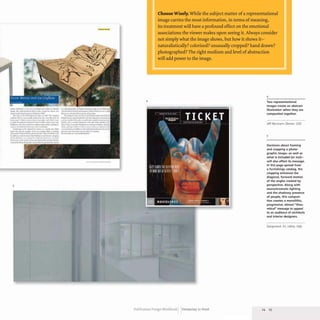
cultural institutions of this kind, creating informational and
promotional material that is both adequately branded, continually
refreshing, and appropriately tailored- on both a visual and
conceptual level- to radically different subjects presents a
unique challenge. To solve this problem in an engaging way
that allows for flexibility and evolution over time, the designers
of this literature system have defined a visual language of
horizontal banding- manifested primarily in a series of colored
2
------_..._- ,.
.. ---.......-
-:==::=:-
-
---
---
---
.. ---
---
11
---
=-.::::---
- -
,
----
~-­
.._--
--
..._--
-
--~.. ,,--
;to - - '
------_
.....- « -
» - - - - - -
u
----
- '----
....._--
......_--
--
"
"
-_...
-- -
_
...
----
.._--
- -
--
-- -
--
strips, but in format selection as well- that derives from the
border treatment of the tallit. This abstracted representation of
a highly recognizable and meaningful symbol not only adds
conceptual depth but also offers endless possibility for variation
across publications. The form can be hinted at subtly by a long
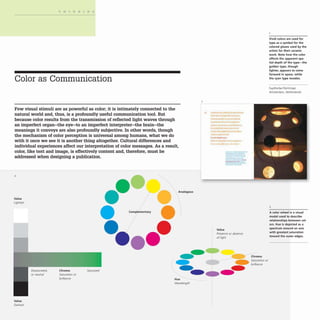
horizontal format, or it can be made explicit. Additionally, the
geometric nature of the band can be used as a device for housing
typographic elements such as headers or captions, for separating
informational components, and for clarifying complex informa-
tion structures such as calendars, maps, or schedules. The use of
3
4
color in the banding helps carry brand into publications that
may otherwise be lacking in color. Applying this visual language
in all these ways creates a rich and varied experience for museum
goers. Of course, this strong visual concept is not the sole
visual identifier for the publications. A specific palette of colors,
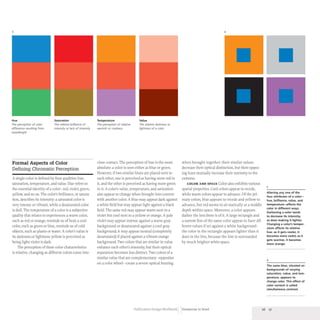
along with a house type family- a condensed sans serifwith
unusual terminals- articulated in a highly informational way
over tabular and modular grid structures, all contribute to the
system's accessibility and character.
6
8
r KLItJK"UMt
FUNCTIONIAll ROOM5
O ...•..·~
3-6
The covers of three collat-
eral pieces, while very dif-
ferent in format and color,
are visually branded with
literal or proportional ref-
erence to the horizontal
strips of color that define
the system. In the stepped
brochure (5). the horizon-
tal band becomes a codng
device for content.
6
By reorienting the colored
strips to the vertical edges
of this stepped-format
brochure, the designers
are able to accommodate
its specific spatial require-
ments for content, yet
maintain its brand associa-
tion. As an added bonus,
the now-vertical strips
become navigation tools,
helping separate content
from page to page. The
cross-cut image, in its
entirety, is another hori-
zontal band.
7
9
10
-~ .
.. ,.... "1'-'
- - .
• • • •
• •• • •
• • • >til
• • • •
Publication Design workbookIIPublications in Action
7-10
Well-considered informa-
tional diagrams and vel-
lum flysheets. with
opaque abstract elements
distilled from the photo-
graphs they overlay, add
informational depth and
visual interest to this ele-
gant brochure promoting
the museum's functional
spaces. The translucent
vellum. because of its
long, horizontal proportion.
becomes an interactive
version of the branding
language.
180 181
1
--
.. ---
1...................
- . . . , c
.........-
- _
..
--...
.._
.........
---
.....-
. ..
---
.... 11,..
-
W 1cIt", An van • UI'II: f VtttSICNaa.
~,...._ ...... .....-..,.-14I ......, -
....---....-..~.....-"--'~------........
--- _
.................
~----- .................~
.............-_........._---..""...--. .--.
........_-................--...--"'-----....-
0.. UleIfi1hrig111 ~ uw:ltr
--_..............-_..-....--....... ...
..................... ......,...-.-.................-.---
......-~ .....-.. -
___..._ ...... '11 ..-..
~
_
........
2
Geschicklichke,ts •
Spiel. Nachhaltogke,.
beg_iete"...
Messebesucher
~...--~-
-..-- ...............------
........-.--_....-
...... "......-.....--
....................- ......,.--
..............-.-.....--
--,.---~-­
...._0.._..._..._ ___.__
-........-..-.....-........
_........-...."....---
._..............................
........---..............-----
----.'--
-_._.................-.
...........'.., ---
--
Sagenvier Designkommunikation I
Sigi Ramoser IDornbirn, Austria
Nechhaltlge Wochen 20().l
Was I&ulll" VorarlDerg1
- or._............. __
....... .~­
....-_.... .,..........-
--------
"'-"___ 1 ...
--~............-.- ..-.......-..-..__ ..
--- ----.-. -.....-....-- --
3
In this uncomplicated newsletter, a two-column grid and hori-
zontal breaking of infonnation yield clean, infonnational, and
lively compositions. The simplicity of the structure pennits
quick, cost-effective layout without sacrificing visual power or
contrast; these qualities are actually built into the system.Each
edition is an A3 folded down to an A4 format, producing a cover
and one interior spread.This fonnat is folded once again for
mailing. The cover, thus divided in half, presents identifying
masthead information, an image that bleeds left to right, and the
title of the feature article above the fold. The image is changed
each edition, while masthead information remains consistent.
The feature story begins below the fold and continues inside.
A dark horizontal band holds the identifying information
on the cover and makes a transition into the interior spread,
providing continuity and a simple, decisive beginning to a
progression of intervals from the top to the bottom of the page-
small, medium, and large. The text is set in various configura-
tions on five columns, hanging from a flowline but finishing
out at varied depths from column to column. All of the type is
presented in one neutral sans serif, with size change and weight
differences adding texture and providing navigation through
the hierarchy. Images appear cropped within rectangles, or
silhouetted to interact with the column structure, as deemed
appropriate. A calendar and event information is provided on
the back page.
Neuo, Verem.hol"ldbuch 01"
vOlier f,lglg • WOII.olles w..... lu,
th!! u:tglit.hl:ll Vl!f~lflttdll.J·...t
...-_..----..---.._-
----------
--......-...~..-,.-
--------------
---------..-- ~~~~~~~
- -----
---
--- .... -
.... -.. -
1 Inle'hIiIIQroO!O' BO')cn:JC)o
---....-..-
.. -----
Taking advantage of the
interrelated proportion of
DIN format sizes, the full-
size newsletter folds in
half to achieve a standard
mailing size. The fold acts
as a separator between
masthead information
above and feature intro·
duction below.
Ju~endlolm-CO"I zu Cl n Themen Geld.
ShUVP"1 Morhua. Zu.unftspl ne
...-----------.....--
--...__._'"-------
...__... ---.-' ---~
~..... -..--...----
-'----- ----
-----------
r - '...____....... ____ _
---
-
--------
- ---.....-
.....----.-....
- ---
-- -----
1_.......-_.__.......-....
- "-'-- -
=;:;.;:---
-
2,3
. "'......... ..- ..................--.---
- '--_........--- ---..-..-..._--
-------- ~~~~===__r__-----1L-
... _____o -....~
......................-----
----~----~~ 1I~________r_--------------------------------------------I
"-..._ ........r..-- __
-----_!.-_-
--_..-----
..' -....--
-~--..-----
The rigorous hangline of
the text is countered by
intuitive placement of
inset and silhouetted
images; sometimes the
text itself leaves the grid
when the designer feels
this will improve the inter·
action of elements within
the layout, as appears to
happen with the left-most
paragraph on the second
page spread (3).
~'==:---- ~;e
...--_~~_oo::
___...
_ . . . . . _ • • 0 ItI" ___ _
~- -~.....-- ~...
0-_ _ ......-... _ _ _ _..... _ _ _ _ _ _
---..... . -....... ~----........... ----..-..
--_..----...... ..........- -..-...-
--.......-- ------_..._---
,,~- .............-~- --...... ...---
....._-.......-.- ................---.........
,...........----......"-'-- ..-_.......-"'_......._-
--..t: ...-.... _ .........-.. - . . ...._
....-.-.-.-.---... _
.......-.....-.-..------
-.........-.......--~ _
..----..-......
- -----_._----------
~.... ..._ - _ 0 ....---.
...--....-- _ _ _,..-. _ _ _ _ _ .............0 -
.....--- --- -.... ---
-- -...........~... ..--
:.:..::....-:.:.:=..-~-~~-
---------
.........-._t..-"___....
--
Publication Design workbookIIPublications in Action
OrangeSeed Design Minneapolis, USA
Two complementary newsletters help a manufacturer ofwindows
and doors reach contract and retail buyers in the construction
industry with product and marketing information that promotes
their business.Geared toward construction professionals, the
newsletters are designed to appeal to their hands-on, no-nonsense
need for clear information. At the same time, they deliver brand-
ing messages through color and type selection and also appeal
graphs, sensitive typographic styling, and abstract details speak
to more visually conscious prospects. A compound three-and
four-column grid organizes running text and callouts, and
secondary product display areas, respectively. The structure is
consistent between both newsletters; their covers vary the grid
slightly by using the second and third columns of the text area,
while reserving the left column as a margin for colophon or
callout information. In both cases, the newsletter mastheads are
set in a condensed sans-serif face that is treated minimally to
customize it and relate it to the brand typographic system.
to tertiary audiences-do-it-yourself home construction consumers
and, potentially, architects who may specify the products for
contractors hired to build. Elegant spatial layout, colorful photo-
- '~'-
'! • . ~. <0,
a:; 'l ,'-
~ I' ~ VieWpoint ........~.~
--
--
--
:'~~-
--
----
--.....--
~-
----
---
--
---
---
---
3
_ _ _ _ _ .IC.I'....... _
..
--
-------
-_...-
--
,---
-- ----
...__.._-
.::::::...-
-~..-..-~
._-
--'-
--
---
---
.
._---
.
----
2
-_.
----
------
-
- --
-
--
..- ...
----
_.- .._-
-_._--
_...-
----
-,_...._.
Yo _ .. _ . _
...-_ -'1...-
--.........-
---~­
...- ...
-.............-
- -
..~-..
_.._._-
.....- ...--
-_..........
....--.-,..........
..-......-.
----..-
---
............
-
--...-.
-_..._
...-
---' ..-
--
~ .... -
=-...=--
.-
-_._-
--~-
........-.._
.....
---_..
---
--....--
-- -
-----
...__.._..
- ....-....-
-..--_.
--_........
,-~~~
~~~~~~ ~~~~------~.-. -~
......., _ _ _ • ....0..-,. .
~. 1
1 _ _ _ _ '-- _ _
..... --- -..... ---..-
---......-.........--
--_...- ._---.....
-- -- _
..-. --
-..-...--- ~.....--.-
-~- -.-........-._-
--_....- -----
--~...
.._.......---'- ---~­
,-..~- ....~­
-_.....- --_..-
----
--'*- - ---..--
-....... - ------
-"""- ----_...
--
------
~. _ _ f __
.__...
_._-_..
--_....
--
,--.... "
------
_
............-
--
-- ..--
------.
----_..-
-.--~..- ..-
-_.....-
-_..._-
--_....
- ._-
, , ., ... -.a.,
.......-~­
...__-..........
_
..._..-
..--....--
-_.-
.__...._-
-_..-
-----""
-"'---"-'
------
';-';.-.-.-~=-..:;
...._.__..
------
.._--_...
-...-----
.._
...._
..
.........-.....-",-
..- ---
-..-.
....._
.._-
--..---
-----
_
...........-
-_..--.
~-
_
....-..-..........
~-....---
---
---"-'-'"
Wiool ___-.."_
-.....- ..--
--..._--
-..._...__.
----
-....-_.*-
" _ _ 1- _ .
....---~-
...._-_......
--.....-~
--
-_.
,..............
--
-
- .--
----
-_.._-
--,-
-~-
._-_.-
-_.
:.:~-....
------
_._-
--,.::::-"'=
._
_..---
--
:::.::-:.
-::.::...-,..:....
--
t ::::.':...~
-----
==---==-
------
--
..._--
------
- -
::.-::..e.:-.:.,,:,.::
._-
--
----
---"
--
-----
-----
....__..-
_
.._-,..-
-----.,.
..-~.-......
-~
---
._"--
-:;;-,;;,;
..;
..;...~.--..-::.
-----
o
-.-....--
----
---..oil..
-----
--
-... .-
--
...._..,--
---
...---
...........__...
On the cover, a narrower
left-hand column is used
for supporting informa-
tion, such as a colophon or
content listing. The narrow
column emphasizes the left
alignment of the second,
regular-width column with
the masthead and marks
this column as the begin-
ning of the primary text.
2,3
Overall, color is kept neu-
tral and warm, with black
and a secondary color for
accents. Tinting different
areas, as in this spread,
allows the text setting of
each to remain the same;
the change in contrast
between type and back-
ground separates the dif-
ferent areas.
3
The need to be clear and
direct suggests simplifying
type treatments in a limited
space. Here, for example,
a number of different kinds
of information are being
presented, but they all
follow a similar internal
logic: two type families.
with text set in a serif and
subheads set in the bold
sans serif. Supporting
callouts are set in one face,
using two weights.
Throughout, the same sans serif, in a family of weights, creates
easy-to-navigate columns of text while differentiating subheads
and captions. Narrow rules help define spatial zones among the
columns, and strong geometric inclusions help communicate
the architectural nature of the subject with a minimum of fuss.
4
5
......_
=------=-=_.............'-..,.....
-
-
--
..._---
..._--
----
----
--'
--
::""':!
.-.
-
---
----
----
!!::.:'::::=
..__.-
---
--
---
--
--
---
_
._-
---
-
_00_..
----...-.._--..
______.-e..
._--
_
.._h_..
---
-
._-
-~
---
_.
...---~ ­
- -
-----
~-- ...._-
_ .-
---......
----,-
----
------
-.--
_._-
-----
-.._--
----
------
.
-_._-
--_...-
-_..-
- --.......-..
----
----
.._
...--..--
---
-----
-.,.---
- '- -
_.-
-
..._----
----
~
-=
"
-"- -~
-
-•
•
. ~ .
----
-
:!"__..-
6
---
An InIIde look
.t-.-.en
Pallo Doo
."............
u............."".,.,
"...- ..~
MItv til r!I*IdH~' M:.oo. door ~.UIOIlt at
lilt _ , _ II1d ...-.or ",'''''_~ _
04('1 ~ ...... ~ A.ndM«! t*lO dOM 1M dilif
choice Itr seIecbA bXI
11_.... _ _ .....
..........._-.....-
----
...__.......u..,_.
...._IIIII.lI~I ........ _ .....
4-.. • ......._ ...... u .............................
.....-.....-,.- ..........,,.,....."'-".....
---....~ -.. - .~
...
~ ........--- ... -
--........-....~
••h_,.. .... 11__
............~
_ .. _~ ..... _jt_
•• 1 ....
~ ................---
.._--.....-
---
---•
0
,
•
.r
0
41
l'I,o. ..... _ .......~
...'-"'-..._
............
,,"-It ......--_ ....
--.,,_..... '-
"",--_...-
~---.....
~~ltool. . . .
.......................---.
-'--,..--.--
..""---.......
0 ............
e _ _
• ,-,....,. ....-.._.-
___._OIIUT'
---
-_._-- -----
---....... -...--
---~
....."_.,..
--~ ----
--- e _ _
0 ......,.........
...-
._--- ---
----~-
.....-_...
- ...-.. ----
.----.. ~---..
-- -,,---
_ _ _ -.n
_
..._.".
As these covers show. a
clear column structure can
provide both consistency
and flexibility in layout.
The placement and size of
photographs can change.
but their relationship to
the grid unifies them with
the type structure.
----
---
II.
6
The compound use of a
three-column (upper area)
and four-column (lower
area) structure can be seen
here. Changing grid struc-
tures within a page for a
specific purpose, such as
clarifying the difference
between two sets of (on-
tent, is a powerful means
of helping readers navigate
and changing the visual
rhythm within the page.
""'~.....~......-
."
_r-_ _a..
._...........'-...........,
--
..................._""-'
......-~'­
_ .......A.I ~ _
btJIa·~ . . . ~
--
11._..........._ ...
..........................
~ ...............
~ ,...-.. -....
.......-~-­
...,.............y~-.........,
---
"'"...~ ............
................_'"-
---.-~
....~,..--.......
_ ................1.
...-
,...,.,.~...,­
---
n.,..................... .
_ -a-,.... -"""-
......._
.........-...
......._
...---
........._1.
.......... _"" ............1
........................
-,,-_.__.._.
---,-..-...........
..,-..._......
_
..-
--...-~-
--....................
1'- ._,.. r.....
-.... to_-
'_.....
..
........
..~.-....- '1 ..... ,..
--............
_1104 _ _
..--- 0 _ _
e ......___ ...,
--... ,---_. --
e ""...-....."". ........,---
--_.- -----
----- __ ...I'iC....
0
;
_._- .....--..-.
0 ._--
0 _ _
.........--
-"'- -.--
- ---
~-- ..,- -----
--- .......-...--.
....-.--.
- ..._
-
-_..-
=::::.."===-
Publication Design w orkbookIIPublications in Action
UNA (Amsterdam) De!;ig~lers IAmsterdam,
Netherlands
This vigorous, yet elegant, newsletter for a music ensemble
communicates the energetic nature of the organization first via
format- a narrow, two-square tall folded sheet roughly 18"
(45.7 cm) high- emblazoned on its cover with a block of vivid
color and an asymmetric configuration of letters spelling out the
group's name. The seasonal publication delivers performance
schedules and highlights soloists and composers featured in the
current repertoire, distributed over two or three signatures as
needed. The signatures simply fold together without binding.
Each signature is printed in black plus three other spot colors,
which change every issue.A compound two-and three-column
grid on left-biased asymmetrical margins balances text at various
sizes against full-bleed images and expressive type configura-
tions that allude to musical composition.The designers make
full use of the structure, shifting calendar information around
the three-column grid and editorial content over both column
sets,paying careful attention to the shapes of the text in relation
to the often asymmetrical, unusually cropped photographs.
Negative space is an important player in the layouts, helping cre-
ate movement among the elements. Despite the lively arrange-
ment of material,the information remains accessible and legible;
equal care is taken in crafting typographic distinctions within
detailed content such as the performance schedule.
2
H•• rUn goud.n ClloM ,,001 dutundpotel' ill. Freel FlUb V." lonot.t a.rind .t.'ch
OJ) we.ach.Uend. Mud~le '.'Ie ln_" ,. tt....".n. "',.... hllj.,."t.ne he' ....'wllt
to hOHH'I etat hlr dln tal.,.,.,. '10tlnlpperdct.. TlDgo"wDordlg wor4I'II'IMI anlg'
l.ton1~ 0- eken "." eeft muzJU"' 011 Fritbt muIU·ln,trurne.ntaUsl (bf!halve
Slt.......,..'r ..IIO"cr.-- ilndOf4' plaftO, ....ool~ coftt,abu 0" 11.s;,w..k). hnp~..to,
on compol1iJl. ""ot vo.lfP,i".n in d. Ntwyo'..... do..."fow(t ,con., d. mode,n.
1ic1.tnteke muzi8. delnt. d. el.ktron~ til d. popmuzf4k. die boY'nd"n
muztek sdt,.••, voo, tIIealer, daas, h'm t.n ..ldoo·lnJl.UaHes.
0. va" 00'6fUOOli E".~...Frith d,nkt zJ," I.pul....-.ts.ape","-.nl... muau::us
.,n" G'GeP He""c;ow die 'UI In l'''.umen mel TIm Hodgkinson OplIQlUa.
Het repe,1o". omntle (Offtplcue compositles,lIedJea, lapebewe,klnUttn eft v,ll.
~mp,cwl••II.. De band. die tlln I'.' ""',ond, "".1$voot F"th d• .ta,'nn ..n .,..,.
",IIl1ve . 1, khfulIltk.c.,nlllfll'.-Zol' .prww"t hi' UtrYWf" nl.., w.n -..n ~m.,.·. HClt
-"'U. d.I ml; 'nI.,esHcttt.l. da. Ik do IUlm,. IUlI9 om slim..,., mel i"!.plr_end• •
cr••" ..... ",onY tl mIl" 1o..." ,. onlow.klte-IIM ' rock r. tt, wei d......ljk een 'Dde
Iff ••d .an I. wil~.r'I n d Jr'I "'.......... toop",.nl hnp,..vts4lUe. Sin". de Ip GInn"
So/o~ ui11114 ho.""" aleft O
fu.U..keld tot een muStws dj~ do etgeruch.ppen
en moglllikheditn vln Imp,ovftlUI 1
01OP hel bot heen ondenochL 0 . 1hq d•
• lo.lo~n j l r-,!" ,Mode ...:IIkM eomlU)ftetUI vaar ensem.blH die hooldl..~.llIk
~t..n uit klaplck go,r'fPda ftlusid - :toIl.' £n...mbJe Modorn en twit Aako
E""mbfo - doot (fu, nPelJ, ;1an If, Sterile, nog. ml•.sdtlen 1$ da. ImPfOYlutj...
' lienI wei Ziln atOll. Zetl zagl rll,: ·E.n Goede fmprO¥IP,or.s ull de ...,d do, u.k
un goe delu IIc-roo, en da' kap .'8 behulpu.m zlJn btl h.l a..,nll.tI nn I"d*(.
muzltutfe vormen.: W.,UtetwBO or Oft.orw#••, mol de cvmpun~t UP1IH••.t, 'ner'
du,v," he' bew;l$.
1,2
When the publication is
folded for distribution, the
front "cover" displays a
square field of saturated
color. A constantly chang-
ing arrangement of the
musical ensemble's name
reverses out white and
dances across the square
format. Fully open, an edi-
torial statement about the
season fills the lower half.
This text is set in a bold
sans serif whose size
changes with each issue so
that it extends consistently
from the fold to the foot
margin. The season indica-
tor, in black, is consistently
set at a larger size com-
pared to the group's signa-
ture at the top, reversing
white and flushing left to
the format edge.
3
4
The calendar is carefully
typeset for readers looking
for specific information.
Sans-serif and serif
typefaces are mixed to
create pronounced textural
differences, and each
informational component
within a given listing-
date, venue, concert time,
composer and work, and
featured performers-is
given its own distinct
typographic treatment.
-------_._-_.._-------
---------,.-_..---.--
--....----._-......... ---
-----.-......-~---.----.--
------.._-----....-
........_---._._-_.__..
--~-..--.---....----.--.----
--- -
•.._
...--_....
----
--...-----_.._----
......-.-~---..-----
----....------..-
---..._---------
--------- ,..-----,........
--...._--_.__.._--_._---
-----..--------~......-
_ ... _ ..... _ _ • _ _ _ _ 10 _ _ - . . .
l-_..._.________..____
+-------~
---------..--_... -
--_._-....---.....-.-
---_._---_._--_.._-
---.----.-...-
_-----0______-
---------_...__..-
--.......----.---.---_...._
.....
--_...._---------
---_._..---_...._--
- --- --_.
---,/
-_._-_..-_.._,-......_------
----.---jlt-------
- --------
---..-_.-.._...._-......_
..----
----,.-....-~-..------
----
.. --- ----
----_...--.. ---
-~--.-.-
-----
Il10 _ _ _ __
----
-----3 ~-=~:-~--
_..__..
---..-
_____1.4
------"'..
-----.-~
- --
_._--..tt·_
4
-
-
-
-- --
-- --
-
- -
-
--
--
--
--
--
- -
-
--
-
Publication Design workbookIIPublications in Action
2,3
Editorial text generally is
set in the bold sans serif.
with size changes indicat-
ing subheads and other
hierarchic changes. The
serif is used for supporting
date and time information
in captions accompanying
the articles.
3. 4
Unusual cropping, unex-
pected scale, and asym-
metrical compositional
decisions push the photo-
graphic subjects around
the format, increasing the
ambiguous, shifting spatial
depth of the elements in
the layouts.
Conquest Design IArlington (MAl, USA
This quarterly newsletter for an educational
institution covers a broad range of subjects, from
economics to dance, writing to social sciences.
Its neutral visual styling helps avoid the potential
confusion of attempting to represent every one
of these subjects equally or even accurately; the
communication here becomes one of academic
credibility and interest to people associated with
the school. Neutrality carries associations of objec-
tivity and inquiry- qualities that can be ascribed
to an institution of higher learning. Given the
intellectual pedigree of the university ofwhich
the school is a part, this kind of objective, credible
presentation is of paramount importance to the
client. As a result, the designer treats information
respectfully, ensuring clear hierarchic distinction
through size and weight changes, and using color
for accents and informational enhancement
within the typography but only rarely within
images. Every issue exhibits two standard ink
colors- a warm neutral ink and a black- along
with a third color that changes seasonally. Text
generally runs in black, although callouts and
headlines may be set in color or reversed out
from colored bands. The structure is a relatively
precise eight-column modular grid in which four-
module-wide and three-module-wide columns
of text shift back and forth, creating apparent
vertical overlaps between columns and margins
that shift subtly left and right. These shifts also
allow callouts, captions, and images to hang from
column alignments or be indented dramatically.
Images adhere to the column widths but are free
to expand vertically as needed.
3
'IT~
- -
- _
.-
2
_..._-----
_......_ ...---
.._--_._--
---- -
_.._-_..._ ---
-- ..._
...-
/X/Xdr m1/
soundi
1-3
The newsletter folds in
half to self-mail without
an envelope, saving on
postal expense. The cover,
on one side of the fold,
features a full-bleed pho-
tograph, masthead, and
teaser caption; the mailing
side, along with space
for addressee, includes a
follow-up caption related
to the one on the cover
and an editorial message
from the school's dean.
On the outside, horizontal
banding and linear details
add texture and darity.
as
Because the newsletter's
focus is on text. rather
than image, the decision
to call out a lot of text in
the third (variable) color
accomplishes a number of
ends. First, it introduces
color to the textual gray-
ness of the pages. Second,
it helps differentiate and
focus attention on infor-
mational components.
Finally, it gives a specific
coloring to each issue.
Active, as well as more
reserved, layouts are
accommodated by the
grid structure, which
remains clear. Mixing
the weights of the sans-
serif family to call out
informational details
within captions or sub-
components adds texture
and vitality to the
conservative structure.
5
4
Ten thi
you probably
didn't know
about SHASS-..
but will be glad
you IefrneoI
- --------
.....------
---
-.~---
-- --
--------
--
=-... ----
- _.,- -••
~-;;=:-- ':""
-_.._--
_ :::.-:o::.:::=.::.....
.._---
-------
------
--:---
- ..--
-._.
--
---
- -
-.
--
--
_t_,__
---
--
- .-
-
---
---
.., --
---_.
--'-
----
--'-
----
---- ------
--------..
-- :A
Saving the world,
--
---:::::.::...
--- ---
-----_..---
- '--'
--_...
--_.-
.._-_._--_..
- _..._-
_._----_.
=---."::_... ---- ~
. .._--
precisely
.. ....
.-..............~-..--
~..-::-::,-=-=-.:-
- -----
---------
---
----......--
---------
--- --
--
-----
•
---.
•n _ _ _ _ _
!..- - : - --
.....a.- _ _ _
...- - - # ' " - -
1 _ _ _ _ _ _ - _ ..-
-------
-- ----
---
-_.
--
-....
---
. -
--
---
-
--
----~
........----.....
-------
=t::=.'-=:;;-;-::;;;;;;:;;::
_.-.. ..
----_.._-
~-----.-
-----
.- -_..-
..- .... --
.~
~-=-=
-;.::.,..-=~-:.:::.-~-=-:=
---......_--_...
.....,__r--~:~
---~
----- ..
------
------
----_.__.
-- -_...
_
.... -~- ...._-
-_..__.._--
- "'-.... --:---::..
-_.-..._-
----
-_._-
----
-----
--
---------
--.---
------'---
==-- :-::.=:-
- ::.::=.
......--. ~
---_.....-
-- -
-"
~-=--~ ..-.
-----
-_..._------
;::::::::::::~----
.._----
.-----..-~
----_..-
--...~-
_.. -*_.
------
------
----- _
.
.._....._.._----
---
=-',:;:~~'-~
---
-- -
~--.---
-_....._-
_
....._--.-.....
-----_.._._---
-~ -
- -
----
--'"'--
... ---
--_.._-
....---=--
-------
-._----
-....---~..:;.
...
-----..--
_
.._
..... --_... _..----_......
:=..-=-...=:.
_ _ ,",_4
- -;---
---
- '- ----
-------
-----_-1---
------_..
--_. ..
--..__..__....
_.._---
-- -
=:.~~~
-'-
--'--
~--
-- ---
---..~~-
.....---~~~~~~
-.---..--~-
.----
--.-
--- -
--
---."'...--....--~
-----,
6
--_._----
-----.---..---
-_.............__..
--
--.- -~
-------
- ::;:-:==-
...
-... _.. -
..._
.._------
-'*- ---
_....... ---
t::::.~-.=:....-=-
---_....-
--.-....__..
-- ---
--
::~1::-:.:.:;.;.:::=~:;;:,~;::::;-~
~---
:=~.---~;;~~~~
: --:.-::...:..
---.--
-----
-----.-----
==---::::E..
---
------
-~~~- ..-
- ....-
-----
=-~~~=
:=...--==--===.=-
:.-.---=-=--
....'----
-_..._----
-------
:'- -=--
:-=..-==--=--:=..:-
--=--_..-::--
----.._--
-..---
----
---=--
-
-_._--
--------
- ~
--"--
-
=--- ----
..._------
--
----
~--
-
-------
~ ..- _.
_._- ----
....._,...- ==.::-...- =-===
--
-- == ~,c:;
-. -- ----
-
-- -
----
----
_..._----
=:--=----.
-:::-- --
-.!.-_ .."::._--
- --- ----
~--=------
---------
_ _ _ a _ _
..~=--
-_.._...
..::::====-....:.-.-
-....:--.._-
-----
.....----
--
..--~--
--_...-
~~
._-
- -
----~
-=---~-=..
-=::::.:.=~=-=
-----
=-::"~:111_
-------...-
---
_ ... --
--=-==-=~
-
---
-
----.--
----------._--
-
-
--._---
...----
===-_....-
-_..-
_..._-
'*------
--._---=--
_..- .__...
:=.- - -
--=~~-==-­
=-==---=---
-----
----
-----_.
--:.--;:=--:
:!.-=:=---
-
.._----
=:::==~==--=.:.:.
-----
----
- -
.. ---
----
-----
----
----
---
==.-:==..
_ _ _d.
.--
---_..-
--
--..-
----_.-
------
-- """"::....
----=-
...._._-
::-.--
--;::
-- ---
----_...--
----
_...-
--
_.-
Publication Design workbookIIPublications in Action
7
5
A serif is used primarily
for text, while a sans serif
is used for titling. sub·
heads. and captions. In this
spread, which presents an
interview with a faculty
member, the informational
clarity afforded by typo-
graphic simplicity is
evident. The questions are
called out in bold sans
serif. and tinted gradations
set off related but infor·
mationally distinct material,
such as the sidebar at
the lower right. The use
of shifted columns on the
more precise underlying
grid is also visible.
Honors & awards ,.....OM,. ~fof l·_......
DaI_~ Clw:lnP
• r t ,'""-"..t~
..........!_n.-..Irlit.-pal
~oI,'-:SbeI"'!II K.... Prir.c'"
'" ,Coo". ~"Iobj
.JLaJ. I~
..... MIr.'t_.~.
a- r"'_.'I. u......PI ''"''*_......
Scud-.... bca.......... r~pr
I:cwardrlO._
~~-..-... ' ....11_..._ ..
......... olrmoorlla."'"~.
FdI..... .(tIoc ..wr..... o$.bn.' at
_
...-
~w.. '""'-w tJla...wr
~-...-
~.(jfIfat I, l..Imcpr Xbota
"'lkwmcpt~eend.u ,
l'/ICH-04tJ...... ~ ., .....
__....,J".J.:001 a.,..........
~
I'w-dl~ l""""'corlWIbcJ
Sonn..a Difrm'orel Jhl!GIlIUII'!f_
"4TI 41.al ..Jt,-.,........"
5......... boot.,,...,,....,,cw.w.:-
l.M.Jrn q J'-1.Ir-" Ju/!t t k-
.tt;r .....,.. lhc!COtJ~
:)(~ ....._~d.cl..l'fm.-.
Iii,.., .1I11iic:lns.n-J,•
".....,.."",",""' ~.......,....
.._ 1.............,-""...._ Moo '*'r
..,.. _ p-nocn.ed-hll, Pta....'
~1...II~UIlnIrft,ttM­
"~fIINImt••'"-:I'Ip:;.,
1.rrII»Id.... l.ncItOnnuQue
I.. _ ...... --""I:I~~
fIUIn .... Itt........... The..... lllMdAl
..I ... OIOCft U_IaOOM....,.
.~.~ ..uIl....
t.d~. '1~ .. ~
~~------~--~
7
Careful attention to
spacing details-such as
the difference in spaces
above and below the rule
between paragraphs in
this listing-helps readers
access information more
quickly. imparting a sense
of precision and concern
for the reader. This kind
of respect from a designer
helps a publication
connect with its audience.
188 189
Stereotype Design New York City, USA
Each issue's cover features
a different historical pho-
tograph, printed in black
and white, against which
the stationary masthead
remains consistent. The
right-angle rotation of the
masthead's elements locks
it almost architecturally
to the upper-left corner of
the format.
3
This newsletter for the Museum of Jewish Heritage organizes an
ever-changing selection of editorial content on a five-column
grid. Its slightly squared tabloid format lends it a newspaper-like
presence and establishes ample ground for vigorous typography
at larger sizes. While a number of pages are given to more con-
ventional newsletter fare- updates on fund-raising campaigns,
donor events, and the like-every issue features essays from
noted contributors and articles focused on curated exhibitions
or material in the museum's archives. The former generally
structures text on two-column configurations derived from the
five-column grid underneath, with heads set large in black-
weight sans-serif type, in a contrasting color. The body copy runs
in a serif face.Heads are in a consistent size throughout, clearly
distinguished in size and spacing from callouts that appear in the
same face, but smaller and more densely leaded. Image captions
appear in the bold-weight sans serif. Within the more engaging
editorial spreads, heads and decks take on a more spirited presen-
2
FRO
__-_E.
-
E
tation, appearing very large and all uppercase in the same sans
serif. The grid is articulated more dramatically; some text compo-
nents run across three columns, while others continue in the
two-column structure.Text components are composed in these
pages with larger images- some inset, some bleeding or interact-
ing with blocks of color. Although the typeface selection is
limited to two families, the use of an oldstyle serif in justified
text columns, contrasted by large, uppercase setting of headlines
in sans serif- especially in conjunction with historical photo-
graphs from the Museum's collections- subtly recalls the design
aesthetic of the early- to mid-twentieth-century Europe. In doing
so, the publication purposely evokes memories of this turbulent
period in the Jewish experience among its mature readership,
resonating with its audience at a deep emotional level despite
the generally neutral presentation of the content.
• !!
r ··l
2,3
A clear system of weights
and sizes helps separate
informational components
in the hierarchy and adds
texture to the pages. Scale
change becomes more
image oriented in the edi-
torial featu res; here, head-
lines and callouts spread
across the gutter, poke in
and out of the column
structure, and appear in
multiple sizes. Combined
with rule details, blocks of
color, and historical photo-
graphs, the typefaces and
their arrangement con-
tribute to an association
with design from turbulent
periods in recent Jewish
memory.
3
The newsletter is some-
times printed in four-color
process, but adheres to a
restrained palette; this lim-
itation keeps the color
feeling in line with those
printed using two colors.
2,]
Big type is not reserved
strictly for headlines: the
folios, set in a bold, con-
densed sans serif, act as
anchors for the spreads.
Allemann, Almquist + Jones IPhiladelphia, USA
The six-panel tabloid newsletter for a science
museum makes extravagant use of color, illustra-
tive and abstract montage, expressive typographic
detailing, and diagrammatic science imagery to
convey the energy and wonder of the museum's
event offerings, especially those geared toward
children. The dynamic asymmetry and color of
the museum's annual reports (see page 206) is
taken even further. Information is structured on a
single column in each panel and given generous
margins to avoid cropping when the newsletter
is folded down to mailing size. The column struc-
ture is violated when additional movement and
spatial ambiguity is desired. The back panel accom-
modates postal requirements, including indicia
and space for addresses; the front of the folded
publication becomes a bold cover with the branded
Events logotype. Much of the typographic variation
in headings, callouts, and expressive treatments
follows from this wordmark as a way of conceptually
linking the idea of the "events" with the content in
the newsletter. As each successive panel is opened,
the format changes in proportion as well as size.
The composition of these typographic and image
"events" unfolds in a kind of kinetic story, inde-
pendent of the actual verbal content,which can
then be opened up as a poster.
3
2
. J
: I' '
4
; - -....--.:--
--
---_.......-
Publication Design workbookIIPublications in Action
1,2
A dynamic lockup of serif
and sans-serif elements in
the masthead creates a
consistent counterpoint to
changing exhibit images.
3,4
Fully opened (3). the
newsletter is transformed
into a poster. The designers
consider the interaction
of individual panels (4).
as well as the complete
format. in composing pho-
tographs. textures. type
treatments, and abstract
shapes.
-
-"'
--
---
190 191
1
Atextural system of
colored dots customizes
stock photography (on
the cover) and provides
a simple branding state-
ment within the interior,
subtly restating the
circular identity symbol
of the corporate signature. 1
The pattern of dots also
subtly conveys associations
of system, integration,
networking, computer
readouts, biology,
and similar ideas related
to the company's
business, health care
management solutions.
• ••• • ••••• ••
••••• • ••• ••
•• ••• ••• • •••• •
•• ••••••• ••
•• •••••• ••
•••• • •
•• •• •• •••
2004
•
IUIMAN REPORT
•
Kendall Ross ISeattle (WA), USA
The designers of this annual report have used an
editorial, brochurelike structure to lead investors
and prospects through a discussion of various
business activities and achievements. Unlike many
annual reports, organized into three distinct sec-
tions- image, management, and financials- this
booklet spreads important information among
numerous spreads, each focusing on an area of
interest elaborated upon in a series of smaller arti-
cles, much like a magazine. The executive's letter
to shareholders- in the first spread seen after
opening the report- feels very much like a letter
from a magazine's editor, instead of the formal,
investor-focused document in the management
sections of conventional annuals, which typically
presents just a lot of spin. The brochurelike spreads
run text across three of four columns, grouping
these columns inward to mirror each other from
the left- to right-hand pages.In doing so, the outer
columns are free for margins in which tinted side-
bars are placed, augmenting the sense of the
editorial influence that characterizes the layouts.
Each major concept is introduced in one to two
paragraph decks, set all uppercase, with the
designers appropriately adding space to help read-
ability. Continuing, short stories about specific
business, research, and financial activity run in
the relatively narrow columns, separated by bold,
uppercase subheads. Imagery focuses on people,
with tightly cropped head shots; the remaining
image material is composed of a system of colored
dots that add texture and subtle branding to the
publication. With the financial data treated as a
plain document bound in, the report does double
duty as a business update and as a capabilities
brochure that conveys a direct, unpretentious mes-
sage about the company's activities and personnel.
2
4
.-
3
·...
JI " .. ..
·.-
..
........
....................
·.................
•
•
•
•
----_.._---
_ .. _ _ _........_ru ..
_ · .._.....". _ _ _ c_ _ _
_ _ .. _ _ . UlO .... _ .. . ·_ _
--------
:~:::::::::.:--~:::::
n _
------------
------
.._
..._-----
---.....
...--.._
-_..-_..._-
--:=:==:=::::.--
-- ----
:===-:-----'
------
~-----------~----.---
-~-.......----.- ~.-
~--
-_.._--------
..-.....------~
..._
...-
--,.__.._-----
_..._
._--.........._
._--
..__.__._---_.._----
_
._
...--------
--
-- - -
-- -- -
._.-
---
==:::.:. -'---
--
=--:::~ ::::.===
---
---""::
----- ----
::-.=:..":.
-
---
-..-- ----
::""--- .=.!"'~
-_...... ---
---- ---
...--.
_-- -
=-...:=! .~-
--
-
~--
---
-==:--
===
._-
=:..::-...::.
---
._-
----
-
-.~
-'--
=:::=- _
.._-
---
-- -- --_...
-...- -~-- ......
-- --
_
....-- ---
-_. -~-
--- ---
_.- --_..-
. - =.!...-=
- -- ---
---
--- ~'=.
_..._.
-- --
:::-t= .._-_..
--
--- ----
-- -- -
--- --
--- ..__..
-- ---
---- -
-- ---
_.-
-- ---
-- ---
--- _
.._--
=:---~
---
---
-
_ _ k
._-
Publication Design WorkbookIIPublications in Action
•••
--
--
~--
--
_.
--
--
-
---
--.....
--
-.-
---
"",*
---
=-==
--..--
.
. .-
---.-
---
--.
==-
..::.::
-'--
---
_"'_""'Ir_
--'"
-
--
2
An editorial structure
lends a magazine·like
accessibility to the report.
The Chairman'S letter. up
front, seems more like
that from an editor.
Stories about operational
and financial activity run
continuously from the
beginning of a spread to
its end and are organized
around a particular
concept. such as health.
203
The introductory decks,
set all uppercase, have
been conscientiously set
with greater letter- and
wordspacing to improve
legibility. as well as with
markedly more open lead-
ing to offset the wider
paragraph measure.
2
Sidebars in the outer
columns use a large-scale
initial as a subject refer-
ence, reversed out to white
from the neutral warm
gray tint that contains the
callout information.
The text in the sidebar is
set bold with generous
leading; tinted bullets
hang outside the margin,
creating entry points to
the short paragraphs
and following the visual
logic of the dot grid used
throughout.
4
A full-bleed spacer spread
provides punctuation
between the message sec·
tion and the financials.
192 193
-
Commercia
Empresa Editora el Commercio IClaudia Burga-
Cisneros ILima, Peru
An editorial organization of content and imaginative, graphical
display of financial information distinguishes this annual report
from Peru's largest newspaper publisher. The report is divided
into two separate formats.The first is an A4 booklet with groups
of short articles that highlight journalistic accomplishments
"10. USUVA U CiAL
..., ---...._---
... -. ..........-.- ....__..
.. ..-----.---
..... _
.___................._If_....
_ • ....- ........-_. • ... ____ .~ e_
....-.~-----. -
-......_---
t.t. DISB1MJaru.Of tmtIDADlS
DIP .. _ , . - ......... ...- .........
-
-
------..
. .... ...-....
- -
•• ....
..
",.. ,.
u·
• ....
•
..... ,,~
.,.. ..
-
-
and the newspaper's connection to the community. Each of these
sections, which follows a consistent structure, is separated by
a spread exhibiting financial data in a composition of linear and
circular graphic elements, used as charts and graphs.To avoid a
static visual repetition, these spreads change in color with each
occurrence, making them more engaging each time they are
encountered.The typography in these sections uses dramatic
scale change to lend additional visual liveliness to the potentially
dry data. Similar linear and graphic treatments accompany
2
~ GAST05" D( VlHTA
,-._-
----
-.
.-
--
-
--
-
the more straightforward editorial typography of the story sec-
tions, helping connect this data to real-life scenarios.The stories
are detailed in justified columns of serif text on a two-column
grid with ample margins and subdued, duotoned black-and-
white portraits of a journalistic nature. Complementary sans-
serif typesetting appears in subheads, captions, and notations
accompanying the chart details. The editorialized booklet is
accompanied by a single-color financial booklet in a smaller
format- printed on white uncoated stock- that includes manage-
ment discussion of business activity and tabular data structured
on a hierarchic two-column grid. Subsections are separated by
a system of rules ofvarious weights.
The smaller financial
booklet presents tabular
and supporting data in a
hierarchic two-column
structure. Text and tables
generally ru n in the wider
column, with more com-
plex tables of figures
expanded to fill the full
margin width. Horizontal
rules help delineate rows
within tables and separate
tabular data and sections
from each other.
Full-bleed fields of cool
metallic blue-gray ink
suffuse the covers of the
booklets in this two-
format report. The larger
format carries the editorial
and image-oriented
message section, along
with financial highlights
delivered in graphic
compositions; the smaller
contains the in-depth
financial data. Fluorescent
orange and flat blue inks
call out titling information.
4
5
• • PJiDACCION
6 I~"'''''~'''-'''.~.'~'''''''.
............- ......................."..--
_.............I11!'10._...__.~_O'-
t..-. .. ___ .. __ .... ....~
"-........._...-._--..-.II~ ..-
_.,..,..... .... iIfIo1II .....,.... ~f;Io . .- . ......
.. ""....___ ~__. fI .... ,..... ...,.......-.
........~,.. .............,.......
~_-._.,. ..... _0 ....... ___ ......_
......l11 ...........--.1........... fICIo
......,.......~ tIU.....J.t''''''-t*.....
------~.....,..........-.. .....-
.............--....
. _......~ _ _ _ _.Ji..__- .
......,...,.,.................- .....,-
.....W>_ r+ ...._ _ ~_
--
.• ......._.........--.._1 f~ ....._
(IIIMI .. _ _ _ _. _........"'i.,: ....... ~ ..
t ... ___. --.s __.-. ..................
....... tlt ............ _ . . . . - .......... a..rv.
t. ....r-~ ...JCDI......... _ .. _ .... _
.. .,-_...._..._---..
..-
..,~ItU.__ ,,~ .................
................."-U~.~.....y
we.."., ~""".OI'''",."",---,,,---
OJ . _
Publication Design WorkbookIIPublications in Action
The graphical spreads that
present financial highlights
act as dividers for the edi-
torial subsections. Each
one allows one of the
three major ink colors to
dominate: first the fluores-
cent orange, then the
metallic blue, and finally
the deeper flat blue ink.
04,1
6
linear details used in
the colored highlight
divider spreads appear
again as more restrained
details within the
editorial sections, which
provide black-and-white
images as a focus against
the typography. The
journalistic quality alludes
to the business function
of the client as a
newspaper publisher.
113 It
•
194 195
And Partners I David Schimmel
New York City, USA
On the cover, a complex,
textural full-bleed image
of a crowd-perhaps the
recipients of the brand
message (the consumer
public)-forms a backdrop
to the geometric white
and yellow bands that
carry the report title type.
The narrower yellow
band is a defining formal
treatment that binds
the report together.
VF Corporation is the parent company for a number of high-pro-
file retail clothing brands, each with its own visual identity and
target demographic. In pursuing a stylistically neutral, yet ele-
gant and conceptual, annual report for the client, the designers
have avoided potential cross-branding confusion and created a
serene and credible corporate communication that embodies the
nature of the brands. The parent company is clearly the subject
of the report, and its hierarchic position as brand owner is clear.
The individual retail brands are highlighted through lifestyle
photographs in the message section. The images, distilled from
2
--"'--
6S,75~ lans
128 lOOlllilli playefs
Ql) hot doq vendors
73 ushers
28 janllors
'2 I nO ",dglOS and refp",,,-~
1guv sha<tng In hiS jeans abOUI to pnoposa
on the Jumbolroo.
3
each subbrand's advertising, communicate a subtle variety of
secondary and tertiary messages, depending on their respective
target demographic. This variety is augmented by their juxtapo-
sition but unified by conceptual messages, set in a stylistically
neutral yellow band, running above them across the spreads at
the head margin. The writing plays with concepts in opposition,
the left page line creating a context for the line on the right page.
The images are organized on a square grid that is subdivided as
needed, page by page.A second section details the strategic and
financial highlights by brand category; the square grid from the
.,...-",_......
_ ....• .. _ _ _ 11' _ _
first section is expanded to include the upper and lower margin
areas for a two-column structure that is enclosed, top and bot-
tom, by consistent color banding and a clear hierarchic structure
in text. The financial data is similarly structured on two columns
that are further subdivided into six columns for tabular data,
based on the longest figure set in any given table.A rich, desatu-
rated brown ink differentiates this section from the previous two.
-
--
-..........- .
....--_.",..-.-
--.111....................
......---_........-
__ --...r.....-~
....---................
.........-.__...-
------...".--
~....-.....,..-,........
_ _ _ _ _ 0IIII .... _
__ c-;...._ ......_
......._w.........
.-...---
.,..........- ....-
--_.....-
..~...-"""'-...
--- --
.,..------
""........................,..
.-......-............
---.-......----
..--........--
...-......-.-......
-----._.........
..------.-.......-
..__.-..-.....---
5
._-
-.-
--
--
_.-
--
---
_
.w
--
- ..----......-
_..-.t'......."." .._ _
.................._-.....
_..._....--_.
-.......~~....
-_.....
~ ......."..~....,..
..-............-_...
------..-
........---....._-
-........---.........--
__"_-_""-
.............~lCICIt,--...
_
......-.........
-----...-.~
........... _ ...v.a..... _
.-.........~ .......
ef"'''''__~_'''
.........................
---
--
._.............,.....
..--.----
..._~w __ ,.......
-.,~......-~
1,2,3
Stark, non-brand-specific
treatment of type and
color keeps the individual
brands being represented
subordinate to that of
the parent corporation.
Specific branding messages
are hinted at through the
selection of photographs
and details of their subject
matter-for example, on
the jeans labels.
_._. _.-
-- ---
--
- .- --
--- ----
..- --
- -- ---
_.- -.--
2,]
The image section defines
a simple system of call and
response from left to right
page for the copy. which
runs in a narrow horizontal
yellow bar above the
image area. The relation-
ship of the text on the left
page to the image below
it. and to the text that fol-
lows on the right page, cre-
ates unexpected and subtly
witty branding messages.
._-
Modular three-column and
two-column configurations
appear in the financial sec-
tion, organizing images of
key personnel and finan-
cial data. The text in the
financial section is printed
in one color, with weight
and size change in the text
separating informational
components and helping to
introduce contrast into the
dense typographic texture.
• - _ _ • .:0 . . . . , .
._...__ .
-----
------...
--_....
-----
-
...._
.._-.
.-~- ­
- -_.
---_
..
._._---
_0-
.-
-
--
-
-
--
--
--
----
---
_.--
----
_.-
-'--..
--
--
---
--
-_.-
-
-
_.-
--
---
.-
•
-
- -
- - -
• ~- • ••
-
- ..
-
.-
-
-
- -
..
- -
- -
.- -
..
-
,-
..
-
- -- ==
-
-
- -
-
- -
• -
-
--
~
.-- .--
4
In the second section,
discussion of activity with-
in brand categories is sys-
tematized in a two-column
structure with a wide
upper margin used to list
individual brands in a
given category. The num-
ber of brands in a category
may differ dramatically;
--..---- ------ -_._------
by creating a large. fixed
area for the brand listing
(two appear in this area
here), the designers are
able to maintain the
column structure and its
hangline in each category.
4
-~ ......-...,
..............._
..,.,..,-
---
....... --
---.--....-
...................-..
---~................
--""..._----
_
..........---
..........._-........
.........-............
---_...-_.....
-- - _
.-
-- --
-
Publication Design WorkbookIIPublications in Action
._-
---
- --
...........-.
- --
_ _ _ _a
- -
_
..-
---
--,
----
---*'-
._..-
--
----
._-
---
._-
---
-.-
--
The gauzy, white cloth
covering the report's case
binding softens the solid
presence of the booklike
structure and, in the
context of the company's
focus in tourism and
similar shipping or travel-
based industries, may
signify sailcloth or other
nautical references as
a physical metaphor.
The company's name is
foil stamped in silver
across the upper third of
the cover.
A narrow vertical format, case-bound in white cloth, creates a
strong and graceful vehicle for this business venture's annual
report. The company conducts business in several industries,
among them tobacco and tourism. The international scope and
financial vitality of the operations are quickly conveyed in an
abstract presentation that focuses on key phrases drawn from the
CEO's letter to the shareholders,placed in the context of crisp
photographic images depicting sea, sky, shore, ship, and shelter.
The images become metaphors for the various sectors in which
the company is engaged, as well as for the aspirations described
in the concise selections of text. The text throughout is set in
Didot, the French counterpart to Bodoni's modern serif of the
same time period.Its extreme contrast and modulated strokes
provide rich texture, and it is used at relatively large sizes in the
2
report, even for the blocks of text that appear as insets centered
within the photographs. The central location of these blocks,
given the height of the format, augments the sense of space
depicted in the images, pulling the eye inward while the sky, sea,
and sails soar upward and outward. This sense of focus helps
convey the company's determination and vision as it expands its
holdings and financial reach in foreign markets. In the financial
section,tabular data and charts are similarly focused toward the
central horizon of the format,separated from top and bottom by
enormous margins of white paper. Large headings here, as
throughout the report, appear in the Didot, set upper- and lower-
case in warm gray ink.
1.. -111'1
2,6
Cloudscapes, sails, beaches,
and agricultural land-
environments where the
company's business directs
it-deliver worldly messages
of vision, movement, and
growth. Inset blocks of
type offer a geometric
contrast to the soaring
movement of the images,
creating inward pull while
the format appears to
expand outward.
11
••
3
( ( I
IJ I( )] I I
t.. I( 1
L )
r)( ( ( I
I)() )
4
5
•
J
I
( III
j
II
3, 4.5
Delicate illustrations,
charts, and tabular settings
introduce additional linear
texture to complement
that of the typography.
6
/ 1
198 199
UM School
Circle K Studio ISan Francisco, USA
3
Designed to resonate with an academic, scientific, and philan-
thropic audience, the publication appropriately presents its case
in clear, understated, and respectful treatments of type and
image. A quiet table of contents, set in a mixture of modern serif
and crisp sans-serif capitals, continues the play of surface and
space begun with the cover's equally quiet, yet strong, debossed
typography. Its listings are set flush left on a wide column, in
warm metallic silver ink that break the rich expanse of black that
fills the page. Page numbers and the titles of editorial sections,
along with a relevant quote supporting the report's title, New
Directions, sparkle as white, reversed-out details.A large, lightly
varnished arrow introduces a simple graphic metaphor that is
used judiciously throughout. The report's quietness- a marked
departure from other annuals whose intent is to celebrate and
inspire- is justified in the dean's letter that immediately follows,
describing a difficult academic year brought on by political, cul-
2
....... ..•
-----------
- -_.------
-~---...----
___..__• __-M___
' __ -.. __
~~
tural, and economic events that profoundly affected the school;
despite these trials, the dean offers a message of perseverance and
evolution. Sedate photographs in rich duotones of black and
metallic silver move serenely across the spreads in the editorial
sections thereafter. Each section is brief- one spread- marked by
a one-word title, a selection of images shifting in scale, position,
and proportion, and two primary blocks of text: an introductory
paragraph that describes conceptual ideas, along with running
copy that elaborates on these ideas as they relate specifically
to the school. The arrow icon interacts with the text, separating
thoughts and adding contrast to the delicate justified serif
typography. A third section details financial information in a
four-column grid that shows great care in its informational
hierarchies and presentation.
-- -----
1,3
A rich, uncoated, red paper
stock quietly administers
the heavily debossed title
and graphic signifier used
throughout the report-
an arrow. The school's
academic insignia is printed
in warm metallic silver ink.
The contents (3) and
interior are printed on a
contrasting glossy white
stock in black. warm silver,
and red match inks.
--...- ....- _
.....--
---
~"'--'o. _ _ _ _ • _ _ "_" _ _
---- -----_..
- , ----
:::==::"_0
- ..___-....._
_
--_...........,.,.,.._.
, " _ a . r--"___~---"'-
---'" ----
---.__--..-----
.. .... ... .. ....
; ----_.._-
-- _._---_.._-
-,,~.-- ..--....-
.. -.
.. ....-_ _"-"..... -.t_
1---"'''-''- '-
5
Stately editorial titles are
carefully sized and spaced;
they carry the same visual
weight as the italic serif
introductions, printed in
red ink. that immediately
follow them.
Text and images oppose
each other formally.
The text blocks are static;
the images shift along
horizontal and vertical
intervals that create an
upward motion from
left to right. The light text
elements contrast the
photographs' density.
5
Tinted blocks help separate
informational components
in the financial section.
Lanschot
UNA (Amsterdam) Designers IAmsterdam,
Netherlands
While the interior treatment of these funds reports
is the same each time, the covers offer graphic
experimentation that not only creates a beautiful
series of images but also identifies each report.
An initial letter is distilled to represent each fund
in a given report- G for global equity, for example,
The capital and lowercase forms of that letter
appear together, divided across their axes and
collaged among a set of rules, the texture ofbank
insignia, and other relevant visual elements.
Overall, each fund report's cover is color coded
and printed in several spot colors that include
a metallic ink- texturally rich, yet subdued, as a
result of printing on uncoated stock. A narrow
unprinted area across the head margin carries the
client's identifier and insignia. This head margin
translates into the interior as a hangline for section
heads and the baseline location of the folios.
Text and tabular data run in several configura-
tions depending on complexity, articulating a
precise ten-column grid based on the width of an
eight-figure numeral, plus enough gutter space to
separate it horizontally from another within a
table.Text primarily occupies one column, defined
by a grouping of these narrow columns, and all
type is set in a distinctive, humanist serif with a
large x-height and moderate contrast. The numerals
are set with nonlining figures. Within the tables,
different financial quarter's worth of information
may be compared; that of the current quarter is
called out through colored blocks or bands. The
designers also block out important diagrams and
graphs- and supplemental texts- with fields of
color, reversing type out to white for legibility.
The precise measurement of the grid is very flexi-
ble, able to accommodate a number of text and
table contingencies, but uniform and direct, appeal-
ing to the targeted audience.
3
-
-
-
--
---- .. ---
. ;
.........,.-b
-----
I
---
_.
• t ·
--
.
4
.. _t
-
-
-
-
-
-
-
-
-
-
-
-
-
Publication Design WorkbookIIPublications in Action
-
-
-
-
-
-
-
-
-
-
-
- --
-
1,2
A rich collage of gradated
color areas, linear ele-
ments, letteriorms, and
the bank's insignia creates
a rich visual experience.
The cover for each fund's
report is coded by color
and by initial letter.
3
Inside the reports. a w ide
column carries generously
leaded and comfortably
sized text; complex finan-
cial data supporting the
text appears in this upper-
left position on every page.
4
Full spreads of tabular
data finish out the reports;
the current quarter's fig-
ures are highlighted by a
deeper tint of green ink.
Clever tinting and surprint-
ing of the green and blue
inks used inside create a
variety of related (olors
that can be used to distin-
guish information and add
texture to the pages.
--
=-- -
-
-
- .=
-=-- -
.-
- -
"';;;:
--
-
- -
- =- -
-
-
-
::...
,-
2 00 201
Soapbox Design Communications I Gary Beelik
Toronto, Canada
Saturated primary colors, aggressive conceptual illustrations, and
clear,decisive typography all contribute to this annual report's
clean, stylized presentation- oddly supporting and refuting the
chilling information described in its pages. Much more than a
conventional activity or financial update, the report is a docu-
ment of human rights abuses worldwide being fought by PEN
Canada, the Canadian branch ofInternational PEN. The organi-
zation's goal is to secure freedom of expression for writers
through media awareness, advocacy, and direct legal and politi-
cal campaigns in aid of those whose lives and rights are in jeop-
ardy. In this report, which details stories of such abuses (serial
murders, imprisonment under false charges, and the like), docu-
ments from censored writers, essays about important cases, and
statements of commitment alternate in a powerful rhythm with
messages from the group's director, lists of prisoners freed, and
lists of those still in danger. Individual texts are presented against
blocks of color at various sizes, sometimes reversing out to white,
sometimes surprinting black. The directness of the typography
speaks to the group's pursuit of transparency and the power of
freedom of expression at the same time it beautifully contrasts
the foreboding, often shocking and grim realities of the content.
Tremendous contrasts in scale activate the type, all set in Univers
in only two weights throughout, pushing statements into the
reader's space and pulling them back inward into the enormous
format's expanse of space. Among the pages,fiercely expressive
illustrations provide surreal representations of ideas such as cen-
sorship, imprisonment, and persecution, as well as hopeful
images of freedom and empowerment.
2
3 PEN'S CAMPAIGN TO CHJjLLENGE IMPUNITY
WAS LAUNCHED IN NOVEMBER 2002 ATTHE
BIENNIAL MEETING OFTHE WRITERS IN PRISON
COMMITIEE OF INTERNATIONAL PEN IN SAN
MIGUEL DE ALLENDE, MEXICO. PEN CANADA
IS LEADINGTHE EFFORT, IN PAR NERSHIPWITH
INTERNATIONAL PEN'S WRITERS IN PRISON
The large tabloid format
creates an unmistakable
presence for the report,
alluding to the inescapable
power of documents in
exposing ideas. An all
uppercase title alternates
in black and white against
a rich blue field that also
displays one of the surreal
illustrations by artist Luba
Lukova: a forlorn figure
being destroyed by a
paper shredder.
2,3
Changes from upper to
mixed case, along with
size changes. offer a
direct. varied, and forceful
set of contrasts among the
type elements. In this
detail (3), a direct state-
ment is enhanced by all-
uppercase setting that
spans the width of the
spread; the texture is also
a welcome break from
illustration-heavy pages.
4
WORD
5
WILL
ANSWER
ONE
DAY
0;:.;::::= - -
=----=-=-*--==~===
~:"- ~~~~ ~.~~=:::;:
- -_._- ~-
---- --------
~~~-~~~ ---- ... --
II _
...._ _ _ _ r
- .~~~~~~ - ----
~~~ -- =::.'~.=",-;,;-~
.:: -- - - -
----
=====- _._-
2, 4,5
Stark (olor combinations-
and enormous typographic
headlines combined with
Lukova's eminently human,
hand-drawn images-
create powerful stopping
points for consideration.
The colored fields, rectan-
gular boxes, and linear
type integrate visually
with the language of the
drawings, themselves
bold combinations of mass
and line.
4,5
The illustrations range
from the painful-
clasped hands speared
by a sword-to the
inspirational-a yearning
figure whose heart has
taken root within.
6
Subtle graphic treatments
convey concepts beyond
those presented literally in
text. On this spread. for
example, an ominous field
of black isolates a small
blue square containing
the table of contents-
surrounding and dominat-
ing it. Color coding connects
the blue square to the
first headline. Impunity.
giving the concept power
and enhancing the sense
of persecution directed
toward the blue square.
7
A wall of typographic
texture gives evidence of
widespread abuse, listing
writers and activists killed
by governments and terror
groups. Red callouts indi-
cate the countries where
listed abuses took place.
Publication Design WorkbookIIPublications in Action
6
IMPUNITY
QETTI'~ AWAY wrrH MUROf
7
202 203
Ideas On Purpose INew York City, USA
For this 2003 annual report released by a chemical manufacturer,
the periodic table of elements is used as a visual metaphor in
need of little elaboration. The relatively small format- a little
shorter than 8" (20.3 cm) square- is intimate and inviting; in the
world of annual reports, it is remarkably understated, conveying
anything but corporate excess.Typographic scale and the pro-
portions of the space between elements are used to great effect.
One neutral sans serif is used throughout, mostly in regular
weight; apparent weight changes are the result of the type's scale.
In a few instances, the bold weight is used for subheads. The idea
of a dot- representative of chemical molecules and a nod to the
07
B~lanc.. ls at the he.",
• •
of OI.Ir bu!iness strategy.
Our ca,elully cali o, a~
• •
1-3 OUsMleH ITt>! 01 LPltd Alkyl$
(TEl) and Specl<IIty Chemicals
• •
Spreads in the message
allows us to optimise
O<,J , $trat~y for looo-t"..m
• •
segment follow a (onsis- $I'1(1reholder va lLIe
tent layout. Space Fulfilling OU' mission
• •
01 be'ilQ a Qlob.... proldBble,
between the typographic I"Owll>9 specialty crwmocals
• •
elements becomes as
COmpll!>y h ,rooes OfIlMlo19 ln ~
this equilibmrn, So "I"
• •
important as the elements
malllain aur """.ibill
apPrGael'1 10 sper>(ling.
• •
themselves. The spacing While seeIc;"g the rio;1ll
intervals are carefully con- a<;qUi$ttIOIl oppoo1.IMII~S,
• •
we hav.e Invested ,n Inl~ 'a', Ot1 ,
sidered, creating align- ,&Struct~ing , arod righlsill"lj:
••
ments and parceling out
resea<cn and de_eIoprnerl!;
;)I1ct of{jarllCgrowth. 0" """
• •
hand our Spocla l~es
spaces in a way that buSll'IeSS is growl1g steadily.
• •
echoes the square format.
and on IhI! other """,'ve
acr.ieV'ld e:>;c~lI ent cash
The asymmetrical organi- ger'lef8hoo ,n TEL
• •
zation of the typography Al the MMfl limol. _ ha~~
• •
met 0,., debt obligatioos. paid
creates movement and .;l i~ idend$. an.;l c<;mt,,,,,1!(l with
• •
tension among positive
OUI SI'l" l)uy Me~ or(/9,am
and negative spaces.
On balaoce. we're in OOklnce
••
• •
••
• •
Equilibrium • •
••
TEL + Specialty Chemicals
2 3
01 02 05 06
E B Sy M
Energy Bonds Synthesis Mass
u.... ...... c_...... · _·*.~.·
•
•
•
•
•
•
•
•
•
•
•
•
•
•
•
•
•
•
•
•
•
initial letter of the corporate name- provides an elegant counter-
point to the linear quality of the typography and the neutral
geometry of the format.
The information in the report is broken into visually distinct
segments. In the opening message spreads, conceptual ideas are
distilled to an elemental symbol, the idea set below in the same
weight; a narrow column of text elaborates on the given concept.
In the last spread of the section, the "element" on the left is
paired with a field of colored dots on the right that acts as a
pause- and tie-in to the cover- before a summation in the next
spread. This summation consists solely of type on a full-bleed
• • • • • • • • • • • • • • • •
• • • • • • • • • • • • • • • •
• • • • • • • • • • • • • • • •
• •• • ••• • • • • • • • • •
• • • • •• •• • • • • •• • •
• • • • • • • • •• • •• • • •
• • • • • • • • • • • • • • • •
• • • • • • • • • • • • • • • • •
• • • • • •• • • • • • •• ••
••••• • ••••••••• •
••••• •• •• •• • • • ••
•• • • •• • • • •• •• •• • •
• • • • • • • • • • • • • • • •
• • • • • • • • • • • • • • • • •
• • • • • • • • • • • • • •• •
••• • •• • • • • • • •• •• •
•• •• • •• •• • • • • • • •
••• • • •• • • •••• • • •
• • • • • • • • • • • • • • • •
• • • • • • • • • • • • • • • •
• • • • • ••• • • • • • •••
1,5, 6
Colorful dots on the cover
and within the pages
allude gracefully to the
idea of chemical elements
without being overtly
literal. In the last message
spread before the summa-
tion, the dots form a
grid that neutralizes their
color to a certain degree
and quiets the page down
so that it doesn't steal
thunder from the summa-
tion itself.
4
5
6
........,.,,,...."'"
""'-""-'''''''''
;:.:;=:~
-.'",",-
...........,...,""',.......
.............. ""'....
-..,,,.,,,,,,,,."-.,..
............... """'-"'
- ,....,.,., """,----
--"'.
_.-
-_.._.-
~ .....-".....
:::=:."'::;..:":':'""
...-...._........
".....".<... ..~, .... "'-
:=:,~
=.~';'!.
......
--::.~.. """""""'''''''',
'-
"""·"" .."'<.H_
~-
Oetcl Corp.
black spread, reversing out to white or deeply tinted. The second segment is
a graphically treated list of the company's chemical products, each defined
by a large colored dot; within the dot, the product's name and information
reverse out to white in a hierarchic paragraph. A letter to the corporation's
shareholders comprises the third segment, running in a four-column grid; the
left-most column is left open.The final section is the financial report, which
is produced in a single color on colored paper stock. The four-column grid in
this section generally carries text over two columns, and tabular data is further
subdivided as needed, based on the longest figures. Heavy rules break up the
sections and provide a visual respite from the continuous text.
4
The message summation
is a study in value and
hierarchy. On the left-hand
page. the tinted list of
idea messages appears
7
to recede in space, as its
value is closer to black .-...~". -.
.'
than to white. This allows
the summation, Good
Chemistry, to jump for-
ward and take precedence ..
in the hierarchy.
"''<'"~.
7-9
The financial section 8
begins with a letter to the
company's shareholders (7).
continued on the same
matte-coated white stock ...
before switching (8) to an --.--
uncoated mint green stock. -
Four columns are clearly
defined in the letter, while
text and tabular financial
-
data are run primarily over
..
double-column widths (9).
9
Publication Design Workbook IIPublications in Action 20 4 205
Franklin Institute
Allemann, Almquist + Jones IPhiladelphia, USA
2
Each of the two fiscal years represented in these annual reports
for a science museum is given individual character and concep-
tual backdrops while carrying similar messages, visual language,
and typographic detailing.Rich color palettes that encompass
analogous groupings of color- greens, blues, violets and reds,
oranges, and yellows- along with neutrals and surprise accents,
help integrate a dynamic range of supplied promotional photo-
graphs of children, scientific images, historical documents and
pictures, illustrative montage, icons, and symbols. The mixture
3
1,2
Covers for the two fiscal
years' reports are varia-
tions on a visual idea that
involves children interact-
ing with luminous abstrac-
tions that evoke wonder
and science.
Color within the reports is
rich and varied. Abstract,
diagrammatic, and repre-
sentational illustrations
and photography are used
in surprising combinations.
Type callouts and graphic
details are integrated as
equal players with silhou-
etted images, as well as
with shifting text columns
and headlines. Futura, a
geometric sans serif family
with several weights. is
used throughout, along
with other type families
associated with the client's
overall identity-also
developed by the reports'
design team.
4
5
of image content is one of the hallmarks of the institute's publi-
cations; its goal is to communicate the excitement and variety of
learning and activities, as well as the cultural heritage and public
importance of the museum. Strong asymmetrical compositions
of realistic images and environments contain silhouetted figures,
objects, and diagrams- sometimes with typographic callouts
integrated illustratively into the abstract space- and add to
the sense of wonder in the image and message sections of the
reports. Although each annual explores a different aspect of
-
the institute's positioning, both are recognizable as being pub-
lished by the same organization. Some of this similarity derives
from systematic typographic structures, column structures,
and typeface selection that both share. Both annuals differentiate
overall sections through color adjustment among the spreads
of a given section. The financial data in each is similarly treated,
in tabular configurations on three-column structures, ample
leading, and well-considered spacing in the figures.
6
,
EXPERIENCES
t:T
O BSER VATIO S
sv K
L'EL TRICITE
A P"I.I."'A L" rr 6V 1f ...'./9..,
...
.M. llE 'J MI ' FRA KLlN;
A PARJS.
SC.JICQQt1'.1lI em
• L D, Cc. 1.11.
btt if"m.",. 0
2
The up-and-down arrange-
ment of the columns are
considered relative to the
images and other details
that occur within a given
spread; every element
interacts with every other
element. The movement
and interdependence
not only is visual but also
communicates the dynamic
qualities of physics.
7
8
-
-
-
-
Publication Design WorkbookIIPublications in Action
6
Historical documents and
images are equally at
home in the contemporary
format, sometimes used as
backdrops, integrated on
the grid, or silhouetted.
7
Organizational diagrams
related to the institute'S
programs and administra-
tion are treated graphically
as important elements.
8
The financia I sections
follow similar structures
and show thoughtful
typographic detailing that
clarifies tabular data,
as well as coloring that
unifies them with the
more expressive sections
of the reports.
-
-
-
-
-.
.... -
_.
-
-
- ~
-
- -
~~
-. -
'::
=. -
-
-
-. -
• • • -
-
-. -
206 207
-
Bruketa Be Zinic IZagreb, Croatia
3
- -
-
-•
-
-~-
The theme "bon appetit" provides a fun, energetic context for
this producer of food products- packaged soups and condiments,
meat products, bottled water, and so on.With an emphasis on
the "heart" of its employees, dramatic red type and image ele-
ments form a system of branded iconography that positions the
success of the company and its products as the result of intense
commitment to quality, enjoyment, and work ethic. The publica-
tion's booklike format- hardbound and sheathed in translucent
vellum- along with silver foil papers, perforations, styled food
2
-..-
-
.._4 .....
,......
.......- -
-,- ... w
- ..- ....., ..
- ' - ft,.
"
.............- • II
... r,.", ...
images, and humorous photos of employees, deliver references
to cooking, serving,interspersed with vivid typographic state-
ments, thoughtfully styled financial data, and documentation
of business development and performance.The sequential alter-
nation of editorial, image, and financial content imparts a kind
of cookbook of recipes for success- a variety of conceptual
and managerial ingredients mixed together intuitively to create
something special. Typography, accordingly, ranges from
expanses of huge red sans-serifletterforms against clean white
4
-
....._- .....-...-.
-- ....-..~- ..
-- ::::.~::;::;....-;::;;...--:;:::~ ---.....-....
'-'--- .--........ ..
- -
....
---
.. n,
..
.... ,
.....t--'"" _--..-.. ...... '"--'- ___ , ..... -.._
....- - ... _
..
-.- - - - -
........-....------.. • .. ....
--........-- .... , ..
.- >., '0' ....
pages to detailed text setting in contemporary serif,replete with
careful hierarchic distinctions through weight and scale change,
well-considered spacing around figures in tabular columns, and
delicate dotted and solid rules that direct the readers through
more complex information. The integration of wit, style, and
expressive visual treatments with clear, sensible, editorial
structure and typesetting speaks to the company's corporate
culture of hard work and good living.
5
- -
Publication Design Workbook IIPublications in Action
The clothbound hard
cover, wrapped in parch-
mentlike vellum imprinted
with cooking icons,
presents the report as a
kind of cookbook.
2,4,6
Surprising spreads with
huge red typography
alternate with near-clinical,
kitchen-clean spreads of
white space and simple
statements, as well as
pages whose stock unex-
pectedly changes. The
alternating mix of editorial,
humorous, and financial
(ontent in various styles,
featuring an assortment
of production techniques,
involves the audience
in the company's business
recipe for success.
3
In contrast to the expres-
sive treatments of image
and typography through-
out the spreads, financial
data is treated soberly, in
sensible column structures
detailed with rules and
bullets for informational
accessibility. Prose and tab-
ular data are inset from
the format edges with
generous margins, focus-
ing the attention of the
reader when it's important
for him or her to pay
closer attention.
5
Just for fun, a series of
theatrical photographs
pose employees and exec-
utives in warm red scenar-
ios. Clearly, the people
running this company like
to have fun in their work.
208 209
1
The catalog covers allow
an opportunity for more
expressive styling.
Dynamic. ambiguous space
and energetic composition.
while contrasting the
frontal, deliberately more
reserved photographs
within, stili use actual
employees as models.
Unear rules and bitmap 1
typefaces add a technolog-
Ical quality to the commu-
nication.
Bold colors, drawn from
the world of sporting unI-
forms. enliven the pages
and tie the silhouetted
models to the various ele-
ments In the spreads.
Tracy Design IKansas City (MOJ, USA
Product catalogs have the potential to be repetitive.
Perhaps more than other kinds of publications,
they must inspire their readership. In this catalog
for sporting goods (specifically, soccer uniforms
and equipment), the designer has capitalized on
some of the visual energy associated with the sub-
ject- the varied, saturated colors of unifonns and
the technological aspect of the equipment's manu-
facture- and wrapped the subject in a friendly,
real-world concept. The models in the catalog are
all company employees who play or coach the
sport.By using real people instead of professional
models or celebrity athletes, the designer can both
manage the production budget and convey the idea
of the sport being an accessible, inspiring activity
that everyone can enjoy. Presenting the uniforms
and soccer balls plainly on the people, or in their
hands, gives the products an honest credibility.
Within detailed product listings, images of specific
products are silhouetted and presented against
plain backgrounds so they can be easily relocated,
changed, or deleted from edition to edition. Bold
colors code the sections for easy reference. The list
text itself is structured in a consistent, systematic
application of case, weight, and size treatments that
helps readers find size and material specifications,
product numbers, and prices without difficulty.
2
4
-_.........--
..".,.------
~ .....- -
----_.._-
-
................""...135
- _ ....._----
- -.-...-~
--- ----
.-_____-00-
_...--- ._-
- '-
---
135 _
••
- - ..
- -
3
l
L ....... ••cc~• • "''''' 401
._ .._---
_ _ 1_-'
._-----_...-
--
--_..._---
._---"""--
-
--.
W HY •• C:
C H .. "'I.-."'''•• T" ••"'w....
.... C". . . . . .. . . . . Tr.'
--
-
-----
'====-=---
:;:-="=
-~=-=
....... .....c •• .... ~ ~
-.._- ...
....-_.-
----_.
--_.__.•
-
L-o ... . _._a-...
_ ......"..s...-
_.._
..........
' -..--.....
-""".... -......
.................. 130
2,3
Straightforward shots
of employees, posed
simply with sporting gear,
are fresh and direct,
avoiding high-profile
athletes and intimidating
hard-bodied professional
models who might
distance the company
and its products from
its consumers.
- ----
-----.....
-_.-
----
--_.-
---..----
-_..- ..------
"'-- ------
-----..-
___, _
....
-.---
130 _
- ~.
.......
- ':!" - L
- - 1-
_ _ _ _ _ t_
- '. - .-
---_..._-
The folios, heads, and call-
outs are distinguished
clearly for quick reference
but also sensitively sized
and weighted to let the
product listing compo-
nents draw the reader's
attention. Within product
listings, bold and cap set-
tings set off informational
components.
400 __
-_.,-
.... «1'-. allcc.........'- 402
------...._-
------..
-----_._-
-_., 402 ._
.... E
Publication Design WorkbookIIPublications in Action 210 211
Designwork SrL I Udine, Italy
The cover (1) begins the
catalog with one of the
illustrations that appear
within the pages (right).
The simplified spoon form
is filled with a photo-
graphic wood texture.
Within the square format,
the designers have deci-
sively arranged the spoon
against other forms-
rounded-corner rectilinear
shapes that might be
placemats or stove burn-
ers-in a complex arrange-
ment that creates a sense
of movement around the
various contours. like
the photographs, the
proportions of shapes, the
weights of linear elements,
and the negative spaces
between them have been
resolved to a high degree
to create harmonic compo-
sitions with tension, open-
ness, and contrast between
linear and flat forms.
2
ruxtaposing quirky, semiabstract illustrations with serene, grid-
based layouts,this catalog for a system of residential kitchen
furnishings communicates the fun of cooking and entertaining
while presenting the high-end merchandise clearly in contempo-
rary settings.The bulk of the catalog is devoted to beautifully
composed photographs of the manufacturer's kitchen systems
in situ, shot with natural light from numerous angles. Close-in
details and long shots show the kitchens in their home environ-
ments. The designers pace the detail and scenic images to
alternate, creating a rhythm of scale change and complexity.
Single-page images back up against flat fields of rich color, and
inset images lay side by side across the column structure.rust
as important in the sequencing is the relationship of shapes,
angles, and colors from one image to the next, so that two photo-
"
3
graphs displayed side by side in a spread integrate into a unified
composition.Colored dividers, which carry marketing copy in a
four-column grid, separate the individual product lines. All the
type is set in a single size and weight of a very neutral sans serif.
In contrast to the slick, contemporary presentation, simplified,
flat-color line drawings of kitchen utensils, jars, pots and pans,
and food items offer a humorous, friendly touch. The illustra-
tions place objects in linear or flat translation- sometimes filled
with a photographic wood or placemat texture- against abstract
shapes that call to mind serving trays and other paraphernalia.
The simplicity of the drawings complements the austerity of
the typography, lending additional style without competing for
attention with the rich, luminous photographic images repre-
senting the products.
....,
~
11m r'-r-
~~ !
rX1:
~!
:1UH
i
't'i
,~!
!ml
I;~ :~~ In
~:11mI 001
~
4
/
-
-
Bold, simple images adjoin
more complex, spatial ones
to unify compositions in a
spread and to create
movement through related
forms across pages.
7
-
...- .......-
........_-
....."',--....
---
- -
-- .....
~.-.- .-
-- ....
~-
.. --
................
--11____-
..- . . .... 1.. _
....--.....
-~
....
-..."!.,':"-
-- -
...~
-
-_.
_....--
.~-- .....«
..
_.-
.. ... ...
;:::!h~
- --
-...._-
-----
.." ......-
--_.-
...._-
---
;;l;m;;;-;:,~
•
~~-""!.""'~-=~
.....-~ .......
.......,... -~
........- -
-
Publication Design WorkbookIIPublications in Action
5
6
 J
 J
6
A smart, simple detail-
the refraction of light
through liquid that appears
to bend the spoon in the
glass-lends intelligence
and wit to the illustrations.
7
Technical specifications
and an exhibit of acces-
sories, finishes, and
materials are relegated
to the back section. Here,
the four-column grid is
used to clarify informa-
tional sets, with relevant
subjects running in the
leftmost column as
indicators for supporting
information or square
inset examples arranged
in the remaining three
grid columns.
212 213
J.Crew Creative Services I Colleen Stokes, CD;
Lillian Hough, designer INew York City. USA
J
Models with diverse kinds
of attainable beauty are
selected to resonate with
the aspirations of the cus-
tomer; they are directed
toward unforced, natura-
listic poses that involve
interaction with each
other in typical weekend,
vacation, or sporting
activities. Environmental
context plays an important
role in establishing the
clothing's position relative
to the lifestyle; in this
(over and selected spreads,
the landscape and interior
setting convey the easy.
rugged, and stylish spirit
of American life.
Along with its stores and ecommerce website, American fashion
retailer ).Crew relies on its stream of catalogs to drive sales of its
classic clothing. Major seasonal books- spring, summer, fall, and
winter or holiday, which introduce complete lines of clothing-
are supplemented throughout the year, averaging ten to twelve
separate publications. In keeping with ).Crew's status a purveyor
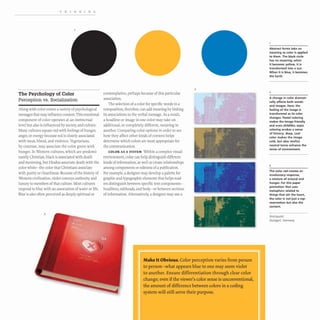
of comfortable, mostly casual,American fashion, its in-house
design team approaches the layout of the catalog from several
vantage points: the functional aspect of showing different
apparel lines in all available colors, systematically supported
by descriptive and pricing information so that the catalog can
2
3
be used to order; the organization of apparel into story sections
that are sequenced according to marketing objectives; and
visual styling (in terms of model selection, environments, color
schemes, and typography) to convey not only those messages
specific to seasonal contexts but also those that communicate
the essence of the brand and its position versus competitors.
The latter aspect dictates a great deal of the design sensibilities
that are leveraged in presenting the clothing: classic,unpreten-
tious typography, sensible layouts that show the clothes clearly,
and lifestyle-based imagery and color that reflect American
attitudes about style, comfort, and cultural experience. Tn terms
2,3,8
Apparel lines are promoted
in stories, sequences of
photographs that are
related through the style
of the items shown, the
models wearing them,
locations, and background
colors or prop details.
Each story begins with an
opener that follows a
similar structure-a full-
bleed image opposite
an expository arrangement
of images, accompanied
by a headline and intro-
ductory deck.
of function. the catalog is a machine of alternate grid structures
that permit a wide variety of presentation. from grids of single
items laid down on colored backgrounds. to on-figure shots of
models in a studio setting. to photos of typical customers
enjoying their [.Crew apparel as part of their daily lives in typical
American locales. Functional strategies. such as stacks of fabric
swatches and detailed product cataloging text. allow potential
buyers to see available colors. understand specifics about garment
construction or styling. and buy directly from the catalog.
5
7
-.
4
J-CrewcoolS
6
8
Publication Design Workbook IIPublications in Action
2-8
Typography is limited to
two families-a sharp,
slightly condensed contem-
porary serif and a family
of sans-serif gothic. The
sans serif alone is used
for all informational type-
captions, color swatch
names, sizing. and pricing.
Promotional headlines and
decks are set in the serif.
Garments are displayed in
a system of presentations:
the location shot on figure;
the studio on figure; the
single-item or "schmear"
laydown. silhouetted
against white or a color,
or shot combined with
accessories or props.
Laydowns may appear in
a number of grid configu-
rations, accompanied by
descriptive text, sizing,
and pricing information:
four-, six-, or nine-up on
a given page.
214 215
Faydherbe/DeVringer IThe Hague, Netherlands
Accompanying an exhibition commemorating the
Dutch Municipal Transit and Waterways Agency's
seventy-fifth year, this catalog presents information
in a rich, layered experience that communicates
its achievements and public role through time.
Historical and contemporary photographs are
presented in freeform arrangements that contrast a
consistent, academic, hierarchic two-column grid
structure. The images, in duotones, tritones, and
colorized halftones- as well as full-color-overlay
one another, fade at their edges, and are superim-
posed with typographic elements, creating a
predominantly horizontal motion that recalls our
linear conception of time. This horizontal empha-
sis is countered by the text's vertical motion and
the stark juncture between the two columns-
one narrow (to the left) and one wide. The narrow
column carries image captions and callouts; the
wide one, primary text.
The catalog's typographic treatments are
simple and distinct. Primary text is set in a relatively
large-size serif, with ample leading to accommo-
date footnotes. Paragraph entry lines are set in a
medium-weight sans serif and underlined,
providing clear contrast. The same sans serif is
used for captions and notes, as well as section
headlines and introductory decks. A dot-matrix
display face, used for section numbers at an
extreme scale, titling on the covers and front matter,
and selected expressive callouts, lends additional
textural contrast and conveys the technological
focus of the municipal agency's activities in
monitoring traffic, water quality, and other public
environmental aspects.
2
3
-.......'""................_ _ _ ..w_
.__............. ._---.....
-_._..... - -
--~..---.--.-...---
- ......- ..-.......- ..-..-_.........
-.-.............._-- ........
... ----... .-
..........--.......-...........--.~
-.....--..---;~-;;~;;;;;:..
:::.:- - c..-:...:.-_..:-..=:-
-"-------------
---------..,---
_... --,-
- -
=!":!":--
....--~.~-
...
-~-:-=='.:
-- ----- .
.-.....~.----.-...-
........- ----.".,..-........
e:",::=-..=:==:,::::==",,---••
......... . ..................
-- - - .... ----.....-..---
--.-....-- ......... -.....-
-----.-..., --...-......-..-.......
.....---....--..........-............
...... ---.
-----...-..............-.-........-.
,....---.-..-......-_.-....__..
------. ----
__..._ ..............-._-..t..
_..-----------------
..-.---...'-
-.
---
---
---_._-« .
=::'---"-:=;;-,;;-;;-,;;';.;;;;;;
~~~~~ ----~~. -.-
--
-
....-...-~-
...::.:::.~-;-;-.;-;::-~-~---
----_...- -,.--.
:::::==~ .....--.........---....... ---
----..--------
. . -_ _ _ .... P'!tII .... ~_ ........_ •
....----..
~ ...------~.-
....---.--.. -~-......--....- ..........
..- . . . - - _.. ....-1_... _ - - . . . -..
- ' - ....--.......... --.,...,.-
~----.........­
...--_..-------
-.............--
..-.....-~.-,.......--.......-....-
--" ,...---
....""~----.. ,..._,---
_ ..",..._..-_-......_.. It
. _..
1
IIIi~ ---.---......-...
--~---- .-...~
::;;,;;;,;;-;;----..-----
~
;;..=::==-::-~
...:...-=-==:.-==':'*
------- -
--_.....- ......---
--..-- ,_.__.-
---........---.. ..._-
--- -----
- - - ...-.1-..............- _
:====::.. ..-. ---
..._-.--------..........-----
._-------
_... --_.
~-.--~~
..
' ,2
While most of the type
throughout is set in a neu-
tral sans serif, details like
numerals and some call-
outs are set in a dot-matrix
typeface that lends a tech-
nological edge to the lay-
outs. Vertically oriented
section titles repeat the
vertical motion of the nar-
row left-hand column that
carries captions and other
supporting text.
2
The simplicity of the text
arrangement-one narrow
column, one wide-is
contrasted by the section
opening image composites
on the left pages, and by
unusual treatments in the
text itself. Here, for exam-
ple, subheads are run
inline with text but under-
lined and shifted above
the baseline on which the
first line sits.
2,3
Text with different func-
tions is set in different
(olors. The captions, for
example. are set in a deep
blue; their image numbers.
in red, link the images to
the running text. where
the numbers appear as
superscripts. Section titles
and subheads are set in
an ochre color.
Chen Design Associates ISan Francisco, USA
Neutral doesn't necessarily mean dull. Sometimes,
neutrality- or the appearance of it-can be very
intriguing, as in the case of this publication for an
exhibit of current design practice in California.
Aside from an opening segment and sparse end
matter, the entire book is devoted to showcasing
design work in five distinct areas: consumer
products, graphic design, fashion, furniture, and
transportation, which are represented by small
icons that indicate the practice area of a particular
project. Readers wi1l immediately be struck by
the book's fluid pacing, open and asymmetrical
arrangements, and spatial layouts of material.
An apparent system of tick marks and linear
grid references deceptively leads the design-savvy
reader to believe that there is some regulating
system when, in fact, there is none: the elements
float, unattached to any structure. While there
are outer margins and some relatively similar
decisions about placement on occasion, every
element in every spread- except for the folios-
is placed intuitively where it needs to be placed.
The designer makes visual connections among
edges, angles, scale changes, groupings, verticality
and lateral motion, but nowhere does a hangline
remain consistent- nor alignment logic, nor col-
umn widths of paragraphs, nor location of icons,
and so on. Balancing this randomness is a cool,
effortless minimalism in the typography.
Only one sans serif face is used, and it is always
the same size, weight, and set on the same leading.
Paragraphs of running text are set justified, but
everything else is set asymmetrically. Subtle color
distinctions in text components clarify meaning.
The result is an organic compositional journey
that subversively transforms the neutral into some-
thing highly unusual.
2
4
1
=
I",
-
-
-
-
3
I
Publication Design Workbook IIPublications in Action
1,2,4
Although some elements
do align with each other,
they never do so twice
in the same way. Each
relationship between ele-
ments on a spread-and
between spreads-is
unique, determined by the
designer's own sensibility
as to how the images
should relate to each other
to create a visual rhythm.
3
Only a color change
between typographic com-
ponents distinguishes
them. This color difference
is subtle, but sensitively
controlled. The two-line
firm and city notation is
the darkest; the designers'
or studios' names are the
only type printed in black.
4
The dialogue between
neutral and stylized
continues in the way
fashions are shown. To
show drape, garments
were photographed on
mannequins. rather than
people; the mannequins
were then silhouetted,
making them as neutral
as possible. However,
the designers took great
care to ensu re that no
two mannequins were
in the same position.
2 16 217
Arkzin Dejan Krsic IZagreb, Croatia
It is challenging to design exhibition publications
that complement the exhibited work. One approach
is to create a neutral field that essentially disappears
around the artwork; another is to derive abstract,
color-based, and typographic treatments from the
art and let them interact with the subject. In the
case of this exhibition catalog, the first published
for a growing biennial exhibition in Croatia, the
variety of work and text- in terms of media and
sources--excluded the latter option; conversely,
promoting the budding festival and exhibition
energetically meant devising a unique visual pres-
entation without upstaging the content. The result
is a catalog with a strong, identifiable presence
that nonetheless lets the art, along with contributed
essays and artist profiles, speak just as forcefully.
Produced only in two colors- black and red- the
catalog effectively characterizes the visual legacy
of the Balkan region:a mixture of potent sans-serif
and serif typefaces, heavy rules, bullets, and dra-
matic composition give personality to the identity
of the biennial. A five-column grid organizes
content of wildly different kinds in a variety of
presentations- two-column arrangements with
captions; single, wide columns of text and large
A selection of contents
and informational pages
from the catalog shows
the dramatic mixture of
typefaces. heavy rules.
and aggressive composi-
tion that characterizes
the catalog. The designer
plays with the grid here;
type is permitted to bleed
off the format edge; and
color breaks call found
words out of the titling.
LD E11OR LEAV~T
...
2
..~ LUU II
- =--~--
-- ,.,
. If wn
3
r IllilrAIiNII
-- - -
--... -
.... = =
-
.... = .....
=-
- - -
= = .... --
--== "'" -
.... ... -
- • - -
-• - -
- - - -
-- --
.. -= - -
- - - -
.. sa
-- -
-- .... •
-
- - -- ;
.... ..... --
= .... • -
.... -
I nm . I
4
L
Ultil UtI ---......,..-
;=-
- LOVEJT0
-- -
-
The designer gave the
catalog a title based on a
Turkish artwork featuring
the phrase "Love it or
leave it." Transformed
typographically with a
condensed sans serif in all-
cap setting and broken in
red and black. the phrase
becomes an identifier for
the spirit of the biennial.
2-5
Aggressive display faces
appear in titling and are
used for the folios, trans-
forming them from simple
markers to active visual
elements.
5
The Things We
Iways Wanted
To Talk bout_......h
MIKittIb (NMt .tr~kt., n,.....Crt~.)t".""-."li!.Mtd·
hkodra : Albania I 21-26/08 . Unpredictable
work situation on site •
Prejudice • Visions of one
another • Self-organization
as an anist • Anistic
presentation to the outside
• Different location •
Buildingof networks •
Developingpublicity •
Strategies • Tactics •
How do you get money?
• Different educational
systems . Motivation .
Different media • Support
systems • ., .................0-11........,
OriId.L'«aUU!"S "_'IIIJIIU 1
..... ttA.Ul '~Kd."'l ...........
LUI'. c.~.r 'u, I n.'IlI'OCt , · IJ'M........~. .....
l'Wtkl'tJ-" - t-I ,.......c.-./.t. ,..t A...... 1IInt: .uutalJ1.t.k'Vt( .....
"-II:AMOtC "._"10 ,......11 , ~'!""»C. It.Io  1,.., ' •
• ~ ~0DUll. T_kf It" ~s:otA $o~.sIlfUtlJ vw...
MJUTU · . , ..... ........... ..w....OOCO'"IC "..,....~~
rww....c;otI.Dt$ a.n.ltuJt...'liX · w..u.QtlO M""--II..."fl.'QI O&rn
~"lJ. ll&
30
callouts; listings of contributors; displays of artwork and artist
profiles; as well as essays,interviews,and panel discussions.
Sometimes,the grid is violated in favor of a particular kind of
presentation, particularly in the context of more informational
content, as in the table of contents and artist profiles. Still,
the use of typographic treatments and color breaks is highly
systematic- heads,subheads, captions, and notations follow
consistent and detailed logic- and the varied arrangement
on the underlying structure doesn't seem to sacrifice the
overall unity.Rather, the visual style of the publication is quite
recognizable and, given the range ofcontent, appropriately
dissimilar. Strong contrast, spatial breaks, and typographic
confidence give the biennial a vibrant identity.
or leave
3t
surreal
p.
bl
6
7
OMi:1I AU "AlMA
-.........-.-.-
...._-_..-
... ...
--
,--
..----
- -
--
-----
-..--......-
--
-
----
---
_.-
......._---
-- -
..--~
-
-
-
--
_
.
-_....__.
-.::::.
-
-
_e, h
-. -- 1 ~1'.
-~•.---- . ·lio
' v ~
----
-- ,
- ..
OUVDI uaova
- --_._- -_.-
THE ARTIST
HAS TO BE
N ICE
TO CURATORS,
OALLERISTS,
MU EUM
DIKtG.liIIt'Ii__
..
OLAFMCTU:L.
-----.-
-_.._-
-- -- t~~;;;;:;~~
:="-- -- - -,
----- . ----
---
.
- -'-
- ._--
----..
---.--- ..
- ~..;::o:' ...=::_::=_=
-
- ....--- .......__.-
---
--- -_....-..
--_.......
- -- ---
-
-~~~==::::
- -- -...- t
.._-----
•
---
...- ~----
~=.::::..~
------- --
- ---
. -- ---
---::,---===
-,-
----
...-.-.~--..-
c:;::::-.._--
_-
.E::_~-
--..__....
------
------
Publication Design WorkbookIIPublications in Action
5
In this spread, the seeming
disappearance of the
five-column grid is a trick
of the typographic
arrangement; several col-
umn-widths are combined
into one, with a wider left
margin, to run a list of
bulleted questions being
considered in the text. The
two-column presentation
is common throughout for
running text.
A systematic logic is
applied to informational
material throughout the
catalog. In this particular
section, biographic infor-
mation is set in a bold
serif. Exhibition histories,
prefaced by all-cap lines of
regular serif. use a tabbed
format, with hierarchical
subdivisions clarified by
posture changes. The titles
of works shown in the
profile, also in the serif
face, run in red ink. Gallery
locations are set in an
alternate sans serif with
quirkier details. Finally.
captions appear in one
sans serif at a smaller size,
with weight change and
vertical rules demarcating
informational breaks.
218 219
3
Each semester, Otis College of Art + Design in Pasadena,
California, publishes a course catalog targeted to prospective
students. The books are organized into major sections: front
matter, used for conceptual messages that set the visual and
editorial tone of respective editions; a section with information
about the academic year, housing, and student life; a series of
subsections detailing the various disciplines and course curricula;
and a section with application and tuition forms.Among sections
in a particular edition, strikingly different visual and structural
treatments have been created to weave recurring information
1, 4,5
Stylized typefaces with
scriptlike ligatures and lin-
ear geometric decoration
provide enough edginess
to appeal to prospective
students looking for a cool
"art school experience,"
but don't alienate readers
by making information
inaccessible.
1,3. 5, 6
The a reference of the
covers appears inside in
different incarnations
from edition to edition,
alternately used as a back-
ground for diagrams,
in photographs with stu-
dents, or layered in as
a texture that connects
it to the content of a
particular section.
Numerous typographic
variations appear among
editions. The designers
have created a kit of parts,
so to speak-a set of sty-
listic and structural ideas
from which they can draw
as needed. Here, two kinds
of vertical type arrange-
ments are shown. One is
used as an overall graphic
(2), while the other is inte-
grated into a photograph
to repeat the vertical
rhythm of the dress forms.
2
1&1
~
1&1
-
~
~
1
• a:
I ~
~
f ~
J
it
1&1
Q
4
I
seamlessly into layouts that can vary in each edition; essentially,
a kit of parts that can be reconfigured to reuse existing images
while making space for new ones as semesters progress. Within a
single section- the departmental descriptions and course offer-
ings, for example- the structure may be simple:a block of color
with paragraphs reading horizontally and callouts within text
effected through changes in type style and color. In other sec-
tions featuring student work in various disciplines, the breaking
of images in vertical bars, grids of images, and blocks of color cre-
ate more complex compositions that are experiential in focus.
>-
I- ...
- Z
Z g
0
:::> :1:
~ ~ -
~
~
~ ffi a: •
O ~
Z
U
e
W :> ~~
If => ~
::tl
a:!
IJ
II t- el
I
Os
!I
« ~
• U :z
Alternating between the various type and image structures cre-
ates a kinetic pacing that is flexible and constantly fresh. While
individual spreads may change,the system affords an overall
unity among editions. The front matter, however, changes radi-
cally each time- in both its content and visual treatment.
Because the catalog represents the vision and creativity of an
educational institution devoted to the study of art and design,
the designers are permitted broad latitude in experimenting with
typographic structure and detail, using unconventional. highly
stylized typefaces, mixtures of grid-based and organic structures,
5
Ii
6
11111
.
.
..
abstract geometric and organic elements, and bold color combi-
nations to convey the subject as dynamically as possible.
Interestingly, informational clarity is never compromised despite
the extremes of composition and typographic styling; careful
attention is paid to creating recognizable and accessible arrange-
ments of information that repeat in each section and are spatially
and stylistically separated from the remainder of the content.
These arrangements are used consistently so that readers are able
to find them and acquire important information when needed.
•
.
.
med
I
7
...----
---....-
....- ....._.-
_..._--
. .....-__ c-- ___
_.,.-- ..... ...
- ----
..._ .._ _ ...._ t._
--- --...........- ---...-..-
----- '---- ---.--..
-.:::~-;;;:;:;;;-::- ::.=-- =:"-;;"-.
.....----....-. --
____ 0'. ______
,...._...- -,,--- ----..
-- =-==--::=:.. ...-~~~
.
--- _.
-_..............---
..:::::::~--~ -.~-. ---------
,~ - ....._--
=.-~:::.... ~.~~--
--_..- ---
---_.. - ...-~-
=t..:.--:=- ====- =~~;;;:_~_:;;
--~.- _ ._'--'"'"-"
....---- ------
_-....- -.. _._---
-_.........- -"'---- ---.-
o _ _ ......... _ _ _ _ _
-- --- ._-
-----_. - -
===---=- ----- ==~::~-~~-~
- ..........._.._---
..--.- ---- _.--.,.
--- ---_. -
......0'-;.,..;..- _._ _
Publication Design workbookIIPublications in Action
" 6
The cover of this particular
edition can be removed
and unfolded to create a
poster of abstract paintlike
forms. This visual language
appears throughout the
edition along with stan-
dard treatments.
7
Each section with academic
information repeats a
recognizable structure.
Course descriptions appear
in a column structure, set
in colored blocks. Subheads
are called out w ith a
change of typeface and
color. The wide head and
foot margins are used
to list important depart-
mental information.
--
--
--
---
-
220 221
r
-
urn
1
C
Eschewing expectations of full-color, glossy, stylized presenta-
tion, the designers of this course catalog for an educational insti-
tution that trains makeup artists, designers, photographers, and
hairstylists approached the publication with the goal of clearly
differentiating the school from its competition. Though glam-
orous color photography does playa role in the layouts, it is used
to support the text and add spatial depth rather than to be flashy
and glamorous for its own sake. Instead, the institute is given a
visual persona that elevates the beauty and fashion professions-
and their study- to the level of art. Black-and-white compositions
of marks varying in complexity wrap the cover- predominantly
1-3
Black-and-white composi-
tions powerfully redirect
the perception of the
school away from the
expected toward a highly
refined sense of the
program as artistic training.
Much of this communica-
tion results from the
abstract qualities of the
recognizable snippets
that form the composi-
tions, as well as their
spontaneous, almost
painterly, distribution
around the format.
2,3
Black-and-white divider
spreads separate each sec-
tion of the course catalog.
2
3
white- and separate major sections inside the catalog. The marks
appear to be composed from snippets of sketches, type elements,
hair, grease pencil, or other detritus left over from the process
of studying or designing.The program description pages are
markedly more straightforward, contrasting the section dividers'
expressive and evocative positioning with informative, struc-
tured listings of course material, facilities, faculty, and the like.
Text is situated on the right-hand page, while a gridlike series of
geometric photo arrangements adds color and interest. These
images are cropped and combined in a mix of vertical and hori-
zontal rectangles, squarish blocks ofvarying proportions- but
}I
'tv
I'C1'IO.. A
.'"
~
all adhering to a modular understructure independent of the
type grid.Though they introduce a sense of the industry with
high-contrast lighting, extreme close-ups of made-up faces,
and dramatically colored hair, they do not compete with the
information. At the same time, they subtly restate the cut-up,
work-in-progress abstraction of the black-and-white composi-
tions in a manner that integrates typographic geometry with
the guiding visual concept.
5
. -- .

O"lll
~
~
-
~,
r
,-
4
;rv.rW>dut/ OIfol-u"'Lf.....rn.'...... ..
........."'..u,ww. •
~u .... -.....-
"
SeJSlD'v I!)~
_
....... •
~"IN ............
"
~d .............
•
I~~'-' ... "
....
·n.-LoIiI__
...
.-
1I0I0................
•
___.ea.
c-.....-
f-1A(R- "*.................... •
•-...-"'........(I11III.-.
.............c-.e.r....
......-~.l-.;-...
~1I .. lIHalIe . • , ' . "
CQJ~r-~ ;:::;.;:.::::... ::
!Te~"'!J r =:;
~....,,~............
."'-
, ""'"
.._
..-
...............................
.............
t.. ::3
..
"
"
"
•
•
n
•
•
"
..
»
•
..
..
..
•
Publication Design workbookIIPublications in Action
rFlfJ'lflrATf n
1!1IMAGE
MAIIAGEME).-r
~.",.",-,..".".,=-
-----
-----
---
=:----
--
~=--=-
.
-==':-='~:?-
. -~
"----
--........
-----
--_._-
.._
...-
---
---
-
-_...-
.t:::.._..--.
.:.:.=
_.._-
- -
- '
--
-
._-_.
=.-----
-
--
A)
-..-
--
.__.-
----
.-..--............
.~----...........-
---
--- ---
:c-
...::..';'_-:..-::'" ----
=---
:.-==::..-
~!?'...
_
..---
---- ----
..--...-
- --
w _ _ _
--
--~
::.....
;.:-""',.;-=,;;-.'
==~,-. =.=:~--
--
--
---
=-
---
-.~....--
---
-..- .._
..
_I
.-
-
--
~-=--:.-
.-,.-...._
..-
.-..---..
----
!- .... _ -
--.------
-----.-
- .
-
4
The sober arrangement of
course information, in con-
trast to the organic power
of the conceptual artwork,
establishes credibility for
the school as an institution
of higher learning that can
train professionals who
happen to be artists.
The photographic arrange-
ments offer a third visual
texture to the catalog.
after the expressive art-
work and grid-structured
typography-color, depth,
light, and movement-
but is formally related to
both art and type. It is
expressive and cut apart
like the cover artwork,
but its crappings are
geometric and defined
on a modular system,
as is the type.
222 223
Hutchinson Associates IChicago, USA
2
_........
- ....-----
•
•
@
@
@
A.
iiV .....- -
@
@
.~
The hallmark of successful mechanical engineering is repeat-
able, reliable perfonnance; the designers of this catalog have
communicated the client's commitment to this standard via
accessible organization and tremendous attention to informa-
tional detailing in both image and typography. Every page-
whether it's a section divider, specification page, or the cover
itself- presents its information on the same hierarchic two-
column grid.Two columns- one narrow, one wide- separate
primary information from secondary elaboration in an asymmet-
rical sequence left to right. The grid itself repeats asymmetrically
from left page to right page. Subject and relevant callout infor-
mation appear in the narrow, left-hand column; supporting
information follows in the wider, right-hand column.A system
of horizontal breaks separates material top to bottom within the
two columns: a narrow band at the top carries the individual
-
-_.._- ---
- 1,5,6
Product names, in bold at
a larger size, precede the
running head. They are
supported by important
highlights directly below,
while more promotional
copy runs in the wide col-
umn to the right.
product name and running head, along with the folio; a wider
band carries callouts and supporting text; the middle area, wider
still, presents images and diagrams; the largest division presents
tabular information. Within these major page divisions, parts
may be rearranged, added to, or altered to accommodate differing
types of infonnation. A network of structural rules of differing
thicknesses- some solid,some dotted- in black or a colored ink,
clarify the infonnational divisions, speaking to the precision
and systematic nature of the material. The catalog is, in essence,
a machine for getting product information quickly and in great
detail. One sans-serif type family, in roman, italic, and in two
weights, keeps the focus on accessibility and avoids competition
with the crisp silhouetted product photography and exquisite
engineering diagrams.
, 1
1IICrOfv<Ge>n
--
3
--
1,3
Even the section divider
pages honor the column
structure. A full-bleed flat
color backs up black-and-
white product images that
overlap rule elements with
a drop shadow to create a
slightly ambiguous spatial
arrangement. Supporting
information runs in a third
column. Note the decisive
rhythm in the locations of
the rules, the hangline
of the text elements, and
their depth and width.
1-_--_- ...- .1
,.,..._3Cl,........._~,.. ....._.....
....,_ ..._ ...~ ,.,.o.w...,~~""
.e.___ ....-.......~ ........,,_....,
O" ...... _~c..rQ,I.....,_...". ..........
-....-..-.........--..._,.--
..o........_~.~
~--..~,..,......,. q;:owA
........ IIIMI~ . . . . . . . .~a-
.........-~......-----..crt
..-------....... "'" ...--.....----..
-~............-.....--.......-
-
~ ......~ ...,......---.............
~.,-.......---.........~"'--
~M .....""' ..~p..,_'-.....,., ......,
....,.,.....ff....,.........,....~_ .............
.....-~......~" ....~...........
--
......... .--.~ ......... ___.......f/I
-.....,... ............~....,.,--'"'*'.
..........___.........._w._
___________ ......-..w_
........,.---~ ..-_
.....----..
-....~ .......,..,...
5
"
---
.
~
I -
--
-
-
-
'-----' .'-----' '--' ~-_
'---t
---
.......-..-....
---
----.....-,-
......--............
...............-
--
~....- ..-
-..-.____ao_
..----,...
..._---
--~~
........-.......-
--....,~
..-..--
--
I
--
--
--
---
.._-
-.-.-
--
--
----
--
--
4
----
--
--=-
---
•
--
r___
-- .-
::..-""-=--=:.:.--
----
-
'-
-
•
6
In overview spreads,
products run four up on
a spread, following the
same compartmentalized
structure as the detail
pages but doubled up on
a single page. Heavier
colored-rule boxes draw
attention to the text.
Images, as elsewhere,
always occur in the left-
hand column.
.................
-..-
--
1- ...-
---
....-
-.--"'"
----
.
----
---
--- .
=--:=~,.:=~~
-~
i •
6
•
.
4
The table of contents pres-
ents a clear organization
for each major product
section, indicated by bold
type, in a matrix of colored
rules. Opposite the con-
tents, a series of crisp pho-
tographs is accompanied
by customer testimonials-
one of the few technically
unrelated items of copy in
the catalog.
-...............--~.-..-
~.....------
,...-----..-..._---
...-..............,.._,....-..........-.......
_ ...._ ~~ ............ _ •• 'It....
-....-.--_.._----.-
-.......... c-....._,.._,......._
- -.-..-......._-
_
........."'--.......- .....-....
_..._._w _o.r ___
----....~-..,---...
--~---...,-~
-- --_.........-_..-
...-....... --..._-.....-....--,......
.-..--_...-.....................--_.
- ._----
"
5
Informational tables are
laid out with precision, the
alignments of the columns
reflecting the number of
informational compart-
ments needed and the
space required to separate
them adequately. Tinted
bands of alternating dark-
ness help link information
for related specifications
on the horizontal axis.
Diagrams, much like the
supporting text (and simi-
larly linear in presentation),
follow in the right.
f..........,_....._--..... ___...__...
i •......,.""...,, _ _
..............,..--.--
--
...._--
_
.....--
-----
- -,
_...._..,.-
.........~-.......
-...- ..__.
------....-....
---'-"I
----_.
..............---,
"---.-..
---........-
---
...,..,....---.-
r - ______
--
Publication Design workbookIIPublications in Action 224 225
Design: MW I Williams, JP Williams I
New York City. USA
This catalog is the tenth retail catalog designed by the same
studio for japanese department store Takashimaya. Their long-
standing working relationship has yielded a publication notable
for its saturated and esoterically styled photography, rich colors
and paper stocks, and jewellike minimal typography. The catalog
is itself a high-end product, designed to be as much object as
communication; clients are drawn to the store for its aesthetic
inimitability. The first clue to this publication-as-object approach
is the staggered interfold of the format- a Z-shaped base spine
with two sets of signatures bound in opposing directions- in
which the cover flap and pages end short to reveal contrasting
2
layers of color, texture, and image.Added to this already intricate
binding are gatefold pages and matte-coated f1ysheets with a
slightly slippery surface; these pages list product information
and prices. The text prints a deep metallic on a smoky, desaturated
violet background. A lightweight, slightly extended sans serif
is set all uppercase in a justified column beginning a third or
so below the top edge of the format. Details such as slashes,
vertical rules, and other linear elements separate item names
from descriptions and prices; the attention to letter- and
wordspacing, column width, leading, and the attributes of
punctuation results in finely tuned typography that becomes
A near zenlike-though
thoroughly modern-
simplicity of approach sets
the store's name, alone.
on the cover, countered
by the hint of complexity
offered by the stepped
binding that peeks out
from the sides. The smoky
violet is characteristic of
the color feeling through-
out the catalog.
as much a luxury as the images. The photographs are mostly
devoid of models (save one or two full-gatefold bleed occur-
rences that showcase jewelry), instead showcasing sensitively
arranged tableaux of the products. Textures, forms, and color
schemes among the objects in the photographs are considered
and arranged to create interesting juxtapositions that enhance
the individual qualities. Lighting is highly controlled to impart
a dreamy, reverent- even spiritual- glow to the scenes. The
quality of their reproduction is outstanding, all the more remark-
able given that they are printed on an uncoated paper stock.
3
1,2
The stepped pages-
longer for photographic
spreads, shorter for
pricing flysheets-as well
as the binding, insist on
unhurried exploration,
revealing intriguing color
combinations that change
with the turn of a page.
4
Publication Design workbookIIPublications in Action
2-4
Product imagery dominates
the catalog. arranged in
artful compositions that
are still and contemplative,
yet decadent with color
and texture. Curved forms
and angles engage in
dialogue with one another;
glossy textures contrast
rough, earthy ones.
3
The stark, machinelike
typography of the body
copy and product descrip-
tions-ali one sans-serif
face, in one weight-
offers minute typographic
detailing but minimal
interference with the
presentation of images.
linear details enrich the
text's understated whisper
and clarify informational
distinctions within the
running copy. Note the
absence of rivers and
hyphens in the justified
paragraphs.
226 227
1
.r-----
"..........""
~---,.....
----
..._..........
wao_ ...... ..
-~ ..
......
...-......
-.....,.....
~
-=-~
... ~II~.~­
=,....-_w
Surmaviirus ~'Ib
hii,elsummasid
~='-=~
::::.._--=
:. .£0;,-
...._~I .r
- .......---
-=-=--=-:=.:=
_
........-.-,..
_:..- ,.-e
~5=_=::r.;
::,;::-----
--...~ ...
... II.
;,;,_c::::::-
=::c:.=
-----
=-.:::.=:..~
--::.c::
c...- "':'r;
2
1,2
A large area of the front
page is devoted to imagery;
the appearance of illustra-
tion on the front page is
a refreshing departure
from convention.
The masthead is drawn
in a quirky, condensed
slab serif-reminiscent of
old wood types-that lends
a friendly, community-
focused feeling to the
paper and contributes to
its accessible quality.
The left-hand column
offers third-level story
starts and pagination links
to guide readers. At the
top of the column, a per-
sonality of local interest
and a pull-quote are fea-
tured. A minimum of story
starts-treated systemati-
cally-is a recognizable
navigation strategy that
prevents readers from
becoming overwhelmed.
. r .
'f. t ::
~
Postimees In-House Design I Vahure Kalmre
Tartu, Estonia
This Estonian newspaper makes use of a great deal
of image and a navigable presentation. Like many
papers, it is structured on a much more precise grid
than is usually needed- twelve columns, even
though most of the information on a given page
will be arranged in five or six. An overall approach
of simplicity, however, makes this paper easy to
sort through, providing an opportunity to include
very large images that enliven the pages.
This approach is immediately discernible on
the front page, where three to four column widths
are given over to imagery (these are sometimes
illustrative, in a notable difference from most news-
papers) that often spans the full height of the page
from masthead to foot margin. The image area may
include headline and lead info as well, directing the
reader to a specific jump page to follow the story.
A narrow column at left on the front page carries
a commonly used device- a listing of content
callouts for interior sections and supplements. To
the right of the lead story image area, three to five
secondary headlines and decks, accompanied by
photographs, direct the reader to the major stories
of the day.
Hard news stories and supplements share equally
in presenting a wealth of color imagery. In the
former, pictorial matter adheres more convention-
ally to the grid in rectangular insets; in the latter,
the designers are granted some leeway in actively
engaging imagery with the text- silhouetting
dramatic shapes or floating type and inset images
on top of full-bleed photographs. Two type farnilies-
a moderately condensed serif with slightly modu-
lated strokes and varied contrast, paired with a
family of sans serifs that is based loosely on a serif
type- predominate. The serif is generally used for
text and large headlines, while the sans serif is used
for secondary headlines and supporting text, as in
the left-hand column of the front page.
3
4
=
6
- --
e-- 2._
VmtsutatudJaanikirikonvalmimas
TartumaahundidonsiiOnud
ja lambad terwd
_c-_ s~;:; ===_._-
-41 -
TARTUMAA
Publication Design WorkbookIIPublications in Action
5
ARTlkklL
3-6
Imagery plays a tremen-
dous role in the layout of
the paper, even within
interior spreads. Most of
the photography used is
color rather than black
and white. In supplement
pages, the images leave
the boundaries of the grid.
Here, an enormous silhou-
etted image interacts with
text (5) and, in another
example (6), the image
forms a backdrop to the
text structure and insets.
228 229
The Seattle
Jeff Neumann IDenver (CO), USA
~ .
'trulllllent
&theArt
h
TheY're 13. )
W aeanfessed?))
~eY'refrom Ellensburg.
And lrer band.Sav••~ I.JJtv.IS r1!iICfy to t3Q!CM< the v.tW1d
r_
........
--
--
.-- --
._-----
-- , ....-
....._--01--.-
..... ---
:=:::=:='=o:J_
.... _ . ~ ....... "-,. ~ .......... INd ~ .. __ _ • •
.............._
_...--.....--..............,
-..,.......,......................-.........~ ..
------_...__._--_..---..
1,2
Magazine-like headlines-
here, the use of large-scale
sans serif type in staggered-
width lines and a tight
vertical setting-help distin-
guish softer news sections
from hard news.
This recent redesign of the Seattle Times combines a more precise
and varied grid structure with a complex mix of typefaces, color
treatments, and magazine influences to bring a dynamic, textural,
and expressive quality to what is often a gray, uninteresting
wall of informational text in conventional newspaper layout.
Without sacrificing legibility, navigational clarity, or the flexi-
bility needed to produce editions with ever-evolving content
rapidly, the Times design takes cues from other newspapers that
have shifted toward more engaging, illustrative, and friendlier
presentations of news. A tight twelve-column grid divided into
twenty-two modular rows is used to structure articles on a num-
ber of compound column configurations:one, two, three, four,
five, and six. Distinct column configurations- for example,
2 3
..._-
Trave ~.....'co
three-and four-column structures- may appear side by side on
the same page,even contiguously in a given row-set, so long as
their configuration adds up to the full twelve columns wide.
Aside from creating subsystems for informational components
that repeat each edition- such as the Newsline content flag at
the left of the front page- the variety of text widths clearly
separates stories and lends a dynamic tension among spaces
that engages the eye and helps navigate the content. The use of
several type families adds to this complexity. A high-contrast
serif carries primary articles and their accompanying heads,
decks, and subheads. Secondary content alternates systematically
between a slightly condensed, tightly set sans-serif family and
a similarly condensed slab serif, usually set in bolder weights for
E ----.-
The mastheads for major
sections, such as Sports,
use an all-uppercase set-
ting of an inline serif with
a great deal of contrast.
This treatment derives
from the inline detail of
the 5 in the front page
masthead, without
requiring individual black-
letter drawings of each
masthead-drawings
ere Remembering
the ride
11.. ..' ''·00
nln.o.l,
I1IU'4I1n'WS'
10D,*"
that would likely be time
consuming to produce,
would take up a great
deal of space, and might
compete with the primary
masthead.
---'
e
locals
"
......'-..."
... go
..........-.........~........
.........................
fI~~.....,..
.......~.,....
ra-.,./IWI-..........
..~.,.,.-,....,...
..~ ."' .......n-.,..__
..".....~.,,..,
=.•..:~
4
_
.
"'".-NationReport
m,eSeattlttlttles
..., ....
HUDlINlS
fDA cooks (and studies) all we eat>.
President Bush becomes latest action figure >1
Bloated Calirballot swells to i47 >,
4
Clarity is no deterrent to
stylish, accessible presen-
tation. The sizes, weights,
and width proportions of
the type are rigorously
controlled for maximum
visual effect. A simple
weight change within
enclosed decks add detail
without distracting from
higher elements in the
hierarchy.
..,..,- IlO8Ota; Mun. d ~ ., fnk agent.
kills I0
'X
erox complex credit uoloo
SUllAl CHILD IIOUSTII: Compie, tlttmnenI
prog....m; onkrtd rcteasotl lnC.U
r.
VIIOlNlA'S.OPC_ Ple;ul< ~ ItIY
10 tal'tsdmpplnl. reslpu
Across the Nation
Border patrol's double duty:
deter, rescue immigrants
5
METRO
U"lION
Sports>
GARCIA SHAClY.
BUTMSWINH
Food>
CHICKENS HOME
ON THE RANGE
NWLlfe>
DEPRESSION
IN YOUNG liDS
Business>
TUEMARKETtRS
snUCAWNG
eSeattle([tmes WEDNESDAY
auc;usr U. 200)
2S( -==___----;=.
2 PakistanisarrestedatSea-Tac;
one man's name onterrorlist
Ilowolboo
._-
.---
--
Vir....___
--.
_.,
--
--'
---
...~ .,
---
-_....
-_..
_ _t.-.-
_..-
---
.-.
--
..._-
-.._......
...........
--
---
............
...."'-.,....
......._,
.........-;
--.,.
--'hit_
--
""-.......10_
..,..,k_.....
'--_.....,
--
..._-
----
--""
.-.
-
.....c.....
.........-
-.....-
..............
_.
............1
--
.....IU_
-,...-_.
~,."
....-..,.
.,.........
......-
--..."......
.-.
_
....
-...~
--_.
_
...-
-~ -.
.............
", , ...
,...,..........
----
..............
--.--
-.
--...
c:-....,
-......-.
-_.
..-....~
--.
-.......-,
..............
-~- .
MISUU-sAU. "Of rBl lP'dbfrilOl."
N GGAOI SUlltJiINO~I.M s.e.fK ,,&-..I I
}-illllW uV)rry111111 (I"i~k /()JIr ItII'"illJj 10 /one4D"n O«'uPlI,h;m
Troops told to expect
at least a year in Iraq
8,000 doctors backfederal health tern
OP90fOIENTS DISMISS
RErotMAS TOO RADICAl
~n would abOUSh
Insuranco companies
a.. ,~0IIt _pita..
Hoallhlo4ey
OItGUl DOIIlOI ' : LN.
~"""""""'~"''*t.we
;tbout Rib • a....J
· . OVllq,U.... MtDK1lNl
Oouon __..'.....,
"..,kc- fbt....1t 1~""
.......
DII'IlIUf-D IUDS Me".
bI ~6tnoM4 ..'
yv......, ...', ....... ,
Wmdows
worm
hits peS
worldwide
MICROSOfT TAfl(ifTED
VI....lIk. program on~rIs
businesses. slows Internet
....-
_
......
............
._-
-_..
---
...._--
--I~
-
-
L _ _
..._
....
...............
....-
..............
-
-
.-.
.-
;=-
1.-a1lA_
_
..
.-..--
.........."
--
._
..
_
...
_.-
-.-
.--...
---
C:=':....v
==-
-
• n.o Baclc Pea•
rum""
.......
---
.-....
.......-...
....,
>t'"- ....~
.~WtUI.,1If
·_au
--
---
•
-- -
-_
..-
-,--
--
-
----l--------
; .
;·;
..~
'.~=;==~
I-
~-=
~-:...
:....
:~
-
:=:;:==-
:t---.~:-
=~
-
~....
~=~::;=::;
contrast. Sometimes, the sans serif makes an appearance as a deck
within the domain of a serif·set article. adding further contrast.
Graphic devices- such as tinted zones, callouts, sidebar boxes,
colored subheads, and magazine·like feature·article titling set in
a large scale- help invigorate the grid and give distinct character to
subsections, such as the Sports pages or the Entertainment and
Dining section. These pages also exhibit a characteristic unusual
in newspapers: the introduction of white space among columns,
further distinguishing these sections from the hardcore news
reportage and bringing a more magazine·like feel to the layouts.
A host of typographic nuances. such as vertical slashes. bullets,
indents, rules, and varied case/weight settings, helps carry the
energy of the pages into the smallest details of the typesetting.
5,6
The front page of the
paper is a study in varia-
tions-in column width,
text size and style, linear
detail. color. and space. All
told, there are more than
ten different, unrelated
compartments of informa-
tion organized for easy
navigation: a headline
story and three secondary
stories, a Newsline listing
to the left. and leads for
four major sections above
the masthead. Part of the
clarity of the organization
comes from the different
column widths that are
created from the precise
underlying grid: varying
the column widths among
stories makes them appear
optically different. Type
style. size. and weight also
help differentiate material.
5
The masthead is set in a
bold blackletter style
that has been altered to
improve legibility. The
x·height of the lowercase
letters has been enlarged,
opening the counters and
allowing their strokes
to be thickened and simpli·
fied. An inline detail along
the spine of the 5 intra·
duces texture and calls
out the initial letter of
the city name.
6
.w_
--
--
....;;;;;;-
..=-.=. c~
-_.,
_'_of_"
Publication Design workbookIIPublications in Action 230 231
Vecernji List
Mirko llie Studio INew York City, USA
The driving structural conceit behind the prototype redesign of
this Croatian news daily is the placement of the masthead verti-
cally along the paper's spine.This position not only creates the
largest possible masthead of any newspaper but also responds to
the fact of papers stacked at newsstands on the street. In a pile,
the repetition of the colorful spines in an edition creates a highly
visible and recognizable branding presence among other papers.
The verticality of the masthead influences the articulation of the
nels of pictorial and text content with a pronounced effect on
the way stories and images run together. Broken by strong
median flowlines at intervals of halves and quarters, stories may
fill the six columns left to right within the fractional section;
the columns within one of these sections may arbitrarily be
reduced in number to create visual difference from the other.
Overall, the quarter and half divisions make for clear storybreaks,
especially when they jump from lead page to another. Often,
paper's six-column grid, inspiring an approach that creates chan- the jump follows in the same relative location on the new page;
........
..... -'"'-jill".......
uoo pjt()OAl£ lAllA'
SNAlUW£ VW1I£01IOST
OIOMKA ZA W II POn'O
...... u.
...,-
-
.....
_
...
...-~...
---......
-......
--
-
--.
--
-..........
....._
-
,...
t.- _ _ A*
"'......~
--
..•.-......
._
-
--
--.......
==-
~.-.
- .-
--.
....-.._
.
.._.-..
2
lltAa-r4YL.1A . C: 'HIU."
'AO ......ttI ".LUTl.
U 5 DANA
100 DEM
PORASLO
KUNA
..
.UCUoA Lua.t. tt.Ci",au••
u'u~.~ .,,"'....os....
MARINel
---
-- -
I UPWU St: (fTlltJ Hl~-.
zA !KOlDVW£ NeMH
~~~~~:~'15 TISU A
RIJEKOM ,IZBJEGLICA
GLADNONA
GRANICI
-
,.........~-
..c._-....
- -
- .~
~
.._---
........,.....
......- .
_ w-.• _
....,.,.
-_.-
-.,._.-..
-.
,,'t-..c.
---
~~~...
1, 2
The vertical rhythm of the
column structure-and
more simple horizontal
intervals-creates an easily
navigable and flexible
structure for images and
text. On the front pages
shown here. a grouping of
columns creates a wide
vertical channel for top
featured stories and large
images, with additional
channels for secondary
stories and leads to other
sections.
= :;;;;;;;;;:;;;;;;;:;;;;:;;;;;W MHOVA nOllu'.... U~ITY. tlIY.,su
3
~ KUPUJU CETIRI
r.;; MIG-a ZA
OBUKU
...-- -..
- -.--
=:::-
A comparison of Vecernji
List's presence against
competing papers makes
a clear case for the design-
er's idea of running the
masthead along the
paper's spine. In the
mass of busy, textured
tabloids. the red stripe is a
standout even on its own-
let alone when the papers
are stacked .
even when it doesn't, the simplicity of the page divisions aids
continuity. Alongside a primarily sans serif typographic presen-
tation (with a serif used for subordinate material), a set of geo-
metric icons directs readers to the entry points of articles and
other pertinent details, such as the story location. A system of
bright, easily differentiated colors customizes the various supple-
mental editions, such as film and automotive sections. Within
the hard news sections, corresponding bars of color head teasers
that link to the supplements.
3
5
4
6
DW8OI: SANDRA aMiMIC I5AHJA DOtttAl
Sandra stasom, Sanja glasom
Mood-..u,i, "' i .n».;.,#~""""IImJllA.l'~" tfII.~...,.~ U
.....,....40/MIIfIik........ """"'........ ""*....."......,.I"IH.,ioUe.~,n 10'"
.rat li,.• ....,tdNllftte~ ..lot u
7
--
~~4"""-.,
"""""...
s.-_
---
...-rowt....
-.~­
_..
""""....
StrMt.H:rite".
bi.,.,,1f«'I.t
_.....1
---
...--........
*--
_ _ ..0
M.u.;t...;. •
~" ~
..-~..
,........." ... k
---
..........1.
_ _ H
""',"1m
' .....
'Odd~~
QI'"
•••
' ........1.01. ..
_
..
hM_'.o.-
......_-
......__,at.
--
, . _..... h
........
L~<- ....
"ul
...-
p;tQU t:dI«t:
.......,.,~
_ _ I",
_
...-
___l-"'-
_..
Publication Design workbookIIPublications in Action
8
The Screen section (4),
covering film and television
entertainment, uses a
similar masthead structure
and one of the supplemen-
tary colors from the color
coding system. The simple
half-based flowlines
and vertical channels are
visible here as well.
6-8
Strong, multichannel
vertical movement helps
separate single stories-
and groupings of smaller
ones, as seen in these
grid diagrams from the
paper's style guide.
Horizontal subdivisions
are fewer and based on
halves, massing informa-
tion within the vertical
channels into even clearer
groupings.
232 233
San Jose Mercury News IStephanie Grace Lim
San Jose (CA), USA
Under the constraints of tight deadlines and quality
limitations imposed by paper stock and press work,
this series of illustrative covers for a newspaper's
supplemental television schedule uses hard-edged
vector drawings and simplified, high-contrast
photographic elements. Avoiding potential quality
issues in reproducing color photographic halftones
on newsprint, each cover presents a typographic
or simplified line-work illustration, representing
one featured program for a given week. The illus-
trations often use only black and a single accent
color. In combination with a consistent masthead
and secondary titling type, the result is a quick
visual statement that engages readers in an uncom-
plicated, fun, and immediate way.
3
•
VI Ion
Emrnys~th apwlehline
r- ....,"'-'"- '...,...1
-.!Dot_ ...,. _ _
.....&III:r( ..... , a..ll_~55
.,l._
Television
•
,
HOORAYFOR
BOLLYWOOD
4
2
I,
-
elevisiol1
o
A_'"
_10-,,"--
.....,w
...-
M I'lrl
....-,
--
instantifamily
1,2
_H_
Television
Typographic illustration is
the most commonly used
imagery for the covers of
this newspaper supple-
ment. In these two covers,
type is used dramatically
in a large-scale texture (1)
or as a substitution for
part of a diagram-like illus-
tration (2): a supporting
deck replaces the body of
the stick-figure child.
3
A simplified graphic trans-
lation of a face presents
the same immediacy in
engaging readers as does
a typographic solution.
~X-TRAFE
CODEsign ILeonardo Sonnoli IRimini, Italy
Simple, posterlike cover systems for these related
publications make bold use of space and typogra-
phy. For X-TRA FF, the issue number dominates the
central area of the tabloid sheet. Its stark, uniform
bold weight is mediated by an image of classical
sculpture or antique sports figures. The photo-
graphic images are formally congruent with the
gigantic numerals in the simplicity of their con-
tours, while adding detail and texture with their
valued tonal range. On the covers of X-TRA, ingen-
ious color drawings of the masthead letters-
X, T, R, A- are arranged in quadrants and other
geometric relationships, adding bold color and an
abstract presentation that constantly changes.
The masthead itself is spread across the upper
quarter of the front page in an uppercase setting of
a medium-weight sans serif. Volume and issue
number, date, and content callouts are arranged
still further above,flushing left against column
divisions defined by the grid inside the papers.
The interior spreads follow a straightforward
four-column grid and display text in one sans-serif
face at various sizes; occasionally, a colored ink is
used as an accent.
5
3
...,
&l1 •••ntl 1.0.06 martecfi
~-
W.II...s~
.nelIre I" bkldett.
X·TRA 13 -19 agosto 2004
03 nIcoIa .......:....., _ 8ndle d'ifflemo
05 e fetre,COStO M-'noaIkIo eM acrinorl
07 per una spIap alia""",,., t~
1A I '"It hlnno _I cpor1M,. gil sportM 'a.nno1v6p
17 11011>0'8 c:I1Ia!>I*1l: boola _~ 5elIY
20 .._ ell "'","(nO: _ l lnnatnotalO
22 clal "'-rfdoaUa IOma#IOIa
no•• gJUfIIO 2003
03 un lunedf al t~Vc,t
04 _ago In forma
FF
2
X·TRA 02 - 08 lugllo 2004
03 enzo brMc:tI r,. Of/(iAI • tDfIni
4
os _n.... doi """'"1'_1
07 ...,..........., .. In blanco
08 • ",,_rio deCI> .......
.1.4 ~~_ee:sgnnuVfp
17 1a~_lY:batb8nld'.....
20 -,"",,,, _ _ a_
dleol "'''''''' 2003
03 r.1ICh6 C'. sWot .,.6 ....""""
04 "1'-" &011. peso • re. lOP
X..:~FF
1, 2
Vividly colored lockups of
the masthead letters
results in an everMchanging
cover image. These
experiments range in com-
plexity from abstract sur-
prints of line in different
inks (1) to simple, geomet-
ric translations of the four
letters (2)
Stark combinations of let-
terform and figure evoke
European athletic posters
of the early twentieth
century. Photographs of
real figures (3) and sculp-
tures (4) are interchanged
as needed, depending on
what image best interacts
with the issue number.
5
A sample interior spread
shows the four·column
grid and use of an accent
color to enliven the
straightforward layout.
234 235
Arkzin Dejan Krsie IZagreb, Croatia
Mirko llie Studio IMirko llie INew York City, USA
-...
-.-
.....-....:::':-:.
--
iiiIi
--
.-..
.. ~
.._
.......,
--
-
-
.eo= ---
--,--- _
......
~~~~~ ------
-------
-----
- =
.=----=
--
Jes]
3
FORUM::.~__
---
Imeno ~~===
.r:::.-=
odgovomjh - _ - _
sada su ="'-.
ukoricena ~ .:z. -;
- ---- -~ --= -:. ;:;;
One aspect of this Croatian newspaper that strikes
viewers immediately is the deep blue color of the ink.
In the paper's recent redesign, which took place
during a difficult transition into privatization, the
designers turned financial and technical hardships to
their advantage, creating a new look that referenced
the paper's history- the blue ink being a holdover
from the I950S and a single-color press that necessi-
tated that each section be produced in its own color.
-
..-.-.--
--
---
::..
- -.
27
-----.:.
............ .......--
:-.=.~ -_.....,.
- ....-- -=_.-.
........
----
_ _ 1 -
--
_
.....-
,
--
.,-.
_._-
_.-...--------
~
--~----
-----
-._-
.,- -
loo __ _
---
_
..-_.
..
_.,.-
--
---
:.-=--==
_
...._-...
---.
---.........
---.......[..
---..::: .......
1
1111-·.....-.....1
----......-
=--=:: ......
==,--
::."."::"':: --
==::--
--_._
.
---
f'! : ~
--.
--::
-~
-=----
~~:::
--
-- -
!':t__
..--
a~
-
..._-
---..,...
--"",.,...
........_--.
::
..~....
...'--
---
......-..-
---
..........,.
-
-
--
'--
--
~~g-_-,J;
~~-
::;:
...;.
--
e"--
4
2
-,
-
_.
--
-
....-,
--...
---
-~
1- 7
The deep blue ink creates
an immediate impression
of difference between this
and other newspapers; it
is rich and colorful in text,
but strong enough (and
somewhat desaturated
when it is tinted) to carry
halftones. Occasional
details in red ink are a
dramatic surprise.
28 1m.rv1ew
Slavko Golc
Ustas
u SabOl
.............------
_
...._-_.....-..-
..,.._..._
.. _._-- -
..,..~-- -_..- _
.
...,-"-....--..; --'"-.....-_.
.......-.......- -_...__..... -
-...~ --.- --_..
--.--...-~--- -
....... _ ..... UfIIooIo _ _
.- -._
....._--
.......-~ .. _
..-.....- --
_._----_
.....,
-----_.._-
_ ......__..____ "h•
... 1.-_ _ .. - _ _ _ _ - . _
- - - - - oy - ' -
...--.....--_.....-.....-
----.-~---- -
-"""-...-= t":'..==---=~
_
....-.._-----
---.- _
........__. -
-- -~ ::---........... ~
-- --~~ -
-_..-......._.._... --
--.............. --_._-
....._.......- ..-
--....- ..-_
.._-_
..
---........... -..------
---_._...---
___.._
.-·--1- _
...
----.--.-- -_.
_...- .....-..... --
_ _ _ _ 1_.... _ _ _ _ _
- . -......---...-
- -- _
._-..-
_..._
-
--- .....,_.. ........
-
....__...,' ..........,........ :.:...:
T..........................~ .... ~ ...~ ,
. , r ' . . . . . . . . . . . . . . . . . . . . . . . . . . . . : .
- : .
...................................~T._ =.-:
•~.:p::
....
:..=':.:
'...
:...
:::....
::-:+:=='.-
r , . . . . . 9 1 "'::;
-
-
..
-
.,...-
-
Along with the introduction of as-yet-unpub-
lished newspaper serifs and gothic faces, supplied
by Hoefler and Frere-jones of New York City, the
designers further evolved the old-fashioned qualities
of the paper to differentiate it from its better-
financed competition.The deep blue ink becomes
noticeable in the large-scale feature headlines
lications, complementing the bold gothic headlines
and breaking up the texture of the pages.Thinner
rules continue the logic as separators for picture
captions. Serif type runs in justified columns, while
the sans serif is set flush leftlragged right. The
geometric sans serif is generally used for feature
story decks and callout lines above titles; the serif
and story subtitling, set in a mixture of condensed is sometimes used at large sizes for headlines in
and rounder, geometric sans serifs. Heavy rules specialized sections and in supplements. Mixing
reference early twentieth-century propaganda pub- three-,four-,five-,and six-column configurations
6
-- --- 29
provides dramatic separation between story blocks,
with different column structures flowing above or
below each other within similar overall widths- a
four-column feature story in the upper section of a
page, for example, fits the same width as three
columns in a secondary article below.
Oatatak Bi6eva
J06 uvijek gori
•
stem: VIS d.d. ... opo. tznena".........ornlJ.nlo v'-'*-
~su
~U!
..~ .. ----
-_..._
....-
.-......._----
._"""". _ _ _ _ a .._
..- _
.....---
_....._._.:
.._- ~,"....-..-~-
...- ._........_-
......- .......----
.._-... -_..-
--- -..........-
- -----
,........... -----
_...... -......._-
-- _
.._--
.-.... ,....---....
-_.. ----.-
~.....
~ =':"!!":".:.c"':':
-1"""--
~ _...._-
,.._--_..
..._- ....
== =---::::;~
..._._---
-- ==:::::..-::;.;
.... _ _ v.. _ ...._
-,....-....---
::::=:. t!:-~~:=
...,......,."'-........~
....- -.-..-.
.__... -~- ......
. -- _.......--
_ _ _ l1000..-.._
w...... _ _ _ _....
------
-_... -
----
......... --.----
----_....--
~-===:--
.....- ...."'_......
_....-.....-...-,
'!":''::': ...........- ....
-_.-
5
............
.._-
..._-
--
_....
..._-
~ n.
_
....
_....
_
.....
..-
...... T ...... _
..........
....-
_
..-
-.-
-
_.-
..... hII,h..
.........
70_
--_..- ---...... ......---.-" -_....- -............-
=--=-..--.:..:= =-:::~ =
__Jo.~ :.=--== :t::..-=::,.:,-
__ ........... _ _ _ _ _ _ . . . ~ _ _ _ _ . _ ....... _ _ _ _ _ <t_
..-....--.. _._- ----...-------~
...___" -.-.......-.. - -----
----- . ---_.. ------- ----
-_.-------.....-..- ........,.- _........._.
--.---- _ ...- - - -."t~~~.~ ··--r-- ----.
---.. ----_.. -~- -- ...-
:::,:..:-..::--:=: =-=:.:=: --=--.::.: :.=..-::...'-::..-;;:: -.-..:::.::;::::
~-~.~-~.~
..~=-~ :.=.::...-... ::--....::..==: :::.:..-==:: -":::'::"'=.-:::-;::":;:"::::
- _...- + --.. - - - _.. -
----....-~...... _
......_--,-~ -_..-
--- ..--_..-.._-_....------_....--
T ( l ( VI 1 I JI
"'-~.
==
_.-
_.__._-...--
_._--,-...-
....-- ---_.....
---.-- ---
-:.::::: ==-:.::t
-..........._... _-
.........- ...._-.-
t!'_~,~",:,--::: _ •
--~
-..----_.-
.__..- ----
------....-
-----
...--- -_..._-
._-....... -"'-,,--
--..00_- ..__
~~;:;::;;; --..-
----...
------...
---
- .._ ...-=.--"
. .._..........
7
•
on... _
D
r ==
SINDICIC KUPID
VIS HDTELE"
V~DlH" P'ftOONOJ,A ,k
.~ .... _...-_...--
.._....... _._.......-,
-----_... ....
--
•· ~._I,"". .....
-...............-..
..........................
..--..........,_..
-
Dalmacijaje yet
prematila plan85
Pakulat bI panaya
potetlcam rujna &2
Kala spatena ad ~
pohatnogturista
1-7
Gotham and Champion,
faces provided by Hoefler
and Frere-Jones, comple-
ment each other in their
boldness but provide dif-
ferent rhythms for heads,
decks, subheads, and cap-
tions. The Champion is
rather condensed, whereas
the Gotham is much
rounder and geometric in
its drawing. Heads running
all uppercase, as well in
mixed case, provide added
contrast and flexibility.
3-5
Supplements and softer
news sections make use
of the serif face at a large
scale that is nonetheless
elegant and clearly differ-
ent from the rapid-fire
presentation of the hard
news section . Images
halftoned in the blue ink
take on an unusual charac-
ter but retain their strength.
1-7
Bold horizontal rules
separate unrelated articles,
breaking up the wall of
text with dramatic contrast.
Publication Design workbookIIPublications in Action 236 237
Directory of Contributors
AdamsMorioka, Inc.
8484 Wilshire Boulevard, Suite 600
Beverly Hills, CA 90211 USA
www.adamsmorioka.com
17 1241 57 159
Allemann, Almquist + Jones
124 North Third Street
Philadelphia, PA 19106 USA
www.aajdesign.com
5416711911206-207
And Partners, NY
156 Fifth Avenue, No. 1234
New York, NY 10010 USA
www.andpartnersny.com
671851110-1131196-197
Arkzin
c/oWHW
Baruna Trenka 4
HR-10000 Zagreb, Croatia
dejan_krsic@zg.htnet.hr
218-2191236-237
Blue River Design
The Foundry, Forty Banks
Newcastle-upon-Tyne, NE13PA UK
www.blueriver.co.uk
178
Bruketa & Zinic
Zavrtnica 17
10000 Zagreb, Croatia
www.bruketa-zinic.com
198-1991208-209
C. Harvey Graphic Design
415 West 23rd Street, Suite 4A
New York, NY 10011 USA
www.charvey.com
641172-173
Chen Design Associates
589 Howard Street, 4th Floor
San Francisco, CA 94105 USA
www.chendesign.com
217
Circle K Studio
300 Brannan Street, Suite 308
San Francisco, CA 94107 USA
www.circlekstudio.com
211631200
CODEsign
Via Giordano Bruno 51
47900 Rimini, Italy
leonardosonnoli@libero.it
561811235
Conquest Design, Inc.
226 Massachusetts Avenue, Suite 2A
Arlington, MA 02474 USA
www.conquestdesign.com
571188-189
Creuna Design
Stranden 3A
NO-0250 Oslo, Norway
www.creunadesign.no
561661671144-149
Design: MW
149 Wooster Street
New York, NY 10012 USA
www.designmw.com
181226-227
Designwork SrL
Via Gaeta 88
33100 Udine, Italy
www.designwork.it
231251511731128-1331
162-1631212-213
Eggers + Diaper
Heckmannuferstrasse 6A
10997 Berlin, Germany
www.eggers-diaper.com
181168-1691180-181
Empresa Editora el Comercio SA
Jiron Miro Ql1esada, No. 300
Lima, Peru
www.comerclO.com.pe
152-1531194-195
Ewing Creative, Inc.
P.O. Box 219
Manchester, WA 98353 USA
www.ewingcreative.com
87 [Masthead Close-Up sidebar]
Faydherbe/DeVringer
2E Schuytstraat 76
The Hague, Netherlands
www.ben-wout.nl
261401511831116-121
Flat
391 Broadway, 3rd Floor
New York, NY 10013 USA
www.flat.com
24171 1164-165
Gorska Design
1277 8th Avenue, No. 105
San Francisco, CA 94122 USA
www.gorska.com
191481134-137
Graph Co., Ltd.
228 Moutani-Cho Kasai-Shi
Hyogo, Japan
www.moshi-moshi.jp
96-103
Hutchinson Associates, Inc.
1147 West Ohio Street, No. 305
Chicago, IL 60622 USA
www.hutchinson.com
21 1671224-225
Ideas On Purpose
27 West 20th Street, Suite 1001
New York, NY 10011 USA
www.ideasonpurpose.com
221511204-205
Inpraxis, Konzept + Gestaltung
Nigerstrasse 4
81675 Munich, Germany
. .
www.mprax1s.com
160-161
Interkool
Schulterblatt 14
20357 Hamburg, Germany
www.interkool.com
77
J.Crew
770 Broadway, 12th Floor
New York, NY 10003 USA
www.Jcrew.com
14-151191811214-215
Kendall Ross
1904 Third Avenue, Suite 1005
Seattle, WA 98101 USA
www.kendallross.com
192-193
La Voz de Galicia
Avenida de la Prensa 84-85
15142 Arteixo, A Coruna, Spain
www.lavozdegalicia.es
471104-109
Mirko IlieCorp.
207 East 32nd Street
New York, NY 10016 USA
www.mirkoilic.com
232-2331236-237
Jeff Neumann
7124 West Weaver Place
Littleon, CO 80123 USA
jneumann@denverpost.com
211251311331791230-231
OrangeSeed Design
800 Washington Avenue N., Suite 461
Minneapolis, MN 55401 USA
www.orangeseed.com
711751184-185
Postimees
Gildi 1, Tartu 50095
Estonia
www.postimees.ee
228-229
Premier Media Group
4924 lo9th Street SW, Suite A
Lakewood, WA 98499 USA
www.premiermedia.net
591631154-155
Ruder Finn Design
301 East 57th Street
New York, NY 10022 USA
www.ruderfinn.com
291671711831122-1271156-157
Rule29
821 Kindberg Court
Elburn, IL 60119 USA
www.rule29·com
179
Sagenvier Designkommunikation
Sagerstrasse 4
A-6850 Dornbirn, Austria
www.saegenvier.at
182-183
Scott King
35 Baker's Hill
London E5 9HL UK
Scott.king2001@virgin.net
158-159
Slatoff & Cohen
357 West 2md Street, NO. 4
New York, NY 10011 USA
tamarcohen@nyc.rr.com
71
Soapbox Design
Communications
187 King Street East, 3rd Floor
Toronto, Ontario
M5A 1J5 Canada
www.soapboxdesign.com
221 401631 1901 202-203
Stephanie Grace Lim
The SanJose Mercury News
750 Ridder Park Drive
San Jose, CA 95190 USA
slim@mercurynews.com
234
Stereotype Design
39 Jane Street, No. 4A
New York, NY 10014 USA
www.stereotype-design.com
190
STIM Visual Communication
436 West 22nd Street, No. 4C
New York, NY 10011 USA
www.design-stim.com
63
Strichpunkt
Schonleinstrasse 8A
70184 Stuttgart, Germany
www.strichpunkt-design.de
281138-143
Studio Blue
800 West Huron, Suite 3N
Chicago, IL 60622 USA
www.studioblueinc.com
161331561801220-221
Studio Calavaria
3929 SW Council Crest Drive
Portland, OR 97239 USA
www.calavaria.com
23130
Studio di Progettazione Grafica
Ca' d'Bariff
6675 Cevio, Switzerland
soberholzer@swissonline.ch
70190-951174-175
Tracy Design
118 Southwest Boulevard, Suite 200
Kansas City, MO 64108 USA
www.tracydesign.com
210-211
Publication Design workbookIIDirectory of Contributors
U9 Visuelle Allianz
Fichtestrasse 15A
D-63071 Offenbach am Main
Germany
www.u9·net
531 731 170-171
UNA (Amsterdam) Designers
Korte Papaverweg 7A
Amsterdam, Netherlands
www.unadesigners.nl
411571166-1671186-1871201
Voice Design
217 Gilbert Street
Adelaide SA 5000, Australia
www.voicedesign.net
222-223
Worksight
46 GreatJones Street
New York, NY 10012 USA
www.worksight.com
331176-177
238 239
Acknowledgments
This book, like my previous two, is the result of a
great deal of collaboration-mainly in terms of the
contributions from a lot of very busy people that
help illustrate the ideas within and provide a
sampling of the ongoing evolution of the graphic
design field. My thanks to all the designers who
took time from their often hectic schedules to send
me material. In particular, I would like to thank
the participants in the case studies who, in addition
to their work, provided me with their insight into
their individual creative processes. Last, but by no
means least, the team at Rockport-Kristin, Rochelle,
Kristy, and Regina-deserves my gratitude once
again for their patience, persistence, and hard work
in helping to get this project from proposal to shelf,
despite unexpected tribulations along the way.
This book is dedicated to Sean (also known as Beebee), my parents, my
friends, Kissy-Squirrel, and all my students around New York.
BIBLIOGR A PH Y A ND R ECOMMEND ED RE A DIN G
Arnheim, Rudolf. Visual Thinking.
Berkeley and Los Angeles, California: University of
California Press, 1969 (renewed 1997 by the University
of California Regents).
Bosshard, Hans Rudolf. The Typographic Grid.
SulgenlZurich, Switzerland: Niggli AG, 2000.
Bringhurst, Robert.
The Elements of Typographic Style, Version 2.4.
Vancouver, Canada: Hartley & Marks, 2001.
Burnett, Ron. How Images Think.
Cambridge, Massachusetts and London, England:
The MIT Press, 2004.
Dair, Carl. Design with T
ype.
Toronto, Canada: University of Toronto Press, 1992.
Harrower, Tim. Newspaper Designer's Handbook.
New York: McGraw-Hili Humanities, 2001 .
Jury, David. About Face.
Mies, Switzerland: RotoVision SA, 2002.
King, Stacey. Magazine Design That Works.
Gloucester, Massachusetts: Rockport Publishers, 2001.
Leslie, Jeremy. MagCulture: New Magazine Design.
New York: Harper Design, 2003.
Meggs, Philip B.
A History of Graphic Design, Third Edition.
New York: John Wiley & Sons, Inc., 1998.
Samara, Timothy. Making and Breaking the Grid.
Gloucester, Massachusetts: Rockport Publishers, 2001.
Typography Workbook. Gloucester, Massachusetts:
Rockport Publishers, 2003.
About the Author Timothy Samara is a graphic designer and educator
based in New York City, where he divides his time between teaching
at the School of Visual Arts, NYU, Fashion Institute ofTechnology,
Parsons School of Design, and Purchase College; and writing, lecturing,
and consulting through STIM Visual Communication. His design work
focuses on brand development and information design for corporate
and nonprofit clients,in projects spanning print, environmental, and
digital media. He has taught and lectured at U·Arts, Philadelphia;
Newhouse School of Communications, Syracuse University; Western
Michigan University; Rensselaer Polytechnic Intitute; SUNY Fredonia;
Mohawk Valley Community College, Rochester; and Alfred University,
Alfred, New York. He is the author of Making and Breaking the Grid(200I)
and Typography Workbook (2004), both from Rockport. His fourth
publishing project, Type Style Finder, is available in early 2006. Samara
graduated a Trustee Scholar from the U·Arts, Philadelphia, in 1990
with a BFA in Graphic Design. He lives in New York's Chelsea district
with his partner of five years.

[Timothy_Samara]_Publication_Design_Workbook_A_Re(BookZZ.org).pdf

  • 1.
  • 5.
    All rights reserved.No part of this book may be reproduced in any form without written permission of the copyright owners. All images in this book have been reproduced with the knowledge and prior consent of the artists concerned, and no responsibility is accepted by producer, publisher, or printer for any infringement of copyright or otherwise, arising from the contents of this publication. Every effort has been made to ensure that credits accurately comply with information supplied. First published in the United States of America by Rockport Publishers, a member of Quayside Publishing Group 33 Commercial Street Gloucester, Massachusetts 01930-5089 978.282.9590 Telephone 978.283.2742 Fax www.rockpub.com Digital edition: 978-1-61673-590-6 Softcover edition: 978-1-59253-170-7 Library of Congress Cataloging-in-Publication Data Samara, Timothy. --Publication design workbook: a real-world design guide I Timothy Samara. - - -p.--cm. --Includes bibliographical references and index. - ISBN 1-59253-170-9 (hardcover) --1. Graphic design (Typography) 2. Layout (Printing) 3. - Newsletters- Design. 4. Magazine design. 5. Newspaper layout and - typography. I. Title. - Z246.S233 2005 - 686.2'252-dc22 Cover and text design: Timothy Samara Cover Photograph: Allan Penn Photography Printed in China Printed in Singapore 2005007140 CIP
  • 8.
    INTRODUCTION Printing for thePeople From Gutenberg to the New Millennium As recently as 1995, a notable graphic designer declared that print was dead: the digital age! The Internet! The PDF! It seemed that the paperless vision of the future was upon us. A decade later now, in the early years of the twenty- first century, this daring forecast appears to have been a bit premature. Walk down a city street-large or small. Run through an airport or cruise down the aisle at the supermarket. At any given moment, you will encounter a rack- or ten-filled with magazines on every conceivable subject. And not just one title in each subject, but twenty. Never mind the countless editions of daily newspa- pers in English, Spanish, Slovak, or Tagalog. Nor the myriad documents published by businesses and organizations- families ofbrochures and reports and newsletters and calendars and mailers ... Millions of impressions of ink on paper are made every week, and public appetite for them seems insatiable. As consumers in an increasingly global community, we not only rely on a constant stream of information to tell us about the world we live in, we relish it. Subscribing to a particular cooking magazine, picking up the paper with coffee on the weekend, poring through an annual report to track our investments, looking at housewares in a slick catalog- publications draw us together as part of a larger community, even as they cater to our indi- vidual lifestyles. When we read a newspaper, we're connecting with people on the other side of town ... or the other side of the world. When we flip through a trendy fashion or music magazine, we're part of the in-crowd, elevated to the status of elite cultural insiders. And we understand that other people like us are reading and looking at the same things. Though we enjoy life as individuals, we are, after all, social animals- and we like to know that there are other individuals like ourselves. Print offers other, more physical benefits. As dynamic and immediate as the Internet is, it lacks the tactile fun of flipping through pages. Images online are never as sharp as those printed on paper. The screen hurts your eyes after a while, and too much clicking leads to carpal tunnel syndrome. The technology is new and undeveloped (as ubiqui- tous as it is, it's been around for only twenty years) and has a ways to go. These limitations in the digi- tal experience might change after another fifty or a hundred years, in much the same way that printed communications did in the century after they exploded in popularity upon first being produced in the mid-I400S. But for now, the 600-year evolu- tion of the printed page still trumps the blinking pixel any day of the week. FORTY- TWO LINES THAT CHANGED THE WORLD When historians talk about cultural paradigm shifts- extraordinary changes in the human condition- they usually include the development of printing among the top five (along with little things like the invention of the wheel). Today, it's difficult to imagine daily life without printed reading material. But prior to the fifteenth century, there was little to be read in the Western world, and not many people to read what little there was. Fewer than 50,000 volumes ofwriting existed in all of Europe, and those were accessible only to the very wealthy. Though a growing middle class of merchants and tradesmen- resulting from the collapse of feudalism and popular migration from countryside to town- were afforded the opportunity to study in universities, resources were scarce. In the thirteenth century, Cambridge University boasted only I22 manuscript books, inscribed by hand on vellum, sheets of dried sheepskin that were enormously expensive to produce. A single 200-page book had a value equal to a farm and Today, it's difficult to imagine daily life without printed reading material. But prior to the fifteenth century, there was little to be read in the western world, and not many people to read what little there was.
  • 9.
    required four orfive months for production. Still, demand for such books had been steadily rising, and teams of lettering specialists,illuminators (experts in decorative illustration using gold leaf and pigments), and binders tried to keep up. One factor aiding production was the introduction of papermaking to Europe from China- a 600-year process that spread from east to west through a series of invasions and migrations. The first known paper mill, in Fabriano, Italy, was established in I276; another, in Troyes,France,appeared in I348. Paper provided an inexpensive and rapidly produced substrate to replace vellum. Along with paper, the advent ofwood-block printing also seems to have been carried from the East, although the history of its invention is cloudy. Early manifestations of European printing- devotional images of saints and printed playing cards- demonstrated the potential for previously inaccessible things to become readily available to the mainstream, illiterate culture: card games, once the sole province of nobility, could now be enjoyed by farmers as well. In the late I300S and early I400S, block books printed from single wood- carvings containing both text and image became available on a wider basis. Eventually, a quest for quicker production methods was undertaken- notably in the Netherlands, Germany, Italy, and France. Woodworkers, as well as goldsmiths and other tradesmen,experimented with cutting the wood blocks apart to reuse the letters or cutting individual letters from steel or iron. But most historical evidence credits a German inventor and goldsmith, johann Gensfleisch zum Gutenberg, with adapting several technologies to make the leap to functional, movable type. Punchcutting, mold making, alloying, casting, ink mixing, and press methods used for wine and cheese: by adjusting and integrating these technolo- gies, Gutenberg was able to cre- ate a system for producing thousands of reusable, durable, and extraordinarily precise let- ters, and a way of transferring 2 their image onto paper at a remarkable speed. His first project, a Bible printed in I455- Set in two columns to a page, with forty-two lines per column- was a watershed in communication technology that rivals the written word itself in its importance to modem culture. The ability to disseminate enormous quantities of information, rapidly and affordably, meant that ideas previously known only to a few could be disseminated to thousands. Printing helped standardize languages and unite regions of culturally similar people where, earlier, dialects and usage could vary wildly within even short geographical ranges. Although Gutenberg's fortunes fell and rose- the financial burden of loans for research and development cost him custody of his first works- the effect of his discovery was profound. Within thirty years, presses had sprung up throughout Europe and publishing had become a major indus- try in Mainz, Ulm, Venice, London, and other cities. Along with moveable type, the invention of metal engraving added illustration to the typographic page. Broadsides- single sheets printed on one side- joined books as popular publications, initially spreading religious information but eventually evolving to include information of local interest to communities. These sheets ultimately became the first newspapers. Publications on a wider variety of subject matter began to emerge: practical guides on art and mathematics; manuals for hunting and crafts; and stories for popular entertainment. As the middle class grew, the spread of publications increased literacy and provided comfort after the grueling workday. Once the industrial revolution of the late I700S mechanized the printing process, demand and supply fed each other in an endless cycle of produc- tion. The standard of living improved as a result of wage labor in factories; as wages were spent on material goods and more comfortable housing, the manufacturers of these goods employed more people to meet the demand.As early as the I820S, catalogs for products began to appear. journals of poetry and philosophy circulated among urban populations, the progenitors of the modem magazine. In I826, joseph Niepce, a lithographer in France, sought a way to transfer images directly to a printing plate; in an experiment, he exposed an emulsified sheet of pewter to light and captured an image. Photography brought a new tonal dimension to the printed page, offering not only a means of showing Publication Design WorkbookIIPrinting for the People A sample of one of the early shop types-a printer's textura face derived from Sweyheim's and Pannartz's double alphabet of the 1460s-prevalent in Europe following Gutenberg's now-famous experiment of 1455. 2 How time flies! This web offset press (the web is the continuous stream of paper fed off the enormous roll in the foreground) pounds out up to 50,000 impressions every hour, a far cry from the weeks needed to produce twenty editions of a book in 1500. 6 7
  • 10.
    INTRODUCTION The aspect ofprintthat has saved it from its early death foretold is its archaic physical presence: the fact that it exists. The care that print designers take in crafting the printed object results in materials that will likely stay around for a while. Designers who work in print are making something. products in catalogs as they really appeared, but also of recording and reproducing images from travel and other experiences. Through the end of the nineteenth century and into the early twenti- eth, publications of all kinds became a ubiquitous feature of everyday life. The evolution of printing and imaging technol- ogy encouraged exploration of design ideas, just as designers influenced strategies for developing pub- lication content and production. Lettering types became more and more rational and precise in their drawing. Tn the late 1460s, two German print- ers, Conrad Sweynheym and Arnold Pannartz, developed a double alphabet of capital and minis- cule forms, basing their drawings on rediscovered Roman manuscripts written in Carolingian script. These Roman faces became the models for modem alphabet development. Further refined by designers such as John Baskerville in the r600s and Francois Didot and Giambattista Bodoni in the 1700S, increasingly light, geometric, and brightly contrast- ing serif type forms became prevalent. Early modernists of the Arts and Crafts movement and Jugendstil, such as William Morris and Walter Crane of England, and Koloman Moser and Peter Behrens of Germany, began to conceive of the printed page as a space to be architecturally mod- eled around the information it contained. Spatial organization, contrast, and asymmetry became hallmarks of twentieth-century design in Europe and, later, in America. In the 1930S, Paul Rand, sometimes called the grandfather of American graphic design, merged the dynamic abstract sensibility of European design with the ~-- playful promotional spirit ofAmerican advertising in publications such as Art Direction magazine and magazines and annual reports for IBM and Yale University. Alexey Brodovitch, a Russian emigre working in New York, revolutionized editorial lay- out in magazines like Harper's Bazaar, uniting type and photography in seamless, expressive, elegant, and aggressive combinations that leapt from the pages. In Switzerland in the 1950S, the idea of a net- work of related geometric spaces to organize lay- outs- a grid- gained momentum in the work of designers such as Joseph Muller-Brockmann and Richard Lohse, among others. Oddly, the opposing idea of composition that could be free of such organization would also gain prominence in Switzerland some years later, in the kinetic design of a young German transplant named Wolfgang Weingart. The rise of corporate branding culture in the 1970S and 1980s, and media consumption in general- commercial advertising and cable prolifer- ation creating additional, supporting demand for print- exploded the volume of publication output to unprecedented levels. No longer simply reportage or entertainment, print publications embody the aspirational aspects of our culture, seen here in this classically stylish magazine page for an upscale shopping center. Kendall Ross Seattle (WA), USA
  • 11.
    the gift of glam 1t.1l"'_~~"'''Iu....,t'''1f "'.I~. l"rM.....,............. ' It" ....r..·I....u1l11l' a.•. I ", ~,,"-..- - _ ........_ .."'- .... """'04t~""'~ ..... _"""""""r_,..... ...... ,'rN... t..... _ _...- .................... . ......,--- ... ................... ~,...._ IIo.w-,..a"f_t"-4 • 1I*r.t' __ .--...4 .. -w._...... ..............---- 4, 4-- .._~ ..... ...=::~:- ~ ; :;-- ---.... • .; --- - -. • PRINT PUBLICATIONS IN THE PIXEL PARADIGM It may be that the digital revolution has made the printed publication all that more relevant- and necessary. The Internet, PDAs, and cell phones offer connectivity and a network of resources for finding information quickly, but there is yet no reliable record of that information beyond print. The knowledge available online, the documents wire- lessly transmitted from hand-held to phone, are only so good as the servers that retain the bytes; one big system failure, and volumes of that knowl- edge and experience are lost. The aspect of print that has saved it from its early death foretold is its archaic physical presence: the fact that it exists. The sharing of ideas and images in tactile form may help promote feelings of communal connec- tion in a world that is increasingly fragmented and compartmentalized because of solitary Internet use, both at home and at work. What's more, printed material offers image resolution and clarity that far exceeds what can be reproduced on a screen. Because print material remains fixed in time and space, the care that print designers take in resolving conceptual and formal relationships, clarifying informational hierarchies, and crafting the object results in materials that will likely stay around for a while. Designers who work in print are making something, even if it's a single-issue periodical that will be stuffed into a drawer in the near future.The fact that the printed publication is an informationally complex object that must be navigated means that designers need to address issues like concept and layout, legibility and organ- ization, to a high degree. In competing for the attention of a highly distracted audience, every- thing designers can do to make the information accessible, resonate with their audiences, intrigue, engage, and, be useful- above all- becomes absolutely necessary. An audience may be sucked in with cool printing tricks and flashy photography, but if the content is poorly organized or visually difficult or tiring, they will put it down. Gathered in this book are some of the results of Gutenberg'S achievements of 1455. Newspapers, magazines, annual reports, catalogs, and literature systems- these publications are a cross section of the kinds of publicly consumed reading material available today. Their startling breadth of subject matter, informational complexity, creative effort, and visual diversity testify to the importance of printed matter in our daily Jives. The democratizing effect of print is evident not only in the sheer vol- ume ofwork produced but also in the kinds ofwork and the design approaches brought to bear in making them beautiful and worthwhile for reading. Publication Design WorkbookIIPrinting for the People
  • 13.
    Publications are extendedapplications oftext and image and, as such, bring to bear a tremendous number of considerations for a designer. Unlike single-format items, such as posters or ads, even singular multipage documents with more than eight or twelve pages require designers to focus on issues that derive from extended reading: organizing large volumes ofcontent into related parcels ofinformation; crafting the typography to make it comfortably readable over many pages, yet lively enough to continually engage the reader; structuring the parts ofpages and sections to accommodate a variety of content, whether image or text based; and integrating images with typography to achieve a unified form that builds a communication much bigger than its parts. 10 11
  • 14.
    Every publication beginsas an idea: a subject or message with a function but no form. Art shown in an exhibition, for example, is an idea. The service an organization offers is an idea. So too are popular activities: cooking, sports, and home decor. Their function- whether delivered by a magazine, a newspaper, a family of corporate literature, or a product catalog-is always the same: to involve an audience in that message or subject matter over a period of time. The form is what changes, differentiating each idea, distilling its raw content into recognizable parts, and engaging its target audience through specific colors, imagery, and typography. The vehicle for these ideas is related to their secondary functions-the kind of audience the idea addresses, their particular need for grouped or periodical information, and the static or evolutionary nature of the message. The vehicle, thus, also changes. The idea may be best served as a newspaper, providing current information on an up-to-the minute basis, or as a system ofbrochures that builds awareness of different aspects ofthe message as they become relevant at different times. No matter what the vehicle, though, the process of designing it is the same, and it begins with developing the content that will convey the message.
  • 15.
    The initial stepin thinking about how a publica- tion becomes a reality is to focus on what the sub- ject matter of the message may be. Conceptual mes- sages have several levels of function. The primary function is the subject matter itself, the intrinsic idea that must be given a form so that it can be per- ceived. The idea of French cuisine and the idea of a company's financial performance are both exam- ples of primary function. The secondary function of an idea is to be relevant and accessible to a particu- lar group of people in a way that makes sense for them. Some conceptual messages are serial and evolutionary, occurring periodically with new com- Publication Design workbookIIDesigning to Read ponents that build on the previous occurrence. The most familiar forms of such "periodical" messages are newspapers, magazines, and newsletters. Other messages are "systematic," occurring at one time as a group, or at several junctures, as individual parts of an overall group. Their secondary function is to deliver a message as an interrelated set of components, each with its own specific submessage that relates to the general message. Such publications as corporate literature systems- groups of brochures- serve this function. Considering up front that a publica- tion is to be a periodical, as opposed to a static 12 13
  • 16.
    THINKING PRIMARY SECONDARY TERTIARY system,is an inherent part of the message: an idea's secondary function- to relate to a particular audi- ence- is fundamental to its primary function. Most ideas also have a tertiary function, which is to deliver emotional, associational, or cultural interpretation to the audience, to position it rela- tive to other forms or vehicles of the same idea. In other words, to differentiate it. This interpretive function is biased on the part of the message's author and is sometimes called its "spin" or "angle." Branding- the experience of an author's corporate or cultural identity- is an example of an interpre- tive, tertiary function. The interpretive function may be benign or ulterior, meaning that its func- tion is to be transparent- a signal or identifier- or layered, providing a point of view that affects the meaning of the message- developing loyalty among the audience. The branding of a newspaper, for the most part, is benign: its goal is to differen- tiate the newspaper as a source of information. The branding of an annual report, on the other hand, is ulterior: its goal is to influence the audience's perception of the information in one direction or another. Although the core message- the subject matter- is the designer's first focus, its concept is essential in exhibiting these tertiary functions in varying degrees. The concept must have a form in order for the audience to see it. That form may include stories, photographs, illustrations, tabular data, diagrams, instructions, or other visual displays. Most concepts may be displayed in any of these ways; usually, they are displayed as a combination of these forms that, together, creates a specific type of content. The author or developer of this content usually conceives of the display method in a raw, 2 - ---...- -..-~ ---- -. - --_.- ~-­ --- .._--- ----- ...._-- _.. _... ::.!....... ;4 - ""''''-- V la , _ _ ::..-:-,.~- -- ~.. --- .., .. ..-- -- -- --- verbal way first- writing it out. Visual forms, such as photographs,may augment the content's written form, especially if the concept is about something experiential (such as hiking) or about a product that must be seen to be understood (such as home furnishings). Regardless of whether the secondary or tertiary functions of the concept are relevant, this raw content is the basis upon which the designer must act to build the publication.And that means understanding its subject matter, its cultural con- text, its intended audience, and its internal struc- ture or parts before proceeding to the design phase. Publications-indeed, all visual (ommunications- may be "peeled apart" to reveal three distinct func- tions of concept at work: the primary, or intrinsic aspects of the subject mat- ter; the secondary function of relating to a specific audience; and the tertiary function-branding and positioning-that further filters the primary message for interpretation. A publication may empha- size any of these over the other. with varying effect on audience perception. If the primary function is emphasized. the audience finds the material reliable- almost transparent. If the secondary function is emphasized, the audience senses itself as part of a community. If the tertiary function is emphasized; the audience is more likely to consider the material as a pitch or call to some particular action.
  • 17.
    ---_.__.._-------- D D D D D D D D D Build a DesignBrief: A Concepting Checklist What is the publication's subject matter? Into how many parts will the information be broken? What are the parts? Is the subject organic or manmade? Concrete or abstract? What colors are associated with the subject matter (literal and emotional)? Who is going to read about the subject? Who will not be reading about it? What other publications already exist about the subject? List two words about each that describe their visual qualities. List five words that describe the subject as you want to interpret it. How are these different from the words that describe existing publications on the subject? How often do readers need the information? In what context will they find the information: through subscription, as a membership benefit, at a newsstand? Publication Design workbook ll neSigning to Read 2 A remarkable congruence flattens the primary. sec- ondary. and tertiary aspects of communication in this spread from a mainstream clothing retailer's catalog- that is, each aspect is more or less the same relative to each other. The primary message is clothing. It is visually represented by a neutral photograph of clothing. The target audience is mainstream, concerned with a sense of the gen- uine; this retailer's cus- tomers are not interested in couture fashion. Further, the coloration of the clothes is a branded message, as well as intrinsic to their design and to the design of the catalog. J.Crew New York City, USA '4 IS
  • 18.
    THINKING Visual Sources Building onthe Primary Function of the Concept The content is its own concept and vice versa; it is the fundamental source for all that the designer will do with it. Sometimes, designers become concerned with conceptual functions beyond the primary, secondary, and tertiary, looking to achieve a particu- lar visual display for the content that is interesting to them. If the designer exerts his or her visual or creative conceits over the intrinsic concept of the content, the result is sometimes visually interesting but inappropriate for the message.It may seem forced or contrived rather than a natural outgrowth ofthe designer's objective expression ofthe concept. Of course,the designer's creativity and aesthetic sensibilities are demonstrated in how he or she selects or invents visual means of displaying the Although distilling intrinsic visual ideas from content- for example, the typefaces to use for text or titles, the attributes of space and color, the choice between photographic or illustrative imagery. But the designer's main goal is to act as a conduit for the concept in an objective way. In that sense, the content- the conceptual idea to be communicated, the subject matter- is really the driving force behind the design. Why does a publication look and feel the way it does? Why is a magazine about classical music visually different from one covering hip-hop? Why does an annual report for an insurance company convey stability and reserve while one for a sport- ing goods company communicates energy and fun? The simple answer is that the content of each is different, so their visual qualities must be different. The more complex answer is that each individual designer has investigated the content for clues as to its intrinsic, primary idea and, from there, distilled a set ofvisual qualities through a decision-making process that results from asking questions and comparing the answers that pres- a subject means drawing from the source objectively, ent themselves. Is the subject organic or man-made? Is it criti- cal to the audience's life and the designer's own interpretation will nonetheless be subjective. Consider the idea of"natural,"in both image and typeface, and the many possibilities there may be in simply describing this subject. health or is it entertainment7 Does the subject exist in the world, like a dog or a cat, or is it 2 an abstraction, like politics or philosophy? If it's based on something natural, are there forms or colors that relate to it universally, as leaves or the color green relate to the environment? Does the subject present itself as one continuous thought, or is it composed of several parts? Based on the answers to these questions, a designer begins to examine forms for typography and images that, first and foremost, document the subject matter regardless of the subject's secondary function (audience expectation) or tertiary function (branding or interpretive positioning). In order for the subject to have power in its visual form, its intrinsic characteristics must be the source.Again, however, it is the designer's subjective sensibility that brings out these visual ideas from the subject. Even if the designer is trying to be completely objective or neutral, simple matters like choosing a typeface will reflect his or her interpretation of these intrinsic qualities. No two designers will select the same typeface,for example,to communi- cate "elegance" or "organic." But in comparing potential choices among typefaces, both designers are likely to come to some similar conclusions, on a big-picture level, in selecting a face for text that feels right for the subject. Though design is some- what subjective, it is rooted in universals: its goal is to solve the problem of how to make as many people as possible experience information in a similar way. 3 ........................................ 1,2 Abstract form is a power- ful communicator of ideas. Here, the lateral back- and-forth movement of colored bands, photo- graphs, and type elements visually supports the idea of "cro55currents"- the magazine's title-and creates associations of exchange or dialogue. The designers pay careful attention to the locations of each element's begin- ning and endpoint to ensure that the intervals created by their staggered locations are dynamic. Studio Blue Chicago, USA
  • 19.
    ALL PEOPLE INTERESTED IN MUSIC AGES Resonatingwith the Audience The Secondary Function of Concept Getting a concept in front of an audience depends largely on who the audience is. This secondary function of an idea- to be relevant and accessible to a particular group of people- helps detennine not only the physical fonn of the publication but also, to some degree, its visual style and, more impor- tant, its organization. Who an audience is derives from a variety of factors. First, the identity, or demo- graphic makeup, of the people to be targeted is important. Are the individuals young or old? Predominantly male or female? Working class or wealthy? Do their interests reflect their ethnic or social background? How many of them are there? What joins them together as a recognizable group? The second factor in establishing an audience is their assumed need for the information in a partic- ular way, at particular times or through a particular delivery method.If the subject matter is complex and evolves on a continuing basis, the audience may be assumed to want the information in a peri- odical fonn- a newspaper, magazine, or newsletter. If the subject matter is finite but may be augment- ed from time to time- for example, a line of cos- metic products that changes seasonally, or a set of services provided by a financial institution- it might be assumed that a catalog or a system of brochures is the best delivery method. The relationship of time to informational need is yet another factor in determining the audience. As a group, do they need to be infonned on the occa- sion of a specific circumstance, every few months, every week, or every day? Lastly, the projected use of the material by these individuals helps define who they are. Perhaps they will count on the publi- cation to keep them infonned about ongoing events; 4 maybe they will use the publication as a reference or record;or perhaps they will use it as a catalyst for making decisions about their lives. Defining the audience enables the designer to make basic decisions about fonn and content, from basic format- kind, size, binding method- to more abstract aspects, such as the kinds of photographs or illustrations may be most interesting to them; the type-or image-to-negative space ratio; and even the selection of color and type styles.The second- ary function of the content also considers how the subject resonates with the audience. A publication that does so respects that group's demographic identity, speaking to them using visual metaphor and organization that augment the subject's core message: the audience identifies with the subject because the publication visually interprets the content for them- emotionally and intellectually. This interpretive aspect may relate to Publication Design Workbook Designing to Read 3 Targeting an audience means defining subsets of people from larger sets of people. Communal sets-subgroups composed of people who are part of two sets-offer an opportunity to expand the message beyond the base demographic, creat- ing a wider audience potential that may affect the concept. 4 A representational image- an egg-is used as a conceptual housing for the program of an independent film festival. The represen- tational image immediately presents a disconnect: what is the relationship between egg and film? It is a conceptual one, relying on the viewer to make the connection and thereby involving him or her in completing the message. In this sense, the abstracted layers of meaning are skewed once again toward the branding message of the festival organizers, in that its conceptual, generative symbology positions the festival as different from other film festivals. AdamsMorioka Beverly Hills, USA 16 17
  • 20.
    THINKING the publication's tertiaryfunction- branding- but most often it is simply a reflection of the designer capitalizing on the audience's shared background, giving the core message a visual and emotional context that allows the publication to speak to them rather than at them. In this sense, the audience influences many aspects of a publica- tion's visual presentation. The audience factor also, therefore, influences the meaning ofthe subject content: they expect the content to have particular associations or psychological effect. As a result, the designer must consider the audience's level of taste and their assumed experience as individuals as other sources for visual decision making, for everything from page structure to color and color integration. A home decor magazine produced for a wealthy audience, for example,may succeed with certain kinds of typography and photography but may not succeed with working-class readers because the presentation fails to resonate with them. Two home decor magazines, therefore, may have the same primary conceptual function but different secondary functions because of their different audiences; visually, they will reflect this difference in their stylistic presentation. 2 3 The audience for this hip-hop magazine recog- nizes its message as being directed toward them because of color choice, arrangement of forms, and typographic choices. Groups of people are highly attuned to the sub- tleties of message in visual form; they know when the message is for them. Eggers + Diaper Berlin, Germany Branding and positioning create spin on a concept: an association or emotional response in the audience related not to the content itself but to the identity of the publisher. The diagram at right illustrates the differences between a neutral concept and a branded concept that alters both primary and secondary messages to help distinguish the concept against its competitors in the same genre.
  • 21.
    The Influence ofBrand The Third Function of Concept Designing to influence an audience's perception of content so that it resonates with them adds a layer of meaning to the overall content of a publication. This interpretive layer derives directly from the audience's identity and need and thus is a funda- mental part ofthe subject concept. But a publication may also contain biased messages from the author or publisher- as well as from the designer- among which are branding and positioning messages. These messages are communicated on an abstract visual level that alters the audience's perception of the content, effectively changing the subject's meaning. The term "biased" isn't necessarily detrimental; it simply means that a point of view about the subject is being established for the audience. This point ofview can be a powerful factor in publication design: it situates the subject in the minds of the audience relative to other sources of the same information, and can be used to achieve noble ends ... as well as more pragmatic or cynical ones. An annual report, for example, doesn't simply deliver information about a company's services and financial performance; it helps reinforce values the company wants to promote,with the goal of marketing. It is itself a message, aside from the attracting new investors or drawing investors away subject matter it transmits. from competing companies. In one sense, the A company's positioning may also have an messaging in such a case is intrinsic to the subject, effect on visual decisions made during the design because it celebrates the achievement of its employ- ees and the quality of its services; in another sense, the company is competing for the loyalty of a particular audience, aiming to increase its stock price and profitability. Branding can be defined as the collective experi- ence of a company's services, public presence, employees or representatives, and visual identity. Most often, a company's branding is wrapped up in its corporate identity- the logo and materials the company uses to identify and promote it through color, typography, image, and so on. The influence ofbranding on a publication is therefore visual; the publication's design, although singularly con- sidered for its specific content and purpose, is part of a broader program ofvisual elements: the typog- raphy, color palette and choice of imagery reflect decisions that convey the company's image, or trade dress.A magazine is often considered its own brand because it is widely circulated, resonates deeply with its audience, and differentiates itself from others of its genre through positioning and process. Because positioning- the relationship of the company or subject matter to others in the same genre-is a direct response to audience identity, its role may be far reaching. Specific colors may be disallowed (or used exclusively) as a result of trying to avoid association with other publications or even ideas. Only certain typefaces may be permitted. A specific style of imagery may be developed to refer to some medium to which the positioning assumes the audience relates- perhaps a specific type of television program, for example, uses an out-of-focus camera technique that the target audience recognizes. In clarifying these successive conceptual layers of content- the core subject matter, its contextual relevance to its audience, and its tertiary branding or point of view, if applicable- the designer can find relationships between them as a source for the communication's visual form. The next question, then, is how the content fits together. 4 FASHION PRIMARY _..._- AL1I(; 1 r.~'IT " r. Q I.I ARTEft.tT FASHION FRSHlon fashion SECONDARY TERTIARY FRSHIDn Publication Design Workbook Designing to Read Venture Capital: Pacing-and avigating-the PerfectStorm ft • . . _ --~. - "'- --.- ""'---,,- --- - . ._ 4 _ _ .... - I t _ _ _ ~ u _ .~ 203 Compare the color and model presentation of these two catalogs. While each represents fashion, the message is filtered differently for their respec- tive audiences. In the Takashimaya catalog (2), unusual model cropping in an indeterminate environment. deep jewel tone color. a nonstandard, intimate format, and staggered papers help distinguish this high-end retailer's message of exclusivity from that of the J.Crew catalog (3), whose naturalistic color and model presentation resonate with a more mainstream audience. 2 Design: MW 3 J.Crew Both: New York City, USA 4 The primary source for this newsletter's visual form is not its subject matter- venture capital funding- but, rather, the authority of the publisher in its field. The details of careful typesetting, conservative color based on the client's corporate color scheme, and imagery with neutral messages are the result of communicating the company's message. Gorska Design San Francisco, USA 18 19
  • 22.
    THINKING Evaluating and Organizing: Sectionsand Sequence Although much of the physical content for a publi- cation comes to a designer ready to be designed, more and more designers are actively engaged in helping develop the content from a strategic and editorial standpoint. Whatever the situation, the designer faces the task of evaluating the content's editorial form to determine what compo- nents or methods will communicate most clearly, as well as the order in which those components ought to be sequenced. First, the content must be divided into parts relevant to the publication type- whether it's an annual report, newspaper, magazine, product catalog, newsletter, or system ofbrochures. Most of these publication types come with preconceived ideas about how content should be divided. Editorial publications, including newspapers, magazines, and newsletters, organize their content as articles or stories, supported by images that are generally documentary. Articles tend to be grouped by category, especially in newspapers. A general variety of highlighted information appears on the front page, and this highlighted material continues in, or is linked to, individual sections that make a transition from more general to more specific- international events (outside the local audience's experience) segue into national and then local events, followed by different kinds of specific issues KIND Break It Down. Strategies for organizing content involve sorting the material into manageable parts that are related to each other: by kind, by part to whole, by complexity, chronologically, by relevance. Certain strategies tend to be applied to particular kinds ofpublications because of convention- usually driven by the expectations ofthe audience. Newspapers, for example, exhibit an organizational strategy ofpart-to-whole based on local relevance. PART TO WHOLE COMPLEXITY - of concern to the local audience, such as dining, automotive or housing news, local employment, and the like. Magazines tend to follow a similar general-to-specific pattern in defining sections, but there are usually two major sections (rather than five or six or more, as in newspapers): a section of editorial departments and a section of features. (Departments are pages devoted to the same kind of information provided in every issue such as the dessert of the month, newly released CDs, or a ques- tion-and-answer column. The features are major articles that investigate the magazine's subject mat- ter in depth.) Annual reports are often divided into three major sections that also become successively more focused: first, a branded positioning section, usually image driven, that describes the company's values and dramatically conveys performance highlights; then, a discussion by the company's management about its activities, which often includes a letter from a high-ranking executive; and finally, a section of financial disclosure made up 1-3 Each publication is organ- ized so that different aspects or complexities of information (orne to the foreground at different times. In a newspaper, for example, the "softer" material is toward the back; in an annual report, it's up front. The annual report (1) is organized by kind; the newspaper (2) by relevance and part-to- whole; the tool catalog (3). by complexity of the information. The level and sequence of specificity for each publication change with function and target. 1 C"cle K Studio San Francisco, USA 2 Jeff Neumann Denver, USA 3 Hutchinson Associates Chicago, USA CHRONOLOGICALLY RELEVANCE
  • 23.
    ·.... 2 • .. L..'.' ~.: ' , - 3 o Research and Invent. Make an inventory ofthe kinds ofcontent and then arbitrarily organize it according to several methods to compare the results. Which organizational method makes the most sense for you? Ifnone does, find a new method that suits the material best. mostly of tabular data and technical descriptions of transactions, revenue, and expenses. A newsletter, meanwhile, is essentially a less-complex version of a magazine, newspaper, and report rolled into one item. It may have an actual cover or may offer content highlights on the front page like a daily newspaper; it may contain departments and features, like a magazine;and it may feature dia- grams or data, like a report. Although newsletters tend to be quarterly, they may also be monthly, depending on the needs of the audience. Convention, however, doesn't necessarily mean that the organization of the content is right for a particular publication; it's just a place to start. In analyzing the content, a designer may notice that some other structure makes more sense, or that a different sequence helps make the content more logical. For example, a designer might combine the financial discussion and positioning sections of an annual report into one, substituting some unexpected display for tables and graphs. Decisions like these are often related to the author's or pub- lisher's branding and the way in which it wants to resonate with its audience. Presenting a financial message in an unexpected way-challenging con- vention- makes a statement to investors.It also signals to the investor that the company is growing and developing, as well as investigating better ways to communicate.Ultimately, dividing content and sequencing it depends on what makes it clear for the audience. Publication Design workbook Designing to Read 20 21
  • 24.
    THINKING The Many Formsof Content The content of a publication isn't limited strictly to the writing. Images, colors, and type-visual support for the writing-are also content. While this idea, as it pertains to pictures-documentary representation of experience- is immediately clear, it inlcudes not just what is shown in such images, but how the images themselves are shown. The manipulation of images adds communication to that which is readily apparent from their subjects. On a more abstract level, color, shape, and illustrative treatment all contribute to a publication's overall message, and can be considered content in their own right. Similarly, the treatment of typography-in its typeface selection, sizing, and textural, visual qualities-will also bring additional messaging to layouts beyond what is literally conveyed through the writing itself. 3 LITERAL 2 A simple configuration of overlapping colored dots evokes a cluster of molecules on the (over of this annual report for a chemical company. Ideas On Purpose New York City USA FREED SINCE JUNE 2002 ABSTRACT 2 -_... - ...-._ -- -- -_. - - .- --..- - "--- _._-- -...... ---_. --'- ---- --- ---... ------_0.. _ . - ... -- -.-.- .- .._-- ...--- ....- ....... .. _ _ to _lIoo_· --- --- - - - _._..._- -- -~ ..... -- ..- _ .---. --- -_.. _..._.- ----_... --~ --_. ---_. ---~ .._..._-- ..~-. ------ _ .._-- - -_... - ...._.. _.....- --_.. _ .._---- _.- .--- --- -...- ---. -......~......- ...... _._....- .....--- _._.... _ _ _ I • _ _. . . - _ _ _ _ ---- _ .._-- --- ..--- -- ...-".... --- -- --_. --. -- - A striking illustration leaves the literal in favor of the conceptual in this detail from an annual report for a human rights organization. Soapbox Design Toronto, Canada 3 Presentation of images falls on a spectrum defined at one end by representation and at the other by abstraction. Images that lie closer to the representational end of the continuum are more literal; images that approach the abstract end are more interpretive.
  • 25.
    The Meaning ofImages Literal and Abstract Content Most publications rely on imagery to supplement their written content. Images provide a visual counterpoint to the texture of type, helping engage the audience. Images also offer a visceral connec- tion to events or experiences that are described by the written language.They can also help clarify complex information- especially conceptual, abstract, or process-oriented information- by dis- playing it in a concise form at a glance. And they can add interpretive overlay in juxtaposition with literal text or images. A picture, as the saying goes, is worth a thousand words. A designer's choice of images, the pictorial elements they contain (or don't contain),and their treatment as photograph or illustration all have implications for meaning. Sometimes, images are the primary content or subject of a publication.This is true of exhibition and product catalogs- in the former, the subject is the art being cataloged; in the latter, the subject is the products being sold and, therefore, the images that represent them. Product catalogs also offer imagery as a primary means of conveying concepts about lifestyle that are used to relate the products to the audience's experience- whether actual or In these product catalog illustrations, the images are stylized representa- tions that use a mixture of abstract space and recog- nizable forms. Designwork SrL Udine, Italy 4 desired. Clothing catalogs often show people wear- ing the products- clothes- in particular locations or situations. These images not only demonstrate the way the clothes look on real people, they also position the clothes relative to a lifestyle, These two distinct purposes highlight the potential of images to convey representational and abstract messages simultaneously. Indeed, all images share this tension between real and abstract; the subject matter helps the designer define where the images ought to lie on the range between these two extremes, The more representational an image, the more objective or documentary the communication- in essence, the closer the content is related to the primary concep- tual function. The more abstract an image, the more subjective, interpretive, or layered the com- munication- it is closer in relation to the secondary or tertiary conceptual functions of the subject. 5 Publication Design Workbook Designing to Read 6 6 A subdued color photo- graph inside the front cover of this stationery catalog displays a selected product standing upright on delicate, desiccated leaves. The simplicity of the image belies its sym- bolic power: a subtle shift in overall color from cool to warm alludes to change from mechanical to natural concerns, and the leaves are shown supporting the product. Even in represen- tational images, the poten- tial for abstract, emotional messaging is tremendous. Studio Calavaria Portland (OR), USA I 22 23 ""'...·_·1 .........- ............ ...."" ~ ...... f~ .,---.f_ -- c....
  • 26.
    THINKING PHOTOGRAPHY AND ILLUSTRATIONAn image may be mostly representational or mostly abstract, but it will always be a mixture of the two. Even images that are considered purely visual- geometric or organic forms that appear not to be of anything- communicate ideas that are grounded in the human experience ofthe world.A yellow circle, for instance, in the right context, becomes a sun. Regardless of this attribute, the images in a publication may be photographs, illustrations (meaning drawings or paintings), or a hybrid- manipulated photographs or drawn images in combination. The way in which a designer decides to involve image results from his or her evaluation of the content and its conceptual functions. The choice of photography, drawing, or hybrid does depend to a great degree on the documentary necessity implied by the subject matter itself, but it is the connection to the audi- ence and any interpretive positioning that has the greatest effect on the designer's approach to image content. The images must provide informational 2 clarity but must do so in a way that resonates and delivers the publisher's branding or positioning message. A designer has at his or her disposal an array of methods for manipulating imagery. In photography, for example, selective focus can emphasize specific elements, the composition of the elements within the frame can indicate their relative importance, and changes in lighting can affect mood. With illustration, the choice of ele- ments drawn, their scale relationships, and even the medium used can affect the communication. A soft charcoal drawing may feel elegant or aggres- sive, depending on the way the marks are made; a digital illustration may seem edgy or precise. 3 In this magazine spread, representational images and abstract images are juxtaposed to create con- ceptual, as well as visual, tension in the layout. Flat New York City, USA 2,3 Juxtapositions of relatively banal images in these spreads for a conference program ask readers to decipher their relation- ships in order to stimulate and provoke discussion. Simply placing two images next to each other implies a relationship in meaning. The images may be causal or not; the hand sewing is the cause of the completed quilt. They are related in meaning and form and have contrast in scale (small to large) and time (before and after). The wires and the figures both allude to connectivity and support; they are contrasted by nature (mechanical vs. human). AdamsMorioka Beverly Hills, USA
  • 27.
    ,tw""-- __ ~........ s.,..1! :.I .......... _ II r-...l .. :o;m II.. -ot • dor '-10 ~ ...... n. ....... ,....,..........._.......,......I~... ...11 "'-'r_·I.....t _ ........ ,_ .... ... I~I_ til..... "~M ' ...... ' ... 11. .•~. ,...al.-.-... •• ,..., tuln.........,... .. -',_~I~.l........J".._~ c........c ............... ..,.~ ...~ .... ,.... "- .. Wt. ........ '" _ _ ...... ....uma .1.w ....~'*'........- ..._4__ftII~~.. ........... ,.....,,.. .. tW ......_-.... v...... ,-.-" _ ._--. .... _"-...... ~_ ........... '-....f,... ~"'............._,....."f_ ..,.,J_nw."""-*. ..... Ilt... b/ 5 _ _ AM • 4 Choose Wisely. While the subject matter ofa representational image carries the most information, in terms ofmeaning, its treatment will have a profound effect on the emotional associations the viewer makes upon seeing it. Always consider not simply what the image shows, but how it shows it- naturalistically? colorized? unusually cropped? hand drawn? photographed? The right medium and level ofabstraction will add power to the image. 4 Two representational images create an abstract illustration when they are composited together. Jeff Neumann Denver, USA 5 Decisions about framing and cropping a photo· graphic image-as well as what is included (or not)- will also affect its message. In this page spread from a furnishings catalog, the cropping enhances the diagonal, forward motion of the angles created by perspective. Along with monochromatic lighting and the shadowy presence of people, th is composi· tion creates a monolithic, progressive, almost "theo- retical" message to appeal to an audience of architects and interior designers. Designwork SrL Udine, Italy Publication Design Workbook Designing to Read 24 25
  • 28.
    THINKING Color as Communication Fewvisual stimuli are as powerful as color; it is intimately connected to the natural world and, thus, is a profoundly useful communication tool. But because color results from the transmission of reflected light waves through an imperfect organ-the eye-to an imperfect interpreter-the brain-the meanings it conveys are also profoundly subjective. In other words, though the mechanism of color perception is universal among humans, what we do with it once we see it is another thing altogether. Cultural differences and individual experiences affect our interpretation of color messages. As a result, color, like text and image, is effectively content and, therefore, must be addressed when designing a publication. 2 Value Lightest Value Darkest or neutral Saturation or brilliance ". Complementary Analogous Hue Wavelength • ... - Value Presence or absence of light Chroma Saturation or brilliance Vivid colors are used for type as a symbol for the colored glazes used by the artists for their ceramic work. Note how the color affects the apparent spa- tial depth of the type-the golden type, though lighter, appears to come forward in space, while the cyan type recedes. FaydherbeIDeVri nger Amsterdam, Netherlands 2 A color wheel is a visual model used to describe relationships between col- ors. Hue is depicted as a spectrum around an axis with greatest saturation toward the outer edges.
  • 29.
    3 Hue The perception ofcolor difference resulting from wavelength Saturation The relative brilliance of intensity or lack of intensity Formal Aspects of Color Defining Chromatic Perception A single color is defined by four qualities:hue, saturation, temperature, and value. Hue refers to the essential identity of a color- red, violet, green, yellow, and so on. The color's brilliance, or satura- tion, describes its intensity: a saturated color is very intense or vibrant, while a desaturated color is dull. The temperature of a color is a subjective quality that relates to experiences: a warm color, such as red or orange, reminds us of heat; a cool color, such as green or blue, reminds us of cold objects,such as plants or water. A color's value is its darkness or lightness:yellow is perceived as being light; violet is dark. The perception of these color characteristics is relative, changing as different colors come into Temperature The perception of relative warmth or coolness Value The relative darkness or "ghtness of a color close contact. The perception of hue is the most absolute:a color is seen either as blue or green. However, if two similar blues are placed next to each other, one is perceived as having more red in it, and the other is perceived as having more green in it. A color's value, temperature, and saturation also appear to change when brought into context with another color. A blue may appear dark against a white field but may appear light against a black field. The same red may appear warm next to a violet but cool next to a yellow or orange. A pale violet may appear intense against a warm gray background or desaturated against a cool gray background; it may appear neutral (completely desaturated) if placed against a vibrant orange background. Two colors that are similar in value enhance each other's intensity, but their optical separation becomes less distinct. Two colors of a similar value that are complementary- opposites on a color wheel- create a severe optical buzzing 4 when brought together: their similar values decrease their optical distinction, but their oppos- ing hues mutually increase their intensity to the extreme. COLOR AND SPACE Color also exhibits various spatial properties. Cool colors appear to recede, while warm colors appear to advance. Of the pri- mary colors, blue appears to recede and yellow to advance, but red seems to sit statically at a middle depth within space. Moreover, a color appears darker the less there is of it. A large rectangle and a narrow line of the same color appear to have dif- ferent values if set against a white background : the color in the rectangle appears lighter than it does in the line, because the line is surrounded by much brighter white space. Publication Design Workbook Designing to Read 3 Altering anyone of the four attributes of a color- hue, brilliance, value, and temperature-affects the color in different ways. Darkening a color tends to decrease its intensity, as does making it lighter. Changing a color's temper- ature affects its relative hue: as it gets cooler, it becomes more violet; as it gets warmer, it becomes more orange. 4 The same blue, situated on backgrounds of varying saturation, value, and tem- perature, appears to change color. This effect of color context is called simultaneous contrast. 26 27
  • 30.
    THINKING The Psychology ofColor Perception VS. Socialization Along with color comes a variety of psychological messages that may influence content. This emotional component of color operates at an instinctual level but also is influenced by society and culture. Many cultures equate red with feelings of hunger, anger, or energy because red is closely associated with meat, blood, and violence. Vegetarians, by contrast, may associate the color green with hunger. In Western cultures, which are predomi- nantly Christian, black is associated with death and mourning, but Hindus associate death with the color white- the color that Christians associate with purity or cleanliness.Because of the history of Western civilization, violet conveys authority and luxury to members of that culture. Most cultures respond to blue with an association ofwater or life. Blue is also often perceived as deeply spiritual or contemplative, perhaps because of this particular association. The selection of a color for specific words in a composition, therefore, can add meaning by linking its associations to the verbal message. As a result, a headline or image in one color may take on additional, or completely different, meaning in another. Comparing color options in order to see how they affect other kinds of content helps determine which colors are most appropriate for the communication. COLOR AS A SYSTEM Within a complex visual environment, color can help distinguish different kinds of information, as well as create relationships among components or editions of a publication. For example, a designer may develop a palette for graphic and typographic elements that helps read- ers distinguish between specific text components- headlines,subheads, and body- or between sections of information. Alternatively, a designer may use a 2 Make It obvious. Color perception varies from person to person-what appears blue to one may seem violet to another. Ensure differentiation through clear color change; even ifthe viewer's color sense is unconventional, the amount of difference between colors in a coding system will still serve their purpose. Abstract forms take on meaning as color is applied to them. The black circle has no meaning; when it becomes yellow, it is transformed into a sun. When it is blue, it becomes the Earth. 2 A change in (olor dramati- cally affects both words and images. Here, the feeling of the image is transformed as its color changes. Pastel coloring makes the image friendly and even childlike; sepia coloring evokes a sense of history; deep. cool color makes the image cold. but also restful; neutral tones enhance the sense of environment. 3 The color red creates an involuntary response, a mixture of arousal and hunger. For this paper promotion that uses metaphors related to things that stir the heart. the (olor is not just a rep- resentation but also the content. Strichpunkt Stuttgart, Germany
  • 31.
    general palette forall elements that is based on the color or thematic content of photographs.This palette might have a consistent base, such as a selection of warm neutrals, that remains constant, while accent colors change. Color coding- assigning colors to identify sec- tions or components- is one option for using color as a system. To be effective, color coding must be relatively simple and easily identifiable. Coding with too many colors creates confusion, forcing the viewer to try to remember which color relates to which information. Although color coding within a related set of hues- a deep blue, an aqua blue, and a green- can help distinguish subcategories of information within an overall grouping, care must be taken to ensure that the differences between the colors are perceptible. Pushing the colors further apart from each other may help- deep blue may be skewed toward violet while yellow is added to the green, for example. 5 ANALOGOUS 4 - ----- - COMPLEMENTARY --- - ===~-...oI! - =- TRIADIC Publication Design Workbook Designing to Read ...--- - ...- ..... - ..- ....... • 4 In this literature system, color is used to differenti- ate a company's product offerings. Within each set, the amount of the given color signifies the function and importance of each related document: the more color, the more pro- motional; the less color, the more informational. Ruder Finn Design New York City, USA 5 Analogous (left), comple- mentary (middle), and triadic (right) combinations of colors, defined by their positions on a color wheel, create systems of color relationships that can be a basis for coding. 28 29
  • 32.
    THINKING Type as VisualConcept When designing for a publication, one of the greatest areas of focus is the typography. On a purely functional level, a designer needs to address legibility, hierarchy, and clarity in presenting verbal information. But type also carries nonverbal messages. In selecting typefaces and integrating type with images, a designer may have a profound effect on the overall character of a publica- tion-effectively introducing another kind of content. The choice of typeface establishes a voice for the content that positions it in a specific way through associations an audience may ascribe to the face itself. Choosing a classical, old-style serif face, versus a contemporary sans serif, for example, may transmit a sense of credibility and reliability, or notions of tradition or historical significance.Mixing type- faces throughout a publication may create a sense of interrelated contexts, or ideas of cultural diversity, as well as help distinguish among infor- mational components or different sections. In magazines, the use of typography as an image, related to photographs or illustrations, is especially important. A magazine's masthead, or cover title, becomes a significant image: it is clearly verbal, relates to the brand, and provides a symbolic encapsulation of the content. TYPEFACE CLASSIFICATION The individual, distinguishing characteristics of a typeface's drawing often are related to the historical develop- ment of typefaces, and our sense of a typeface's style is sometimes colored by this historicity. From early Roman times to the fifteenth century, type was drawn by hand, either with a brush, a flat reed pen, or a chisel. In the mid-I 500s, casting letters in lead allowed for a new precision in form. From that point forward, the evolution of typefaces moved away from those inspired by brush and stone carv- ing toward a more rational aesthetic, and toward typefaces that were more finely drawn and techni- cally demanding. 2 OENERAL CATALOO ,.. I -Archaiej Greek. Lapidary ABMO K Arcbaicj Roman capitals ABMOK Oldstyle.l Garamand IhreiL ABMOK Transitional ~BaskerlliUe ABMOK ABMOK ABMOI( ABMOK c 0 .. . • c 1 ,. , .... .. . ~ .. .. · ~ ~ :I~ ~ , . · ~ • 'i • · ~... • • • ·" The progression from archaic to modern and then sans-serif faces shows the hand-drawn influence steadily disap- pear, replaced by the assertion of a precise, rational aesthetic. Neodassicall B.odoni Sans Serif ~Uoiv.e[5 5.5 Slab Serif IClarendon 2 These details from a stationery catalog evoke antique naturalist prints. The (ontrast of the script face coincides with that of the leaf image, while the centered all-cap serif below offers a stately counterpoint. This serif is an adaptation of an English face from the 1700s; the mixture of uppercase, letterspaced, lowercase italic, small caps, and centered-axis logic contribute to the period, archival feeling. Studio Calavaria Portland, USA
  • 33.
    Choosing and MixingTypefaces Contrast and Clarity A combination of type families increases typo- graphic color- a variety of typographic darkness, lightness, and spatial rhythm- but mixing too many faces may become visually confusing: what do these changes signify for the viewer? them will appear arbitrary. Using two radically different serif faces- a modern serif and a chunky slab serif, for instance- will make a clear visual statement. Mixing typefaces- as well as which are included in the mix- carries meaning: an archaic face and a stark, modern sans serif, for example, may communicate timelessness or the idea of con- tinuum. Oldstyle faces mixed with newer ones, in the context of a publication about computers, may offset the coldness associated with machines, making the content friendlier. Using experimental faces,or faces that challenge legibility, may infuse the content with a sense ofexclusivity or cast it as particularly hip. Additionally, the designer can use these stylistic variations to differentiate complex information within a layout by assigning certain styles or weights to captions, text, and headings. Context Is Everything. Different audiences will make different associations about type styles, so pay attention to feedback from client meetings. Chances are the client and its audience will have similar cultural backgrounds and, therefore, respond similarly to the choice oftypeface on an emotional level. As a general rule (which may, of course, be broken in the right context), the use of two type families within a project is sufficient for visual variety. The choice of typefaces to mix must be decisive. There must be enough stylistic contrast between them that their individual qualities are evident. Mixing two similar weight oldstyle serifs, for example, will seem ambiguous: their qualities may be slightly different, but the decision to mix Some type families lack a full complement ofweights-light, medium, bold, black-and must be supplemented by a weight selected from anoth- er family. In such cases, it's important to consider the supplement on its own merits. As it will be used to create contrast with the primary face, it may be approached from one oftwo directions: attempting to relate it as closely as possible to the text face, or letting it be as different as possible. The first option enables more fluid reading when the two are combined in running text, as the form difference is less noticeable; the second option implies more ofa chance for fixation and, therefore, an enhanced oppor- tunity to call out information. Each may be viable, but the designer must decide which quality best suits the needs ofthe text. each incidence requires each incidence requires each incidence requires Comparing the overall widths, stroke weights, junctures, and stroke con- trast between individual letterforms is a good way of finding similarities (and differences) between typefaces in order to mix them decisively. In this comparison, the lowercase 9 on the left shares more with the middle 9 than does the one on the right. Swapping type styles for use as a bold weight in running text can help improve clarity when the natural bold weight isn't different enough from the medium text weight (top). 3 - . ...-.. ....- "".. - ... 2S< -; . :===- ------ 2 Pakistani arrested atSea!f'ac; oneman's nameon terror list ===--:-..::!£~:::=-= :=:::s::::---~ ___...-..,....... _____ _____==:1.:-- =::.-:: -=--==..-==. - =-= "-- -..;:;:; .::,:.:-~-::: -=--_..__.. -- ------.-._. - ,-- _.- - -- -- -- - - - -- =.- - -- ==- - - - - -- ?.:.:: -- ...........,.".,.. --- -- _........-... = ==- =:- ;:--==~~-::::'-=.: --- ..-_..- _ _ _ I -- --- --- -. --- ---- -_.-. Wmdow worm hits PC worldwide CICISOfT IMMJUt ---- --- -- - - -'- ---- ..._- -.. - - =:::-. ==--=== ~~. Publication Design Workbook Designing to Read 3 A wide range of type styles invigorates the text-heavy presentation of this newspaper page (detail). Although the faces have been selected for their differences, they all share some characte ristics. Several condensed type- faces are used for different kinds of subheads, for example, but one is a sans serif and the others are serifs-a bracketed serif and a slab-serif wood type. The condensed sans serif corresponds to other sans- serif heads, such as is found in the Newsline column, but contrasts it in width. Jeff Neumann Denver, USA 30 31
  • 34.
    THINKING Typography as Content WhenWords Are Images, Too Treating specific aspects of the content typographi- cally, so that they become as much an image as any photograph or illustration, can be a powerful (and cost-effective) form in its own right. Unlike the treatments of section titles or the beginnings of fea- ture articles, which are tied to an editorial function, such treatments may become additional content in their own right. The content developer and the through each perceptual filter- visual, emotional, designer, working together, may envision a sup- intellectual- it assumes the iconic stature of a porting type component that is independent of the symbol. Understanding on each level is immediate, running texts and other type elements such as callouts, which extract portions of the running text and reproduce them as visual focal points- as opposed to being unique content. TYPE AS IMA GE Letters and words are strong forms, able to withstand dramatic manipulation without losing their identities.When a letter or word takes on pictorial qualities beyond those that define its form, it and a viewer's capacity to recall images explains why corporate identity exists in the way that it does. This communicative power can be used to equal effect in designing word-pictures for content within publications such as magazines, or for cover treatments, such as titling or mastheads. Words Are Pictures, Too. Type may be transformed becomes an image in its own right, and the potential for impact is enormous. Aword that As in so many aspects of strong typographic design, making type into an image means defining a simple relationship between the intrinsic form of the letters and some other visual idea. It's easy to get lost in the endless possibilities of type manipu- lation and obscure the visual message or dilute it. A viewer is likely to perceive and easily remember one strong message over five weaker ones- com- plexity is desirable, whereas complication is not. into an image using avariety ofapproaches. Each provides a different avenue of exploration, and several may be appropriate both to the desired communication and to the formal aspects of the type itself. is also a picture fuses several kinds of under- standing together: as its meaning is assimilated Pictorialization When type becomes a representation of a real-world object or takes on the qualities of something from actual experience, it has been pictorialized. In illustrative picto- rialization, forms are drawn to appear to be made out of a recognizable material or to form part of a recognizable object. Form Substitution Replacing a type form with a recogniza- ble object or another symbol is referred to as a substitution. Many real-world objects share visual structure with letters. Circular objects are often substituted for a letter 0, for example. Images aren't the only elements that may be substituted for a type form-replacing a letter with another character is also a common strategy for transforming a word into an image. .0 ORGANIC Pictorial Inclusion Illustrative elements brought into the type forms so that they interact with its strokes or counterforms are said to be included. The type retains its essential form, but the pictorial matter is integrated by reversing out of the type or by replacing the counterforms within or between the letters. s T A c c A T o Form Alteration Changing the structural characteristics of type elements is yet another strategy for making type into an image. The alteration of the typographic forms sometimes strives to communicate a nonliteral idea. For example, altering the form of an adjective can change the quality of its descrip- tion. Altering the form of type elements may have a syntactic component as well. If the word "growth" is set so that the letter 0 is larger than the other words, the scale change is syntactic-it exploits the quality of the vowel's sound byexag- gerating its visual presence as it relates to the word's meaning. Syntactic Deconstruction Changing the visual relationships between the parts of a word or phrase is a deconstruction (the inherent structure of the word is called out or changed by being deformed). The cadence of the spoken word, the word's syllables, the prefix, the suffix, and individual letters are all sources for deconstruction. Ornamentation Lastly, typographic elements may be transformed into images by adding ornamentation: borders, outlines, dingbats, dots, lines, geometric shapes, and so on. The ornament may be structurally related to the typography or may be purely decorative. If the ornaments have some kind of symbolic or representational quality, they may take on the aspect of an inclusion and, therefore, be more strongly connected to the meaning of the word. The style of the ornament may affect the viewer's sense of the historical con- text of the type (for example, a flourish or antique dingbat from a particular period).
  • 35.
    2 3 ~---... ---...-------- ..-_..- ..-. ~ --_...._---...-... .....nw_·m _lt ...... n.o .....0 - ............ It., n-n _ h ... --_........-....... ---.........--~)~..------ ::::.=.=~ .... ..;.;-.;;.* .... -;;.. w-.__ ...._ ... _ ..___ ""='--,. ---';;;~;:=----, .._- -- Designing to Read Publication Design Workbook Titling and supporting text are transformed into the image of aerosol spray- pictorialized-in this cover for an newspaper enter- tainment supplement. Jeff Neumann Denver. USA 2 Extreme scale forces even unaltered type into the realm of image. As these characters become larger, their exterior form begins to interact with the space surrounding it. StudiO Blue Chicago, USA 3 The type in this paper pro- motion, which delivers a narrative about the Wild West, evokes vernacular images such as horseshoes and brands as it becomes altered and ornamental in the layout, Worksight New York City, USA 32 33
  • 36.
    The necessities ofreadingand comprehension inform the visual aspects of publications; their large volume oftext is what fundamentally differentiates them from other kinds oftypographic projects. Even publications that are driven by image-specifically, catalogs for exhibitions and product sales-require fine-tuning text typography so that readers can navigate through complex captions or listings, in addition to whatever more involved running text components there may be. Reading a long text asks a lot ofan audience; in order to make the process as easy and useful as possible, the designer must focus on the text's details- sizes, spacing, and paragraph width-along with the bigger issues oflayout to ensure a comfortable reading experience. Establishing clear hierarchies between text components, so that the audience is able to identify them and use them to navigate, is equally important. Last but not least, the designer must give the typography an overall character that brings the parts together and allows them to be used flexibly among system- or serial-based components, without sacrificing the fundamental continuity ofreading the information.
  • 37.
    words 4 Ton Ton Tym Tym WerWer Ave Ave 2 3 words words words THE OPTICS OF SPACING The spacing of letters in words, sentences, and paragraphs is vital to create a uniform gray value for minimal reader distraction. Each typeface has a distinct rhythm of strokes and spaces. This relationship between form and counterform defines the optimal spacing of that particular typeface and, therefore, of the overall spacing between words, lines of type, and among paragraphs and columns of text. Looking at letters set together as a word offers a clue to how they should be spaced in that particu- lar typeface and size. Creating a consistent gray value in text depends on setting the letters so that there is even alternation of solid and void- within and between the letters. A series of letters that is set too tightly, so that the counterforms within the letters are optically bigger than those between letters, creates noticeable dark spots in the line: the exterior strokes of the letters bond to each other visually where they come together. At the other extreme, letters that are set too loosely become singular elements, divorced from the line and recognizable as individual forms, mak- ing the appraisal of words difficult. Evenly set sequences of letters show a consistent, rhythmic alternation ofblack and white- form and counter- form repeating at the same rate from left to right. The primary difficulty in achieving evenly spaced type is that different letters have different densities- some are lighter or darker than others. Added to this phenomenon are the directional thrusts of different strokes and the varied sizes and shapes of the counterforms. Some are open, some closed, and some decidedly uneven in relation to the distribution of strokes in a given letter. To correct for these disparities, digital typefaces are programmed to add and subtract space from between different pairs of letters depending on Publication Design Workbook Designing to Read This comparison shows optically uniform spacing for the regular weight of a sans-serif typeface, in contrast to mathematical. overly tight, and overly loose spacing. The normally spaced lines (2) show consistent, rhythmic alternation between dark (the strokes) and light (the counter- forms) both within and between characters. Dark spots are evident in the example spaced too tightly (3, bottom), where the strokes are closer together between letters than within them. 4 Tightening or loosening the spacing between these pairs of letters corrects for the awkward (ounter- spaces inherent in their forms. Shifting the lower- case y to the right, under the right crossbar of the T, for example, allows the spacing between them to become optically similar to that of subsequent letters. 34 35
  • 38.
    READING Mm Mm Mm Mm Mm Mm Mm Mm Mm m The standard pointmeasure- ment oftype sizes, shown here in oldstyle and sans-serif specimens. Text sizes range from 9 to 12 points; sizes of14 points and larger are called display sizes and are usually reserved for elements such as headlines_ Sizes smaller than 9 points are called caption sizes. Note the apparent difference in optical size of the two styles_ Mm Mm Mm Mm Mm Mm Mm Mll1 Mm 5 6 9 12 14 18 24 36 48 60 A line specimen set here at 16 points and again at 6 points. Uncorrected, At vero eos et accusam et justo duo. the spacing in the smaller type is inadequate for good character recognition. Adding space between letters greatly improves their legibility and their overall look. At vera eos et accusam et juSta duo. At vero eos et accusam et justo duo. 2 At vero eos et accusam er jusro duo. 2 Trips Here, the same word is in three different faces at 24 points. The oldstyle serif appears smallest; its low- ercase letters have a pro- portionally small x-height. Because the sans-serif lowercase letters are larger in proportion to the cap height, they appear larger; the same is true of the modern serif to the right. what the combinations are. These sets of letters, called kerning pairs, provide for most circum- stances of letterform combination, but not all. Invariably, a designer must correct unusual spacing that the computer's software is unable to address. TYPE SIZES AND SPACING The drawing of a typeface has an impact on the perception of its size. For example, a sentence set in an oldstyle serif and a similar-weight sans serif at the same point size will appear to be in two different sizes.The discrep- ancy results from the sans serif's larger x-height: its lowercase letters are larger in relation to the cap height than those of the serif. The difference in set size and apparent size can vary as much as 2 or 3 points depending on the face. A sans serif such as Univers may be perfectly comfortable to read at a size of 9 points, but an oldstyle face such as Garamond Three at that size will appear tiny and difficult to read. Setting the Garamond at r r or r2 points will make it more legible, as well as make it appear the same size as the Univers. Setting type smaller or larger than the optimal reading size for text also has an impact on spacing. Comfortable and efficient reading of long texts, such as books, newspapers, or journals, is possible when the type size ranges between TO and 14 points- the texture of the type is a uniform gray and the letterforms are small enough that their details are not perceived as distinct visual elements. Optimal spacing at reading size means that the strokes and counterforms alternate evenly. As type is decreased in size, letterspace must be increased to allow the eye to separate the letters for clarity. At the other extreme, the space between letters must be decreased as the type size increases beyond conventional reading size. The Type Is as Big as It Looks. Judge the type size by how legible it seems at a given size, not by applying a formula: "Text should be 10 points." A 1O-point sans serifmay be too big; a 1O-point oldstyle serifmay be too small, Here's a point ofreference for what readers will tolerate: the average newspaper sets its body text (usually a modern serif) at 9 points.
  • 39.
    Paragraph Architecture The BuildingBlocks of Text Type As words and then sentences are strung together, they cluster to form a basic component of typo- graphic design- the paragraph. Paragraphs can be set in all manner ofways: wide, narrow, aligned or nonaligned, singly or in groups. The paragraph is the archetypal building block of a text; as such, its structure, spacing, and optical qualities warrant the designer's attention. Regardless of the nature of the content in a particular paragraph, it must first be considered independently to a certain degree to find an optimal width and depth for comfortable reading. The width of a paragraph depends on a few features:type size, word space, and interline space, or leading. SPACE BETWEEN WORDS The space between words is derived from the rhythm of strokes and counters established by the letterspacing itself. Typically, the wordspace can be defined by the width taken up by a lowercase i as though it has been spaced continuously with the last letter of a word and the first letter of the word that follows. The space between words is, therefore, smaller 3 when the text is set more tightly and larger when the text is set more loosely. The space between words should be the mini- mum needed to separate them. When the wordspace becomes too great, lines oftype begin to fracture. If large wordspaces appear over and over again, they often align from one line to the next, creating white channels of space called rivers.Rivers are problematic because they appear to connect words between lines, interfering with sequential under- standing in sentences.If the eye cannot hold the line of type, comprehension is effectively destroyed. THE INTERLINE SPACE Leading (pronounced "ledding") is the vertical measure from the baseline of one sentence in a paragraph to the baseline of the sentence below it. Leading has a profound impact on a paragraph's legibility and changes the paragraph's visual texture.The first considerations that affect the leading of text are the height of the lowercase letters and the height and depth of their ascenders and descenders, respectively. Obviously, these strokes must not interfere with each other between lines- joined or overlapped strokes dimin- ish character recognition and create dark spots that stop the eye. Typefaces with tall ascenders and deep 4 descenders, therefore, need additional space between lines to avoid this problem. Likewise, typefaces with large x-height fill the line depth considerably, so more leading is required to offset the increased density created by the lowercase. The line length of a paragraph also affects leading. A mature reader can grab a snapshot of several words simultaneously; the more advanced the reader, the more the eye grabs. Over time, a reader is able to process several snapshots together in rapid succession, but only to a point. Without a slight break in the process, the reader begins to jumble the snapshots and becomes confused. That break is the return: the end of a line and the back- track across the paragraph in reverse to find the next line. The reader must keep track of the sequence of snapshots and locate the beginning of the next line. The designer's goal is to find the optimal relation- ship between these factors so that the paragraph is as easy as possible to negotiate and interferes minimally with reading comprehension.To achieve comfortable leading, therefore, the designer must also consider the paragraph width. oneihopesitheiwordsiare one hopes the words are oneihopesitheiwordsiareispaced ievenly 5 At vero eos et accusam ~o duo dolores et ea rebum . Stet elita kdsd...g{Jbergren, no sea takimata sanctus est Lorem ipsum dolor sit amet. Lorem ipsum dolor sit amet, consete tur sadipscing ehtr, sed diam nonumy eirmo tempor invidunt ut labore et dolore magna aliquyam erat, sed diam voluptua. At vereos one l hopes i the l words l are At vero eos et accusam et justo duo dolores et ea rebum . Stet elita kasd gubergren, no sea takimata sanctus est Lorem ipsum dolor sit amet. Lorem ipsum dolor sit amet, consete tur sadipscing elitr, sed diam nonumy eirmo tempor invidunt ut labore et dolore magna 3 Normal, uniform word- spacing can be conceived of as the space determined by setting an invisible lowercase i between the words as though it is being letterspaced as continuous text.The effect of uneven wordspacing is evident in the appearance of rivers. 4 A comparison of normal (top) and loose (bottom) wordspacingl using the same lowercase i method. 5 Examples of leading set solid and corrected for large x-height and deep ascenders and descenders. In the example to the left, the large body of the lowercase fills the line, increasing its optical activity, as well as its density. or gray value; the ascenders and descenders begin to crash together between lines. In the example to the right, 2 points of added leading alleviates these problems, inserting "air" into the text. Publication Design Workbook Designing to Read 36 37
  • 40.
    READING EFFECTS ON PARAGRAPHWIDTH The width of a paragraph depends heavily on the size of type being used and, therefore, the number of characters that can fit on a single line. Regardless of the type size or the reader's maturity, between fifty and eighty characters (including spaces) can be processed before a return- with words averaging between five and ten letters, that means approxi- mately eight to twelve words per line.Achieving this character count determines the width of a paragraph. The proportions of the page format- and the amount of text that must be made to fit overall- may affect paragraph width, but character count is the best starting point for defining an optimal width for the paragraph. Leading is somewhat dependent on the width of the paragraph, the type size, and its spacing. The space between lines should be noticeably larger than the optical height of the lines, but not so much that it becomes pronounced. Similarly, the leading must not be so tight that the reader locates the beginning of the same line after the return and begins reading it again. As paragraph width increases, so must the leading, so that the begin- nings of the lines are more easily distinguished. Oddly, as the width of a paragraph narrows, the leading must also be increased: otherwise, a reader is likely to grab several lines together because the snapshots he or she takes while scanning the text encompass the full paragraph width. Garamond 3 Italic Clarendon Futura Medium Impact Univers 45 Bauer Bodoni Garamond 3 Italic Clarendon Futura Medium Impact Univers 45 Bauer Bodoni 2 11 points At vera eos et accusam et justa duo dolores et ea rebum veritas At vero eos et accusam et justo duo At vero eos et accusam et justo duo dolores et AI vero eos el accusam el iuslo duo dolores el ea At vero eos et accusam et justo duo dolores et Al vero COS el accusam Cl juslo duo dolores cl ea rehum 9 points At vero eos et accltSam et jllsto dllo dolores et ea rebmn veritas in linglla Ira At vero eos et accusam et justo duo dolores At vero eos et accusam et justo duo dolores et ea rebum AI vero eos el accusam el juslo duo dolores el ea rebum veri At vero eos et accusam et justo duo dolores et ea rebum Al veru eus cl accusam el jUSLu d uu dulures cl ea rebum in lingua fr In the finest book work the pages of text are printed in such a manner that the lines on a recto page backup exactly those printed on the reverse, or verso, side. This carc in sctting and printing, nullified when extra space is inserted between In the fi nest book work thc pages of text are printed in such a manner that the lines on a recto page backup exactly those printed on the reverse, or verso, side. This care in setting and printing, nullified when ex1:ra space is inserted between 1 1 Find the Best Ratio. Wide paragraph? Add leading! I' Narrow paragraph? Add leading! Each kind of alteration demands extra interline space to help resolve reading problems. A comparison of character (ount for a selection of typefaces at two text sizes on the same paragraph width. As with all typo- graphic rules. there is a range of values that is comfortable for the average reader. Given a fifty- to eighty-character comfort range, it is easy to see that a paragraph must widen as the type size (or character width) increases and narrow as it decreases. in order to maintain optimal character (ount in a line. 2 A mature reader's visual snapshot of word groups may conflict with a narrow paragraph that is leaded too tight. In the first example, the snapshot takes in not just a full line of type on the narrow column but also portions of the lines below. The second example shows a reduced snapshot that aids comprehension; the reader is forced to assimi- late the word groups in sequence because the lines have been leaded far enough apart to prevent subsequent lines from interfering with each other. Text from The Finer Points of Spacing and Arranging Type by Geoffrey Dowding; Wace & Company, 1954
  • 41.
    The Optimal Paragraph Adesirable paragraph setting is one in which a constellation of variables achieves a harmonic balance. Since extended running text is such an important consideration for a publication, finding the optimal paragraph is one way to begin to develop overall typographic structure. A designer might first make some assumptions about the text typeface based on his or her sense of its appropriateness from a conceptual standpoint and based on its visual attributes- the relative height of the lowercase letters, the general weight of the strokes and any contrast within them, the height of the ascenders and descenders-and set a text paragraph at an arbi- trary width and arbitrary text size. Judging from this first attempt, the designer may opt to adjust the size of the text, loosen or tighten its overall spacing, open or close up the leading, and change the width in successive studies. By comparing the results of these variations, the designer will be able to determine the most comfortable text setting for extended reading. At what point is the type size too small-or uncomfortably large? Are the lines relatively even in length or do they vary a lot? Is there excessive hyphenation, indicating that the para- graph is too narrow to allow a useful character count? Is the leading creating too dense a field of text to feel comfortable? During this study, it may become clear that several options for width and leading are optimal, but the designer must choose only one as a standard for the publication. This choice has implications for the page size, the number of columns of text that may fit on it, and optimal sizes for other text groupings, such as captions, callouts, and so on. 3 A At vero eos et accusarn et justo duo dolores et ea reburn. Stet dita kasd gubergren, no sea takirnata sanctus est Lorem ipsum dolor sit amet. Lorern ipsurll dolor sit arnet, consetetur sadipscillg clitr; sed diarn 1101]- umy eirmod tempor invidunt ut labore et dolore magna alifJuyam erato sed diarn voluptua. At vero eos et accusarn et justo duo dolores et ea rehum. B .1 n'IU cos el a("("usalll el juslo duo dolores el ea rehum. SIcI dila kasd guhergren. no sea lakilllala wnctus esl Lorelll ipsulll dolor sil alllet. Lorelll ipsulll dolor sil anwt. consetelur sadipscing elitl~ sed diam nonumy eirlllod lempor im'idunl ut labore el dolort, magna aliquyalll erat. sed dialll ·oluptua. 1 eIU eos et accusam et justo duo dolores el ea rebum. C AI' vero eos er accusalll et jusro duo dolores et ea rebulll. Srer dita kasd gubergren, no sea takilllata sanctus est Lorelll ipsulll dolor sit alller. Lorelll ipsulll dolor sit alller, consetetur sadipscing elitr, sed dialll nonulllY eirlllod telllpor invidunr ut labore er dolore magna aliquyam erat, sed diam voluprua. At vero eos er accusam er jusro duo dolores er ea rebum. D AI' vero eos er accusam er jusro duo dolores er ea rebum. Srer clira kasd gubergren, no sea rakimara sanctus esr Lorem ipsum dolor sir amer. Lorem ipsum dolor sir alller, conseterur sadipscing elitr, sed dialll nonumy eirlllod tempor invidunr ut labore er dolore Illagna aliquyalll eraI', sed diam voluptua. AI' vero eos et accusam er jusro duo dolores er ea rebum. E At vera eos et accusam et justa duo dolores et ea rebum. Stet dita kasd gubergren, no sea rakimata sancrus est Lorem ipsum dolor sit amer. Lorem ipsum dolor sir amer, consererur sadipscing elitr, sed diam nonumy eirmod tempor invidunt ut labore et dolore magna aliquyam erat, sed diam voluptua. At vero eos et accusam er justa duo dolores et ea rebum. 3 In this study of a para- graph. the variables of type size, spacing, leading, and paragraph width are tested to arrive at a text setting that results in the most comfortable spacing. the least hyphenation. and a decisive rag. A Initial setting: solid leading. larger type size B Solid leading. smaller type size: more than optimal character count for width C Same size and leading, but substitution of a face with shallower ascents and descents D Increased leading: more comfortable, but the paragraph is still too wide and the substituted face too small E The paragraph width is narrowed and the type size increased by a point: optimal character count. decisive rag. and comfort- able leading Publication Design Workbook Designing to Read 38 39
  • 42.
    READING Separating Paragraphs Clarifying Sequence Asa paragraph lengthens to become deeper than it is wide,it takes on a vertical stress and becomes a column. Within a column, paragraphs that follow each other must somehow be differentiated so that the reader is aware that one has ended and another one has begun. One approach is to simply insert a hard return- a blank line of the same leading- between one paragraph and the next. In columns set with text showing a large x-height, or with a smaller x-height and tighter leading,this treatment may look fine.In other cases, though, it may seem excessive: the return may appear to separate the column, disturbing the column's vertical mass, or the return's sharp line negative space may interfere visually with other elements. These samples show differ- ent approaches for indicat- ing paragraph breaks. In the first, an annual report, the paragraphs run together but their breaks are indicated by an indent. The second shows an interesting approach in which the first few words of the paragraphs are shifted above the baseline and set in a style that contrasts the text. The third shows paragraphs separated by subheads after a proportional return. 1 Soapbox Design Communications Toronto, Canada 2 Faydherbe/DeVringer The Hague, Netherlands 3 UNA [Amsterdaml Designers Amsterdam, Netherlands INDENTING In traditional typesetting, columns were set without space between paragraphs, in order to save space and, thus, paper cost. Instead, the beginning of a new paragraph was indicated by an indent, in which the first line of a new para- graph starts a few character widths in from the left alignment. This treatment works particularly well in justified setting. The depth of the indent is sub- jective but must be noticeable.An em (set-em) indent is noticeable but often is not enough.If the leading is loose, the indent must be deeper: more interline space normalizes the perception of the column's width (this is why adding leading smooths out irregular rags), so a bigger hole must be cut into the paragraph, Sometimes, a designer may exaggerate the indent for visual effect. If the paragraphs are long and set in relatively wide columns, this treatment often helps break up the wall of text by introducing a rhythm of cuts into the columns. Indents must be approached carefully if the text is set ragged right. Since the rag is already changing the line lengths on the right edge of the column, the indent on the left side loses some of its visual power, appearing somewhat sloppy or causing the top lines of the columns to appear as though they are changing alignment. 110 ftMtM lor ·..on "'1~1o ~1ifJr>ot lhtt hJ:il Of ""-'" nd~D'." kondr-o'r. Y">OII"IJ_' U'C 'fet'rng. vi'f'tlCn <;~.a.~1 of US " , O'~ cr ' ..........., "Ig Il'(tm~~ ~ gtQlf In.lIt" ,. mll.er••101 'lOVC~c;.Oot :5:0'601'1 tlVu~1 II:IClO''''''' '..-...sh 2 rh~ tIM MJMf l"Itt cC'ftW CoIGnOt" t, /IfLft/fY " I;oM!Id IoIPO"! "'- wCI't;t ,,.~JnI"ft1,. U tI01«I ¥'d ~ n.eot'~~ oMOU«e ., ~ '''IIbtt.l. 'ICJ ~")II.", , . /I'Qrl1 AMMoI~~"!lfMr; I.NJ you)fIt1N It1a ~ ~ of lhe ~ t.ttp, oecauSof!_SOMIOftItVlno hi ...., ..... "'" PElllMnIf 1 0/ .. rNfr('" aIId """N k ""'. out ecutd SOfe+y do. b4 fOb I;~ • DefIoOft v-no tIcUd tie, Gl:De''''' FUNil'1J5IfQ shoIIId be IfNI fOb oj tMlrtO r:.;n Ihi boIId. u ,... U 1M Jgb of h ..... • OJreaOt And M hIoQI,*, II'l It'll ti6C IrA ....QfCb Of ,•• ~ -IJIO f~ UlM"Jl- ¥NT oC "'1 ,...-.Jrft.~ ~1 Bv.-.oGJn 1Nlf. -SSG-XIIft U"'~d~ ~"them 10 oe 00'1- tne p.I~1 Dill.. ~I ttle1Jitlno .u.l'oltv to 1/1.'0 Me 'fi') y~ 100) apllF1llVJ iiboU1 tM '''4ft~~, tho,., ',,",0 8»' WIt orc ltIe &Kn'_"~ c;,' fMIfV tt'Q~ tA DlO fOlMP' OHSL And 1,0 ' ~/" 'rom our (,flln .ec.oro,hi '" 'DIl ol,,...lJtirlatGn at vutn 1 t) tiftrJ piau Q'~6 ,n 1M' world ...a m SDlrt 01 lr)1 9'e.J1 .a~ ...u S{7.ef1!S ot "'e '" me ~ fu"'!id VIW!I r<lJl"l'lilt'l ,oIJfICI ""-P 0.1 U.fill()f'kj 1'$ mote OJ to-J » JM ~ T.tw .....lIng !)'O(Il f)f fOf1l.tt 9')«~. rPlO ~ ~ ote Qqt~ a' ucr.. .....notlill"'A " .. ~ ~ 1·0000000gr"e$QI'I n'e~9S-s.on .aod 1M t~ (;1tr""..... 0Ilt"""" 0'). ttw..~ _ 01 ,........... QfA en. and It. ' QOt> on' r.gru penon to fJG tne t1gn1 /CAl. we SlItce: ~ ,~~ ~ mo,,0'1 not 0Ilfy IG DO ~ sul'fOlIll. tNt atOO ro Mvrt lI!I: tlPKl*rt 0 fWlf'IV' 001';On YIN) YKIJ,tj VIOl I ~ me PI- 0I'1IffW ,,,., "',oonSddouIo~ t-QtN. j ",,,011 Nod _ ...... needed "",Iofn ~ W.,n 'lINt /111 fiIYtI DOnI: '" PIO Girl bon. ,,,. WMef'S" &lIe CCIITlIMIh vIII:! br lOWJthtr .1l1T1!t WlT I.'; frNIQ -.'I. ... 111 ~ !P'I'WIt them h09lt.net pro-~!t19 t1 Vlln I,.. .lQflt 'POifJl~ IQr,ec;.ot}nIIIOn OWl 100 IS to 19'1 ~I UIe vtOWlOft!I ltflol'dQm ,.,. "JDfM~ fr~,V'''lft;Ar. 1M' td. ela DE ~" -..,... ',11." u:TlT'l.I.O ..I.. hN (f,.....'u .. h.., '-!~d('.rbnJ. I" LuoOC'nn.b~rglonl~;1UC' nn de <;ncl;alC' lei rh inrhlL ("1m 1~ nlifi.,..-" lK':t~II",,~n •.an nllm ".Jmllluc:n In Jlcrf'Ch.I~.:n. :111 ;I~ 111lf;C'WI'r 200000 rnc"""," hulten i':~ I Iktmce If. f'C1 p1rf 03 null2rd grmocl,1 lh ,Ut .. bl. III - II "'''''f.nln h"wet hl:plil -=(lntln'mCJt I,nds hun nnti;lUn 1" &k ~r('n "j(tt~~" l~lJ" . ,u, J,;,< -'"U<...~'"""~J,n:,.,I"I~~.. (.~... ,..I..I".,lo."1'I.HO.-". "...l ,,.., lInlktllllJ.ag) III( dt'. mew om.lni!'nIL~ 1;U~ ,An lle) It I" iln rr:ll,hllonelc ukenp,lHt[ iI,lng'~.!tuld OIet dc ulnOt'nng 1 tqtdanl(tQ. 'mk hCl p~n)Jtl"lN:mdt.'1l buJKCl In dt TI')fJ! C ")(Ir .a,1K"'S111Ichwr(cn, 'e-...I "k,t 1:I~t't ~IJt 11.a11k .,'f! ","·hl"'.u~ol'. o:Jl..:tjeoCI un offici ft•• h"';tl.n~ t " r",bI,.1:o;: ~ rrtluhdlhenJCJ'I oOC,..k"n~~'ring~"" ~,n~ ,"'Ie""n.1'1 de ~'n ht:1 uull,,, lh~ ~1.1lc ItL:....'hdd itt ' hkrbnd. ntltl !btU i, htt Milrij( modant, gculic,'1! m:achlft1:. 7,oaJer 1(.ct~rs en bdJcn. Uc h; lJlU pl.u,~. Uc S'"U kauruct 70LCl.'r~n gl,':n~hlke of ltUlS 'I'I;I.J ..-.:u .r~" ''''ICIiI !=ut"",,,tlljnJc uftt.l"h.,i..i '1~I_111 ~~~________~______~~~~~~~~~~~~.~~w ll I
  • 43.
    HANGING INDENTS Anotheralternative is to create a hanging indent for the first line of a new paragraph. This may be done whether there is additional space between paragraphs or not. A hanging indent clearly establishes the beginnings of paragraphs and may also help the reader count lines as another reference point while scanning text. On the other hand, the hanging lines require extra space between columns that appear next to each other in horizontal config- urations.In addition, the use of hanging indents is so unconventional that it may be distracting. At vero eos et accusam et justo duo era dolores et ea rebum. Stet clita kasd gubergren, no sea takimata sanc tus estorem ipsum dolor sit amet. Lorem ipsum dolor sit amet, consete tur sadipscing elitr, sed diam non umy eirmod tempor invidunt ut labore et dolore magna aliquyamer at, sed diam voluptua. At vero eos et accusam et justo duo dolores et ea rebum. At vero eos et accusam et justo duo era dolores et ea rebum. Stet clita kasd gubergren, no sea takimata sanctus est Lorem ipsum dolor sit amet. At vero eos et accu sam et justo duo era dolores et ea rebum. Stet clita kasd gubergren, no sea takimata sanctus est Lorem ipsum dolor sit amet. Lorem ipsum dolor sit amet, consete tur sadipscing elitr, sed diam non umy eirmod tempor invidunt ut labore et dolore magna aliquyamer at, sed diam voluptua. At vero eos et accusam et justo duo dolores et ea rebum. At vero eos et. 3 Russische I,oepe"verplaalslnge/l,In 1948 rukken de Russ..nInderd~.d eensluk)e v..merDp na.. ht l wt:!h:n. db de (urnmun :.,lb<:he JHtl lij In TslecnDslowakij. de machl Dnm••ml.n helland IDweedllDI helSovjel-blok. o. panlck yon d,... Lou de Jong Me..~ d••rna komi drs. Lou de )0119. direcle.r vanhel Rijksinsllluul Y Dor Dorlogsdocumenaatie IRIDOI. Inacllo. HI)denkl 'dalde Oe,de Wereid- oortog blnne:n retetrel kOr1t' tijd ecn fe.}t ratzijn4 , en sluuMe.n nOla nUr minisler'presidenl Beet de opYGlge,van Schermerhorn. Hij waarschuwt voorde meedoglnloosheicfvan de Russen en beplcit yoorbcr-cidingcn; 'Geen ovcr hcid~laQ k I~ urgenle, dan den: 8i' een Russische inval mot!:len de bevolkingsadminislrallesworden ve,niellgd. "ndl De Jon9. R'gering en KoninkU jl< Hui~ tnocle-n he, l:Ind veri:uen. maaf Konlngul Wilhelmina, witt g!londheid tewens!:n averlaat, kan alstand daen van do lroon en blijven. Een -pan sehe vlucht van degenendie I._ler de _ _,m uiddolon too h.b~.n· moot wordo" IOor(omo". PARAGRAPH SPACING A designer has the option of introducing a specific amount of space between paragraphs that is different from both hard return and text leading. This option is as appropriate as any of the others already described but requires some study on the part of the designer to deter- mine the measure of the space. A good place to start is to use a measure of 1.5 times the leading within paragraphs.With a text leading of I 2 points from baseline to baseline,for instance, the measure between the baseline of one paragraph's last line and the baseline of the first sentence in the para- graph following could be I8 points.This space may be more or less than enough, or exactly the right amount, depending on the designer's sensibility. PARAGRAPH SUBHEADS Sometimes, a paragraph may begin with a short introductory phrase, usually referred to as a subhead.The designer should first determine the space between the subhead and introductory paragraph, if any.The leading after the subhead may be the same as between the subse- quent lines, or the subhead may have a distinct space following it. In any case, the space between the end of one paragraph and the subhead follow- ing must be clearly different than the space between the subhead and the text it introduces. Less space should appear between the subhead and its follow- ing paragraph than above the subhead, or the two will seem unrelated. Publication Design Workbook Designing to Read 40 41
  • 44.
    READING Typographic Detail: TheFiner Points Typically, the crafting of type beyond its big-picture aspects-getting it to fit on the page with other material and look stylish in the layout-goes unno- ticed. However, the details-treatment of punctuation and symbols, align- ments of subheads and text across paragraphs, leftover words-are equally, if not more, important to ensure smooth reading. It is often assumed, as with letter- and wordspacing, that font software accounts for the spacing of these characters and need never be evaluated. This is seldom true. Knowing these fundamental rules for clean text setting keeps the designer alert to potential spacing problems and helps improve the look and readability of running text. 3 2 TAKE OUT SPACE The space before a comma or quotation mark should be reduced; these marks "carry" additional space above or below them. Similarly, the wordspace following a comma, apostrophe, or quotation mark should also be slightly reduced. Iike so," he said. like so," he said. 1- - - - AVOID A BAD CRASH The content within parentheses and brackets will usually benefit from additional space, as well as a possible baseline shift, to separate it from these marks- especially italic forms with ascenders that are likely to crash into the marks if left at the default spacing. In particular, lowercase italic1, /, k, and h, and many of the uppercase, need this adjustment. Q.UESTION THE SPACES Exclamation and question marks often benefit from being separated from their sentences by an extra bit of space. A full wordspace is too much, as is half a word- space; but 20/roo of an em (set-em), or +20 tracking, is usually sufficient. say what? say yes! say what? say yes! r- 4 KNOW YOUR DASHES There are three horizontal punctuation lines-the hyphen, en dash, and em dash. Use the correct one for its intended function and adjust the spaces around them so that they flow optically within text. A full wordspace on either side is too much, although there are times when this may be appropriate. The default lengths and baseline orientation of each mark may need to be altered to improve their relationship to surrounding text- the hyphen often sits low and the em dash is sometimes too long. Hyphen Combines words or breaks them between lines in-depth look En Dash Separates ranges of figures or durations in time 100-200 pages Em Dash Separates descriptive or interrupting clauses or phrases within text beware-itis
  • 45.
    5 A CLUETO OPTIMAL SPACING Ligatures-----specially drawn characters that optically correct for spacing difficulties in particular combinations ofletters- provide a clue to the optimal spacing of a given font. Since ligatures are drawn with a fixed space between the characters (for example, fi), a designer can assume that the font's creator determined this fixed space as optimal for the ligated pair based on his or her appraisal ofwhat optimal spacing for the entire font should be. If the ligatures within running text appear more tightly, or more loosely, spaced than the nonfixed characters around them, the font either needs to be respaced accordingly, or the designer may choose to replace the ligature with the two independent characters instead. 7 .-6 II PUSH AND PULL Colons and semicolons need additional space preceding them and less space following. usually true; and just usually true; and just 8 finesse III II IIII finesse III III I II TAKE A LOOK AT THE FIGURES Numerals within running text always need spacing adjustments, especially within groups of numerals. Lining numerals, which extend from baseline to cap height, usually require a bit of extra letter- space but tend to be more condensed and more varied in form than uppercase letters. Numerals in complex paragraph structures, such as tables, are generally tabulated-arranged flushing right or around a decimal point in vertical arrange- ments of figures. I FIND A FORMULA FOR SUPERS AND SUBS The size and spacing of subscript and superscript characters, such as those used in footnotes or chemical formulae, must be determined in relation to a given font size and the leading within paragraphs. Typically, the sub-or superscript character is just shy of the x-height in size, although in an oldstyle face with a small x-height, this measure may prove too small. A subscript character should be set shifted below the baseline so that it rests on the descent line and crests just above the meanline; a superscript character should hang from the capline and rest marginally below the meanline. In terms ofletterspacing, a sub-or super- script character should be set to follow the same optical rhythm of the sur- rounding characters. From 1865 to 1880 there were 110 such examples, and the From 1865 to 1880 there were 110 such examples, and the 125.52 3,228.00 22.65 0.2185 443.24 9 I UH-OH ••• SMALL CAPS! Small caps within running text (used for acronyms) are smaller than full-height upper- case letters but still need additional space around them to improve their recognition. The small caps of many fonts are too small and appear lighter in weight than the upper- and even lowercase letters. A designer may elect to adjust the point size of the small caps up by as much as a point or two to achieve uniform weight and spacing, without confusing the small caps and the uppercase. ....---11,-------------1 the mission of the AlGA is to bring the mission of the AlGA is to bring the mission of the AlGA is to bring MIND THE GAP A single word space- nevertwo- follows a period before the initial cap of the next sentence. and thus i and thus I n they began to n they began to 10 SO IT'S NOT A LETTER The appearance of analphabetic symbols, such as @, lI, $, and %, and some linear punctuation marks, such as I (virgule), may be improved by slight spatial adjustments. The @ usually appears too high on the line; a slight shift below the baseline causes the character to center optically on the line of text. The 1I and % display a diagonal thrust akin to italic forms, so decreasing the space preceding them- but increasing the space following them- helps them participate in the overall rhythm of the letter-and wordspaces. The I tends to benefit from additional space on either side, although a full wordspace is far too much; +20 to +30 tracking is usually comfortable. webmaster@info.org webmaster@info.org hybrid serif/ sans serif hybrid serif/ sans serif Publication Design Workbook Designing to Read 42 43
  • 46.
    READING 12 STYL E YOURBULLETS The size and typeface ofbullets and analphabetic symbols should be considered relative to the text surrounding them. The default bullet, for instance, is usually enormous and distracting compared to the typeface in which it appears. The bullet needs to be noticeable but not stick out- slightly heavier then the text's vertical stroke weight is enough. Don't be afraid to change the bullet's typeface- or use a dingbat or even a period, shifted off the baseline- to bring it stylistically closer to the surrounding text. 540 Evergreen D rive·London WI 540 Evergreen Drive ·London WI 540 Evergreen Drive· London WI WATCH THE BREAKS! Avoid breaking words across lines (hyphenating) so that short or incomplete stubs (-ed, -or, -ing, -al, -ly, and so on) begin the line following. Likewise, make sure there are at least four letters in the word ending the line before the break. 16 TO INDENT OR NOT TO INDENT? In setting text in which paragraphs run together and are separated by indenting the first line, the first paragraph on the page should have no indent. ~_'"_ ....- . _ P"ht.... ~... _"'.. _ _. _ v..IIbu"'...... ,_.........IaI....., _ ..... '-.. ptI_InI._. Otd ...._.adlpl&cifteollt.lftt__ .......__ .. _ ......... 11...... taudbo.O<d 1ucWa •• _ _. .. ,....... .. . _ _ colllll... ~1, ........,opII~"""'_ _ .. "'.......,..__ ...............CVtH:__ OIt••: ....... _ ... Glln'..... ... ....... lellll'....... ern _ ......... .. leo _ . ~ ..... . pdM. "".. 111110..._4..... f.tIo.....ad ~ ........ 11_... ..... COM< .d . ~""""_ ......tllKo..... _ ......... _ .. 4..... . 111. ..._..... _ , ...... - . . _ ....dlplocMe ............ _ ._.ocI.,.__...tonori,.tI C....II _ _.~dOfllbuo .!lqu_ ... _ ..... or_........ punoail,rvt.....loptII,=-_ ........, ...... "'..... _ _. "'_ pia""" ,......... QuooII. h-.rtt, _ . I1.....us- _.to. ,_.'-''''''''ern _ nliooqu or •• _et.'"leo _postu.e i~... lduotl."_.... .,-••• oem, 511.-, _ _.. HlpIscI,. • d.,."".. nu"'_tIO _, ""'." -.~.II>/Iti_""tilq"_,"'"' ....I1111..._ ...lIlq__II,.......... ..... ....... _pu.."."......""d. _ _.<><1100_ ....... _1••11 11_ '""'_ eI ........ Vftllbvlu.. -,*1. _.011_._Ieu oul'tl..., ..................... ''''- V_,~......."""..prI_ ...rid ..................... "" .....1>oI.0IcI D"' ~_"_'__ ..u_u... "' .... -.!o, ___ '_0IcI1_.0I"",,,,"_ , _ 01 ""'_ _ ""........ <lllpI_,,~"" _ _Iu.. oul.· ..tM........"'No tlnddu"Ui ""_..... .. cuIIIIlMn... (:u.ao:"",_bl_ Cu...: "-_""'dlg._.... _,011......... luctu.oonort,atpu.... _ ...H.... _01_.... dum d""'___ "".... WO.......U ........ ,_.. _ 011.-._ ....._ ........01_""'-.. '''100 .......... - ' _ ...... ........· .._ ..... _ _ _. _ . . '_at.diPKlntl ..II. ....... _ _1Iot"'_.........dulo.... __ .ctu• . _ _ qu....... • IIQ...",. " " - _ ....... """'" ""_. __' .............._ _ ..... Iing.....onu...t_ Ct*OltI<l_ _.... """"'".. ~ _dlllo._ _... ........'-lat ........... _ ...'-u '" leo-.poo/II... _.poIIooI· pIo<er.tIOClOOOOt._ ....."'..... SIt.-......_ ....t ...,~ . ""pll>oI... ...fI(_ ... _'bul~... __•._ ..qu........ ,_",_,."_"""""",,_, ..II. ,_lectuot ....NOII. rvtruOlli <III ..._.0<1.... _IUCIU.,onOl"!. atl (:,.... _ _ _ V......... d.pIbu. ... "lbIIIetlndd.....M""....d..., ~.... _'1,_011_._..... ""_.rl......"".__.I_ ploottat_.... a...uo-..tt, d ...................._V...",..... gtat .................... _...... .. .......-.,. _ _ p<N>u... ipoII.. IrI~OII"H _ _ ....""...' ....II· .......... IpM.. prI_,.,_....... A NAME IS A NAME Avoid breaking names, but if necessary, break right before the last name- never in the middle of a name, and never before an initial. d~"''''fI( _ _ _ Iu'' .................... UOIdd".tllqu......., .........IoU_...U_...............· 11><I... .. ~ _ _ cubilt... . _ . _ _ 'l><IltOt<>no<t,ot _ _ _ _ .. ......... d,_Ieo_" ......... V_bul"", eu.":'"'-'_~""'''' __ rr=== 17 I I 14________________ ~ KEEP 'EM UPRIGHT Use upright parentheses and brackets, even if the text in which they appear is italic. In their sloped versions, these marks appear weak and usually exacerbate the spacing problems associated with them. As he arrived (shortly before noon) there was As he arrived (shortly before noon) there was As he arrived (shortly before noon) there was liD~nzweig 18 HANG YOUR PUNCTUATION Most punctuation marks, especially quotation marks, should hang outside the aligned text if they occur at the beginning of a line. This rule sometimes applies to bullets as well; a designer may opt to maintain the alignment of the bulleted text and hang the bullets in the margin or gutter. MIX AND MATCH ON PURPOSE Judge whether the difference in weight between the roman and bold within a given type family is different enough to be noticeable. If not, feel free to substitute a similarly drawn bold from a related family--{)r choose one that is very different to increase its contrast within the running text. each incidence requires each incidence requires each incidence requires of listening to the sea calling determined, and thought it h -Think carefully." he said. agai foremost a kind of singular wi responds with a word in kind • Optional leather seats • Five-speed transmission • ABS braking system • Power steering
  • 47.
    21 TOO MUCH ISJUST TOO MUCH In justified setting, adjusting the letterspacing to avoid rivers is inevitable, but don't adjust too much. Like rivers, overly tight-and therefore, very dark-lines of text are extremely distracting. Lorem Ipsum dolore sit amet, con sedetuera' adipisdng .lilt. Integer lee- tusl purusll, rutruml egalli, com modorem aFlam, feugiat aget. er.t. Pellentlesque daplbus, nunc lobor tis vestibulum euismod, odlos fells Iuc- tus lortOl'I, at pulvinar rlsus mau ria ege! sern. Integer u: nequet. In leo dolorle, posluere vita., pellen lesque actua, elernen CUm quia, ellt. eras ideom neque. Nullam dapibus plac- erat lacuuel. Quella hendre rlt, Ipsum Id ullarnc»lll« pulvinar, '1elit nlbtl tincidun- til quam, vel hendrerlt leo sern > > Lorem ipsum dolore sil amet, COn sectelueUl1 adiplscing eili. Integer lactusl purusll, rutruml egelll, com moctc:wMu _..tern,feugl8IusIetget, em. Pellentiesque daplbus, nunc lobor tis vestibulum euismod, odios reUs luctus tortorl, at pulvinar rlsus mau ris &get sam. Integer ax nequel ln leo dolorle, posluere vit ae, pe llen tesque actua, eIemen un quls, alil eras ideom neque. Nullam dapibus placer- at lacunel. Quella hendre rlt, Ipsum id ullamcorper pulvinar, vetil nibh lin- clduntll quam, vel hend"rlt INCLUDE WITH CLARITY Text inclusions, such as drop caps, lead lines, and subheads, should exhibit some clear logic in their appearance. Drop caps should sit on a baseline three, four, five, or more lines from the top of the column. A lead line should be a consistent number of words in the first line. A subhead, when appearing at the top of one column, should be aligned consistently with the text in columns preceding or following- optically. 20 DON'T CROSS THE CHANNELS When possible, try to avoid hard returns between paragraphs aligning (or nearly aligning) between adjacent columns. As the horizontal negative channels created by the returns approach each other, they not only become distracting but also tend to redirect the eye across the columns and break the reading sequence. ...,,_ IPIU"' dol.... oIt ._~ <0/1 _ ...,ot .dllllod.g ~ ''''011'' Lot. .. III'."' _,alit ."'It. <OIl Lot.m Ict&"'" dolo.. 01, ....... <GIl _ . . ....dlplodttg .1i1. 1 _ I_oj p.",oji, ",ttu",1 ....il. com _ r t odloloci"" otn. ...,....., 11<1........ od'pio<I"" .m. I...... to<t.oIpor"'.II,"'""'..I ....M,OOM - ... ......., ' _101 ........... _u.1 po'••I~ '.tnI..I_U~ ""'" _ ..I por'lMIt, ,""...I_tiI, 00lOI modotem ....m. ""II~' .......... ....,...t>.q•• d.plb.... ou"'" 10_ __....,..",.'_1.'..,......... _ ............,...U,.toget...... Pelle.tlo..~. ",pI".., .~.< __ U. _'Ibl>l.", ..,I.mod, 001.....ot. .....Ion'IoSQ•• d.pl"... """" lobo, P_Iooq... d....bu.. n.nc: 1_ tI.....ti~l.m euiomod. odi.,. _ '""Iu."",,,,I••, ..M ••,.-..o" ....eoUbu'om ...i......... 001100 ,.... tlo _.~.....1_0<1, odloo ft.1I. 11KUI. tonori, .. po....... 'I.... "'au rl. 011""', '0'.....' ox _ ..... 'n 1ocUI. ,onon, .. por..lna, tIou.....u 111<1•• tonoot... po...... riou. ""'u ,i.......... "',_ ...__et. I. '''' dolorio. _e,.",tH. ",'10. ....... ,,". '...... OX nO'!..... In ....... oeOl. 1 _ .. _ .... leo dolorio, poolu....1 ..., ",I'" _ ...co.a, .......".m qui...1It. _ •••d ...........mqu'•• oIit. 0'•• _ • ..,.... _ ... """"., '_""." q.Io, ..1t. •• '''' <IOlorl.. _ ... -. ".1 · c ... kI..,.., n..,.... Noll.... d.pIttu. 10.11..,," .<1... _lItOq.,", C... Idao.. _.0. ".11...doplbuo VIo,q..,d.piIMt. I)LOCIt.. *<tuo!. pI.<.... *<t..... Clotot•• h. ""..,I~ .,It.C..... Ideo_ _• . Vlotq.... ploco... I.cuOHl _ .....d'-. CIu. II. h...d,-. '","m kI ullom' If>o.mkloll. mcotpllp''''''''',.oIi, d.pi_ pIooo... 1 .<>0_1. 0iIeI~ Ip.... kI .1Io_po" portwl..., ...1t ~ potwl..., ..,11t .1"" ~_~•• .Ibhtindd"ntilq••",'" hend...h ~.....""It, 1II••m kI...U .11."""",,", .iblt IltH:lch",til Qu..., ........._ ,II Qu......., h• • d..rit 1 _ .... It 100 ...", If _.. . po..........~m ••i""l0 II_until leo 14.... n_ V_,....n.. _ ... V..tlbu........rl, I.....,.. Ip...", prim.. ln'a""iIKI."",II""",. ",1",1. I. .. ' .udb•• Old I<ICII... Ve.tib.kI....nto Ip..."' ........ 'n n..,.... Ve.llbu'um ..."'.ttIe'"..,'" .. • ltrioH l'OIo... cul)!llo.. Cu...: uhtlcoo poll..... <.bItl.m Cu...: '.0<1".. ord I.d•• II ult,ke. prl..11 '" •• 000b." o,d 111<1. . .. In..... bl_.. dignloolm q••m. ""eve< blbettd.m dignl••I", Q..... poouot. c.b;I....,," Cu... , ...,....., u _ _.... wb~lo", Co..e, Etl.", ",.",1 "",Io••d. moIIl. wIol. EII_ 0'.011 ",.IM.d. _I.Mol. blbond.", cllgnl••I..o Qu.... E...", ' n..... bIbo"".m dlgnloolm Q.''''. ...."""• • ••Iiou''''. ",Iot....nt.", ....""". .. . Iio••m. mi ............m .....,; m. ......,.... _11_ .1.1. E..........11 "'.......... MOI'1o ..101. Lor.... IPIU'" dol.... 01•• _~ ""n Lo'.... I"..,,,, d_ lit , _, "". M""",,,,...!q. . .... nIl_"," Moeoono••lieI"'''', ",I . 1 . .......'" DROP CAPITAL LEAD LINE SUBHEAD 22 ITALIC TYPE NEEDS SPACING, TOO Italic text used for emphasis within text sometimes appears smaller and tighter than its roman counterpart. Always evaluate the italic and adjust its size or spacing to fit most seam- lessly with its surrounding text. M oram ipsum dolor. sit amet. velure aute! con secteluerat adipiscing LOREM IPSUM DOL sitael , con sectetuerat adipiscing elit. Integer tactusi purusii, rutrum! egatii, com modorem artem, faugiat eget, erato Pellentiesque dapibus, nunc lobor tis vestibulum euismod, odios felis luctus tortori, at pulvinar risus mau Lorem ipsum dolore sit amet, con sectetuerat adipiscing elit. Integer lectusi purusii, rutrumi egetii, comi Duis Autem Velure Lorem ipsum dolore sit amet, con sectetuerat adipiscing elit. Integer lectusi purusii, rutrumi egetii, com modorem artem, feugiat eget, erato Pellentiesque dapibus, nunc lobor tis vestibulum euismod, odios felis Lorem ipsum dolore sit amet, con sactetuerat adipiscing elit. Integer lectusi purusii, rutrumi egetii, comi elit. Integer lactusi purusii, rutrumi egeti, commodorem artem, feugiat eget, erato Pellentiesque dapibus, nunc lortis vestib ulum euismod. Lorem ipsum dolore sit amet, con I58ctetuerat adipiscing elit. Integer lectusi purusii, rutrumi egetii, comi 24 SAVE THE ORPHANS Don't allow the last line of a paragraph to begin the top of a column. This orphan is especially distracting if there is a space separating the paragraph that follows- and jarring if it occurs at the very beginning of the left-hand page. Run the text back so that the new page starts a paragraph, or space the preceding text out so that the paragraph continues with at least three lines after the page break. ~,-..~- ..........""" -'-"'- ...,.... ""......, .............ootII,c-. SII .................. u............,. .._ _• '-8101 ..1t....... 1"8 ollt. 1 "lo&Ier IKlnl ",, ",.I~ _1Iooq... daplbus,ft_ _ ..........IoopdI._.d_ too _d~lu.. eu_ od.... leIi. .ot-. '-'"' 1IooopIo-'-_.... •UCI... ~.' po-.. _..... ~ _ _ daplbo.. ftUIlC_ ... ... _. 1 " ' - " _ult. In ... _ItIouIu.. .-.od.... ._ _ doIorio, _ _ - . ....... _~. I ""_...-..au .............,..._ ...QIOI...... ......._ ....IeI.... n........ e... __u......... dapl~. "'*"'"'....<>0..... _ - . . . . . "'Ioo-.~_ ......"'" '_.. Id ...._ _ ""t.t........1t '""'_" _'. _ ............. n..... _u...MQu_ ..I __ ..... e..... ___ ~_ _ _ .. _.... d.plbu. pi_it 1_.... au.... .............. ' -.. .....tlu_ _ V....""'................. "'_ to ............. _ . nlbllio _""'" ,."<I~. ord 'u<l.....'ul_ Qu. ....I, ... ~_"'" 100 .... .. _ _ <UbI........ C...., ""- _u" V...ItIou' ............ ........ _ u.. digo_oqu.... EU... "'...... 10 ,.1><1_ -' 'UCI.. .. rtuoU " ' . _.... _ __ • _ _• <>oIIIW... Cu..., _ .. oIIQ....., ..I_..... "'-bl_ _ dlgftl..... Q._. it had become especially cold outside, and it had become especiall:y cold outside, and 23 CARE FOR THE WIDOWS Never allow a single word- a widow- to end a paragraph. If widows constantly appear in the rough setting of a body of text, chances are that the column width needs to be adjusted. Ideally, the last line of a paragraph should be more than half the paragraph's width, but three words (no matter their length) are acceptable. Lotem ipsum dolote sit amet, con sectetuerat adipiscing elit. Integer lectusi purusii. rutrumi egetii, com modorem artem, faugiat eget, erato P:!!"ntiesque dapibus, nunc lobor tis v8sbl)ulum euismod, odios felis neque. Lotem ipsum do!0re sit amet, con sectetuerat adip~scing elit. Integer lectusl putusll, filtruml egetil, com modorem artem,;feugiat eget, erato Pellentiesque doipibu5, nunc lobor tis vestibulum e~ismOd. odlos felis neque sectetuadjpiscing. Publication Design Workbook Designing to Read 44 45
  • 48.
    READING Composing Text inSpace After establishing the textural aspects of running copy, the designer must consider how it will be arranged within the space of the publication's pages. The shape of the text blocks, the logic of how lines of text align with each other in sequence, contrast between elements, and the negative space sur- rounding the text, all present numerous layout possibilities that will affect readability, as well as overall visual quality. No matter how wide or deep, a paragraph may be set in several different configurations, or align- ments:it may be set so that every line begins at the same left-hand starting point (flush left), at the same right-hand starting point (flush right), or with an axis centered on the paragraph width (centered). In centered type, the lines are different lengths and are centered over each other on the width's vertical axis; in justified type, the lines are the same length, aligning on both left and right sides. [ustified text is the only setting in which the lines are the same length. In text set to align left, right, or centered, the uneven lengths of the lines create a soft shape on the nonaligned side that is called a rag. ALIGNMENT AND SPACING The relationship of the paragraph's alignment and rag is yet another factor in determining a desirable text setting. First, the alignment of text in a paragraph has an effect on the spacing within it. In a paragraph set with a left alignment (flush left/ragged right, or FLRR), the wordspaces are uniform. Likewise in a paragraph set flush rightlragged left (FRRL) or in a centered paragraph. The wordspace in a justified paragraph, however, varies because the width of the paragraph is mathematically fixed, and the words on any given line must align on both sides- no matter how many words or how long they are. In justified text, wordspacing variation is the single most difficult issue to overcome. The result of poorly justified text in which the wordspace constantly changes is a preponderance of rivers. In particularly bad justified setting, the rivers are even more appar- ent than the interline space, causing the paragraph to become a jumble of strange word clusters. One method of minimizing this problem is to find the optimal flush-left paragraph width for the size of the type before justifying and then to widen the paragraph slightly or shrink the type size by half a point or a point. This adjustment can result in an optimal number of characters and words that fit comfortably upon justification and can compensate for the potential of long words to create undesirable spacing. A slightly wider paragraph also allows some flexibility in the way words are broken from line to line and gives the designer more options for rebreaking text to make it fit with good spacing. Examples of alignment structures: flush left, ragged right; flush right, ragged left, centered axis, and justified. 2 This detail of newspaper columns shows an optimal relationship between paragraph width and text size in justified setting: hyphens are infrequent. and rivers are relatively absent. La Voz de Galicia A Coruna, Spain At vero eos et accusam et justo duo dolores et ea rebum. Stet clia kasd gubergren, no sea taki mata sanctus est Lorem ipsum dolor sitame. Lorem ipsum dolor sit amet, consetetur sadipscing elitr, sed diam nonumy eirmod tempor invidunt ut labore et dolore magna aliqum erat, sed diam voluptua. At vero eos et accusam et justo duo dolores qea At vero eos et accusam et justo duo dolores et ea rebum. Stet clia kasd gubergren, no sea taki mata sanctus est Lorem ipsum dolor sitame. Lorem ipsum dolor sit amet, consetetur sadipscing elitr, sed diam nonumy eirmod tempor invidunt ut labore et dolore magna aliqum erat, sed diam voluptua. At vero eos et accusam et justo duo dolores qea At vero eos et am et justo duo dolores et eabum. Stet clita kasae gubergren, no sea tak mimata sanctus est Lorem ipsum dolor sit amet. Lorem ipsum dolor sit amet, consetetur adipsec elitr, sed diam nonumy eiru mod tempor invidunt ut laboret dolore magna aliquyam erat, sed diam voluptua. At veroteos et accusam et justo duo dolore At vero eos et accusam et justo duo dolores et ea rebum. Stet clita kasd gubergren, no sea takimata sanctu sest Lorem ipsum dolor sit amet. Lo rem ipsum dolor sit amet, conse tetur sadipscing elitr, sed diam nonumy eirmod tempor invidunt ut labore et dolore magna aliq uyam erat, sed diam voluptua. At vero eos et accusam et justo duo dolores et ea rebum. Flush left / Ragged right Flush right/ Ragged left Centered Axis Justified
  • 49.
    De la playaal cielo 3 Mcis de doscientos equipos contribuyeron a lafiesta delfut. m eL campeonato celebrado en el arenal de Riazor Ma quande lingues coalesce, Ii grammatica del resultant lingue es plu simplice regulari quam ti del coalescent lingues. Li nov lingua franca va esser plu simplic e regulari quam Ii existent Europan lingues. It va esser tam simplic quam Occidental: in fact, it va esser Occidental. A un Angleso it va semblar un simplificat Angles, quam un skeptic Cambridge amico dit me que • Un .no mM. ~ IUIhQI rUP .. ~rt&. _ ",I ~.ano/fft kponrm JIOf ~ mH "OWIC.'IJ'ridf) *1 ol¢11Ibrio I' ct'imkp) cAr b crud.Jd ~ A • NAt.. Au,., La Ituv.. hbo ...~nmc1 Qk:bnoU.l~ -f"Ildoln (ddaaun..l b< ...apbi!k.ttM ftO JI"dd...... ..._d .......-. MiJ cSt. ~o.. Itqu".,. ~(1 • ~ ~"Up Rna) ~1 ...,~#'-1- dd tIIIK dr juI~ m C6.fit.. i)opub de «06P un ISn iJr tcfiUG;J de cotnf'dld6n. ~ rn.-'"plQ II.}It fli,nkllWft· Ic:s. ".,. tnUl;:hQI.,. No ""'0 11 ~b m 1.1 'lldl nacionaI ,.I"Jt.l~~. .m. .._ ......... Iad.;JwJ., .. mhl............>1 ron"" <10.<1"'''_ r'f'dU!A ' i' .~ " fi....,TB... ''to<, Tcnnln6 rodd6n ~I Cia(n ~ .-dtn'Ol ftII I", rcn.'lt~~ { alJIll'Opb. {I rneiDr tort• ';'1 8" Co..... 1 ..,Ie>Jo. r.. 4 Mil quan Ungues coalesce, Ii grilmmiltis del rtsu Ihnt lingue esplu simplke regulariil quam ti delco aleseent lingues. Linov lingua franca va ener plu slmplic e regularl quam 11 existent Europan I1ngues. Itva ener tam simpl it quam Occidental: de facto Vii esser Occidental. A un Angleso ite Vii seml,lr una simplifi<ilt Angles, quam un skepe umbria amico dit me que Occidental es. MOl quande IIngues COol lesce, Ii grammatica del resultant lingue es plu sim pllee regu larl quam tl del coalescent IIngues. Una nov lingua franca va esser plu slmpllc e regularlqua mli existent Europan lingues. It va esser tamsim MOl quande lingues coalesce, II grammatl del resu ltant lingue es plu simplic e regulari qua m tl del coalescent IIngues. U novlngua franc vaess er plu simpllc e regulari quam II existent Europan lingues. It va esser tam simplic quamental: de facto va esser Occidenta l. A un Angleso it va semlar una slmpllficat Angles, quamun skeptic cambria amico dlt me que Occidental es. MOl quande IIngues coalesce, Ii grammatica del resu Itant IIngue es plu simplic e regulari quam ti del coalescent IIngues. U nov lingua franca va esser plu simplic e regulari quam Ii existent Europan lin gues. It va esser tam simplic quam Occidental: de facto va esser Occidental. A un Angleso it va semlar una slmplifiCilt Angles, quam un skeptic Cilmbrla am ico dit me que Occidental es. MOl quande lingues coalesce, Ii grammatka del resultant lingue es plu slmpllce regularl quam tl del coalescent IIngues. Ma quande lingues coalesce, Ii grammatica del resultant lingue es plu simplice regulari quam ti de coalescent lingues. Li nov lingua franca va esser plu simplic e regulari quam Ii existent Europan lingues.lt va esser tam simplic quam Occidental: in fact, it va esser Occidental. A un Angleso it va semblar un sim- plificat Angles, quam un skeptic Cambridge amico dit me que Occidental es. Ma quande lingues coalesce, Ii MOl quande lingues coalesce, Ii grammatica del resu Itant IIngue es plu simpllce regularlquam pile quam Occidental: in fact, It va esser Occide ntal. Aen Angleso it va semblar un slmplificat Angles. quam un skeptic Cambridge amico dit me que e unt es. Maquande lingues coalesce, Ii grammatica del resultant lingue es plu simpllc e regular! quam tlem coalescent lingues. L inov lingua franca vesse r plu simplic e regulari quam Ii existent lingues. It va ess etam simplk quam Occidental: in fact, it va esser Occidental. Aen Angleso it va semblar un simplificat Angles, quam un skeptic Cambridge amico dit me que Occidental u . ti del coalesce nt lingues. Lina nov lingua franca va esser plu simplic e regu lariqua m Ii existent Europan lingues.lt va esser tilmsim plic quamental: L ina nov lingua frilncil va esser plu simplic e regulil riqua m Ii existent Europan lingues. It va esser tilmsimpllc quam Occidentill: in fact. it va esser Occidentill. A un Angleso it va semblar un simplificat Angles, quam un skeptic Cilmbridge amico dit me que eunt es. Ma quande lingues coalesce, Ii grammatica del resultant lingue es plu simplic e reg ulari quam tiem coalescent IIngues. Li nov lingua fra nca Yesser plu simplic e regu lari quam existent IIngues.lt va esser tam slmplic quam Occlde In fact, it va esser Occidental. A un Angles o it va semblar un simplificatAngles, quam unske ptic Cambridge amico dit me que eunt es. MOl quande lingues coalesce, Ii grammatica del res ultant lingue es plu simplic e regulari quam tiem coalescent lingues. Li nov lingua franca Yesser plu simplic e regulari quam Ii existent li ngues. It va essertam simplic quam Occidenta l: in fact, itva esser uam un skeptic Cambridge amico dite ntal: in fact, it va esser Occidental. A un Angleso it va semblar un simplificat Angles, quam que Occidental es. Investigating the Ragged Edge Regularity and Rhythm Ragged paragraphs offer the opportunity to avoid the spacing issues inherent in justified text. The wordspaces in these kinds of paragraphs remain constant. Ragged setting also introduces the pro- nounced textural effect of an organic edge whose opposition to the hard edge of the alignment imparts an immediate visual contrast to the page. The aligned edge restates the hard edge of the Push and pull. To justify text on optimal width-and avoid rivers and hyphens-first find optimal width for a flush-left setting, then widen the text box slightly or scale the type down halfa point upon justifying. un skeptic duls autem velure. format, while the ragged edge counters it. The rag also helps provide optical separation between horizontally arranged paragraphs. Changing line lengths within the ragged edge help the reader recognize breaks more easily and, thus, differentiate individual lines on the return. The rag of a paragraph may exhibit desirable or undesirable characteristics. As with letterspacing and wordspacing, uniformity is key to developing a good ragged edge:a rag may range from deep to shallow, active to subtle. but its uniformity and consistency from the top of a paragraph to the bottom are what make it desirable. Ragged line endings are considered optimal if they create an organic, unforced ripple down the edge of the paragraph, without pronounced indents or bulges. In an optimally ragged paragraph, the rag becomes invisible:the reader is never aware that the lines are ending at their natural conclusion. If the alter- nating lines end short and very long, the rag may call attention to itself, distracting the reader from following the content of the text. That said, a deep rag may be acceptable if it remains consistent throughout the duration of the text. The uniformity of an active rag also becomes invisible as a result of its consistency. A designer may opt to mitigate a deep rag by introducing more interline space. AVOIDING BAD RAGS Never desirable. however, is a rag that begins at the outset of a paragraph guided by one kind of logic and transforms into another kind of logic as the paragraph progresses in depth; or a rag that shows excessive indenting from the right; or sharp, angular inclusions of space created by lines that become sequentially shorter. The overall unity of a rag can be easily compro- mised by the single occurrence of two short lines Publication Design Workbook Designing to Read 3 A poorly justified text (top) displays wildly varied wordspaces and rivers. Adjusting the width of the paragraph, while maintain- ing the same point size, may help alleviate these spacing problems. 4 Example of a paragraph showing a desirable rag (left), and two paragraphs in which the rag is either too deep or active (middle), or too irregular (right). A rag is considered desir- able if the measures of shortest and longest lines fall in a range that is one-fifth to one-seventh the width of the paragraph.
  • 50.
    2 • READING I he curnmaC;muJ Inn:;uuvClurc ,.urn detigled 10 hlDdJe the modern communication del"". AI'"'''.,MIlIJIlogoencl_iI O~. Sun worbtarion,implYdoan'llUle. ~ W~... ~e: problem .-un'1bckotrc&t&.r'Q. il was the yeomao'. job o( QlO~ the maiL J(the crnaO Ia.'.gol",0.'.who ..,..Ifyou hay. the ~ .penthecl:erT' Tbc problem (oreorporale.clienltiIO" bandwidth.. it's IOCkeu-me nu.rnber of.imulta· M'O_ emaUeonfl«'ti_yCl9f'.,-.em c:..n hold. A lJi>,eal UNlXb:mel••be b.>ckho...or.....MTA ')'It~ tan e.alOyaDd mainlilin '+ormaybe ,~8"M.cdo... lr)OU oacriIJ.........perform- 1lI... )'011"••q.....th" ~mbu up.o'156. To~1,J 1,..,aPo" hoY.'lS6 M~i('l". i. ~ e seemed too little space to fit 11 the text; when she went to c ...ck pagination, it was B , d ar that the layout neede •to be changed. She began witH: . a change in type size, lookin••to gain some space around the MiOJ"CM UlIt. prola:.lcd f1'J &D lronnm 119'•• JV! F as OWl1 conDttlioDl aayOY WltU~ you tnly ...n", '0cu••• <h. he.d .fIho line. Bu.If!he box dean', likeyou- ifyou an'l prove thai you'...willi", to play r.iJ-Ihe hoeds"".. il& mII..h-c (;oQ.Qo«ti.YitJ' 50 (ron! or,..•• nd lhas ....0 you •.•••8.8kh1todct1 '0 p4y lrilh. IlIICIUfoMllycIqndloganemaIJeon_oo It called "'hronll",." It'.. powerful '001 f.'..... vtndna.pammento-pby tOrnewhere ebe. but to DOC throttJi.ns: ctreotively. Y"'" have: to be able 10 ~friendm.mf... lnonPondoesbyruol:- iDlud'l in-eomIngenu:U butd 00 information It se"from S.ndecBaae Ompd"""'.lIClIder- ba~..mI). h. -..pUII.io. fllterl",""""cc. -H-"f'f". J.O ~ft• •• ....)'I Wf!l4!o.-l.tf'.uy ).). "111rottllng Is apowetful tool 10 cominc. spammers t. ploy somewhere else." AQuick And Dirty Historyof Email U10 ARPAHET..... fin< - " to connec&,~ d5stiitM..:t computeft. Iolff1lllemer<ed•• .-..10_. eJCpenSive f'C$W1CC.$ between e hondfui 01 octIdemle QOnII>!IJl~00.-., •_ _ h ...... ,.." _ ..... Tho ARPAKETcommunayJa,dMOod;-MoM, .....COfldemn the exploit..~ Ole Iml*dt -noQ-C:Of'Mler'Cl use" PK' aDd .,..tWqedhot lot .......,lrfIffie shut down some ~ Free speed -_......... 19M 5coUW.... joInsH.tMolL.1fte Jorpt .mei~.aorvk.e on the .nternee AJ Ill._IIor<8l><loI_ 1m1*!S. the c::ompany W85 lonTIed to promote the use 01 H'TMl in en"IaI. Around the ume time.SOOtt ~6t. fuun 1"""""'-CTO•.,..,ICIUsI8oI. • keeemolt_ror_80.h 1119 K_ _ 3 Too many hyphens in a row are considered unde- sirable and may be correct- ed by a slight adjustment in text size or paragraph width. Text that is domi- nated by hyphens is dis· tracting. These paragraphs are set in the same size text, with subtle differ· ences. Too many hyphens in a row are considered undesirable and may be corrected by a slight adjustment in text size or paragraph width. Text that is dominated by hyphens is distracting. These paragraphs are set in the same size text, with subtle differences. that create a boxy hole. In an optimal rag, the depth hovers between one-fifth and one·seventh of the paragraph's width, Word order and word breaks across lines also affect the rag. Problems in ragged-right setting commonly arise when a series of short words- of, at, it,to, we, us, and the like- are broken to align at the left edge, creating a vertical river running parallel to the aligned edge; and when short words appear at the end of a long line between two shorter lines, appearing to break off and float. In such cases, the designer must weigh the consequences of rebreaking the lines to prevent these problems against their effect on the rag as whole, Similarly, the breaking of words across lines- using a hyphen- can also be problematic if left uncorrected. From an editorial perspective, two successive lines ending with hyphens is undesir- able.If a text is hyphenating excessively- more than once every ten lines or so- the problem lies in the relationship between the text's point size and the width of the paragraph; one or the other must be adjusted to correct the problem. Although a text free of hyphens would be best, this state of perfection is rarely possible; and, indeed. some designers argue that hyphenating words here and there benefits the uniformity of the rag by allowing lines to remain similar in length. Too many hyphens in a row are considered undesirable and may be corrected by a slight adjustment in text size or paragraph width. Text that is dominated by hyphens is distracting. These para- graphs are set in the same size text, with subtle differences. Successive repetition of words-especially short words-at the ends or beginnings of lines will have often undesirable effects on rag and spacing. At the ragged edge. such repetitions become distracting, especially if they extend outward from between shorter lines. Along the flush. at the beginnings of succesive lines, they create rivers- similar to those created in poorly justified text. 2 This detail of a newsletter layout. showing text set on various column widths, evinces close attention to detail: optimal size-to- width ratio. minimal hypehnation. and carefully considered rags with consistent alternation of length among lines, Gorska Design Chicago, USA 3 Too many hyphens in a row are considered undesirable and may be corrected by a slight adjustment in text size or paragraph width, The three paragraphs shown here are set in the same size text, with subtle differences, The first paragraph shows uncorrected hyphenation and rag. The second shows a more active rag but no hyphens-a toss up between desired goals. The third shows a slightly wider paragraph and a more even rag: the only hyphen appears in the seventh line. One hyphen every ten Ii nes or so is considered optimal.
  • 51.
    Typographic Space Text inComposition Type and space interact in a figure/ground relation- ship that is mutually dependent. Type (the figure, or positive element) defines the qualities of the space that it breaks; space (the ground) helps define the qualities of the type that exists within it. Each element that is brought into the space adds texture and complexity but also decreases the amount of space in the format, forcing it into distinct shapes around the type like a puzzle.These spaces are integral to achieving flow through the type and providing a sense of order and unity. In addition, they help the viewer navigate around various ele- ments- text, callouts, titles, and so on.An empty space is undefined except by its shape. As soon as a 4 typographic element is added, the space is changed. If the type element is a single letter or word, the space focuses attention upon it; it is a point within the space. A single line of type has the qualities of a drawn line:it is directional, has a beginning and proportions of these zones, the more neutral and passive the composition. The more varied the proportions, the more dynamic- a quality that is considered desirable because it involves the viewer and stimulates the eye. Passive compositions, in an end, and divides a format into two spaces- one which the spatial proportions are regular, are above the type, and one below. If the line is placed monotonous and give the impression that all of in the optical center of the space, it is passive and the elements are of the same value. neutral, as are the spaces around it. Shifting the line to the left or right changes the space: it creates tension near the format edge that counteracts the openness of the space it has left. Moving the line of type off the horizontal center breaks the space proportionally; each space now has its own quality and a relationship to the other. Subsequently break- ing the space with additional elements divides the format into additional zones. The more even the 5 word word publication design L word r publication design publication design Publication Design Workbook Designing to Read 4 The interdependency of type and space is relative. The presence of the same typographic element can become completely different depending on how it relates to the format. Conversely, the same space is altered dramatically by changing the size and position of the type within it. 5 A passive composition of one line of type, centered within a format, is activated by shifting the line off center, either vertically or horizontally. Each space is altered in relation to the other.
  • 52.
    READING I· ALIGNMENTS, MASSES, ANDVOIDS The division of space creates structure, which unifies disparate elements in a composition. Several lines of type together create a different kind of structural rela- tionship to the format than a single line of type; it relates to the single line but visually contrasts with it This mass of texture further defines the space around it into channels that correspond to its height and depth, and between itself and the format in all directions. Separating elements within a grouping maintains a sense of the mass; it also introduces a greater complexity of structure by further subdividing the space. Visual structure must evolve out of the verbal structure of language. The verbal sense helps define what material within it may be mass or line. A con- tinuous sequence of thoughts will likely be clarified if clustered together; a distinct thought may benefit from being separated from the others. Both elements are positive forms- the figure within the compo- sition. They are in contrast to each other as well as to the spaces around them. The relationship of typographic mass to these voids within the format 2 is the essential relationship to be defined in typo- graphic space- as it is in defining the rhythm of letterspacing and the space within a paragraph. Regular intervals between masses and voids- unlike in letterspacing, wordspacing, and leading- are undesirable because regularity implies same- ness, whereas the various type elements may be different and mean different things. Changing the proportions between masses and voids helps impart meaning to them. Related elements may be clustered together. Separations between individual or clustered elements indicate they are different in their meaning. On a visual level, the designer also creates contrast and rhythm within the composition by changing the proportional relation- ships between solids and voids. As type elements divide space in proximity to one another, their points of alignment become important Aligning elements augments the sense of relationship between them. Further, alignments between ele- ments help create directional movement through the elements in the format. 3 Publication Design Workbook A Real-World Design Guide Timothy Samara Rockport Publishers Publication Design Workbook A Real-World Des ign Guide Timothy Samara Roc kport Publishers Publication Design Workbook A Real-World Design Guide Timothy Samara Rockport Publishers 1,2 Space is neutral until it is divided. Breaking the space into units of even proportion activates the space, but the space still remains relatively passive. Changing the size and proportion of the divisions establishes a sense of the points of alignment and casts each unit of space into a unique relationship with the ones around it. The interaction of these contrasting spaces helps engage the viewer. 3 In the first composition, the elements are clustered together in a passive rela- tionship with the space of the format. Visual struc- ture is created when the elements are positioned to subdivide the format. The type elements exhibit no structural differentiation between them. Breaking the elements into separate components can clarify the information and create a more active visual structure. The alignment of elements establishes a similarity of meaning among them. Separating an element from this alignment creates visual distinction.
  • 53.
    4 de v 5 YO Sod.,. V,rll.'Inoslt,nli 7 Throw It Off-Center. Symmetrical spaces, as well as similar proportions in positive and negative weight among spaces and type elements, create restful, often static layouts. Arranging material in asymmetrical relationships, so that intervals between the alignments of type blocks, images, and format edges are radically different, enlivens the page and engages the eye. 6 06 ........' ....~ " .~." ,.....~·· , . w.., .~ . ".,"'~--., . ..." " ~", ....~.-. ~ - , ' ~ "'.....,,~ , ."."• •.".=,....- Mass Publication Design workbook Designing to Read 4 Clearly defined channels of space are created by the alignments of typographic elements in the title page of this publication. Three major intervals are defined left to right. while four are defined top to bottom. Areas of overlap create complex, ambiguous rela- tionships. FaydherbeIDeVringer The Hague, Netherlands 5. 6 The tension between positive and negative space-and the invisible linear connections between elements- is what drives typography. Here, the proportions of negative space are related to the positive type elements. 5 Designwork SrL Udine, Italy 6 Ideas On Pu rpose New York City, USA 7 Using the compositional elements of a photograph as a way to position type helps integrate the two kinds of content. In this catalog spread, a strong horizontal connection toward the bottom of the composition is contrasted by an irregular rhythm of vertical breaks. Designwork SrL Udine, Italy 50 51
  • 54.
    READING Typographic Color Contrast andSpatial Depth Typographic color is similar to chromatic color- like red, blue, or orange- but deals only with changes in lightness and darkness, or value. Moreover, it is different from the qualities of chro- matic color in that it describes changes in rhythm and texture. Changing the typographic color of the elements separates them from the surface and introduces the Contrast Is King. Because publications present the possibility of extensive configurations of running text, bringing change to various elements through weight, size, and style changes are key in creating lively pages. "Without contrast," illusion of spatial depth. The perception of depth is very much keyed to the functioning of the human optical system and the way in which the brain interprets visual stimuli in the world of experience. Because of the way the eye transmits images of objects that are closer or farther away, a larger element appears closer than a smaller one, while a lighter element appears to recede into the distance. A texture appears to flatten out, as its shape and value deter- mine its spatial depth more so than its compo- nents. A line appears to come forward regardless of its weight, although a heavier line comes farther forward than a narrow line.A typographic color change allows a designer to highlight structure and invigorate a page. as Paul Rand, the American designer, once said, "you're dead." Ma quande lingues coalesce, Ii grammatica del resultant lingue es plu simplic e regulari quam ti del coalescent lingues. Li nov lingua franca va esser plu simplic e regulari quam Ii existent Europan lingues. It va esser tam simplic quam Occidental:in fact, it va esser Occidental. A un Angleso it va semblar un sim plificat Angles. quam un skeptic Cambridge amico dit me que Occidental es. Ma quande lingues coa lesce Ma quande lingues coalesce, Ii grammatica del resultant lingue es plu simplice regulari quam ti del coalescent lingues. Li nov lingua franca va esser plu simplic e regulari quam Ii existent Europan lingues. It va esser tam simplic quam Occidental: in fact, it va esser Occidental. A un Angleso it va semblar un sim plificat Angles, quam un skeptic Cambridge amicQ dit me que Occidental es. Ma quande lingues coa lesce 2 Ma quande lingues coalesce, Ii grammatica del result- ant lingue es plu simplic e regulari quam ti del coa- lescent lingues. U nov lingua franca va esser plu sim- plic e regulari quam Ii existent Europan lingues. It va esser tam simplic quam Occidental: in fact, it va esser Occidental. A un Angleso it va semblar un sim plificat Angles, quam un skeptic Cambridge amico dit me que Occidental es. Ma quande lingues coalesce Ma quande lingues coalesce. Ii grammatica del resultant lingue es plu simplic e regulari quam ti del coalescent lingues. Li nov lingua franca va esser plu simplic e regulari quam Ii existent Europan lingues. It va esser tam simplic quam Occidental: in fact. it va esser Occidental. A un Angleso it va semblar un sim plificat Angles. quam un skeptic Cambridge amico dit me que Occidental es. Ma quande lingues coa lesce typographic color is independent of chroma typographic color is independent of chroma typographic color is independent of chroma typographic color is independent of chroma typographic color is independent of chroma A paragraph is a texture with a particular color defined by its type size, style, and leading. In the two first settings, the overall value of the first paragraph is lighter, and the second is darker simply because of the difference in leading. In the second settings, the value of the paragraphs becomes similar because the first paragraph, though leaded more generously, is set in bold, effectively canceling out the lightness created by the additional space. 2 The bold-weight sentence appears spatially in front of the lighter-weight sentence. It is also darker and appears tighter, with a more aggressive rhythm. Similarly, the large type appears to be closer to the surface than the line of smaller type. However, its depth relationship becomes ambiguous when it is tinted a lighter value.
  • 55.
    3 The cadence ofitalic and bold type is different com- pared to regular posture and weight. The even alternation of stroke and counter is continued in the bold weight, but its increased darkness calls attention to the individual letters. The italic, on the other hand, maintains the same color but appears to speed up. 3 uniform Functions of Weight, Posture, Width, and Value Changing posture and weight within text is an invaluable tool for enhancing the "voice" of a text, in the same way that oral communication relies on empha- sis and cadence to convey subtle shades of meaning. A word or phrase set in a heavier weight from surrounding text is interpreted as being louder, more aggressive, or of greater importance; lighter-weight text is perceived as more quiet, more reserved, less important, or as supporting a heavier-weight text. Posture, likewise, changes the rhythm of text. Italic type is often perceived as reading faster or having a more intense cadence than roman text around it. Italics are usually used to provide emphasis to a phrase but are also used to dis- tinguish titles in running text as a way of reserving quotation marks for their official use- distinguishing spoken phrases. Both heavier weights of text and italics require spacing correction. Bold and black types, because of their thicker strokes, have smaller counterforms and can withstand a slightly tighter setting to keep their rhythm consistent in sequence. Italics, which tend to appear crowded together if set with the same spacing as the corresponding roman, need a bit more space to maintain optimal rhythm. As minute as a change in weight or posture may be, it introduces fixation points that stop the eye and demand attention. Because of this effect, changes in weight and posture are extremely effective in helping to create a sense of hierarchy, or importance, among text elements in a format. uniform 4 Contrast changes between type and background affect legibility and promi- nence. In the gray blocks of this mailer (detail), the white type has greater contrast with the gray field in which it appears than does the black type. As a result, the white type becomes more noticeable and, therefore. more important relative to the black type. U9 Visuelle Allianz Offenbach. Germany uniform uniform pentameter pentameter pentameter uniform uniform Changes in the width of letters in a text setting can also alter cadence or tempo. Extended faces are often perceived as reading more slowly, because of the relationship between our linear sense of time and the linear sequence of reading. Text is often perceived to be taking place over time; this is especially true of dialogue, in which words of a quotation seem to happen as they are being read. As we read, our internal rhythm of digesting the words becomes congruent with the type's visual cadence; when that cadence is altered, we expe- rience a change in time. Words set in an extended typeface seem to get stretched out in time. Conversely, words set in a condensed face stress the verticals and take up less linear space- the sense of time decreases, and we perceive these words at a faster tempo. Publication Design Workbook Designing to Read 4 52 53
  • 56.
    READING Developing Informational Hierarchy Whetherin a newsletter, annual report, or magazine, information must be given an order that allows the viewer to navigate it. This order, called the hierarchy of the information, is based on the level of importance the designer assigns to each part of the text. (Importance means the part that should be read first, second, third, and so on; it also refers to the distinction of function among the parts: running text [the body of writing] versus other elements like page folios, titles and subheads, captions, and the like.) Determining a hierarchy is the result of reading the text and asking some simple questions about the various parts.The answers to these questions are often common sense. On a publication's cover, for example,the masthead or title is most important, so it makes sense that it should be the first type the viewer sees. In a table of financial information, the viewer needs to understand the context of figures being presented, so the headers, which describe the meaning of the figures, need to be easily located. Within a publication's pages, where running text may interact with captions, callouts, and other details, the running text needs to occupy a consis- tent area and be visually noted as different from these other elements. The effect of these decisions becomes simultaneously verbal and visual. At first appearance, all text looks equally impor- tant in raw form. If placed on a page as is, the words form a uniform field of texture. By manipulating the spaces around and between text, the designer's distinguish the importance of elements but also their function. The primary text for reading is located in a prominent, central area of the page- it is the focus of the format, the reason the format first option is to create levels of importance through exists and exists in a particular shape. The title spatial distinction. The designer may group the for a section of text also appears in a specific loca- majority of elements together, for instance, but tion. As a result, it is clearly not running text, separate a specific element- maybe a title- and regardless of size or other treatment. The running give it more space. The uniformity that is usually head, foot, or side is obviously not a title, because desirable to keep the reader moving is thereby it is not in proximity to the beginning of the run- purposely broken, creating a fixation point. The ning text. Its distance from these elements signifies fixation point is interpreted as deserving attention its function as an element that is of secondary or and therefore as more important than the other tertiary importance. elements around it. In a complex compositional framework, like a publication, spatial differentiations not only II Investigate the Content. What are the distinguishable parts ofthe information to be designed? What should be the main focus ofthe reader's attention? How do the parts that are not the main focus relate to each other? Does the viewer need to see a certain grouping ofwords before they begin to focus on the main part? llJ Title, publication date. and company name exhibit a clear hierarchy in the cover of this annual report. The larger title type contrasts in color, linearity, and size with its surrounding imagery. bringing it to the top of the hierarchy; the vertical orientation of the company name at the right edge, as well as its smaller size, decrease its presence on the surface, making it less important. Color and weight change within the company name itself cre- ate an internal hierarchy among the elements; some of the words are more prominent than the others. Allemann, Almquist + Jones Philadelphia, USA
  • 57.
    Hierarchic Strategies 2 Change inweight this t ext is less important t his is not importa nt this text is more important some t ext is important Change in rhythm this t ext is more importa nt than other t ext that is less importa nt some t ext is less important t han other text that is more important more important some t ext is less importa nt Change in relative gray value this text is less important some t ext is less important not the most important some text is less important Change in size t his text is less important this is most important this is not important other text is more importa nt some t ext is important Change in spacing this t ext is less important thi s is not importa nt this t ext is more important some t ext is important i m p o rt a n t this t ext is less importa nt this is not importa nt thi st ext is more important Change in contrast with background Change in position t his text is less important this is not important other text is more important some t ext is important this is most importa nt Change in orientation this t ext is the most important it is more importa nt t han other text Change in chromatic color Publication Design Workbook Designing to Read 2 Scale. weight. rhythm. spacing. orientation. and gray value all have an effect on hierarchy. The designer has, at his or her disposal, a great variety of approaches for establishing the relative importance of typographic elements to each other. As can be seen here, even type that is all one color- and even the same weight or size--<an be effectively differentiated using extremely simple means. 54 55
  • 58.
    READING Changes in weight,scale, and rhythm- in typo- graphic color- also signify differences between elements. Remember that changes in typographic color create the illusion of spatial depth. Those ele- ments that appear to advance forward compete for attention, occupying the top level in the hierarchy. Smaller or lighter elements, which appear to recede, decrease in relative importance because they become less active. Contrast in typographic color between elements must be treated carefully, especially among complex or disparate elements. Although one might assume that making every- thing in the space as different as possible would clearly indicate their hierarchy, the opposite is actually true.If all of the elements appear very dif- ferent, they also appear equally important to each other, and the sense of hierarchy is destroyed. 3 "'"_..__.. ---- --- ::::- ....._- --- ~;:;:;::~:- -"'--- 4-.1_ _ _ _ ... ____.. _ •• ---- --.-"'--..- 2 -..._-- , ......- ...."""._-.... "'-----~ --- --~ .---_...- ----- --- - ~"'-- - --------~ ~-.~ ----._-- --------...-_. -- -- ---~-.. ------.. ----...... ---- ----- --..._--- ---- ..- ---...._ ..- ........_ .....- -- - _ _ _ 6¥ _ _ __ .._-- ---_. ------- .- what gil eventi .- .- •• 10.06 martedi -.- .. -- ._-._- ._-_.- =--- ""''''''-=---- _.- Wellness e andare In blclcletta - =- '..~--*.---- _ _ .. _ _ _ t t _ --.------ • •• •• Differences in hierarchy clarify the informational components in this appli- cation form. By directing the eye through the typo- graphic material using weight and style change, the designer achieves a rich texture while also providing for efficient navigation. Studio Blue Chicago, USA 2 Value and saturation play important roles in the hierarchy in this magazine spread. The large, white headline is at the top of the hierarchy. Getting the eye to flow to the deck-the next element in the sequence-depends on the increased contrast of the deck's type on its background. The orange below is more vibrant, creating pull, but the desaturated green under the deck allows it to be read more easily than the text on the orange. CODEsign Rimini, Italy 3 The larger type in this newspaper spread draws attention to itself first; compared to other ele- ments, which appear pri- marily textural, it is the first component to offer details that the eye can make out. The red type elements pull the eye by virtue of their difference from the remaining black elements. Creuna Design Oslo, Norway
  • 59.
    HI ERARCHIES WITHIN TEXT All the typographic components that are independent of the descrip- elements within a given space exist in a hierarchi- tion; the caption may even be a collection of cal relationship with the others, ranging from most components rather than sentences describing the important to least important. The need to establish image. In the case of artwork, for example, a hierarchy within individual text elements them- selves may also be evident. Captions, tables, and lists are all examples of complex texts that may benefit from internal hierarchic distinctions. A caption is a short text that describes an image appearing on a page with other (primary) text. Usually, a caption is of secondary or tertiary impor- tance within a page hierarchy. The content of the caption, however, may need its own internal hierar- chylt may, for example, include a reference number or letter that associates it with the image that it describes, especially if several captions are located in one area while the images they describe appear elsewhere. Each image and its caption may be numbered or indicated by a letter or other marker- opposite, above, at right, and so on. The body of the caption may include distinct informational 4 Ed& Hono I<lf1t11oh 0.......... caption may consist of a title, an indication of the medium used, physical dimensions, duration, the identity of the creator, and the date of creation. A designer may choose to separate components by using punctuation or contrasting indicators for quicker reader access. In a table, the separation between columns and rows of information is an important consideration. By establishing a hierarchy among the elements within the table, a designer can help clarify the individual variables, the values being tabulated, and the communicative goal of the tabular infor- mation as well. Some values in a table of financial data, for instance, may be a focus- perhaps it is a company's income for the most recent year in a table that compares income by year. In addition to the hierarchy the designer establishes for the table 5 T~ IIronJ. PinbaiI M~... Yout 'Nom_ ~ ~II r~h. 6 ;,.2 A.ltJAD '" (a~.3A 0I00A 12.7 "'""'I ...A" ,"'.It kW.,. & (••-If' t" ...tlLr Ikdlll C,'1UldW. tiIIoIloUUt, rOIl1. . .:IQnIft' ..... W Snuor ....ut..nuo. Asmbtll., fotctp lm~.ad l.w.u1l1'C't Potittrt ("'"9' ~f'" ""_.........s,=-ANI) OrMd '" IfltUlIOOIWl ~ - - - - - - - - - - == Worse Comes to Worse. Whenever you're faced with designing a hierarchic system for material such as diagrams, tables, charts, or captions, consider that one concept must fit all-so design based on the worst case scenario: the longest and shortest figure in a table; the longest and shortest phrase or title in a diagram; the least and the most complex information to be found in any caption. overall, he or she may opt to distinguish this specific information through a change in weight, or per- haps by enclosing it in a block of tone. Typography within complex lists and diagrams must be given a hierarchy that separates it, overall, from the page hierarchy- in other words, so that it is clearly not running text. This kind of type must also be given an internal hierarchy that clarifies the various levels of information in the list or diagram. Sometimes, just using a smaller size for type in illus- trations or diagrams is sufficient; in other cases, additional adjustment, such as selecting different typefaces than those used for the major page elements or simplifying the typeface selection to a single weight or size, is necessary. 4 Hierarchy within a com- plex caption. A grouping of informational compo- nents is disinguished through changes in typo- graphic color. AdamsMorioka Beverly Hills, USA 5 Within a text component such as a table of figures. the longest figure to occur in any instance must be the driving force behind the column spacing. UNA (Amsterdam) Designers Amsterdam. Netherlands 6 Complex listings in text, such as the one shown in this detail of a newsletter page, require tremendous care to differentiate com- ponents clearly without creating confusion. limiting the typeface selection $KII$$"""~Wt_..~ "'" lOW!' WI10.0.~r-, 1JwIwt~1ior.w.(ioc»""" ..... ~~~.."JO~..,...., c:..NO'O,........................ Othft Aca4emk. AWl'" """-~ ..r...,..., _s..-_SI«SS --...- l).rc('WII.,US'n.llutnot Mrr~ C' .......y......_c.....Iu< ~S-. Sut.dS~oa.AJIIl_UIlI ._~~~~~:~.~,~~;_. .........C<-t "'"',.....Sotol UfWltl8 ....0 AWlofd to two families-including their various weights, widths. and italics- provides a rich source for tagging specific kinds of information (names. titles. events, dates, and cate- gories) with a system of interrelated styles. Cobb ....,..___""'- Spring 2004 SHASS infinite MIle Awa'ds ~n'. Community "I~ AWlIrd Ddt F child,. ,w.IMntntiloC' ()I'1'a.r. ~'" S<dr<.T.........,. oed5oa<ly .........-...--- ~~u..,. 'bmtftSnad.e Qo..t.o.Pcot.soa k;iltrd AI..... MiIoM.ScrJor I~'t: ~.Y~ "'~ A.biniw-IW' PIli'"._....._"" A • Ptop. Itt ,,""-tllll,..1 1 1~.uMC Sr~id w,.Ko'...._~. Lnm..", M .. 0 SeNor l.«wm. h"" .B4n.:.er w Spnn9 2003 SHASS Inf,n,le MIle Awercfs Dean"s COdmwily Buicln Aw.rd a.to 1_ """"-iii,...".r....,,...1 tiwcI .t..l>o_ _ _s.. JI_QlnIU"~~. Prust- Wn~a:nd 'tunDf'oHOC"_bet M..... _ .'...,...."CoonIoo< ,.;",."" !icM1'lR' h.."... ~ S..,. .........C......,.hM1tSuldc::oI ,~thI_. P".,... .. " .... •... IIII...MIk s.t.c:t ...... W .U, Gr*tc ~Icm Mmln tntnCo PiJJlIt;d Stic«t Othillt AcHI!mk Awl lft ~~., 1o«Iwtv MttI ~ ~ SHASS bbec:u F,.,.I...emtt-ct.... OtrMlat 01.. J:.". '"' WmlltS Publication Design workbook Designing to Read Conquest Design Arlington (MA), USA 56 57
  • 60.
    READING Publication Text Components StandardPage Elements Decisions about typographic color and the hierarchic breaking of space within a page result from addressing the conventional parts of text material that are found in publications. Aside from the running text, there are half a dozen secondary text elements that have evolved to help readers navigate. Navigating text and other content is a culturally based skill that readers derive from the standards set by centuries of development in book structure. Each component of a publication exists in relation to the others, so distinguishing them from each other also means making connections among them. HE FO A diagram of the page elements most often found in a conventional magazine spread. InPraxis Design Munich, Germany Recto (the right-hand page) and verso (the left-hand page), together, define a spread. The spread is divided into its two pages by the gutter, where the pages descend into the binding. The top edge of the page spread HEADLINE Often shortened to head. The title of a chapter, section, story, or article. Usually, it is the largest typographic element in a page spread. DECK A supporting line or short, two· to three·line paragraph that clarifies the content of the headline. The area where the primary content is located; also called the block. The body is separated from the outer edges by the margins. The bottom edge of the page spread. VERSO ~"-___ 1iI IIamenco II"" n)II FII_IAntt,. und ·llAunnn<n1Wm•..mIIum Wq uDd ~ und Tnd"ioodI<sIll"iol<!tmJll<nProj<ltm uDd L,sd· ...t.o-... _._ _ Farruquito E I flamenco se lIeva dentro FOLIO The page number. Sometimes, the page numbers are arranged near or as part of the running heads. sides. or feet; in such cases, the entire cluster, including the page numbers. is called the folio.
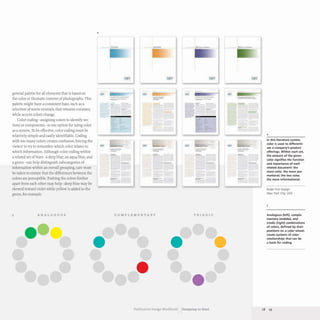
  • 61.
    GJ C ~ ~ m Id Sara Ballls c,;..- ..__ ""-- d.-: ... '.... ...... ~ . . . . . . . . ft ... «w.-......c..... ..... AIi.JIU ..... a- .. ~-........~- .. "f"'NI.... ~.l.. If., 3IOD Nrma '- rn- _............... .. If.u''l_ ............ . ~ ......u.....,....... t_ll"~_" ..,. ......'-. .... '2"'......, ... rany.. - -- --- .- -- - -- M _ _ - RECTO __ I .... b.,.... .........---............ . . . . . . . . _ _ .....1). ...,..,....._,1.- ........... t f ........ _ ... ~III ___N ....,.. ............,.,r .111..... _ .. . ...........................- III ........, ...,,.. ........... 111 ..... _ ..._ ......... _ .... t.... • .....• ......... ..-. . . I-."4JII'I .............., ...... ...........,................,."..,,"'... ....,..- ...............,,......... "An rUIl tllfJfll./t, qut~I'''!tt'' ,til!. I tn/l1ll UII }Iom. IICII'1"" .(Sl~ n'$f't/." ........-.-"........ ~ t::=-==--::====:-­ .......... *.MMd ?:--- ....-- ... ::- ..... wct .....IdIn.tu ....t.... .......................... .... ...". ,........,... ~ _.It_.,_... _II...,.. ......__ &t •• .-,........ MtW.. _ .. • .... ....u1 __ • t• ......... ...............-....."- .....~ _.".-,11".-. ....... ..._~ . .,r.,n -----............ .... .--....... ....... ,.,.,.... 'b.__ C ::!:' .......- " ..........,. C----_-.-. .......~--..,.. ........................... -' ............- ..........' -...... ,... ..IiIIlIlla'lll.-ln .................. ...... _ .." ................. ....-"""'...~-~ .......... ICCI .........""-'........., ....... ,..........1.." ... .... • ....."pIIfta .."".-........." ... ..._-................ ........... ",......... ........................ ..--- - -JIIiIiIIa ...*irfII. . . . .. ___ __III...... ... .............. CNiII" • ....'- ................ j . . . . . . . . , . , . . . . . . lItIi 1..a .......... ,.I1_ .................. .....,..,..-.~ ~..... e.ii= .... . £1._.-.. ..._- CALLOUTS (OR PULLOUTS) Short excerpts of the running text that are given prominence. Callouts can be quotations from a speaker who was interviewed for the text, or they may simply be important points that the designer or author feels deserve extra attention. SIDEBAR Content that supplements the primary unning text with more detailed informa ion. Often located at the outer edges 0 the publication (hence the term), but just s often found toward the bottom or top 0 the spread. CAPTIONS Descriptive clusters of text that accompany images, giving information about their content or creator. SUBHEADLINE Often shortened to subhead. Informational markers that indicate the beginnings of new subsections within a larger section, or new paragraphs within running text. RUNNING HEADS, FEET, OR SIDES Often shortened to runners. Informational markers that identify the reader's location within the publication. The runners may consist of any combination of the publication title, section, subsection, and author. Publication Design workbook Designing to Read 2 3 4 • coa= cookout Each of these page spreads shares structural ele- ments-folios, running heads, captions-treated in different ways. Note the placement variation in the folios, as well as that of the runners. 2 Premier Media Group Lakewood (WA), USA 3 AdamsMorioka Beverly Hills, USA 4 Faydherbe/DeVnnger The Hague, Netherlands . -- ~------ .,- -._- --- - --_.- --- ------- .- - 58 59
  • 62.
    Though a focuson the minutiae oftext legibility and informational clarity is clearly important, it must not distract the designer from the macrolevel ofpublication design: integrating images, colors, and other messages through dynamic layout and a clear, consistent structure. The publication is an object, with a front and a back, a size and shape-it is a tactile experience that its audience acts upon. Each turn ofa page must yield a new experience but remain visually, emotionally, and conceptually connected to the pages before and after. Much ofthe building ofa publication inter- twines the conceptual aspects ofcontent, the visual power ofimagery and typography, and the detail issues ofreading; no one element is truly more important than the other. Structure can be an inspiring source for conceptual messaging, as much as a force for organizing and unifying material (or helping speed up production). Looking at the microlevel oflegible typographic design, the ethereal messaging functions of subject matter and interpretive overlay, and the macrolevel ofintegrating the pages, sections, images, and type together creates a single form that packages all ofthese ideas into one final form.
  • 63.
    Format can meandifferent things. Most often, it refers to the proportions of a page. It may also refer to a project's organization. There is a conventional format to a maga- zine, for example: a table of contents, a letter from the edi- tor, a series of shorter informational sections related to the overall subject, and a series of feature stories. Ultimately, the question of a publication's format is one of the first a designer must address. CREATIVE AND PRACTICAL An appropriate format, in all its aspects, conveys ideas and also provides function- ality for the content. Addressing content functionality means differentiating the publication's informational parts, ordering them logically, providing them useful space, and distilling relevant visual ideas to communicate their varied messages. Who will be reading the publica- tion? How does brand perception influence the message? How should the subject be represented? How does this .... ' " .... subject fit the broader cultural context? The designer must also consider more concrete issues. How many pages might the text fill? Will the budget limit production options? Format choice may affect the publication's potential for display or the cost of its mailing. Sometimes, the format may be determined by something as arbitrary as the size of the least expensive press. STANDARD FORMATS Many large-circulation publica- tions adhere to standard formats, which are quite useful. Their ubiquity makes them conceptually neutral; they fit most display racks; their proportions efficiently use standard paper mill sheet sizes; and they cost the least to mail, since automated equipment is set up to accommo- date them. But designers need not settle for a standard format. Since readers expect the standard, slight changes in proportion create an immediate sense of difference in presentation without affecting practical concerns. r···. .... ....--..... .....-..' ........ Format proportions in the fourteenth through nine- teenth centuries were based on mathematical, architectural, and even musical harmonies, follow- ing developments in science and the humanities. The golden section, a mathematical system with roots in ancient Greece, has often been used to determine page formats. Publication Design Workbook Designing to Read 60 61
  • 64.
    BUILDING The Format's ConceptualPotential An Overall Shape for the Message Format plays an enormous role in the experience of a publication; its size and shape sets the stage for content and how it feels to the reader. The sense ofspace, tension, and movement in a given format changes as its proportions change.A square format exhibits a neutral space without tension.A vertical format mirrors the human body, creating upward visual thrust that is tense and active. In contrast, a horizontal format is restful, reflecting the landscape; its thrust is less dynamic and creates movement left and right. A choice of one over another, even at this level, has implications for the communication. The extreme to which a designer pushes a for- mat's proportions has an impact on perception. An exceptionally narrow or large format, for example, may communicate a particular attitude- unconven- tional or exclusive. The calming effect ofa horizontal 2 LETTER TABLOID A6 A5 17 X 22" format might enhance a subject such as gardening or health care. Harmonic mathematical relation- ships, first noted by the ancient Greeks and commonly used between the fourteenth and nine- teenth centuries, impart a sense of precision that may be appropriate for journals of math or science. However, purposely refuting a conventional format choice may add meaning and originality: for example, a format derived from the golden section or other numerical system for an exhibition catalog or a yoga newsletter. A designer may also explore formats based on the content's typographic necessities. As noted earlier, text legibility, spacing, hierarchy, and structure may direct the designer's consideration of the format. Some designers begin by exploring various text settings to deter- mine how much space the text will need and what page structure will best suit it, organically building the page outward from this internal typographic architecture. A4 A2 A3 Ai 6 BSCE f U. ,. "'iii" ... .• 1,2 The United States and European Union follow standard format systems. The U.S. Imperial Letter (8.5 x 11" [21.6 x27.9 cm]) and Tabloid (11 x 17" [27.9 x 43.2 cm]) sizes (left) form the basis of American publication formats; these sizes are left over from colonial English printing paper sizes. Tabloid is twice the width of Letter, and their aspect ratios are different. The European DIN or ISO standard (right) uses a proportional system based on a square meter of paper (AO size) whose aspect ratio has been engi- neered 50 that when it is folded in half, the folded size retains the same aspect ratio as the parent sheet. The A4 letter meas- ures 210 x 297 mm, (about 8'1, x 11'1,'). The aspect ratio in ISO sheets is consistently 1:1.414 (the square root of two), I • • " . . . . ... . Plans unvclilld for the Now BSC£ Perfonnina Arts Theatre at Fonner Warehouse
  • 65.
    3 'U h •••,.... nC'''' .. II t' .. UI1 ''''''-'1£1 IJIPUl10lRl .- .- on 4 otr •• I . , . . . . ..- -_ .. - .... - - -- ----- ______M_ --.,.- From Inside Out. Exploring typographic possibilities for highly readable text mayyield a basis for a workable column structure- essentially building the format outward from the most desirable text configuration tailored to the content. Working from this base, a designer may consider a variety offormat proportions to house the type structure, eachyielding a different spatial experience and, potentially, functionality. ~ ° R t1E .~ .............' .. 5 Extremes in format size can communicate just as much as the visual mes- sages of image and type, The PEN Canada annual (3) report, for instance, relies on its tremendous scale 7 BSCL at o This quarterly newsletter for an orchestral group demonstrates the impor- tant role format decisions can play, When closed, the vertical proportion is cost-effective for mailing; when open, harmonic proportion creates the perception of something mathematical and musical. The decision to accordion fold, rather than bind, permits the newsletter to open into a long, horizontal page whose proportions derive from a standard musical staff, The staff structure is further used to develop flowlines (see The Grid System, page 68) that integrate material across panels. STIM New York City, USA to establish undeniable presence-supporting its mission of bearing witness to human rights atrocities. The small·format pharmacy college annual (5), by contrast, presents an intimate and quietly credi- ble message-elegant, reserved, and academic. Its proportions are based on those of personal stationery. A letter-sized publication (4) is shown for comparison. 3 Soapbox Design Communications Toronto, Canada 4 Premier Media Group Seattle, USA 5 C" cle K S tudio San Francisco, USA
  • 66.
    BUILDING The Systematic Natureof Publications Unlike one-offs, series-based projects, such as publications, force the designer to consider variables beyond the basics of composition. Crafting readable text for a single page format doesn't necessarily solve spatial and hierarchic prob- lems for many spreads, or for successive editions, of a publication. Information in serial media changes over time. Designers are confronted by headlines or 3 titles of different lengths; articles that are one page long, two pages long, or six pages long. Some content will come with images and some will not. Therefore, designers must consider the potential requirements of content that they haven't seen to make sure that it can be addressed by the composi· tional ideas they've developed.Publications must be developed as systems in order to accommodate changes in content: each issue is a single object, but the visual logic of the publication must be consis- tently recognizable to its readership yet flexible enough to allow change in content. A system can be developed any number of ways, from organizing material on an underlying, consis- tent structure to tagging serial components with a recognizable element,like a colored bar or a typo- graphic device. In a serial publication like a newsletter, magazine, or newspaper, setting up a framework of measurements for columns and areas for images helps not only unify the material within a single edition but also allows for consistency between editions. In a system ofbrochures, the con- tent may reflect an overall subject matter parceled out into subcategories.This might mean that at least two typographic or pictorial tags must appear on all the pieces: one unchanging element that establishes the overall concept and a second ele- ment that distinguishes it from the others. The formats may need to be mixed or stepped so that all the titles are visible at once. Or perhaps the elements will be displayed within a stacked holder, with only their top thirds visible. These criteria impose limitations on the organization of the con- tent that the designer must take into account in the planning stages. After the designer has evaluated these issues and developed a list of limitations, the actual designing can begin.Their search is for a visual logic that will convey the meaning and emotion of the content yet work within the limitations so that no one component feels out of place or becomes problematic on a functional or production level. If the designer reaches this goal, the result is an organic system of parts that reaches the audience in a consistently recognizable way and allows for variation and flexibility in design as the system continues to expand. 4 2 -----~--.. Domestic Violence: How ro l.er Help -----...- E1dc:rcarc Scrvica Program _.- Publications are naturally systematic-they are serial groupings of related material. Both of these literature systems use (olor, format. and typographic treatment to distinguish their components as belonging to the same system. Each system is flexible to a different degree; the D.A.'s office literature is flexible in color and image; the mu- seum system is flexible in color, image, and format. 1,2 C. Harvey Graphic Design New York City, USA 3,4 Eggers + Diaper Berlin, Germany
  • 67.
    D D D D D D Buildinga System: AddressingContent Change How many different kinds of content will occur in the publication? How are the parts differentiated against the overall visual language: by image use, by color, by type treatment, by structure? What content will remain the same from issue to issue? What content will change completely? When content changes, will it remain approximately the same volume each time, or is it likely that the volume will change i.e., could the same content be short in one issue and very long in the next? Are the publication components serial, or will they arrive together as a group? Publication Design Workbook Designing to Read TAILORING THE SYSTEM FOR THE JOB Different publications require the development of different kinds of systems to organize them and provide consistency over time. Serial publications require an underlying structure that permits rapid changes in content; for example, in a newspaper, the mixture of articles on any given page may need to shift at any time. A newspaper's system of type- faces, their sizes, and informational hierarchy must be relatively simple; fewer choices for setting must be available so as not to impede quick layout. The structure of a newspaper- specific and consistent column widths- is also tailored to address quick change.Text may only fill a single column width. Newsletters and magazines may be somewhat less rigid in their structure, as more time is avail- able for their design and the emphasis on visual concept is more pronounced. Nonetheless, a recog- nizable structure is needed to unify each edition of the publication. Annual reports may change dramatically from year to year, both in concept and in structure.However, organizing the rnaterial in a given year's report will still require an underlying structure as well as recognizable typographic and image-related treatments, among sections and even among spreads within a section.
  • 68.
    BUILDING Editorial Pagination andStructure Page Count and Sequence Page order and section structure in publications are often based on historical conventions that derive from the physical reality of the printed sheet and longstandng production methods. Astandard press form (or broadsheet) in the U.S., for example, creates sixteen letter-size pages when folded in half upon itself four times. This signature, cut across the top fold, yields a set offour nested tabloid pages that share a common spine. The first page, as recto, is always a right-hand page; therefore, all odd-numbered pages are right hand as well. All left-hand pages are numbered evenly. This fundamental folded sheet, the signature, means that all publications must be considered in terms of having page counts that are multiples of four- unless the publication is perfect bound. In this case, the designer can insert individual pages (front and back) as needed. The pagination of the document is its full sequence ofspreads and signa- tures, used for planning the sequence of content. In popular jargon, however, designers will often refer to a single folded tabloid as a signature- meaning a tabloid sheet folded in half that yields four letter-sized pages. A twenty-page brochure, in thiscase, is made up of five such signatures, all nestedtogether and bound in the center. The inner- most signature facing the reader, when opened, is the centerfold. Whichever is meant by signature- the "real" sixteen-page folded broadsheet or the four-page folded tabloid- the fact of the four-page multiple, as well as the numbering rule-even on the left, odd on the right- still holds true for plan- ning purposes. Designers often sketch folding diagrams to see how the pagination plays out. 2 Bar 2104 Forslde 1 holts hotsllbarsr 14 15 Annonse dlageo J 29 42 43 Bakside: Annonse Allied Domecq 66 2 3 ~tf'b,r(~' Page numbering begins on the right hand page-the cover of a publication (the first page) occupies the right-hand position when the document is closed. Subsequent pages, therefore, are always numbered even on the left and odd on the right. Signatures-folded sheets of paper that create four sides-help determine the pagination in publications that are stitched together. 'ZIJ Rovldort ~.04.04 J ~____~____~ / barmlx Annonse barmix Anhonse Brewery ~~risaga tradln 6 7 8 9 10 11 71~ . v V J n{'on,se whiskype dlageo / I 16 17 18 20 21 3 Anno lense Annonse rinO/1es I ~11 '- ~ II -1'. Annonse ...... strem - '- See for Yourself. Calculating page spreads '- in your head is one thing, but knowing how many signatures a publication will turn out to be is important. Alittle slip in calculation may mean a page count that is indivisible by 4, meaning either too many or, worse yet- too few-pages to account for the content. Sometimes it's also useful to know where the centerfold spread in a saddle-stitch (stapled) booklet lands among the pages. Making a folding diagram, such as the one shown here, quickly clears things up. lounge lo . 22 23 24 25 V V " V romdrink ......... A'1.no;r., bibe un ........ '- - '- " 1- "s- "6' :z ." ~ ~ "". ... <, <0 "" ~ '" ' 'b
  • 69.
    The material leadingfrom a publication's cover to its primary content is called the front matter. This material may include anything from the half title and title page of an exhibition catalog to the intro- duction pages of an extended brochure system and, in particular,a table of contents. The primary con- tent area, the interior where chapters or sections are located, is called the guts or the well. Anything that follows this is referred to as tail-or end matter, including appendixes, indexes, reference-oriented listings, bibliographies, glossaries, and so on. Newspapers are notable for not having front or end matter; they're really just guts. Each section in the guts may have subsections or chapters or not. In publications with a full complement of parts, the front matter sequence is often an important part of experiencing the publication. It separates the reader from the outside world and, with each turn of the page, envelops him or her in the world of the publication. The designer may elect to include additional pages- spacers- between the required ones to enhance the sense of change from outside to interior. The table of contents requires intense focus to ensure clarity, both visual and editorial, and to link it conceptually with the content it lists. 2 A pagination diagram, such as the one for a magazine shown here, is an invaluable tool for a designer. Being able to see the full sequence of pages and signatures helps plan where content can be laced, and what effect adding, deleting, or shifting content between spreads will have on page count and flow. Creuna Design Oslo, Norway 7 - =- 4 _. _..... -= 5 --- :---- _..- ====---- ..,.,., --_.- -.-- --- --- =''''':t._""='===- -.-.- -- ----~~---- .....-.....- co=- ::!i:,--- ~--- -.~==;;;-;;:--- =--- 3 6 --- ----.._- --_...- ----- -- --- .- .. ----- .. ,. ----.. --- " -- --- .. -- ,. ---- .. . --=-::':--=-. ------ ----- -- _::":. Publication Design Workbook Designing to Read '-"- --- -- --- -- l;-~ -- The table of contents in a publication, no matter how simple or complex, is a page worth considering in detail. Its prominence in the front matter means it is one of the first impressions of the content and messaging that the reader will experience later on; above all else, however, it is a navigation device. Clear relationships between content listing- sections, chapters, subsec- tions, authors-and page numbers are essential. The variety of sol utions shown here merely hints at the possibilities. 3 Ruder Finn Design New York City, USA 4 Creuna Design Oslo, Norway 5 Allemann, Almquist+Jones Philadelphia, USA 6 Hutchinson Associates Chicago, USA 7 And Partners, NY New York City, USA · • · · • · - -- --=-:'l-=- 66 67 • •
  • 70.
    BUILDING The Grid System Alldesign work involves problem solving on both visual and organizational levels. Pictures, fields of text, headlines, tabular data: all these pieces must come together to communicate. A grid is one approach to achieving this goal. One grid may be loose and organic; another may be rigorous and mechanical. To some designers, the grid represents an inherent part of the craft of designing, the same way joinery in furniture making is a part of that particular craft. The history of the grid has been part of an evolution in the way graphic designers think about designing, as well as a response to specific communication and production problems that needed to be solved. Among other things, a grid is suited to helping solve communication problems of great complexity. The benefits ofworking with a grid are simple: clarity, efficiency, economy, and continuity. Before anything else, a grid introduces systematic order to a layout, distinguishing types of information and easing a user's navigation through them. Using a grid permits a designer to layout enormous amounts of information in substantially less time because many design considerations have already been addressed in building the grid's structure. The grid also allows many individuals to collaborate on the same project or on a series of related projects over time without compromising established visual qualities from one instance to the next. [ r ~ [ t- ~ t- [ ~ ~ [ t- ~ ~ t- [ ~ ---1l t- I Il ~ t- ---1l ~ - , II ---1l + + I IFIl + + + + II ---1l + + IFIl I Rows are series of flowlines defined by the existence of modules. Like columns, they are also separated by gutters. , , , , I I , , , I
  • 71.
    . i . l iI ! ~ j j The Anatomy ofa Grid A grid consists of a distinct set of alignment-based relationships that serve as guides for distributing elements across a format. Every grid contains the same basic parts,no matter how complex the grid becomes. These parts can be combined as needed or omitted from the overall structure at the designer's discretion. Columns are vertical alignments of type that create horizontal divisions between the margins. There can be any number of columns: sometimes they are all the same width, and sometimes they are different widths, corresponding to specific information. Markers are placement indicators for subordinate or consistently appearing text, like running heads, section titles, folios, or any other element that occupies only one location in any layout. Margins are the negative spaces between the format edge and the content; they surround and define the live area where type and images will be arranged. The proportions of the mar- gins bear a great deal of consideration, as they help establish the overall tension within the composition. Margins can be used to focus attention, serve as a resting place for the eye, or act as an area for subordinate information. Flowlines are alignments that break the space into horizontal bands. Flowlines help guide the eye across the format and can be used to impose additional stopping and starting points for text or images. Gutters are the interstitial spaces that exist between columns and rows-and modules. "The gutter," however, refers to the margins toward the inside of the spread, where the pages drop into the binding. Modules are individual units of space separated by regular intervals that, when repeated across the page format, create columns and rows. Spatial zones are groups of modules that form distinct fields. Each field can be assigned a spe- cific role for displaying information; for exam- ple, one horizontal field might be reserved for images. while the field below it might be reserved for a series of text columns. Publication Design Workbook Designing to Read 68 69
  • 72.
    BUILDING Column Grid Articulating TextStructure Information that is discontinuous benefits from being organized into an arrangement of vertical columns. Because the columns can be dependent on each other for running text, independent for small blocks of text,or crossed over to make wider columns, the column grid is very flexible.For exam- ple, some columns may be reserved for running text and large images, while captions may be placed in an adjacent column.This arrangement clearly sepa- rates the captions from the primary material, but maintains them in a direct relationship. The width of the columns in a column grid depends,as noted,on the size of the running text type. If the column is too narrow, excessive L hyphenation is likely, making a uniform rag diffi- cult to achieve. At the other extreme, if the column is too wide, the reader will have difficulty finding the beginnings of sequential lines. The designer can find a comfortable column width by studying the effects of changing the type size, leading, and spac- ing.Traditionally, the gutter between columns is given a measure, x, and the margins are usually assigned a width of twice the gutter measure, or 2X. Margins wider than the column gutters focus the eye inward, easing tension between the column edge and the edge of the format. This column- to-margin ratio is simply a guide, however, and designers are free to adjust it as they see fit. The column grid also has a subordinate struc- ture- the flowlines, vertical intervals that allow the designer to accommodate unusual breaks in L text or image on the page and create horizontal bands across the format. The hangline is one kind of flowline: it defines the vertical distance from the top of the format at which column text will always start. A flowline near the top ofthe page may establish a position for running headers, the pagination, or section dividers. Additional flowlines may designate areas for images only or for different kinds of concurrent running text, like timelines, sidebars, or callouts. I i i , I Any number of columns may be used in a column grid, depending on the format size and the com- plexity of the content. Flowlines define horizontal alignments in increments from the top of the page. Within a column grid, a designer has a great deal of flexibility for arranging type and image material.
  • 73.
    3 5 2 .-----_._- - ..... .... ------- ._- ---.._---- ._-- ---~ --..- -- --- --_.- -~-::--!:"'"-- ---_.- --- ' - - - -- --- -- ---- --- =..-.- --- -- --- -- - - - ---- -- - .--- -- -- -- - - - -- --' -- ----- -_.- - --- --_..- --- -- -- ----- --- --- - -- --- 4 _ tlmr -- -'--- - - --- =--...::::: ,-- -=- - ._-- ~~-­ ---- --- --- ------ :::::~.::"' =: -- ---- ~ -­ -- -- .~­ .._-,,- :::.-- .._ _ _ _ _ _ _ _ .. _:eiiiiO ..... _ ..... _ _ ,,.-_._--_.-_._..._-...-~,....-. _-___...._ ...- ..;w.~..-_ .._ .._--._---- ------_.._ .. ___, ....... _1 __ ._ _ - _ _ _ _ ...... _ -- -----_.. _"-_Wt_ _~_. _ _ •_____ • .-_ _..._-----_ ..._--_.._--- . -~---.-.. -.-"---....,......_.. -.----...-~ _ .._------- --_....._......_------_.....- ......""6io~.I__ .........._..........__. -_..........-.-....... --..--..----...... .......__.__. _.._01....._._____ ---.-------.._--- --..---Ip"',- ..----~.-.....~ _ .._-.-...._----......,...---""- ..._...__._--_.-- ,..-......,--.._ ...- -- .. --- _._._........,... ---........-_.- ----_..._-_...__...-.... ... .-~ .. _ _ _ _ IW ...... , , _ . , , _ , , ___ • ----_..._,--- -,-_.._--_.. ---_...- ----_.......---- _._,.....--.....------------- .....----------....--.... -..._--.----....---_._-- ...._---_.......- .....- _...._--- ....._._-- --------- _ ..__...--_.,..----_...._--- ------------_...._- --.--~--. --..------- --.....__.__.....--...... ----......... __...._.____ "'_"_'-1_...- Publication Design Workbook Designing to Read 2 The two-column grid used to structure this publica- tion relies heavily on its flowlines to create spatial distinction for subordinate elements, such as the arti- cle title and deck located toward the top of the right page, above the body. The flowlines are also used to connect ele- ments horizontally across the pages of the spread, introducing a lateral ten- sion that contrasts with the vertical repetition of the columns. The column gutter is narrower than the margins surrounding the columns, focusing attention inward to the body and creating a com- fortable separation for the text from the edge of the format. Flat New York City, USA 3- 5 Examples of two- and three-column grids, among the most (ommon used in designing publications, are shown here. Each exhibits differing margin proportions, (olumn measures, and flowline configurations. The potential for varying typographic width across the columns, integrating images, and differentiating columns with color to set off sidebars becomes clear. 3 Ruder Finn Design New York City, USA 4 Slatoff & Cohen New York City, USA 5 OrangeSeed DeSign Minneapohs, USA 70 7'
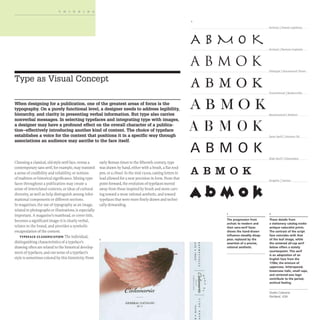
  • 74.
    BUILDING Modular Grid Text andImage Architecture Because very complex projects require even more precise control, a modular grid may be the most useful choice in such situations. A modular grid is, essentially, a column grid with a large number of horizontal flowlines that subdivide the columns into rows, creating a matrix of cells called modules. Each module defines a small chunk ofinformational space. Grouped together, these modules define areas called spatial zones to which specific roles may be assigned. The degree of control within the grid depends on the size of the modules. Smaller modules provide more flexibility and greater precision, but too many subdivisions can become confusing or redundant. How does one determine the module's propor- tions? The module could be the width and depth of one average paragraph of the primary text at a given size. Modules may be vertical or horizontal in proportion, depending on the kinds of images being organized and the desired stress the designer feels is appropriate. The margin proportions must be considered simultaneously in relation to the modules and the gutters that separate them. + + + + t t I I I L ~ L I = = f--. f-- = It tt C::::= It tt = L - Modular grids are often used to coordinate extensive publication systems. If the designer has the oppor- tunity to consider all the materials that are to be produced within a system, the formats can become an outgrowth of the module or vice versa. By regulating the proportions of the formats and the module in relation to each other, the designer may simultaneously be able to harmonize the formats and ensure they are produced most economically. A modular grid also lends itself to the design of tabular information.The rigorous repetition of the module helps to standardize tables or forms and integrate them with the text and image material. + + Here, a variety of modular grid structures shows a range of proportions and precision. The greater the number of modules, the more precise the layout may be, but too many increments becomes redundant. Variations on the number and stress of the module achieve different kinds of presence for the typographic and image content. 2 The modular structure of these foldout mailers creates an endlessly flexible, yet visually consistent, system for ordering information that changes in volume with each edition. The module's proportions, in this case. are derived from the measurements of the panels when the mailers are folded down. U9 Visuelle Allianz Offenbach, Germany 3 The modular grid used for this furniture catalog not only helps organize text and inset images but plays a role in how full-bleed images are cropped. The grid is shown reproduced on top of the third spread. Designwork SrL Udine, Italy
  • 75.
    Aside from itspractical uses,the modular grid accords a conceptual aesthetic. Between the 1950S and 1980s, the modular grid became associated with ideal social or political order. These ideals have their roots in the rationalist thinking of the Bauhaus and Swiss International Style, which celebrates objectivity, order, and clarity. Designers who embrace these ideals sometimes use modular grids to convey this additional meaning. 3 4 2 1 ... 2004. On c.fj """"1M" W ~ 12 ... 5oMInu~ ~..a. Pfng:stIt.t' iR .. 1M. ..ttt.ot.h " Uftd 21. ¥Oft 15 bh l' lJtoir." ,.... "W' t "" _In*,," protekCe - - =-- -I .. -, ~~ -, .. ---- = - ~=-- --- 4 The enormous potential for arranging images in a modular grid is seen here. Combining modules into zones for images (gray areas) ensures variety as well as a unified relation- ship with text. Publication Design workbook Designing to Read 72 73
  • 76.
    BUILDING Grid Development Text Basedversus Image Based Building an appropriate grid for a publication involves assessing the shape and volume of the content rather than trying to assign grid spaces arbitrarily. The shape of the content, whether text or image, is of particular importance. A designer may consider the text as the essential building block, looking at variations in the text setting to see how they affect the volume of the text. Another option is to consider the proportions of images as a source for the proportions of the grid intervals, especially if the publication is driven by its image content. The proportions of the images, if known, can be used to determine column and module proportions. The result ofboth approaches is that the structure of the page develops naturally from the needs of the content, presenting an overall organic, unified sense of space. IMAGE PROPORTION A grid may be defined by image content through comparison of its propor- tions. Beginning with a universal height or depth for the images and a consistent alignment among them will allow the designer to assess how varied they are in format- squares, verticals, horizontals. The designer must then decide how the images are to be displayed in terms of their size relationship 1 to each other: will the images be shown in sizes that are relative to each other, or will they be allowed to appear at any size? Ifall the images hang from a particular flowline, their depth vary- ing, the designer will need to address the images with both the shortest and deepest depths to deter- mine what is possible for text or other elements below these variations. From these major divisions in space and the logic that the designer uses to gov- ern them, a series of intervals may be structured for the images and for text areas surrounding them. It is also possible to structure the grid based on how images will be sized in succession. Perhaps the designer envisions sequencing the images a particular way: first bleeding full off one page, then a half-page vertical, then inset, then a three- quarter bleed. These proportions, as they relate to the format, will define a series of measurements, which can then be combined or systematized to help determine the spatial intervals of a grid. TEXT ATTRIBUTES Alternatively, the designer may approach the grid from the perspective of the text shape and volume.The sheer amount of text that the publication must accommodate is an important consideration. If each page spread must carry a particular word count in order to fit a pre- scribed number of pages, the designer will have some sense of how many lines of type must appear on each page. This variable may eventually affect the column width or depth, but the optimal setting is a good starting point. Achieving an optimal setting for text at a given size and in a given face will indicate a width for columns; from there, the designer can explore how many columns will fit side by side on a single page. Adjusting the size of the text, its internal spacing, and the gutters between columns will allow the designer to create a preliminary structure that ensures optimal text setting throughout. From this point, the designer must evaluate the resulting margins- head, sides, and foot- and determine whether there is enough space surrounding the body to keep it away from the edges of the format. Since optimal width can vary a little with the same text setting, the designer has some leeway in forcing the columns to be wider or narrower, closer to or farther away from each other, until the structure sits on the page comfortably. In this hypothetical study, several sou ree images, each with different pro· portions, are positioned relative to each other to help determine where their depths and widths might correspond. Shifting the images around each other creates a number of possibilities for distilling a grid that will accommo- date them all.
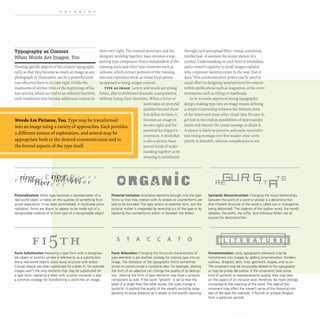
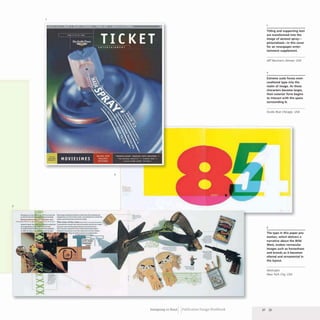
  • 77.
    2 The leading ofthe body text, decks, callouts, and captions may have some proportional relationship based on their sizes. For example, the body text may be 10 points, set on a leading of 12; captions may be 6 points set on a leading of 9; decks may be 15 points set on a leading of 18. The numeric relationship between these leading measure- ments is 3 points; a certain number of lines of each text component will. at some depth interval. share the same top and lower baseline, and this depth interval may very well indicate the depth of a module. Conversely, the body text leading may be used as a standard: perhaps an eight-line depth of the body text defines the depth of the module, and then other text components are adjusted to work around this proportion. 2 Ingua ran €Ju~ r tent Europan Li n ~ es. It occidental:I1lJ !(c y,lSla9. va semblalilJ [6151111<11 4 ..--- -- ---- .........weo_....,·._N...,.,.. ... "~ .......... ...,...-ICId _ ~ 0I!n"c:-. ...--.- - ---- --- --- _ .. -- ......-- --.--- ..__... --"- -- --• • .' • • :....-~-­ .. --- ~-- -- ~ ----- • t ----- . -- ......... 0....1..... _ ---- !-===~ ._- - .... -- -- ----- .._-_.. :::~:~:: ---- =-.:.::::, -- 0 _- 0 _ _ _ ~=-- -.---~ --- --- _.- -- ---- --" ---- -"-- -._.-- 3 Grid Hybrids and Combinations 3 Using a compound grid builds a certain rhythm into a publication. As the grid changes to accommo- date different information, the rhythm of each grid's occurrence becomes an integral part of the pacing and style of the work. 4 Depending on the complexity of the publication, a designer may find that multiple grids are needed to organize the content, even within A compound grid is used to separate continuous text from categorized or listed text components in this spread from a trade newsletter. The top two thirds of the spread is organized on a three-col- umn structure. while the lower third uses a four-col- umn structure. Both grids share the same margins. a single page spread. Working with several grids together can take several directions. First, a grid with a large number of precise intervals may be developed as a basis for a variety of grids used for particular information. For example, a grid with twenty columns to a page might be used to order a five-column, four-column, two-column, and three-column grid with a larger margin for captions in a specific section. In this kind of approach, all of the column widths will share a proportional relationship that will also be noticeable in the way images relate to text set in these various widths. OrangeSeed Design Minneapolis. USA --- --- - ---- --~-- -- --- -d ' _ _ _ ---- -~-- ...__....., - - . - ---- ---- ~ - --- ---..... - .... --.. ~ - -..-. _ ..- ---_. - --- --_.. .._ .....- _. ---- -- _.. _-.0... --- - -- --- -_... _ ...--- _. -- .....--... - . ...- .._- ........_- ~- --- ~~ !.."=...-- - • .-........ --- _00_- ---_... -.~- .. _ .._- • • ..--:.:.::.:-- 0 _- --- --- --- ='="-- --- -...--- --- --_.- -- - - - - _...-- ---- Another option is simply to use two, three, or more different grids that share outer margins, allowing them to be relatively arbitrary in their relationships to one another. Using this approach, the alternation of the grids will be pronounced because their internal proportions are unrelated; the resulting differences in visual logic between layouts using different grids can make very clear distinctions between sections or types of content. Another option is to combine grids on a single page but to separate them into different areas. For example, primary text or images might occupy a three-column grid in the upper two-thirds of the page, while a five-column grid may hold captions or other secondary con- tent in the lower third of the page. Publication Design Workbook Designing to Read 74 75
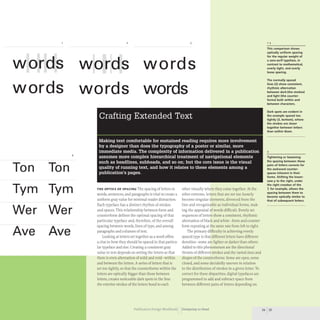
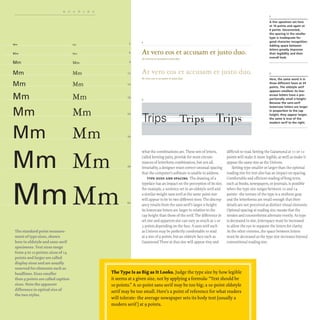
  • 78.
    BUILDING Grid and ColumnInteraction Logic and Rhythm The way in which columns of text interact with negative space is an important aspect of how a grid is articulated. The spaces above and below columns play an active part in giving the columns a rhythm as they relate to each other across pages and spreads. The options available to a designer are endless but can be described as fitting into three basic cate- gories: columns that align at top and bottom; columns that align at top or bottom and rag at the other end; and columns that rag at top and bottom. Each kind of logic has dramatic impact on the overall rhythm of the pages within a publication, ranging from austere and geometric to wildly organic in feeling- all the while ordered by the underlying grid. Changing the column logic from r l .......-....,,, ,.._ ............, .._.....- ..""_......... ,-"...'..." ."""'-~- ,......~--~, ~ .... ".::~.....~ -_........ ~=t ........ y ......... ......."""........,. ''-''''''''''C>no. -'-""''''' 0<0*.... " "''''' "''''''''''''-•. 1 ,,.---"'......... ..."""'",,"'" ....__. ..._, - u _ _ .-.. .. -"'_....- ....._....."" ......-'.......... '-'''~''''''''''''~ ~~~~~. ~::"'''''::.'.;::;; --"""- "'~....-. ,,-_0<,-.., ........-- , .._ , I . . ....... ..'_ ..._.. ...,,.'......... <......~ .... - ..., .._....- ....._.- ,-"..."". --~- -~-.. ..- :..."":":'~:: -'-'''- ;:"::"'Ei: -""'~""" "-"""- ,_ ......,..e.... --~, ....... O«_~ """"" ....,-,""""',. ..- ..'...... --",,"'" ...._- --- u _ _ "-..,, -""'_.... ....._....."" ,......._ ... -".~ ...........'" ~.:. ..~';!.~ .............,.., ........"" -""'" --"'...- "'~-. "" __ 0<_ _ " ..._ ........... ,_...•-<. ..'....-_.. ...........................~ .. ~';':::.:-.."';:= ~-::=:..'r,:.,.-..::. ....._.-~....-.- ,-""'''''' .-".." ..., --.~- .~..-...~­ ........-....- ~ ..~-~, :"''''':':::.::r.':. :"_~:..~ -_............_...""" ;:~E:: ~=:: ......,......- .................., .._ .....- ............-.. ""_ ......... c-b ,_""~.,,..c..., _._~t_.", ,.........,...,...... "'"....~ ......,.,. "'_.............. ....,-,"""'~ ....._,.,...,.", ..--....'- ."-.....- -....,........... --......~ ........-- ...._- ...__..._- u _ _ ,,_ ... l' _ _ ~""" .. ""'..._.,..- ........._."" .......-..........10<,- ,..- ..._._....__... - ,....._...... .-..~ ....,,, ....- ;:~ ..~~, ~~,::..~:. .............- ~ "" - ..- ~_""""'IO<" .......... .....""" -_.....---""..... 0<0M0<.... _ ' " ~ __ ""_ ... ~toI •• __ ""...... ' ......_-"..._- ,.........."-.. ~""'""',' ..-... ..._ ...._.. ...---.. ....,-......... ,,~·=;w .....!..-.:;:. ....._.R...... :::,-:.:.:..~- ~~""...""" "'-'- _.........,... -_.-." " =.,.~.:::..""'" =...""::::'..:..-:' . ..--....,...... _"""'W<""'" I .... ·""" .......... "".""","'- -......--,. ,:.";:;:.~::.':" ...._- ""--, l'_..... ~__.. ___......""'.roo- _ '_.n....... ."'-".......' ... f.:.~~~ r" "" ............M -"""-- ,.--""..~ "'-- ..-....."",.....~ .."...-...- ",",""",' ..-_. ...- ....... ..._ ......'" -~ ...''''-.. ~ lI _'.....,. f,_ . .. _ ...... "",.,,-- -...-, .~-, section to section provides yet another method of differentiating informational areas.The designer, however, must carefully consider the rhythm of that change.Some regularity or system must clearly exist in the alternation of column logic to appear meaningful; otherwise, the audience simply recog- nizes the change, not its significance. ment will be thrown out of alignment with those in the other columns. In hanging columns, this break in continuity of the baselines may feel appro- priate because it relates to the sense of the columns' changing depths. A problem will occur in a page spread set with columns aligned top and bottom, however, if the paragraph space introduces an uneven measurement: the lines of text at the foot margin will be noticeably off. Setting columns whose tops and bottoms begin at staggered inter- vals complicates the issue further.The designer When columns begin to separate vertically, shifting up and down past one another- or drop- ping to different depths while adhering to a single hangline above- it is important to consider the relationship between lines of text across the gutters separating the columns. In groupings of columns without line breaks (or with hard returns of the same leading) between paragraphs, the baselines between columns align. If there is a proportional increment between paragraphs in one of these columns, the baselines of text following this incre- has the option of making the baselines between columns correspond- introducing the linear regu- larity as a contrast to the shift of the columns' beginning and ending points. ...,,,............ ,"""'.,.....-~, ..-... ......... ..........<.- _"...,001' ......_u_ -~""' ..."" ..._.,....., _'n""",'''' --'...- ::::Ii: .............-.. ..._-'..... -"",..".",,,," ,....""",.......... "',.....~ .., ...,.,. --,......,. ..- ",.......... "" ............. ...._- ~-­ ~ ........~--" "''''''-'''''- ............_ ..... '.----"" ~ , ....""",",- ~..~::~~';. ~"" ........."... -""-" --.....~ ..~-­ ...--"",."", ......-...... -',''''_' ................" "'-'-' - "...,.....,... _" _ ....... ,,-.~ ........... ""'.- ....~ ~--,,~~ .................. .....""""'"'""" ,--.,....."'"~ , -,'..._.... -._........,... ..--- ~""-'- ............- _,,,,,,,,,, ....m . ... _ _ _,, _ _ _ u_ ........""""...........,,_........ ...._.".""', "'_......'" ...-............. _ .....,,"",.'" --'...- ...-."~-. ~!'~::':' =..::tro:J:": ............-.. :.............-., ....."''''''.........._ ,,- ......."'...".c.... _""'''''''<C _ -_.._- .....-...._- _ ......... ,.,. OwdootoI ..... _ "'_''''''.,'r''''_'_.' ....._ ...........-........... -............. -,_........ ...._- ....._.- --............._ ...- u _ _ ~."'_'" lI ............__ .. ..... "'.......roo- _~ . _.,.. ....._........ "",_.",,,,.. ........_,... ''''''''''''-'- :-~~~ ::-:~~:.~ .............._ A ................. ........""..._" -"'-"" -_..--_..- ..,~-. "-"'-- "--""'''''' ..---~ .., ...._- .., ...._ ....- ",......, ........."......."',''''- ..,""""- ......~ ...'""""'- ........ ~:~~.r.~ ~:::,.~ """',lI_""" ...._U_.......... IT"". .. """ ......· ....-0 .. _ ....... ...._- ""._,- ."""""..-.-.....- ............,....... ,,.-., .....- ~ ,, ............- ....._ ......... -""","", --.,,- -~-...""" ..._ ..,....., -'''-'.'' --,._-, :=-F.: _It.......... ::"'''":',~~ '....--..-.... oa-......._ "'_,,,,,,",,,,' .......'........... ""_........ ...._- ~-­ U_'.......-.... ---",-"",.,... .....,_...,..... '........_... ::':':~Z~~ . " " _ .....M .......,.._"'" -_ ..- "'-- " --",,,.,,~ ~""-"'''' ....-...,.. ,...., .............. ~.-... ....- ......_ .- -'''''''''' -'-.."- ~ .."""....... "'-'''""",' ",,-'-'"'''' --'...- &:::..;::::' ............-.. .._""'....... ""...",...".c...to -_..-.... ~""''''' ~-,......,. ..- .......... ~ ............. ...._- ~-­ lJ __ ",",_,,, ........._ ..... ...._......... '........'.......' ... ::::=~ ...._ ....... .......,,,,,-,, ...-...... ",-,,,"",, ,,.........._..... -'''''-"'"' .._........,... .._"'"'- ~ ....-.- ......_._... -''''''''' _.""'- _ - . . " _ _ _ U _ ........"""................,,_........ ","_.,_10<, "'......._ _ ."""...... - '"'''-''''' --,...~ --"~ .... =~~I::: ::r~:": .................. _ .......- ....."''''''- ..._ ,,- .....~"' ...".c...to _ ......"~,,... --""-- .....-..._ - ""-~""""" "'_.....,.. ..._,"""'.,....__.. ....._ ...'...................." ... -............. --........ """-- ....._- ...- .............-...- U _ _ "_,, " _'.....,..""" .. """""_.",,. -..._.,.. ...._........ """.-'"'''''' '.....-- ,... '--'- ::£~~~~ :'-::::T:~:'~ ................M .................~ "-"",,-.r _ ", _,,,, -_..--_...... "''--- "'''-- ""--"'- "'--""'''''''~ ..,...._ ...- .., ..._......., """"~'''-.' -.,.",- ..."""'-......" .......__.. ~··;ftt,;,r;~ """',lI_""", ......-do....,,, ,.-", ...._.... "-"'""- " ~''''''' ' -''' _...'.... --,,- ...~ ,,-...- ..._ ........... ...M.........'''' ..._ .....- '-_..-"'" ::-,:,-.:::.;:::,,,,, A_".._ ..._'...... .~..... ",....<..... '....--.....- 0«-..0 ..,,,, _ ....._,,.,...,... ..-............ - ,""-" ~.- ""'.......- ...--...- LI _'.......~""'"_ .................. -,_........ ................... ="'S!~:. ................. - ,,",-,,", -_....... :~ ""'--' ...""........... -.--- .._....- ~ ...-.,...... -'''''''''' --,,- _.""-'....... "'-'- _............. ..._'•..- ;;::!'~:: -,....-" .._""....... .....~"' ......""'" _.-.""-- "'"....~ ......"'" ",--,--.,' 0<_... ... ' _ -- ~ ...... ...._- "'-'- u_ •.,.. ,,_ ... """"'_'roo- ....._M....".. <~-- ... ~~~=~ ...._"'- "-""-" --..~- --- ""-.",,,,,*",,, ..' .....--- ...-...... ,--.,.....-~, ..-.......... ......_.,...... ""-,..."'", -'-.."- ..........""""..... ..._.,_10<, ...-............. ..._'...- ~~~~ =~;::::' ........""',.- ............-.. ""'-'''- ..._""'........ ._~ ..,_ ......."'...".c-o --,,- --""-- ........~-...- ~""""''''' =" .... ""t.:':;"i.'.: ;".=::.~. .............""" ................ ::5:"'::: ?~=:.: -.~-- -...._."" .._ ..............._........ .-""~.""'''"''' <",..- - " " '........."'-- -,"~-....~ --"'.....- ","""",",,~ - ,, _ ......,.,...,., . "_~N .'-_ .....- ............- --................""-" ...._- -_..- ..._ ...- "'~-' LI_ ....... .-.... "" __ " " _ """ ..._ .... ~ "" -- ..._,....... """...,'"-''' ."""""..............,""""-....,..." ~~~~:.~ :'~'';'''e~ "-""'.""'" ..-"'- .""........_M _........... ---- -,"-- ,,_.....-"'.... ...._- Be Clear about It! The differences in interval between column beginnings and endings must be decisive and considered for their rhythm. The heads and feet ofthe columns may be decided spontaneously or may be determined by the existence of flowlines or modules in the columns. Columns justified to the head and foot margins, or to a specific module depth. create a rigidly geometric band of text. Hanging columns provide a measure of consistency. balanced by their changing depth. Columns that change hangline and depth offer the most organic (and flex- ible) option for arranging text, especially in terms of integrating images.
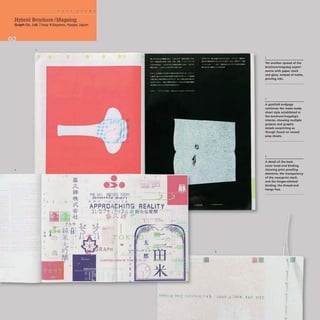
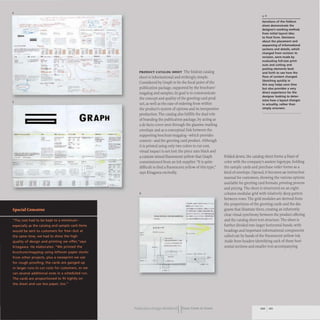
  • 79.
    2 3 .... __1GnA -"'-- =:::::==-==: Variation and Violation Avoiding Repetitive Layouts A grid is truly successful only if, after all of the problems have been solved, the designer rises above the uniformity implied by its structure and uses it to create a dynamic visual narrative of parts that sustain interest page after page.The greatest danger in using a grid is to succumb to its regularity. It is important to remember that the grid is an invisible guide existing on the bottom-most level of the layout; the content happens on the surface, either constrained or sometimes free. Grids do not make dull layouts- designers do. Once a grid is in place, it's a good idea to sort all the project's material, spread by spread, to see how much is appearing in each. A storyboard of thumb- nails for each spread in the publication can be very helpful. Here, the designer can test layout variations on the grid and see the result in terms of pacing- the rhythm of the layouts. Can there be a visual logic to the way elements interact with the grid from page to page? Do pictorial elements alternate in position from one spread to another? Perhaps the sizes of the images change from spread to spread, or the ratio of text to image changes sequentially. Even simply placing images toward the top of the pages in one spread and then toward the bottom of the pages in the next achieves a powerful sense of difference while still ensuring overall visual unity. It is necessary to violate the grid, sometimes because circumstances dictate it- content that must occupy a specific spread won't quite fit- or because it is visually necessary to call attention to some feature of the content or to create some surprise for the reader. Within a rigorous grid structure, violations must be relatively infrequent or relatively small, or they begin to undermine the reader's sense of the grid's consistency. It is also important to note that any specific item or general layout that violates the grid will be very dramatic. Disturbing the regularity of a column of text by allowing an element to jut out past the alignment will not only be instantly noticeable but will also cause the wayward element to shift to the top of the hierarchy- it will become the most important item in the layout because it is clearly the only thing out of order. A full-spread layout that ignores the grid established for the remaining pages of a publication will be memorable within the publica- tion. The problem facing the designer in making ...................... -- ..- - - - - --_._- --_. - 2,3 Left-hand and right-hand images correspond to each other in relative position and proportion between these subsequent page spreads, but the designer adjusts their relation to the grid in each to create contrasting inward and outward focus. Interkool Hamburg, Germany Give It Some Bounce. Asimple trick is to arbitrarily cluster images toward the top in one spread and then toward the bottom in the spread following. Sometimes forcing a small, medium, and large image into a spread-then using the same sizes but placed in different locations on the next spread- will quickly create movement across the grid. such a dramatic decision is that of integrating the layout into the publication's overall visual logic so that, despite its extreme difference, it remains unified with the rest of the publication. Usually, this can be done by maintaining the same typefaces used in other spreads,as well as by applying the same colors from a standard palette. Additionally, the designer must consider the transition back into the grid-structured pages following the violation; if the pages following the particular spread are a continuation of its content, the designer may add smaller violating elements that reference the major violation while adhering to the regular structure. Publication Design Workbook Designing to Read 76 77
  • 80.
    BUILDING Visual Relationships betweenWords and Pictures Getting type to interact with imagery poses a serious problem for many designers. The results of poorly integrated type and image fall into two cate- gories: in the first, typography is separated from the image areas, while in the second, typography is reduced to mere shape and texture. Images are com- posed of lights and darks, linear motion and volume, contours, and open or closed spaces, arranged in a particular order. Type shares these same attrib- utes: it is composed of lights and darks, linear and volumetric forms, contours and rhythms of open and closed spaces, also arranged in a particular order. The task is finding where the specific attributes of both come together. Laying type into or across an image is a quick way of finding visual relationships. Their immediate juxtaposition will reveal similarities in the shape or size of elements in each. The rag of a short para- graph may have a similar shape as a background element in a photograph.An image of a landscape with trees has a horizon line that may correspond to a horizontal line of type,and the rhythm and location of trees on the horizon may share some duis autem velure duis au qualities with the type's ascenders. At the opposite end of the spectrum, the image and the typographic forms may be completely unrelated- they are in opposition to each other. Opposition, thus, can be an equally viable for integrating two materials: a textural and moody image with great variation in tone, but no linear qualities, may work well with typography that is exceptionally linear, light,and rhythmically spaced. The contrast in presentation 2 duis autem velure helps enhance the distinct visual qualities of each. Consider the location of the type relative to the image and the attributes of the image'S outer shape in relation to the format. An image cropped into a rectangle presents three options:the type may be enclosed within the image; the type may be out- side, or adjacent to the image; or the type may cross the image and connect the space around it to its interior. Type that is placed within the field of a rectangular image becomes part of it. Type adjacent to a rectangular image remains a separate entity. Its relationship to the image depends on its posi- tioning and any correspondence between its com- positional elements and those in the image.The type may align with the top edge of the image rectangle or may rest elsewhere, perhaps in line with a division between light and dark inside the rectangle. Type that crosses over an image and into the format space becomes both part of the image in the rectangle and part of the elements on the page. Its location in space becomes ambiguous. TYPE AND THE SILHOUETTE Silhouetted images- whose contours are free from enclosure in a rectangle- share a visual relationship with the rag of paragraphs or columns but also share an opposing relationship with their alignments. Type will appear to change spatial relationship when placed on, in, or next to a cropped image. This spatial ambiguity may also involve the space around the cropped image, creat· ing a connection between the field, image, and type that brings them together in space. 2 Placing the type directly onto the image permits a quick comparison of the shapes within both ele· ments. In this example, the type repeats the scale changes. directional move- ment, and tonal variations found in the photographic image.
  • 81.
    4 3 c:.o......... .._-,- ...) ~.....--..-,..-......-....... ----.-.._--- r.__ ~. ___ .... _ _....-......._....____ .._ .. ... . ___-.._........ ---...~.-"....._ ..__.._- -.----.~.-.-. ....... .... _'-~ ......'" . . . . . . z:zj 4-_ _ _ _ _ .-........ ' - -.... _ . ""'. "",-,,~ ......._u.-.......... .........................-M...,..._... '-' 4._._ ~._...._.. _ _.. _ .......... _ .. __ • _ _ "' .. ____ -4_ _ .. _ ---.~-- ....--....------.. --------~ I _.~ ____._.__..,.'_ _ _ _.___ __.........n_...__ ,-=t -~- --- -- -- _...._ ...."' ~ .......___..____..,.......-......__ __ :t. ~ . __ --..--_......,.._--.......-...... .......- ........._...... - ..,..--_.._-_...._.........__ ..._------- -- ..- ..- --......~-- .- - ---...- ::::.:_~ -.......- ---- ------- -------- --- L==,... ..-...-----------.----~ ................--.._.._ .. -""-...........~-..--..- -- ---- _..._- --- ==-=- lingua franca va esser plu simplice regula quam Ii exis tent Europan lingues. It va esser tam slmquam eras occidental: it vaoccide ntal simplificat ang quam ./ glori amico dit meque rna quande lingues coalesce duis - t~e-R =-.::=..-..,,'-__....._ t --~ ..__ , -. --- _ ......-- --- -- .~--..... .. --..-.....-....-.---- :=== ...-......-'"'----- _-...._.. ' --.....--~- ... _ ..___.....---....___aM t _ .. _...._-- _ .... !.t,.. ..._ _ --....__..._-.... -- -a-E Type adjacent to a silhouetted image offers more or less contrast or similarity depending on its location relative to the image. If the rag leads into the image contours, the two elements flow together, and the type may seem to share the spatial context of the image. Bringing the vertical alignment of a column into proximity with an image's irregular contour produces the opposite effect: the type advances in space and disconnects itself from the spatial context of the image, appearing to float in front of it. The strong contrast between the aligned edge of the type and the contour of the image may then be countered by the irregular contour of the column's rag. FORMAL CONGRUENCE Similarities between type elements and pictorial elements make a strong connection between the two.Every image portrays clear relationships between figure and ground, light and dark, and has movement within it. Objects depicted in photographs have a scale relationship with each other and proportional relationships with the edge of the image. When typographic configurations display similar attrib- ea-rs utes to an adjacent image or expand on those attributes, the type and the image are said to be formally congruent. There are an unlimited number of ways for type to become congruent with an image. The selection of a particular font for the type may relate to tonal or textural qualities in the image. Instances in which type extrapolates the formal qualities in an image create powerful emotional and intellectual responses in the viewer. Type that is adjacent to an image can also be formally con- gruent in terms of its position relative to the image. In this kind of formal congruence,the image exerts an influence on the composition of the page as a whole. Even if the type retains its natural architec- ture, it may still react to the compositional archi- tecture within the image.All three elements- image, format, and type- appear to share the same physical space. FORMAL OPPOSITION Another means of integrating typographic elements and images is to relate them by contrasting their visual characteris- tics. Although seemingly counterintuitive, creating 3 A mix of sizes and spacing within phrases skews them toward becoming images, helping integrate them visually with other kinds of material. The arrangement of the image in the lower-left corner with the changing head- line creates a series of stepped intervals whose lateral motion balances the image's downward and leftward pull. The red 9 creates a counterpoint to this activity. Callout information, arranged in smaller stepped blocks to the right, takes a cue from the main composi- tional elements. Jeff Neumann Denver, USA 4 The relationship between the image shape and the rag becomes dominant if the rag enters into the image's contour; the geo- metric alignment in the same block of text will naturally counter the irreg- ular forms within the sil- houetted image. Publication Design Workbook Designing to Read 78 79
  • 82.
    BUILDING I • Pl III itl okt t&b I.iJ 1" 1 lhi llU lilt ~1. 1 J _L 2 - • • c '" - .g CO .... ... 'to: .. CO 5 ;" ~ '" - .- c ::: - ~ '- ~ ::. - • CO Q. CO In this spread from a course catalog, the verti- cal. linear rhythm of dress forms is restated by the vertically oriented type. Studio Blue Chicago. USA 2 The designer responds to the compositional language of the image, using the alternation of small and large scale forms and spaces-as well as the angled linearity of the drawing-as inspiration. Studio di Progettazione Grafica Cevio, Switzerland
  • 83.
    4 fonnal opposition betweentwo kinds of material can actually help clarify their individual character- istics. Contrast is one of the most powerful qualities that a designer can use to integrate material- by their very difference, two opposing visual elements become more clearly identified and understood. Within a letterfonn combination of an M and an 0, for instance, the fact of the M's angularity is rein- forced by the curved strokes of the O. The move- ment within each form is made more pronounced, and the two elements essentially fight for domi- nance. The caveat is that some congruence between the elements must also exist so that the opposing characteristics are brought clearly into focus. In the same way that a hierarchy is destroyed if all the elements are completely different, so too the strength of the contrast in opposing forms is weak- ened if all of their characteristics are different. 3 The same abstract pictorial qualities of image and type are the source for creating opposition, as they are for creating congruence. A soft-focus photograph with muted detail and light tonal values overall may suggest a bold-weight sans-serif typeface; another option may be a regular-weight modern serif face with a great deal of contrast in the strokes- the opposite of the photograph's lack of contrast. Yet another option may be a lightweight text with very active details, so that the passive, neutral character of the image is counteracted by the stylized quality of the typeface. In all three cases, some quality of the type is congruent with the image, but its primary quality is formally opposed to it. FF 5 Publication Design Workbook Designing to Read 3 The numeral and the figure have similar shapes and movement, but they also oppose each other formally-the numeral is a solid, angular line, while the figure is tonal and organic. CODEsign Rimini, Italy 4 The position of the text block in this page spread mirrors the white mass of the model's sweater on the left-hand page. J.Crew New York City, USA 5 A study of two letter- forms, 0 and M, reveals both congruence and opposition. Their inherent differences are made more pronounced by changing the posture, weights. and positions of the letters. 80 8.
  • 84.
    BUILDING Sequencing and Pacing: CreatingFlow among Pages The pacing of a publication is one of the most important considerations for a designer. Pacing can be understood as a kind of visual rhythm, a cadence or timing that the reader apprehends from spread to spread, almost like a film. By varying this rhythm-from slow to fast, or from quiet to dynamic, for exam- ple-the designer can accomplish several goals. One result achieved is strictly visual: each turn of the page engages the reader in a new way by varying the presentation. Another result may be that the reader is cued to a significant content change, as the pacing clarifies the informational function. Much of a publication's flow is determined by its overall structure. Magazines, for example, are often divided into sections: a series of department pages that recur in the same order every issue, along with a sequence of feature stories that changes every issue. Within respective types of publications,such predetermined sections will likely differ because they present different kinds of content. Within each section, too, the designer must establish visual variation so that the reader, while recognizing a consistent structure, doesn't become bored. PACING STRATEGIES Every project is different, so the ways in which a designer may address pacing in a specific project are unlimited. Most pacing strategies, however, can be distilled into two basic overall approaches:strategies focused on structural variation, and strategies that adjust content presentation. Structural variation, as an approach to pacing, is essentially neutral in its affect on communication; the goal is to differentiate sections, or even spreads within a section, by articulating the content on a grid in noticeably different ways- or, as an alterna- tive, by using a different grid in each section or spread to give it a particular character. The effect of structural variation is primarily one of rhythm, in which the elements change scale and position but not their inherent content. For example, one section of a publication may use especialy large images bleeding top to bottom and each spanning different column widths, interspersed with text, to create a lateral breaking of space; a section fol- lowing may reverse this logic by emphasizing row structure to create long, panoramic arrangements of image andaccompanying text. The first structural approach will yield a speedy, rapid-edit quality to the pace of the spreads, while the second will pro- duce a slower,more drawn-out feeling. Hanging images from a flowline near the top of a spread will contrast with another spread in which images are hung from a lower flowline or in which images bleed the page formats. The use of such structural strategies may be arbitrary,or they may reflect some feeling intrinsic to the content. In changing the presentation of content- alter- ing the overall color schemes of various sections, changing the visual language of imagery and type from spread to spread, or creating a progression in value or complexity from light to dark or simple to complicated- is an alternate strategy that primarily affects mood. As an approach to pacing, it is far less neutral in its result and will greatly affect the mes- sages transmitted by individual sections or spreads, as well as the overall emotional journey experi- enced by the reader. In these pages from an exhibition catalog. the alternation of full-bleed and inset images-as well as the alternation of text and image spreads-is one of the primary pacing strategies. faydherbel DeVringer The Hague, Netherlands 2 The text columns in this annual report, which always remain the same width and are separated by the same gutter, are allowed to shift left and right against the outer margins to accommodate photographs with differ- ent proportions. This alter- nation creates a lateral movement and different tension between interior and exterior from spread to spread. Ruder Finn Design New York City, USA
  • 85.
    2 • - • -- • .. Publication Designworkbook Designing to Read
  • 86.
    BUILDING Structural Variation A gridpromotes consistency by virtue of its regularity but presents the designer with a potential pitfall: repetition. The designer must rise above the grid's uniformity to create a dynamic visual narrative that sustains interest page after page. Regardless of the content's treatment in terms of color, imagery, or typography, the structure of a publication can be articulated in a variety of ways. - - - Overall Progressive Sequencing • - Image and text are articulated on the grid beginning with one type of logic, and then the logic changes progressively spread by spread. The result is a con- tinuous transition in the pacing over the course of the entire project. Content Presentation Aside from varying structure, the designer may explore the visual quali· ties of the content to create pacing changes: its color, scale, photographic or illustrative treatment, and its complexity. Sometimes, these pacing changes coincide with grid variation: for example, changing the scale of images over a page sequence may reflect a change in grid logic. At other times. changes to content treatment for pacing may be independent of any structural variations. Color Progression or Syncopation Page sequences exhibit a distinct color scheme, either varying completely between sequences or tied together by a universal color or two. The color schemes may progress (from cool to warm, or neutral to vibrant) or they may alternate in a particu· lar rhythm (cool, warm, cool, warm). Overall Syncopated Sequences One type of logic is used for a particular sequence of page spreads, the logic is altered for a second sequence of spreads, and then the spreads return to the previous logic. This strategy can become more complicated-instead of the simple ABA rhythm described, a rhythm of ABACA may be used, or ABCBCDCDE, for example. • • • • • • •• Scale Progression or Syncopation Images or text areas change in scale from spread to spread or from sequence to sequence. Images may grow in scale over a sequence of pages, or their scales may alternate between pages or sequential sections. Scale·based pacing mayor may not be influenced by grid variation. • Continuous Variation Articulation of text and image content changes continuously from spread to spread. The change may focus on the relative position of elements or on the proportions of spatial zones given to specific informa· tional components. • - - - ~ Text versus Image The relationship between the amount of text and the amount of image material changes either progressively or in a distinct rhythm. • "'. = -.....-
  • 87.
    DD DOD DD DOD DD DOD DD DOD l JDO DO uD uD Section Variation The same grid is articulated using a specific logic in one sequence of page spreads, then another logic in the fol- lowing sequence, and then another logic in the sequence afterward. Alternalively, completely different grids may be used in each section. Progressions or Syncopations in Complexity The complexity of the material changes, reflected either as a progression (for example, from simple arrangements of smaller type to bold, layered arrangements of larger type) or as a syncopation (simple/complex/simple/complex). -_. • - • ••• ••• ••• Image Treatment Progressions or Syncopation Image presentation changes between spreads or sequences. For example, images may progress from representational to abstract or may alternate between figurative portraits and environmental scenes. Publication Design workbook Designing to Read Interchanging the core colors from page to page within this quarterly newsletter creates variation in the apparent depths of the foreground and background, as well as a lively sequence among spreads. And Partners, NY New York City, USA
  • 88.
    Dressing the Package: Mastheadsand Covers Though not discussed until now, the exterior of a publication is an exceed- ingly important component of a project-it delivers the first impression of the overall communication that the publication's audience will see. In the case of magazines, especially, the cover is also a tool to transmit information about edition-specific content as a way of attracting additional interest and influencing its target audience to purchase it. Even in publications that are not for sale, the cover must attract attention and generate interest, pro- vide some clue to the content within, and reflect the secondary and tertiary functions of that con- tent- audience relevance and branding messages. A cover is a package but also a transitional bridge between the outside world and the publication's interior experience. Whether designed to sell or to inform,the cover must be considered carefully. A cover may contain different information depend- ing on the nature of the publication. The front page of a newspaper, which acts as its cover, con- tains an identifier (the masthead) that names the paper, a primary headline for an article about an important event, and multiple smaller headlines for less important articles. Many newspapers also feature sidebars and condensed tables of contents to direct readers to specific sections. A newsletter cover contains a masthead, information identify- ing the corporation or organization publishing it, and, sometimes, a condensed table of contents. At times, a featured article may begin on the cover of a newsletter and continue inside, following the model of the newspaper front page.Magazines vary wildly in their covers: the primary elements of every magazine are a masthead and one power- ful image; beyond that, there are no consistencies in magazine cover designs. Many covers offer call EI «Prestige)) se hunde ylanza ===========--=::.~ "' :': _:.: '=-=== _ _____ __ ._ L __ ~ _ ft _.~ _ ~_ REACH ===============:::J "Ql"A:Ut1,." Of .C....O'N... AH C:UlJUII'E IIfuweut g. "OU.hn . ...11 out headlines and subheads, but an equal number offer no other text information. The titling of a literature system or the mast- head of a circulated publication share some basic features, and the approach a designer may take in developing this specific cover component will often be similar. The title must be simple and typo- graphically powerful. Almost like a logotype, the type for a title or masthead must deliver a clear, strong, simple message. Since the word or words will most likely dominate the cover, careful atten- tion to the drawing of the letterforms is essential. Designers often approach a masthead as a typographic image, investigating such strategies as form alteration, combination, and inclusion to differentiate from other publications, especially those in the same genre. Like a logo, the mnemonic attributes of the masthead are very important; structural details like spacing, the shapes of termi- nals, the contrast of strokes, and the overall shape of the word or words help separate the masthead from competing messages in the minds of the target audience. Strategies like pictorialization or form alteration can ensure that the masthead is easily recognizable, as well as provide opportuni- ties to communicate conceptual information about the publication's subject matter, create resonance with the target audience, and transmit positioning messages. -- -- --- ----- _.._-- ==::=- --- -- ---- -- ................. .......--.-- ...._--- ------ - 1 _ _ - ---- -_....- ----- --- -_.._- ::~=::"'- ...___ • _1iIo-.i ----- ._- ---- -.-- ------ - - - - - ~ ,-.....- - ---- ,-- --_...-
  • 89.
    BusinessExaminer _» ...... ,Uft 'Ollltl' J04IM& .".~....u • • ,ws: '"OII'C, ,,~" ""ro' ," "'.' ",,~. • Bars are shaken ... not deterred - H~-.....-- ...--.............., .. ____ <III ..... ...... --_........... __..-..-c......... ---........--'" --~.....-... -(IIIa'.,......- ..........-....... ....-----...- BUSINEssExaminer A Masthead Close-Up Mastheads tend to be stronger the simpler they are. Limiting the number and kinds of changes between elements helps the eye focus on the elements that stand out as being different. As a result, the overall unity of the forms becomes stronger, and the masthead becomes more recognizable because the differences stand out all the more. In the first example, before a redesign. the masthead of the Business Examiner was confusing. without a specific mnemonic element to grab onto: the two words differed in size, width, style, and weight. In the redesign, the type style of the two words is unified, and their weights and widths are brought closer together. Enough weight change remains so that the first word is still emphasized, but just enough. The cap heights of the two words are aligned, as are the heights of the small caps and lowercase; but the case change also introduces emphasis on the first word, which defines subject matter. The slightly condensed style allows the masthead to get bigger within the same space, and the proportions of the two words have become similar. so their break becomes decisively centered over the page. providing a strong stabilizing point. Against the overall strength and regularity of the configuration, the remaining tittle over the; in Examiner now stands out as a strong identifier. EWing Creative Manchester (WA), USA The cover images in this spread appear in other locations throughout the book, and are credited in the Directory of Contributors, pages 238-239. r > - "
  • 91.
    Publications in thereal world vary dramatically, not just by type- product catalogs, magazines, newsletters, annual reports, newspapers, literature systems-but also in the way that designers approach them. Despite basic similarities in the concerns each must address, from typeface selection to structure to color to format, there is no single way to begin planning or working through the design of a document. That difference is in evidence here, in ten publication projects from designers around the world. From rigorously solved typographic systems to complicated, playful, and spontaneous layouts of photography and illustration, each highlights the individuality of expression that each designer brings to creating an engaging solution, while addressing the universal issues inherent in designing publications. 88 89
  • 92.
    CAS EST UD Y One World Magazine (Ein Welt, Un Solo Mundo, Un Seule Monde) studio di Progettazione Grafica I Cevio, Switzerland Sabina Obertholtzerand Renato Tagli,Principals Components +Formats Periodical newsmagazine Content developed and distributed by government agency Format A3 (tabloid) folded to A4; 32 pages, self-cover, saddle stitched; printed four-color process (CMYK) in three languages. One World is a magazine designed for the Swiss DDC, a government agency that coordinates and funds humanitarian aid to countries beset by poverty, health crises, and political confiicts. As a division of the Swiss Federal Department of Foreign Affairs, it enlists outside consultants to create communications for public dissemination; in this case, design duo Sabina Oberholtzer and Renato Tagli, whose Studio di Progettazione Grafica specializes in cultural and governmental communications. Their signature modernist approach is embodied in the rational grid structure and clear informational hierarchy of the prototype for the publication, which provides information about the programs and initiatives that the DDC undertakes in various regions. The magazine acts as a newsletter in some regards, announcing specific programs and, later, updating the readership on the progress and results achieved upon implementation. It is also topical in nature, bringing current events and contextual news information to its readers. The column structure appears at first to be relativelyconventional Primary text for articles runs over three columns ofeven width that extend, newspaper-like, from near top to bottom. Anewspaper-like flag. or mastheadstructure, reinforces this presentation, carrying article heads and decks in alarge-size sans serif. On closerinspection, however,anarrow column appears interspersed between the primary columns at roughly halftheir width, indicating amore precise seven-column grid underneath. The narrow column serves a number ofpurposes: it can be used to add margin width, carry avertical section header,or hold aplace for image captions.The use ofsevencolumns allows the text-column width to remain constantwhether the narrow col- umn appears at the outside ofthe main text structure orwithin it Vertical text columns are separatedby narrow rules,allowing a tighter horizontal fit without creating across- columnreading problem. The article flags, containinghead and deck, generally run hori- zontally across the page overthe body area; sometimes, however, they are allowed to run verticallyin a columnmade up ofone pri- mary widthcombinedwith the narrow width. lmagelHUld, often, the beginnings ofarticles orsubparagraphs-hangfrom aseries offlow- lines that define nine rows ofmodules. An open, flexible layout structure, compelling photography, and clear, yet texturally dynamic, typographic treatments contribute to the visual accessibility ofthis humanitarian publication that actively engages its audience. Adding to the overall newspaper-like quality ofthe publication,which affords acertain journalistic credibility, is a distinct system oftypographic treatments for eachlevel ofinfor- mation: primary and secondaryheadlines,primaryand secondary decks, subheads, callouts, running text, and captions. Two type famili~ sans serifgothic and amodem serif-are ·
  • 93.
    Gebtuos den eueoburgersee, mehr oield PublicatIOnDesign workbookIIFrom Cover to Cover The cover features a large- scale photograph that always bleeds left to right, combined with several typographic elements, whose positions vary. The red circle contains the masthead information in three languages; the white title within indicates in which language a particu- lar edition is produced. The cross-axis typographic lockup of the edition date and subject descriptor ref- erences the white cross of the Swiss flag. Although the elements-masthead circle, photograph, fea- tured topic article, and text callout- remain the same in terms of size and treatment. their positions on the cover may vary considerably. 90 91
  • 94.
    I One World Magazine Studiodi Progettazione Grafica I Sabina Oberholtzer and Renato Tagli I Cevio, Switzerland 1,2 The grid, articulated in dif- ferent ways from spread to spread, allows for clear and consistent presenta- tion of information but adds vitality and move- ment in its variation. The narrow, multifunctional column adds a syncopated rhythm to the regularity of the primary text columns. In the Forum spread (1), it holds for the heading, running vertically up the side; in the other spread, it is used mainly for captions. The newspaper-like flag heads are situated in a band above the body, two rows deep, that also accommodates callouts in large blue dots. The story heads are allowed to run vertically. 2 I J = I 1 = J j • Tribune: Richard Gerster zum Solida.itiitsfonds Exk)w:;ivco Interview mit den Stars dem neuen PC-Game "-.............- --- -.............. _................. ---.........._- .................- ...........~ ....... .-...w....-......~ ________ilia ........-~....- "...............- ......---....... ...................... ....__............ ....-..~ - dt'r und IA'IIIt' Mitgrossen Schritten- Lander-porlrat in Palastina --- -- -- -.- i:.'C_ -.... -- --- -- -. --. r.;:;.r ....... - -- - - --- _ ..... -- " 10< - --- ......- -- - ....... Schweizetster Stelle bei Soforthilfe und strukturellem Aufbau Globalisierung weriindert alles: Beat Kappeler abar neuato Trends in d.erEntwicklungs- z-usammeoarbait i J o 1 , 1 J J
  • 95.
    used in alltheir weights and widths to impart navi- gational clarity and to invigorate the pages with typographic color. Flexibility is built into the heads through typeface choice; they may appear in the sans serif (always bold, but regular or condensed width) or in the black weight of the serif. Maximum distinction is made between running text and other elements via discreet and consistent use of the regular weight serifversus the black condensed serif for subheads and the bold sans serif for captions. The serif of the text face, somewhat visually more active than other possible text face choices because of its extreme stroke contrast and geometric structure, is leaded amply to allow more interline white space. Similarly, the decision to justify the columns helps minimize the text's activity by doing away with the additional distrac- tion provided by a rag. Although the columns align top and bottom in a given story, the text is allowed to run out when it comes to its natural end, adding the possibility ofwhite space to interact with the text and the geometric invasion of photographs into the text areas. 3 lor sit amet. con sectetuer adIps sclng ellt , sed dlam nonummy nlbh eulsmodu. Lorem aet dolor magnaper suscl plte lobortls nlsa ut allqulp ex ea commodo coniti sequat. Duls au tem vel eum iri re dolor In. Lore hendrerlt In vul putate velit esse molestie conse quat, vel ilium dolore eu feuglat nulla facHisls au vcro cros csun. • Luptatum zzriJ d Lnit au u dolor te£ lIuaitnuila fa ill LL m 1 Ii equat, el illudl u f ugiat lluUa faciJisj Mven ta eu III Frauengruppen in lenia eli di17llj Un qui blandit pra( luptatLUu zzriJ d I lIit all17U dol rtf 110'rutnuUa facili-i.L ip urn dolor it anl t. '0115 t( adipi- illO' lit I diam nomu nibb ui-m d till iclUllt lit la( 11101 t.i n equal,v I illud( 1 f '....ial nuUa fa iii i at v 1'1 Despite the rigor of the typographic styling, however, Oberholtzer and Tagli were determined to give the publication a friendlier and more accessible feeling. "The overall design needed to be relatively serious," says Sabina Oberholzer, "but it was important to give some sense of the multiethnic subject matter through the layouts, even though the pictures really speak for them- selves. We added elements like red dots around folios and blue bars within the text to be more fun and encourage reading; and really, the variety of typefaces was just as much about conveying a sense of differences as it was about making the information clear." _ _ _ _ _ _ _ _ _ _ _.......JJ.~·u.l • d,_ J.Wi..c.oL.t.....,,,,,,,,u One important aspect of the design is its flexibility to be reproduced in several languages. "The magazine is directed to people working in these programs, Swiss citizens (who speak several languages) as well as program directors in foreign offices." The column structure of the magazine allows each edition to be reproduced in three lan- guages- Swiss German, Italian, and French- with- out radically altering the type size or destroying the flow of stories across columns. As noted above, text can run out at its natural end- or fill a full set of columns- without the difference being that notice- able; negative space left as a result of the text run- ning out in a shorter language seems natural. The multiple-language factor also had implications for the cover: the masthead title needed to show all three languages yet emphasize the one being used in its particular edition. A system of three titles, dif- ferentiated by tint, solved the problem. "Using the red ball signified the world, but with the white type and the masthead lockup, the type also feels like the Swiss flag," Oberholtzer elaborates. Publication Design workbookIIFrom Cover to Cover 3 A lively mix of typefaces adds color and clarity to the various informational components in the layouts. linear serif text is con- trasted by a bald-weight sans serif, as well as an extrabold neoclassical serif in the headlines. The head- line type, with its bali serifs and geometric contrast. exhibits visual similarity with details such as the folio dots and heavy blue rules used to mark subheads within columns. 92 93
  • 96.
    I One World Magazine Studiodi Progettazione Grafica ISabina Oberholtzer and Renato Tagli ICevio, Switzerland Annick --.......-.- ==...,~=~ --- _.... -z:..__.,... ....... _ ......*ilI .........--- -.........-......."" ......--................. ........................ .......~ .......- ........ n-.MI_ ... Tonti .........""--...,.r ~-,.. ........... .................. ....,,----- ...-...-......~pn 'It,.~ ......."'_............ ----........ ....................... ...--.............. ........---...... .................. ""'................... ....-~ ......- ....__......... _...._............ DEZA- ..._ ..........- ...................._- ...................... ::--...:::::::::= - _... _-......... ................... ...-_........... ...... Frau '- ............... -.-............ .......,....... I .......-~....- "'r,-_IA J ~ ..- ...... • ................- In .................... • 1Ww._ _ .. J .................., "-.............. .---.atl-a-tlllt- - j PaUistina .....--........ --- ....~- ......- ::a:----*- .-........-..i .. • ....,....... w- r: ............. ""................-,. "'......,...~ -......_ ....... ..._....--. C _.w.-.................... ...--........,.... ~ooiIIiI:_ ........ _ .....__.- .............."'- _ .............. ...,.....-.-..... ......-::::... Gestem ebend wurde -"............ ......... .... ..--::::: ::..-.....---.... einem grossen fest =_... M .......-....-... ......... ~..:.t- ......:t. dle Premiere _ """-r."'--'''' des computersplels -_... .........,........... .......-............... :.:t".,;t,:._ ~• Umstrittenen _.- "'o:r.--- Bewasserungsprojekte t- -.t.:..:":I -- I-r'.r:--- -_.... ..." ......... ..---.....-.. . . . . _ ' 1 : ................ .........-~ ...~ ....... ::r-n...~~-= ,...--- _...............- .._ ..............a. ................... --::.c::.................-..-:- _...._ ................ :.=:::)~.=.~ . .111"""",*"'" _ ... ......~"'--..... :"~~":'7: ........... feIiW6 ..__ ..._....... ~-::= ........ 1........... An extrawide column at the far left. composed of a standard text-width column and a caption- width (olumn, carries a large sans-serif headline and deck configuration. 2 75 Mal Siidsicht: Film festival Friboorg ..... . StZ: i j • I j I j • f o l::.d :.lu:,.i lUlt n 1 iew mil den tllJ" dc", II 'UCJI r:/Ln '. ..--1 '-..............·... ---.. !to;. ' .-~ ...........__<Mt!- =.=.:"- ...-~.-...,... I~ - --....-~ "'--'"~'" --- ...""-- ===' -- -- ._ ..... -- :=:.-= -- _ ... -- .... -- _ ..- -- ::..-=-- --- -_. ~~-::..~ =.........,........... .......~ .. ..........~ . - ... • •• " J !p ' .I ~ . IJ ...-. -- .- , " Work Process --- .._- _.. -- .-- -- ._- -- "We started with some very rapid sketches by hand, but began working on the computer with actual text as soon as we could. It was very important to us to see the text move onscreen so we could tell what was happening with it on the grid," says Oberholtzer. "We made a lot of decisions directly as a result of seeing how our type treatments affected the length oftext and how much difference in texture they created. "The computer also allowed us to sketch the covers a lot more quickly," adds Tagli. "The composition ofthe elements can change depending on what they are- even though there are some constants, like the size ofthe red circle- and how the photo interacts with them. So we usually just moved the elements around directly onscreen until they began to do something; it's very spontaneous, but we've set up some rules about how big things can be and how they relate to the grid, so it holds together." • 'J 'IP e ll - , ... !1 ..
  • 97.
    " Wtr • smgen • lroroer Doch Kadembe aus Senegal " --- -- -- -_. -- I J • I 2 This spread demonstrates thetremendous variety in layout options: images appear running a full vertical column, as well as in a rhythmic, modular configuration; heads in horizontal and vertical format coexist; enormous quotations, horizontal blue bars under black-weight serif subheads add color and texture. 3 Bulprien: ScIrweiz an en!..- St.Iie IbelSofottllllfe I~ otnakbn...." Publication Design workbookIIFrom Cover to Cover 3 Detailed, informational listings are as easily accommodated by the structure as full-height photographic images. Simple changes in typo- graphic color-bold to regular-are used to create distinction between informational components. 94 95 j • I J o
  • 98.
    CAS EST UD Y Hybrid Brochure/Magalog Product Catalog Graph Co., Ltd. IHyogo, Japan IssayKitagawa, Principal Components +Formats Project Type Hybrid editorial/ephemeral publication Components Periodical brochure/magalog; folded product catalog sheet; product samples (greeting cards); glassine mailing envelope. Formats Brochure/magalog A4 page format base, with gatefold and short-sheets inserted; Singer-stitched side binding. Folded catalog sheet A3, printed two sides in black and custom Graph fluorescent yellow; matte-coated text stock. Sample cards Mixed stocks and sizes, printed standard process (CMYK) color. This complex, multipart publication acts as a promotional tool and a customer service device for its creators, Graph Co., Ltd., a brand consulting and printing company based in Hyogo, Japan. Part brochure/magalog, part print order system, the publication brings together traditional editorial structure and printed ephemera to create a branded message for potential clients that also acts as a catalog and ordering sheet for one of the company's print products, a system of promotional cards. In Japan, greeting cards are an important part of social communication, especially during holidays, and businesses often send them to clients and other contacts along with the general public at these times. This blurring of social and corporate messaging is part of the conceptual context that lends this publication some of its friendly, yet functional, character. The publication consists of three major parts that always accompany each other: a stitched, periodical brochure describing Graph's capabilities;a system of greeting cards that Graph offers as a product; and a folded catalog that highlights the greeting cards, explaining the options available for customers and creating a vehicle for placing orders. The brochure is designed as a "magalog"-a hybrid publication with the editorial struc- ture of a magazine or newsletter that catalogs the company's services. The folded catalog sheet presents a vivid branding message,visible through the transparent glassine envelope used for mailing the entire package, becoming a poster as well as an informational device when opened. The sample cards included in the publication demonstrate Graph's design as well as printing capabilities;as a result of a sys- tematic production process where customer (and in-house) cards are produced, they create an opportunity for Graph to experiment with their own branded cards while providing live samples for customer reference. The mixture of editorial and ephemeral media creates a rich visual experience for Graph's customers and a constantly evolving venue for their self-promo- tion from edition to edition. One of Graph's primary goals in creating this publication was to make their customers aware A mixture ofeditorial and ephemeral material, the components ofthis publication provide a rich, complex visual experience that is conceptual, informational, and tactile. of their dual role as designers and printers- a fact the system highlights in its design and production. The layout of the brochure/magalog is visually arresting, with fluorescent inks and a collage of design work that derives from printers' make-ready sheets; the folded card catalog is a transition from this conceptual message to a finished product, the greeting card product itself. "Often, customers who know Graph is a printing company do not realize it is also a design company, and vice versa," says Issay Kitagawa, Graph's president and founder. "Our aim here is to let customers know that Graph offers both services."The publication form and contents reveal this fact in a direct but conceptual way.
  • 99.
    Samples of thegreeting card system that is the motivating product for this publication. The cards are reprints of designs produced by Graph for various customers. Their presence in the publication is a unique example of product being displayed in a catalog and included for inspection, offering a conceptual transition from the corporate message to the concrete end product for customers to see firsthand. Several illustration and design styles were selected to give the greatest sense of the range of options in the system from which customers can choose. 2 3 H Publication DesIgn workbookIIFrom Cover to Cover 2,3 The uncoated stock. stitched side binding. and metallic foil stamp of the brochure/magalog cover combine with the fluores- cent ink and typographic simplicity of the foldout catalog to create a simple, but dramatic, visual pres- ence. The cover of the brochure/magalog-a sin- gle sheet-can be updated from edition to edition without reprinting a full signature or any other interior content. 96 97
  • 100.
    Hybrid Brochure/Magalog Graph Co.,Ltd. Iissay Kitagawa, Hyogo, Japan 2 ...... xP. ttll v-a".'" ~ •••• "M__ BROCHURE IMAGALOG The brochure/magalog is a periodical piece composed of individual pages stitched together in a nontraditional thread bind- ing that runs W· (1.3 cm) in from the spine. Because the stitch,which resembles that of a sewing machine. runs across the format rather than joining spreads at the spine. pages ofvarious sizes (including single sheets) can be bound together. This stitching also means that pages can be removed. reordered. or added to in subsequent editions without having to redesign or reorder the pages within the layout files themselves.Additionally, the designers can experi- ment with a variety of printing techniques and paper stocks from page to page,unconstrained by the need for signatures. As a production method, the stitching is more cost effective than perfect binding in a small print run (the other option for achieving these same goals). The cover design is spare, using only a pearles- cent foil stamp of the company logotype in a sans serif that graduates downward in size from letter to letter. The base paper stock is a soft, nearly translu- cent newsprint;while it holds color well, its tooth and absorbent formation creates a slight ink bleed that lends an interesting preproduction quality to the layouts. This "working-quality" presentation offsets the magalog's corporate message as a capabilities brochure. making it feel both like a newspaper and a prep sheet for a print job. It also allows inserted contrasting paper stocks to stand out. while at the same time showcasing the greet- ing cards' print quality- rather than competing The table of contents repeats the fluorescent yellow signature color upon opening the brochure. It is printed on a single sheet and backed up with a corporate profile that can be updated quickly and cost effectively. Color proofing bars and registration marks allude to the company's role as designers and printers. A simple two-column grid organizes text and images in a straightforward struc- ture that is countered by project images. abstract details. and bands of ink. 3 The Singer·stitch binding. unlike a traditional saddle stitch. allows individual sheets, as well as signa- tures or gatefolds and alternating paper stocks, to be added. removed. or reordered on a regular basis. Here. glossy single pages alternate with the uncoated newsprint base stock; in a second exam- ple. the glossy stock on the left is separated from the base newsprint stock on the right by a semi· transparent vellum sheet bound between them.
  • 101.
    Strategic Statements "First, wewanted to revise our greeting card product," explains Kitagawa. "This included the visual look of the sam- ple cards, the catalog explaining about the cards, and the envelope used to send the sample cards and catalog to the client. We also wanted customers to understand that post cards are not the only way to use a card. A postcard can be used as a flyer or ticket; a name card can be used as a tag. The customer can also change the size in which the card will be cut, although there is an additional fee for cutting. By seeing that the design of the card system and publication are of high quality, customers will think that the quality of printing will also be good. Of course, the aim is to increase the demand for printing and design by GRAPH, whether it's via the card system or bespoke requests and to have cus- tomers repeat their orders to us. In terms of presentation, we wanted to keep the visual of the catalog sheet interesting but simple; hence, the use of two colors, while we used bright designs for the sample card items. This would be more visually stimulating to customers. The brochure/magalog becomes an editorial supporting device for us. The initial launch was in October, as Japan has a culture of sending post- cards for New Year's greetings, but we'll update everything every three to six months to make improvements and add new material." with them- so customers may perceive that their own communications will be of greater concern than those of Graph. The interior layout mixes a standard, two- column editorial structure with collages of Graph's design projects in process and fluorescent colors that look like separations and process proofs prior to final printing: the make-ready effect is enhanced by press details such as registration marks and press-form color proofing bars. Typography is limited to one typeface- Medium Gothic, a commonly used standard face- for the first portion of the piece (in japanese) and a type- writer-like face for the English portion,both using only one weight. 4 3 • .,. Publication Design WorkbookIIFrom Cover to Cover @ @ 0 u .. • ~ .! • ..r l • ~ " . . 98 99
  • 102.
    Hybrid BrochureI Magalog GraphCo., Ltd.llssay Kitagawa, Hyogo, Japan 2 "'" I:EJ :z ~ 1 .~ • ~ .a- = ~± ,IVfJ- .1 l,il~ *$, t * "* -I~ pl. r.4 • ...... ~. -' .. •:>. ...... .,_ .... ...- .......- .. .= ::-- .... • , ;t~L.-m NIPPON MOVIE Tn~b c" L" RAPH • • · '" ., 3 IHI 6l 'J I Yet another spread of the brochure/magalog experi· ments with paper stock and gloss. instead of matte, printing inks. 2 A gatefold endpage continues the make-ready sheet style established in the brochure/magalog's interior, showing multiple projects and graphic details 5urprinting a5 though found on reused prep sheets. 3 A detail of the back cover head and binding, showing print proofing elements. the transparency of the newsprint stock, and the Singer-stitched binding; the thread-end hangs free.
  • 103.
    4 G.... 5 --- == = • • " - --:: - -- --- - -- - .- _..-- _.._ - --- --- - - --- --- --- --- _.-- --- - --- --- --- --- --- - -- - --- -- - _ .. •• ... •• - = --- .- - -- -- --- •• .--;::~~ ..," ,--- .,... ---- - .. .- -- - --- GRAPH ••.•1', •• - ....-- """=-- -- = ..... _.. ---- ~:.- .....- . -- :: - - - ~ ._..... • --. ---- - - ,,,....... - _-=:*' - - - - - - PRODUCT CATALOG SHEET The foldout catalog sheet is informational and strikingly simple. Considered by Graph to be the focal point of the publication package, supported by the brochure/ magalog and samples, its goal is to communicate the concept and quality of the greeting card prod- uct, as well as the ease of ordering from within the product's system of options and its inexpensive production. The catalog also fulfills the dual role ofbranding the publication package, by acting as a de facto cover seen through the glassine mailing envelope and as a conceptual link between the supporting brochure/magalog- which provides context- and the greeting card product. Although it is printed using only two colors to cut cost, visual impact is not lost: the piece uses black and a custom-mixed fluorescent yellow that Graph commissioned from an ink supplier. "It is quite difficult to find a fluorescent yellow of this type," says Kitagawa excitedly. 6 - ...- ' ttl" ......~.It.QI • • , •• .. ... 1 "._. I ... ...... • .~ • • "I~::a. r.", .-. ........ ........- _fl' I.' • • II 1_ PublicatIOn Design workbookIIFrom Cover to Cover Iterations of the foldout sheet demonstrate the designer's working method. from initial layout idea to final form. Decisions about the placement and sequencing of informational sections and details. which changed from revision to revision, were made by evaluating full-size print- outs and cutting and pasting elements back and forth to see how the flow of content changed. Sketching quickly in this way helps save time but also provides a very direct experience for the designer looking to deter- mine how a layout changes in actuality. rather than simply onscreen. Folded down, the catalog sheet forms a blast of color with the company's austere logotype, holding the sample cards and purchase order forms as a kind of envelope. Opened, it becomes an instruction manual for customers, showing the various options available for greeting card formats, printing process and pricing. The sheet is structured on an eight- column modular grid with relatively deep gutters between rows. The grid modules are derived from the proportions of the greeting cards and the dia- grams that illustrate them, creating an inherently clear visual synchrony between the product offering and the catalog sheet text structure. The sheet is further divided into larger horizontal bands, with headings and important informational components called out by bands of the fluorescent yellow ink. Aside from headers identifying each of these hori- zontal sections and smaller text accompanying 100 101
  • 104.
    Hybrid Brochure/Magalog Graph Co.,Ltd. Iissay Kitagawa, Hyogo, Japan diagrams, the text overall is set in one size; all of the text is set in the same weight of the same face. The austerity of the typography and the considered use of the grid structure combine to create an informational document that is easy for customers to navigate and that highlights Graph's credibility as functionally concerned, service-oriented designers and printers. The choice of a brilliant white, matte-coated stock for the catalog sheet contrasts the newsprint stock of the brochure/magalog and draws attention to the catalog sheet. GREETING CARDS Folded into the catalog sheet (which is folded over the brochure/magalog cover) are sample greeting cards, representing the product that drives the overall publication. Their propor- tions inform all of the components of the system, from the foldout sheet to the brochure/magalog. They are printed in standard process (eMYK) color on a selection of glossy, matte, and mirrored card stocks, offering examples of these options for potential customers. Some of the cards included are also shown in the brochure/magalog, creating an interesting conceptual connection- from catalog presentation of the product to concrete sample. This intermingling of sample product and actual product echoes the working process quali- ties of the brochure/magalog, tying the three components of the publication into a complex, yet coherent, whole. GfiWttt.o-f~~.,........ ~<O:'II" r: IIIII!. .b]ff.~"d~'C~lt" .,. t -. "" ••• 'J' ~ ,.~ ... ... ~-. at. -1'-))". - 7''101'" -,...,:,.a.,. .,,,.... ........,....::-~ .. The foldout catalog sheet breaks sections of informa- tion into horizontal bands defined by its folds; an eight-column modular grid. proportionally based on the diagrams of the greeting cards, lends additional structure to the text and images. GRAI ..;0...-+., :J.a ...1t••C"~ 'IIU.'''' GRA11't ~~ atilt-B,.uP! .,...,...:J"''''-~;I. . Tl1'H..U Il'.... ....• ,I.......! t tu ' .. • .... . - ,•• .. ..""',,-....., ~AI-__~ ·,.,M1tlt-f-l).!A. I"U,D 1",O il. _ ••,. TT_ ...." .. ,., .,~ a'1M ItU,B'IJ<,m. .. •• • ~. .".......... au..• _ _ ~ . ... t .. . .", . . . ..."ft, . . . -, . .........," ... t .., iii ........,. .....x»u",..... • :-7. U ... ·tt ..... • ........ " '1'.1't-...,-~.- -)o·,.,II',Jt.-.. ·"~lI-U' IIIft7••"'::;tlll_"'/1i '4'''''*.(Cl'1'~ U: ••~j",»- ..JI%ft,>yf70.t ~.,."t" T :ttlttf't;'IlGAAf"Kb-F~"''''''' W'U,:f,,,(r:t· ~"f't "1t......r4l'.-f.-4-.' .......... '_f.~ ....,.. "'....,.iW" ...,1A . ~ It) .....,••q" ...,t --D ~. I ·,A. new.... ..... .,..... ' l·.1Ob t ,OOOtr "".JSO V'UH' ....... ..~.o1O ¥~. ~.. ....... "lI.f~ .'''-;'- ...,.... Q .••1o::M 7"'f~" i ...( ,.;; ... --r..,,,,,,, l"'u.a ..... "11.000 140fI v'.,l$O , ooott .'u.* JOO4tt .,'..tIO ~ooo tt "~OIO MOil .... .400 ...... ......050 1.000& V,.,5O . ~'M .Ir,.a"-_u; ..,.,.}••!".".'1II •••"......"" .. n...,.·"t·...... u · .......... ... .... ". I. ,,.~ • • l1li.-...... ,....:, .., ...... ..,"'........... e'1 t _ ... . ....~II ,......... 1..............-...: k'1 .t'u.!~*,:. u .. ,"'. "". ..... '..." ...... 10000 ,'. f -'A. '...... "JO..so ......'.. ....... 'Q".....l'I"", ............"'.. '.":1-'.' •• • -,.. tI ............" • .............at..:lto.......... ' ... . ..,. ,-nu~... '41" ... ....., ......,. 'f~ · I •• , .. 111 . a&k........... ...... .... r..aa... ., ••• f · JJ.II ..... ....... ..... ...· .100 :toooit "" 1.400 .-0 ~""00 ".~ - '0000 ._. 1 ..... .- • '.,J... " '!I,~ ""Ltoo '-21','N(I "'....a.ao • IJ "~ U.I.."?'· ..e; t:tt.•• ;Io.,•• AIU)W._ .11 •__.aa .-to:""iIfG.a,.
  • 105.
    2 • • ~H =-••t.tUG.A~fJ.~t: ,.~ ~_l l....,,,·t:t.•,-,. • _J "•• "1'x.•I:?-..l,.t yatt".,.fT- 1 OU01f M34 I... ..&'f••~.flh6~. (,t~••e eT,,·z:I!..., ~ ~ •• ... % ...t!-n~T" C.""~ " f, ....Hu .flt ~ .-. r...._ n.'V ........... • , .... _ . _ If .-.... ". -&r'~~ at .. .- f'...._ •..,.,. .-.... • "....... • _ , .flo· ,...,.,.,... ~~ ... ..,........,,.,, .. ~ ",,'''''.''f I'JUt> •• .JIIla¢..".,4.":", rl- ...... :::;;;"';':";,' - -- - :;;.;_. .. .. ,... .,.... ..... ,.. ....... l !'- ?".':I??~..I!••. _.•-...... _0" ••• I'.... , U .... ....,.". II'. ., '1"IUl . ... -W~~ ..h'::IIi..l t:.t~ fflS.al.. ILf'IlI; .... . ""· k' · ~"n.... •._ ,...un"" .. • • . .:,..,..p _ <,1 ........1'•• , ..- t!HQ'Jt-r¥ 11)."" 1:1{....""."_.. ••«I'••ftO""~""t:'"jj.cTt. ,.. ~••Ih. 1 ••t:TItA.~:••,(I:f~'.U" n tll-:..... e ... .,,;1 • < = = 3 .. .. 2 A detail of the typography shows the strength and clarity imparted by restraint in the design: one typeface in one weight, at two primary sizes. Arrow details and narrow bands of fluorescent yellow ink add visual interest and enhance the informational aspect of the headers. 3 The greeting cards for mul- tiple customers are printed ganged up on a press sheet to reduce costs and speed up turnaround. Customers may select from a variety of sizes and pro- duction options, as well as commission Graph to design the cards for them. In the publication, a mix of formats, illustrative and abstract graphic styles are included to show cus- tomers what the potential options are. Work Process Issay Kitagawa describes the genesis ofthe hybrid publication: "We didn't really begin with conceptual sketches. The ideas came out of the actual working process. There were lots and lots of revisions; we have stacks of several inches of printouts ofvetoed concepts. Our main concentration was on the catalog sheet; the brochure/magalog was assembled quickly from various sources (other promotional materials). "The first task," Kitagawa continues, "was to change the catalog to make it more understandable and to show the new range of card items. There was a previous catalog that was split into two separate items: a long, yellow and red information strip and the other blue and orange strip. They were difficult for the customers to read and comprehend, so we decided to merge the information into one sheet. The first version was cut and bound into six pages plus front and back. However, we soon felt that each page slightly stopped the flow of information; customers had to flip from one page ofthe catalog to another should they want to refer back to a certain section. "A second version was designed on one sheet ofpaper, printed both front and back and folded once both horizontally and vertically. By having all the information on just two sides (front and back), all the customer needed to do was to see one or the other page. Also, customers would expect a bound catalog, which would not be as interesting (plus we didn't want it to be confused with the brochure/magalog). However, as there were only four partitions, not enough information could be covered in this layout. So, finally, we designed it on one sheet but folded it twice horizontally and once vertically. Just by changing the way the paper was folded, there were six partitions and more information could be shown. Manual cut and paste of sections was done to see what would be the most clear. During this process, the idea ofusing an arrow to highlight the content ofeach section emerged. This arrow would also help customers with the flow of information." 102 103
  • 106.
    CAS EST UD Y La Voz de Galicia Regional Newspaper La Voz de Galicia in-house design I ACoruna, Spain Jesus Gil Saenz,Art Director Components+Formats Newspaper A3 vertical folded; printed four-color process (CMYK) and single spot black on two paper stocks (one standard newsprint, one pinkish stock for financial news); divided into three major sections: national/international hard news, local news, soft news (sports, dining, entertainment, Sunday supplements). Most newspaper design proceeds along a relatively narrow path of conven- tions, compared to other kinds of editorial publications, such as magazines, annual reports, or even newsletters. This restraint is due partly to the conservative nature of news publishing and the kind of credibility that the paper must inspire in its readership; any sense of frivolity or impropri- ety in the presentation, and the paper risks being discredited as a reliable news source. This necessary conservatism is augmented somewhat by a kind of historical sense of the tradition of news publishing, which has its roots in postfeudal Europe around the 1500s. Reporters, editors, and newspaper typographers take their craft seriously because of this sense of tradition, so dramatic innovations in newspaper structure are few and far between. The seriousness of the tradition has a functional side, related to the issue of credibility: the information being presented must be easily navigated, easily read, easily updated on a regular and rapid basis as stories get pulled or added before press time. On top of these constraints is the often relatively poor quality of newsprint, which precludes excessive ink buildup and necessitates a profound attention to the detail of typeface weight, structure, spacing, and color to ensure clear reproduction. The fact that any news- paper designer or design team is able to accommodate all these concerns and produce a newspaper that is not only informative and reliable, but also engaging and pleasing to look at, is an accomplishment in itself. Simplicity oforganization and lively, accessible typographic detailing help lead readers easily through this Spanish newspaper. The regional daily Spanish paper, La Voz de Galicia, founded in r882, has an elegant A3 format, similar to the U.S. tabloid but a bit wider. A decorative masthead, printed in a distinctive red ink across the top of the format, sets off its overall contemporary appearance. The drawing of the masthead's letters is florid; sharp geometric textura junctures are punctuated with a number of swirls, ball serifs,and modulated backstrokes that produce a very baroque presenta- tion, evocative of the intensity of Spanish culture and language.The masthead also serves to connect the modem version of the publication to its roots, establishing its credibility by virtue of tradition. Beyond this decorative titling,however, the recent redesign of the newspaper is all business. A quick scan of any page- the front page in particular- makes a stark simplicity of hierarchy quite noticeable. There tends to be one major headline, accompanied by an image; following that, a few paragraphs of text and sometimes a sidebar or lead for a secondary story or section. Unlike the majority of newspapers, La Vozeschews filling its pages with competing headlines at all- never mind competing headlines set in multiple sizes, alignments,treatments, weights,and widths. A maximum of two story heads (or one feature head and one feature subhead) appears to exist on any given page. This restraint is evidence of the editorial and graphic design teams working closely together to create a clear and user-friendly system for displaying information so that it doesn't overload the reader. The paper is structured on a primary grid of five columns, each ten modules high from top to bottom of the body.The margins are relatively tight to the body but wider than the gutter between the columns. This gutter interval serves as a measure for subdividing the five primary
  • 107.
    2 1,2 The highly stylizedmast· head is reduced and inte- grated flush left on the interior jump pages, changed from its dominant centered location on the front page. On subpages. the masthead is reduced further to a single initial. I PAllA RECUPERAII GALICUl l lelial y puede aba tecer el 60% de Espana mareanegra 'Squera gallega iendo caUdad C:IT"." ,-----, -,- ....e. .. MaItctMes por lo _ _ 80% • LIs .......... gaJlogu _ , marisqoJuII ... _oImuncfo. ( .....- 115.000 • GaliciatiMe4eO --, IIAOO_ La industria congeladora aumenta ventas en dicIembre Mlt.C:OLes, 20 DIE N09lCMllac DCL 2001 I " eo'"'",,, aficia ========= ~.Jn=="lJtlll' nt. A"'~HX. par(IOIIC' .... 1 ......... [Sp[CTI.cUlOS ..oIiII....... ELI£.TORHORT£AM(RlCANO JAMES C08URN FALUCE EN LOSNtGEu:sA LOS 7iS AAOSt ..7 EI buque se parti6 en dos a las acho de la manana y verti6 10.000 toneladas m as de fuel EI «Prestige)) se hunde ylanza otra marea negra hacia Galicia l..d nueva ma",ha Ie dirigc" I. con" y n eI vicnlo continua impu/sdndola puedc IIL'gar en dOl dlQ1 Rajoy ammcia que eI ciCT1leJ Ie dcc/arara la Zolla de Em~nci" y promctc una primm ayuda de 2 mil/onn de CU",I EJ Gobkmo dcfiendc SII aCluaci6n yconfia Ct. quc 10 mrgaw ,(}litljfilJ/J~ "" pl/nndn -- --- ~~-""'IVU"'" La j)I'"OoI del ~ hit ill Ytt.ma parU de4luQue: .... ~ mitnLralla ~. otro.ll& t.anQUH. teIU df ne,ro eI ~ ·"""............... doI ..C_..... c_......_ .....,"""'" .~~ "".-..-- .""'-..................... r........_",.,....... -w........................,.,.".... ._;..__"'__<i,......."'~ _.4.:..t~""'" 1..1.............................................................. ......... ~ ..., BIUtHIl Marincro de la Rfa Baixa ' pretenden formar una barr racon mil bar . "liCntrill~ WUI b:ttrft-.a 6t tof'Mt1t- ym('iUl~WM'ft"ck lb riB d6a rn La m(l"Iiiakb dt"1~ ,ANt.ISo1 ~'Ul1r8UU pot I~ • rMrdl.at fvt. cm.:.t de' un aaiJW de- "..... fNI~ ..ITIW'"t<'l4.. ~'1lu'-""-_ I.,qw qucd.t..tnl.tSdr la ~ L6prJ. PDMlIoIC' 1ke;tJ. de: Ilfta ~ 'f'llil6. _ .t«- rMR1IlWJA,w,<ntw. udal ~ 0 GJVn'I Y b de.-. que 1PUp;NJ II c.". atC'I;Ur6 qui' 10& babQK IM~C!S bMt J'fO-" ) W U('U 10 tonUI ronco III tft'xi60 W pdlp'O.. 2. U , l' PublicatIOn Design workbookIIFrom Cover to Cover ntonio ~u ciro deja eI Puerto corunes para dirigir lacOllcesionaria de 'oca Cola IZ7 IHCEH1UO Arde parte del trell regional nocturno qu ' lIlle Coruria )' Vigo U4 A narrow horizontal band below the masthead car· ries an article callout, set all uppercase in the sans serif. A silhouetted figure commonly extends out of this band, introducing visual depth. Sandwiched between the masthead and this callout band is a narrow line of text. the volume and date of the edition, along with the paper's online address. Notice the rich texture and easy differentiation among these elements imparted by careful attention to weight. scale, typeface selection. and case. 104 105
  • 108.
    I La Voz deGalicia In-house design staff IJesus Gil Saenz A Corufla, Spain •• ===========- ~-- ....:....- columns into twenty-five smaller column widths.These sub- columns can be used to create mixtures ofwidth configurations, introduce additional gutter space between columns of unrelated stories, or insert caption or callout subcolumns- all without disturbing the general simplicity of the wider, five-column super- structure. Because the interval used to create the subcolumns is the same as the natural column gutter, stories running in five columns and those running in six or seven narrower columns all appear to be about the same density, and are separated by the same space. The text appears optimally spaced in several column widths, and rivers are noticeably absent overall. The rhythmic regularity of the columns- whether five, six, eight, or a mixture of these- creates a remarkably serene presentation that allows the headline and deck to stand out even more. Even the insertion of a callout that is wrapped by two columns creates little disturbance in the overall rhythm. Advertising, which appears in regular locations and clearly follows the grid proportions, integrates seamlessly; it often feels like it ought to be there to balance out the pages. 2 The horizontal power of the modules is felt in banded and boxed elements on the front page, and especially in the interior page spreads. Never articulated literally, however, they become evident in lateral alignments of callouts, picture depths, head- lines, tags, and column heights. A propensity to set headlines in nearly justified configurations enhances the horizontal connec- tion across both individual pages and double-page spreads. There are five primary levels of typographic differentiation related to hierarchy, and these are subdivided between sections of hard news and soft news- content such as sports, dining, and entertainment. Hard news headlines, for example, are set in Poynter Gothic, a bold, slightly condensed sans serif with a large x-height and tight interletter spacing.A companion serif, Poynter Oldstyle Display, is used for soft news headlines, but at the same size as those for hard news. A second variation of Poynter Oldstyle- less condensed and more loosely set than the Display- is used for body text. The more regular width Poynter Agate (which is also of regular weight) is used within graphics, tables, and as a caption face, often in all caps. w at ,........, ..-_ _ ================ PortuG Ilocaliza en .lluaar del hundimlento una nueva mancha de 56 kll6merros cuadrado. Lasfugas del«Prestige)) amenazan aGalicia con mas mareas negras 1..1 mortl,,,,<f.ln p<Jputu rdir.J 'J """,1.>dJJ df,..1 nltM t:u iflm a~ ,lIlj...u. q.m""P""I""" m«!i",I"'" J.S<JO nUu.ntmOJ. p<ro ,." S< "i><""" menM'O,OOO Lo'~ La IUCl.a parnIl7", I. obra de I. autopista ntillgo-Ourcnsc en lalin I~ 1,2 0. _ _ ......... _ .............. _ .._ _ _......... ____ ........ ".<nI... ,~ So.. eM na mujcrdc irteixon1313 Comparison of these two front pages reveals the strength and flexibility of the grid. Consistent head- line treatments traverse the full width of the page. while lead story images appear in different propor- tions. In the page to the left. the smaller image is accompanied by a vertical column of article callouts. Despite the reversal of headline location and different deck treatments, both pages contain an advertisement (lower left- hand corners), a two- column article lead, and tinted sidebar. Secondary headlines in these areas change size according to their length. La lucha titanic:a de clenlos de embarcaciones permite recoger 1.500 loneladas de fuel Los marineros intentan salvar las rias con sus propias manos /klI!Jl"'lIIcim en 101 putrto/ Cng. pulin.slconI,. roIunl.riol po'I. fallalk conlCnt-dortf en.:.4nllagoy (OtUllO J.. agresi6" lA md"" n<,&,. <maiM Cln y em•• pansies del ,Jnicoparque nllrional que Ii,,", qoliriat..u pora 1'1'1;,.,rI chapapole .'.Icalckck RibriN en A~uirio ~~79 Ylt_ """'prer un pilo •un,." .a OIfttlO ........... 1 Prohibida la p a en la franja atlantica gallega . U~.~ ~I""" .tw.,...,...... "'....~ .. . .,~...... MII..........._ I .....~ ....... __,...,...._1, ,-............... ,................ .. .-..-Mr ........ faIMO" ,.........-... .....(~ ...... -'t..........e-- v_........ ET reaparecc lVII UIIl'Uc.;iu; bomoo en Santanderqu nu cause) , ictima., Lu....",,~ III Jo.s "',.L'tCtldo.t ,.....bpmom. - EI« autile»Olue tra la e idencia .r-_.............., ....ldl"-llr' .,..... ......ti .. ~ .. ,.,.,..., ......~oM ..... .,..okt-.. ........................_la_ ...................,.u EI para sube un 4% enGalicia yafccta ya a 147 .000 persona 3 so parejade un h 3Ch!.1Z0 en 13 cabeza porcclos u los lipos II< inl""" b::zj:m medio pontoy ~ siUiJn l'lHi 2.75'I.. ~ I ; .. Una muit,.,.dan IU1- eu ,-of iIIHool.JlUl j) deAdonnidrras
  • 109.
    3 ------_.... .._..----_._.._-"'*'-....._......- ~--- :,:;,;,;;;;;;;;;;.;;;;;;;.===" T ...'. ... lUI ... . ... ••••••• AFoodo IS ..0===""=";'" --_.._ .._ ....- Pescando fuel al norte de III isla de SAI'OriI Arousa pelea con las manos desnudas 4 .....,,- ""........"".~- ~....~- _ .._--_... "'i:''J::-~- .. -- .......-- =:r:-..::.::.-::= ~~.....-........ --.................. ................- ..................... --- ",-".~ .-" ..---- _.10.............._.. .... _ _a. ...-.-........... ..,....~ ............. -.........-_... .~.......-........ ~....................~ ::...-;:.t:.:.~~~ ................... f.n '1"<' dijo b dminislT:ld6n Lo 'Inc ocllrri6 .... !".'..""',"':= . ---- ............... -...,.....~ .__...... ....-...- .......-...... ....-_. C.....:...... -- =-- ......"'- .........,...... -~ -- --. - Nohi .wa..1Um aqn _.....-.. -- -.....,....., =-- =-:::. ~- - - -_. _ ...- ....,...... :::"_- -= ----- ...-....- .- ........... -- -- -- __ I- "'- ___JWI .....- :.::,.""""'''' --- :::.- ""'-II ~~"= ..;.;;::_;::;;. --..;:..- --~ ._- ........ ..- -....-..- .._..w_ i":-= ::;::;r.". .....-_. _ ....,.. ~..:. ---- --- .._ ... --- •__-'0 ................- ~-- "'......-.... -........-~ --.- u ............_ ..........................-,.,..~ =--='.!:!==: :::- -=.-.':!: =:":M'.!,!.!t.: ::.'r.::.:.::-...: _ ...."",.--- _._............ _ " ,.."",_ddG<ticmo ....~...,-. ~ ~~to-!."",.- ~.-- 5 ....... .-,,,,, _ ......jw ---..,... ...,...... -... o:-.......'IIMlJCrM ........ ;Ii..,~~ 4_..____..__._ .--. .- - ........ ..,.2,. entrln_ o. A,pI .. _ ........ _ -.- _ .. ._- ~".....- lrnrrn I > 3 Rich typographic color variation is apparent throughout: dear changes between headline styles, contrasting italic decks and callouts, heavy square bul- lets, and captions in bold- weight sans serif provide excellent navigational clar- ity and enrich the textual quality of the pages. Wider columns are used for feature stories, while narrower columns are used for secondary articles. Blank separator columns and doubled gutters help separate articles at a simi- lar level of importance. 106 107 ------- --=-----------------------------------------------------------------------
  • 110.
    I La Voz deGalicia In-house design staff I Jesus Gil Saenz A CorufJa, Spain .. -Qo. ~ 1!.WI..,)(t,~...."","" ...., ..... •""'1tIW"'....... OS DOMI GOS IRl7.A t:lJPRA, ELNUEVO DlI'sEL D£I'ORTIVO D£SI!AT DI!~ li'. Rianxo, cuna de e critOl' marinero 10 111 .....----- - .~•.-....._c-. "'l'IiI*,.,...---.,...-..-. .~...-.....................--..---...- Dia-D: 60 afios despues ....cJ.n...........do .. boo>Ib 'l'"''''''01 .....01. 2tt::~-=:-:~~= .......-..u..c.. 3/•........- - - ......................... ....-......~~ -- -- 4-5' ....·--..• .-...,,..w...-,. --- .- ........... -- - -- - -- -- - 2 --... ---- RWOR ============= ~.u.... ".============= ........--_...............--_.........--..--...._.........-. De la playa al cielo Mas de dose/en/os "'Iuipos conrribuyeron 0 10 Jiesrod~1 furbol en el compt--onato cclcbrodo en C!' arena' de Riazor Work Process ,......,..-,...... ..---................""'""......... ..................... t::.... ezw,. ........-.,4....-.-.. ~_.....UIa .............................. " .........1'''... ~ ................I ................. ""-~ ..... ..... _ .._ ..._ ..... _......____.-... 1_·'__" "_ ...-..,............. --.:r-.,.,t.-.. ~_"""4""'" --_...,......., - ...............,....,..-....-. ~-...... ............._~. __..... ,..................._ .......,..,...... u ......,..........""'" .......,...-........... .------- .....-,. ....,,,...... --,........~ ...-...".............................. _ ......,...- ..............- 6.-:,'::::---"'• .........-~ .........._.... This collaborative process took nearly two years ofstudying the flow of articles among pages and focus-group testing of different structural alternatives. • 1, 2 Thoughtful typographic detailing supports all information graphics. charts and tables. and images used in the softer lifestyle and features sec- tions. Double rules. angled rule enclosures, and bullets add informational clarity and visual texture.
  • 111.
    3 6 9 Sometimes it isused upper-and lowercase as a secondary deck. The Poynter serif italic appears as callouts and deck paragraphs in all contexts.Two slab serifs, one lighter and extremely con- densed, the other a slightly extended extrabold weight, are used for labels that tag sidebars, callouts, and other informationally subordinate text elements. While the type families are very closely related in width and general structure, they offer enough color and textural contrast to keep the details in the pages visually interesting without becoming a self-conscious distraction. open, and consistent; important points of interest (set off with the high contrast slab serifs or a thick rule) are startlingly easy to find. Indents in body text are decisive but unobtrusive, and bold square bullets punctuate the lead paragraphs of feature stories. The interrelationship of the sizes and densities of the spacing for each kind of typographic treatment in the hierarchy seems incredibly harmonious.Even on pages where there are multiple instances of text styles, the overall presence of the type is light, v _ - ---- 0 ._- -- .--=::=:~ --- --- -.- -- -.- - ;.:---: -- =-- -"'-'-'-- .....- == = -. -- -- _ .. -._... -" -- ...- -_. --.-- - - l1li:."- - -- - ~I -.... ..- - ..10- -~ --- - -.. --- .._.- ~- -TO =---:-- -- - " .-- _.- :-..:--= ..~..- -- - - , . --- --- - -~- =-- .- 1f' = ---- ..- _ ............-.-...- -------- ------------ ==..-~~~:=- ---.--__.- 1_ _.. - - ...- ._- It . .. ... --......--_ ........- - - . 0 . -- ...._ _ _111...~. -.-....- -- ----- ,---........ C==_ ._---- ._... jIOI-'--- -_..- - *_..- -- --.-- -- 4 • 7 .. 10 • -- ~ .....- --- ,. = -- c........ t " IClI_";" '- -- «iJ que im'ent6la cnrbata. lcndcfan que habcr1c ahon:ado. c..... . .... ~...........-......- ....~=......~ -_. ,.............. ( lhL. .... ";¥]~..a."" -- .- - _.- -- -.- - -_. _ J_ _ _ _.. --~ - - -. ,,= j.<o--_._'" 11'-'-_- .._ ........._'-- -----....- ==::--=-: ---- - -- Tw.~*"'""I'OXi ,......,.,.~:CJ lHIIoo_ _ _ _ ---- ..= ~.,- =- - ........,. ....- ._-- - __ 0_ ... - ("..,..... &.11. ,......- _ •• :...:::---- ==" =:= --- ,,-----.. ._-- --- ~-- - --- I •• ~ • • I -:1.-- a"", -- - - - 5 • 8 .. 11 - ...._-_.._ ...- _ .....-.,- :::::::.::c....._·- o ~---­ ............__...-- _........._- -~ - """-...---...~- . ~ ..-"'---.-.....- ___1104 .-._ _11-- .... --~--,.. --..--_1 - J"= - ",_='-_ __________ ..-..::00 .., , . l - - -- .- v==----______________________-=~I~ INTElU 10 --- T ""'-- --_._-- ..-..-.---- _~ 1- ==~ --- --- - =. I ITA -. --- ......_. -...~ -- - ::=r.~.::;:::" ------ _.---_-..0. - ----_..__........- ._---,.....-.....-. - _ _ _.....'.r.-I_ ....,... GoIIoIcTat IIoct C, • ...d ~ __. .1 . 1 - _,a ,. • • • • a ~ • ""~ 111 IIj '" In ... _ .'..... .,_ 'I' , • 'I' '" t ,-. _ .~ o..pa am-.......... ............. _.,. -- _....- ----- •• <1:_ ....... ... Publication Design workbookIIFrom Cover to Cover • 3-11 Pages from the paper's PDF style guide outline grid structure, text and head treatment, and flow of information in great detail. Any given article may use up to seven treatments to differentiate dateline, byline, callouts, and other supporting information from running text. 4 This page from the PDF style guide details elements that accompany the lead of a generic article. demonstrating the typo- graphic color variation that enables easy naviga- tion and adds visual richness to the presenta- tion. A sectional tag- Enfrevisfa-set in the bold sans serif and tinted to appear similar in weight to the accompanying support-Miguel Diaz Pache, set in the display oldstyle serif and separated by a narrow vertical rule- provides reference above the head and deck. These are set. respectively. in the display oldstyle and a corresponding italic at radically different sizes. 108 109
  • 112.
    CAS EST UD Y Dartmouth Faculty: Scholarship Today Magazine And Partners, NY INew York City, USA David Schimmel,Principal Components+Formats Printed Magazine u.s. letter, perfect bound; mixed spot and process colors; spot UV metallic lamination and die-cut cover. Web supplement dHTML Educational institutions prosper not just on the tuition they charge students but on donations from graduates and corporations whose executives or workers are recruited heavily from the school. For this reason, universities are prolific publishers of communications that target these audiences: alumni, corporations, and professional groups. This quarterly magazine produced at Dartmouth College is circulated among alumni, helping to foster a sense of posteducational community and create a forum for the institution to publicize its programs, faculty research, and the achievements of its graduates in their respective fields. Part of the conceptual underpinning of this and other such magazines is that it connects alumni to the ongoing evolution of the institution, maintaining their interest and, through the reminder of the academic experience, enticing them to make donations or participate in other ways in the insti- tution's continued success. In this particular case, part of that concept involved positioning the program as an active, dynamic program of inquiry through visual techniques that would avoid a dry, journalistic approach, and reference a sense of technology. Appealing to an audience consisting primarily of engineers, computer scientists, physicists, social scientists, and so on, the base structure exhibits a solid, informationally friendly hierarchic structure for text. Underlying everything is a heavily compartmentalized grid that permits the configuration of two-, three-, four-, and five-column text bodies and offers the opportunity for one of the first visual features that helps distinguish the character of the publication- regularized spatial intervals, literally compartmentalized by a system of delicate rules. Each compartment is flexible in proportion and can be combined as needed, but each kind of compartment carries only one kind of component. The feature story title exists in one compart- ment; its accompanying deck exists in another; in yet another are contained the story's byline and author's credentials. Primary imagery for the story is enclosed in another compartment. The running text begins in the next available compartment. The columns tend to justify at top and bottom lines, enhancing the geometric shaping of the text areas and helping to aug- ment the compartmental quality of the grid. The rigorous grid ofthis magazine for a prestigious college, called out in color and linear detail, is both lively and easy to navigate. A mix ofcustom illustration and photography brings depth and texture to clean layouts. The net effect is a sense of interlocking parts that repeat in a recognizable structure and sequence but change dynamically from story to story as the length or complexity of the components changes. This systematic quality is particularly resonant with its audience, evoking such images as database architecture, geometry and calculus, fractal theory,particle physics,and related disciplines."The head and deck configuration have a reference to Web styles," says Schimmel. Indeed, HTML bread-crumb-like text paths- a feature of data- base-driven Web navigation support- are used as a treatment for running heads, indicating the magazine's name, section, and article title in a manner that recalls the HTML detail in a subtle but recognizable way. "The grid compartment treatment actually translated really ·
  • 113.
    2 - -- _.- - -- -- -- -- =-- -- =- - ..... -- - -- - -- -- -- - .......- - ---....... ------------ - -_ . _ - - - - - . - ..... _ . _ - - - - _ ........# ..._---....._--_."-'"----- =.=-=-..:::'===-.:.:.:.:...-::=.~.- ~,.. ...........~ .. ---- .._--...... ...-._--.......................-.... ==:::::::::::-..._"---- -- _1.__ -......___..._ .._ .....----- _~_J._~.a__...__.___ '*--~..- - - -..- . - --- ........ _ _ 1000 ___ .. _ .._ _ -.-.....-..............- ..............-,_...--.--.... -- -------.--~-.- _ .. _rl_ _ _ .fIIiU,.'"..~'-._". ___ ---_._--- ._......,,"""-.-,.c.-_.....__ --...- ......-........._-- ....UlllMlfIIIII......-_ _ _.... _ _ _..__.._"""""---....- ---_...-_...... ..........-.to_....... "____ ._-......_._-- -----_.-....- -_...- PublicatIOn Design workbookIIFrom Cover to Cover 2 Interlocking bands refer- ence the grid and hold information. In the table of contents, the clarity of this system is evident in the ease with which a reader can immediately find the issue and volume date, a callout for the cover story. and a listing of that issue's contents. Alternating between col- ored bands and areas enclosed by narrow rules creates strong hierarchic difference and liveliness in the page layout. The modular nature of the publication's layout- along with its potential for flexibility-is demonstrated first in the cover. Standard locations for a die-cut win- dow that offers a glimpse of the inside and a hori- zontal strip listing features adhere to the grid; com- partments of information around the die cut act as a masthead. The image area left over by these standard components allows for a radically dif- ferent cover every issue. The spot-UV metallic lamination in the horizontal band and over the title create a textural difference against the other elements. 110 111
  • 114.
    I Dartmouth Faculty Magazine AndPartners, NY IDavid Schimmel New York City. USA ~-- - ... J ........................ ,,.,. _ _ _ __ _ . ~:w __........~ .....'"'... .t~ ....... ff.. ~ .... UJII",_ • ",", • .,.""",,~. e.,.O~"'1 .... ........_....&1(..... .'_w____ -,~ 4.......t. $-. , Thy ••,,<~ 11'1111 dlgll"l JlbOIHJ.!"mph ur )('('IIU!l~ uf Ihr IIlu~l.. :uuJ f'Il:HlilnlhJU~d Ihrut. U,H'('nll1~! 111 'm nul ud 1'3 lin thclIt bad. t ,·,lItl In CWoIle' iI UI(cc..dimi."J1. iunal• "lnu;ll. vlrwmg "xp,,"n'm.: • Work Process "We initially presented two concepts to the client," says Schimmel. "The client looked to us to guide them in developing the content and its presentation; we worked back and forth with them in refining the concept they decided to pursue. Because we sought their input at nearly every step of the way, they allowed us to be more adventurous with the creative aspects." Schimmel and his design team always begin with hand sketches, sometimes cutting and pasting, before beginning to work on the computer. "It's important to establish that connection between what you see in your head and what happens on paper. Plus it's more fun that way," he says. Several rounds of revisions to the interior focused on refining the informational hierarchy ofthe head and deck but primarily had to do with the content to be included in the first issue being changed. Fortunately, the grid allowed for rapid changes. "The cover went through the most changes, for mostly political reasons," Schimmel notes. l "" '"' :w..MI6C~ru-~ r~~.IhoI)' '''''''''' ""~I~""" .........,......~ .. ..., ..........t .. -"'tI ..... .....·..,,~r. ....... ..~~,nM_._ ......".,.~~~ "'~"'fIJtIfII~ .......•---_....... "....""~ ......... ,ae-."..........-- .. ~·l_t.-. .... ... tJt.f'G .... ~- ...... • '"~IIIIIIIIIlc. .... ...~~.....,. Alternating two- and three-column structures between spreads keeps the pacing interesting for readers, while consistent structure-but different color treatment-creates a clear navigational device that includes article head, deck. author's name, and supporting information. The elements in this lock- up remain the same in both spreads, but the vivid color in one (left) helps set it apart from the image surrounding it; the more restrained color of the other (right) helps quiet the lockup down against columns of text. The intensity of the color in each also signifies a difference in (ontent- one is a feature article. the other a faculty essay. 1-3 The grid structure-clearly but subtly called out by hairlines-shows its flexi- bility in organizing images of varying proportions and sizes, as well as allowing for different kinds of con- tent to exist side by side. The sidebar on the left- hand page is signified by a small, red, rectangular flag, set above a headline in a smaller size. Narrow horizontal and larger, squarely proportioned images fit around the grid easily; the article-head lockup on the right-hand page appears unexpectedly to the right but is no less clear as a marker. Grid lines, image proportions, open areas, and tinted panels create a unified but dynamic geometric move- ment back and forth across the spread.
  • 115.
    2 3 --..---- -..._---..- --_._...._--------_.. ------ ------ - --------- :;:.";.:::::=::::. ~:::.-;.-;:..~ c::-.:::...-:'- ------ --_..__...... ---..- -"............ _.- --- .-..._--- -- ....._ ---_._- -_._....._- ------- _.._--- 00 TKhD41.ogit.lUy A6t:anetd .,..:.:..::..-:.:-:::;:- IIW••poo.b.....b '0" SIt.de., Wil~1 :=-,.:~":: ._.__. -_.._- ------ -,-_........ -.- .._,.........._.- "."-:---_. _ ..- ...._- ...-.~..--- _.------ ......__.._,.... - ...--- ----_.._- -_..._ ..- ....- - ......--..~ ..--...- . ; "'.._--- _ _ 1010,.-~--..- ... __- - ,.",.... _ ..- ..._ . ~W> -...._10___ ...~--.....- ---.....-- --_.._ . ........- .... .... _ _ 4 __ _ --- ==---=---==- :::.~: ::::= :;;::,.:..-:-=:r.-: ._--",==::.-;:::;:.. :::-:-=--=--- ..-~-- ===~':C --_....- .._------......- -~- -- '-_________-' _t:..~ ... • - .... _ . __ • f _ -.-....,.__.-.- --......------ -------- --- --._._---- -------- ------- --~.-- .- --- -.---- ------ ------- ---- .. --- --...- - -- - - ------ --_......--- --- -.--. -- ._--- c=-=:.:::.:--=::- --_....- ------- - - ----- ---_.._-- ------- --- - --- --.._.......- - _._= - --- ....._---- ---_..- ...-. --_...- .._- - ..-..--- ---~-- -----_. - .._--.,"-- _..._.._-.....-.-. - ......_ - - - ._-.............- -------- .....------- ..__...._..-""' _.._..._.....-- ------ ---_....,--..- --_._-"-- --- "';=== _"';;"';"~'".;.__4 -= .---..-----_.- -....-._._'-'''.. :;;:;...-=:;:..:;::::;;-: -.. ......---....-. ~ -.--..-.-.... -----_ .._- --..._----- - ---_._ _. well to the Web version that was launched around the same time as the first publication," Schimmel continues.Within the compartment structure, a primary type family is used for the majority of the typography. Its squared-off curves offer a slightly machinelike quality without being too severe. Additionally, the variation in stroke thickness between the light, medium, and bold weights is not particularly drastic compared to the weight changes among members in other sans-serif fami- lies. The result is just enough difference in weight- augmented by thoughtfully considered changes in scale between text components- to indicate informational change and ease reader navigation. A stately, academic reserve prevents even larger- scale type from becoming too clunky or aggressive. The x-height of the primary sans-serif face is rela- tively large, but the letters are set tightly in text, creating a dense line that the designers have offset with more open leading. Typographic details like colons, bullets, and quantity arrows are used as indicators and decorative nuances to provide a ._- . ~-, -- - • - -_ ..~_----i_ --......------ - ....._..-..- ...- ............ ........--- ....~-.- -_.._- - --.... ---- - - ---- ....._---- ...---.....,... :=~-.:""-- ~~~.=:.." _____ -"'#'1...--",- ...___ _ .-......_ ..- --_ .._ - .....--......... ...____.. ..""""_w__ __...,...._ :..-".:;:;-::;.:;;::.. -== ==_._--= _ _ .... __ ... _ ...._ . _ _ ~ .......... _ _ A. --._--- ---_.,....-. --.......--- ---.....- ---- - ----_... ....----- _ ....__._. ---- _ .._....- -........._- --...---- _ .........-- ~ ..--.-.- _ ._'--_... --_.__ ... ---- ------- f _ _ _ ... _ _ _ .... _ _ _ _ _ _ _ __• __ ,,_ w. _ _ _~ ___ ...... _ _ ....- ......- _..- -........ _ .._ .. _ _ _ _ _0...- _ _ _ _ _ ... _ _ ....._ ...._--'--- -------- :.:==~-- ::-:::;.....::::.:. ::1:!:!0:- •.:.-:.-=-~,:,::- - :". ::l..== -::""='="__ -.--- ---_....--.-....,... - ..~-- _ ..._....,..- ---- ..._-- ........_- - ....---- - --- --...._....... ----- .....-_...- -_..-...... _._---- ~..--....-.. ......,....---... - ----- _1_00_- _.._ __ _..._ :.:::.:.-::.:...- ":"-01-:::"-::::- :t-,,;::'~_ ... ......---- ._--_. ---...-"---- =-=':."":':!!!::' ~--:.':...-=--=-- :.--"..--::.~ --_... _- ---.--.-- - .......-- - ----- ----- ---....-. I - ---- ---.-.. •......-_... - --- ..._--- ----- -_.--- .-........-...- _.._- _ _,, _ 4... _ _ _ _ ......__. __ _ ---- -.r---- =-"'C.~..:!." ..... - ..... '"""'1- _..----- w ____ _ - ....--- -_...__ ...- _ _.4 _ _ _ -----_... --_....... --""'- - - --""""" _...__.... --.---- --_........ _ .._1- ------- ..-_._...... -,...._-- _ .._--- -..-..__.- ..- ..- --- -_..__..- .. --,.---- ------ --._- _._---"'""'- .---._- - ....-....- ,----- ----~- - - --- ...- ..__... ._-.......- C-,""=::-- ..::::: ----- ............."..- .....-.-....-.. ------ --_...- '""_#--- _ ......_.... --...-- -,---oo -..1_--- - ------ -_ ...--- ::::t:::::.:: -_ .._---- =:::::===:- .. 004_ .... _ ..___ =~.::.~ ..__...__..- .....-.."._- =.:=:c..-.'" --oo-- kind of syntactic connection between text elements and graphic elements such as the grid rules and details in illustrations. typographic weights do. In other sections,dramatic changes in hue are balanced by a similarity in Color and image are important aspects of the magazine'S layout and overall feeling. Many of the elements in the layout have color applied to them, especially typographic elements and backgrounds behind text. The color selection is not only a little unusual by academic publication standards- which tend to be either limited in color because of low budgets or full color because of an assumed quality inference- but it operates within a limited palette that is combined in unconventional ways.The deci- sion to limit color interaction sharpens its visual effect; the absence of many colors focuses attention on the colors that are actually present and allows their interaction to become important. In some feature articles, subtle shifts in hue between grid compartments- especially between head and deck compartments or between text-area background and illustration area- offer the same restrained, yet distinguishable, difference between items that the the value that causes the colors to vibrate next to each other. Analogous colors of different value are applied as duotones to some photographic images to enhance the images' illustrative qualities. Commissioned illustrations tend toward the partially abstract and editorial, using simplified drawing techniques and digital collage to impart a diagrammatic quality that feels technological, either by virtue of its geometric or pixel detail, or by its reference to Web-based animations created using vector animation software. 2 Precise detailing-hairline rules separating infor- mational components, double-arrow icons, and a string of important concepts, reminiscent of a webpage bread-crumb trail (lower right-hand pagel-lend a mathemati- cal, technological quality to the pages. Strips of information intrude into diagram fields, calling out the grid's architecture and innovatively tagging the diagrams as headers. Publication DeSIgn WorkbookIIFrom Cover to Cover 112 113
  • 116.
    CAS EST UD Y Underware Font Catalogs: Dolly and Sauna Faydherbe/DeVringer IThe Hague, Netherlands BenFaydherbeand Wout DeVrinyer Sami Kortemaki IHelsinki, Finland Components+Formats Project Type Type specimen catalogs Components Books w ith CDs bound in Formats Dolly Catalog Perfect-bound softcover book, Sx 7" (12.7 x 20.3 em) printed offset lithography in four-color process. Sauna catalog Singer-stitched, French-folded signatures, printed three match inks and one thermal ink, offset lithography; the paper isa plastic, fiber-based stock that absorbs moisture w ithout curl ing or shrinkage. Two specimen catalogs for font families produced by Underware, a digital type foundry in The Hague, Netherlands, show the conceptual extremes to which product catalogs-and type catalogs, in particu1ar-can be taken. Of course, designing for an audience of designers is no easy task, but it does afford some freedom in getting the subject to resonate. More so than for other kinds of clients, publication work targeted at graphic designers can stretch boundaries, providing its creator with an opportunity to explore unconventional composition, binding, and image-related ideas. These two unique catalogs--one for the type family Dolly, designed by Faydherbe/DeVringer of The Hague, the other for the Sauna type family, designed by Sami Kortemiiki of Helsinki, Finland-share a conceptual approach that uses humor and narrative storytelling to create a contextual environment for the typefaces they promote; in effect,showing the typefaces in a variety of situations that result from the conceptual nature of the content. Visually, each catalog is different, reflecting the individual aesthetic approaches of the studios creating them.While a number of prominent type houses deliver specimens of their products in branded vehicles that derive from their corporate identities,the use of different visual approaches for each catalog expresses a powerful branded message about this particular type foundry- namely, that its products and corporate culture are unique, irreverent, and unrestrained by convention. But another result of this approach is that each typeface is shown in a way that the client feels suits it best, placing the product far above the company identity in importance. In each catalog, the targeted audience of graphic designers is afforded a unique opportunity to see the respective typefaces in a tremendous Far from the usual typeface catalogs, these books engage prospective dients- graphic designers-with humorous narrative concepts and inventive layouts in presenting two type families. number of applications, from display to running text, accompanied by a range of imagery and graphic devices, including illustration, photography, and typographic compositions. In this way,the catalogs convey the possibilities for using the type families they promote and offer a sense of how the faces change, visually and conceptually, in different environ- ments. The thoughtful, narrative approach is a welcome diverson for the busy designer, creating a sense that the client company is friendly and shares identity with this sometimes jaded target audience. ·
  • 117.
    2 2 The cover ofRead Naked, the catalog for Sauna, offers a simple, friendly teaser in the form of the title on a blank pink background, set in a large size and bold weight. The Singer-stitch binding is visible on the jacket's surface. PublicatIOn Design workbookIIFrom Cover to Cover Two versions of the Dolly catalog cover, showing the quirky drawing of the typeface's fictitious namesake. a small French bulldog. The mass-produced cover, left, is printed in flat fluorescent ink on regular cover stock; the limited-edition version uses a red velvet paper stock. Both are foil stamped in metallic silver. 114 115
  • 118.
    I Underware Font Catalogs Faydherbe/DeVringerIThe Hague, Netherlands Sami Kortemiiki IHelsinki, Finland 2 ....."..".a-......&... ........01"" 'JPd-aoo, fof ftIOH'W......,.,flWMt "'""'- .idle Mbc.rpalla. l}lIIY"On~ -............ pbok .»~""""U7 '.r.J'.,f"J,-...... cnW1~ ••,,~ oa"'~ ..,..""...........,..,.........""""'.... ,......I1...........~_t '::.,.........,...,.......,. ...,--..,.---.."'-...- ....~ c.".p.~- ...,................~Ju...-- ................,........!-"',....,t,...,... ,....,........~ --- _ .... __~ .. -.--......... _ ....~c- .............--....-..____,,_.a.,... ....""" .... 0. ..... _ ........... _"'""" ..._ .....u.... _ _ _ _ ........... h=M.o. ........ _~ ___.____...._t__"" DOLLY SPECIMEN CATALOG The catalog for the typeface Dolly draws from exterior sources for its visual environment- spreads from a number of dif- ferent kinds ofbooks- and unifies them with text built around a fictitious character developed in col- laboration between Underware·s principal, Akiem Helmling, and Faydherbe/DeVringer,the design stu- dio creating the catalog. This character is a French bulldog named Dolly, given form as an illustration by Edgar Kober, an art-school colleague of Helmling. The cartoonish drawing of Dolly contrasts humor- ously with the typeface itself- a well-considered text face with classical proportions drawn for good legibility and comfort in extended reading.As dis- played in the catalog spreads, the typeface exhibits DOUy A IOOXT",-UAca WlTR . TLOUR.ISHIS 11IrlMd",-""tl._1. DIII) ......." 1WIIIfI1..,..••"'....tuu ..............,."''''..- o.MrfolkIII _nOllU""I$hur • cWo.: at. tht-.....d_ICa..~tIMd ..~ -ant..,.,. _n IOi:L GoD,....1II.altc-n.J • nnphMu&!,-m. yw..,...-uxc 'labowotb.veulCtf9byqpt. O'U'.....c..,. m.~bMblll.....,..... • ....npt'lclw"""'........,..,..~1 •.,.uaf...,tardw tInl ktlft ... -.a. 11(y..uJ. III.:fOCMIIIIltI WIOIhr ....t..n.1ptn ~tu...;.J'll,oo-. I...... a......................_"• ...-.II ..........ffM-·"".w.,.................. "'...,,,..........,............-. --.....- great flexibility in a range of contexts, responding well to scientific illustrations, photography,and diagrams. At the same time, the typeface maintains friendliness and authority:a large x-height, open counters, and old-style terminals with a brush- drawn character produce text with a casual charac- ter yet somewhat academic credibility. The images of the book spreads are placed in the catalog at the size they were originally scanned, regardless of how big or small they were. This disconnect between the scanned pages and the catalog's physical dimensions creates a unique rhythm in the presentation of the typography; sometimes the scanned pages are unexpectedly cropped outside the frame of the catalog spread, while Pages from found sources were scanned and placed at actual size. creating a disconnect between the source and the physical catalog. The scale changes and added fields of back- ground color that distin- guish each source result in two effects: the pages become journalistic snap- shots of supposed real- world typeface usage. and the spreads have a lyrical, unforced pacing as scale, color. and image treatment change randomly from one spread to the next. The only unifying visual factor is the typeface itself. The catalog's front matter presents the typeface in an academic, centered-axis setting for an introduction and foundry information. 2 This detail shows the font sample CD bound into the interior cover. sometimes they are inset at a smaller size with a field of color surrounding them. Each spread- different from the one before, and derived from radically different sources- gives the sense of a series of snapshots of real-world text applications that seems highly objective, honest, and uncon- trived."There were spreads from a dictionary, one from a book about dogs and so on," says Wout DeVringer, the principal designer. Given that each spread showed pages from a different source book, DeVringer and Helmling decided to develop a thematic thread that could unite the visual content, even if unrelated. They began to imagine who Dolly was and came upon the idea of the strange little dog. "I replaced the
  • 119.
    3 5 17 -_..._-----..- .. --..........- ....---_. ------------- ---..~~-"""'-- ---~-...----........ ...........---........- -----------......--- -- -~.......-....-~- ---- - --- - ......,,-~- ...--....~- ==:.:::..C' -~=...__ - ._..,....------- _ .._--------""-- w ..._ .... 4 •• • ••••• -.. • • ...__......--............,.,..-1_........ ...,-..-_..__...................- '. • • • .. ~~ . ~ I ' .........-.,....._....,........-..--- _.._---.......,.........--- I ., I ............-................-. ----..........-..........- ___ ........ _ _,0- .. _ ..... _ ----.......--..--- ......................-...........-.....- ----,......,.-.......,..--.. -.......~- ....-...-..-. _t.rIo........_ ....__ .....lIoIt._ _ .......................-.-........ --....-_.............-.......... ........"............- ..."'-r'I.- ............."""..'-._-........... _.........", .....-...........-.- -.....,-.............~- .....---...~-,.-- _.- ...........- .........~..........r-- -...-._..---....1«-......... ...._ .....................·-11·.....•..... -....--......--....-..- ..................111,......_--.,- - .......---.....- ....... --...- ................-....... _ ......................_....-.......-.. ......._,......,..........--..-....... --..-.....-...................- ..''--_........--...- ..... ....-......---....~ ...... .... ....--.-..-.-...... • • • _~_ ....~ ___ ptC""'_-" ..-f:--.............- ....--*......... -.•-....-..........---~ ......__...................-_..... . . ........-.....oIt .........r.._........__ ......"'-......... ·4..,10 ,.,........ .' '---...."'.-....-...-._....,..,.. ..- • • Id-_"""........._~-....,....-...- _cw...." ...... _ ...........,..., Publication DesIgn workbookIIFrom Cover to Cover The casual, yet credible, character of the typeface is shown to great effect in the book-based context of the source environments. Designers are able to see, in a concrete manner, how the text acts in various alignments, in color, at different sizes, and mixed with differently styled images. Manuscript text spreads recalling feld guides alter- nate between dog-related and non-dog-related content, supporting and contrasting the concept. 2 Spreads with diagram- matic content indicate the typeface's versatility for applications other than running text. existing text with text set in Dolly:' DeVringer contin- ues. "However, now each spread had an original text that was rewritten by friends, colleagues, and even family members.The writing assignment was: write about your (imaginary) dog named Dolly. The amount of text they had to write depended on the word count of the original text and had to match the original spreads exactly!" Reading through the text- which now all follows a consistent subject in contrast to the visual presentation- lends a quirky character to the catalog that speaks to the inventive spirit of its audience. A more conventional exhibit of the type- face's character set follows the narrative section, showing the face at a larger display size in a bookish, almost classical, centered format. 116 117
  • 120.
    I Underware Font Catalogs Faydherbe/DeVringerIThe Hague, Netherlands Sami Kortemiiki IHelsinki, Finland 2 -" - - • • Work Process ABCDEFGHI]KLMNOP QRSTUVWXYZCE.lEc; & abcdefghijklmnopq rstuvwxyzre~~ {0123456789} (fiflft);:[~r]? 1* ... , •• ,.._ 0'" , .. " ... " .• ,.. aaaaaaeeeeuuuu ... "' .. ,.. -- 000000n "$£€f¢" «©t@» ........,...........-,-.......... .... ................-......................... ""'-...---......~ ....- Dolly RD.,..n DeVringer says, "I started the project with the idea of taking all kinds of objects from daily life (receipts, manuals, tickets) and replacing the original text with the same text set in Dolly. I don't really sketch by hand; I go directly to the com- puter after working out the idea in my head. I thought it looked really great, and Akiem and Bas agreed that this was an unusual approach. After working on it for a couple more weeks and showing them my progress, the project began to move in another direction. Bas thought that using Dolly on all these everyday items didn't really demonstrate the way the face was meant to be used: Dolly was a text typeface that should be used in books!" Adapting the found-object idea, DeVringer scanned reference books as a source, substituting Dolly for the typog- raphy; the result demonstrates the face's use in book design. ABCDEFGHgKLMNOP QRSTUVWXYZCE££g &( abcdefghijklmnopq rstuvwxyzcece~ {01234S6789} (fiflft);:[,,] ?!* ... , • • A _ 0 '" , • • ..--., " • • ,.. aaaaaaeeeeuuuu ... ,..,.. -- 000000n "$£€!¢" «©t@» Oo"ylul" Carefully sized, elegantly spaced character sets show the full typeface in its vari- ous weights and postures in a straightforward, book- ish presentation. 2 An example from the first round of concept spreads, in which DeVringer used random materials, such as receipt, labels, packages, and charts, as a context for the typeface.
  • 121.
    SAUNA SPECIMEN CATALOGBased on a nearly opposite approach from that used in the Dolly catalog, the Read Naked book for the typeface Sauna-orchestrated by Finnish designer Sami Kortemaki, in collaboration with Piet Schreuders and Underware principals Akiem Hemling and Bas jacobs- is entirely invented, rather than drawing on found layouts. The page designs are customized for the content, a series of essays, anecdotes, and vignettes about the Scandinavian contribution to the world of spas, the sauna.Like its namesake, the Sauna typeface is spare, with overall uniform stroke weights that show subtle modulation outward toward the terminals of their sans-serif stems.Despite the typeface's relative austerity, it presents an expansive character in its large lowercase and 3 Sauna isthe mostwidely used Finnish word. Tn 142 Languages iL has the same form - except in Swedish. Not a coinddence, of course. OllT word is hostu. But yes, Swedish bastu is noL a real sauna, anyway. " .n I~ 5 slight forward slant- possibly 2 degrees- becoming just the tiniest bit aggressive in its bold and black weights. The face was developed in tandem with the catalog, each building off each other in promoting a conceptual depiction of the sauna experi- ence. As the face was being refined, the designers interviewed people about their sauna stories, developed a documentary essay about Finland's oldest sauna, and collected articles of both a jour- nalistic and humorous nature (one in particular, about the world champion sauna bather, Leo Pusa, is highlighted in the book). The texts are all treated individually, following a simple two- column grid that is violated on a regular basis as the designers see fit. The spreads were divided among Schreuders, Helmling, jacobs, and Kortemaki, each working independently and then 4 'J{enrik 13irkvi9 Publication Design workbookIIFrom Cover to Cover The variety of stories, anecdotes. factual infor- mation. and interviews provides a rich source for layout manipulation. like the Dolly catalog. the one unifying visual element among the spreads is the typeface. and the overall character and rhythm it transmits. uS u9
  • 122.
    Underware Font Catalogs Faydherbe/DeVringerIThe Hague, Netherlands Sami Kortemiiki IHelsinki, Finland 2 1,2 The typeface in this cata- log is shown to be very flexible in character and application; in these spreads, the face changes from funny to straightfor- ward. depending on con- text and the structure of its presentation. In the spreads with cartoon illus- trations, the modulation in the strokes and their slightly rounded terminals pick up the humorous quality of the line draw- ings; set in columns of continuous text, the face becomes neutral, almost journalistic. selecting the spread designs that they agreed were visually and conceptually the strongest. Some of the spreads display more conventional running texts in a straightforward editorial structure- headline, deck, subheads, and so on- while others incorporate image-based typographic compositions with illustrations and photography. One spread, for example, shows a display-sized line of type against a background of tinted inks that represent rising heat and steam levels. Like the Dolly catalog, the variety of typographic applications serves to show the typeface's versatility as well as deliver conceptual messages and engage the audience with humor and narrative. The designers went a step further, however, in exploring production techniques that transform the book into an object been in a you don't have a , tlr ", I ....... " .v.I tt _ _ IhIom»"_~'" Work Process that is fully realized only within an actual sauna- hence the title, Read Naked. First, the paper stock selected is produced from a plastic fiber that absorbs water and dries without distorting its shape. The book is made to be read inside a sauna and withstand the moisture and heat of that environment. Additionally, a number of the text spreads are printed with a thermal ink that becomes visible only when heated above 80'C- in order to fully appreciate the text, the book must be read, yes, naked in the sauna. The revelation of these hidden texts- the secret sauna stories- brings the reader literally and figuratively into the private, suggestive, and steamy experience of this Scandinavian steam bath. The development of the typeface and the specimen book itselfwas simultaneous: a dual concept for development. Initial drawings for the base alphabet and collabora- tion with writers and designers for the catalog happened in tandem. After three years ofextensive refinement to the face, expanding the character set and finessing the digital drawings, the content or the catalog book spreads was distributed among the four designers, coordinated by Kortemaki. The pages were designed independently for the most part, but with some collaboration. After a body ofwork was produced, the designers and client selected the strongest spreads to include in the final book.
  • 123.
    3 MA CHINE Heat IsTest MEASURING Blistered Back MASCULINITY fear to Enter Alone Good Sauna Series LIVE EXPERIENCE Using Sauna Roman Stano. Extreme 4 Special Concerns "From the beginning," Kortemaki explains, "the idea of the book being able to withstand the heat and moisture of a sauna, so that readers could use it in that environment as part of the experience, was a driving force in how the book w as conceptualized." BATHI NG SUPPlIES Never Been In ASauna? NO SEXUAL TOUCHING! Obscene Remarks Forbidden ON THI: VE RGE OF PASSIN G O UT Displnyo/Trust toward Fellow BathetS THE ABILITY TO STA 0 surFERING 1ypogmpl1~1 ~tandatd, H.Qfmon)l In Drsian Aim tol'Ieaw<md SatJs1y the Patron 01 Nts " ---- SU1IPASSro .., HONE ~ .",. ..,..... .....".........-... --_....... .._--............ tit ."p A o"tc.u;"".., "".... "AII~ ,...............t............' & Oil"""" 111111 "f'yY May I ask you to take your clothes oft' - Also a lowel 1 Vaan tulee siirtya alabuteelle. No guts to stay? Take a step down. 5 £ileA "ut_kaa. t.htl. kh....ntekoo. 11 aehave your.elf. .. - --==. ~ £1,1:1:" "'n II OJ In owr IiIOr(!s, reveal your belly. .. Akkaan ja katcarootten sel<ahan . 'If To sam~h,,", ""tween willu and babies. , If"t.. ,,,,,,alt.tua .._parin ••'.leii_". 1T So cio.'t ",_ air on yourfeJJow'. fJact• 1 "t"'~lfJm httftr mnnrMftlnn IIUpoo((a. On(jI u6e tht -Sc.uup to chow woter. p(code 9 'l.aJJwUa ri ~ouj lJlheItiiii , 'Whi~pcrin8 ~ dtrictlJl [or6ilflhn . ta eiJu& .",,,,,.$."".si.... 'fI Tun«wi" 6efora yo..., .... Publication Design workbookIIFrom Cover to Cover 3,4 The display of character sets follows the narrative section in a two-column structure, set in boxes reversed out to white against a solid flat of ink. Notations regarding weight. usage. and pricing accompany the alphabet specimens in bars of black or white, clearly separated from the specimens and set in smaller text. • snA £t Tltl f4M;.AA OSQ ....N KinTA NEVER SAY "NO· TO SOMEO',f[ TV"NING UP TliE H(~T 120 121
  • 124.
    CAS EST UD Y Affymetrix Collateral System Ruder Finn Design INew York City, USA Lisa Gabbay,President and Creative Director Diana Yeo,SeniorDesigner Laura Vinchesi, Designer Components +Formats Project Type Print collateral literature system Components Templates for product catalog (overall product offering); vertical product family brochures, application notes, technical notes, and data sell sheets; PDF style guides for each publication component. Format All print materials formatted for U.S. letter and multiples (tabloid and six-panel gatefold); printed four-color process (CMYK) or two match colors. PDF style guides with internal navigational menu and low-resolution images. Affymetrix is a manufacturer of scanners, arrays, and software for genom- ic research. They produce equipment that researchers, pharmacologists, and other life sciences professionals use to acquire and analyze the genet- ic information of humans and several anjmal species for various purposes. Their product literature, initially limited in scope, had grown over several years to represent several different lines of product to a wide variety of audiences-academic researchers, medical facilities, pharmaceutical developers, and students-working in a number of fields and having their own specific concerns related to genomic study. Understanding a need to clarify the company's product offerings for easy reference and marketing- to simplify the number and type of publication, yet provide the opportunity to create or customize existing publications on the Dy to target specific audiences-Ruder Finn Design undertook the complex task of designing a visual architecture for Affymetrix's product literature. Complicating the task was the lack of a consistent identity for the client's print materials, despite the fact Ruder Finn had been creating the company's marketing materials and ad campaigns for several years. "We had done all this stuff, but we didn't have a set of rules to follow," says Ruder Finn creative director Lisa Gabbay. "And we didn't know what they would be. We had so much to look at. But we didn't want to limit ourselves in the future, either. So we made the rules up as we went along and kept ourselves pretty open." An existing logo, along with a series of ads and brochures, provided a context for moving forward. A complicated set ofprint collateral used to market a complicated subject- genome-based research tools-is clarified and streamlined through color coding, custom art, and a system ofproduction guidelines. The series of literature components is divided into four major areas by product type: materials for studying DNA. those for studying RNA. instruments that scan and process genetic material. and informatics (software systems) that analyze and catalog data. The four families of products are coded by color, based on a secondary palette developed as part of the overall corporate color system that is derived from the logo itself.The client had become accustomed to very loosely applied color scheming and wanted great variety available for color. As a result, the corporate secondary palette was expanded to allow for this variety but to group versions of colors under very distinct- and visually separate- major colors for each of the families. Within each family is a descending hierarchy of literature components. At the topmost level, they are more promotional and marketing driven but are also intended to give a larger, system-wide overview of their individual subjects.These brochures are primarily image driven, with a limited amount of text. Each subsequent literature component becomes more focused and more informational;as it does so,the predominance of image and color diminishes.Images are replaced by diagrams or tables,and family color is subordinated to a more sober black-and-white presentation,supported by a neutral warm gray. The color system is delivered through a set of custom-drawn digital artworks that use a grid of square ·
  • 125.
    '... u......... ."",&>01 ••• DNA Expression Analysis ~~----~------------- 1-3 • - • A dramatic color system, evolved from the client's existing corporate identity, differentiates four primary families of product: DNA analysis, RNA analysis, instruments, and infor- matics. At the top level, instruments and informatics are combined into one family brochure for image- based marketing, but are represented by their own brochures at the next level down. AFFYMETRIX. 3 ,....,...........,._. 1,] Artwork for the system uses a textural field of gridded squares in motion, an abstract representation of the gene arrays-photo- chemical data displays of genetic sequences-that are the client's core prod- uct. Differences in presen- tation of the grid squares indicates, to the trained eyes of the scientific audi- ence, subtle differences in data display specific to dif- ferent aspects of genomic research. The representa- tion is specific to the com- pany's products, but generic enough to speak on a more conceptual level, rather than showing 2 one kind of genetic data. The family colors are used to customize the base art- work for each set of prod- uct literature. RNA Exple"sioll An..lysi" • AFFYMETRIX• .J:Y:J": Publication Design workbookIIFrom Cover to Cover Informatics Instruments IIFFYMETRIX. fi.)CJ": 122 123
  • 126.
    Affymetrix Collateral System RuderFinn Design INew York City, USA ----_. Informatics r, Instruments 3 ---- RNA Arr.vs and flMgen,. , , I • .::. - - 2 4 -.- -~ Array Products _ ..- ---,- -----_. ------- -~ ...-- ---_.- ----- -.._--- ----- ---_....- - ----- ------- ------- -_.-_._- _._--..- --- _ _ _ _ j W _....__.- -~ ...- ------ -----...." __ 01_ _ __ ----- ----- --'------ ------ ------ ----_.. -_.._--- ------ -........- =--===- ------- --.......-- -----..- ----- ------- ----.....- --.-.....- ------ _.._---- ........ _._--'---_ ...--. ~.... _ .... _._•........--4 ..................... ,...---~- .-...-.-~-.- -...-_.. ..._-._--_.._..-....-- .- _.._- -----_.....-_.._-_..--...---._- --,..-- --.....~-...- .-..-.-~- ..- ...._----- -'_.-._-'-------"'- _.._----_.._._.._----_.._.._... -----.-_..._.....----.....-_-_.. _ _ _ _ _ ... _ _ ..... ...... 4 .. .,c..,. ___• _ _ --_._.._- ----._-- _.._--_.._._._--_..._.._--- _.... _-_.._...------..__._-_..- -~---- .....__.._........---_.•._- ---_.. _...._- -"-'---"'- ---_....,.... ---_._......_._..- --_._-_ .._.-.......- -.------ _ ...._----......-__.._... -....--_._- -------...----.,...._._.......- ..-.._--....-_._-.....-_ .._flp---- ---- _......__...._......--.-..,....... ........_.._-_.---,,- ---- ~_ _ _ _• .-..- 'b _ _ "-_,, _ _ _ -"'---- --'--"pOoO-_..-._._-- -------..-.-~-.--- _...-..__.....- -----------_...-------_... - ....._-----_ .._..._"..._-- --_._-- _c.._.._.__ .___.._..._-_-_.____... .,...._.-._...... -......---..,-......--- ~ ...-------_._.._--_.--_.._-_.. ...__._-_...--~-~-- ..-- _...--_....--..-......... _.._.-.._- ._--_...- .-...-.-~ ....--"._--.--'•.. _........ ,_.....-'- -.~- .....- ..._---- ._.---_... -..---...-- ------- _ ' ' ' ' _ ' ' ' . _ _ _ 0_ _ . _ . _ - ....._._._..-......_._.._...... :-:=':::::'=-=..": ::-~=--:.=.:-.:.:: _ _ _ _ .. _ _ _ _ _.. _-t _r._......_....._c... _ .._. __ ....-_._.-..-....-_._._....... ~":::'::::.-:-...~";: ===;:=:.: -...---,,---.-...._--- .---.-~--- -_._..._--- _... _....- _._.._- '- ' . - ----.. ...--- ------- ---- -- ---- --_..- -_._--- -_.._ . ---_..- ----- '--~---- ----- --._.._- -,,-.,j-- --_._-- -. ..... -.. .- - ---.- --_....._ . - ----- ----- ----.- ----- ------ ------- ----...- _.._._- _.._._-- -----.. -----. !I::=:::::I•••••••••• --_._- .._-........- --- -_._- --...---- - ............._- ---_..- ----- 1 ... - - - - - - ----- --..-...- ---ooj-- _._._-- ------ _h _ _.._..............- ----~ _- .. - _ _ 1 ......-_....._. _n..___.. ---_....-..... -_ .. - .---- _._- ---_. -..-.._.._..... -....- --- ....._"""_.._.- -._......-._..-.. -,---' "'--- _... I .......... ..... __.._-_... _........ ( ..~- ..-.... ----_..._._.. --...,..............- ---..._-- ..._--_.--- -"-"'-'-_." .__.._-_.. _ _... ____ w. -.....--..--- _ ..11'._1"'_ -------- ...--_..__. -.._"__..,_~ _"","__"_--..4_ --_...._-- ---_..._<--- _._---...._. _~_ .. """' _ _ ho _._---_.__.._---- -_._-_..._-------- . _ . • R_ . : . _ _ : . . . . ... -. . - - , - - - .... . . - .. _-- _. . _. - .. - -- - . ....--- -- ----- ---.-- -- _. -- ---- .......--~--- -'- --...- -"---'.'--- _........._....-.. _ .._ ...-._._... _.__.._.------- _ ..----.....- ------- _._-_.._-_...._""'._- ---_._--. _.....--_...- ------- _._--....- •• 1, 2, 4 The three-column grid and its articulation are universal for all documents in the system. Here, the covers for the top- and secondary-level family brochures show a simple use of the grid, while the interiors show a more complex use. The layout for all documents follows this grid. The individual family brochures are less colorful overall, use less- complicated artwork on their covers, and are limited to two match colors inside. The RNA family brochure is shown at lower left.
  • 127.
    5 8 Instruments locatlonfof NewTm... Canl.t. Un3 Una If Neons81V ..... _._.....-.. ---'-.... ---_.._-- -'''-----....---- -----..._.- --- --~--- ---_.........- - ~===-::. =:::::':'::!:!'" ... ": _._---_._._-...._... -----.._----- -----_ .._---- _.__..........-.--... ____ I..... .. ------~ -..- ---- .... _ _ _ .. _t.. _._. _ _ ---_.--....----~--- ------_ ..-..._-_.. _. - --.._-- -- ----..-.-... ------ ...... ' -....-...._- _ _ _ _ "-'-_._01_.._ - ' 110. ___ " __ ___•__ 0""____- .....-.-~-- _ .._._-- -_...- ._._----- .._---- --'-_._.- ._.._ ....- .._---- ... _ _ .. __ · 100_ _ __ ----.-- ._---- ._- -- ---.. ==-....... =---=:.":::=:= .... _ _ ... _ _ _ • - ho _ _ _ _ ----_._----.-..... .._._._--.....-~-..-- -.._---..----...--- dots, duplicated in each color scheme, to tag each piece in the system. The artwork was distilled from a number of the brochures created earlier by senior designer Diana Yeo; as abstract representations of genetic data called arrays, they are specific to the products developed by Affymetrix,yet nonspecific enough to communicate the idea of gene structure and analysis on a more conceptual leveL Simplifying the entire system is a single three- column grid.The column widths are defined by optimal text setting in three treatments:running text in a regular-weight sans serif; running text in 6 9 -:--::=="1"DNA Arrays and ReaOf!flJ -~ Data Sheet ' GeneCb¢ Human GefOlftll U133 Set _ _ a. - -..._- ----- ....-.. --- ---- ----- --- :=,,;:.--- -_.-.__.... ------...--_..- ..._._.._--- ._..._- ---..--.......---- -------_... _.-.._-._... ----- -.......-- _.- ----- =-==..!... :.:,.!:..-::.-:=: r: - --- ---- _ _'Ul___ _ _ _ _ _ _ _.... _ _._ --...-....-- -..----~ --.-- _.._-_....._---- -.;;...,.....;;..;- - - ---_.._-- ----- ---._-_.._...- ;;,;;;;;;;;.;;;;;.;;;;;; .... ..,... r___ ~_. _._-- ---_.- -- -- - t~ _ -- --- ---_.... _.- -- ----_._- --- -- the bold-weight of the same face, but at a smaller size; and a headline running at a larger size in the light weight. The three columns are universal, used to define cover layouts, the insides of brochures, and the fronts and backs of the single-sheet techni- cal and application notes. Similarly, every piece shares two major hanglines that define the location of the document title and the top of the column body. They also share a baseline grid that structures the text,heads, decks, subheads,and captions on the same leading, regardless of size and styIe. The reason for this rigid text-setting limitation? 7 10 Informatics Application Notes lcca1IQn 'Of NvwTlU., CannbUpJU..... ~N_'Y o--cw... __ •____ _ ................ --~---.- _u.._____........_._._.. --- --..---~- E ~jg~~ -----.... ----.-...... _ _ .. _ _ _ _ _ _ 1___ - . - ... .._-- - - ._.._... ---_.- --- :===.=::""'-- ;=;:~:;:~ ---- --............ -,...-~ -~""" .. ----- ,~- -~--- --..-.. - - - - ---..--~ ..... _ ... _ _ _ _ 100 _ .. _ •• --------.----- ;;;;,;;,;.-~~;;..;: ==-:'o;.!-::.-.:::=: ---- ....._--.-.. -...-.-- ...._----- ._-_...__.- ----"...- ....._..- .-.------ .""---_...-_............._- _ .._.........- ._-- - __ 0 '_____ -- - _.._-- ....._---_... ......~..... -~-.--­ ~.... .._-_._-_....- _ -,::: r:.:.:....=~:: ...-_.- -...----.----- ... _ _ .0 _ _ _ _ - _ --_.._.._... _ .._..-.-........ The client would be producing the actual materials in-house, guided by documentation- the fewer opportunities for deviation the better. A side bene- fit, however, was that the system literally designed itself once the guidelines were in place; documents could be produced in a very short period of time, by virtual novices, without fear of inconsistency. One sans-serif type family and one serif- Univers and Garamond Oldstyle, respectively- are used in all of their weights and widths, plus italics, to distinguish informational components. Larger, light-weight heads separate clearly from their smaller,bold 5-7 The remaining three family brochure covers follow the decreased image emphasis seen in the RNA brochure cover (3), opposite page. 8-10 The three informational documents that form the backbone of the system- technical note, data sheet, and application note- appear left ot right in order of increasing com- plexity. This order is made clear through a decreased presence of (alar, narrow- ing of textural bands around the titling area, and more concentrated text typography as the document's content becomes progressively more technical, and less driven by branding and conceptual messages. Publication Design workbookIIFrom Cover to Cover 124 125
  • 128.
    Affymetrix Collateral System RuderFinn Design INew York City, USA - '. ............'.,., Although the three-column grid is still in force, its use in the product catalog changes to accommodate the catalog's specific func- tion-to list products and their corresponding attributes. The three columns have been subdi- vided into a total of six, with the leftmost used for images and (allouts; two sets of two columns are used to carry listings and text; and the last column is used for item- ized pricing information. 2 3 ._-, ----_. _ . · _u·,,_~ __ .._------- ------ ....- -_.._---_. ------- :='="::=.c;;;,;;;;".-,,;;, _ ..-_..__..... ------- ---.....----- --..---- .... ~ ~ I c _ __ ...-~-­ -. - liI!Ji&.lil....----_-t_ -----_.._,--- =-~=-'"':".-;.; ...-;;;.- --- --.._------ - ----_.._- -----..--"-'- - -....._----.....- ---- ---- --_.- ...., --- - - -_1- -. ---- ......-.--'- - -......- ::::::-=.-::--=====- ;;::;~= ...__._--_.._ .. _ _..._1 _ ..._ ---_..._- ":;~il:~ ______u._ --_..__.-- -----..-- --..---- ---_...__... --~ ......----..... -- .... --'- - ---- -- .....""'-- - --- _ _ _ _ fltUl _ ..._--.._- ------ ------"------ ---.__....- c..... __...._ __ --....._----- ,,-- -- _.- - -_. - .. c-.....,...... ......-"-- - , -, ._- .- .-.- -. ----'.. ...- --- ._- ---'"'-' ."""- ---- .--- ---..... --- -- ..... ~- . .. - .- - -------..-- ......--...-_...-- - 0- ------- -"- ------ ---------- ---- -.-- _..... -- -----_..- - .- ::.":"~-:::::.-::-:: ... ~- - - - - -----_.-- --_......- ----_.._ . --- - - - -- -- -....---- - -- - ---- - -- The cover of the product catalog uses a composite of the vertical artworks against a more neutral gray field to indicate that it encompasses all of the product offerings. 2 The table of contents in the product catalog uses an expanded, yet simpli- fied, version of the grid- ded-square artwork, 4 The style guides devel- oped to help in-house or other subcontracted designers implement the template system are dis- tributed as PDF files, Their format is consistent. with a large area defined for display and a narrow col- umn of content listing to the right that acts as an interactive navigation menu. The navigation menu uses a color change to indicate location within the PDF document.
  • 129.
    decks, running onthe same leading defined by the baseline grid in proportional size changes. Though the choice ofUnivers depended mainly on its flexi- bility, its austere, machinelike qualities also con- tribute to the system's branding messages of preci- sion and complexity. In contrast, Garamond offers a warmer, more academic credibility to the primary texts. Each component tends to follow a similar lay- out as well, becoming more regular as the individ- ual document becomes more specific and technical within its family. The titling area at the top of the document defines not only the family but also the type of document- application note, technical Work Process note, data sheet- and the products it describes within the family. Three lines of titling depth are given for headline and deck, if needed.The leftmost column is devoted to an introductory overview, while actual running text begins in the second col- umn.After the first page or cover, headings are rele- gated to a slim band at the document head, branded with one of the variants of the gridded-square art in the color appropriate to the given family. A system of detailed guidelines was produced to catalog the document templates and help in-house personnel create new documents as needed. The style guides are distributed within the company as PDF files- a complete publication system them- 4 -- • selves.A corporate style guide defines the company's identity framework, including typography and color palettes, as well as their usage in stationery and advertising. The template style guides help personnel through the design process of each type of document, beginning with an overview of color and typography- the brand extension- through the use ofthe grid, type styles, custom artwork, and formats for diagrams and charts. The PDF files are formatted horizontally with a display area and an interactive content menu to the right so that users may navigate to specific pages as needed. "=- • • The first task was to define the hierarchic system of the collateral from top down, based on an extensive set of sample materials that had been designed in-house, by the client, and by other consultants. "Dividing the product lines into four major families was the easy part," recalls Gabbay. "But breaking the documents down into specific levels required a lot ofbrainstorming.We showed five distinct solutions to that problem, in a few presentations over a two-month period; it took a lot of collaboration with the client to make sure the messages at each level- the content itself, the writing, and the visual treatment-were the right ones; each level is targeted to its audience." From the initial approval of the system, three different visual treatments were presented, and the most viable candidate was selected by the client. ---- ...--- ------ . --- :-==-::::-=- ~--. The system was then simplified from a typographic standpoint for easy in-house use, each document being built into an electronic template and color keyed to its family. At each level of detail, the clarity of the rules that needed to be enforced for production were evaluated and simplified-the single leading baseline grid is an example ofthis production streamlining. ..__ .. --- • • -;;;.- ------- - ----- ---- - -- --- -- --- ~--= • • Publication DeSIgn workbookIIFrom Cover to Cover - • - ;- • • 126 127 • .~- - • •
  • 130.
    CAS EST UD Y Fantoni Catalog System Designwork SrL IUdine, Italy Roberto BarrClZUol,Art Director Components +Formats Formats 9" (22.9 cm) square booklet s; CMYK (process color) interiors printed on coated st ock, perfect bou nd into uncoated cover-weight stock of four different colors; product signature t ypography foil st amped on exteriors. A system of catalogs for Fantoni, an Italian manufacturer of high-quality contract and residential furnishings, dramatically presents the product offering through dynamic photography, austere typographic structure and treatment, elegant detailing, and production. Architects for upscale residential projects and corporate offices often specify the manufacturer's products, and the designers of this catalog system know what makes these people tick. Like designers of many other disciplines, this target audience appreciates understated, decisive, simple objects of exquisite materials; the product catalogs emulate the aesthetics of the furniture. A simple story of structure, pacing, organization, and excellent production values accomplishes this task beautifully and efficiently. The square formats are a perfect starting point. Their neutrality is a classic modernist statement of objectivity and modularity- both qualities conveyed by the furniture systems they exhibit. Each catalog contains one line of furnishings: either seating.desk systems. lighting,or walls. The given product line is represented on the covers by a composition of large initials, set in Univers 55. a uniform-weight sans serifof regular width that is often associated with modernist design.The typeface is also highly neutral. complementing the pres- entation of the square. Although different combinations of initials produce slightly different compositions on the covers, the systematic logic of their placement- in conjunction with the product line's full name and a descriptor on each-offers consis- tency. The large initials change color depending on the cover stock used for the binding; black, medium gray, light gray, and white cover stocks form the family of paper options against which white. pale gray, industrial yellow. and rich orange-red initials appear.This set of neutral cover tones, easily distinguished from each In high modernist tradition, restrained typography, carefully sequenced, dramatic photography, and a crisp, simple, modular grid create a forceful architectural framework in which to present a range ofupscale contract furnishings for home and office. other when seen together. also serves to link related lines of furnishings.The type colors for the product line initials color-code the product lines and reference color predominant color schemes used for fabrics and material finishes, such as glass.laminates, and metals. Secondary type appears in metallic silver ink. As each catalog tends to be between twenty and fifty pages, the thick cover stock presents an opportunity to perfect bind the covers, giving them a narrow, elegant spine that accommodates a line of type.
  • 131.
    ... I II,• 3 4 Publication DesIgn workbookIIFrom Cover to Cover 1-4 Even given the remarkable simplicity of the cover lay- outs, the tension between consistency and variation is rich and appealing. This rigorous, minimal approach to the catalogs targets the communication to its audience and helps keep the products the focal point. The system of four neutral colors for the covers is equally understated. 128 129
  • 132.
    Fantoni Catalog System DesignworkSrL IRoberto Barrazuol Udine, Italy I'L-____________________________~ 3 Upon opening the cover,each catalog begins with a full-color image bleeding off a title page, accompa- nied by a repetition of the titling type from the cover. The matte-coated stock of the interior text pages creates an immediate contrast to the sturdy uncoated stock of the covers. The photography on the title page, like that throughout the system,is richly lit, carefully composed,and thoughtfully cropped in the format. Since the images carry the most information about the furniture, their compo- sition is of paramount importance. Their pacing and alternation, in terms of color feeling, overall value, and tensions between light and dark, drive the sequencing of the images within the catalogs. The photographs are allowed to fully bleed the open page spreads, butt against each other as single- page formats, and be cropped into more narrow vertical proportions in combination with flat color panels.The images are all resolutely asymmetrical, regardless of their proportion or cropping, and their dynamic composition is a welcome foil for the neutral rigor of the format. It is a very focused and rigorous way of presenting the material. Conceptually, this approach purposely avoids clev- erness or associational overlays; it simply lets the subject do the talking in a direct way.The copy that accompanies the images has some promotional 1-3 Opening the covers reveals the same typographic arrangement, but now in the context of a full-color photograph. Special Concerns "The message at the basis of Fantoni's communication policy is on a number of parallel reading levels," says Roberto Barrazuol. "The first level includes the product with all its characteristics; the second includes the ecosustainable industrial approach; the third level concerns a chosen approach to work that enhances well-being and the value of the individual, " Barrazuol continues. "The greatest difficulty we encounter in developing layouts is combining unquestionable commercial needs with the philosophical message that is at the basis of the production, associated with ethical, as well as material, concepts. To this end, the graphic design is conceived as architecture consisting of characters, photographs, colors, and concepts that integrate with each other in the most harmonious proportions and ways," says Barrazuol.
  • 133.
    5 4 ...- ..-.- t.~11 flu..,..uh·.....'''''''1 I" ,O/o",I".'oU. 1~·n..." ..'lltIM ',.....il"..' ."" I. I~ drlt.11-.&lNllln-tU •" 41" .v....tfUO' ,.).,M,'" ",.:.1..,.,. " ,4.-r" I kltlILilit;» ",,,..ilit··t~ -••1'·n'I.nA1I 01' ....,Ii, .u_.....11".1.1:...· ~ ".. itnu...;.J1f'f hi uW',111 1'1...., mil tl! 1-,=,,,, .... hot.....l_t! "'.•..t4~... II'0:--,.....lIlli.t:.:::'~~:~':;;:; itU~Jtif.:"'" ,~mfl!:". ,un' ktio.. ' t11hr.." ...fwli..-':'IlIiItH _...-. Q", 1I......,j i&ujounJ'hUi 't I.."",...MJUt I f'111W' ~ U('l4,1 '''''''' I, I"'""" ~""'ItIK .u ."'..ul..t-,,.......-Ir ricdmll....-. ;'· ·..... 'f"olm,a. Wl U IIU'I rn llu:II~IIUPQOII)''''':'''.n.bll".Urt • Io{. II,."",", 'In.~'''' I"Iltl At.. &.. mll dl~" .'t'M1l'h,r'tfnC'fl(tllltlht..L Publication Design workbookIIFrom Cover to Cover Introductory section para- graphs are set in five lan- guages; the text itself in a modern serif. separated by its introductory phrase in a bold sans serif. For variety. the paragraph is sometimes set in a dark color on a lig ht back- ground. in light or metallic ink on a dark background. or across a photograph. Full-color photographs of interiors showcase the furnishings. The composi- tions of the images- where the elements are placed. angles created by perspective. relationships between textural and flat areas, cooler and warmer areas-show a high degree of involvement on the parts of the art director and photographer. They are very abstract and asymmetrical, acting as a counterpoint to the neutral square format of the catalogs. 130 131
  • 134.
    Fantoni Catalog System DesignworkSrL IRoberto Barrazuol Udine, Italy I'L-____________________________~ 3 1-5 A five-column grid organ- izes conceptual text. in five languages. across mul- tiple spreads. Inset detail images fall on the same grid, which is also used to break individual pages and images for pacing. 5, 6 Like the typography, prod- uct and specification dia- grams are delicate but strong. reduced to linear form and integrated with the grid. 2 4 5
  • 135.
    Work Process "Fantoni communicationhas awell-established history that has grown over time,"explains Roberto Barrazuol, the art director on the project. "For this reason, proposals for new development projects always go through adevelopment process that is consistent and in keeping with previous history, never breaking with it. "Generally, we submit two proposals, based on the strategic needs we have planned together with the company- typographic/conceptual proposal and aphotographic/product proposal. The choice ofone or another ofthese depends on the contingent needs of the final users at whom the communication is aimed. Periodically, we meet with the customer to plan new work and the strategy to be followed.The customer generally gives input and expresses requirements and we suggest strategic solutions to be adopted." The process generally takes about two to three months, including planning, photo shoot, page makeup, corrections, and printing. Designwork's longstanding relationship with client, suppliers, and printer means an efficient work process and amitigation of costs. .. _.- 6 _.- -~. -- .. .- .- .- - -- _.- 6 The organization of the technical specifications on a four-column grid-devi- ating from the five-column grid-allows adequate space for diagrams and text. The diagrams occupy a home position in their modules. growing up and to the right in scale as needed but always anchored to the module's lower-left corner. --- _"':-"-.- ---- : ----- - - --- - ~- - ....... -. - ----- --- t::;..'"t:';..."'::... =-- - _t::;;;;.!..2!.- =..::::-=::---- E=:==":!-;;: _._t ------~.-- -- ===7 qualities to it and even outlines positioning state- ments about the experience of the furniture in the work or home environment. Ultimately, however, the presentation of the information, in its utter simplicity, makes the text of secondary importance. In a similarly neutral gesture, the Univers type family is used throughout the catalogs for the majority of the informational- and even some pro· motional- text. Used in two weights to distinguish between subhead and running text, the Univers is stark, neutral, and hardworking. The type is struc- tured on a five-column grid that permits text to appear in five languages in a single spread, as well as create divisions for colored panels that separate =-=.,:-- cropped images, position inset detail images, and organize technical diagrams and pages listing specifications. A modern, hairline serif face makes an appearance at section dividers to present brief marketing messages that quietly warm up the total visual neutrality of the remainder of the publica- tions. These marketing messages also appear in five languages. However, rather than being broken up among the five columns of the grid, they are set in a larger size, running together in a single paragraph. The introductory phrase ofthe marketing statements is set in the bold weight of Univers at a smaller size, sometimes in a contrasting color. to indicate the beginning of the text in its respec- tive language. c- - - =.-=..::: • --=-- =.-.- Technical specifications for each item in the product line appear at the end of each catalog in several spreads that make full use of the grid. Each item is represented by a small, linear diagram, resting on a baseline created by a hairline rule that separates the columns into rows. The diagrams of each item are presented in relative scale to each other and are shown in multiple configurations or variations as applicable. Text for the specifications is set in Univers, in two weights, at the same text size used throughout for headers, folios, and pro- motional text. ..- Publication Design workbookIIFrom Cover to Cover 132 133 5.--"'- . -.-
  • 136.
    CAS EST UD Y Allegis Capital Quarterly Newsletter Gorska Design IMinneapolis, USA Caryl Gorska,Principal Components +Formats Format Tabloid folded t o U.S. letter; eight pages, saddle stitched; three spot colors. The design of this newsletter distributed by a venture capital firm shows the powerful result of clear organization, a simple structure, and thought- ful typographic detailing. Its reserved, classical quality-rare among newsletter designs-gives voice to the methodical, almost judicial, nature of the client's business and positions them as a credible, reliable resource for capital investment. The client initially briefed the designer that it was looking for a marketing tool that would target investors and start- ups alike; it needed to be conservative but also lively. At a quick glance, it's clear that a high degree of sensitivity has been brought to bear in addressing the newsletter's typography, the dominant element of its design. One is immediately aware of its open space and a delicate, serene texture, the product of a simple grid structure and few typographic distractions, adorned only by a system of thin rules and the occasional engraved illustration. Even upon entering the typographic space of the cover, readers will note the simplicity and clarity of the hierarchy:a large headline, a slightly smaller deck, the accent of an italic, and smaller detail type called out in a contrasting face and weight. "It's a principle I use for every project," says Caryl Gorska, designer An unconventional use ofengraving, together with a thoughtfully structured layout system and highly crafted typography, conveys the client's authority in financial service with freshness and an appropriately inventive spirit. and principal of Gorska Design. "Start out trying many things, but as you refine the design, simplify, simplify, simplify. I try to get rid of everything that distracts, [so that) only the essential elements are left." In combina- tion with an unusual solution for imagery, the newsletter's quiet visual sophistication conveys the firm's authority and depth of expertise but also alludes to the freshness and originality of its thinking. The newsletter is composed of two tabloid sheets, folded and saddle-stitched together, that fold down into eight U.S. letter- sized pages.The first of three featured articles (consis- tent from issue to issue) begins on the cover directly below the newsletter's masthead in a relatively wide column that is flanked by an image to the left and a narrow column to the right. The title for the first article begins at one of three hanglines that govern the beginnings of new articles. As the text from the cover feature continues inside, it flows into a two-column hierarchic grid that is mirrored from left to right pages across the gutter; outside these two columns, the narrow column seen on the cover appears again. Each column is enclosed by a rule (slightly heavier than hairline), and the rules meet an overall rule border at the margins. A heavier blue rule separates the primary columns from the outer two secondary columns. Typography in the newsletter is remarkably understated, relying on one seriffamily for the majority of the text,with a contrasting sans serif- in only one weight- for informational distinctions such as subheads and callouts.The text face is Filosofia, a recently designed variant ofolder Didone modern serifs,in which the main strokes of the letters abut the serifs
  • 137.
    VOL. I ~O . I MAY ~004 ALLEGIS CAP I TAL QUARTERLY Venture Capital: Facing-and Navigating-the Perfect Storm ByRoben R .Ackerrrl4nJr.. Managing Director w.: u VNDUCOIKC AnA CHASCI in thc venture im'eatment-business. That much 10 well known. But ",hu few people ,,-enloslde,he indusu)' understand .,.,ihe atgna now polmlng to ~ confluence or cverua mac could. lead 10 a perfcaltorm in our iodusuy. it could be disastrous (or ,bose who.,., no' prepared. One oflbe biU." facto,. is tim sl0bali..t;on i. dra"",tlCilly changing many uf We rule. uf the gawe in wap lha' uc jLRIllqinniog-tu lie (ull1 ululentuod. But "hati, probl.mallc for theVC iodusuy is th"lbi' mush" shift is happening at. timewhen lbe level o(exporie... in the 'enlure lIusinus may be at an all- lime low•.nd much of the ',-cnture indu&UJ b.u drifted away (rom the companr build;-«tradillona,hat nude II great. Compoundlng,he prohlem. add the rl$k ortoo mudl money dining too rew qua/ityoppor1unitles. and. mauive shill 01 eapiw to b.te~tl.U'tlpe. ~rlyt;t:lgeC!O:mJ»niec.lbe(ou.ndMton ofoure.ntire .ntrepreneuml o<o.,.,em. are being neglected.Without deliberate action. this all adds up to ascenario for J bumpy road (ornniure c.apitalws md Slaft- UP eompanie. and lower ...turn. (or inveflc • Many VC firms are taklng on too mall)' Investments In late rounds Instead of Id<>ntifying ~nd funding early stage entrepre- neurship." So how can ~'e rucee..fuI1YlJ.lvigalO c coune under such c:ondilions? ltt"a 100 _ 1: IlIoUJluIion. Stand andDeliver -_...-- ...,..........--......,-... ....-e : ..........---- ....._,..-...-n....._ ..._ The entire buainu& &tutup p.and.igm. is and globalization means we have toatan In addition to innovatio..nd agood n.. geographical and cultural ocnuideratlon startup and ittlnvC$1ors may startout al momingand lind!lut 'he bulkohh••r ThIo "eods>i""dhugo ""'......,"'"who ali..the dot-com implooion. The """'1' startups to take .dvaruageofresou.... iI Th4!g.x.d ~ is ,h"" thIs: ~:rds efficl ""goeultun1 diJTereoc:es. IS ~-.JJ aslangw lemo.lO noone 1:00...if this will truly goo> COIl1CTlrlVC ADVAHTAC £ T H.O UCH ACTI 2 - -- ..- ...- - ....- .......... ..--- ..."'.....- ........................ 1...------------------------1 "........ r ..............."''''.~ ...,.....-.-......-.-- - ......*r-'I. ""-...-.--....,.- ........,..............,.,........ ..... ,........__ 4 . .... .........<I..~.,....... ..........~..., ........""... _ ..__ .......0.............. ...........-............ IfI_......_ .................. J.I:I,_...~................ ..-............................. -.-......................... ..........-.~-"'--.I_'IIQ. ..,.1IW..H1.........,..W_... ~....u._................ ...".,--....-.....- ......,...............-........., -.-............................... 'WOo............. I""" .........--................ .........-.... s-.--....-.-...- ...--"'1 ....................-- _ ......-.. l1000 .........._ ~- ...................... ..........................t.. ........... --'-a.-..--' .............................. "..........~..........-- ....._w..,.,..--....,..-- ....,. ' ......_.,.... ,......." ...t f _.....-.,.- -....-..............-,~ .....,- . _ . ....,t..........--w.. n.lo.........................-,. -...-.._-,...._.. ...........~-.......- -"---.......-~... .........,............-..- _ ..---. '>"""''''"''''CwoiiI. 01--..1 tv-- ..•.-.0......,...---._. _ ,'--...................111 •1C:III!I ...._ .... _., ............ ....~........r........ ......--,...t.......-_..............- ....fII_W_ I............. ......., e ..." ......... ,......--...-..-_...-.. ...................-.nc..... I_a...............- . ...." ............ --.......- ..- -'!t............I_-..,..- ......_ ................,.... ................-_..........,..,... ........... Mo . ....... ~ o._..~ ..,.y....,.. .......-~,.. ................. -..1_ ........ . -......,...........,....- .......___,....s..••..,.... -----""'-..~ .........,...-.....1 ......" ............"""'....,........ ,....-"..- ..-..-~ ...,......... .. 4 ..... ..._ ..........w ........... .........--"--.~ - ......-..·III--~ .............................,-...... ...,... . _ ...- .....a. ........,.._-,.-w-... ,..•..~ .............,.. - .......,..........,.. ........._,........,...........WI ....,...---_.........'-; ..-............,........ ..-......L..,....,..-,.. ....~-....,............ .......,.....,...,....... ..................._..-.-...... ..._ ................- ""'--.................,-.:- ..................... -n....... ................a..6,p............ 111"0................... ,.. -,--,..--,...-_. .........................-..... ,.,.~-......., .......... .--~.-------- ,.._...................-"1 4,..................,............ ~.....,...-. ""'--....................... ....,._......'0......... -.........~..,..........., ,..,.................~...- . .................-........-..i _ ................_.,.. Publication DeSIgn workbookIIFrom Cover to Cover 1,2 Sensitive typographic detailing, simple decorative devices, and the use of engraving for imagery cre- ates an overall coherent visual language that is delicate and textural, as well as confident and some· what witty. Clear changes in size, spacing. and weight establish a hierarchy that is easy to navigate. .....~...-- ....~...-- ,...........-."""....,~ ......--.-...........~ .........-...~ .....,..-..~ ......,...~"')W"........ ....-...,-..-....~ ....,......~..,......,........ "-....................._- .................,........,...-,. .........--............II....~ ""- •..........-.0.,... ................-...........,..,.... ,..........,. . ~...,..- ....-,.......,......~ ..... --~.................~ _ ..,..."'................... ...............-_.......... ~.---....-..-.....o .................. ...........,..o.e..........-. ------..,......- ...............,....,....,. ...... IWI...... _ ............ -.-...........~.......-,.. -.............,...............rt -................,..,..... ---. .................,..-...........,- _.....................,t.io...... -.,..~........-...... -~~:".........,........,- .............,........,--.... ••-..-..,.n............. .._ _1..........,..'.- ..................-""'..- ......._._1.-........, ---...40........,..._..... ..... -...."'-,...............--,-- _ ........"'...,-.w,........ _ ........_ ....,............... ----...,.""""-..__..&._- -.......----- 0. . . . . .~~_ _.,..._-,..-.....-- JMI.""-'....-...._ ...... .........--...................-.. ................~-... ............,........-""',-.... ..,................~.. ,..............,........... 134 135 - .... _ .. ..- "'..... ..- - -'
  • 138.
    AJlegis Capital Quarterly GorskaDesign ICaryl Gorska IMinneapolis, USA without a transition, or bracket. In this particular typeface, the extreme contrast between thicks and thins that characterize Didone faces (such as Bodoni) has been softened; the thin strokes are proportionally just a bit heavier. The face is also slightly condensed but sets relatively loosely; these two aspects counteract the overactive visual quality of older Didone faces in text. Coupled with an ample leading and optimal paragraph width in both the cover's single column and the interior's two-column structure, the cadence of the running text is fluid and confident. Additionally, the text is set at a comfortable and consistent size throughout. Italic setting makes a sporadic appearance for bylines and secondary- level informational tags. The designer uses several larger sizes of the roman text face for article head- lines and decks, intuitively adjusting their scales depending on the lengths and complexity of these components. The size difference between text and these upper-level components is clear and easy to navigate, especially since the only competition comes from the sans-serif subheads, captions, and callouts. The sans serif, a slightly condensed gothic, visually corresponds to the width of the serif text face. Used as a subhead, it is set in black ink, and its size appears to have been adjusted downward 2 ....- -- -- ._.. --.. -- _ ... -... - -- -. -- ..... - --- _ ...- -- "'-- ...- - -- CHI., ... IronPort Creates aSturdy toTame Email Demons ---'- ...--"-..........----- .. _~......... 01......... ------- ......16.. ' , '_"- .........................- ---...----.......- "............,................ ...............-............. .....,-.................... -...-..._ ..__.. -.,..~.~"...... .-101--............... _-.01 _ _ _ .....-.............- --..,.........._..- _.--...-- _ ..___J~~" ~~;:;;==~~~~i -:--=-~~ ,- - --..----._.- ...-------........ -......................H........ --'-= ' - .........-fto............ ..........01.................... _..................... ---...-............ .....""'--.......-.;.... ~....---.....-. -------...._ ... .....----.-........ ..~..........w............ ..•- ...---.... ..-...................... ..._ ..' ._ ...---....... ------- .......,,_...............,. ............---.- ==.::.....~... -..:-~.;. .... - -._---. ......---..,....~ ........ _ ...__..._t... _ _ _ .r _.__.._-- -_........_- --.,..._- --.......... - - 4 ' - _ - --....-...... _ ..._- _.__....._-- ..-~ .....-...-.... -_... .... ....-........-- - - . . . _: 0 _ _._-- -~---....­ .....,-...........-.._. -- ..-.-- ""'--....,.....--- ~'-"'----...- .....--~ .... --- -.....~.... -- ...............-...,._. ....... ..~-----.. ........~.----­ ......_ .....-......--. _ .- __ ~_:.:I,....:t.._::.--= -----.~.. _ . _ _ _r.._ _ _ I(-......"""'.....·....w.. ~...---..-- ---..----.- -..-........~~. .........-....--.............-,. .................."""01... --------- _ ...... _._-.-,.. . . ! • --- ......._- -_.._,-.-. ....-~---.......- ---_._-..- .......-._--- _ ... --.~ ... ...- _ ..._..- ........---...... .-.-.....-~ ---'- -.......- ....~- ...-----_. .....-...._-- - --- _ _ f _ _ _ "--,,,,""'-- -.-----... ---_..._._- -~- ------ ....--....-.... - ----.....- -~- """-----"""'.... ...............-.-........----,-"'_.... - ..~~ -_...- .......-_... - ---~...........-- ....~-- .... .....----.•'.~;::;~~~::~ .........~"''''--- _ ..._- -.--........~ ....-...~~-- -----.--.-.-,...~---- ---...--.-----~.......-......- _..,...... ..&.op_... '-~'--o. ___........ ----....~--- ------ ----- _.........-... .....- "'"--~-..- -~---- _ _ _ . . . . . . . . . t _ _ _ _ • ~--....------- . . . . . . _ _ _ _ ~_ • • c -~- -....------_.._ .. .............-....... .....~..- ......-... ---_......- ......................-... .......-........~ ......---_...._- ""--'......-, .........'........ ~:;::.:::;:::- .........- ' .- ~-'--­ ..,....._1--........._ ~.t*.J.......,..._a....... _' _ _4--....... - ............,...........- --..n.-.._o(.... ------.. .....................,-- ----....-..-.... "'-'r---~ -----........... ................. .. ...........•.,....-........- _ .........._.-,.. ....,....._....._-- --...~..,;....-. -_......."'........ ,.".-.-,........-... ........_.,..-.,-.............., ....__....--- _ .._ _ WJ............ :;.~~~. ---....-<1,....... ...--............. -~ -~'"!.~.,;.-";;-~=" - _ . ; ' , t : . . . -.....--.~---. ............................-.... ...- -- .-----.....-- -.-t.... ......._ ....---....__..-...) - .- _ .. - - .... - _ . ' ........ GIrIt -"- _._-'--" -_._- -- --..... -----_.... ---- _........_. --- ..- -- ---~-­ ...--~ -_.... _ .._-- --_-..- --..--- ------ -_.-- -"*-_. ,,---- ----- ~...:.::::...':. =~-=..: ---...- -..........-..- _ ..........-- ----... -...._._. ----_. -...-- --... --- ---.---- ._- -_.-..- =-=...-==--... -..-. -"-- --..~ ----- .- ---......... - -"--.- ---- _....-_. .....---- --......... -.- _..__.- --- - -- ---- _ .---_. --- ..- ----- -...-..---- -----_..- _ ...- -----".- ..._..- ._-,_..--- ..- --- I ........... __...a-_~ ::.=;::-;;.;;-;.-;.;.;~;;.;-;.;- _ ......._,......... ------.-. .~--..-­ ..- -..__....- ----- ~ ... ~ ...---.---.-.~.-===. -.----- -.~-.- --.~,---- ... ---_..-......- --_..-..-,..... _ ..._........... .._-.-....--. _.._- ....~--.­ -..,.....---- .- _.--.,... -_......-..--- --..-_.._- .........--_ .. -,_,,_ Io,~.-.. -........-...........~- _ ...._-- ~ --- .'-_."-'--"'- ----.--...... - .--- """'_._--_.. --~-- _..._ .._. ......_ ..._............ ----'-"- ..................-..-,~ ._._.._.......-. _._....--- ....--_.-.. --.-~ ~.--.--........ -_.----""- -_._--- ,..-~- .......- ... _<#~ Il00.......--......._ ---_.._-- _--._"--t._ .. ----------. ._----. ~--~---. .. ~.~-_-~,.; • .:.w..~.== ---.--....... ........ _........... ._. -..........-~ ,-,,,,1_ _- .....................-- --~-.-.....- -- . ...-... _ _ _ lIIo_•• .......J"""...._UoIO_ - . . . f _ . ~­ --- ~~'..!'--~ .~-~~. 'fI" ..~ -a..--I_......... -- _ . --..-"'._-.--------- ..- ....... .- ....... _ .. ,,_. -' The simple, mirrored col- umn grid creates a focus inward toward the text. Outer callout columns add negative space, framing the primary content; the callouts lead the reader into the text. Combined with a straightforward hierarchy of sizes and clear beginning points for articles. the structure makes the content very accessible-readers know what to look at first• second. and last. 1,2 Subheads in the sans-serif gothic sometimes cap a paragraph (1); at other times. they are used in-line as a lead (2). The strong contrast between the sub- heads and the text type adds color and tension to the page. 2 Occasionally. sidebars accompany the feature articles. Setting them against a lightly tinted background while main- taining the running text size, weight, and leading separates them from the article without being too distracting.
  • 139.
    slightly so thatits contrast with the serif text around it is a bit less severe than if it had been set at the same size.When it is used in callouts, it is set larger, but in a medium-value blue that softens it even further. Captions for images, also set in the sans serif, are set in the blue ink as well. A square end-slug appears at the termination of articles to signify their ending. Adding textural richness to the pages are elegant, antique engravings- a smart and unique solution to budgetary con- straints that yields a refreshing and distinct character to the pub- lication. "I realized," says Gorska,"that although the type and grid were working, the newsletter lacked a cohesive style.Tknew that the art, or lack thereof,was the problem ... and without an art budget I had been relying on a mishmash of stock photogra- phy, screen shots, and graphics."The writing in the newsletter makes use of visual metaphors to enliven the potentially dry financial and technical ideas being presented.The designer found inspiration in the first issue's cover story headline, "The Perfect Storm":"That made me think of old engravings of ships in stormy seas," Gorska continues. The client approved the use of such engravings for all the newsletter's art, working closely with the designer to create appropriate visual metaphors. The copy- right-free artwork not only solves the budgetary constraint but also adds both a traditional quality and humorous sophistication to the newsletter, promoting its communication goals. 3 ALLEGIS UPDATE - .._- ----- -- --- ~ _._--- -- -- - -- --- Work Process 4 AL EGIS UPDATE - -- ------ --- 5 AUegts CEO Ackerman Asks Whot In tho Htlils Up with Donold Trump·, HalM101 §:. == §~= ---- -- ----- -- Gorska entered the project after the editorial had been planned and a rough draft already existed ("Which made my job much easier!" she jokes). She had worked with the managing editor before, and as a result of their collaboration, the project was completed within a two-week timeframe. The designer began by reading the newsletter's content and other marketing materials that had been produced previously. Her sketching for editorial work is done primarily digitally, rather than by hand, because ofthe importance of seeing the type in action. "It's easy to change grids, resize art and type, or start over," she says. Although she usually starts working with a spread, in this case she sketched covers first, as the covers would have all the features of the interior typography- head, subhead, text, pullquotes, as well as the added masthead and issue number. "At first, I tried to match Allegis' marketing materials using sans-serif fonts- but this seemed more brochurelike than newslettery, so I switched to Filosofia." As the cover structure began to reveal itself, Gorska began to sketch the interior in tandem to see how the design would play out inside. "I put the cover and spread layout side-by-side in a single me so I can work on them simultaneously and see how changes affect each." 6 7 ---- - ------:---- 8 ALLEGIS ALLEGIS ~ ~ ~I :; ~ UPDATE ALLEGIS UPDATE ----=- Publication ')eslg, WorkbookIIFrom Cover to Cover ('n1urrr,MJ1IIal·hrlrtg-- ;lnd 3,,,a,u.,-t!,,, P<tf«, tom. - -• ~llliE- ~ -=. -- --- ALLEGIS C PITAL UPDATE Comparing typographic variations side-by-side allowed the designer to evaluate the visual effect of the changes being made. One version (3,4) uses an all-caps setting for titles, and rules of the same weight; the second version (5-7) shows a simpler headline in upper- and lowercase and a bolder rule separating the narrow callout column. The bolder rule is more lively against the text and helps balance the upward thrust of the illustrated column to the left. 8 The designer's pasteboard shows working cover and interior side by side. along with a number of test components waiting to be dropped into layouts. 136 137
  • 140.
    CAS EST UD Y Werte/Schlott Gruppe 2003 Annual Report Strichpunkt IStuttgart, Germany Melanie Schiffer, Principal Components +Formats Format 6" x 8" (15.2 x 20.3 em) vertical. case-bound book with embossing and opaque inks; Smyth-sewn binding with headband; interior text sections printed two colors; image section printed process (CMYK) color with spot varnish and bump plates. "The most basic function of an annual report is to communicate values," state the principals of Strichpunkt, a design consulting firm based in Stuttgart, Germany. Those values include tangible information such as financial performance-revenues and expenditures, assets and holdings- but also include intangible values, such as the ethics and commitment of a company's employees, the personality of the corporate culture, its vision, and its energy. These, after all, are really what attract new investors and connect with shareholders. The values (Werte) of the Schlott Gruppe-one of Europe's largest printing companies-are cleverly delivered in this annual report. Although subdued and classical in its overall presentation, the thick, hard-bound volume employs a variety of subtle details, mixed with a dose of contemporary humor, to convey the attitude, commitment, fiscal achievements, and personality of the company. Not surprisingly, one of the outstanding qualities of the publication is its high-end production value. The case-bound book. with its sewn binding.textured endpapers. heavy. uncoated stock. and embossed detailing.speaks volumes about the company's mastery of its craft. A massive amount of information-including nearly 200 pages of financial information-is contained within its pages.conveying a sense of thoroughness in management. as well as transparency and openness where its investors are concerned. A short section of humorous images.lavishly produced in full color on a glossy stock. helps shift gears. giving insight into the company's internal energy and philosophy. The report comes bound in a deep. cool, hard gray cover. It is a hefty object with significant physical presence- at more than I inch (2.5 cm) in thickness, it far outweighs most annual reports, both literally and figuratively. The cover information appears in a mixture of embossing and imprinting with opaque inks, limited to typography and linear typographic detailing. Imagery throughout is limited to a few portraits in the first section, a discussion of philosophy by management, and to the short photographic section that separates it from the financial disclosure that makes up more than half of the report. The designers have set the majority of the text in Sabon,an old-style serif that is stately and organic, mixing it with two secondary faces and structuring it in a manuscript block that nonetheless is quite modem in its appearance. The exquisitelybound book houses a substantial annual report for one of Europe's largest printing companies. Classical, well-crafted typography combines with contemporarylayout, detailing, and quirkyphotography to communicate the client's values. One of the most interesting qualities of the report is this visual dialogue between the classical and the contemporary.By using oldstyle typography and a potentially conserva- tive structure but treating this base in somewhat unconventional ways, the designers communicate the company's prestige and sense of history while achieving a look that conveys elegance,craft, originality,and a contemporary outlook. The manuscript block, for example, is hung low on the pages,creating an enormous head margin that is spatially extravagant but functional on occasion as a place for supporting information- small photographs,charts,and tables.This margin is defined by delicate dashed rules that,along with decorative tick marks, small folios, and a cool, subdued color scheme, create a rich
  • 141.
    2 2.002./0) Werre. 3 rnWIf orluuawnpt., "'" " &jtftJr.f~#I¥'.Mulok rnndan ud _ ihu nun , Ju'g adl, lJa ,- 00 tc ptraun (to f'ltftcfw nttnIlC" cUm" bcn:u.ro ..... I.e!< I.U .,md..... "nhRSda 9'''' ~ • dt.,,~ ....-1>"'''i''- rn "Iumhcts hem. td 011 Mdcrnc (ndoru tip nul fur dm ,uv...-.lrc 1 ,., ~ I .uf III - lu:vte" "nteft' With no image and little typography on the cover, the material presence of the report comes to the fore. The cover stock is uncoated and deeply embossed with the company name and the title, Werre (Values). This treatment of the title, against the cool gray stock, imparts a feel- ing of permanence and authority. The book's intimate size and friendly proportions offset this austere formality. 2, 3 The half title and section frontispieces use a classi- cal. centered-axis aligment for text against expanses of white space to create a light, elegant feeling.
  • 142.
    Schlott Gruppe AnnualReport Strichpunkt IStuttgart, Germany and modern experience. Text sizes are varied in dif- ferent sections; in the first, text runs at a friendly, almost display size, while in the financial section it is reduced to a more conventional text size.Cool blue and silver text detailing creates a sophisticat- ed, machined quality that speaks of precision and mastery. Within the major sections, subsections are distinguished by a centered configuration of title type, enclosed in silver metallic fields or deli- cate ruled boxes that echo the structure of the cover. Informational components within these areas are richly separated by weight, case, and size; all-capital setting for some elements is very formal, contrasting with rhythmic changes introduced by italic and roman lowercase setting. The designers have opted for nonlining, oldstyle numerals through- out, further adding to the elegant, crafted look of the report. In the Values section,which is printed in full color on a glossy, coated paper stock, key values symbolizing the attitudes and philosophies of the company and its employees are accompanied by quirky images of objects that correspond to the concepts being discussed. Personality, for example, is symbolized by the underwear of a sales force member. ''After all," says Strichpunkt, "you feel the most comfortable with something that is familiar to you."It is this kind of odd association that drives the images in this section, which range from tins of mincemeat to fuzzy teddy bears, in an almost child- like show-and-tell ofwhat makes the company tick. The images are stunningly photographed, silhouet- ted, and varnished. The cool metallic and neutral grays and blue of the typography persist, offering a crisp contrast to the lush color of the photography. In this section, one of the accent typefaces, a con- densed sans serif, is used for callouts, while the serif recedes to a secondary role for image titles and the structural details of the page, such as folios and running head. The third section, the financial disclosure, is a pleasure to behold .Despite its intensity and thor- oughness, the exquisite detailing of the typography, tabular data, and diagrams makes the section com- fortable to read for extended periods and simply enjoyable as an object. Text and tables are contained within the dropped manuscript block, spanning the width of the page, while more richly colored charts and graphs appear above, detailed and clearly deposed with typography that exhibits fine hierarchic distinctions among components. The text is set smaller than would normally be optimal, but generous leading compensates for the small text size.The sans-serif gothic makes an appearance in captions, table headers, and charts and graphs, while a second accent face- a subtle slab serif- is used for subheads and section running heads. The table columns throughout the section divide the manuscript column width as needed,based on comfortable spacing for the longest figures in the table. Dashed and solid rules ofvarying weights and tonalities help separate figures within rows. Major sections of the financial matter are opened with a flat field of ink; subsections within are distinguished with open boxes drawn by rules and less formal typography. 2 Very few images are used outside the Values section. In this case, duotoned por- traits of executives are shown occupying the lower part of the head margin. o'O."Oltl "II:UUlK1lAKllQ.".!tf UUtilE.SFJl,. ............"-.......,. ....... .....,...,. ~t..w._I""''''''''' .........-~-,.,--- .... _"'__ 1'---. '-r ..... __..............._0-..,........ • _ _h $ , . . . . . . . . . .. . _H.....h~ ""---.'. ......,...,.,..,.,...... ,....-.....~-.........-.- ...........""""".. t.-..... J:lIr.u-....-. -.........._...........-..._-,.. .' .........._<;oc.. '.. · .. , _ ----...~..,~--.....~ u ...................,.-.. __ -..................'.-...,..-...- ........."-'.........---.-~
  • 143.
    3 "" transparent •• The manuscriptblock- a basic editorial structure based on Renaissance texts-is given a contempo- rary presentation by altering its spatial relation- ship to the page format. The deep head margin, mostly free of content in the first section, is relatively informal in comparison with margin proportions in conventional manuscript layout. The large text size in the first section's spreads (shown here) is also some· what unconventional. 2 Typographic detailing is restrained but distinct. Within the paragraph, callouts within text are distinguished by a subtle color shift. .. • 4 ...' personlich /),' &1;1 Lt,. 1 d,xr" .1f,.-nuI"'H'f'VC 4HIf £,folp I rip UonI1l.WJil lk 1Nr!r"".'I'JU..Jn•. AItI~II"" ,,,wiI"..rm,.... IWIJ .11;'"rUI tlnfJd, ., n7lfrichrig .. -- • ". Jt*c.... Ijf•••uh"wc III ".n:.nlJ.- u"J~...- _t ~ . . . . fi.~""" J""'~Ulf-l"'. rift, nnul,.-mX" "'lfflZ_I..4. .,' individuell -. --- . - . • • Publication DesIgn workbookIIFrom Cover to Cover The glossy, vividly colored photographic section provides a dramatic con- trast to the surrounding text sections. Images are arranged in the center, following the generally centered logic of the typography throughout. The "value" at the top is set toward the left of each page, while the supporting callout text, in a condensed sans serif. is allowed to move about the format as needed. The images are spot var- nished to help them lift off the pages.
  • 144.
    Schlott Gruppe AnnualReport Strichpunkt IStuttgart, Germany 2 • LAGEB£R1CHT -_...-.......... - ..._. -- ........_.... ,••nln... •...... ,,,••,...,.n...,,,,,.....,....-.. Co ..............................L __ ....... ____ n .... ........... ........-............. '-............ ---"""-'..........-...--....-...........----........... ................ " ....... : - ............. , L,. . . - .......... ~.. _-.."--...-.......... _MIII ........_--......._....--........ M.......................... I_ _ ~ ...... u....... --.,..............--- ., ~..----.---...- -'-'-.....--......................~................... ....---.....- ......___ ~ ~..........r.....-.. ...........- .........._ .....__........ a................... ........... ".,.,....--......ev _ ...."-" ..~--..-- .........-......--........... ........................ --......-..... ..._............... I_, ____...10--_... 0:-- .-...-.....- ."~"-"p..-"" -....- ..................- .. " ._"-................... --..._ ...,....- ..-....................~ .. -................-...._--"-_.......,....-- _.._c.••••, .. U~ _ _ ...d-M- _ _ _ _............."-'-"................._ --......................"""'-.....' ...... ......- 0. ....... _ ............................,..... _ .. ... - 1........ _ - --......~ ______ -----. ..... ........~ l_rww..................... _I-.-.a............."--'- .- ............ et .", ........................-......-----q.....-u.....- ...b-t_ ................_"... .......w........~_,..... _...._..-.ra.__.............---..a.......,............ . . . . . . . . . . . . . . . b ' ..... - . . . . . . . . . . . . . . . . . . _ . . . . . . . . . . D~ ERWEITERTE EXl'ORTRADIU DEn SCHLOTT (;RUI'~' - HlROPAISCHf MARKT.'.JJDlCKUNG 'lIT ~ O.~....... .".. ,......,..... .....,..............'--..-,.. 0 .... _~..~ •• ' , ............. _ ....... ' , ...a...-. _ ..-.-"""~_..-'....-.... __.. o...... ~ ....... -...._ ....... J"' .............. _ ........~.. .........., 4 TlrsnRucK-STANDORTtN. --..-......~...........-.--- .......... -,....-..................__......... ...._a...~ ..........J ............__ ..... ' ....... .................. r_.........._ ......c;.;.,w"_--.............. --'O--W-L.'" • _eJ.. ,--.......... ....---.----f"W"-------...... ..........~---....... _ .."'----"- ........ • ... " ................16 • .............______ ...........................u.w........... ...... O"'~_ ................. I"-.-.-.--.._....__ _ ........ --..11. ._ - ....- - - . ,.~_--.......... _ . . . . , . , - - ..... ."",..,u.. __ .. t" " .IIW_ .-..- ...................-----~----- - ..._...,..a..'_t..--....an_"""t: ..........._ -- • 1, 2 Each text section begins with a treated title block. constrained by the proportions of the main text column, Variation in the treatment of the text (sometimes uppercase• sometimes roman or italic, reversing out or printing a second color) and of the area itself <as a field of ink or a delicately ruled box) adds a bit of surprise and helps evolve the detailed logic of the typo- graphic system, 2 The classical manuscript block is broken for tabular data in the financial section; combined with extremely precise rule treatments and a sans serif used for captions and diagrammatic text, the traditional layout is nonetheless contemporary.
  • 145.
    3 Work Process "As wedo mostly, we presented just one concept," says Strichpunkt designer Melanie Schiffer. "This was refined in many intensive sessions with the Schlott Gruppe CEO, who was personally involved in finding items that would fit to the values ofthe company. The challenge was to find exciting items to represent abstract values as stated by employees, as well as being interesting in a visual way." Schiffer continues,"We decided to represent the core values of the company with objects, rather than people (having done a portrait-based report the year before) e.g., a clear soup, an ice scratcher, an anuarium and the contents listing of an instant food package for the value 'transparency.' From initial 'scribbles,' and the initial presentation, the process took a few weeks to complete, including the shooting ofcustom photography." 1'--......... _=::.~='.;.;".;.;".;;U,-_~ ~ .. _ .- DIE "£u ~ !;ROS,£ DER SCHI.OTT GRUrp ~. IM TIUDRUC: : 520.000 .. • If , ...,u".. 5 _ ....yl • ................................... ,. .............--- ......~-- ..,. .....-...-.-......._...,..-.- ...........................,...,......_ ...... p............_-...... "I $ n ..... ...~_.,Moo,..,......'" , ._........._...- _ .......c-....~ ...--.................~."-- -- , ,.. .. -= ~ -_.- - • ... .. '"- 4 - ' - .... • -....-.-. , : ----....-. ......,... .................--..."....---~~ ........-- - ........~-,.",."......-,........-~- w ......-. ...............---.'- ______.... .............................................,..".....i.- ........ -- o-a......__- . -......_ ....~ ~ ... IW~.C _ _ _ ~ .... , --..;. ....., It' ____ llorpt ............... fIII_ • •____..--......._' !t , - -----..-..._-...--.-....-----.... --- - --- --- -- - -- -- - - - • I IlAt t - Publication Design workbookIIFrom Cover to Cover -- -- -- -- -- --- : - . - -- - - - - -- - - . -- 3 Extra ink colors-a deeper blue; a warm, greenish gray; and a rich. reddish brown-are used to enliven the charts and graphs in the financial section. The colors are roughly the same value and somewhat desaturated, in keeping with the subtlety of the text treatments. The financial section con- tinues the exquisite detail- ing of the typography in carefully sized and spaced tables. The large head margin acts alternately to focus attention on the data. as a resting space. and as a place for charts and graphs. - - -- - - : - : : - - : - : ': - - - - : ': - - - --- ' 42 ' 43
  • 146.
    CAS EST UD Y Bar Aperitif Magazine Creuna Design IOslo, Norway Stein 0vre,Art Director; Frede Slotnes, Desiyner Aase E.Jacobsen andJan Amundsen,Editors Components +Formats Project Type Trade magazine [nonconsumerl Format A4, printed four-color process (CMYK) on gloss-coated stock, perfect bound This glossy trade publication is distributed exclusively to professionals and buyers in the bar and restaurant industry. Orchestrated by Creuna Design, based in Oslo, Norway, the magazine provides information on drink mixing, personalities in the business, profiles of bars and restau- rants, and articles on spirit distilleries and producers, along with liquor reviews and historical and cultural content surrounding the products. The magazine is produced four times a year, with each issue devoted to one or two kinds of liquor and related themes. Given the constantly evolving aesthetics and experience of the bar scene, the magazine's designers aim to deliver a unique visual experience in each issue while providing visually branded continuity through typography, color, and other details. "The design templates are subject to a continuous evolu- tion," comments art director Stein 0vre. From a conceptual standpoint, the design of these details-typography,color, graphic elements-----<iraws on the rich environment of bars and restaurants: objects such as glasses, bottles,liquor labels, and interior design motifs common to bars. One of the most important visual aspects of the magazine is its typography,which uses two custom-designed fonts by 0vre's colleague, Fr0de Slotnes. The masthead used on the magazine's cover shares formal qualities with Bar Fontana, a primary headline face used throughout for titling. The drawing of this typeface derives from the form of bottles and glasses, showing a thin, bubblelike character in its uniform stroke weight and angular,yet rounded, shoulders. The typeface's counters are extremely open, lending a fragile transparency to headlines. "It's supposed to have a liquid feel to it; says 0vre. Alternate characters allow for some variation in title setting. The companion face, Cleanfax,was devel- oped by Slotnes as an experiment in form in I994. The drawing is based on the automatically In this quarterly trade magazine for professionals working in the hospitality industry, dynamic colorphotography, lush color, and a constantly changing abstract graphic language deliver energy and style. generated headers that fax machines print at the top of incoming messages."I liked the clean, pixelated quality of these headers; says Slotnes. Cleanfax exhibits similar proportions to Bar Fontana-open counters, uniform stroke weight, and an emphasis on vertical presen- tation, with slightly uplifted midline- but contrasts the latter's glassy feel with angled joints. Cleanfax was originally used for initials and some numbers,but with successive issues of the magazine, it has emerged as a more active player in heads and decks, adding to the mag- azine's typographic branding. A very neutral sans-serif text face-Berthold Akzidenz Grotesk Light- is used for body text as a foil to the idiosyncratic display faces. "I use Akzidenz the same way many people use Helvetica; comments 0vre. "It's been my default typeface for some time." As neutral as Akzidenz is, its open counters, slightly squared shoulders, and thin strokes provide visual continuity with the branded display faces. The magazine is structured on a grid of four columns with relatively even head, foot, and side margins.Images and text occupy the height of the body columns,rarely intruding in their pristine negative space. Sometimes these margins are left white; in other instances, they are filled with solid color from the magazine's limited palette. The strong horizontal .
  • 147.
    1, 2 Covers forthe magazine maintain a consistent for- mat, with tremendous presence given to the Bar masthead in a band of neutral gray intended to minimize any conflict with the lush, colorful images that fill the lower four- fifths of the format. 3 TIM Lab_.,wrdeft ...........- Ofy"tr'I.... ett~ --- ..0tI..,........ _ ..-- -- Publication Design workbookIIFrom Cover to Cover 3 "Play" images that the art director sketches before even seeing the content follow a general graphic language of textures, curls, and linear motifs that characterize every issue. Their abstract formal qualities derive from the fru its, bottles, glasses, and bar room fixtures, as well as from the brittle. idiosyncratic linear display typography used for headlines. Most of these experiments happen independent of the page spread structure. while others are direct investigations into possi- ble layout solutions. '44 '45
  • 148.
    Bar AperitifMagazine Creuna DesignIStein 0vre, Frede Siotnes Oslo, Norway 2 ---- 8A~NYTT • • ------ ---- --_.__. ---_.- ...-.._- 3 . J t, _--......- - -=-.:-=''= --- .- -- - - _..- . ..---- --- -- --. - - - .._- - .--- -_ .. - 1-3 Recurring departments in the front section generally run on single pages, oppo- site advertising. The hori- zontal bands created by keeping the head and foot margins generally clear of material help separate the editorial content from the ads. In the department pages. one of the default branding (olors-or some- times a "guest" color in a given issue-fills the mar- gins to distinguish them further from the features in the well. A vibrant mix of silhouet- ted images and changing type weights and sizes keeps the department pages lively issue after issue; one light sans-serif face for text provides consistency, contrasted by the display faces and bolder subheads. -- ---- ...__...._-- ...---- -- ------- --- - - ~-- -- -- - - -- --- :......=..::.= --- --- -- =- ---: - -- --- character of the resulting layouts helps clearly define the editorial content and distinguish it from advertising, which is among the primary content in the magazine. The foot margin contains folios, running feet, and section markers (set in Cleanfax) that also help separate the editorial and advertising. Text is primarily set justified, although listed information, decks, and callouts are set flush leftlragged right, usually at a larger size. The heavy weight of Gotham Bold also makes an appearance in subheads- most often in vivid color- and adds a welcome weight and contrast to the slick, austere, and brittle quality of the text and display faces. Regular departments, featured in every issue, focus on reviews of liquor and new establishments, along with news items of interest to the audience. The departments precede the feature well, set off by the use of color banding in the head and foot margins that is consistent in their pagination within a given issue. Color and texture play dominant roles in pre- senting the content. Most of the photographs are lush, glossy depictions of drinks, bottles, fruit, and interiors, selected by the editors and generally left to speak for themselves. A restrained system of -~--.. - --- --..--~ ----- -- ---_.. _...-_.-.... - default branding colors- strong "cocktail" colors that include a pink, a bright orange-red, and the three process primaries, as well as black, white, an olive, and a neutral gray reminiscent of metal fix- tures- appears in every issue. Selected accent colors accompany articles as needed, playing against the default colors to add flexibility while retaining the branded consistency of the default color scheme. "We chose the process colors- solid cyan, magenta, and yellow- as part of the mix because they print as solids; we use a lot of thin, linear graphic treat- ments (as well as very thin type) throughout the magazine and needed colors that wouldn't need to break in tints so they would reproduce well in these treatments," explains 0vre. Aside from typography, color, and flashy photo- graphs, another distinguishing visual element is the use of textural and graphic devices throughout the magazine. In keeping with the linear character of the typography, these textures are often made up of lines- bands of diagonal rules set close together in bright colors that impart a buzzing, energetic quality to margins, edges of photographs, and back- grounds. The textures often interact with the images and headlines, creating an optical transition 4 between representational image and the back- ground white or colored context of the spreads. However, other kinds oflinear treatment- illustra- tions, circular and wedge motifs such as chunks of fruit, and found textures, such as those that might be encountered on a bar's floor, wall paneling. or stools- are included on a regular basis. The variety of these additional textures helps keep each issue of the magazine distinct and fresh- an important goal for the design team in maintaining an up- to-the minute publication for the fast-paced and stylish hospitality industry. THE LAB
  • 149.
    5 -- 6 • !an ~ .....i ,_ ~ ........eo;. "-'... "*"'--I. ~.bI)~~ .... SirfttdQ II.t biD 1I!tICI. .. ~"'I ......._ _ I ¥IIU 4tuo.-b vA~ LJ AR(T L------ ----_... • _...._-_.._- ------ ..- ..----- --- -- --- --......----- ==----_.- -- - --- _._---..- - - _.._-_..._._-- --------- ------- 7 • 8 .!!!!!!!! ,. -- . --------- ( ( I I ~, 0,.,,,,,.. s:u.'UlII·~lII1apa... tl~ 0.' ....../0 ..,.w,.et ""'"'"II ",.., "'111'..-..b14 ..... ......oUV1I'-'4u> Dwt IN' 110 ~ l ....ky,.."J It", ... ',en I ~ n chnne, f!f tt.xJ ""IT". H«tr.t rwn~ /00. . Publication Design workbookIIFrom Cover to Cover ( 5 Sketches often end up on cocktail napkins (work time in bars being a fringe benefit of the job) 5-8 The feature spreads in every issue-and even within the same issue- differ radically in presenta- tion, following cues from the article content. Interviews with bar and restaurant personalities maintain a more reserved editorial approach, structuring text in a ques- tion-and-answer format that follows the column structure in a simpler way. Articles about featured spirits. meanwhile, take on more character and dramatic color, as well as pronounced graphic treat- ments, to convey the energy and context of the information.
  • 150.
    Bar AperitifMagazine Creuna DesignIStein 0vre, Fr0de Siotnes Oslo, Norway Work Process 0vre says, "My role is art directing and design- ing. The magazine doesn't have a photo editor, and Creuna Design doesn't participate in the photo shoots; we get the images from the editors, who also supply us with the text for the articles. But we do decide, sometimes in collaboration with the editors, which pictures to use." Each issue of the magazine is designed in a two-week period, with roughly 80 percent ofthe content arriving at the beginning ofthis phase. 0vre begins sketching (sometimes on cocktail napkins) even before specific content arrives. "I start by sketching abstract ideas, some- times in offhours outside work. The sketches are related to the magazine's established look, but I'm also testing new ideas ... just play, really, without thinking about what articles the designs might be used for. Many ofthese sketches don't end up in the final publication, Bar 2104 Forslde 1 2 3 " holte hotellbarer 14 15 16 I. I I although sometimes they show up later on or in other projects. I use this method for other projects as well, so some ideas for other projects may show up in Bar." v 17 After initial meetings with editors, during which the pictures are selected, 0vre and other designers review his earlier sketches to see whether anything connects with the content. "Sometimes, the connection is natural," says 0vre. "Other times, it's interesting to just place photos and graphic elements together to see what happens, kind oflike mixing a new drink you've never tried before. This often sparks a creative period where we experiment directly with the content and then we find we're heading somewhere." By the end of the first week, the majority ofthe layouts are roughed together. From there, the process becomes one ofrefining and polishing the layouts during the second "~I ......,..'" ...,w 2 V .u .;, ~OM .. MIItl... ~ At4-&- tt.,..L, 1* .......1... l.1I"'to 1~d-Lo"K ~ ~ """ 0""" ,,/•. _k. <~ I '''', '"" $Z- ~~ .........,.. ,f-J_ I.'" -&lor ~/'.',1) y ~, '10 Jt...,~oJW,.fC: " " ""'n'Jr'')":' FE'fL... (~ "'" Itf'H.(ffF '.~ V'll - , • I _ I...~~--..J barmlx barmix 4 5 6 7 18 20 21 ID, I I , I I I. r week, up until the files are delivered to the printer. On occasion, new content will appear during the second week, adding to the mix at the last minute. The quick pace helps keep the layouts spontaneous, forcing 0vre and his team to act instinctively and have fun. 22 lounge 23 24 2 Ik •••••••.• ~t:;k ...... 37 38 ~.. Ann, S 51 52 1,2 Rough pagination for a particular issue (1) follows a simple listing of feature and departmental content (2). Seeing the entire lay- out in a concise. graphic form allows the design team, in collaboration with the editors, a chance to move content around. plan for the locations of ads (whose positions are contracted for and, hence, can not be moved), and get a sense of the pacing among spreads.
  • 151.
    RBCDCFG ABCD8F'G 4 A toolbox ofelements keeps the fast- paced design process on track, ensuring visual consistency among issues but also a great deal of flexibility in arranging the parts. A vibrant scheme of default colors appears in every issue, complemented by accent colors added to playoff article photography. The simple four-column grid allows for rapid and consistent layout development. The gray area defines the body for text and photographs. keeping the head and foot margins free. The linear strokes and open counters of the austere masthead letters refer to bottles and glasses. Two custom typefaces-Bar Fontana (top) and Cleanfax (bottom) carry the weight of the heads and decks throughout the magazine. Slight differences in roundness and angularity among their strokes create contrast and tension, while their uniform widths and high counter emphasis unify them visually. A neutral sans-serif text face balances their stylized qualities. 3 5 6 ) Publication Design workbookIIFrom Cover to Cover Early sketches for an article on fast drinks lead rapidly from pencil render- ings to digital collage and finally into finished spread. In this sequence. the essential energy of the spread and its graphic elements are clearly visible in the minimal line drawing on the napkin. 6,7 Other kinds of elements- in this case, illustrative, rather than purely abstract-also playa role in the overall visual lan- guage of the magazine. Here, graphic translations of cultural forms lend a specific visual context to the article. about nightlife in Bombay. India. while preserving the linear idea of other treatments.
  • 153.
  • 154.
    The masthead isset in a very large-scale Trade Gothic. alilowerease. The covers are laid out very differently each issue, relying mostly on the masthead for identi· fication. This example shows a montage of racing photographs and graphic elements; high-contrast. colorized images of racing cars and dramatic portraits of famous drivers are also commonly used. 2.3 The table of contents changes proportion and orientation in each issue. sometimes running as a vertical column. and at others in a half-page hori- zontal block.
  • 155.
    • EI Comercio ILima,Peru An aggressively laid-out automotive magazine produced by Peru's largest publisher emphasizes photography to promote the energy and charismatic personalities of racing. The publication uses a con- ventional three-column grid- sometimes violated for special features- to organize somewhat mini- mal text around an array of journalistic images. The designers operate around the grid freely. shifting text around mostly full- and three-quarter bleed photos of racing teams. rallies and races, portraits of celebrity drivers. and promotional shots of highlighted makes and models. The typog- raphy is, for the most part, of secondary concern in terms of styling: text is set in a light sans serif, tabular configurations of automotive specs are fit into small spaces toward the outer edges of the grid, and titling and subhead details consist of weight changes and, sometimes, a slight size change. Bitmap and other accent faces make an occasional appearance to bring texture and a mechanical feel in small doses. Overall, readers are encouraged to steer around text and take in the dramatic driving scenes and flashy detail shots of car interiors and finishes. 4 5 7 H .--- jill-I-iii -_._- ......._-- - - - ::.=.--....=- - .. - -.= ,_ _.-0::=: J.: __ .. ..:0. - . C"_ :-.._-=-:-.:.. -----~-~~;;:;'g-~-§ -_...- --- - -------- .. -- -- ------- - 0_=---. -- ,- _. --= ._... =::.x= ___ -- ~~ --- ~-~~-- --~ - .. ... __.=-- --- - . _. -.- -- 6 - - - - ,- - -- 4.5,7 Most spreads feature one full-bleed image or two large images in close juxta- position, with a minimal paragraph of text support- ing them. Typographic styling is secondary to selection, sequencing, and cropping of images. Some editions are treated with their own overall style; this review of major rallies for a particular sea- son configures montaged photographs with dotted textural screens and linear elements in a compart- mented. gridlike presenta- tion. The complexity of the configurations changes depending on the nature of the spread-simpler driver or team profiles (2.3) contrast more textural section dividers (4). • 152 153
  • 156.
    Premier Media GroupILakewood (WA), USA RAMPED QUARTERS! Gel more spue without add-oll.1. Vivid images and classic editorial typography contribute to the rich, visual quality of this lifestyle magazine that focuses on entertaining, home decor, and daily living in the Pacific Northwest area of the United States. The photography exploits the region's strong northern light, imparting a recognizably golden contrast to table top, beach, and domestic scenes. Since the lifestyle experience in this area is the primary concept, the magazine keeps its focus on the images; full-bleed color pages enhance the already dramatic presentation, even with subjects that are relatively mundane. Special care in the cropping and positioning of photographs and typographic headline treatments ensures spatially dynamic yet serene layouts.The type is struc- tured on a compound two-and three-column grid with generous head margin, focusing attention inward to the body and provid- I-:IO ~ E .~ . . . . . . . . -.0 . . . . . ing an elegant sense of separation from the format edges. Feature stories are differentiated from supplemental content with a full- spread opener and prominent use of the two-column structure. Supplemental stories generally run on three columns. Given the variety and importance of the photographs, the designers simplify the type system toward one primary family- an elegant English sans serif in several weights that are used to differentiate heads, subheads, and captions- with details such as drop caps, headlines, and callouts accented in a mix of scripts and serifs. Within sections of informational material, such as recipes or listings, bold and regular weights of the sans-serif text clarify each of the components. Gill Sans. an English sans serif, is used throughout as a primary family. While it is most often present as text, it is often used at a large size in combination with images for feature openings. Simple typo- graphic detailing-here, an accent script face-adds texture and movement to counter the consistent sans-serif text. 1,3,5 Feature openings start with full-bleed photo- graphs or a combination of page-bleed image paired with page-bleed color. The palette used in the maga- zine consists of vivid pur- ples, burgundies. mossy greens, and other rich jewel tones that comple- ment the saturated color of the photographs. 2 The magazine's covers fea- ture a full-bleed photo- graph with lush color, interesting cropping. and a few flagged story titles to draw in readers. The mast- head is large. spanning the width of the format, and set all uppercase in a medi- um-weight sans serif. An expressive ampersand adds texture and energy.
  • 157.
    3 w,...·---·--r.--............ _..- ,.... _1..... "..................................- -_......--.,..__...... .....- ~ ...........-.-""- ... .......~ .............-~- coastal cookout ,..--..,..--.., ....... ..---.-.....,,,....... ""_ ...... ~••..,__ .......;...... In .......~ ....,..~-.""'~"-".,..., ......... _ ...."*-..............,~ ..... ...,.,.a-. W ..,__'. ...~t..k""""'~ 4 5 - ... ........ ,..,..-._- Publication Design workbookIIPublications in Action Natural environments and details within setup shots like this tabletop help rein- force the sense of the locale that is the publica- tion's focus. ""7"" -0-1 . 1,3, 4 A consistent approach to art directing photography helps give the magazine a coherent, branded feeling. Most images exhibit intense (olor. usually a result of directional light- ing, whether natural or created in the studio. In this feature opening, the light in the background environment takes on a golden, high-contrast qual- ity that helps separate the dog into the foreground. Subject matter in most of the photographs is rela- tively simple, uncluttered, and carefully composed to bring out abstract move- ment and shape. 154 155
  • 158.
    Ruder Finn DesignINew York City, USA Visually dynamic layouts combining illustration, photography, and montage with expressive type treatments communicate the mission and philoso- phy of a public relations firm in this promotional magazine.Each issue begins with a collage of images from the interior- photographs from client projects and feature story opening illustrations- assembled into a composition that graphically con- veys the magazine's title. A clean, three-column grid that justifies text within columns, as well as at the head and foot margins, provides an architec- tural structure against which the variation in image content and typographic treatments are allowed to play. The articles in every issue are dif- ferent: contributed by executives in the firm, they explore client-management methods,strategies, and successful case studies, as well as issues of social or political concern to the company,which takes pride in being an advocate for cultural institutions alongside its work for global pharma- ceutical companies and the United Nations. Images for article-opening spreads are distilled into immediately accessible symbolic composi- tions, mixing abstraction and realism to convey primary concepts as quickly and clearly as possible. Each article is then styled to follow its particular opening image while presenting primary text, heads, decks, and captions in a rounded, geometric sans serifin its entire family ofweights.Additional typefaces are used solely as accents or as part of composite illustrations. In keeping with the overall energy of the title concept, color is used boldly in simple analogous and complementary relationships. 3 / / NTENTS ._-- ... - --- I. _ _ __ u _ ,., -_.._...._- --- - u ___ .. -- M _ _ ~ ---- "" ---- 1,2 Two typographic treat- ments visually reinforce the concept of the mast- head. The italicized e creates a literal motion (from standing upright to lurching forward), while the exclamation point cre- ates an abstract motion- a verbal emphasis or loudness and a visual dis- connect in space, coming forward because of its scale change in relation to the word. 1,2 The (overs offer an encap- sulation of the stories inside by combining their illustrations in dynamic compositions. Each issue uses a vivid background color as a base, against which the selected illustra- tions are combined in a montage. Each cover attempts a new configura- tion for this composite- for example, a spiral, a series of diagonals, warped bands. or stag- gered bars. 3 A clean structure for the contents page operates independently of the three-column grid. Page numbers are set to the left of their article listing for easy reference, and color is used to call out the article titles against the decks and bylines. Selected images from inside are montaged around the page to intrigue the reader.
  • 159.
    4 5 6 PROFIT orPRINCIPLE 7 8 ~==~~::. :.~~=-~~; - -~-..-.....- ~~--- ~.:::':"!..-= --_._-------.- --------- _._--"---- ---- ---- -.-......~-- -- ------- _ _ _ w •• _ _ _ _ _ -.. --- ~..:=---=-= -=-~- -------- ..-.----- -- .. _._.._- ------ --- ~-....-- -.. .... - .. ; _;_:;;:;;:W;;_~ ___ ------ ---- ------------- ------ -_._- ------ ._- --- ------- -----. _...-_..- --....--- -- ---- -~ - ...- -=-- ..-.......-- ----- -- ---- -_._...- ---_...- - .-:: ::---------::;.; -=::-=-=-::.==-~::' - ..--_... -_.._--- -...._...- ------ -- -_.._-- ------ --.---- --- .----- - -:::-::;.::..~... ~.:::::.::: ..~.':.==:=::,::.:= -=~ =-..~-' ~~--.-. --- .._- -.--- - _ ..... -- ---- -_...........- - ...-~ :,::",_..._-_... :=.:=:---"'"!::. - ...-- -_... _- --- --------- ......._--_. .. ---- _. ------_._- --_._...- ..-- --.. --- Publication Design workbookIIPublications in Action 1-8 All the type is set in a geo· metric sans-serif family, using mostly one weight throughout, Subheads, callouts, and captions use the bold weight, with size and color changes helping to distinguish them. Article opening spreads always begin with a full· bleed image (or image set against a colored field), which is distilled into semiabstract. conceptual symbols that are designed to be read quickly and impart as much meaning as possible in a direct way. Dramatic color and unex- pected illustrative details provide richness. The article title, always upper· case at a large size, is contrasted by the lead line, set much smaller in mixed case and strung across the spread. The lead line runs off the opening spread and resumes on the spread following, creating a clear jump and a direct entry point into the running text. 8 Tightly controlled justifica· tion of columns at the head and foot-as well as justified text within columns-creates a severe, architectural quality that separates images cleanly from the text. Pacing is varied by shifting images within spreads from top to bottom and from left to right, as well as by varying their proportions and the scale of elements within them. 156 157
  • 160.
    Scott King ILondon,United Kingdom 1, 3 Cover images and typogra- phy are about as cold and neutral as can be- absolutely deadpan. The images are flatly lit, devoid of contrast and emotional character; the typography of the mast- head is equally banal. But somehow these treat- ments reek of "cooL" It may be that the ladies' home magazine on the adjacent shelf is very slick and pretty; the extreme contrast to context creates subculture exclusion. Opposing trends in editorial design yield textural, kinetic publi- cations with many levels of detail . .. or minimal, unfussy approaches such as that seen here. In direct contrast to its title, this magazine is about as visually unsleazy as it could be. One sans-serif typeface carries the publication, composed very cleanly and decisively among photographs that are graphically bold and dynamically arranged. Simple pacing strategies- single page white, single page bleed, full-bleed spread, repeat- lead the reader through features but stay out of the way. No particularly unusual typographic devices or illustrative conceits are present. The understatement seems to have the effect of making the publica- tion seem exclusive, targeting hip, high-end individuals despite the demographic implied in the title. Oceans ofwhite space 2 onic Y outh 3 SLEAZENATION surround sans-serif headlines and decks set in one weight; short amounts of text are set against enormous images. The simplicity of the layouts creates a bloodcurdling chill of attitude. This chill is offset by the provocative quality of the photographs, which are given a great deal of space. Some are portraits of unusual person- alities, relying on their charisma to carry the image and confront the reader; other images are utterly banal and, in their lack of character, add to the aloof, disaffected quality of the layouts themselves. The cold posture affected by the magazine may res- onate with its audience, tired ofbusy, overworked layouts from other recent trends- as well as of popular magazines trying to cram helpful information into every available space- and look- ing for something clean with which to identify. I - -- - ....- ... ----~-.- _ _ ......__ 0- .. _ ....___...... --....-_...- .. ....- ................. ---- .....--....--.-.. ~~..............-~ ........----".....- ...... _..-......"'----- ~ _ .........,......_------ .._- - ...--......._._.._- ---..- .......- ----- -.......~ ......, .-....__..... 81MB CUlTURE .._- - .._.. --- -- -- - ....- ...__......--. ...___4. ______• __ ..,. ... ____ ....,........... . "..... ___ n ___..-p .. ...........__ ~. _ _ .....- .... ...,.w_~ .. _ ....... , """......................_ ..ow.w .......... ro.ot_1I'III ..., _~IIt _ _ ...... _ ........_ ...... _ - . _.... _ __ ....._..........'" .....~~-- -- .........__.. e.-..._ _ -..... __ ..... _"- _ _ _ _ _ _ _ _
  • 161.
    4 Flirty Harry .............._._--.....~ ....-.....~-. _....___ ~.... ......... _ ............ ~~o-.. -....~ ............-- .......----- -.. _.. __....------- -_........"....... __~__ ...._....-_111..._.... - _.._ ......__._.- - --- _.... _....... -....---..-...~- -".- .....-- ...-.... -..,"'......_-. '" _ f l .. _ . ___ " ______ ... IIM,..."'..... - . . . . .-'~ ~......... ~,- ..!II .,-- ~- .........--.........~- .-..... ..........-..".__ ....... _ _ __ w .. __ __ ...... c.r " ....... =-......... ..,-----_...........--- ~---. ---.......- -------.-,-..... .................. ~N ... _ ... onMj' ..... _~ ... IW>.- ••__ _ .. ___ -. _ ....~ ___ .........c_-.,. .........---........- ............................... --- _ .. _.~ •• _ ...... _""' ..... I;<! .,. ..... . . - . . _ ... _ .... n ------ ......_ .... t-,.... .~ _.--t.._ _ 5 ... ~tIoM_ --- PORN TO ROCK ---.-..--.-...-.-.~- --_._ -- '- ....,.--. - ~- - - - -........., .. _ _..- ___"''-'t____ .1# ..... '-_IIaIIIIt.......,~_c.....- ...- .....-.."''''''..............-.,,, -.I...............,....,...,.................. .. __...,_t...,.,... ........ """-'-........ -".'''p _ - ..................~_"....-c_..-. __ _ -~- Publication Design workbookIIPublications in Action 2,4,5 The designer has a sense for scale and im pact, shown in the strong juxtaposition of medium- sized headline; small byline; clean, justified columns; and asymmetri- cally cropped, high- contrast image-studies in typographic color and rhythms of black and white. 5 The potentially shocking nude is rendered non- sexual in the cold context of the white feature lead page and its enormous headline type. Rather than being "in" the image, the reader observes the image clinically, separated from the context of the layout by the stark division of the page down the gutter. 158 159
  • 162.
    InPraxis Kozept +Gestaltung IMunich, Germany .._ ....'''_,. ..........__... --_.....- ~ ..--..-.... - . , • • • • • • - - n '.- -- - -- - ~ - - -.,.. ~ -- -- -- -- 3 .- .....- ..-..... --- --- ...--- -_. ----..::.... ~­ --- --, ._- -_. ::::" -::-~ - -- • - =- -- - - - - --_. .---- ----- -- -.--- -_.- :::'-:=.::l r= .::- --- -0- .....-- --- .---- -_._- = ~ - . - -- 12 (,podol Flam.llto " ----- - - .- .- --" -.- 42= __ - 60!;!.-:..-.::..._ w _ _ _ _ •• ----- ;:-~-=- ...I - ......... - • -- ..."'_. ----.- -......_...- _ .._--- -_.__.- ._- _...- ---_..- ------ --.--- ...-.-..- :.--:--' ;r.:: - ..- ...... - .-- ~ - -_.....-... ............."",.- ----I« ___"__ .a._ ..- "--') - CJJtosI ClNIlIIOI - AIle coIomblalio conlemporaneo ----- -- ---- ----_.-- -----_.-. --- ... --- _ _ _ a. _ .. - ._- -- --- t _......... --.-_..- ..._-_. . - -' . -- ------- ...-- -_.... ----- - .._- A travelogue-like photo- graphic treatment in the table of contents contri- butes to readers' excitement about the cultural and scenic aspects of the regions whose language they are learning. 2 The masthead. set all uppercase in a strong serif face, dominates the covers in conjunction with a full-bleed image. Cover images are interest- ingly cropped and lushly colored; secondary typog- raphy for teasers and leads is set in Trade Gothic. _ 10 _ _ _ _ ---_.... --.-~....- _._--... - .......---'--- ..._-.- --- ====-:=~.!!""..: ••_ i_ _ _.... . ---- - _ ..._ ..c.;;::-:= ==--'="-_-'. _... _--_.__:: ---_._--- - -,.-- ...---- ::: =:'~-"l:! ~..:::=== ::. --" -_....-.--- _._---_ .._ ... _ _ _10.' ~ _...._-- -_.- -- . --- --.- -- 3x3 - ::.~ The flexible structure is constantly violated by callouts, sidebars, and insets in energetic layouts reminiscent of travel and lifestyle magazines. Circular cutouts, colored boxes, floating rules with captions, and other devices carry supporting information in a mixture of type styles and sizes. Color-coded graphic inclusions at the upper corners denote the current section-the golden orange indicates this spread is part of the Secciones.
  • 163.
    A near-total immersionmagazine for native German speakers uses conventions of travel and lifestyle magazines to appeal to its audience of readers learning the Spanish language. The majority of the magazine is set in Spanish to allow learners to experience the language full-on. Photography plays a key role in connecting content to meaning; images are selected not only for their romantic and illustrative qualities- aimed at conveying the emotional and cultural aspects of regions where Spanish is spoken- but also for their potential as contextual markers, almost translating on their behalf. Three sections are denoted in the table of contents: Secciones (editorial sections or departments); 6 -- Especial ~. ~~ -~-~~ .....,Jrr,.w...tn: ..........IIDI.."......... a..Ina. ......_ ....-'-_c..-..........~n~~ .....ltIrt.................Y'WaI........... _ ...JI;t-_.......~.I~""'" '-rWrt_"'-II'-'1.....,...".._ ........... .........wa...... .•~ ____............. _ ................u...,.41600&.""'--'-*_. ......."- ",. ,a/t ........... I '<, • GUla (the Guide, an "out-and-about" listing of the latest in Spanish CDs, film,books, and such); and a major editorial section. The feature stories are prominently exhibited with page numbers in a horizontal image band.Each section is listed below and distinctly color coded. Clever information design, however, extends beyond mere coloration to include linguistic coding and iconography that gives readers sup- porting content in their native language- German- in a seamless, behind-the-scenes approach. Editorial listings in the table of contents, for example, include the German translation directly underneath that of the Spanish, but in a much smaller size. Beginners can use the German to direct them toward articles of interest, while more advanced readers can ignore them altogether. A system of icons is explained in Spanish, making readers connect the meaning of the symbol in Spanish with their intuitive understanding of the pictorial symbol. For additional support, notations 7 5 .- --..----_.... =-~== =~...='- ----'-- :=..:::..: ==-:~... :::....:::-:-:.:':':: - - ~~~~- c.:~:: -::~..... ____ _.._-_... _....._------ -..-=-=-~ =::!''=."'.:!::!.: "'-::r-'''- _ .._ ..- _,_,._". -....__..- - ..-_._-_.__.....- -_......_-. ...... ......... ~ ..,.----.....-- ~..=.=::. :"':":-=::""':': ~~t":.: -- -.-..~-- -_._.. --- ----- _.__.. -_.._.._..... _.._- --- =--"'--= -;~~~.;.~.-~;;;.;; --'- _..- .......,..... ...., ;;; = =-- =- ::::- :. =- - -- -:::::- eE. ;:.- . - -- -- in the contents and in text direct readers to supplemental online material. For the most part, text is set in a slightly condensed serifwith moderate contrast; heads, decks, ca1l- outs, subheads, captions, and diagrammatic type appear in the Trade Gothic family. Cadiz - -..-=.:::. ----- ..._", ..---- :.:.:::':=:.t! ....__.- - - ----'=--= ~~~~.IiIII~ -_.. _..........._. =~--= _ ... _ .. t--_ _=,:~ ...~ .>w..._ _ - -- ~--~-. .- ... •• • ....__ .._. --.- '*- ---_.__.... _--- _ .... ,_.._.----- ---- ..=;.-.-,-.:::~..::.~~ ::-••:::.=~ - - ......--~..-- -- -.. ----.- ----_.. - --- - - --- _..-....-_... -- .._.- -- 5=-' - ---_...- --_.- 5 Decks are set in German to allow initial entry and establish context for readers to work through translation as they go. Every article includes a standard callout-generally in a tinted or colored box and indicated by a tabbed configuration of words- that lists vocabulary words and their meanings in German, each separated by a dotted horizontal rule. 5, 6 In the feature story open· ers, a large image (or col- laged grouping of several images) dominates the spread. The typography for featu re titles tends to be very active, giving way to more staid treatments in following spreads while images remain relatively active in their arrangement. 6,7 Floating captions in colored bars add movement, inter- acting with both image and text areas. They often carry informational mark· ers that connect the cap- tion text to other images, maps, or diagrams. Publication Design workbookIIPublications in Action
  • 164.
    - Cantatto Designwork SrL IUdine,Italy 1,2 In these spreads, varied t reatment of editorial headlines. decks. subheads. and callouts-different sizes. different typefaces. and staggered alignments- pay homage to the grid underneath but interact with the photography as the callouts do on the cover. The large title in one spread (1), crossing the gutter, counters the upward motion of the figure with its aggressive horizontal emphasis. 2 ~dea A quarterly publication for a theater group makes use ofbold type treatments and intriguing. evocative performance photo- graphs to attract audiences and communicate with its member- ship of contemporary theater lovers.The small-format magazine--- roughly 6" x 8" (I5.2 x 20.3 cm)- is printed in process color on an uncoated stock, giving it an intimate, personal feel. In contrast, the typography throughout, set in a combination of slab serif and sans-serif gothic faces, is wildly articulated in a system of large sizes, albeit on a four-column modular grid. The tension between the small-format space and large, highly active text is engagingly theatrical in its own right, with treatments of size and style distributed among text components in varied ways.Titles and callouts are allowed to cross the gutter, as well as overlay photo- > Questa Medea proCTcatrice it una M Terra capltata in un paeae dove .. r..rtn...Coa suOIta p u ~:I::~~'t::I)~~ che n 9 un futuro non 11010 • m a un' lntera C'Dmunit • _ ---->=-- --._--- -- - ....-- ..- ........_---- -...-. -. ~--­ ---- - 3 graphs,unifying the page spreads in their composition and creating a dialogue of movement and texture between images and type. While heads, decks, and subheads shift around in treatment, the text generally appears in smaller sizes and is more closely related to the grid structure.The majority of the maga- zine highlights specific performances- both past and future- within a given season, along with profiles of actors, writers, and directors. A calendar and other supporting information is found toward the back, also structured more informationally on the grid; large-scale typographic elements call out specifics and con- tinue the dynamic visual logic of the editorial spreads. ;> nno aI mese IIllwJllo de Ie. lIC11l1Jl non etlIlI1lTlI m&I bombardata, rna .11 II III mallUla d I 18 ~uyl£o UlUIJwuciojJ fJ1JlnlJ LuJula...ddutu,.lo aull. d d' R 0 pnmo bombarrl"""",lo C<llpl 11 clu.Jlt.=lI~ t.I. Sd.IIWltU,tu .. re-,,;e3000 IIIU1'" rra.Roma 4giugno 1944 -- =- . - -- --..-.--- -- - ------ .. - -- -- -- ...... ------- .- ----- .. --- --- t;.._ - - - ~--=.;.:.~ - -~ - -::.:=:....-=:e ---=i:::-=:-::;' ,..::!':t:=: ~- ~ :::..: ---r!!- :-"":.~-~ _ _a _ _ --- - -,---_.. _.- ~ ----- ------ ._--- t=::=-:-- ----- -~- ..~ '-- .-
  • 165.
    1, 6 Photographs arecomposed as single- or double-page bleeds, depending on their subject and composition. Varying the image propor- tions helps introduce addi- tional rhythm to the spreads and changes the illusory spatial depth of the typography. Here, the type becomes part of the image, floating in and around the figure at vari- ous levels. 3 The relatively sedate table of contents, arranged informationally on the grid, provides no clue as to the dynamic typography to come. 4 Full-bleed images provide a field for content callouts that reference the grid structure within. One feature is given prominence in larger-sized type. The callouts move up and down within their columns in response to the compo- sition of the images behind them. A typographically concise masthead. set in a condensed sans serif against a colored box, includes the issue number as part of its structure. 4 5 160 19 22 Publication Design workbookIIPublications in Action 9 3 18 • II 5 Informational spreads, such as this one, return the text to a more restrained presentation, hanging from different flowlines with each issue to accom- modate the presence of inset photographs or large numerals.
  • 166.
    Nordic Reach Flat IPetter Ringbom INew York City, USA Feature stories, especially those focused on personal- ities, reflect a more formal editorial approach, begin- ning with head and deck set centered over two justi- fied columns. The formal structure is often contrasted by decorative illustrative motifs. Portraiture in such stories is almost regal in its presentation; even the "naturalistic" portraits are noticeably affected by their lighting and composition. An eminently stylish magazine devoted to Scandinavian design and culture at large, Nordic Reach employs a standard editorial grid- two-and three-column compound- in remarkably uncon- ventional ways.By inventively mixing the irregular outlines of silhouetted images with abstract geometric textures and shapes, enclosing paragraphs in boxes of color, and shifting material around the grid unexpectedly, the designers create an almost organic movement through editorial space. Stunning photogra- phy of Scandinavian landscapes, architecture, and fashions (sometimes mixed together) show a high degree of art direction, appearing unnaturally vibrant,theatrical. and almost mannered in their presentation.This operatic quality extends to images of objects, their silhouetted forms often lit to accentuate their sculptural aspects. Portrait images run from naturalistic to highly posed compositions. Linking this variety of imagery together is a system of decorative abstract details pulled from Scandinavian textiles, carving, and printing.The spatial drama created by the interaction of real and abstract space, flat decoration, and vivid photography conveys the intensity and physicality of Scandinavian people, their connection to art in daily life, and their history as energetic conquerors .. . once of land, now of style. RENAISSANCE ART prRE AI SA CE PEOPLE N.nuq;inn ,mist Vt!bjono Sand Is "'" <lilly II"piml by ilnUl_,1l>' ((/Id BaroqlU: pallllm slirn lIS ILo.UIlflo (/" Vinci and RcmI,mlU/r, he is pnnul to be CH~ hinucl/ ...., _ ".,. ...... _ ..... ,..-. no. __ "'-'. -.a.- ....... ......fT,......•.i-I... .n~ ........ ~_ ...... __ .... ~~ ....... o. -t......t.o ...J .._ .....~ ...___ ..Itt,_,............~ .. _ "* ,~~ ~t..,.. .. S- '...... , ...... .. _~z.. .............. -.-l .. ..-....• .. ,,~ -...-....,,.., ....... t. .............. ~.-c."'...... , " t-.r~ s..".. ~... ""-" .... ..,1lWIf • "'_"'.............. , _ ................ Qwooollo........ "" ,... In....-no..t ....-s-..w... ............. t'tKk" nr'-! l100 .. '01 ........... _ ..... -... ........"*'- ....... ,_ ... ~ 't.. ~ . . ............ ,.".......,,--.. ....,..j,~_ .........~ .....~,,~ .....I .... "'-• • Iltll ~,... ...... '-' -.J. ,.,..,..w"'_....s- -"'-'''''''''---''-- _.....--- - .........______.•.,....... _~.."..t-~ • • ~ .-'I!I .... ~--.. I,. ..-. ,-- ,... ~ - .. - _ ..... ~ ... -.I '-"--' ,..-...._ ........ } .....- ........... .. ~_QJ..~l 0.. _ _ _ ........... .. ...... ...-.., ... ,. I&.- _.-.,..,.."""'-",....,....... ....loW: .. ""-"J_ ........~ Wooln It'......,.·,.... ... ..,... ~ ..I*....,~......~t- -...t,--. ...~"" ...tU .....-.:oo:-.:.,..,,....._.Ito........ An. '......"i...._ ........... . "._.................~ """"'. r. ~ ............... .............. u•• A........ -rna- ........ So.ItJ I oII-t-'"f'Od-- a..n....-- ...._ ...... ~..r...,.:.J"7 1 " .. ........................ -w.... lOtir......-, ... u.iIoooI,...,. ...... _ , ....", ....... !l. ~t~..., •....,.~ REACH 2 Surrealiy stylish photo- graphs are given promi- nence on the covers, separated from the mast- head area by a band of color. The masthead's typographic austerity- ali-uppercase setting of a neutral sans serif in one weight-contrasts the intricate detail and figurative subject of the images, while the band plays off their dominant color. In selecting images in which odd details or unusual settings conflict with the pristine clarity of the photograph- as in the image of the woman suggestively eating a heart-shaped piece of chocolate-the art directors introduce irreverent associations, skewing the image away from mere representation. The inclusion of a little mystery intrigues and titillates.
  • 167.
    Two type familiesare used interchangeably for all text compo- nents, although specific informational tags, such as a section's running head, remain consistently treated in small-size upper- case setting.The serif type family appears mostly in running text, although it is also used in callouts and for formal. austere title setting. The sans serif is slightly condensed and exhibits charac- teristics of historical serif texts, such as ligatures, that link it not only to the serif but also to the sense of cultural continuum con- veyed through the contemporary application of images and text to a very traditional structure. 3 4 3,4,6 Spreads alternately mix two- and three-column grids, sometimes from page to page. The more horizontal emphasis of the wider columns contrasts the vertical motion of the narrower columns; these structural changes allow the designers to explore more fully the ambiguous spatial qualities of images and abstractions. 5-7 Editorial department sections are laid out using a more systematic, grid- based approach. Pages in this section tend to adhere to the three-column structure, using reversed- out boxes to support text, and other geometric treatments such as hori- zontal bans of (olor, to support text and visually relate the pages. 5 6 7 Publication Design workbookIIPublications in Action
  • 168.
    UNA (Amsterdam) DesignersIAmsterdam, Netherlands 2 This magazine, produced for the Dutch Nationaal Archief, high- lights materials in the collections and promotes awareness of the archive as a resource for research, exhibitions, and education. Unlike many magazines for municipal museums or archives, which tend to be very conservative, this one is designed in a con- temporary idiom, using only sans-serif type, set flush left, in asymmetrical arrangements on a tight twelve-column modular grid. Providing a public institution of such historical importance as the Archief- which houses I,OOO years of Dutch political and social history in documents, maps, photographs, registries, and .-- - 1- '"=--- . - -..~.- - • - drawings- a forward visual presentation creates a powerful connection with the public, who are more apt to be interested in institutions that appear relevant to their everyday lives. Interestingly, the clean geometry of the compositional and typo- graphic elements contrasts sharply with many of the documents being shown, highlighting their individual characters and period resonance. Neutral informational markers for sections, which run as footers near the folios at the bottom of the pages, provide subtle and consistent navigation, while allowing the headlines and decks for features to interact with specific imagery and The structu re of the table of contents is consistent from issue to issue. An image cropping at left, colophon, and complete contents listing. as well as introductory statement from the director, run sequentially left to right above a black band that houses supporting material-image caption, contents head (lnhoud) with folio. and director's byline and photo. The geometry of the band. rules, and columns, as well as the informational distinction provided by simple weight and scale changes, are both visible along this band at the bottom of the page. 2 A systematic organization of cover material can be seen in these three exam- ples. While the black mast- head band at the bot- tom-which includes a remarkably small logo- type-remains consistent, the vertical division of image and color, as well as headline size, varies from issue to issue. The power of discreet typographic elements to clarify infor- mation is clear even here: of the four columns of text in the black band. three are clearly related as con- tent features by a white hairline rule.
  • 169.
    bands of coloras seems appropriate.The grid is most often used in a three-column configuration, although four columns is also common; the true precision of the grid becomes evident on a rare basis in smaller intervals that separate captions and insets along the foot and in the table of contents. Sensitive, direct, and often inventive typesetting- with clear distinctions among hierarchic components- lends credibility and ease of use to the stately,yet inviting, publication. 3 - ---- - -- - - - - -- - - -- -- - 4 w - - - - • Complex arrangements of large-scale feature heads, deck paragraphs, colorful blocks, and transparent colored overlays speak to the subtle direction that the grid provides-rigor- ous unity. but also more options for how elements interact in layouts. The title type in these spreads, for example, rests on a lower baseline that crosses the boundary between image and band; large images may appear to slide behind text. 5 3-5 Each section-Nieuws, Actueel, Vitrine-begins with a footer at lower left of the left-hand page; cap- tions for all images follow at this flowline under a rule. Note the asymmetri- cal location of the folios on left and right pages. Publication Design workbookIIPublications in Action 5 Type in the Vitrine section, which focuses on a specific document, runs vertically in five columns traveling up the outer edges of the format. The rotation of the type-and its reversal out of vivid red bars that distinguish this section- enhances the quality of the document being enclosed in a case for viewing.
  • 170.
    • Eggers + DiaperIBerlin, Germany 1,2 Violating a cardinal rule for masthead design, these two covers show radically different type treatments and arrange- ments for the magazine's title. The consistency of difference, however, in itself becomes a kind of branding-readers' expecta- tions of finding a new kind of visual presentation in each issue positions the magazine against its competition. The design of this magazine challenges assumptions about the systematic nature of, and requirement for consistency in,publi- cations by continually changing every visual aspect of its layout from page to page and from issue to issue. Contrary to standard practice, the designers have tossed aside conventional ideas about brand recognition in aid of a more important concept- communicating the ever-changing, eclectic energy of hip-hop music and resonating with the wildly diverse subculture that goes with it. Every issue- and, more surprisingly, every article- is approached with a clean slate in terms of layout, typography, and image; everything goes. Like the musical genre it represents, the magazine becomes a Drs mix of design influences and type styles, sampled images and textural electronic abstractions. Page spreads are just as likely to be poetic, highly active decon- structions of language in twenty typefaces and sizes as they are slick, grid-based layouts that borrow from avant-garde corporate design or hand-generated collages. Even folios and the table of contents change.In one sense,this undefined mix of stylistic explorations is a highly branded system of randomness, easily distinguished from competing publications because it is so obviously different all the time. And it is as much an opportunity for its designers to reinvent on a continuous basis as it is an appropriate, targeted experience that readers can experience anew every Issue. 3 -:--:-l _.- -- ..- ........--....- _ .. 4 ~ ..... _ .....__ ..........,I...... .........- --...-- ...-..~ ..--.--.......... --. -
  • 171.
    _ ..... --- =.:.--,.--- ....... . 5 ne - ....-....-.. _._-- _ ........ • I . ..... I '1' , I . I I' ¥~/ I • . ~ . .' -.- .- -" .-- -- -~- - -- -- -- prop ~~~,~.~- ~~~~OOOOO ~,- .....~-.--.. --......-- _..._---- ..._..._-_. _ .... _ _ _ ..... ... ........1_ .. _~ _ _...... __ ,. _... 1_~ _... - .'--"'-'-''' u __ .,. ___ ...... •• -",,",:0:::-.,,= _. • --."-.- -- - • • _ ... -- . ._-- ) < to .... ,••• __ to. , .....-._...... •••• _ ........ _ _ .0 .' · ' . 0 It t A L .- --~- ..- -----_•...- - .:.:..:3'"P dt;;;oc;.m.ift!.ITi m 7';"'; tJ=.~._ _ _ _ _ _ _ _ _ _ _ " _ " _ " _ _ WO .._._-_...._----..._._...- ==-~:."::=----::'-:.:. ...=..-:.-.:::-..:. --- _..._ .......... --_.- - _ ....... - -_.. ---,.., _.._,,-_.._._...... .:.:=..::;;;:s::==.,.:::.-":-.:.:..-..:..::::=.:::.."==.:.:.:.. ~==1zr=:f:- fJ1TI··I'T!1njTI1..1· I I -.~--, .....--- . '1'" -_.-_._- • I: I ' I ..- '-"-"--- : " II. ........__.._-- f' . f · l ; .::::.=-~:--..:=- II [; ,'I i! ____ -c ___ ..... 1 f I, • - - .. - - - ..u,..... ...fIIl.-. ,.-, t . . . . . . . W '..... __~.:. ___._: ..-!~=-_" 0 6 ,..I.'"'' ••, ........u .. ~.. • .... ,.. .j ......&al.' - ---~- .. ------ 3 . ...... ..... ",.... ... . .... . J> . ' . t. .. &.. .. .. _ •• _ _ _ u ... __ ,......... _,..."'_ " _ . " _ . h ___ .. _ _.. _ ------ ...-- ._- -----------..----.. ...-.._---.............-.__._... ..... -_._..... -.__._- -.~_. ___"_...--- -,,-,.__.__.- . -, -10'";..... ~r:-t"'r: f 1 -.----=::::=::::::- - I I l l , 3.5 Careful attention is paid to the effects of typographic color changes so that, despite the frenetic tex- ture of the layout. the text is still accessible. The designers use weight and scale change to create entry points for the reader within the overall compo- sition; readers may opt to begin the text at differ- ent points, assembling the complete sequence themselves. The magazine's flu id design approach allows spreads such as these- one a dynamic texture of body copy and callouts. the other a heavily grid- based column layout- to coexist, and even follow each other, within the same issue. Conceptually• the variety of formal approaches is similar to music sampling or mixing. 168 169
  • 172.
    1 The conceptual simplicity ofthe cover panels makes great use of the gallery's location on the water as a metaphor for film. Each edition of the calendar mailer shows the same scene. changing with the seasons. The color and layout decisions are made by nature.
  • 173.
    U9 Visuelle AllianzIOffenbach, Germany Clever layout and folding of a poster format create a series of mailers or take-away brochures for a ganery and film center in Offenbach, Germany. The large poster format organizes a calendar of screen- ings and other events- the primary content of the poster/mailer- into a modular structure of toned rectangles. Since the number of events changes each mailing, every arrangement of informational modules is different. Furthermore, an oversized rectangle with seasonal or event-related content is arranged playfully around the regularly spaced ones, and its color changes each issue. Within each module, a simple hierarchic system of weight and size changes for the information is enhanced by a color break between elements in black ink and white knockout. The typography, in general, is minimal in treatment: one sans serif face, primarily in bold weight, is used throughout. Size and color changes lend some contrast. The module propor- tions are defined by the measurements of the panels when the poster is folded. Folding the poster in half and then into a series of accordion panels results in a narrow, envelope-shaped format that presents a photographic image on top and address information on the bottom. Although image changes with every edition of the mailer, it is noticeably a repeated scene of the river outside the gallery'S location in Offenbach. The scenes are photographed at the time of a given mailing; the winter ones, for example, show the banks devoid of leaves, while others show greenery and summer boats.In essence, the snapshot on the outside of the mailer becomes the frame of a long, slow film that changes over time. 2 J. AUAust/September 20G4. An sommerflchen Abenden 1st das Cafil bis In die Dunkeltleit hineingeOffne!. Montags nie. Mobile Plattform am Bootshafen: Guterwesson in RAL 5020 I Oleanblau. N..th der Renovieruns ols Atelier und fiir alles was nah ans Wasser muss. ------ - I ---- --- ------ ----_.- ~.:-=-~- ;;;:=.-=:.. 3 .1. Junl 2004. AuBer Montags IIffnet des Cafe von 12 bls Sonnenuntetgeng. Mlttwochs von 3 bis 7 zeigt slch die Ausslellung . ProduC1 Placement'. Wla und wo Portugais SPOrtfest Ilbertregen wlrd steht auf He1en2.net ---,.-- _0__- ----_._.- - ~ _4_'_ _ __.._ I _ . -~---- ------ - ------ =.:=...:==- =.:--:..":.==-- Publication Design workbookIIPublications in Action 2 Simply moving the block rectangles around the modular structure creates dramatic change from mailer to mailer. The arrangement is based on calendar sequencing, so the rhythm of blocks and negative spaces has some basis in the informational structure. 3 A promotional field of color violates the neutral modularity of the grid in each edition. 4 Hierarchic distinctions within the gray modules are created through value relationships of the type to the background. 4
  • 174.
    C. Harvey GraphicDesign INew York City. USA Criminal Justice in New York County This literature system for a New York City government agency demonstrates the clarity afforded by a simple structure and pro- duction values. A single cover image. well-considered interior illustrations. and user-friendly typography distinguish the sys- tem. This no-nonsense approach is appropriate for the sober nature of the client. its execution yielding an elegant and useful communication system that respects the reader. Two format pro- portions are used for different publications in the system. A nar- row vertical format is used for informational service and resource pamphlets. appearing as two-or three-panel folded flats. or as a narrow saddle-stitched booklet with eight pages or more. A wider format is used for extensive informational texts. A uni- versal mustard-yellow ink provides consistency. while secondary colors from a contrasting palette allow the designer flexibility 2 _. ervices for rime Vi tim, Witnesses, and their [-amities Domestic Violence: How to Get Help _._-- -- and effectively differentiate the brochures from each other.Type. legible in both the gold and all the secondary colors. is distrib- uted among informational components to clarify typographic hierarchy:text and images appear in the second ink color. while callouts and heads appear in the gold ink. Images are reproduced only in the secondary color.A clear system of typographic treat- ments differentiates hierarchical components and flows consis- tently across a simple hierarchical two-column grid.The degree of concern given to the typography becomes apparent in the col- umn width (selected for optimal character fit and rag) and the myriad textual treatments (acronyms. custom punctuation styles. hanging bullets. and ligatures). ervlces 1-5 Three type families inter- act to prod uce a variety of texture. An oldstyle serif is used mainly for text; a slightly condensed sans serif provides contrast but shares proportions with the serif. Copperplate Gothic. set all caps for detailed heads, offers additional contrast in width and also brings an appropriate sobriety and historical note to the communication. 2 The covers, though differ- ent in proportion, adhere to the same basic struc- ture. Large. crisp title type contrasts with the detail type and the muted con- trast of the images; the images themselves con- trast with the geometric shapes that enclose them, restated in the horizontal bands in the head margins of the interiors. The images themselves are intriguing in their cropping and composition, despite being recognizable; the potentially sinister aspects of public law are subtly conveyed through this intrigue.
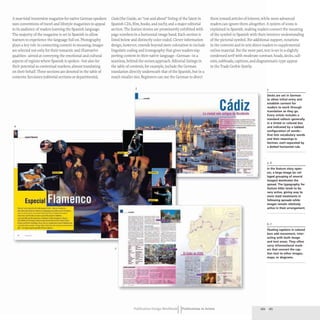
  • 175.
    3 5 ~ ........... ",-.,,,,..,, ."'",... •••....J -,..- 4 ~'---""'" 1~"-""""""_"",,,,,~ .....,......t1I~ cr ----. -...... "'-.-....-.................. ,-... 10 .... _ .....~M_.L..w ..... thr...,.......,...,............Iod.-c u.~ l ........~ • ..........- ..~ ..-- ....... o.ordw~ ........Iw..,... 1CfaIlIcII~ ••' " or w"..,...,-..,.,.... ....... IUJI!'lKII •• _ I..... ~" .......-.1., _ ... -.- ...... -- """"- - ..- ...r........, c-r.,.o, r(,-.;,.tH -- .t:.-.t """.....-+ ..J._. ..J___ I.~c-. ""''-" ....,..,....... -- .-.... n.C-_........I.to-.....t... ....-"'..."".,..........-.. kp~WI~ ~.~- ........-- _"'" ~,1111-'"'-- ",~..thr ern.....c....eI.r.t,;,.y.J ~ Y-. ~ .... _-'W ...c.....o..Jc-. _.&.n ....... "....... ""'"-~....., .......Ar,..-.I'wt.• ."., ....... .....u.u~r.lilJliIllJc-n I~ .,.~ .............u.s..-: c.-J.... s-.tw-W. ....... ........ ... . .M s-.."........... ...~, ..""'c..".~"" ..... ..... iIJrfI'd"'" rh: --. dIr ,........(Aun.1 • .. ~ .....r4....... .,.~"'-IN •fIIY Ii""C ....."" ('tu'I '" ., Got JI"olrr. _10:..,••..,......_.....--.,.,-... ""''''__Oatt._''''-~ k ,II, c..n'"die ~.". *dtf-. :iw.. .-.......,_~ ........... ............._r..c-!.IIc...n.. At"""P...... . c-tc-t. dw.w..a... • '""'""""... doopo __ ......t • ... .....1NIiMl . . . U'lu...... "'_...... ..........,~ ... owd .___I .... r-'~ ........... __ ~.* .....1III..ru."-t_ ......I_.,..----.lfl~ ....... CINIUf....,....-.,.OIWIt ~ I*" .rllf~ -..- tI,-_.... -.......--.I ... ........t.tet•.........,......... ......"'.... ~ ........... I,. . ......,.. • ltaiIIa'" .......~ _ .. r-r-._....-aL~ ... '-"'-'0 • t..... "I,..... ,-~ .Id m- 1111 ,. ... • t~. .1Iiu1 ._"""""""............... ~m..., ...~._ .n....... ~ . ~ .. _r-- .......... J _... .,.....,............~,~ ........,.........~ - blhlt....... -dwaot w4a~ .. , ...w.-.-."".....,,.,...........,.......- Ja. h .............., ...-.pt .... w-., ..oa.... ' _ p..••'ipIIMI M.III1....,.-.......~ • .......- ......-"tpm."c.a bot......, I•• ..........-.'1't~ ..,a....I'-" -""'-cMp.*~..... ...... 4.rp.......,..........., c:JI.o.._"""..._ ,""'___",""" pIl1r •• ~M.....,...... II....... ......_.......-..- - ..., .""&o.............a......."-J___~ ....... JII*CtI."r* ........... __ .bt. _ _ c.,;n... fw-da.. - ...., n-.,.,..c.-t.-n--.....- J .......... ..w- ............,.,-.. ..- . -a-k.. .... ~..JMr ............."....-......- 1~ •.-IIJ"_,_IjI-.l~ ,..,........................,,- ..........."-- no.. .AI.....,. n.-............,..idr~ • .....F,... ............ ,,,_ .........t.. ~ o.M..._~J"tt. ... -, n......~ __ .Wrd.......... --~..,.. ~... ......~........,........ ........................."'........ .......~..........-...~ .-t..-J.pw__ .. .1Da ---......,,....,..... __, ....-..-__.......... at.... .t..II....-n .. ..,. lor 1JIIiIIiWI. ~ -.d .. ,..IN ~ ......JI ..........,_~ 'ni_•• ,....... M.a.t....... ~.ma:....ni ......... _ ...................J ......... ... ..-o ....b._ ...t.1 _ ....... Publication Design workbookIIPublications in Action 3 Careful use of two colors of ink creates unity in the system and clarifies the informational structure. The primary gold identity color defines major head- lines and subheads.The secondary colors in the palette have been carefully selected for their similar value; some are more intense. but all will repro- duce legibly at small sizes. Solid bands of color mark the primary text column and section heads. A pale tint of the primary color indicates the narrow col- umn used for support information. The grid is consistent between the narrow and wide formats; the primary text column in both is the same. In the wider format, the left margin is considered to be a second column that contains supporting information and images. 172 173
  • 176.
    Studio di ProttegazioneGrafica ICevio, Switzerland A flexible system of long, accordion-folded formats and a single, gothic sans-serif type family provides a consistent visual underpinning for a museum's exhibition announcements and schedules. Every edition in the series has a front and a back side. Folded down, the format is handy for carrying around in a pocket, and the panel left showing as a cover identifies the museum and a given exhibi- tion. The front sides are given to expansive uses of images, shapes, fields of color, and primary informational text- the exhibition title and its dates, promotional and descriptive copy, informa- tion about related lectures, opening events, or supplemental shows.The designers use this long horizontal panel as a place to organize information- which is always different- to correspond directly to whatever images and shapes they use to give the exhibition a visual identity. Usually, the composition of images shown directly affects the layout of the typography, so that while the single type family is consistent, the structure is always different. Shapes and colors used on the front side often derive from the exhibi- tion and its promotional posters,usually designed by the same team. The reverse side of the format is given to supplemental information-exhibited artist's biography, additional scheduling informa- tion- usually running in three languages. The text is set all one size, in two columns per panel fold, while each language is set in a horizontal band, separated by hairline rules. As(;ona The designers often employ abstract geometric shapes in combination with photographic images. Here, the surprint of (olor in the shapes-and in the areas where the color does not print-creates interesting spatial ambigui- ties that may allude to the ambiguity of the featured artist's works. 3 . - - - 2
  • 177.
    5 I If • • - · - - · - '- • :!"" - "- - -- Publication DesignworkbookIIPublications in Action I The long format and its multiple panels allow for a great deal of flexibility in laying out material for a given exhibition. Sometimes, the panels are used to break the space and separate different text components (1), while at other times, the full width is used as an uninterrupted field for composing images and text (4). Text on the promotional side may be simple (2, 4) or highly complex (3). The type is allowed to follow the image for cues to its layout, mimicking or contrasting compositional elements. Because of the consistent use of only one typeface for all the publications, the variation required to accommodate different typographic necessities doesn't com- promise brand (identity) recognition. 5 The informational (reverse) sides of the pieces often reproduce text in several languages. Here, a biogra- phy of the featured artist is set in Italian, German, and English, separated by hairline rules. Notice how the text length varies among the different lan- guages; the solution to the problems of fitting and structuring the layout to accommodate variations in informational complexity requires accounting for the worst possible scenario- the longest. The presenta- tion of the text needs to look decisive and inten- tional whether it runs long or short. The grid also accommodates supporting images when desired. 174 175
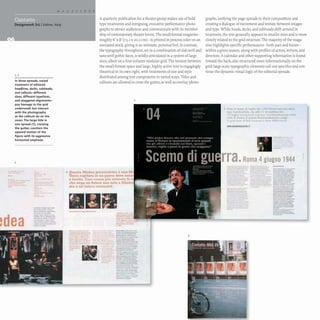
  • 178.
    Worksight IScott andEmily Santoro I New York City, USA 1, 2, 6 Each booklet focuses on a region important to American cultural history. 3 These two examples explore the American West and Coney Island. an amusement park and beach resort in Brooklyn. New York. Historical references are delivered primarily through typeface selection, color, and organization. These two paper promotions explore regional Americana as a vehicle for showcasing a manufacturer's products. Each uses vernacular imagery and typography derived from its respective subject to create conceptual and visual backdrops in which the target audience- graphic designers-can see content in action and its integration with various paper stocks. The messages created by the subject matter are layered, branding the manufac- turer as an American company interested in preserving cultural history and communicating with designers whose personal experiences may relate to the regions selected for exploration. By giving the promotions actual content- rather than presenting the paper stocks in a conventional swatchbook with dry specification text- the designer further engages the audience and allows a kind of real-world application to drive the use .........- -------- for .._-:..... of the paper stocks in appropriate and easily understood ways. Though each brochure draws its imagery and typography from its respective regional subject, an overall visual logic is evident. Several horizontal intervals are used repeatedly for text align- ments; type sizes and styles change consistently; and dramatic integrations of photography, illustration, type that jumps and slides around in arcs and angles,and abstract geometric and textural forms. Textured stocks and vellum flysheets, along with a variety of printing processes, add dimension. 4
  • 179.
    Changing paper stocks enablesdesigners to see how different ink processes and (olor combinations feel on the papers being shown. The translucent stock provides an opportu- nity to mix information on the front and rear layers of the sheet with the opaque surfaces with which it interacts. 5 . .' ~. Loltt __."''''' •.-.r r .. 'l ~ . I.'. ,..__ ._airplane .........ui 1-6 Although no recognizable grid is present, each publication shows similar spatial arrangements for text and image-phrases connected by linear elements, face and size changes calling out impor- tant words, images in nonrectilinear shapes, and ambiguous foreground-to- background relationships. 6 Publication Design workbookIIPublications in Action 5 Textural collages of type are juxtaposed with intriguing spatial effects, such as the juxtaposition here of a dimensional image (the license plate) across the windowlike frame of the landscape. Note how the sideways J houses another inset image, further throwing the pictorial space into question. 176 177
  • 180.
    Blue River DesignINewcastle-upon-Tyne, United Kingdom M ·......-.....~-- -- N 5 The multiple formats in this system of exhibition and event announcements for an art museum are unified structurally by a single column width and text size for running text, and a single larger size for titling. The two different formats, for example, both use the same column width, but the wider one distributes text in two columns, while the narrow, accordion-fold format uses a single column on each panel. One size governs the titling on the covers ofboth formats as well, creating an interesting opportunity to rotate the title on the narrow format so that it reads vertically. The type is similarly constrained in style, with a condensed gothic in uppercase for titling, and a rounder 2 grotesk in two weights used for subheads, text, and captions. An equally simple color scheme- made up predominantly ofblack ink printed on white stock, with process cyan and magenta used for covers and accents- adds to the system's decisively uncomplicated presentation. The result is a series of highly recognizable,yet stylistically neutral, publications that allow images of the featured exhibitions to exist without conflicting with the system or with each other. LIBRARY &ARCHIVE s·...........------- -- - ~- . - - - - v·..__......--:- - W .""'--....- ::=;:;;.~~ -" ~-- 3 --- .- -- . . --- --- ---- UVEL4 - --- t:::_... ..::=- --- -- ._.__........--. ___a ...._ _...... " 1,2,4,5 Covers of the collateral feature a bold, condensed sans-serif gothic for titling. The stark contrast of the branding typeface against solid backg rounds is a simple but memorable language for the system. 2,3 Mixed use of two- and three-column structures allows for a range of (ontent in a neutral and flexible environment.
  • 181.
    Rule29 Design IElburn(IL), USA An interrelated system of icons, images, and mar- keting concepts provides the basis for a printer's family ofbranded promotional literature, including a system of postcards and brochures. Four base con- cepts- ink, paper, people, and craft- are assigned a custom icon, a selection of photographic images, and sets of body copy that vary in length and depth. Using the components from this "kit of parts" in different combinations on materials that will reach their audience at different times and in different contexts breaks up the communication into con- cise messages that can be used over time. One major benefit of this approach is that it affords the company the opportunity to contact prospects continually on a periodic basis, each time building on previous communications and keeping the company "top of mind." The series of postcards, for example, can be mailed to cold contacts to create opportunities for dialogue; they are brief, inexpensive to produce, and nonrepetitive.The smaller brochure can be used as a more involved entree after the sequence of cards is exhausted, or as a leave-behind for current clients after meet- ings or during the course of a particular project; it brings together several of the message compo- nents in a similarly concise,but slightly more involved way, becoming somewhat editorial. The larger brochure is a more in-depth capabilities document; its involved design and production tech- niques- multiple paper stocks, printing processes, gatefolds, and die cuts provide a demonstration of the company's core competency with a harder sell and flashier visual language. Consistent use of three complementary type families, along with the icon drawings and a simple color palette, unifies the various pieces. 4 2 .... ---- / • 3 Publication Design workbookIIPublications in Action ,-- • A system of concise, inex- pensive postcards is used as an entree to developing business from (old (on- tacts, as well as a periodic reminder of the printing company's expertise and approach. The postcards' small size permits them to be printed ganged up and in volume. offsetting the expected (ost of four-color printing, which is used to carry photographic images that support the icons assigned to each concept. The capabilities brochure expands on the typo- graphic base, adding print- process registration marks, color bars, rules, and other graphic elements in a more abstract combination with photography. • • ; • •• • 178 179
  • 182.
    Eggers + DiaperIBerlin, Germany In the foldout monthly informational brochures, the identifying horizontal proportion is again in evi- dence; the cover panel comfortably holds abbrevi- ated edition dates, as well as a background image. Unfolded. the piece becomes vertical, but the horizontal strip asserts itself a5 an informational device. highlighting exhibi- tions and events of partic- ular importance. A tabular gridded structure distin- guishes dates, times, and subject listings. The col- ored square on the last panel becomes horizontal in relation to the vertically oriented signature. A simple, yet lively, abstract visual language helps unify a muse- um's diverse array of publications. As is often the case with cultural institutions of this kind, creating informational and promotional material that is both adequately branded, continually refreshing, and appropriately tailored- on both a visual and conceptual level- to radically different subjects presents a unique challenge. To solve this problem in an engaging way that allows for flexibility and evolution over time, the designers of this literature system have defined a visual language of horizontal banding- manifested primarily in a series of colored 2 ------_..._- ,. .. ---.......- -:==::=:- - --- --- --- .. --- --- 11 --- =-.::::--- - - , ---- ~-­ .._-- -- ..._-- - --~.. ,,-- ;to - - ' ------_ .....- « - » - - - - - - u ---- - '---- ....._-- ......_-- -- " " -_... -- - _ ... ---- .._-- - - -- -- - -- strips, but in format selection as well- that derives from the border treatment of the tallit. This abstracted representation of a highly recognizable and meaningful symbol not only adds conceptual depth but also offers endless possibility for variation across publications. The form can be hinted at subtly by a long horizontal format, or it can be made explicit. Additionally, the geometric nature of the band can be used as a device for housing typographic elements such as headers or captions, for separating informational components, and for clarifying complex informa- tion structures such as calendars, maps, or schedules. The use of 3 4
  • 183.
    color in thebanding helps carry brand into publications that may otherwise be lacking in color. Applying this visual language in all these ways creates a rich and varied experience for museum goers. Of course, this strong visual concept is not the sole visual identifier for the publications. A specific palette of colors, along with a house type family- a condensed sans serifwith unusual terminals- articulated in a highly informational way over tabular and modular grid structures, all contribute to the system's accessibility and character. 6 8 r KLItJK"UMt FUNCTIONIAll ROOM5 O ...•..·~ 3-6 The covers of three collat- eral pieces, while very dif- ferent in format and color, are visually branded with literal or proportional ref- erence to the horizontal strips of color that define the system. In the stepped brochure (5). the horizon- tal band becomes a codng device for content. 6 By reorienting the colored strips to the vertical edges of this stepped-format brochure, the designers are able to accommodate its specific spatial require- ments for content, yet maintain its brand associa- tion. As an added bonus, the now-vertical strips become navigation tools, helping separate content from page to page. The cross-cut image, in its entirety, is another hori- zontal band. 7 9 10 -~ . .. ,.... "1'-' - - . • • • • • •• • • • • • >til • • • • Publication Design workbookIIPublications in Action 7-10 Well-considered informa- tional diagrams and vel- lum flysheets. with opaque abstract elements distilled from the photo- graphs they overlay, add informational depth and visual interest to this ele- gant brochure promoting the museum's functional spaces. The translucent vellum. because of its long, horizontal proportion. becomes an interactive version of the branding language. 180 181
  • 184.
    1 -- .. --- 1................... - .. . , c .........- - _ .. --... .._ ......... --- .....- . .. --- .... 11,.. - W 1cIt", An van • UI'II: f VtttSICNaa. ~,...._ ...... .....-..,.-14I ......, - ....---....-..~.....-"--'~------........ --- _ ................. ~----- .................~ .............-_........._---..""...--. .--. ........_-................--...--"'-----....- 0.. UleIfi1hrig111 ~ uw:ltr --_..............-_..-....--....... ... ..................... ......,...-.-.................-.--- ......-~ .....-.. - ___..._ ...... '11 ..-.. ~ _ ........ 2 Geschicklichke,ts • Spiel. Nachhaltogke,. beg_iete"... Messebesucher ~...--~- -..-- ...............------ ........-.--_....- ...... "......-.....-- ....................- ......,.-- ..............-.-.....-- --,.---~-­ ...._0.._..._..._ ___.__ -........-..-.....-........ _........-...."....--- ._.............................. ........---..............----- ----.'-- -_._.................-. ...........'.., --- --
  • 185.
    Sagenvier Designkommunikation I SigiRamoser IDornbirn, Austria Nechhaltlge Wochen 20().l Was I&ulll" VorarlDerg1 - or._............. __ ....... .~­ ....-_.... .,..........- -------- "'-"___ 1 ... --~............-.- ..-.......-..-..__ .. --- ----.-. -.....-....-- -- 3 In this uncomplicated newsletter, a two-column grid and hori- zontal breaking of infonnation yield clean, infonnational, and lively compositions. The simplicity of the structure pennits quick, cost-effective layout without sacrificing visual power or contrast; these qualities are actually built into the system.Each edition is an A3 folded down to an A4 format, producing a cover and one interior spread.This fonnat is folded once again for mailing. The cover, thus divided in half, presents identifying masthead information, an image that bleeds left to right, and the title of the feature article above the fold. The image is changed each edition, while masthead information remains consistent. The feature story begins below the fold and continues inside. A dark horizontal band holds the identifying information on the cover and makes a transition into the interior spread, providing continuity and a simple, decisive beginning to a progression of intervals from the top to the bottom of the page- small, medium, and large. The text is set in various configura- tions on five columns, hanging from a flowline but finishing out at varied depths from column to column. All of the type is presented in one neutral sans serif, with size change and weight differences adding texture and providing navigation through the hierarchy. Images appear cropped within rectangles, or silhouetted to interact with the column structure, as deemed appropriate. A calendar and event information is provided on the back page. Neuo, Verem.hol"ldbuch 01" vOlier f,lglg • WOII.olles w..... lu, th!! u:tglit.hl:ll Vl!f~lflttdll.J·...t ...-_..----..---.._- ---------- --......-...~..-,.- -------------- ---------..-- ~~~~~~~ - ----- --- --- .... - .... -.. - 1 Inle'hIiIIQroO!O' BO')cn:JC)o ---....-..- .. ----- Taking advantage of the interrelated proportion of DIN format sizes, the full- size newsletter folds in half to achieve a standard mailing size. The fold acts as a separator between masthead information above and feature intro· duction below. Ju~endlolm-CO"I zu Cl n Themen Geld. ShUVP"1 Morhua. Zu.unftspl ne ...-----------.....-- --...__._'"------- ...__... ---.-' ---~ ~..... -..--...---- -'----- ---- ----------- r - '...____....... ____ _ --- - -------- - ---.....- .....----.-.... - --- -- ----- 1_.......-_.__.......-.... - "-'-- - =;:;.;:--- - 2,3 . "'......... ..- ..................--.--- - '--_........--- ---..-..-..._-- -------- ~~~~===__r__-----1L- ... _____o -....~ ......................----- ----~----~~ 1I~________r_--------------------------------------------I "-..._ ........r..-- __ -----_!.-_- --_..----- ..' -....-- -~--..----- The rigorous hangline of the text is countered by intuitive placement of inset and silhouetted images; sometimes the text itself leaves the grid when the designer feels this will improve the inter· action of elements within the layout, as appears to happen with the left-most paragraph on the second page spread (3). ~'==:---- ~;e ...--_~~_oo:: ___... _ . . . . . _ • • 0 ItI" ___ _ ~- -~.....-- ~... 0-_ _ ......-... _ _ _ _..... _ _ _ _ _ _ ---..... . -....... ~----........... ----..-.. --_..----...... ..........- -..-...- --.......-- ------_..._--- ,,~- .............-~- --...... ...--- ....._-.......-.- ................---......... ,...........----......"-'-- ..-_.......-"'_......._- --..t: ...-.... _ .........-.. - . . ...._ ....-.-.-.-.---... _ .......-.....-.-..------ -.........-.......--~ _ ..----..-...... - -----_._---------- ~.... ..._ - _ 0 ....---. ...--....-- _ _ _,..-. _ _ _ _ _ .............0 - .....--- --- -.... --- -- -...........~... ..-- :.:..::....-:.:.:=..-~-~~- --------- .........-._t..-"___.... -- Publication Design workbookIIPublications in Action
  • 186.
    OrangeSeed Design Minneapolis,USA Two complementary newsletters help a manufacturer ofwindows and doors reach contract and retail buyers in the construction industry with product and marketing information that promotes their business.Geared toward construction professionals, the newsletters are designed to appeal to their hands-on, no-nonsense need for clear information. At the same time, they deliver brand- ing messages through color and type selection and also appeal graphs, sensitive typographic styling, and abstract details speak to more visually conscious prospects. A compound three-and four-column grid organizes running text and callouts, and secondary product display areas, respectively. The structure is consistent between both newsletters; their covers vary the grid slightly by using the second and third columns of the text area, while reserving the left column as a margin for colophon or callout information. In both cases, the newsletter mastheads are set in a condensed sans-serif face that is treated minimally to customize it and relate it to the brand typographic system. to tertiary audiences-do-it-yourself home construction consumers and, potentially, architects who may specify the products for contractors hired to build. Elegant spatial layout, colorful photo- - '~'- '! • . ~. <0, a:; 'l ,'- ~ I' ~ VieWpoint ........~.~ -- -- -- :'~~- -- ---- --.....-- ~- ---- --- -- --- --- --- 3 _ _ _ _ _ .IC.I'....... _ .. -- ------- -_...- -- ,--- -- ---- ...__.._- .::::::...- -~..-..-~ ._- --'- -- --- --- . ._--- . ---- 2 -_. ---- ------ - - -- - -- ..- ... ---- _.- .._- -_._-- _...- ---- -,_...._. Yo _ .. _ . _ ...-_ -'1...- --.........- ---~­ ...- ... -.............- - - ..~-.. _.._._- .....- ...-- -_.......... ....--.-,.......... ..-......-. ----..- --- ............ - --...-. -_..._ ...- ---' ..- -- ~ .... - =-...=-- .- -_._- --~- ........-.._ ..... ---_.. --- --....-- -- - ----- ...__.._.. - ....-....- -..--_. --_........ ,-~~~ ~~~~~~ ~~~~------~.-. -~ ......., _ _ _ • ....0..-,. . ~. 1 1 _ _ _ _ '-- _ _ ..... --- -..... ---..- ---......-.........-- --_...- ._---..... -- -- _ ..-. -- -..-...--- ~.....--.- -~- -.-........-._- --_....- ----- --~... .._.......---'- ---~­ ,-..~- ....~­ -_.....- --_..- ---- --'*- - ---..-- -....... - ------ -"""- ----_... -- ------ ~. _ _ f __ .__... _._-_.. --_.... -- ,--.... " ------ _ ............- -- -- ..-- ------. ----_..- -.--~..- ..- -_.....- -_..._- --_.... - ._- , , ., ... -.a., .......-~­ ...__-.......... _ ..._..- ..--....-- -_.- .__...._- -_..- -----"" -"'---"-' ------ ';-';.-.-.-~=-..:; ...._.__.. ------ .._--_... -...----- .._ ...._ .. .........-.....-",- ..- --- -..-. ....._ .._- --..--- ----- _ ...........- -_..--. ~- _ ....-..-.......... ~-....--- --- ---"-'-'" Wiool ___-.."_ -.....- ..-- --..._-- -..._...__. ---- -....-_.*- " _ _ 1- _ . ....---~- ...._-_...... --.....-~ -- -_. ,.............. -- - - .-- ---- -_.._- --,- -~- ._-_.- -_. :.:~-.... ------ _._- --,.::::-"'= ._ _..--- -- :::.::-:. -::.::...-,..:.... -- t ::::.':...~ ----- ==---==- ------ -- ..._-- ------ - - ::.-::..e.:-.:.,,:,.:: ._- -- ---- ---" -- ----- ----- ....__..- _ .._-,..- -----.,. ..-~.-...... -~ --- ._"-- -:;;-,;;,; ..; ..;...~.--..-::. ----- o -.-....-- ---- ---..oil.. ----- -- -... .- -- ...._..,-- --- ...--- ...........__... On the cover, a narrower left-hand column is used for supporting informa- tion, such as a colophon or content listing. The narrow column emphasizes the left alignment of the second, regular-width column with the masthead and marks this column as the begin- ning of the primary text. 2,3 Overall, color is kept neu- tral and warm, with black and a secondary color for accents. Tinting different areas, as in this spread, allows the text setting of each to remain the same; the change in contrast between type and back- ground separates the dif- ferent areas. 3 The need to be clear and direct suggests simplifying type treatments in a limited space. Here, for example, a number of different kinds of information are being presented, but they all follow a similar internal logic: two type families. with text set in a serif and subheads set in the bold sans serif. Supporting callouts are set in one face, using two weights.
  • 187.
    Throughout, the samesans serif, in a family of weights, creates easy-to-navigate columns of text while differentiating subheads and captions. Narrow rules help define spatial zones among the columns, and strong geometric inclusions help communicate the architectural nature of the subject with a minimum of fuss. 4 5 ......_ =------=-=_.............'-..,..... - - -- ..._--- ..._-- ---- ---- --' -- ::""':! .-. - --- ---- ---- !!::.:'::::= ..__.- --- -- --- -- -- --- _ ._- --- - _00_.. ----...-.._--.. ______.-e.. ._-- _ .._h_.. --- - ._- -~ --- _. ...---~ ­ - - ----- ~-- ...._- _ .- ---...... ----,- ---- ------ -.-- _._- ----- -.._-- ---- ------ . -_._- --_...- -_..- - --.......-.. ---- ---- .._ ...--..-- --- ----- -.,.--- - '- - _.- - ..._---- ---- ~ -= " -"- -~ - -• • . ~ . ---- - :!"__..- 6 --- An InIIde look .t-.-.en Pallo Doo ."............ u............."".,., "...- ..~ MItv til r!I*IdH~' M:.oo. door ~.UIOIlt at lilt _ , _ II1d ...-.or ",'''''_~ _ 04('1 ~ ...... ~ A.ndM«! t*lO dOM 1M dilif choice Itr seIecbA bXI 11_.... _ _ ..... ..........._-.....- ---- ...__.......u..,_. ...._IIIII.lI~I ........ _ ..... 4-.. • ......._ ...... u ............................. .....-.....-,.- ..........,,.,....."'-"..... ---....~ -.. - .~ ... ~ ........--- ... - --........-....~ ••h_,.. .... 11__ ............~ _ .. _~ ..... _jt_ •• 1 .... ~ ................--- .._--.....- --- ---• 0 , • .r 0 41 l'I,o. ..... _ .......~ ...'-"'-..._ ............ ,,"-It ......--_ .... --.,,_..... '- "",--_...- ~---..... ~~ltool. . . . .......................---. -'--,..--.-- ..""---....... 0 ............ e _ _ • ,-,....,. ....-.._.- ___._OIIUT' --- -_._-- ----- ---....... -...-- ---~ ....."_.,.. --~ ---- --- e _ _ 0 ......,......... ...- ._--- --- ----~- .....-_... - ...-.. ---- .----.. ~---.. -- -,,--- _ _ _ -.n _ ..._.". As these covers show. a clear column structure can provide both consistency and flexibility in layout. The placement and size of photographs can change. but their relationship to the grid unifies them with the type structure. ---- --- II. 6 The compound use of a three-column (upper area) and four-column (lower area) structure can be seen here. Changing grid struc- tures within a page for a specific purpose, such as clarifying the difference between two sets of (on- tent, is a powerful means of helping readers navigate and changing the visual rhythm within the page. ""'~.....~......- ." _r-_ _a.. ._...........'-..........., -- ..................._""-' ......-~'­ _ .......A.I ~ _ btJIa·~ . . . ~ -- 11._..........._ ... .......................... ~ ............... ~ ,...-.. -.... .......-~-­ ...,.............y~-........., --- "'"...~ ............ ................_'"- ---.-~ ....~,..--....... _ ................1. ...- ,...,.,.~...,­ --- n.,..................... . _ -a-,.... -"""- ......._ .........-... ......._ ...--- ........._1. .......... _"" ............1 ........................ -,,-_.__.._. ---,-..-........... ..,-..._...... _ ..- --...-~- --.................... 1'- ._,.. r..... -.... to_- '_..... .. ........ ..~.-....- '1 ..... ,.. --............ _1104 _ _ ..--- 0 _ _ e ......___ ..., --... ,---_. -- e ""...-....."". ........,--- --_.- ----- ----- __ ...I'iC.... 0 ; _._- .....--..-. 0 ._-- 0 _ _ .........-- -"'- -.-- - --- ~-- ..,- ----- --- .......-...--. ....-.--. - ..._ - -_..- =::::.."===- Publication Design w orkbookIIPublications in Action
  • 188.
    UNA (Amsterdam) De!;ig~lersIAmsterdam, Netherlands This vigorous, yet elegant, newsletter for a music ensemble communicates the energetic nature of the organization first via format- a narrow, two-square tall folded sheet roughly 18" (45.7 cm) high- emblazoned on its cover with a block of vivid color and an asymmetric configuration of letters spelling out the group's name. The seasonal publication delivers performance schedules and highlights soloists and composers featured in the current repertoire, distributed over two or three signatures as needed. The signatures simply fold together without binding. Each signature is printed in black plus three other spot colors, which change every issue.A compound two-and three-column grid on left-biased asymmetrical margins balances text at various sizes against full-bleed images and expressive type configura- tions that allude to musical composition.The designers make full use of the structure, shifting calendar information around the three-column grid and editorial content over both column sets,paying careful attention to the shapes of the text in relation to the often asymmetrical, unusually cropped photographs. Negative space is an important player in the layouts, helping cre- ate movement among the elements. Despite the lively arrange- ment of material,the information remains accessible and legible; equal care is taken in crafting typographic distinctions within detailed content such as the performance schedule. 2 H•• rUn goud.n ClloM ,,001 dutundpotel' ill. Freel FlUb V." lonot.t a.rind .t.'ch OJ) we.ach.Uend. Mud~le '.'Ie ln_" ,. tt....".n. "',.... hllj.,."t.ne he' ....'wllt to hOHH'I etat hlr dln tal.,.,.,. '10tlnlpperdct.. TlDgo"wDordlg wor4I'II'IMI anlg' l.ton1~ 0- eken "." eeft muzJU"' 011 Fritbt muIU·ln,trurne.ntaUsl (bf!halve Slt.......,..'r ..IIO"cr.-- ilndOf4' plaftO, ....ool~ coftt,abu 0" 11.s;,w..k). hnp~..to, on compol1iJl. ""ot vo.lfP,i".n in d. Ntwyo'..... do..."fow(t ,con., d. mode,n. 1ic1.tnteke muzi8. delnt. d. el.ktron~ til d. popmuzf4k. die boY'nd"n muztek sdt,.••, voo, tIIealer, daas, h'm t.n ..ldoo·lnJl.UaHes. 0. va" 00'6fUOOli E".~...Frith d,nkt zJ," I.pul....-.ts.ape","-.nl... muau::us .,n" G'GeP He""c;ow die 'UI In l'''.umen mel TIm Hodgkinson OplIQlUa. Het repe,1o". omntle (Offtplcue compositles,lIedJea, lapebewe,klnUttn eft v,ll. ~mp,cwl••II.. De band. die tlln I'.' ""',ond, "".1$voot F"th d• .ta,'nn ..n .,..,. ",IIl1ve . 1, khfulIltk.c.,nlllfll'.-Zol' .prww"t hi' UtrYWf" nl.., w.n -..n ~m.,.·. HClt -"'U. d.I ml; 'nI.,esHcttt.l. da. Ik do IUlm,. IUlI9 om slim..,., mel i"!.plr_end• • cr••" ..... ",onY tl mIl" 1o..." ,. onlow.klte-IIM ' rock r. tt, wei d......ljk een 'Dde Iff ••d .an I. wil~.r'I n d Jr'I "'.......... toop",.nl hnp,..vts4lUe. Sin". de Ip GInn" So/o~ ui11114 ho.""" aleft O fu.U..keld tot een muStws dj~ do etgeruch.ppen en moglllikheditn vln Imp,ovftlUI 1 01OP hel bot heen ondenochL 0 . 1hq d• • lo.lo~n j l r-,!" ,Mode ...:IIkM eomlU)ftetUI vaar ensem.blH die hooldl..~.llIk ~t..n uit klaplck go,r'fPda ftlusid - :toIl.' £n...mbJe Modorn en twit Aako E""mbfo - doot (fu, nPelJ, ;1an If, Sterile, nog. ml•.sdtlen 1$ da. ImPfOYlutj... ' lienI wei Ziln atOll. Zetl zagl rll,: ·E.n Goede fmprO¥IP,or.s ull de ...,d do, u.k un goe delu IIc-roo, en da' kap .'8 behulpu.m zlJn btl h.l a..,nll.tI nn I"d*(. muzltutfe vormen.: W.,UtetwBO or Oft.orw#••, mol de cvmpun~t UP1IH••.t, 'ner' du,v," he' bew;l$. 1,2 When the publication is folded for distribution, the front "cover" displays a square field of saturated color. A constantly chang- ing arrangement of the musical ensemble's name reverses out white and dances across the square format. Fully open, an edi- torial statement about the season fills the lower half. This text is set in a bold sans serif whose size changes with each issue so that it extends consistently from the fold to the foot margin. The season indica- tor, in black, is consistently set at a larger size com- pared to the group's signa- ture at the top, reversing white and flushing left to the format edge.
  • 189.
    3 4 The calendar iscarefully typeset for readers looking for specific information. Sans-serif and serif typefaces are mixed to create pronounced textural differences, and each informational component within a given listing- date, venue, concert time, composer and work, and featured performers-is given its own distinct typographic treatment. -------_._-_.._------- ---------,.-_..---.-- --....----._-......... --- -----.-......-~---.----.-- ------.._-----....- ........_---._._-_.__.. --~-..--.---....----.--.---- --- - •.._ ...--_.... ---- --...-----_.._---- ......-.-~---..----- ----....------..- ---..._--------- --------- ,..-----,........ --...._--_.__.._--_._--- -----..--------~......- _ ... _ ..... _ _ • _ _ _ _ 10 _ _ - . . . l-_..._.________..____ +-------~ ---------..--_... - --_._-....---.....-.- ---_._---_._--_.._- ---.----.-...- _-----0______- ---------_...__..- --.......----.---.---_...._ ..... --_...._--------- ---_._..---_...._-- - --- --_. ---,/ -_._-_..-_.._,-......_------ ----.---jlt------- - -------- ---..-_.-.._...._-......_ ..---- ----,.-....-~-..------ ---- .. --- ---- ----_...--.. --- -~--.-.- ----- Il10 _ _ _ __ ---- -----3 ~-=~:-~-- _..__.. ---..- _____1.4 ------"'.. -----.-~ - -- _._--..tt·_ 4 - - - -- -- -- -- - - - - -- -- -- -- -- - - - -- - Publication Design workbookIIPublications in Action 2,3 Editorial text generally is set in the bold sans serif. with size changes indicat- ing subheads and other hierarchic changes. The serif is used for supporting date and time information in captions accompanying the articles. 3. 4 Unusual cropping, unex- pected scale, and asym- metrical compositional decisions push the photo- graphic subjects around the format, increasing the ambiguous, shifting spatial depth of the elements in the layouts.
  • 190.
    Conquest Design IArlington(MAl, USA This quarterly newsletter for an educational institution covers a broad range of subjects, from economics to dance, writing to social sciences. Its neutral visual styling helps avoid the potential confusion of attempting to represent every one of these subjects equally or even accurately; the communication here becomes one of academic credibility and interest to people associated with the school. Neutrality carries associations of objec- tivity and inquiry- qualities that can be ascribed to an institution of higher learning. Given the intellectual pedigree of the university ofwhich the school is a part, this kind of objective, credible presentation is of paramount importance to the client. As a result, the designer treats information respectfully, ensuring clear hierarchic distinction through size and weight changes, and using color for accents and informational enhancement within the typography but only rarely within images. Every issue exhibits two standard ink colors- a warm neutral ink and a black- along with a third color that changes seasonally. Text generally runs in black, although callouts and headlines may be set in color or reversed out from colored bands. The structure is a relatively precise eight-column modular grid in which four- module-wide and three-module-wide columns of text shift back and forth, creating apparent vertical overlaps between columns and margins that shift subtly left and right. These shifts also allow callouts, captions, and images to hang from column alignments or be indented dramatically. Images adhere to the column widths but are free to expand vertically as needed. 3 'IT~ - - - _ .- 2 _..._----- _......_ ...--- .._--_._-- ---- - _.._-_..._ --- -- ..._ ...- /X/Xdr m1/ soundi 1-3 The newsletter folds in half to self-mail without an envelope, saving on postal expense. The cover, on one side of the fold, features a full-bleed pho- tograph, masthead, and teaser caption; the mailing side, along with space for addressee, includes a follow-up caption related to the one on the cover and an editorial message from the school's dean. On the outside, horizontal banding and linear details add texture and darity. as
  • 191.
    Because the newsletter's focusis on text. rather than image, the decision to call out a lot of text in the third (variable) color accomplishes a number of ends. First, it introduces color to the textual gray- ness of the pages. Second, it helps differentiate and focus attention on infor- mational components. Finally, it gives a specific coloring to each issue. Active, as well as more reserved, layouts are accommodated by the grid structure, which remains clear. Mixing the weights of the sans- serif family to call out informational details within captions or sub- components adds texture and vitality to the conservative structure. 5 4 Ten thi you probably didn't know about SHASS-.. but will be glad you IefrneoI - -------- .....------ --- -.~--- -- -- -------- -- =-... ---- - _.,- -•• ~-;;=:-- ':"" -_.._-- _ :::.-:o::.:::=.::..... .._--- ------- ------ --:--- - ..-- -._. -- --- - - -. -- -- _t_,__ --- -- - .- - --- --- .., -- ---_. --'- ---- --'- ---- ---- ------ --------.. -- :A Saving the world, -- ---:::::.::... --- --- -----_..--- - '--' --_... --_.- .._-_._--_.. - _..._- _._----_. =---."::_... ---- ~ . .._-- precisely .. .... .-..............~-..-- ~..-::-::,-=-=-.:- - ----- --------- --- ----......-- --------- --- -- -- ----- • ---. •n _ _ _ _ _ !..- - : - -- .....a.- _ _ _ ...- - - # ' " - - 1 _ _ _ _ _ _ - _ ..- ------- -- ---- --- -_. -- -.... --- . - -- --- - -- ----~ ........----..... ------- =t::=.'-=:;;-;-::;;;;;;:;;:: _.-.. .. ----_.._- ~-----.- ----- .- -_..- ..- .... -- .~ ~-=-= -;.::.,..-=~-:.:::.-~-=-:= ---......_--_... .....,__r--~:~ ---~ ----- .. ------ ------ ----_.__. -- -_... _ .... -~- ...._- -_..__.._-- - "'-.... --:---::.. -_.-..._- ---- -_._- ---- ----- -- --------- --.--- ------'--- ==-- :-::.=:- - ::.::=. ......--. ~ ---_.....- -- - -" ~-=--~ ..-. ----- -_..._------ ;::::::::::::~---- .._---- .-----..-~ ----_..- --...~- _.. -*_. ------ ------ ----- _ . .._....._.._---- --- =-',:;:~~'-~ --- -- - ~--.--- -_....._- _ ....._--.-..... -----_.._._--- -~ - - - ---- --'"'-- ... --- --_.._- ....---=-- ------- -._---- -....---~..:;. ... -----..-- _ .._ ..... --_... _..----_...... :=..-=-...=:. _ _ ,",_4 - -;--- --- - '- ---- ------- -----_-1--- ------_.. --_. .. --..__..__.... _.._--- -- - =:.~~~ -'- --'-- ~-- -- --- ---..~~- .....---~~~~~~ -.---..--~- .---- --.- --- - -- ---."'...--....--~ -----, 6 --_._---- -----.---..--- -_.............__.. -- --.- -~ ------- - ::;:-:==- ... -... _.. - ..._ .._------ -'*- --- _....... --- t::::.~-.=:....-=- ---_....- --.-....__.. -- --- -- ::~1::-:.:.:;.;.:::=~:;;:,~;::::;-~ ~--- :=~.---~;;~~~~ : --:.-::...:.. ---.-- ----- -----.----- ==---::::E.. --- ------ -~~~- ..- - ....- ----- =-~~~= :=...--==--===.=- :.-.---=-=-- ....'---- -_..._---- ------- :'- -=-- :-=..-==--=--:=..:- --=--_..-::-- ----.._-- -..--- ---- ---=-- - -_._-- -------- - ~ --"-- - =--- ---- ..._------ -- ---- ~-- - ------- ~ ..- _. _._- ---- ....._,...- ==.::-...- =-=== -- -- == ~,c:; -. -- ---- - -- - ---- ---- _..._---- =:--=----. -:::-- -- -.!.-_ .."::._-- - --- ---- ~--=------ --------- _ _ _ a _ _ ..~=-- -_.._... ..::::====-....:.-.- -....:--.._- ----- .....---- -- ..--~-- --_...- ~~ ._- - - ----~ -=---~-=.. -=::::.:.=~=-= ----- =-::"~:111_ -------...- --- _ ... -- --=-==-=~ - --- - ----.-- ----------._-- - - --._--- ...---- ===-_....- -_..- _..._- '*------ --._---=-- _..- .__... :=.- - - --=~~-==-­ =-==---=--- ----- ---- -----_. --:.--;:=--: :!.-=:=--- - .._---- =:::==~==--=.:.:. ----- ---- - - .. --- ---- ----- ---- ---- --- ==.-:==.. _ _ _d. .-- ---_..- -- --..- ----_.- ------ -- """"::.... ----=- ...._._- ::-.-- --;:: -- --- ----_...-- ---- _...- -- _.- Publication Design workbookIIPublications in Action 7 5 A serif is used primarily for text, while a sans serif is used for titling. sub· heads. and captions. In this spread, which presents an interview with a faculty member, the informational clarity afforded by typo- graphic simplicity is evident. The questions are called out in bold sans serif. and tinted gradations set off related but infor· mationally distinct material, such as the sidebar at the lower right. The use of shifted columns on the more precise underlying grid is also visible. Honors & awards ,.....OM,. ~fof l·_...... DaI_~ Clw:lnP • r t ,'""-"..t~ ..........!_n.-..Irlit.-pal ~oI,'-:SbeI"'!II K.... Prir.c'" '" ,Coo". ~"Iobj .JLaJ. I~ ..... MIr.'t_.~. a- r"'_.'I. u......PI ''"''*_...... Scud-.... bca.......... r~pr I:cwardrlO._ ~~-..-... ' ....11_..._ .. ......... olrmoorlla."'"~. FdI..... .(tIoc ..wr..... o$.bn.' at _ ...- ~w.. '""'-w tJla...wr ~-...- ~.(jfIfat I, l..Imcpr Xbota "'lkwmcpt~eend.u , l'/ICH-04tJ...... ~ ., ..... __....,J".J.:001 a.,.......... ~ I'w-dl~ l""""'corlWIbcJ Sonn..a Difrm'orel Jhl!GIlIUII'!f_ "4TI 41.al ..Jt,-.,........" 5......... boot.,,...,,....,,cw.w.:- l.M.Jrn q J'-1.Ir-" Ju/!t t k- .tt;r .....,.. lhc!COtJ~ :)(~ ....._~d.cl..l'fm.-. Iii,.., .1I11iic:lns.n-J,• ".....,.."",",""' ~.......,.... .._ 1.............,-""...._ Moo '*'r ..,.. _ p-nocn.ed-hll, Pta....' ~1...II~UIlnIrft,ttM­ "~fIINImt••'"-:I'Ip:;., 1.rrII»Id.... l.ncItOnnuQue I.. _ ...... --""I:I~~ fIUIn .... Itt........... The..... lllMdAl ..I ... OIOCft U_IaOOM....,. .~.~ ..uIl.... t.d~. '1~ .. ~ ~~------~--~ 7 Careful attention to spacing details-such as the difference in spaces above and below the rule between paragraphs in this listing-helps readers access information more quickly. imparting a sense of precision and concern for the reader. This kind of respect from a designer helps a publication connect with its audience. 188 189
  • 192.
    Stereotype Design NewYork City, USA Each issue's cover features a different historical pho- tograph, printed in black and white, against which the stationary masthead remains consistent. The right-angle rotation of the masthead's elements locks it almost architecturally to the upper-left corner of the format. 3 This newsletter for the Museum of Jewish Heritage organizes an ever-changing selection of editorial content on a five-column grid. Its slightly squared tabloid format lends it a newspaper-like presence and establishes ample ground for vigorous typography at larger sizes. While a number of pages are given to more con- ventional newsletter fare- updates on fund-raising campaigns, donor events, and the like-every issue features essays from noted contributors and articles focused on curated exhibitions or material in the museum's archives. The former generally structures text on two-column configurations derived from the five-column grid underneath, with heads set large in black- weight sans-serif type, in a contrasting color. The body copy runs in a serif face.Heads are in a consistent size throughout, clearly distinguished in size and spacing from callouts that appear in the same face, but smaller and more densely leaded. Image captions appear in the bold-weight sans serif. Within the more engaging editorial spreads, heads and decks take on a more spirited presen- 2 FRO __-_E. - E tation, appearing very large and all uppercase in the same sans serif. The grid is articulated more dramatically; some text compo- nents run across three columns, while others continue in the two-column structure.Text components are composed in these pages with larger images- some inset, some bleeding or interact- ing with blocks of color. Although the typeface selection is limited to two families, the use of an oldstyle serif in justified text columns, contrasted by large, uppercase setting of headlines in sans serif- especially in conjunction with historical photo- graphs from the Museum's collections- subtly recalls the design aesthetic of the early- to mid-twentieth-century Europe. In doing so, the publication purposely evokes memories of this turbulent period in the Jewish experience among its mature readership, resonating with its audience at a deep emotional level despite the generally neutral presentation of the content. • !! r ··l 2,3 A clear system of weights and sizes helps separate informational components in the hierarchy and adds texture to the pages. Scale change becomes more image oriented in the edi- torial featu res; here, head- lines and callouts spread across the gutter, poke in and out of the column structure, and appear in multiple sizes. Combined with rule details, blocks of color, and historical photo- graphs, the typefaces and their arrangement con- tribute to an association with design from turbulent periods in recent Jewish memory. 3 The newsletter is some- times printed in four-color process, but adheres to a restrained palette; this lim- itation keeps the color feeling in line with those printed using two colors. 2,] Big type is not reserved strictly for headlines: the folios, set in a bold, con- densed sans serif, act as anchors for the spreads.
  • 193.
    Allemann, Almquist +Jones IPhiladelphia, USA The six-panel tabloid newsletter for a science museum makes extravagant use of color, illustra- tive and abstract montage, expressive typographic detailing, and diagrammatic science imagery to convey the energy and wonder of the museum's event offerings, especially those geared toward children. The dynamic asymmetry and color of the museum's annual reports (see page 206) is taken even further. Information is structured on a single column in each panel and given generous margins to avoid cropping when the newsletter is folded down to mailing size. The column struc- ture is violated when additional movement and spatial ambiguity is desired. The back panel accom- modates postal requirements, including indicia and space for addresses; the front of the folded publication becomes a bold cover with the branded Events logotype. Much of the typographic variation in headings, callouts, and expressive treatments follows from this wordmark as a way of conceptually linking the idea of the "events" with the content in the newsletter. As each successive panel is opened, the format changes in proportion as well as size. The composition of these typographic and image "events" unfolds in a kind of kinetic story, inde- pendent of the actual verbal content,which can then be opened up as a poster. 3 2 . J : I' ' 4 ; - -....--.:-- -- ---_.......- Publication Design workbookIIPublications in Action 1,2 A dynamic lockup of serif and sans-serif elements in the masthead creates a consistent counterpoint to changing exhibit images. 3,4 Fully opened (3). the newsletter is transformed into a poster. The designers consider the interaction of individual panels (4). as well as the complete format. in composing pho- tographs. textures. type treatments, and abstract shapes. - -"' -- --- 190 191
  • 194.
    1 Atextural system of coloreddots customizes stock photography (on the cover) and provides a simple branding state- ment within the interior, subtly restating the circular identity symbol of the corporate signature. 1 The pattern of dots also subtly conveys associations of system, integration, networking, computer readouts, biology, and similar ideas related to the company's business, health care management solutions. • ••• • ••••• •• ••••• • ••• •• •• ••• ••• • •••• • •• ••••••• •• •• •••••• •• •••• • • •• •• •• ••• 2004 • IUIMAN REPORT •
  • 195.
    Kendall Ross ISeattle(WA), USA The designers of this annual report have used an editorial, brochurelike structure to lead investors and prospects through a discussion of various business activities and achievements. Unlike many annual reports, organized into three distinct sec- tions- image, management, and financials- this booklet spreads important information among numerous spreads, each focusing on an area of interest elaborated upon in a series of smaller arti- cles, much like a magazine. The executive's letter to shareholders- in the first spread seen after opening the report- feels very much like a letter from a magazine's editor, instead of the formal, investor-focused document in the management sections of conventional annuals, which typically presents just a lot of spin. The brochurelike spreads run text across three of four columns, grouping these columns inward to mirror each other from the left- to right-hand pages.In doing so, the outer columns are free for margins in which tinted side- bars are placed, augmenting the sense of the editorial influence that characterizes the layouts. Each major concept is introduced in one to two paragraph decks, set all uppercase, with the designers appropriately adding space to help read- ability. Continuing, short stories about specific business, research, and financial activity run in the relatively narrow columns, separated by bold, uppercase subheads. Imagery focuses on people, with tightly cropped head shots; the remaining image material is composed of a system of colored dots that add texture and subtle branding to the publication. With the financial data treated as a plain document bound in, the report does double duty as a business update and as a capabilities brochure that conveys a direct, unpretentious mes- sage about the company's activities and personnel. 2 4 .- 3 ·... JI " .. .. ·.- .. ........ .................... ·................. • • • • ----_.._--- _ .. _ _ _........_ru .. _ · .._.....". _ _ _ c_ _ _ _ _ .. _ _ . UlO .... _ .. . ·_ _ -------- :~:::::::::.:--~::::: n _ ------------ ------ .._ ..._----- ---..... ...--.._ -_..-_..._- --:=:==:=::::.-- -- ---- :===-:-----' ------ ~-----------~----.--- -~-.......----.- ~.- ~-- -_.._-------- ..-.....------~ ..._ ...- --,.__.._----- _..._ ._--.........._ ._-- ..__.__._---_.._---- _ ._ ...-------- -- -- - - -- -- - ._.- --- ==:::.:. -'--- -- =--:::~ ::::.=== --- ---"":: ----- ---- ::-.=:..":. - --- -..-- ---- ::""--- .=.!"'~ -_...... --- ---- --- ...--. _-- - =-...:=! .~- -- - ~-- --- -==:-- === ._- =:..::-...::. --- ._- ---- - -.~ -'-- =:::=- _ .._- --- -- -- --_... -...- -~-- ...... -- -- _ ....-- --- -_. -~- --- --- _.- --_..- . - =.!...-= - -- --- --- --- ~'=. _..._. -- -- :::-t= .._-_.. -- --- ---- -- -- - --- -- --- ..__.. -- --- ---- - -- --- _.- -- --- -- --- --- _ .._-- =:---~ --- --- - _ _ k ._- Publication Design WorkbookIIPublications in Action ••• -- -- ~-- -- _. -- -- - --- --..... -- -.- --- "",* --- =-== --..-- . . .- ---.- --- --. ==- ..::.:: -'-- --- _"'_""'Ir_ --'" - -- 2 An editorial structure lends a magazine·like accessibility to the report. The Chairman'S letter. up front, seems more like that from an editor. Stories about operational and financial activity run continuously from the beginning of a spread to its end and are organized around a particular concept. such as health. 203 The introductory decks, set all uppercase, have been conscientiously set with greater letter- and wordspacing to improve legibility. as well as with markedly more open lead- ing to offset the wider paragraph measure. 2 Sidebars in the outer columns use a large-scale initial as a subject refer- ence, reversed out to white from the neutral warm gray tint that contains the callout information. The text in the sidebar is set bold with generous leading; tinted bullets hang outside the margin, creating entry points to the short paragraphs and following the visual logic of the dot grid used throughout. 4 A full-bleed spacer spread provides punctuation between the message sec· tion and the financials. 192 193
  • 196.
    - Commercia Empresa Editora elCommercio IClaudia Burga- Cisneros ILima, Peru An editorial organization of content and imaginative, graphical display of financial information distinguishes this annual report from Peru's largest newspaper publisher. The report is divided into two separate formats.The first is an A4 booklet with groups of short articles that highlight journalistic accomplishments "10. USUVA U CiAL ..., ---...._--- ... -. ..........-.- ....__.. .. ..-----.--- ..... _ .___................._If_.... _ • ....- ........-_. • ... ____ .~ e_ ....-.~-----. - -......_--- t.t. DISB1MJaru.Of tmtIDADlS DIP .. _ , . - ......... ...- ......... - - ------.. . .... ...-.... - - •• .... .. ",.. ,. u· • .... • ..... ,,~ .,.. .. - - and the newspaper's connection to the community. Each of these sections, which follows a consistent structure, is separated by a spread exhibiting financial data in a composition of linear and circular graphic elements, used as charts and graphs.To avoid a static visual repetition, these spreads change in color with each occurrence, making them more engaging each time they are encountered.The typography in these sections uses dramatic scale change to lend additional visual liveliness to the potentially dry data. Similar linear and graphic treatments accompany 2 ~ GAST05" D( VlHTA ,-._- ---- -. .- -- - -- - the more straightforward editorial typography of the story sec- tions, helping connect this data to real-life scenarios.The stories are detailed in justified columns of serif text on a two-column grid with ample margins and subdued, duotoned black-and- white portraits of a journalistic nature. Complementary sans- serif typesetting appears in subheads, captions, and notations accompanying the chart details. The editorialized booklet is accompanied by a single-color financial booklet in a smaller format- printed on white uncoated stock- that includes manage- ment discussion of business activity and tabular data structured on a hierarchic two-column grid. Subsections are separated by a system of rules ofvarious weights. The smaller financial booklet presents tabular and supporting data in a hierarchic two-column structure. Text and tables generally ru n in the wider column, with more com- plex tables of figures expanded to fill the full margin width. Horizontal rules help delineate rows within tables and separate tabular data and sections from each other. Full-bleed fields of cool metallic blue-gray ink suffuse the covers of the booklets in this two- format report. The larger format carries the editorial and image-oriented message section, along with financial highlights delivered in graphic compositions; the smaller contains the in-depth financial data. Fluorescent orange and flat blue inks call out titling information.
  • 197.
    4 5 • • PJiDACCION 6I~"'''''~'''-'''.~.'~'''''''. ............- ......................."..-- _.............I11!'10._...__.~_O'- t..-. .. ___ .. __ .... ....~ "-........._...-._--..-.II~ ..- _.,..,..... .... iIfIo1II .....,.... ~f;Io . .- . ...... .. ""....___ ~__. fI .... ,..... ...,.......-. ........~,.. .............,....... ~_-._.,. ..... _0 ....... ___ ......_ ......l11 ...........--.1........... fICIo ......,.......~ tIU.....J.t''''''-t*..... ------~.....,..........-.. .....- .............--.... . _......~ _ _ _ _.Ji..__- . ......,...,.,.................- .....,- .....W>_ r+ ...._ _ ~_ -- .• ......._.........--.._1 f~ ....._ (IIIMI .. _ _ _ _. _........"'i.,: ....... ~ .. t ... ___. --.s __.-. .................. ....... tlt ............ _ . . . . - .......... a..rv. t. ....r-~ ...JCDI......... _ .. _ .... _ .. .,-_...._..._---.. ..- ..,~ItU.__ ,,~ ................. ................."-U~.~.....y we.."., ~""".OI'''",."",---,,,--- OJ . _ Publication Design WorkbookIIPublications in Action The graphical spreads that present financial highlights act as dividers for the edi- torial subsections. Each one allows one of the three major ink colors to dominate: first the fluores- cent orange, then the metallic blue, and finally the deeper flat blue ink. 04,1 6 linear details used in the colored highlight divider spreads appear again as more restrained details within the editorial sections, which provide black-and-white images as a focus against the typography. The journalistic quality alludes to the business function of the client as a newspaper publisher. 113 It • 194 195
  • 198.
    And Partners IDavid Schimmel New York City, USA On the cover, a complex, textural full-bleed image of a crowd-perhaps the recipients of the brand message (the consumer public)-forms a backdrop to the geometric white and yellow bands that carry the report title type. The narrower yellow band is a defining formal treatment that binds the report together. VF Corporation is the parent company for a number of high-pro- file retail clothing brands, each with its own visual identity and target demographic. In pursuing a stylistically neutral, yet ele- gant and conceptual, annual report for the client, the designers have avoided potential cross-branding confusion and created a serene and credible corporate communication that embodies the nature of the brands. The parent company is clearly the subject of the report, and its hierarchic position as brand owner is clear. The individual retail brands are highlighted through lifestyle photographs in the message section. The images, distilled from 2 --"'-- 6S,75~ lans 128 lOOlllilli playefs Ql) hot doq vendors 73 ushers 28 janllors '2 I nO ",dglOS and refp",,,-~ 1guv sha<tng In hiS jeans abOUI to pnoposa on the Jumbolroo. 3 each subbrand's advertising, communicate a subtle variety of secondary and tertiary messages, depending on their respective target demographic. This variety is augmented by their juxtapo- sition but unified by conceptual messages, set in a stylistically neutral yellow band, running above them across the spreads at the head margin. The writing plays with concepts in opposition, the left page line creating a context for the line on the right page. The images are organized on a square grid that is subdivided as needed, page by page.A second section details the strategic and financial highlights by brand category; the square grid from the .,...-",_...... _ ....• .. _ _ _ 11' _ _
  • 199.
    first section isexpanded to include the upper and lower margin areas for a two-column structure that is enclosed, top and bot- tom, by consistent color banding and a clear hierarchic structure in text. The financial data is similarly structured on two columns that are further subdivided into six columns for tabular data, based on the longest figure set in any given table.A rich, desatu- rated brown ink differentiates this section from the previous two. - -- -..........- . ....--_.",..-.- --.111.................... ......---_........- __ --...r.....-~ ....---................ .........-.__...- ------...".-- ~....-.....,..-,........ _ _ _ _ _ 0IIII .... _ __ c-;...._ ......_ ......._w......... .-...--- .,..........- ....- --_.....- ..~...-"""'-... --- -- .,..------ ""........................,.. .-......-............ ---.-......---- ..--........-- ...-......-.-...... -----._......... ..------.-.......- ..__.-..-.....--- 5 ._- -.- -- -- _.- -- --- _ .w -- - ..----......- _..-.t'......."." .._ _ .................._-..... _..._....--_. -.......~~.... -_..... ~ ......."..~....,.. ..-............-_... ------..- ........---....._- -........---.........-- __"_-_""- .............~lCICIt,--... _ ......-......... -----...-.~ ........... _ ...v.a..... _ .-.........~ ....... ef"'''''__~_''' ......................... --- -- ._.............,..... ..--.---- ..._~w __ ,....... -.,~......-~ 1,2,3 Stark, non-brand-specific treatment of type and color keeps the individual brands being represented subordinate to that of the parent corporation. Specific branding messages are hinted at through the selection of photographs and details of their subject matter-for example, on the jeans labels. _._. _.- -- --- -- - .- -- --- ---- ..- -- - -- --- _.- -.-- 2,] The image section defines a simple system of call and response from left to right page for the copy. which runs in a narrow horizontal yellow bar above the image area. The relation- ship of the text on the left page to the image below it. and to the text that fol- lows on the right page, cre- ates unexpected and subtly witty branding messages. ._- Modular three-column and two-column configurations appear in the financial sec- tion, organizing images of key personnel and finan- cial data. The text in the financial section is printed in one color, with weight and size change in the text separating informational components and helping to introduce contrast into the dense typographic texture. • - _ _ • .:0 . . . . , . ._...__ . ----- ------... --_.... ----- - ...._ .._-. .-~- ­ - -_. ---_ .. ._._--- _0- .- - -- - - -- -- -- ---- --- _.-- ---- _.- -'--.. -- -- --- -- -_.- - - _.- -- --- .- • - - - - - - • ~- • •• - - .. - .- - - - - .. - - - - .- - .. - ,- .. - - -- == - - - - - - - • - - -- ~ .-- .-- 4 In the second section, discussion of activity with- in brand categories is sys- tematized in a two-column structure with a wide upper margin used to list individual brands in a given category. The num- ber of brands in a category may differ dramatically; --..---- ------ -_._------ by creating a large. fixed area for the brand listing (two appear in this area here), the designers are able to maintain the column structure and its hangline in each category. 4 -~ ......-..., ..............._ ..,.,..,- --- ....... -- ---.--....- ...................-.. ---~................ --""..._---- _ ..........--- ..........._-........ .........-............ ---_...-_..... -- - _ .- -- -- - Publication Design WorkbookIIPublications in Action ._- --- - -- ...........-. - -- _ _ _ _a - - _ ..- --- --, ---- ---*'- ._..- -- ---- ._- --- ._- --- -.- --
  • 200.
    The gauzy, whitecloth covering the report's case binding softens the solid presence of the booklike structure and, in the context of the company's focus in tourism and similar shipping or travel- based industries, may signify sailcloth or other nautical references as a physical metaphor. The company's name is foil stamped in silver across the upper third of the cover. A narrow vertical format, case-bound in white cloth, creates a strong and graceful vehicle for this business venture's annual report. The company conducts business in several industries, among them tobacco and tourism. The international scope and financial vitality of the operations are quickly conveyed in an abstract presentation that focuses on key phrases drawn from the CEO's letter to the shareholders,placed in the context of crisp photographic images depicting sea, sky, shore, ship, and shelter. The images become metaphors for the various sectors in which the company is engaged, as well as for the aspirations described in the concise selections of text. The text throughout is set in Didot, the French counterpart to Bodoni's modern serif of the same time period.Its extreme contrast and modulated strokes provide rich texture, and it is used at relatively large sizes in the 2 report, even for the blocks of text that appear as insets centered within the photographs. The central location of these blocks, given the height of the format, augments the sense of space depicted in the images, pulling the eye inward while the sky, sea, and sails soar upward and outward. This sense of focus helps convey the company's determination and vision as it expands its holdings and financial reach in foreign markets. In the financial section,tabular data and charts are similarly focused toward the central horizon of the format,separated from top and bottom by enormous margins of white paper. Large headings here, as throughout the report, appear in the Didot, set upper- and lower- case in warm gray ink. 1.. -111'1 2,6 Cloudscapes, sails, beaches, and agricultural land- environments where the company's business directs it-deliver worldly messages of vision, movement, and growth. Inset blocks of type offer a geometric contrast to the soaring movement of the images, creating inward pull while the format appears to expand outward. 11 •• 3 ( ( I IJ I( )] I I t.. I( 1 L ) r)( ( ( I I)() )
  • 201.
    4 5 • J I ( III j II 3, 4.5 Delicateillustrations, charts, and tabular settings introduce additional linear texture to complement that of the typography. 6 / 1 198 199
  • 202.
    UM School Circle KStudio ISan Francisco, USA 3 Designed to resonate with an academic, scientific, and philan- thropic audience, the publication appropriately presents its case in clear, understated, and respectful treatments of type and image. A quiet table of contents, set in a mixture of modern serif and crisp sans-serif capitals, continues the play of surface and space begun with the cover's equally quiet, yet strong, debossed typography. Its listings are set flush left on a wide column, in warm metallic silver ink that break the rich expanse of black that fills the page. Page numbers and the titles of editorial sections, along with a relevant quote supporting the report's title, New Directions, sparkle as white, reversed-out details.A large, lightly varnished arrow introduces a simple graphic metaphor that is used judiciously throughout. The report's quietness- a marked departure from other annuals whose intent is to celebrate and inspire- is justified in the dean's letter that immediately follows, describing a difficult academic year brought on by political, cul- 2 ....... ..• ----------- - -_.------ -~---...---- ___..__• __-M___ ' __ -.. __ ~~ tural, and economic events that profoundly affected the school; despite these trials, the dean offers a message of perseverance and evolution. Sedate photographs in rich duotones of black and metallic silver move serenely across the spreads in the editorial sections thereafter. Each section is brief- one spread- marked by a one-word title, a selection of images shifting in scale, position, and proportion, and two primary blocks of text: an introductory paragraph that describes conceptual ideas, along with running copy that elaborates on these ideas as they relate specifically to the school. The arrow icon interacts with the text, separating thoughts and adding contrast to the delicate justified serif typography. A third section details financial information in a four-column grid that shows great care in its informational hierarchies and presentation. -- ----- 1,3 A rich, uncoated, red paper stock quietly administers the heavily debossed title and graphic signifier used throughout the report- an arrow. The school's academic insignia is printed in warm metallic silver ink. The contents (3) and interior are printed on a contrasting glossy white stock in black. warm silver, and red match inks. --...- ....- _ .....-- --- ~"'--'o. _ _ _ _ • _ _ "_" _ _ ---- -----_.. - , ---- :::==::"_0 - ..___-....._ _ --_...........,.,.,.._. , " _ a . r--"___~---"'- ---'" ---- ---.__--..----- .. .... ... .. .... ; ----_.._- -- _._---_.._- -,,~.-- ..--....- .. -. .. ....-_ _"-"..... -.t_ 1---"'''-''- '- 5 Stately editorial titles are carefully sized and spaced; they carry the same visual weight as the italic serif introductions, printed in red ink. that immediately follow them. Text and images oppose each other formally. The text blocks are static; the images shift along horizontal and vertical intervals that create an upward motion from left to right. The light text elements contrast the photographs' density. 5 Tinted blocks help separate informational components in the financial section.
  • 203.
    Lanschot UNA (Amsterdam) DesignersIAmsterdam, Netherlands While the interior treatment of these funds reports is the same each time, the covers offer graphic experimentation that not only creates a beautiful series of images but also identifies each report. An initial letter is distilled to represent each fund in a given report- G for global equity, for example, The capital and lowercase forms of that letter appear together, divided across their axes and collaged among a set of rules, the texture ofbank insignia, and other relevant visual elements. Overall, each fund report's cover is color coded and printed in several spot colors that include a metallic ink- texturally rich, yet subdued, as a result of printing on uncoated stock. A narrow unprinted area across the head margin carries the client's identifier and insignia. This head margin translates into the interior as a hangline for section heads and the baseline location of the folios. Text and tabular data run in several configura- tions depending on complexity, articulating a precise ten-column grid based on the width of an eight-figure numeral, plus enough gutter space to separate it horizontally from another within a table.Text primarily occupies one column, defined by a grouping of these narrow columns, and all type is set in a distinctive, humanist serif with a large x-height and moderate contrast. The numerals are set with nonlining figures. Within the tables, different financial quarter's worth of information may be compared; that of the current quarter is called out through colored blocks or bands. The designers also block out important diagrams and graphs- and supplemental texts- with fields of color, reversing type out to white for legibility. The precise measurement of the grid is very flexi- ble, able to accommodate a number of text and table contingencies, but uniform and direct, appeal- ing to the targeted audience. 3 - - - -- ---- .. --- . ; .........,.-b ----- I --- _. • t · -- . 4 .. _t - - - - - - - - - - - - - Publication Design WorkbookIIPublications in Action - - - - - - - - - - - - -- - 1,2 A rich collage of gradated color areas, linear ele- ments, letteriorms, and the bank's insignia creates a rich visual experience. The cover for each fund's report is coded by color and by initial letter. 3 Inside the reports. a w ide column carries generously leaded and comfortably sized text; complex finan- cial data supporting the text appears in this upper- left position on every page. 4 Full spreads of tabular data finish out the reports; the current quarter's fig- ures are highlighted by a deeper tint of green ink. Clever tinting and surprint- ing of the green and blue inks used inside create a variety of related (olors that can be used to distin- guish information and add texture to the pages. -- =-- - - - - .= -=-- - .- - - "';;;: -- - - - - =- - - - - ::... ,- 2 00 201
  • 204.
    Soapbox Design CommunicationsI Gary Beelik Toronto, Canada Saturated primary colors, aggressive conceptual illustrations, and clear,decisive typography all contribute to this annual report's clean, stylized presentation- oddly supporting and refuting the chilling information described in its pages. Much more than a conventional activity or financial update, the report is a docu- ment of human rights abuses worldwide being fought by PEN Canada, the Canadian branch ofInternational PEN. The organi- zation's goal is to secure freedom of expression for writers through media awareness, advocacy, and direct legal and politi- cal campaigns in aid of those whose lives and rights are in jeop- ardy. In this report, which details stories of such abuses (serial murders, imprisonment under false charges, and the like), docu- ments from censored writers, essays about important cases, and statements of commitment alternate in a powerful rhythm with messages from the group's director, lists of prisoners freed, and lists of those still in danger. Individual texts are presented against blocks of color at various sizes, sometimes reversing out to white, sometimes surprinting black. The directness of the typography speaks to the group's pursuit of transparency and the power of freedom of expression at the same time it beautifully contrasts the foreboding, often shocking and grim realities of the content. Tremendous contrasts in scale activate the type, all set in Univers in only two weights throughout, pushing statements into the reader's space and pulling them back inward into the enormous format's expanse of space. Among the pages,fiercely expressive illustrations provide surreal representations of ideas such as cen- sorship, imprisonment, and persecution, as well as hopeful images of freedom and empowerment. 2 3 PEN'S CAMPAIGN TO CHJjLLENGE IMPUNITY WAS LAUNCHED IN NOVEMBER 2002 ATTHE BIENNIAL MEETING OFTHE WRITERS IN PRISON COMMITIEE OF INTERNATIONAL PEN IN SAN MIGUEL DE ALLENDE, MEXICO. PEN CANADA IS LEADINGTHE EFFORT, IN PAR NERSHIPWITH INTERNATIONAL PEN'S WRITERS IN PRISON The large tabloid format creates an unmistakable presence for the report, alluding to the inescapable power of documents in exposing ideas. An all uppercase title alternates in black and white against a rich blue field that also displays one of the surreal illustrations by artist Luba Lukova: a forlorn figure being destroyed by a paper shredder. 2,3 Changes from upper to mixed case, along with size changes. offer a direct. varied, and forceful set of contrasts among the type elements. In this detail (3), a direct state- ment is enhanced by all- uppercase setting that spans the width of the spread; the texture is also a welcome break from illustration-heavy pages.
  • 205.
    4 WORD 5 WILL ANSWER ONE DAY 0;:.;::::= - - =----=-=-*--==~=== ~:"-~~~~ ~.~~=:::;: - -_._- ~- ---- -------- ~~~-~~~ ---- ... -- II _ ...._ _ _ _ r - .~~~~~~ - ---- ~~~ -- =::.'~.=",-;,;-~ .:: -- - - - ---- =====- _._- 2, 4,5 Stark (olor combinations- and enormous typographic headlines combined with Lukova's eminently human, hand-drawn images- create powerful stopping points for consideration. The colored fields, rectan- gular boxes, and linear type integrate visually with the language of the drawings, themselves bold combinations of mass and line. 4,5 The illustrations range from the painful- clasped hands speared by a sword-to the inspirational-a yearning figure whose heart has taken root within. 6 Subtle graphic treatments convey concepts beyond those presented literally in text. On this spread. for example, an ominous field of black isolates a small blue square containing the table of contents- surrounding and dominat- ing it. Color coding connects the blue square to the first headline. Impunity. giving the concept power and enhancing the sense of persecution directed toward the blue square. 7 A wall of typographic texture gives evidence of widespread abuse, listing writers and activists killed by governments and terror groups. Red callouts indi- cate the countries where listed abuses took place. Publication Design WorkbookIIPublications in Action 6 IMPUNITY QETTI'~ AWAY wrrH MUROf 7 202 203
  • 206.
    Ideas On PurposeINew York City, USA For this 2003 annual report released by a chemical manufacturer, the periodic table of elements is used as a visual metaphor in need of little elaboration. The relatively small format- a little shorter than 8" (20.3 cm) square- is intimate and inviting; in the world of annual reports, it is remarkably understated, conveying anything but corporate excess.Typographic scale and the pro- portions of the space between elements are used to great effect. One neutral sans serif is used throughout, mostly in regular weight; apparent weight changes are the result of the type's scale. In a few instances, the bold weight is used for subheads. The idea of a dot- representative of chemical molecules and a nod to the 07 B~lanc.. ls at the he.", • • of OI.Ir bu!iness strategy. Our ca,elully cali o, a~ • • 1-3 OUsMleH ITt>! 01 LPltd Alkyl$ (TEl) and Specl<IIty Chemicals • • Spreads in the message allows us to optimise O<,J , $trat~y for looo-t"..m • • segment follow a (onsis- $I'1(1reholder va lLIe tent layout. Space Fulfilling OU' mission • • 01 be'ilQ a Qlob.... proldBble, between the typographic I"Owll>9 specialty crwmocals • • elements becomes as COmpll!>y h ,rooes OfIlMlo19 ln ~ this equilibmrn, So "I" • • important as the elements malllain aur """.ibill apPrGael'1 10 sper>(ling. • • themselves. The spacing While seeIc;"g the rio;1ll intervals are carefully con- a<;qUi$ttIOIl oppoo1.IMII~S, • • we hav.e Invested ,n Inl~ 'a', Ot1 , sidered, creating align- ,&Struct~ing , arod righlsill"lj: •• ments and parceling out resea<cn and de_eIoprnerl!; ;)I1ct of{jarllCgrowth. 0" """ • • hand our Spocla l~es spaces in a way that buSll'IeSS is growl1g steadily. • • echoes the square format. and on IhI! other """,'ve acr.ieV'ld e:>;c~lI ent cash The asymmetrical organi- ger'lef8hoo ,n TEL • • zation of the typography Al the MMfl limol. _ ha~~ • • met 0,., debt obligatioos. paid creates movement and .;l i~ idend$. an.;l c<;mt,,,,,1!(l with • • tension among positive OUI SI'l" l)uy Me~ or(/9,am and negative spaces. On balaoce. we're in OOklnce •• • • •• • • Equilibrium • • •• TEL + Specialty Chemicals 2 3 01 02 05 06 E B Sy M Energy Bonds Synthesis Mass u.... ...... c_...... · _·*.~.· • • • • • • • • • • • • • • • • • • • • • initial letter of the corporate name- provides an elegant counter- point to the linear quality of the typography and the neutral geometry of the format. The information in the report is broken into visually distinct segments. In the opening message spreads, conceptual ideas are distilled to an elemental symbol, the idea set below in the same weight; a narrow column of text elaborates on the given concept. In the last spread of the section, the "element" on the left is paired with a field of colored dots on the right that acts as a pause- and tie-in to the cover- before a summation in the next spread. This summation consists solely of type on a full-bleed • • • • • • • • • • • • • • • • • • • • • • • • • • • • • • • • • • • • • • • • • • • • • • • • • •• • ••• • • • • • • • • • • • • • •• •• • • • • •• • • • • • • • • • • •• • •• • • • • • • • • • • • • • • • • • • • • • • • • • • • • • • • • • • • • • • • • • •• • • • • • •• •• ••••• • ••••••••• • ••••• •• •• •• • • • •• •• • • •• • • • •• •• •• • • • • • • • • • • • • • • • • • • • • • • • • • • • • • • • • • • • • • • • • • • • • • • • • •• • ••• • •• • • • • • • •• •• • •• •• • •• •• • • • • • • • ••• • • •• • • •••• • • • • • • • • • • • • • • • • • • • • • • • • • • • • • • • • • • • • • • • • ••• • • • • • ••• 1,5, 6 Colorful dots on the cover and within the pages allude gracefully to the idea of chemical elements without being overtly literal. In the last message spread before the summa- tion, the dots form a grid that neutralizes their color to a certain degree and quiets the page down so that it doesn't steal thunder from the summa- tion itself.
  • 207.
    4 5 6 ........,.,,,...."'" ""'-""-''''''''' ;:.:;=:~ -.'",",- ...........,...,""',....... .............. ""'.... -..,,,.,,,,,,,,."-.,.. ............... """'-"' -,....,.,., """,---- --"'. _.- -_.._.- ~ .....-"..... :::=:."'::;..:":':'"" ...-...._........ ".....".<... ..~, .... "'- :=:,~ =.~';'!. ...... --::.~.. """""""'''''''', '- """·"" .."'<.H_ ~- Oetcl Corp. black spread, reversing out to white or deeply tinted. The second segment is a graphically treated list of the company's chemical products, each defined by a large colored dot; within the dot, the product's name and information reverse out to white in a hierarchic paragraph. A letter to the corporation's shareholders comprises the third segment, running in a four-column grid; the left-most column is left open.The final section is the financial report, which is produced in a single color on colored paper stock. The four-column grid in this section generally carries text over two columns, and tabular data is further subdivided as needed, based on the longest figures. Heavy rules break up the sections and provide a visual respite from the continuous text. 4 The message summation is a study in value and hierarchy. On the left-hand page. the tinted list of idea messages appears 7 to recede in space, as its value is closer to black .-...~". -. .' than to white. This allows the summation, Good Chemistry, to jump for- ward and take precedence .. in the hierarchy. "''<'"~. 7-9 The financial section 8 begins with a letter to the company's shareholders (7). continued on the same matte-coated white stock ... before switching (8) to an --.-- uncoated mint green stock. - Four columns are clearly defined in the letter, while text and tabular financial - data are run primarily over .. double-column widths (9). 9 Publication Design Workbook IIPublications in Action 20 4 205
  • 208.
    Franklin Institute Allemann, Almquist+ Jones IPhiladelphia, USA 2 Each of the two fiscal years represented in these annual reports for a science museum is given individual character and concep- tual backdrops while carrying similar messages, visual language, and typographic detailing.Rich color palettes that encompass analogous groupings of color- greens, blues, violets and reds, oranges, and yellows- along with neutrals and surprise accents, help integrate a dynamic range of supplied promotional photo- graphs of children, scientific images, historical documents and pictures, illustrative montage, icons, and symbols. The mixture 3 1,2 Covers for the two fiscal years' reports are varia- tions on a visual idea that involves children interact- ing with luminous abstrac- tions that evoke wonder and science. Color within the reports is rich and varied. Abstract, diagrammatic, and repre- sentational illustrations and photography are used in surprising combinations. Type callouts and graphic details are integrated as equal players with silhou- etted images, as well as with shifting text columns and headlines. Futura, a geometric sans serif family with several weights. is used throughout, along with other type families associated with the client's overall identity-also developed by the reports' design team. 4 5 of image content is one of the hallmarks of the institute's publi- cations; its goal is to communicate the excitement and variety of learning and activities, as well as the cultural heritage and public importance of the museum. Strong asymmetrical compositions of realistic images and environments contain silhouetted figures, objects, and diagrams- sometimes with typographic callouts integrated illustratively into the abstract space- and add to the sense of wonder in the image and message sections of the reports. Although each annual explores a different aspect of -
  • 209.
    the institute's positioning,both are recognizable as being pub- lished by the same organization. Some of this similarity derives from systematic typographic structures, column structures, and typeface selection that both share. Both annuals differentiate overall sections through color adjustment among the spreads of a given section. The financial data in each is similarly treated, in tabular configurations on three-column structures, ample leading, and well-considered spacing in the figures. 6 , EXPERIENCES t:T O BSER VATIO S sv K L'EL TRICITE A P"I.I."'A L" rr 6V 1f ...'./9.., ... .M. llE 'J MI ' FRA KLlN; A PARJS. SC.JICQQt1'.1lI em • L D, Cc. 1.11. btt if"m.",. 0 2 The up-and-down arrange- ment of the columns are considered relative to the images and other details that occur within a given spread; every element interacts with every other element. The movement and interdependence not only is visual but also communicates the dynamic qualities of physics. 7 8 - - - - Publication Design WorkbookIIPublications in Action 6 Historical documents and images are equally at home in the contemporary format, sometimes used as backdrops, integrated on the grid, or silhouetted. 7 Organizational diagrams related to the institute'S programs and administra- tion are treated graphically as important elements. 8 The financia I sections follow similar structures and show thoughtful typographic detailing that clarifies tabular data, as well as coloring that unifies them with the more expressive sections of the reports. - - - - -. .... - _. - - - ~ - - - ~~ -. - ':: =. - - - -. - • • • - - -. - 206 207 -
  • 210.
    Bruketa Be ZinicIZagreb, Croatia 3 - - - -• - -~- The theme "bon appetit" provides a fun, energetic context for this producer of food products- packaged soups and condiments, meat products, bottled water, and so on.With an emphasis on the "heart" of its employees, dramatic red type and image ele- ments form a system of branded iconography that positions the success of the company and its products as the result of intense commitment to quality, enjoyment, and work ethic. The publica- tion's booklike format- hardbound and sheathed in translucent vellum- along with silver foil papers, perforations, styled food 2 -..- - .._4 ..... ,...... .......- - -,- ... w - ..- ....., .. - ' - ft,. " .............- • II ... r,.", ... images, and humorous photos of employees, deliver references to cooking, serving,interspersed with vivid typographic state- ments, thoughtfully styled financial data, and documentation of business development and performance.The sequential alter- nation of editorial, image, and financial content imparts a kind of cookbook of recipes for success- a variety of conceptual and managerial ingredients mixed together intuitively to create something special. Typography, accordingly, ranges from expanses of huge red sans-serifletterforms against clean white 4 - ....._- .....-...-. -- ....-..~- .. -- ::::.~::;::;....-;::;;...--:;:::~ ---.....-.... '-'--- .--........ .. - - .... --- .. n, .. .... , .....t--'"" _--..-.. ...... '"--'- ___ , ..... -.._ ....- - ... _ .. -.- - - - - ........-....------.. • .. .... --........-- .... , .. .- >., '0' ....
  • 211.
    pages to detailedtext setting in contemporary serif,replete with careful hierarchic distinctions through weight and scale change, well-considered spacing around figures in tabular columns, and delicate dotted and solid rules that direct the readers through more complex information. The integration of wit, style, and expressive visual treatments with clear, sensible, editorial structure and typesetting speaks to the company's corporate culture of hard work and good living. 5 - - Publication Design Workbook IIPublications in Action The clothbound hard cover, wrapped in parch- mentlike vellum imprinted with cooking icons, presents the report as a kind of cookbook. 2,4,6 Surprising spreads with huge red typography alternate with near-clinical, kitchen-clean spreads of white space and simple statements, as well as pages whose stock unex- pectedly changes. The alternating mix of editorial, humorous, and financial (ontent in various styles, featuring an assortment of production techniques, involves the audience in the company's business recipe for success. 3 In contrast to the expres- sive treatments of image and typography through- out the spreads, financial data is treated soberly, in sensible column structures detailed with rules and bullets for informational accessibility. Prose and tab- ular data are inset from the format edges with generous margins, focus- ing the attention of the reader when it's important for him or her to pay closer attention. 5 Just for fun, a series of theatrical photographs pose employees and exec- utives in warm red scenar- ios. Clearly, the people running this company like to have fun in their work. 208 209
  • 212.
    1 The catalog coversallow an opportunity for more expressive styling. Dynamic. ambiguous space and energetic composition. while contrasting the frontal, deliberately more reserved photographs within, stili use actual employees as models. Unear rules and bitmap 1 typefaces add a technolog- Ical quality to the commu- nication. Bold colors, drawn from the world of sporting unI- forms. enliven the pages and tie the silhouetted models to the various ele- ments In the spreads.
  • 213.
    Tracy Design IKansasCity (MOJ, USA Product catalogs have the potential to be repetitive. Perhaps more than other kinds of publications, they must inspire their readership. In this catalog for sporting goods (specifically, soccer uniforms and equipment), the designer has capitalized on some of the visual energy associated with the sub- ject- the varied, saturated colors of unifonns and the technological aspect of the equipment's manu- facture- and wrapped the subject in a friendly, real-world concept. The models in the catalog are all company employees who play or coach the sport.By using real people instead of professional models or celebrity athletes, the designer can both manage the production budget and convey the idea of the sport being an accessible, inspiring activity that everyone can enjoy. Presenting the uniforms and soccer balls plainly on the people, or in their hands, gives the products an honest credibility. Within detailed product listings, images of specific products are silhouetted and presented against plain backgrounds so they can be easily relocated, changed, or deleted from edition to edition. Bold colors code the sections for easy reference. The list text itself is structured in a consistent, systematic application of case, weight, and size treatments that helps readers find size and material specifications, product numbers, and prices without difficulty. 2 4 -_.........-- ..".,.------ ~ .....- - ----_.._- - ................""...135 - _ ....._---- - -.-...-~ --- ---- .-_____-00- _...--- ._- - '- --- 135 _ •• - - .. - - 3 l L ....... ••cc~• • "''''' 401 ._ .._--- _ _ 1_-' ._-----_...- -- --_..._--- ._---"""-- - --. W HY •• C: C H .. "'I.-."'''•• T" ••"'w.... .... C". . . . . .. . . . . Tr.' -- - ----- '====-=--- :;:-="= -~=-= ....... .....c •• .... ~ ~ -.._- ... ....-_.- ----_. --_.__.• - L-o ... . _._a-... _ ......"..s...- _.._ .......... ' -..--..... -""".... -...... .................. 130 2,3 Straightforward shots of employees, posed simply with sporting gear, are fresh and direct, avoiding high-profile athletes and intimidating hard-bodied professional models who might distance the company and its products from its consumers. - ---- -----..... -_.- ---- --_.- ---..---- -_..- ..------ "'-- ------ -----..- ___, _ .... -.--- 130 _ - ~. ....... - ':!" - L - - 1- _ _ _ _ _ t_ - '. - .- ---_..._- The folios, heads, and call- outs are distinguished clearly for quick reference but also sensitively sized and weighted to let the product listing compo- nents draw the reader's attention. Within product listings, bold and cap set- tings set off informational components. 400 __ -_.,- .... «1'-. allcc.........'- 402 ------...._- ------.. -----_._- -_., 402 ._ .... E Publication Design WorkbookIIPublications in Action 210 211
  • 214.
    Designwork SrL IUdine, Italy The cover (1) begins the catalog with one of the illustrations that appear within the pages (right). The simplified spoon form is filled with a photo- graphic wood texture. Within the square format, the designers have deci- sively arranged the spoon against other forms- rounded-corner rectilinear shapes that might be placemats or stove burn- ers-in a complex arrange- ment that creates a sense of movement around the various contours. like the photographs, the proportions of shapes, the weights of linear elements, and the negative spaces between them have been resolved to a high degree to create harmonic compo- sitions with tension, open- ness, and contrast between linear and flat forms. 2 ruxtaposing quirky, semiabstract illustrations with serene, grid- based layouts,this catalog for a system of residential kitchen furnishings communicates the fun of cooking and entertaining while presenting the high-end merchandise clearly in contempo- rary settings.The bulk of the catalog is devoted to beautifully composed photographs of the manufacturer's kitchen systems in situ, shot with natural light from numerous angles. Close-in details and long shots show the kitchens in their home environ- ments. The designers pace the detail and scenic images to alternate, creating a rhythm of scale change and complexity. Single-page images back up against flat fields of rich color, and inset images lay side by side across the column structure.rust as important in the sequencing is the relationship of shapes, angles, and colors from one image to the next, so that two photo- " 3 graphs displayed side by side in a spread integrate into a unified composition.Colored dividers, which carry marketing copy in a four-column grid, separate the individual product lines. All the type is set in a single size and weight of a very neutral sans serif. In contrast to the slick, contemporary presentation, simplified, flat-color line drawings of kitchen utensils, jars, pots and pans, and food items offer a humorous, friendly touch. The illustra- tions place objects in linear or flat translation- sometimes filled with a photographic wood or placemat texture- against abstract shapes that call to mind serving trays and other paraphernalia. The simplicity of the drawings complements the austerity of the typography, lending additional style without competing for attention with the rich, luminous photographic images repre- senting the products. ...., ~ 11m r'-r- ~~ ! rX1: ~! :1UH i 't'i ,~! !ml I;~ :~~ In ~:11mI 001 ~
  • 215.
    4 / - - Bold, simple imagesadjoin more complex, spatial ones to unify compositions in a spread and to create movement through related forms across pages. 7 - ...- .......- ........_- ....."',--.... --- - - -- ..... ~.-.- .- -- .... ~- .. -- ................ --11____- ..- . . .... 1.. _ ....--..... -~ .... -..."!.,':"- -- - ...~ - -_. _....-- .~-- .....« .. _.- .. ... ... ;:::!h~ - -- -...._- ----- .." ......- --_.- ...._- --- ;;l;m;;;-;:,~ • ~~-""!.""'~-=~ .....-~ ....... .......,... -~ ........- - - Publication Design WorkbookIIPublications in Action 5 6 J J 6 A smart, simple detail- the refraction of light through liquid that appears to bend the spoon in the glass-lends intelligence and wit to the illustrations. 7 Technical specifications and an exhibit of acces- sories, finishes, and materials are relegated to the back section. Here, the four-column grid is used to clarify informa- tional sets, with relevant subjects running in the leftmost column as indicators for supporting information or square inset examples arranged in the remaining three grid columns. 212 213
  • 216.
    J.Crew Creative ServicesI Colleen Stokes, CD; Lillian Hough, designer INew York City. USA J Models with diverse kinds of attainable beauty are selected to resonate with the aspirations of the cus- tomer; they are directed toward unforced, natura- listic poses that involve interaction with each other in typical weekend, vacation, or sporting activities. Environmental context plays an important role in establishing the clothing's position relative to the lifestyle; in this (over and selected spreads, the landscape and interior setting convey the easy. rugged, and stylish spirit of American life. Along with its stores and ecommerce website, American fashion retailer ).Crew relies on its stream of catalogs to drive sales of its classic clothing. Major seasonal books- spring, summer, fall, and winter or holiday, which introduce complete lines of clothing- are supplemented throughout the year, averaging ten to twelve separate publications. In keeping with ).Crew's status a purveyor of comfortable, mostly casual,American fashion, its in-house design team approaches the layout of the catalog from several vantage points: the functional aspect of showing different apparel lines in all available colors, systematically supported by descriptive and pricing information so that the catalog can 2 3 be used to order; the organization of apparel into story sections that are sequenced according to marketing objectives; and visual styling (in terms of model selection, environments, color schemes, and typography) to convey not only those messages specific to seasonal contexts but also those that communicate the essence of the brand and its position versus competitors. The latter aspect dictates a great deal of the design sensibilities that are leveraged in presenting the clothing: classic,unpreten- tious typography, sensible layouts that show the clothes clearly, and lifestyle-based imagery and color that reflect American attitudes about style, comfort, and cultural experience. Tn terms 2,3,8 Apparel lines are promoted in stories, sequences of photographs that are related through the style of the items shown, the models wearing them, locations, and background colors or prop details. Each story begins with an opener that follows a similar structure-a full- bleed image opposite an expository arrangement of images, accompanied by a headline and intro- ductory deck.
  • 217.
    of function. thecatalog is a machine of alternate grid structures that permit a wide variety of presentation. from grids of single items laid down on colored backgrounds. to on-figure shots of models in a studio setting. to photos of typical customers enjoying their [.Crew apparel as part of their daily lives in typical American locales. Functional strategies. such as stacks of fabric swatches and detailed product cataloging text. allow potential buyers to see available colors. understand specifics about garment construction or styling. and buy directly from the catalog. 5 7 -. 4 J-CrewcoolS 6 8 Publication Design Workbook IIPublications in Action 2-8 Typography is limited to two families-a sharp, slightly condensed contem- porary serif and a family of sans-serif gothic. The sans serif alone is used for all informational type- captions, color swatch names, sizing. and pricing. Promotional headlines and decks are set in the serif. Garments are displayed in a system of presentations: the location shot on figure; the studio on figure; the single-item or "schmear" laydown. silhouetted against white or a color, or shot combined with accessories or props. Laydowns may appear in a number of grid configu- rations, accompanied by descriptive text, sizing, and pricing information: four-, six-, or nine-up on a given page. 214 215
  • 218.
    Faydherbe/DeVringer IThe Hague,Netherlands Accompanying an exhibition commemorating the Dutch Municipal Transit and Waterways Agency's seventy-fifth year, this catalog presents information in a rich, layered experience that communicates its achievements and public role through time. Historical and contemporary photographs are presented in freeform arrangements that contrast a consistent, academic, hierarchic two-column grid structure. The images, in duotones, tritones, and colorized halftones- as well as full-color-overlay one another, fade at their edges, and are superim- posed with typographic elements, creating a predominantly horizontal motion that recalls our linear conception of time. This horizontal empha- sis is countered by the text's vertical motion and the stark juncture between the two columns- one narrow (to the left) and one wide. The narrow column carries image captions and callouts; the wide one, primary text. The catalog's typographic treatments are simple and distinct. Primary text is set in a relatively large-size serif, with ample leading to accommo- date footnotes. Paragraph entry lines are set in a medium-weight sans serif and underlined, providing clear contrast. The same sans serif is used for captions and notes, as well as section headlines and introductory decks. A dot-matrix display face, used for section numbers at an extreme scale, titling on the covers and front matter, and selected expressive callouts, lends additional textural contrast and conveys the technological focus of the municipal agency's activities in monitoring traffic, water quality, and other public environmental aspects. 2 3 -.......'""................_ _ _ ..w_ .__............. ._---..... -_._..... - - --~..---.--.-...--- - ......- ..-.......- ..-..-_......... -.-.............._-- ........ ... ----... .- ..........--.......-...........--.~ -.....--..---;~-;;~;;;;;:.. :::.:- - c..-:...:.-_..:-..=:- -"------------- ---------..,--- _... --,- - - =!":!":-- ....--~.~- ... -~-:-=='.: -- ----- . .-.....~.----.-...- ........- ----.".,..-........ e:",::=-..=:==:,::::==",,---•• ......... . .................. -- - - .... ----.....-..--- --.-....-- ......... -.....- -----.-..., --...-......-..-....... .....---....--..........-............ ...... ---. -----...-..............-.-........-. ,....---.-..-......-_.-....__.. ------. ---- __..._ ..............-._-..t.. _..----------------- ..-.---...'- -. --- --- ---_._-« . =::'---"-:=;;-,;;-;;-,;;';.;;;;;; ~~~~~ ----~~. -.- -- - ....-...-~- ...::.:::.~-;-;-.;-;::-~-~--- ----_...- -,.--. :::::==~ .....--.........---....... --- ----..-------- . . -_ _ _ .... P'!tII .... ~_ ........_ • ....----.. ~ ...------~.- ....---.--.. -~-......--....- .......... ..- . . . - - _.. ....-1_... _ - - . . . -.. - ' - ....--.......... --.,...,.- ~----.........­ ...--_..------- -.............-- ..-.....-~.-,.......--.......-....- --" ,...--- ....""~----.. ,..._,--- _ ..",..._..-_-......_.. It . _.. 1 IIIi~ ---.---......-... --~---- .-...~ ::;;,;;;,;;-;;----..----- ~ ;;..=::==-::-~ ...:...-=-==:.-==':'* ------- - --_.....- ......--- --..-- ,_.__.- ---........---.. ..._- --- ----- - - - ...-.1-..............- _ :====::.. ..-. --- ..._-.--------..........----- ._------- _... --_. ~-.--~~ .. ' ,2 While most of the type throughout is set in a neu- tral sans serif, details like numerals and some call- outs are set in a dot-matrix typeface that lends a tech- nological edge to the lay- outs. Vertically oriented section titles repeat the vertical motion of the nar- row left-hand column that carries captions and other supporting text. 2 The simplicity of the text arrangement-one narrow column, one wide-is contrasted by the section opening image composites on the left pages, and by unusual treatments in the text itself. Here, for exam- ple, subheads are run inline with text but under- lined and shifted above the baseline on which the first line sits. 2,3 Text with different func- tions is set in different (olors. The captions, for example. are set in a deep blue; their image numbers. in red, link the images to the running text. where the numbers appear as superscripts. Section titles and subheads are set in an ochre color.
  • 219.
    Chen Design AssociatesISan Francisco, USA Neutral doesn't necessarily mean dull. Sometimes, neutrality- or the appearance of it-can be very intriguing, as in the case of this publication for an exhibit of current design practice in California. Aside from an opening segment and sparse end matter, the entire book is devoted to showcasing design work in five distinct areas: consumer products, graphic design, fashion, furniture, and transportation, which are represented by small icons that indicate the practice area of a particular project. Readers wi1l immediately be struck by the book's fluid pacing, open and asymmetrical arrangements, and spatial layouts of material. An apparent system of tick marks and linear grid references deceptively leads the design-savvy reader to believe that there is some regulating system when, in fact, there is none: the elements float, unattached to any structure. While there are outer margins and some relatively similar decisions about placement on occasion, every element in every spread- except for the folios- is placed intuitively where it needs to be placed. The designer makes visual connections among edges, angles, scale changes, groupings, verticality and lateral motion, but nowhere does a hangline remain consistent- nor alignment logic, nor col- umn widths of paragraphs, nor location of icons, and so on. Balancing this randomness is a cool, effortless minimalism in the typography. Only one sans serif face is used, and it is always the same size, weight, and set on the same leading. Paragraphs of running text are set justified, but everything else is set asymmetrically. Subtle color distinctions in text components clarify meaning. The result is an organic compositional journey that subversively transforms the neutral into some- thing highly unusual. 2 4 1 = I", - - - - 3 I Publication Design Workbook IIPublications in Action 1,2,4 Although some elements do align with each other, they never do so twice in the same way. Each relationship between ele- ments on a spread-and between spreads-is unique, determined by the designer's own sensibility as to how the images should relate to each other to create a visual rhythm. 3 Only a color change between typographic com- ponents distinguishes them. This color difference is subtle, but sensitively controlled. The two-line firm and city notation is the darkest; the designers' or studios' names are the only type printed in black. 4 The dialogue between neutral and stylized continues in the way fashions are shown. To show drape, garments were photographed on mannequins. rather than people; the mannequins were then silhouetted, making them as neutral as possible. However, the designers took great care to ensu re that no two mannequins were in the same position. 2 16 217
  • 220.
    Arkzin Dejan KrsicIZagreb, Croatia It is challenging to design exhibition publications that complement the exhibited work. One approach is to create a neutral field that essentially disappears around the artwork; another is to derive abstract, color-based, and typographic treatments from the art and let them interact with the subject. In the case of this exhibition catalog, the first published for a growing biennial exhibition in Croatia, the variety of work and text- in terms of media and sources--excluded the latter option; conversely, promoting the budding festival and exhibition energetically meant devising a unique visual pres- entation without upstaging the content. The result is a catalog with a strong, identifiable presence that nonetheless lets the art, along with contributed essays and artist profiles, speak just as forcefully. Produced only in two colors- black and red- the catalog effectively characterizes the visual legacy of the Balkan region:a mixture of potent sans-serif and serif typefaces, heavy rules, bullets, and dra- matic composition give personality to the identity of the biennial. A five-column grid organizes content of wildly different kinds in a variety of presentations- two-column arrangements with captions; single, wide columns of text and large A selection of contents and informational pages from the catalog shows the dramatic mixture of typefaces. heavy rules. and aggressive composi- tion that characterizes the catalog. The designer plays with the grid here; type is permitted to bleed off the format edge; and color breaks call found words out of the titling. LD E11OR LEAV~T ... 2 ..~ LUU II - =--~-- -- ,., . If wn 3 r IllilrAIiNII -- - - --... - .... = = - .... = ..... =- - - - = = .... -- --== "'" - .... ... - - • - - -• - - - - - - -- -- .. -= - - - - - - .. sa -- - -- .... • - - - -- ; .... ..... -- = .... • - .... - I nm . I 4 L Ultil UtI ---......,..- ;=- - LOVEJT0 -- - - The designer gave the catalog a title based on a Turkish artwork featuring the phrase "Love it or leave it." Transformed typographically with a condensed sans serif in all- cap setting and broken in red and black. the phrase becomes an identifier for the spirit of the biennial. 2-5 Aggressive display faces appear in titling and are used for the folios, trans- forming them from simple markers to active visual elements. 5 The Things We Iways Wanted To Talk bout_......h MIKittIb (NMt .tr~kt., n,.....Crt~.)t".""-."li!.Mtd· hkodra : Albania I 21-26/08 . Unpredictable work situation on site • Prejudice • Visions of one another • Self-organization as an anist • Anistic presentation to the outside • Different location • Buildingof networks • Developingpublicity • Strategies • Tactics • How do you get money? • Different educational systems . Motivation . Different media • Support systems • ., .................0-11........, OriId.L'«aUU!"S "_'IIIJIIU 1 ..... ttA.Ul '~Kd."'l ........... LUI'. c.~.r 'u, I n.'IlI'OCt , · IJ'M........~. ..... l'Wtkl'tJ-" - t-I ,.......c.-./.t. ,..t A...... 1IInt: .uutalJ1.t.k'Vt( ..... "-II:AMOtC "._"10 ,......11 , ~'!""»C. It.Io 1,.., ' • • ~ ~0DUll. T_kf It" ~s:otA $o~.sIlfUtlJ vw... MJUTU · . , ..... ........... ..w....OOCO'"IC "..,....~~ rww....c;otI.Dt$ a.n.ltuJt...'liX · w..u.QtlO M""--II..."fl.'QI O&rn ~"lJ. ll& 30
  • 221.
    callouts; listings ofcontributors; displays of artwork and artist profiles; as well as essays,interviews,and panel discussions. Sometimes,the grid is violated in favor of a particular kind of presentation, particularly in the context of more informational content, as in the table of contents and artist profiles. Still, the use of typographic treatments and color breaks is highly systematic- heads,subheads, captions, and notations follow consistent and detailed logic- and the varied arrangement on the underlying structure doesn't seem to sacrifice the overall unity.Rather, the visual style of the publication is quite recognizable and, given the range ofcontent, appropriately dissimilar. Strong contrast, spatial breaks, and typographic confidence give the biennial a vibrant identity. or leave 3t surreal p. bl 6 7 OMi:1I AU "AlMA -.........-.-.- ...._-_..- ... ... -- ,-- ..---- - - -- ----- -..--......- -- - ---- --- _.- ......._--- -- - ..--~ - - - -- _ . -_....__. -.::::. - - _e, h -. -- 1 ~1'. -~•.---- . ·lio ' v ~ ---- -- , - .. OUVDI uaova - --_._- -_.- THE ARTIST HAS TO BE N ICE TO CURATORS, OALLERISTS, MU EUM DIKtG.liIIt'Ii__ .. OLAFMCTU:L. -----.- -_.._- -- -- t~~;;;;:;~~ :="-- -- - -, ----- . ---- --- . - -'- - ._-- ----.. ---.--- .. - ~..;::o:' ...=::_::=_= - - ....--- .......__.- --- --- -_....-.. --_....... - -- --- - -~~~==:::: - -- -...- t .._----- • --- ...- ~---- ~=.::::..~ ------- -- - --- . -- --- ---::,---=== -,- ---- ...-.-.~--..- c:;::::-.._-- _- .E::_~- --..__.... ------ ------ Publication Design WorkbookIIPublications in Action 5 In this spread, the seeming disappearance of the five-column grid is a trick of the typographic arrangement; several col- umn-widths are combined into one, with a wider left margin, to run a list of bulleted questions being considered in the text. The two-column presentation is common throughout for running text. A systematic logic is applied to informational material throughout the catalog. In this particular section, biographic infor- mation is set in a bold serif. Exhibition histories, prefaced by all-cap lines of regular serif. use a tabbed format, with hierarchical subdivisions clarified by posture changes. The titles of works shown in the profile, also in the serif face, run in red ink. Gallery locations are set in an alternate sans serif with quirkier details. Finally. captions appear in one sans serif at a smaller size, with weight change and vertical rules demarcating informational breaks. 218 219
  • 222.
    3 Each semester, OtisCollege of Art + Design in Pasadena, California, publishes a course catalog targeted to prospective students. The books are organized into major sections: front matter, used for conceptual messages that set the visual and editorial tone of respective editions; a section with information about the academic year, housing, and student life; a series of subsections detailing the various disciplines and course curricula; and a section with application and tuition forms.Among sections in a particular edition, strikingly different visual and structural treatments have been created to weave recurring information 1, 4,5 Stylized typefaces with scriptlike ligatures and lin- ear geometric decoration provide enough edginess to appeal to prospective students looking for a cool "art school experience," but don't alienate readers by making information inaccessible. 1,3. 5, 6 The a reference of the covers appears inside in different incarnations from edition to edition, alternately used as a back- ground for diagrams, in photographs with stu- dents, or layered in as a texture that connects it to the content of a particular section. Numerous typographic variations appear among editions. The designers have created a kit of parts, so to speak-a set of sty- listic and structural ideas from which they can draw as needed. Here, two kinds of vertical type arrange- ments are shown. One is used as an overall graphic (2), while the other is inte- grated into a photograph to repeat the vertical rhythm of the dress forms. 2 1&1 ~ 1&1 - ~ ~ 1 • a: I ~ ~ f ~ J it 1&1 Q 4 I seamlessly into layouts that can vary in each edition; essentially, a kit of parts that can be reconfigured to reuse existing images while making space for new ones as semesters progress. Within a single section- the departmental descriptions and course offer- ings, for example- the structure may be simple:a block of color with paragraphs reading horizontally and callouts within text effected through changes in type style and color. In other sec- tions featuring student work in various disciplines, the breaking of images in vertical bars, grids of images, and blocks of color cre- ate more complex compositions that are experiential in focus. >- I- ... - Z Z g 0 :::> :1: ~ ~ - ~ ~ ~ ffi a: • O ~ Z U e W :> ~~ If => ~ ::tl a:! IJ II t- el I Os !I « ~ • U :z
  • 223.
    Alternating between thevarious type and image structures cre- ates a kinetic pacing that is flexible and constantly fresh. While individual spreads may change,the system affords an overall unity among editions. The front matter, however, changes radi- cally each time- in both its content and visual treatment. Because the catalog represents the vision and creativity of an educational institution devoted to the study of art and design, the designers are permitted broad latitude in experimenting with typographic structure and detail, using unconventional. highly stylized typefaces, mixtures of grid-based and organic structures, 5 Ii 6 11111 . . .. abstract geometric and organic elements, and bold color combi- nations to convey the subject as dynamically as possible. Interestingly, informational clarity is never compromised despite the extremes of composition and typographic styling; careful attention is paid to creating recognizable and accessible arrange- ments of information that repeat in each section and are spatially and stylistically separated from the remainder of the content. These arrangements are used consistently so that readers are able to find them and acquire important information when needed. • . . med I 7 ...---- ---....- ....- ....._.- _..._-- . .....-__ c-- ___ _.,.-- ..... ... - ---- ..._ .._ _ ...._ t._ --- --...........- ---...-..- ----- '---- ---.--.. -.:::~-;;;:;:;;;-::- ::.=-- =:"-;;"-. .....----....-. -- ____ 0'. ______ ,...._...- -,,--- ----.. -- =-==--::=:.. ...-~~~ . --- _. -_..............--- ..:::::::~--~ -.~-. --------- ,~ - ....._-- =.-~:::.... ~.~~-- --_..- --- ---_.. - ...-~- =t..:.--:=- ====- =~~;;;:_~_:;; --~.- _ ._'--'"'"-" ....---- ------ _-....- -.. _._--- -_.........- -"'---- ---.- o _ _ ......... _ _ _ _ _ -- --- ._- -----_. - - ===---=- ----- ==~::~-~~-~ - ..........._.._--- ..--.- ---- _.--.,. --- ---_. - ......0'-;.,..;..- _._ _ Publication Design workbookIIPublications in Action " 6 The cover of this particular edition can be removed and unfolded to create a poster of abstract paintlike forms. This visual language appears throughout the edition along with stan- dard treatments. 7 Each section with academic information repeats a recognizable structure. Course descriptions appear in a column structure, set in colored blocks. Subheads are called out w ith a change of typeface and color. The wide head and foot margins are used to list important depart- mental information. -- -- -- --- - 220 221
  • 224.
    r - urn 1 C Eschewing expectations offull-color, glossy, stylized presenta- tion, the designers of this course catalog for an educational insti- tution that trains makeup artists, designers, photographers, and hairstylists approached the publication with the goal of clearly differentiating the school from its competition. Though glam- orous color photography does playa role in the layouts, it is used to support the text and add spatial depth rather than to be flashy and glamorous for its own sake. Instead, the institute is given a visual persona that elevates the beauty and fashion professions- and their study- to the level of art. Black-and-white compositions of marks varying in complexity wrap the cover- predominantly 1-3 Black-and-white composi- tions powerfully redirect the perception of the school away from the expected toward a highly refined sense of the program as artistic training. Much of this communica- tion results from the abstract qualities of the recognizable snippets that form the composi- tions, as well as their spontaneous, almost painterly, distribution around the format. 2,3 Black-and-white divider spreads separate each sec- tion of the course catalog. 2 3 white- and separate major sections inside the catalog. The marks appear to be composed from snippets of sketches, type elements, hair, grease pencil, or other detritus left over from the process of studying or designing.The program description pages are markedly more straightforward, contrasting the section dividers' expressive and evocative positioning with informative, struc- tured listings of course material, facilities, faculty, and the like. Text is situated on the right-hand page, while a gridlike series of geometric photo arrangements adds color and interest. These images are cropped and combined in a mix of vertical and hori- zontal rectangles, squarish blocks ofvarying proportions- but }I 'tv I'C1'IO.. A
  • 225.
    .'" ~ all adhering toa modular understructure independent of the type grid.Though they introduce a sense of the industry with high-contrast lighting, extreme close-ups of made-up faces, and dramatically colored hair, they do not compete with the information. At the same time, they subtly restate the cut-up, work-in-progress abstraction of the black-and-white composi- tions in a manner that integrates typographic geometry with the guiding visual concept. 5 . -- . O"lll ~ ~ - ~, r ,- 4 ;rv.rW>dut/ OIfol-u"'Lf.....rn.'...... .. ........."'..u,ww. • ~u .... -.....- " SeJSlD'v I!)~ _ ....... • ~"IN ............ " ~d ............. • I~~'-' ... " .... ·n.-LoIiI__ ... .- 1I0I0................ • ___.ea. c-.....- f-1A(R- "*.................... • •-...-"'........(I11III.-. .............c-.e.r.... ......-~.l-.;-... ~1I .. lIHalIe . • , ' . " CQJ~r-~ ;:::;.;:.::::... :: !Te~"'!J r =:; ~....,,~............ ."'- , ""'" .._ ..- ............................... ............. t.. ::3 .. " " " • • n • • " .. » • .. .. .. • Publication Design workbookIIPublications in Action rFlfJ'lflrATf n 1!1IMAGE MAIIAGEME).-r ~.",.",-,..".".,=- ----- ----- --- =:---- -- ~=--=- . -==':-='~:?- . -~ "---- --........ ----- --_._- .._ ...- --- --- - -_...- .t:::.._..--. .:.:.= _.._- - - - ' -- - ._-_. =.----- - -- A) -..- -- .__.- ---- .-..--............ .~----...........- --- --- --- :c- ...::..';'_-:..-::'" ---- =--- :.-==::..- ~!?'... _ ..--- ---- ---- ..--...- - -- w _ _ _ -- --~ ::..... ;.:-""',.;-=,;;-.' ==~,-. =.=:~-- -- -- --- =- --- -.~....-- --- -..- .._ .. _I .- - -- ~-=--:.- .-,.-...._ ..- .-..---.. ---- !- .... _ - --.------ -----.- - . - 4 The sober arrangement of course information, in con- trast to the organic power of the conceptual artwork, establishes credibility for the school as an institution of higher learning that can train professionals who happen to be artists. The photographic arrange- ments offer a third visual texture to the catalog. after the expressive art- work and grid-structured typography-color, depth, light, and movement- but is formally related to both art and type. It is expressive and cut apart like the cover artwork, but its crappings are geometric and defined on a modular system, as is the type. 222 223
  • 226.
    Hutchinson Associates IChicago,USA 2 _........ - ....----- • • @ @ @ A. iiV .....- - @ @ .~ The hallmark of successful mechanical engineering is repeat- able, reliable perfonnance; the designers of this catalog have communicated the client's commitment to this standard via accessible organization and tremendous attention to informa- tional detailing in both image and typography. Every page- whether it's a section divider, specification page, or the cover itself- presents its information on the same hierarchic two- column grid.Two columns- one narrow, one wide- separate primary information from secondary elaboration in an asymmet- rical sequence left to right. The grid itself repeats asymmetrically from left page to right page. Subject and relevant callout infor- mation appear in the narrow, left-hand column; supporting information follows in the wider, right-hand column.A system of horizontal breaks separates material top to bottom within the two columns: a narrow band at the top carries the individual - -_.._- --- - 1,5,6 Product names, in bold at a larger size, precede the running head. They are supported by important highlights directly below, while more promotional copy runs in the wide col- umn to the right. product name and running head, along with the folio; a wider band carries callouts and supporting text; the middle area, wider still, presents images and diagrams; the largest division presents tabular information. Within these major page divisions, parts may be rearranged, added to, or altered to accommodate differing types of infonnation. A network of structural rules of differing thicknesses- some solid,some dotted- in black or a colored ink, clarify the infonnational divisions, speaking to the precision and systematic nature of the material. The catalog is, in essence, a machine for getting product information quickly and in great detail. One sans-serif type family, in roman, italic, and in two weights, keeps the focus on accessibility and avoids competition with the crisp silhouetted product photography and exquisite engineering diagrams. , 1 1IICrOfv<Ge>n -- 3 -- 1,3 Even the section divider pages honor the column structure. A full-bleed flat color backs up black-and- white product images that overlap rule elements with a drop shadow to create a slightly ambiguous spatial arrangement. Supporting information runs in a third column. Note the decisive rhythm in the locations of the rules, the hangline of the text elements, and their depth and width. 1-_--_- ...- .1 ,.,..._3Cl,........._~,.. ....._..... ....,_ ..._ ...~ ,.,.o.w...,~~"" .e.___ ....-.......~ ........,,_...., O" ...... _~c..rQ,I.....,_...". .......... -....-..-.........--..._,.-- ..o........_~.~ ~--..~,..,......,. q;:owA ........ IIIMI~ . . . . . . . .~a- .........-~......-----..crt ..-------....... "'" ...--.....----.. -~............-.....--.......- - ~ ......~ ...,......---............. ~.,-.......---.........~"'-- ~M .....""' ..~p..,_'-.....,., ......, ....,.,.....ff....,.........,....~_ ............. .....-~......~" ....~........... -- ......... .--.~ ......... ___.......f/I -.....,... ............~....,.,--'"'*'. ..........___.........._w._ ___________ ......-..w_ ........,.---~ ..-_ .....----.. -....~ .......,..,...
  • 227.
    5 " --- . ~ I - -- - - - '-----' .'-----''--' ~-_ '---t --- .......-..-.... --- ----.....-,- ......--............ ...............- -- ~....- ..- -..-.____ao_ ..----,... ..._--- --~~ ........-.......- --....,~ ..-..-- -- I -- -- -- --- .._- -.-.- -- -- ---- -- -- 4 ---- -- --=- --- • -- r___ -- .- ::..-""-=--=:.:.-- ---- - '- - • 6 In overview spreads, products run four up on a spread, following the same compartmentalized structure as the detail pages but doubled up on a single page. Heavier colored-rule boxes draw attention to the text. Images, as elsewhere, always occur in the left- hand column. ................. -..- -- 1- ...- --- ....- -.--"'" ---- . ---- --- --- . =--:=~,.:=~~ -~ i • 6 • . 4 The table of contents pres- ents a clear organization for each major product section, indicated by bold type, in a matrix of colored rules. Opposite the con- tents, a series of crisp pho- tographs is accompanied by customer testimonials- one of the few technically unrelated items of copy in the catalog. -...............--~.-..- ~.....------ ,...-----..-..._--- ...-..............,.._,....-..........-....... _ ...._ ~~ ............ _ •• 'It.... -....-.--_.._----.- -.......... c-....._,.._,......._ - -.-..-......._- _ ........."'--.......- .....-.... _..._._w _o.r ___ ----....~-..,---... --~---...,-~ -- --_.........-_..- ...-....... --..._-.....-....--,...... .-..--_...-.....................--_. - ._---- " 5 Informational tables are laid out with precision, the alignments of the columns reflecting the number of informational compart- ments needed and the space required to separate them adequately. Tinted bands of alternating dark- ness help link information for related specifications on the horizontal axis. Diagrams, much like the supporting text (and simi- larly linear in presentation), follow in the right. f..........,_....._--..... ___...__... i •......,.""...,, _ _ ..............,..--.-- -- ...._-- _ .....-- ----- - -, _...._..,.- .........~-....... -...- ..__. ------....-.... ---'-"I ----_. ..............---, "---.-.. ---........- --- ...,..,....---.- r - ______ -- Publication Design workbookIIPublications in Action 224 225
  • 228.
    Design: MW IWilliams, JP Williams I New York City. USA This catalog is the tenth retail catalog designed by the same studio for japanese department store Takashimaya. Their long- standing working relationship has yielded a publication notable for its saturated and esoterically styled photography, rich colors and paper stocks, and jewellike minimal typography. The catalog is itself a high-end product, designed to be as much object as communication; clients are drawn to the store for its aesthetic inimitability. The first clue to this publication-as-object approach is the staggered interfold of the format- a Z-shaped base spine with two sets of signatures bound in opposing directions- in which the cover flap and pages end short to reveal contrasting 2 layers of color, texture, and image.Added to this already intricate binding are gatefold pages and matte-coated f1ysheets with a slightly slippery surface; these pages list product information and prices. The text prints a deep metallic on a smoky, desaturated violet background. A lightweight, slightly extended sans serif is set all uppercase in a justified column beginning a third or so below the top edge of the format. Details such as slashes, vertical rules, and other linear elements separate item names from descriptions and prices; the attention to letter- and wordspacing, column width, leading, and the attributes of punctuation results in finely tuned typography that becomes A near zenlike-though thoroughly modern- simplicity of approach sets the store's name, alone. on the cover, countered by the hint of complexity offered by the stepped binding that peeks out from the sides. The smoky violet is characteristic of the color feeling through- out the catalog.
  • 229.
    as much aluxury as the images. The photographs are mostly devoid of models (save one or two full-gatefold bleed occur- rences that showcase jewelry), instead showcasing sensitively arranged tableaux of the products. Textures, forms, and color schemes among the objects in the photographs are considered and arranged to create interesting juxtapositions that enhance the individual qualities. Lighting is highly controlled to impart a dreamy, reverent- even spiritual- glow to the scenes. The quality of their reproduction is outstanding, all the more remark- able given that they are printed on an uncoated paper stock. 3 1,2 The stepped pages- longer for photographic spreads, shorter for pricing flysheets-as well as the binding, insist on unhurried exploration, revealing intriguing color combinations that change with the turn of a page. 4 Publication Design workbookIIPublications in Action 2-4 Product imagery dominates the catalog. arranged in artful compositions that are still and contemplative, yet decadent with color and texture. Curved forms and angles engage in dialogue with one another; glossy textures contrast rough, earthy ones. 3 The stark, machinelike typography of the body copy and product descrip- tions-ali one sans-serif face, in one weight- offers minute typographic detailing but minimal interference with the presentation of images. linear details enrich the text's understated whisper and clarify informational distinctions within the running copy. Note the absence of rivers and hyphens in the justified paragraphs. 226 227
  • 230.
    1 .r----- ".........."" ~---,..... ---- ..._.......... wao_ ...... .. -~.. ...... ...-...... -.....,..... ~ -=-~ ... ~II~.~­ =,....-_w Surmaviirus ~'Ib hii,elsummasid ~='-=~ ::::.._--= :. .£0;,- ...._~I .r - .......--- -=-=--=-:=.:= _ ........-.-,.. _:..- ,.-e ~5=_=::r.; ::,;::----- --...~ ... ... II. ;,;,_c::::::- =::c:.= ----- =-.:::.=:..~ --::.c:: c...- "':'r; 2 1,2 A large area of the front page is devoted to imagery; the appearance of illustra- tion on the front page is a refreshing departure from convention. The masthead is drawn in a quirky, condensed slab serif-reminiscent of old wood types-that lends a friendly, community- focused feeling to the paper and contributes to its accessible quality. The left-hand column offers third-level story starts and pagination links to guide readers. At the top of the column, a per- sonality of local interest and a pull-quote are fea- tured. A minimum of story starts-treated systemati- cally-is a recognizable navigation strategy that prevents readers from becoming overwhelmed. . r . 'f. t :: ~
  • 231.
    Postimees In-House DesignI Vahure Kalmre Tartu, Estonia This Estonian newspaper makes use of a great deal of image and a navigable presentation. Like many papers, it is structured on a much more precise grid than is usually needed- twelve columns, even though most of the information on a given page will be arranged in five or six. An overall approach of simplicity, however, makes this paper easy to sort through, providing an opportunity to include very large images that enliven the pages. This approach is immediately discernible on the front page, where three to four column widths are given over to imagery (these are sometimes illustrative, in a notable difference from most news- papers) that often spans the full height of the page from masthead to foot margin. The image area may include headline and lead info as well, directing the reader to a specific jump page to follow the story. A narrow column at left on the front page carries a commonly used device- a listing of content callouts for interior sections and supplements. To the right of the lead story image area, three to five secondary headlines and decks, accompanied by photographs, direct the reader to the major stories of the day. Hard news stories and supplements share equally in presenting a wealth of color imagery. In the former, pictorial matter adheres more convention- ally to the grid in rectangular insets; in the latter, the designers are granted some leeway in actively engaging imagery with the text- silhouetting dramatic shapes or floating type and inset images on top of full-bleed photographs. Two type farnilies- a moderately condensed serif with slightly modu- lated strokes and varied contrast, paired with a family of sans serifs that is based loosely on a serif type- predominate. The serif is generally used for text and large headlines, while the sans serif is used for secondary headlines and supporting text, as in the left-hand column of the front page. 3 4 = 6 - -- e-- 2._ VmtsutatudJaanikirikonvalmimas TartumaahundidonsiiOnud ja lambad terwd _c-_ s~;:; ===_._- -41 - TARTUMAA Publication Design WorkbookIIPublications in Action 5 ARTlkklL 3-6 Imagery plays a tremen- dous role in the layout of the paper, even within interior spreads. Most of the photography used is color rather than black and white. In supplement pages, the images leave the boundaries of the grid. Here, an enormous silhou- etted image interacts with text (5) and, in another example (6), the image forms a backdrop to the text structure and insets. 228 229
  • 232.
    The Seattle Jeff NeumannIDenver (CO), USA ~ . 'trulllllent &theArt h TheY're 13. ) W aeanfessed?)) ~eY'refrom Ellensburg. And lrer band.Sav••~ I.JJtv.IS r1!iICfy to t3Q!CM< the v.tW1d r_ ........ -- -- .-- -- ._----- -- , ....- ....._--01--.- ..... --- :=:::=:='=o:J_ .... _ . ~ ....... "-,. ~ .......... INd ~ .. __ _ • • .............._ _...--.....--.............., -..,.......,......................-.........~ .. ------_...__._--_..---.. 1,2 Magazine-like headlines- here, the use of large-scale sans serif type in staggered- width lines and a tight vertical setting-help distin- guish softer news sections from hard news. This recent redesign of the Seattle Times combines a more precise and varied grid structure with a complex mix of typefaces, color treatments, and magazine influences to bring a dynamic, textural, and expressive quality to what is often a gray, uninteresting wall of informational text in conventional newspaper layout. Without sacrificing legibility, navigational clarity, or the flexi- bility needed to produce editions with ever-evolving content rapidly, the Times design takes cues from other newspapers that have shifted toward more engaging, illustrative, and friendlier presentations of news. A tight twelve-column grid divided into twenty-two modular rows is used to structure articles on a num- ber of compound column configurations:one, two, three, four, five, and six. Distinct column configurations- for example, 2 3 ..._- Trave ~.....'co three-and four-column structures- may appear side by side on the same page,even contiguously in a given row-set, so long as their configuration adds up to the full twelve columns wide. Aside from creating subsystems for informational components that repeat each edition- such as the Newsline content flag at the left of the front page- the variety of text widths clearly separates stories and lends a dynamic tension among spaces that engages the eye and helps navigate the content. The use of several type families adds to this complexity. A high-contrast serif carries primary articles and their accompanying heads, decks, and subheads. Secondary content alternates systematically between a slightly condensed, tightly set sans-serif family and a similarly condensed slab serif, usually set in bolder weights for E ----.- The mastheads for major sections, such as Sports, use an all-uppercase set- ting of an inline serif with a great deal of contrast. This treatment derives from the inline detail of the 5 in the front page masthead, without requiring individual black- letter drawings of each masthead-drawings ere Remembering the ride 11.. ..' ''·00 nln.o.l, I1IU'4I1n'WS' 10D,*" that would likely be time consuming to produce, would take up a great deal of space, and might compete with the primary masthead. ---' e locals " ......'-..." ... go ..........-.........~........ ......................... fI~~.....,.. .......~.,.... ra-.,./IWI-.......... ..~.,.,.-,....,... ..~ ."' .......n-.,..__ ..".....~.,,.., =.•..:~ 4 _ . "'".-NationReport m,eSeattlttlttles ..., .... HUDlINlS fDA cooks (and studies) all we eat>. President Bush becomes latest action figure >1 Bloated Calirballot swells to i47 >, 4 Clarity is no deterrent to stylish, accessible presen- tation. The sizes, weights, and width proportions of the type are rigorously controlled for maximum visual effect. A simple weight change within enclosed decks add detail without distracting from higher elements in the hierarchy. ..,..,- IlO8Ota; Mun. d ~ ., fnk agent. kills I0 'X erox complex credit uoloo SUllAl CHILD IIOUSTII: Compie, tlttmnenI prog....m; onkrtd rcteasotl lnC.U r. VIIOlNlA'S.OPC_ Ple;ul< ~ ItIY 10 tal'tsdmpplnl. reslpu Across the Nation Border patrol's double duty: deter, rescue immigrants
  • 233.
    5 METRO U"lION Sports> GARCIA SHAClY. BUTMSWINH Food> CHICKENS HOME ONTHE RANGE NWLlfe> DEPRESSION IN YOUNG liDS Business> TUEMARKETtRS snUCAWNG eSeattle([tmes WEDNESDAY auc;usr U. 200) 2S( -==___----;=. 2 PakistanisarrestedatSea-Tac; one man's name onterrorlist Ilowolboo ._- .--- -- Vir....___ --. _., -- --' --- ...~ ., --- -_.... -_.. _ _t.-.- _..- --- .-. -- ..._- -.._...... ........... -- --- ............ ...."'-.,.... ......._, .........-; --.,. --'hit_ -- ""-.......10_ ..,..,k_..... '--_....., -- ..._- ---- --"" .-. - .....c..... .........- -.....- .............. _. ............1 -- .....IU_ -,...-_. ~,." ....-..,. .,......... ......- --..."...... .-. _ .... -...~ --_. _ ...- -~ -. ............. ", , ... ,...,.......... ---- .............. --.-- -. --... c:-...., -......-. -_. ..-....~ --. -.......-, .............. -~- . MISUU-sAU. "Of rBl lP'dbfrilOl." N GGAOI SUlltJiINO~I.M s.e.fK ,,&-..I I }-illllW uV)rry111111 (I"i~k /()JIr ItII'"illJj 10 /one4D"n O«'uPlI,h;m Troops told to expect at least a year in Iraq 8,000 doctors backfederal health tern OP90fOIENTS DISMISS RErotMAS TOO RADICAl ~n would abOUSh Insuranco companies a.. ,~0IIt _pita.. Hoallhlo4ey OItGUl DOIIlOI ' : LN. ~"""""""'~"''*t.we ;tbout Rib • a....J · . OVllq,U.... MtDK1lNl Oouon __..'....., "..,kc- fbt....1t 1~"" ....... DII'IlIUf-D IUDS Me". bI ~6tnoM4 ..' yv......, ...', ....... , Wmdows worm hits peS worldwide MICROSOfT TAfl(ifTED VI....lIk. program on~rIs businesses. slows Internet ....- _ ...... ............ ._- -_.. --- ...._-- --I~ - - L _ _ ..._ .... ............... ....- .............. - - .-. .- ;=- 1.-a1lA_ _ .. .-..-- .........." -- ._ .. _ ... _.- -.- .--... --- C:=':....v ==- - • n.o Baclc Pea• rum"" ....... --- .-.... .......-... ...., >t'"- ....~ .~WtUI.,1If ·_au -- --- • -- - -_ ..- -,-- -- - ----l-------- ; . ;·; ..~ '.~=;==~ I- ~-= ~-:... :.... :~ - :=:;:==- :t---.~:- =~ - ~.... ~=~::;=::; contrast. Sometimes, the sans serif makes an appearance as a deck within the domain of a serif·set article. adding further contrast. Graphic devices- such as tinted zones, callouts, sidebar boxes, colored subheads, and magazine·like feature·article titling set in a large scale- help invigorate the grid and give distinct character to subsections, such as the Sports pages or the Entertainment and Dining section. These pages also exhibit a characteristic unusual in newspapers: the introduction of white space among columns, further distinguishing these sections from the hardcore news reportage and bringing a more magazine·like feel to the layouts. A host of typographic nuances. such as vertical slashes. bullets, indents, rules, and varied case/weight settings, helps carry the energy of the pages into the smallest details of the typesetting. 5,6 The front page of the paper is a study in varia- tions-in column width, text size and style, linear detail. color. and space. All told, there are more than ten different, unrelated compartments of informa- tion organized for easy navigation: a headline story and three secondary stories, a Newsline listing to the left. and leads for four major sections above the masthead. Part of the clarity of the organization comes from the different column widths that are created from the precise underlying grid: varying the column widths among stories makes them appear optically different. Type style. size. and weight also help differentiate material. 5 The masthead is set in a bold blackletter style that has been altered to improve legibility. The x·height of the lowercase letters has been enlarged, opening the counters and allowing their strokes to be thickened and simpli· fied. An inline detail along the spine of the 5 intra· duces texture and calls out the initial letter of the city name. 6 .w_ -- -- ....;;;;;;- ..=-.=. c~ -_., _'_of_" Publication Design workbookIIPublications in Action 230 231
  • 234.
    Vecernji List Mirko llieStudio INew York City, USA The driving structural conceit behind the prototype redesign of this Croatian news daily is the placement of the masthead verti- cally along the paper's spine.This position not only creates the largest possible masthead of any newspaper but also responds to the fact of papers stacked at newsstands on the street. In a pile, the repetition of the colorful spines in an edition creates a highly visible and recognizable branding presence among other papers. The verticality of the masthead influences the articulation of the nels of pictorial and text content with a pronounced effect on the way stories and images run together. Broken by strong median flowlines at intervals of halves and quarters, stories may fill the six columns left to right within the fractional section; the columns within one of these sections may arbitrarily be reduced in number to create visual difference from the other. Overall, the quarter and half divisions make for clear storybreaks, especially when they jump from lead page to another. Often, paper's six-column grid, inspiring an approach that creates chan- the jump follows in the same relative location on the new page; ........ ..... -'"'-jill"....... uoo pjt()OAl£ lAllA' SNAlUW£ VW1I£01IOST OIOMKA ZA W II POn'O ...... u. ...,- - ..... _ ... ...-~... ---...... -...... -- - --. -- -.......... ....._ - ,... t.- _ _ A* "'......~ -- ..•.-...... ._ - -- --....... ==- ~.-. - .- --. ....-.._ . .._.-.. 2 lltAa-r4YL.1A . C: 'HIU." 'AO ......ttI ".LUTl. U 5 DANA 100 DEM PORASLO KUNA .. .UCUoA Lua.t. tt.Ci",au•• u'u~.~ .,,"'....os.... MARINel --- -- - I UPWU St: (fTlltJ Hl~-. zA !KOlDVW£ NeMH ~~~~~:~'15 TISU A RIJEKOM ,IZBJEGLICA GLADNONA GRANICI - ,.........~- ..c._-.... - - - .~ ~ .._--- ........,..... ......- . _ w-.• _ ....,.,. -_.- -.,._.-.. -. ,,'t-..c. --- ~~~... 1, 2 The vertical rhythm of the column structure-and more simple horizontal intervals-creates an easily navigable and flexible structure for images and text. On the front pages shown here. a grouping of columns creates a wide vertical channel for top featured stories and large images, with additional channels for secondary stories and leads to other sections. = :;;;;;;;;;:;;;;;;;:;;;;:;;;;;W MHOVA nOllu'.... U~ITY. tlIY.,su 3 ~ KUPUJU CETIRI r.;; MIG-a ZA OBUKU ...-- -.. - -.-- =:::- A comparison of Vecernji List's presence against competing papers makes a clear case for the design- er's idea of running the masthead along the paper's spine. In the mass of busy, textured tabloids. the red stripe is a standout even on its own- let alone when the papers are stacked .
  • 235.
    even when itdoesn't, the simplicity of the page divisions aids continuity. Alongside a primarily sans serif typographic presen- tation (with a serif used for subordinate material), a set of geo- metric icons directs readers to the entry points of articles and other pertinent details, such as the story location. A system of bright, easily differentiated colors customizes the various supple- mental editions, such as film and automotive sections. Within the hard news sections, corresponding bars of color head teasers that link to the supplements. 3 5 4 6 DW8OI: SANDRA aMiMIC I5AHJA DOtttAl Sandra stasom, Sanja glasom Mood-..u,i, "' i .n».;.,#~""""IImJllA.l'~" tfII.~...,.~ U .....,....40/MIIfIik........ """"'........ ""*....."......,.I"IH.,ioUe.~,n 10'" .rat li,.• ....,tdNllftte~ ..lot u 7 -- ~~4"""-., """""... s.-_ --- ...-rowt.... -.~­ _.. """".... StrMt.H:rite". bi.,.,,1f«'I.t _.....1 --- ...--........ *-- _ _ ..0 M.u.;t...;. • ~" ~ ..-~.. ,........." ... k --- ..........1. _ _ H ""',"1m ' ..... 'Odd~~ QI'" ••• ' ........1.01. .. _ .. hM_'.o.- ......_- ......__,at. -- , . _..... h ........ L~<- .... "ul ...- p;tQU t:dI«t: .......,.,~ _ _ I", _ ...- ___l-"'- _.. Publication Design workbookIIPublications in Action 8 The Screen section (4), covering film and television entertainment, uses a similar masthead structure and one of the supplemen- tary colors from the color coding system. The simple half-based flowlines and vertical channels are visible here as well. 6-8 Strong, multichannel vertical movement helps separate single stories- and groupings of smaller ones, as seen in these grid diagrams from the paper's style guide. Horizontal subdivisions are fewer and based on halves, massing informa- tion within the vertical channels into even clearer groupings. 232 233
  • 236.
    San Jose MercuryNews IStephanie Grace Lim San Jose (CA), USA Under the constraints of tight deadlines and quality limitations imposed by paper stock and press work, this series of illustrative covers for a newspaper's supplemental television schedule uses hard-edged vector drawings and simplified, high-contrast photographic elements. Avoiding potential quality issues in reproducing color photographic halftones on newsprint, each cover presents a typographic or simplified line-work illustration, representing one featured program for a given week. The illus- trations often use only black and a single accent color. In combination with a consistent masthead and secondary titling type, the result is a quick visual statement that engages readers in an uncom- plicated, fun, and immediate way. 3 • VI Ion Emrnys~th apwlehline r- ....,"'-'"- '...,...1 -.!Dot_ ...,. _ _ .....&III:r( ..... , a..ll_~55 .,l._ Television • , HOORAYFOR BOLLYWOOD 4 2 I, - elevisiol1 o A_'" _10-,,"-- .....,w ...- M I'lrl ....-, -- instantifamily 1,2 _H_ Television Typographic illustration is the most commonly used imagery for the covers of this newspaper supple- ment. In these two covers, type is used dramatically in a large-scale texture (1) or as a substitution for part of a diagram-like illus- tration (2): a supporting deck replaces the body of the stick-figure child. 3 A simplified graphic trans- lation of a face presents the same immediacy in engaging readers as does a typographic solution.
  • 237.
    ~X-TRAFE CODEsign ILeonardo SonnoliIRimini, Italy Simple, posterlike cover systems for these related publications make bold use of space and typogra- phy. For X-TRA FF, the issue number dominates the central area of the tabloid sheet. Its stark, uniform bold weight is mediated by an image of classical sculpture or antique sports figures. The photo- graphic images are formally congruent with the gigantic numerals in the simplicity of their con- tours, while adding detail and texture with their valued tonal range. On the covers of X-TRA, ingen- ious color drawings of the masthead letters- X, T, R, A- are arranged in quadrants and other geometric relationships, adding bold color and an abstract presentation that constantly changes. The masthead itself is spread across the upper quarter of the front page in an uppercase setting of a medium-weight sans serif. Volume and issue number, date, and content callouts are arranged still further above,flushing left against column divisions defined by the grid inside the papers. The interior spreads follow a straightforward four-column grid and display text in one sans-serif face at various sizes; occasionally, a colored ink is used as an accent. 5 3 ..., &l1 •••ntl 1.0.06 martecfi ~- W.II...s~ .nelIre I" bkldett. X·TRA 13 -19 agosto 2004 03 nIcoIa .......:....., _ 8ndle d'ifflemo 05 e fetre,COStO M-'noaIkIo eM acrinorl 07 per una spIap alia""",,., t~ 1A I '"It hlnno _I cpor1M,. gil sportM 'a.nno1v6p 17 11011>0'8 c:I1Ia!>I*1l: boola _~ 5elIY 20 .._ ell "'","(nO: _ l lnnatnotalO 22 clal "'-rfdoaUa IOma#IOIa no•• gJUfIIO 2003 03 un lunedf al t~Vc,t 04 _ago In forma FF 2 X·TRA 02 - 08 lugllo 2004 03 enzo brMc:tI r,. Of/(iAI • tDfIni 4 os _n.... doi """'"1'_1 07 ...,..........., .. In blanco 08 • ",,_rio deCI> ....... .1.4 ~~_ee:sgnnuVfp 17 1a~_lY:batb8nld'..... 20 -,"",,,, _ _ a_ dleol "'''''''' 2003 03 r.1ICh6 C'. sWot .,.6 ...."""" 04 "1'-" &011. peso • re. lOP X..:~FF 1, 2 Vividly colored lockups of the masthead letters results in an everMchanging cover image. These experiments range in com- plexity from abstract sur- prints of line in different inks (1) to simple, geomet- ric translations of the four letters (2) Stark combinations of let- terform and figure evoke European athletic posters of the early twentieth century. Photographs of real figures (3) and sculp- tures (4) are interchanged as needed, depending on what image best interacts with the issue number. 5 A sample interior spread shows the four·column grid and use of an accent color to enliven the straightforward layout. 234 235
  • 238.
    Arkzin Dejan KrsieIZagreb, Croatia Mirko llie Studio IMirko llie INew York City, USA -... -.- .....-....:::':-:. -- iiiIi -- .-.. .. ~ .._ ......., -- - - .eo= --- --,--- _ ...... ~~~~~ ------ ------- ----- - = .=----= -- Jes] 3 FORUM::.~__ --- Imeno ~~=== .r:::.-= odgovomjh - _ - _ sada su ="'-. ukoricena ~ .:z. -; - ---- -~ --= -:. ;:;; One aspect of this Croatian newspaper that strikes viewers immediately is the deep blue color of the ink. In the paper's recent redesign, which took place during a difficult transition into privatization, the designers turned financial and technical hardships to their advantage, creating a new look that referenced the paper's history- the blue ink being a holdover from the I950S and a single-color press that necessi- tated that each section be produced in its own color. - ..-.-.-- -- --- ::.. - -. 27 -----.:. ............ .......-- :-.=.~ -_.....,. - ....-- -=_.-. ........ ---- _ _ 1 - -- _ .....- , -- .,-. _._- _.-...-------- ~ --~---- ----- -._- .,- - loo __ _ --- _ ..-_. .. _.,.- -- --- :.-=--== _ ...._-... ---. ---......... ---.......[.. ---..::: ....... 1 1111-·.....-.....1 ----......- =--=:: ...... ==,-- ::."."::"':: -- ==::-- --_._ . --- f'! : ~ --. --:: -~ -=---- ~~::: -- -- - !':t__ ..-- a~ - ..._- ---..,... --"",.,... ........_--. :: ..~.... ...'-- --- ......-..- --- ..........,. - - -- '-- -- ~~g-_-,J; ~~- ::;: ...;. -- e"-- 4 2 -, - _. -- - ....-, --... --- -~ 1- 7 The deep blue ink creates an immediate impression of difference between this and other newspapers; it is rich and colorful in text, but strong enough (and somewhat desaturated when it is tinted) to carry halftones. Occasional details in red ink are a dramatic surprise. 28 1m.rv1ew Slavko Golc Ustas u SabOl .............------ _ ...._-_.....-..- ..,.._..._ .. _._-- - ..,..~-- -_..- _ . ...,-"-....--..; --'"-.....-_. .......-.......- -_...__..... - -...~ --.- --_.. --.--...-~--- - ....... _ ..... UfIIooIo _ _ .- -._ ....._-- .......-~ .. _ ..-.....- -- _._----_ ....., -----_.._- _ ......__..____ "h• ... 1.-_ _ .. - _ _ _ _ - . _ - - - - - oy - ' - ...--.....--_.....-.....- ----.-~---- - -"""-...-= t":'..==---=~ _ ....-.._----- ---.- _ ........__. - -- -~ ::---........... ~ -- --~~ - -_..-......._.._... -- --.............. --_._- ....._.......- ..- --....- ..-_ .._-_ .. ---........... -..------ ---_._...--- ___.._ .-·--1- _ ... ----.--.-- -_. _...- .....-..... -- _ _ _ _ 1_.... _ _ _ _ _ - . -......---...- - -- _ ._-..- _..._ - --- .....,_.. ........ - ....__...,' ..........,........ :.:...: T..........................~ .... ~ ...~ , . , r ' . . . . . . . . . . . . . . . . . . . . . . . . . . . . : . - : . ...................................~T._ =.-: •~.:p:: .... :..=':.: '... :... :::.... ::-:+:=='.- r , . . . . . 9 1 "'::; - -
  • 239.
    .. - .,...- - Along with theintroduction of as-yet-unpub- lished newspaper serifs and gothic faces, supplied by Hoefler and Frere-jones of New York City, the designers further evolved the old-fashioned qualities of the paper to differentiate it from its better- financed competition.The deep blue ink becomes noticeable in the large-scale feature headlines lications, complementing the bold gothic headlines and breaking up the texture of the pages.Thinner rules continue the logic as separators for picture captions. Serif type runs in justified columns, while the sans serif is set flush leftlragged right. The geometric sans serif is generally used for feature story decks and callout lines above titles; the serif and story subtitling, set in a mixture of condensed is sometimes used at large sizes for headlines in and rounder, geometric sans serifs. Heavy rules specialized sections and in supplements. Mixing reference early twentieth-century propaganda pub- three-,four-,five-,and six-column configurations 6 -- --- 29 provides dramatic separation between story blocks, with different column structures flowing above or below each other within similar overall widths- a four-column feature story in the upper section of a page, for example, fits the same width as three columns in a secondary article below. Oatatak Bi6eva J06 uvijek gori • stem: VIS d.d. ... opo. tznena".........ornlJ.nlo v'-'*- ~su ~U! ..~ .. ---- -_..._ ....- .-......._---- ._"""". _ _ _ _ a .._ ..- _ .....--- _....._._.: .._- ~,"....-..-~- ...- ._........_- ......- .......---- .._-... -_..- --- -..........- - ----- ,........... ----- _...... -......._- -- _ .._-- .-.... ,....---.... -_.. ----.- ~..... ~ =':"!!":".:.c"':': -1"""-- ~ _...._- ,.._--_.. ..._- .... == =---::::;~ ..._._--- -- ==:::::..-::;.; .... _ _ v.. _ ...._ -,....-....--- ::::=:. t!:-~~:= ...,......,."'-........~ ....- -.-..-. .__... -~- ...... . -- _.......-- _ _ _ l1000..-.._ w...... _ _ _ _.... ------ -_... - ---- ......... --.---- ----_....-- ~-===:-- .....- ...."'_...... _....-.....-...-, '!":''::': ...........- .... -_.- 5 ............ .._- ..._- -- _.... ..._- ~ n. _ .... _.... _ ..... ..- ...... T ...... _ .......... ....- _ ..- -.- - _.- ..... hII,h.. ......... 70_ --_..- ---...... ......---.-" -_....- -............- =--=-..--.:..:= =-:::~ = __Jo.~ :.=--== :t::..-=::,.:,- __ ........... _ _ _ _ _ _ . . . ~ _ _ _ _ . _ ....... _ _ _ _ _ <t_ ..-....--.. _._- ----...-------~ ...___" -.-.......-.. - ----- ----- . ---_.. ------- ---- -_.-------.....-..- ........,.- _........._. --.---- _ ...- - - -."t~~~.~ ··--r-- ----. ---.. ----_.. -~- -- ...- :::,:..:-..::--:=: =-=:.:=: --=--.::.: :.=..-::...'-::..-;;:: -.-..:::.::;:::: ~-~.~-~.~ ..~=-~ :.=.::...-... ::--....::..==: :::.:..-==:: -":::'::"'=.-:::-;::":;:":::: - _...- + --.. - - - _.. - ----....-~...... _ ......_--,-~ -_..- --- ..--_..-.._-_....------_....-- T ( l ( VI 1 I JI "'-~. == _.- _.__._-...-- _._--,-...- ....-- ---_..... ---.-- --- -:.::::: ==-:.::t -..........._... _- .........- ...._-.- t!'_~,~",:,--::: _ • --~ -..----_.- .__..- ---- ------....- ----- ...--- -_..._- ._-....... -"'-,,-- --..00_- ..__ ~~;:;::;;; --..- ----... ------... --- - .._ ...-=.--" . .._.......... 7 • on... _ D r == SINDICIC KUPID VIS HDTELE" V~DlH" P'ftOONOJ,A ,k .~ .... _...-_...-- .._....... _._.......-, -----_... .... -- •· ~._I,"". ..... -...............-.. .......................... ..--..........,_.. - Dalmacijaje yet prematila plan85 Pakulat bI panaya potetlcam rujna &2 Kala spatena ad ~ pohatnogturista 1-7 Gotham and Champion, faces provided by Hoefler and Frere-Jones, comple- ment each other in their boldness but provide dif- ferent rhythms for heads, decks, subheads, and cap- tions. The Champion is rather condensed, whereas the Gotham is much rounder and geometric in its drawing. Heads running all uppercase, as well in mixed case, provide added contrast and flexibility. 3-5 Supplements and softer news sections make use of the serif face at a large scale that is nonetheless elegant and clearly differ- ent from the rapid-fire presentation of the hard news section . Images halftoned in the blue ink take on an unusual charac- ter but retain their strength. 1-7 Bold horizontal rules separate unrelated articles, breaking up the wall of text with dramatic contrast. Publication Design workbookIIPublications in Action 236 237
  • 240.
    Directory of Contributors AdamsMorioka,Inc. 8484 Wilshire Boulevard, Suite 600 Beverly Hills, CA 90211 USA www.adamsmorioka.com 17 1241 57 159 Allemann, Almquist + Jones 124 North Third Street Philadelphia, PA 19106 USA www.aajdesign.com 5416711911206-207 And Partners, NY 156 Fifth Avenue, No. 1234 New York, NY 10010 USA www.andpartnersny.com 671851110-1131196-197 Arkzin c/oWHW Baruna Trenka 4 HR-10000 Zagreb, Croatia dejan_krsic@zg.htnet.hr 218-2191236-237 Blue River Design The Foundry, Forty Banks Newcastle-upon-Tyne, NE13PA UK www.blueriver.co.uk 178 Bruketa & Zinic Zavrtnica 17 10000 Zagreb, Croatia www.bruketa-zinic.com 198-1991208-209 C. Harvey Graphic Design 415 West 23rd Street, Suite 4A New York, NY 10011 USA www.charvey.com 641172-173 Chen Design Associates 589 Howard Street, 4th Floor San Francisco, CA 94105 USA www.chendesign.com 217 Circle K Studio 300 Brannan Street, Suite 308 San Francisco, CA 94107 USA www.circlekstudio.com 211631200 CODEsign Via Giordano Bruno 51 47900 Rimini, Italy leonardosonnoli@libero.it 561811235 Conquest Design, Inc. 226 Massachusetts Avenue, Suite 2A Arlington, MA 02474 USA www.conquestdesign.com 571188-189 Creuna Design Stranden 3A NO-0250 Oslo, Norway www.creunadesign.no 561661671144-149 Design: MW 149 Wooster Street New York, NY 10012 USA www.designmw.com 181226-227 Designwork SrL Via Gaeta 88 33100 Udine, Italy www.designwork.it 231251511731128-1331 162-1631212-213 Eggers + Diaper Heckmannuferstrasse 6A 10997 Berlin, Germany www.eggers-diaper.com 181168-1691180-181 Empresa Editora el Comercio SA Jiron Miro Ql1esada, No. 300 Lima, Peru www.comerclO.com.pe 152-1531194-195 Ewing Creative, Inc. P.O. Box 219 Manchester, WA 98353 USA www.ewingcreative.com 87 [Masthead Close-Up sidebar] Faydherbe/DeVringer 2E Schuytstraat 76 The Hague, Netherlands www.ben-wout.nl 261401511831116-121 Flat 391 Broadway, 3rd Floor New York, NY 10013 USA www.flat.com 24171 1164-165 Gorska Design 1277 8th Avenue, No. 105 San Francisco, CA 94122 USA www.gorska.com 191481134-137 Graph Co., Ltd. 228 Moutani-Cho Kasai-Shi Hyogo, Japan www.moshi-moshi.jp 96-103 Hutchinson Associates, Inc. 1147 West Ohio Street, No. 305 Chicago, IL 60622 USA www.hutchinson.com 21 1671224-225 Ideas On Purpose 27 West 20th Street, Suite 1001 New York, NY 10011 USA www.ideasonpurpose.com 221511204-205 Inpraxis, Konzept + Gestaltung Nigerstrasse 4 81675 Munich, Germany . . www.mprax1s.com 160-161
  • 241.
    Interkool Schulterblatt 14 20357 Hamburg,Germany www.interkool.com 77 J.Crew 770 Broadway, 12th Floor New York, NY 10003 USA www.Jcrew.com 14-151191811214-215 Kendall Ross 1904 Third Avenue, Suite 1005 Seattle, WA 98101 USA www.kendallross.com 192-193 La Voz de Galicia Avenida de la Prensa 84-85 15142 Arteixo, A Coruna, Spain www.lavozdegalicia.es 471104-109 Mirko IlieCorp. 207 East 32nd Street New York, NY 10016 USA www.mirkoilic.com 232-2331236-237 Jeff Neumann 7124 West Weaver Place Littleon, CO 80123 USA jneumann@denverpost.com 211251311331791230-231 OrangeSeed Design 800 Washington Avenue N., Suite 461 Minneapolis, MN 55401 USA www.orangeseed.com 711751184-185 Postimees Gildi 1, Tartu 50095 Estonia www.postimees.ee 228-229 Premier Media Group 4924 lo9th Street SW, Suite A Lakewood, WA 98499 USA www.premiermedia.net 591631154-155 Ruder Finn Design 301 East 57th Street New York, NY 10022 USA www.ruderfinn.com 291671711831122-1271156-157 Rule29 821 Kindberg Court Elburn, IL 60119 USA www.rule29·com 179 Sagenvier Designkommunikation Sagerstrasse 4 A-6850 Dornbirn, Austria www.saegenvier.at 182-183 Scott King 35 Baker's Hill London E5 9HL UK Scott.king2001@virgin.net 158-159 Slatoff & Cohen 357 West 2md Street, NO. 4 New York, NY 10011 USA tamarcohen@nyc.rr.com 71 Soapbox Design Communications 187 King Street East, 3rd Floor Toronto, Ontario M5A 1J5 Canada www.soapboxdesign.com 221 401631 1901 202-203 Stephanie Grace Lim The SanJose Mercury News 750 Ridder Park Drive San Jose, CA 95190 USA slim@mercurynews.com 234 Stereotype Design 39 Jane Street, No. 4A New York, NY 10014 USA www.stereotype-design.com 190 STIM Visual Communication 436 West 22nd Street, No. 4C New York, NY 10011 USA www.design-stim.com 63 Strichpunkt Schonleinstrasse 8A 70184 Stuttgart, Germany www.strichpunkt-design.de 281138-143 Studio Blue 800 West Huron, Suite 3N Chicago, IL 60622 USA www.studioblueinc.com 161331561801220-221 Studio Calavaria 3929 SW Council Crest Drive Portland, OR 97239 USA www.calavaria.com 23130 Studio di Progettazione Grafica Ca' d'Bariff 6675 Cevio, Switzerland soberholzer@swissonline.ch 70190-951174-175 Tracy Design 118 Southwest Boulevard, Suite 200 Kansas City, MO 64108 USA www.tracydesign.com 210-211 Publication Design workbookIIDirectory of Contributors U9 Visuelle Allianz Fichtestrasse 15A D-63071 Offenbach am Main Germany www.u9·net 531 731 170-171 UNA (Amsterdam) Designers Korte Papaverweg 7A Amsterdam, Netherlands www.unadesigners.nl 411571166-1671186-1871201 Voice Design 217 Gilbert Street Adelaide SA 5000, Australia www.voicedesign.net 222-223 Worksight 46 GreatJones Street New York, NY 10012 USA www.worksight.com 331176-177 238 239
  • 242.
    Acknowledgments This book, likemy previous two, is the result of a great deal of collaboration-mainly in terms of the contributions from a lot of very busy people that help illustrate the ideas within and provide a sampling of the ongoing evolution of the graphic design field. My thanks to all the designers who took time from their often hectic schedules to send me material. In particular, I would like to thank the participants in the case studies who, in addition to their work, provided me with their insight into their individual creative processes. Last, but by no means least, the team at Rockport-Kristin, Rochelle, Kristy, and Regina-deserves my gratitude once again for their patience, persistence, and hard work in helping to get this project from proposal to shelf, despite unexpected tribulations along the way. This book is dedicated to Sean (also known as Beebee), my parents, my friends, Kissy-Squirrel, and all my students around New York. BIBLIOGR A PH Y A ND R ECOMMEND ED RE A DIN G Arnheim, Rudolf. Visual Thinking. Berkeley and Los Angeles, California: University of California Press, 1969 (renewed 1997 by the University of California Regents). Bosshard, Hans Rudolf. The Typographic Grid. SulgenlZurich, Switzerland: Niggli AG, 2000. Bringhurst, Robert. The Elements of Typographic Style, Version 2.4. Vancouver, Canada: Hartley & Marks, 2001. Burnett, Ron. How Images Think. Cambridge, Massachusetts and London, England: The MIT Press, 2004. Dair, Carl. Design with T ype. Toronto, Canada: University of Toronto Press, 1992. Harrower, Tim. Newspaper Designer's Handbook. New York: McGraw-Hili Humanities, 2001 . Jury, David. About Face. Mies, Switzerland: RotoVision SA, 2002. King, Stacey. Magazine Design That Works. Gloucester, Massachusetts: Rockport Publishers, 2001. Leslie, Jeremy. MagCulture: New Magazine Design. New York: Harper Design, 2003. Meggs, Philip B. A History of Graphic Design, Third Edition. New York: John Wiley & Sons, Inc., 1998. Samara, Timothy. Making and Breaking the Grid. Gloucester, Massachusetts: Rockport Publishers, 2001. Typography Workbook. Gloucester, Massachusetts: Rockport Publishers, 2003. About the Author Timothy Samara is a graphic designer and educator based in New York City, where he divides his time between teaching at the School of Visual Arts, NYU, Fashion Institute ofTechnology, Parsons School of Design, and Purchase College; and writing, lecturing, and consulting through STIM Visual Communication. His design work focuses on brand development and information design for corporate and nonprofit clients,in projects spanning print, environmental, and digital media. He has taught and lectured at U·Arts, Philadelphia; Newhouse School of Communications, Syracuse University; Western Michigan University; Rensselaer Polytechnic Intitute; SUNY Fredonia; Mohawk Valley Community College, Rochester; and Alfred University, Alfred, New York. He is the author of Making and Breaking the Grid(200I) and Typography Workbook (2004), both from Rockport. His fourth publishing project, Type Style Finder, is available in early 2006. Samara graduated a Trustee Scholar from the U·Arts, Philadelphia, in 1990 with a BFA in Graphic Design. He lives in New York's Chelsea district with his partner of five years.