Changing Times,
Changing Readers:
  Let's Start With
        Tim Carmody
   Senior Writer, Wired.com
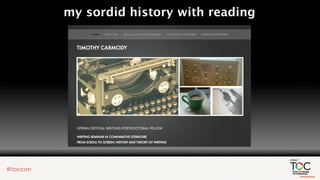
my sordid history with reading

    The Bookfuturist Manifesto
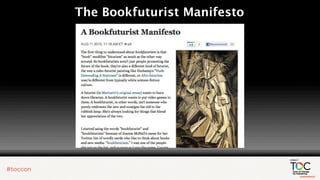
The Bookfuturist Manifesto
my sordid history with reading

      The Bookfuturist Manifesto

Ten Reading Revolutions Before E-Books
my sordid history with reading

          The Bookfuturist Manifesto

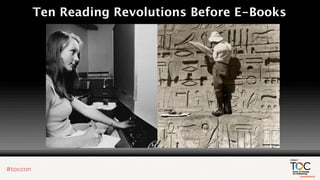
   Ten Reading Revolutions Before E-Books

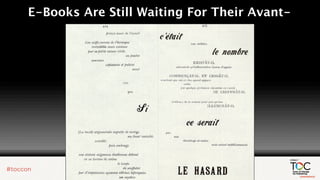
E-Books Are Still Waiting For Their Avant-Garde
E-Books Are Still Waiting For Their Avant-
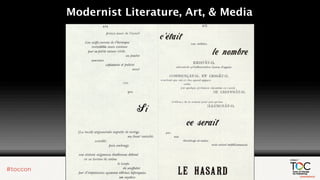
Modernist Literature, Art, & Media
Paper Modernism
Paper Modernism

    1850-1950
Paper Modernism

                  1850-1950

media revolutions: cinema, newspapers, telegraph
typewriters, diagrammming sentences, advertising
Paper Modernism

                     1850-1950
media revolutions: cinema, newspapers, telegraph
typewriters, diagrammming sentences, advertising
                 all deeply related
Paper Modernism

                     1850-1950
media revolutions: cinema, newspapers, telegraph
typewriters, diagrammming sentences, advertising
                 all deeply related
technical possibilities of production & distribution
Paper Modernism

                     1850-1950
media revolutions: cinema, newspapers, telegraph
typewriters, diagrammming sentences, advertising
                 all deeply related
technical possibilities of production & distribution
     typewriter, offset printing, cheap paper
Paper Modernism

                     1850-1950
media revolutions: cinema, newspapers, telegraph
typewriters, diagrammming sentences, advertising
                 all deeply related
technical possibilities of production & distribution
     typewriter, offset printing, cheap paper
 bombarded with information, text and images in
new expectations and possibilities for reading


      how text should look and be experienced
new expectations and possibilities for reading


      how text should look and be experienced

            books, movies, city streets
new expectations and possibilities for reading


      how text should look and be experienced

             books, movies, city streets

       no reason to distinguish between media
just like now
the 21st century media industry
How to cover


the 21st century media industry
How to cover


the 21st century media industry

           all together
How to cover


the 21st century media industry

            all together
           or in tiny bits
all together
Amazon


all together
Amazon


all together

   Apple
in tiny bits
weird obsessions


  in tiny bits
weird obsessions


                  in tiny bits

how do you do text entry in a Netflix app for the Wii?
unusual contexts for reading and writing


             unusual devices
unusual contexts for reading and writing


             unusual devices
     unusual functions and use cases
unusual contexts for reading and writing


             unusual devices
     unusual functions and use cases
             not so unusual
unusual contexts for reading and writing


             interface jumps
unusual contexts for reading and writing


                 interface jumps
      part of the experiential background
that reading is defined with or defined against
How do we read, really?


         in a hyperliterate society
       the vast majority of reading
is not consciously recognized as reading
what readers expect
is more important than
   what readers want
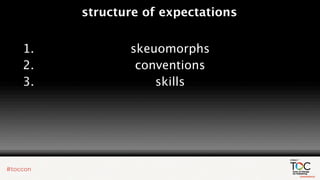
structure of expectations


    what readers expect
  is more important than
     what readers want
structure of expectations


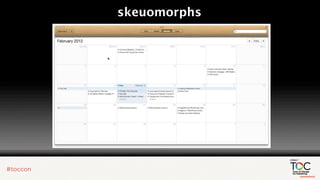
1.          skeuomorphs
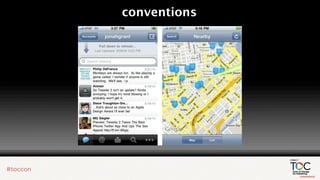
2.           conventions
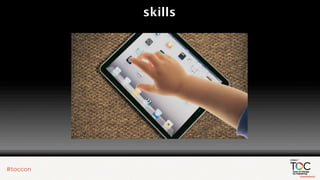
3.              skills
skeuomorphs
conventions
skills
skills


Clay Shirky: “a screen without a mouse ships
                   broken”
skills


Clay Shirky: “a screen without a mouse ships
                   broken”
Steve Jobs: “if you see a stylus, they blew it”
skills


Clay Shirky: “a screen without a mouse ships
                   broken”
Steve Jobs: “if you see a stylus, they blew it”
      if you see a mouse, they blew it
skills


Clay Shirky: “a screen without a mouse ships
                   broken”
Steve Jobs: “if you see a stylus, they blew it”
      if you see a mouse, they blew it
                  NOT TRUE
skills


Bill Buxton: “every tool is the best at something
        and the worst at something else”
skills


Bill Buxton: “every tool is the best at something
        and the worst at something else”
              “skills are expensive”
skills


deeper than skeuomorphs or conventions
skills


deeper than skeuomorphs or conventions
    stronger relationship to the body
skills


deeper than skeuomorphs or conventions
    stronger relationship to the body
          more generalizable
skills


deeper than skeuomorphs or conventions
    stronger relationship to the body
          more generalizable
 most poorly utilized in interface design
skills


how to button a button
skills


how to button a button
manuscript / pen & ink
skills


      how to button a button
      manuscript / pen & ink
your pocket is a multitouch interface
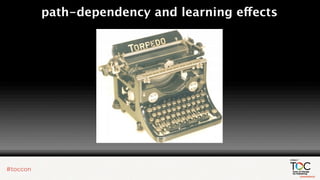
path-dependency and learning effects


            switching costs
coordinating around a common standard
people get better at things they practice
path-dependency and learning effects


            switching costs
coordinating around a common standard
people get better at things they practice

          need external shock
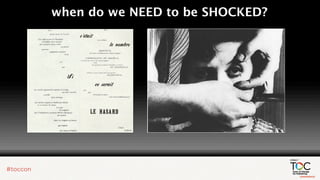
when do we NEED to be SHOCKED?
most important expectations for reading


         not how the page looks
most important expectations for reading


         not how the page looks
   not even just how we interact with it
most important expectations for reading


         not how the page looks
   not even just how we interact with it
         nothing qualitative at all
most important expectations for reading


               QUANTITY
most important expectations for reading


               QUANTITY
            how much we get
            how we get more
             who’s in charge
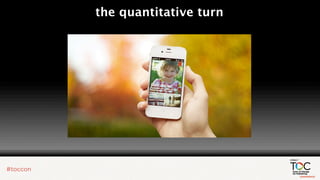
the quantitative turn
Odysseus and the Sirens


we actually like constraints once we’re in them
Odysseus and the Sirens


we actually like constraints once we’re in them
            constraints are freedom
Odysseus and the Sirens


we actually like constraints once we’re in them
            constraints are freedom
  we have an endless supply of constraints
Odysseus and the Sirens


we actually like constraints once we’re in them
            constraints are freedom
  we have an endless supply of constraints
            (this itself is a paradox)
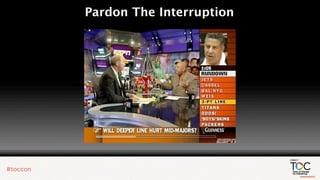
Pardon The Interruption

Changing Times, Changing Readers: Let's Start With Experience