Academic E-Reading
Themes from User Experience Studies


Nicole Hennig, Head
MIT Libraries User Experience Group
Nov. 8, 2011
Today’s talk

1. User needs study results

2. Mobile academic ereading - the current state

3. Mobile academic ereading - improving it
User Needs Research

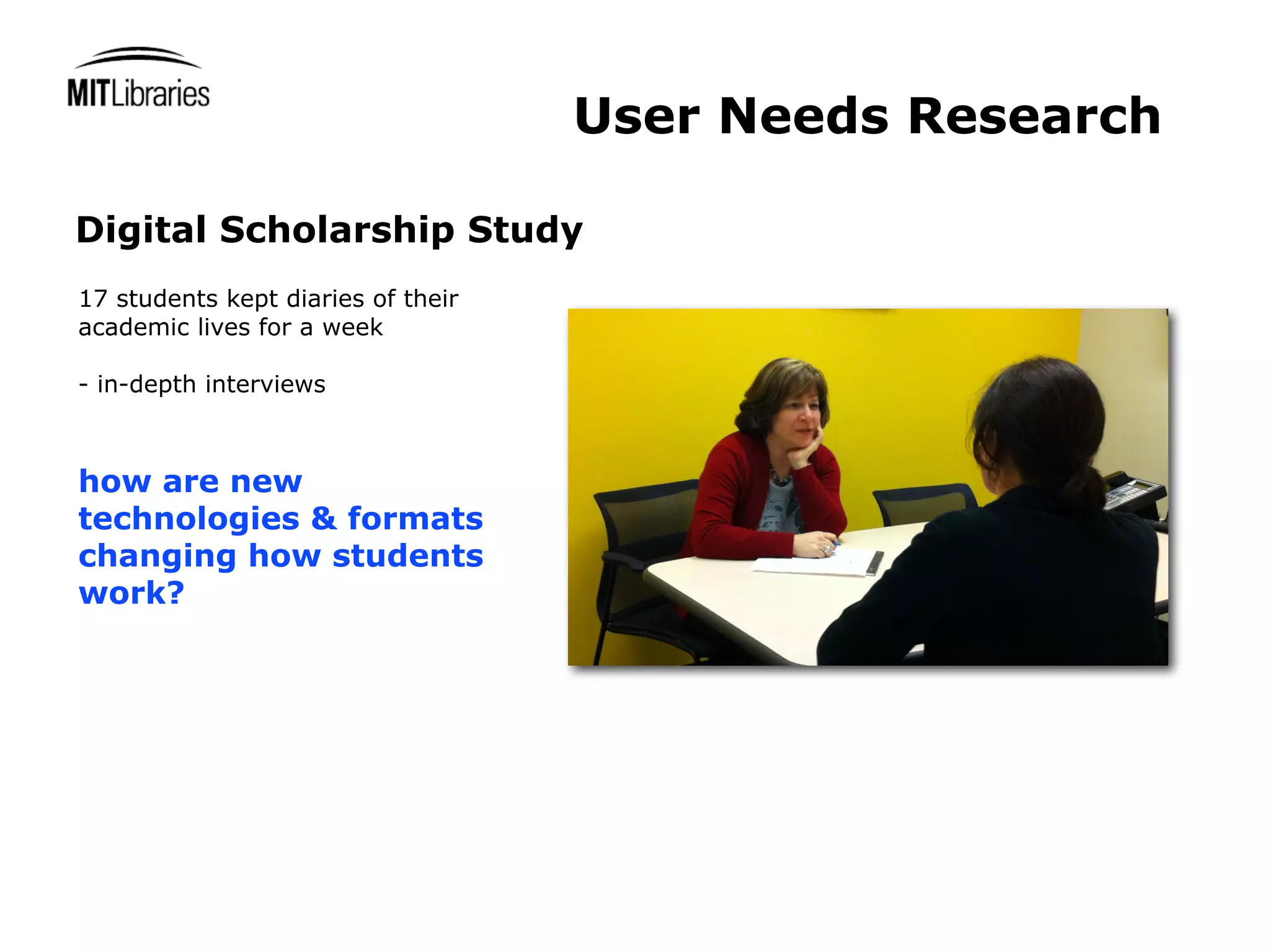
Digital Scholarship Study
17 students kept diaries of their
academic lives for a week

- in-depth interviews


how are new
technologies & formats
changing how students
work?
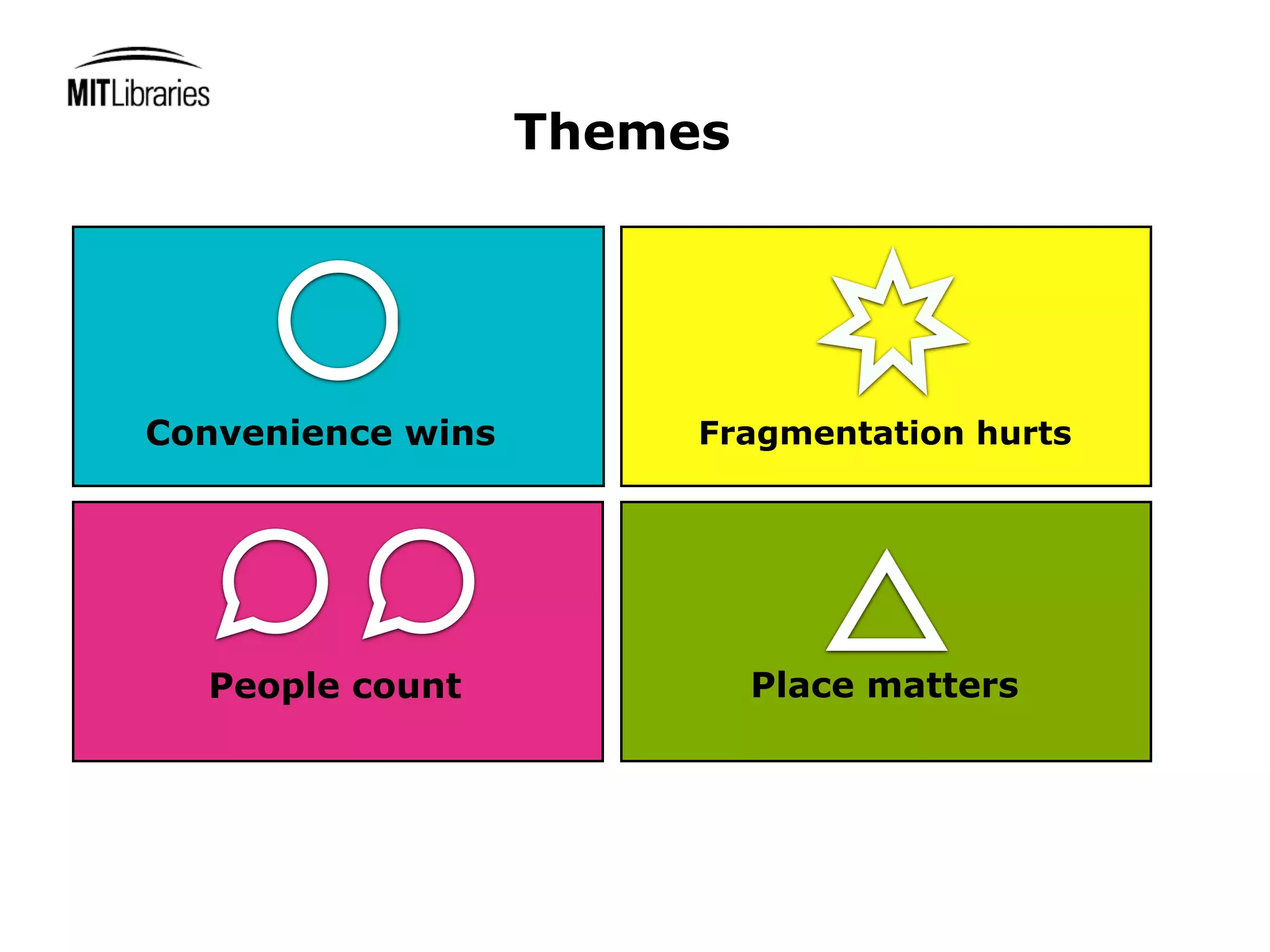
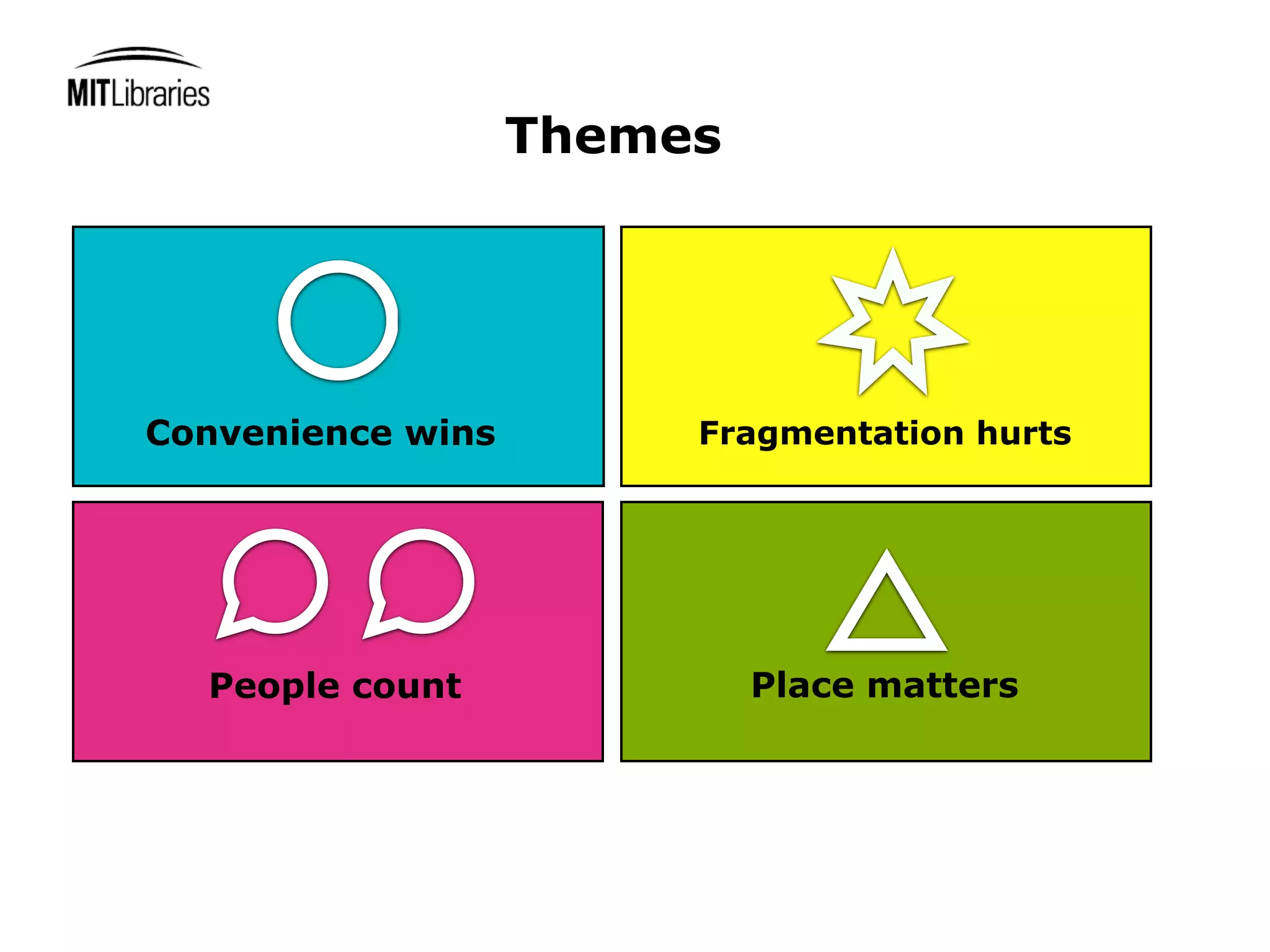
Themes


Convenience wins        Fragmentation hurts


  People count              Place matters
Convenience wins

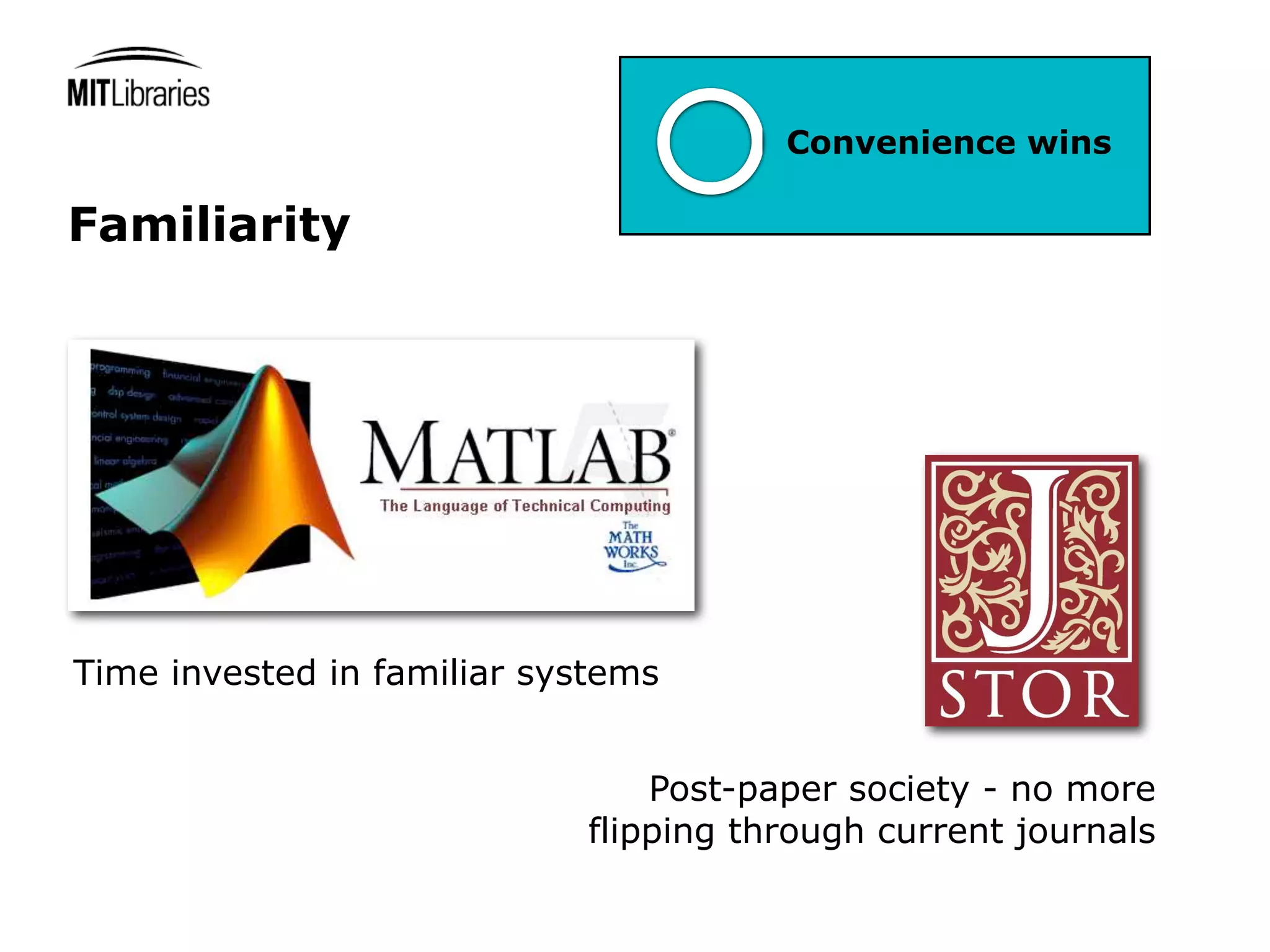
Familiarity


Time invested in familiar systems


                                Post-paper society - no more
                            flipping through current journals
Convenience wins


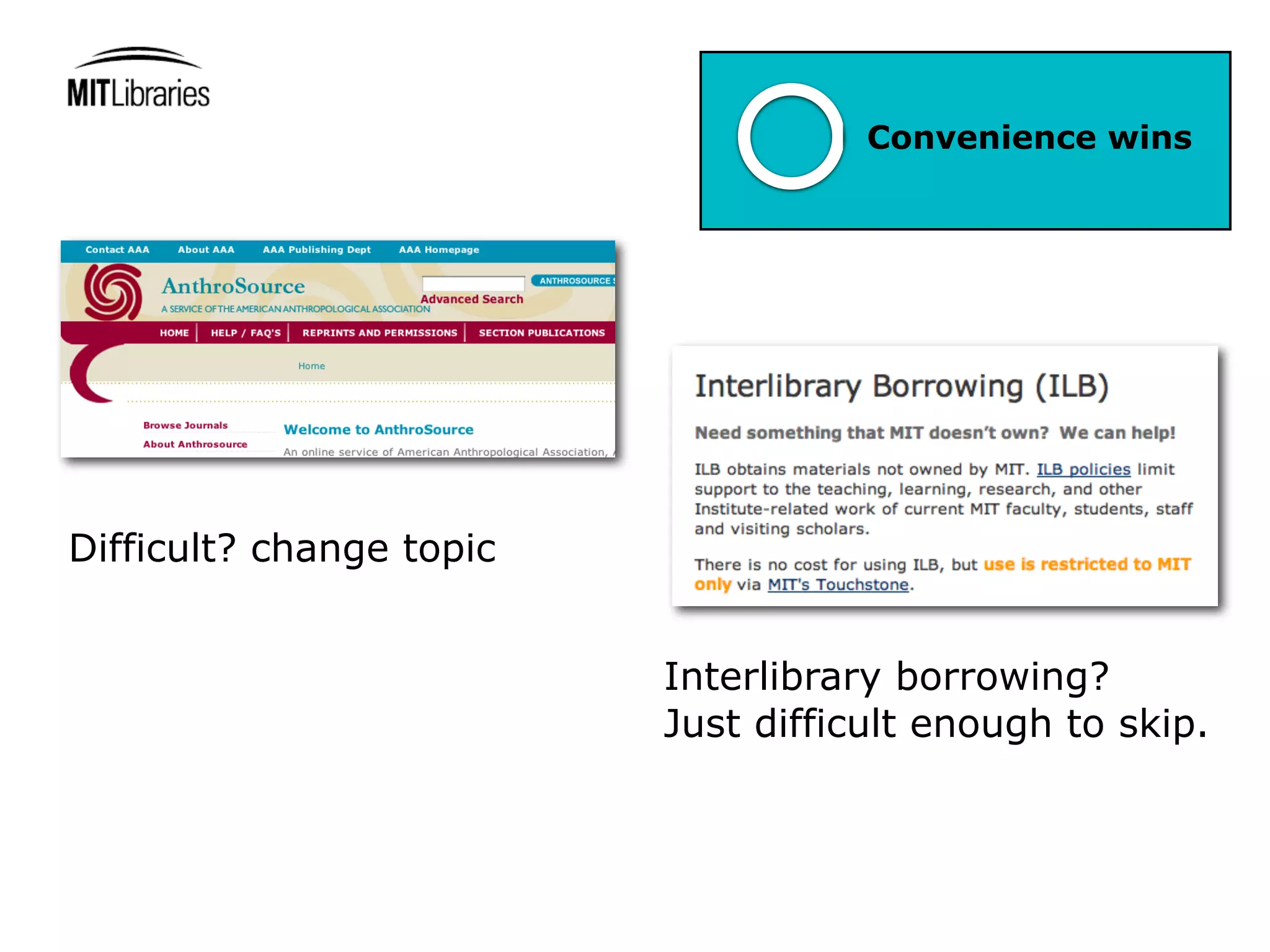
Difficult? change topic


                          Interlibrary borrowing?
                          Just difficult enough to skip.
Convenience wins


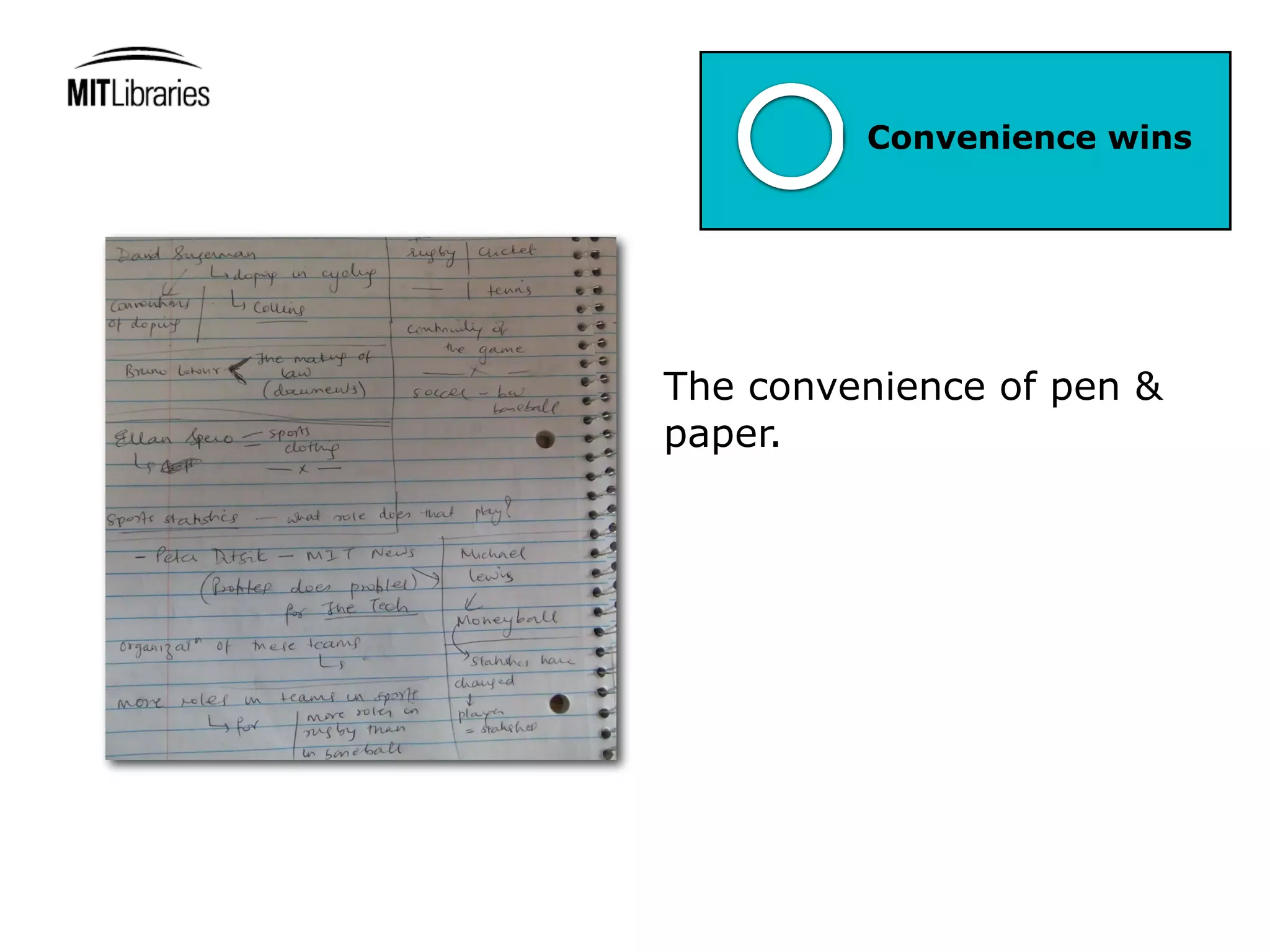
The convenience of pen &
paper.
Convenience wins


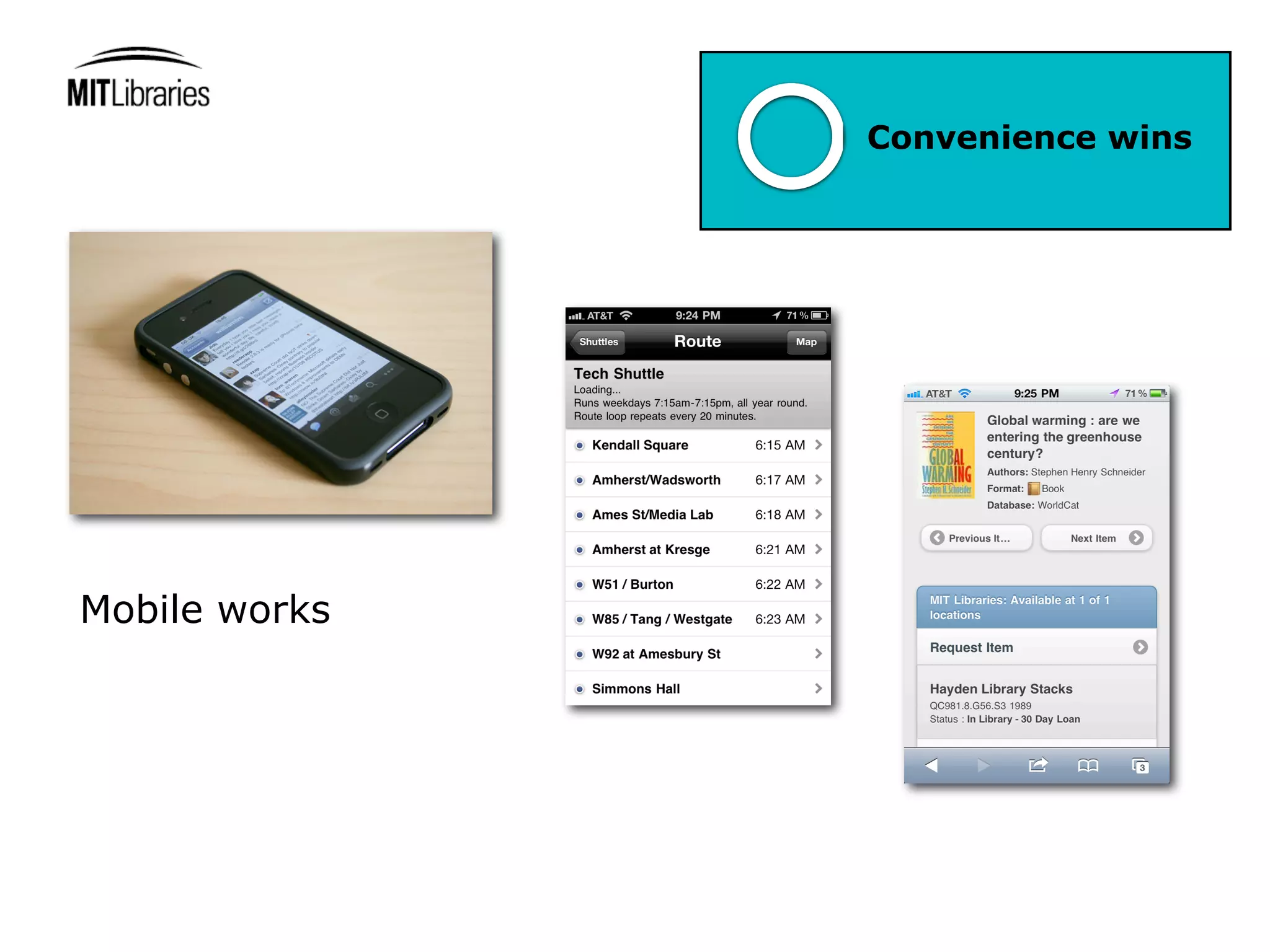
Mobile works
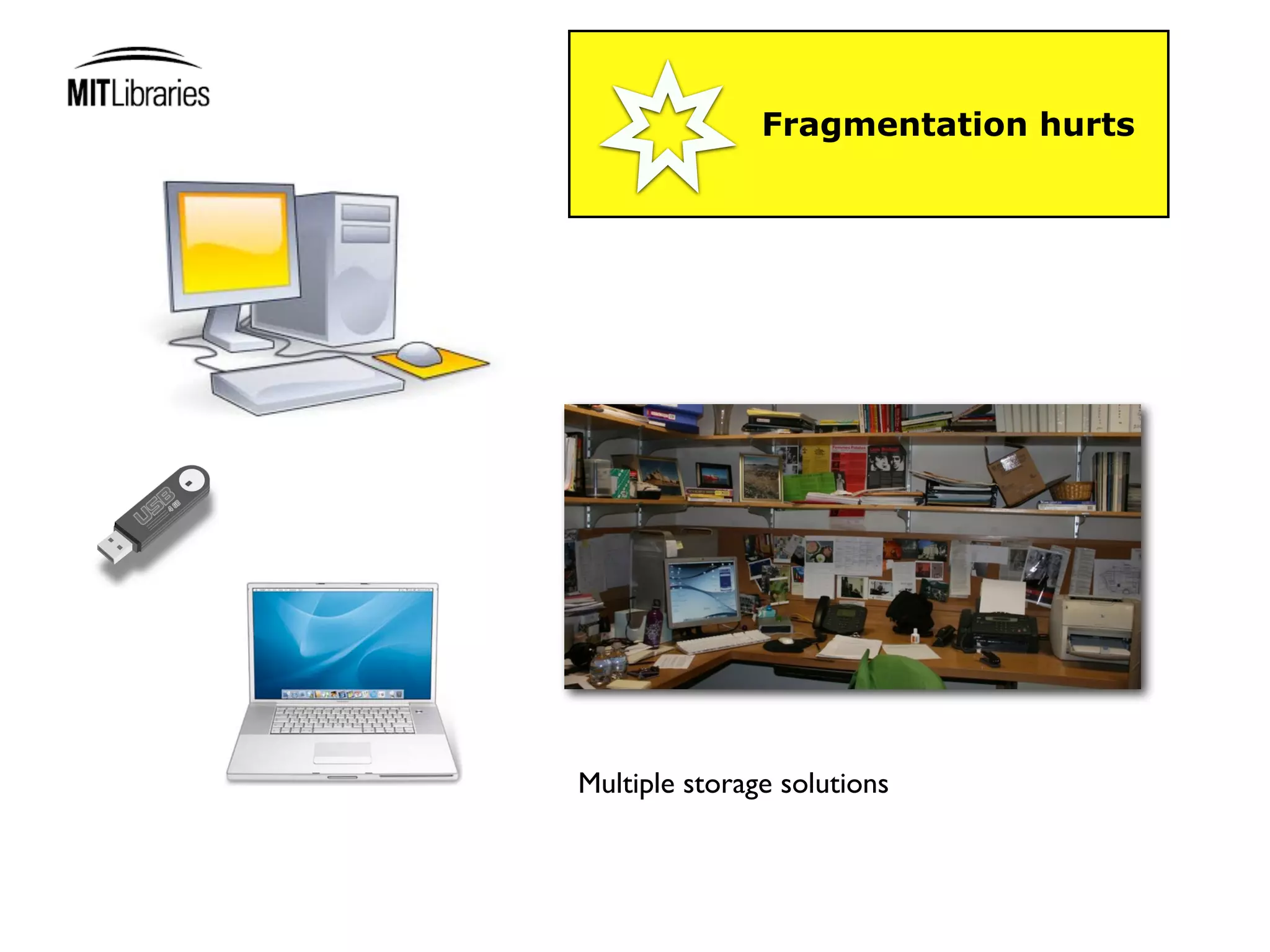
Fragmentation hurts


Multiple storage solutions
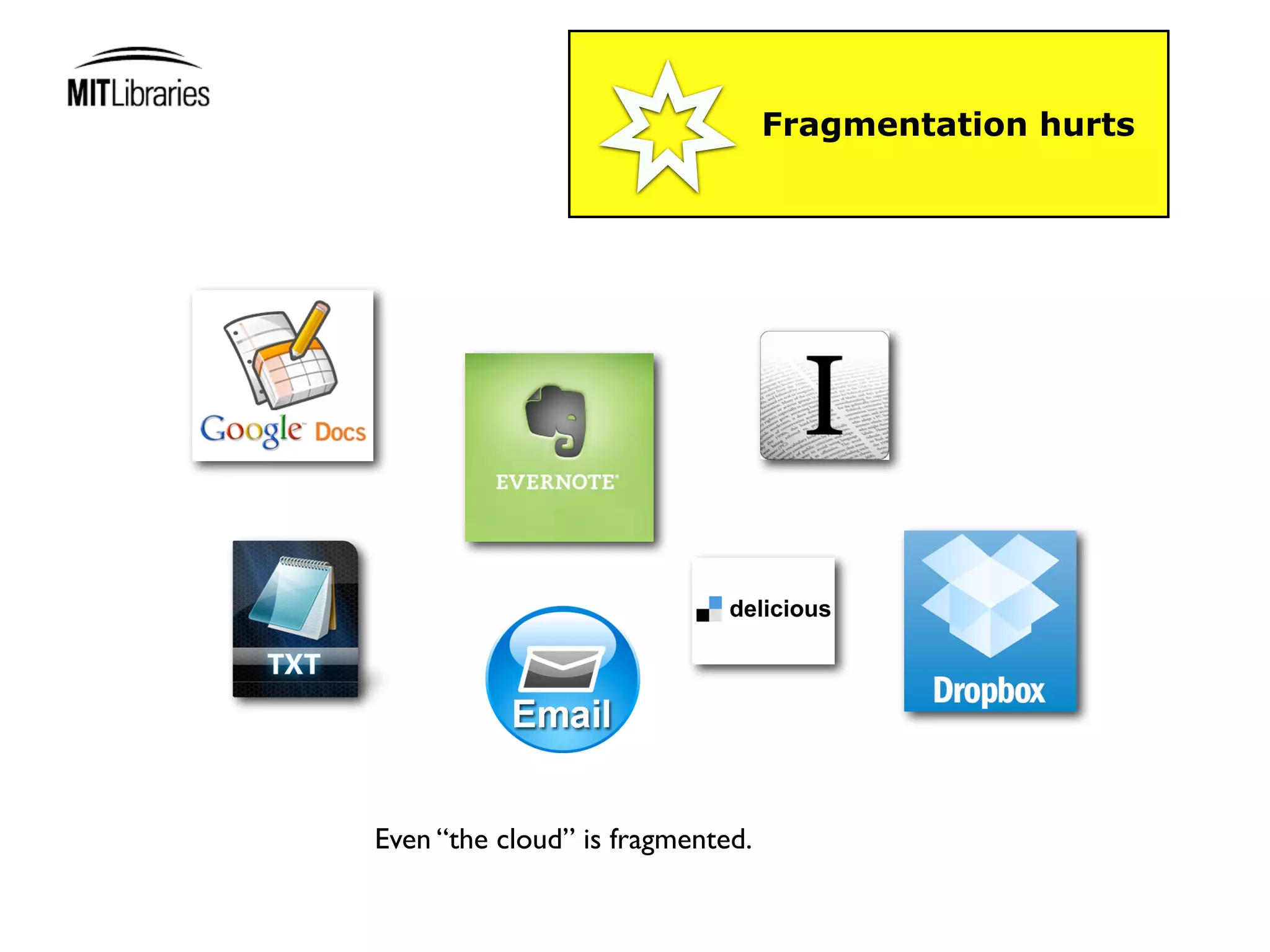
Fragmentation hurts


Even “the cloud” is fragmented.
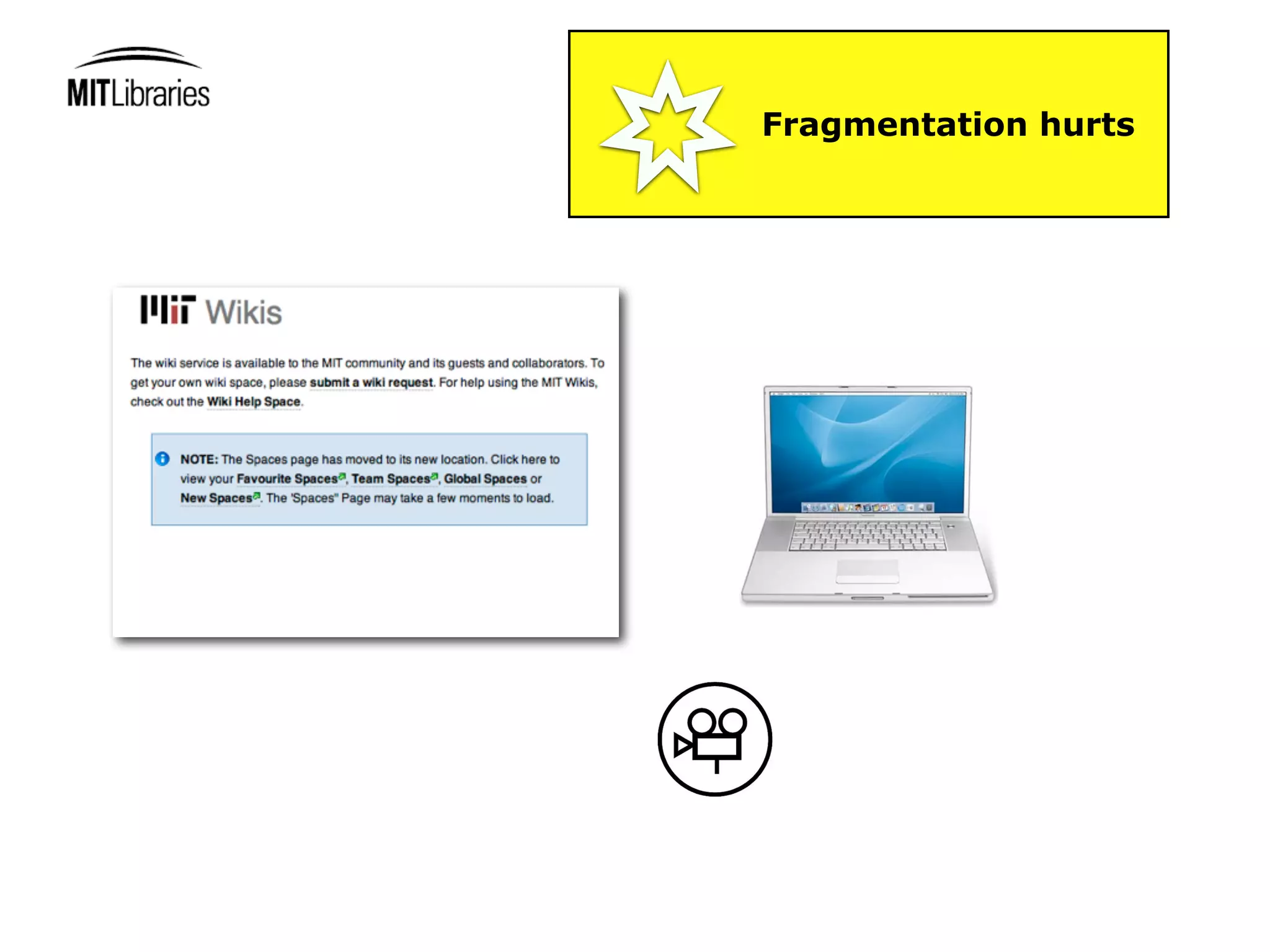
Fragmentation hurts
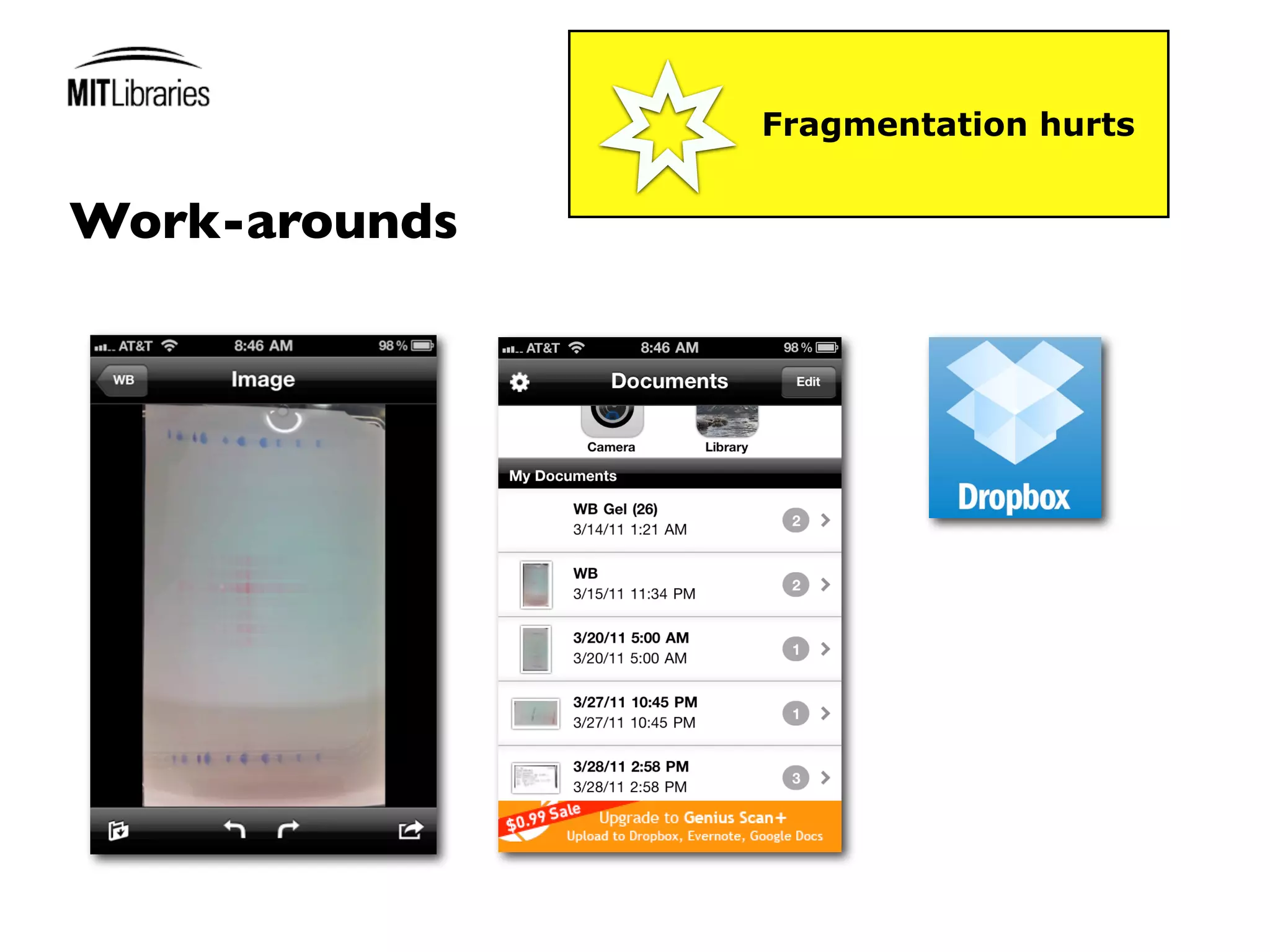
Fragmentation hurts


Work-arounds
People count
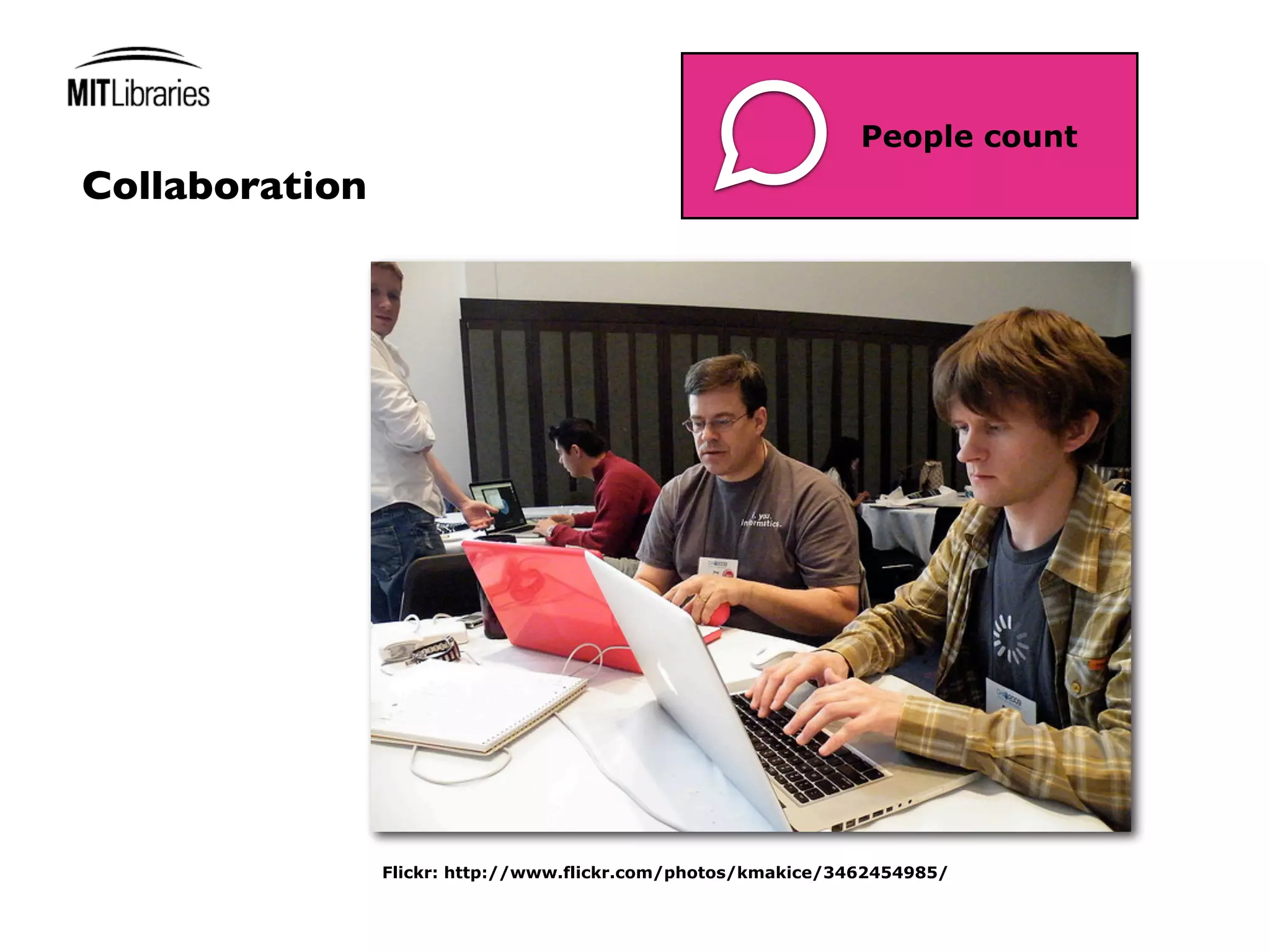
Collaboration


                Flickr: http://www.flickr.com/photos/kmakice/3462454985/
People count


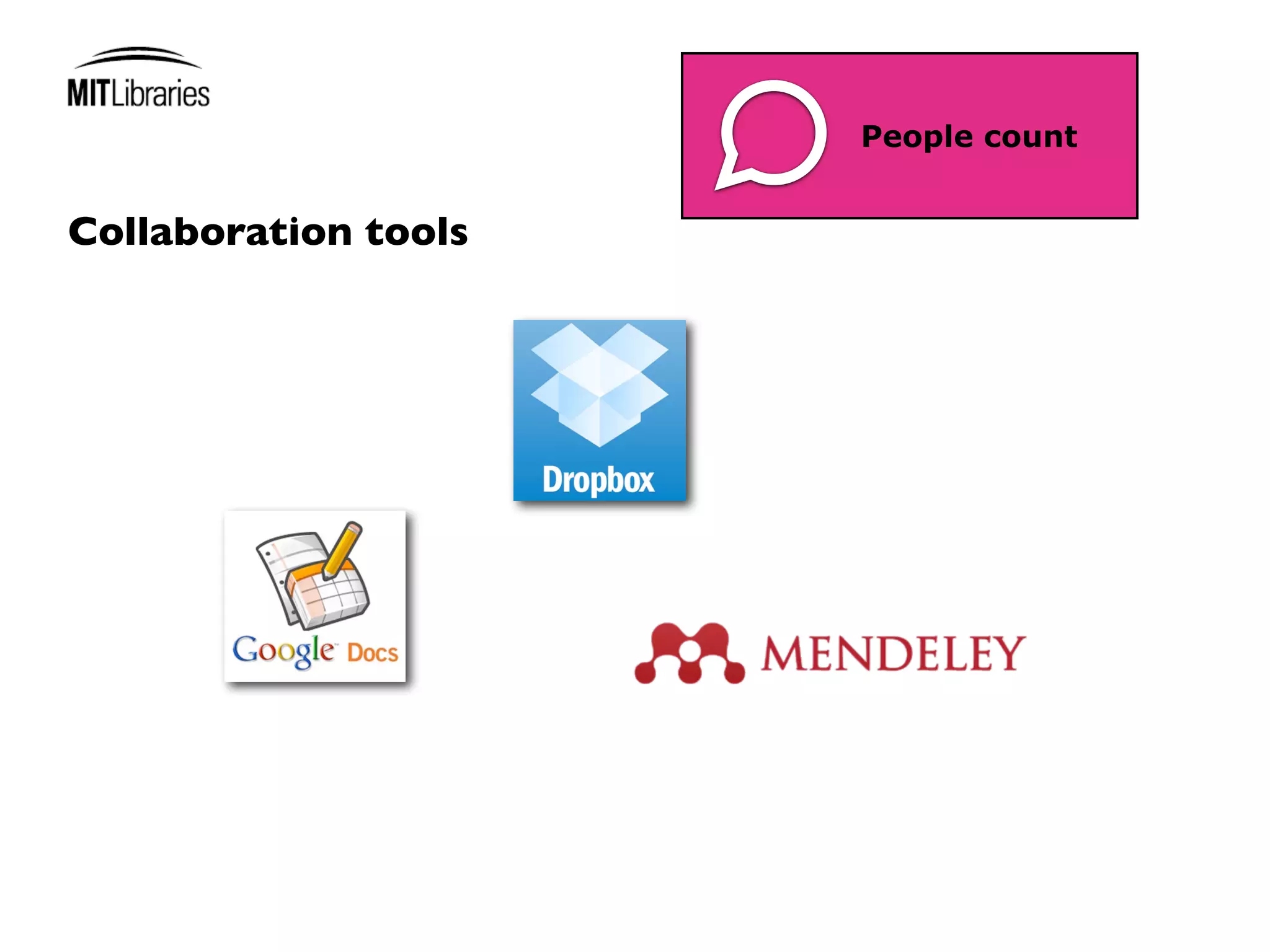
Collaboration tools
People count

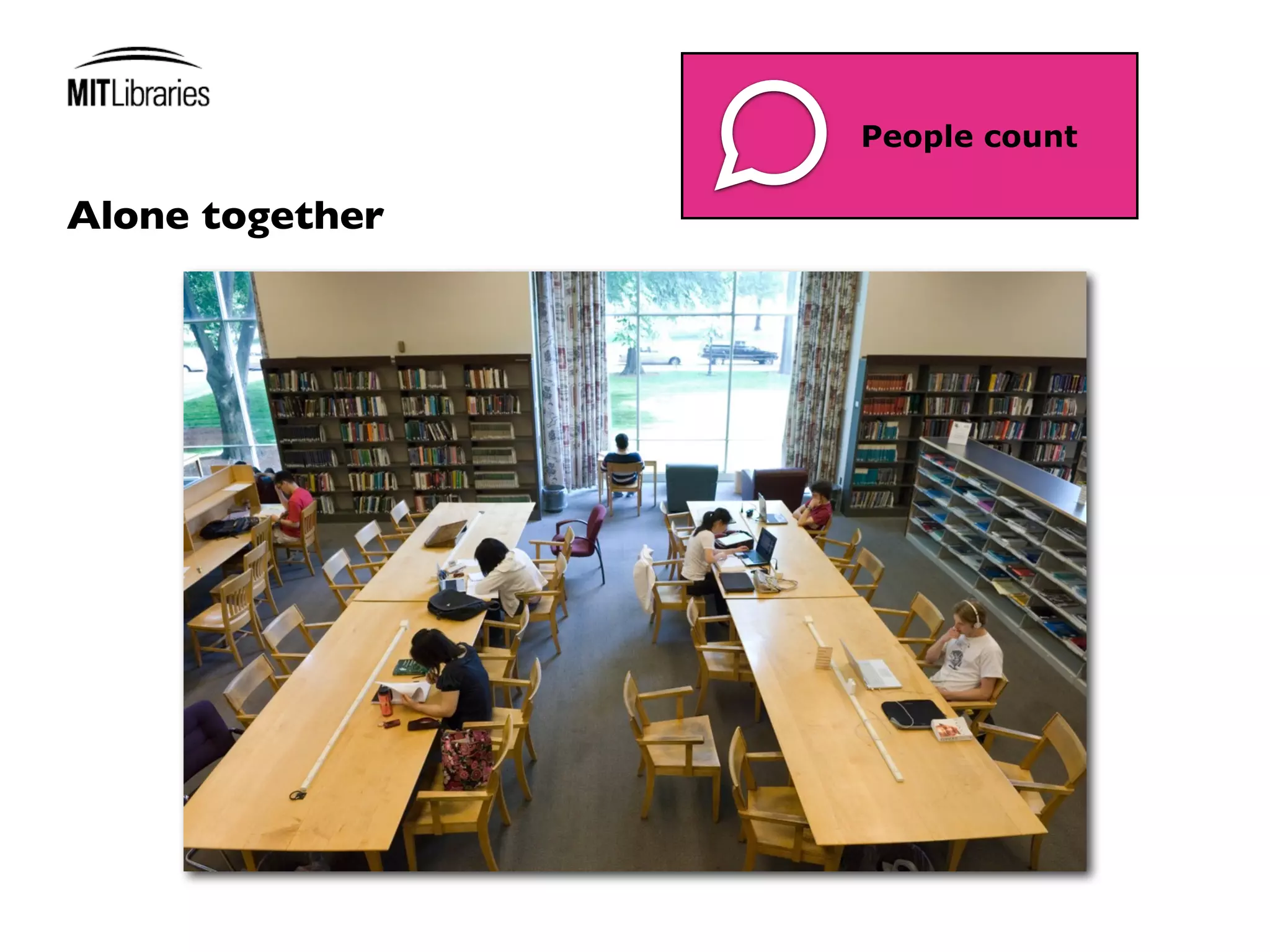
Alone together
People count

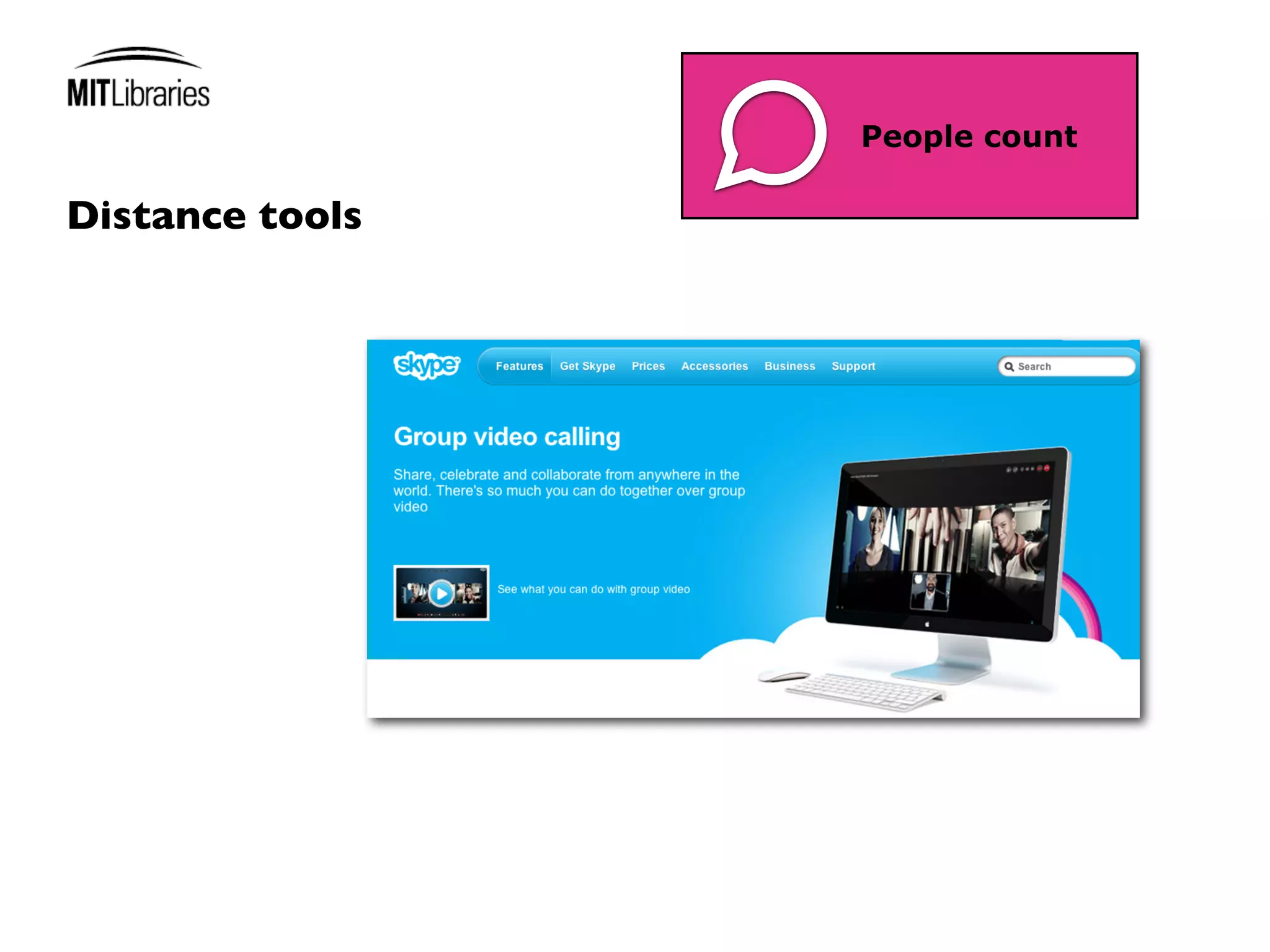
Distance tools
People count

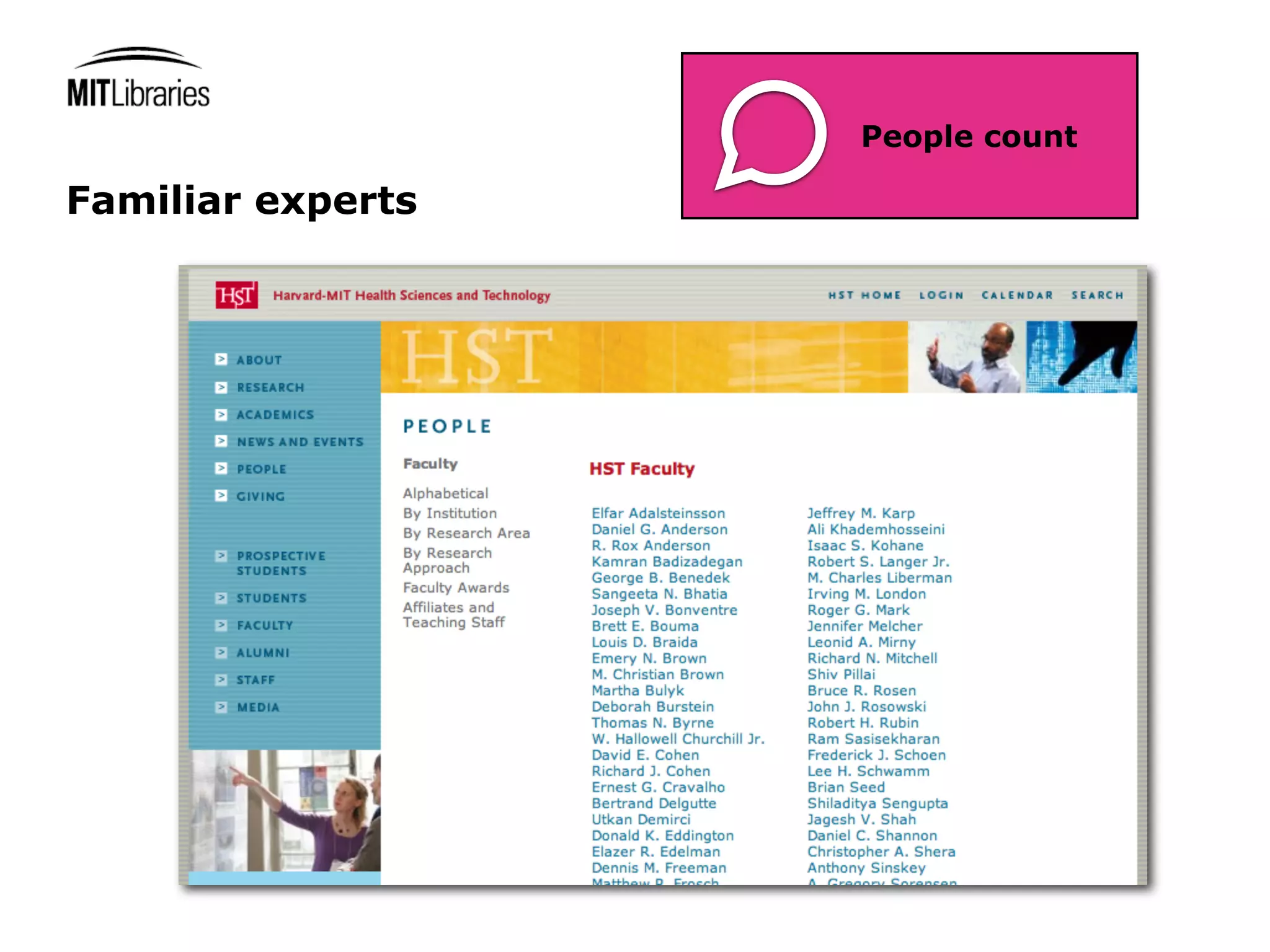
Familiar experts
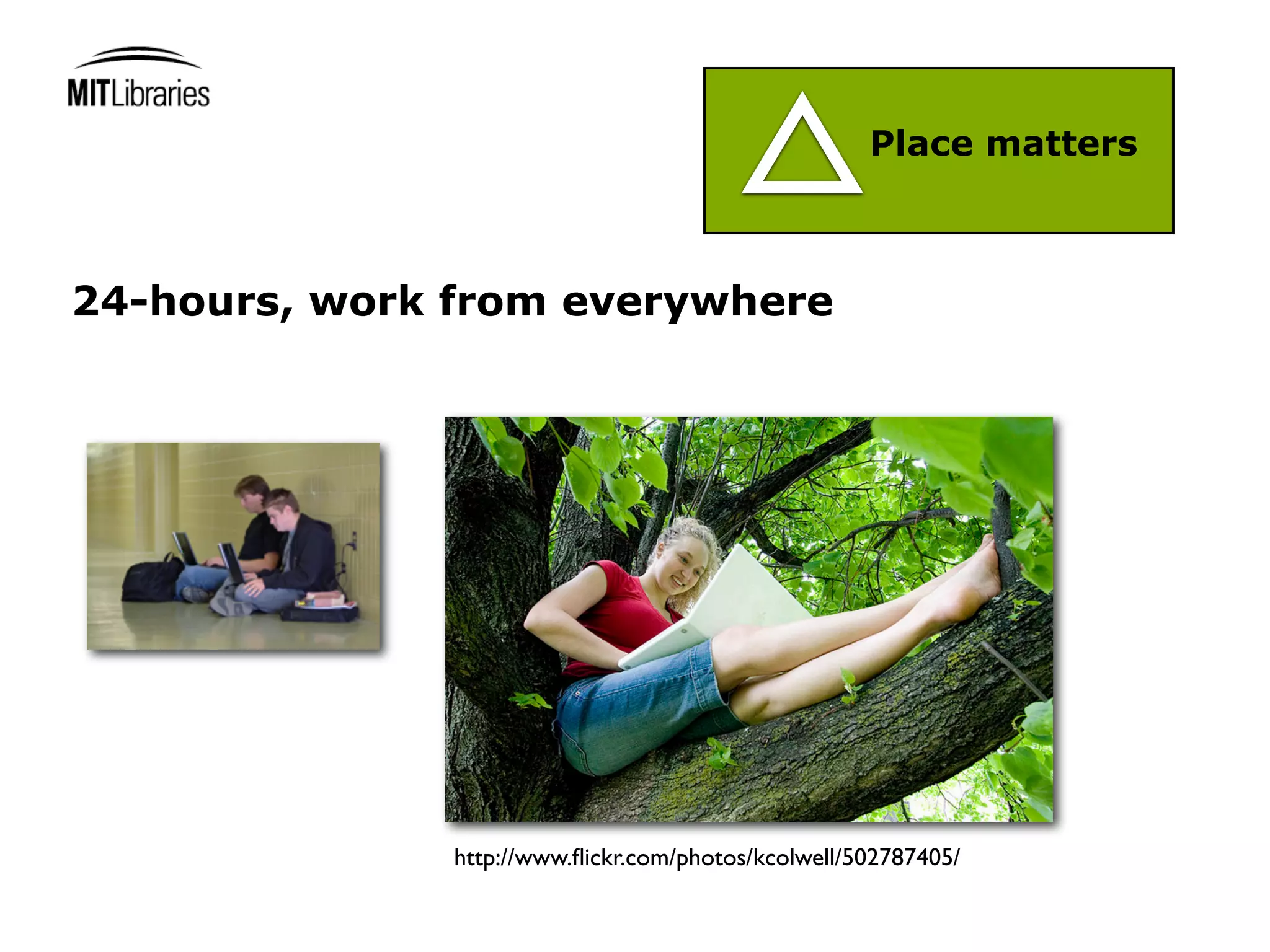
Place matters


24-hours, work from everywhere


               http://www.flickr.com/photos/kcolwell/502787405/
Themes


Convenience wins        Fragmentation hurts


  People count              Place matters
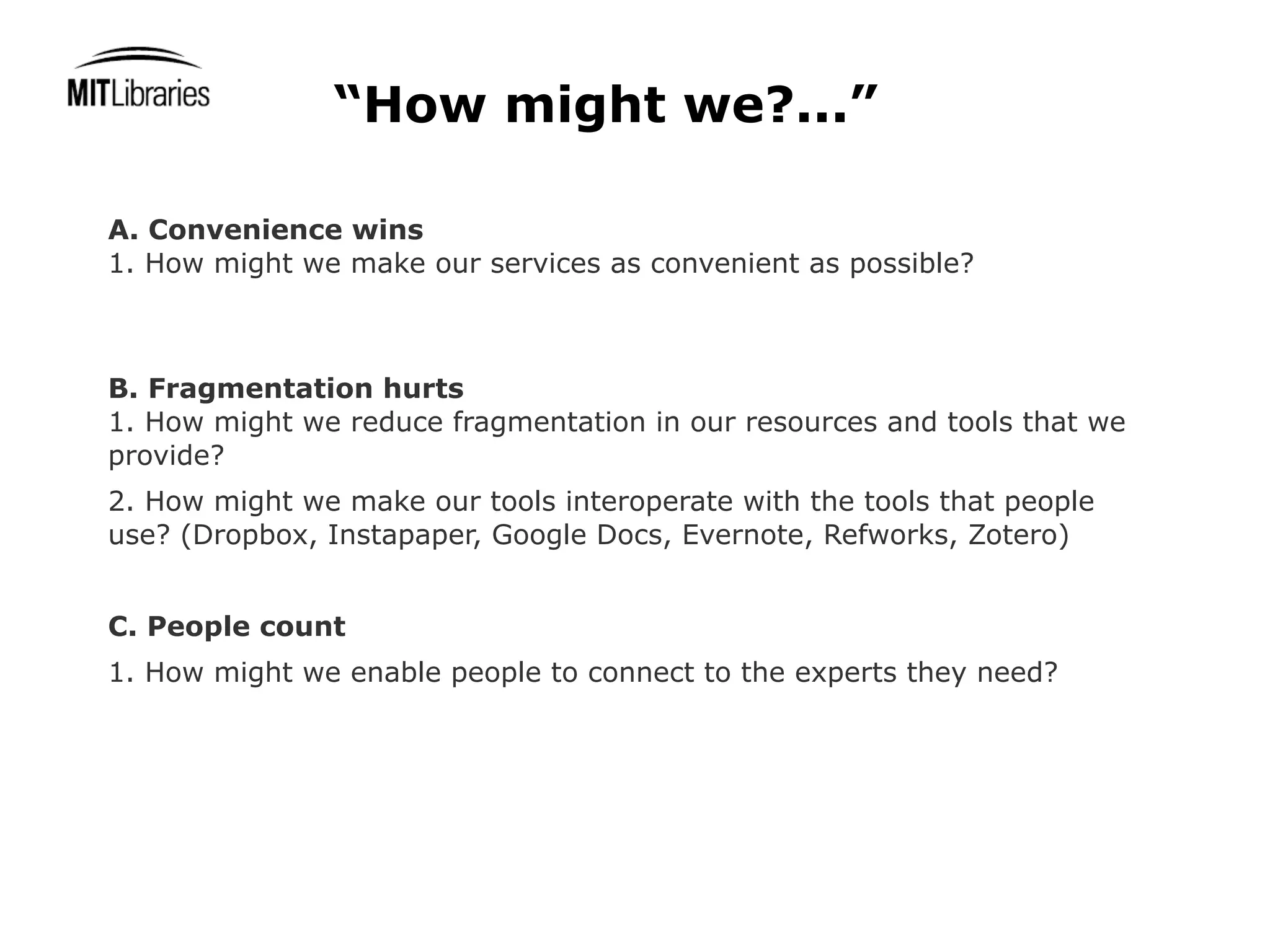
“How might we?...”

A. Convenience wins
1. How might we make our services as convenient as possible?


B. Fragmentation hurts
1. How might we reduce fragmentation in our resources and tools that we
provide?
2. How might we make our tools interoperate with the tools that people
use? (Dropbox, Instapaper, Google Docs, Evernote, Refworks, Zotero)


C. People count
1. How might we enable people to connect to the experts they need?
Academic ebooks - current situation
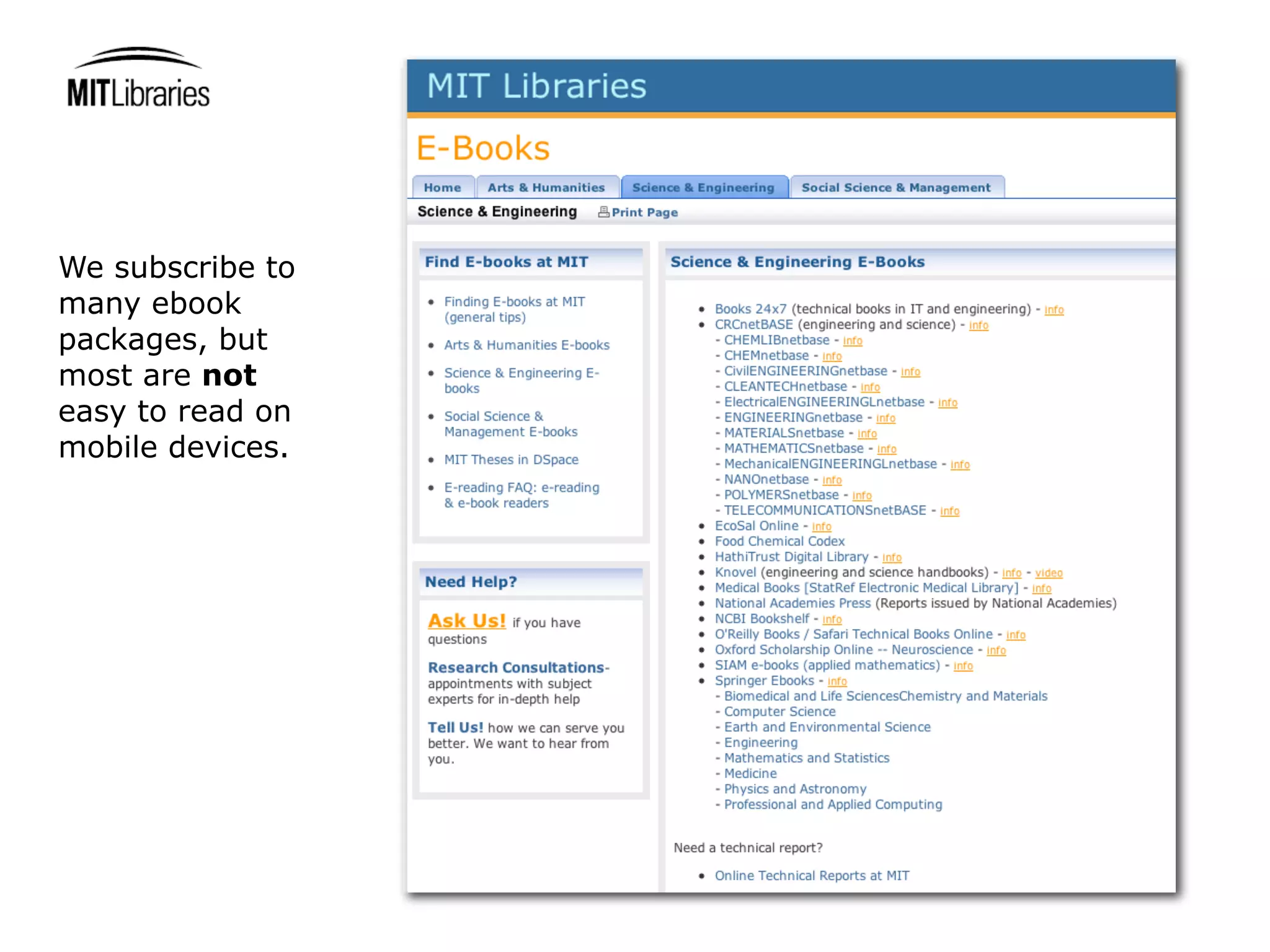
We subscribe to
many ebook
packages, but
most are not
easy to read on
mobile devices.
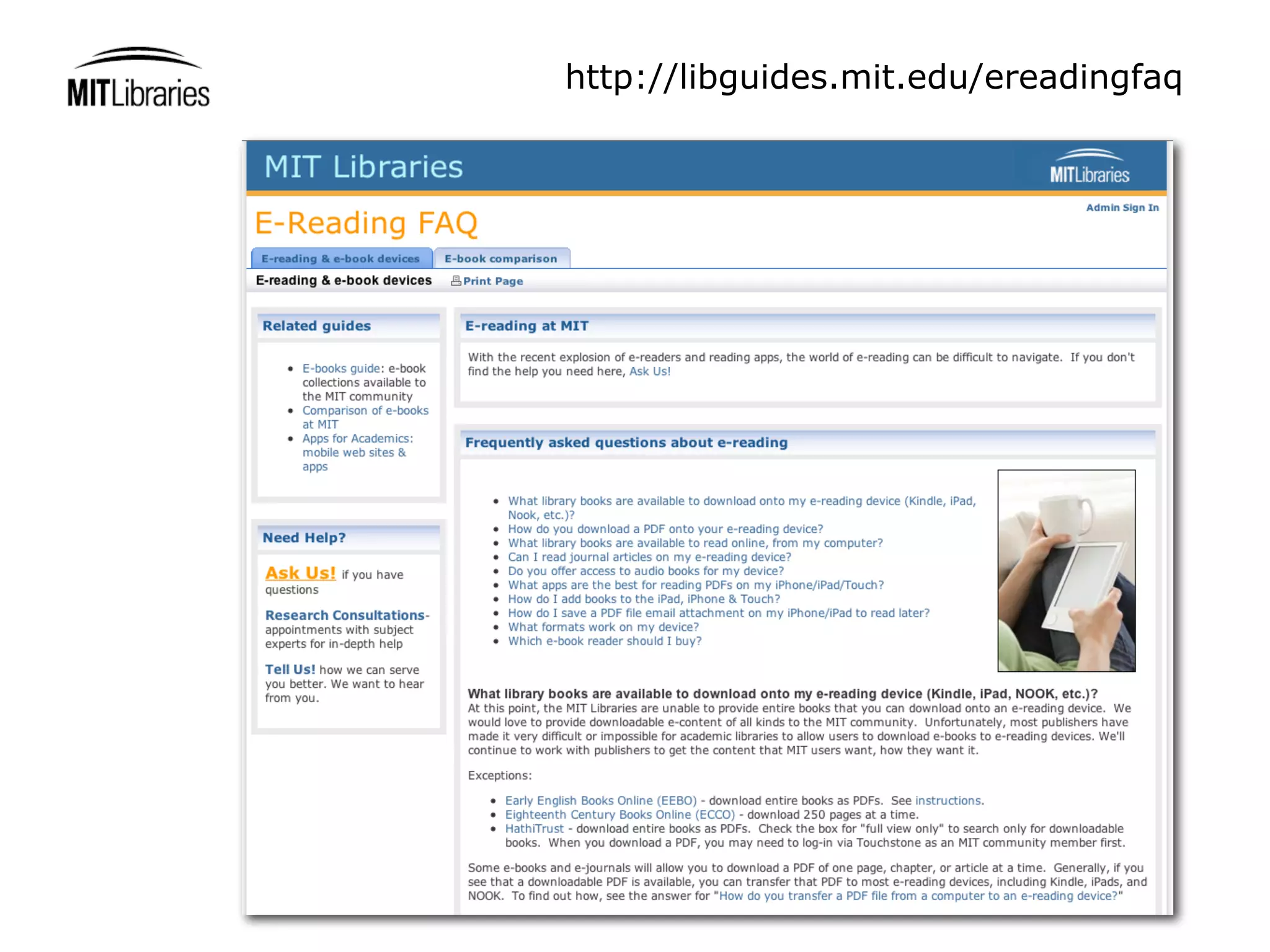
http://libguides.mit.edu/ereadingfaq
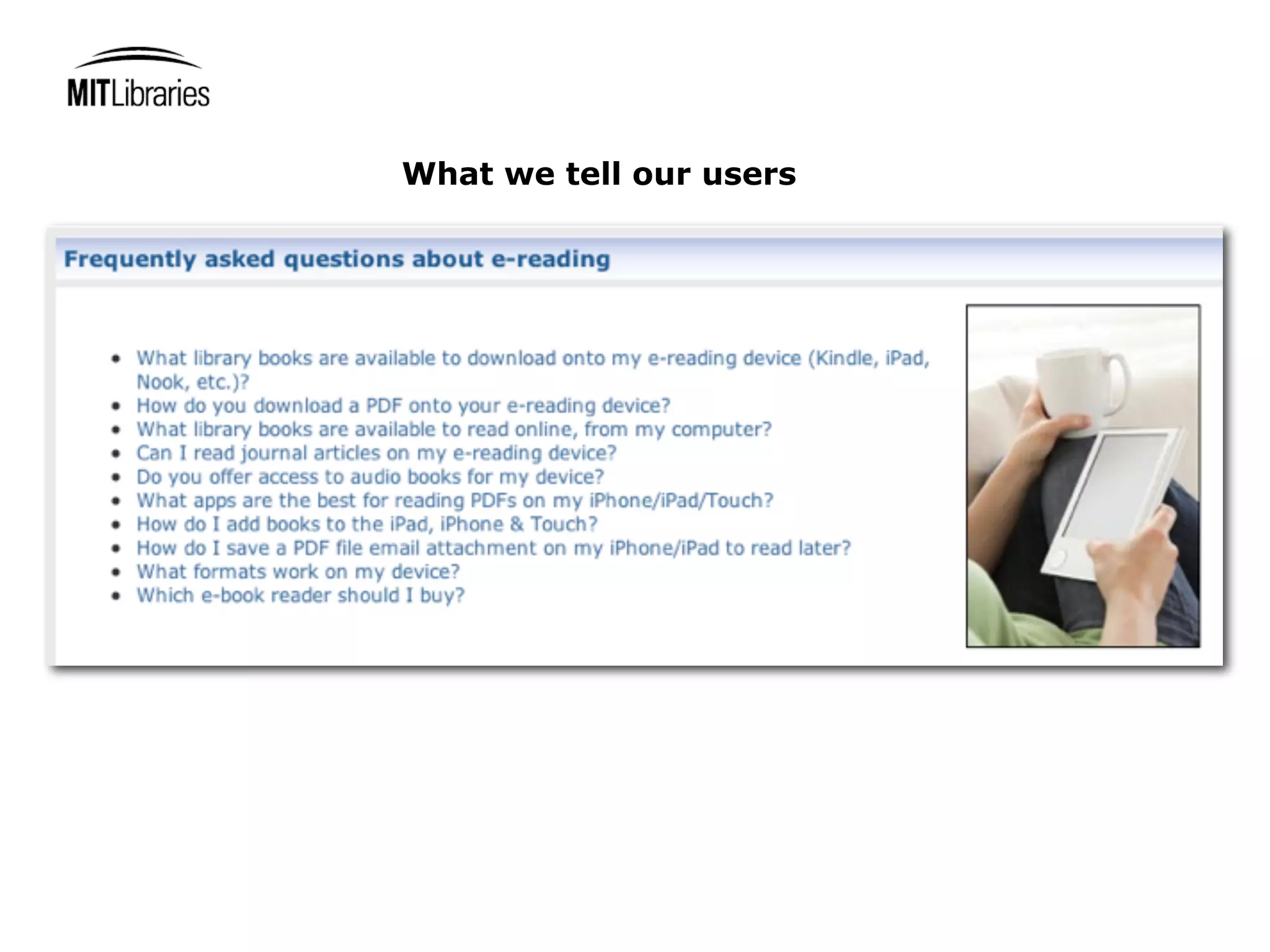
What we tell our users
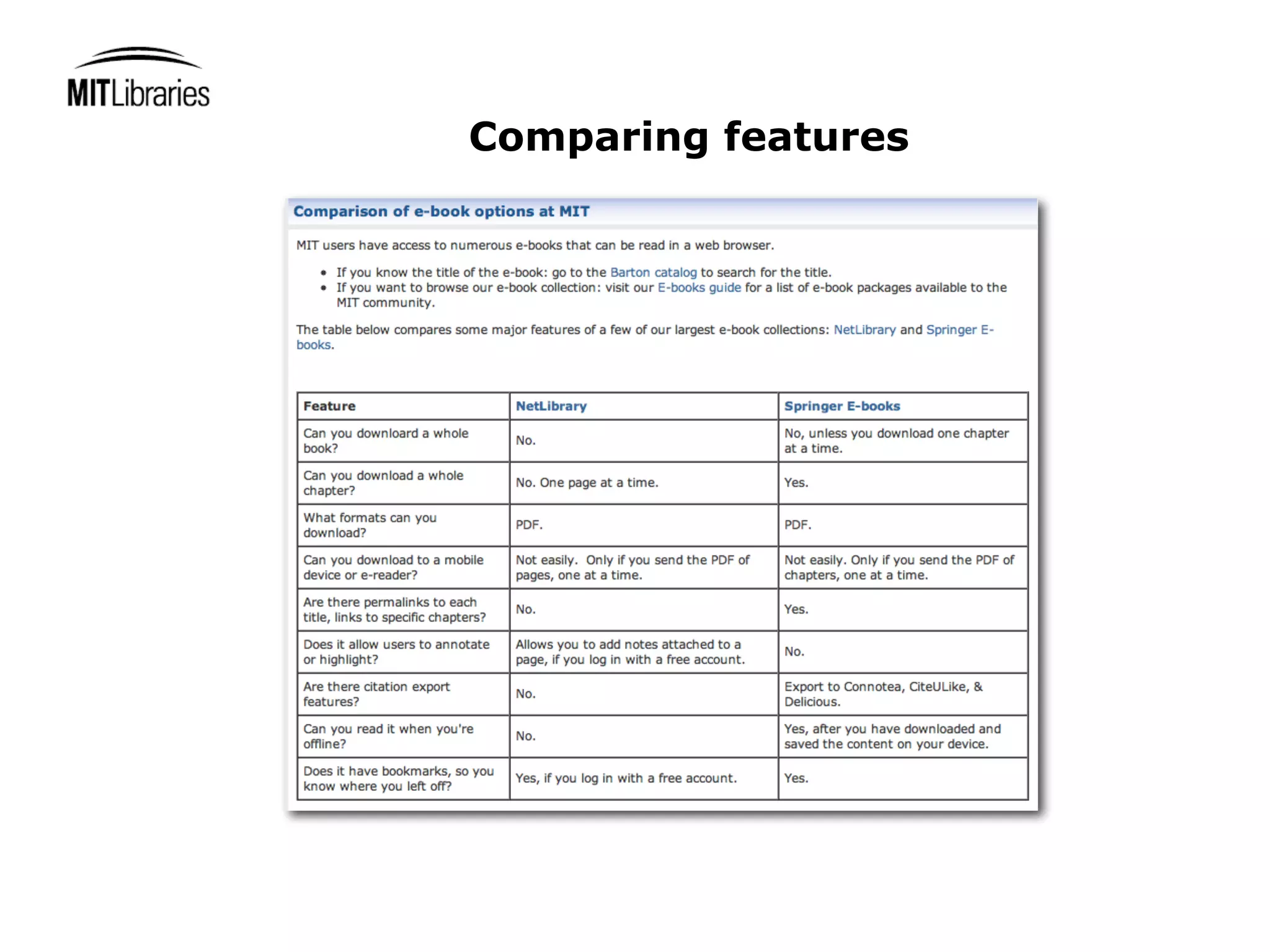
Comparing features
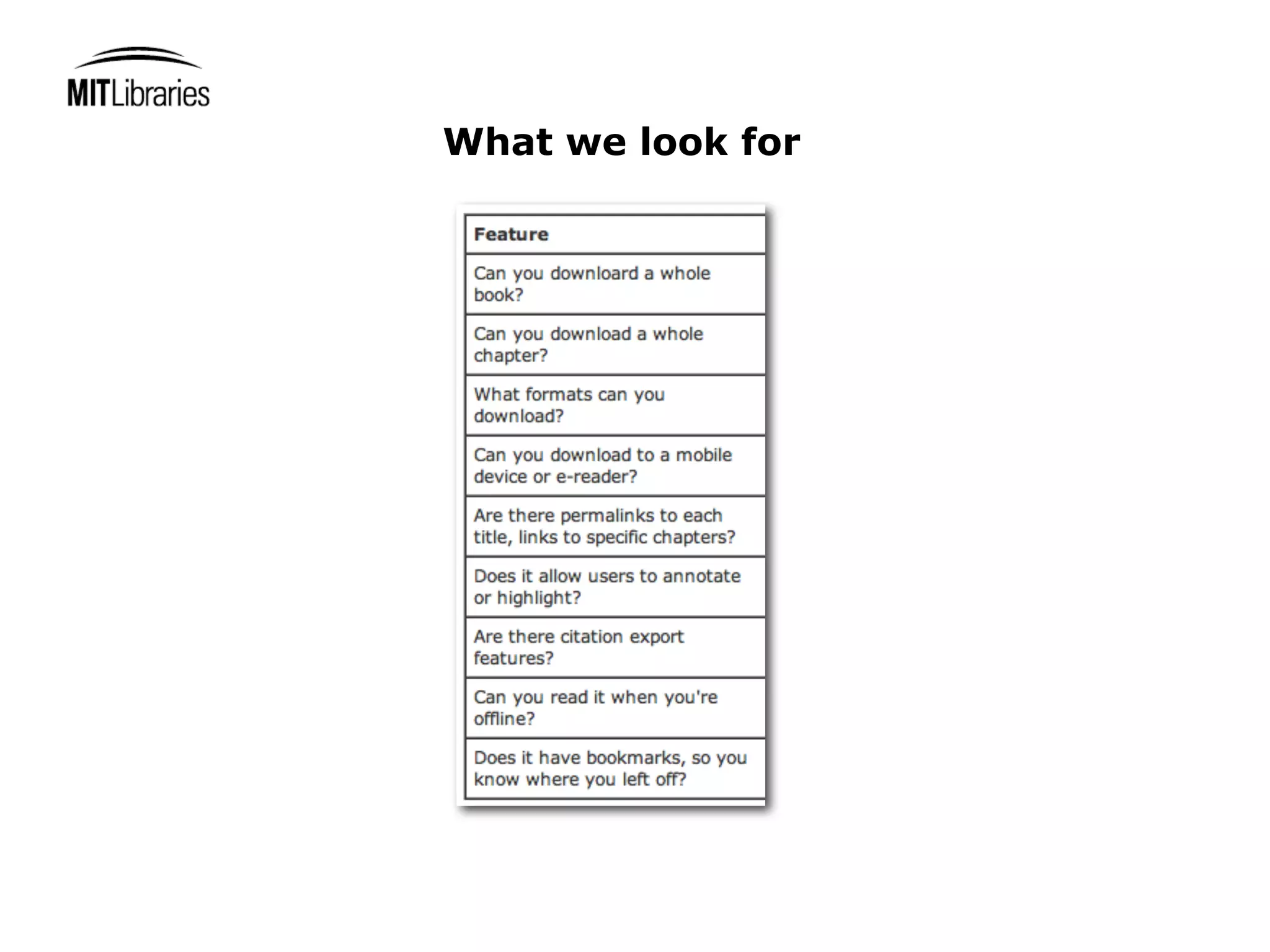
What we look for
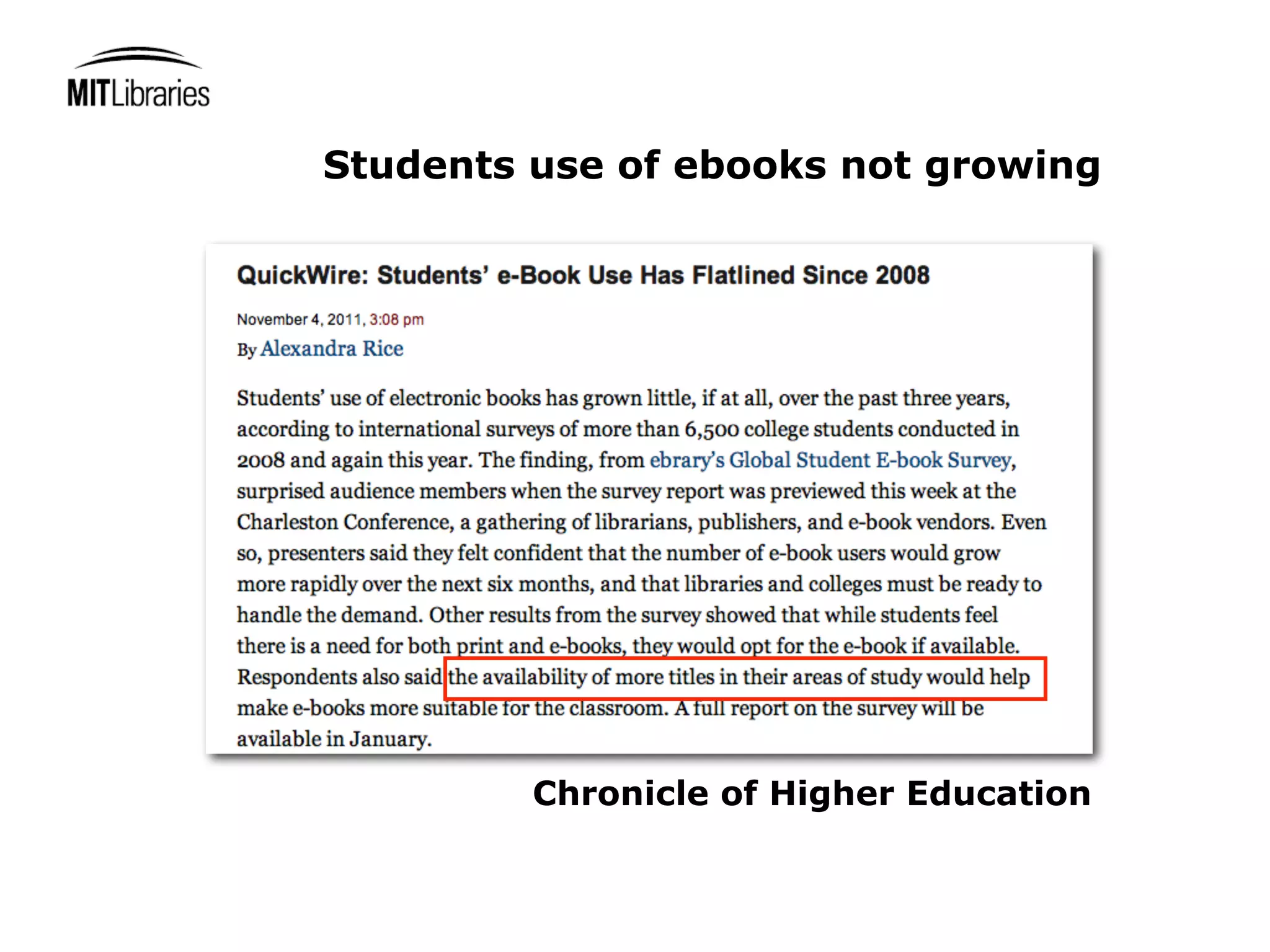
Students use of ebooks not growing


         Chronicle of Higher Education
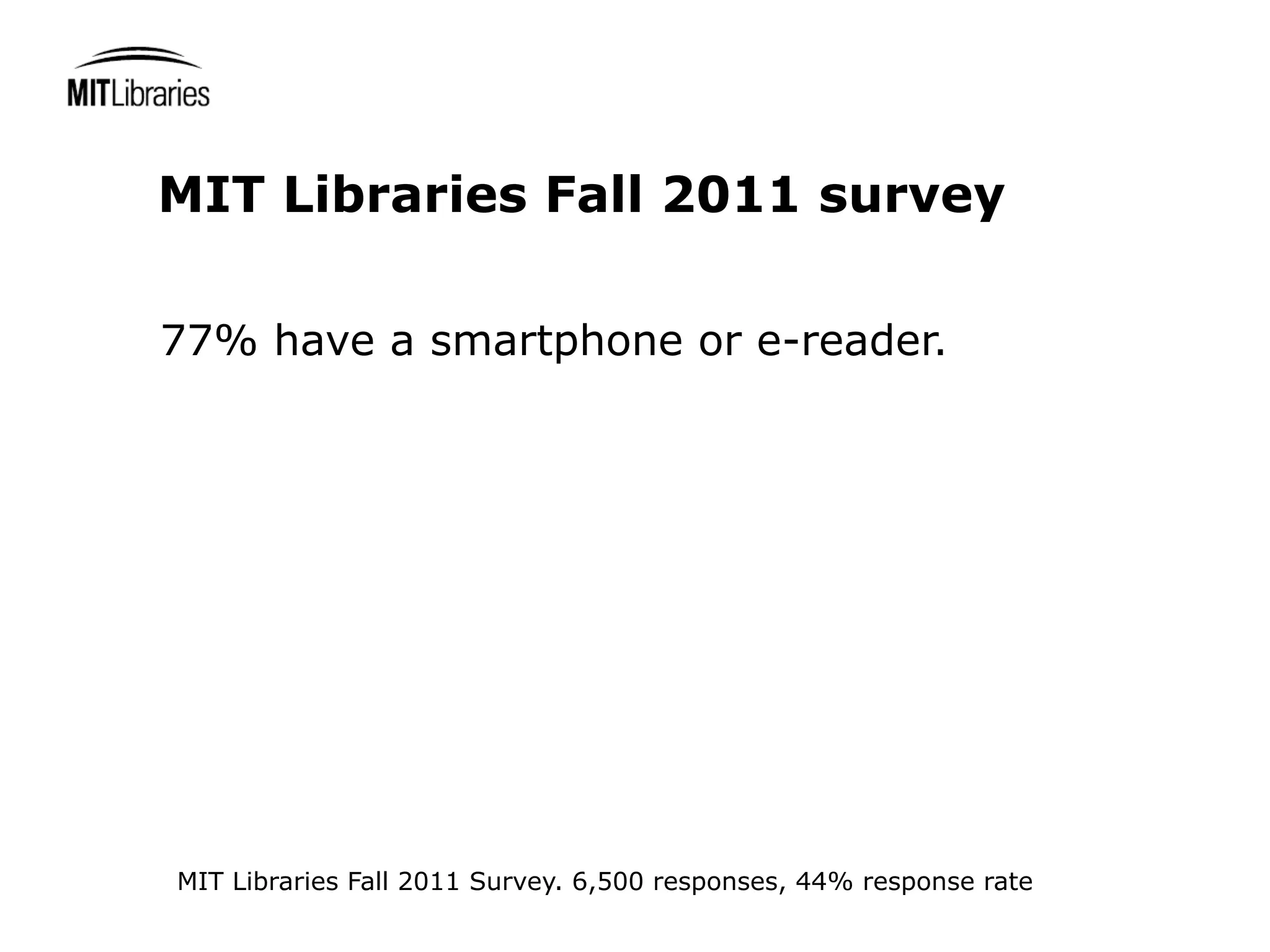
MIT Libraries Fall 2011 survey

77% have a smartphone or e-reader.


MIT Libraries Fall 2011 Survey. 6,500 responses, 44% response rate
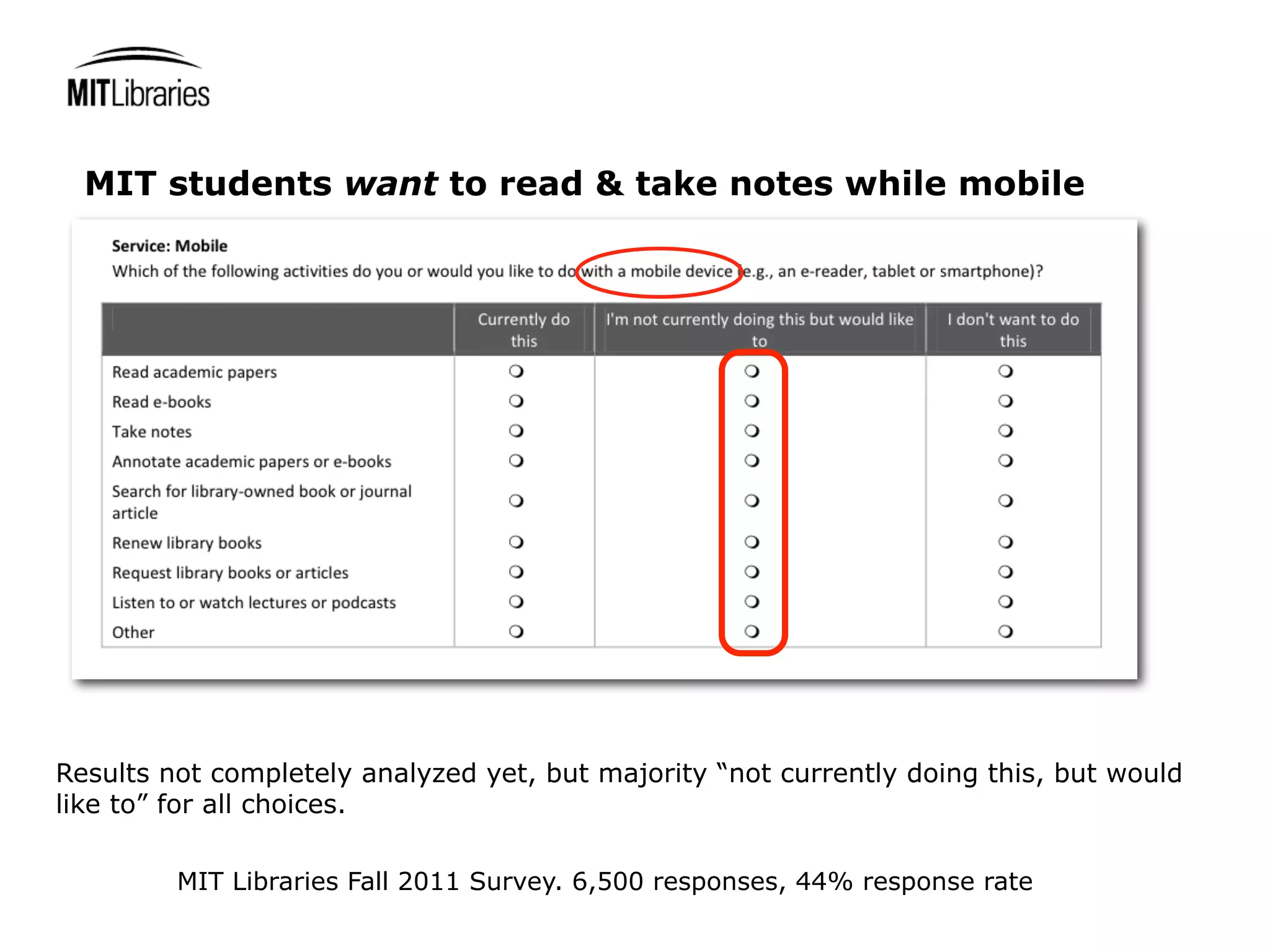
MIT students want to read & take notes while mobile


Results not completely analyzed yet, but majority “not currently doing this, but would
like to” for all choices.

         MIT Libraries Fall 2011 Survey. 6,500 responses, 44% response rate
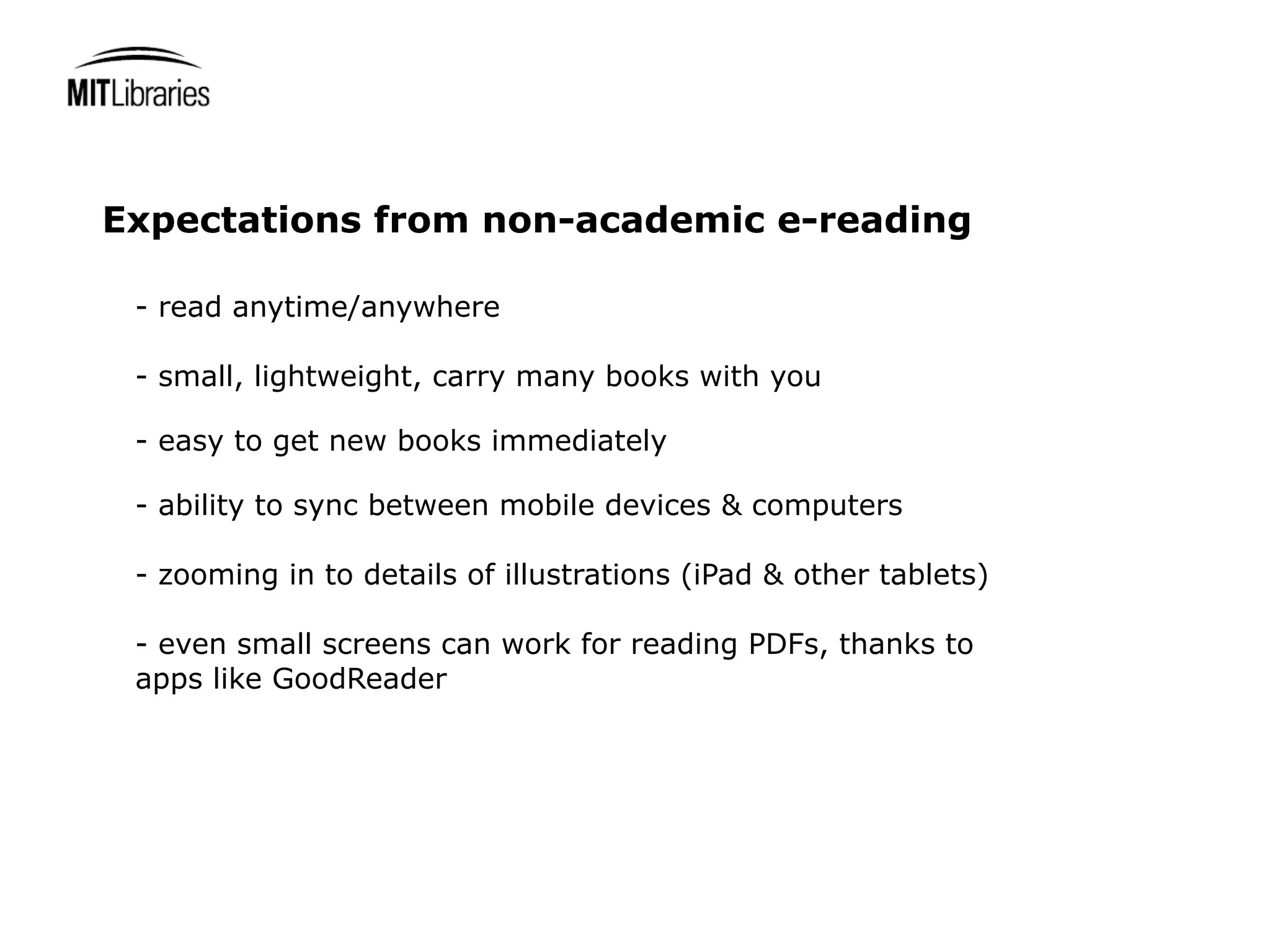
Expectations from non-academic e-reading

 - read anytime/anywhere

 - small, lightweight, carry many books with you

 - easy to get new books immediately

 - ability to sync between mobile devices & computers

 - zooming in to details of illustrations (iPad & other tablets)

 - even small screens can work for reading PDFs, thanks to
 apps like GoodReader
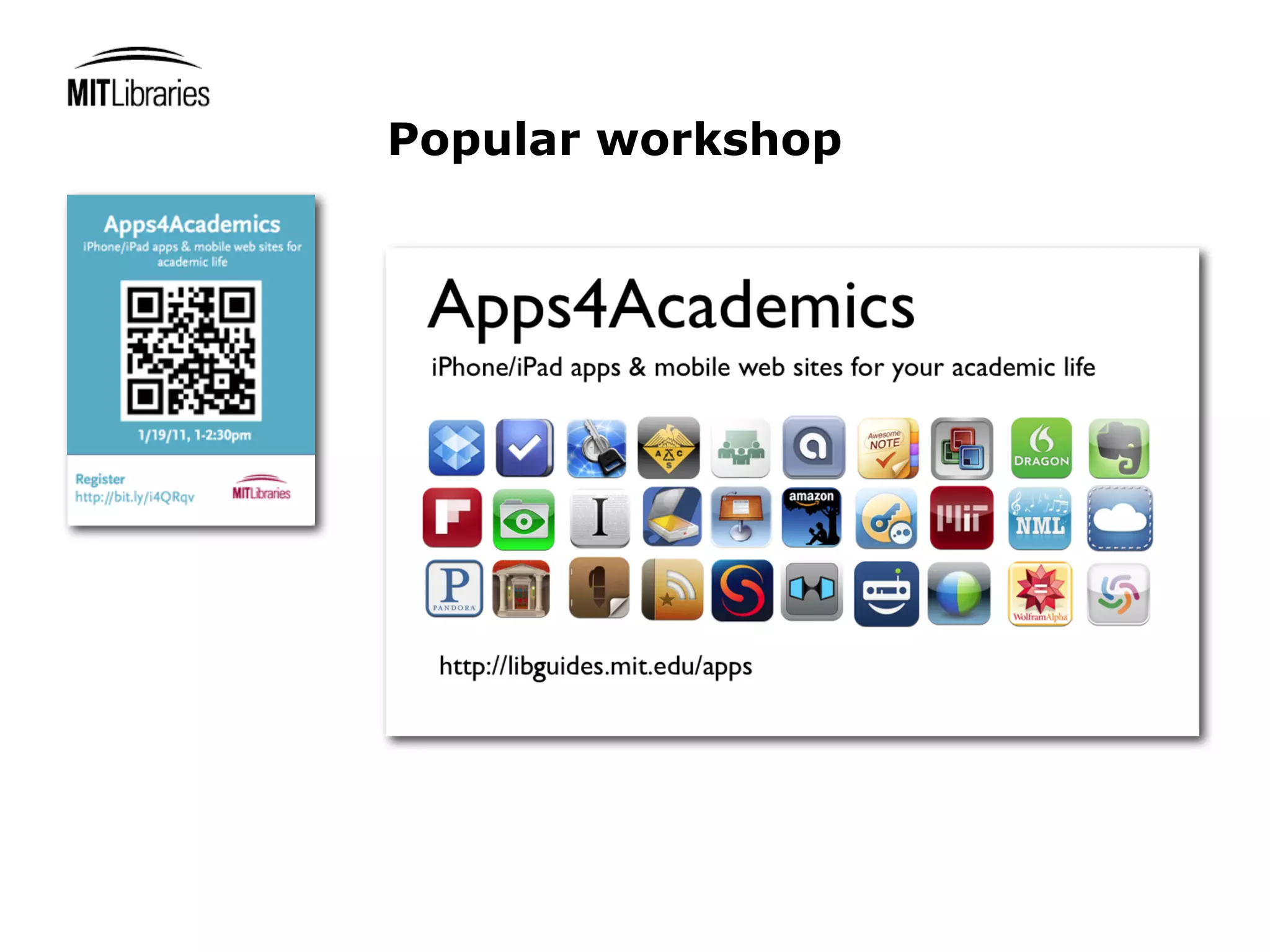
Popular workshop
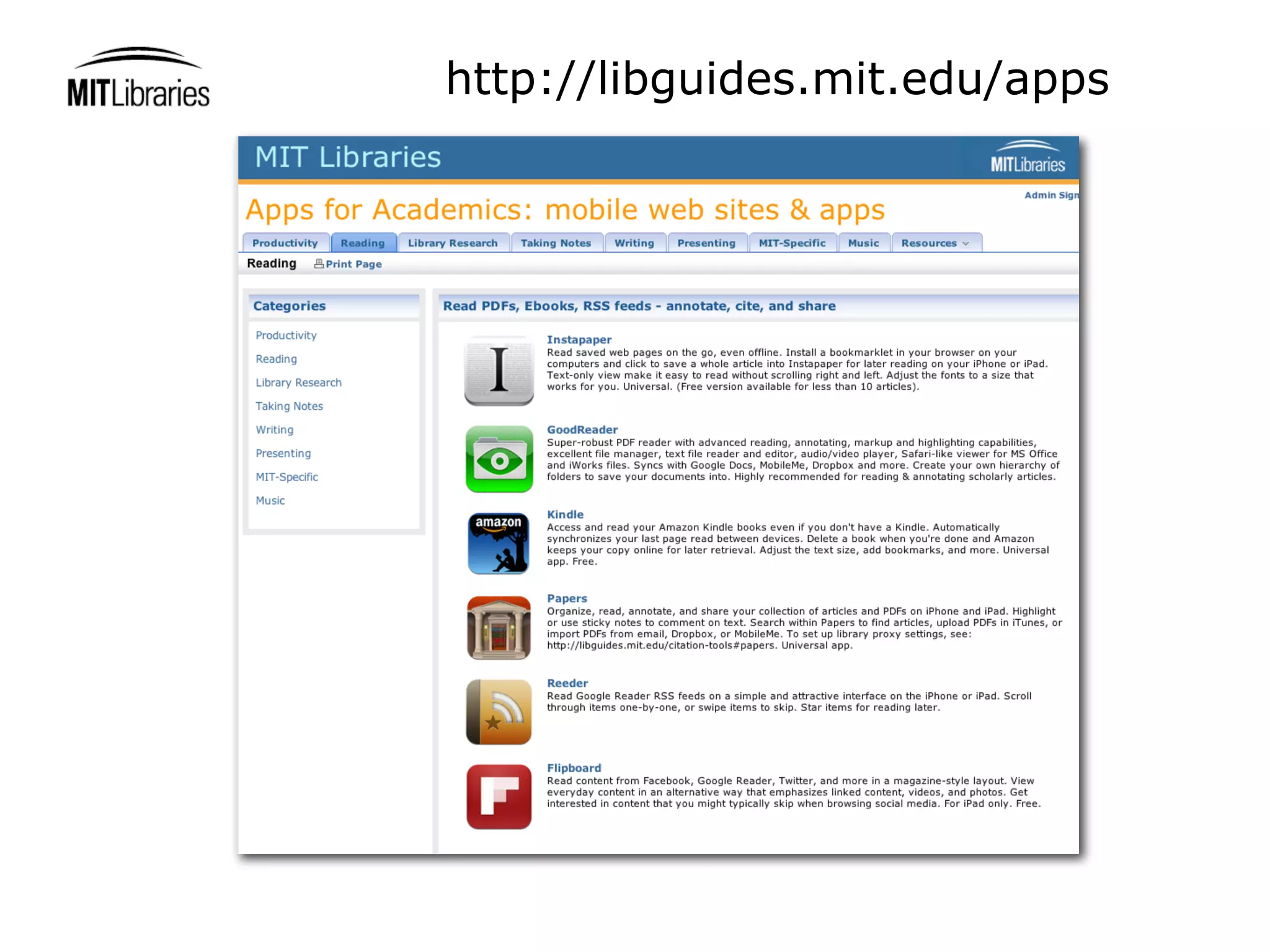
http://libguides.mit.edu/apps
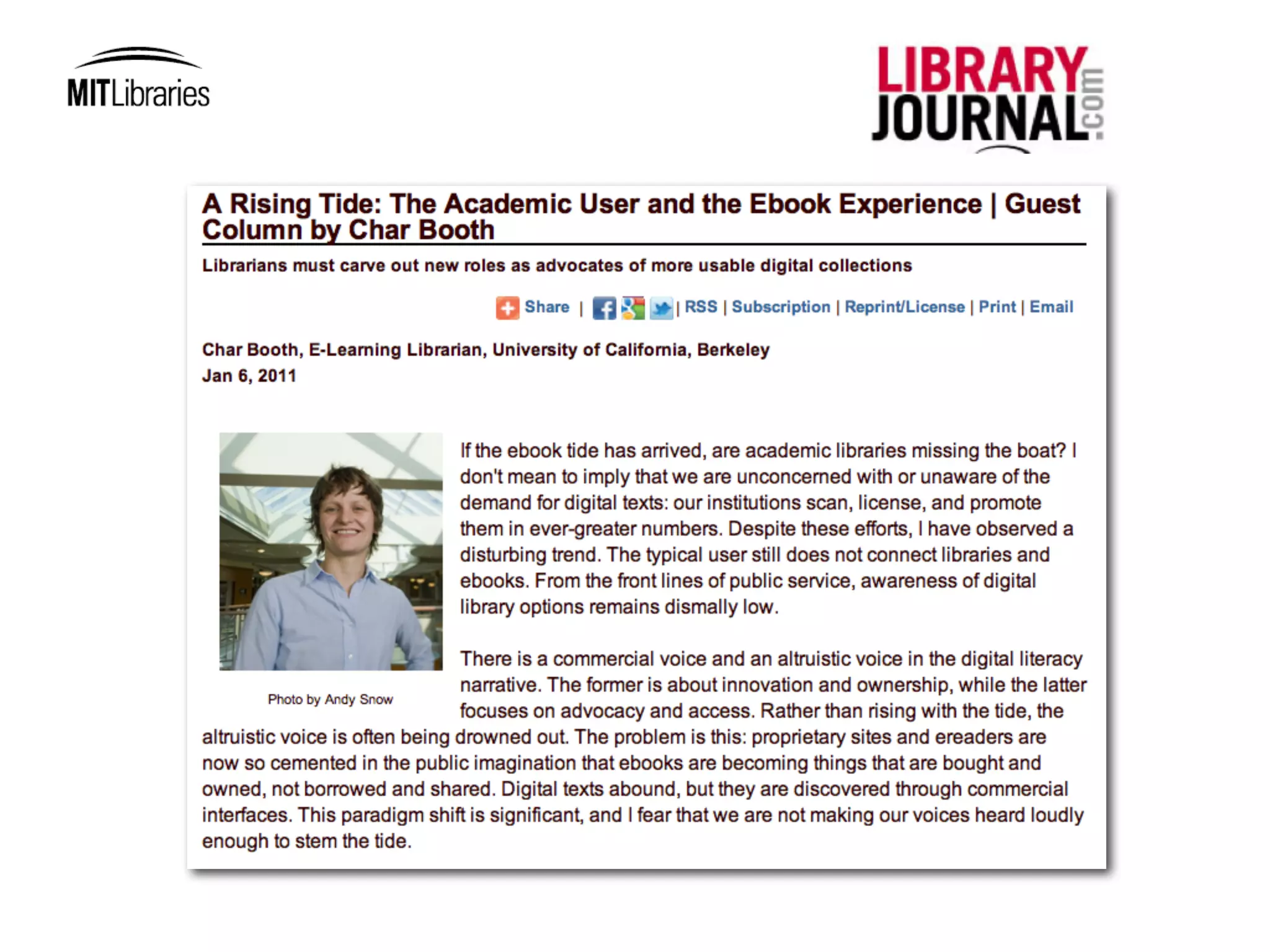
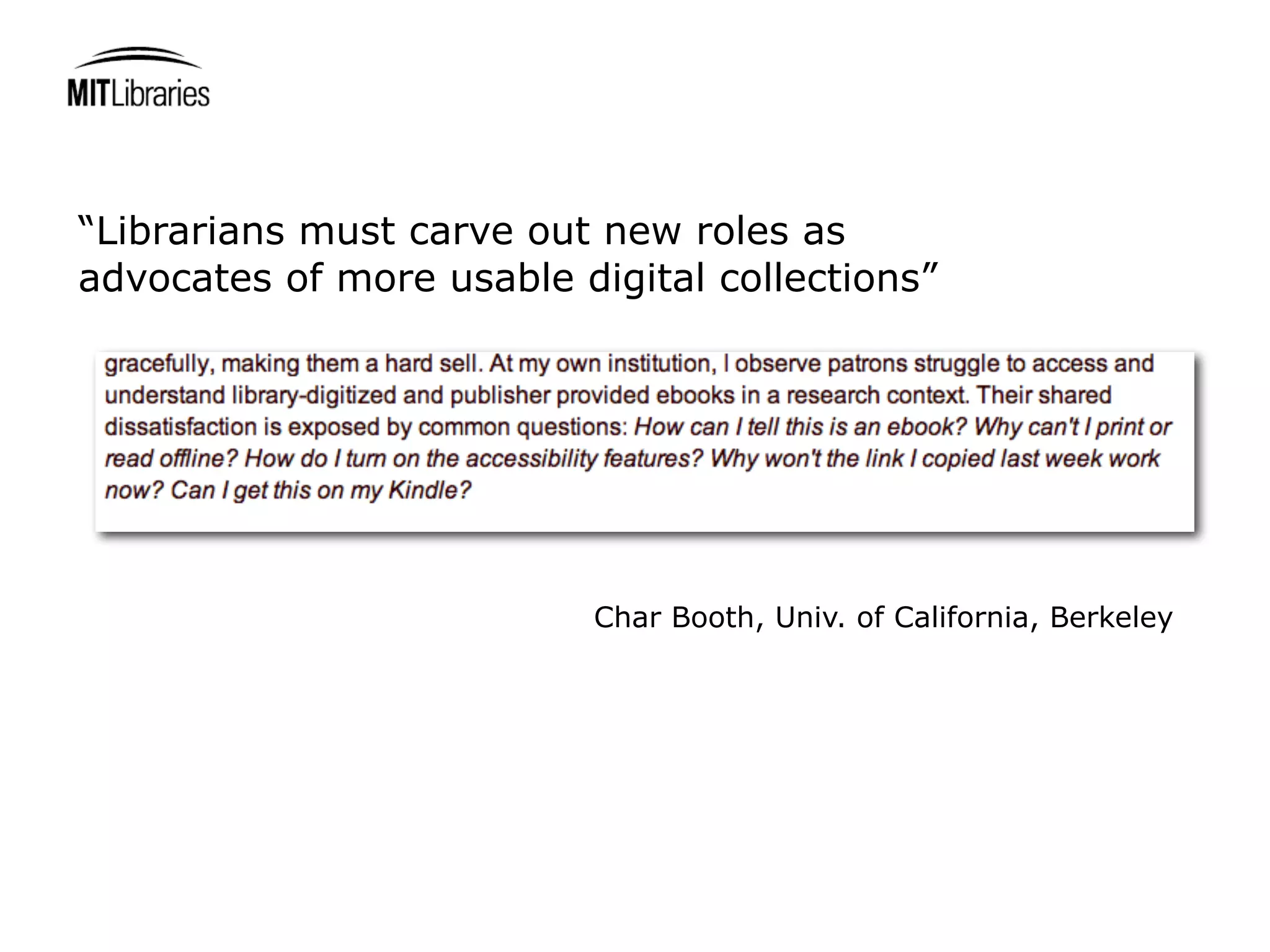
“Librarians must carve out new roles as
advocates of more usable digital collections”


                          Char Booth, Univ. of California, Berkeley
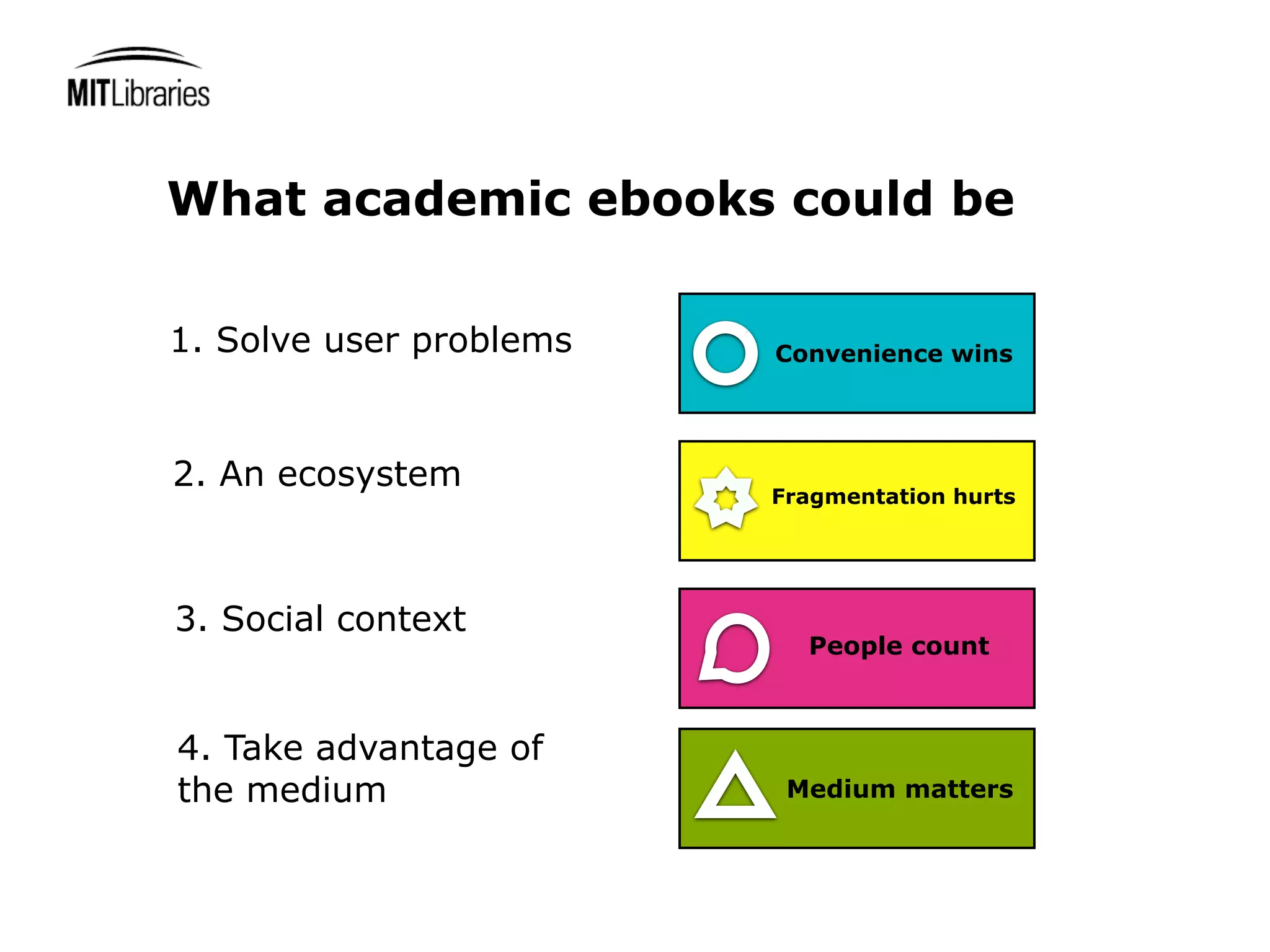
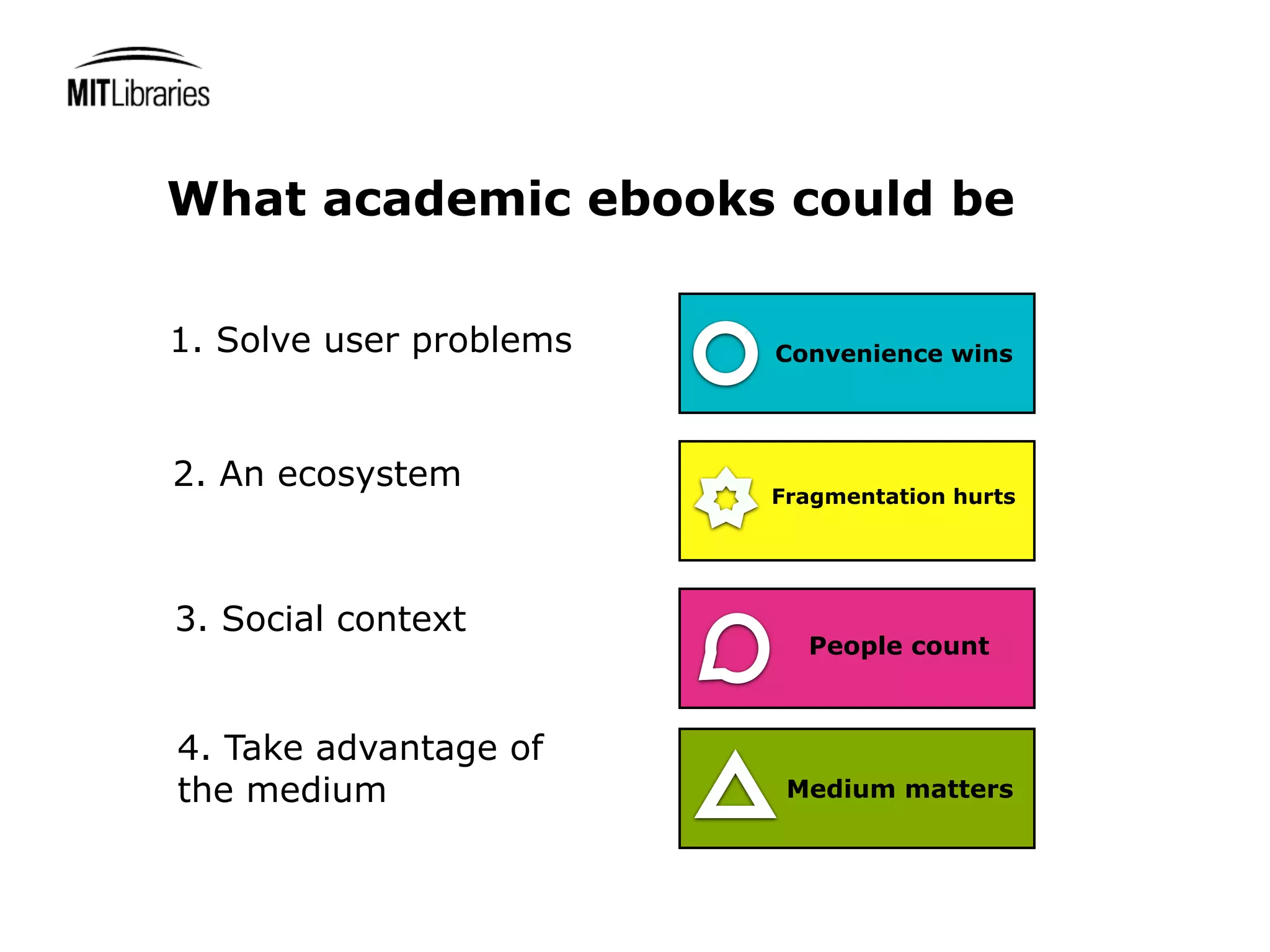
What academic ebooks could be

1. Solve user problems   Convenience wins


2. An ecosystem
                         Fragmentation hurts


3. Social context
                           People count


4. Take advantage of
the medium                Medium matters
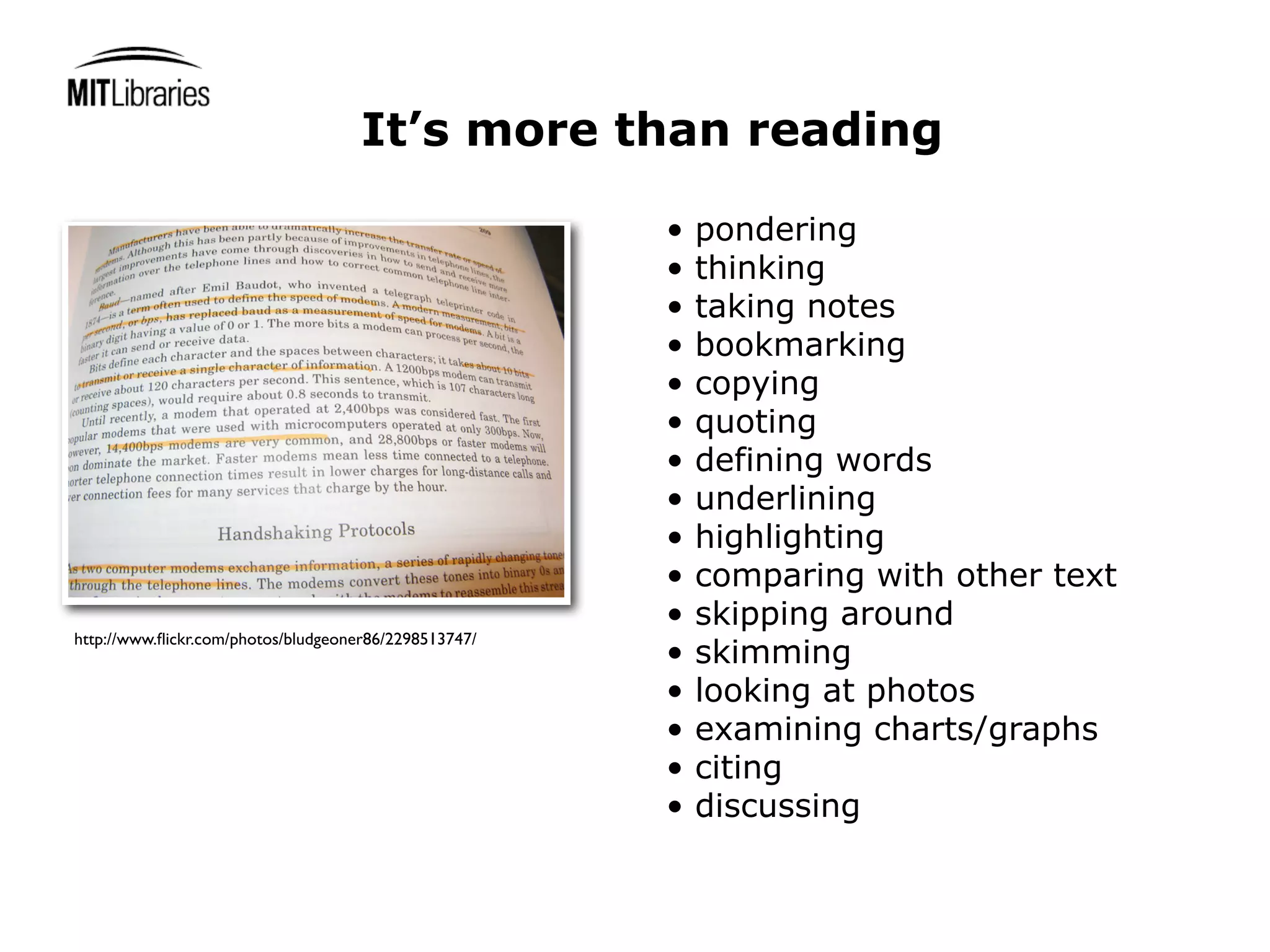
It’s more than reading

                                                       •   pondering
                                                       •   thinking
                                                       •   taking notes
                                                       •   bookmarking
                                                       •   copying
                                                       •   quoting
                                                       •   defining words
                                                       •   underlining
                                                       •   highlighting
                                                       •   comparing with other text
                                                       •   skipping around
http://www.flickr.com/photos/bludgeoner86/2298513747/
                                                       •   skimming
                                                       •   looking at photos
                                                       •   examining charts/graphs
                                                       •   citing
                                                       •   discussing
Convenience wins


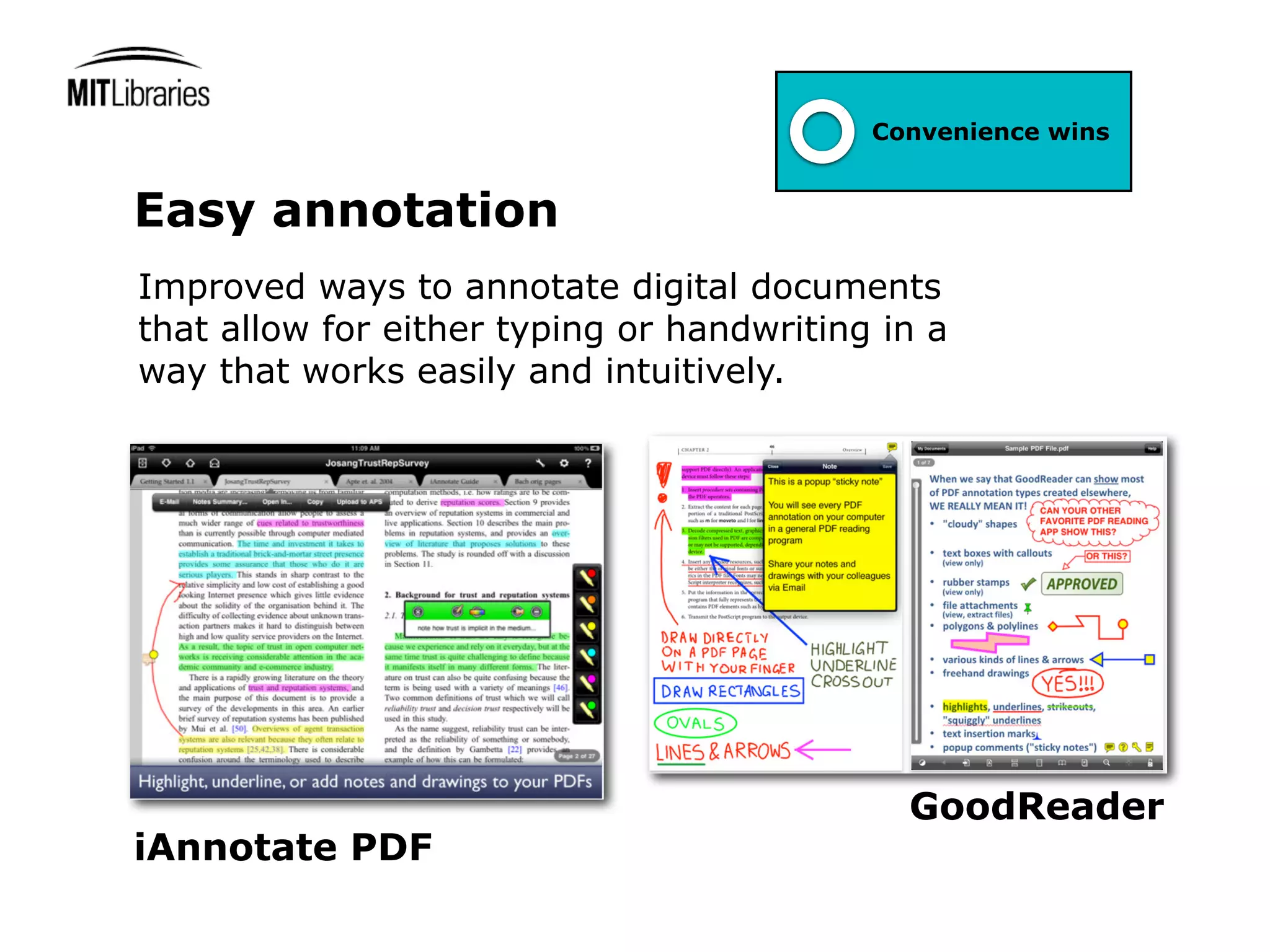
Easy annotation
Improved ways to annotate digital documents
that allow for either typing or handwriting in a
way that works easily and intuitively.


                                             GoodReader
iAnnotate PDF
1
                                          Convenience wins


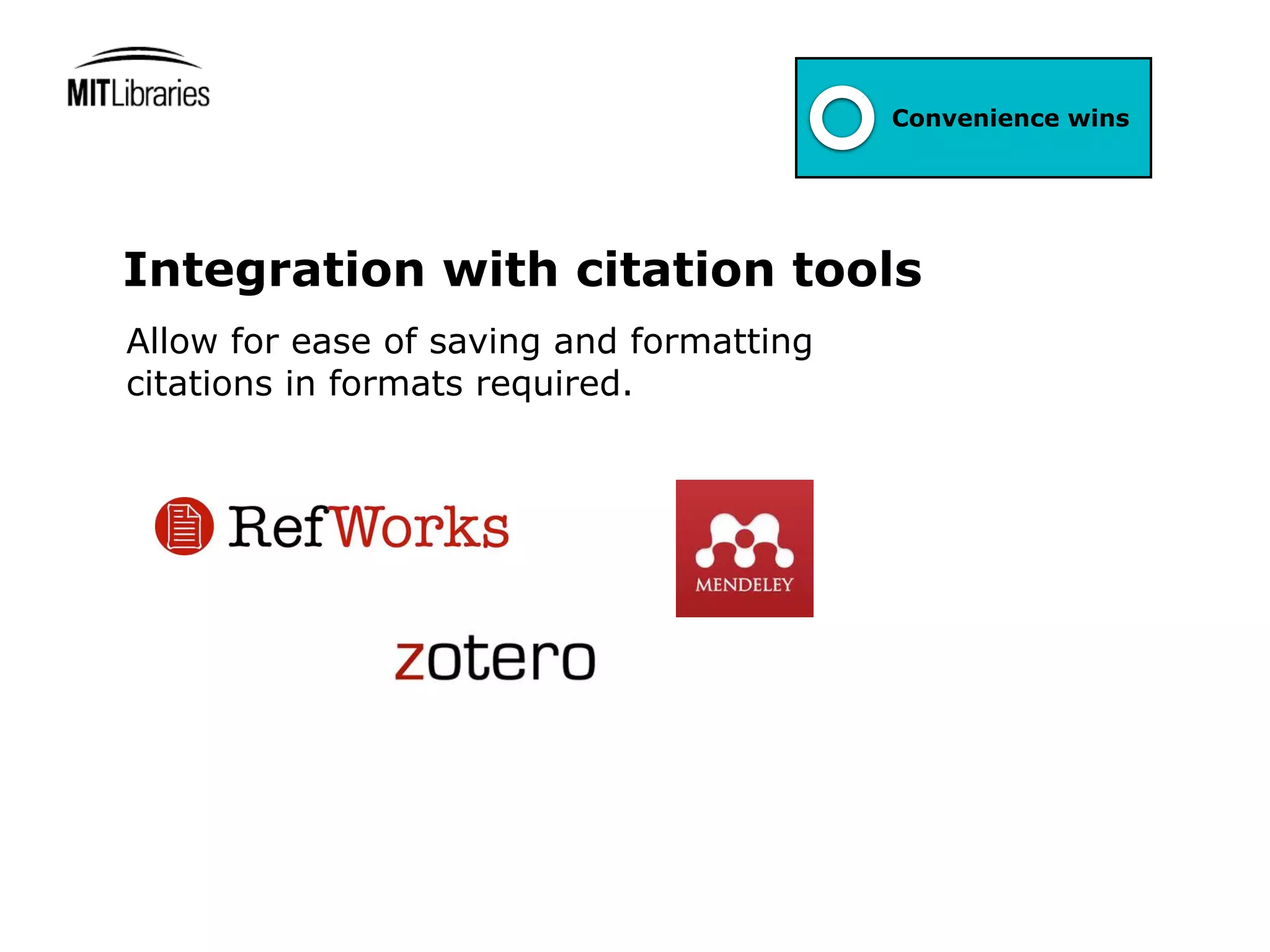
Integration with citation tools
Allow for ease of saving and formatting
citations in formats required.
Convenience wins


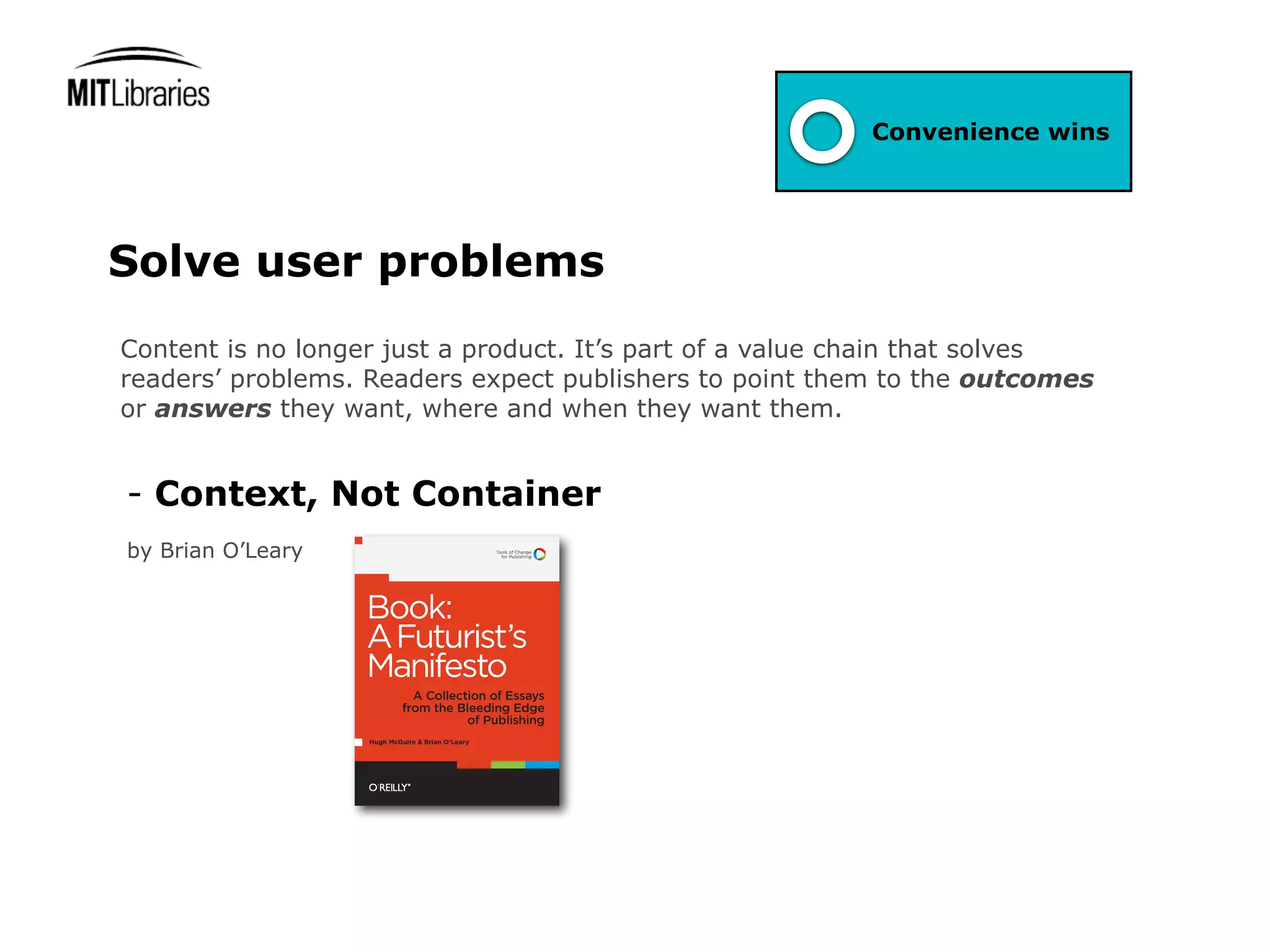
Solve user problems
Content is no longer just a product. It’s part of a value chain that solves
readers’ problems. Readers expect publishers to point them to the outcomes
or answers they want, where and when they want them.


- Context, Not Container
by Brian O’Leary
Fragmentation hurts


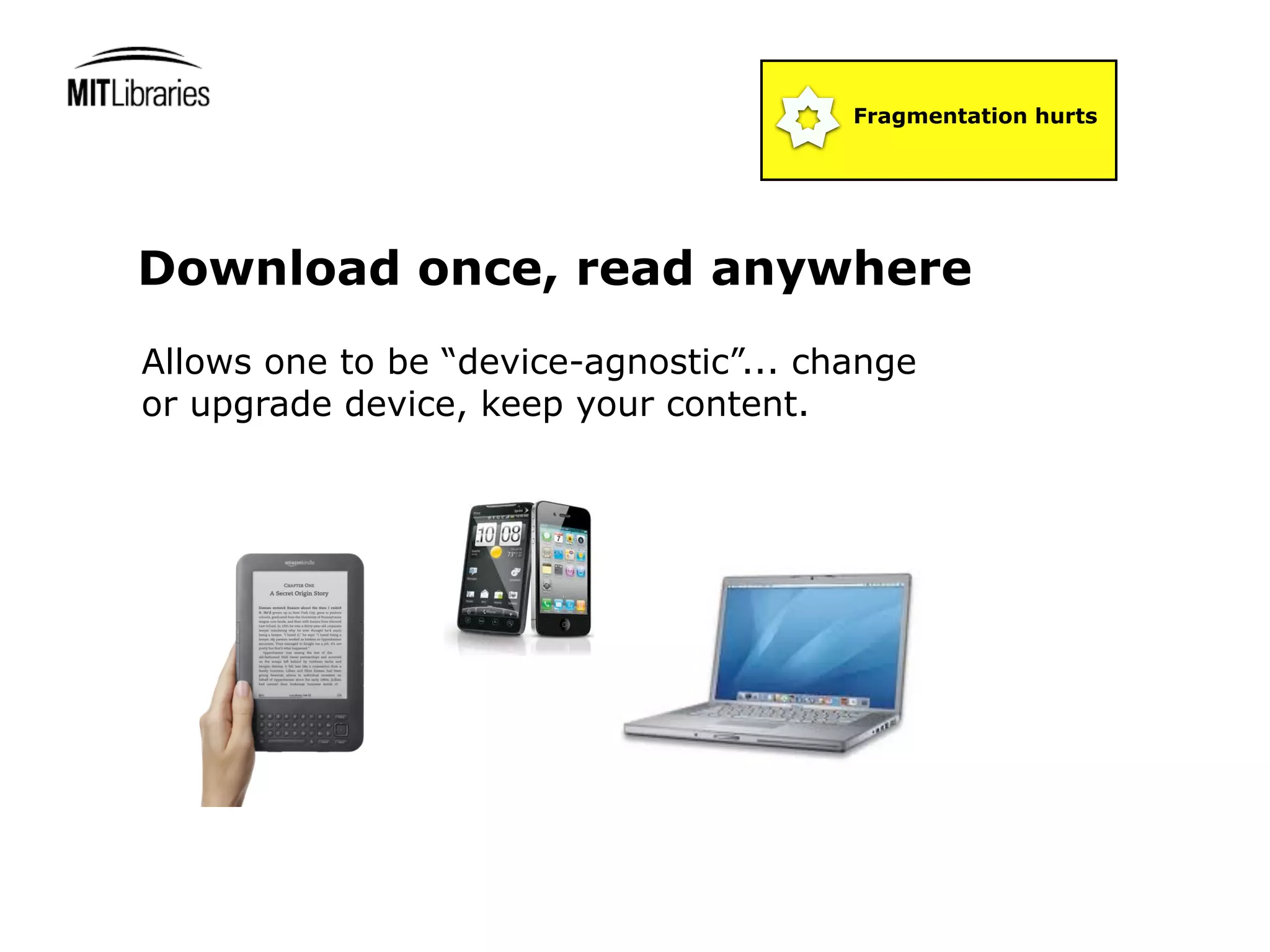
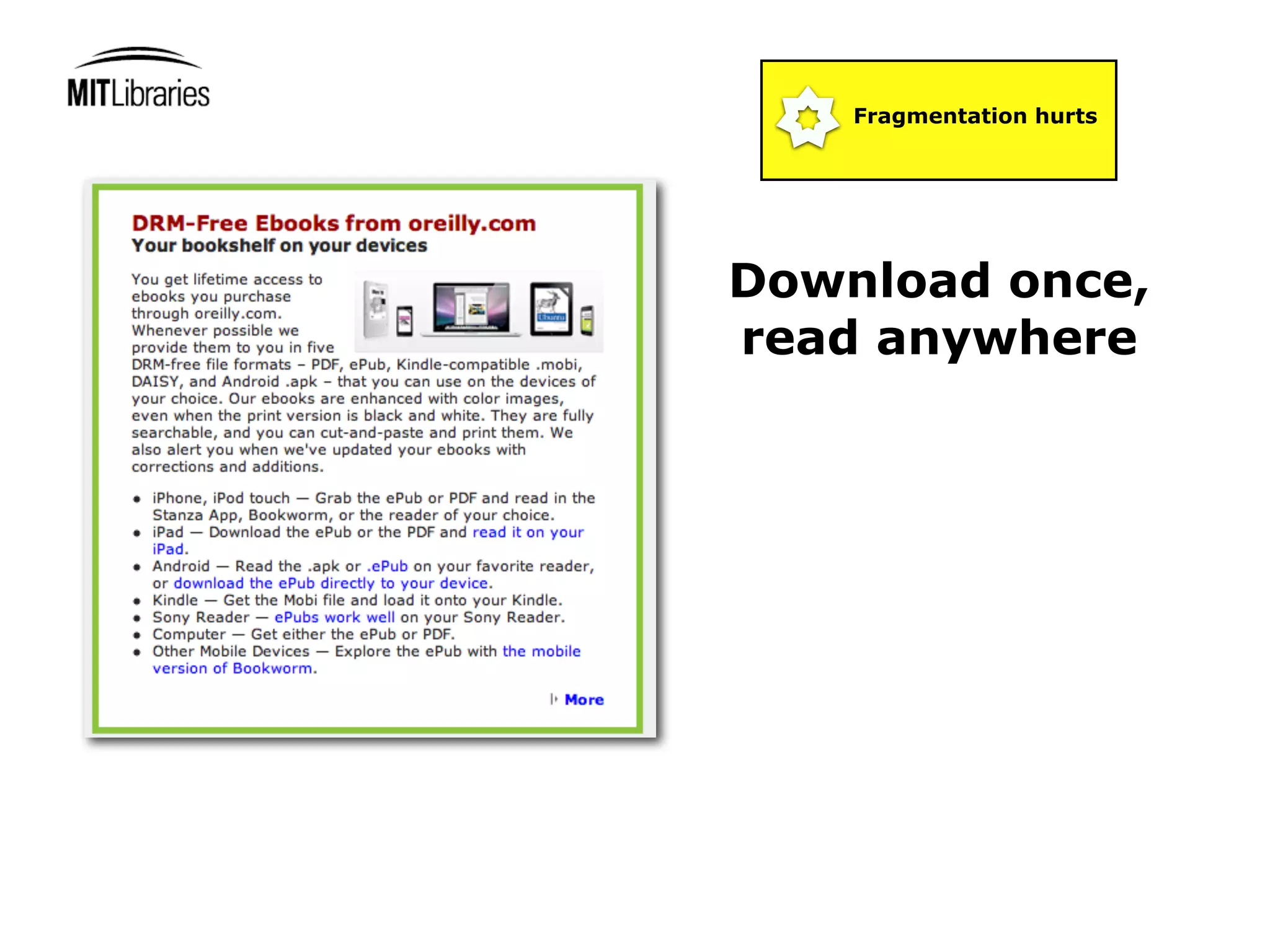
Download once, read anywhere
Allows one to be “device-agnostic”... change
or upgrade device, keep your content.
Fragmentation hurts


Download once,
read anywhere
Fragmentation hurts


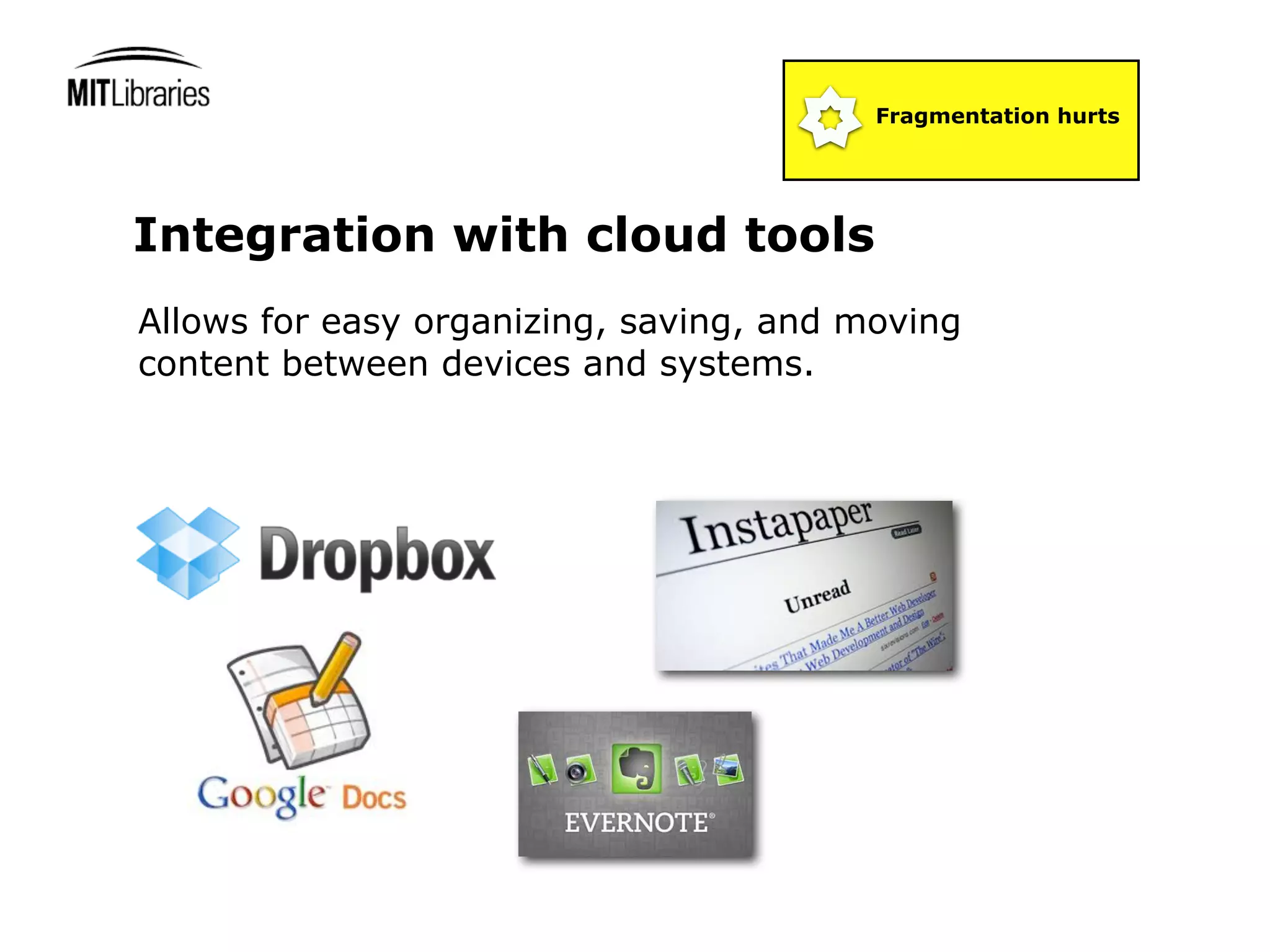
Integration with cloud tools
Allows for easy organizing, saving, and moving
content between devices and systems.
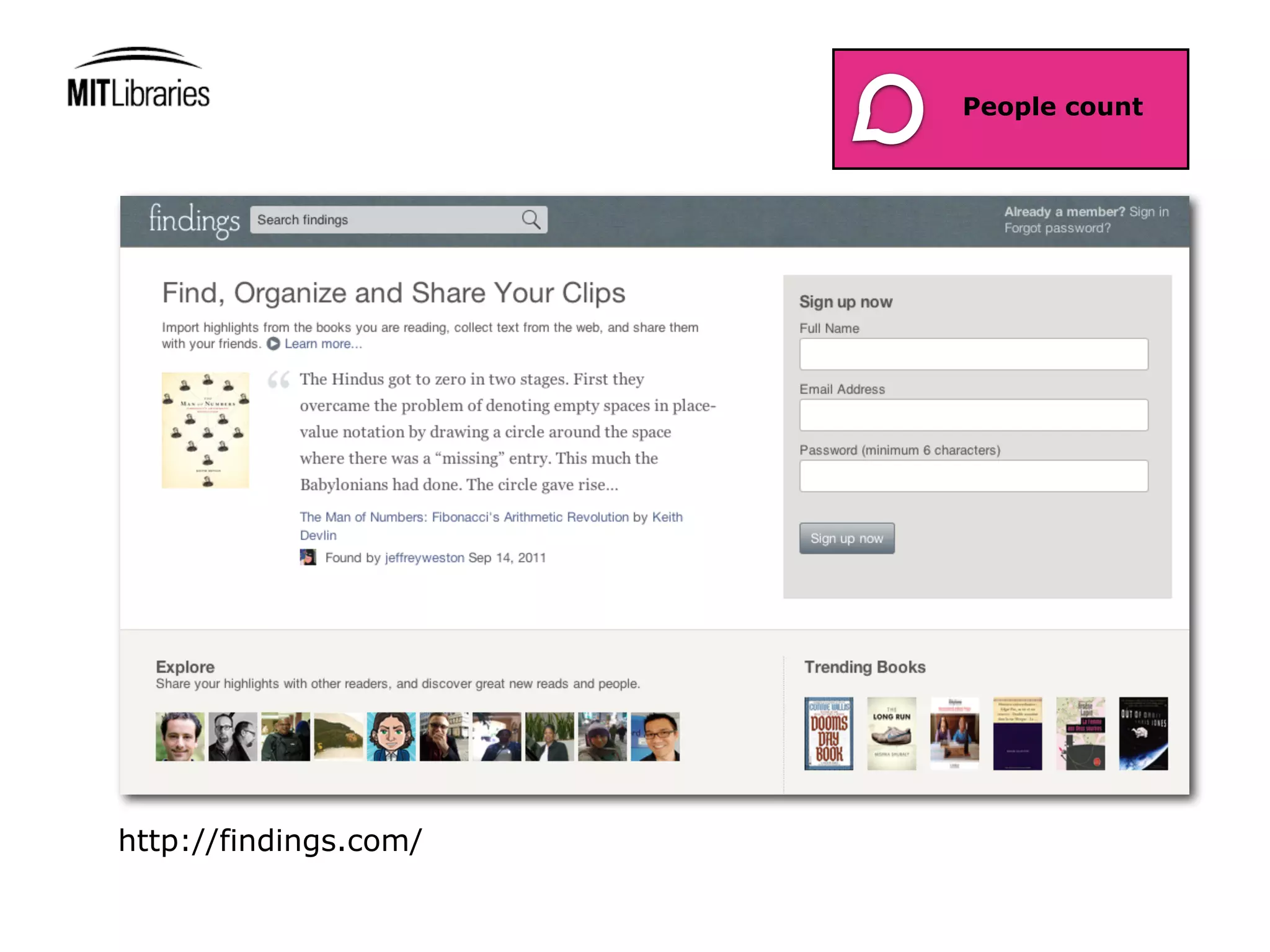
People count


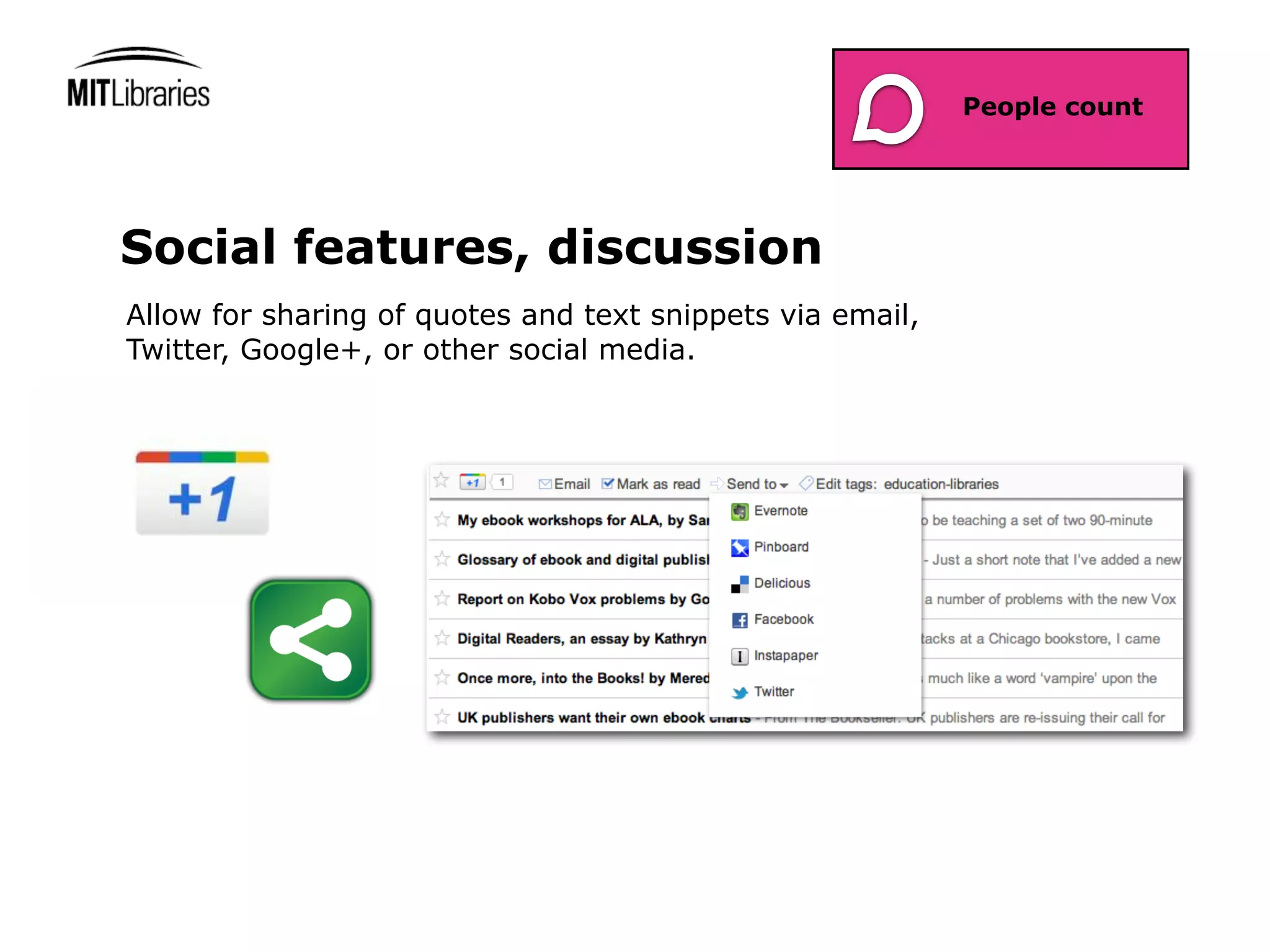
Social features, discussion
Allow for sharing of quotes and text snippets via email,
Twitter, Google+, or other social media.
People count


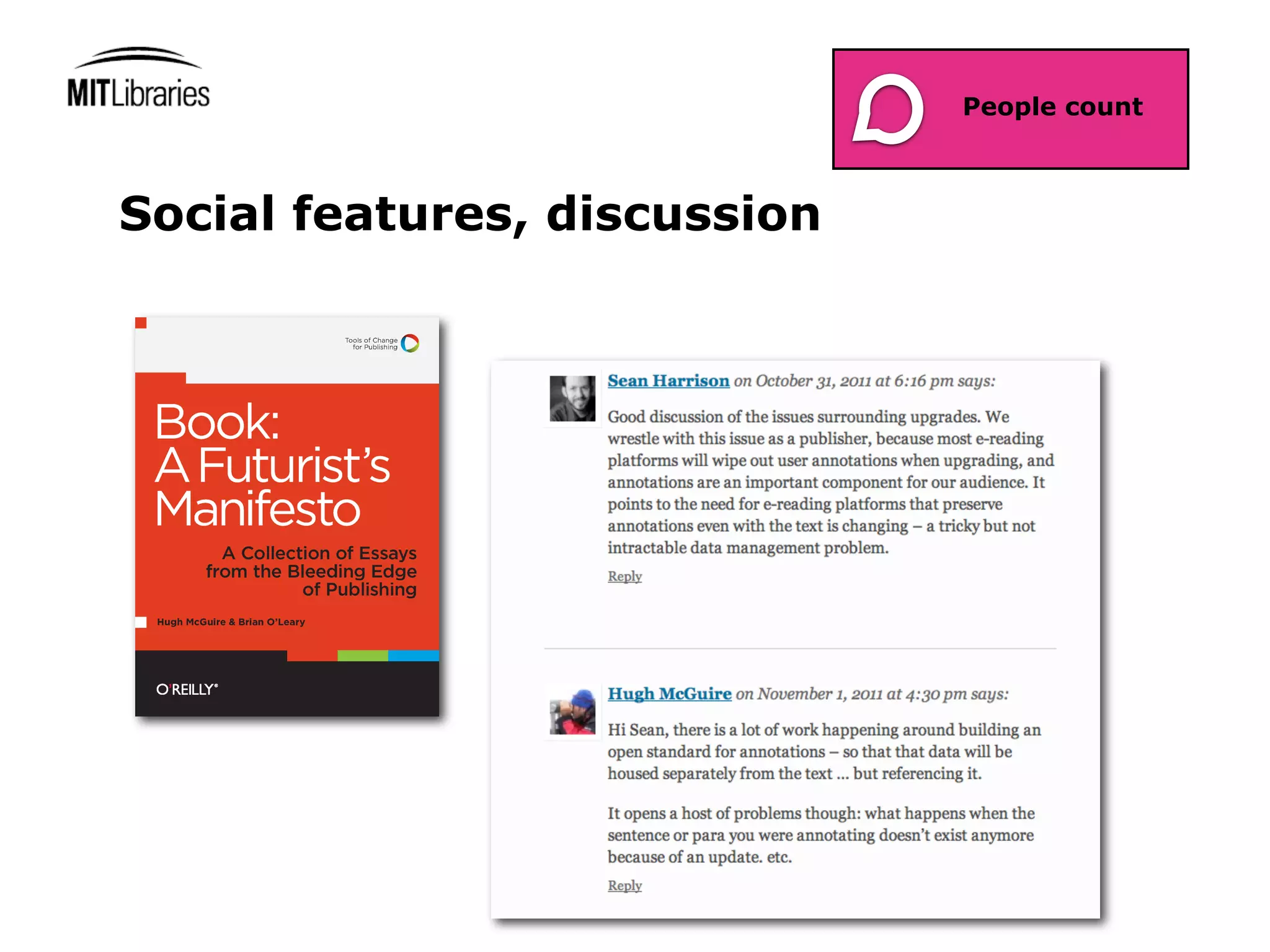
Social features, discussion
People count


http://findings.com/
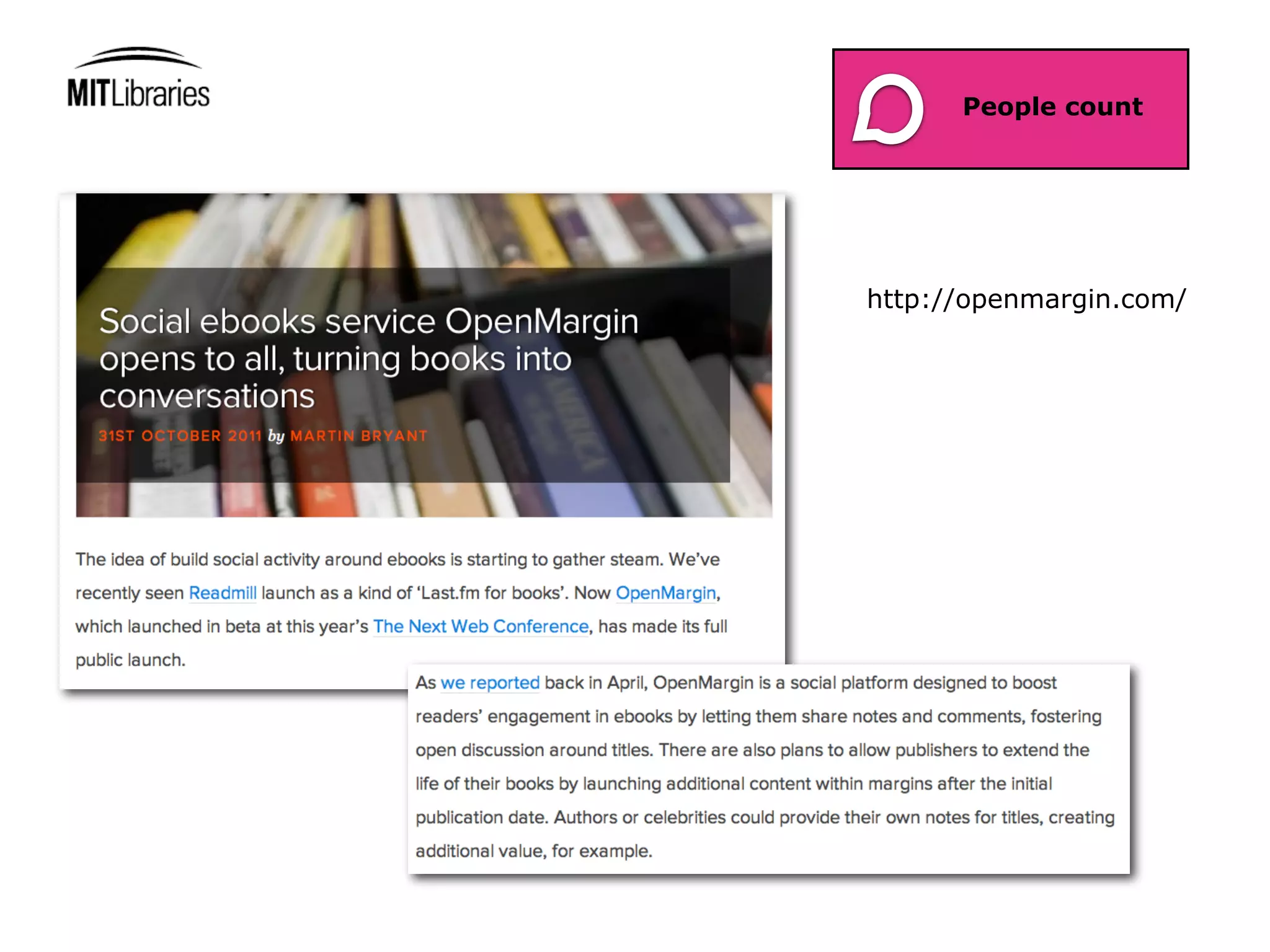
People count


http://openmargin.com/
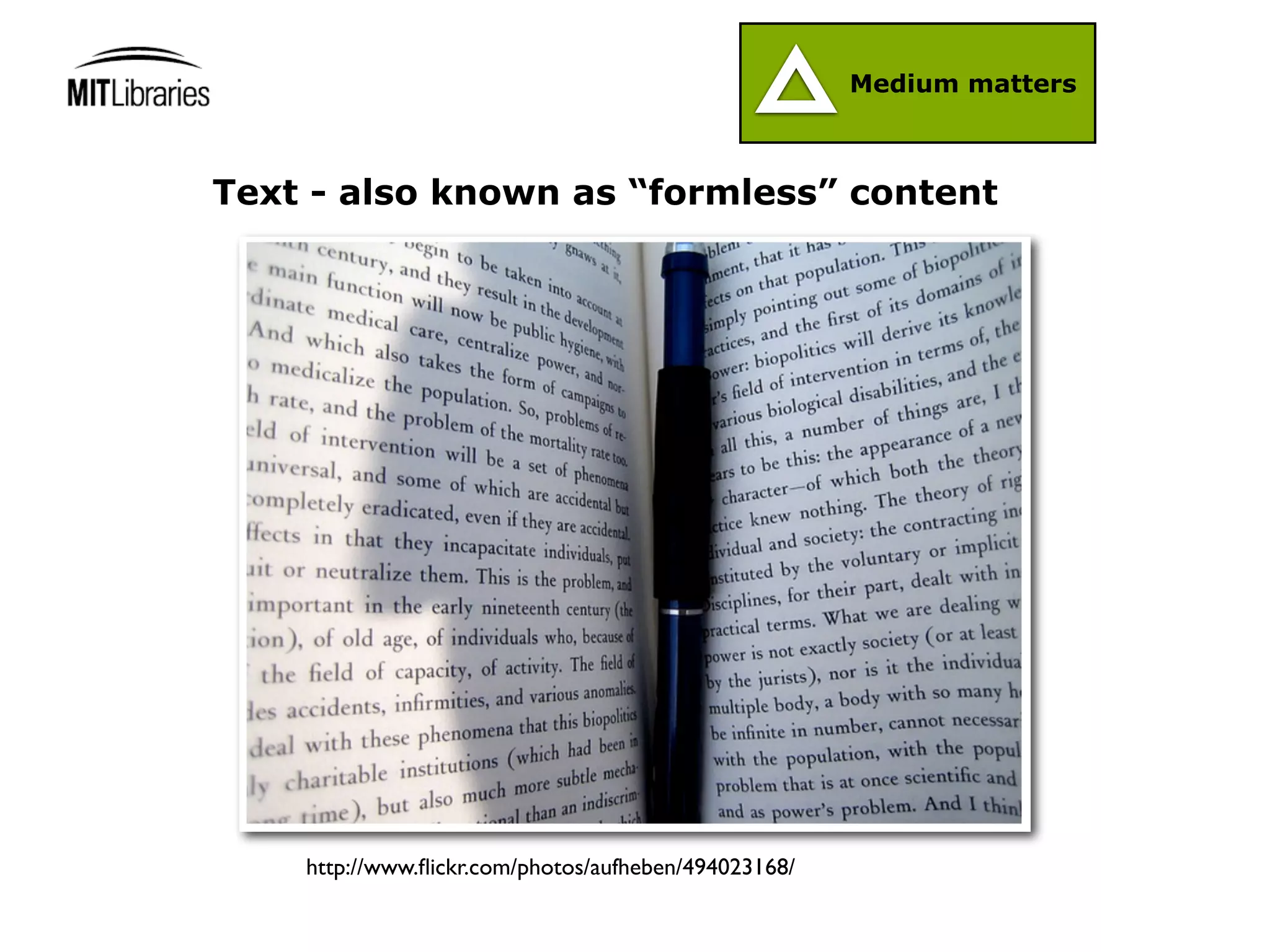
Medium matters


Text - also known as “formless” content


    http://www.flickr.com/photos/aufheben/494023168/
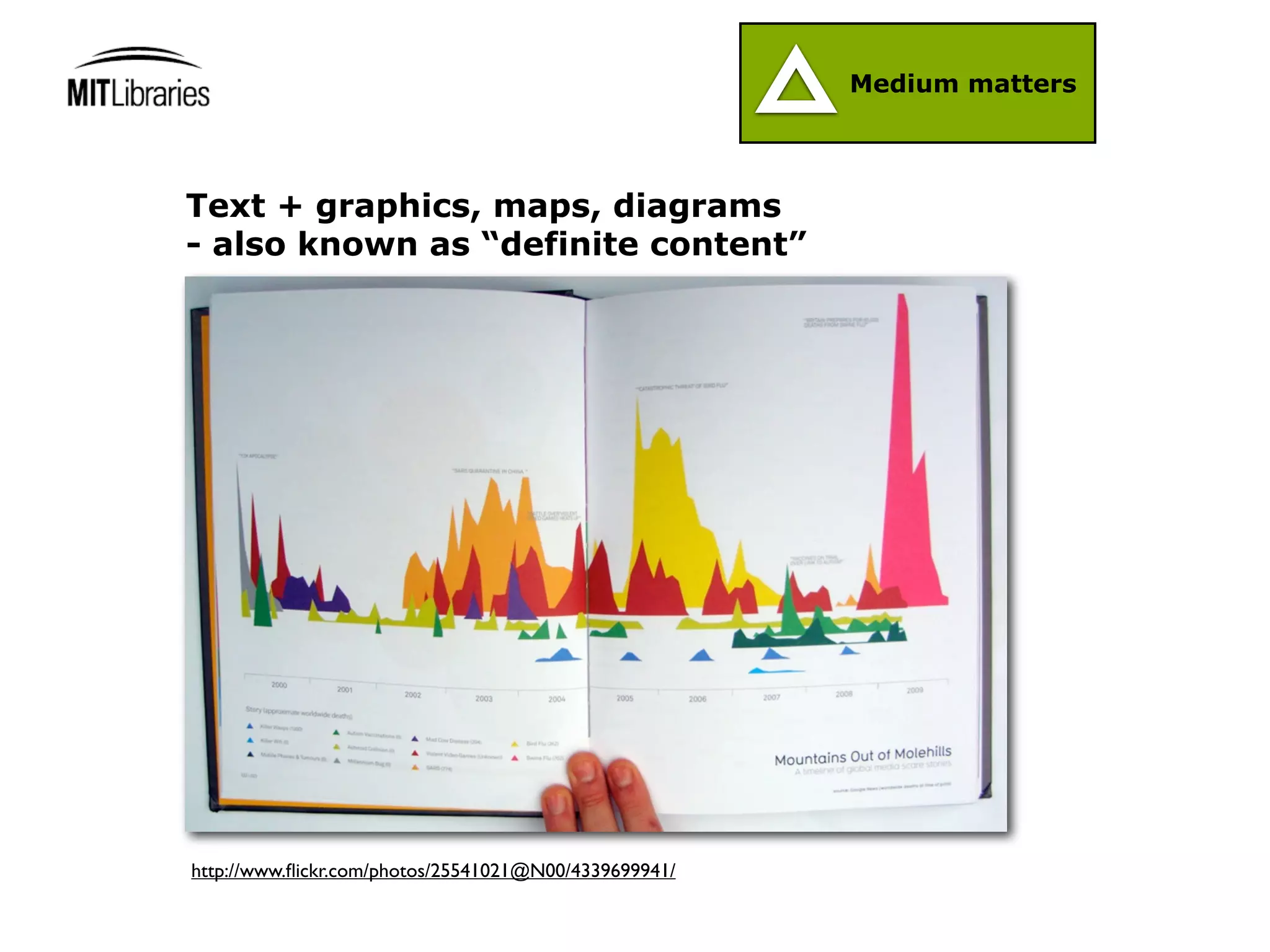
Medium matters


Text + graphics, maps, diagrams
- also known as “definite content”


http://www.flickr.com/photos/25541021@N00/4339699941/
Medium matters


Formless vs. Definite Content

“.....definite content..... It may be reflowable, but depending
on how it is reflowed, inherent meaning and quality of the
text may shift.”


— Books in the age of the iPad
by Craig Mod
Medium matters


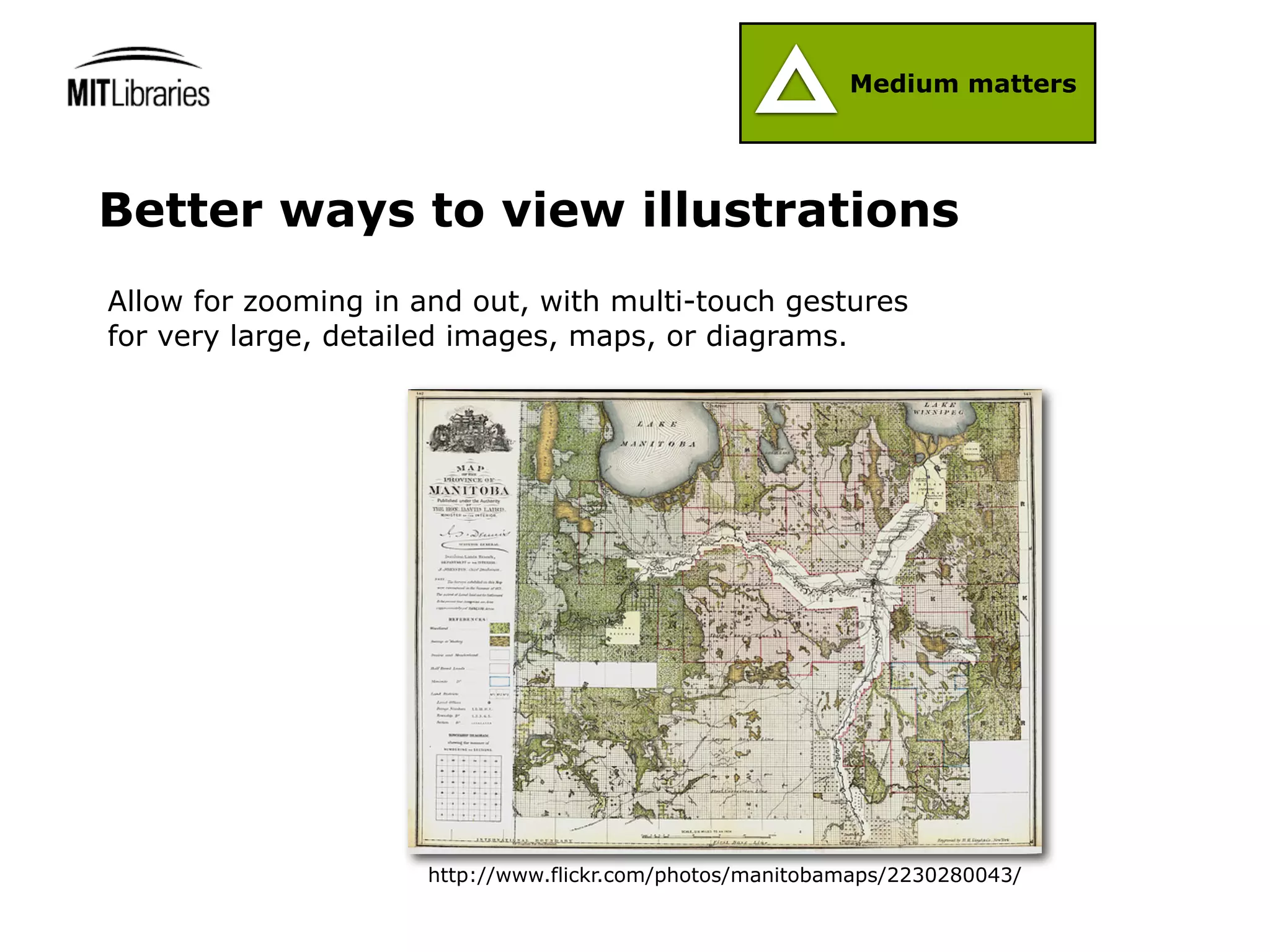
Better ways to view illustrations
Allow for zooming in and out, with multi-touch gestures
for very large, detailed images, maps, or diagrams.


                      http://www.flickr.com/photos/manitobamaps/2230280043/
Medium matters


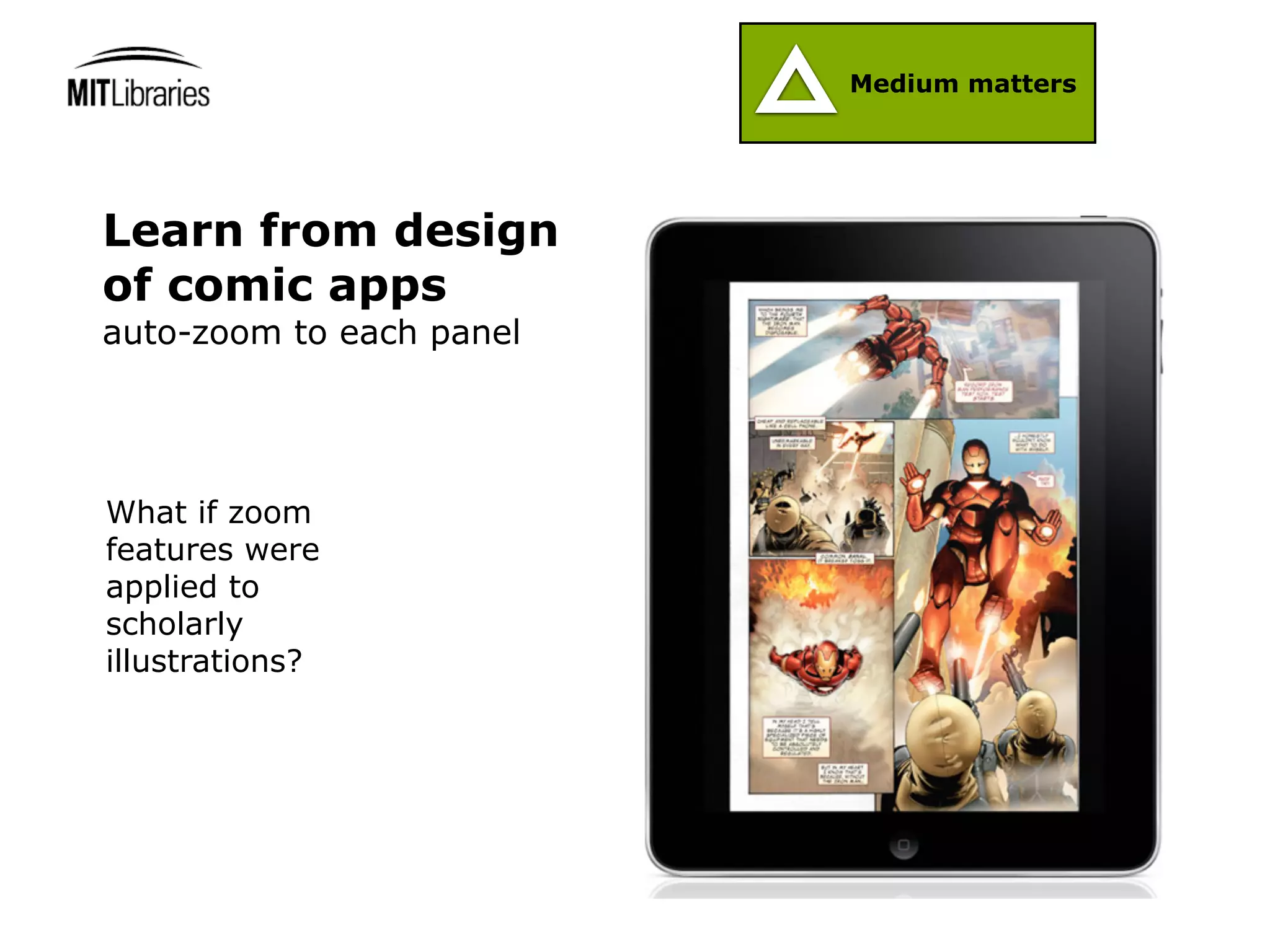
Learn from design
of comic apps
auto-zoom to each panel


What if zoom
features were
applied to
scholarly
illustrations?
Medium matters


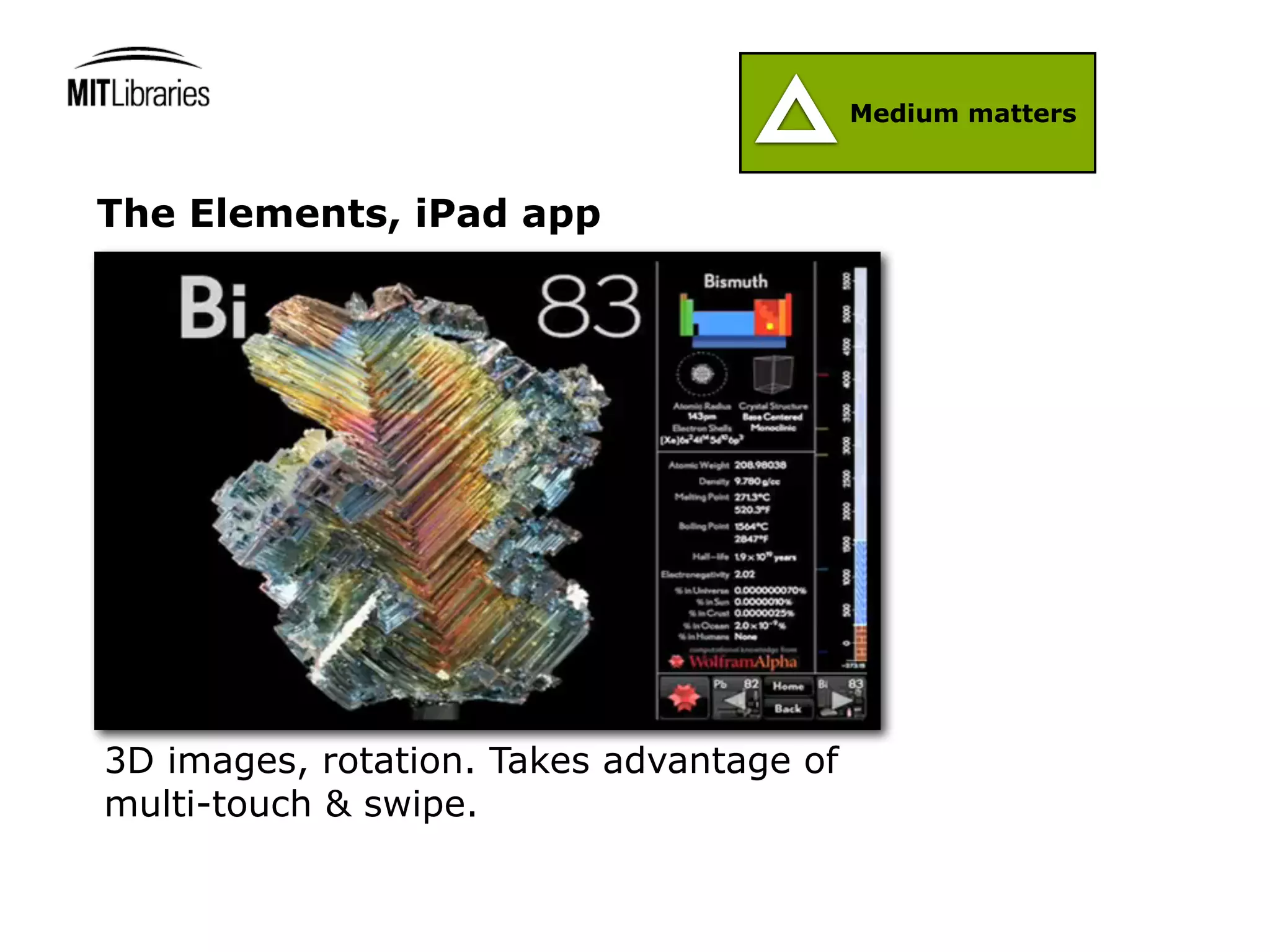
The Elements, iPad app


3D images, rotation. Takes advantage of
multi-touch & swipe.
Medium matters


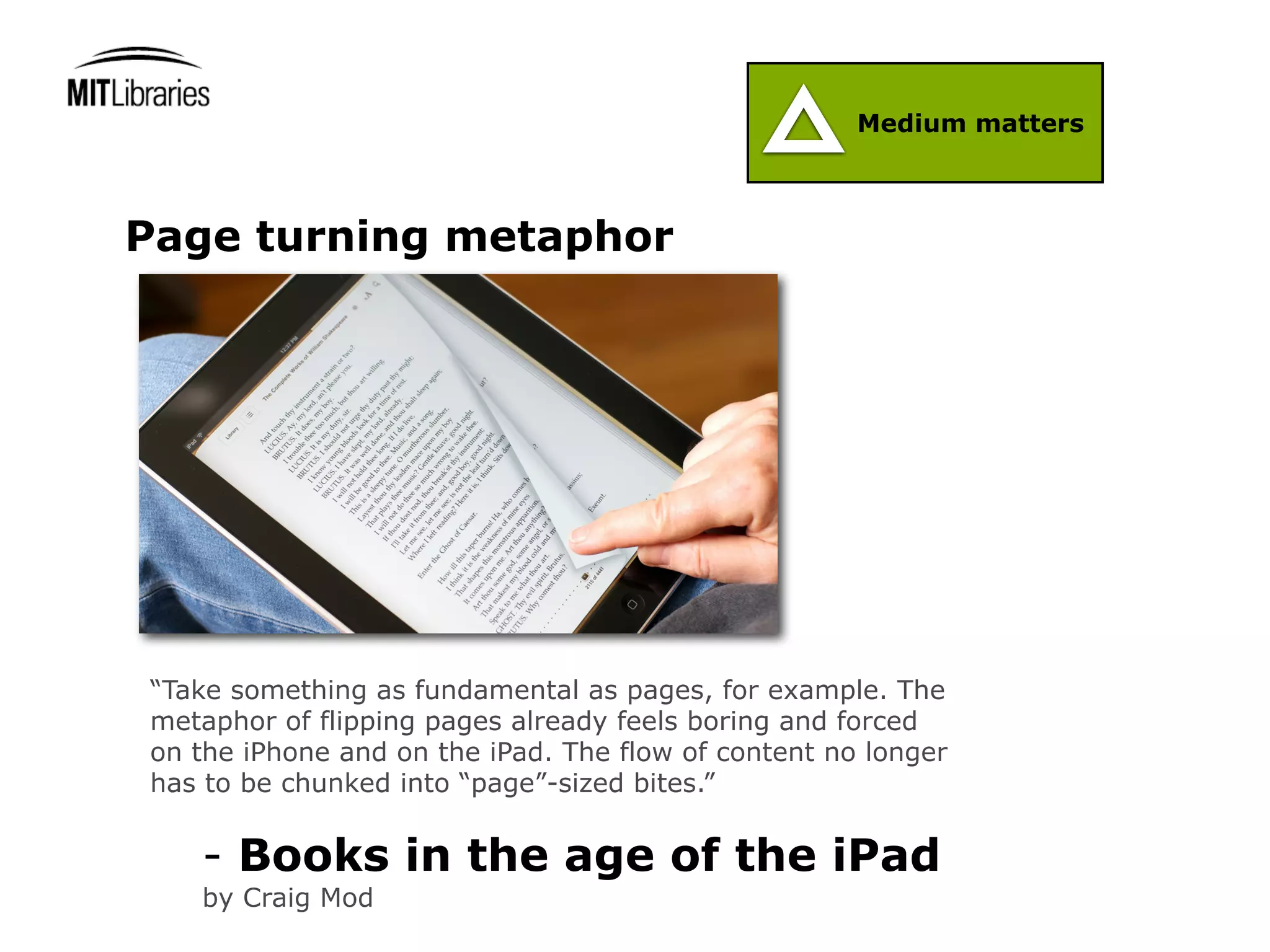
Page turning metaphor


“Take something as fundamental as pages, for example. The
metaphor of flipping pages already feels boring and forced
on the iPhone and on the iPad. The flow of content no longer
has to be chunked into “page”-sized bites.”


   - Books in the age of the iPad
   by Craig Mod
Medium matters


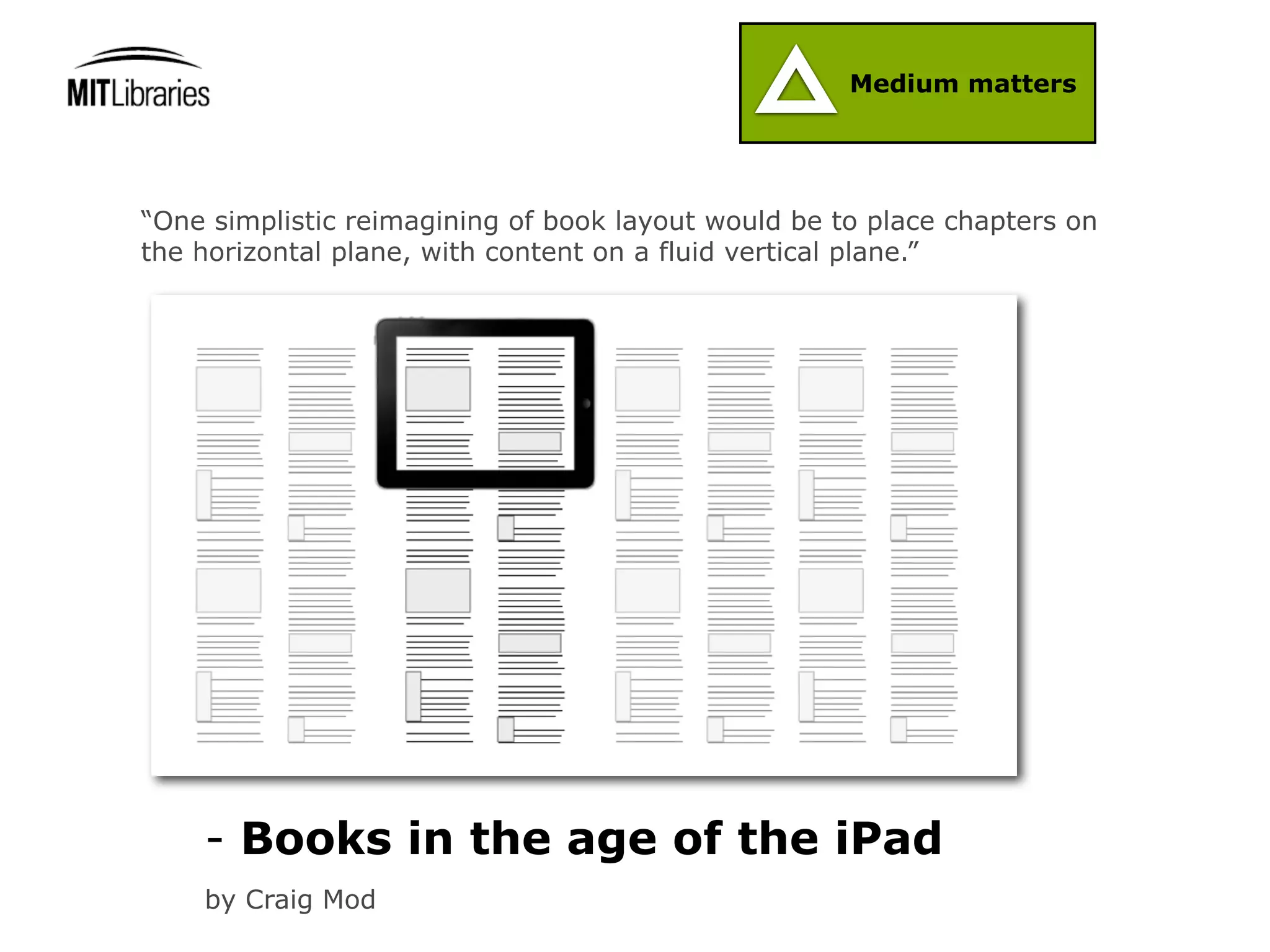
“One simplistic reimagining of book layout would be to place chapters on
the horizontal plane, with content on a fluid vertical plane.”


    - Books in the age of the iPad
    by Craig Mod
Medium matters


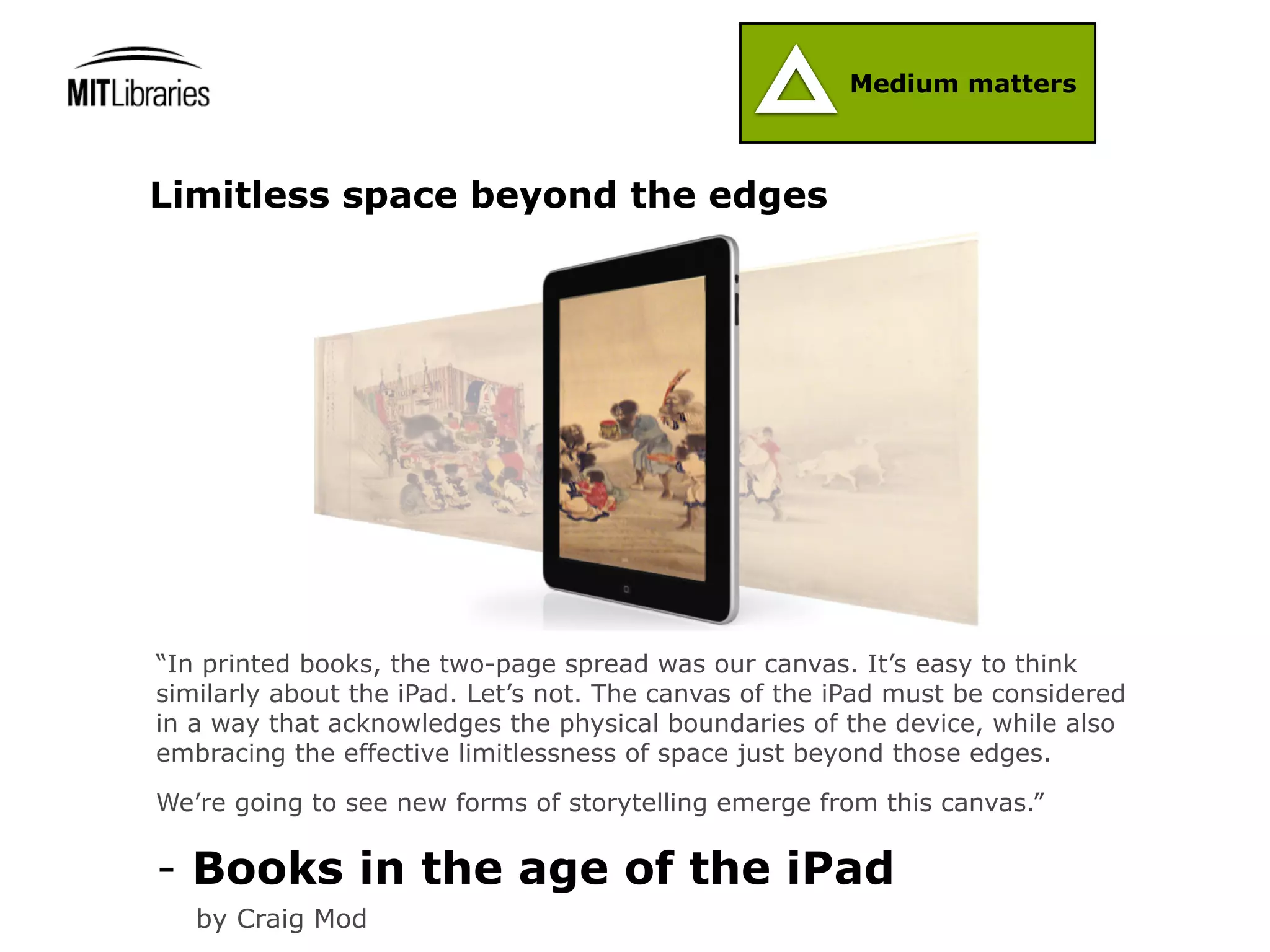
Limitless space beyond the edges


“In printed books, the two-page spread was our canvas. It’s easy to think
similarly about the iPad. Let’s not. The canvas of the iPad must be considered
in a way that acknowledges the physical boundaries of the device, while also
embracing the effective limitlessness of space just beyond those edges.

We’re going to see new forms of storytelling emerge from this canvas.”

- Books in the age of the iPad
   by Craig Mod
Medium matters


“The way we think about book, magazine, and newspaper
publishing is unduly governed by the physical containers we have
used for centuries to transmit information.”


- Context, Not Container
by Brian O’Leary
Medium matters


DIY: create your own, mix/match
“Many current audiences (and all future ones) live in an open and
accessible environment. They expect to be able to look under the
hood, mix and match chunks of content, and create, seamlessly,
something of their own. Failure to meet those needs will result in
obscurity, at best.”


- Context, Not Container
by Brian O’Leary
Medium matters


Librarians & scholarly publishers
- we want to offer the best
- we want to innovate
- we want to provide useful tools for scholarship and learning
- we need more thoughtful analysis around DRM issues
Medium matters


DRM: Making informed decisions

Meanwhile, a growing number of mostly independent publishers are doing
the unthinkable: releasing ebooks without any form of copy restriction.
Are these publishers completely oblivious to the obvious problem of digital
piracy? Or are they taking a calculated risk that will ultimately benefit
their business?


- Analyzing the business case for DRM
by Kirk Biglione
http://book.pressbooks.com/chapter/analyzing-business-case-for-drm
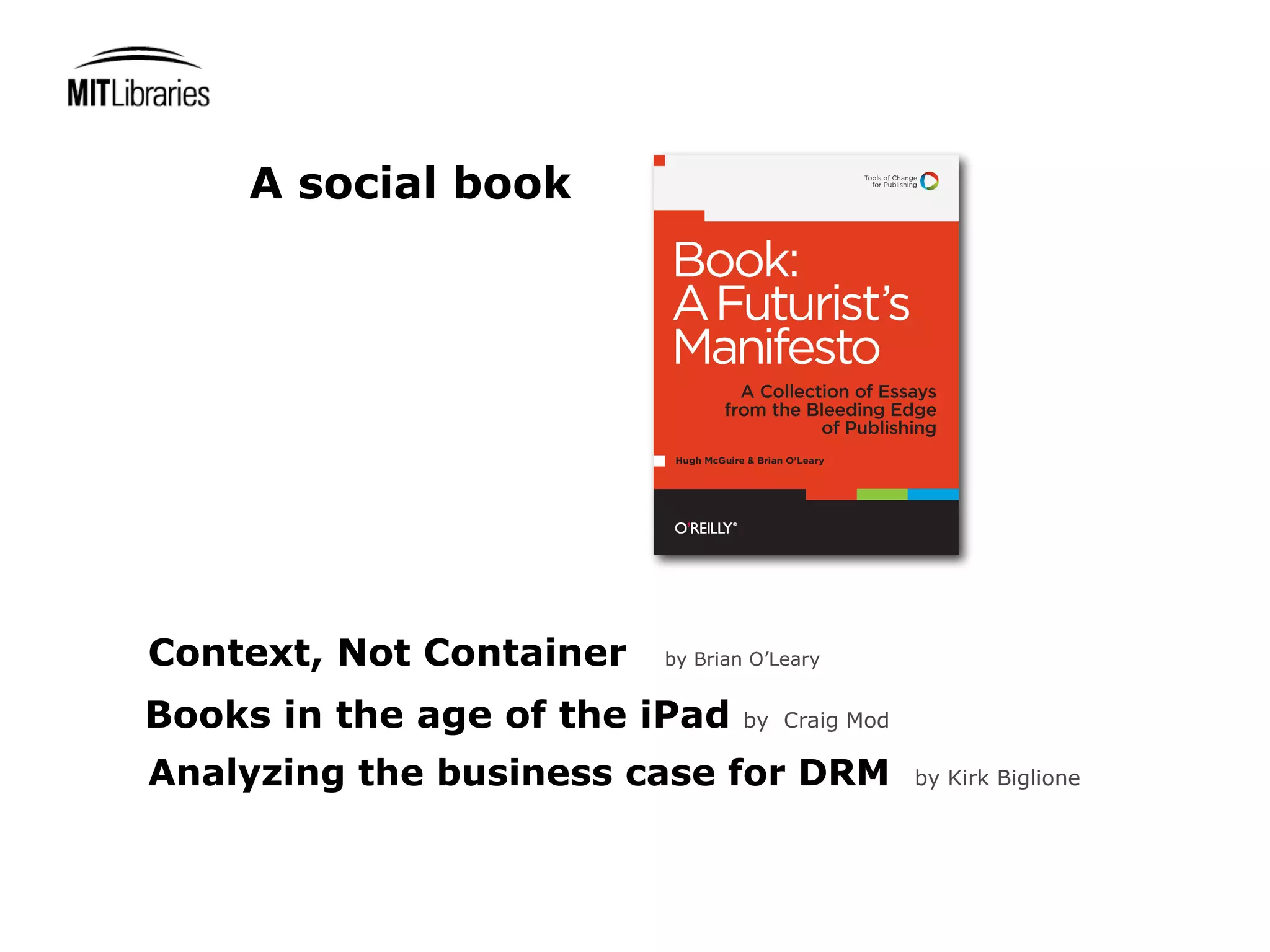
A social book


Context, Not Container   by Brian O’Leary


Books in the age of the iPad     by Craig Mod

Analyzing the business case for DRM             by Kirk Biglione
What academic ebooks could be

1. Solve user problems   Convenience wins


2. An ecosystem
                         Fragmentation hurts


3. Social context
                           People count


4. Take advantage of
the medium                Medium matters
Nicole Hennig
hennig@mit.edu

Academic e-reading: themes from user experience studies

  • 1.
    Academic E-Reading Themes fromUser Experience Studies Nicole Hennig, Head MIT Libraries User Experience Group Nov. 8, 2011
  • 2.
    Today’s talk 1. Userneeds study results 2. Mobile academic ereading - the current state 3. Mobile academic ereading - improving it
  • 3.
    User Needs Research DigitalScholarship Study 17 students kept diaries of their academic lives for a week - in-depth interviews how are new technologies & formats changing how students work?
  • 4.
    Themes Convenience wins Fragmentation hurts People count Place matters
  • 5.
    Convenience wins Familiarity Time investedin familiar systems Post-paper society - no more flipping through current journals
  • 6.
    Convenience wins Difficult? changetopic Interlibrary borrowing? Just difficult enough to skip.
  • 7.
  • 8.
  • 9.
  • 10.
    Fragmentation hurts Even “thecloud” is fragmented.
  • 11.
  • 12.
  • 13.
    People count Collaboration Flickr: http://www.flickr.com/photos/kmakice/3462454985/
  • 14.
  • 15.
  • 16.
  • 17.
  • 18.
    Place matters 24-hours, workfrom everywhere http://www.flickr.com/photos/kcolwell/502787405/
  • 19.
    Themes Convenience wins Fragmentation hurts People count Place matters
  • 20.
    “How might we?...” A.Convenience wins 1. How might we make our services as convenient as possible? B. Fragmentation hurts 1. How might we reduce fragmentation in our resources and tools that we provide? 2. How might we make our tools interoperate with the tools that people use? (Dropbox, Instapaper, Google Docs, Evernote, Refworks, Zotero) C. People count 1. How might we enable people to connect to the experts they need?
  • 22.
    Academic ebooks -current situation
  • 23.
    We subscribe to manyebook packages, but most are not easy to read on mobile devices.
  • 24.
  • 25.
    What we tellour users
  • 26.
  • 27.
  • 28.
    Students use ofebooks not growing Chronicle of Higher Education
  • 29.
    MIT Libraries Fall2011 survey 77% have a smartphone or e-reader. MIT Libraries Fall 2011 Survey. 6,500 responses, 44% response rate
  • 30.
    MIT students wantto read & take notes while mobile Results not completely analyzed yet, but majority “not currently doing this, but would like to” for all choices. MIT Libraries Fall 2011 Survey. 6,500 responses, 44% response rate
  • 31.
    Expectations from non-academice-reading - read anytime/anywhere - small, lightweight, carry many books with you - easy to get new books immediately - ability to sync between mobile devices & computers - zooming in to details of illustrations (iPad & other tablets) - even small screens can work for reading PDFs, thanks to apps like GoodReader
  • 32.
  • 33.
  • 35.
    “Librarians must carveout new roles as advocates of more usable digital collections” Char Booth, Univ. of California, Berkeley
  • 37.
    What academic ebookscould be 1. Solve user problems Convenience wins 2. An ecosystem Fragmentation hurts 3. Social context People count 4. Take advantage of the medium Medium matters
  • 38.
    It’s more thanreading • pondering • thinking • taking notes • bookmarking • copying • quoting • defining words • underlining • highlighting • comparing with other text • skipping around http://www.flickr.com/photos/bludgeoner86/2298513747/ • skimming • looking at photos • examining charts/graphs • citing • discussing
  • 39.
    Convenience wins Easy annotation Improvedways to annotate digital documents that allow for either typing or handwriting in a way that works easily and intuitively. GoodReader iAnnotate PDF
  • 40.
    1 Convenience wins Integration with citation tools Allow for ease of saving and formatting citations in formats required.
  • 41.
    Convenience wins Solve userproblems Content is no longer just a product. It’s part of a value chain that solves readers’ problems. Readers expect publishers to point them to the outcomes or answers they want, where and when they want them. - Context, Not Container by Brian O’Leary
  • 42.
    Fragmentation hurts Download once,read anywhere Allows one to be “device-agnostic”... change or upgrade device, keep your content.
  • 43.
  • 44.
    Fragmentation hurts Integration withcloud tools Allows for easy organizing, saving, and moving content between devices and systems.
  • 45.
    People count Social features,discussion Allow for sharing of quotes and text snippets via email, Twitter, Google+, or other social media.
  • 46.
  • 47.
  • 48.
  • 49.
    Medium matters Text -also known as “formless” content http://www.flickr.com/photos/aufheben/494023168/
  • 50.
    Medium matters Text +graphics, maps, diagrams - also known as “definite content” http://www.flickr.com/photos/25541021@N00/4339699941/
  • 51.
    Medium matters Formless vs.Definite Content “.....definite content..... It may be reflowable, but depending on how it is reflowed, inherent meaning and quality of the text may shift.” — Books in the age of the iPad by Craig Mod
  • 52.
    Medium matters Better waysto view illustrations Allow for zooming in and out, with multi-touch gestures for very large, detailed images, maps, or diagrams. http://www.flickr.com/photos/manitobamaps/2230280043/
  • 53.
    Medium matters Learn fromdesign of comic apps auto-zoom to each panel What if zoom features were applied to scholarly illustrations?
  • 54.
    Medium matters The Elements,iPad app 3D images, rotation. Takes advantage of multi-touch & swipe.
  • 55.
    Medium matters Page turningmetaphor “Take something as fundamental as pages, for example. The metaphor of flipping pages already feels boring and forced on the iPhone and on the iPad. The flow of content no longer has to be chunked into “page”-sized bites.” - Books in the age of the iPad by Craig Mod
  • 56.
    Medium matters “One simplisticreimagining of book layout would be to place chapters on the horizontal plane, with content on a fluid vertical plane.” - Books in the age of the iPad by Craig Mod
  • 57.
    Medium matters Limitless spacebeyond the edges “In printed books, the two-page spread was our canvas. It’s easy to think similarly about the iPad. Let’s not. The canvas of the iPad must be considered in a way that acknowledges the physical boundaries of the device, while also embracing the effective limitlessness of space just beyond those edges. We’re going to see new forms of storytelling emerge from this canvas.” - Books in the age of the iPad by Craig Mod
  • 58.
    Medium matters “The waywe think about book, magazine, and newspaper publishing is unduly governed by the physical containers we have used for centuries to transmit information.” - Context, Not Container by Brian O’Leary
  • 59.
    Medium matters DIY: createyour own, mix/match “Many current audiences (and all future ones) live in an open and accessible environment. They expect to be able to look under the hood, mix and match chunks of content, and create, seamlessly, something of their own. Failure to meet those needs will result in obscurity, at best.” - Context, Not Container by Brian O’Leary
  • 60.
    Medium matters Librarians &scholarly publishers - we want to offer the best - we want to innovate - we want to provide useful tools for scholarship and learning - we need more thoughtful analysis around DRM issues
  • 61.
    Medium matters DRM: Makinginformed decisions Meanwhile, a growing number of mostly independent publishers are doing the unthinkable: releasing ebooks without any form of copy restriction. Are these publishers completely oblivious to the obvious problem of digital piracy? Or are they taking a calculated risk that will ultimately benefit their business? - Analyzing the business case for DRM by Kirk Biglione http://book.pressbooks.com/chapter/analyzing-business-case-for-drm
  • 62.
    A social book Context,Not Container by Brian O’Leary Books in the age of the iPad by Craig Mod Analyzing the business case for DRM by Kirk Biglione
  • 63.
    What academic ebookscould be 1. Solve user problems Convenience wins 2. An ecosystem Fragmentation hurts 3. Social context People count 4. Take advantage of the medium Medium matters
  • 64.