
CFLM 2 (Character Formation 2)
Leadership, Decision Making,
Management and Administration
JENNER P
. PANDAN, RC, MSC, MPA
Prelim Course Outline
Understanding Self-
Leadership
 Significance of Self-Leadership
 Development of Self-Leadership
 Simple Ways to Lead Yourself
 Concept of Leadership
 Most Important Keys to Effective
MODULE 1
UNDERSTANDING
SELF-LEADERSHIP
Lesson 1: Significance of Self-
Leadership
 Leadership is the ability to influence people in
order to get things done.
 Meanwhile, self-leadership is the ability to
consciously influence your own thoughts and
behavior in order to achieve your personal
goals or an organization’s objectives.
Self-led people mostly take their own
decisions and set personal targets. This
ability is typical of entrepreneurs,
mentors, top managers etc.
We say a person has self-leadership skills
when he has foresight, makes the right
decisions and choices on his own, and
exhibits dedication towards achieving his
goals.
Importance of self-leadership
Self-leadership is the first stage or level
of leadership. For employees, whether
mangers or ordinary subordinates, self-
leadership is of great importance.
As a manager, you receive very little or
no supervision. This means you should be
able to plan and set your objectives on
your own, as well as influence your own
self to follow those plans.
 As lower level employee, you can never be sure
the kind of management or leaders you will meet
in the course of tour career. Despite whatever
leadership you may come across –whether laissez
faire, democratic or autocratic – you should be
able to exhibit self-leadership. Employers like
workers who can take great decisions on their
own and are able to influence themselves to
work effectively.
 Self-leadership helps make the
individual proactive, disciplined, and
an independent decision maker.
People who have no strong sense of
self-leadership tend to feel they are
not in control of themselves, often lack
focus and get overwhelmed easily.
Lesson 2: How to develop self-
leadership
 Clarity of purpose
Every leadership or leader has a vision.
Being your own leader, your purpose or
vision will be the foundation upon which
you will build self-leadership. Without
properly scripted objectives or purpose
for your life, you will be at peril – trying to
follow people’s plans or ideas for your life
– and you end up stuck in the middle of
nowhere.
How to develop self-leadership
 Aim at success and take reasonable risks
Risk taking is an essential aspect of life.
Challenge yourself to take on daring
projects. Don’t discourage yourself with
past failures of yourself or others – focus
on success. However, they should be
reasonably calculated risks that are relevant
to your purpose.
How to develop self-leadership
 Spend time to reflect on your life
While you remain the active doer of the things
you do, you may see things from your
perspective only. Take some time off to reflect on
your life – compare the past to the present and
the present to future goals. Until you take a break
to analyze yourself, you may never identify
certain petty shortcomings. Reflections can also
mean allowing someone to make an objective
assessment of you.
How to develop self-leadership
Don’t tolerate just anything
You cannot put your vision at risk. You
should learn to be intolerant of any
suggestion or ideas which are not in line
with your vision. This intolerance is not
towards others only but yourself too. It
includes not tolerating negative aspects
of your nature such as laziness, fear,
timidity etc.
Lesson 3: 3 ways to lead yourself
1. Invest in yourself
2. Lead by example
3. Be ready to be wrong
Invest in yourself
 Reading a book. Now, I’m not talking about
the latest trendy management book. While
there’s certainly value in taking in new
thinking and opinions, I find I’m the most
drawn to good biographies or
autobiographies. Read about a person who’s
actually done what you aspire to do or
possesses traits you admire.
Invest in yourself
 Volunteering. Want to test your
leadership skills? Try motivating people
who aren’t being paid to do something.
You’ll quickly find out what works and
what doesn’t when it comes to leading
teams and connecting with others.
Volunteering allows you to get out of
your comfort zone and hone your
organizational skills, all while doing
good.
Invest in yourself
 Engaging people. Start by
finding a mentor. It’s as simple as
offering an invitation to lunch.
Come prepared to learn and ask
smart questions — if you find a
leader who’s generous with his or
her time, don’t waste it. Be
proactive.
Lead by example
“lead from the front." Set an example for
how you want those around you to lead.
Be the type of leader you want to see on
your management team.
Lead by example
 Making Sure You "Walk the Walk"
As a leader, part of your job is to inspire
the people around you to push themselves
– and, in turn, the company – to greatness.
To do this, you must show them the way
by doing it yourself.
Lead by example
 Get your hands dirty. Do the work and know
your trade. You don’t have to be the most
advanced technician on the team, but you must
have an in-depth understanding of your
industry and your business. Leaders have many
responsibilities, but it is important to work
alongside your team. This is a great way to build
trust and continue to develop your own
knowledge and skills.
Lead by example
 Watch what you say. Actions do speak louder
than words, but words can have a direct
impact on morale. For better or for worse. Be
mindful of what you say, to whom, and who is
listening. Always show support for all team
members. If someone needs extra guidance,
provide it behind closed doors.
Lead by example
 Respect the chain of command. One of the
fastest ways to cause structural
deterioration, foster confusion, and damage
morale is to go around your direct reports.
All team members need to respect the
leadership at every level. If the senior
leaders don’t respect the chain of
command, why would anyone else?
Lead by example
 Listen to the team. As leaders, sometimes we are so
consumed with providing directive, giving orders,
and, well, talking that we forget to stop and listen. If
the recruitment and training engine is functioning
well, you should have a whole team of experts to
turn to for advice. One sign of good leadership is
knowing that you don’t know everything. Listen and
get feedback from your team regularly.
Lead by example
 Take responsibility. As the saying goes, it’s
lonely at the top. Blame roles uphill. Great
leaders know when to accept that mistakes
have been made and take it upon
themselves to fix them. It doesn’t matter if
one of your team members messed up or
you did. If you are the leader, you need to
take responsibility.
Lead by example
 Let the team do their thing. Stop
micromanaging. Communicate the
mission, vision, values, and goals. Then
step back and let the team innovate.
Setting this example for the team will
encourage your other managers to do the
same.
Lead by example
 Take care of yourself. Wellness and
fitness are essential for good
leadership. The more you take care of
yourself, the more energy you will have
and the better work you will do. The
only way to build a fitness oriented
culture is to lead by example. Get in
shape and lead from the front.
Be ready to be wrong
 Those are tough, tough things to do when
you’re passionate about your work and
vision. But a strong leader will be open to
changing his or her mind if it’s for the
greater good. Good leaders know when to
lead, follow or get out of the way — and let
the team they hired do what it does best.
Be ready to be wrong
 Being an effective leader takes a lot of work
and practice, even if you’re lucky enough to
have a lot of natural leadership traits.
Whether you want to be a leader someday,
or you’ve been leading for decades, never
stop honing your leadership skills, starting
with leading yourself.
Lesson 4: Concept of Leadership
I used to think that running an organization was
equivalent to conducting a symphony orchestra.
But I don't think that's quite it; it's more like jazz.
There is more improvisation. — Warren Bennis
 Good leaders are made, not born. If you have
the desire and willpower, you can become an
effective leader. Good leaders develop
through a never ending process of self-study,
education, training, and experience (Jago,
1982). This guide will help you through the
journey.
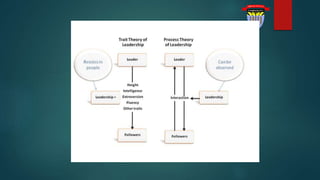
 Leaders carry out this process by applying their
leadership knowledge and skills. This is called Process
Leadership (Jago, 1982). However, we know that we have traits
that can influence our actions. This is called Trait
Leadership (Jago, 1982), in that it was once common to
believe that leaders were born rather than made. These two
leadership types are shown in the chart below (Northouse,
2007, p5):
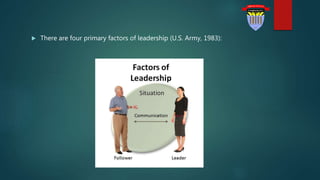
 There are four primary factors of leadership (U.S. Army, 1983):
 Leader
You must have an honest understanding of who you
are, what you know, and what you can do. Also, note
that it is the followers, not the leader or someone else
who determines if the leader is successful. If they do
not trust or lack confidence in their leader, then they
will be uninspired. To be successful you have to
convince your followers, not yourself or your
that you are worthy of being followed.
 Followers
Different people require different styles of leadership. For
example, a new hire requires more supervision than an
experienced employee does. A person who lacks motivation
requires a different approach than one with a high degree of
motivation. You must know your people! The fundamental
starting point is having a good understanding of human nature,
such as needs, emotions, and motivation. You must come to
know your employees' be, know, and do attributes.
 Communication
You lead through two-way communication. Much of it
is nonverbal. For instance, when you “set the example,”
that communicates to your people that you would not
ask them to perform anything that you would not be
willing to do. What and how you communicate either
builds or harms the relationship between you and
followers.
 Situation
All situations are different. What you do in one
will not always work in another. You must use your
judgment to decide the best course of action and the
leadership style needed for each situation. For
you may need to confront an employee for
inappropriate behavior, but if the confrontation is too
late or too early, too harsh or too weak, then the
may prove ineffective.
Lesson 5: Effective Leadership
 Effective leadership is the ability to help
people grow in their own abilities.
 Successful leaders are those who drive others
to achieve their own success.
The Effective Leader
Listen
Evaluate
Assist
Discuss
Empathize
Respond
The Effective Leader has
Vision
They can see into the future, they
know where they are going and what
they are trying to accomplish.
 This quality separates them from managers.
 They are able to transform an organization’s
future.
 While managers are great to get the job done,
great leaders tap into the emotions of others.
The Effective Leader has
Courage
 They are willing to take risks to
achieve goals with no assurance
of success.
 Because there is no certainty in life, every
commitment you make and every action you take
involves a risk of some kind.
It takes courage to stand for one’s beliefs and
goals.
The Effective Leader has
Integrity
 This is complete honesty in everything you do, both with
your members and with the community.
 The core of integrity is truthfulness.
 Integrity requires that you always tell the truth to all people
in every situation.
 Truthfulness is the foundation quality for trust, which is
necessary for the success of any organization or leader.
The Effective Leader has
Humility
Effective leaders are those who are strong and
decisive but also humble.
This doesn’t mean that you are weak or
unsure of yourself.
Humility means that you have the
self-confidence and self-awareness to
recognize the value of others
without feeling threatened.
It means you are willing to admit that you
could be wrong.
The Personality of an Effective
Leader
• Be strong but not rude
• Be kind but not weak
• Be bold but not bully
• Be proud but not arrogant
Respect Others to Gain Respect
 People don’t always pay attention to big issues. For most
people, the little things matter most.
 These little things shape us into who we are.
 They also determine how we respond to
big things.
Five Steps to Gain the Respect of
People
1. Listen to people and ask for their opinions.
2. Compliment people on their achievements.
3. Respect others, be positive by focusing on
the good.
4. Be involved, help and care about others.
5. Admit and learn from your mistakes.
Imperatives of Effective
Leadership
Every situation can be systematically resolved by a leader who applies four
imperatives:
Build trust
Clarify purpose
Align priorities
Unleash talent
Build Trust
 The first step to help others grow in their abilities
is for them to trust you.
 Understand what drives people’s desires, fears, needs,
wants and
why they react the way they do.
 Show that you care and
understand other
perspectives.
Clarify Purpose
 Anything can be achieved if there is clear purpose.
 A good leader is one that constantly reminds others
of the common purpose.
 The purpose must be clear enough for everyone
involved to understand.
Align Priorities
 There should be no conflict
between the measurement of
progress and what is important.
 What is important is that the team
is working towards a clearly
defined purpose and not whether
you are succeeding or failing.
Unleash Talent
 Empower people by utilizing their capacity.
 Understand you can only succeed
by relying on the talents of the
people around you.
 Allow people take ownership,
give them a chance and help
them grow in confidence
and abilities.
ACTIVITY
Activity 1
Think about someone who
inspired you to do something
you never imagined you
would do…
How did this person
inspire you?
Activity 2
Name someone you
consider a great leader.
What is the reasoning for
your choice?
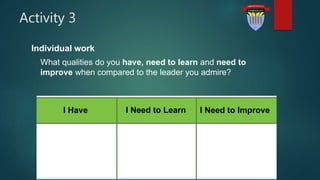
Activity 3
Individual work
What qualities do you have, need to learn and need to
improve when compared to the leader you admire?
I Have I Need to Learn I Need to Improve
Case 1 (Individually)
You are a leader of a committee that seeks to create a youth empowerment
program. Your committee is made up of a wide range of people; the younger
people want to begin with research to understand the need among young
people, while the older people think it is a waste of time and pressure you to
move forward with a plan. This causes the young people to threaten to walk
out of your committee. The two groups start meeting separately.
How should a leader address this situation to keep committee together?

Cflm 2

  • 1.
    CFLM 2 (CharacterFormation 2) Leadership, Decision Making, Management and Administration JENNER P . PANDAN, RC, MSC, MPA
  • 2.
    Prelim Course Outline UnderstandingSelf- Leadership  Significance of Self-Leadership  Development of Self-Leadership  Simple Ways to Lead Yourself  Concept of Leadership  Most Important Keys to Effective
  • 3.
  • 4.
    Lesson 1: Significanceof Self- Leadership  Leadership is the ability to influence people in order to get things done.  Meanwhile, self-leadership is the ability to consciously influence your own thoughts and behavior in order to achieve your personal goals or an organization’s objectives.
  • 5.
    Self-led people mostlytake their own decisions and set personal targets. This ability is typical of entrepreneurs, mentors, top managers etc.
  • 6.
    We say aperson has self-leadership skills when he has foresight, makes the right decisions and choices on his own, and exhibits dedication towards achieving his goals.
  • 7.
    Importance of self-leadership Self-leadershipis the first stage or level of leadership. For employees, whether mangers or ordinary subordinates, self- leadership is of great importance.
  • 8.
    As a manager,you receive very little or no supervision. This means you should be able to plan and set your objectives on your own, as well as influence your own self to follow those plans.
  • 9.
     As lowerlevel employee, you can never be sure the kind of management or leaders you will meet in the course of tour career. Despite whatever leadership you may come across –whether laissez faire, democratic or autocratic – you should be able to exhibit self-leadership. Employers like workers who can take great decisions on their own and are able to influence themselves to work effectively.
  • 10.
     Self-leadership helpsmake the individual proactive, disciplined, and an independent decision maker. People who have no strong sense of self-leadership tend to feel they are not in control of themselves, often lack focus and get overwhelmed easily.
  • 11.
    Lesson 2: Howto develop self- leadership  Clarity of purpose Every leadership or leader has a vision. Being your own leader, your purpose or vision will be the foundation upon which you will build self-leadership. Without properly scripted objectives or purpose for your life, you will be at peril – trying to follow people’s plans or ideas for your life – and you end up stuck in the middle of nowhere.
  • 12.
    How to developself-leadership  Aim at success and take reasonable risks Risk taking is an essential aspect of life. Challenge yourself to take on daring projects. Don’t discourage yourself with past failures of yourself or others – focus on success. However, they should be reasonably calculated risks that are relevant to your purpose.
  • 13.
    How to developself-leadership  Spend time to reflect on your life While you remain the active doer of the things you do, you may see things from your perspective only. Take some time off to reflect on your life – compare the past to the present and the present to future goals. Until you take a break to analyze yourself, you may never identify certain petty shortcomings. Reflections can also mean allowing someone to make an objective assessment of you.
  • 14.
    How to developself-leadership Don’t tolerate just anything You cannot put your vision at risk. You should learn to be intolerant of any suggestion or ideas which are not in line with your vision. This intolerance is not towards others only but yourself too. It includes not tolerating negative aspects of your nature such as laziness, fear, timidity etc.
  • 15.
    Lesson 3: 3ways to lead yourself 1. Invest in yourself 2. Lead by example 3. Be ready to be wrong
  • 16.
    Invest in yourself Reading a book. Now, I’m not talking about the latest trendy management book. While there’s certainly value in taking in new thinking and opinions, I find I’m the most drawn to good biographies or autobiographies. Read about a person who’s actually done what you aspire to do or possesses traits you admire.
  • 17.
    Invest in yourself Volunteering. Want to test your leadership skills? Try motivating people who aren’t being paid to do something. You’ll quickly find out what works and what doesn’t when it comes to leading teams and connecting with others. Volunteering allows you to get out of your comfort zone and hone your organizational skills, all while doing good.
  • 18.
    Invest in yourself Engaging people. Start by finding a mentor. It’s as simple as offering an invitation to lunch. Come prepared to learn and ask smart questions — if you find a leader who’s generous with his or her time, don’t waste it. Be proactive.
  • 19.
    Lead by example “leadfrom the front." Set an example for how you want those around you to lead. Be the type of leader you want to see on your management team.
  • 20.
    Lead by example Making Sure You "Walk the Walk" As a leader, part of your job is to inspire the people around you to push themselves – and, in turn, the company – to greatness. To do this, you must show them the way by doing it yourself.
  • 21.
    Lead by example Get your hands dirty. Do the work and know your trade. You don’t have to be the most advanced technician on the team, but you must have an in-depth understanding of your industry and your business. Leaders have many responsibilities, but it is important to work alongside your team. This is a great way to build trust and continue to develop your own knowledge and skills.
  • 22.
    Lead by example Watch what you say. Actions do speak louder than words, but words can have a direct impact on morale. For better or for worse. Be mindful of what you say, to whom, and who is listening. Always show support for all team members. If someone needs extra guidance, provide it behind closed doors.
  • 23.
    Lead by example Respect the chain of command. One of the fastest ways to cause structural deterioration, foster confusion, and damage morale is to go around your direct reports. All team members need to respect the leadership at every level. If the senior leaders don’t respect the chain of command, why would anyone else?
  • 24.
    Lead by example Listen to the team. As leaders, sometimes we are so consumed with providing directive, giving orders, and, well, talking that we forget to stop and listen. If the recruitment and training engine is functioning well, you should have a whole team of experts to turn to for advice. One sign of good leadership is knowing that you don’t know everything. Listen and get feedback from your team regularly.
  • 25.
    Lead by example Take responsibility. As the saying goes, it’s lonely at the top. Blame roles uphill. Great leaders know when to accept that mistakes have been made and take it upon themselves to fix them. It doesn’t matter if one of your team members messed up or you did. If you are the leader, you need to take responsibility.
  • 26.
    Lead by example Let the team do their thing. Stop micromanaging. Communicate the mission, vision, values, and goals. Then step back and let the team innovate. Setting this example for the team will encourage your other managers to do the same.
  • 27.
    Lead by example Take care of yourself. Wellness and fitness are essential for good leadership. The more you take care of yourself, the more energy you will have and the better work you will do. The only way to build a fitness oriented culture is to lead by example. Get in shape and lead from the front.
  • 28.
    Be ready tobe wrong  Those are tough, tough things to do when you’re passionate about your work and vision. But a strong leader will be open to changing his or her mind if it’s for the greater good. Good leaders know when to lead, follow or get out of the way — and let the team they hired do what it does best.
  • 29.
    Be ready tobe wrong  Being an effective leader takes a lot of work and practice, even if you’re lucky enough to have a lot of natural leadership traits. Whether you want to be a leader someday, or you’ve been leading for decades, never stop honing your leadership skills, starting with leading yourself.
  • 30.
    Lesson 4: Conceptof Leadership I used to think that running an organization was equivalent to conducting a symphony orchestra. But I don't think that's quite it; it's more like jazz. There is more improvisation. — Warren Bennis
  • 31.
     Good leadersare made, not born. If you have the desire and willpower, you can become an effective leader. Good leaders develop through a never ending process of self-study, education, training, and experience (Jago, 1982). This guide will help you through the journey.
  • 32.
     Leaders carryout this process by applying their leadership knowledge and skills. This is called Process Leadership (Jago, 1982). However, we know that we have traits that can influence our actions. This is called Trait Leadership (Jago, 1982), in that it was once common to believe that leaders were born rather than made. These two leadership types are shown in the chart below (Northouse, 2007, p5):
  • 34.
     There arefour primary factors of leadership (U.S. Army, 1983):
  • 35.
     Leader You musthave an honest understanding of who you are, what you know, and what you can do. Also, note that it is the followers, not the leader or someone else who determines if the leader is successful. If they do not trust or lack confidence in their leader, then they will be uninspired. To be successful you have to convince your followers, not yourself or your that you are worthy of being followed.
  • 36.
     Followers Different peoplerequire different styles of leadership. For example, a new hire requires more supervision than an experienced employee does. A person who lacks motivation requires a different approach than one with a high degree of motivation. You must know your people! The fundamental starting point is having a good understanding of human nature, such as needs, emotions, and motivation. You must come to know your employees' be, know, and do attributes.
  • 37.
     Communication You leadthrough two-way communication. Much of it is nonverbal. For instance, when you “set the example,” that communicates to your people that you would not ask them to perform anything that you would not be willing to do. What and how you communicate either builds or harms the relationship between you and followers.
  • 38.
     Situation All situationsare different. What you do in one will not always work in another. You must use your judgment to decide the best course of action and the leadership style needed for each situation. For you may need to confront an employee for inappropriate behavior, but if the confrontation is too late or too early, too harsh or too weak, then the may prove ineffective.
  • 39.
    Lesson 5: EffectiveLeadership  Effective leadership is the ability to help people grow in their own abilities.  Successful leaders are those who drive others to achieve their own success.
  • 40.
  • 41.
    The Effective Leaderhas Vision They can see into the future, they know where they are going and what they are trying to accomplish.  This quality separates them from managers.  They are able to transform an organization’s future.  While managers are great to get the job done, great leaders tap into the emotions of others.
  • 42.
    The Effective Leaderhas Courage  They are willing to take risks to achieve goals with no assurance of success.  Because there is no certainty in life, every commitment you make and every action you take involves a risk of some kind. It takes courage to stand for one’s beliefs and goals.
  • 43.
    The Effective Leaderhas Integrity  This is complete honesty in everything you do, both with your members and with the community.  The core of integrity is truthfulness.  Integrity requires that you always tell the truth to all people in every situation.  Truthfulness is the foundation quality for trust, which is necessary for the success of any organization or leader.
  • 44.
    The Effective Leaderhas Humility Effective leaders are those who are strong and decisive but also humble. This doesn’t mean that you are weak or unsure of yourself. Humility means that you have the self-confidence and self-awareness to recognize the value of others without feeling threatened. It means you are willing to admit that you could be wrong.
  • 45.
    The Personality ofan Effective Leader • Be strong but not rude • Be kind but not weak • Be bold but not bully • Be proud but not arrogant
  • 46.
    Respect Others toGain Respect  People don’t always pay attention to big issues. For most people, the little things matter most.  These little things shape us into who we are.  They also determine how we respond to big things.
  • 47.
    Five Steps toGain the Respect of People 1. Listen to people and ask for their opinions. 2. Compliment people on their achievements. 3. Respect others, be positive by focusing on the good. 4. Be involved, help and care about others. 5. Admit and learn from your mistakes.
  • 48.
    Imperatives of Effective Leadership Everysituation can be systematically resolved by a leader who applies four imperatives: Build trust Clarify purpose Align priorities Unleash talent
  • 49.
    Build Trust  Thefirst step to help others grow in their abilities is for them to trust you.  Understand what drives people’s desires, fears, needs, wants and why they react the way they do.  Show that you care and understand other perspectives.
  • 50.
    Clarify Purpose  Anythingcan be achieved if there is clear purpose.  A good leader is one that constantly reminds others of the common purpose.  The purpose must be clear enough for everyone involved to understand.
  • 51.
    Align Priorities  Thereshould be no conflict between the measurement of progress and what is important.  What is important is that the team is working towards a clearly defined purpose and not whether you are succeeding or failing.
  • 52.
    Unleash Talent  Empowerpeople by utilizing their capacity.  Understand you can only succeed by relying on the talents of the people around you.  Allow people take ownership, give them a chance and help them grow in confidence and abilities.
  • 53.
  • 54.
    Activity 1 Think aboutsomeone who inspired you to do something you never imagined you would do… How did this person inspire you?
  • 55.
    Activity 2 Name someoneyou consider a great leader. What is the reasoning for your choice?
  • 56.
    Activity 3 Individual work Whatqualities do you have, need to learn and need to improve when compared to the leader you admire? I Have I Need to Learn I Need to Improve
  • 57.
    Case 1 (Individually) Youare a leader of a committee that seeks to create a youth empowerment program. Your committee is made up of a wide range of people; the younger people want to begin with research to understand the need among young people, while the older people think it is a waste of time and pressure you to move forward with a plan. This causes the young people to threaten to walk out of your committee. The two groups start meeting separately. How should a leader address this situation to keep committee together?