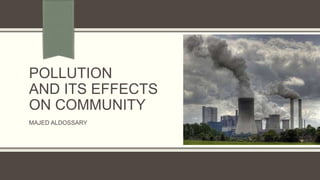
POLLUTION
AND ITS EFFECTS
ON COMMUNITY
MAJED ALDOSSARY
Content Layout
Introduction
Types of Pollution
Causes of Pollution
Effects of Pollution on Society
Diseases and Life Threatening due to Pollution
Preventive Analysis
WHO and Health Organizations Initials
Conclusion
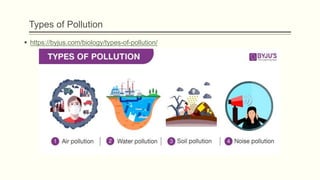
Types of Pollution
 https://byjus.com/biology/types-of-pollution/
Air Pollution
Health can be impacted by air pollution for everyone. When we take in air pollutants, they can
enter our bloodstream and cause or aggravate a variety of respiratory and lung disorders, which
can result in hospitalizations, cancer, or even an early death. They can also cause or worsen
itchy eyes and coughing. Lung cancer, heart problems, and respiratory infections are all made
more likely by it.
https://evidence.nejm.org/doi/full/10.1056/EVIDra2200068
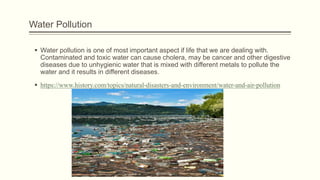
Water Pollution
 Water pollution is one of most important aspect if life that we are dealing with.
Contaminated and toxic water can cause cholera, may be cancer and other digestive
diseases due to unhygienic water that is mixed with different metals to pollute the
water and it results in different diseases.
 https://www.history.com/topics/natural-disasters-and-environment/water-and-air-pollution
Soil Pollution
 When abnormally high amounts of harmful compounds are present in the soil, it is referred to
as soil pollution. Given the numerous health risks it contains, it is a severe environmental
problem. For instance, exposure to soil with high benzene concentrations increases the chance
of developing leukemia.
 https://www.conserve-energy-future.com/causes-effects-solutions-of-land-pollution.php
Noise Pollution
 Every day, millions of individuals are impacted by noise pollution. It most frequently results in
noise-induced hearing loss (NIHL). Stress, high blood pressure, heart disease, and sleep
difficulties can all be brought on by exposure to loud noise. Children but all age groups, might
experience these health issues.
 https://www.daily-sun.com/post/429150/Sound-pollution-is-harmful-for-health-and-wellbeing
Effects of Pollution on Society
 Serious medical disorders including cancer, heart attacks, and strokes can be brought on by
prolonged exposure. Air pollution contributes to one in three global fatalities from heart attacks,
lung cancer, and chronic respiratory diseases.
 Due to these, Pollution has adverse effects on society, and these are expanding day by day.
 http://jalaloadedshuks.blogspot.com/2017/03/effect-of-air-pollution-on-human-health.html
Diseases and Life Threatening due to Pollution
 The most common diseases caused by air pollution,
 Ischemic heart disease
 Stroke
 Chronic obstructive pulmonary disease (COPD)
 Lung cancer
 Acute lower respiratory infections in children.
 https://world-heart-federation.org/news/air-pollution-and-cardiovascular-disease-a-window-of-
opportunity/
Preventive Measures
Take these Extra Steps to Reduce Pollution on Days with Expected High Particle Levels:
Reduce the amount of automobile journeys you make.
Reduce or stop using wood stoves and fireplaces.
Do not burn rubbish, leaves, or other items.
Use electric or battery-powered lawn and garden tools
Preventive Analysis
https://www.researchgate.net/figure/
Mitigation-measures-to-reduce-air-
pollution-exposure_fig1_347318371
Preventive Measures taken by US
Environmental experts highlight several shortcomings in the Clean Air Act:
The United States still prioritizes cleaning above prevention.
The United States Congress was unable to raise the minimum fuel economy requirements for
cars.
The laws governing motorbike and two-cycle engine emissions are still insufficient.
In American ports, there is either very little or no control of air pollution from oceangoing
ships.
WHO and Health Organizations Initials Regarding Pollution
Under WHO, to prevent Pollution, authorities have taken actions.
Sanitation needs a lot of work in terms of both water supply and availability, so WHO and a
group of nations has selected five top goals for preserving the environment, encouraging
healthy living, and raising standards of living using,
Drinking water standards (including increased access to water and sanitation)
Solid garbage (including hazardous wastes, such as health care waste)
Domestic biomass combustion (indoor air pollution)
Control of food safety vectors.
Conclusion
By explaining all these contents about pollution, it is concluded that it is one of the community
issues that we face daily. Due to increasing Pollutants in the environment, it is our duty to make
our environment clean and hygienic. WHO and other health organizations have made different
preventive and systematic measures to minimize this problem and for this green energy and solar
panels are used now-e-days to make surroundings pollution free. Governments have taken
precautionary measures to eliminate gas and diesel cars and try to use electric cars so that there
would be less gases formed and it can save not our lives, but it is also compulsory for our future
generation.
References
1. Van der Ploeg, F., de Zeeuw, A.J. International aspects of pollution control. Environmental and Resource Economics 2, 117–139 (1992).
https://doi.org/10.1007/BF00338239
2. Bert Brunekreef, Stephen T Holgate, Air pollution and health,The Lancet, Volume 360, Issue 9341, 2002, ISSN 0140-6736,
3. Moss Brian, 2008Water pollution by agriculturePhil. Trans. R. Soc. B363659–666
4. Morillas, J.M.B., Gozalo, G.R., González, D.M. et al. Noise Pollution and Urban Planning. Curr Pollution Rep 4, 208–219 (2018). https://doi.org/10.1007/s40726-018-
0095-7
5. Gupta, A., Gupta, A., Jain, K. et al. Noise Pollution and Impact on Children Health. Indian J Pediatr 85, 300–306 (2018). https://doi.org/10.1007/s12098-017-2579-7
6. João Pinto da Costa, The 2019 global pandemic and plastic pollution prevention measures: Playing catch-up, Science of The Total Environment, Volume 774, 2021, ISSN
0048-9697
7. Karrari, P., Mehrpour, O. & Abdollahi, M. A systematic review on status of lead pollution and toxicity in Iran; Guidance for preventive measures. DARU J Pharm Sci 20,
2 (2012). https://doi.org/10.1186/1560-8115-20-2
8. Landrigan PJ, Fuller R, Hu H, Caravanos J, Cropper ML, Hanrahan D, Sandilya K, Chiles TC, Kumar P, Suk WA. Pollution and Global Health – An Agenda for
Prevention. Environ Health Perspect. 2018 Aug 6;126(8):084501. doi: 10.1289/EHP3141. PMID: 30118434; PMCID: PMC6108842.
9. Elleuch, B., Bouhamed, F., Elloussaief, M. et al. Environmental sustainability and pollution prevention. Environ Sci Pollut Res 25, 18223–18225 (2018).
https://doi.org/10.1007/s11356-017-0619-5
10. Josh Ederington, Arik Levinson, Jenny Minier; Footloose and Pollution-Free. The Review of Economics and Statistics 2005; 87 (1): 92–99. doi:

POLLUTION.pptx

  • 1.
    POLLUTION AND ITS EFFECTS ONCOMMUNITY MAJED ALDOSSARY
  • 2.
    Content Layout Introduction Types ofPollution Causes of Pollution Effects of Pollution on Society Diseases and Life Threatening due to Pollution Preventive Analysis WHO and Health Organizations Initials Conclusion
  • 3.
    Types of Pollution https://byjus.com/biology/types-of-pollution/
  • 4.
    Air Pollution Health canbe impacted by air pollution for everyone. When we take in air pollutants, they can enter our bloodstream and cause or aggravate a variety of respiratory and lung disorders, which can result in hospitalizations, cancer, or even an early death. They can also cause or worsen itchy eyes and coughing. Lung cancer, heart problems, and respiratory infections are all made more likely by it. https://evidence.nejm.org/doi/full/10.1056/EVIDra2200068
  • 5.
    Water Pollution  Waterpollution is one of most important aspect if life that we are dealing with. Contaminated and toxic water can cause cholera, may be cancer and other digestive diseases due to unhygienic water that is mixed with different metals to pollute the water and it results in different diseases.  https://www.history.com/topics/natural-disasters-and-environment/water-and-air-pollution
  • 6.
    Soil Pollution  Whenabnormally high amounts of harmful compounds are present in the soil, it is referred to as soil pollution. Given the numerous health risks it contains, it is a severe environmental problem. For instance, exposure to soil with high benzene concentrations increases the chance of developing leukemia.  https://www.conserve-energy-future.com/causes-effects-solutions-of-land-pollution.php
  • 7.
    Noise Pollution  Everyday, millions of individuals are impacted by noise pollution. It most frequently results in noise-induced hearing loss (NIHL). Stress, high blood pressure, heart disease, and sleep difficulties can all be brought on by exposure to loud noise. Children but all age groups, might experience these health issues.  https://www.daily-sun.com/post/429150/Sound-pollution-is-harmful-for-health-and-wellbeing
  • 8.
    Effects of Pollutionon Society  Serious medical disorders including cancer, heart attacks, and strokes can be brought on by prolonged exposure. Air pollution contributes to one in three global fatalities from heart attacks, lung cancer, and chronic respiratory diseases.  Due to these, Pollution has adverse effects on society, and these are expanding day by day.  http://jalaloadedshuks.blogspot.com/2017/03/effect-of-air-pollution-on-human-health.html
  • 9.
    Diseases and LifeThreatening due to Pollution  The most common diseases caused by air pollution,  Ischemic heart disease  Stroke  Chronic obstructive pulmonary disease (COPD)  Lung cancer  Acute lower respiratory infections in children.  https://world-heart-federation.org/news/air-pollution-and-cardiovascular-disease-a-window-of- opportunity/
  • 10.
    Preventive Measures Take theseExtra Steps to Reduce Pollution on Days with Expected High Particle Levels: Reduce the amount of automobile journeys you make. Reduce or stop using wood stoves and fireplaces. Do not burn rubbish, leaves, or other items. Use electric or battery-powered lawn and garden tools
  • 11.
  • 12.
    Preventive Measures takenby US Environmental experts highlight several shortcomings in the Clean Air Act: The United States still prioritizes cleaning above prevention. The United States Congress was unable to raise the minimum fuel economy requirements for cars. The laws governing motorbike and two-cycle engine emissions are still insufficient. In American ports, there is either very little or no control of air pollution from oceangoing ships.
  • 13.
    WHO and HealthOrganizations Initials Regarding Pollution Under WHO, to prevent Pollution, authorities have taken actions. Sanitation needs a lot of work in terms of both water supply and availability, so WHO and a group of nations has selected five top goals for preserving the environment, encouraging healthy living, and raising standards of living using, Drinking water standards (including increased access to water and sanitation) Solid garbage (including hazardous wastes, such as health care waste) Domestic biomass combustion (indoor air pollution) Control of food safety vectors.
  • 14.
    Conclusion By explaining allthese contents about pollution, it is concluded that it is one of the community issues that we face daily. Due to increasing Pollutants in the environment, it is our duty to make our environment clean and hygienic. WHO and other health organizations have made different preventive and systematic measures to minimize this problem and for this green energy and solar panels are used now-e-days to make surroundings pollution free. Governments have taken precautionary measures to eliminate gas and diesel cars and try to use electric cars so that there would be less gases formed and it can save not our lives, but it is also compulsory for our future generation.
  • 15.
    References 1. Van derPloeg, F., de Zeeuw, A.J. International aspects of pollution control. Environmental and Resource Economics 2, 117–139 (1992). https://doi.org/10.1007/BF00338239 2. Bert Brunekreef, Stephen T Holgate, Air pollution and health,The Lancet, Volume 360, Issue 9341, 2002, ISSN 0140-6736, 3. Moss Brian, 2008Water pollution by agriculturePhil. Trans. R. Soc. B363659–666 4. Morillas, J.M.B., Gozalo, G.R., González, D.M. et al. Noise Pollution and Urban Planning. Curr Pollution Rep 4, 208–219 (2018). https://doi.org/10.1007/s40726-018- 0095-7 5. Gupta, A., Gupta, A., Jain, K. et al. Noise Pollution and Impact on Children Health. Indian J Pediatr 85, 300–306 (2018). https://doi.org/10.1007/s12098-017-2579-7 6. João Pinto da Costa, The 2019 global pandemic and plastic pollution prevention measures: Playing catch-up, Science of The Total Environment, Volume 774, 2021, ISSN 0048-9697 7. Karrari, P., Mehrpour, O. & Abdollahi, M. A systematic review on status of lead pollution and toxicity in Iran; Guidance for preventive measures. DARU J Pharm Sci 20, 2 (2012). https://doi.org/10.1186/1560-8115-20-2 8. Landrigan PJ, Fuller R, Hu H, Caravanos J, Cropper ML, Hanrahan D, Sandilya K, Chiles TC, Kumar P, Suk WA. Pollution and Global Health – An Agenda for Prevention. Environ Health Perspect. 2018 Aug 6;126(8):084501. doi: 10.1289/EHP3141. PMID: 30118434; PMCID: PMC6108842. 9. Elleuch, B., Bouhamed, F., Elloussaief, M. et al. Environmental sustainability and pollution prevention. Environ Sci Pollut Res 25, 18223–18225 (2018). https://doi.org/10.1007/s11356-017-0619-5 10. Josh Ederington, Arik Levinson, Jenny Minier; Footloose and Pollution-Free. The Review of Economics and Statistics 2005; 87 (1): 92–99. doi:

Editor's Notes

  • #2 NOTE: To change the image on this slide, select the picture and delete it. Then click the Pictures icon in the placeholder to insert your own image.