POLISH TRADITIONS
• Poles are considered to be the nation which
like celebrating, tied to tradition, supporting
the old manners. The oldest rituals, particularly
those dating back to pagan times, have lost
their magical nature, becoming a colorful relic
of the past and an element of fun. Affection
with tradition is beeing felt the most during the
biggest celebration of religious holidays such
as Christmas, Easter and Corpus Christi,
during which processions are organized, or All
Saints' Day.
CHRISTMAS
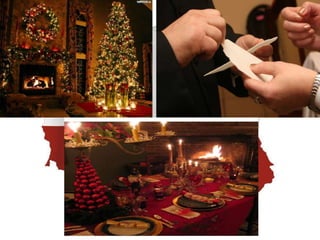
• Christmas takes a special place in Polish
tradition. This is the most beautiful and family
holiday of the year, which is connected with
most rituals and beliefs. It is accompanied by a
magical atmosphere, unforgettable emotions,
tradition, meticulously cultivated for
generations. In almost every Polish home at
this special time can not miss Christmas tree,
wafer, carols and gifts.
Christmas traditions
• Christmas Tree
A huge role in creating the Christmas atmosphere
has solemnly decked house where reigns the Christmas
tree. In Poland, the custom of putting up the Christmas
tree came from Germany in the eighteenth century.
Previously suspended from the ceiling of the top of fir,
pine or spruce. In the corner a sheaf were placed.Tree is
to protect the house and its inhabitants from evil spirits.
A star, suspended often at the top symbolizes the Star of
Bethlehem.? Dressed in ornaments and flippery
Christmas Tree usually remains until Epiphany.
• Dishes for Christmas Eve
Each region in Poland prefer their own dishes for
Christmas Eve, but in every house this special meal is
dominated by mushrooms, cabbage, poppy seeds,
raisins and dried fruits. On the Polish table can not miss
the red or fungal borscht with dumplings stuffed with
mushrooms, dumplings with cabbage and mushrooms,
cooked in many ways herrings, fishes and salads. A
traditional delicacy is fried carp in jelly. Christmas
desserts are poppy seed, honey gingerbread, cookies
with almonds, walnuts and raisins, and a compote of
dried apples, pears and plums. Special meaning is
attached to kutii (wheat with poppy seeds and honey) ,
which is a relic of the ancient rites in honor of the dead.
• Carols
Carols are traditional songs in praise of the
birth of Christ. The oldest are from the
fifteenth century. Handed down from
generation to generation. Most, such as the
„Silent Night" or "God is Born" were created
at the turn of the seventeenth and eighteenth
centuries, and are sung during Christmas Eve
and Christmas until today.
WIELKANOC
• Easter is the oldest and the most important
Christian feast, commemorating the resurrection
of Jesus Christ. It is a movable feast, celebrated
on the first Sunday after the first full moon of
spring (between March 21 and April 25).
Preceding the week during which the Church and
the faithful recall the most important events for
the Christian faith, is called Holy Week. Easter in
Poland is very colorful, accompanied by many
religious and folk rituals.
Easter traditions
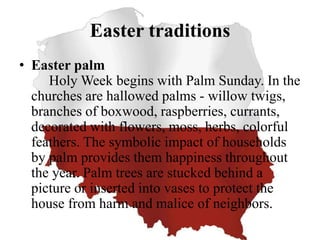
• Easter palm
Holy Week begins with Palm Sunday. In the
churches are hallowed palms - willow twigs,
branches of boxwood, raspberries, currants,
decorated with flowers, moss, herbs, colorful
feathers. The symbolic impact of households
by palm provides them happiness throughout
the year. Palm trees are stucked behind a
picture or inserted into vases to protect the
house from harm and malice of neighbors.
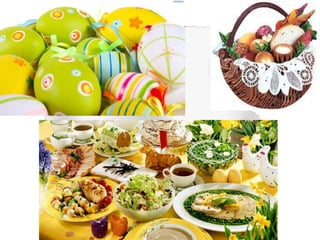
• Easter basket
Holy Saturday is a day of joyful
expectation. That day the Easter basket is
preparing. It’s a decorative basket with food,
which we hallow in the church. You can not
miss in it eggs, which are a symbol of birth
and new life, the lamb of sugar symbolizes the
martyred Christ, bread, salt, meat, horseradish,
festive cake. Easter basket is ate the next day
after the resurrection.
• Easter breakfast
On Easter Sunday, after Resurrection
family sits down to a Christmas breakfast.
Festive table covered with a white cloth,
decorated Easter eggs, catkins or fresh flowers
that bring spring mood. On "honorary" place
there is an Easter basket. Easter breakfast
begins by sharing the blessed egg, which is
similar in form and symbolism to the
Christmas wafer breakage. This ceremonial
morning we first eat foods that have been
hallowed the previous day.
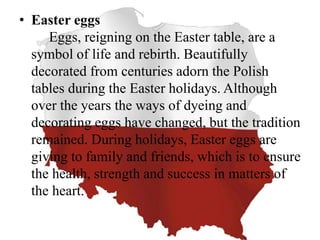
• Easter eggs
Eggs, reigning on the Easter table, are a
symbol of life and rebirth. Beautifully
decorated from centuries adorn the Polish
tables during the Easter holidays. Although
over the years the ways of dyeing and
decorating eggs have changed, but the tradition
remained. During holidays, Easter eggs are
giving to family and friends, which is to ensure
the health, strength and success in matters of
the heart.
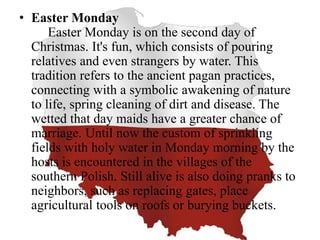
• Easter Monday
Easter Monday is on the second day of
Christmas. It's fun, which consists of pouring
relatives and even strangers by water. This
tradition refers to the ancient pagan practices,
connecting with a symbolic awakening of nature
to life, spring cleaning of dirt and disease. The
wetted that day maids have a greater chance of
marriage. Until now the custom of sprinkling
fields with holy water in Monday morning by the
hosts is encountered in the villages of the
southern Polish. Still alive is also doing pranks to
neighbors, such as replacing gates, place
agricultural tools on roofs or burying buckets.
NATIONAL CELEBRATION MAY 3
• On May 3 1791 the Constitution of the Republic of
Both Nations was approved. It was the first constitution
in modern Europe and second in the world.
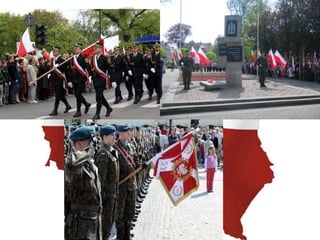
In an especially solemn atmosphere the main
celebrations of May 3 at the Tomb of the Unknown
Soldier on Pilsudski Square in Warsaw are held. They
are accompanied by a military parade, cannon salvos,
the solemn admission of the guard, laying of wreaths.
Fete 3 May is a joyful celebration. Throughout Poland
spring events, concerts and family picnics are held.
Many people take part in the run on the streets of
Warsaw under the slogan „From the Constitution of
May 3 to the European Union”.
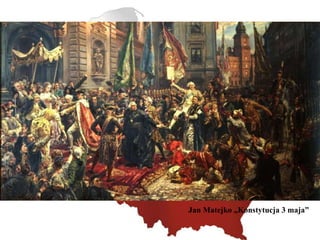
Jan Matejko „Konstytucja 3 maja”
INDEPENDENCE DAY
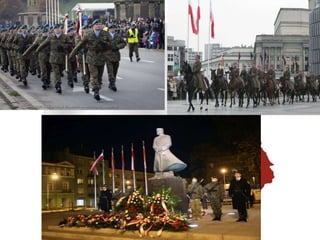
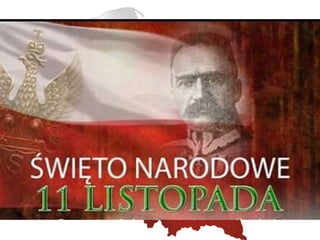
• National holiday in Poland celebrated on 11 November
to commemorate reclaiming of the independence by the
Polish nation in 1918 after 123 years of partitions
Polish made ​​by the Russian Empire, the Kingdom of
Prussia and the Habsburg Empire. Reclaiming of
Poland's independence was a gradual process. The
choice of November 11 can be justified by confluence
of event in Poland with the completion of the First
World War. 11 November 1918, the Polish nation
realized fully regain their independence, and the mood
of deep emotion and enthusiasm ambrased the country.
ST. NICHOLAS DAY
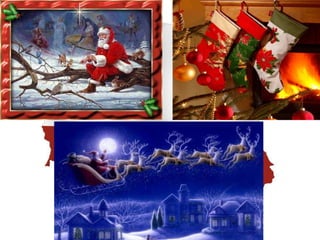
• St. Nicholas Day is celebrated on December 6
in Poland. The presence of Santa Claus
announces the coming of Christmas. On this
day Santa Claus (actually a person dressed as
him) brings gifts to children. These are usually
small gifts, candy or small toys. Adults also are
giving presents to their relatives. On the night
of December 5 to December 6 we put the gifts
under the pillow, in the boot or in a large sock.
Polish dishes and traditions

Polish dishes and traditions

  • 1.
  • 2.
    • Poles areconsidered to be the nation which like celebrating, tied to tradition, supporting the old manners. The oldest rituals, particularly those dating back to pagan times, have lost their magical nature, becoming a colorful relic of the past and an element of fun. Affection with tradition is beeing felt the most during the biggest celebration of religious holidays such as Christmas, Easter and Corpus Christi, during which processions are organized, or All Saints' Day.
  • 3.
    CHRISTMAS • Christmas takesa special place in Polish tradition. This is the most beautiful and family holiday of the year, which is connected with most rituals and beliefs. It is accompanied by a magical atmosphere, unforgettable emotions, tradition, meticulously cultivated for generations. In almost every Polish home at this special time can not miss Christmas tree, wafer, carols and gifts.
  • 5.
    Christmas traditions • ChristmasTree A huge role in creating the Christmas atmosphere has solemnly decked house where reigns the Christmas tree. In Poland, the custom of putting up the Christmas tree came from Germany in the eighteenth century. Previously suspended from the ceiling of the top of fir, pine or spruce. In the corner a sheaf were placed.Tree is to protect the house and its inhabitants from evil spirits. A star, suspended often at the top symbolizes the Star of Bethlehem.? Dressed in ornaments and flippery Christmas Tree usually remains until Epiphany.
  • 6.
    • Dishes forChristmas Eve Each region in Poland prefer their own dishes for Christmas Eve, but in every house this special meal is dominated by mushrooms, cabbage, poppy seeds, raisins and dried fruits. On the Polish table can not miss the red or fungal borscht with dumplings stuffed with mushrooms, dumplings with cabbage and mushrooms, cooked in many ways herrings, fishes and salads. A traditional delicacy is fried carp in jelly. Christmas desserts are poppy seed, honey gingerbread, cookies with almonds, walnuts and raisins, and a compote of dried apples, pears and plums. Special meaning is attached to kutii (wheat with poppy seeds and honey) , which is a relic of the ancient rites in honor of the dead.
  • 7.
    • Carols Carols aretraditional songs in praise of the birth of Christ. The oldest are from the fifteenth century. Handed down from generation to generation. Most, such as the „Silent Night" or "God is Born" were created at the turn of the seventeenth and eighteenth centuries, and are sung during Christmas Eve and Christmas until today.
  • 8.
    WIELKANOC • Easter isthe oldest and the most important Christian feast, commemorating the resurrection of Jesus Christ. It is a movable feast, celebrated on the first Sunday after the first full moon of spring (between March 21 and April 25). Preceding the week during which the Church and the faithful recall the most important events for the Christian faith, is called Holy Week. Easter in Poland is very colorful, accompanied by many religious and folk rituals.
  • 10.
    Easter traditions • Easterpalm Holy Week begins with Palm Sunday. In the churches are hallowed palms - willow twigs, branches of boxwood, raspberries, currants, decorated with flowers, moss, herbs, colorful feathers. The symbolic impact of households by palm provides them happiness throughout the year. Palm trees are stucked behind a picture or inserted into vases to protect the house from harm and malice of neighbors.
  • 11.
    • Easter basket HolySaturday is a day of joyful expectation. That day the Easter basket is preparing. It’s a decorative basket with food, which we hallow in the church. You can not miss in it eggs, which are a symbol of birth and new life, the lamb of sugar symbolizes the martyred Christ, bread, salt, meat, horseradish, festive cake. Easter basket is ate the next day after the resurrection.
  • 12.
    • Easter breakfast OnEaster Sunday, after Resurrection family sits down to a Christmas breakfast. Festive table covered with a white cloth, decorated Easter eggs, catkins or fresh flowers that bring spring mood. On "honorary" place there is an Easter basket. Easter breakfast begins by sharing the blessed egg, which is similar in form and symbolism to the Christmas wafer breakage. This ceremonial morning we first eat foods that have been hallowed the previous day.
  • 13.
    • Easter eggs Eggs,reigning on the Easter table, are a symbol of life and rebirth. Beautifully decorated from centuries adorn the Polish tables during the Easter holidays. Although over the years the ways of dyeing and decorating eggs have changed, but the tradition remained. During holidays, Easter eggs are giving to family and friends, which is to ensure the health, strength and success in matters of the heart.
  • 14.
    • Easter Monday EasterMonday is on the second day of Christmas. It's fun, which consists of pouring relatives and even strangers by water. This tradition refers to the ancient pagan practices, connecting with a symbolic awakening of nature to life, spring cleaning of dirt and disease. The wetted that day maids have a greater chance of marriage. Until now the custom of sprinkling fields with holy water in Monday morning by the hosts is encountered in the villages of the southern Polish. Still alive is also doing pranks to neighbors, such as replacing gates, place agricultural tools on roofs or burying buckets.
  • 15.
    NATIONAL CELEBRATION MAY3 • On May 3 1791 the Constitution of the Republic of Both Nations was approved. It was the first constitution in modern Europe and second in the world. In an especially solemn atmosphere the main celebrations of May 3 at the Tomb of the Unknown Soldier on Pilsudski Square in Warsaw are held. They are accompanied by a military parade, cannon salvos, the solemn admission of the guard, laying of wreaths. Fete 3 May is a joyful celebration. Throughout Poland spring events, concerts and family picnics are held. Many people take part in the run on the streets of Warsaw under the slogan „From the Constitution of May 3 to the European Union”.
  • 17.
  • 18.
    INDEPENDENCE DAY • Nationalholiday in Poland celebrated on 11 November to commemorate reclaiming of the independence by the Polish nation in 1918 after 123 years of partitions Polish made ​​by the Russian Empire, the Kingdom of Prussia and the Habsburg Empire. Reclaiming of Poland's independence was a gradual process. The choice of November 11 can be justified by confluence of event in Poland with the completion of the First World War. 11 November 1918, the Polish nation realized fully regain their independence, and the mood of deep emotion and enthusiasm ambrased the country.
  • 21.
    ST. NICHOLAS DAY •St. Nicholas Day is celebrated on December 6 in Poland. The presence of Santa Claus announces the coming of Christmas. On this day Santa Claus (actually a person dressed as him) brings gifts to children. These are usually small gifts, candy or small toys. Adults also are giving presents to their relatives. On the night of December 5 to December 6 we put the gifts under the pillow, in the boot or in a large sock.