BULGARIAN
CUSTOMS
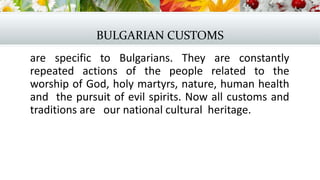
BULGARIAN CUSTOMS
are specific to Bulgarians. They are constantly

repeated actions of the people related to the
worship of God, holy martyrs, nature, human health
and the pursuit of evil spirits. Now all customs and
traditions are our national cultural heritage.
SPRING
HOLIDAYS
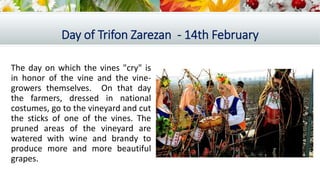
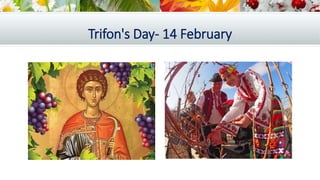
Day of Trifon Zarezan - 14th February
The day on which the vines "cry" is
in honor of the vine and the vine-
growers themselves. On that day
the farmers, dressed in national
costumes, go to the vineyard and cut
the sticks of one of the vines. The
pruned areas of the vineyard are
watered with wine and brandy to
produce more and more beautiful
grapes.
Trifon's Day- 14 February
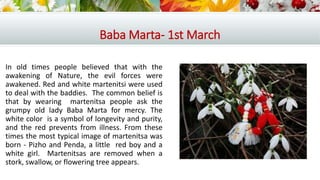
Baba Marta- 1st March
In old times people believed that with the
awakening of Nature, the evil forces were
awakened. Red and white martenitsi were used
to deal with the baddies. The common belief is
that by wearing martenitsa people ask the
grumpy old lady Baba Marta for mercy. The
white color is a symbol of longevity and purity,
and the red prevents from illness. From these
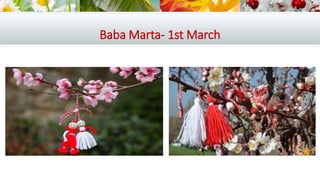
times the most typical image of martenitsa was
born - Pizho and Penda, a little red boy and a
white girl. Martenitsas are removed when a
stork, swallow, or flowering tree appears.
Baba Marta- 1st March
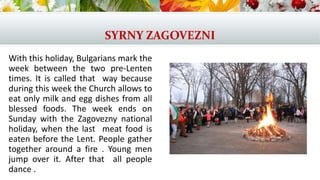
SYRNY ZAGOVEZNI
With this holiday, Bulgarians mark the
week between the two pre-Lenten
times. It is called that way because
during this week the Church allows to
eat only milk and egg dishes from all
blessed foods. The week ends on
Sunday with the Zagovezny national
holiday, when the last meat food is
eaten before the Lent. People gather
together around a fire . Young men
jump over it. After that all people
dance .
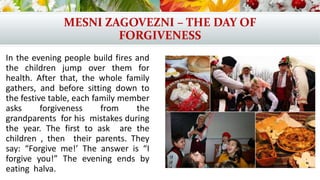
MESNI ZAGOVEZNI – THE DAY OF
FORGIVENESS
In the evening people build fires and
the children jump over them for
health. After that, the whole family
gathers, and before sitting down to
the festive table, each family member
asks forgiveness from the
grandparents for his mistakes during
the year. The first to ask are the
children , then their parents. They
say: “Forgive me!’ The answer is “I
forgive you!” The evening ends by
eating halva.
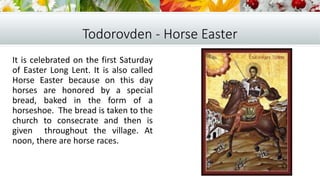
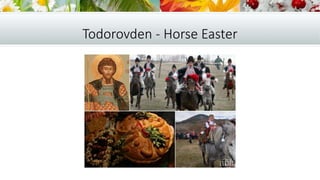
Todorovden - Horse Easter
It is celebrated on the first Saturday
of Easter Long Lent. It is also called
Horse Easter because on this day
horses are honored by a special
bread, baked in the form of a
horseshoe. The bread is taken to the
church to consecrate and then is
given throughout the village. At
noon, there are horse races.
Todorovden - Horse Easter
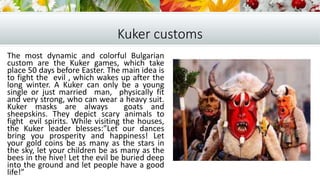
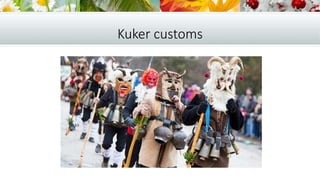
Kuker customs
The most dynamic and colorful Bulgarian
custom are the Kuker games, which take
place 50 days before Easter. The main idea is
to fight the evil , which wakes up after the
long winter. A Kuker can only be a young
single or just married man, physically fit
and very strong, who can wear a heavy suit.
Kuker masks are always goats and
sheepskins. They depict scary animals to
fight evil spirits. While visiting the houses,
the Kuker leader blesses:”Let our dances
bring you prosperity and happiness! Let
your gold coins be as many as the stars in
the sky, let your children be as many as the
bees in the hive! Let the evil be buried deep
into the ground and let people have a good
life!”
Kuker customs
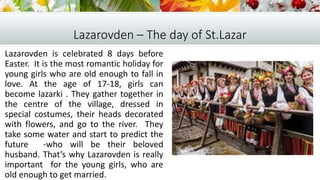
Lazarovden – The day of St.Lazar
Lazarovden is celebrated 8 days before
Easter. It is the most romantic holiday for
young girls who are old enough to fall in
love. At the age of 17-18, girls can
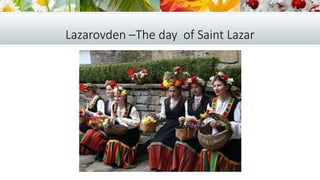
become lazarki . They gather together in
the centre of the village, dressed in
special costumes, their heads decorated
with flowers, and go to the river. They
take some water and start to predict the
future -who will be their beloved
husband. That’s why Lazarovden is really
important for the young girls, who are
old enough to get married.
Lazarovden –The day of Saint Lazar
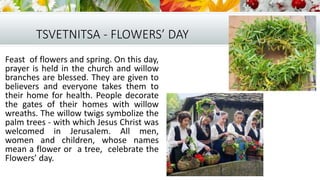
TSVETNITSA - FLOWERS’ DAY
Feast of flowers and spring. On this day,
prayer is held in the church and willow
branches are blessed. They are given to
believers and everyone takes them to
their home for health. People decorate
the gates of their homes with willow
wreaths. The willow twigs symbolize the
palm trees - with which Jesus Christ was
welcomed in Jerusalem. All men,
women and children, whose names
mean a flower or a tree, celebrate the
Flowers’ day.
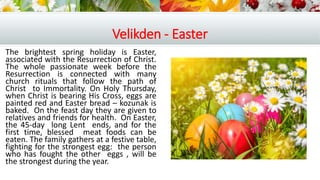
Velikden - Easter
The brightest spring holiday is Easter,
associated with the Resurrection of Christ.
The whole passionate week before the
Resurrection is connected with many
church rituals that follow the path of
Christ to Immortality. On Holy Thursday,
when Christ is bearing His Cross, eggs are
painted red and Easter bread – kozunak is
baked. On the feast day they are given to
relatives and friends for health. On Easter,
the 45-day long Lent ends, and for the
first time, blessed meat foods can be
eaten. The family gathers at a festive table,
fighting for the strongest egg: the person
who has fought the other eggs , will be
the strongest during the year.
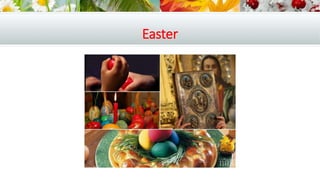
Easter
Gergyovden - Saint George's Day
On this feast, a lamb is sacrificed to the
sacrifice of St. George, the patron saint of
sheep and shepherds. St. George's special
ring-shaped buns are also baked - one for
the beehive, one for the table and the
other which is given to relatives for
health. The buns are richly decorated
with symbols. In the morning before the ritual is performed, the
home owner goes to the fields and buries a red
egg kept since Easter. He cuts off a green wheat-
ear, which he takes home to protect the fields
from hailstorms, after which the sheep are fed
with grass and the doors of the houses are
decorated with geranium.
SUMMER
HOLIDAYS
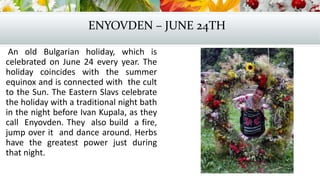
ENYOVDEN – JUNE 24TH
An old Bulgarian holiday, which is
celebrated on June 24 every year. The
holiday coincides with the summer
equinox and is connected with the cult
to the Sun. The Eastern Slavs celebrate
the holiday with a traditional night bath
in the night before Ivan Kupala, as they
call Enyovden. They also build a fire,
jump over it and dance around. Herbs
have the greatest power just during
that night.
AUTUMN
HOLIDAYS
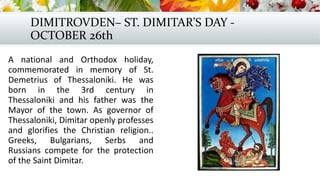
DIMITROVDEN– ST. DIMITAR’S DAY -
OCTOBER 26th
A national and Orthodox holiday,
commemorated in memory of St.
Demetrius of Thessaloniki. He was
born in the 3rd century in
Thessaloniki and his father was the
Mayor of the town. As governor of
Thessaloniki, Dimitar openly professes
and glorifies the Christian religion..
Greeks, Bulgarians, Serbs and
Russians compete for the protection
of the Saint Dimitar.
WINTER
HOLIDAYS
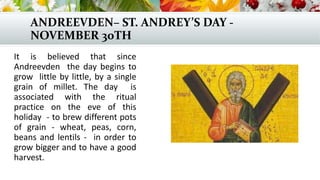
ANDREEVDEN– ST. ANDREY’S DAY -
NOVEMBER 30TH
It is believed that since
Andreevden the day begins to
grow little by little, by a single
grain of millet. The day is
associated with the ritual
practice on the eve of this
holiday - to brew different pots
of grain - wheat, peas, corn,
beans and lentils - in order to
grow bigger and to have a good
harvest.
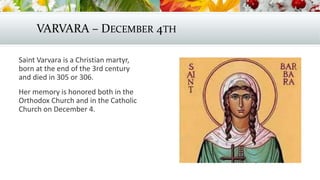
VARVARA – DECEMBER 4TH
Saint Varvara is a Christian martyr,
born at the end of the 3rd century
and died in 305 or 306.
Her memory is honored both in the
Orthodox Church and in the Catholic
Church on December 4.
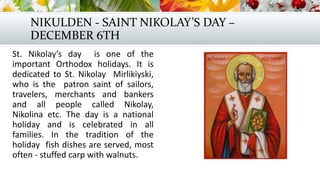
NIKULDEN - SAINT NIKOLAY’S DAY –
DECEMBER 6TH
St. Nikolay’s day is one of the
important Orthodox holidays. It is
dedicated to St. Nikolay Mirlikiyski,
who is the patron saint of sailors,
travelers, merchants and bankers
and all people called Nikolay,
Nikolina etc. The day is a national
holiday and is celebrated in all
families. In the tradition of the
holiday fish dishes are served, most
often - stuffed carp with walnuts.
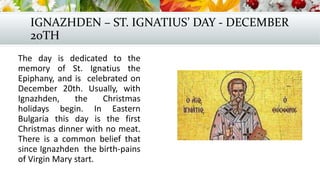
IGNAZHDEN – ST. IGNATIUS’ DAY - DECEMBER
20TH
The day is dedicated to the
memory of St. Ignatius the
Epiphany, and is celebrated on
December 20th. Usually, with
Ignazhden, the Christmas
holidays begin. In Eastern
Bulgaria this day is the first
Christmas dinner with no meat.
There is a common belief that
since Ignazhden the birth-pains
of Virgin Mary start.
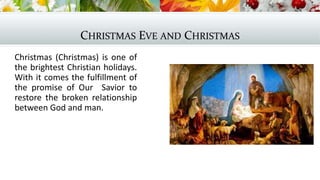
CHRISTMAS EVE AND CHRISTMAS
Christmas (Christmas) is one of
the brightest Christian holidays.
With it comes the fulfillment of
the promise of Our Savior to
restore the broken relationship
between God and man.
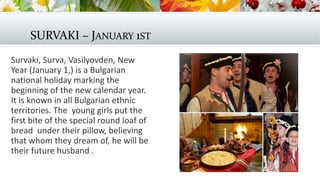
SURVAKI – JANUARY 1ST
Survaki, Surva, Vasilyovden, New
Year (January 1,) is a Bulgarian
national holiday marking the
beginning of the new calendar year.
It is known in all Bulgarian ethnic
territories. The young girls put the
first bite of the special round loaf of
bread under their pillow, believing
that whom they dream of, he will be
their future husband .
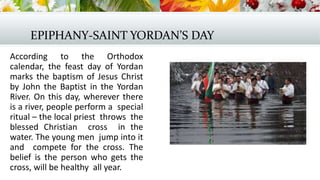
EPIPHANY-SAINT YORDAN’S DAY
According to the Orthodox
calendar, the feast day of Yordan
marks the baptism of Jesus Christ
by John the Baptist in the Yordan
River. On this day, wherever there
is a river, people perform a special
ritual – the local priest throws the
blessed Christian cross in the
water. The young men jump into it
and compete for the cross. The
belief is the person who gets the
cross, will be healthy all year.
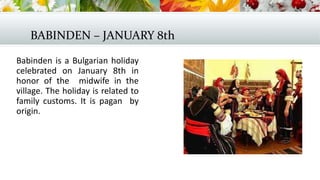
BABINDEN – JANUARY 8th
Babinden is a Bulgarian holiday
celebrated on January 8th in
honor of the midwife in the
village. The holiday is related to
family customs. It is pagan by
origin.
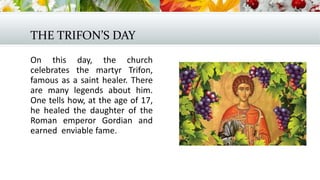
THE TRIFON’S DAY
On this day, the church
celebrates the martyr Trifon,
famous as a saint healer. There
are many legends about him.
One tells how, at the age of 17,
he healed the daughter of the
Roman emperor Gordian and
earned enviable fame.

1.bulgarian customs en

  • 1.
  • 2.
    BULGARIAN CUSTOMS are specificto Bulgarians. They are constantly repeated actions of the people related to the worship of God, holy martyrs, nature, human health and the pursuit of evil spirits. Now all customs and traditions are our national cultural heritage.
  • 3.
  • 4.
    Day of TrifonZarezan - 14th February The day on which the vines "cry" is in honor of the vine and the vine- growers themselves. On that day the farmers, dressed in national costumes, go to the vineyard and cut the sticks of one of the vines. The pruned areas of the vineyard are watered with wine and brandy to produce more and more beautiful grapes.
  • 5.
  • 6.
    Baba Marta- 1stMarch In old times people believed that with the awakening of Nature, the evil forces were awakened. Red and white martenitsi were used to deal with the baddies. The common belief is that by wearing martenitsa people ask the grumpy old lady Baba Marta for mercy. The white color is a symbol of longevity and purity, and the red prevents from illness. From these times the most typical image of martenitsa was born - Pizho and Penda, a little red boy and a white girl. Martenitsas are removed when a stork, swallow, or flowering tree appears.
  • 7.
  • 8.
    SYRNY ZAGOVEZNI With thisholiday, Bulgarians mark the week between the two pre-Lenten times. It is called that way because during this week the Church allows to eat only milk and egg dishes from all blessed foods. The week ends on Sunday with the Zagovezny national holiday, when the last meat food is eaten before the Lent. People gather together around a fire . Young men jump over it. After that all people dance .
  • 9.
    MESNI ZAGOVEZNI –THE DAY OF FORGIVENESS In the evening people build fires and the children jump over them for health. After that, the whole family gathers, and before sitting down to the festive table, each family member asks forgiveness from the grandparents for his mistakes during the year. The first to ask are the children , then their parents. They say: “Forgive me!’ The answer is “I forgive you!” The evening ends by eating halva.
  • 10.
    Todorovden - HorseEaster It is celebrated on the first Saturday of Easter Long Lent. It is also called Horse Easter because on this day horses are honored by a special bread, baked in the form of a horseshoe. The bread is taken to the church to consecrate and then is given throughout the village. At noon, there are horse races.
  • 11.
  • 12.
    Kuker customs The mostdynamic and colorful Bulgarian custom are the Kuker games, which take place 50 days before Easter. The main idea is to fight the evil , which wakes up after the long winter. A Kuker can only be a young single or just married man, physically fit and very strong, who can wear a heavy suit. Kuker masks are always goats and sheepskins. They depict scary animals to fight evil spirits. While visiting the houses, the Kuker leader blesses:”Let our dances bring you prosperity and happiness! Let your gold coins be as many as the stars in the sky, let your children be as many as the bees in the hive! Let the evil be buried deep into the ground and let people have a good life!”
  • 13.
  • 14.
    Lazarovden – Theday of St.Lazar Lazarovden is celebrated 8 days before Easter. It is the most romantic holiday for young girls who are old enough to fall in love. At the age of 17-18, girls can become lazarki . They gather together in the centre of the village, dressed in special costumes, their heads decorated with flowers, and go to the river. They take some water and start to predict the future -who will be their beloved husband. That’s why Lazarovden is really important for the young girls, who are old enough to get married.
  • 15.
    Lazarovden –The dayof Saint Lazar
  • 16.
    TSVETNITSA - FLOWERS’DAY Feast of flowers and spring. On this day, prayer is held in the church and willow branches are blessed. They are given to believers and everyone takes them to their home for health. People decorate the gates of their homes with willow wreaths. The willow twigs symbolize the palm trees - with which Jesus Christ was welcomed in Jerusalem. All men, women and children, whose names mean a flower or a tree, celebrate the Flowers’ day.
  • 17.
    Velikden - Easter Thebrightest spring holiday is Easter, associated with the Resurrection of Christ. The whole passionate week before the Resurrection is connected with many church rituals that follow the path of Christ to Immortality. On Holy Thursday, when Christ is bearing His Cross, eggs are painted red and Easter bread – kozunak is baked. On the feast day they are given to relatives and friends for health. On Easter, the 45-day long Lent ends, and for the first time, blessed meat foods can be eaten. The family gathers at a festive table, fighting for the strongest egg: the person who has fought the other eggs , will be the strongest during the year.
  • 18.
  • 19.
    Gergyovden - SaintGeorge's Day On this feast, a lamb is sacrificed to the sacrifice of St. George, the patron saint of sheep and shepherds. St. George's special ring-shaped buns are also baked - one for the beehive, one for the table and the other which is given to relatives for health. The buns are richly decorated with symbols. In the morning before the ritual is performed, the home owner goes to the fields and buries a red egg kept since Easter. He cuts off a green wheat- ear, which he takes home to protect the fields from hailstorms, after which the sheep are fed with grass and the doors of the houses are decorated with geranium.
  • 20.
  • 21.
    ENYOVDEN – JUNE24TH An old Bulgarian holiday, which is celebrated on June 24 every year. The holiday coincides with the summer equinox and is connected with the cult to the Sun. The Eastern Slavs celebrate the holiday with a traditional night bath in the night before Ivan Kupala, as they call Enyovden. They also build a fire, jump over it and dance around. Herbs have the greatest power just during that night.
  • 22.
  • 23.
    DIMITROVDEN– ST. DIMITAR’SDAY - OCTOBER 26th A national and Orthodox holiday, commemorated in memory of St. Demetrius of Thessaloniki. He was born in the 3rd century in Thessaloniki and his father was the Mayor of the town. As governor of Thessaloniki, Dimitar openly professes and glorifies the Christian religion.. Greeks, Bulgarians, Serbs and Russians compete for the protection of the Saint Dimitar.
  • 24.
  • 25.
    ANDREEVDEN– ST. ANDREY’SDAY - NOVEMBER 30TH It is believed that since Andreevden the day begins to grow little by little, by a single grain of millet. The day is associated with the ritual practice on the eve of this holiday - to brew different pots of grain - wheat, peas, corn, beans and lentils - in order to grow bigger and to have a good harvest.
  • 26.
    VARVARA – DECEMBER4TH Saint Varvara is a Christian martyr, born at the end of the 3rd century and died in 305 or 306. Her memory is honored both in the Orthodox Church and in the Catholic Church on December 4.
  • 27.
    NIKULDEN - SAINTNIKOLAY’S DAY – DECEMBER 6TH St. Nikolay’s day is one of the important Orthodox holidays. It is dedicated to St. Nikolay Mirlikiyski, who is the patron saint of sailors, travelers, merchants and bankers and all people called Nikolay, Nikolina etc. The day is a national holiday and is celebrated in all families. In the tradition of the holiday fish dishes are served, most often - stuffed carp with walnuts.
  • 28.
    IGNAZHDEN – ST.IGNATIUS’ DAY - DECEMBER 20TH The day is dedicated to the memory of St. Ignatius the Epiphany, and is celebrated on December 20th. Usually, with Ignazhden, the Christmas holidays begin. In Eastern Bulgaria this day is the first Christmas dinner with no meat. There is a common belief that since Ignazhden the birth-pains of Virgin Mary start.
  • 29.
    CHRISTMAS EVE ANDCHRISTMAS Christmas (Christmas) is one of the brightest Christian holidays. With it comes the fulfillment of the promise of Our Savior to restore the broken relationship between God and man.
  • 30.
    SURVAKI – JANUARY1ST Survaki, Surva, Vasilyovden, New Year (January 1,) is a Bulgarian national holiday marking the beginning of the new calendar year. It is known in all Bulgarian ethnic territories. The young girls put the first bite of the special round loaf of bread under their pillow, believing that whom they dream of, he will be their future husband .
  • 31.
    EPIPHANY-SAINT YORDAN’S DAY Accordingto the Orthodox calendar, the feast day of Yordan marks the baptism of Jesus Christ by John the Baptist in the Yordan River. On this day, wherever there is a river, people perform a special ritual – the local priest throws the blessed Christian cross in the water. The young men jump into it and compete for the cross. The belief is the person who gets the cross, will be healthy all year.
  • 32.
    BABINDEN – JANUARY8th Babinden is a Bulgarian holiday celebrated on January 8th in honor of the midwife in the village. The holiday is related to family customs. It is pagan by origin.
  • 33.
    THE TRIFON’S DAY Onthis day, the church celebrates the martyr Trifon, famous as a saint healer. There are many legends about him. One tells how, at the age of 17, he healed the daughter of the Roman emperor Gordian and earned enviable fame.