Technology
Designs aspects of PM machines
Henk Polinder


                                 Challenge the future   1
Structure

1   Permanent magnets
2   Classification of PM machines
3   What is different from other types of machines
4   Calculation methods
5   Issues
6   Conclusions


                                                     Challenge the future   2
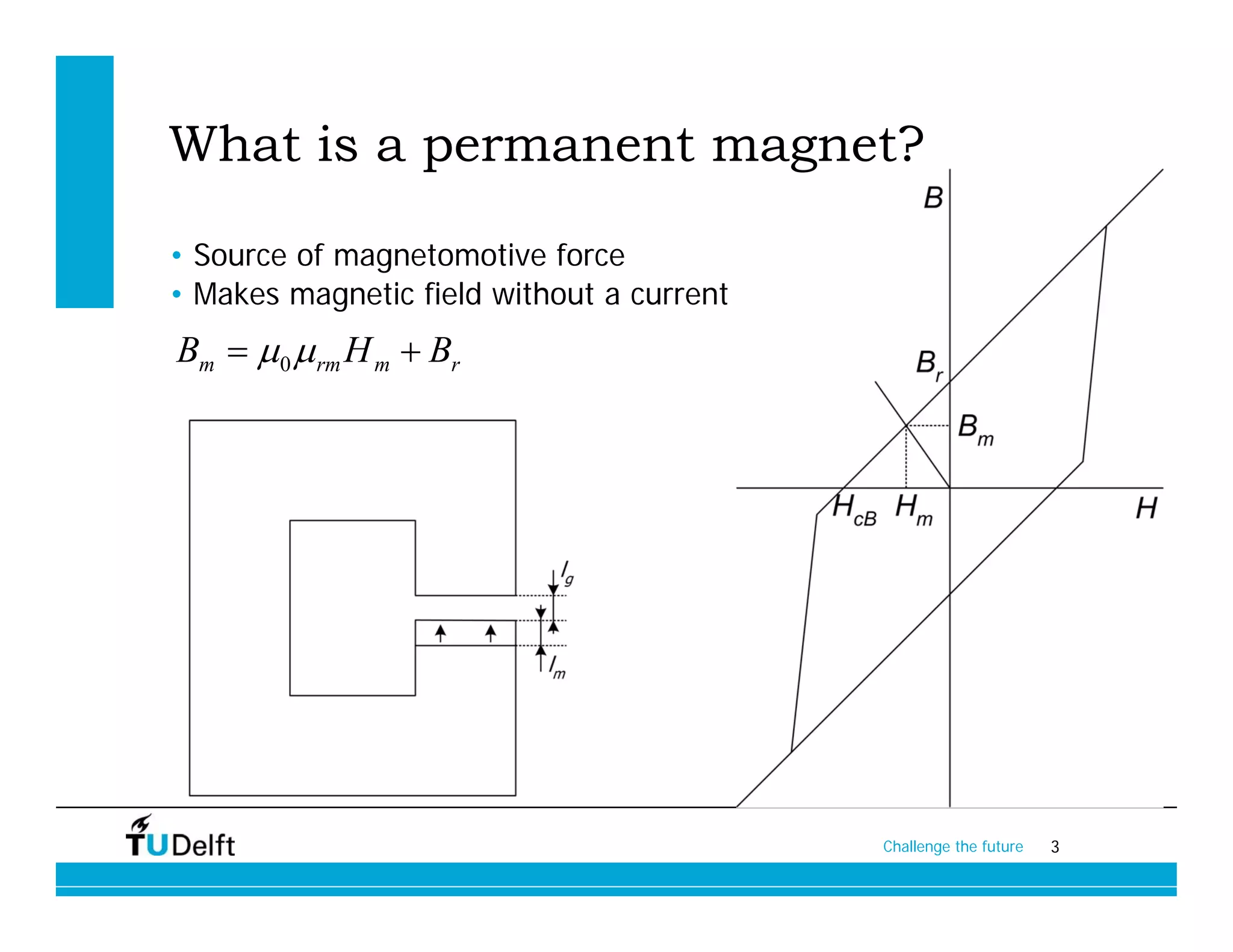
What is a permanent magnet?

• Source of magnetomotive force
• Makes magnetic field without a current
Bm   0  rm H m  Br


                                           Challenge the future   3
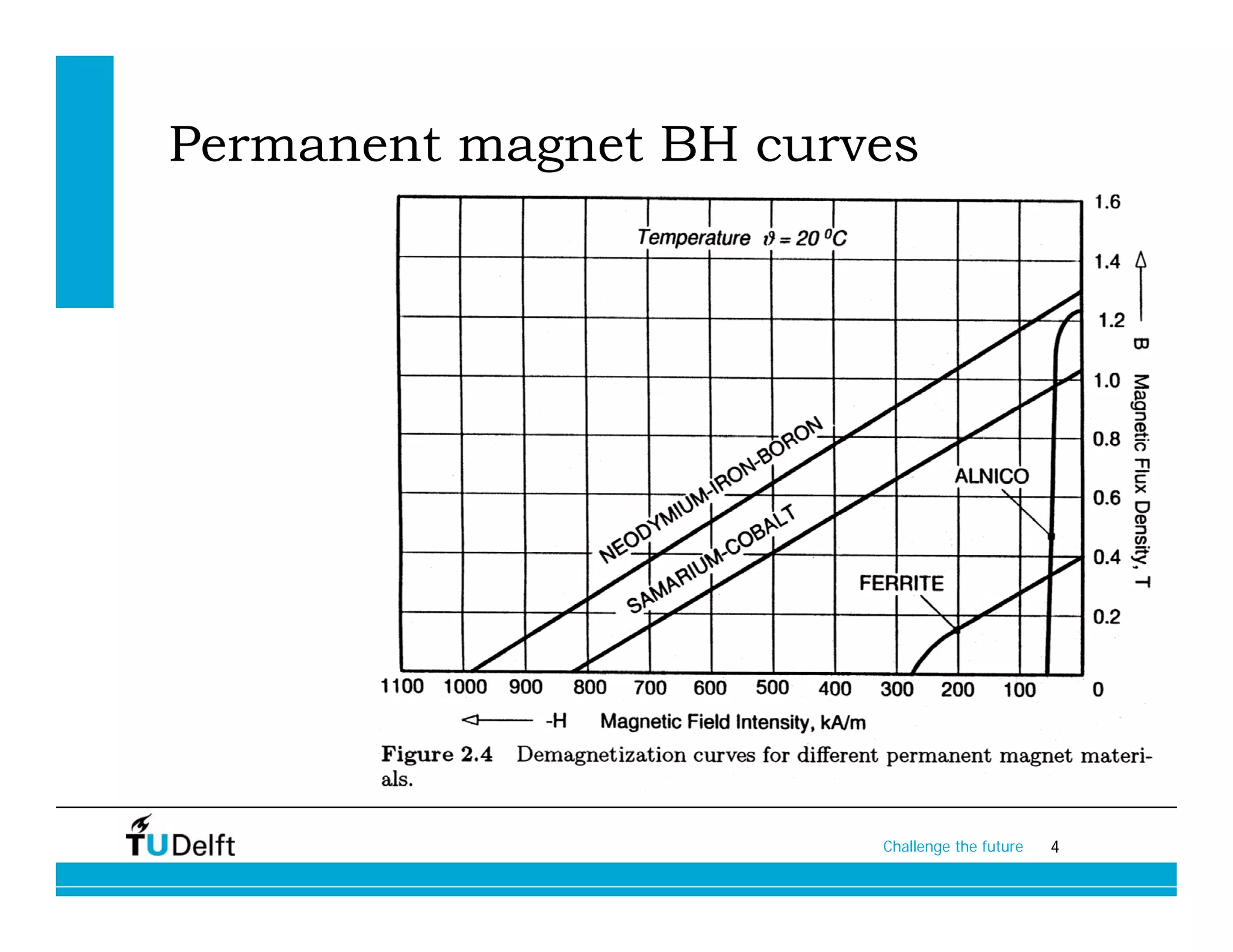
Permanent magnet BH curves


                        Challenge the future   4
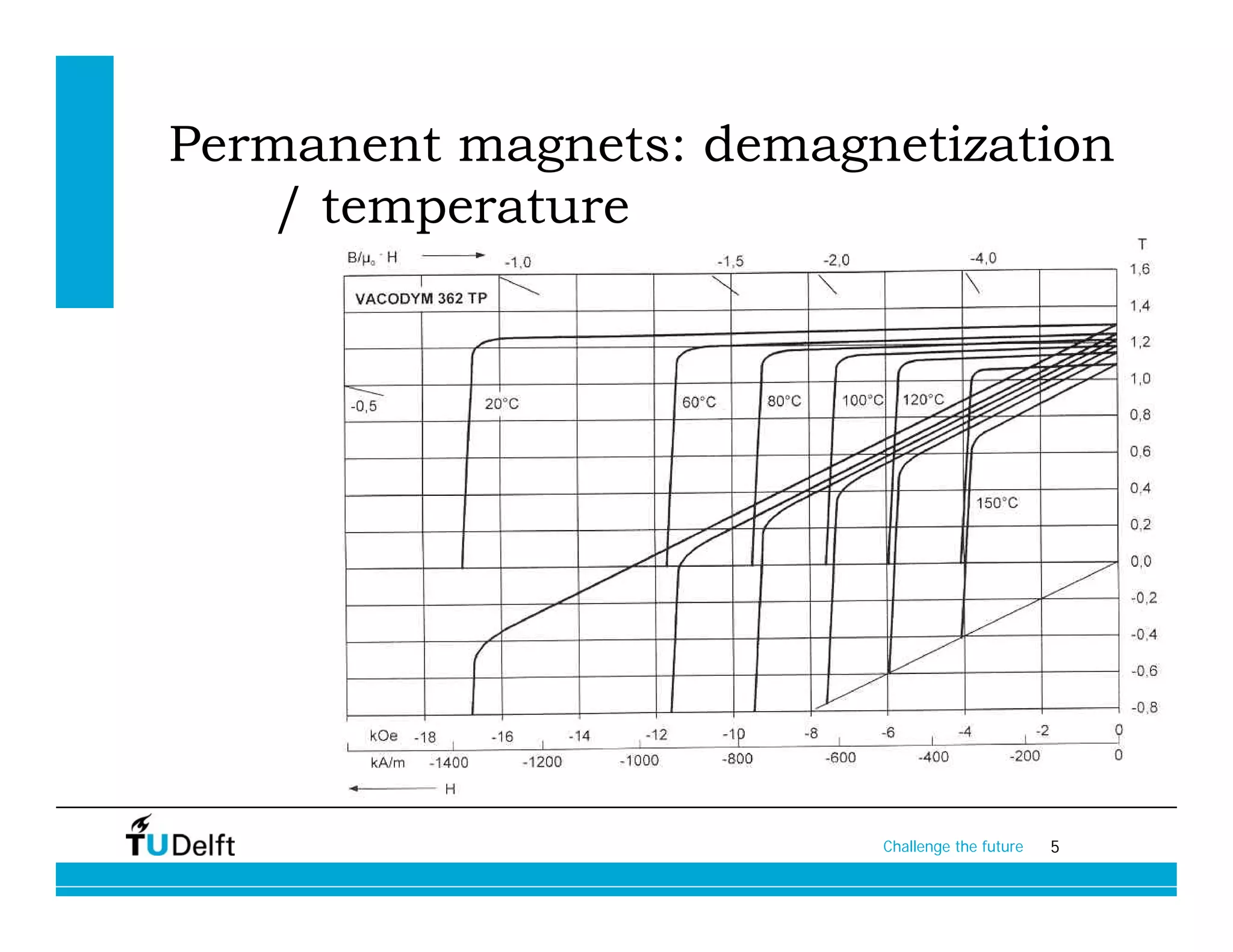
Permanent magnets: demagnetization
   / temperature


                         Challenge the future   5
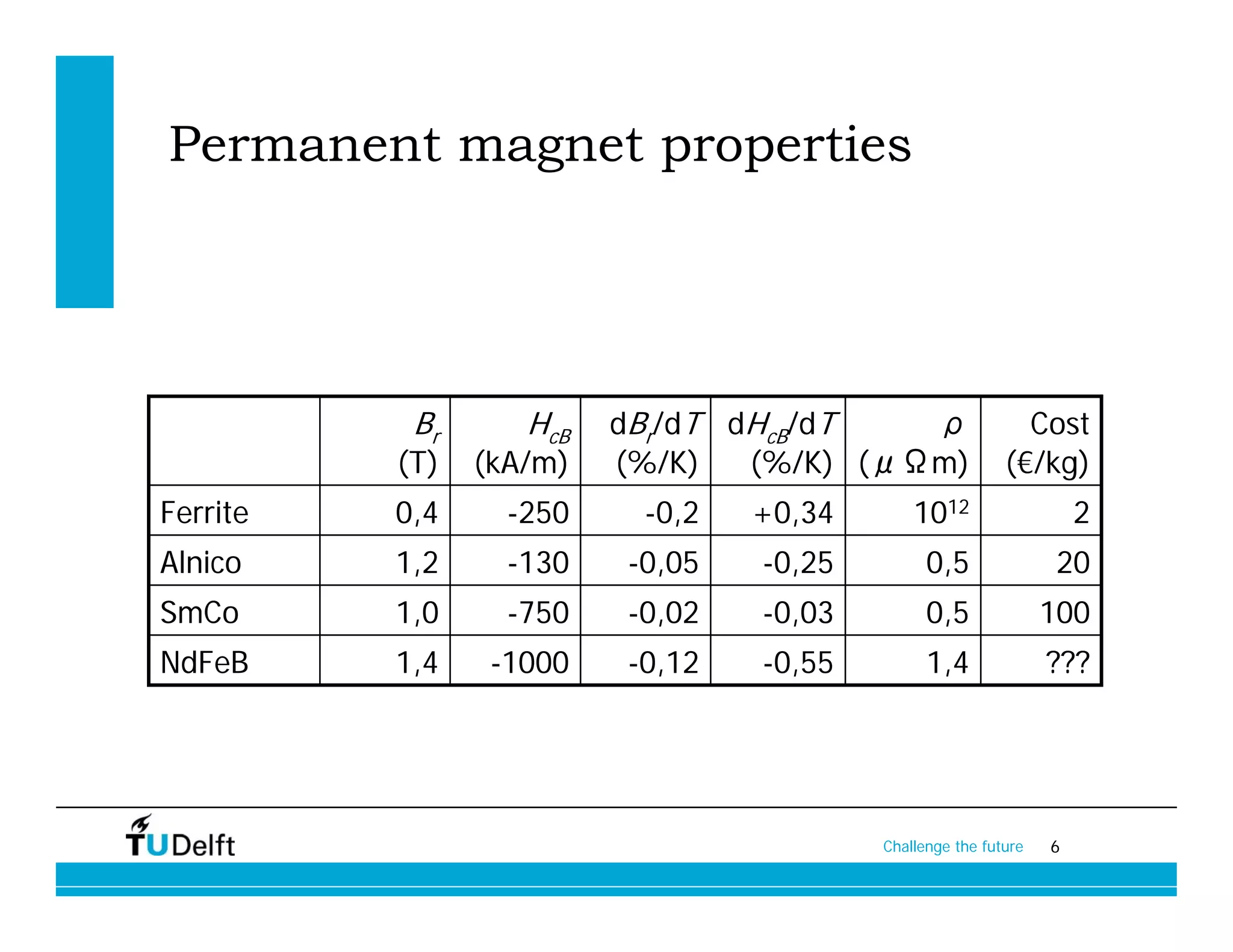
Permanent magnet properties


           Br      HcB   dBr/dT dHcB/dT   ρ                 Cost
          (T)   (kA/m)   (%/K)   (%/K) (μΩm)              (€/kg)
Ferrite   0,4     -250    -0,2   +0,34       1012                   2
Alnico    1,2     -130   -0,05   -0,25         0,5              20
SmCo      1,0     -750   -0,02   -0,03         0,5              100
NdFeB     1,4    -1000   -0,12   -0,55         1,4              ???


                                         Challenge the future   6
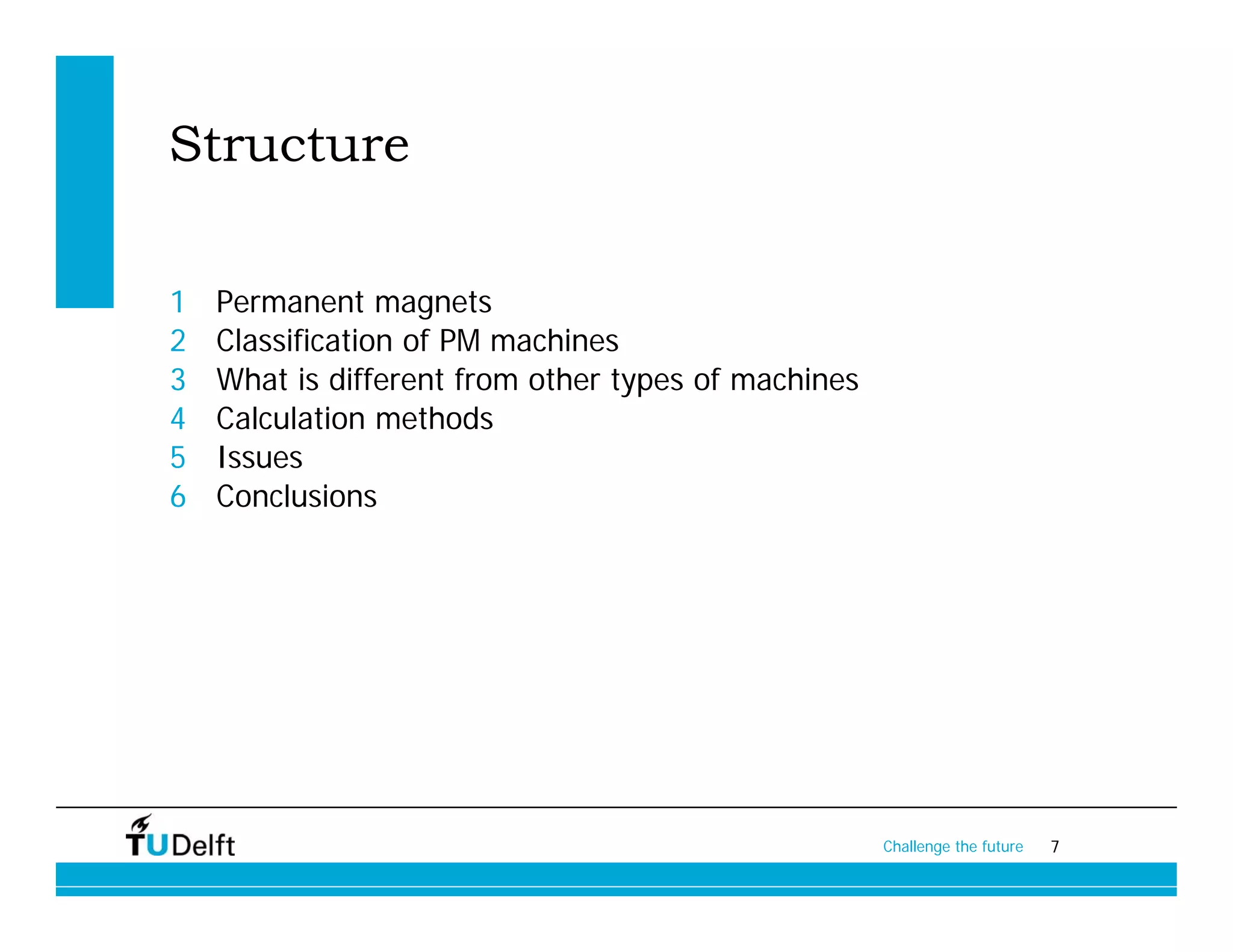
Structure

1   Permanent magnets
2   Classification of PM machines
3   What is different from other types of machines
4   Calculation methods
5   Issues
6   Conclusions


                                                     Challenge the future   7
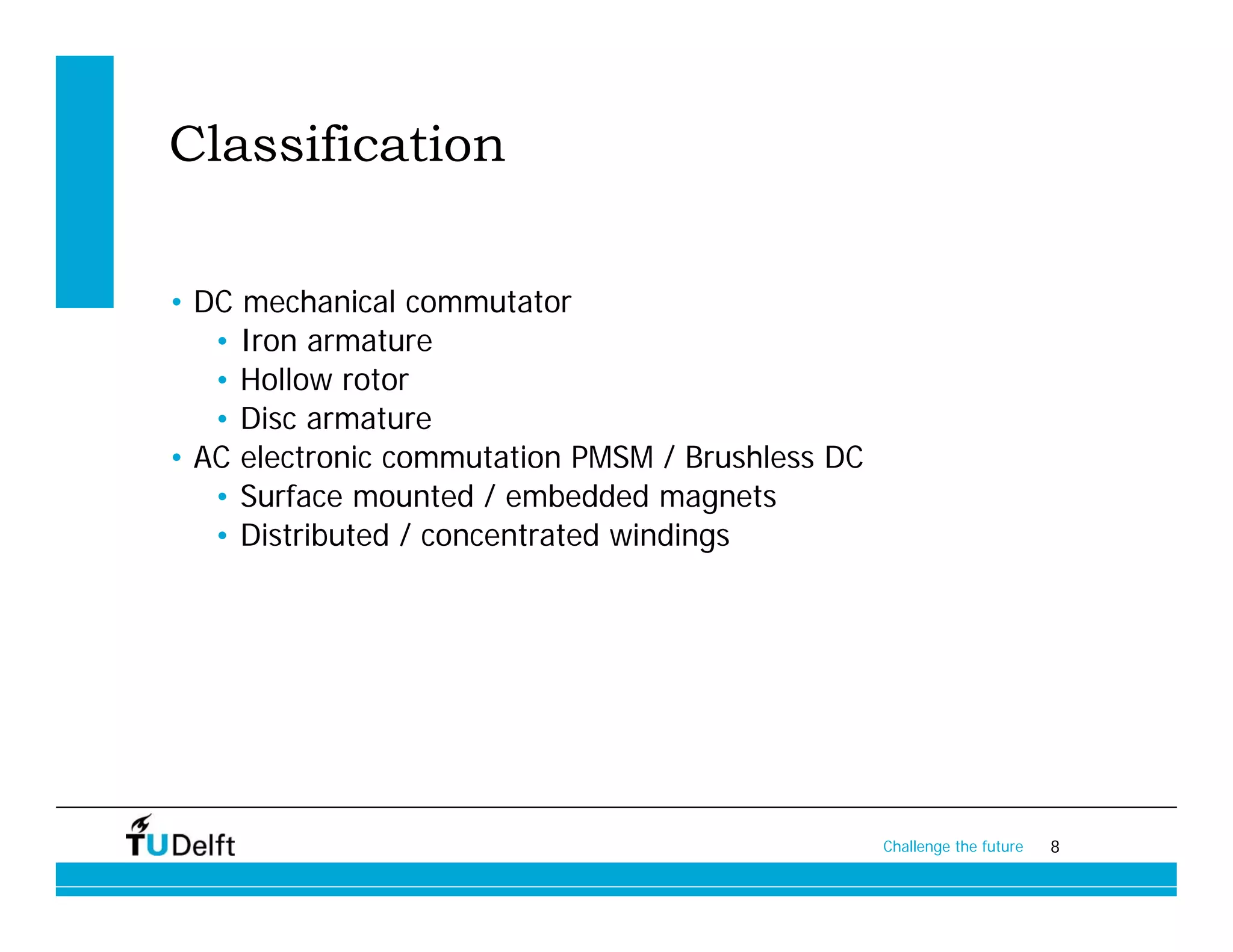
Classification

• DC mechanical commutator
   • Iron armature
   • Hollow rotor
   • Disc armature
• AC electronic commutation PMSM / Brushless DC
   • Surface mounted / embedded magnets
   • Distributed / concentrated windings


                                                  Challenge the future   8
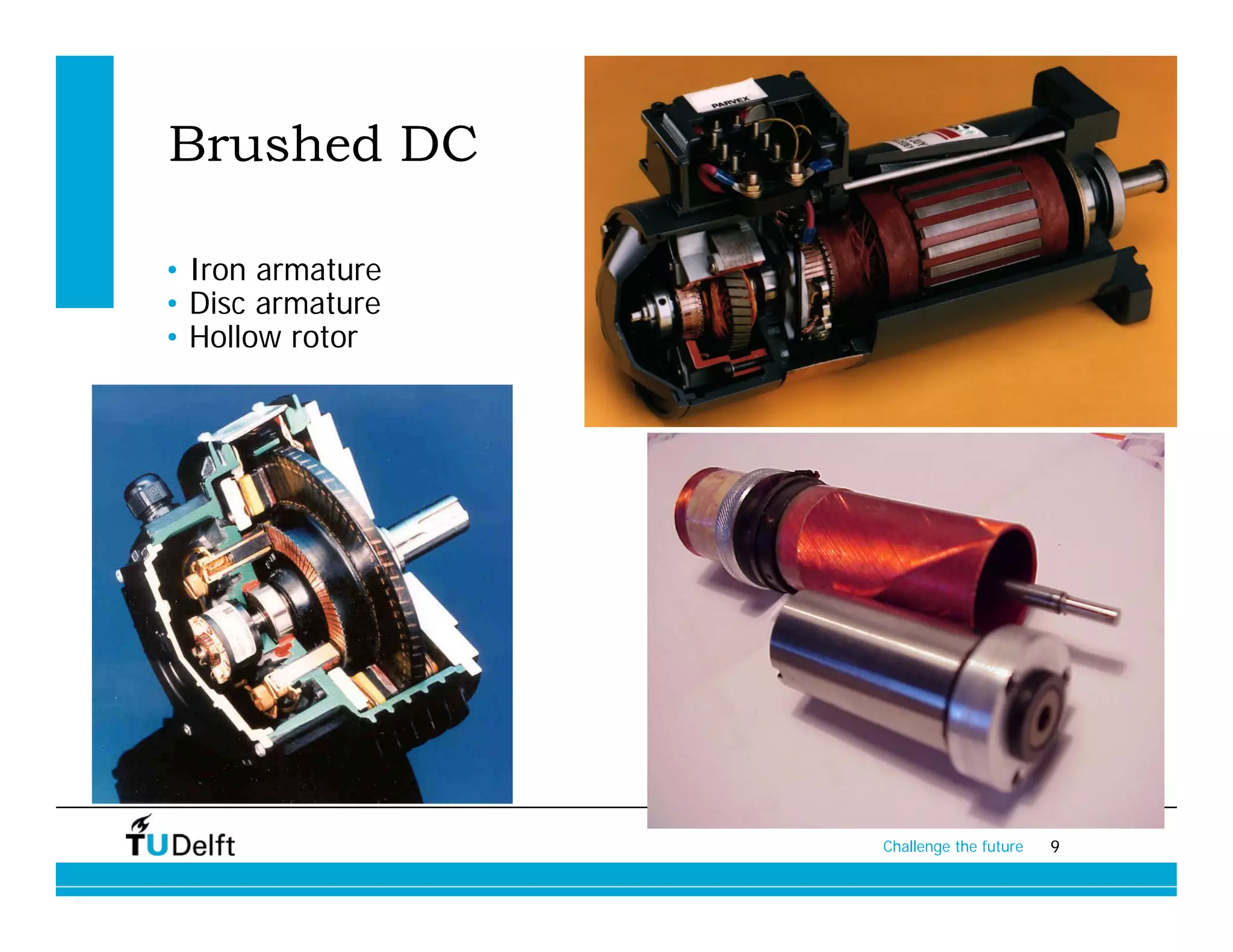
Brushed DC

• Iron armature
• Disc armature
• Hollow rotor


                  Challenge the future   9
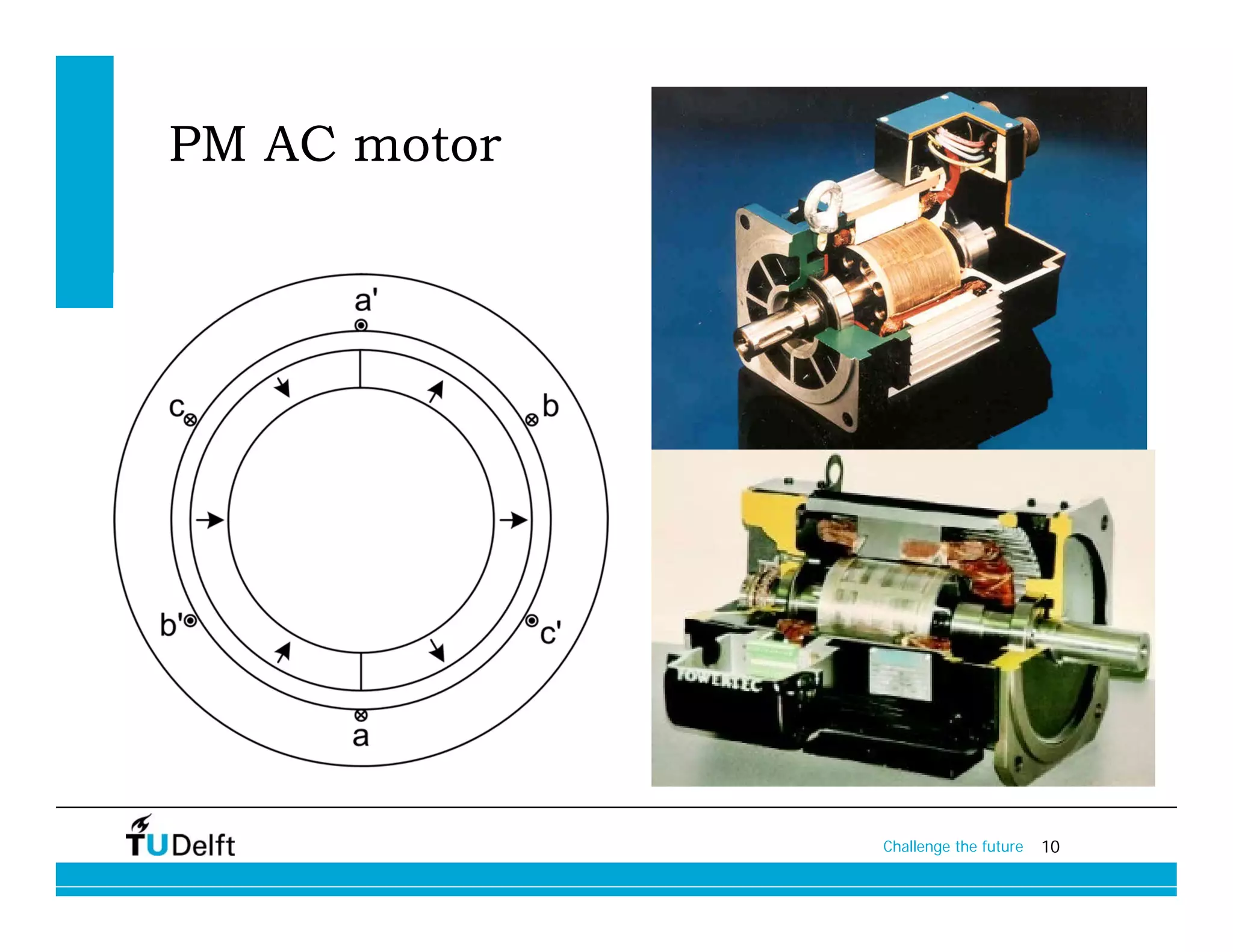
PM AC motor


              Challenge the future   10
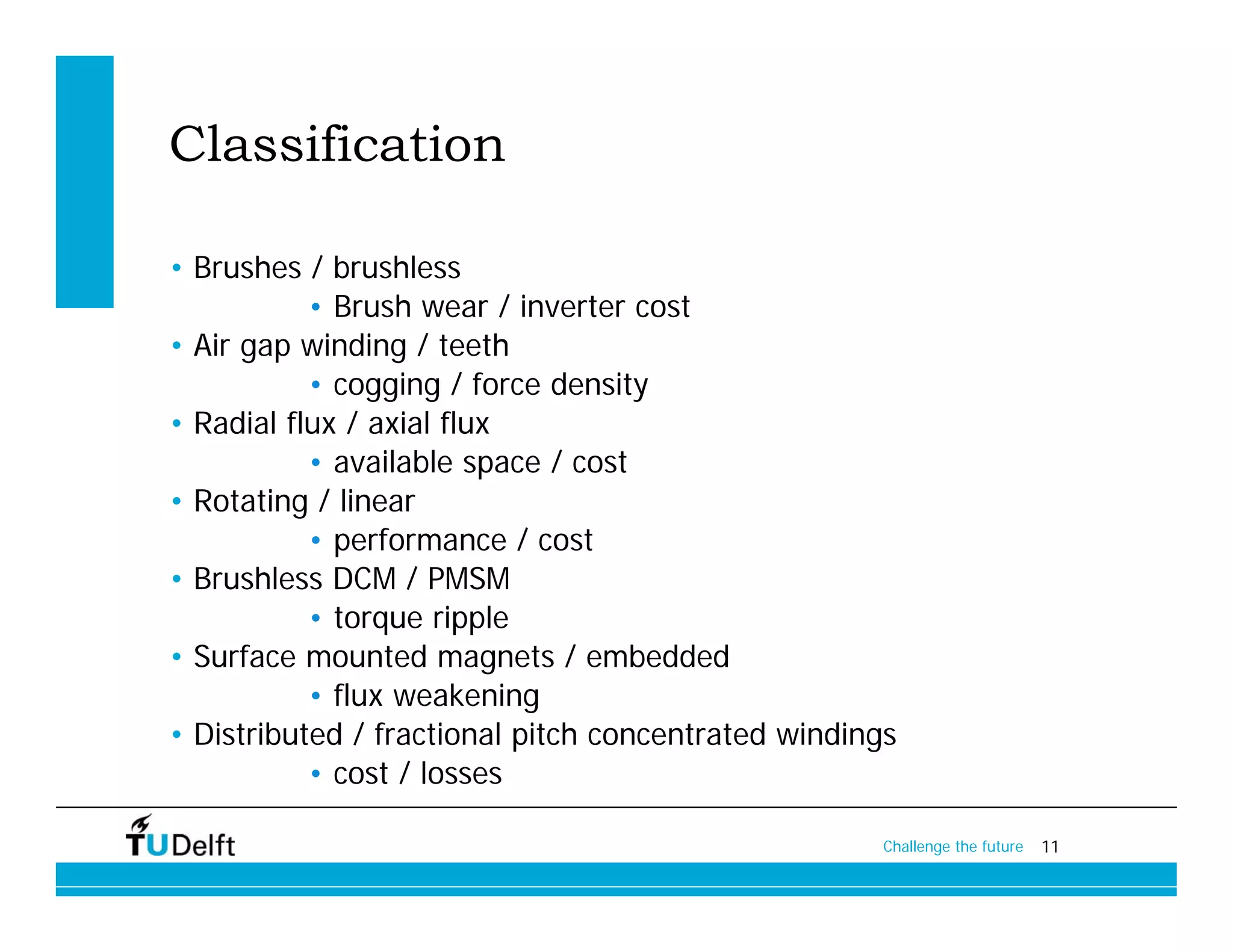
Classification

• Brushes / brushless
           • Brush wear / inverter cost
• Air gap winding / teeth
           • cogging / force density
• Radial flux / axial flux
           • available space / cost
• Rotating / linear
           • performance / cost
• Brushless DCM / PMSM
           • torque ripple
• Surface mounted magnets / embedded
           • flux weakening
• Distributed / fractional pitch concentrated windings
           • cost / losses

                                                    Challenge the future   11
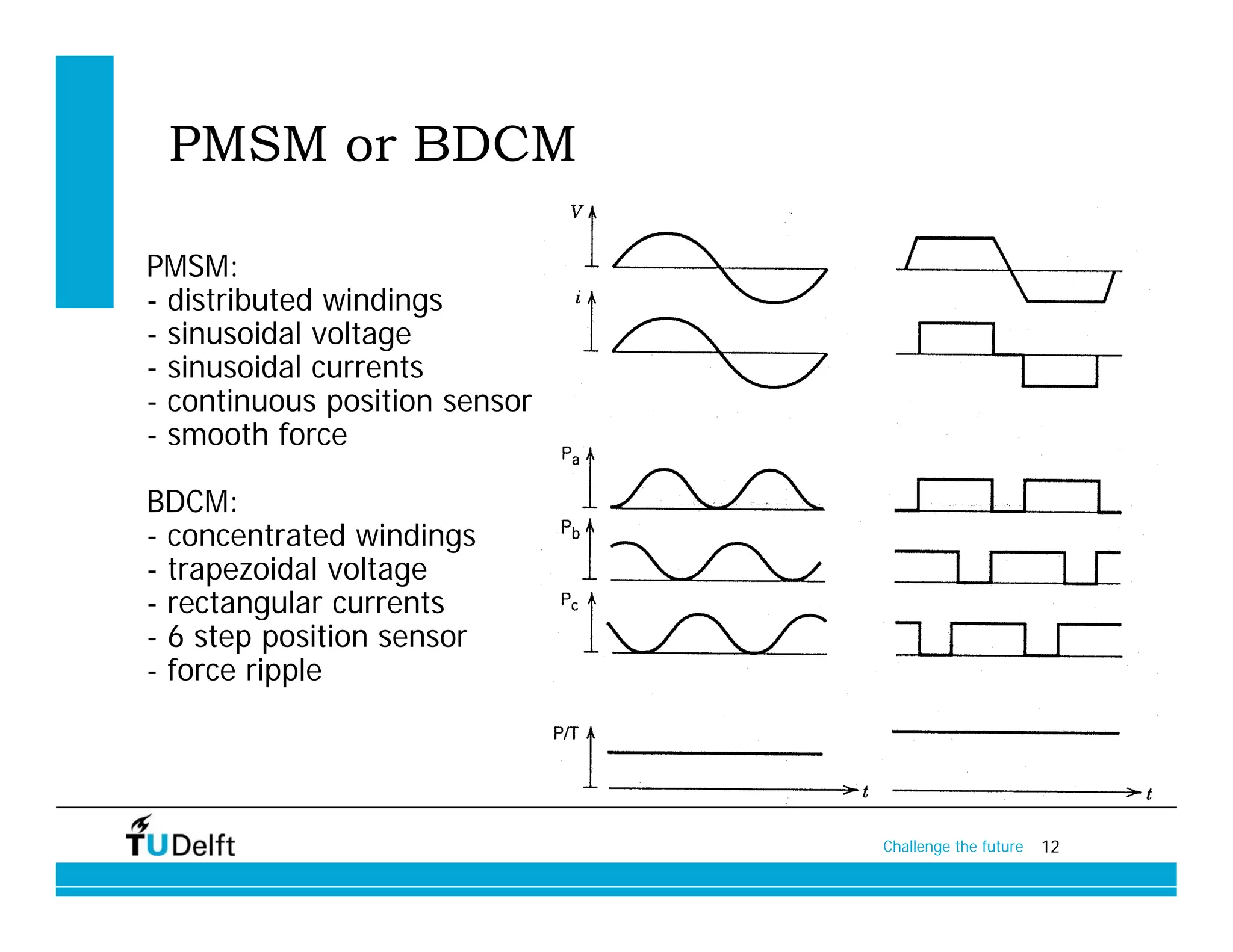
PMSM or BDCM

PMSM:
- distributed windings
- sinusoidal voltage
- sinusoidal currents
- continuous position sensor
- smooth force

BDCM:
- concentrated windings
- trapezoidal voltage
- rectangular currents
- 6 step position sensor
- force ripple


                               Challenge the future   12
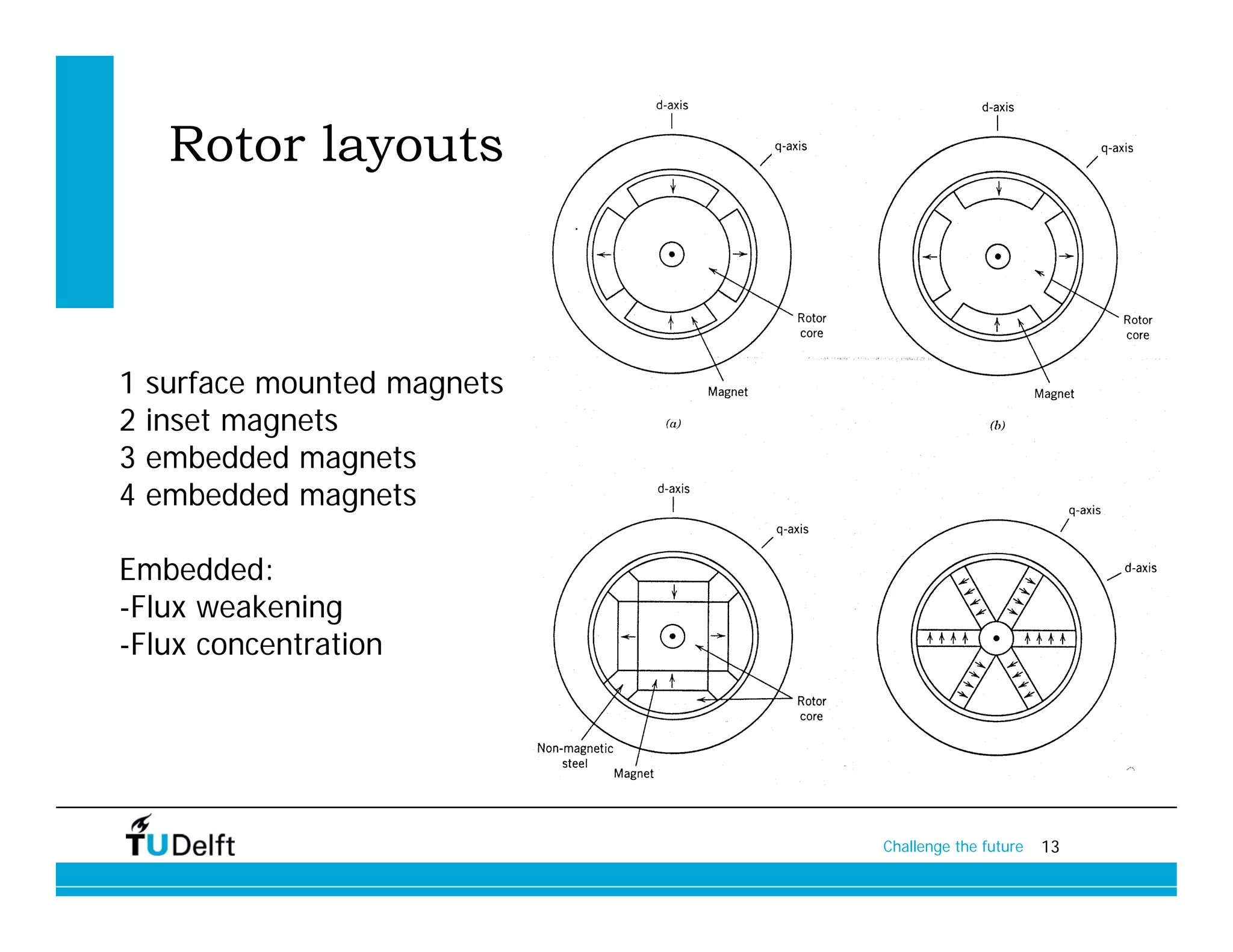
Rotor layouts


1   surface mounted magnets
2   inset magnets
3   embedded magnets
4   embedded magnets

Embedded:
-Flux weakening
-Flux concentration


                              Challenge the future   13
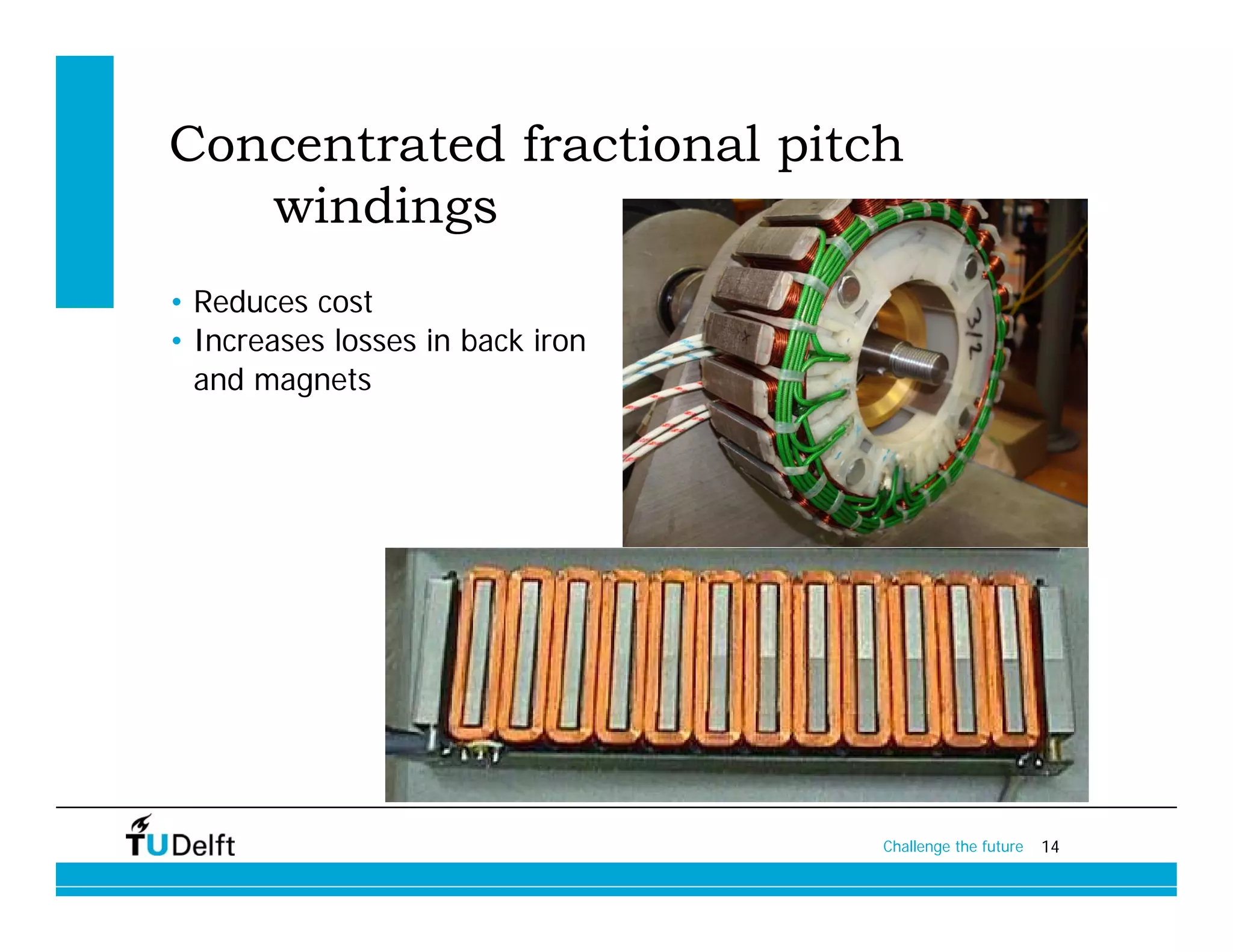
Concentrated fractional pitch
   windings
• Reduces cost
• Increases losses in back iron
  and magnets


                                  Challenge the future   14
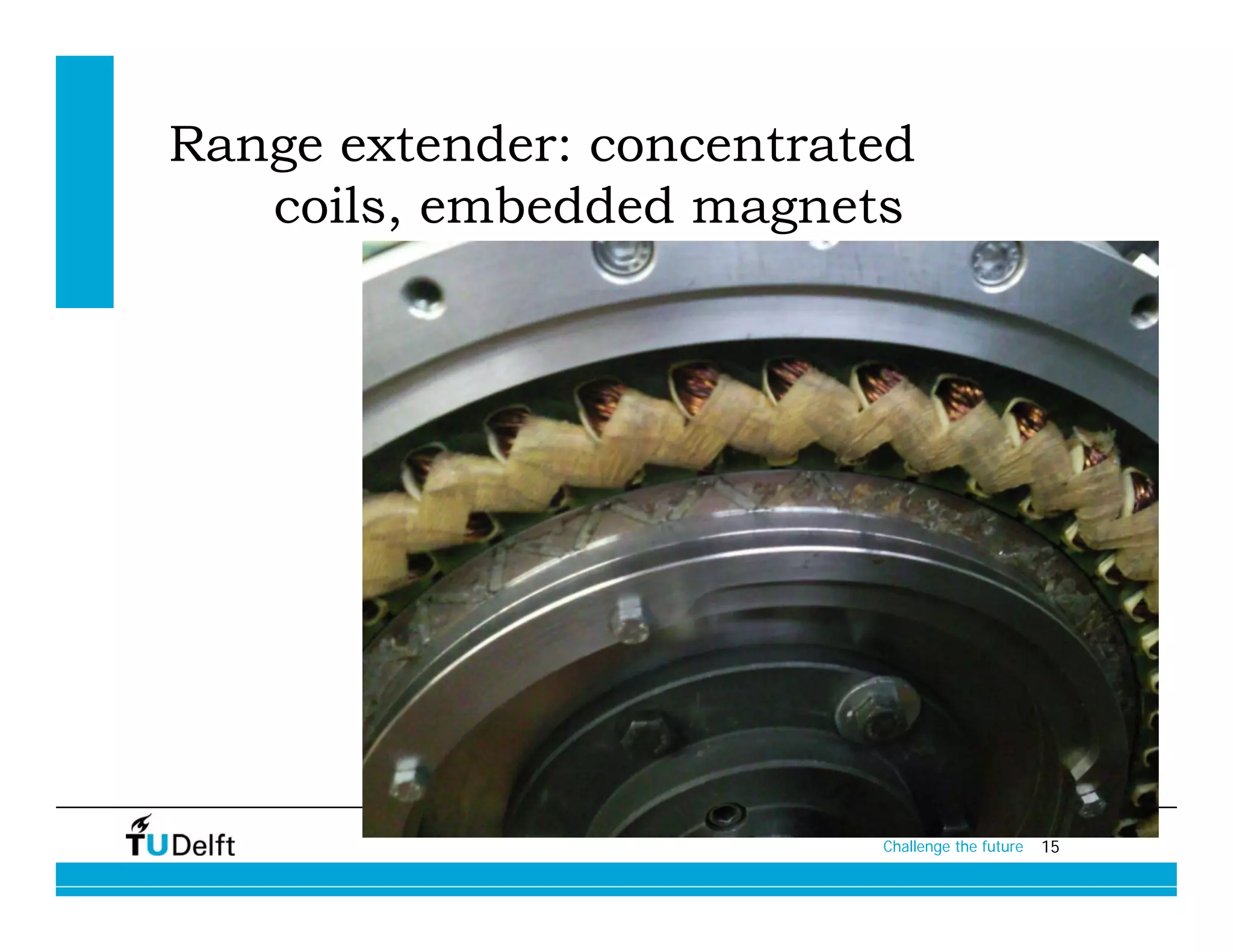
Range extender: concentrated
   coils, embedded magnets


                          Challenge the future   15
Structure

1   Permanent magnets
2   Classification of PM machines
3   What is different from other types of machines
4   Calculation methods
5   Issues
6   Conclusions


                                                     Challenge the future   16
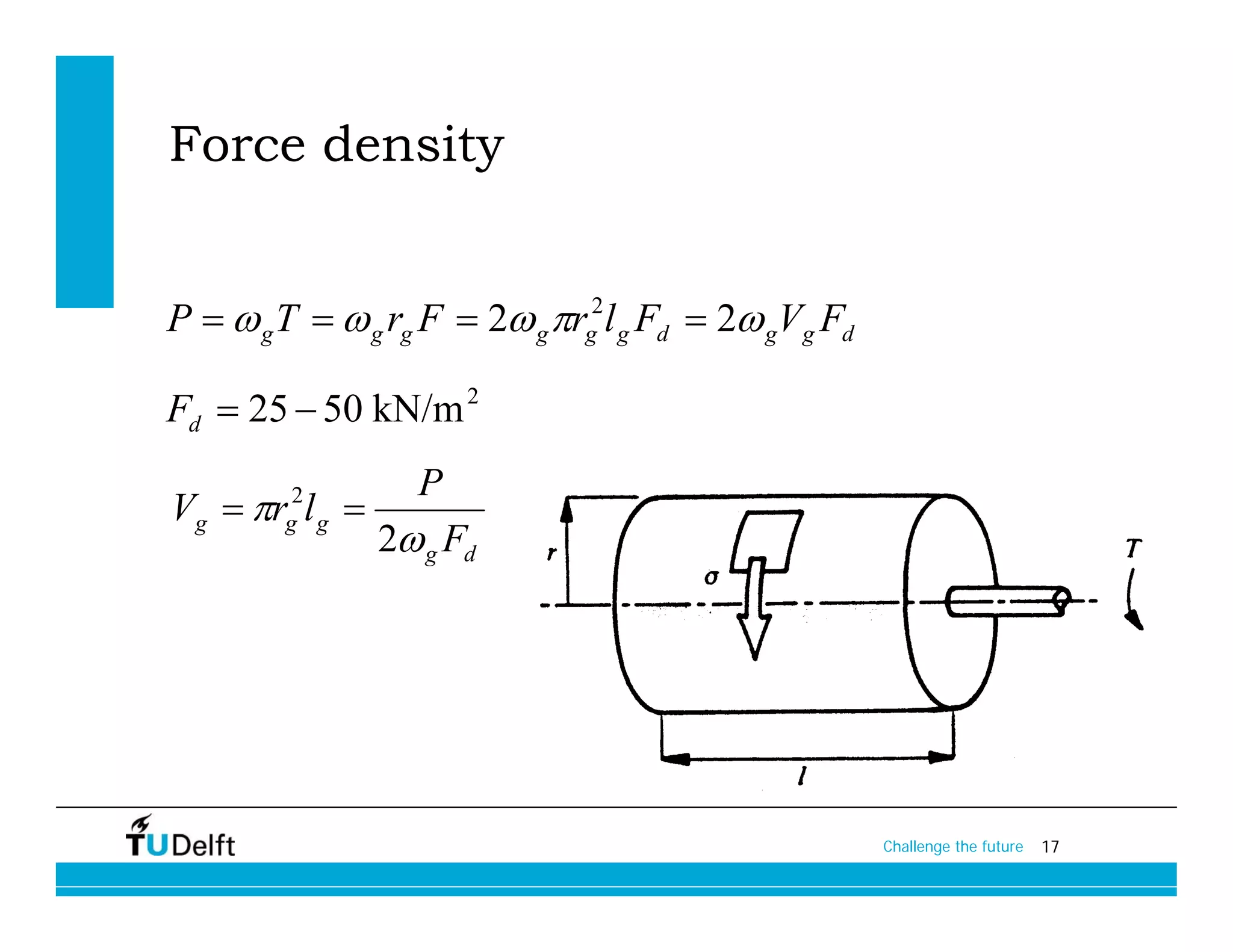
Force density


P   g T   g rg F  2 g rg2l g Fd  2 gVg Fd

Fd  25  50 kN/m 2
              P
Vg  r l 
         2

            2 g Fd
        g g


                                                     Challenge the future   17
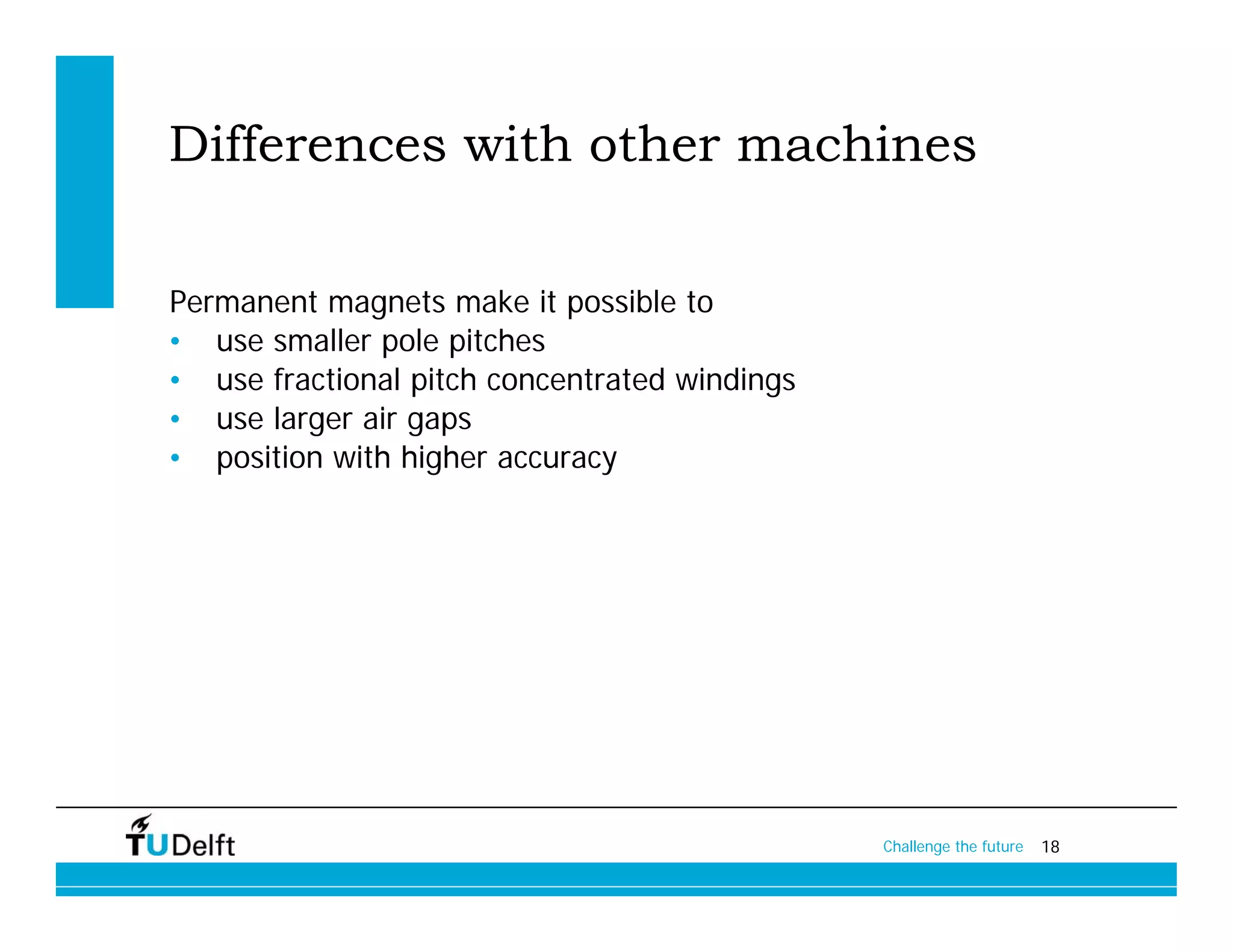
Differences with other machines

Permanent magnets make it possible to
• use smaller pole pitches
• use fractional pitch concentrated windings
• use larger air gaps
• position with higher accuracy


                                               Challenge the future   18
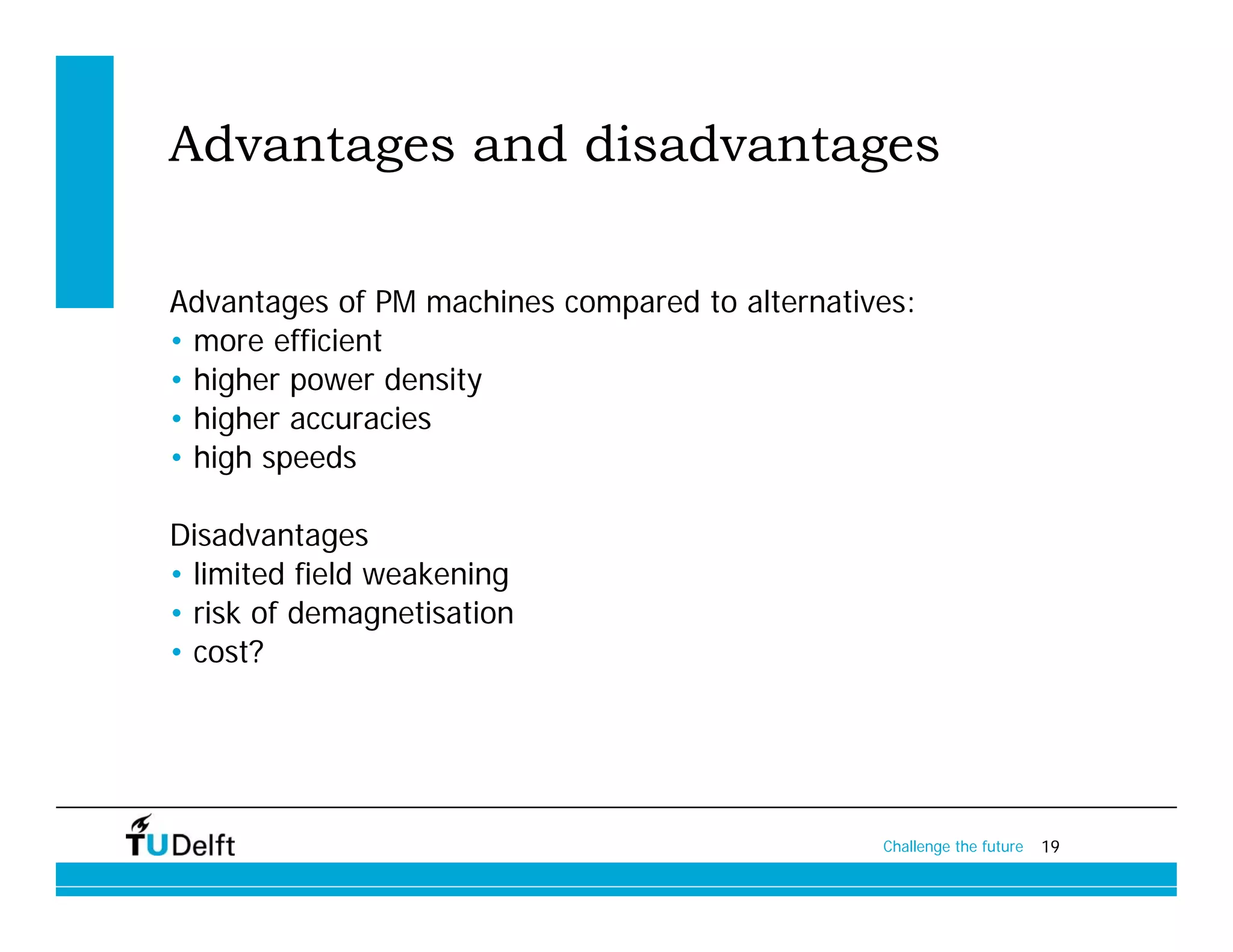
Advantages and disadvantages

Advantages of PM machines compared to alternatives:
• more efficient
• higher power density
• higher accuracies
• high speeds

Disadvantages
• limited field weakening
• risk of demagnetisation
• cost?


                                                Challenge the future   19
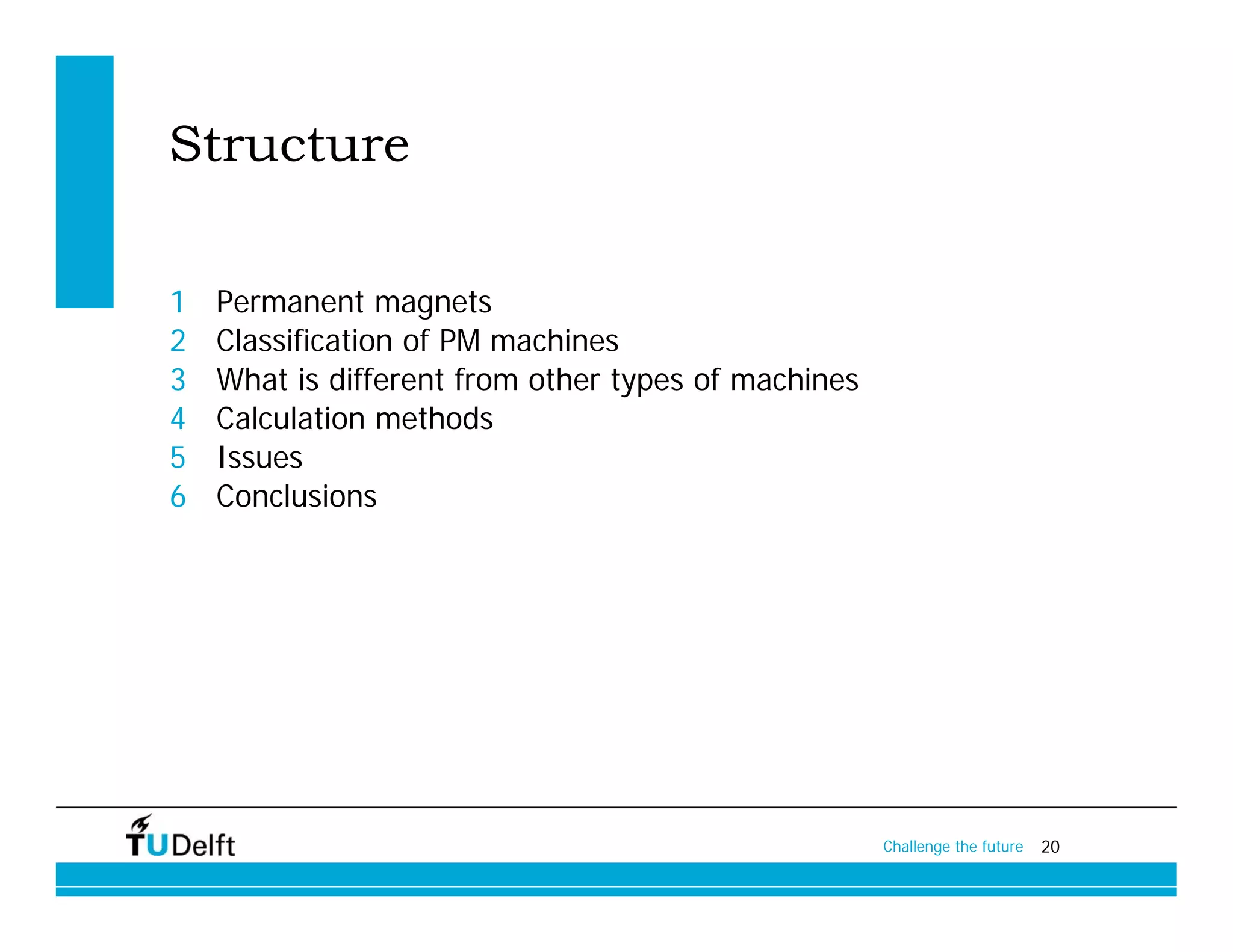
Structure

1   Permanent magnets
2   Classification of PM machines
3   What is different from other types of machines
4   Calculation methods
5   Issues
6   Conclusions


                                                     Challenge the future   20
Calculation methods

• 1D analytical approximations
• 2D analytical modelling
• Numerical: FEM


                                 Challenge the future   21
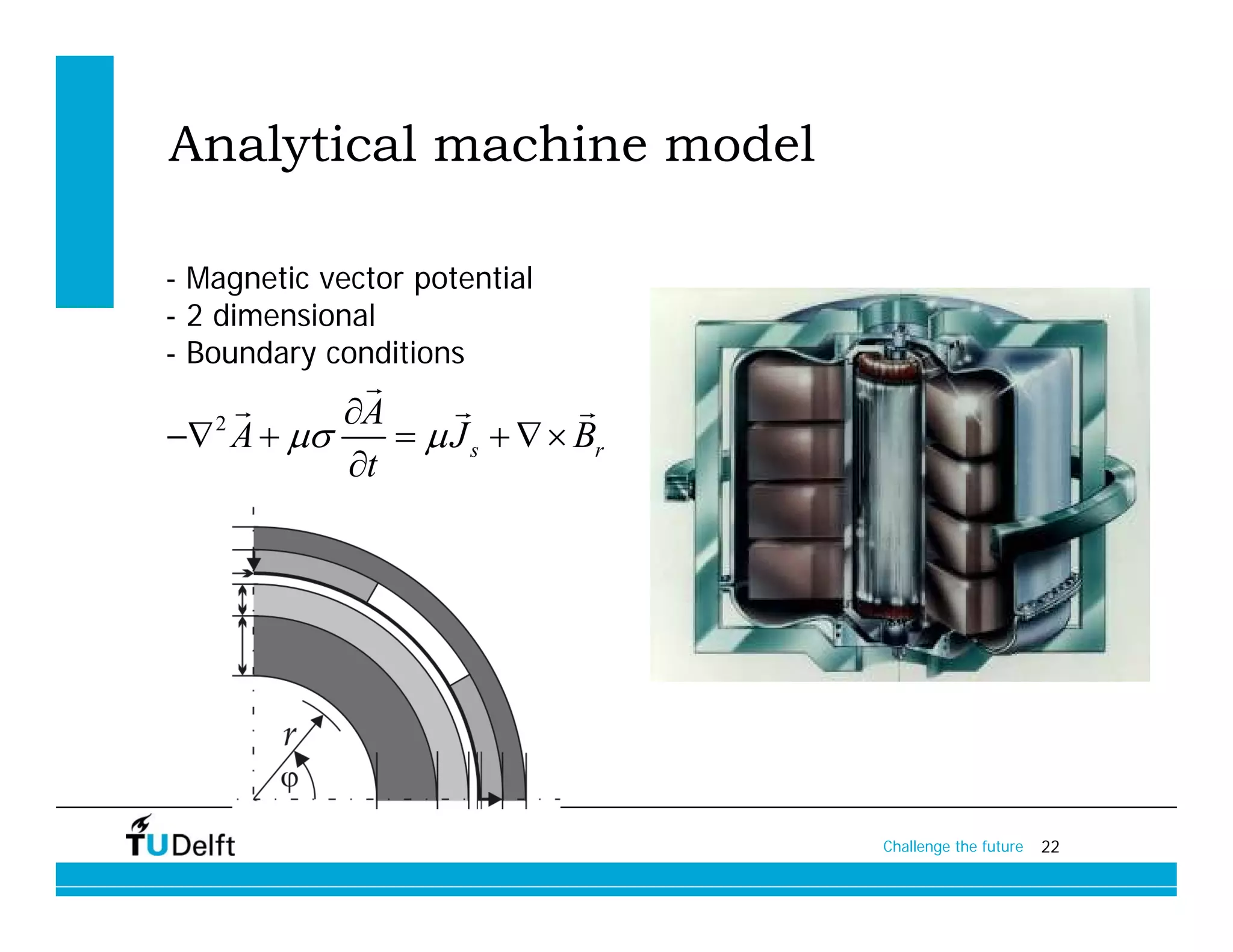
Analytical machine model

- Magnetic vector potential
- 2 dimensional
- Boundary conditions
           
         A              
 A  
  2
               J s    Br
          t


                                Challenge the future   22
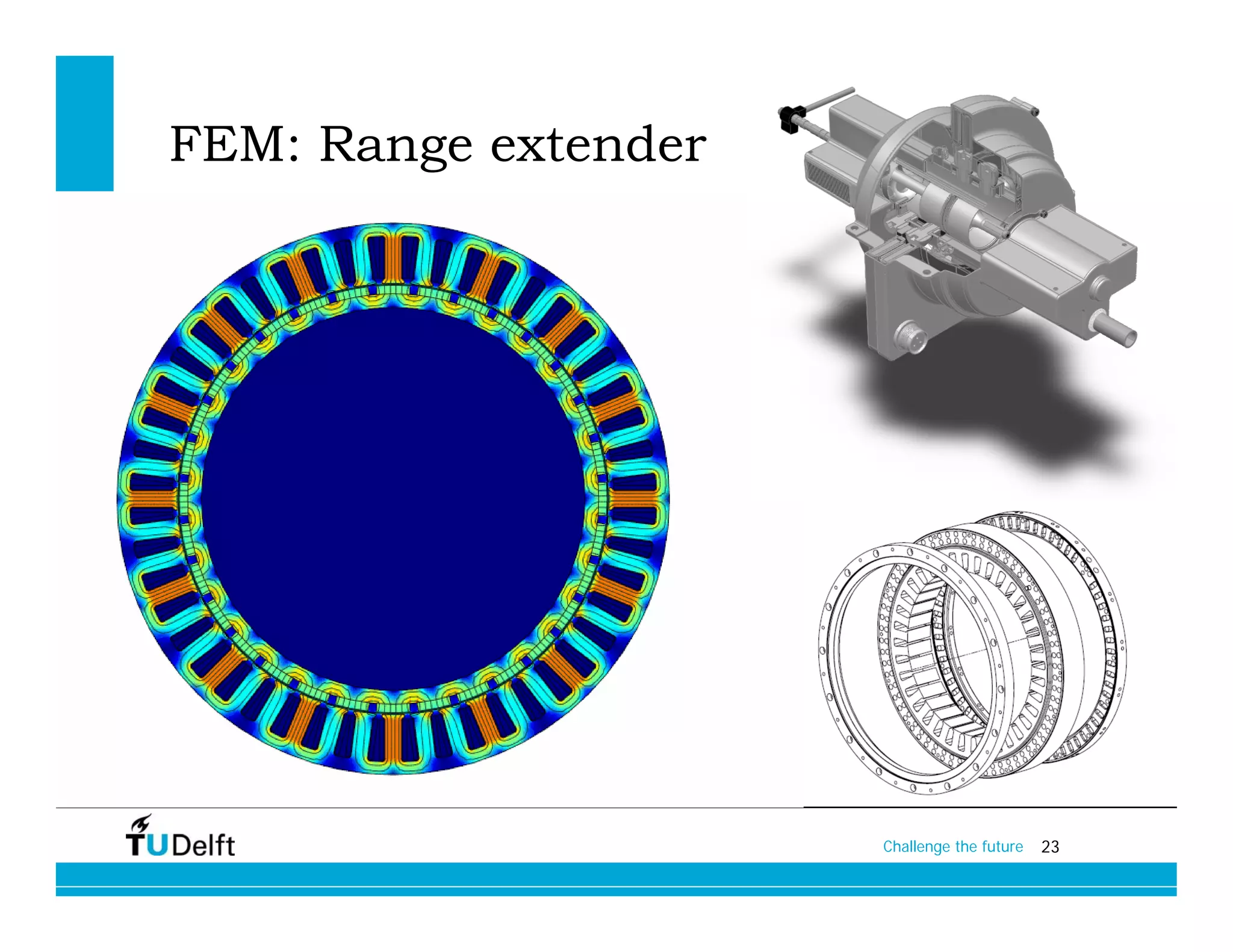
FEM: Range extender


                      Challenge the future   23
Structure

1   Permanent magnets
2   Classification of PM machines
3   What is different from other types of machines
4   Calculation methods
5   Issues
6   Conclusions


                                                     Challenge the future   24
Issues

•   Demagnetisation (earlier)
•   Losses, mainly for fractional pitch windings
•   Availability of magnet material and magnet cost
•   Fault tolerance
•   Design for specific applications


                                                      Challenge the future   25
Availability of NdFeB material

• Between 1990 and 2005, magnet prices dropped by roughly a
  factor of 10
• The permanent magnet crisis (2010/2011)
    • Over 95% of rare earth materials mined in China
    • Large demand
       • Renewable energy generation
       • Electric mobility
    • China protects market
• Long term
    • Materials also found at other places
    • Mining is being developed
    • Cost??


                                                Challenge the future   26
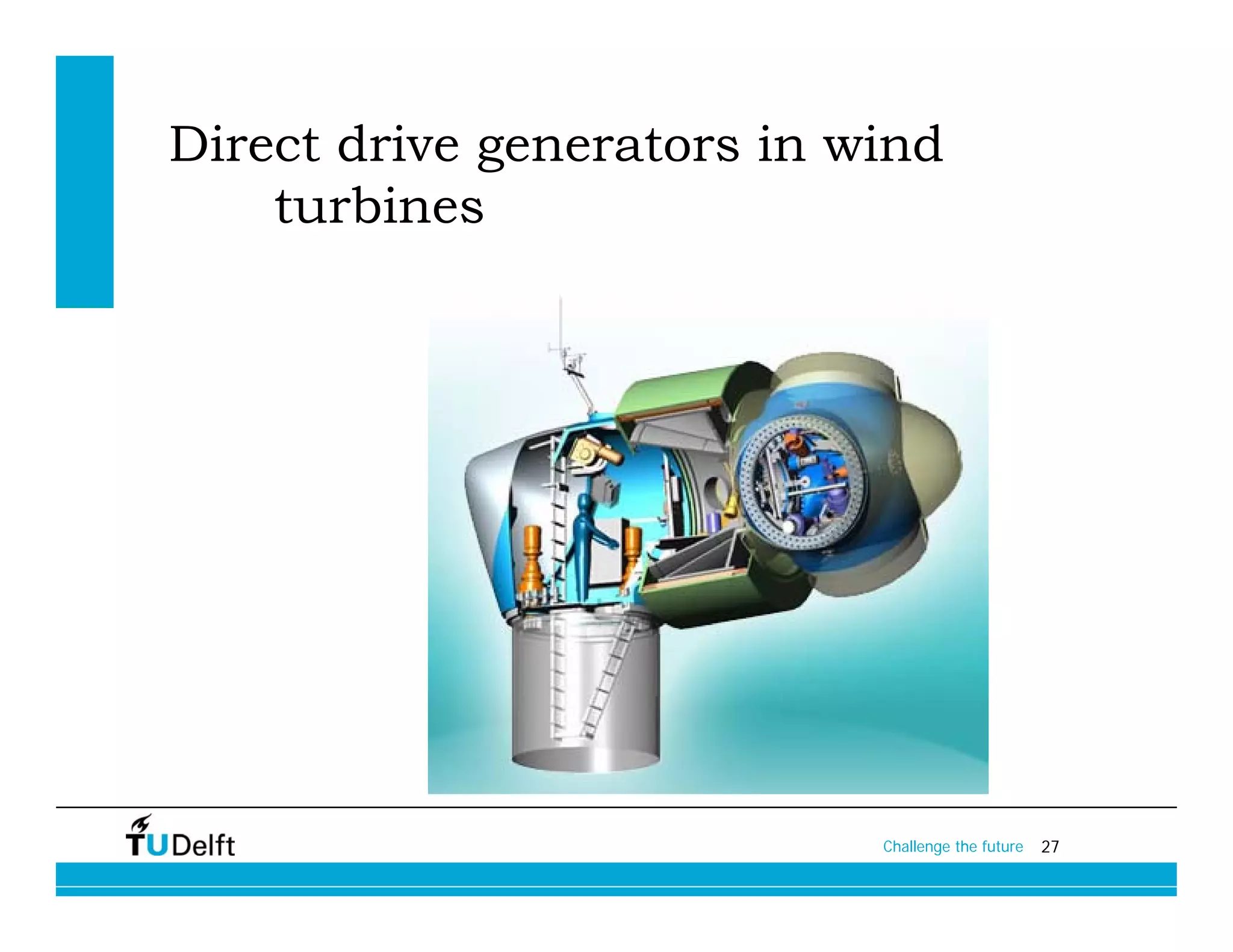
Direct drive generators in wind
    turbines


                            Challenge the future   27
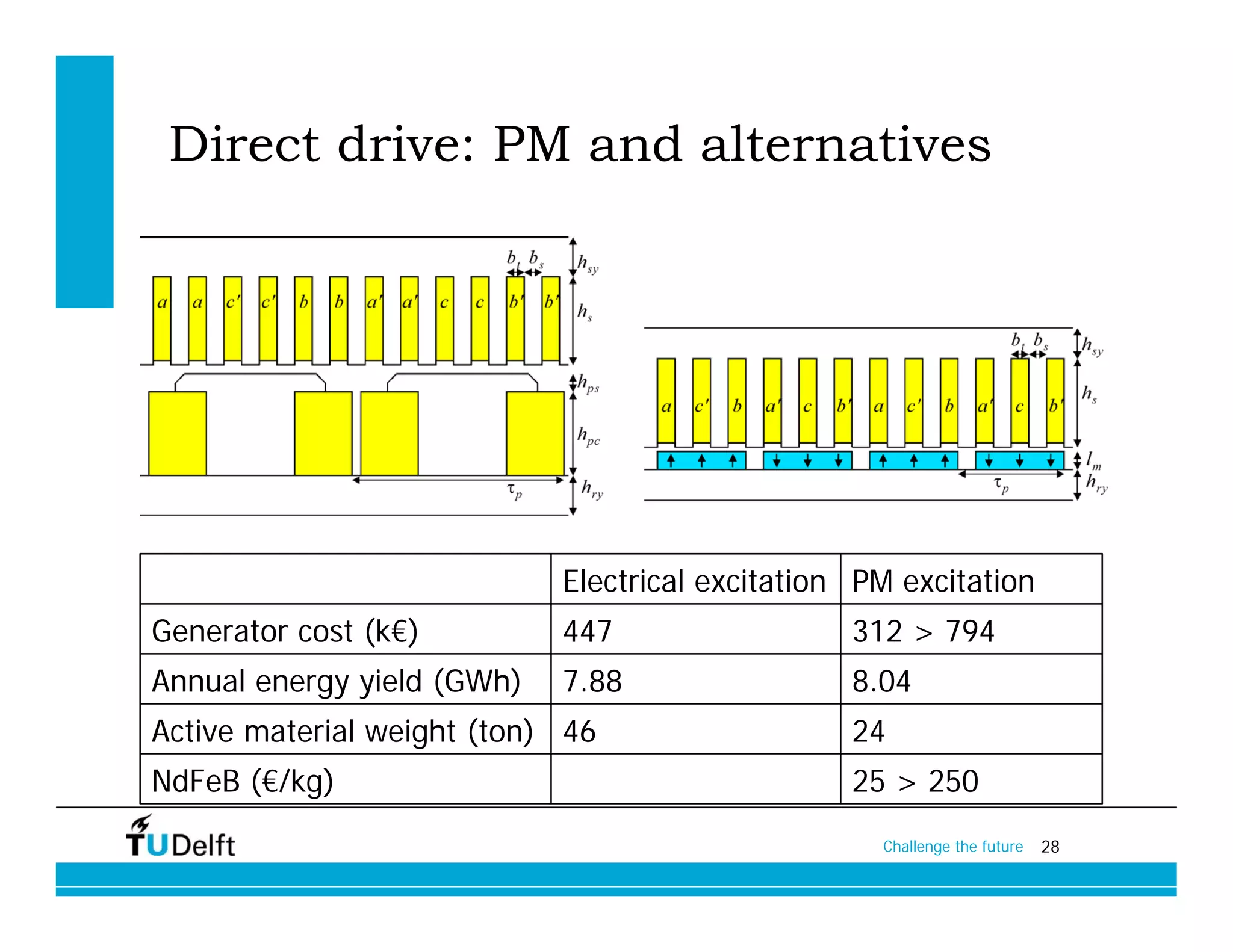
Direct drive: PM and alternatives


                            Electrical excitation PM excitation
Generator cost (k€)         447                  312 > 794
Annual energy yield (GWh)   7.88                 8.04
Active material weight (ton) 46                  24
NdFeB (€/kg)                                     25 > 250
                                                   Challenge the future   28
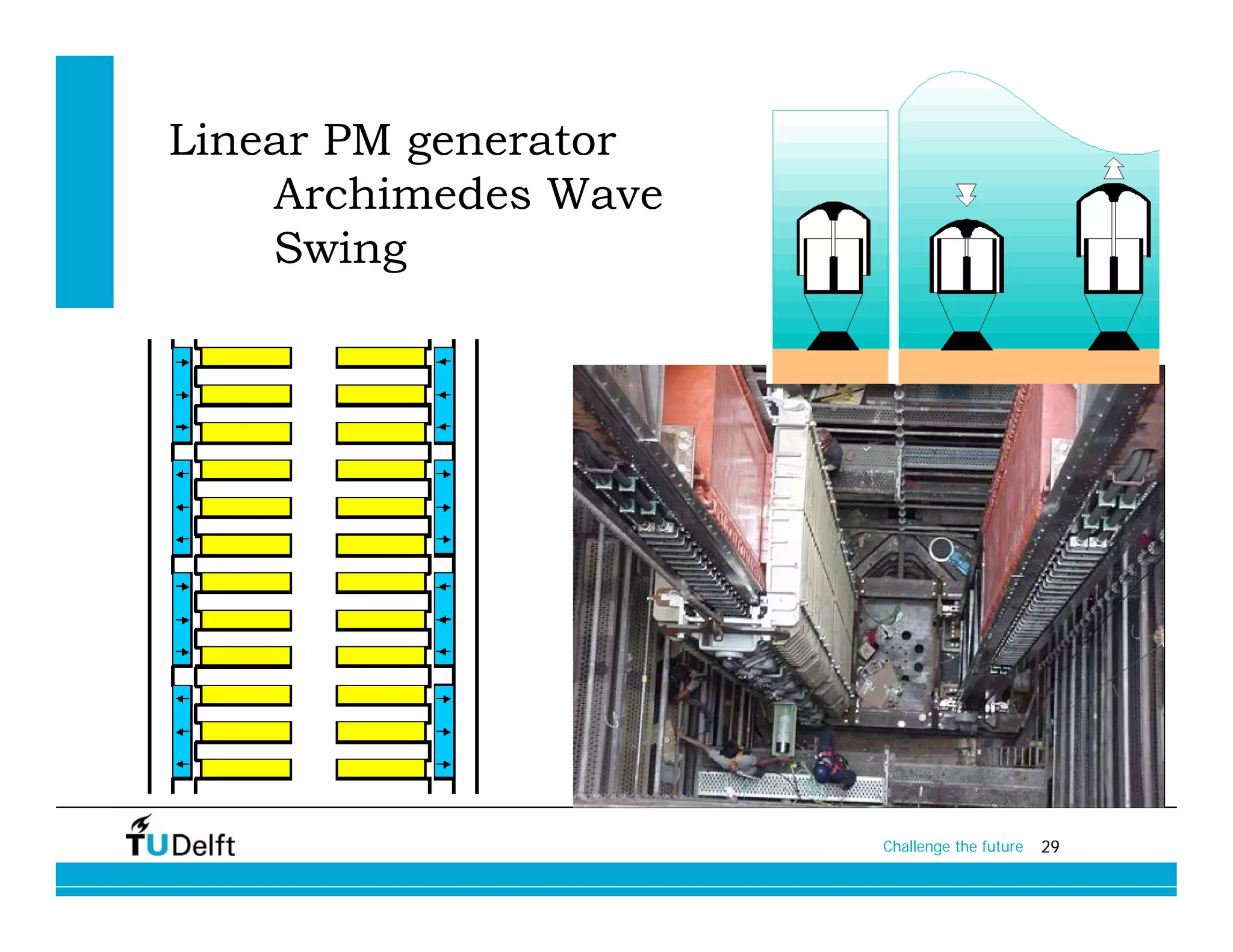
Linear PM generator
    Archimedes Wave
    Swing


                      Challenge the future   29
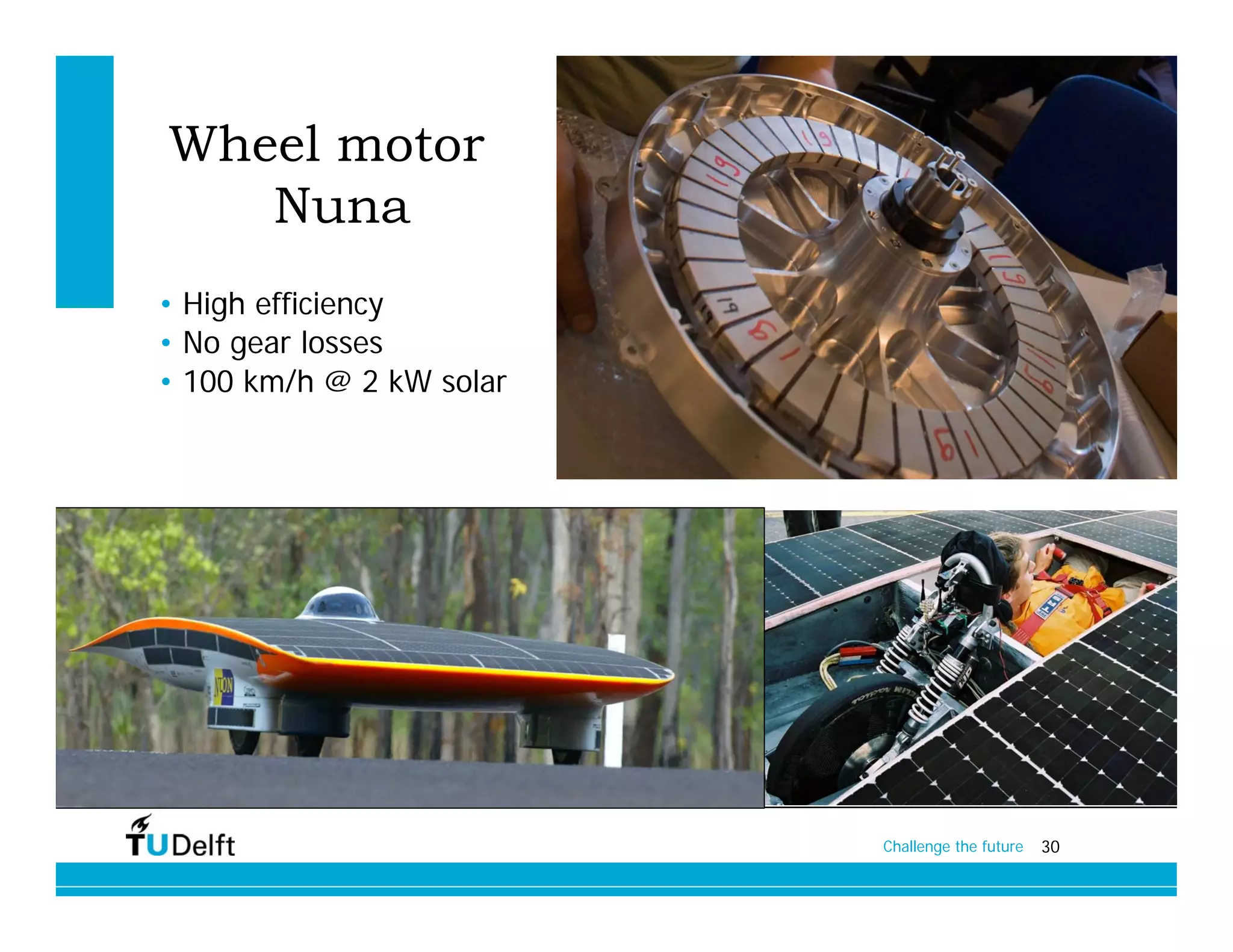
Wheel motor
   Nuna
• High efficiency
• No gear losses
• 100 km/h @ 2 kW solar


                          Challenge the future   30
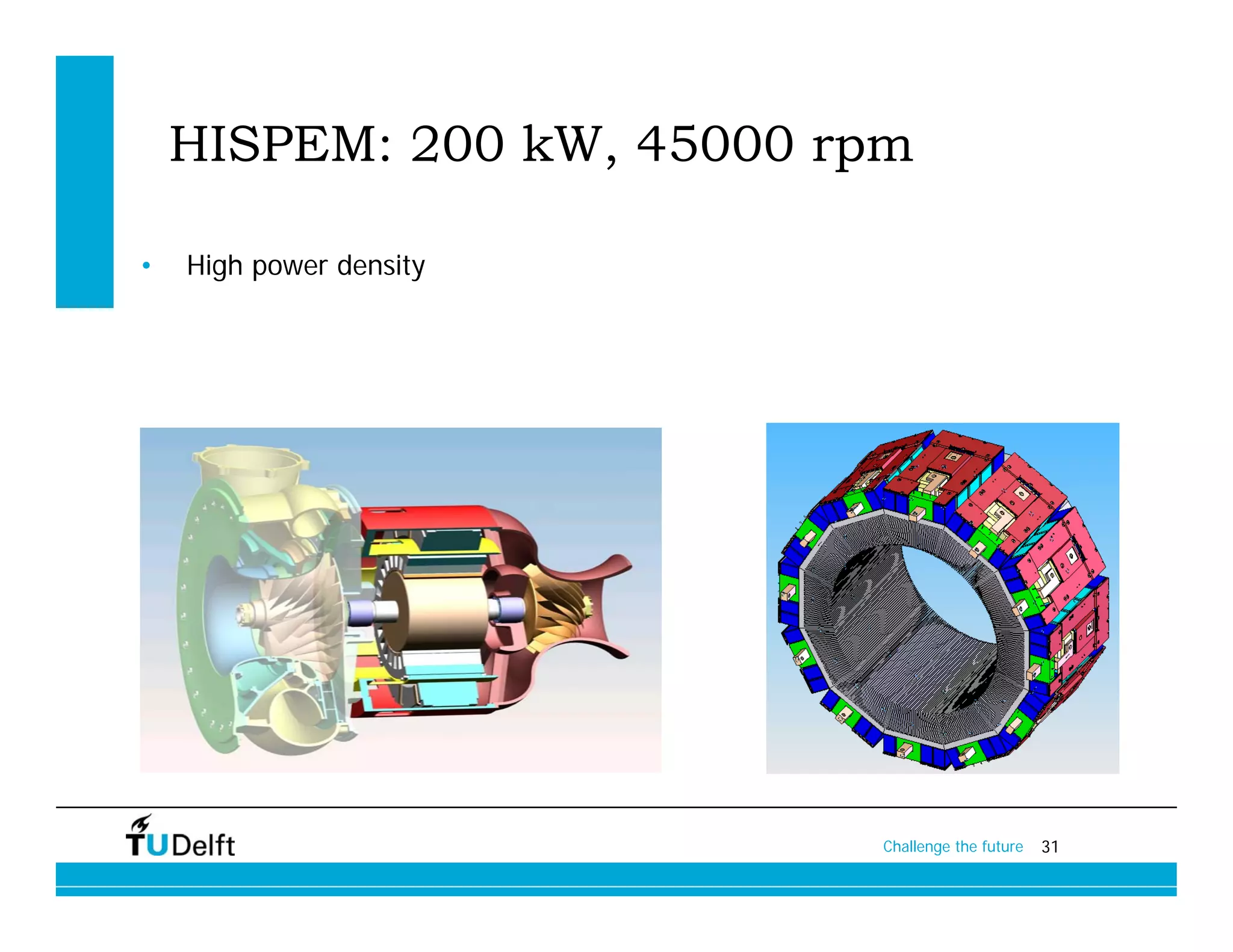
HISPEM: 200 kW, 45000 rpm

•   High power density


                           Challenge the future   31
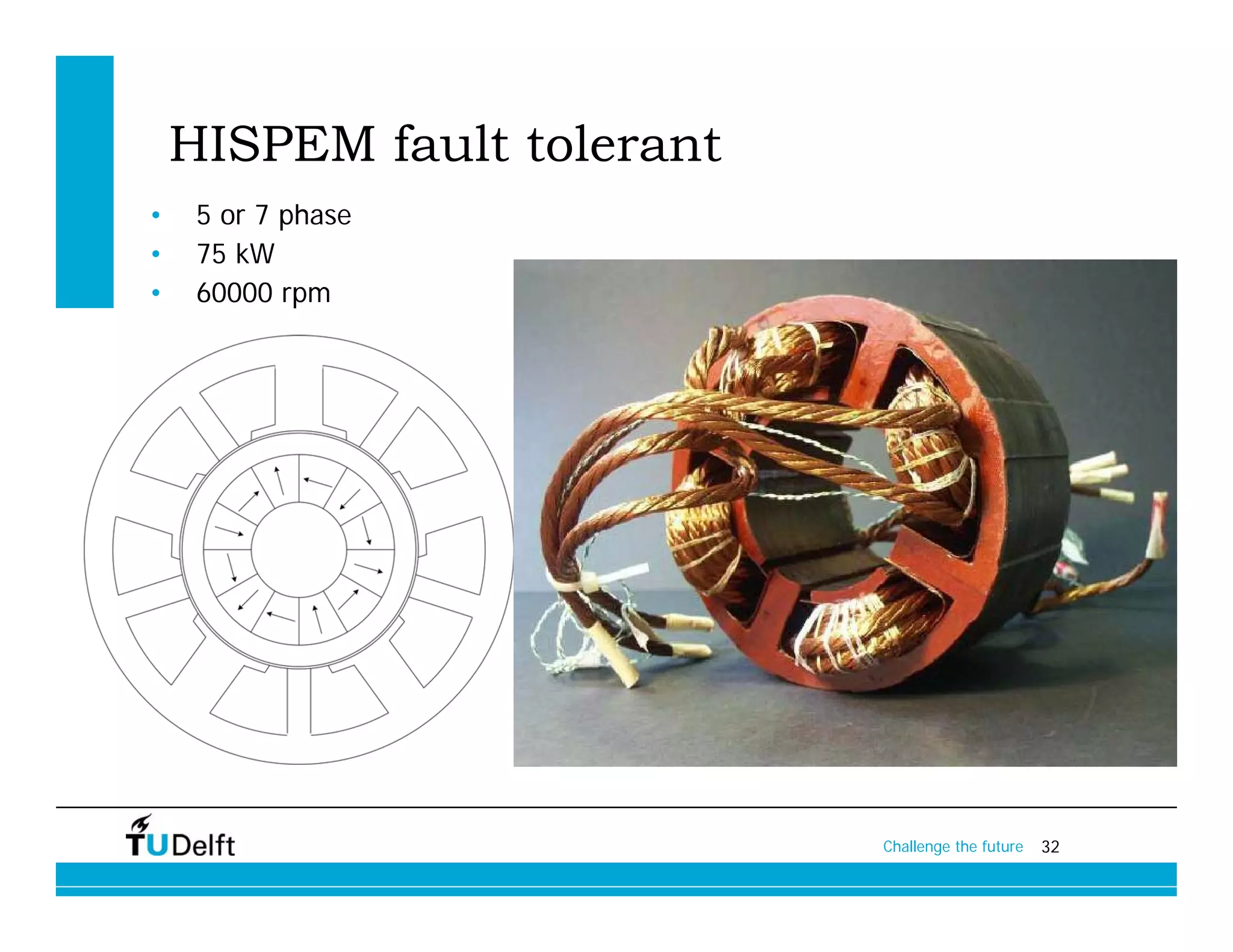
HISPEM fault tolerant
•    5 or 7 phase
•    75 kW
•    60000 rpm


                            Challenge the future   32
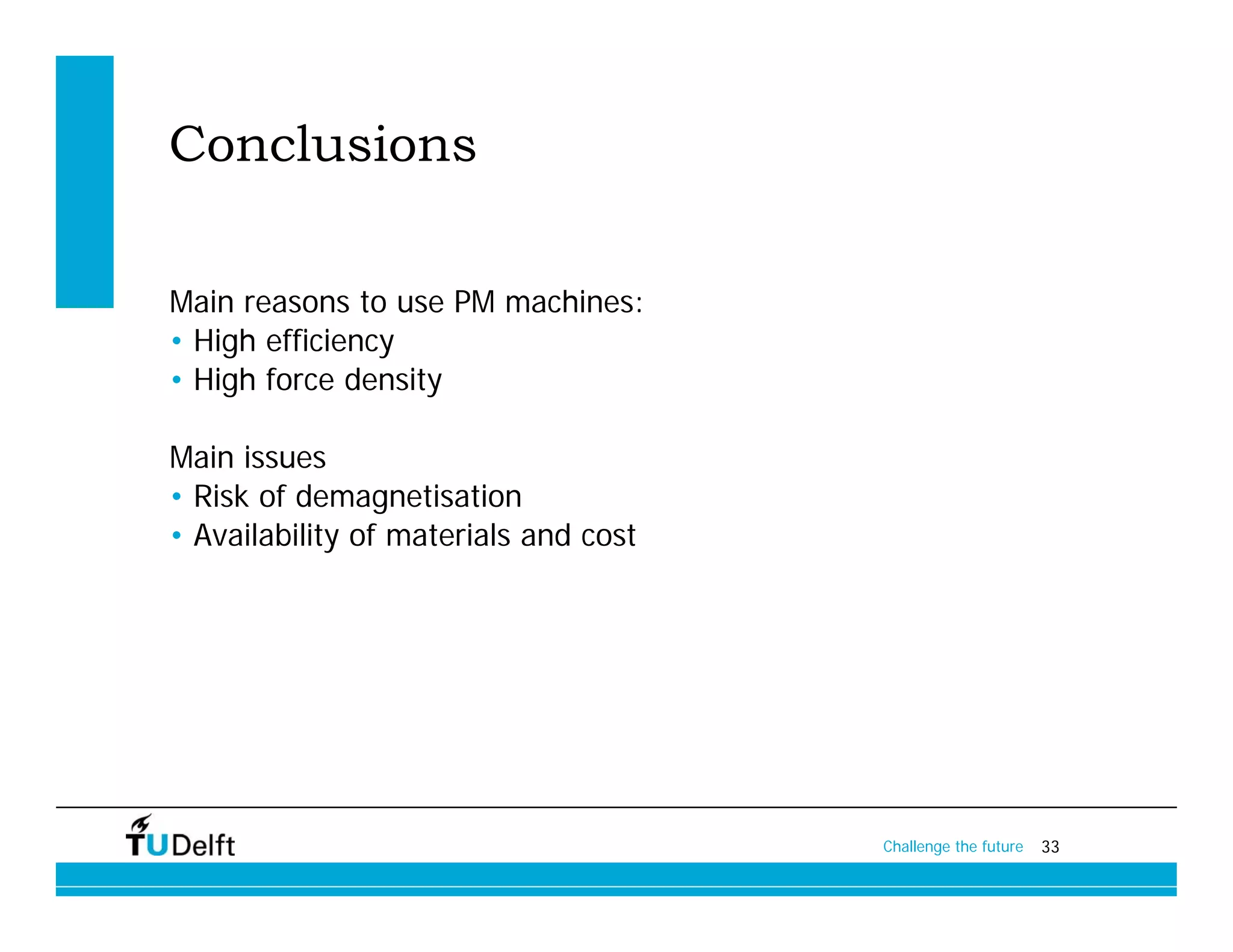
Conclusions

Main reasons to use PM machines:
• High efficiency
• High force density

Main issues
• Risk of demagnetisation
• Availability of materials and cost


                                       Challenge the future   33

Technology Designs aspects of PM machines

  • 1.
    Technology Designs aspects ofPM machines Henk Polinder Challenge the future 1
  • 2.
    Structure 1 Permanent magnets 2 Classification of PM machines 3 What is different from other types of machines 4 Calculation methods 5 Issues 6 Conclusions Challenge the future 2
  • 3.
    What is apermanent magnet? • Source of magnetomotive force • Makes magnetic field without a current Bm   0  rm H m  Br Challenge the future 3
  • 4.
    Permanent magnet BHcurves Challenge the future 4
  • 5.
    Permanent magnets: demagnetization / temperature Challenge the future 5
  • 6.
    Permanent magnet properties Br HcB dBr/dT dHcB/dT ρ Cost (T) (kA/m) (%/K) (%/K) (μΩm) (€/kg) Ferrite 0,4 -250 -0,2 +0,34 1012 2 Alnico 1,2 -130 -0,05 -0,25 0,5 20 SmCo 1,0 -750 -0,02 -0,03 0,5 100 NdFeB 1,4 -1000 -0,12 -0,55 1,4 ??? Challenge the future 6
  • 7.
    Structure 1 Permanent magnets 2 Classification of PM machines 3 What is different from other types of machines 4 Calculation methods 5 Issues 6 Conclusions Challenge the future 7
  • 8.
    Classification • DC mechanicalcommutator • Iron armature • Hollow rotor • Disc armature • AC electronic commutation PMSM / Brushless DC • Surface mounted / embedded magnets • Distributed / concentrated windings Challenge the future 8
  • 9.
    Brushed DC • Ironarmature • Disc armature • Hollow rotor Challenge the future 9
  • 10.
    PM AC motor Challenge the future 10
  • 11.
    Classification • Brushes /brushless • Brush wear / inverter cost • Air gap winding / teeth • cogging / force density • Radial flux / axial flux • available space / cost • Rotating / linear • performance / cost • Brushless DCM / PMSM • torque ripple • Surface mounted magnets / embedded • flux weakening • Distributed / fractional pitch concentrated windings • cost / losses Challenge the future 11
  • 12.
    PMSM or BDCM PMSM: -distributed windings - sinusoidal voltage - sinusoidal currents - continuous position sensor - smooth force BDCM: - concentrated windings - trapezoidal voltage - rectangular currents - 6 step position sensor - force ripple Challenge the future 12
  • 13.
    Rotor layouts 1 surface mounted magnets 2 inset magnets 3 embedded magnets 4 embedded magnets Embedded: -Flux weakening -Flux concentration Challenge the future 13
  • 14.
    Concentrated fractional pitch windings • Reduces cost • Increases losses in back iron and magnets Challenge the future 14
  • 15.
    Range extender: concentrated coils, embedded magnets Challenge the future 15
  • 16.
    Structure 1 Permanent magnets 2 Classification of PM machines 3 What is different from other types of machines 4 Calculation methods 5 Issues 6 Conclusions Challenge the future 16
  • 17.
    Force density P  g T   g rg F  2 g rg2l g Fd  2 gVg Fd Fd  25  50 kN/m 2 P Vg  r l  2 2 g Fd g g Challenge the future 17
  • 18.
    Differences with othermachines Permanent magnets make it possible to • use smaller pole pitches • use fractional pitch concentrated windings • use larger air gaps • position with higher accuracy Challenge the future 18
  • 19.
    Advantages and disadvantages Advantagesof PM machines compared to alternatives: • more efficient • higher power density • higher accuracies • high speeds Disadvantages • limited field weakening • risk of demagnetisation • cost? Challenge the future 19
  • 20.
    Structure 1 Permanent magnets 2 Classification of PM machines 3 What is different from other types of machines 4 Calculation methods 5 Issues 6 Conclusions Challenge the future 20
  • 21.
    Calculation methods • 1Danalytical approximations • 2D analytical modelling • Numerical: FEM Challenge the future 21
  • 22.
    Analytical machine model -Magnetic vector potential - 2 dimensional - Boundary conditions   A    A   2   J s    Br t Challenge the future 22
  • 23.
    FEM: Range extender Challenge the future 23
  • 24.
    Structure 1 Permanent magnets 2 Classification of PM machines 3 What is different from other types of machines 4 Calculation methods 5 Issues 6 Conclusions Challenge the future 24
  • 25.
    Issues • Demagnetisation (earlier) • Losses, mainly for fractional pitch windings • Availability of magnet material and magnet cost • Fault tolerance • Design for specific applications Challenge the future 25
  • 26.
    Availability of NdFeBmaterial • Between 1990 and 2005, magnet prices dropped by roughly a factor of 10 • The permanent magnet crisis (2010/2011) • Over 95% of rare earth materials mined in China • Large demand • Renewable energy generation • Electric mobility • China protects market • Long term • Materials also found at other places • Mining is being developed • Cost?? Challenge the future 26
  • 27.
    Direct drive generatorsin wind turbines Challenge the future 27
  • 28.
    Direct drive: PMand alternatives Electrical excitation PM excitation Generator cost (k€) 447 312 > 794 Annual energy yield (GWh) 7.88 8.04 Active material weight (ton) 46 24 NdFeB (€/kg) 25 > 250 Challenge the future 28
  • 29.
    Linear PM generator Archimedes Wave Swing Challenge the future 29
  • 30.
    Wheel motor Nuna • High efficiency • No gear losses • 100 km/h @ 2 kW solar Challenge the future 30
  • 31.
    HISPEM: 200 kW,45000 rpm • High power density Challenge the future 31
  • 32.
    HISPEM fault tolerant • 5 or 7 phase • 75 kW • 60000 rpm Challenge the future 32
  • 33.
    Conclusions Main reasons touse PM machines: • High efficiency • High force density Main issues • Risk of demagnetisation • Availability of materials and cost Challenge the future 33