April 26, 2011
What Makes a Film Political?
 Depends on what theory of the relationship between
  films (popular culture) and politics you are using.
 For some, only explicitly political films are political
 For others, all films are political
 In short, you get to decide this for yourself
What Makes a Political Film Good?
  Depends on what films you consider political and
   that in turn depends on your own political beliefs.
  However, there are aspects of film-making and film
   criticism that can be described in purely formal
   ways.
  Some films are more innovative,
   conservative/subversive, than others.
  A good film always tells a story that the audience
   finds compelling, worth watching.
James Monaco on Film Theory
“The job of film theory is truly dialectical. As a
 fully matured art, film is not longer a separate
 enterprise but an integrated pattern in the warp
 and woof of our culture. Cinema is an expansive
 and far-reaching set of interrelating oppositions
 between filmmaker and subject, film and
 observer, establishment and avant garde,
 conservative purposes and progressive purposes…”
 (How to Read a Film, p. 424)
Mediated Reality
 One of the most common themes in discussion of
  films is the relationship between film and reality.
 We now understand that film, like all other
  media, is an interpretation of reality that is partly
  controlled by the filmmaker and partly by the
  viewer.
 Most of us are more dependent on media now
  than we were in the past.
 This makes our ability to “read films” and other
  media much more important.
Film Technology: A Moving Target
 Film as an art form was originally quite restricted
  by its inability to portray color, sound, outdoor
  images, and certain kinds of motion.
 Film technology developed progressively to
  reduce the restrictions on the ability of the
  medium to portray reality.
 More recent technology allows filmmakers to
  “enhance” reality in ways that early filmmakers
  could only dream about.
What Have We Gained and What Have We
Lost?
 We have become more dependent on film and video
  for entertainment and less capable of entertaining
  ourselves.
 As passive consumers of high-quality sound and
  imagery, we may even be losing our ability to process
  abstract ideas via text.
 Are multimedia and the Internet the answer to this
  problem?
Power to the Producer
 Cheap cameras, cheap editing, cheap
  distribution
 Positive indications:
    AtomFilms.com
    IFilm.com
    Blair Witch Project
 Negative indication: continued dominance
  of large conglomerates in media industries
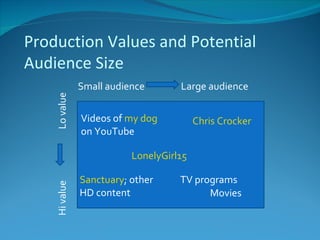
Production Values and Potential
Audience Size
               Small audience       Large audience
    Lo value


               Videos of my dog          Chris Crocker
               on YouTube

                          LonelyGirl15

               Sanctuary; other     TV programs
    Hi value


               HD content                 Movies
Another Quote from Monaco
“For more than half a century, first film and
 then television inculcated that suffocating
 passivity that so concerned Aldous Huxley
 and others. But the balance is now shifting.
  Not because we heeded the warnings of the
 social critics and took action, but because
 the image and sound technologies that are
 now maturing bring the power of
 production to us.” (p. 515)

Polf20

  • 1.
  • 2.
    What Makes aFilm Political?  Depends on what theory of the relationship between films (popular culture) and politics you are using.  For some, only explicitly political films are political  For others, all films are political  In short, you get to decide this for yourself
  • 3.
    What Makes aPolitical Film Good?  Depends on what films you consider political and that in turn depends on your own political beliefs.  However, there are aspects of film-making and film criticism that can be described in purely formal ways.  Some films are more innovative, conservative/subversive, than others.  A good film always tells a story that the audience finds compelling, worth watching.
  • 4.
    James Monaco onFilm Theory “The job of film theory is truly dialectical. As a fully matured art, film is not longer a separate enterprise but an integrated pattern in the warp and woof of our culture. Cinema is an expansive and far-reaching set of interrelating oppositions between filmmaker and subject, film and observer, establishment and avant garde, conservative purposes and progressive purposes…” (How to Read a Film, p. 424)
  • 5.
    Mediated Reality  Oneof the most common themes in discussion of films is the relationship between film and reality.  We now understand that film, like all other media, is an interpretation of reality that is partly controlled by the filmmaker and partly by the viewer.  Most of us are more dependent on media now than we were in the past.  This makes our ability to “read films” and other media much more important.
  • 6.
    Film Technology: AMoving Target  Film as an art form was originally quite restricted by its inability to portray color, sound, outdoor images, and certain kinds of motion.  Film technology developed progressively to reduce the restrictions on the ability of the medium to portray reality.  More recent technology allows filmmakers to “enhance” reality in ways that early filmmakers could only dream about.
  • 7.
    What Have WeGained and What Have We Lost?  We have become more dependent on film and video for entertainment and less capable of entertaining ourselves.  As passive consumers of high-quality sound and imagery, we may even be losing our ability to process abstract ideas via text.  Are multimedia and the Internet the answer to this problem?
  • 8.
    Power to theProducer  Cheap cameras, cheap editing, cheap distribution  Positive indications:  AtomFilms.com  IFilm.com  Blair Witch Project  Negative indication: continued dominance of large conglomerates in media industries
  • 9.
    Production Values andPotential Audience Size Small audience Large audience Lo value Videos of my dog Chris Crocker on YouTube LonelyGirl15 Sanctuary; other TV programs Hi value HD content Movies
  • 10.
    Another Quote fromMonaco “For more than half a century, first film and then television inculcated that suffocating passivity that so concerned Aldous Huxley and others. But the balance is now shifting. Not because we heeded the warnings of the social critics and took action, but because the image and sound technologies that are now maturing bring the power of production to us.” (p. 515)