Poetry Through History

Poetry is an art form that predates
              literacy
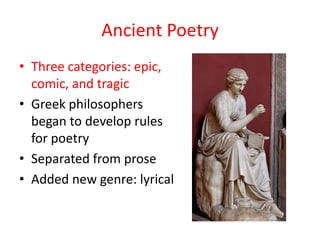
Ancient Poetry
• Three categories: epic,
  comic, and tragic
• Greek philosophers
  began to develop rules
  for poetry
• Separated from prose
• Added new genre: lyrical
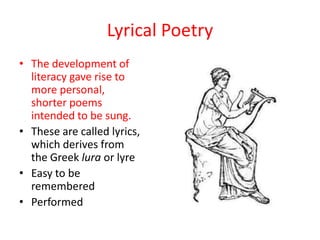
Lyrical Poetry
• The development of
  literacy gave rise to
  more personal,
  shorter poems
  intended to be sung.
• These are called lyrics,
  which derives from
  the Greek lura or lyre
• Easy to be
  remembered
• Performed
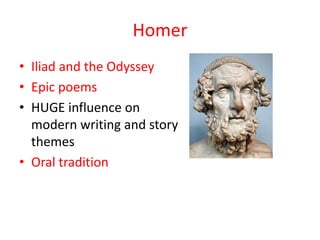
Homer
• Iliad and the Odyssey
• Epic poems
• HUGE influence on
  modern writing and story
  themes
• Oral tradition
Hero Stories
                                                               The Hero's Journey
•   The Ordinary World: Here the person is introduced to the audience. S/he doesn't know her/his personal potential or calling.
•   Call to Adventure: The call to adventure is the point in a person's life when s/he is first given notice that everything is going to
    change, whether they know it or not.
•   Refusal of Call/Reluctant Hero: Often when the call is given, the future hero refuses to heed it. This may be from a sense of duty or
    obligation, fear, insecurity, a sense of inadequacy, or any of a range of reasons that work to hold the person in his or her current
    circumstances.
•   Meeting Wise Mentor: Once the hero has committed to the quest, consciously or unconsciously, his or her guide and magical helper
    appears, or becomes known.
•   The First Threshold :This is the point where the person actually crosses into the field of adventure, leaving the known limits of his or
    her world and venturing into an unknown and dangerous realm where the rules and limits are not known.
•   Tests, Allies and Enemies : The road of trials is a series of tests, tasks, or ordeals that the person must undergo to begin the
    transformation. Often the person fails one or more of these tests, which often occur in 3s.
•   Supreme Ordeal : This is sometimes described as the person's lowest point or darkest moment. The separation has been made
    between the old world and old self and the potential for a new world/self. By entering this stage, the person shows her/his
    willingness to make a change, to die and become a new person.
•   Revisiting the Mentor : The person revisits the teachings of an old mentor or meets and learns from a new mentor and subsequently
    returns to the path s/he started on.
•   Return with New Knowledge : The trick in returning is to retain the wisdom gained on the quest, to integrate that wisdom into a
    human life, and then maybe figure out how to share the wisdom with the rest of the world. This is usually extremely difficult. Just as
    the hero may need guides and assistants to set out on the quest, often times he or she must have powerful guides and rescuers to
    bring them back to everyday life, especially if the person has been wounded or weakened by the experience.
•   Seizing the Sword (or Prize) : Here the hero confronts and defeats old enemies with the new power and knowledge gained. S/he is
    able to overthrow or defeat the opponent.
•   Resurrection : The old self dies physically or spiritually and moves beyond the normal human state. This is a god-like state where the
    hero acknowledges her/his new stature. Another way of looking at this step is that it is a period of rest, peace and fulfillment before
    the hero begins the return.
•   Return with Elixir*: The return with elixir is the achievement of the goal of the quest. It is what the person went on the journey to
    get. All the previous steps serve to prepare and purify the person for this step, since in many myths the elixir is like a plant, or a magic
    potion or medicine, that supplies immortality. For a human hero, it means achieving a balance between material and spiritual world.
    There is freedom to live and freedom from the fear of death. This is sometimes referred to as "living in the moment".
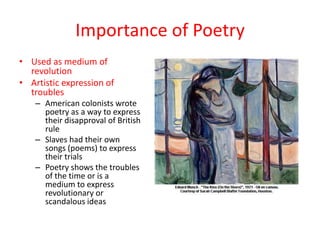
Importance of Poetry
• Used as medium of
  revolution
• Artistic expression of
  troubles
    – American colonists wrote
      poetry as a way to express
      their disapproval of British
      rule
    – Slaves had their own
      songs (poems) to express
      their trials
    – Poetry shows the troubles
      of the time or is a
      medium to express
      revolutionary or
      scandalous ideas
Revolutionary Poetry
• Poets are often inspired by revolutions
• French Revolution, American Revolution, Arab
  Spring
• http://www.huffingtonpost.com/john-
  lundberg/poetry-of-the-
  revolution_b_221590.html
        Let the wolves know that in our tribe
         If the father dies, his gun will remain
       Even if all the men of the tribe are killed
     A baby son will remain in the wooden cradle
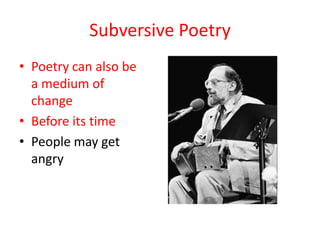
Subversive Poetry
• Poetry can also be
  a medium of
  change
• Before its time
• People may get
  angry

Poetry Through History

  • 1.
    Poetry Through History Poetryis an art form that predates literacy
  • 2.
    Ancient Poetry • Threecategories: epic, comic, and tragic • Greek philosophers began to develop rules for poetry • Separated from prose • Added new genre: lyrical
  • 3.
    Lyrical Poetry • Thedevelopment of literacy gave rise to more personal, shorter poems intended to be sung. • These are called lyrics, which derives from the Greek lura or lyre • Easy to be remembered • Performed
  • 4.
    Homer • Iliad andthe Odyssey • Epic poems • HUGE influence on modern writing and story themes • Oral tradition
  • 5.
    Hero Stories The Hero's Journey • The Ordinary World: Here the person is introduced to the audience. S/he doesn't know her/his personal potential or calling. • Call to Adventure: The call to adventure is the point in a person's life when s/he is first given notice that everything is going to change, whether they know it or not. • Refusal of Call/Reluctant Hero: Often when the call is given, the future hero refuses to heed it. This may be from a sense of duty or obligation, fear, insecurity, a sense of inadequacy, or any of a range of reasons that work to hold the person in his or her current circumstances. • Meeting Wise Mentor: Once the hero has committed to the quest, consciously or unconsciously, his or her guide and magical helper appears, or becomes known. • The First Threshold :This is the point where the person actually crosses into the field of adventure, leaving the known limits of his or her world and venturing into an unknown and dangerous realm where the rules and limits are not known. • Tests, Allies and Enemies : The road of trials is a series of tests, tasks, or ordeals that the person must undergo to begin the transformation. Often the person fails one or more of these tests, which often occur in 3s. • Supreme Ordeal : This is sometimes described as the person's lowest point or darkest moment. The separation has been made between the old world and old self and the potential for a new world/self. By entering this stage, the person shows her/his willingness to make a change, to die and become a new person. • Revisiting the Mentor : The person revisits the teachings of an old mentor or meets and learns from a new mentor and subsequently returns to the path s/he started on. • Return with New Knowledge : The trick in returning is to retain the wisdom gained on the quest, to integrate that wisdom into a human life, and then maybe figure out how to share the wisdom with the rest of the world. This is usually extremely difficult. Just as the hero may need guides and assistants to set out on the quest, often times he or she must have powerful guides and rescuers to bring them back to everyday life, especially if the person has been wounded or weakened by the experience. • Seizing the Sword (or Prize) : Here the hero confronts and defeats old enemies with the new power and knowledge gained. S/he is able to overthrow or defeat the opponent. • Resurrection : The old self dies physically or spiritually and moves beyond the normal human state. This is a god-like state where the hero acknowledges her/his new stature. Another way of looking at this step is that it is a period of rest, peace and fulfillment before the hero begins the return. • Return with Elixir*: The return with elixir is the achievement of the goal of the quest. It is what the person went on the journey to get. All the previous steps serve to prepare and purify the person for this step, since in many myths the elixir is like a plant, or a magic potion or medicine, that supplies immortality. For a human hero, it means achieving a balance between material and spiritual world. There is freedom to live and freedom from the fear of death. This is sometimes referred to as "living in the moment".
  • 6.
    Importance of Poetry •Used as medium of revolution • Artistic expression of troubles – American colonists wrote poetry as a way to express their disapproval of British rule – Slaves had their own songs (poems) to express their trials – Poetry shows the troubles of the time or is a medium to express revolutionary or scandalous ideas
  • 7.
    Revolutionary Poetry • Poetsare often inspired by revolutions • French Revolution, American Revolution, Arab Spring • http://www.huffingtonpost.com/john- lundberg/poetry-of-the- revolution_b_221590.html Let the wolves know that in our tribe If the father dies, his gun will remain Even if all the men of the tribe are killed A baby son will remain in the wooden cradle
  • 8.
    Subversive Poetry • Poetrycan also be a medium of change • Before its time • People may get angry