This Photo by Unknown Author is licensed under CC BY
Elements of Poetry
Elements of Poetry
•What is poetry?
•Poetry is not prose. Prose is the ordinary language
people use in speaking or writing.
•Poetry is a form of literary expression that captures
intense experiences or creative perceptions of the
world in a musical language.
•Basically, if prose is like talking, poetry is like singing.
•By looking at the set up of a poem, you can see the
difference between prose and poetry.
Distinguishing Characteristics of Poetry
• Unlike prose which has a narrator, poetry
has a speaker.
– A speaker, or voice, talks to the reader. The
speaker is not necessarily the poet. It can also be
a fictional person, an animal or even a thing
Example
But believe me, son.
I want to be what I used to be
when I was like you.
from “Once Upon a Time” by Gabriel Okara
Distinguishing Characteristics of Poetry
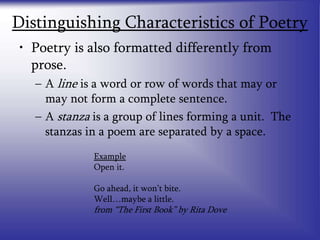
• Poetry is also formatted differently from
prose.
– A line is a word or row of words that may or
may not form a complete sentence.
– A stanza is a group of lines forming a unit. The
stanzas in a poem are separated by a space.
Example
Open it.
Go ahead, it won’t bite.
Well…maybe a little.
from “The First Book” by Rita Dove
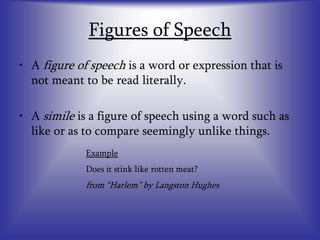
Figures of Speech
• A figure of speech is a word or expression that is
not meant to be read literally.
• A simile is a figure of speech using a word such as
like or as to compare seemingly unlike things.
Example
Does it stink like rotten meat?
from “Harlem” by Langston Hughes
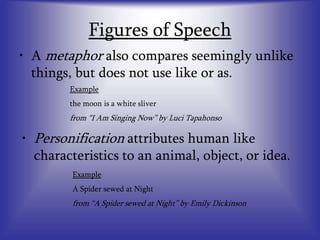
Figures of Speech
• A metaphor also compares seemingly unlike
things, but does not use like or as.
Example
the moon is a white sliver
from “I Am Singing Now” by Luci Tapahonso
• Personification attributes human like
characteristics to an animal, object, or idea.
Example
A Spider sewed at Night
from “A Spider sewed at Night” by Emily Dickinson
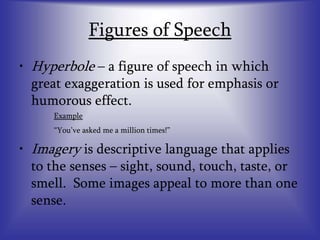
Figures of Speech
• Hyperbole – a figure of speech in which
great exaggeration is used for emphasis or
humorous effect.
Example
“You’ve asked me a million times!”
• Imagery is descriptive language that applies
to the senses – sight, sound, touch, taste, or
smell. Some images appeal to more than one
sense.
Rhyme
• Rhyme is the repetition of the same stressed vowel
sound and any succeeding sounds in two or more
words.
• Internal rhyme occurs within a line of poetry.
• End rhyme occurs at the end of lines.
• Rhyme scheme is the pattern of end rhymes that
may be designated by assigning a different letter of
the alphabet to each new rhyme
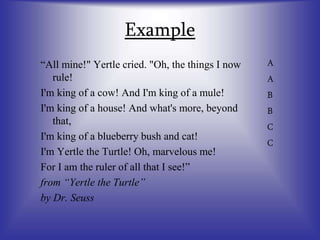
Example
A
A
B
B
C
C
“All mine!" Yertle cried. "Oh, the things I now
rule!
I'm king of a cow! And I'm king of a mule!
I'm king of a house! And what's more, beyond
that,
I'm king of a blueberry bush and cat!
I'm Yertle the Turtle! Oh, marvelous me!
For I am the ruler of all that I see!”
from “Yertle the Turtle”
by Dr. Seuss
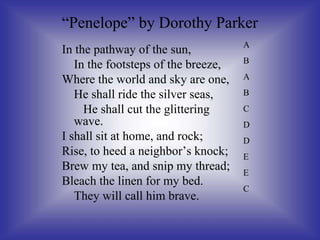
In the pathway of the sun,
In the footsteps of the breeze,
Where the world and sky are one,
He shall ride the silver seas,
He shall cut the glittering
wave.
I shall sit at home, and rock;
Rise, to heed a neighbor’s knock;
Brew my tea, and snip my thread;
Bleach the linen for my bed.
They will call him brave.
“Penelope” by Dorothy Parker
A
B
A
B
C
D
D
E
E
C
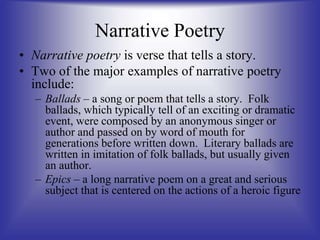
Narrative Poetry
• Narrative poetry is verse that tells a story.
• Two of the major examples of narrative poetry
include:
– Ballads – a song or poem that tells a story. Folk
ballads, which typically tell of an exciting or dramatic
event, were composed by an anonymous singer or
author and passed on by word of mouth for
generations before written down. Literary ballads are
written in imitation of folk ballads, but usually given
an author.
– Epics – a long narrative poem on a great and serious
subject that is centered on the actions of a heroic figure
This Photo by Unknown Author is licensed under CC BY-NC-ND

elements_of_poetry - Copy.ppt

  • 1.
    This Photo byUnknown Author is licensed under CC BY
  • 2.
  • 3.
    Elements of Poetry •Whatis poetry? •Poetry is not prose. Prose is the ordinary language people use in speaking or writing. •Poetry is a form of literary expression that captures intense experiences or creative perceptions of the world in a musical language. •Basically, if prose is like talking, poetry is like singing. •By looking at the set up of a poem, you can see the difference between prose and poetry.
  • 4.
    Distinguishing Characteristics ofPoetry • Unlike prose which has a narrator, poetry has a speaker. – A speaker, or voice, talks to the reader. The speaker is not necessarily the poet. It can also be a fictional person, an animal or even a thing Example But believe me, son. I want to be what I used to be when I was like you. from “Once Upon a Time” by Gabriel Okara
  • 5.
    Distinguishing Characteristics ofPoetry • Poetry is also formatted differently from prose. – A line is a word or row of words that may or may not form a complete sentence. – A stanza is a group of lines forming a unit. The stanzas in a poem are separated by a space. Example Open it. Go ahead, it won’t bite. Well…maybe a little. from “The First Book” by Rita Dove
  • 6.
    Figures of Speech •A figure of speech is a word or expression that is not meant to be read literally. • A simile is a figure of speech using a word such as like or as to compare seemingly unlike things. Example Does it stink like rotten meat? from “Harlem” by Langston Hughes
  • 7.
    Figures of Speech •A metaphor also compares seemingly unlike things, but does not use like or as. Example the moon is a white sliver from “I Am Singing Now” by Luci Tapahonso • Personification attributes human like characteristics to an animal, object, or idea. Example A Spider sewed at Night from “A Spider sewed at Night” by Emily Dickinson
  • 8.
    Figures of Speech •Hyperbole – a figure of speech in which great exaggeration is used for emphasis or humorous effect. Example “You’ve asked me a million times!” • Imagery is descriptive language that applies to the senses – sight, sound, touch, taste, or smell. Some images appeal to more than one sense.
  • 9.
    Rhyme • Rhyme isthe repetition of the same stressed vowel sound and any succeeding sounds in two or more words. • Internal rhyme occurs within a line of poetry. • End rhyme occurs at the end of lines. • Rhyme scheme is the pattern of end rhymes that may be designated by assigning a different letter of the alphabet to each new rhyme
  • 10.
    Example A A B B C C “All mine!" Yertlecried. "Oh, the things I now rule! I'm king of a cow! And I'm king of a mule! I'm king of a house! And what's more, beyond that, I'm king of a blueberry bush and cat! I'm Yertle the Turtle! Oh, marvelous me! For I am the ruler of all that I see!” from “Yertle the Turtle” by Dr. Seuss
  • 11.
    In the pathwayof the sun, In the footsteps of the breeze, Where the world and sky are one, He shall ride the silver seas, He shall cut the glittering wave. I shall sit at home, and rock; Rise, to heed a neighbor’s knock; Brew my tea, and snip my thread; Bleach the linen for my bed. They will call him brave. “Penelope” by Dorothy Parker A B A B C D D E E C
  • 12.
    Narrative Poetry • Narrativepoetry is verse that tells a story. • Two of the major examples of narrative poetry include: – Ballads – a song or poem that tells a story. Folk ballads, which typically tell of an exciting or dramatic event, were composed by an anonymous singer or author and passed on by word of mouth for generations before written down. Literary ballads are written in imitation of folk ballads, but usually given an author. – Epics – a long narrative poem on a great and serious subject that is centered on the actions of a heroic figure
  • 13.
    This Photo byUnknown Author is licensed under CC BY-NC-ND