IBM Systems and Technology                                                                                                      Power Systems
Data Sheet


                                                                 IBM PowerVM for
                                                                 IBM PowerLinux
                                                                 Virtualization without limits


                                                                 Complexity can work its way into any IT infrastructure, driven by the
                    Highlights                                   rollout of new applications and unanticipated change. However, adding
                                                                 servers in response to each demand for new workloads drives the need
           ●● ● ●
                    Deliver services with superior economics     for more datacenter space, power, cooling, network cabling, data storage
                    by more efficient virtualization of Linux
                    workloads
                                                                 and administrative resources. Such complexity leads to inefficiency. The
                                                                 answer is virtualization, which allows organizations to combine multiple
                Deliver services faster by automating
           ●● ● ●
                                                                 potentially disparate workloads on a single platform.
                deployment of virtual machines and
                storage
                                                                 IBM PowerVM® for IBM PowerLinux™ provides the industrial-
                    Dynamically optimize utilization of server
                                                                 strength virtualization solution for IBM PowerLinux servers. Based on
           ●● ● ●


                    and storage resources to control cost and
                    boost ROI                                    more than a decade of evolution and innovation, PowerVM represents
                                                                 the state of the art in enterprise virtualization and is broadly deployed in
           ●● ● ●
                    Flexibly scale your virtualized deploy-
                    ments without impacting performance
                                                                 production environments worldwide by most Power Systems owners.
                    and throughput
                                                                 The IBM PowerLinux family of servers is optimized for scale-out Linux
                Eliminate scheduled downtime by
           ●● ● ●


                deploying live application mobility              computing, maximizing flexibility and reliability when compared to tradi-
                between servers                                  tional Linux servers. With these servers and IBM PowerVM virtualiza-
                                                                 tion, an organization can more efficiently virtualize all server resources
                Deliver higher quality services by
           ●● ● ●


                optimizing virtual resource management           and reduce server sprawl by driving higher utilization per core and more
                and eliminating security vulnerabilities         throughput per server. This efficiency results in significantly reduced
                                                                 costs, with improved service levels and security.

                                                                 PowerVM also offers a reliable and resilient virtualization environment,
                                                                 built on the advanced RAS (reliability, availability and serviceability) fea-
                                                                 tures, extreme scalability and leadership performance1 of the IBM Power
                                                                 Systems platform, based on the outstanding POWER7® processors.
IBM Systems and Technology                                                                                               Power Systems
Data Sheet


In addition, IBM PowerLinux servers with PowerVM offer
midsize businesses a cloud-ready infrastructure that combines
the f lexibility of virtualization without limits and Linux
economics.

Employing virtualization
Organizations can employ virtualization in many ways to
achieve improvements in efficiency and flexibility:

●● ●
       Consolidation of multiple workloads with varied and dynamic
       resource requirements
●● ●
       Rapid deployment and scaling of workloads to meet changing
       business demands
●● ●
       Aggregation of system resources such as CPUs, memory and
       storage into shared pools for dynamic reallocation between
       multiple workloads
●● ●
       Application development and testing in secure, independent
       domains
●● ●
       Live mobility of active workloads between servers to support       or storage resources across multiple operating systems,
       platform upgrades, systems balancing, or to avoid planned          borrowing capacity from idle VMs to handle high resource
       maintenance downtime                                               demands from other workloads.

Processor virtualization                                                  With PowerVM on IBM PowerLinux servers, you have the
IBM PowerLinux servers provide the freedom to run the                     power and flexibility to address multiple system requirements
broadest selection of Linux based Open Source and commercial              in a single machine. PowerVM Micro-Partitioning® supports
applications without the costs and complexity often associated            multiple VMs per processor core and, depending upon the
with managing multiple physical servers. PowerVM can help                 IBM PowerLinux server model, organizations can run up
eliminate underutilized servers because it is designed to pool            to 160 VMs on a single server—each with its own processor,
resources and optimize their use across multiple application              memory, and I/O resources. Processor resources can be
environments and operating system instances. Through                      assigned at a granularity of 1/100th of a core. Consolidating
advanced virtual machine (VM) capabilities, a single VM can               systems with PowerVM can help cut operational costs, improve
act as a completely separate operating environment, using                 availability, ease management and improve service levels,
dedicated or shared system resources. With shared resources,              while allowing businesses to quickly deploy applications.
PowerVM can automatically adjust pooled processor, memory


                                                                      2
IBM Systems and Technology                                                                                               Power Systems
Data Sheet


Multiple Shared Processor Pools allows for the automatic                I/O virtualization
non-disruptive balancing of processing power between VMs                The Virtual I/O Server (VIOS) is a special purpose VM that
assigned to shared pools, resulting in increased throughput.            can be used to virtualize I/O resources for Linux client VMs.
It also provides the ability to cap the processor core resources        VIOS owns the resources that are shared with clients. A physi-
used by a group of VMs to potentially reduce processor-based            cal adapter assigned to the VIOS can be shared by one or more
software licensing costs.                                               other VMs. VIOS is designed to reduce costs by eliminating
                                                                        the need for dedicated network adapters, disk adapters and
Shared Dedicated Capacity allows for the “donation” of spare            disk drives, and tape adapters and tape drives in each client
CPU cycles from dedicated processor VMs to a Shared                     VM. With VIOS, client VMs can easily be created for test,
Processor Pool. Since a dedicated VM maintains absolute                 development, or production purposes.
priority for CPU cycles, enabling this feature can increase
system utilization without compromising the computing                   Shared Storage Pools allow storage subsystems to be combined
power for critical workloads.                                           into a common pool of virtualized storage that can be shared by
                                                                        the VIOS on multiple Power Systems servers. Shared storage
Because its core technology is built into the system firmware,          pools support capabilities such as thin provisioning, whereby
PowerVM offers a highly-secure virtualization platform that             VM storage is dynamically allocated and released as required,
has received the Common Criteria Evaluation and Validation              to improve overall storage resource utilization.
Scheme (CCEVS) EAL4+ certification2 for its security
capabilities.                                                           N_Port ID Virtualization (NPIV) provides direct access to
                                                                        Fiber Channel Adapters from multiple VMs, simplifying the
Memory virtualization                                                   deployment and management of Fiber Channel SAN
PowerVM features Active Memory™ Sharing, a technology                   environments.
that allows you to intelligently and dynamically reallocate mem-
ory from one VM to another for increased utilization, flexibility       Live Partition Mobility
and performance. Active Memory Sharing enables the sharing              PowerVM for IBM PowerLinux Live Partition Mobility
of a pool of physical memory among VMs on a server, helping             supports the concurrent movement of multiple running Linux
to increase memory utilization and drive down system costs.             VMs from one Power Systems server running Linux to another
The memory is dynamically allocated amongst the VMs as                  without application downtime, helping avoid application inter-
needed, to optimize the overall physical memory usage in                ruption for planned system maintenance, provisioning, and
the pool.                                                               workload management. Live Partition Mobility can be used
                                                                        to simplify migration of operating environments to new servers
Active Memory Deduplication is a powerful optimization                  temporarily or permanently.
feature that can be enabled when Active Memory Sharing is
in being used. This memory optimization intelligently detects
and removes duplicate memory pages used between VMs and
as a result reduces overall memory consumption.


                                                                    3
IBM Systems and Technology                                                                                             Power Systems
Data Sheet


Systems management                                                   PowerLinux. With PowerVM, these workloads can be
PowerVM virtualization features are managed through the              combined on a single server or set of servers for maximum
Integrated Virtualization Manager (IVM) or the Hardware              efficiency and low operational cost.
Management Console (HMC)
                                                                     Many IBM software offerings are also optimized for a
IVM allows you to point and click to manage VMs with its             PowerVM environment supporting the consolidation of a
easy-to-use web-based interface. IVM lowers the cost of entry        diverse set of workloads—from database and application
into POWER7 processor-based virtualization since it does             servers to web infrastructure. For example, PowerVM and
not require the use of a centralized management console for          WebSphere® Virtual Enterprise work together to provide
system management. With IVM, you can manage a single                 a cross system virtualized application infrastructure that can
system, including the creation of VMs, virtualized storage           lower operational and energy costs required to create, run,
and virtualized networking.                                          and manage enterprise applications and SOA environments.
                                                                     WebSphere Virtual Enterprise increases flexibility and agility
IBM Systems Director VMControl™ for PowerLinux also                  to ensure business process integrity, improve service and appli-
supports the PowerVM environment. VMControl is the                   cation performance, and better manage application health.
IBM virtualization management tool for multiple, heteroge-
neous servers. With VMControl you can manage PowerVM                 Help from the experts
and other virtualization environments from the same screen.          IBM’s depth and breadth of Linux expertise is unmatched.
VMControl is a plug-in for IBM Systems Director that sup-            IBM has enabled highly skilled Business Partners to help archi-
ports advanced management functions such as health check             tect, size, implement, customize and tune IBM PowerLinux
and topology mappings, as well as the ability to take action         solutions for your business needs. You can be confident in your
on monitored events. VMControl simplifies the creation and           IBM Business Partner’s abilities to help you deliver services
management of standardized virtual appliances (ready-to-run          faster with higher quality and superior economics
VMs) and system pools—combinations of VMs on multiple
servers that can be managed as a single entity.                      IBM Global Services technical consultants not only have hands-
                                                                     on experience and familiarity with these state-of-the-art Linux
Diverse set of workloads                                             servers, but they also maintain intimate knowledge of emerging
The IBM PowerLinux servers and PowerVM for                           technologies, software releases and hardware enhancements
IBM PowerLinux are optimized for specific software stacks,           through working with IBM development teams and research
which are tuned to help address the unique needs of popular          laboratories. When your organization works with IBM to
Linux workloads like infrastructure and ERP, and visionary new       implement PowerVM capabilities, you can benefit from the
solutions for competitive business advantage such as Big Data        extensive intellectual capital and implementation methods that
analytics. For example, Linux distributions for POWER from           the entire IBM Global Services team has accumulated, tested
Red Hat and SUSE include Linux application services for web,         and proven over the years.
email, file and print, and networking optimized for


                                                                 4
IBM Systems and Technology                                                                                                            Power Systems
Data Sheet


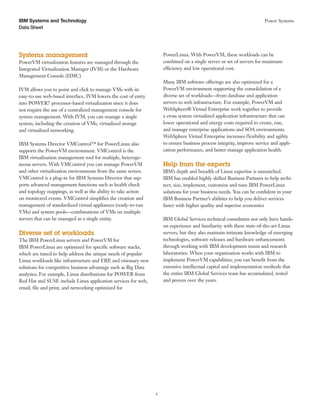
Feature                             Benefits

PowerVM Hypervisor                  ●● ●
                                           Supports multiple operating environments on a single system
Micro-Partitioning                  ●● ●
                                           Enables up to 10 VMs per processor core
Dynamic Logical Partitioning        ●● ●
                                           Processor, memory, and I/O resources can be dynamically moved between VMs
Shared Processor Pools              ●● ●
                                           Processor resources for a group of VMs can be capped, reducing software license costs
                                    ●● ●
                                           VMs can use shared (capped or uncapped) processor resources
                                    ●● ●
                                           Processor resources can automatically move between VMs based on workload demands
Shared Storage Pools                ●● ●
                                           Storage resources for Power Systems servers and VIOS can be centralized in pools to optimize
                                           resource utilization
Integrated Virtualization Manager   ●● ●
                                           Simplifies VM creation and management for entry Power Systems servers and blades
Live Partition Mobility             ●● ●
                                           Live Linux VMs can be moved between servers, eliminating planned downtime
Active Memory Sharing               ●● ●
                                           Intelligently flows memory from one VM to another for increased memory utilization
Active Memory Deduplication         ●● ●
                                           Reduces memory consumption for Active Memory Sharing configurations by detecting and eliminating
                                           duplicate memory pages
NPIV                                ●● ●
                                           Simplifies the management and improves performance of Fibre Channel SAN environments
System Planning Tool                ●● ●
                                           Simplifies the planning for and installation of Power Systems servers with PowerVM


                                                                            5
For more information
To learn more about PowerVM, please contact your
IBM marketing representative or IBM Business Partner,
or visit the following website:
ibm.com/systems/power/software/virtualization/index.html


                                                           Please Recycle


                                                                            POD03066-USEN-02

IBM PowerVM for IBM PowerLinux

  • 1.
    IBM Systems andTechnology Power Systems Data Sheet IBM PowerVM for IBM PowerLinux Virtualization without limits Complexity can work its way into any IT infrastructure, driven by the Highlights rollout of new applications and unanticipated change. However, adding servers in response to each demand for new workloads drives the need ●● ● ● Deliver services with superior economics for more datacenter space, power, cooling, network cabling, data storage by more efficient virtualization of Linux workloads and administrative resources. Such complexity leads to inefficiency. The answer is virtualization, which allows organizations to combine multiple Deliver services faster by automating ●● ● ● potentially disparate workloads on a single platform. deployment of virtual machines and storage IBM PowerVM® for IBM PowerLinux™ provides the industrial- Dynamically optimize utilization of server strength virtualization solution for IBM PowerLinux servers. Based on ●● ● ● and storage resources to control cost and boost ROI more than a decade of evolution and innovation, PowerVM represents the state of the art in enterprise virtualization and is broadly deployed in ●● ● ● Flexibly scale your virtualized deploy- ments without impacting performance production environments worldwide by most Power Systems owners. and throughput The IBM PowerLinux family of servers is optimized for scale-out Linux Eliminate scheduled downtime by ●● ● ● deploying live application mobility computing, maximizing flexibility and reliability when compared to tradi- between servers tional Linux servers. With these servers and IBM PowerVM virtualiza- tion, an organization can more efficiently virtualize all server resources Deliver higher quality services by ●● ● ● optimizing virtual resource management and reduce server sprawl by driving higher utilization per core and more and eliminating security vulnerabilities throughput per server. This efficiency results in significantly reduced costs, with improved service levels and security. PowerVM also offers a reliable and resilient virtualization environment, built on the advanced RAS (reliability, availability and serviceability) fea- tures, extreme scalability and leadership performance1 of the IBM Power Systems platform, based on the outstanding POWER7® processors.
  • 2.
    IBM Systems andTechnology Power Systems Data Sheet In addition, IBM PowerLinux servers with PowerVM offer midsize businesses a cloud-ready infrastructure that combines the f lexibility of virtualization without limits and Linux economics. Employing virtualization Organizations can employ virtualization in many ways to achieve improvements in efficiency and flexibility: ●● ● Consolidation of multiple workloads with varied and dynamic resource requirements ●● ● Rapid deployment and scaling of workloads to meet changing business demands ●● ● Aggregation of system resources such as CPUs, memory and storage into shared pools for dynamic reallocation between multiple workloads ●● ● Application development and testing in secure, independent domains ●● ● Live mobility of active workloads between servers to support or storage resources across multiple operating systems, platform upgrades, systems balancing, or to avoid planned borrowing capacity from idle VMs to handle high resource maintenance downtime demands from other workloads. Processor virtualization With PowerVM on IBM PowerLinux servers, you have the IBM PowerLinux servers provide the freedom to run the power and flexibility to address multiple system requirements broadest selection of Linux based Open Source and commercial in a single machine. PowerVM Micro-Partitioning® supports applications without the costs and complexity often associated multiple VMs per processor core and, depending upon the with managing multiple physical servers. PowerVM can help IBM PowerLinux server model, organizations can run up eliminate underutilized servers because it is designed to pool to 160 VMs on a single server—each with its own processor, resources and optimize their use across multiple application memory, and I/O resources. Processor resources can be environments and operating system instances. Through assigned at a granularity of 1/100th of a core. Consolidating advanced virtual machine (VM) capabilities, a single VM can systems with PowerVM can help cut operational costs, improve act as a completely separate operating environment, using availability, ease management and improve service levels, dedicated or shared system resources. With shared resources, while allowing businesses to quickly deploy applications. PowerVM can automatically adjust pooled processor, memory 2
  • 3.
    IBM Systems andTechnology Power Systems Data Sheet Multiple Shared Processor Pools allows for the automatic I/O virtualization non-disruptive balancing of processing power between VMs The Virtual I/O Server (VIOS) is a special purpose VM that assigned to shared pools, resulting in increased throughput. can be used to virtualize I/O resources for Linux client VMs. It also provides the ability to cap the processor core resources VIOS owns the resources that are shared with clients. A physi- used by a group of VMs to potentially reduce processor-based cal adapter assigned to the VIOS can be shared by one or more software licensing costs. other VMs. VIOS is designed to reduce costs by eliminating the need for dedicated network adapters, disk adapters and Shared Dedicated Capacity allows for the “donation” of spare disk drives, and tape adapters and tape drives in each client CPU cycles from dedicated processor VMs to a Shared VM. With VIOS, client VMs can easily be created for test, Processor Pool. Since a dedicated VM maintains absolute development, or production purposes. priority for CPU cycles, enabling this feature can increase system utilization without compromising the computing Shared Storage Pools allow storage subsystems to be combined power for critical workloads. into a common pool of virtualized storage that can be shared by the VIOS on multiple Power Systems servers. Shared storage Because its core technology is built into the system firmware, pools support capabilities such as thin provisioning, whereby PowerVM offers a highly-secure virtualization platform that VM storage is dynamically allocated and released as required, has received the Common Criteria Evaluation and Validation to improve overall storage resource utilization. Scheme (CCEVS) EAL4+ certification2 for its security capabilities. N_Port ID Virtualization (NPIV) provides direct access to Fiber Channel Adapters from multiple VMs, simplifying the Memory virtualization deployment and management of Fiber Channel SAN PowerVM features Active Memory™ Sharing, a technology environments. that allows you to intelligently and dynamically reallocate mem- ory from one VM to another for increased utilization, flexibility Live Partition Mobility and performance. Active Memory Sharing enables the sharing PowerVM for IBM PowerLinux Live Partition Mobility of a pool of physical memory among VMs on a server, helping supports the concurrent movement of multiple running Linux to increase memory utilization and drive down system costs. VMs from one Power Systems server running Linux to another The memory is dynamically allocated amongst the VMs as without application downtime, helping avoid application inter- needed, to optimize the overall physical memory usage in ruption for planned system maintenance, provisioning, and the pool. workload management. Live Partition Mobility can be used to simplify migration of operating environments to new servers Active Memory Deduplication is a powerful optimization temporarily or permanently. feature that can be enabled when Active Memory Sharing is in being used. This memory optimization intelligently detects and removes duplicate memory pages used between VMs and as a result reduces overall memory consumption. 3
  • 4.
    IBM Systems andTechnology Power Systems Data Sheet Systems management PowerLinux. With PowerVM, these workloads can be PowerVM virtualization features are managed through the combined on a single server or set of servers for maximum Integrated Virtualization Manager (IVM) or the Hardware efficiency and low operational cost. Management Console (HMC) Many IBM software offerings are also optimized for a IVM allows you to point and click to manage VMs with its PowerVM environment supporting the consolidation of a easy-to-use web-based interface. IVM lowers the cost of entry diverse set of workloads—from database and application into POWER7 processor-based virtualization since it does servers to web infrastructure. For example, PowerVM and not require the use of a centralized management console for WebSphere® Virtual Enterprise work together to provide system management. With IVM, you can manage a single a cross system virtualized application infrastructure that can system, including the creation of VMs, virtualized storage lower operational and energy costs required to create, run, and virtualized networking. and manage enterprise applications and SOA environments. WebSphere Virtual Enterprise increases flexibility and agility IBM Systems Director VMControl™ for PowerLinux also to ensure business process integrity, improve service and appli- supports the PowerVM environment. VMControl is the cation performance, and better manage application health. IBM virtualization management tool for multiple, heteroge- neous servers. With VMControl you can manage PowerVM Help from the experts and other virtualization environments from the same screen. IBM’s depth and breadth of Linux expertise is unmatched. VMControl is a plug-in for IBM Systems Director that sup- IBM has enabled highly skilled Business Partners to help archi- ports advanced management functions such as health check tect, size, implement, customize and tune IBM PowerLinux and topology mappings, as well as the ability to take action solutions for your business needs. You can be confident in your on monitored events. VMControl simplifies the creation and IBM Business Partner’s abilities to help you deliver services management of standardized virtual appliances (ready-to-run faster with higher quality and superior economics VMs) and system pools—combinations of VMs on multiple servers that can be managed as a single entity. IBM Global Services technical consultants not only have hands- on experience and familiarity with these state-of-the-art Linux Diverse set of workloads servers, but they also maintain intimate knowledge of emerging The IBM PowerLinux servers and PowerVM for technologies, software releases and hardware enhancements IBM PowerLinux are optimized for specific software stacks, through working with IBM development teams and research which are tuned to help address the unique needs of popular laboratories. When your organization works with IBM to Linux workloads like infrastructure and ERP, and visionary new implement PowerVM capabilities, you can benefit from the solutions for competitive business advantage such as Big Data extensive intellectual capital and implementation methods that analytics. For example, Linux distributions for POWER from the entire IBM Global Services team has accumulated, tested Red Hat and SUSE include Linux application services for web, and proven over the years. email, file and print, and networking optimized for 4
  • 5.
    IBM Systems andTechnology Power Systems Data Sheet Feature Benefits PowerVM Hypervisor ●● ● Supports multiple operating environments on a single system Micro-Partitioning ●● ● Enables up to 10 VMs per processor core Dynamic Logical Partitioning ●● ● Processor, memory, and I/O resources can be dynamically moved between VMs Shared Processor Pools ●● ● Processor resources for a group of VMs can be capped, reducing software license costs ●● ● VMs can use shared (capped or uncapped) processor resources ●● ● Processor resources can automatically move between VMs based on workload demands Shared Storage Pools ●● ● Storage resources for Power Systems servers and VIOS can be centralized in pools to optimize resource utilization Integrated Virtualization Manager ●● ● Simplifies VM creation and management for entry Power Systems servers and blades Live Partition Mobility ●● ● Live Linux VMs can be moved between servers, eliminating planned downtime Active Memory Sharing ●● ● Intelligently flows memory from one VM to another for increased memory utilization Active Memory Deduplication ●● ● Reduces memory consumption for Active Memory Sharing configurations by detecting and eliminating duplicate memory pages NPIV ●● ● Simplifies the management and improves performance of Fibre Channel SAN environments System Planning Tool ●● ● Simplifies the planning for and installation of Power Systems servers with PowerVM 5
  • 6.
    For more information Tolearn more about PowerVM, please contact your IBM marketing representative or IBM Business Partner, or visit the following website: ibm.com/systems/power/software/virtualization/index.html Please Recycle POD03066-USEN-02