zClouds: A better Business Cloud


© Satyam 2009          1
Mainframe - Practice Highlights


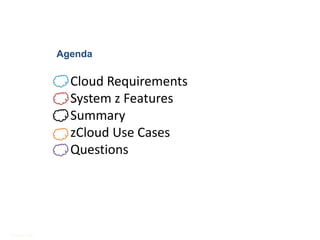
                Agenda

                  Cloud Requirements
                  System z Features
                  Summary
                  zCloud Use Cases
                  Questions


© Satyam 2009                   2
Mainframe - Practice Highlights
   Cloud Requirements

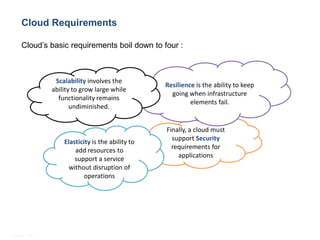
      Cloud’s basic requirements boil down to four :


                 Scalability involves the
                                                       Resilience is the ability to keep
                ability to grow large while
                                                         going when infrastructure
                  functionality remains
                                                                elements fail.
                       undiminished.


                                                       Finally, a cloud must
                    Elasticity is the ability to         support Security
                        add resources to                 requirements for
                        support a service                  applications
                      without disruption of
                            operations


© Satyam 2009                                      3
Mainframe - Practice Highlights
   Scalability
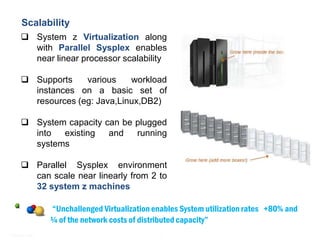
      System z Virtualization along
       with Parallel Sysplex enables
       near linear processor scalability

      Supports    various    workload
       instances on a basic set of
       resources (eg: Java,Linux,DB2)

      System capacity can be plugged
       into  existing   and   running
       systems

      Parallel Sysplex environment
       can scale near linearly from 2 to
       32 system z machines

                “Unchallenged Virtualization enables System utilization rates +80% and
                ¼ of the network costs of distributed capacity”
© Satyam 2009                                 4
Mainframe - Practice Highlights
   Virtualization
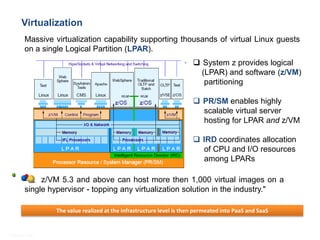
        Massive virtualization capability supporting thousands of virtual Linux guests
        on a single Logical Partition (LPAR).
                                                                       System z provides logical
                                                                        (LPAR) and software (z/VM)
                                                                         partitioning

                                                                       PR/SM enables highly
                                                                        scalable virtual server
                                                                        hosting for LPAR and z/VM

                                                                       IRD coordinates allocation
                                                                        of CPU and I/O resources
                                                                        among LPARs

        “… z/VM 5.3 and above can host more then 1,000 virtual images on a
        single hypervisor - topping any virtualization solution in the industry."

                 The value realized at the infrastructure level is then permeated into PaaS and SaaS


© Satyam 2009                                            5
Mainframe - Practice Highlights
      The Power and Flexibility of System z Virtualization
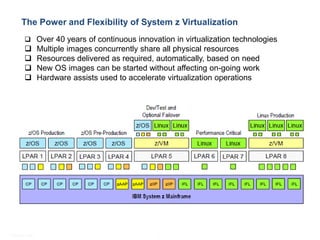
         Over 40 years of continuous innovation in virtualization technologies
               Multiple images concurrently share all physical resources
               Resources delivered as required, automatically, based on need
               New OS images can be started without affecting on-going work
               Hardware assists used to accelerate virtualization operations


© Satyam 2009                                    6
Mainframe - Practice Highlights
   Parallel SYStems comPLEX
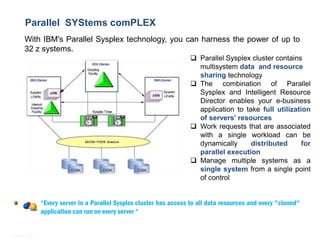
        With IBM's Parallel Sysplex technology, you can harness the power of up to
        32 z systems.
                                                                       Parallel Sysplex cluster contains
                                                                        multisystem data and resource
                                                                        sharing technology
                                                                       The combination of Parallel
                                                                        Sysplex and Intelligent Resource
                                                                        Director enables your e-business
                                                                        application to take full utilization
                                                                        of servers’ resources
                                                                       Work requests that are associated
                                                                        with a single workload can be
                                                                        dynamically      distributed      for
                                                                        parallel execution
                                                                       Manage multiple systems as a
                                                                        single system from a single point
                                                                        of control


                “Every server in a Parallel Sysplex cluster has access to all data resources and every "cloned"
                application can run on every server “


© Satyam 2009                                              7
Mainframe - Practice Highlights
   Resilience
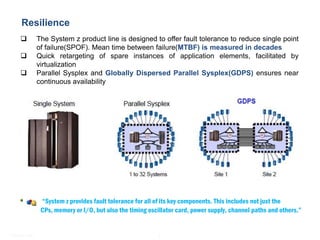
               The System z product line is designed to offer fault tolerance to reduce single point
                of failure(SPOF). Mean time between failure(MTBF) is measured in decades
               Quick retargeting of spare instances of application elements, facilitated by
                virtualization
               Parallel Sysplex and Globally Dispersed Parallel Sysplex(GDPS) ensures near
                continuous availability


                 “System z provides fault tolerance for all of its key components. This includes not just the
                 CPs, memory or I/O, but also the timing oscillator card, power supply, channel paths and others.”


© Satyam 2009                                                8
Mainframe - Practice Highlights
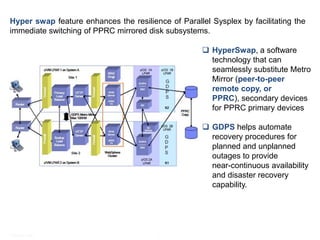
Hyper swap feature enhances the resilience of Parallel Sysplex by facilitating the
immediate switching of PPRC mirrored disk subsystems.

                                                      HyperSwap, a software
                                                       technology that can
                                                       seamlessly substitute Metro
                                                       Mirror (peer-to-peer
                                                       remote copy, or
                                                       PPRC), secondary devices
                                                       for PPRC primary devices

                                                      GDPS helps automate
                                                       recovery procedures for
                                                       planned and unplanned
                                                       outages to provide
                                                       near-continuous availability
                                                       and disaster recovery
                                                       capability.


© Satyam 2009                            9
Mainframe - Practice Highlights
      Elasticity
      The      virtualization,   resource
       allocation and coordination are built
       into the platform

      Shared everything enables less
       components and a more simplistic
       IT foundation

      Supports capacity upgrade on
       demand (CUoD) and on/Off
       Capacity on demand(on/off CoD)
       that is transparent to end users

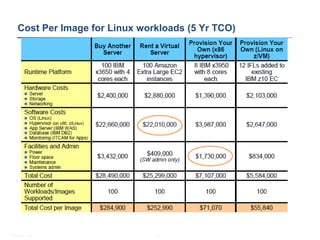
       Cost Per Image for Linux workloads is lowest for a z/VM based
        private cloud by adding IFLs to existing System z infrastructure


© Satyam 2009                          10
Mainframe - Practice Highlights

      CUoD & On/Off CoD
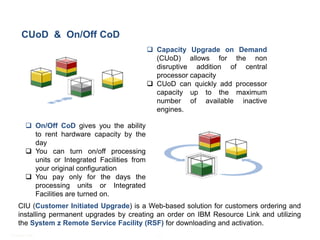
                                                 Capacity Upgrade on Demand
                                                  (CUoD) allows for the non
                                                  disruptive addition of central
                                                  processor capacity
                                                 CUoD can quickly add processor
                                                  capacity up to the maximum
                                                  number of available inactive
                                                  engines.

         On/Off CoD gives you the ability
          to rent hardware capacity by the
          day
         You can turn on/off processing
          units or Integrated Facilities from
          your original configuration
         You pay only for the days the
          processing units or Integrated
          Facilities are turned on.
    CIU (Customer Initiated Upgrade) is a Web-based solution for customers ordering and
    installing permanent upgrades by creating an order on IBM Resource Link and utilizing
    the System z Remote Service Facility (RSF) for downloading and activation.
© Satyam 2009                                      11
Mainframe - Practice Highlights
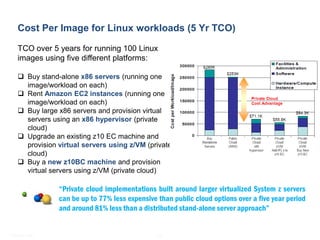
    Cost Per Image for Linux workloads (5 Yr TCO)

    TCO over 5 years for running 100 Linux
    images using five different platforms:

     Buy stand-alone x86 servers (running one
      image/workload on each)
     Rent Amazon EC2 instances (running one
      image/workload on each)
     Buy large x86 servers and provision virtual
      servers using an x86 hypervisor (private
      cloud)
     Upgrade an existing z10 EC machine and
      provision virtual servers using z/VM (private
      cloud)
     Buy a new z10BC machine and provision
      virtual servers using z/VM (private cloud)

                “Private cloud implementations built around larger virtualized System z servers
                can be up to 77% less expensive than public cloud options over a five year period
                and around 81% less than a distributed stand-alone server approach”


© Satyam 2009                                   12
Mainframe - Practice Highlights
    Cost Per Image for Linux workloads (5 Yr TCO)


© Satyam 2009                    13
Mainframe - Practice Highlights
   Security
               Extremely high levels of security
                for guest operating systems
                 Hardware Registry
                 Virtual Address Space
                 IOCDS Definitions
               z/VM user definition and z/VM
                security is accomplished by the
                z/VM directory.
               ESMs like Resource Access
                Control Facility (RACF) provide
                additional   centralized    security
                functions
               The cryptographic co-processor              The z/OS IDS uses policy-based - rather
                does      encryption               in        than signature-based - identification with
                hardware,        reducing        the         capabilities for detecting and preventing not
                performance penalty                          only known attacks, but also new attacks
               With z/VM you can setup the                  for which there are no developed attack
                TCP/IP connections to the z/VM               signatures.
                guests to be protected by Secure            zSeries hardware partitioning was the first
                Socket Layer (SSL).                          product of its kind to be awarded EAL5
               Uses the internal Hipersockets to            (Evaluation Assurance Level)
                reduce the security risks that come          international common criteria security
                with network externalization                 certification.
© Satyam 2009                                           14
Mainframe - Practice Highlights


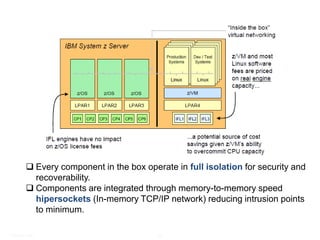
         Every component in the box operate in full isolation for security and
          recoverability.
         Components are integrated through memory-to-memory speed
          hipersockets (In-memory TCP/IP network) reducing intrusion points
          to minimum.

© Satyam 2009                            15
Mainframe - Practice Highlights
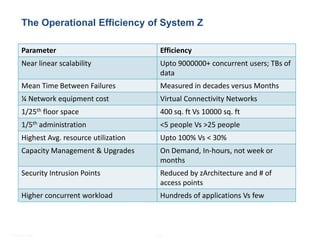
   The Operational Efficiency of System Z

      Parameter                            Efficiency
      Near linear scalability              Upto 9000000+ concurrent users; TBs of
                                           data
      Mean Time Between Failures           Measured in decades versus Months
      ¼ Network equipment cost             Virtual Connectivity Networks
      1/25th floor space                   400 sq. ft Vs 10000 sq. ft
      1/5th administration                 <5 people Vs >25 people
      Highest Avg. resource utilization    Upto 100% Vs < 30%
      Capacity Management & Upgrades       On Demand, In-hours, not week or
                                           months
      Security Intrusion Points            Reduced by zArchitecture and # of
                                           access points
      Higher concurrent workload           Hundreds of applications Vs few


© Satyam 2009                             16
Mainframe - Practice Highlights
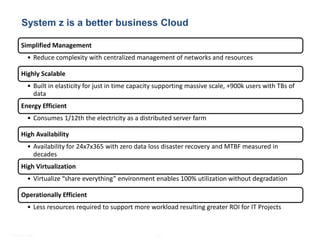
   System z is a better business Cloud

      Simplified Management
         • Reduce complexity with centralized management of networks and resources

      Highly Scalable
         • Built in elasticity for just in time capacity supporting massive scale, +900k users with TBs of
           data
      Energy Efficient
         • Consumes 1/12th the electricity as a distributed server farm

      High Availability
         • Availability for 24x7x365 with zero data loss disaster recovery and MTBF measured in
           decades
      High Virtualization
         • Virtualize “share everything” environment enables 100% utilization without degradation

      Operationally Efficient
         • Less resources required to support more workload resulting greater ROI for IT Projects


© Satyam 2009                                           17
Mainframe - Practice Highlights
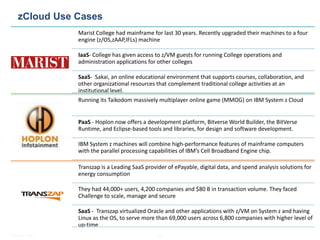
  zCloud Use Cases
                Marist College had mainframe for last 30 years. Recently upgraded their machines to a four
                engine (z/OS,zAAP,IFLs) machine

                IaaS- College has given access to z/VM guests for running College operations and
                administration applications for other colleges

                SaaS- Sakai, an online educational environment that supports courses, collaboration, and
                other organizational resources that complement traditional college activities at an
                institutional level.
                Running its Taikodom massively multiplayer online game (MMOG) on IBM System z Cloud


                PaaS - Hoplon now offers a development platform, Bitverse World Builder, the BitVerse
                Runtime, and Eclipse-based tools and libraries, for design and software development.

                IBM System z machines will combine high-performance features of mainframe computers
                with the parallel processing capabilities of IBM’s Cell Broadband Engine chip.

                Transzap is a Leading SaaS provider of ePayable, digital data, and spend analysis solutions for
                energy consumption

                They had 44,000+ users, 4,200 companies and $80 B in transaction volume. They faced
                Challenge to scale, manage and secure

                SaaS - Transzap virtualized Oracle and other applications with z/VM on System z and having
                Linux as the OS, to serve more than 69,000 users across 6,800 companies with higher level of
                up-time
© Satyam 2009                                   18

zClouds - A better business Cloud

  • 1.
    zClouds: A betterBusiness Cloud © Satyam 2009 1
  • 2.
    Mainframe - PracticeHighlights Agenda Cloud Requirements System z Features Summary zCloud Use Cases Questions © Satyam 2009 2
  • 3.
    Mainframe - PracticeHighlights Cloud Requirements Cloud’s basic requirements boil down to four : Scalability involves the Resilience is the ability to keep ability to grow large while going when infrastructure functionality remains elements fail. undiminished. Finally, a cloud must Elasticity is the ability to support Security add resources to requirements for support a service applications without disruption of operations © Satyam 2009 3
  • 4.
    Mainframe - PracticeHighlights Scalability  System z Virtualization along with Parallel Sysplex enables near linear processor scalability  Supports various workload instances on a basic set of resources (eg: Java,Linux,DB2)  System capacity can be plugged into existing and running systems  Parallel Sysplex environment can scale near linearly from 2 to 32 system z machines “Unchallenged Virtualization enables System utilization rates +80% and ¼ of the network costs of distributed capacity” © Satyam 2009 4
  • 5.
    Mainframe - PracticeHighlights Virtualization Massive virtualization capability supporting thousands of virtual Linux guests on a single Logical Partition (LPAR).  System z provides logical (LPAR) and software (z/VM) partitioning  PR/SM enables highly scalable virtual server hosting for LPAR and z/VM  IRD coordinates allocation of CPU and I/O resources among LPARs “… z/VM 5.3 and above can host more then 1,000 virtual images on a single hypervisor - topping any virtualization solution in the industry." The value realized at the infrastructure level is then permeated into PaaS and SaaS © Satyam 2009 5
  • 6.
    Mainframe - PracticeHighlights The Power and Flexibility of System z Virtualization  Over 40 years of continuous innovation in virtualization technologies  Multiple images concurrently share all physical resources  Resources delivered as required, automatically, based on need  New OS images can be started without affecting on-going work  Hardware assists used to accelerate virtualization operations © Satyam 2009 6
  • 7.
    Mainframe - PracticeHighlights Parallel SYStems comPLEX With IBM's Parallel Sysplex technology, you can harness the power of up to 32 z systems.  Parallel Sysplex cluster contains multisystem data and resource sharing technology  The combination of Parallel Sysplex and Intelligent Resource Director enables your e-business application to take full utilization of servers’ resources  Work requests that are associated with a single workload can be dynamically distributed for parallel execution  Manage multiple systems as a single system from a single point of control “Every server in a Parallel Sysplex cluster has access to all data resources and every "cloned" application can run on every server “ © Satyam 2009 7
  • 8.
    Mainframe - PracticeHighlights Resilience  The System z product line is designed to offer fault tolerance to reduce single point of failure(SPOF). Mean time between failure(MTBF) is measured in decades  Quick retargeting of spare instances of application elements, facilitated by virtualization  Parallel Sysplex and Globally Dispersed Parallel Sysplex(GDPS) ensures near continuous availability “System z provides fault tolerance for all of its key components. This includes not just the CPs, memory or I/O, but also the timing oscillator card, power supply, channel paths and others.” © Satyam 2009 8
  • 9.
    Mainframe - PracticeHighlights Hyper swap feature enhances the resilience of Parallel Sysplex by facilitating the immediate switching of PPRC mirrored disk subsystems.  HyperSwap, a software technology that can seamlessly substitute Metro Mirror (peer-to-peer remote copy, or PPRC), secondary devices for PPRC primary devices  GDPS helps automate recovery procedures for planned and unplanned outages to provide near-continuous availability and disaster recovery capability. © Satyam 2009 9
  • 10.
    Mainframe - PracticeHighlights Elasticity  The virtualization, resource allocation and coordination are built into the platform  Shared everything enables less components and a more simplistic IT foundation  Supports capacity upgrade on demand (CUoD) and on/Off Capacity on demand(on/off CoD) that is transparent to end users  Cost Per Image for Linux workloads is lowest for a z/VM based private cloud by adding IFLs to existing System z infrastructure © Satyam 2009 10
  • 11.
    Mainframe - PracticeHighlights CUoD & On/Off CoD  Capacity Upgrade on Demand (CUoD) allows for the non disruptive addition of central processor capacity  CUoD can quickly add processor capacity up to the maximum number of available inactive engines.  On/Off CoD gives you the ability to rent hardware capacity by the day  You can turn on/off processing units or Integrated Facilities from your original configuration  You pay only for the days the processing units or Integrated Facilities are turned on. CIU (Customer Initiated Upgrade) is a Web-based solution for customers ordering and installing permanent upgrades by creating an order on IBM Resource Link and utilizing the System z Remote Service Facility (RSF) for downloading and activation. © Satyam 2009 11
  • 12.
    Mainframe - PracticeHighlights Cost Per Image for Linux workloads (5 Yr TCO) TCO over 5 years for running 100 Linux images using five different platforms:  Buy stand-alone x86 servers (running one image/workload on each)  Rent Amazon EC2 instances (running one image/workload on each)  Buy large x86 servers and provision virtual servers using an x86 hypervisor (private cloud)  Upgrade an existing z10 EC machine and provision virtual servers using z/VM (private cloud)  Buy a new z10BC machine and provision virtual servers using z/VM (private cloud) “Private cloud implementations built around larger virtualized System z servers can be up to 77% less expensive than public cloud options over a five year period and around 81% less than a distributed stand-alone server approach” © Satyam 2009 12
  • 13.
    Mainframe - PracticeHighlights Cost Per Image for Linux workloads (5 Yr TCO) © Satyam 2009 13
  • 14.
    Mainframe - PracticeHighlights Security  Extremely high levels of security for guest operating systems  Hardware Registry  Virtual Address Space  IOCDS Definitions  z/VM user definition and z/VM security is accomplished by the z/VM directory.  ESMs like Resource Access Control Facility (RACF) provide additional centralized security functions  The cryptographic co-processor  The z/OS IDS uses policy-based - rather does encryption in than signature-based - identification with hardware, reducing the capabilities for detecting and preventing not performance penalty only known attacks, but also new attacks  With z/VM you can setup the for which there are no developed attack TCP/IP connections to the z/VM signatures. guests to be protected by Secure  zSeries hardware partitioning was the first Socket Layer (SSL). product of its kind to be awarded EAL5  Uses the internal Hipersockets to (Evaluation Assurance Level) reduce the security risks that come international common criteria security with network externalization certification. © Satyam 2009 14
  • 15.
    Mainframe - PracticeHighlights  Every component in the box operate in full isolation for security and recoverability.  Components are integrated through memory-to-memory speed hipersockets (In-memory TCP/IP network) reducing intrusion points to minimum. © Satyam 2009 15
  • 16.
    Mainframe - PracticeHighlights The Operational Efficiency of System Z Parameter Efficiency Near linear scalability Upto 9000000+ concurrent users; TBs of data Mean Time Between Failures Measured in decades versus Months ¼ Network equipment cost Virtual Connectivity Networks 1/25th floor space 400 sq. ft Vs 10000 sq. ft 1/5th administration <5 people Vs >25 people Highest Avg. resource utilization Upto 100% Vs < 30% Capacity Management & Upgrades On Demand, In-hours, not week or months Security Intrusion Points Reduced by zArchitecture and # of access points Higher concurrent workload Hundreds of applications Vs few © Satyam 2009 16
  • 17.
    Mainframe - PracticeHighlights System z is a better business Cloud Simplified Management • Reduce complexity with centralized management of networks and resources Highly Scalable • Built in elasticity for just in time capacity supporting massive scale, +900k users with TBs of data Energy Efficient • Consumes 1/12th the electricity as a distributed server farm High Availability • Availability for 24x7x365 with zero data loss disaster recovery and MTBF measured in decades High Virtualization • Virtualize “share everything” environment enables 100% utilization without degradation Operationally Efficient • Less resources required to support more workload resulting greater ROI for IT Projects © Satyam 2009 17
  • 18.
    Mainframe - PracticeHighlights zCloud Use Cases Marist College had mainframe for last 30 years. Recently upgraded their machines to a four engine (z/OS,zAAP,IFLs) machine IaaS- College has given access to z/VM guests for running College operations and administration applications for other colleges SaaS- Sakai, an online educational environment that supports courses, collaboration, and other organizational resources that complement traditional college activities at an institutional level. Running its Taikodom massively multiplayer online game (MMOG) on IBM System z Cloud PaaS - Hoplon now offers a development platform, Bitverse World Builder, the BitVerse Runtime, and Eclipse-based tools and libraries, for design and software development. IBM System z machines will combine high-performance features of mainframe computers with the parallel processing capabilities of IBM’s Cell Broadband Engine chip. Transzap is a Leading SaaS provider of ePayable, digital data, and spend analysis solutions for energy consumption They had 44,000+ users, 4,200 companies and $80 B in transaction volume. They faced Challenge to scale, manage and secure SaaS - Transzap virtualized Oracle and other applications with z/VM on System z and having Linux as the OS, to serve more than 69,000 users across 6,800 companies with higher level of up-time © Satyam 2009 18