PYRIDINE
NAME : YASH HIRVE
ROLL NO : 21
1. INTRODUCTION
• Pyridine on an industrial scale is obtained from coal tar
(0. 1%) or by distilitionof bone oil from bones.
• Pyridine is a basic, heterocyclic, organic compound
(C₅H₅N) structurally related to benzene but with one
methine group replaced by a nitrogen atom, known for
its flammable, weakly alkaline, water-miscible, and foul-
smelling properties
2. PROPERTIES OF PYRIDINE
• Pyridine is a colourless liquid with a characteristic and unpleasant
odour.
• Its boiling point is 115.5°C.
• It is soluble in water and most of the organic solvents
• The chemistry of pyridine can be explained under the following
heads:
• 1) Stucture of pyridine.
• 2) Hybridisation of pyridine, and
• 3) Basicity of pyridine
3. STRUCTURE
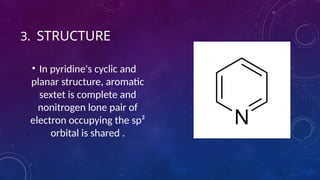
• In pyridine's cyclic and
planar structure, aromatic
sextet is complete and
nonitrogen lone pair of
electron occupying the sp²
orbital is shared .
4.SYNTHESIS OF PYRIDINE
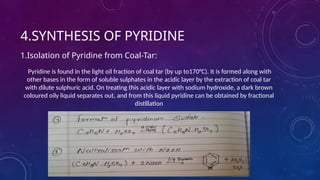
1.Isolation of Pyridine from Coal-Tar:
Pyridine is found in the light oil fraction of coal tar (by up to170°C). It is formed along with
other bases in the form of soluble sulphates in the acidic layer by the extraction of coal tar
with dilute sulphuric acid. On treating this acidic layer with sodium hydroxide, a dark brown
coloured oily liquid separates out, and from this liquid pyridine can be obtained by fractional
distillation
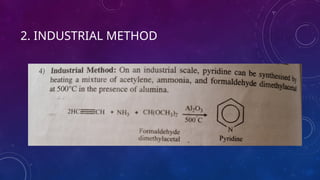
2. INDUSTRIAL METHOD
5. REACTION OF PYRIDINE
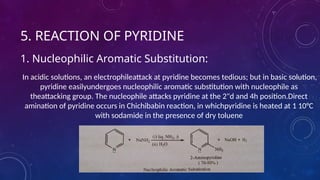
1. Nucleophilic Aromatic Substitution:
In acidic solutions, an electrophileattack at pyridine becomes tedious; but in basic solution,
pyridine easilyundergoes nucleophilic aromatic substitution with nucleophile as
theattacking group. The nucleophile attacks pyridine at the 2"d and 4h position.Direct
amination of pyridine occurs in Chichibabin reaction, in whichpyridine is heated at 1 10°C
with sodamide in the presence of dry toluene
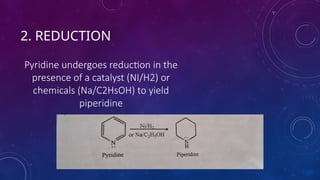
2. REDUCTION
Pyridine undergoes reduction in the
presence of a catalyst (NI/H2) or
chemicals (Na/C2HsOH) to yield
piperidine
6. MEDICINAL USES
1. Antiviral
2. Anticancer
3. Antibacterial
4. Antifungal
5. Anti-inflammatory
6. Antidiabetic
activities
THANK YOU

POC 3 PYRIDINE ppt heps to Study it.pptx

  • 1.
    PYRIDINE NAME : YASHHIRVE ROLL NO : 21
  • 2.
    1. INTRODUCTION • Pyridineon an industrial scale is obtained from coal tar (0. 1%) or by distilitionof bone oil from bones. • Pyridine is a basic, heterocyclic, organic compound (C₅H₅N) structurally related to benzene but with one methine group replaced by a nitrogen atom, known for its flammable, weakly alkaline, water-miscible, and foul- smelling properties
  • 3.
    2. PROPERTIES OFPYRIDINE • Pyridine is a colourless liquid with a characteristic and unpleasant odour. • Its boiling point is 115.5°C. • It is soluble in water and most of the organic solvents • The chemistry of pyridine can be explained under the following heads: • 1) Stucture of pyridine. • 2) Hybridisation of pyridine, and • 3) Basicity of pyridine
  • 4.
    3. STRUCTURE • Inpyridine's cyclic and planar structure, aromatic sextet is complete and nonitrogen lone pair of electron occupying the sp² orbital is shared .
  • 5.
    4.SYNTHESIS OF PYRIDINE 1.Isolationof Pyridine from Coal-Tar: Pyridine is found in the light oil fraction of coal tar (by up to170°C). It is formed along with other bases in the form of soluble sulphates in the acidic layer by the extraction of coal tar with dilute sulphuric acid. On treating this acidic layer with sodium hydroxide, a dark brown coloured oily liquid separates out, and from this liquid pyridine can be obtained by fractional distillation
  • 6.
  • 7.
    5. REACTION OFPYRIDINE 1. Nucleophilic Aromatic Substitution: In acidic solutions, an electrophileattack at pyridine becomes tedious; but in basic solution, pyridine easilyundergoes nucleophilic aromatic substitution with nucleophile as theattacking group. The nucleophile attacks pyridine at the 2"d and 4h position.Direct amination of pyridine occurs in Chichibabin reaction, in whichpyridine is heated at 1 10°C with sodamide in the presence of dry toluene

  • 8.
    2. REDUCTION Pyridine undergoesreduction in the presence of a catalyst (NI/H2) or chemicals (Na/C2HsOH) to yield piperidine
  • 9.
    6. MEDICINAL USES 1.Antiviral 2. Anticancer 3. Antibacterial 4. Antifungal 5. Anti-inflammatory 6. Antidiabetic activities
  • 10.