Introduction to NFS v4 and pNFS
    PRESENTATION TITLE GOES HERE


 David Black, SNIA Technical Council, EMC


                                    slides by Alan Yoder, NetApp
                                    with thanks to Michael Eisler
                                    and Brent Welch
NFS v4.0


  Under development from 1998-2005
    primarily driven by Sun, Netapp, Hummingbird
    some University involvement (CITI UMich, CMU)
    systems beginning to ship
       available in Linux


                                        © 2008 Storage Networking Industry Association. All Rights Reserved.
NFS v4.0


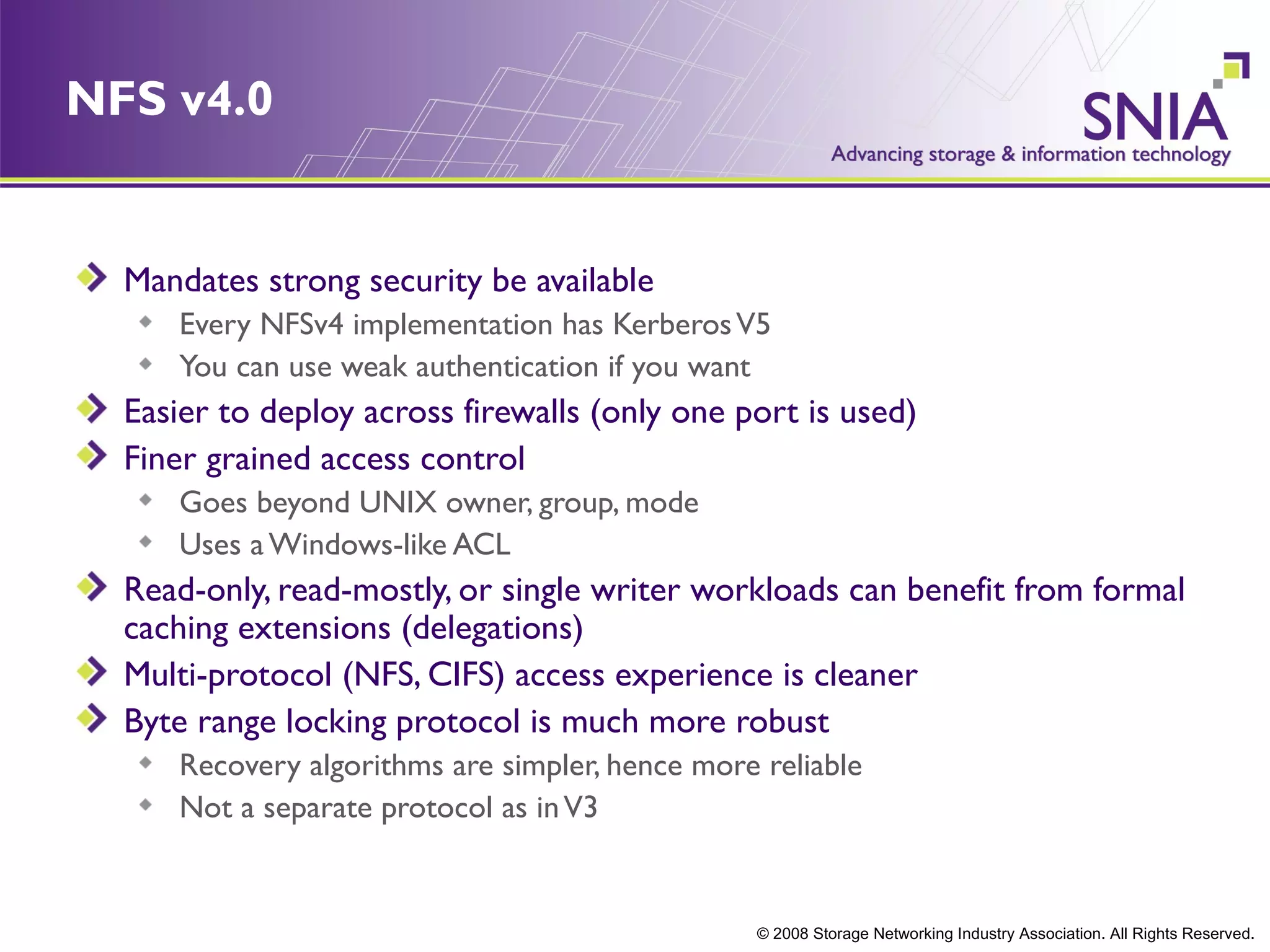
  Mandates strong security be available
     Every NFSv4 implementation has Kerberos V5
     You can use weak authentication if you want
  Easier to deploy across firewalls (only one port is used)
  Finer grained access control
     Goes beyond UNIX owner, group, mode
     Uses a Windows-like ACL
  Read-only, read-mostly, or single writer workloads can benefit from formal
  caching extensions (delegations)
  Multi-protocol (NFS, CIFS) access experience is cleaner
  Byte range locking protocol is much more robust
     Recovery algorithms are simpler, hence more reliable
     Not a separate protocol as in V3


                                                © 2008 Storage Networking Industry Association. All Rights Reserved.
NFS v3 and v4 compared


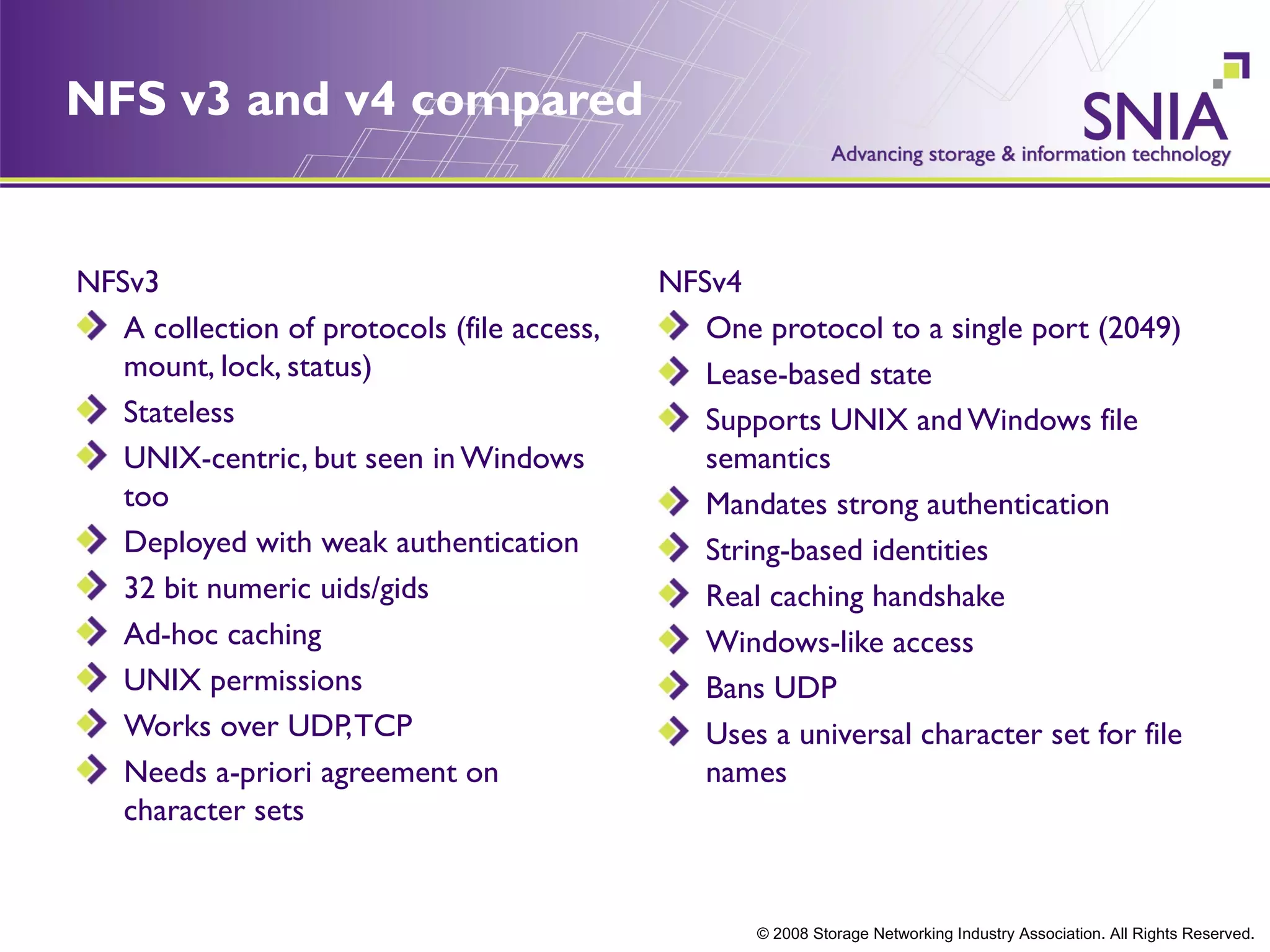
NFSv3                                        NFSv4
   A collection of protocols (file access,      One protocol to a single port (2049)
   mount, lock, status)                         Lease-based state
   Stateless                                    Supports UNIX and Windows file
   UNIX-centric, but seen in Windows            semantics
   too                                          Mandates strong authentication
   Deployed with weak authentication            String-based identities
   32 bit numeric uids/gids                     Real caching handshake
   Ad-hoc caching                               Windows-like access
   UNIX permissions                             Bans UDP
   Works over UDP, TCP                          Uses a universal character set for file
   Needs a-priori agreement on                  names
   character sets


                                                    © 2008 Storage Networking Industry Association. All Rights Reserved.
pNFS history


  Idea to use SAN FS architecture for NFS originally from Gary
  Grider (LANL) and Lee Ward (Sandia)
  Development driven by Panasas, Netapp, Sun, EMC, IBM,
  UMich/CITI
  Folded into NFSv4 minor version NFSv4.1 in 2006


                                      © 2008 Storage Networking Industry Association. All Rights Reserved.
pNFS


 Essentially makes clients aware of how a clustered filesystem
 stripes files
 Files accessible via pNFS can be accessed via non-parallel NFS
 (and in the case of filers, CIFS, and other file access protocols)
 Benefits workloads with
    many small files
    very large files
 Three supported methods of access to data:
    Blocks (FC, iSCSI)
    Objects (OSD)
    Files (NFSv4.1)


                                        © 2008 Storage Networking Industry Association. All Rights Reserved.
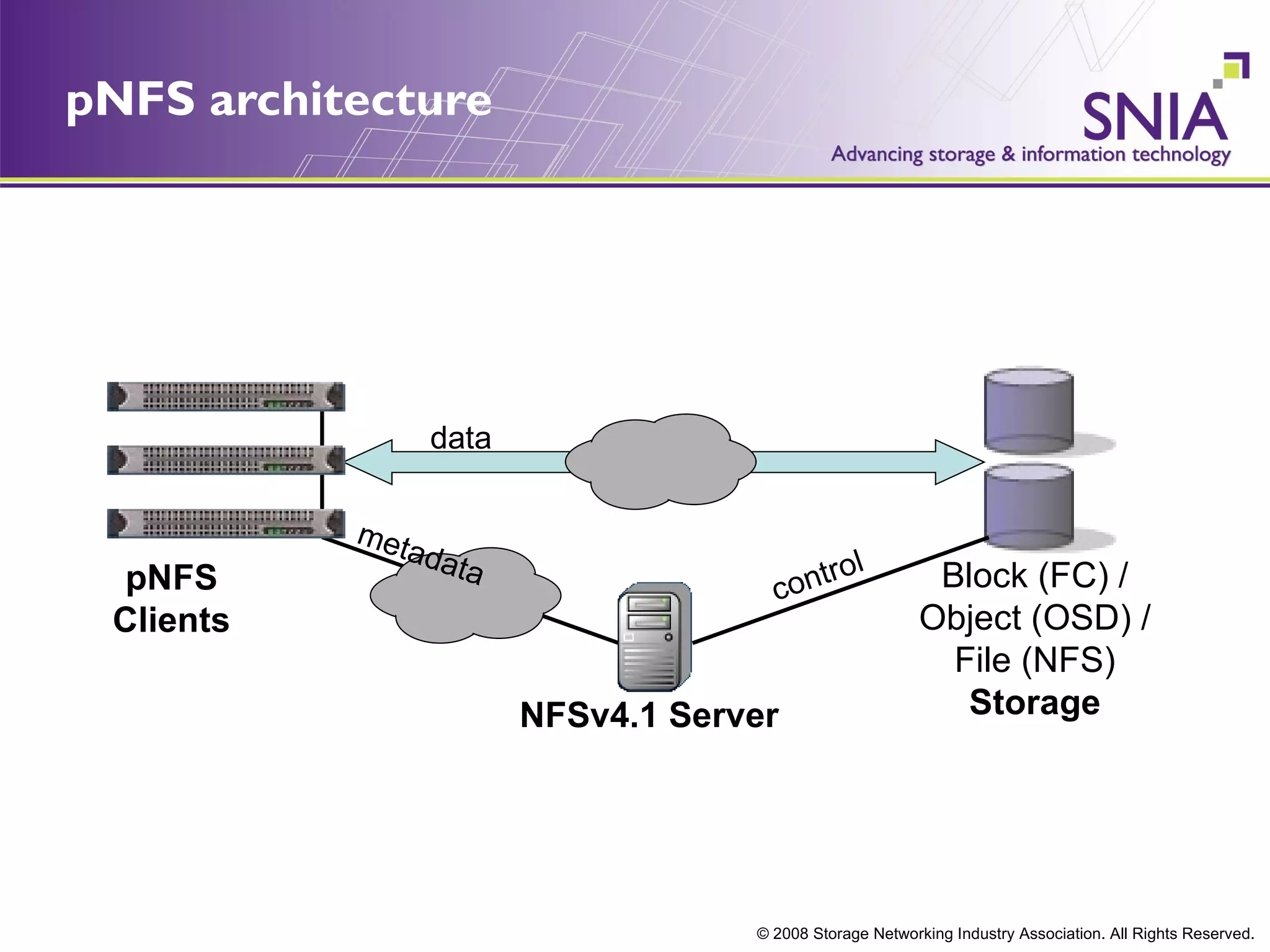
pNFS architecture


                  data

           met
                 ada                              l
                    ta                        o
  pNFS                                 c ontr               Block (FC) /
 Clients                                                   Object (OSD) /
                                                             File (NFS)
                         NFSv4.1 Server                       Storage


                                     © 2008 Storage Networking Industry Association. All Rights Reserved.
pNFS architecture


                              data

                       met
                             ada                                   l
     pNFS                       ta                          tro              Block (FC) /
                                                        con
    Clients                                                                 Object (OSD) /
                                                                              File (NFS)
                                     NFSv4.1 Server                            Storage
Only this is covered by the pNFS protocol
Client-to-storage data path and server-to-storage control path are specified
elsewhere, e.g.
    SCSI Block Commands (SBC) over Fibre Channel (FC)
    SCSI Object-based Storage Device (OSD) over iSCSI
    Network File System (NFS)


                                                      © 2008 Storage Networking Industry Association. All Rights Reserved.
pNFS basic operation


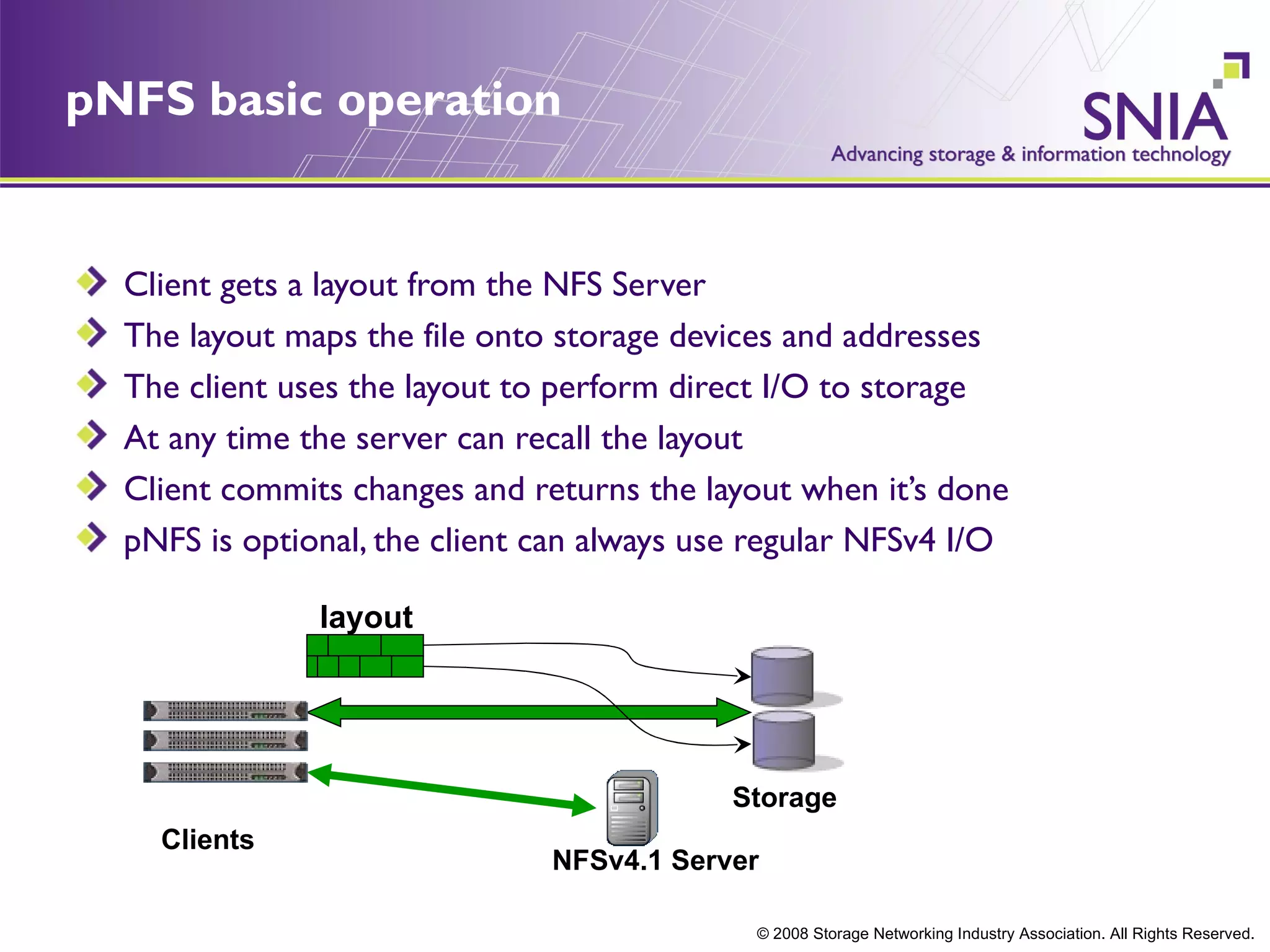
  Client gets a layout from the NFS Server
  The layout maps the file onto storage devices and addresses
  The client uses the layout to perform direct I/O to storage
  At any time the server can recall the layout
  Client commits changes and returns the layout when it’s done
  pNFS is optional, the client can always use regular NFSv4 I/O

               layout


                                           Storage
    Clients
                               NFSv4.1 Server

                                             © 2008 Storage Networking Industry Association. All Rights Reserved.
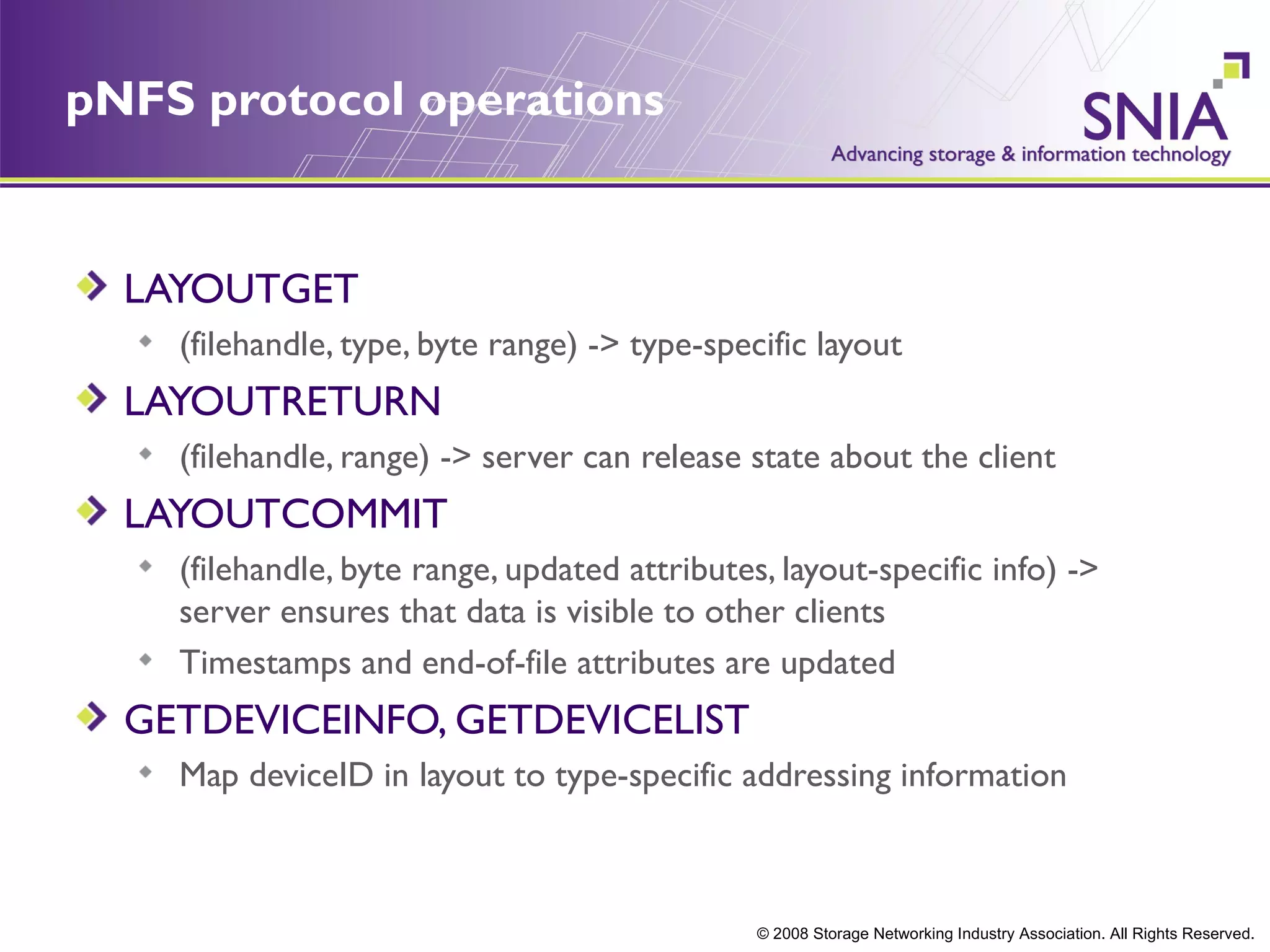
pNFS protocol operations


  LAYOUTGET
    (filehandle, type, byte range) -> type-specific layout
  LAYOUTRETURN
    (filehandle, range) -> server can release state about the client
  LAYOUTCOMMIT
    (filehandle, byte range, updated attributes, layout-specific info) ->
    server ensures that data is visible to other clients
    Timestamps and end-of-file attributes are updated
  GETDEVICEINFO, GETDEVICELIST
    Map deviceID in layout to type-specific addressing information


                                               © 2008 Storage Networking Industry Association. All Rights Reserved.
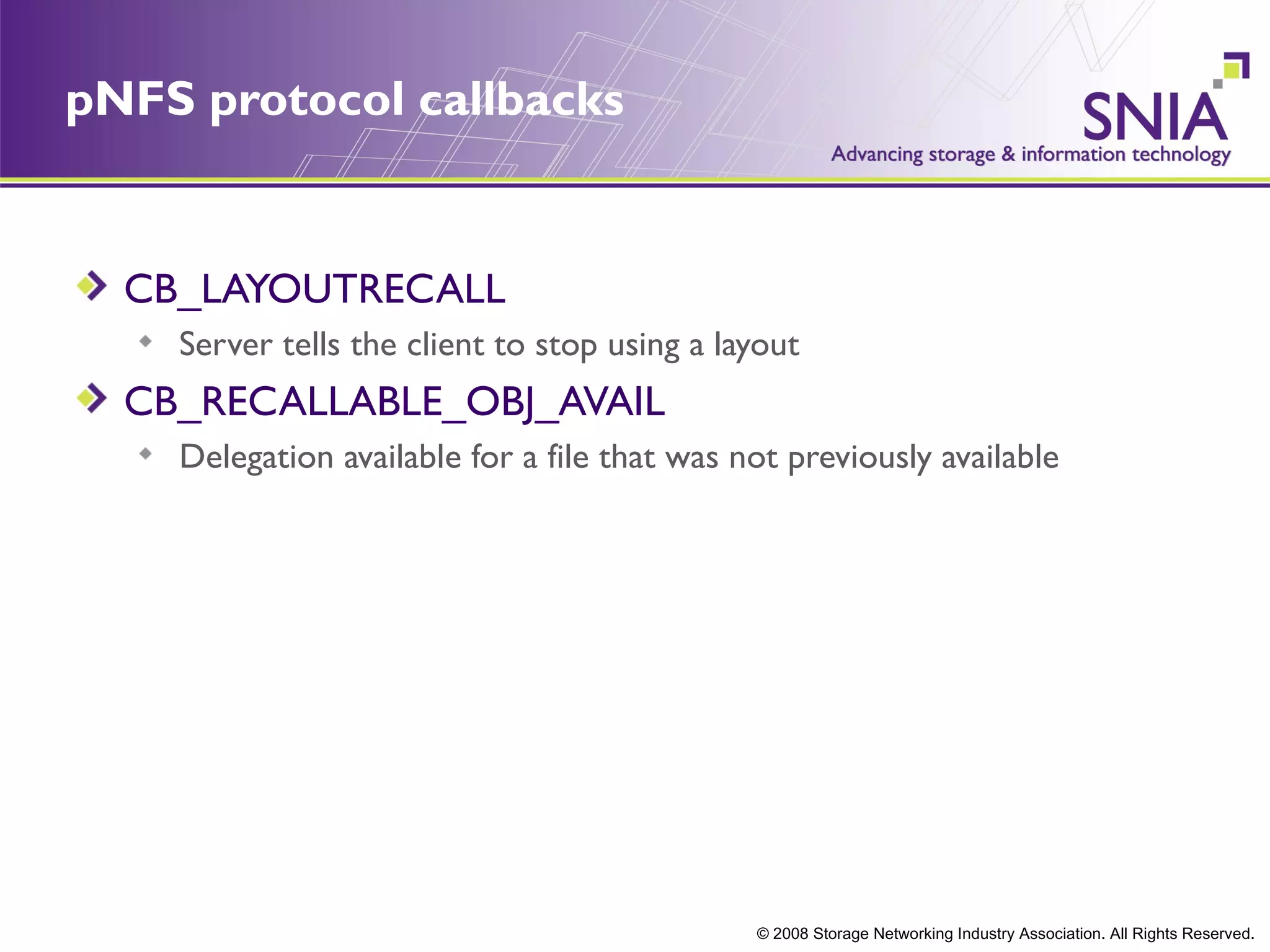
pNFS protocol callbacks


  CB_LAYOUTRECALL
    Server tells the client to stop using a layout
  CB_RECALLABLE_OBJ_AVAIL
    Delegation available for a file that was not previously available


                                              © 2008 Storage Networking Industry Association. All Rights Reserved.
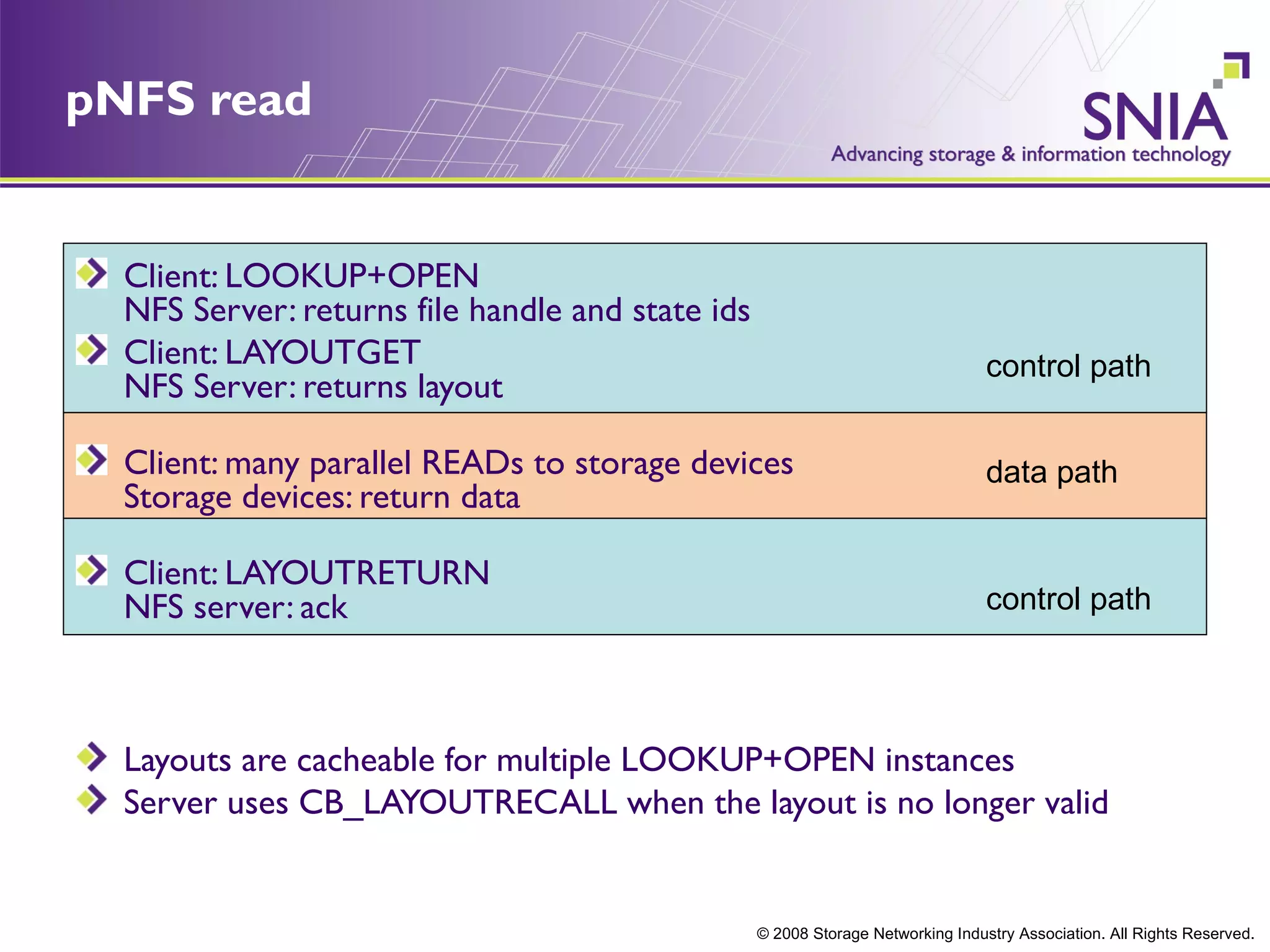
pNFS read


  Client: LOOKUP+OPEN
  NFS Server: returns file handle and state ids
  Client: LAYOUTGET                                                              control path
  NFS Server: returns layout

  Client: many parallel READs to storage devices                                 data path
  Storage devices: return data

  Client: LAYOUTRETURN
  NFS server: ack                                                                control path


  Layouts are cacheable for multiple LOOKUP+OPEN instances
  Server uses CB_LAYOUTRECALL when the layout is no longer valid


                                                  © 2008 Storage Networking Industry Association. All Rights Reserved.
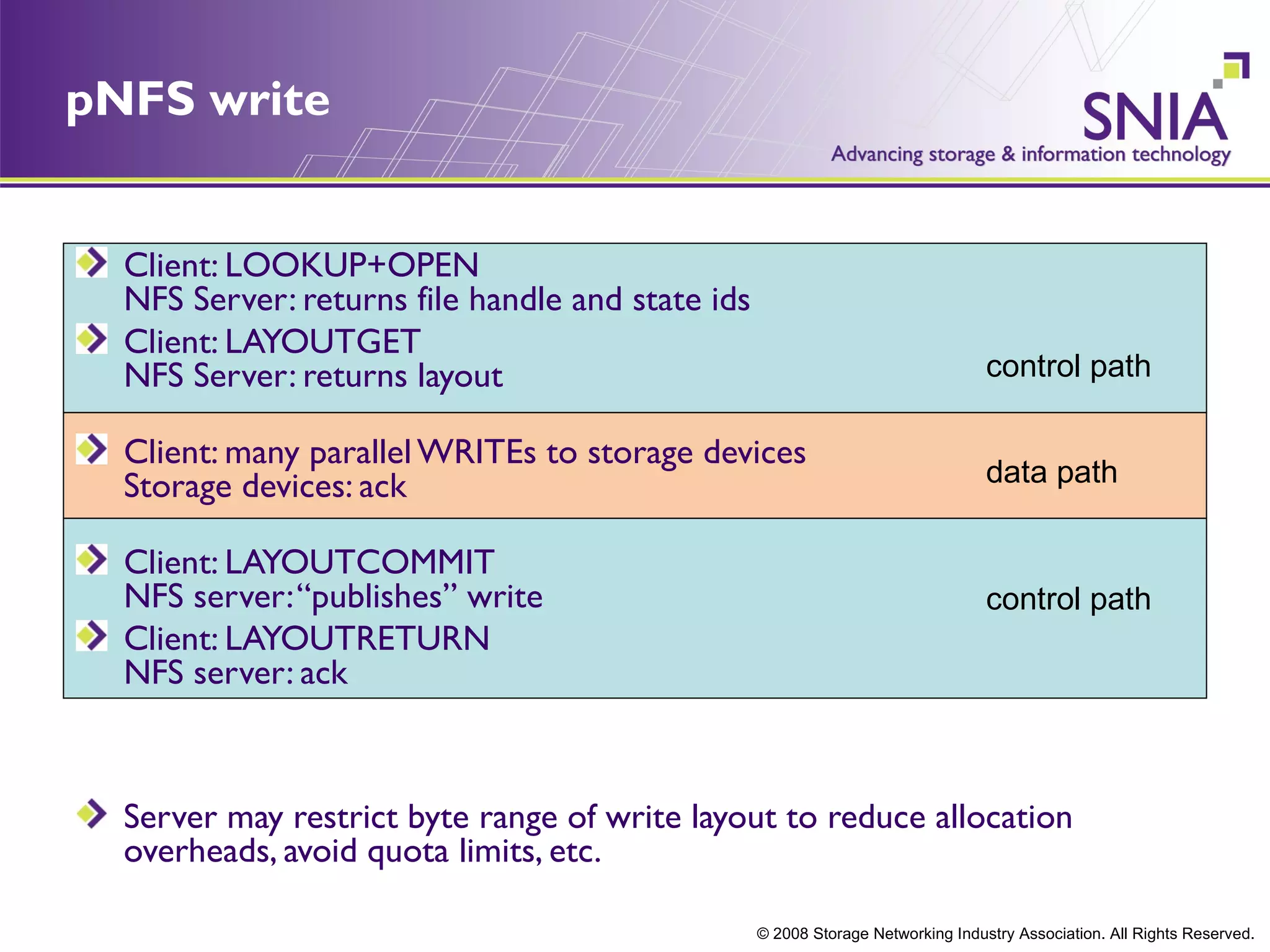
pNFS write


  Client: LOOKUP+OPEN
  NFS Server: returns file handle and state ids
  Client: LAYOUTGET
  NFS Server: returns layout                                                     control path

  Client: many parallel WRITEs to storage devices
  Storage devices: ack                                                           data path

  Client: LAYOUTCOMMIT
  NFS server: “publishes” write                                                  control path
  Client: LAYOUTRETURN
  NFS server: ack


  Server may restrict byte range of write layout to reduce allocation
  overheads, avoid quota limits, etc.

                                                  © 2008 Storage Networking Industry Association. All Rights Reserved.
What pNFS doesn’t give you


  Improved cache consistency
     NFS has open-to-close consistency
  Perfect POSIX semantics in a distributed file system
  Clustered metadata
     Though a mechanism for this is not precluded


                                                                             
                                           © 2008 Storage Networking Industry Association. All Rights Reserved.

Pnfs

  • 1.
    Introduction to NFSv4 and pNFS PRESENTATION TITLE GOES HERE David Black, SNIA Technical Council, EMC slides by Alan Yoder, NetApp with thanks to Michael Eisler and Brent Welch
  • 2.
    NFS v4.0 Under development from 1998-2005 primarily driven by Sun, Netapp, Hummingbird some University involvement (CITI UMich, CMU) systems beginning to ship available in Linux © 2008 Storage Networking Industry Association. All Rights Reserved.
  • 3.
    NFS v4.0 Mandates strong security be available Every NFSv4 implementation has Kerberos V5 You can use weak authentication if you want Easier to deploy across firewalls (only one port is used) Finer grained access control Goes beyond UNIX owner, group, mode Uses a Windows-like ACL Read-only, read-mostly, or single writer workloads can benefit from formal caching extensions (delegations) Multi-protocol (NFS, CIFS) access experience is cleaner Byte range locking protocol is much more robust Recovery algorithms are simpler, hence more reliable Not a separate protocol as in V3 © 2008 Storage Networking Industry Association. All Rights Reserved.
  • 4.
    NFS v3 andv4 compared NFSv3 NFSv4 A collection of protocols (file access, One protocol to a single port (2049) mount, lock, status) Lease-based state Stateless Supports UNIX and Windows file UNIX-centric, but seen in Windows semantics too Mandates strong authentication Deployed with weak authentication String-based identities 32 bit numeric uids/gids Real caching handshake Ad-hoc caching Windows-like access UNIX permissions Bans UDP Works over UDP, TCP Uses a universal character set for file Needs a-priori agreement on names character sets © 2008 Storage Networking Industry Association. All Rights Reserved.
  • 5.
    pNFS history Idea to use SAN FS architecture for NFS originally from Gary Grider (LANL) and Lee Ward (Sandia) Development driven by Panasas, Netapp, Sun, EMC, IBM, UMich/CITI Folded into NFSv4 minor version NFSv4.1 in 2006 © 2008 Storage Networking Industry Association. All Rights Reserved.
  • 6.
    pNFS Essentially makesclients aware of how a clustered filesystem stripes files Files accessible via pNFS can be accessed via non-parallel NFS (and in the case of filers, CIFS, and other file access protocols) Benefits workloads with many small files very large files Three supported methods of access to data: Blocks (FC, iSCSI) Objects (OSD) Files (NFSv4.1) © 2008 Storage Networking Industry Association. All Rights Reserved.
  • 7.
    pNFS architecture data met ada l ta o pNFS c ontr Block (FC) / Clients Object (OSD) / File (NFS) NFSv4.1 Server Storage © 2008 Storage Networking Industry Association. All Rights Reserved.
  • 8.
    pNFS architecture data met ada l pNFS ta tro Block (FC) / con Clients Object (OSD) / File (NFS) NFSv4.1 Server Storage Only this is covered by the pNFS protocol Client-to-storage data path and server-to-storage control path are specified elsewhere, e.g. SCSI Block Commands (SBC) over Fibre Channel (FC) SCSI Object-based Storage Device (OSD) over iSCSI Network File System (NFS) © 2008 Storage Networking Industry Association. All Rights Reserved.
  • 9.
    pNFS basic operation Client gets a layout from the NFS Server The layout maps the file onto storage devices and addresses The client uses the layout to perform direct I/O to storage At any time the server can recall the layout Client commits changes and returns the layout when it’s done pNFS is optional, the client can always use regular NFSv4 I/O layout Storage Clients NFSv4.1 Server © 2008 Storage Networking Industry Association. All Rights Reserved.
  • 10.
    pNFS protocol operations LAYOUTGET (filehandle, type, byte range) -> type-specific layout LAYOUTRETURN (filehandle, range) -> server can release state about the client LAYOUTCOMMIT (filehandle, byte range, updated attributes, layout-specific info) -> server ensures that data is visible to other clients Timestamps and end-of-file attributes are updated GETDEVICEINFO, GETDEVICELIST Map deviceID in layout to type-specific addressing information © 2008 Storage Networking Industry Association. All Rights Reserved.
  • 11.
    pNFS protocol callbacks CB_LAYOUTRECALL Server tells the client to stop using a layout CB_RECALLABLE_OBJ_AVAIL Delegation available for a file that was not previously available © 2008 Storage Networking Industry Association. All Rights Reserved.
  • 12.
    pNFS read Client: LOOKUP+OPEN NFS Server: returns file handle and state ids Client: LAYOUTGET control path NFS Server: returns layout Client: many parallel READs to storage devices data path Storage devices: return data Client: LAYOUTRETURN NFS server: ack control path Layouts are cacheable for multiple LOOKUP+OPEN instances Server uses CB_LAYOUTRECALL when the layout is no longer valid © 2008 Storage Networking Industry Association. All Rights Reserved.
  • 13.
    pNFS write Client: LOOKUP+OPEN NFS Server: returns file handle and state ids Client: LAYOUTGET NFS Server: returns layout control path Client: many parallel WRITEs to storage devices Storage devices: ack data path Client: LAYOUTCOMMIT NFS server: “publishes” write control path Client: LAYOUTRETURN NFS server: ack Server may restrict byte range of write layout to reduce allocation overheads, avoid quota limits, etc. © 2008 Storage Networking Industry Association. All Rights Reserved.
  • 14.
    What pNFS doesn’tgive you Improved cache consistency NFS has open-to-close consistency Perfect POSIX semantics in a distributed file system Clustered metadata Though a mechanism for this is not precluded  © 2008 Storage Networking Industry Association. All Rights Reserved.