pNFS: Parallel NFS


   Bergwolf@linuxfb.org
Agenda


 pNFS Technology Overview


 Timeline


 Future Work


 Discussions & Questions


                            Page 2
Traditional NFS limitations


 � Single NFS server bottleneck: limited bandwidth & CPU
 � Multiple NFS servers are separate storage islands


                    NFS


                                                           Page 3
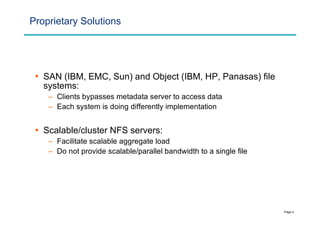
Proprietary Solutions


 � SAN (IBM, EMC, Sun) and Object (IBM, HP, Panasas) file
   systems:
    – Clients bypasses metadata server to access data
    – Each system is doing differently implementation


 � Scalable/cluster NFS servers:
    – Facilitate scalable aggregate load
    – Do not provide scalable/parallel bandwidth to a single file


                                                                    Page 4
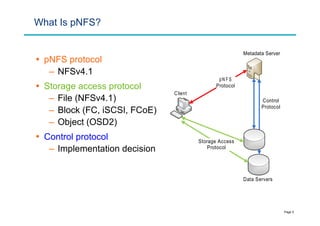
What Is pNFS?


                                                          Metadata Server
� pNFS protocol
   – NFSv4.1
                                                pN FS
� Storage access protocol                      Protocol
                               C lient
   – File (NFSv4.1)                                              Control
                                                                 Protocol
   – Block (FC, iSCSI, FCoE)
   – Object (OSD2)
� Control protocol                       Storage Access
   – Implementation decision                Protocol


                                                          Data Servers


                                                                            Page 5
pNFS Advantage


� Distributed data access across the storage cluster
� Reduce load on NFS server
� I/O Acceleration


                                                       Page 6
pNFS Performance


� Linear I/O increase
� Client performance limitation is on backend
� Numbers taken with EMC MPFS, from which pNFS block
  layout derives


                                                       Page 7
pNFS Related Standards


� RFC 5661: NFSv4.1, including pNFS file layout
� RFC 5662: NFSv4.1 XDR representation
� RFC 5663: pNFS block/volume layout
� RFC 5664: pNFS object operations


                                                  Page 8
Other NFSv4.1 Key Features


� EOS (Exactly Once Semantics)
� File and directory delegation
� No more “silly rename”
� Data retention
� Session trunking and client ID trunking


                                            Page 9
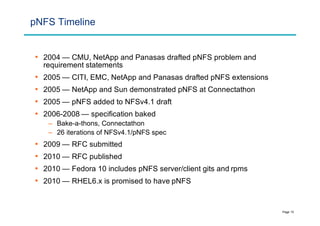
pNFS Timeline


� 2004 — CMU, NetApp and Panasas drafted pNFS problem and
  requirement statements
� 2005 — CITI, EMC, NetApp and Panasas drafted pNFS extensions
� 2005 — NetApp and Sun demonstrated pNFS at Connectathon
� 2005 — pNFS added to NFSv4.1 draft
� 2006-2008 — specification baked
   – Bake-a-thons, Connectathon
   – 26 iterations of NFSv4.1/pNFS spec
� 2009 — RFC submitted
� 2010 — RFC published
� 2010 — Fedora 10 includes pNFS server/client gits and rpms
� 2010 — RHEL6.x is promised to have pNFS


                                                                 Page 10
Industry Support


� BlueArc          � NetApp
� CITI             � Ohio SuperComputer Center
� CMU              � Panasas
� EMC              � Seagate
� IBM              � StorSpeed
� LSI              � Sun Microsystems (now Oracle)


                                                     Page 11
Linux pNFS Client


� Applications transparency
� Fewer support issues for storage vendors
� Generic pNFS client with layout driver plugins
                               Client
                             Applications

                             pNFS Kernel
                               M odule

                            Layout
                            D river
                                                 N F S v 4.1
                 S torage                       LayoutGet
                 Protocol                      LayoutReturn


                                                               pNFS
                            Control Protocol                   Server


                                                                        Page 12
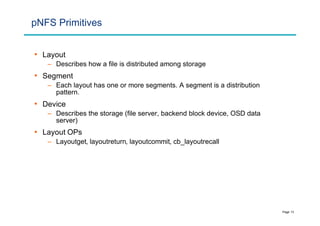
pNFS Primitives


� Layout
   – Describes how a file is distributed among storage
� Segment
   – Each layout has one or more segments. A segment is a distribution
     pattern.
� Device
   – Describes the storage (file server, backend block device, OSD data
     server)
� Layout OPs
   – Layoutget, layoutreturn, layoutcommit, cb_layoutrecall


                                                                          Page 13
Linux pNFS Client Driver API


� struct pnfs_layoutdriver_type
   – layout driver specific functions (segment ops, layout ops)
� struct pnfs_layout_hdr
   – generic layout header
� struct pnfs_device
   – generic device
� struct pnfs_layout_segment
   – generic layout segment


                                                                  Page 14
Linux pNFS Merge Plan


� End of 2010
   – Linux 2.6.37 — Files pNFS client and server
� Feb, 2011
   – Linux 2.6.38 — Object pNFS client and server
� May, 2011
   – Linux 2.6.39 — Block pNFS client and server


                                                    Page 15
What Is Expected In NFSv4.x


� File, Block, Object layout driver
� Server side copy
� Federated file system


                                      Page 16
Open Issue – Layout stateid, open mode relationship


        Client Behavior         Server Returns
          OPEN read-only           open stateid1

         LAYOUTGET with           layout stateid1
          IOMODE_READ
             CLOSE

         OPEN read-write           open stateid2

        LAYOUTGET with            layout stateid1
     IOMODE_READ using open
            stateid2
   LAYOUTGET with IOMODE_RW    NFS4ERR_OPENMODE
       using layout stateid1


                                                      Page 17
Open Issues


� Is LAYOUTRETURN still necessary for forgetful mode?
� Slot id is required for every COMPOUND request, but
  idempotent non-modifying requests do not really need one
� Security issue for block layout
� Can File, Object and Block layouts co-exist in the same
  storage network?


                                                             Page 18
Page 19

pnfs status

  • 1.
    pNFS: Parallel NFS Bergwolf@linuxfb.org
  • 2.
    Agenda pNFS TechnologyOverview Timeline Future Work Discussions & Questions Page 2
  • 3.
    Traditional NFS limitations � Single NFS server bottleneck: limited bandwidth & CPU � Multiple NFS servers are separate storage islands NFS Page 3
  • 4.
    Proprietary Solutions �SAN (IBM, EMC, Sun) and Object (IBM, HP, Panasas) file systems: – Clients bypasses metadata server to access data – Each system is doing differently implementation � Scalable/cluster NFS servers: – Facilitate scalable aggregate load – Do not provide scalable/parallel bandwidth to a single file Page 4
  • 5.
    What Is pNFS? Metadata Server � pNFS protocol – NFSv4.1 pN FS � Storage access protocol Protocol C lient – File (NFSv4.1) Control Protocol – Block (FC, iSCSI, FCoE) – Object (OSD2) � Control protocol Storage Access – Implementation decision Protocol Data Servers Page 5
  • 6.
    pNFS Advantage � Distributeddata access across the storage cluster � Reduce load on NFS server � I/O Acceleration Page 6
  • 7.
    pNFS Performance � LinearI/O increase � Client performance limitation is on backend � Numbers taken with EMC MPFS, from which pNFS block layout derives Page 7
  • 8.
    pNFS Related Standards �RFC 5661: NFSv4.1, including pNFS file layout � RFC 5662: NFSv4.1 XDR representation � RFC 5663: pNFS block/volume layout � RFC 5664: pNFS object operations Page 8
  • 9.
    Other NFSv4.1 KeyFeatures � EOS (Exactly Once Semantics) � File and directory delegation � No more “silly rename” � Data retention � Session trunking and client ID trunking Page 9
  • 10.
    pNFS Timeline � 2004— CMU, NetApp and Panasas drafted pNFS problem and requirement statements � 2005 — CITI, EMC, NetApp and Panasas drafted pNFS extensions � 2005 — NetApp and Sun demonstrated pNFS at Connectathon � 2005 — pNFS added to NFSv4.1 draft � 2006-2008 — specification baked – Bake-a-thons, Connectathon – 26 iterations of NFSv4.1/pNFS spec � 2009 — RFC submitted � 2010 — RFC published � 2010 — Fedora 10 includes pNFS server/client gits and rpms � 2010 — RHEL6.x is promised to have pNFS Page 10
  • 11.
    Industry Support � BlueArc � NetApp � CITI � Ohio SuperComputer Center � CMU � Panasas � EMC � Seagate � IBM � StorSpeed � LSI � Sun Microsystems (now Oracle) Page 11
  • 12.
    Linux pNFS Client �Applications transparency � Fewer support issues for storage vendors � Generic pNFS client with layout driver plugins Client Applications pNFS Kernel M odule Layout D river N F S v 4.1 S torage LayoutGet Protocol LayoutReturn pNFS Control Protocol Server Page 12
  • 13.
    pNFS Primitives � Layout – Describes how a file is distributed among storage � Segment – Each layout has one or more segments. A segment is a distribution pattern. � Device – Describes the storage (file server, backend block device, OSD data server) � Layout OPs – Layoutget, layoutreturn, layoutcommit, cb_layoutrecall Page 13
  • 14.
    Linux pNFS ClientDriver API � struct pnfs_layoutdriver_type – layout driver specific functions (segment ops, layout ops) � struct pnfs_layout_hdr – generic layout header � struct pnfs_device – generic device � struct pnfs_layout_segment – generic layout segment Page 14
  • 15.
    Linux pNFS MergePlan � End of 2010 – Linux 2.6.37 — Files pNFS client and server � Feb, 2011 – Linux 2.6.38 — Object pNFS client and server � May, 2011 – Linux 2.6.39 — Block pNFS client and server Page 15
  • 16.
    What Is ExpectedIn NFSv4.x � File, Block, Object layout driver � Server side copy � Federated file system Page 16
  • 17.
    Open Issue –Layout stateid, open mode relationship Client Behavior Server Returns OPEN read-only open stateid1 LAYOUTGET with layout stateid1 IOMODE_READ CLOSE OPEN read-write open stateid2 LAYOUTGET with layout stateid1 IOMODE_READ using open stateid2 LAYOUTGET with IOMODE_RW NFS4ERR_OPENMODE using layout stateid1 Page 17
  • 18.
    Open Issues � IsLAYOUTRETURN still necessary for forgetful mode? � Slot id is required for every COMPOUND request, but idempotent non-modifying requests do not really need one � Security issue for block layout � Can File, Object and Block layouts co-exist in the same storage network? Page 18
  • 19.