2014 
PaciKic 
Neighborhoods 
Consortium 
Annual 
Conference 
and 
Joint 
Meeting 
Toward 
Next 
Generation 
of 
Gazetteer: 
Utilizing 
GeoSPARQL 
For 
Developing 
Linked 
Geoname 
Data 
Dongpo 
Deng 
! 
Geospatial 
Information 
Specialist 
Institute 
of 
Information 
Science 
Academia 
Sinica 
dongpo@iis.sinica.edu.tw
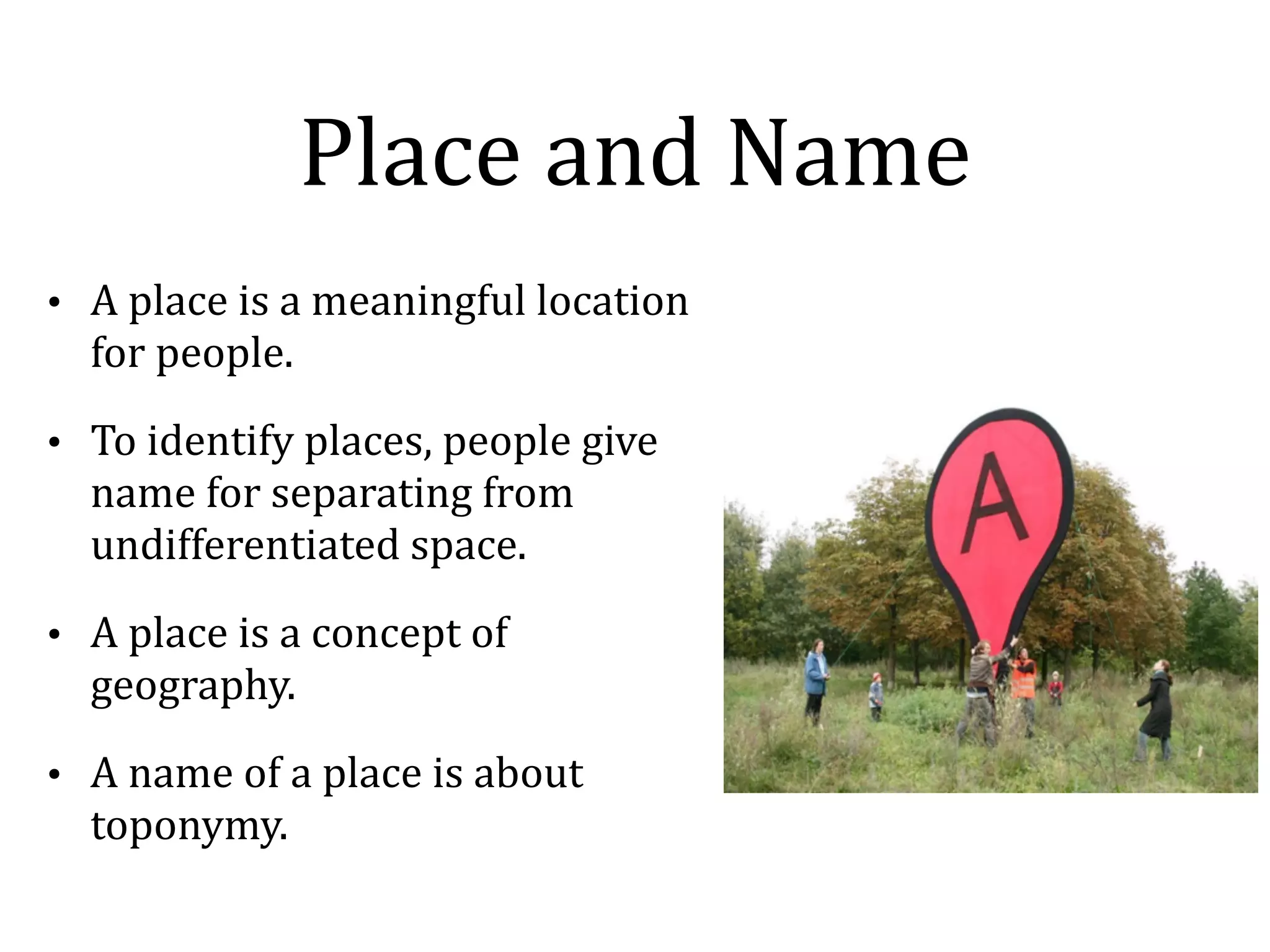
Place 
and 
Name 
• A 
place 
is 
a 
meaningful 
location 
for 
people. 
• To 
identify 
places, 
people 
give 
name 
for 
separating 
from 
undifferentiated 
space. 
• A 
place 
is 
a 
concept 
of 
geography. 
• A 
name 
of 
a 
place 
is 
about 
toponymy.
Gazetteer 
• 
A 
gazetteer 
is 
deKined 
by 
(Hill, 
2000) 
as 
geospatial 
dictionaries 
of 
geographic 
names 
with 
the 
core 
components 
of 
• A 
name 
(could 
have 
variant 
names 
also) 
; 
• A 
location 
(coordinates 
representing 
a 
point, 
line, 
or 
areal 
location) 
; 
• A 
type 
(selected 
from 
a 
type 
scheme 
of 
categories 
for 
places/features).
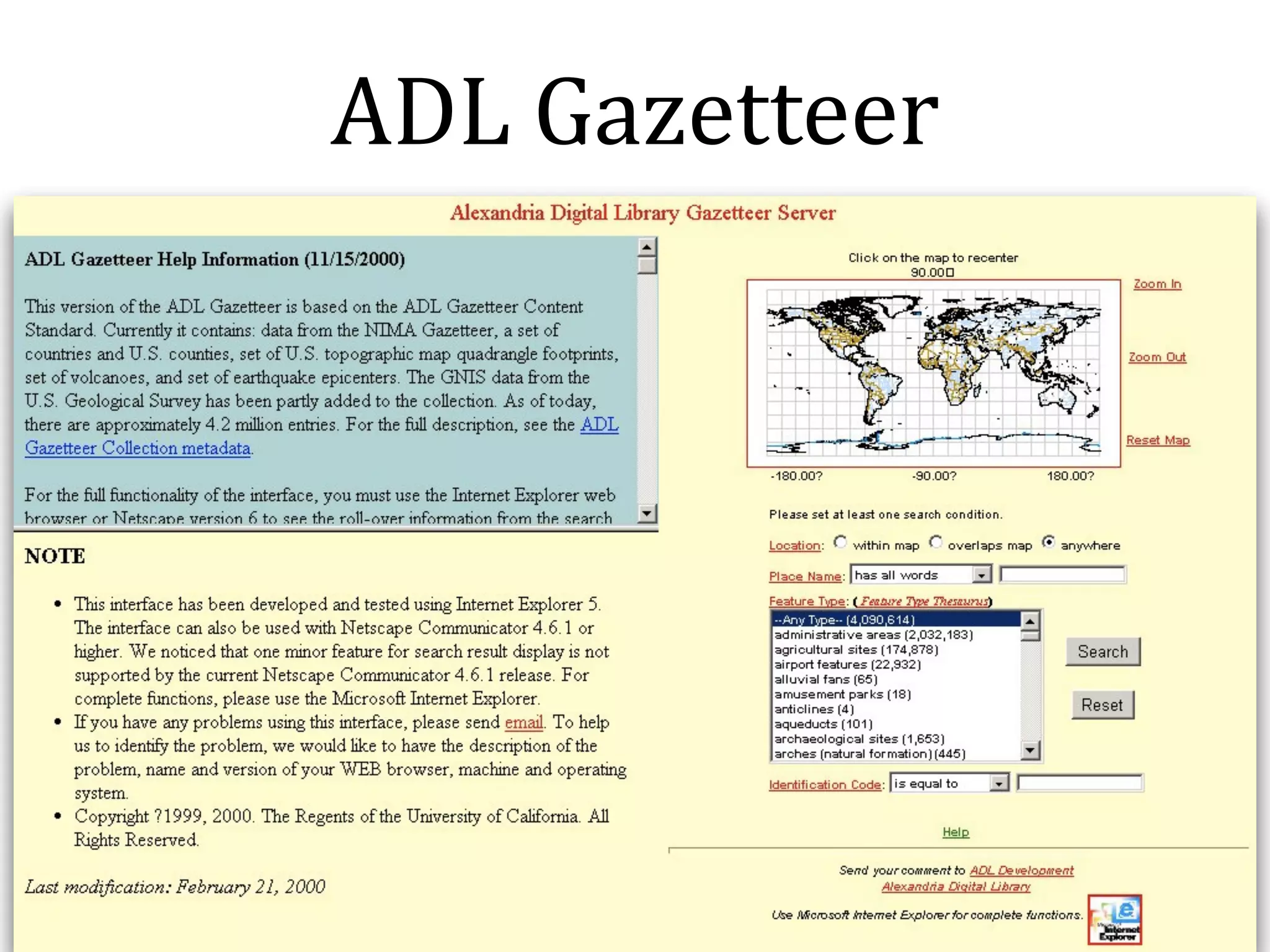
ADL 
Gazetteer
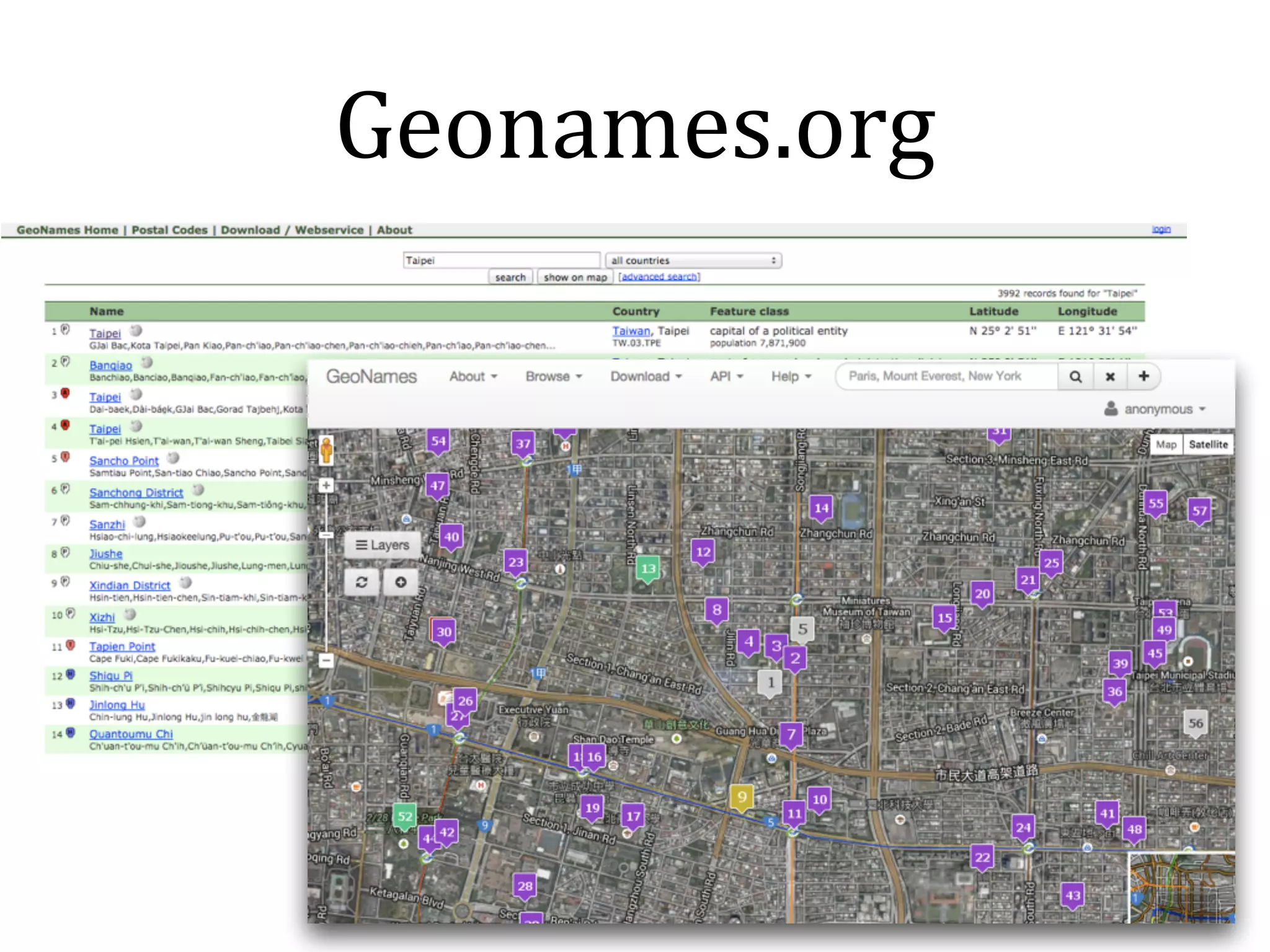
Geonames.org
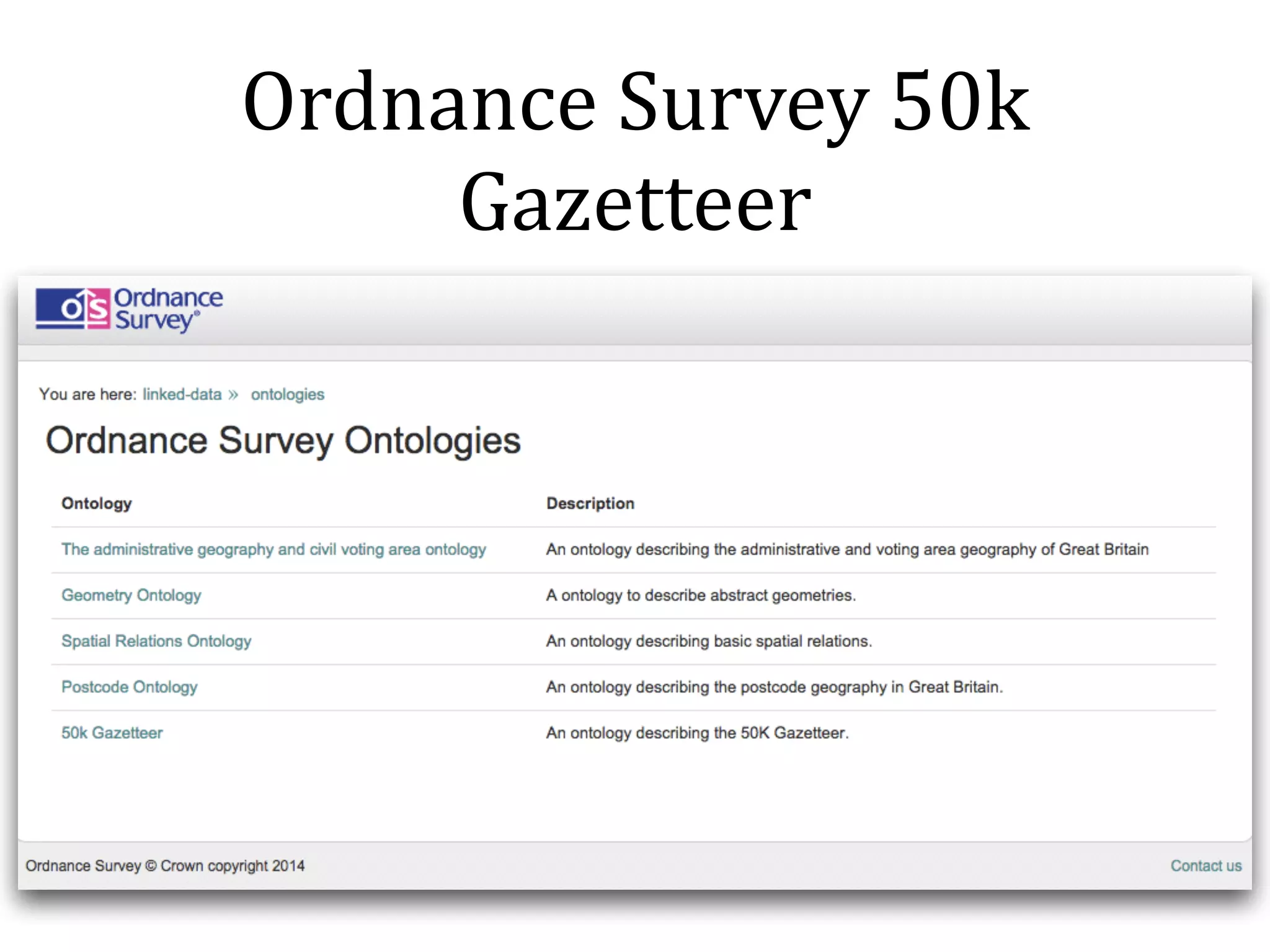
Ordnance 
Survey 
50k 
Gazetteer
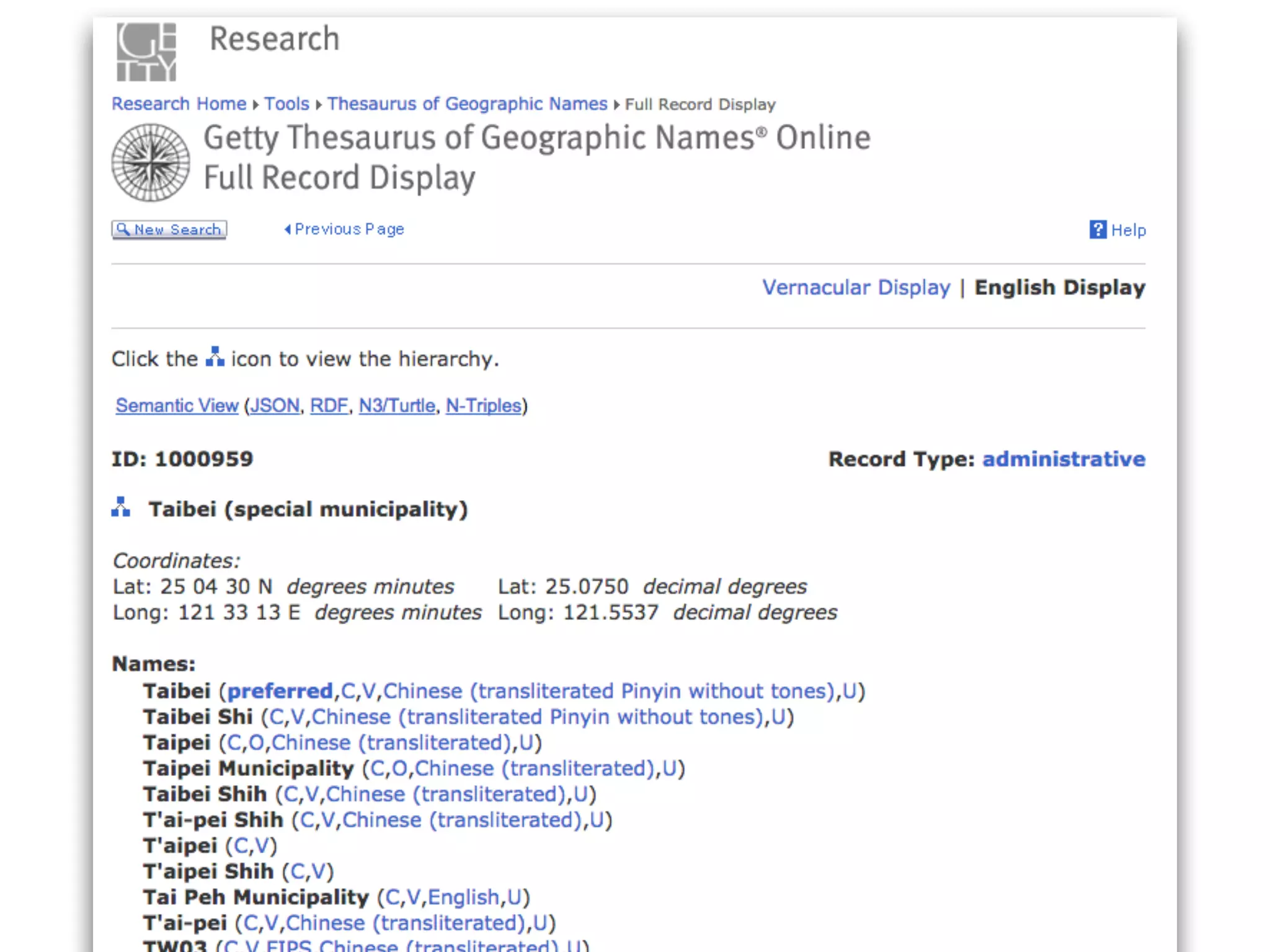
Getty 
TGN
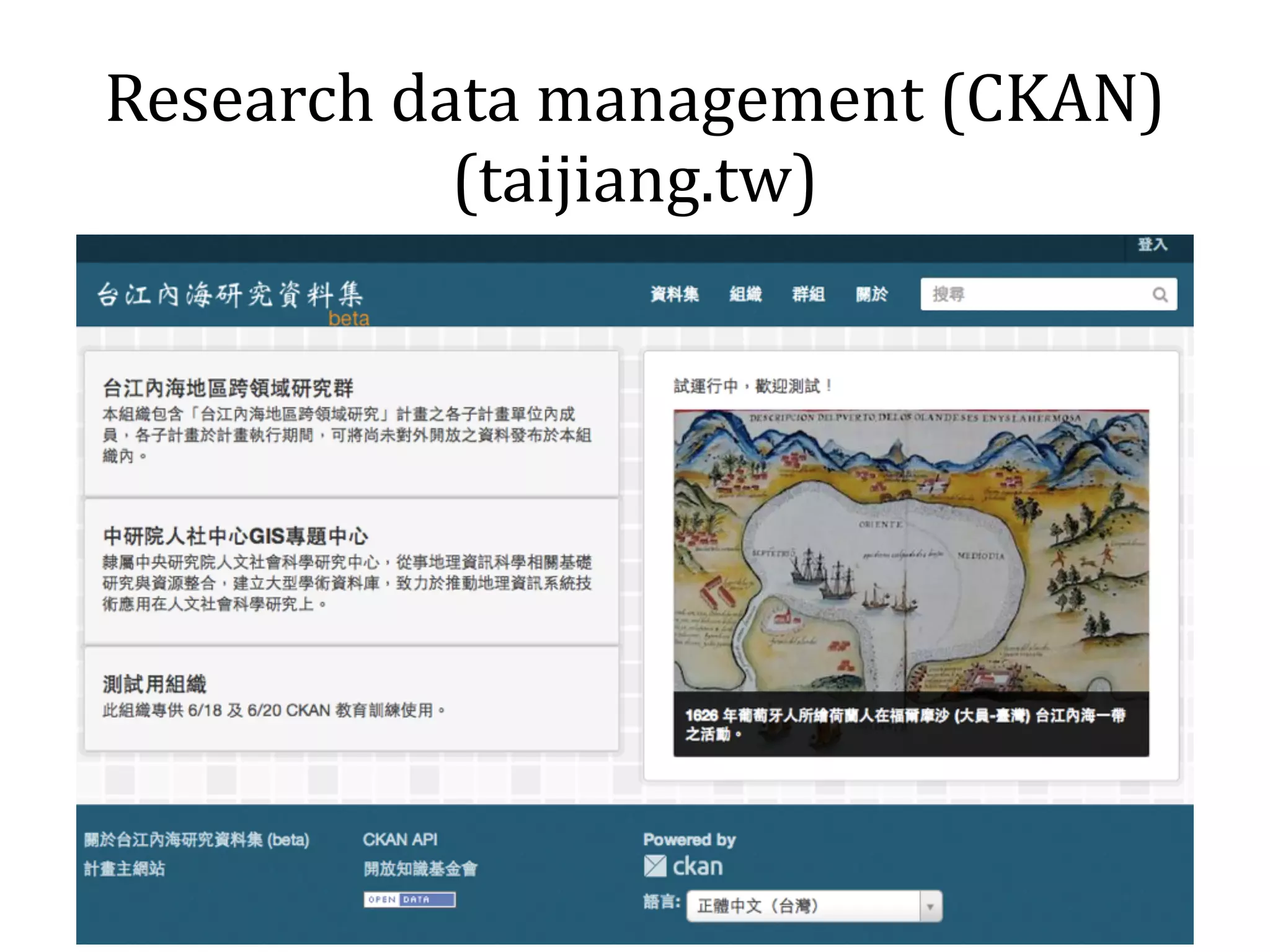
Research 
data 
management 
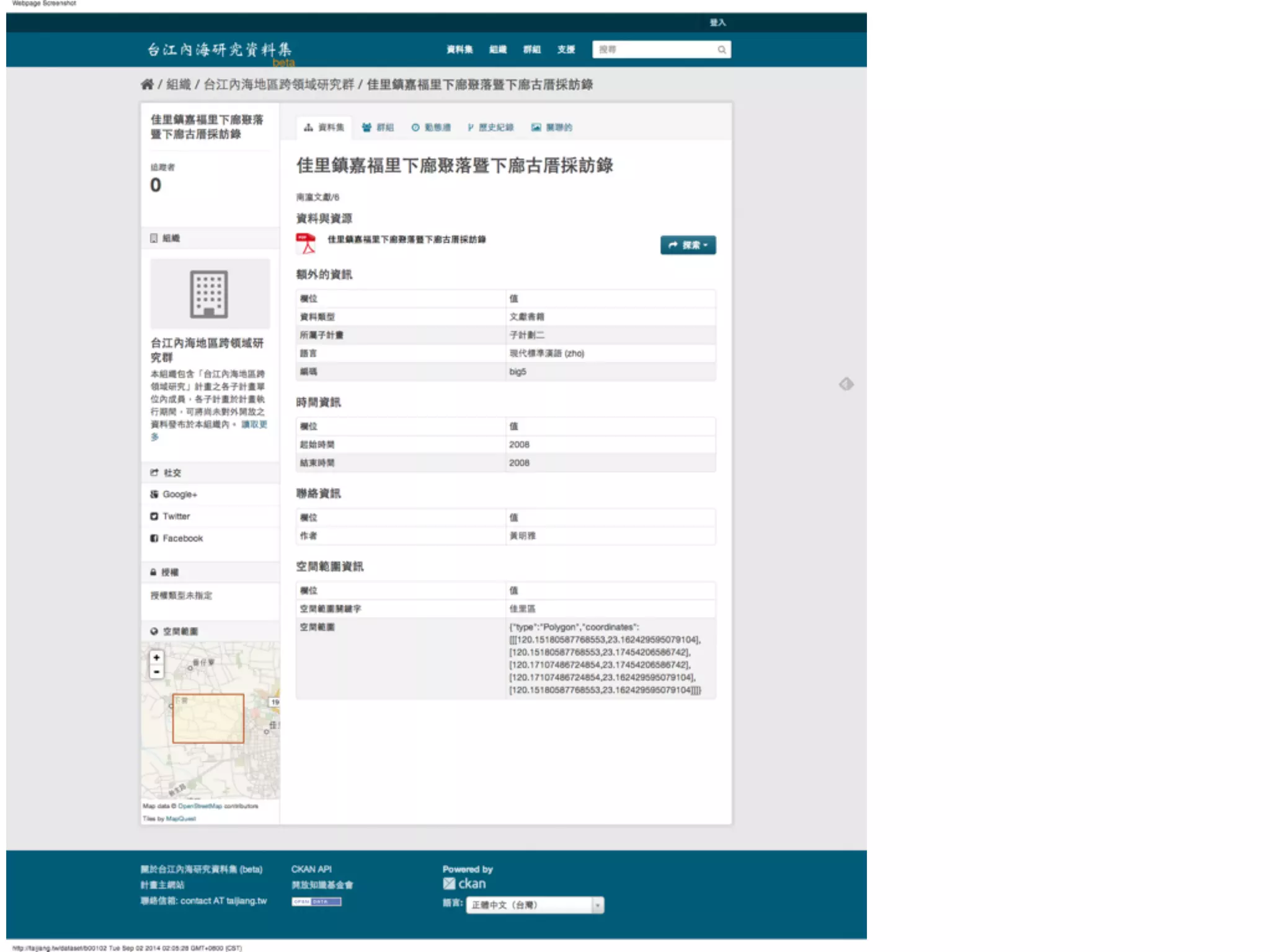
(CKAN) 
(taijiang.tw)
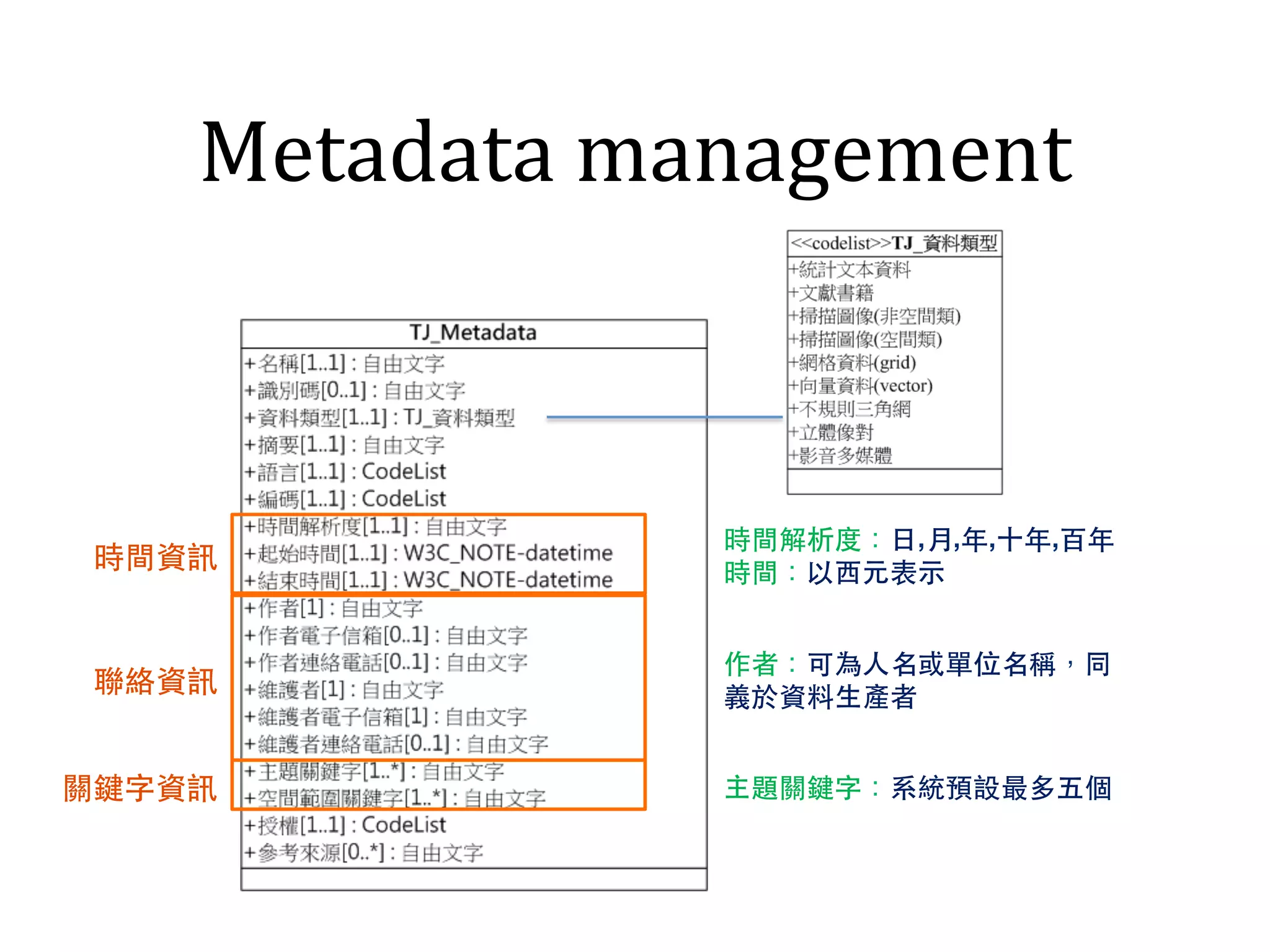
Metadata 
management 

- 
'.- 
/- 

02
,,,,! 

2	# 
2+1 
*)$
/2 (,%
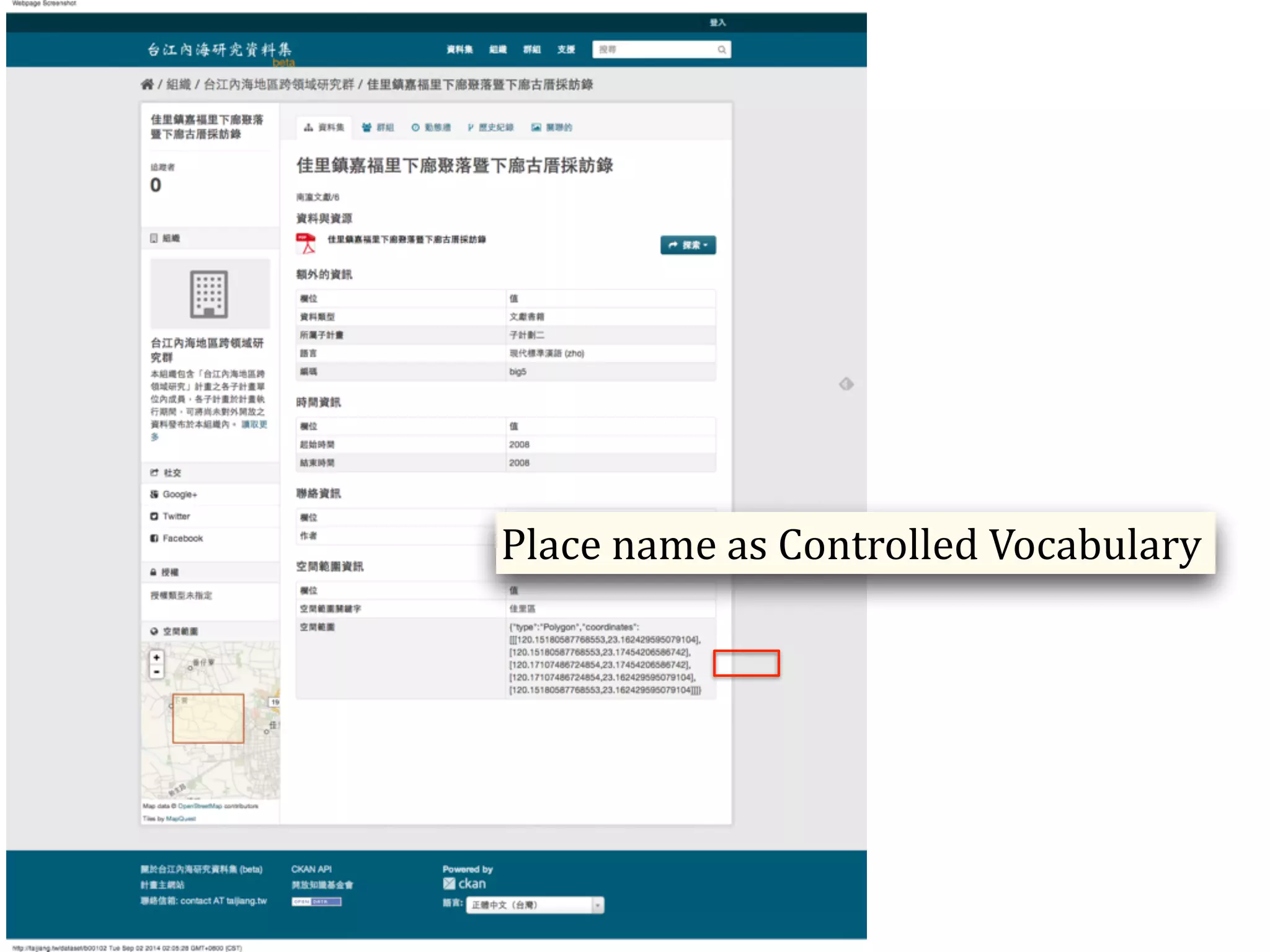
Place 
name 
as 
Controlled 
Vocabulary
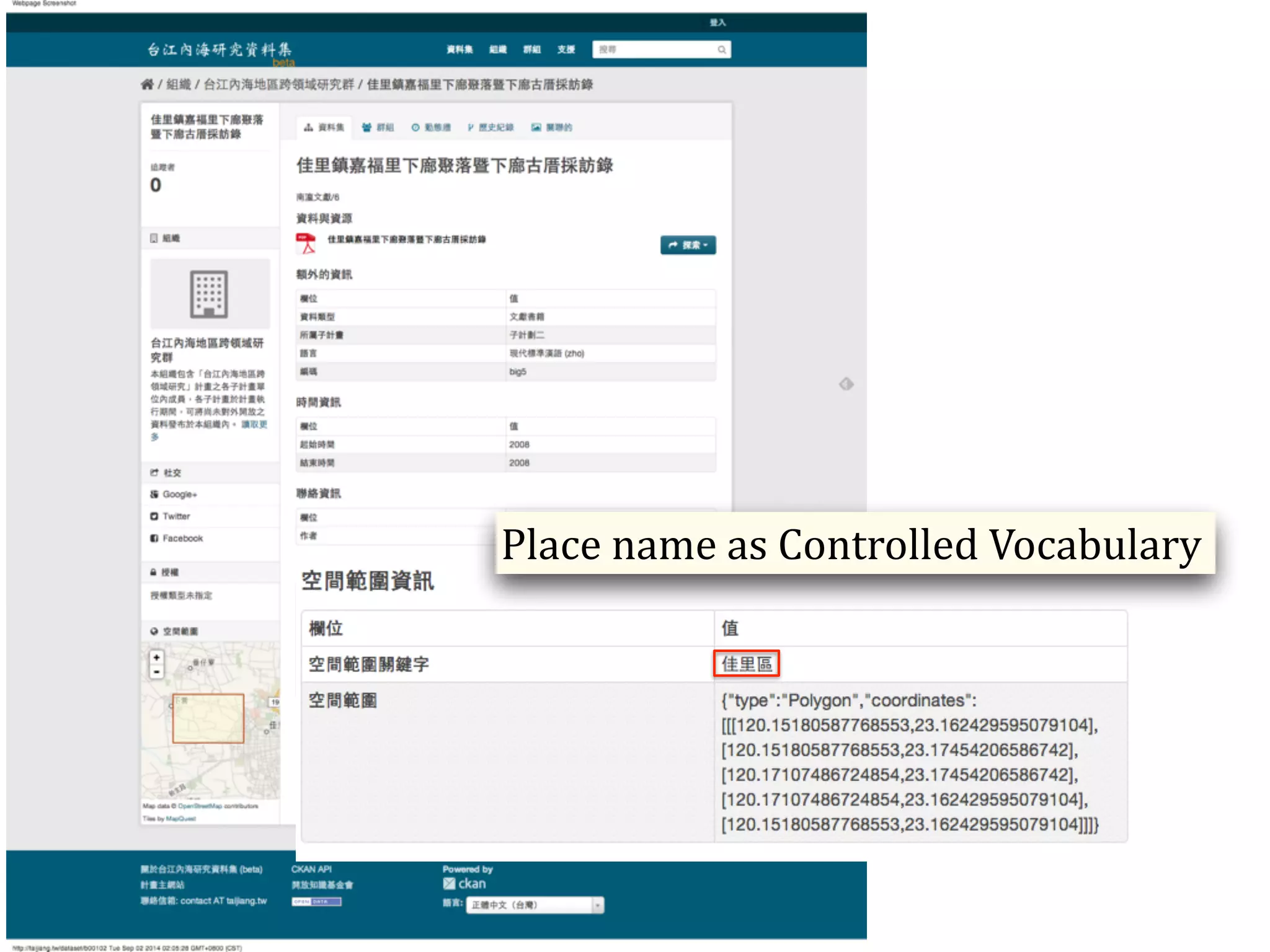
Place 
name 
as 
Controlled 
Vocabulary
Ambiguity 
of 
Place 
names 
• Many 
places 
have 
same 
name 
• A 
place 
can 
have 
many 
name 
• Long 
place 
names 
are 
often 
shortened 
• Spatial 
footprints 
of 
place 
names 
are 
often 
difKicult 
to 
deKine
Linked 
Data 
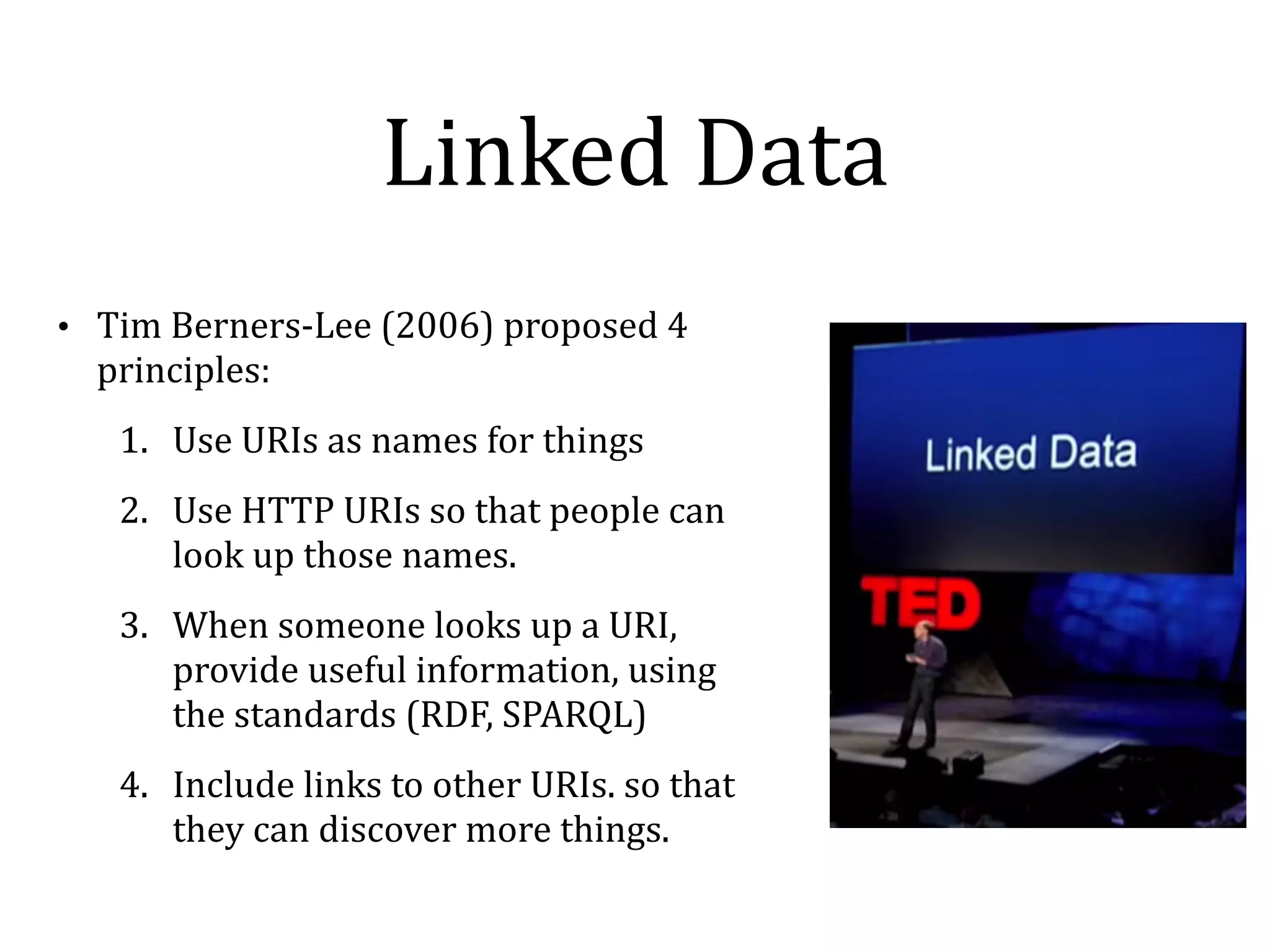
• Tim 
Berners-­‐Lee 
(2006) 
proposed 
4 
principles: 
1. Use 
URIs 
as 
names 
for 
things 
2. Use 
HTTP 
URIs 
so 
that 
people 
can 
look 
up 
those 
names. 
3. When 
someone 
looks 
up 
a 
URI, 
provide 
useful 
information, 
using 
the 
standards 
(RDF, 
SPARQL) 
4. Include 
links 
to 
other 
URIs. 
so 
that 
they 
can 
discover 
more 
things.
Why 
Linked 
Data? 
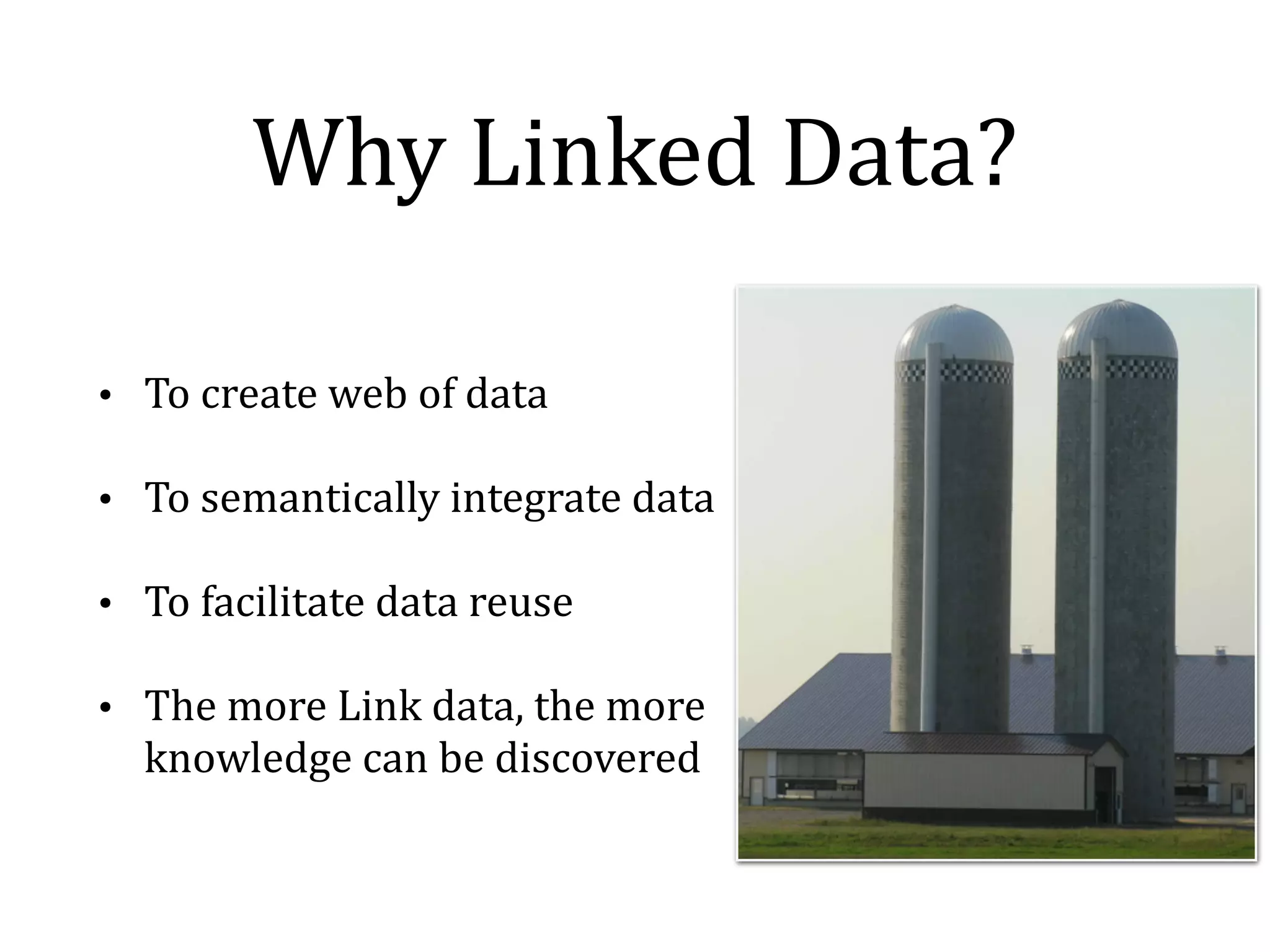
• To 
create 
web 
of 
data 
• To 
semantically 
integrate 
data 
• To 
facilitate 
data 
reuse 
• The 
more 
Link 
data, 
the 
more 
knowledge 
can 
be 
discovered
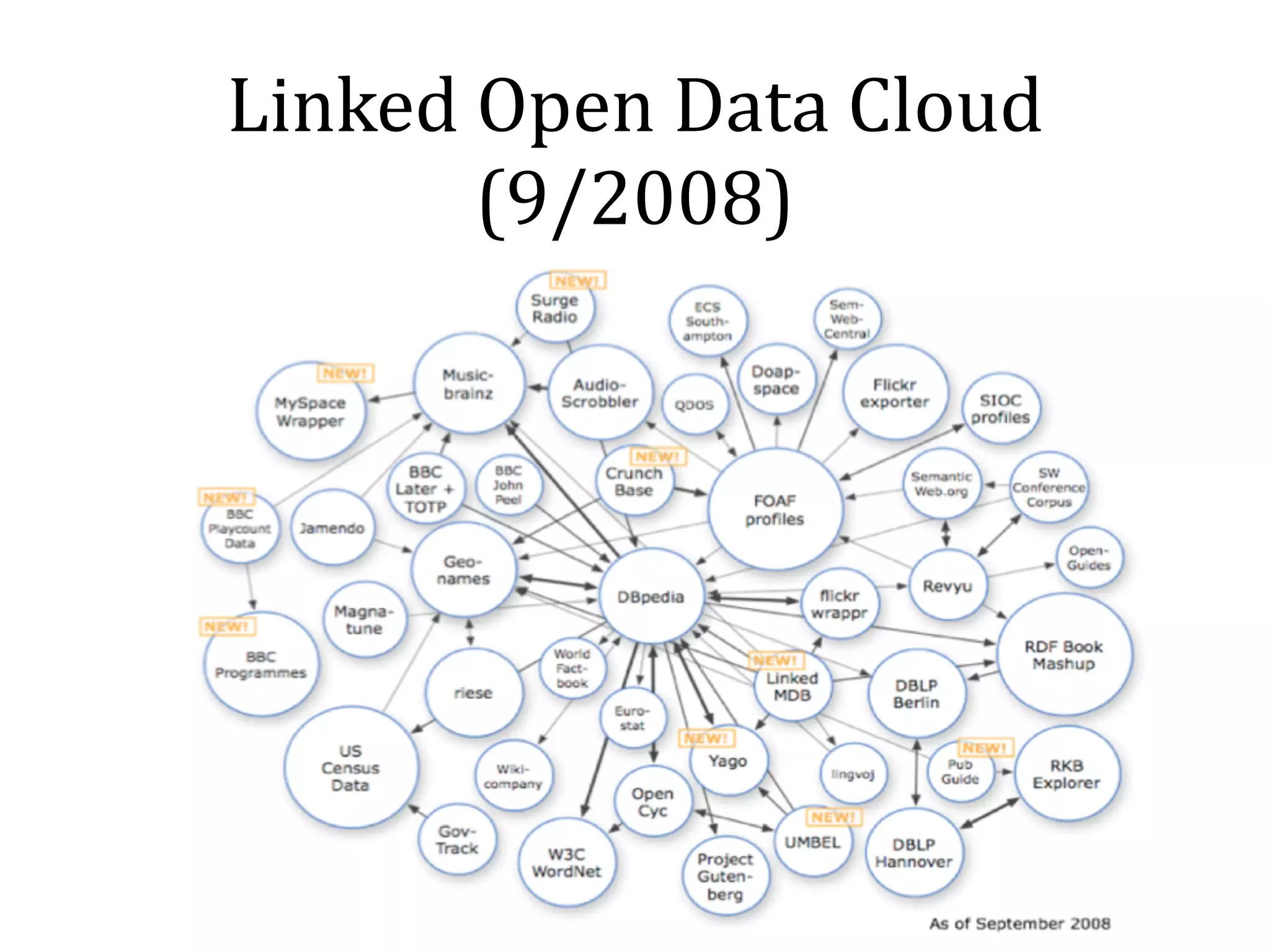
Linked 
Open 
Data 
Cloud 
(9/2008)
Linked 
Open 
Data 
Cloud 
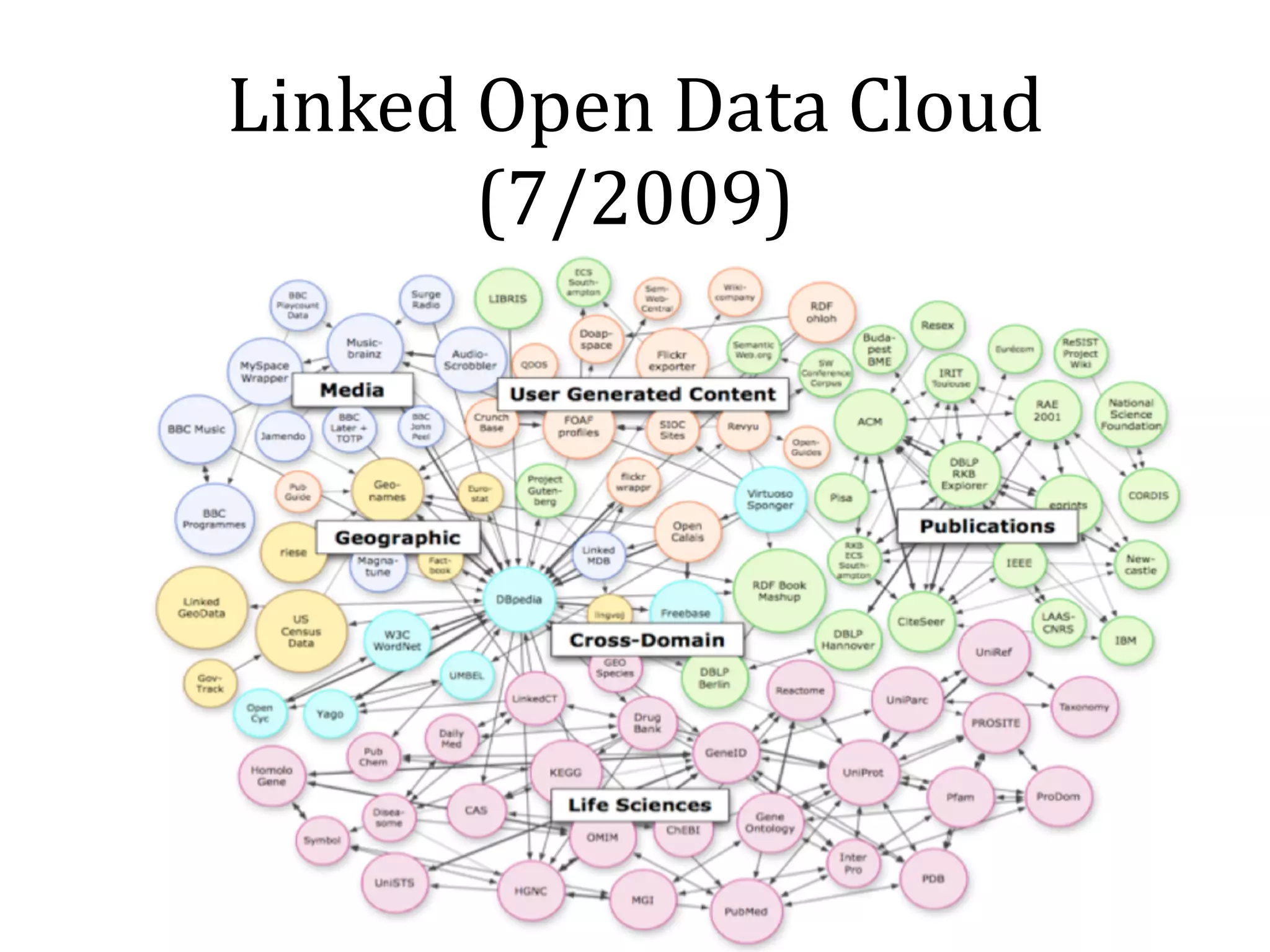
(7/2009)
Linked 
Open 
Data 
Cloud 
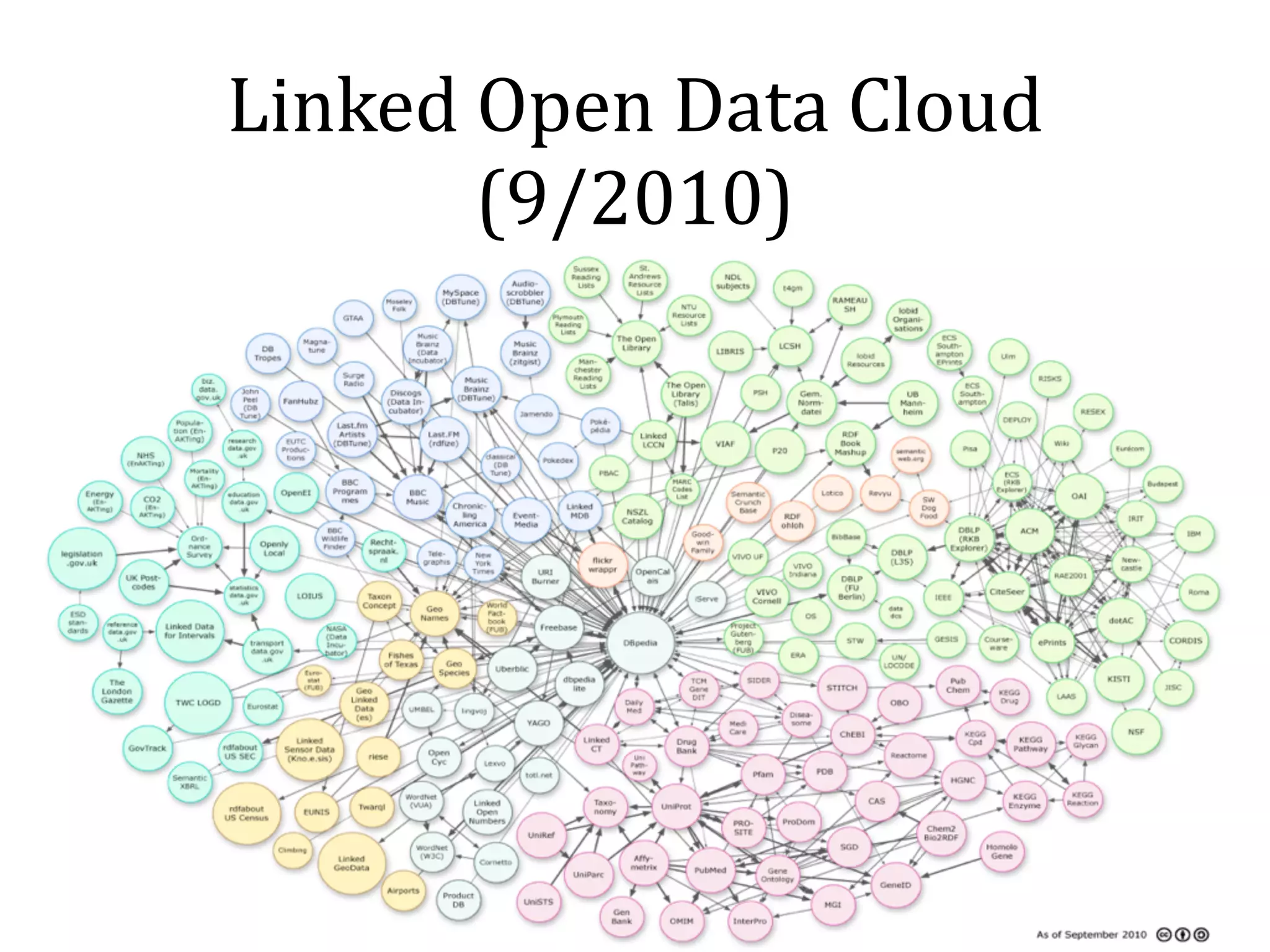
(9/2010)
Linked 
Open 
Data 
Cloud 
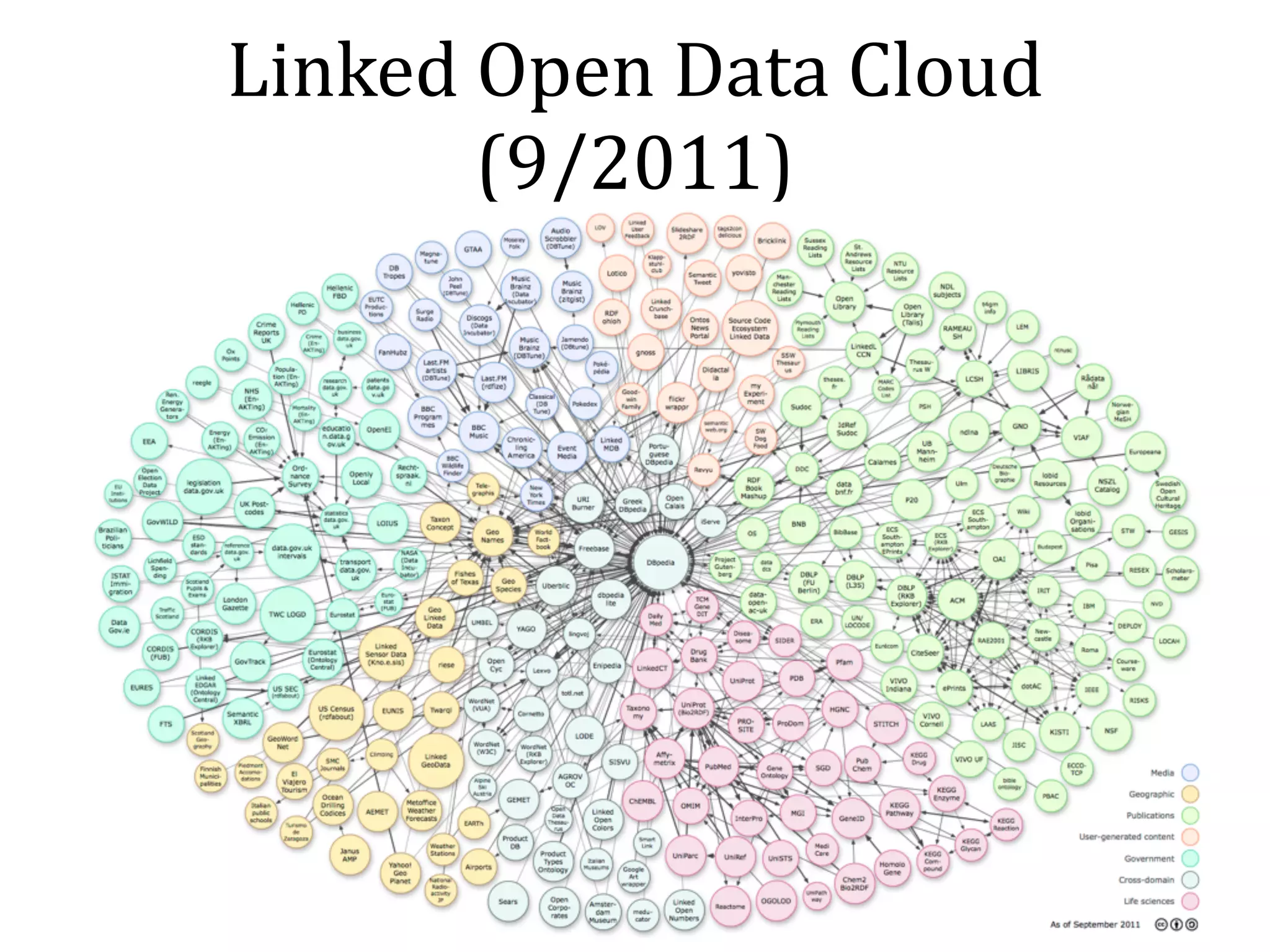
(9/2011)
Linked 
Open 
Data 
Cloud 
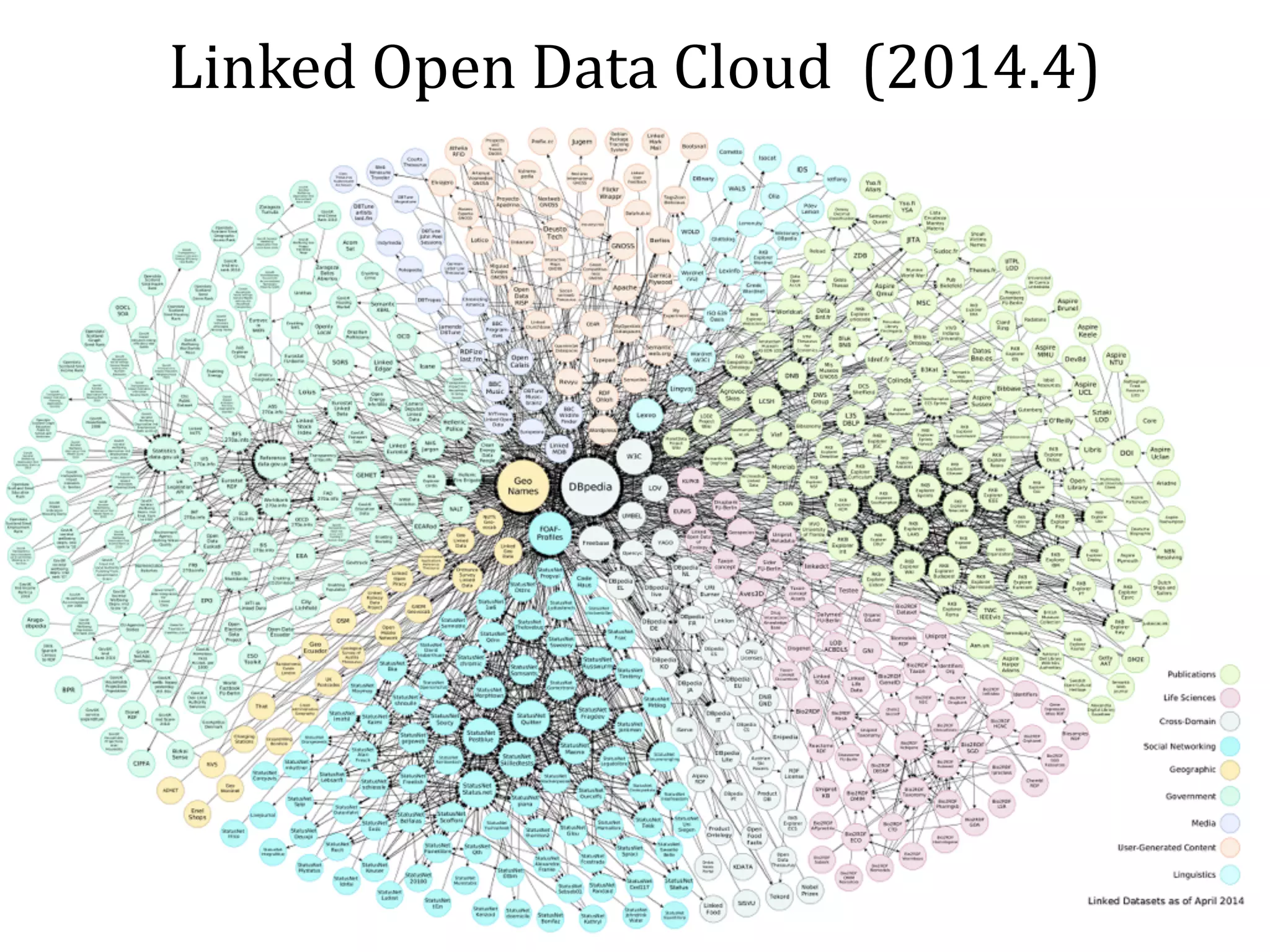
(2014.4)
OGC 
GeoSPARQL 
• The 
GeoSPARQL 
is 
a 
new 
OGC 
standard, 
which 
provides 
three 
main 
components 
for 
encoding 
geographic 
information: 
• (1) 
The 
deKinitions 
of 
vocabularies 
for 
representing 
features, 
geometries, 
and 
their 
relationships; 
• (2) 
A 
set 
of 
domain-­‐speciKic, 
spatial 
functions 
for 
use 
in 
SPARQL 
queries; 
• (3) 
A 
set 
of 
query 
transformation 
rules
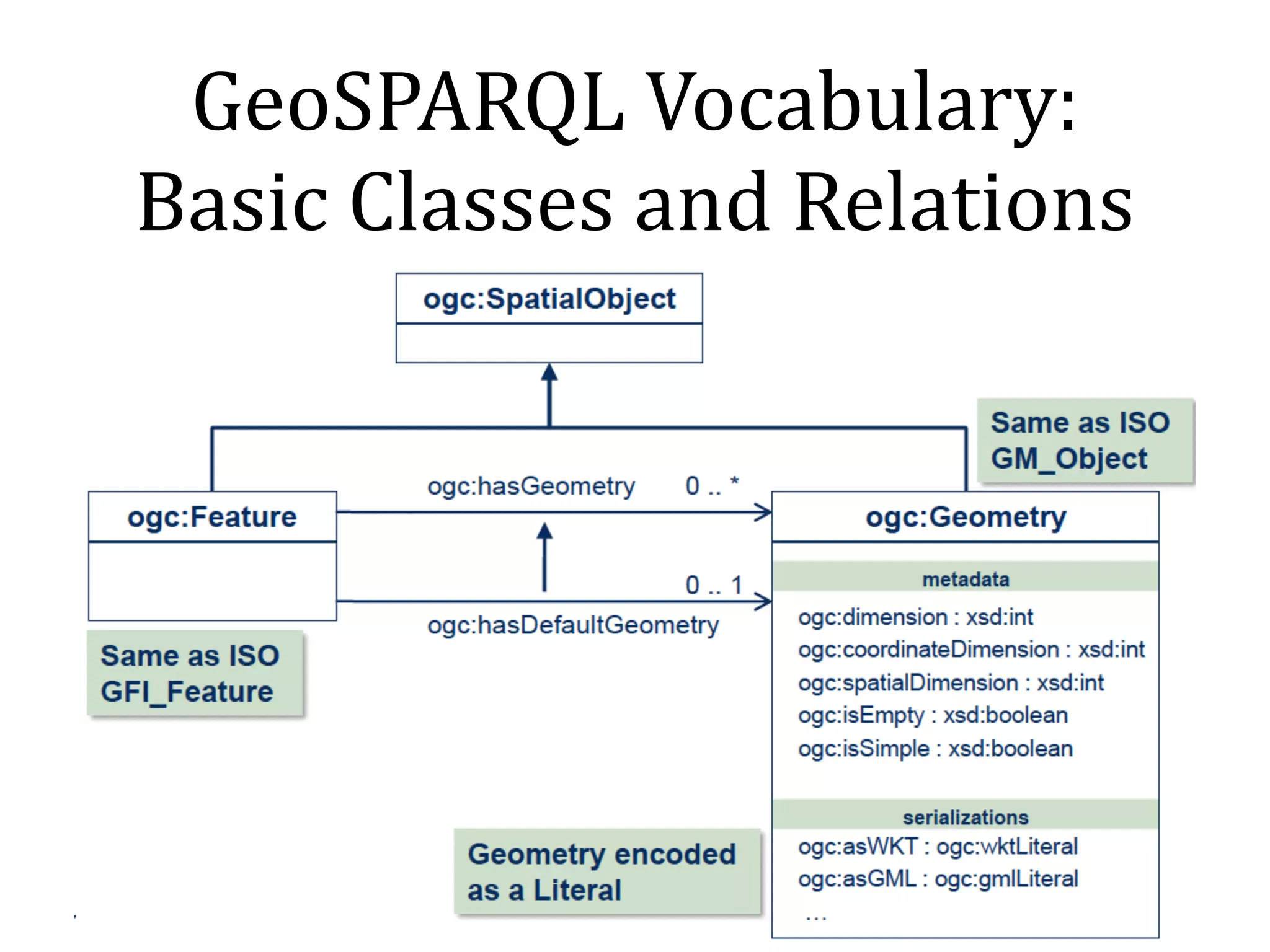
GeoSPARQL 
Vocabulary: 
Basic 
Classes 
and 
Relations
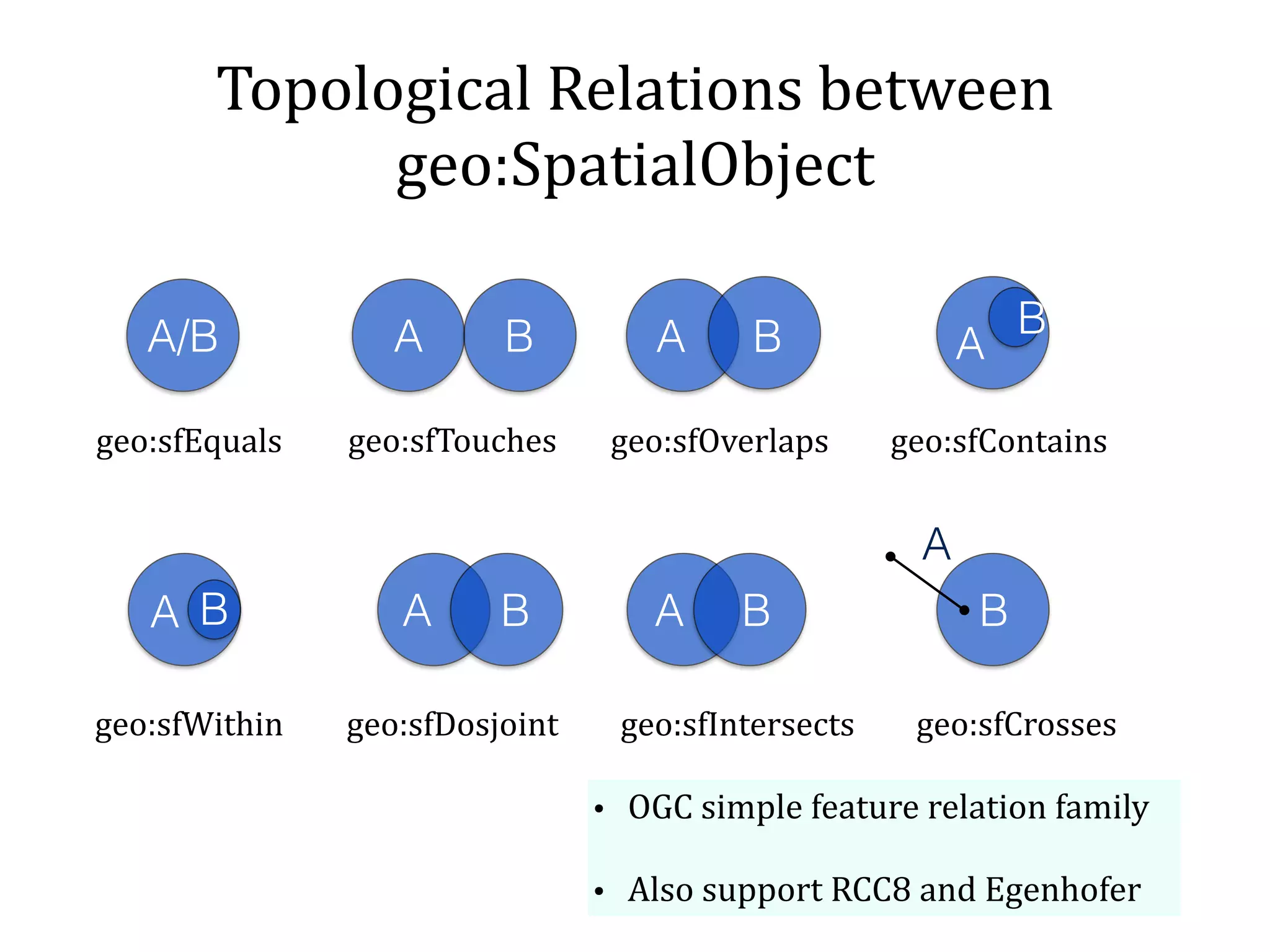
Topological 
Relations 
between 
geo:SpatialObject 
A B A B B 
A 
B 
A A B A B 
A 
B 
• OGC 
simple 
feature 
relation 
family 
• Also 
support 
RCC8 
and 
Egenhofer 
A/B 
geo:sfEquals geo:sfTouches geo:sfOverlaps geo:sfContains 
geo:sfWithin geo:sfDosjoint geo:sfIntersects geo:sfCrosses
Components 
of 
GeoSPARQL 
• Vocabulary 
for 
Query 
Patterns 
• Classes 
• Spatial 
Object, 
Feature, 
Geometry 
• Properties 
• Topological 
relations 
• Links 
between 
features 
and 
geometries 
• Datatypes 
for 
geometry 
literals 
• geo:wktLiteral, 
geo:gmlLiteral 
• Query 
Functions 
• Topological 
relations, 
distance, 
buffer, 
intersection, 
… 
• Entailment 
Components 
• RDFS 
entailment 
• RIF 
rules 
to 
compute 
topological 
relations
Some 
GeoSPARQL 
examples 
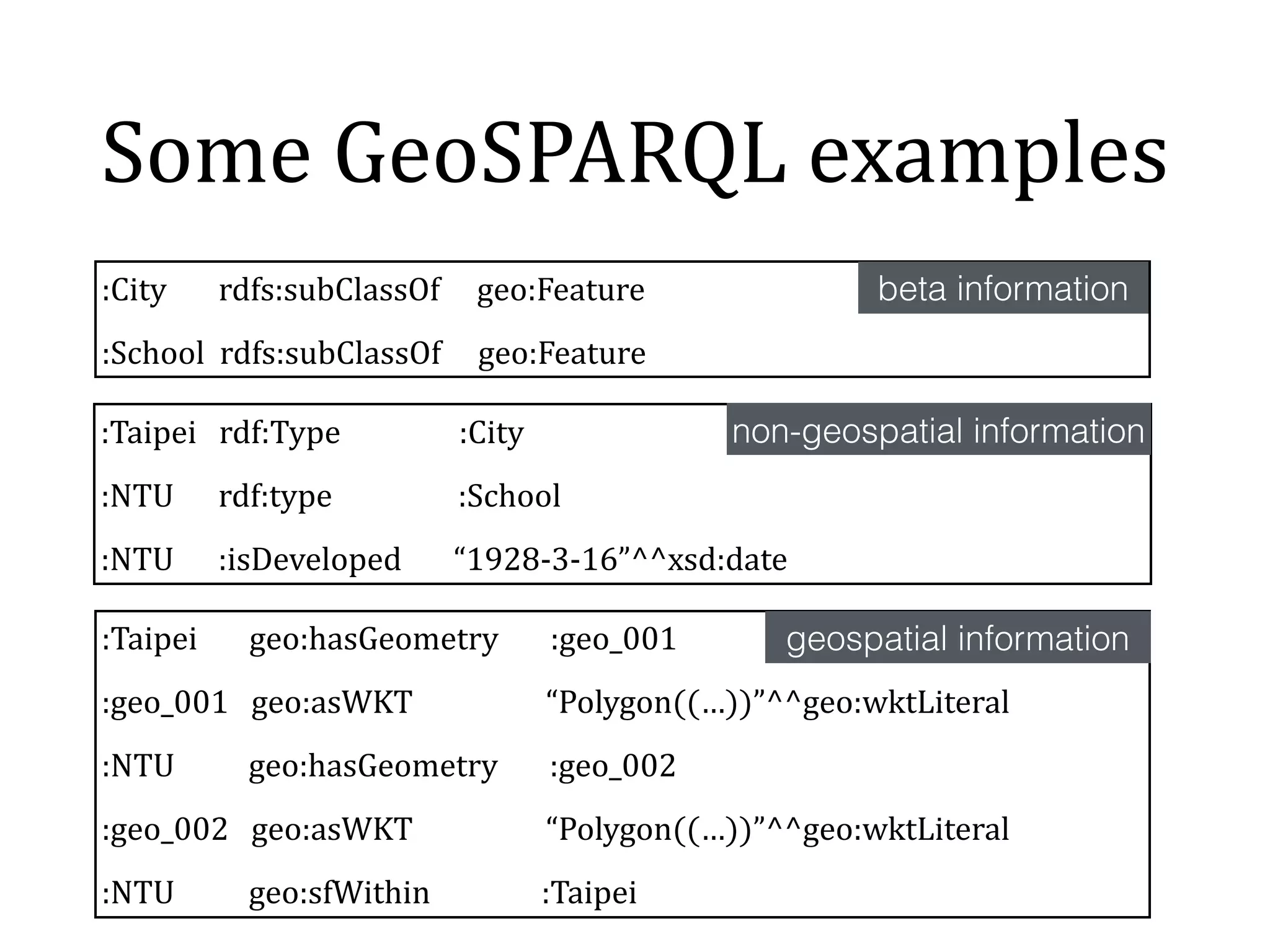
:City 
rdfs:subClassOf 
geo:Feature 
:School 
rdfs:subClassOf 
geo:Feature 
:Taipei rdf:Type :City 
:NTU rdf:type :School 
:NTU :isDeveloped “1928-­‐3-­‐16”^^xsd:date 
:Taipei geo:hasGeometry :geo_001 
:geo_001 geo:asWKT “Polygon((…))”^^geo:wktLiteral 
:NTU geo:hasGeometry :geo_002 
:geo_002 geo:asWKT “Polygon((…))”^^geo:wktLiteral 
:NTU geo:sfWithin :Taipei 
beta information 
non-geospatial information 
geospatial information
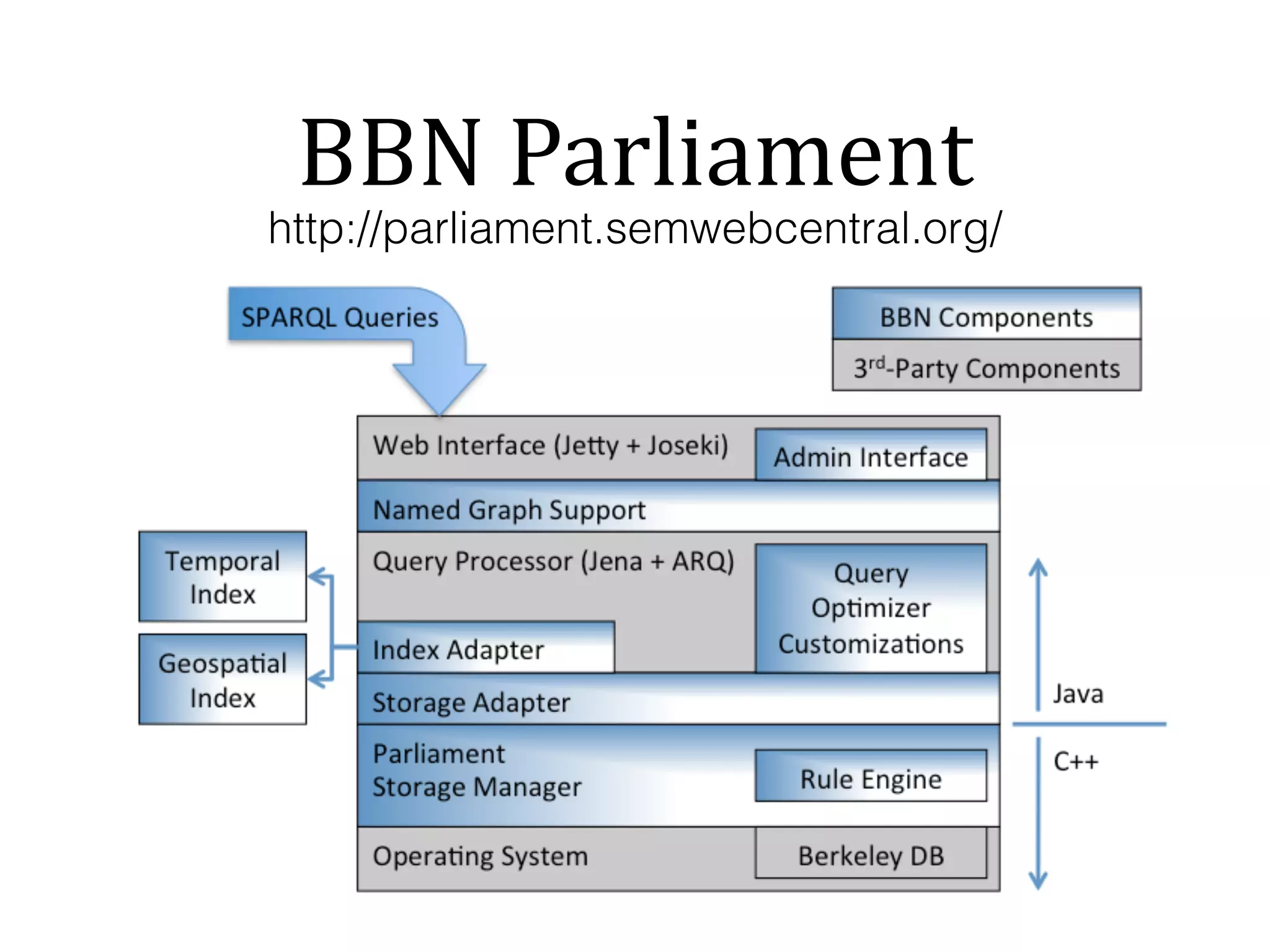
BBN 
Parliament 
http://parliament.semwebcentral.org/
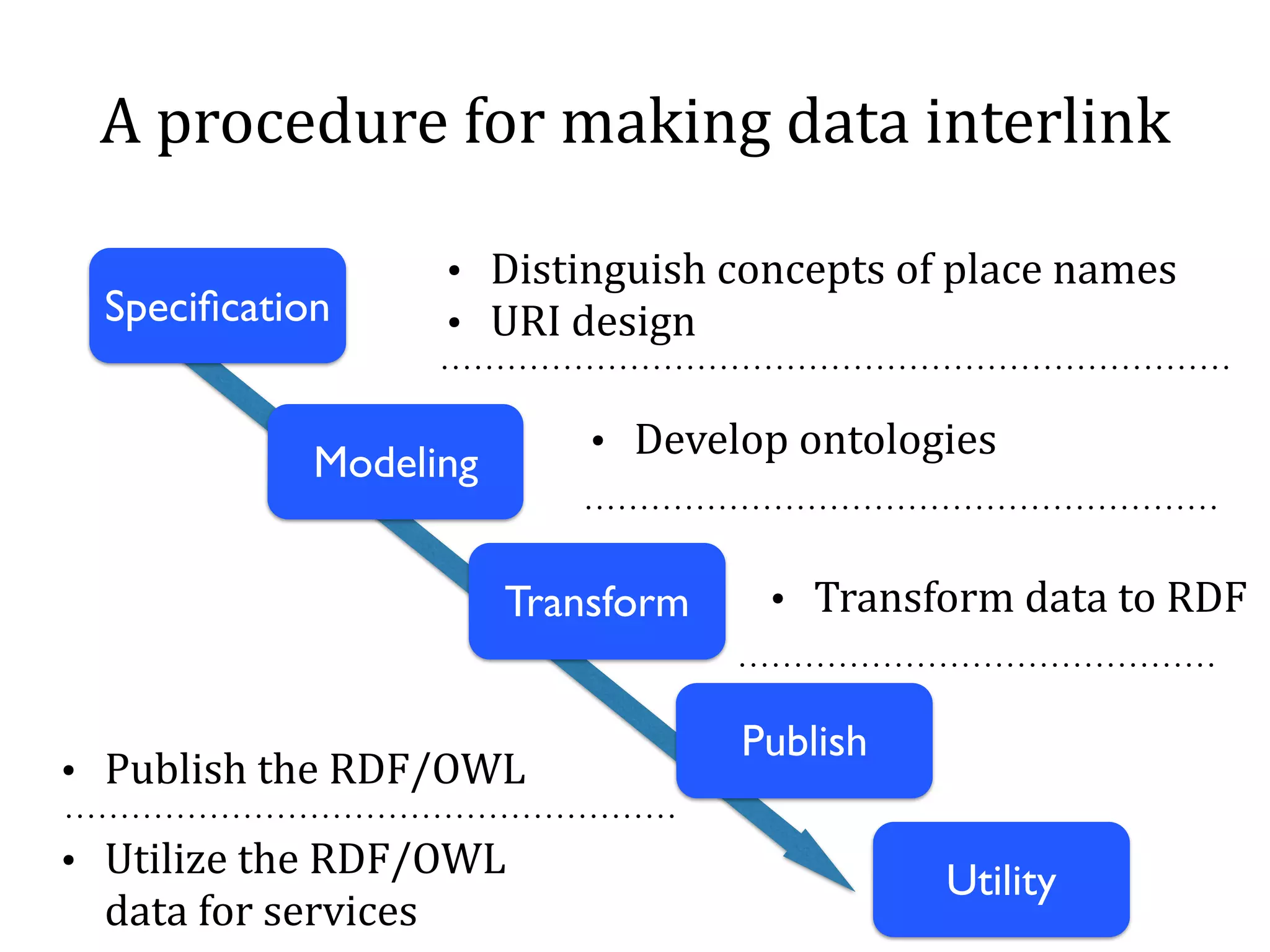
A 
procedure 
for 
making 
data 
interlink 
Specification 
• Distinguish 
concepts 
of 
place 
names 
• URI 
design 
Modeling 
• Develop 
ontologies 
Publish 
Utility 
Transform 
• Transform 
data 
to 
RDF 
• Publish 
the 
RDF/OWL 
• Utilize 
the 
RDF/OWL 
data 
for 
services
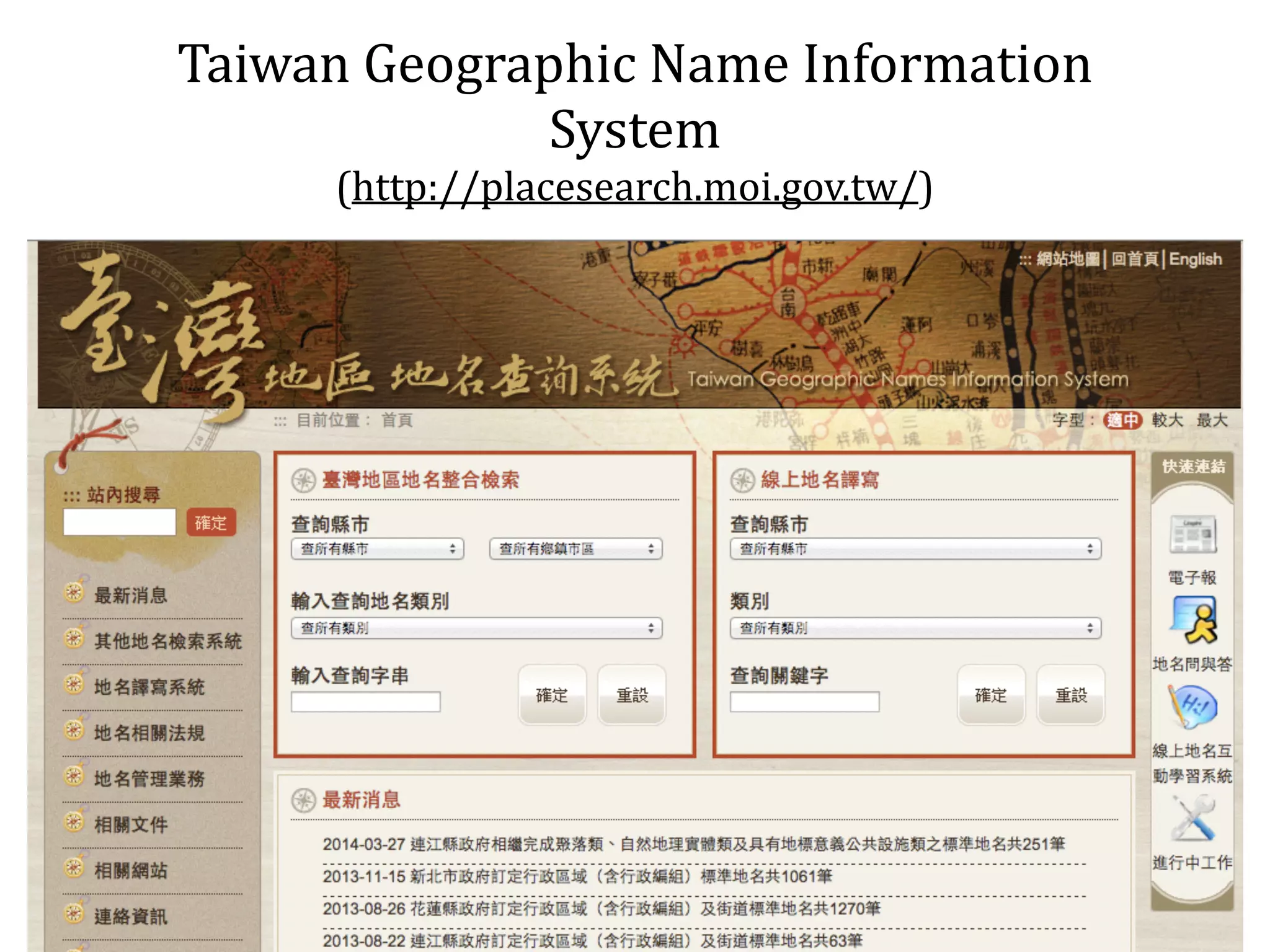
Taiwan 
Geographic 
Name 
Information 
System 
(http://placesearch.moi.gov.tw/)
A 
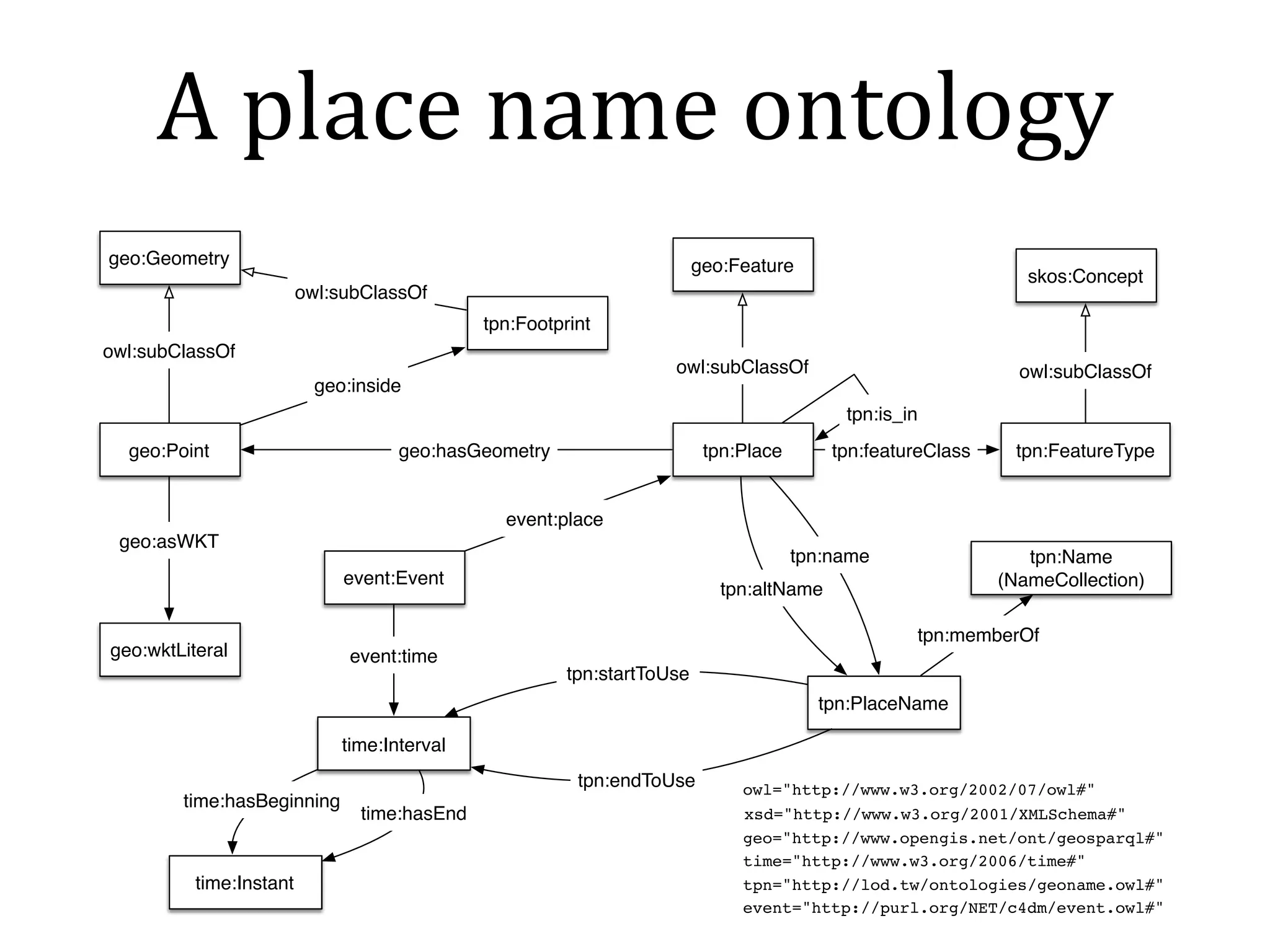
place 
name 
ontology 
geo:Feature 
tpn:Place 
tpn:featureClass tpn:FeatureType 
owl:subClassOf 
skos:Concept 
owl:subClassOf 
geo:inside 
time:Interval 
geo:Geometry 
owl:subClassOf 
geo:Point 
tpn:Footprint 
geo:hasGeometry 
geo:asWKT 
geo:wktLiteral 
tpn:is_in 
owl:subClassOf 
event:Event 
event:place 
tpn:memberOf 
tpn:name 
owl=http://www.w3.org/2002/07/owl# 
xsd=http://www.w3.org/2001/XMLSchema# 
geo=http://www.opengis.net/ont/geosparql# 
time=http://www.w3.org/2006/time# 
tpn=http://lod.tw/ontologies/geoname.owl# 
event=http://purl.org/NET/c4dm/event.owl# 
event:time 
tpn:Name 
(NameCollection) 
tpn:PlaceName 
time:hasBeginning 
time:Instant 
tpn:startToUse 
tpn:endToUse 
time:hasEnd 
tpn:altName
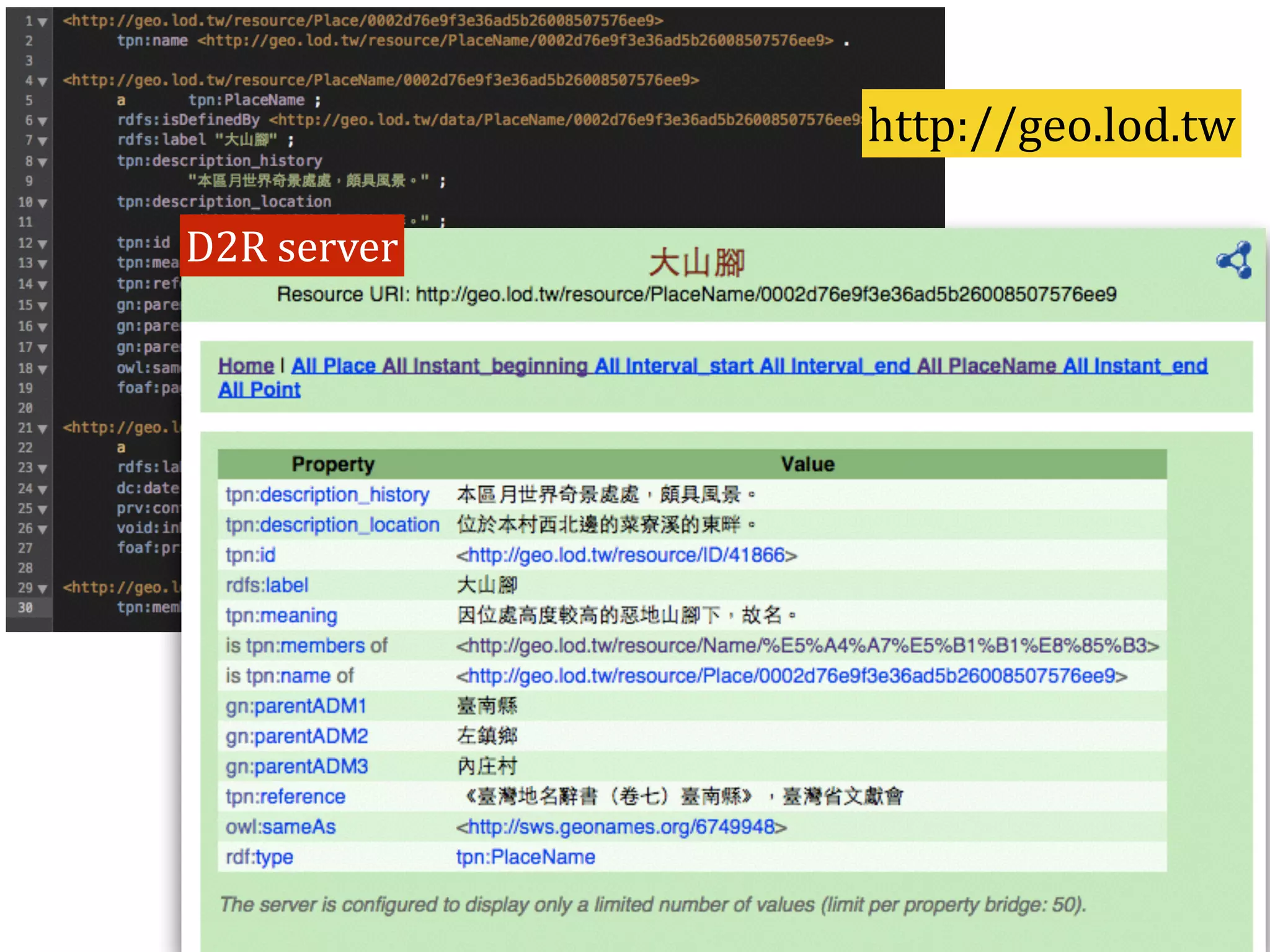
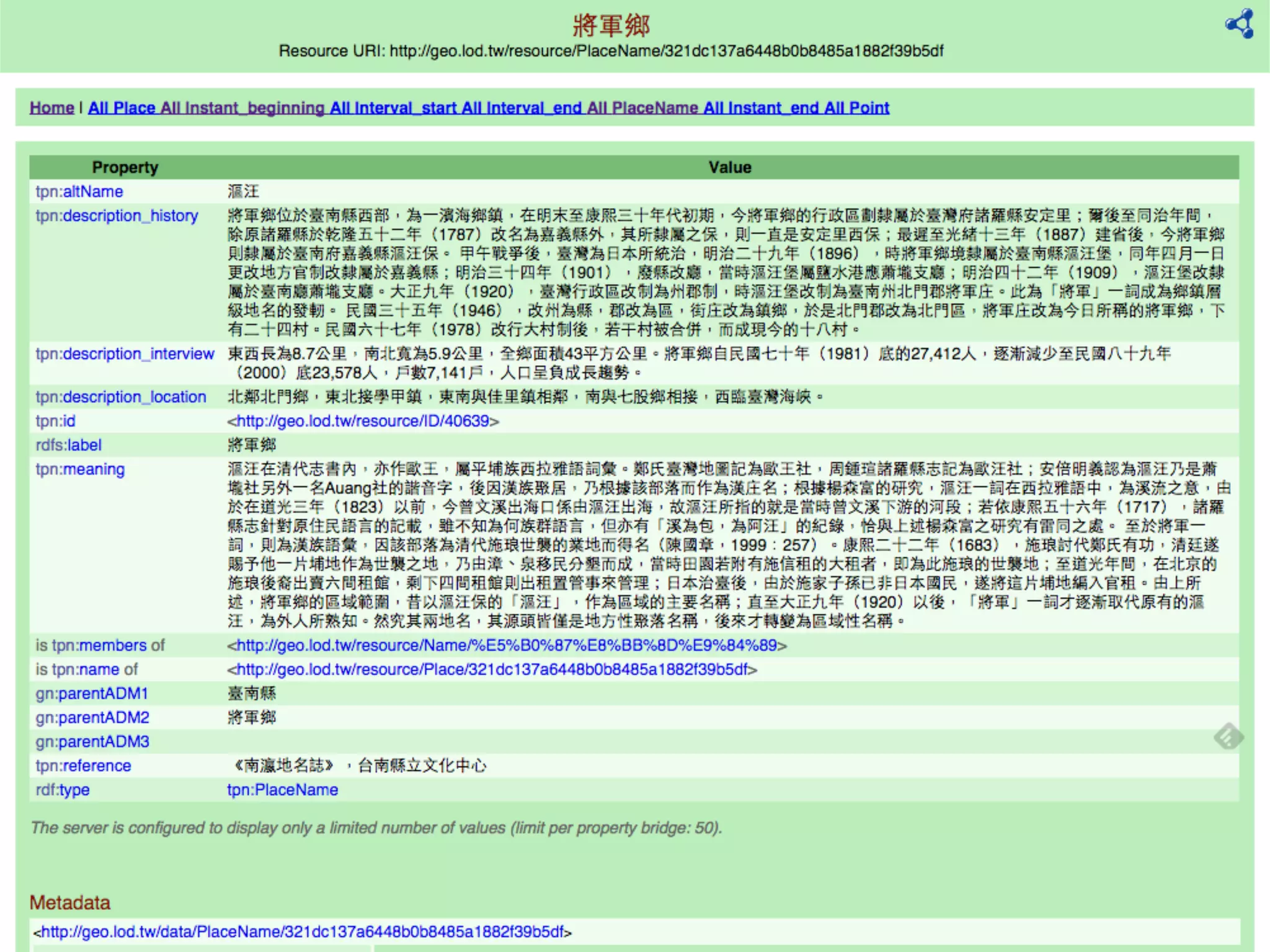
http://geo.lod.tw 
D2R 
server
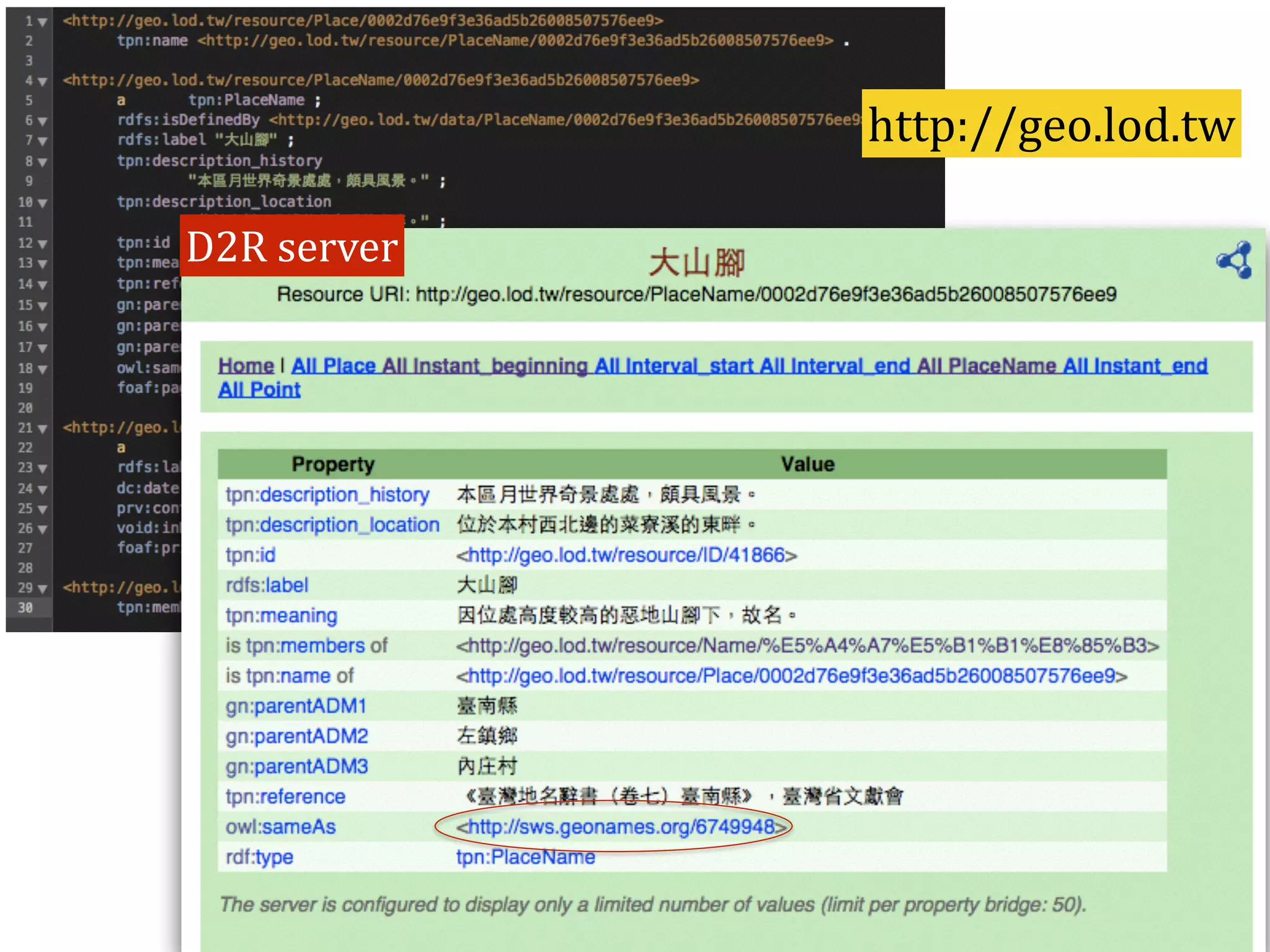
http://geo.lod.tw 
D2R 
server
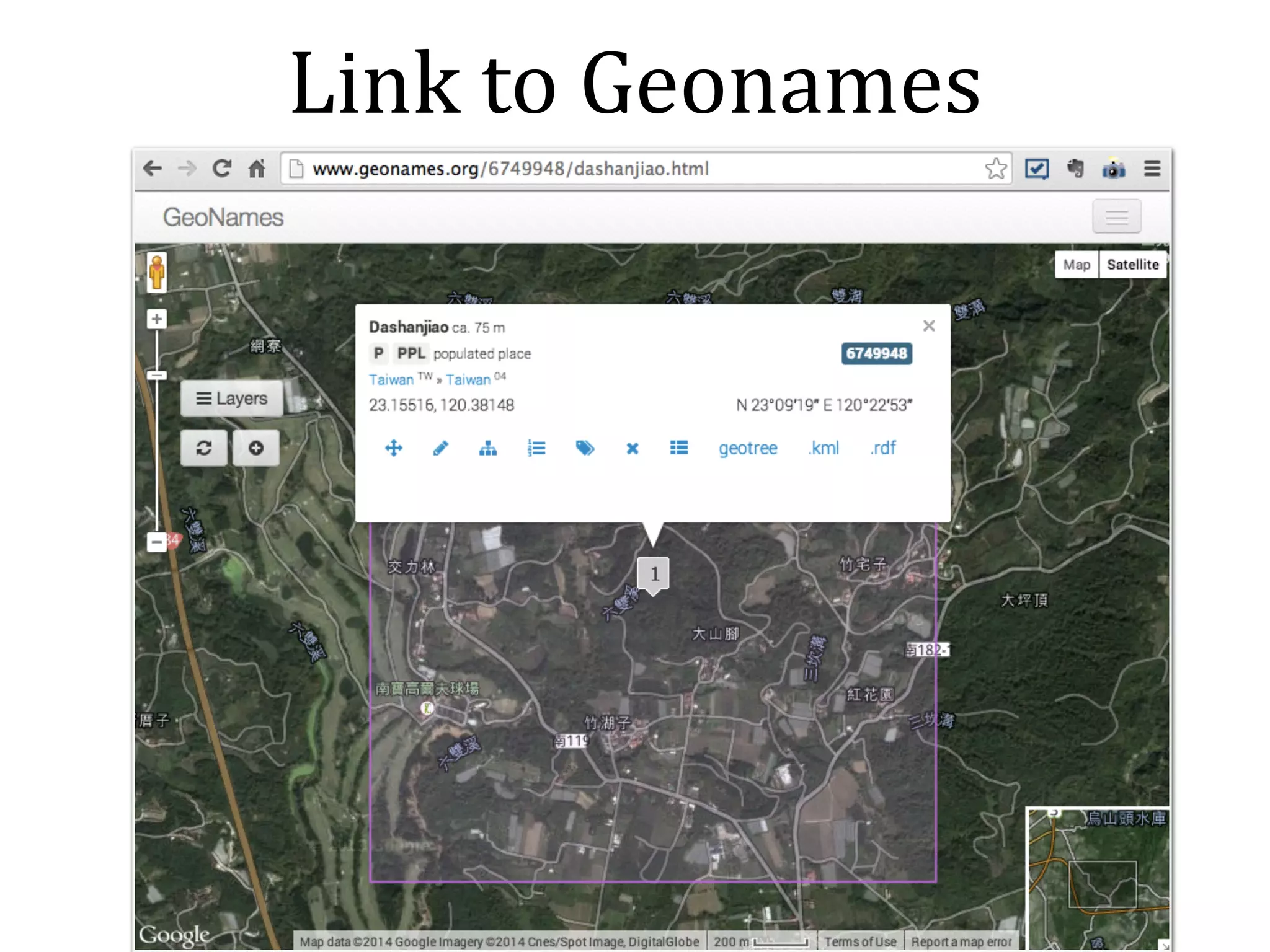
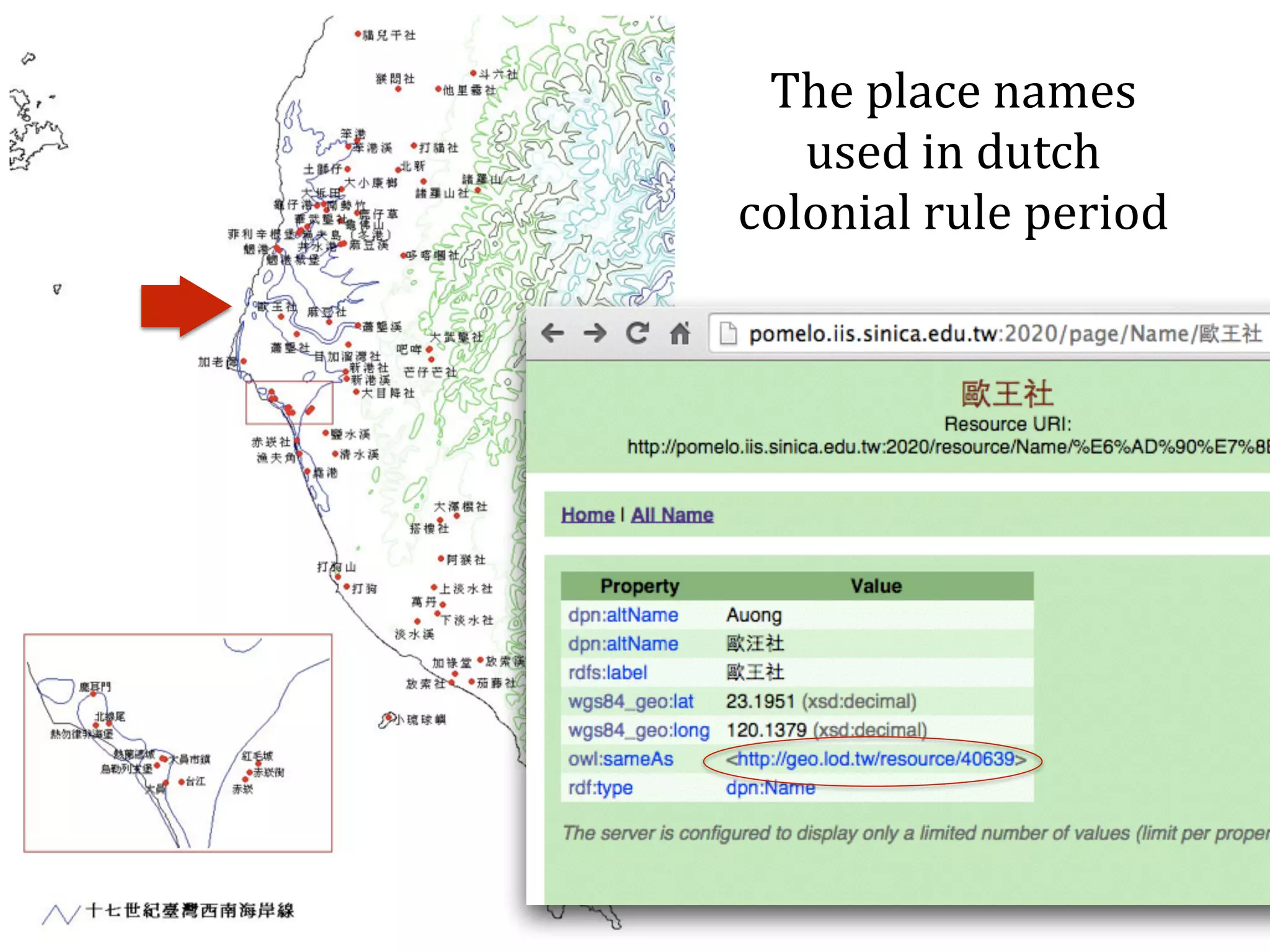
Link 
to 
Geonames
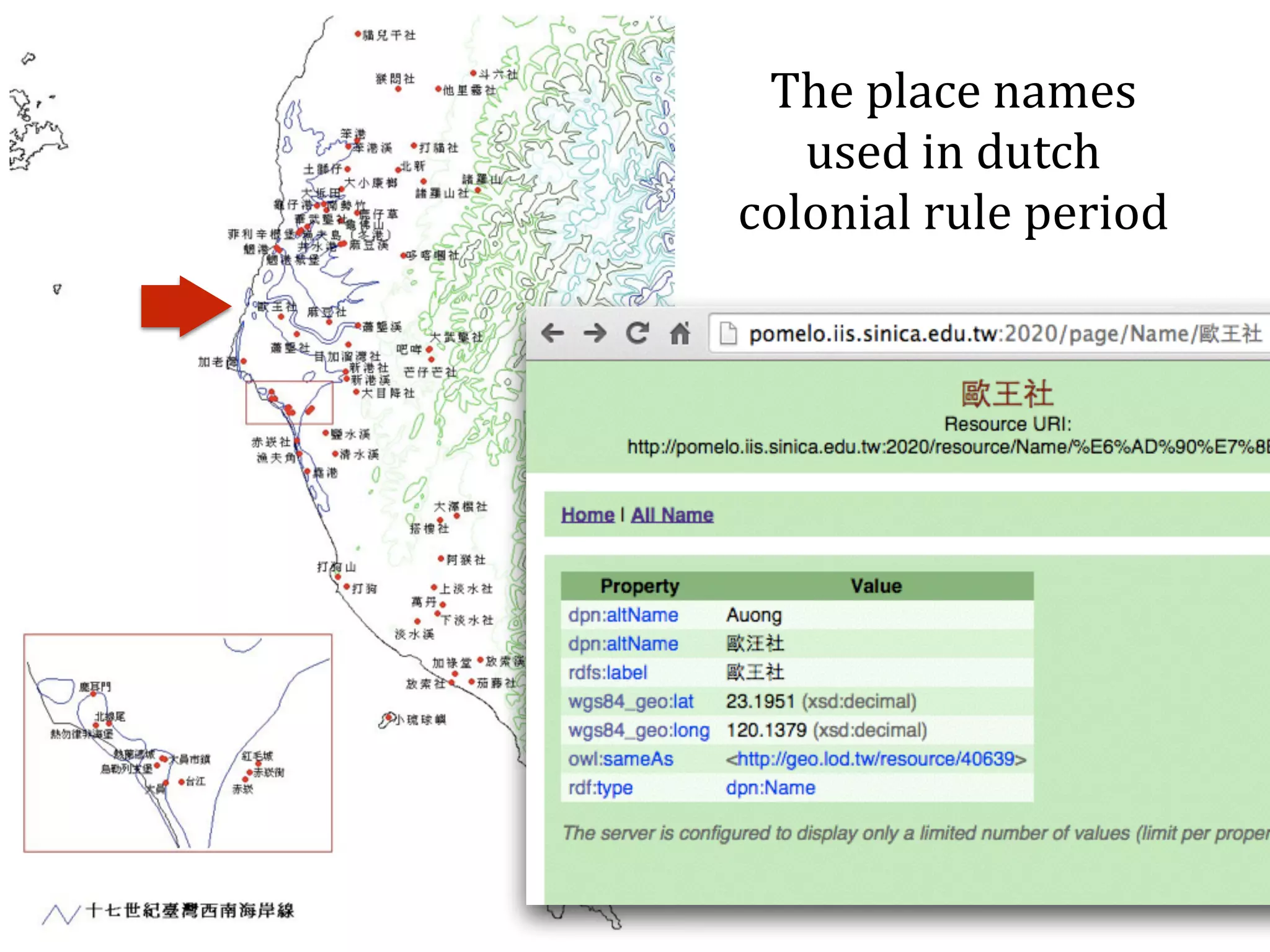
The 
place 
names 
used 
in 
dutch 
colonial 
rule 
period
The 
place 
names 
used 
in 
dutch 
colonial 
rule 
period
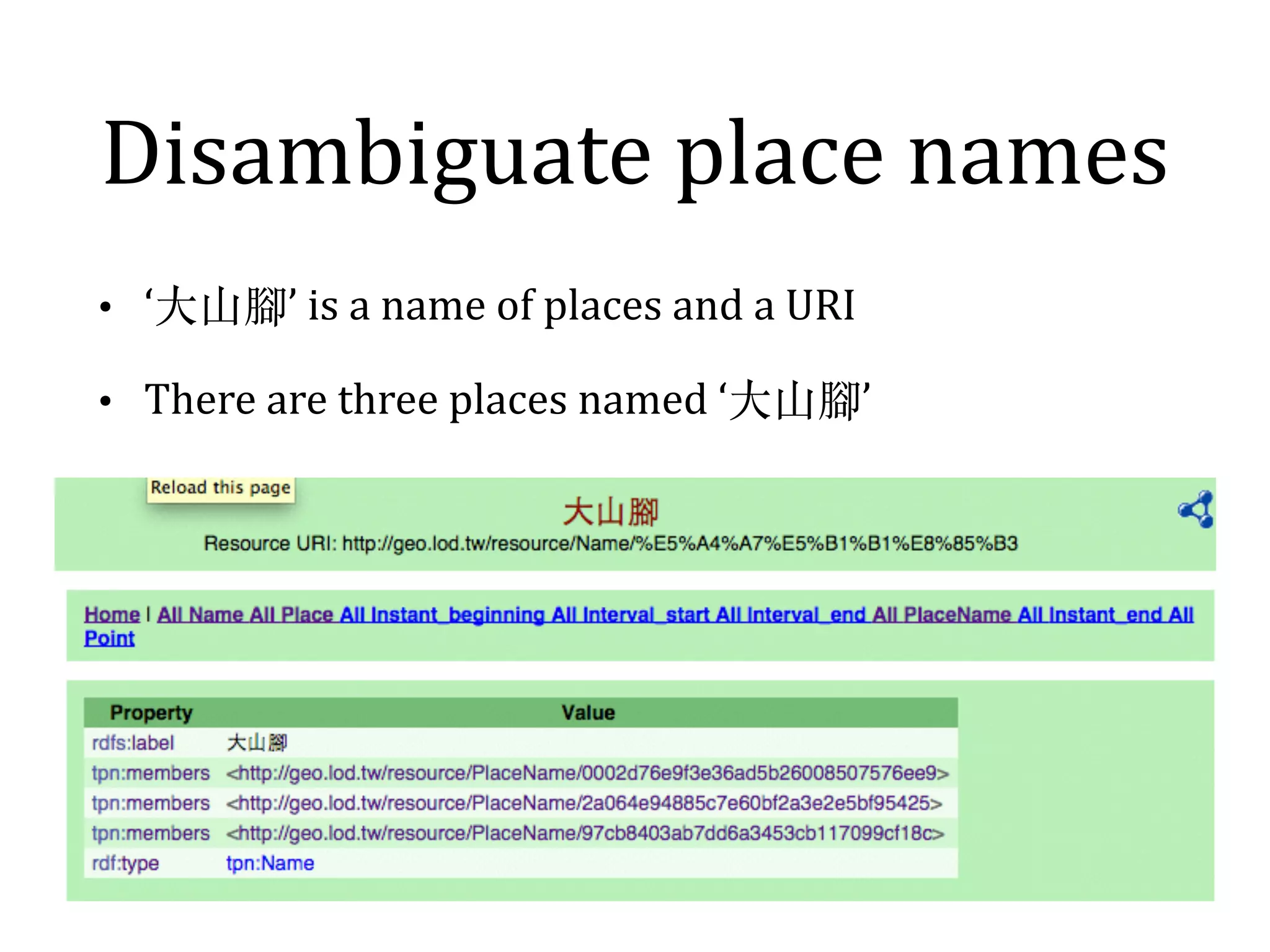
Disambiguate 
place 
names 
• ‘⼤大山腳’ 
is 
a 
name 
of 
places 
and 
a 
URI 
• There 
are 
three 
places 
named 
‘⼤大山腳’
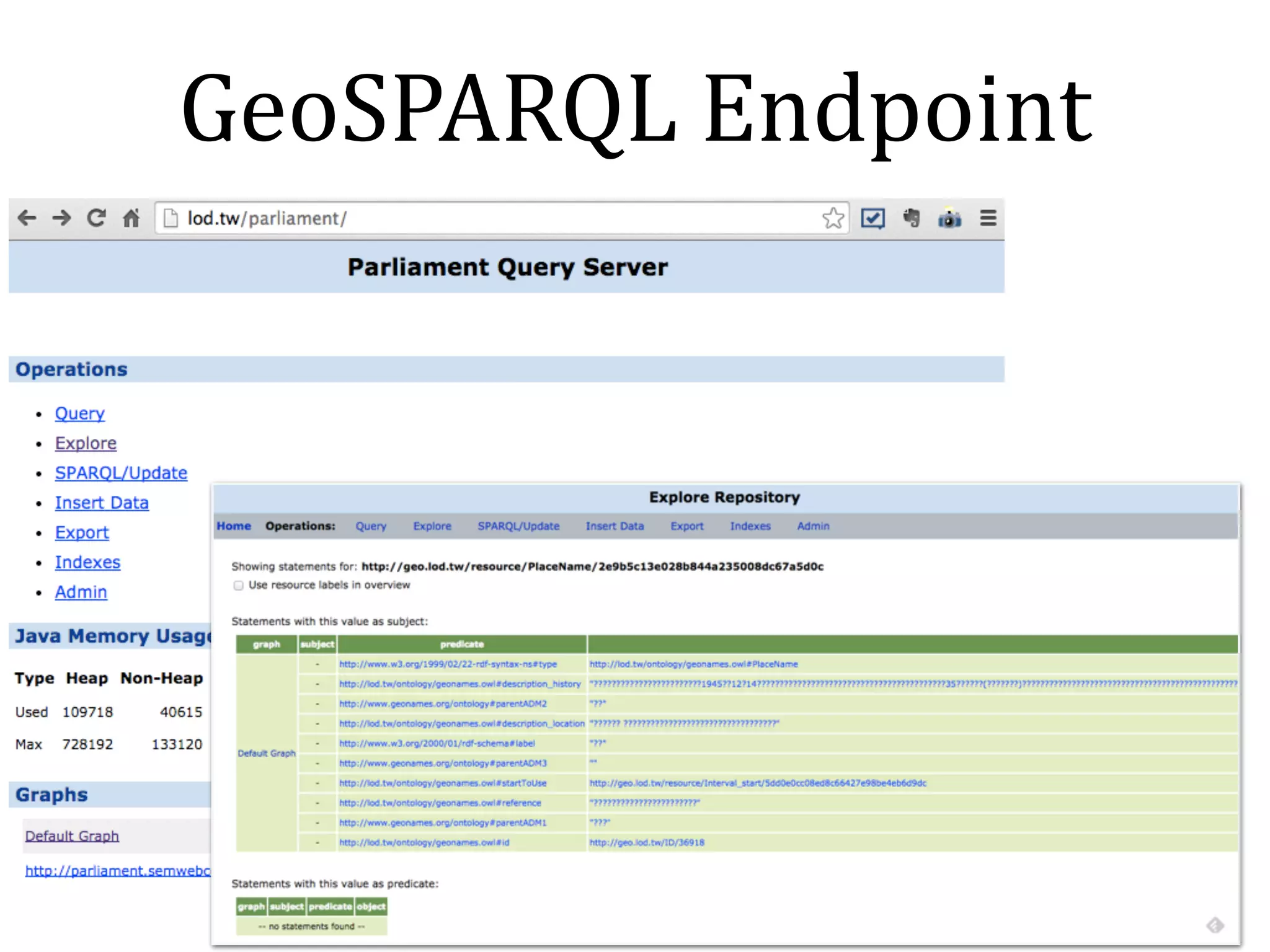
GeoSPARQL 
Endpoint
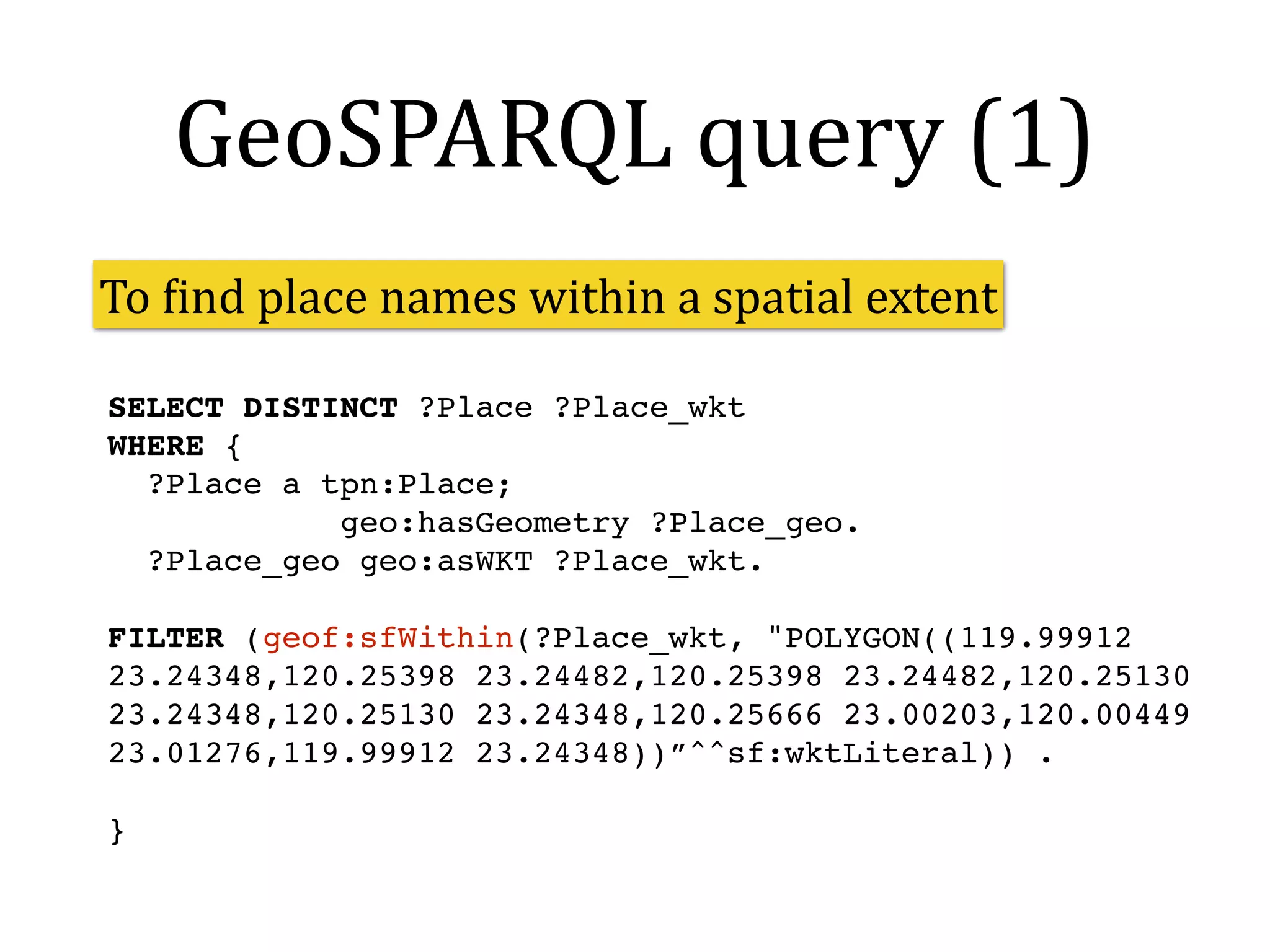
GeoSPARQL 
query 
(1) 
To 
Kind 
place 
names 
within 
a 
spatial 
extent 
SELECT DISTINCT ?Place ?Place_wkt! 
WHERE { ! 
?Place a tpn:Place;! 
geo:hasGeometry ?Place_geo.! 
?Place_geo geo:asWKT ?Place_wkt.! 
! 
FILTER (geof:sfWithin(?Place_wkt, POLYGON((119.99912 
23.24348,120.25398 23.24482,120.25398 23.24482,120.25130 
23.24348,120.25130 23.24348,120.25666 23.00203,120.00449 
23.01276,119.99912 23.24348))”^^sf:wktLiteral)) .! 
! 
} !
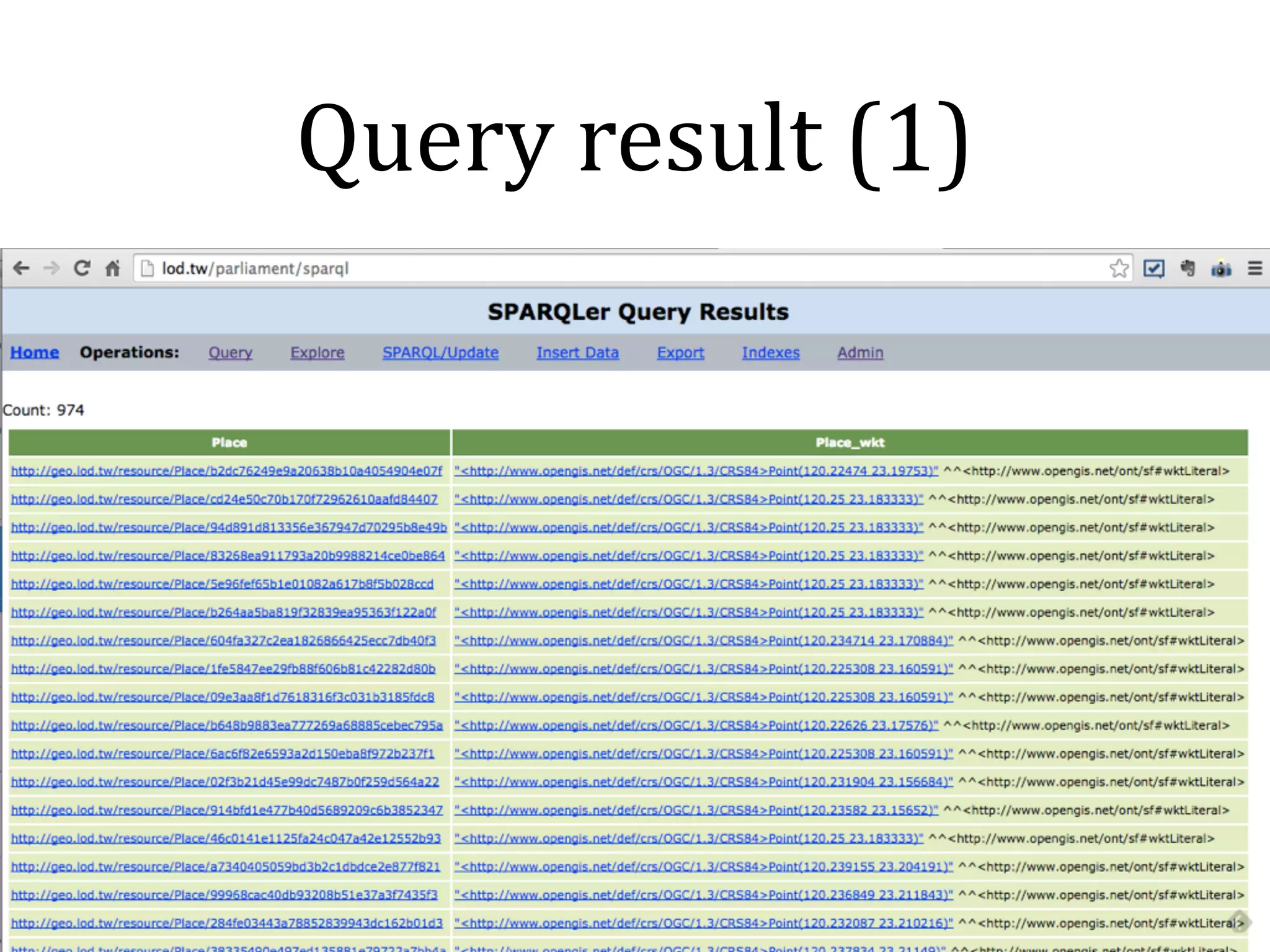
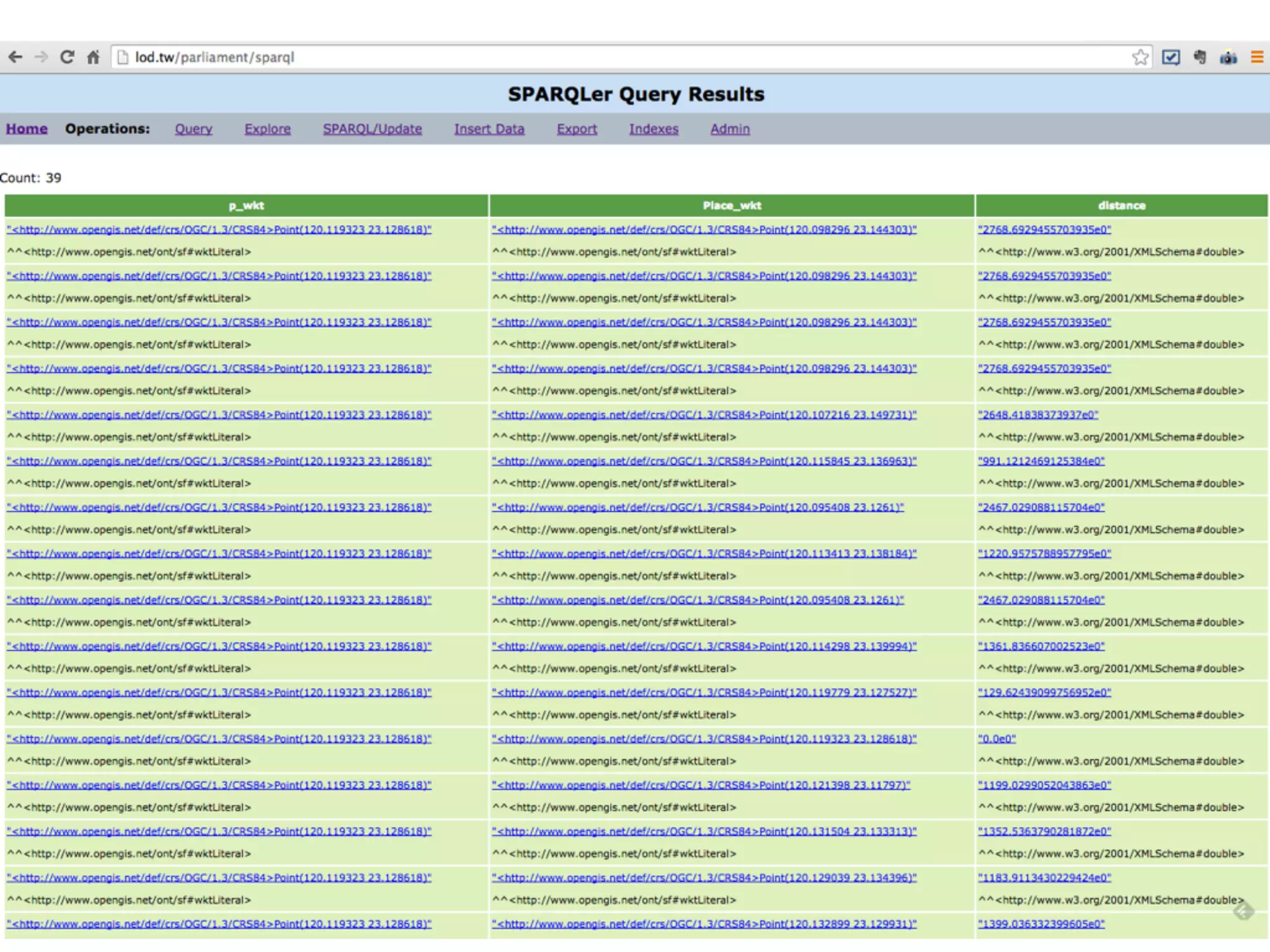
Query 
result 
(1)
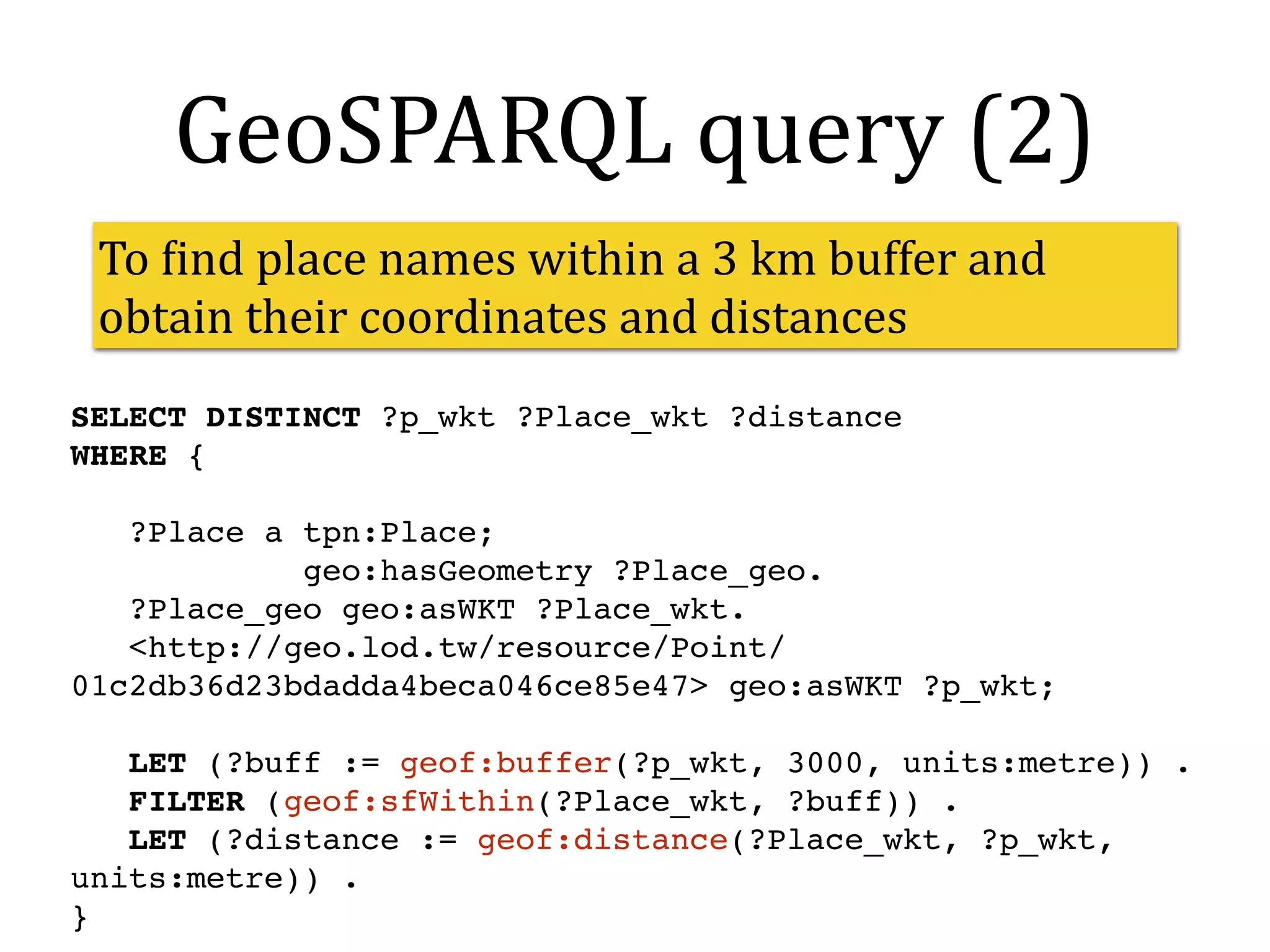
GeoSPARQL 
query 
(2) 
To 
Kind 
place 
names 
within 
a 
3 
km 
buffer 
and 
obtain 
their 
coordinates 
and 
distances 
SELECT DISTINCT ?p_wkt ?Place_wkt ?distance! 
WHERE { ! 
! 
?Place a tpn:Place;! 
geo:hasGeometry ?Place_geo.! 
?Place_geo geo:asWKT ?Place_wkt.! 
http://geo.lod.tw/resource/Point/ 
01c2db36d23bdadda4beca046ce85e47 geo:asWKT ?p_wkt;! 
! 
LET (?buff := geof:buffer(?p_wkt, 3000, units:metre)) .! 
FILTER (geof:sfWithin(?Place_wkt, ?buff)) .! 
LET (?distance := geof:distance(?Place_wkt, ?p_wkt, 
units:metre)) .! 
}
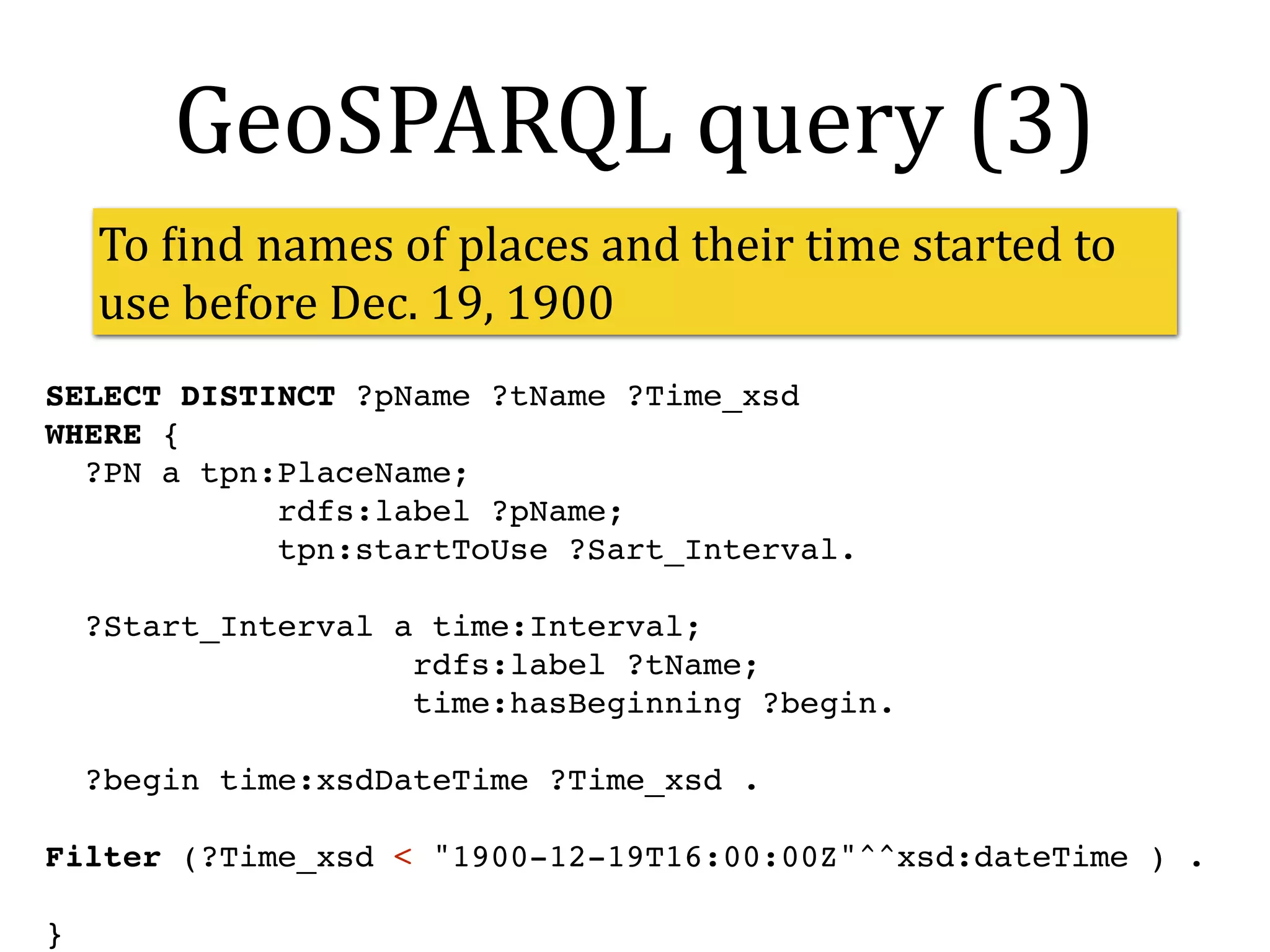
GeoSPARQL 
query 
(3) 
To 
Kind 
names 
of 
places 
and 
their 
time 
started 
to 
use 
before 
Dec. 
19, 
1900 
SELECT DISTINCT ?pName ?tName ?Time_xsd! 
WHERE { ! 
?PN a tpn:PlaceName;! 
rdfs:label ?pName;! 
tpn:startToUse ?Sart_Interval.! 
! 
?Start_Interval a time:Interval;! 
rdfs:label ?tName;! 
time:hasBeginning ?begin.! 
! 
?begin time:xsdDateTime ?Time_xsd .! 
! 
Filter (?Time_xsd  1900-12-19T16:00:00Z^^xsd:dateTime ) .! 
! 
}
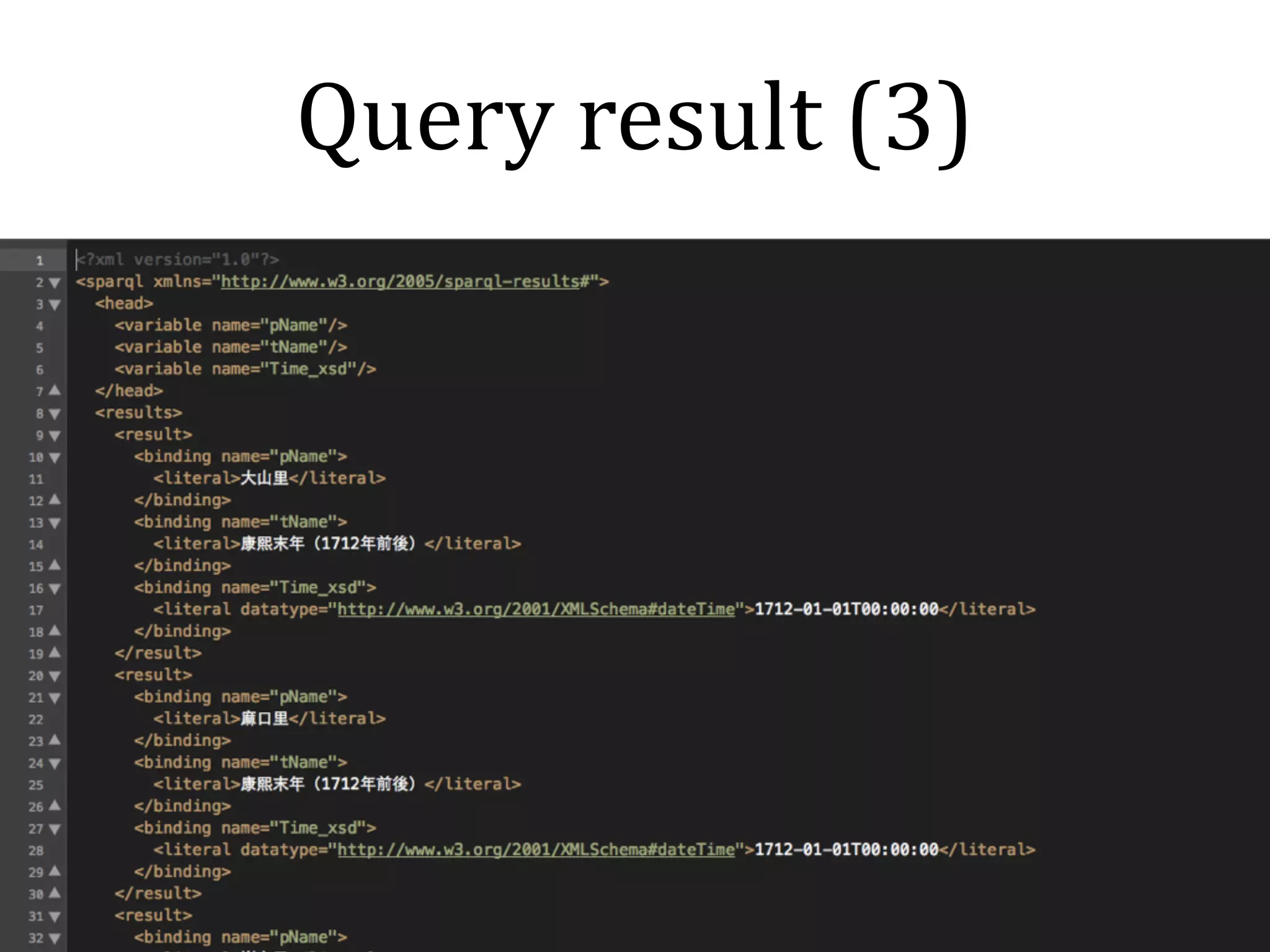
Query 
result 
(3)
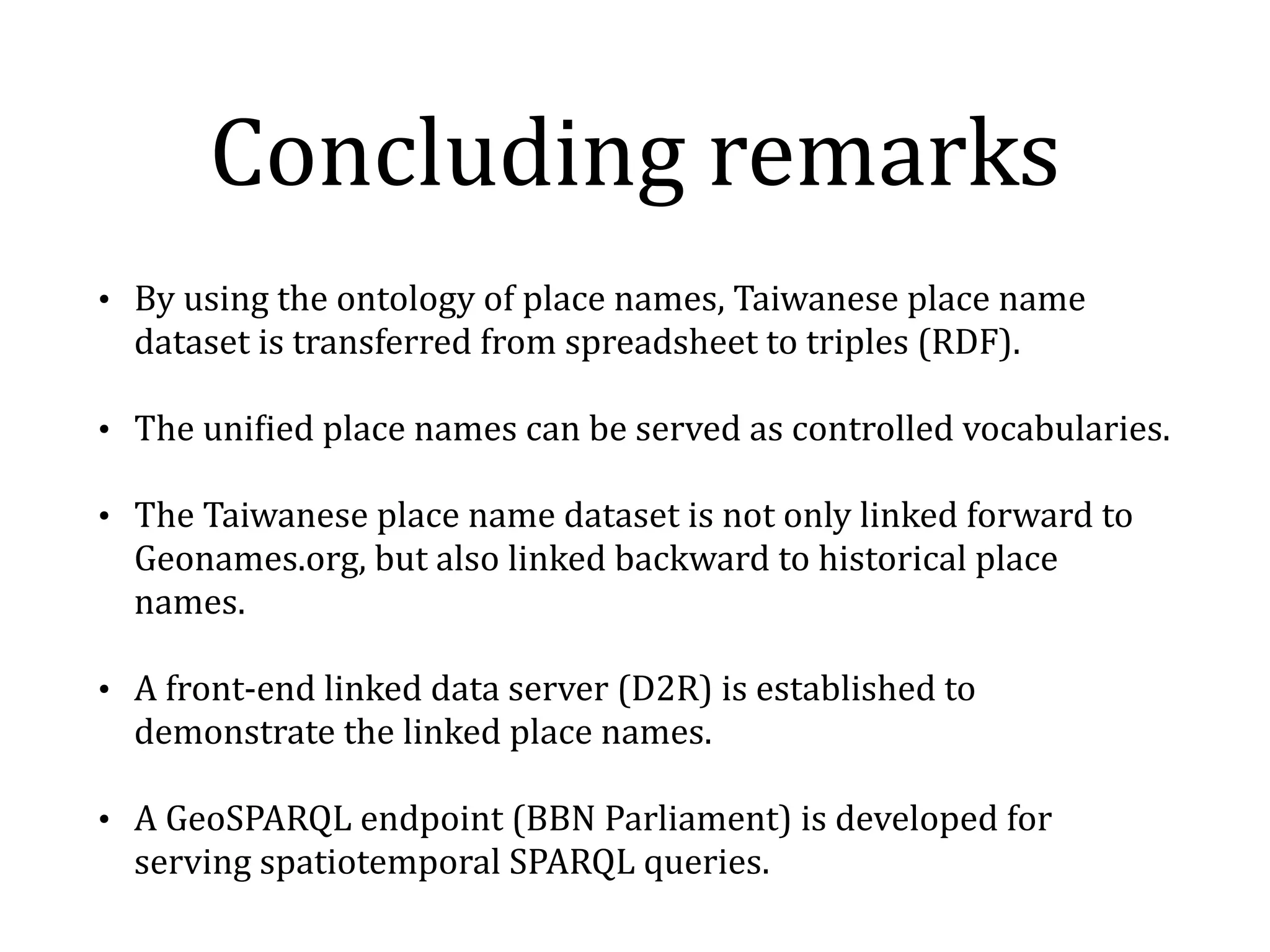
Concluding 
remarks 
• By 
using 
the 
ontology 
of 
place 
names, 
Taiwanese 
place 
name 
dataset 
is 
transferred 
from 
spreadsheet 
to 
triples 
(RDF). 
• The 
uniKied 
place 
names 
can 
be 
served 
as 
controlled 
vocabularies. 
• The 
Taiwanese 
place 
name 
dataset 
is 
not 
only 
linked 
forward 
to 
Geonames.org, 
but 
also 
linked 
backward 
to 
historical 
place 
names. 
• A 
front-­‐end 
linked 
data 
server 
(D2R) 
is 
established 
to 
demonstrate 
the 
linked 
place 
names. 
• A 
GeoSPARQL 
endpoint 
(BBN 
Parliament) 
is 
developed 
for 
serving 
spatiotemporal 
SPARQL 
queries.

Toward Next Generation of Gazetteer: Utilizing GeoSPARQL For Developing Linked Geoname Data

  • 1.
    2014 PaciKic Neighborhoods Consortium Annual Conference and Joint Meeting Toward Next Generation of Gazetteer: Utilizing GeoSPARQL For Developing Linked Geoname Data Dongpo Deng ! Geospatial Information Specialist Institute of Information Science Academia Sinica dongpo@iis.sinica.edu.tw
  • 2.
    Place and Name • A place is a meaningful location for people. • To identify places, people give name for separating from undifferentiated space. • A place is a concept of geography. • A name of a place is about toponymy.
  • 3.
    Gazetteer • A gazetteer is deKined by (Hill, 2000) as geospatial dictionaries of geographic names with the core components of • A name (could have variant names also) ; • A location (coordinates representing a point, line, or areal location) ; • A type (selected from a type scheme of categories for places/features).
  • 4.
  • 5.
  • 6.
  • 7.
  • 8.
    Research data management (CKAN) (taijiang.tw)
  • 9.
    Metadata management - '.- /- 02 ,,,,! 2 # 2+1 *)$
  • 10.
  • 12.
    Place name as Controlled Vocabulary
  • 13.
    Place name as Controlled Vocabulary
  • 14.
    Ambiguity of Place names • Many places have same name • A place can have many name • Long place names are often shortened • Spatial footprints of place names are often difKicult to deKine
  • 15.
    Linked Data •Tim Berners-­‐Lee (2006) proposed 4 principles: 1. Use URIs as names for things 2. Use HTTP URIs so that people can look up those names. 3. When someone looks up a URI, provide useful information, using the standards (RDF, SPARQL) 4. Include links to other URIs. so that they can discover more things.
  • 16.
    Why Linked Data? • To create web of data • To semantically integrate data • To facilitate data reuse • The more Link data, the more knowledge can be discovered
  • 17.
    Linked Open Data Cloud (9/2008)
  • 18.
    Linked Open Data Cloud (7/2009)
  • 19.
    Linked Open Data Cloud (9/2010)
  • 20.
    Linked Open Data Cloud (9/2011)
  • 21.
    Linked Open Data Cloud (2014.4)
  • 22.
    OGC GeoSPARQL •The GeoSPARQL is a new OGC standard, which provides three main components for encoding geographic information: • (1) The deKinitions of vocabularies for representing features, geometries, and their relationships; • (2) A set of domain-­‐speciKic, spatial functions for use in SPARQL queries; • (3) A set of query transformation rules
  • 23.
    GeoSPARQL Vocabulary: Basic Classes and Relations
  • 24.
    Topological Relations between geo:SpatialObject A B A B B A B A A B A B A B • OGC simple feature relation family • Also support RCC8 and Egenhofer A/B geo:sfEquals geo:sfTouches geo:sfOverlaps geo:sfContains geo:sfWithin geo:sfDosjoint geo:sfIntersects geo:sfCrosses
  • 25.
    Components of GeoSPARQL • Vocabulary for Query Patterns • Classes • Spatial Object, Feature, Geometry • Properties • Topological relations • Links between features and geometries • Datatypes for geometry literals • geo:wktLiteral, geo:gmlLiteral • Query Functions • Topological relations, distance, buffer, intersection, … • Entailment Components • RDFS entailment • RIF rules to compute topological relations
  • 26.
    Some GeoSPARQL examples :City rdfs:subClassOf geo:Feature :School rdfs:subClassOf geo:Feature :Taipei rdf:Type :City :NTU rdf:type :School :NTU :isDeveloped “1928-­‐3-­‐16”^^xsd:date :Taipei geo:hasGeometry :geo_001 :geo_001 geo:asWKT “Polygon((…))”^^geo:wktLiteral :NTU geo:hasGeometry :geo_002 :geo_002 geo:asWKT “Polygon((…))”^^geo:wktLiteral :NTU geo:sfWithin :Taipei beta information non-geospatial information geospatial information
  • 27.
  • 28.
    A procedure for making data interlink Specification • Distinguish concepts of place names • URI design Modeling • Develop ontologies Publish Utility Transform • Transform data to RDF • Publish the RDF/OWL • Utilize the RDF/OWL data for services
  • 29.
    Taiwan Geographic Name Information System (http://placesearch.moi.gov.tw/)
  • 30.
    A place name ontology geo:Feature tpn:Place tpn:featureClass tpn:FeatureType owl:subClassOf skos:Concept owl:subClassOf geo:inside time:Interval geo:Geometry owl:subClassOf geo:Point tpn:Footprint geo:hasGeometry geo:asWKT geo:wktLiteral tpn:is_in owl:subClassOf event:Event event:place tpn:memberOf tpn:name owl=http://www.w3.org/2002/07/owl# xsd=http://www.w3.org/2001/XMLSchema# geo=http://www.opengis.net/ont/geosparql# time=http://www.w3.org/2006/time# tpn=http://lod.tw/ontologies/geoname.owl# event=http://purl.org/NET/c4dm/event.owl# event:time tpn:Name (NameCollection) tpn:PlaceName time:hasBeginning time:Instant tpn:startToUse tpn:endToUse time:hasEnd tpn:altName
  • 31.
  • 32.
  • 33.
  • 34.
    The place names used in dutch colonial rule period
  • 35.
    The place names used in dutch colonial rule period
  • 37.
    Disambiguate place names • ‘⼤大山腳’ is a name of places and a URI • There are three places named ‘⼤大山腳’
  • 38.
  • 39.
    GeoSPARQL query (1) To Kind place names within a spatial extent SELECT DISTINCT ?Place ?Place_wkt! WHERE { ! ?Place a tpn:Place;! geo:hasGeometry ?Place_geo.! ?Place_geo geo:asWKT ?Place_wkt.! ! FILTER (geof:sfWithin(?Place_wkt, POLYGON((119.99912 23.24348,120.25398 23.24482,120.25398 23.24482,120.25130 23.24348,120.25130 23.24348,120.25666 23.00203,120.00449 23.01276,119.99912 23.24348))”^^sf:wktLiteral)) .! ! } !
  • 40.
  • 41.
    GeoSPARQL query (2) To Kind place names within a 3 km buffer and obtain their coordinates and distances SELECT DISTINCT ?p_wkt ?Place_wkt ?distance! WHERE { ! ! ?Place a tpn:Place;! geo:hasGeometry ?Place_geo.! ?Place_geo geo:asWKT ?Place_wkt.! http://geo.lod.tw/resource/Point/ 01c2db36d23bdadda4beca046ce85e47 geo:asWKT ?p_wkt;! ! LET (?buff := geof:buffer(?p_wkt, 3000, units:metre)) .! FILTER (geof:sfWithin(?Place_wkt, ?buff)) .! LET (?distance := geof:distance(?Place_wkt, ?p_wkt, units:metre)) .! }
  • 43.
    GeoSPARQL query (3) To Kind names of places and their time started to use before Dec. 19, 1900 SELECT DISTINCT ?pName ?tName ?Time_xsd! WHERE { ! ?PN a tpn:PlaceName;! rdfs:label ?pName;! tpn:startToUse ?Sart_Interval.! ! ?Start_Interval a time:Interval;! rdfs:label ?tName;! time:hasBeginning ?begin.! ! ?begin time:xsdDateTime ?Time_xsd .! ! Filter (?Time_xsd 1900-12-19T16:00:00Z^^xsd:dateTime ) .! ! }
  • 44.
  • 45.
    Concluding remarks •By using the ontology of place names, Taiwanese place name dataset is transferred from spreadsheet to triples (RDF). • The uniKied place names can be served as controlled vocabularies. • The Taiwanese place name dataset is not only linked forward to Geonames.org, but also linked backward to historical place names. • A front-­‐end linked data server (D2R) is established to demonstrate the linked place names. • A GeoSPARQL endpoint (BBN Parliament) is developed for serving spatiotemporal SPARQL queries.
  • 46.
    Slides are availableon http://tinyurl.com/pnc2014ddp dongpo.deng@gmail.com! twitter: @dongpo! facebook: dongpo.deng