OGC OWS-10 
Cross-Community Interoperability 
Geospatial Ontologies and 
GeoSPARQL Services 
OGC TC Meeting- Geosemantics WG 
March 27, 2014 
Stephane Fellah, Chief Knowledge Scientist 
Copyright © 2014 Image Matters LLC. All rights reserved. | www.imagemattersllc.com
Objectives of Our Research & Development 
• Prove core concepts and state of readiness of 
semantic-based approaches to interoperability 
• Build, test and demonstrate Core Geospatial 
Ontology 
– Key new building block in achieving geospatial 
interoperability 
– Enabler for producing and sharing Geospatial Linked Data 
(shared geospatial knowledge) 
• Implement a true semantic-enabled service that 
demonstrates semantic integration and 
interoperability across disparate geospatial sources 
(a prototype “Semantic Gazetteer”; featuring 
GeoSPARQL) 
Copyright © 2014 Image Matters LLC. All rights reserved. | www.imagemattersllc.com 
Page 2
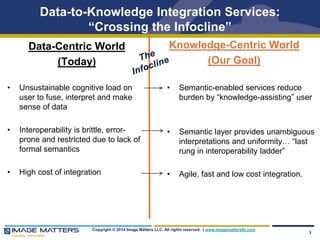
Data-to-Knowledge Integration Services: 
“Crossing the Infocline” 
Data-Centric World 
(Today) 
• Unsustainable cognitive load on 
user to fuse, interpret and make 
sense of data 
• Interoperability is brittle, error-prone 
and restricted due to lack of 
Copyright © 2014 Image Matters LLC. All rights reserved. | www.imagemattersllc.com 
formal semantics 
• High cost of integration 
Knowledge-Centric World 
(Our Goal) 
• Semantic-enabled services reduce 
burden by “knowledge-assisting” user 
• Semantic layer provides unambiguous 
interpretations and uniformity… “last 
rung in interoperability ladder” 
• Agile, fast and low cost integration. 
3
Copyright © 2014 Image Matters LLC. All rights reserved. | www.imagemattersllc.com 
Page 4 
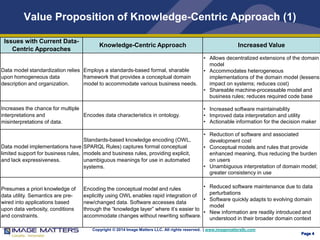
Value Proposition of Knowledge-Centric Approach (1) 
Issues with Current Data- 
Centric Approaches 
Knowledge-Centric Approach Increased Value 
Data model standardization relies 
upon homogeneous data 
description and organization. 
Employs a standards-based formal, sharable 
framework that provides a conceptual domain 
model to accommodate various business needs. 
• Allows decentralized extensions of the domain 
model 
• Accommodates heterogeneous 
implementations of the domain model (lessens 
impact on systems; reduces cost) 
• Shareable machine-processable model and 
business rules; reduces required code base 
Increases the chance for multiple 
interpretations and 
misinterpretations of data. 
Encodes data characteristics in ontology. 
• Increased software maintainability 
• Improved data interpretation and utility 
• Actionable information for the decision maker 
Data model implementations have 
limited support for business rules, 
and lack expressiveness. 
Standards-based knowledge encoding (OWL, 
SPARQL Rules) captures formal conceptual 
models and business rules, providing explicit, 
unambiguous meanings for use in automated 
systems. 
• Reduction of software and associated 
development cost 
• Conceptual models and rules that provide 
enhanced meaning, thus reducing the burden 
on users 
• Unambiguous interpretation of domain model; 
greater consistency in use 
Presumes a priori knowledge of 
data utility. Semantics are pre-wired 
into applications based 
upon data verbosity, conditions 
and constraints. 
Encoding the conceptual model and rules 
explicitly using OWL enables rapid integration of 
new/changed data. Software accesses data 
through the “knowledge layer” where it’s easier to 
accommodate changes without rewriting software. 
• Reduced software maintenance due to data 
perturbations 
• Software quickly adapts to evolving domain 
model 
• New information are readily introduced and 
understood in their broader domain context
Copyright © 2014 Image Matters LLC. All rights reserved. | www.imagemattersllc.com 
Page 5 
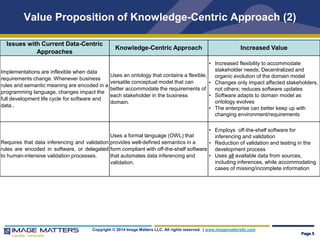
Value Proposition of Knowledge-Centric Approach (2) 
Issues with Current Data-Centric 
Approaches 
Knowledge-Centric Approach Increased Value 
Implementations are inflexible when data 
requirements change. Whenever business 
rules and semantic meaning are encoded in a 
programming language, changes impact the 
full development life cycle for software and 
data.. 
Uses an ontology that contains a flexible, 
versatile conceptual model that can 
better accommodate the requirements of 
each stakeholder in the business 
domain. 
• Increased flexibility to accommodate 
stakeholder needs; Decentralized and 
organic evolution of the domain model 
• Changes only impact affected stakeholders, 
not others; reduces software updates 
• Software adapts to domain model as 
ontology evolves 
• The enterprise can better keep up with 
changing environment/requirements 
Requires that data inferencing and validation 
rules are encoded in software, or delegated 
to human-intensive validation processes. 
Uses a formal language (OWL) that 
provides well-defined semantics in a 
form compliant with off-the-shelf software 
that automates data inferencing and 
validation. 
• Employs off-the-shelf software for 
inferencing and validation 
• Reduction of validation and testing in the 
development process 
• Uses all available data from sources, 
including inferences, while accommodating 
cases of missing/incomplete information
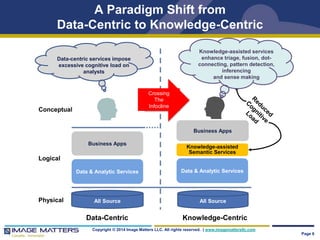
A Paradigm Shift from 
Data-Centric to Knowledge-Centric 
Data-centric services impose 
excessive cognitive load on 
analysts 
Business Apps 
Knowledge-assisted services 
enhance triage, fusion, dot-connecting, 
Business Apps 
Data & Analytic Services 
Copyright © 2014 Image Matters LLC. All rights reserved. | www.imagemattersllc.com 
Page 6 
Crossing 
The 
Infocline 
Conceptual 
Logical 
Physical 
Data & Analytic Services 
All Source All Source 
pattern detection, 
inferencing 
and sense making 
Knowledge-assisted 
Semantic Services 
Data-Centric Knowledge-Centric
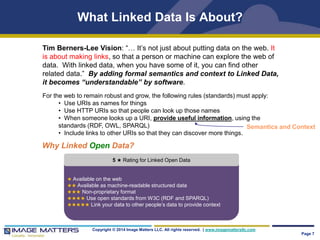
Why Linked Open Data? 
5 ★ Rating for Linked Open Data 
Copyright © 2014 Image Matters LLC. All rights reserved. | www.imagemattersllc.com 
Page 7 
What Linked Data Is About? 
Tim Berners-Lee Vision: “… It’s not just about putting data on the web. It 
is about making links, so that a person or machine can explore the web of 
data. With linked data, when you have some of it, you can find other 
related data.” By adding formal semantics and context to Linked Data, 
it becomes “understandable” by software. 
For the web to remain robust and grow, the following rules (standards) must apply: 
• Use URIs as names for things 
• Use HTTP URIs so that people can look up those names 
• When someone looks up a URI, provide useful information, using the 
standards (RDF, OWL, SPARQL) 
• Include links to other URIs so that they can discover more things. 
★ Available on the web 
★★ Available as machine-readable structured data 
★★★ Non-proprietary format 
★★★★ Use open standards from W3C (RDF and SPARQL) 
★★★★★ Link your data to other people’s data to provide context 
Semantics and Context
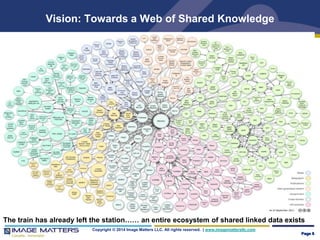
Vision: Towards a Web of Shared Knowledge 
The train has already left the station…… an entire ecosystem of shared linked data exists 
Copyright © 2014 Image Matters LLC. All rights reserved. | www.imagemattersllc.com 
Page 8
Summary of IM Contributions to OWS-10 
• Geospatial ontologies 
• Incident ontology 
• Semantic service components 
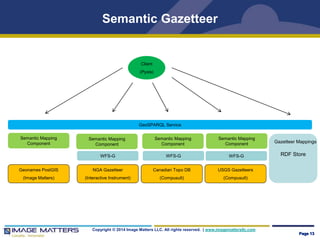
• Prototype “Semantic Gazetteer” service (GeoSPARQL-enabled) 
that unifies access to 5 gazetteer sources – produces 
“geospatial linked data” that can be shared across the Web 
Copyright © 2014 Image Matters LLC. All rights reserved. | www.imagemattersllc.com 
Page 9
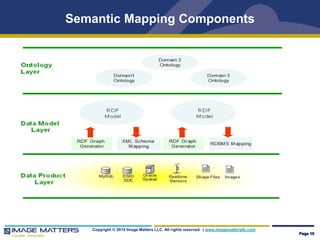
Semantic Mapping Components 
Copyright © 2014 Image Matters LLC. All rights reserved. | www.imagemattersllc.com 
Page 10
Geospatial Ontologies Overview 
• In-kind contribution from Image Matters to OGC community (8+ years of 
development and testing) 
• Core cross-domain geospatial ontologies 
• Candidate foundational ontologies to bootstrap the Geospatial Semantic 
Copyright © 2014 Image Matters LLC. All rights reserved. | www.imagemattersllc.com 
Web 
• Design criteria: 
– Minimalist semantic commitment 
– Modular 
– Extensible 
– Reusable 
– Cross-domain 
– Leverage existing standards 
• Benefits 
– Multilingual support 
– Linkable to other domains 
– Sharable and machine-processable 
– etc. (see slides 5 & 6) 
Page 11
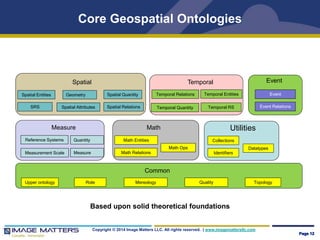
Core Geospatial Ontologies 
Temporal Relations Temporal Entities Event 
Math 
Math Entities 
Math Relations 
Math Ops 
Copyright © 2014 Image Matters LLC. All rights reserved. | www.imagemattersllc.com 
Page 12 
Mereology 
Collections 
Quality 
Spatial Entities 
Spatial Attributes Spatial Relations 
Identifiers 
Datatypes 
Upper ontology 
Geometry 
Measure 
Reference Systems 
Topology 
SRS Temporal RS 
Quantity 
Temporal Quantity 
Spatial Quantity 
Temporal 
Role 
Event Relations 
Measurement Scale 
Spatial 
Measure 
Common 
Event 
Utilities 
Based upon solid theoretical foundations
Semantic Gazetteer 
WFS-G WFS-G WFS-G 
Copyright © 2014 Image Matters LLC. All rights reserved. | www.imagemattersllc.com 
Page 13 
NGA Gazetteer 
(Interactive Instrument) 
Canadian Topo DB 
(Compusult) 
USGS Gazetteers 
(Compusult) 
GeoSPARQL Service 
Semantic Mapping 
Component 
Semantic Mapping 
Component 
Semantic Mapping 
Component 
Semantic Mapping 
Component 
Geonames PostGIS 
(Image Matters) 
Gazetteer Mappings 
RDF Store 
Client 
(Pyxis)
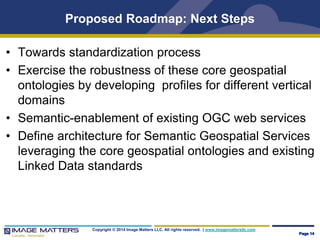
Proposed Roadmap: Next Steps 
• Towards standardization process 
• Exercise the robustness of these core geospatial 
ontologies by developing profiles for different vertical 
domains 
• Semantic-enablement of existing OGC web services 
• Define architecture for Semantic Geospatial Services 
leveraging the core geospatial ontologies and existing 
Linked Data standards 
Copyright © 2014 Image Matters LLC. All rights reserved. | www.imagemattersllc.com 
Page 14
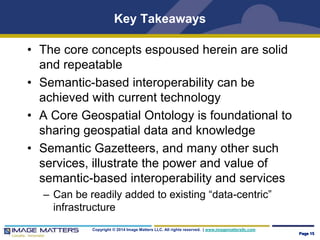
Key Takeaways 
• The core concepts espoused herein are solid 
and repeatable 
• Semantic-based interoperability can be 
achieved with current technology 
• A Core Geospatial Ontology is foundational to 
sharing geospatial data and knowledge 
• Semantic Gazetteers, and many other such 
services, illustrate the power and value of 
semantic-based interoperability and services 
– Can be readily added to existing “data-centric” 
infrastructure 
Copyright © 2014 Image Matters LLC. All rights reserved. | www.imagemattersllc.com 
Page 15
Questions? 
Contact Information 
Stephane Fellah 
Chief Knowledge Scientist 
Image Matters LLC 
Leesburg, VA 
USA 
+(703) 669 5510 
stephanef@imagemattersllc.com 
Copyright © 2014 Image Matters LLC. All rights reserved. | www.imagemattersllc.com 
Page 16

Geospatial Ontologies and GeoSPARQL Services

  • 1.
    OGC OWS-10 Cross-CommunityInteroperability Geospatial Ontologies and GeoSPARQL Services OGC TC Meeting- Geosemantics WG March 27, 2014 Stephane Fellah, Chief Knowledge Scientist Copyright © 2014 Image Matters LLC. All rights reserved. | www.imagemattersllc.com
  • 2.
    Objectives of OurResearch & Development • Prove core concepts and state of readiness of semantic-based approaches to interoperability • Build, test and demonstrate Core Geospatial Ontology – Key new building block in achieving geospatial interoperability – Enabler for producing and sharing Geospatial Linked Data (shared geospatial knowledge) • Implement a true semantic-enabled service that demonstrates semantic integration and interoperability across disparate geospatial sources (a prototype “Semantic Gazetteer”; featuring GeoSPARQL) Copyright © 2014 Image Matters LLC. All rights reserved. | www.imagemattersllc.com Page 2
  • 3.
    Data-to-Knowledge Integration Services: “Crossing the Infocline” Data-Centric World (Today) • Unsustainable cognitive load on user to fuse, interpret and make sense of data • Interoperability is brittle, error-prone and restricted due to lack of Copyright © 2014 Image Matters LLC. All rights reserved. | www.imagemattersllc.com formal semantics • High cost of integration Knowledge-Centric World (Our Goal) • Semantic-enabled services reduce burden by “knowledge-assisting” user • Semantic layer provides unambiguous interpretations and uniformity… “last rung in interoperability ladder” • Agile, fast and low cost integration. 3
  • 4.
    Copyright © 2014Image Matters LLC. All rights reserved. | www.imagemattersllc.com Page 4 Value Proposition of Knowledge-Centric Approach (1) Issues with Current Data- Centric Approaches Knowledge-Centric Approach Increased Value Data model standardization relies upon homogeneous data description and organization. Employs a standards-based formal, sharable framework that provides a conceptual domain model to accommodate various business needs. • Allows decentralized extensions of the domain model • Accommodates heterogeneous implementations of the domain model (lessens impact on systems; reduces cost) • Shareable machine-processable model and business rules; reduces required code base Increases the chance for multiple interpretations and misinterpretations of data. Encodes data characteristics in ontology. • Increased software maintainability • Improved data interpretation and utility • Actionable information for the decision maker Data model implementations have limited support for business rules, and lack expressiveness. Standards-based knowledge encoding (OWL, SPARQL Rules) captures formal conceptual models and business rules, providing explicit, unambiguous meanings for use in automated systems. • Reduction of software and associated development cost • Conceptual models and rules that provide enhanced meaning, thus reducing the burden on users • Unambiguous interpretation of domain model; greater consistency in use Presumes a priori knowledge of data utility. Semantics are pre-wired into applications based upon data verbosity, conditions and constraints. Encoding the conceptual model and rules explicitly using OWL enables rapid integration of new/changed data. Software accesses data through the “knowledge layer” where it’s easier to accommodate changes without rewriting software. • Reduced software maintenance due to data perturbations • Software quickly adapts to evolving domain model • New information are readily introduced and understood in their broader domain context
  • 5.
    Copyright © 2014Image Matters LLC. All rights reserved. | www.imagemattersllc.com Page 5 Value Proposition of Knowledge-Centric Approach (2) Issues with Current Data-Centric Approaches Knowledge-Centric Approach Increased Value Implementations are inflexible when data requirements change. Whenever business rules and semantic meaning are encoded in a programming language, changes impact the full development life cycle for software and data.. Uses an ontology that contains a flexible, versatile conceptual model that can better accommodate the requirements of each stakeholder in the business domain. • Increased flexibility to accommodate stakeholder needs; Decentralized and organic evolution of the domain model • Changes only impact affected stakeholders, not others; reduces software updates • Software adapts to domain model as ontology evolves • The enterprise can better keep up with changing environment/requirements Requires that data inferencing and validation rules are encoded in software, or delegated to human-intensive validation processes. Uses a formal language (OWL) that provides well-defined semantics in a form compliant with off-the-shelf software that automates data inferencing and validation. • Employs off-the-shelf software for inferencing and validation • Reduction of validation and testing in the development process • Uses all available data from sources, including inferences, while accommodating cases of missing/incomplete information
  • 6.
    A Paradigm Shiftfrom Data-Centric to Knowledge-Centric Data-centric services impose excessive cognitive load on analysts Business Apps Knowledge-assisted services enhance triage, fusion, dot-connecting, Business Apps Data & Analytic Services Copyright © 2014 Image Matters LLC. All rights reserved. | www.imagemattersllc.com Page 6 Crossing The Infocline Conceptual Logical Physical Data & Analytic Services All Source All Source pattern detection, inferencing and sense making Knowledge-assisted Semantic Services Data-Centric Knowledge-Centric
  • 7.
    Why Linked OpenData? 5 ★ Rating for Linked Open Data Copyright © 2014 Image Matters LLC. All rights reserved. | www.imagemattersllc.com Page 7 What Linked Data Is About? Tim Berners-Lee Vision: “… It’s not just about putting data on the web. It is about making links, so that a person or machine can explore the web of data. With linked data, when you have some of it, you can find other related data.” By adding formal semantics and context to Linked Data, it becomes “understandable” by software. For the web to remain robust and grow, the following rules (standards) must apply: • Use URIs as names for things • Use HTTP URIs so that people can look up those names • When someone looks up a URI, provide useful information, using the standards (RDF, OWL, SPARQL) • Include links to other URIs so that they can discover more things. ★ Available on the web ★★ Available as machine-readable structured data ★★★ Non-proprietary format ★★★★ Use open standards from W3C (RDF and SPARQL) ★★★★★ Link your data to other people’s data to provide context Semantics and Context
  • 8.
    Vision: Towards aWeb of Shared Knowledge The train has already left the station…… an entire ecosystem of shared linked data exists Copyright © 2014 Image Matters LLC. All rights reserved. | www.imagemattersllc.com Page 8
  • 9.
    Summary of IMContributions to OWS-10 • Geospatial ontologies • Incident ontology • Semantic service components • Prototype “Semantic Gazetteer” service (GeoSPARQL-enabled) that unifies access to 5 gazetteer sources – produces “geospatial linked data” that can be shared across the Web Copyright © 2014 Image Matters LLC. All rights reserved. | www.imagemattersllc.com Page 9
  • 10.
    Semantic Mapping Components Copyright © 2014 Image Matters LLC. All rights reserved. | www.imagemattersllc.com Page 10
  • 11.
    Geospatial Ontologies Overview • In-kind contribution from Image Matters to OGC community (8+ years of development and testing) • Core cross-domain geospatial ontologies • Candidate foundational ontologies to bootstrap the Geospatial Semantic Copyright © 2014 Image Matters LLC. All rights reserved. | www.imagemattersllc.com Web • Design criteria: – Minimalist semantic commitment – Modular – Extensible – Reusable – Cross-domain – Leverage existing standards • Benefits – Multilingual support – Linkable to other domains – Sharable and machine-processable – etc. (see slides 5 & 6) Page 11
  • 12.
    Core Geospatial Ontologies Temporal Relations Temporal Entities Event Math Math Entities Math Relations Math Ops Copyright © 2014 Image Matters LLC. All rights reserved. | www.imagemattersllc.com Page 12 Mereology Collections Quality Spatial Entities Spatial Attributes Spatial Relations Identifiers Datatypes Upper ontology Geometry Measure Reference Systems Topology SRS Temporal RS Quantity Temporal Quantity Spatial Quantity Temporal Role Event Relations Measurement Scale Spatial Measure Common Event Utilities Based upon solid theoretical foundations
  • 13.
    Semantic Gazetteer WFS-GWFS-G WFS-G Copyright © 2014 Image Matters LLC. All rights reserved. | www.imagemattersllc.com Page 13 NGA Gazetteer (Interactive Instrument) Canadian Topo DB (Compusult) USGS Gazetteers (Compusult) GeoSPARQL Service Semantic Mapping Component Semantic Mapping Component Semantic Mapping Component Semantic Mapping Component Geonames PostGIS (Image Matters) Gazetteer Mappings RDF Store Client (Pyxis)
  • 14.
    Proposed Roadmap: NextSteps • Towards standardization process • Exercise the robustness of these core geospatial ontologies by developing profiles for different vertical domains • Semantic-enablement of existing OGC web services • Define architecture for Semantic Geospatial Services leveraging the core geospatial ontologies and existing Linked Data standards Copyright © 2014 Image Matters LLC. All rights reserved. | www.imagemattersllc.com Page 14
  • 15.
    Key Takeaways •The core concepts espoused herein are solid and repeatable • Semantic-based interoperability can be achieved with current technology • A Core Geospatial Ontology is foundational to sharing geospatial data and knowledge • Semantic Gazetteers, and many other such services, illustrate the power and value of semantic-based interoperability and services – Can be readily added to existing “data-centric” infrastructure Copyright © 2014 Image Matters LLC. All rights reserved. | www.imagemattersllc.com Page 15
  • 16.
    Questions? Contact Information Stephane Fellah Chief Knowledge Scientist Image Matters LLC Leesburg, VA USA +(703) 669 5510 stephanef@imagemattersllc.com Copyright © 2014 Image Matters LLC. All rights reserved. | www.imagemattersllc.com Page 16

Editor's Notes

  • #5 Data model standardization relies upon homogeneous data description and organization. This imposes strict adherence to a standard that is defined at the syntactic-schematic level, whereupon it’s harder to achieve consensus and less flexible. Modelers struggle between producing simpler models for which it is easier to gain consensus, but harder to achieve desired business reality, versus those seeking richer models that are closer to reality but have unwanted complexity. The knowledge-based approach employs a standards-based formal, sharable framework that provides a conceptual domain model to accommodate various business needs. Decentralized model extensions can be accommodated without adversely affecting existing information infrastructure. Increased value Allows decentralized extensions of the domain model Accommodates heterogeneous implementations of the domain model (lessens impact on systems; reduces cost) Shareable machine-processable model and business rules; reduces required code base Data-centric approaches increase the chance for multiple interpretations and misinterpretations of data. Data interpretation requires knowledge of its semantics (e.g., meanings, significance, relevance, etc.) and surrounding context. Data-centric approaches are unable to capture these semantics and context, which are in turn required for automated fusion, analytics, and reasoning. Knowledge centric approaches encode data characteristics in ontology. By formalizing the semantic and business rules unambiguously in a declarative ontology, software can use off-the-shelf semantic components to interpret, infer and validate domain data, reducing interpretation errors. Increased value: Increased software maintainability Improved data interpretation and utility Actionable information for the decision maker Data model implementations have limited support for business rules, and lack expressiveness. Data centric implementations encode business rules using software or database programming languages. Additional programming is necessary to apply business rules when using the data. Robust conceptual and contextual meanings of information may not be captured in the model. The risk is high for inconsistent conceptual encoding and interpretation in each implemented system. Standards-based knowledge encoding (OWL, SPARQL Rules) captures formal conceptual models and business rules, providing explicit, unambiguous meanings for use in automated systems. With richer semantic and contextual expressiveness, automated systems are less complex to design and develop. Proper interpretation and use is more consistent across business systems. Increase value: Reduction of software and associated development cost Conceptual models and rules that provide enhanced meaning, thus reducing the burden on users Unambiguous interpretation of domain model; greater consistency in use Data-centric approaches presume an a priori knowledge of data utility. Semantics are pre-wired into applications based upon data verbosity, conditions and constraints. Changes in data directly impact code. Encoding the conceptual model and rules explicitly using OWL enables rapid integration of new/changed data. Software accesses data through the “knowledge layer” where it’s easier to accommodate changes without rewriting software. Reduced software maintenance due to data perturbations Software quickly adapts to evolving domain model New information are readily introduced and understood in their broader domain context
  • #6 Data-centric implementations are inflexible when data requirements change. Whenever business rules and semantic meaning are encoded in a programming language, changes impact the full development life cycle for software and data. When the change includes a conceptual change (new/enhanced business concept), the full standardization process must also be executed. The knowledge-based approach uses an ontology that contains a flexible, versatile conceptual model that can better accommodate the requirements of each stakeholder in the business domain. Changes or extensions are integrated and implemented by enhancing the domain ontology. Older concepts can still be supported. Increased value Increased flexibility to accommodate stakeholder needs; Decentralized and organic evolution of the domain model Changes only impact affected stakeholders, not others; reduces software updates Software adapts to domain model as ontology evolves The enterprise can better keep up with changing environment/requirements Data centric approaches require that data inferencing and validation rules are encoded in software, or delegated to human-intensive validation processes. Reliable data that is essential for critical systems, inferencing, and effective decision support, requires rules that support inferencing and validation. Knowledge-centric approaches use a formal language (OWL) that provides well-defined semantics in a form compliant with off-the-shelf software that automates data inferencing and validation. Knowledge-centric approaches can accommodate situations where information may be missing or incomplete. Increased value Employs off-the-shelf software for inferencing and validation Reduction of validation and testing in the development process Uses all available data from sources, including inferences, while accommodating cases of missing/incomplete information Data-centric approaches presume an a priori knowledge of data utility. Semantics are pre-wired into applications based upon data verbosity, conditions and constraints. Changes in data directly impact code. Encoding the conceptual model and rules explicitly using OWL enables rapid integration of new/changed data. Software accesses data through the “knowledge layer” where it’s easier to accommodate changes without rewriting software. Increased value Reduced software maintenance due to data perturbations Software quickly adapts to evolving domain model New information are readily introduced and understood in their broader domain context