Environmental Impact Assessment:
Grenada
Submitted to
by
Hurricane Lenny Recovery in the
Caribbean
In association with
November 21, 2000
Contract Number 532-C-00-01-00006-00
USAIDThe US Agency for International Development
USAID
Note: Title page added to electronic version by
USAID Development Experience Clearinghouse
Environmental Impact Assessment i
Environmental Impact Assessment – Grenada
November 21, 2000
Executive Summary
Construction of a seawall with armour stone revetment at Gouyave, Grenada is expected to
provide substantive long-term benefit to shoreline stability and integrity. Pedestrian and
vehicular safety and access are also expected to improve over the long term as a result of this
coastal protection design option.
Habitat in the nearshore zone consists largely of bare sand bottom with associated infaunal
communities. No significant fish or floral population assemblages were observed within the
nearshore zone. Further offshore (400m from the road and shoreline), seagrass habitat is
encountered. Sensitive habitats are sufficiently far offshore so as not to be negatively
impacted by site clearance, construction activities and operation of infrastructure once the
works have been completed, and assuming that sufficient care is exercised in implementing
mitigation recommendations during construction.
Although coastal pelagic seine fishing is an important activity within the Gouyave area, this
activity does not occur within the affected project site zone, and will not be affected either
during or after the completion of construction.
Informal consultation with the Department of Planning suggests that there are no significant
physical development or environmental management plans with which the affected project
site and proposed remedial design option would conflict.
The impact assessment exercise indicates that the most significant negative impacts that will
likely be generated will be those that impair access and safety of pedestrian and vehicular
traffic during the site clearance and construction phase activities. These impacts will mostly
be medium-term and may be mitigated by effective pedestrian and vehicular traffic
management and control measures.
Table of Contents
Executive Summary.............................................................................................................................. i
1. Objectives ....................................................................................................................................2
2. Site Description...........................................................................................................................2
2.1 Description of General Area............................................................................................2
2.2 Description of Baseline Environmental Conditions ....................................................6
3. Options for Remediation...........................................................................................................9
3.1 Preferred Option................................................................................................................9
3.2 No-Action Option.............................................................................................................9
4. Environmental Consequences of Preferred Option............................................................10
4.1 Site Preparation and Construction Impact Analysis...................................................10
4.2 Operation and Maintenance Impact Analysis .............................................................20
5. List of Preparers........................................................................................................................22
Appendix 1 EIA Matrix
Environmental Impact Assessment 2
1. Objectives
The principal objective of this assessment is to evaluate the environmental impacts and to
recommend mitigation strategies for the execution of alternative proposed sea defense and
coastal road remediation design works along the main arterial entrance road into Gouyave,
along the northwestern coast of Grenada. The proposed remedial works are in direct
response to the coastal damage and increased shoreline vulnerability that has resulted from
storm-generated waves associated with the passage of Hurricane Lenny in November 1999.
2. Site Description
2.1 Description of General Area
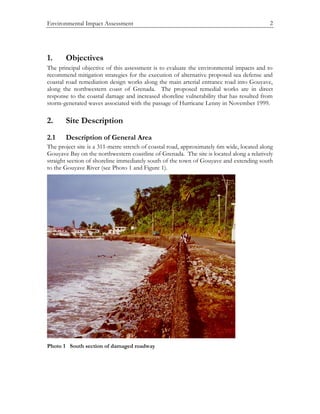
The project site is a 311-metre stretch of coastal road, approximately 6m wide, located along
Gouyave Bay on the northwestern coastline of Grenada. The site is located along a relatively
straight section of shoreline immediately south of the town of Gouyave and extending south
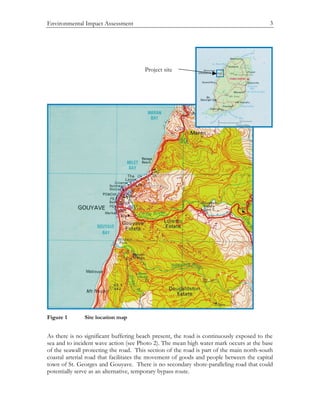
to the Gouyave River (see Photo 1 and Figure 1).
Photo 1 South section of damaged roadway
Environmental Impact Assessment 3
Figure 1 Site location map
As there is no significant buffering beach present, the road is continuously exposed to the
sea and to incident wave action (see Photo 2). The mean high water mark occurs at the base
of the seawall protecting the road. This section of the road is part of the main north-south
coastal arterial road that facilitates the movement of goods and people between the capital
town of St. Georges and Gouyave. There is no secondary shore-paralleling road that could
potentially serve as an alternative, temporary bypass route.
Project site
Environmental Impact Assessment 4
According to a DIWI/TAEP Study conducted in 1994, annual average daily traffic (AADT)
in this locale was 655 vehicles. Projections for AADT were also undertaken for the years
2003 and 2013, and values of 1047 and 1705 vehicles respectively were derived for these
years. Detailed assumptions for the basis of these projections were not, however, presented
comprehensively.
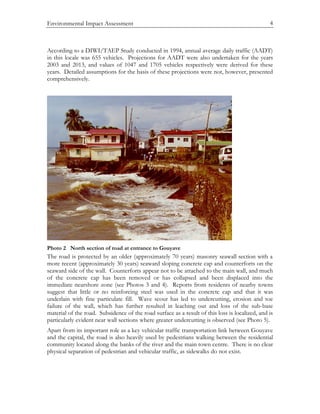
Photo 2 North section of road at entrance to Gouyave
The road is protected by an older (approximately 70 years) masonry seawall section with a
more recent (approximately 30 years) seaward sloping concrete cap and counterforts on the
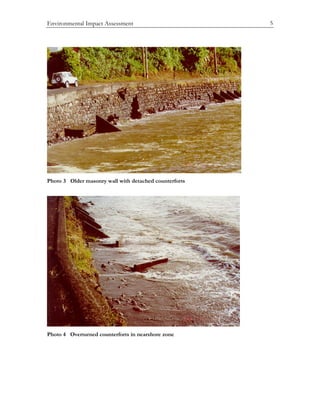
seaward side of the wall. Counterforts appear not to be attached to the main wall, and much
of the concrete cap has been removed or has collapsed and been displaced into the
immediate nearshore zone (see Photos 3 and 4). Reports from residents of nearby towns
suggest that little or no reinforcing steel was used in the concrete cap and that it was
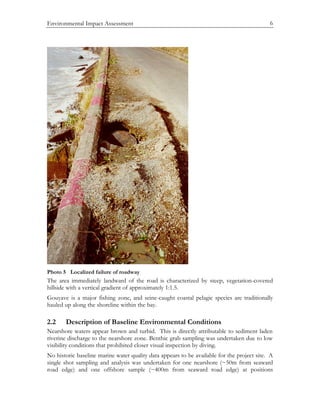
underlain with fine particulate fill. Wave scour has led to undercutting, erosion and toe
failure of the wall, which has further resulted in leaching out and loss of the sub-base
material of the road. Subsidence of the road surface as a result of this loss is localized, and is
particularly evident near wall sections where greater undercutting is observed (see Photo 5).
Apart from its important role as a key vehicular traffic transportation link between Gouyave
and the capital, the road is also heavily used by pedestrians walking between the residential
community located along the banks of the river and the main town centre. There is no clear
physical separation of pedestrian and vehicular traffic, as sidewalks do not exist.
Environmental Impact Assessment 5
Photo 3 Older masonry wall with detached counterforts
Photo 4 Overturned counterforts in nearshore zone
Environmental Impact Assessment 6
Photo 5 Localized failure of roadway
The area immediately landward of the road is characterized by steep, vegetation-covered
hillside with a vertical gradient of approximately 1:1.5.
Gouyave is a major fishing zone, and seine-caught coastal pelagic species are traditionally
hauled up along the shoreline within the bay.
2.2 Description of Baseline Environmental Conditions
Nearshore waters appear brown and turbid. This is directly attributable to sediment laden
riverine discharge to the nearshore zone. Benthic grab sampling was undertaken due to low
visibility conditions that prohibited closer visual inspection by diving.
No historic baseline marine water quality data appears to be available for the project site. A
single shot sampling and analysis was undertaken for one nearshore (~50m from seaward
road edge) and one offshore sample (~400m from seaward road edge) at positions
Environmental Impact Assessment 7
approximately coincident to the middle of the affected project site. Samples were analyzed
for turbidity, nitrates, phosphates, faecal coliform and faecal streptococcus. Samples were
assessed by the laboratory of the National Water and Sewage Authority, (NAWASA), in
Grenada. Results are presented in Table 1 following.
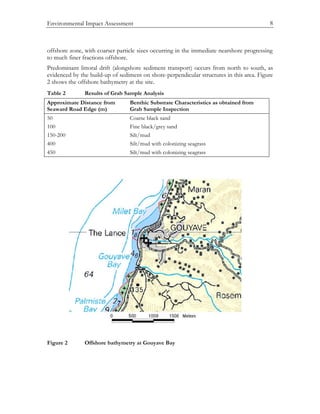
Table 1 Summary of Single Episode Water Quality Sampling Results for Nearshore
and Offshore Stations at Affected Project Site
Nearshore
Station
Offshore
Station
Recommended Standards Source
Turbidity 5.26 NTU 0.47 NTU 1.5 NTU
Nitrate 1.1mg/L 1.3mg/L 0.0098mg/L USEPA
(1992)
Phosphate 0.01mg/L 0.01mg/L 0.0014mg/L USEPA
(1992)
Faecal Coliforms
(FC)
76 colonies per
100ml
0 colonies per
100ml
Geometric mean should not
exceed 200 colonies per 100ml
USEPA
(1992)
Faecal
Streptococcus
(FS)
460 colonies
per 100ml
25 colonies
per 100ml
Geometric mean should not
exceed 35 colonies per 100ml
USEPA
(1992)
Levels of water column turbidity are confirmed to be higher in the nearshore and diminish in
the offshore. Levels of nitrate appear slightly higher in the offshore than the nearshore,
although both levels significantly exceed recommended threshold levels for marine
ecosystem health. Nitrate levels are between 112 and 113 times higher than levels
recommended for marine waters. Phosphate levels are also significantly higher
(approximately 7 times) than recommended threshold levels.
With respect to bacterial levels, although faecal coliform (FC) counts appear to be low, faecal
streptococcus (FS) counts recorded for the nearshore sample site are high, exceeding levels
recommended for safe recreational bathing. Those FS levels for the offshore station
approach but do not exceed standard levels recommended for safe recreational use of
marine waters.
The high contaminant levels observed in the nearshore are consistent with, and probably
attributable to, point source input from the Gouyave River.
At 0-15m from the seaward road edge, the nearshore is partially occupied by cobble and a
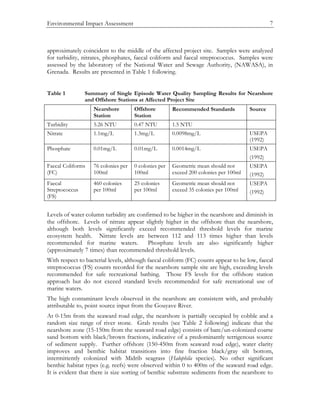
random size range of river stone. Grab results (see Table 2 following) indicate that the
nearshore zone (15-150m from the seaward road edge) consists of bare/un-colonized coarse
sand bottom with black/brown fractions, indicative of a predominantly terrigenous source
of sediment supply. Further offshore (150-450m from seaward road edge), water clarity
improves and benthic habitat transitions into fine fraction black/gray silt bottom,
intermittently colonized with Midrib seagrass (Halophila species). No other significant
benthic habitat types (e.g. reefs) were observed within 0 to 400m of the seaward road edge.
It is evident that there is size sorting of benthic substrate sediments from the nearshore to
Environmental Impact Assessment 8
offshore zone, with coarser particle sizes occurring in the immediate nearshore progressing
to much finer fractions offshore.
Predominant littoral drift (alongshore sediment transport) occurs from north to south, as
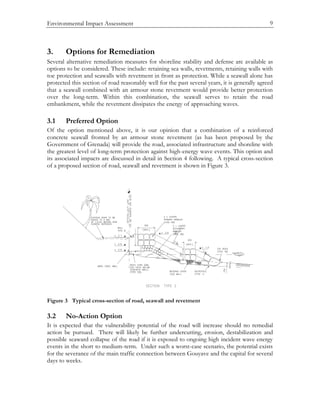
evidenced by the build-up of sediment on shore-perpendicular structures in this area. Figure
2 shows the offshore bathymetry at the site.
Table 2 Results of Grab Sample Analysis
Approximate Distance from
Seaward Road Edge (m)
Benthic Substrate Characteristics as obtained from
Grab Sample Inspection
50 Coarse black sand
100 Fine black/grey sand
150-200 Silt/mud
400 Silt/mud with colonizing seagrass
450 Silt/mud with colonizing seagrass
Figure 2 Offshore bathymetry at Gouyave Bay
Environmental Impact Assessment 9
3. Options for Remediation
Several alternative remediation measures for shoreline stability and defense are available as
options to be considered. These include: retaining sea walls, revetments, retaining walls with
toe protection and seawalls with revetment in front as protection. While a seawall alone has
protected this section of road reasonably well for the past several years, it is generally agreed
that a seawall combined with an armour stone revetment would provide better protection
over the long-term. Within this combination, the seawall serves to retain the road
embankment, while the revetment dissipates the energy of approaching waves.
3.1 Preferred Option
Of the option mentioned above, it is our opinion that a combination of a reinforced
concrete seawall fronted by an armour stone revetment (as has been proposed by the
Government of Grenada) will provide the road, associated infrastructure and shoreline with
the greatest level of long-term protection against high-energy wave events. This option and
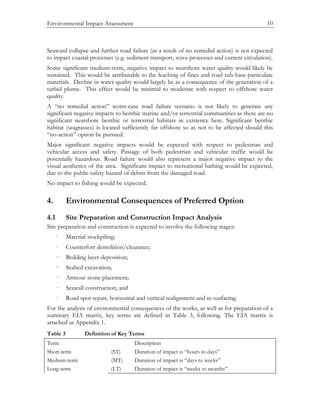
its associated impacts are discussed in detail in Section 4 following. A typical cross-section
of a proposed section of road, seawall and revetment is shown in Figure 3.
Figure 3 Typical cross-section of road, seawall and revetment
3.2 No-Action Option
It is expected that the vulnerability potential of the road will increase should no remedial
action be pursued. There will likely be further undercutting, erosion, destabilization and
possible seaward collapse of the road if it is exposed to ongoing high incident wave energy
events in the short to medium-term. Under such a worst-case scenario, the potential exists
for the severance of the main traffic connection between Gouyave and the capital for several
days to weeks.
Environmental Impact Assessment 10
Seaward collapse and further road failure (as a result of no remedial action) is not expected
to impact coastal processes (e.g. sediment transport, wave processes and current circulation).
Some significant medium-term, negative impact to nearshore water quality would likely be
sustained. This would be attributable to the leaching of fines and road sub-base particulate
materials. Decline in water quality would largely be as a consequence of the generation of a
turbid plume. This effect would be minimal to moderate with respect to offshore water
quality.
A “no remedial action” worst-case road failure scenario is not likely to generate any
significant negative impacts to benthic marine and/or terrestrial communities as there are no
significant nearshore benthic or terrestrial habitats in existence here. Significant benthic
habitat (seagrasses) is located sufficiently far offshore so as not to be affected should this
“no-action” option be pursued.
Major significant negative impacts would be expected with respect to pedestrian and
vehicular access and safety. Passage of both pedestrian and vehicular traffic would be
potentially hazardous. Road failure would also represent a major negative impact to the
visual aesthetics of the area. Significant impact to recreational bathing would be expected,
due to the public safety hazard of debris from the damaged road.
No impact to fishing would be expected.
4. Environmental Consequences of Preferred Option
4.1 Site Preparation and Construction Impact Analysis
Site preparation and construction is expected to involve the following stages:
« Material stockpiling;
« Counterfort demolition/clearance;
« Bedding layer deposition;
« Seabed excavation;
« Armour stone placement;
« Seawall construction; and
« Road spot repair, horizontal and vertical realignment and re-surfacing.
For the analysis of environmental consequences of the works, as well as for preparation of a
summary EIA matrix, key terms are defined in Table 3, following. The EIA matrix is
attached as Appendix 1.
Table 3 Definition of Key Terms
Term Description
Short-term (ST) Duration of impact is “hours to days”
Medium-term (MT) Duration of impact is “days to weeks”
Long-term (LT) Duration of impact is “weeks to months”
Environmental Impact Assessment 11
Minimal effect Low magnitude, easily reversible, small spatial scale, minimum
impact effect
Moderate effect Intermediate magnitude impact, moderate spatial scale,
reversible with some effort
Significant effect: High magnitude, potentially irreversible, large spatial scale,
maximal impact effect
No effect expected
Significant positive effect
4.1.1 Material Stockpiling
Both armour stone and road fill materials will have to be transported from remote quarry
sites and stockpiled on-site for use. Depending on quarry location, armour stone will be
conveyed to site either by barge or by truck. Should the barge option be necessary, a
temporary landing ramp will have to be constructed out from shore. Construction of the
landing ramp will not significantly impact benthic marine communities, as there are no major
habitats in the nearshore. Construction of the landing ramp may, however, contribute to a
further decline in nearshore water quality depending on substrate materials used in its
construction and their treatment. If fine materials are used, the potential for a nearshore
sediment plume to develop exists. No other significant impacts from temporary ramp
construction is anticipated. Construction of the ramp may induce some short-term groyne
effect by trapping littoral sediment drift.
The stockpiling activity itself is not expected to generate any significantly negative long-term
or widespread impacts on coastal process, the natural environment and/or the built
environment.
Negligible impacts on nearshore circulation, longshore drift and wave processes are expected
from material stockpiling.
The potential for some moderate, short-term degradation of nearshore water quality exists if
there is heavy rainfall and leaching of runoff from designated stockpile zones. Such impact
would be primarily in the form of increased water column turbidity due to sediment loading.
It is important to recognize that ambient nearshore water quality is generally low here due to
the consistent sediment-laden discharge from the river. Any runoff impact from the
stockpile will be a minor addition to already poor water quality. Impacts to offshore water
quality are expected to be minimal and brief if runoff from stockpile areas takes place.
As there are no significant viable benthic marine communities existing within the immediate
nearshore zone, no impact from material stockpiling and/or potential runoff is expected. If
there are any negative impacts to offshore benthic communities, they will be minimal and
short-term. Such impacts would be due to stormwater runoff from the material stockpile.
The likelihood of this type of impact, however, is low, especially given the distance from
shore at which viable offshore habitat begins to occur.
No major negative impacts to terrestrial habitats are anticipated, as none exist within the
vicinity of the affected project site.
Environmental Impact Assessment 12
Localized, moderate medium-term disruptive impacts on pedestrian access and safety as well
as vehicular access and safety are expected in the vicinity of the designated stockpile zone.
Given the availability of space at the site, stockpiling is only feasible towards the southern
section of the site, closer to the bridge, or in the vicinity of the existing playing field.
Recreational bathing in the nearshore zone will be significantly impacted in a negative way in
the medium-term by the stockpiling activities as well as by general site preparation and
construction activities.
Fishing will be unaffected, as seine hauling is not undertaken within the immediate nearshore
of the project site. Seine net hauling is undertaken both south and north of the project site.
Stockpiling can be expected to produce moderate medium-term impacts with respect to the
generation of noise, dust and vibration. Noise and vibration cannot be avoided. Since most
residential communities are some distance away from likely stockpile zones, however, these
impacts are not expected to be significant. Vehicular and pedestrian traffic may be similarly
affected.
Stockpiling will impact negatively on the visual aesthetics of the project site in the medium-
term, for the time that the armour stone and bedding material remain in place.
Stockpiling will have negligible impact on the structural integrity of the existing seawall, as
the stockpile is not expected to be located sufficiently close to this structure.
Recommended Mitigation
• If a landing ramp is required due to the use of a barge to transport material to site, a
ramp should be constructed using large, pre-washed stone (if possible) rather than
with fine particle substrate materials;
• If fine particle substrate materials are used to construct the temporary ramp, the
edges should be wrapped with geotextile, to prevent leaching of material into
nearshore waters;
• The “groyne effect” of a ramp can be minimized if the ramp is kept short (i.e. it does
not extend more than 15-20 metres from the shore), if loading and shore transfer of
material is carried out rapidly and the ramp is removed immediately once the
required material is stockpiled on site;
• Pre-washing of armour stone units should be carried out to remove any particulate
material that might adhere to the surface of the stones prior to their deployment;
• The construction schedule should be optimized to minimize the residence time of
material stockpiled on site; and
• Surfaces of stockpiled rock for the bedding layer can be periodically wetted to reduce
suspension of fines by wind.
4.1.2 Counterfort Demolition
The existing counterforts will have to be removed from their location immediately seaward
of the old sea wall. This demolition is not expected to generate any significantly negative,
Environmental Impact Assessment 13
long-term or widespread impacts on coastal processes or the natural environment. Some
social and built environment impacts are, however, possible.
Some minimum short-term contribution to a decline in nearshore water quality is expected
as a result of demolition and removal of counterforts from the nearshore clean up. This will
be largely as a result of sediment suspension due to some bottom substrate agitation. This
impact is expected to be minimal and will only persist for the duration of the activity.
Impact on offshore water quality is expected to be negligible, as the demolition will be of a
short duration, localized and will not be carried out over a large area.
As there are no significant viable benthic marine communities existing within the immediate
nearshore zone, no impact from counterfort demolition is expected. No habitat loss or
mortality impact from demolition is expected for offshore seagrass habitat. No major
negative impacts to terrestrial habitats are anticipated, as none exist within the vicinity of the
affected project site.
Access along the seaward fronting lane of the existing road will be obstructed for the
duration of this activity. The demolition is expected to have significant negative, short-term
impacts on both pedestrian and vehicular safety at this location.
Demolition of the counterforts, once complete, will provide some small positive impact on
pedestrian safety, in that it will reduce the hazard potential of pedestrians, who might fall off
the road onto the beach, injuring themselves on the counterforts.
Recreational swimming in front of the existing seawall will be significantly negatively
impacted, in that swimming within the immediate vicinity of the works will be hazardous.
Fishing will be unaffected, as seine hauling is not undertaken within the immediate nearshore
of the project site.
Some positive impacts on visual aesthetics are expected from demolition of the counterforts.
Counterfort demolition will likely generate some short-term, moderate noise and vibration
impact. These impacts are unavoidable. No significant dust impact is expected. Residential
communities are unlikely to be significantly impacted, as they are located sufficiently far
from the active demolition zone.
The potential exists for significant medium-term damage to the existing road landward of
the seawall. For this reason, the road resurfacing must be carried out only after this aspect of
the work is completed.
Recommended Mitigation
• Properly inspect and sever any connections between the existing road, the seawall
and the counterforts;
• Undertake cautious removal of counterforts with a crane/excavator such that the
integrity of the existing road is not further compromised (i.e. wall or foundation
sections should not be extracted with the counterfort removal);
• Contain pedestrian access to the landward side of the road, behind a temporary
protective barrier, to reduce potential pedestrian/vehicular contact.
Environmental Impact Assessment 14
• Control traffic flow either manually or automatically (with well-synchronized
temporary traffic lights) at either end of affected stretch of road, restricting traffic to
a single inbound or outbound lane on the landward side of the road. This will ensure
smooth, manageable and safe movement of vehicles; and
• Prohibit recreational swimming activity in the nearshore zone.
4.1.3 Bedding Layer Deposition
As a first step in the construction of a new seawall plus either a benched (or a plain) sloping
armour stone revetment, a layer of bedding stone will have to be deposited from the base of
the existing seawall to approximately 15 metres out into the immediate nearshore. Layers of
larger, protective armour stone units will then cover this layer. This bedding layer will also
serve as a temporary pad, atop which the excavator and/or crane can be used to deploy and
pack armour stone units in front of the existing seawall, while avoiding immersion in
seawater.
Although deposition of the bedding layer effectively constitutes nearshore reclamation and
re-shaping of the existing shoreline, no significant negative impacts to circulation,
alongshore sediment transport and wave processes are envisaged, as this activity is of limited
spatial scale. The alongshore sediment transport pathway, however, will likely be displaced
further from shore along the new shoreline edge, or edge of reclamation. No adverse impact
is expected to result from this.
Some moderate medium-term impact to nearshore water quality is expected as a result of the
washing off and suspension of fine particulates from the surface of the bedding stone
material. The potential for a plume to develop within the immediate nearshore is likely.
This plume is likely to persist for as long as it takes for surface fines to be removed and to
dissipate.
Impact to offshore water quality is expected to be minimal and of short duration.
No mortality impact due to physical displacement and/or smothering is expected from
placement of bedding stone, given the absence of viable benthic marine communities in the
immediate nearshore.
Offshore benthic marine habitats are generally far enough from the zone of bedding stone
placement so as not to be directly negatively impacted. Minimal short-term, indirect impact
to offshore seagrass is only likely if any nearshore plume that develops moves offshore. The
potential for this occurring is extremely low.
No major negative impacts to terrestrial habitats are anticipated, as none exist within the
vicinity of the affected project site.
Bedding stone deposition is expected to have significant negative medium term impact on
both pedestrian and vehicular safety and access along the seaward fronting lane of the
existing road. Access along this section of the road will be obstructed for the duration of the
activity. Similarly, pedestrian access along the inter-tidal beach in front the existing seawall
will also be directly negatively impacted.
Recreational swimming in front of the existing seawall will be significantly negatively
impacted.
Environmental Impact Assessment 15
Fishing will be unaffected, as seine hauling is not undertaken within the immediate nearshore
of the project site.
Bedding layer deposition is likely to generate some moderate, medium-term negative impacts
with respect to noise, dust and vibration emissions. The noise and vibration emissions are
unavoidable. Residential communities are unlikely to be significantly impacted as they are
sufficiently far away from the zone of activity.
Some direct, moderate, medium-term negative impact to visual aesthetics is likely.
Bedding stone deposition is unlikely to impact the integrity of the existing seawall structure.
However, the weight of dump trucks transporting heavy stone may induce damage to the
seaward edge of the road.
Recommended Mitigation
• Specify the bedding material to be a washed, shingle material or riverstone;
• Place geotextile fabric under the seaward edge of the bedding stone layer;
• Contain pedestrian access to the landward side of the road, behind a temporary
protective barrier to reduce potential pedestrian/vehicular contact.
• Control traffic flow either manually or automatically (with well-synchronized
temporary traffic lights) at either end of affected stretch of road, restricting traffic to
a single inbound or outbound lane on the landward side of the road. This will ensure
smooth, manageable and safe movement of vehicles; and
• Prohibit recreational swimming activity in the nearshore zone.
• Periodically wet the bedding layer before the geotextile layer is overlain, so as to
reduce particulate air emission potentials.
4.1.4 Seabed Excavation
Minimal excavation may or may not be required towards the toe end of the bedding stone
layer. This would facilitate the proper placement of protective toe armour stone and to
ensure that design gradients for the protective revetment structure are achieved.
No significant negative impacts to circulation, alongshore sediment transport and wave
processes are envisaged from excavation (should it be pursued), as this activity is expected to
be of limited spatial scale.
Some moderate short-term, direct decline in nearshore water quality can be expected if
excavation of seabed is required. Further decline in nearshore water quality may result due
to agitation of the nearshore bottom substrate and the suspension of fine fraction sediments.
Offshore waters may be indirectly negatively impacted for a short time if the nearshore
plume from excavation moves offshore. The probability of this occurring is low and effects
would be minimal.
As there are no significant viable benthic marine communities existing within the immediate
nearshore zone, no impact from this activity is expected. Offshore benthic marine
communities (i.e. seagrass habitat) are generally, far enough from the likely zone of
Environmental Impact Assessment 16
excavation so as not to be significantly negatively impacted. Offshore communities may be
indirectly impacted for a short time, if the nearshore plume from excavation moves offshore,
however, the potential for this is low.
No major negative impacts to terrestrial habitats are anticipated, as none exist within the
vicinity of the affected project site.
Excavation, if required, is expected to have significant negative short-term impact on both
pedestrian and vehicular safety and access along the seaward fronting lane of the existing
road. Access along this section of the road will be periodically obstructed by the movement
of excavation equipment, for the duration of the activity.
Similarly, recreational swimming in the nearshore zone will be significantly negatively
impacted.
Fishing will be unaffected, as seine hauling is not undertaken within the immediate nearshore
of the project site.
Some moderate, medium-term noise and vibration impact will be produced as a result of
seabed excavation. These impacts cannot be avoided. No dust emission impacts are likely.
Short-term, negative impacts on aesthetics are expected from seabed excavation. This will
be as a result of heavy equipment mobilization and potential nearshore water agitation with
the resulting turbidity.
Since it is expected that seabed excavation will not be near the existing road that protects the
seawall, no impact to structure stability and shoreline integrity is expected.
Recommended Mitigation
• Monitor nearshore plume formation and offshore migration of the plume (400 m
from seaward road edge). Should a persistent plume develop and move rapidly
offshore, excavation activity should be temporarily ceased until plume abates;
• Deploy turbidity barriers if nearshore plume formation is significant;
• Contain pedestrian access to the landward side of the road, behind a temporary
protective barrier to reduce potential pedestrian/vehicular contact.
• Control traffic flow either manually or automatically (with well-synchronized
temporary traffic lights) at either end of affected stretch of road, restricting traffic to
a single inbound or outbound lane on the landward side of the road. This will ensure
smooth, manageable and safe movement of vehicles; and
• Prohibit recreational swimming activity in the nearshore zone.
4.1.5 Armour Stone Placement
In this phase of the work, a secondary layer of small armour stone will be laid atop the
bedding layer, followed by a layer of larger, primary (3-5T) armour stone units at an
approximate slope of 1:2. It is expected that stones of the seaward-most zone will be placed
first, working backwards to the road. No significant differences with respect to potential
environmental impacts are expected whether a benched or simple sloping revetment design
Environmental Impact Assessment 17
is pursued. The latter is likely to have a slightly reduced footprint, while the former will
generate less wave reflection than a simple sloping one.
Armour stone placement is not likely to induce any significant negative impact to circulation,
wave processes or longshore drift. It will, however, provide positive long-term benefit with
respect to shoreline stability and integrity, as well as wave energy dissipation.
Some localized impact to nearshore marine water quality may be expected due to the
suspension of fine surface-adherent particulates when stones are deployed close to the water
line. This impact is expected to be of short duration and of minimal effect. No significant
negative impact to offshore marine water quality is expected. Some minimal, short-term
impact to offshore marine water quality may occur if a turbid plume moves offshore.
As there are no significant viable benthic marine communities existing within the immediate
nearshore zone, no impact from this activity is expected. No significant negative impacts to
offshore benthic marine communities are expected. Impacts to offshore benthic habitat
would be indirect, minimal and short-term. They would only occur if a plume developes in
the nearshore and moves into the offshore zone.
No major negative impacts to terrestrial habitats are anticipated, as none exist within the
vicinity of the affected project site.
The main impacts that are likely to arise during armour stone placement will be to pedestrian
and vehicular safety and access. Armour placement is expected to have significant negative
medium-term impact on both pedestrian and vehicular safety and access along the seaward
fronting lane of the existing road. The movement of heavy equipment for the duration of
the activity will obstruct access along this section of the road periodically.
Recreational swimming in the nearshore zone will also be significantly negatively impacted in
the medium-term during armour stone placement activities. Swimming would only be
possible seaward of the revetment and should not be allowed as there is a significant public
hazard associated with armour stone placement.
Fishing will be unaffected, as seine hauling is not undertaken within the immediate nearshore
of the project site.
Moderate medium-term noise and vibration emissions are expected. Minimal medium-term
dust emissions are likley.
Armour stone placement may be perceived to induce a negative long-term impact with
respect to visual aesthetics. Revetment construction by armour placement will, however,
provide significant positive long-term benefit in terms of structural stability and shoreline
integrity.
Recommended Mitigation
• Pre-wash armour stone units prior to deployment;
• Contain pedestrian access to the landward side of the road, behind a temporary
protective barrier to reduce potential pedestrian/vehicular contact;
• Control traffic flow either manually or automatically (with well-synchronized
temporary traffic lights) at either end of affected stretch of road, restricting traffic to
Environmental Impact Assessment 18
a single inbound or outbound lane on the landward side of the road. This will ensure
smooth, manageable and safe movement of vehicles; and
• Prohibit recreational swimming activity in the nearshore zone
4.1.6 Seawall Construction
Seawall construction will involve the construction or placement of forms and the installation
of reinforcing steel. Concrete will then be poured into the forms, which are removed several
days later. When completed, the seawall will serve two purposes: (1) retaining the composite
fill of the road (and its surface integrity) while (2) protecting the road from marine scour
from high wave energy events. The seawall structure will be further protected by the sloping
armour stone revetment, which will absorb and dissipate the impact of incident waves.
Seawall construction is not anticipated to induce any significant negative impact to
circulation, wave processes or longshore drift. Further, no impacts to benthic marine
communities are expected as none exist in the nearshore, and those in the offshore are
sufficiently far removed so as not to be affected.
Some potential for localized short-term, moderate impact to nearshore water quality exists,
should there be any leaching of cement from the mould during casting. The probability of
this occurring is low.
As there are no significant viable benthic marine communities existing within the immediate
nearshore zone, no impact from this activity is expected. No significant impacts to offshore
water quality are expected as a consequence of seawall construction.
Seawall construction will produce no impact effects on offshore benthic marine
communities (i.e. seagrasses).
No major negative impacts to terrestrial habitats are anticipated, as none exist within the
vicinity of the affected project site.
Significant medium-term impact to both vehicular and pedestrian access and safety are
expected as a result of seawall construction. Cement trucks will cause disruptions,
particularly during pouring.
Recreational swimming will be significantly impacted in the medium-term during seawall
construction. This will occur as a result of the encroachment of heavy equipment within or
near to the nearshore zone.
Fishing will be unaffected, as seine hauling is not undertaken within the immediate nearshore
of the project site.
Minimal medium-term noise, dust and vibration emission impacts are expected from seawall
construction activity.
Seawall construction will generate negative medium-term impact to visual aesthetics as a
result of construction activity and associated traffic. It will, however, provide significant
long-term positive impact to shoreline integrity and stability.
Environmental Impact Assessment 19
Recommended Mitigation
• Carry out inspections with vigilance during cement pouring to prevent overfilling of
forms;
• Provide an elevated sidewalk atop or alongside the crest of wall with railings for
future pedestrian alongshore access;
• Contain pedestrian access to the landward side of the road, behind a temporary
protective barrier to reduce potential pedestrian/vehicular contact.
• Control traffic flow either manually or automatically (with well-synchronized
temporary traffic lights) at either end of affected stretch of road, restricting traffic to
a single inbound or outbound lane on the landward side of the road. This will ensure
smooth, manageable and safe movement of vehicles; and
• Prohibit recreational swimming activity in the nearshore zone.
4.1.7 Spot Repair, Horizontal and Vertical Realignment and Re-surfacing of Road
This work will involve selective excavation, infilling and compaction of localized sites of
road surface damage. The existing road surface will then be raised, minor horizontal and
vertical realignment will be carried out and the road will be re-surfaced to a double surface
dressing.
Road repair and re-surfacing will not significantly impact circulation, alongshore transport,
wave processes and/or existing benthic marine habitats.
Some short-term moderate impact to nearshore water quality could occur if heavy rainfall
events are experienced. Such events can erode and transport, exposed sub-base materials
from the road surface if surface sealing with asphalt has not yet occurred. Under such
conditions, nearshore water would become more turbid due to the leaching and suspension
of fine particulates.
No significant impact is expected for offshore water quality. If there is continuous heavy
rainfall and development of a plume, there is some possibility of short-term, minor impact to
offshore water quality.
As there are no significant viable benthic marine communities existing within the immediate
nearshore zone, no impact from this part of the work is expected. No significant negative
impacts to offshore benthic marine habitats are expected. Similarly, no significant impacts
to terrestrial habitats are expected, as no major habitats exist.
Road surface repair activity will significantly impair pedestrian and vehicular safety and
alongshore access in the medium-term. It will provide long-term positive benefits to
shoreline stability and integrity.
Recreational swimming will be unaffected.
Fishing will be unaffected, as seine hauling is not undertaken within the immediate nearshore
of the project site.
Some moderate, medium-term negative impacts with respect to noise, dust and vibration
emissions can be expected from road repair activity. Residential communities are sufficiently
Environmental Impact Assessment 20
far away so as not to be significantly affected. Vehicle drivers and pedestrians may, however,
be affected, especially by dust emissions.
Some medium-term negative impact to visual aesthetics is anticipated as a result of road
repair and resurfacing.
In terms of structural stability and shoreline integrity, significant long-term benefit from road
repairs and resurfacing are expected.
Recommended Mitigation
• Wet the surface of the finer road base materials after it is placed and compacted;
• Seal and complete the road surface with asphalt rapidly (i.e. as soon as repairs to each
road section is completed);
• Physically separate pedestrian from vehicular traffic, utilizing newly constructed
sidewalks for pedestrians along seawall crest;
• Control traffic flow either manually or automatically (with well synchronized
temporary traffic lights) at either end of affected stretch of road, restricting traffic to
a single inbound or outbound lane on the landward side of road. This will ensure
smooth, manageable and safe vehicular movement. This lane should be alternated to
accommodate road resurfacing; and
• Prohibit recreational swimming in the nearshore zone until after all construction and
remediation activity has been completed.
4.2 Operation and Maintenance Impact Analysis
An assessment of the environmental consequences of the operation and maintenance of the
road, seawall and revetment infrastructure is presented in the following sections.
4.2.1 Road
Road operation, once repair and surface treatment is complete, is not expected to generate
any significant negative impacts to nearshore circulation, alongshore sediment transport and
wave processes.
Some short-term, moderate impact to nearshore water quality may occur from road surface
runoff during episodes of elevated rainfall. Under such conditions, nearshore water quality
will decline.
Impacts to offshore water are expected to be low and short-term, and will only be
experienced if diminished nearshore water quality conditions persist and move offshore.
No significant habitats that could be impacted exist in the nearshore, and seagrass habitat is
located sufficiently far offshore so as not to be significantly negatively impacted. No major
negative impacts to terrestrial habitats are anticipated, as none exist within the vicinity of the
affected project site.
Environmental Impact Assessment 21
Vehicular access and safety is expected to improve with repair and improvements to the road
surface. The potential conflict between pedestrians and vehicles is expected to be
significantly reduced with the provision of a sidewalk at one side of the road.
Some short-term, periodic negative impacts to recreational swimming may be experienced,
during high rainfall, high surface runoff events, when nearshore water quality may decline
further.
Fishing will be unaffected, as seine hauling is not undertaken within the immediate nearshore
of the project site.
Moderate long-term noise, vibration and dust emission impacts consistent with daily major
road use is expected.
Visual aesthetics are expected to improve in the long term as a result of road repair and
surface treatment.
Long-term improvement in structural stability and shoreline integrity is anticipated.
4.2.2 Seawall
On completion, the seawall is not expected to generate any significant negative impacts on
coastal processes, benthic or terrestrial habitats. Seawall construction will, however, provide
long-term benefits with respect to wave force dissipation.
No impacts to nearshore or offshore marine water quality are expected.
No impacts to terrestrial and marine habitats are anticipated. Similarly, no major negative
impacts to terrestrial habitats are anticipated, as none exist within the vicinity of the affected
project site.
Seawall construction will enhance pedestrian and vehicular access and safety due to the
increased level of protection it will deliver to the road edge, from wave attack.
Recreational swimming will not be impacted by the presence of the seawall.
Fishing will be unaffected, as seine hauling is not undertaken within the immediate nearshore
of the project site. No significant negative noise, dust or vibration emission impacts are
expected once the seawall is in place.
Visual aesthetics are expected to improve over the long-term as a result of seawall
construction.
Structural stability and shoreline integrity will be significantly improved in the long-term as a
result of new seawall construction.
4.2.3 Revetment
On completion, the revetment is not expected to generate any significant biophysical, coastal
process impacts.
The revetment will serve to absorb and further enhance the dissipation of incident wave
energy approaching the road. This will offer the road significant protection from wave
attack and scour, particularly during wave higher energy events.
Environmental Impact Assessment 22
The presence of the revetment structure is not expected to impact nearshore or offshore
marine water quality. Similarly, all habitats, nearshore, offshore and terrestrial will remain
unimpacted.
The revetment structure will impair alongshore pedestrian access at the level of the beach
due to its physical presence. Presently, alongshore pedestrian access at beach level is only
possible at those times of the year when there is some beach in front of the seawall at low
tide. At this time of this report, no beach existed here and alongshore access was, therefore,
not possible.
The revetment will enhance pedestrian and vehicular safety and access along the road edge
as a result of the increased level of protection it offers from wave attack and scour.
Recreational swimming will not be impacted by the presence of the revetment. Similarly,
fishing will be unaffected, as seine hauling is not undertaken within the immediate nearshore
of the project site. No significant noise, dust or vibration impacts are expected once the
revetment is in place.
The visual aesthetics of the shoreline will be altered over the long-term by the presence of
the revetment structure. Structural stability of the road and the seawall will be significantly
increased over the long term due to the presence of the revetment.
5. List of Preparers
The following individuals were involved in the preparation of this report.
Name Qualification
Mr. Yuri Chakalall Environmental Specialist - Coastal zone and fisheries management
Dr. David Smith Senior Coastal Engineer/Team leader
Mr. Philip Warner Coastal Engineer
Mrs. Corinne Smith Secretary /Editor
Detailed descriptions of areas of expertise, experience and professional discipline for these
individuals can be furnished on request and were included in the technical proposal.

Pnacp687

  • 1.
    Environmental Impact Assessment: Grenada Submittedto by Hurricane Lenny Recovery in the Caribbean In association with November 21, 2000 Contract Number 532-C-00-01-00006-00 USAIDThe US Agency for International Development USAID Note: Title page added to electronic version by USAID Development Experience Clearinghouse
  • 2.
    Environmental Impact Assessmenti Environmental Impact Assessment – Grenada November 21, 2000 Executive Summary Construction of a seawall with armour stone revetment at Gouyave, Grenada is expected to provide substantive long-term benefit to shoreline stability and integrity. Pedestrian and vehicular safety and access are also expected to improve over the long term as a result of this coastal protection design option. Habitat in the nearshore zone consists largely of bare sand bottom with associated infaunal communities. No significant fish or floral population assemblages were observed within the nearshore zone. Further offshore (400m from the road and shoreline), seagrass habitat is encountered. Sensitive habitats are sufficiently far offshore so as not to be negatively impacted by site clearance, construction activities and operation of infrastructure once the works have been completed, and assuming that sufficient care is exercised in implementing mitigation recommendations during construction. Although coastal pelagic seine fishing is an important activity within the Gouyave area, this activity does not occur within the affected project site zone, and will not be affected either during or after the completion of construction. Informal consultation with the Department of Planning suggests that there are no significant physical development or environmental management plans with which the affected project site and proposed remedial design option would conflict. The impact assessment exercise indicates that the most significant negative impacts that will likely be generated will be those that impair access and safety of pedestrian and vehicular traffic during the site clearance and construction phase activities. These impacts will mostly be medium-term and may be mitigated by effective pedestrian and vehicular traffic management and control measures.
  • 3.
    Table of Contents ExecutiveSummary.............................................................................................................................. i 1. Objectives ....................................................................................................................................2 2. Site Description...........................................................................................................................2 2.1 Description of General Area............................................................................................2 2.2 Description of Baseline Environmental Conditions ....................................................6 3. Options for Remediation...........................................................................................................9 3.1 Preferred Option................................................................................................................9 3.2 No-Action Option.............................................................................................................9 4. Environmental Consequences of Preferred Option............................................................10 4.1 Site Preparation and Construction Impact Analysis...................................................10 4.2 Operation and Maintenance Impact Analysis .............................................................20 5. List of Preparers........................................................................................................................22 Appendix 1 EIA Matrix
  • 4.
    Environmental Impact Assessment2 1. Objectives The principal objective of this assessment is to evaluate the environmental impacts and to recommend mitigation strategies for the execution of alternative proposed sea defense and coastal road remediation design works along the main arterial entrance road into Gouyave, along the northwestern coast of Grenada. The proposed remedial works are in direct response to the coastal damage and increased shoreline vulnerability that has resulted from storm-generated waves associated with the passage of Hurricane Lenny in November 1999. 2. Site Description 2.1 Description of General Area The project site is a 311-metre stretch of coastal road, approximately 6m wide, located along Gouyave Bay on the northwestern coastline of Grenada. The site is located along a relatively straight section of shoreline immediately south of the town of Gouyave and extending south to the Gouyave River (see Photo 1 and Figure 1). Photo 1 South section of damaged roadway
  • 5.
    Environmental Impact Assessment3 Figure 1 Site location map As there is no significant buffering beach present, the road is continuously exposed to the sea and to incident wave action (see Photo 2). The mean high water mark occurs at the base of the seawall protecting the road. This section of the road is part of the main north-south coastal arterial road that facilitates the movement of goods and people between the capital town of St. Georges and Gouyave. There is no secondary shore-paralleling road that could potentially serve as an alternative, temporary bypass route. Project site
  • 6.
    Environmental Impact Assessment4 According to a DIWI/TAEP Study conducted in 1994, annual average daily traffic (AADT) in this locale was 655 vehicles. Projections for AADT were also undertaken for the years 2003 and 2013, and values of 1047 and 1705 vehicles respectively were derived for these years. Detailed assumptions for the basis of these projections were not, however, presented comprehensively. Photo 2 North section of road at entrance to Gouyave The road is protected by an older (approximately 70 years) masonry seawall section with a more recent (approximately 30 years) seaward sloping concrete cap and counterforts on the seaward side of the wall. Counterforts appear not to be attached to the main wall, and much of the concrete cap has been removed or has collapsed and been displaced into the immediate nearshore zone (see Photos 3 and 4). Reports from residents of nearby towns suggest that little or no reinforcing steel was used in the concrete cap and that it was underlain with fine particulate fill. Wave scour has led to undercutting, erosion and toe failure of the wall, which has further resulted in leaching out and loss of the sub-base material of the road. Subsidence of the road surface as a result of this loss is localized, and is particularly evident near wall sections where greater undercutting is observed (see Photo 5). Apart from its important role as a key vehicular traffic transportation link between Gouyave and the capital, the road is also heavily used by pedestrians walking between the residential community located along the banks of the river and the main town centre. There is no clear physical separation of pedestrian and vehicular traffic, as sidewalks do not exist.
  • 7.
    Environmental Impact Assessment5 Photo 3 Older masonry wall with detached counterforts Photo 4 Overturned counterforts in nearshore zone
  • 8.
    Environmental Impact Assessment6 Photo 5 Localized failure of roadway The area immediately landward of the road is characterized by steep, vegetation-covered hillside with a vertical gradient of approximately 1:1.5. Gouyave is a major fishing zone, and seine-caught coastal pelagic species are traditionally hauled up along the shoreline within the bay. 2.2 Description of Baseline Environmental Conditions Nearshore waters appear brown and turbid. This is directly attributable to sediment laden riverine discharge to the nearshore zone. Benthic grab sampling was undertaken due to low visibility conditions that prohibited closer visual inspection by diving. No historic baseline marine water quality data appears to be available for the project site. A single shot sampling and analysis was undertaken for one nearshore (~50m from seaward road edge) and one offshore sample (~400m from seaward road edge) at positions
  • 9.
    Environmental Impact Assessment7 approximately coincident to the middle of the affected project site. Samples were analyzed for turbidity, nitrates, phosphates, faecal coliform and faecal streptococcus. Samples were assessed by the laboratory of the National Water and Sewage Authority, (NAWASA), in Grenada. Results are presented in Table 1 following. Table 1 Summary of Single Episode Water Quality Sampling Results for Nearshore and Offshore Stations at Affected Project Site Nearshore Station Offshore Station Recommended Standards Source Turbidity 5.26 NTU 0.47 NTU 1.5 NTU Nitrate 1.1mg/L 1.3mg/L 0.0098mg/L USEPA (1992) Phosphate 0.01mg/L 0.01mg/L 0.0014mg/L USEPA (1992) Faecal Coliforms (FC) 76 colonies per 100ml 0 colonies per 100ml Geometric mean should not exceed 200 colonies per 100ml USEPA (1992) Faecal Streptococcus (FS) 460 colonies per 100ml 25 colonies per 100ml Geometric mean should not exceed 35 colonies per 100ml USEPA (1992) Levels of water column turbidity are confirmed to be higher in the nearshore and diminish in the offshore. Levels of nitrate appear slightly higher in the offshore than the nearshore, although both levels significantly exceed recommended threshold levels for marine ecosystem health. Nitrate levels are between 112 and 113 times higher than levels recommended for marine waters. Phosphate levels are also significantly higher (approximately 7 times) than recommended threshold levels. With respect to bacterial levels, although faecal coliform (FC) counts appear to be low, faecal streptococcus (FS) counts recorded for the nearshore sample site are high, exceeding levels recommended for safe recreational bathing. Those FS levels for the offshore station approach but do not exceed standard levels recommended for safe recreational use of marine waters. The high contaminant levels observed in the nearshore are consistent with, and probably attributable to, point source input from the Gouyave River. At 0-15m from the seaward road edge, the nearshore is partially occupied by cobble and a random size range of river stone. Grab results (see Table 2 following) indicate that the nearshore zone (15-150m from the seaward road edge) consists of bare/un-colonized coarse sand bottom with black/brown fractions, indicative of a predominantly terrigenous source of sediment supply. Further offshore (150-450m from seaward road edge), water clarity improves and benthic habitat transitions into fine fraction black/gray silt bottom, intermittently colonized with Midrib seagrass (Halophila species). No other significant benthic habitat types (e.g. reefs) were observed within 0 to 400m of the seaward road edge. It is evident that there is size sorting of benthic substrate sediments from the nearshore to
  • 10.
    Environmental Impact Assessment8 offshore zone, with coarser particle sizes occurring in the immediate nearshore progressing to much finer fractions offshore. Predominant littoral drift (alongshore sediment transport) occurs from north to south, as evidenced by the build-up of sediment on shore-perpendicular structures in this area. Figure 2 shows the offshore bathymetry at the site. Table 2 Results of Grab Sample Analysis Approximate Distance from Seaward Road Edge (m) Benthic Substrate Characteristics as obtained from Grab Sample Inspection 50 Coarse black sand 100 Fine black/grey sand 150-200 Silt/mud 400 Silt/mud with colonizing seagrass 450 Silt/mud with colonizing seagrass Figure 2 Offshore bathymetry at Gouyave Bay
  • 11.
    Environmental Impact Assessment9 3. Options for Remediation Several alternative remediation measures for shoreline stability and defense are available as options to be considered. These include: retaining sea walls, revetments, retaining walls with toe protection and seawalls with revetment in front as protection. While a seawall alone has protected this section of road reasonably well for the past several years, it is generally agreed that a seawall combined with an armour stone revetment would provide better protection over the long-term. Within this combination, the seawall serves to retain the road embankment, while the revetment dissipates the energy of approaching waves. 3.1 Preferred Option Of the option mentioned above, it is our opinion that a combination of a reinforced concrete seawall fronted by an armour stone revetment (as has been proposed by the Government of Grenada) will provide the road, associated infrastructure and shoreline with the greatest level of long-term protection against high-energy wave events. This option and its associated impacts are discussed in detail in Section 4 following. A typical cross-section of a proposed section of road, seawall and revetment is shown in Figure 3. Figure 3 Typical cross-section of road, seawall and revetment 3.2 No-Action Option It is expected that the vulnerability potential of the road will increase should no remedial action be pursued. There will likely be further undercutting, erosion, destabilization and possible seaward collapse of the road if it is exposed to ongoing high incident wave energy events in the short to medium-term. Under such a worst-case scenario, the potential exists for the severance of the main traffic connection between Gouyave and the capital for several days to weeks.
  • 12.
    Environmental Impact Assessment10 Seaward collapse and further road failure (as a result of no remedial action) is not expected to impact coastal processes (e.g. sediment transport, wave processes and current circulation). Some significant medium-term, negative impact to nearshore water quality would likely be sustained. This would be attributable to the leaching of fines and road sub-base particulate materials. Decline in water quality would largely be as a consequence of the generation of a turbid plume. This effect would be minimal to moderate with respect to offshore water quality. A “no remedial action” worst-case road failure scenario is not likely to generate any significant negative impacts to benthic marine and/or terrestrial communities as there are no significant nearshore benthic or terrestrial habitats in existence here. Significant benthic habitat (seagrasses) is located sufficiently far offshore so as not to be affected should this “no-action” option be pursued. Major significant negative impacts would be expected with respect to pedestrian and vehicular access and safety. Passage of both pedestrian and vehicular traffic would be potentially hazardous. Road failure would also represent a major negative impact to the visual aesthetics of the area. Significant impact to recreational bathing would be expected, due to the public safety hazard of debris from the damaged road. No impact to fishing would be expected. 4. Environmental Consequences of Preferred Option 4.1 Site Preparation and Construction Impact Analysis Site preparation and construction is expected to involve the following stages: « Material stockpiling; « Counterfort demolition/clearance; « Bedding layer deposition; « Seabed excavation; « Armour stone placement; « Seawall construction; and « Road spot repair, horizontal and vertical realignment and re-surfacing. For the analysis of environmental consequences of the works, as well as for preparation of a summary EIA matrix, key terms are defined in Table 3, following. The EIA matrix is attached as Appendix 1. Table 3 Definition of Key Terms Term Description Short-term (ST) Duration of impact is “hours to days” Medium-term (MT) Duration of impact is “days to weeks” Long-term (LT) Duration of impact is “weeks to months”
  • 13.
    Environmental Impact Assessment11 Minimal effect Low magnitude, easily reversible, small spatial scale, minimum impact effect Moderate effect Intermediate magnitude impact, moderate spatial scale, reversible with some effort Significant effect: High magnitude, potentially irreversible, large spatial scale, maximal impact effect No effect expected Significant positive effect 4.1.1 Material Stockpiling Both armour stone and road fill materials will have to be transported from remote quarry sites and stockpiled on-site for use. Depending on quarry location, armour stone will be conveyed to site either by barge or by truck. Should the barge option be necessary, a temporary landing ramp will have to be constructed out from shore. Construction of the landing ramp will not significantly impact benthic marine communities, as there are no major habitats in the nearshore. Construction of the landing ramp may, however, contribute to a further decline in nearshore water quality depending on substrate materials used in its construction and their treatment. If fine materials are used, the potential for a nearshore sediment plume to develop exists. No other significant impacts from temporary ramp construction is anticipated. Construction of the ramp may induce some short-term groyne effect by trapping littoral sediment drift. The stockpiling activity itself is not expected to generate any significantly negative long-term or widespread impacts on coastal process, the natural environment and/or the built environment. Negligible impacts on nearshore circulation, longshore drift and wave processes are expected from material stockpiling. The potential for some moderate, short-term degradation of nearshore water quality exists if there is heavy rainfall and leaching of runoff from designated stockpile zones. Such impact would be primarily in the form of increased water column turbidity due to sediment loading. It is important to recognize that ambient nearshore water quality is generally low here due to the consistent sediment-laden discharge from the river. Any runoff impact from the stockpile will be a minor addition to already poor water quality. Impacts to offshore water quality are expected to be minimal and brief if runoff from stockpile areas takes place. As there are no significant viable benthic marine communities existing within the immediate nearshore zone, no impact from material stockpiling and/or potential runoff is expected. If there are any negative impacts to offshore benthic communities, they will be minimal and short-term. Such impacts would be due to stormwater runoff from the material stockpile. The likelihood of this type of impact, however, is low, especially given the distance from shore at which viable offshore habitat begins to occur. No major negative impacts to terrestrial habitats are anticipated, as none exist within the vicinity of the affected project site.
  • 14.
    Environmental Impact Assessment12 Localized, moderate medium-term disruptive impacts on pedestrian access and safety as well as vehicular access and safety are expected in the vicinity of the designated stockpile zone. Given the availability of space at the site, stockpiling is only feasible towards the southern section of the site, closer to the bridge, or in the vicinity of the existing playing field. Recreational bathing in the nearshore zone will be significantly impacted in a negative way in the medium-term by the stockpiling activities as well as by general site preparation and construction activities. Fishing will be unaffected, as seine hauling is not undertaken within the immediate nearshore of the project site. Seine net hauling is undertaken both south and north of the project site. Stockpiling can be expected to produce moderate medium-term impacts with respect to the generation of noise, dust and vibration. Noise and vibration cannot be avoided. Since most residential communities are some distance away from likely stockpile zones, however, these impacts are not expected to be significant. Vehicular and pedestrian traffic may be similarly affected. Stockpiling will impact negatively on the visual aesthetics of the project site in the medium- term, for the time that the armour stone and bedding material remain in place. Stockpiling will have negligible impact on the structural integrity of the existing seawall, as the stockpile is not expected to be located sufficiently close to this structure. Recommended Mitigation • If a landing ramp is required due to the use of a barge to transport material to site, a ramp should be constructed using large, pre-washed stone (if possible) rather than with fine particle substrate materials; • If fine particle substrate materials are used to construct the temporary ramp, the edges should be wrapped with geotextile, to prevent leaching of material into nearshore waters; • The “groyne effect” of a ramp can be minimized if the ramp is kept short (i.e. it does not extend more than 15-20 metres from the shore), if loading and shore transfer of material is carried out rapidly and the ramp is removed immediately once the required material is stockpiled on site; • Pre-washing of armour stone units should be carried out to remove any particulate material that might adhere to the surface of the stones prior to their deployment; • The construction schedule should be optimized to minimize the residence time of material stockpiled on site; and • Surfaces of stockpiled rock for the bedding layer can be periodically wetted to reduce suspension of fines by wind. 4.1.2 Counterfort Demolition The existing counterforts will have to be removed from their location immediately seaward of the old sea wall. This demolition is not expected to generate any significantly negative,
  • 15.
    Environmental Impact Assessment13 long-term or widespread impacts on coastal processes or the natural environment. Some social and built environment impacts are, however, possible. Some minimum short-term contribution to a decline in nearshore water quality is expected as a result of demolition and removal of counterforts from the nearshore clean up. This will be largely as a result of sediment suspension due to some bottom substrate agitation. This impact is expected to be minimal and will only persist for the duration of the activity. Impact on offshore water quality is expected to be negligible, as the demolition will be of a short duration, localized and will not be carried out over a large area. As there are no significant viable benthic marine communities existing within the immediate nearshore zone, no impact from counterfort demolition is expected. No habitat loss or mortality impact from demolition is expected for offshore seagrass habitat. No major negative impacts to terrestrial habitats are anticipated, as none exist within the vicinity of the affected project site. Access along the seaward fronting lane of the existing road will be obstructed for the duration of this activity. The demolition is expected to have significant negative, short-term impacts on both pedestrian and vehicular safety at this location. Demolition of the counterforts, once complete, will provide some small positive impact on pedestrian safety, in that it will reduce the hazard potential of pedestrians, who might fall off the road onto the beach, injuring themselves on the counterforts. Recreational swimming in front of the existing seawall will be significantly negatively impacted, in that swimming within the immediate vicinity of the works will be hazardous. Fishing will be unaffected, as seine hauling is not undertaken within the immediate nearshore of the project site. Some positive impacts on visual aesthetics are expected from demolition of the counterforts. Counterfort demolition will likely generate some short-term, moderate noise and vibration impact. These impacts are unavoidable. No significant dust impact is expected. Residential communities are unlikely to be significantly impacted, as they are located sufficiently far from the active demolition zone. The potential exists for significant medium-term damage to the existing road landward of the seawall. For this reason, the road resurfacing must be carried out only after this aspect of the work is completed. Recommended Mitigation • Properly inspect and sever any connections between the existing road, the seawall and the counterforts; • Undertake cautious removal of counterforts with a crane/excavator such that the integrity of the existing road is not further compromised (i.e. wall or foundation sections should not be extracted with the counterfort removal); • Contain pedestrian access to the landward side of the road, behind a temporary protective barrier, to reduce potential pedestrian/vehicular contact.
  • 16.
    Environmental Impact Assessment14 • Control traffic flow either manually or automatically (with well-synchronized temporary traffic lights) at either end of affected stretch of road, restricting traffic to a single inbound or outbound lane on the landward side of the road. This will ensure smooth, manageable and safe movement of vehicles; and • Prohibit recreational swimming activity in the nearshore zone. 4.1.3 Bedding Layer Deposition As a first step in the construction of a new seawall plus either a benched (or a plain) sloping armour stone revetment, a layer of bedding stone will have to be deposited from the base of the existing seawall to approximately 15 metres out into the immediate nearshore. Layers of larger, protective armour stone units will then cover this layer. This bedding layer will also serve as a temporary pad, atop which the excavator and/or crane can be used to deploy and pack armour stone units in front of the existing seawall, while avoiding immersion in seawater. Although deposition of the bedding layer effectively constitutes nearshore reclamation and re-shaping of the existing shoreline, no significant negative impacts to circulation, alongshore sediment transport and wave processes are envisaged, as this activity is of limited spatial scale. The alongshore sediment transport pathway, however, will likely be displaced further from shore along the new shoreline edge, or edge of reclamation. No adverse impact is expected to result from this. Some moderate medium-term impact to nearshore water quality is expected as a result of the washing off and suspension of fine particulates from the surface of the bedding stone material. The potential for a plume to develop within the immediate nearshore is likely. This plume is likely to persist for as long as it takes for surface fines to be removed and to dissipate. Impact to offshore water quality is expected to be minimal and of short duration. No mortality impact due to physical displacement and/or smothering is expected from placement of bedding stone, given the absence of viable benthic marine communities in the immediate nearshore. Offshore benthic marine habitats are generally far enough from the zone of bedding stone placement so as not to be directly negatively impacted. Minimal short-term, indirect impact to offshore seagrass is only likely if any nearshore plume that develops moves offshore. The potential for this occurring is extremely low. No major negative impacts to terrestrial habitats are anticipated, as none exist within the vicinity of the affected project site. Bedding stone deposition is expected to have significant negative medium term impact on both pedestrian and vehicular safety and access along the seaward fronting lane of the existing road. Access along this section of the road will be obstructed for the duration of the activity. Similarly, pedestrian access along the inter-tidal beach in front the existing seawall will also be directly negatively impacted. Recreational swimming in front of the existing seawall will be significantly negatively impacted.
  • 17.
    Environmental Impact Assessment15 Fishing will be unaffected, as seine hauling is not undertaken within the immediate nearshore of the project site. Bedding layer deposition is likely to generate some moderate, medium-term negative impacts with respect to noise, dust and vibration emissions. The noise and vibration emissions are unavoidable. Residential communities are unlikely to be significantly impacted as they are sufficiently far away from the zone of activity. Some direct, moderate, medium-term negative impact to visual aesthetics is likely. Bedding stone deposition is unlikely to impact the integrity of the existing seawall structure. However, the weight of dump trucks transporting heavy stone may induce damage to the seaward edge of the road. Recommended Mitigation • Specify the bedding material to be a washed, shingle material or riverstone; • Place geotextile fabric under the seaward edge of the bedding stone layer; • Contain pedestrian access to the landward side of the road, behind a temporary protective barrier to reduce potential pedestrian/vehicular contact. • Control traffic flow either manually or automatically (with well-synchronized temporary traffic lights) at either end of affected stretch of road, restricting traffic to a single inbound or outbound lane on the landward side of the road. This will ensure smooth, manageable and safe movement of vehicles; and • Prohibit recreational swimming activity in the nearshore zone. • Periodically wet the bedding layer before the geotextile layer is overlain, so as to reduce particulate air emission potentials. 4.1.4 Seabed Excavation Minimal excavation may or may not be required towards the toe end of the bedding stone layer. This would facilitate the proper placement of protective toe armour stone and to ensure that design gradients for the protective revetment structure are achieved. No significant negative impacts to circulation, alongshore sediment transport and wave processes are envisaged from excavation (should it be pursued), as this activity is expected to be of limited spatial scale. Some moderate short-term, direct decline in nearshore water quality can be expected if excavation of seabed is required. Further decline in nearshore water quality may result due to agitation of the nearshore bottom substrate and the suspension of fine fraction sediments. Offshore waters may be indirectly negatively impacted for a short time if the nearshore plume from excavation moves offshore. The probability of this occurring is low and effects would be minimal. As there are no significant viable benthic marine communities existing within the immediate nearshore zone, no impact from this activity is expected. Offshore benthic marine communities (i.e. seagrass habitat) are generally, far enough from the likely zone of
  • 18.
    Environmental Impact Assessment16 excavation so as not to be significantly negatively impacted. Offshore communities may be indirectly impacted for a short time, if the nearshore plume from excavation moves offshore, however, the potential for this is low. No major negative impacts to terrestrial habitats are anticipated, as none exist within the vicinity of the affected project site. Excavation, if required, is expected to have significant negative short-term impact on both pedestrian and vehicular safety and access along the seaward fronting lane of the existing road. Access along this section of the road will be periodically obstructed by the movement of excavation equipment, for the duration of the activity. Similarly, recreational swimming in the nearshore zone will be significantly negatively impacted. Fishing will be unaffected, as seine hauling is not undertaken within the immediate nearshore of the project site. Some moderate, medium-term noise and vibration impact will be produced as a result of seabed excavation. These impacts cannot be avoided. No dust emission impacts are likely. Short-term, negative impacts on aesthetics are expected from seabed excavation. This will be as a result of heavy equipment mobilization and potential nearshore water agitation with the resulting turbidity. Since it is expected that seabed excavation will not be near the existing road that protects the seawall, no impact to structure stability and shoreline integrity is expected. Recommended Mitigation • Monitor nearshore plume formation and offshore migration of the plume (400 m from seaward road edge). Should a persistent plume develop and move rapidly offshore, excavation activity should be temporarily ceased until plume abates; • Deploy turbidity barriers if nearshore plume formation is significant; • Contain pedestrian access to the landward side of the road, behind a temporary protective barrier to reduce potential pedestrian/vehicular contact. • Control traffic flow either manually or automatically (with well-synchronized temporary traffic lights) at either end of affected stretch of road, restricting traffic to a single inbound or outbound lane on the landward side of the road. This will ensure smooth, manageable and safe movement of vehicles; and • Prohibit recreational swimming activity in the nearshore zone. 4.1.5 Armour Stone Placement In this phase of the work, a secondary layer of small armour stone will be laid atop the bedding layer, followed by a layer of larger, primary (3-5T) armour stone units at an approximate slope of 1:2. It is expected that stones of the seaward-most zone will be placed first, working backwards to the road. No significant differences with respect to potential environmental impacts are expected whether a benched or simple sloping revetment design
  • 19.
    Environmental Impact Assessment17 is pursued. The latter is likely to have a slightly reduced footprint, while the former will generate less wave reflection than a simple sloping one. Armour stone placement is not likely to induce any significant negative impact to circulation, wave processes or longshore drift. It will, however, provide positive long-term benefit with respect to shoreline stability and integrity, as well as wave energy dissipation. Some localized impact to nearshore marine water quality may be expected due to the suspension of fine surface-adherent particulates when stones are deployed close to the water line. This impact is expected to be of short duration and of minimal effect. No significant negative impact to offshore marine water quality is expected. Some minimal, short-term impact to offshore marine water quality may occur if a turbid plume moves offshore. As there are no significant viable benthic marine communities existing within the immediate nearshore zone, no impact from this activity is expected. No significant negative impacts to offshore benthic marine communities are expected. Impacts to offshore benthic habitat would be indirect, minimal and short-term. They would only occur if a plume developes in the nearshore and moves into the offshore zone. No major negative impacts to terrestrial habitats are anticipated, as none exist within the vicinity of the affected project site. The main impacts that are likely to arise during armour stone placement will be to pedestrian and vehicular safety and access. Armour placement is expected to have significant negative medium-term impact on both pedestrian and vehicular safety and access along the seaward fronting lane of the existing road. The movement of heavy equipment for the duration of the activity will obstruct access along this section of the road periodically. Recreational swimming in the nearshore zone will also be significantly negatively impacted in the medium-term during armour stone placement activities. Swimming would only be possible seaward of the revetment and should not be allowed as there is a significant public hazard associated with armour stone placement. Fishing will be unaffected, as seine hauling is not undertaken within the immediate nearshore of the project site. Moderate medium-term noise and vibration emissions are expected. Minimal medium-term dust emissions are likley. Armour stone placement may be perceived to induce a negative long-term impact with respect to visual aesthetics. Revetment construction by armour placement will, however, provide significant positive long-term benefit in terms of structural stability and shoreline integrity. Recommended Mitigation • Pre-wash armour stone units prior to deployment; • Contain pedestrian access to the landward side of the road, behind a temporary protective barrier to reduce potential pedestrian/vehicular contact; • Control traffic flow either manually or automatically (with well-synchronized temporary traffic lights) at either end of affected stretch of road, restricting traffic to
  • 20.
    Environmental Impact Assessment18 a single inbound or outbound lane on the landward side of the road. This will ensure smooth, manageable and safe movement of vehicles; and • Prohibit recreational swimming activity in the nearshore zone 4.1.6 Seawall Construction Seawall construction will involve the construction or placement of forms and the installation of reinforcing steel. Concrete will then be poured into the forms, which are removed several days later. When completed, the seawall will serve two purposes: (1) retaining the composite fill of the road (and its surface integrity) while (2) protecting the road from marine scour from high wave energy events. The seawall structure will be further protected by the sloping armour stone revetment, which will absorb and dissipate the impact of incident waves. Seawall construction is not anticipated to induce any significant negative impact to circulation, wave processes or longshore drift. Further, no impacts to benthic marine communities are expected as none exist in the nearshore, and those in the offshore are sufficiently far removed so as not to be affected. Some potential for localized short-term, moderate impact to nearshore water quality exists, should there be any leaching of cement from the mould during casting. The probability of this occurring is low. As there are no significant viable benthic marine communities existing within the immediate nearshore zone, no impact from this activity is expected. No significant impacts to offshore water quality are expected as a consequence of seawall construction. Seawall construction will produce no impact effects on offshore benthic marine communities (i.e. seagrasses). No major negative impacts to terrestrial habitats are anticipated, as none exist within the vicinity of the affected project site. Significant medium-term impact to both vehicular and pedestrian access and safety are expected as a result of seawall construction. Cement trucks will cause disruptions, particularly during pouring. Recreational swimming will be significantly impacted in the medium-term during seawall construction. This will occur as a result of the encroachment of heavy equipment within or near to the nearshore zone. Fishing will be unaffected, as seine hauling is not undertaken within the immediate nearshore of the project site. Minimal medium-term noise, dust and vibration emission impacts are expected from seawall construction activity. Seawall construction will generate negative medium-term impact to visual aesthetics as a result of construction activity and associated traffic. It will, however, provide significant long-term positive impact to shoreline integrity and stability.
  • 21.
    Environmental Impact Assessment19 Recommended Mitigation • Carry out inspections with vigilance during cement pouring to prevent overfilling of forms; • Provide an elevated sidewalk atop or alongside the crest of wall with railings for future pedestrian alongshore access; • Contain pedestrian access to the landward side of the road, behind a temporary protective barrier to reduce potential pedestrian/vehicular contact. • Control traffic flow either manually or automatically (with well-synchronized temporary traffic lights) at either end of affected stretch of road, restricting traffic to a single inbound or outbound lane on the landward side of the road. This will ensure smooth, manageable and safe movement of vehicles; and • Prohibit recreational swimming activity in the nearshore zone. 4.1.7 Spot Repair, Horizontal and Vertical Realignment and Re-surfacing of Road This work will involve selective excavation, infilling and compaction of localized sites of road surface damage. The existing road surface will then be raised, minor horizontal and vertical realignment will be carried out and the road will be re-surfaced to a double surface dressing. Road repair and re-surfacing will not significantly impact circulation, alongshore transport, wave processes and/or existing benthic marine habitats. Some short-term moderate impact to nearshore water quality could occur if heavy rainfall events are experienced. Such events can erode and transport, exposed sub-base materials from the road surface if surface sealing with asphalt has not yet occurred. Under such conditions, nearshore water would become more turbid due to the leaching and suspension of fine particulates. No significant impact is expected for offshore water quality. If there is continuous heavy rainfall and development of a plume, there is some possibility of short-term, minor impact to offshore water quality. As there are no significant viable benthic marine communities existing within the immediate nearshore zone, no impact from this part of the work is expected. No significant negative impacts to offshore benthic marine habitats are expected. Similarly, no significant impacts to terrestrial habitats are expected, as no major habitats exist. Road surface repair activity will significantly impair pedestrian and vehicular safety and alongshore access in the medium-term. It will provide long-term positive benefits to shoreline stability and integrity. Recreational swimming will be unaffected. Fishing will be unaffected, as seine hauling is not undertaken within the immediate nearshore of the project site. Some moderate, medium-term negative impacts with respect to noise, dust and vibration emissions can be expected from road repair activity. Residential communities are sufficiently
  • 22.
    Environmental Impact Assessment20 far away so as not to be significantly affected. Vehicle drivers and pedestrians may, however, be affected, especially by dust emissions. Some medium-term negative impact to visual aesthetics is anticipated as a result of road repair and resurfacing. In terms of structural stability and shoreline integrity, significant long-term benefit from road repairs and resurfacing are expected. Recommended Mitigation • Wet the surface of the finer road base materials after it is placed and compacted; • Seal and complete the road surface with asphalt rapidly (i.e. as soon as repairs to each road section is completed); • Physically separate pedestrian from vehicular traffic, utilizing newly constructed sidewalks for pedestrians along seawall crest; • Control traffic flow either manually or automatically (with well synchronized temporary traffic lights) at either end of affected stretch of road, restricting traffic to a single inbound or outbound lane on the landward side of road. This will ensure smooth, manageable and safe vehicular movement. This lane should be alternated to accommodate road resurfacing; and • Prohibit recreational swimming in the nearshore zone until after all construction and remediation activity has been completed. 4.2 Operation and Maintenance Impact Analysis An assessment of the environmental consequences of the operation and maintenance of the road, seawall and revetment infrastructure is presented in the following sections. 4.2.1 Road Road operation, once repair and surface treatment is complete, is not expected to generate any significant negative impacts to nearshore circulation, alongshore sediment transport and wave processes. Some short-term, moderate impact to nearshore water quality may occur from road surface runoff during episodes of elevated rainfall. Under such conditions, nearshore water quality will decline. Impacts to offshore water are expected to be low and short-term, and will only be experienced if diminished nearshore water quality conditions persist and move offshore. No significant habitats that could be impacted exist in the nearshore, and seagrass habitat is located sufficiently far offshore so as not to be significantly negatively impacted. No major negative impacts to terrestrial habitats are anticipated, as none exist within the vicinity of the affected project site.
  • 23.
    Environmental Impact Assessment21 Vehicular access and safety is expected to improve with repair and improvements to the road surface. The potential conflict between pedestrians and vehicles is expected to be significantly reduced with the provision of a sidewalk at one side of the road. Some short-term, periodic negative impacts to recreational swimming may be experienced, during high rainfall, high surface runoff events, when nearshore water quality may decline further. Fishing will be unaffected, as seine hauling is not undertaken within the immediate nearshore of the project site. Moderate long-term noise, vibration and dust emission impacts consistent with daily major road use is expected. Visual aesthetics are expected to improve in the long term as a result of road repair and surface treatment. Long-term improvement in structural stability and shoreline integrity is anticipated. 4.2.2 Seawall On completion, the seawall is not expected to generate any significant negative impacts on coastal processes, benthic or terrestrial habitats. Seawall construction will, however, provide long-term benefits with respect to wave force dissipation. No impacts to nearshore or offshore marine water quality are expected. No impacts to terrestrial and marine habitats are anticipated. Similarly, no major negative impacts to terrestrial habitats are anticipated, as none exist within the vicinity of the affected project site. Seawall construction will enhance pedestrian and vehicular access and safety due to the increased level of protection it will deliver to the road edge, from wave attack. Recreational swimming will not be impacted by the presence of the seawall. Fishing will be unaffected, as seine hauling is not undertaken within the immediate nearshore of the project site. No significant negative noise, dust or vibration emission impacts are expected once the seawall is in place. Visual aesthetics are expected to improve over the long-term as a result of seawall construction. Structural stability and shoreline integrity will be significantly improved in the long-term as a result of new seawall construction. 4.2.3 Revetment On completion, the revetment is not expected to generate any significant biophysical, coastal process impacts. The revetment will serve to absorb and further enhance the dissipation of incident wave energy approaching the road. This will offer the road significant protection from wave attack and scour, particularly during wave higher energy events.
  • 24.
    Environmental Impact Assessment22 The presence of the revetment structure is not expected to impact nearshore or offshore marine water quality. Similarly, all habitats, nearshore, offshore and terrestrial will remain unimpacted. The revetment structure will impair alongshore pedestrian access at the level of the beach due to its physical presence. Presently, alongshore pedestrian access at beach level is only possible at those times of the year when there is some beach in front of the seawall at low tide. At this time of this report, no beach existed here and alongshore access was, therefore, not possible. The revetment will enhance pedestrian and vehicular safety and access along the road edge as a result of the increased level of protection it offers from wave attack and scour. Recreational swimming will not be impacted by the presence of the revetment. Similarly, fishing will be unaffected, as seine hauling is not undertaken within the immediate nearshore of the project site. No significant noise, dust or vibration impacts are expected once the revetment is in place. The visual aesthetics of the shoreline will be altered over the long-term by the presence of the revetment structure. Structural stability of the road and the seawall will be significantly increased over the long term due to the presence of the revetment. 5. List of Preparers The following individuals were involved in the preparation of this report. Name Qualification Mr. Yuri Chakalall Environmental Specialist - Coastal zone and fisheries management Dr. David Smith Senior Coastal Engineer/Team leader Mr. Philip Warner Coastal Engineer Mrs. Corinne Smith Secretary /Editor Detailed descriptions of areas of expertise, experience and professional discipline for these individuals can be furnished on request and were included in the technical proposal.