1
Click icon toadd picture
SCIENCE
&
TECHNOLOGY
IN THE PHILIPPINES
Prepared by : Diocemee A Polestico
2.
2
Learning Outcomes:
• Discussthe role of Science and Technology in Philippine
Nation Building.
• Evaluate government policies pertaining to science and
technology in terms of their contributions to nation
building.
• Identify actual science and technology policies of the
government and appraise their impact on the development
of the Filipino nation.
3.
3
Group Activity
Prepare andpresent documentary presentation
on the following:
History of S & T in the Philippines
The Philippine Government S &T Agenda
Major Development programs and personalities in S & T
in the Philippines
Science Education in the Philippines
Selected indigenous science and technologies
4.
4
HISTORY of Sand T in the
PHILIPPINES
• represents the wide scientific and technological
advances the Philippines has made.
• The main managing agency responsible is the
Department of Science and Technology (DOST).
• The science department has consulting agencies for
Forestry, Agriculture and Aquaculture, Metal Industry,
Nuclear Research, Food and Nutrition, Health,
Meteorological and the Volcanology and Seismology
5.
5
Fe del Mundo- Pediatrics
Eduardo Quisumbing - Plant Taxonomy
Gavin Trono - tropical marine Phycology
Maria Orosa - Food Technology
…history
Notable Scientists - who have made notable
contributions in different scientific fields:
6.
6
STONE AGE
• Archeologicalfindings show that modern man from Asian
mainland first came over
land on across narrow channels to live in Batangas and
Palawan about 48,000 B.C.
• Subsequently they formed settlement in Sulu, Davao,
Zamboanga, Samar, Negros,
Batangas, Laguna, Rizal, Bulacan and Cagayan.
7.
7
Iron Age
• TheIron Age lasted from the third century
B.C. to 11th century A.D.
• During this period Filipinos were engaged in
the extraction smelting and refining of iron
from ores until the importation of cast iron
from Sarawak and later from China.
8.
8
They learned toweave cotton, make glass ornaments, and
cultivate lowland rice and diked fields of terraced fields
utilizing spring water in mountain regions.
They also learned to build boats for trading purposes.
Spanish chronicles noted refined plank built warships
called caracoa suited for inter-island trade raids.
The Spaniards later utilized Filipino expertise in boat-
building and seamanship to fight the raiding Dutch,
Portuguese,
Muslims and the Chinese pirate Limahong as well as to
build and man the galleons that sailed to Mexico.
Inventions/Discoveries
9.
9
10th Century A.D.
•Filipinos from the Butuan were trading with Champa
(Vietnam) and those from Ma-I (Mindoro) with China
as noted in Chinese records containing several
references to the Philippines.
• These archaeological findings indicated that regular
trade relations between the Philippines, China and
Vietnam had been well established from the 10th
century to the 15th century A.D
10.
10
The people ofMa-I and San-Hsu (Palawan)
traded bee wax, cotton, pearls, coconut heart
mats, tortoise shell and medicinal betelnuts, yu-
ta cloth (probably jute or ramie?) for Chinese
porcelain, leads fishnets sinker, colored glass
beads, iron pots, iron needles and tin.
Trading
11.
11
Before the Spaniards
•Filipinos were already engage in activities and practices related
to science forming primitive or first wave technology. They
were curative values of some plant on how to extract medicine
from herbs.
• They had an alphabet, a system of writing, a method of
counting and weights and measure.
• They had no calendar but counted the years by the period of
the moon and from one harvest to another.
• The Banaue Rice Terraces are among the sophisticated
products of engineering by pre-Spanish era Filipinos.
12.
12
Spanish Colonial Period
•contributed to growth of science and technology in the country.
• The Spanish introduced formal education and founded scientific
institutions.
• Early years of Spanish rule, Parish schools were established where
religion, reading, writing, arithmetic and music were taught.
• Sanitation and more advanced methods of agriculture were
taught to the natives.
• Colleges and universities in the archipelago including the
University of Sto. Tomas were established.
13.
13
• Study ofmedicine was given priority in the Spanish
era, especially in the later years.
• The Spanish also contributed to the field of
engineering by constructing government buildings,
churches, roads, bridges and forts.
• Biology is given focus.
• Contributors to science in the archipelago during the
19th
century were botanists, Fr. Ignacio Mercado., Dr.
Trinidad Pardo de Tavera and Dr. Leon Ma Guerrero,
chemist Anaclento del Rosario, and medicine scholars
Dr. Manuel Guerrero, Dr. Jose Montes and Dr. Elrodario
Mercado.
14.
14
•The Galleon Tradehave accounted in the
Philippine colonial economy.
•Trade was given more focus by the Spaniard
colonial authorities due to the prospects of big
profits.
•Agriculture and industrial development on the
other hand were relatively neglected.
•The opening of the Suez Canal saw the influx of
European visitors to the Spanish colony and some
Filipinos were able to study in Europe influenced
by the rapid development of scientific ideals
brought about by the Age of Enlightenment.
15.
15
Spanish Regime
Later partof the 16th Century -
Development of schools
• Colegio de San Ildefonso-Cebu-1595
• Colegio de San Ignacio-Manila-1595
• Colegio De Nuestra Senora del
Rosario- Manila-1597
16.
16
• Development ofHospitals
oSan Juan Lazaro Hospital - the oldest in the Far East was
founded in 1578.
•The Real Sociedad Economica de los Amigos Del
Pais de Filipinas founded by Governador Jose Basco y Vargas
in 1780 encouraged research in agriculture and industry. The
society promoted cultivation of indigo, cotton, cinnamon, and
silk industry.
• In 1789 Manila was opened to Asian shipping, inaugurating
an era of increase in export of rice, hemp, tobacco, sugar,
and indigo, and imports of manufacturing goods.
17.
17
The 19th Century
•In 1863 the colonial authorities issued a royal degree to
reform the existing educational system.
• In 1871 the school of medicine and pharmacy were opened in
UST. After 15 years it granted the degree of Licenciado en
Medicina to 62 graduates.
• The licentiate degree equivalent to a Master degree was
granted Bachelor’s degree in pharmacy to its 1st six
graduates who included Leon Ma. Guerrero considered was
the father of Philippine Pharmacy due to his works on
Medicinal Plants of the Philippines.
• There were no school for engineering but they offered
nautical four year course for pilot of merchant marine that
includes the subjects: Arithmetic, Algebra, Geometry,
Trigonometry, Physics, Hydrography, Meteorology, Navigation
and Pilotage
18.
18
• Higher educationwas generally viewed with suspicion as
encouraging rebellion among native Filipinos and thus
only few daring students were able to undertake higher
studies.
• The expanded world trade and commerce in the later
part of the 19th century led to the rapid development of
Manila as cosmopolitan center.
• Modern amenities such as steam tramways, waterworks,
newspaper, electric lights, banking system were
introduce in 19th century.
• Jesuits promoted meteorological studies founding
Manila observatory at the Ateneo Municipal de Manila in
1865.
19.
19
American Period and
Post-CommonwealthEra
• The progress of S&T in the Philippines continued under the American rule.
• On July 1, 1901 The Philippine Commission established the Bureau of
Government Laboratories which was placed under the Department of Interior.
The Bureau replaced the Laboratorio Municipal, which was established under
the Spanish colonial era. The Bureau dealt with the study of tropical diseases and
laboratory projects.
• On October 26, 1905, the Bureau of Government Laboratories was replaced by
the Bureau of Science.
• On December 8, 1933, the National Research Council of the Philippines was
established.The Bureau of Science became the primary research center of the
Philippines until World War II.
20.
20
• Science, duringthe American period, was inclined towards agriculture,
food processing, forestry, medicine and pharmacy.
• Not much focus was given on the development of industrial technology
due to free trade policy with the United States which nurtured an economy
geared towards agriculture and trade.
• In 1946, the Bureau of Science was replaced by the Institute of Science.
• In a report by the US Economic Survey to the Philippines in 1950, there is
a lack of basic information which were necessities to the country's
industries, lack of support of experimental work and minimal budget for
scientific research and low salaries of scientists employed by the
government.
21.
21
•In a reportby the US Economic Survey to the
Philippines in 1950, there is a lack of basic
information which were necessities to the country's
industries, lack of support of experimental work
and minimal budget for scientific research and low
salaries of scientists employed by the government.
•In 1958, under President Carlos P. Garcia, the
Philippine Congress passed the Science Act of 1958
which established the National Science
Development Board.
22.
22
Marcos Era andMartial Law
• the importance given to science grew.
• In the amended 1973 Philippine Constitution, Article
XV, Section 9 (1), he declared that the "advancement of
science and technology shall have priority in the
national development.”
• In his two terms of presidency and during Martial Law,
he enacted many laws promoting S&T.
23.
23
the Department ofEducation was directed to revitalize science courses in
public high schools.
additional funds were channeled to support projects in applied sciences and
science education.
a big part of the war damage fund was given to private universities to
encourage them to create courses in science and technology and research.
upgrade of the science curricula and teaching equipment.
establishment of research and development schools, technical institutes,
science education centers, and agricultural colleges and vocational high
schools
Notable S&T Accomplishments of
the Marcos Regime
24.
24
•creation of theNational Grains Authority
•establishment of the Philippine Council for
Agricultural Research to support the progressive
development of agriculture, forestry, and fisheries
•promotion of scientific research and invention
•establishment of the Philippine Atmospheric
Geophysical and Astronomical Services
Administration (PAGASA) under the Department of
National Defense.
•creation of the Philippine National Oil Company
25.
25
• establishment ofthe National Academy of Science and
Technology composed of scientists as a reservoir of
scientific and technological expertise for the country.
• creation of a Task Force on the formulation of a national
action program to assess S&T policies and programs.
• invested funds and time in organizations for scientific
research, such as the NSDB, the Philippine Council for
Agricultural Research and Resources, the Plant Breeding
Institute, the International Rice Research Institute, the
Bureau of Plant Industry, and the Bureau of Forest
Products.
26.
26
• instituted theHealth Sciences Center creation of the
National Committee on Geological Sciences
• reorganization of the National Science Development Board
and its agencies into a National Science and Technology
Authority
• granting of salary increases to teachers in the Philippine
Science High School
• enactment of a law for the completion of the National
Agriculture and Life Sciences Research Complex at the
University of the Philippines at Los Baños
• establishment of Mindanao and Visayas campuses of the
Philippine Science High School.
27.
27
The Fifth Republic
•under President Corazon C. Aquino
• The National Science and Technology Authority was replaced by
the Department of Science and Technology, giving S&T a
representation in the cabinet.
• Under the Medium Term Philippine Development Plan for the
years 1987-1992, S&T’s role in economic recovery and sustained
economic growth was highlighted.
• In the 1990 SONA, Aquino announced that S&T development
shall be one of the top three priorities of the government
towards an economic recovery.
28.
28
• In 1988,Aquino created the Presidential Task Force for Science and
Technology which came up with the first Science and Technology Master
Plan or STMP.
• The goal of STMP was for the Philippines to achieve newly industrialized
country status by the year 2000.
• Aquino encouraged scientists and inventors to bring the Philippines to its
former position as second to Japan in the field of S&T.
• Aquino encouraged the private research sector to form a stronger bond
with public research to help jump-start the progress in the area of Philippine
Research and Development.
• Free Public Secondary Education Act of 1988, Science for the Masses Program
• Funding for the S&T sector was tripled
• The Science and Technology Master Plan was formulated
• A Research and Development Plan was also formulated
29.
29
Under Pres. FidelV. Ramos
• significant increase in personnel specializing in the
S&T field.
• 3,500 scholarships were given to students taking up
S&T-related courses - Science and Technology
Scholarship Law of 1994
• modernization and update of science classrooms.
Health care services were promoted through local
programs - "Doctors to the Barrio Program.”
30.
30
Under Pres. FidelV. Ramos
• Magna Carta for Science and Technology
Personnel
• National Program for Gifted Filipino Children in
Science and Technology
• Science and Technology Agenda for National
Development (STAND)
• Inventors and Inventions Incentives Act
• The Intellectual Property Code of the
Philippines
31.
31
Under Pres. JosephEstrada
• Philippine Clean Air Act of 1999 (Republic Act No.
8749[33]) - to protect and preserve the
environment and ensure the sustainable
development of the country’s natural resources
• Electronic Commerce Act of 2000 (Republic Act
No. 8792)[34] which outlaws computer hacking
and provides opportunities for new businesses
emerging from the Internet-driven New Economy
32.
32
Under Pres. JosephEstrada
• launch of a full-scale program based on cost
effective irrigation technologies
• Basic health care, basic nutrition, and useful
education
• Speed up the program for establishing one science
high school in every province pushed for the
advancement of industries and schools into the
Internet age announcement of the passage of the e-
Commerce Act
33.
33
Under Pres. GloriaArroyo
• dubbed as the "golden age" of science and technology
• Numerous laws and projects concerning the
environment and science helped push STI
• The term "Filipinnovation" was coined to promote the
Philippines to be an innovation hub in Asia
strengthening the schools and education system to
focus more in science, technology and mathematics
passage of the Biofuels Act.
34.
34
Under Pres. BenignoAquino
conferment of 4 new National Scientist for their scientific contribution.
• Gavino C. Trono - extensive studies made on seaweed species
helped families in the coastal areas.
• Angel C. Alcala - served as the pioneer scientist and advocate of coral
reefs aside from his contribution in the fields of systematics,
secology and herpetology
• Ramon C. Barba - all year round availability of mangoes was made
possible through his studies on the induction of flowering of mango
and micropropagation of important crop species.
• Edgardo D. Gomez - steered the national-scale assessment of
damage coral reefs which led to a national conservation program.
35.
35
Major Development Programsand Personalities in S & T in the
Philippines
After series of consultation the National Research Council of the Philippines (NCRP)
recommended policies and programs to improve the competitiveness of the Philippines
36.
36
Teaching science involvesways on how to effectively teach
science – means exploring pedagogical theories and models in
helping teachers teach scientific concepts and processes
effectively
Learning science includes both pedagogy and most interesting
aspect – helping understand and love science
Understanding science implies developing and applying science
process skills and using science literacy in understanding the
natural world and activities in everyday life.
Science Education in the Philippines
Focuses on teaching, learning, and understanding
science
37.
37
•John Dewey stressedthe importance of utilizing
the natural environment to teach students –
nature must indeed furnish first physical stimuli to
provide wealth of meaning through social activities
and thinking
•Marx (1994) – science is going to be one of the
most important school subjects in the future
•
38.
38
• Science Education– justified by the vast
amount of scientific knowledge developed in
this area that prepares citizens in a
scientifically and technically driven world
• Provides skills and knowledge that are
necessary for a person to live in what
Knight (1986) describes as the age of
science and to develop a citizenry that
will meet the goals of science in the
society
• Developing a science culture is therefore
an immense responsibility for schools
39.
39
• Science Educationin Basic and Tertiary
Education
• In basic education science education helps
students learn important concepts and facts
that are related to everyday life
• Develops positive attitude such as the love
for knowledge, passion for innovative
things, curiosity to study about nature, and
creativity
• Develop a strong foundation for studying
science and for considering science-related
careers in the future
40.
40
• In tertiaryeducation, science education deals
with developing students’ understanding and
appreciation of science ideas and scientific words
• through offering courses in the General
Education curriculum
• Focuses on the preparation of science teachers,
scientists, engineers, and other professionals in
various science-related fields such as
engineering, agriculture, medicine and health
sciences
• Provides scholarships to encourage more
students to pursue science courses.
41.
41
Science Schools inthe Philippines
• Science education is supported by the
government in the establishment of science
schools in various parts of the country.
• Several government programs implemented by
the Department of Education and few private
schools for science education
• Some science schools:
• Philippine Science High Schools
• Special Science Elementary Schools (SSES)
• Quezon City Regional Science High School
• Manila Science High School
• Naga City Science High School
• Goa Science High School
42.
42
Selected Indigenous Scienceand Technologies
Indigenous Knowledge – is embedded in the daily life experiences of young
childrens as they grow up
• Some examples:
• Predicting weather conditions and seasons using knowledge in observing animals’
behavior and celestial bodies
• Using herbal medicine
• Preserving foods
• Classifying plants and animals into families and groups based on cultural properties
• Preserving and selecting good seeds for planting
• Using Indigenous technology in daily lives
• Building local irrigation systems
• Classifying different types of soil for planting based on cultural properties
• Producing wines and juices from tropical fruits
• Keeping the custom of growing plants and vegetables in the yard
47
• the accelerationof economic
growth.
• the reduction of inequality.
• the eradication of absolute
poverty.
Development
48.
48
•is a multi-dimensionalprocess
• .
•involves the reorganization and
reorientation of entire economic and
social systems
•involves major changes in the
administrative, institutional and social
structures
•involves major changes in popular
attitudes, customs and beliefs.
50
Science and Technologyare
both regarded as forces
needed for
improving the welfare of
developing states.
Role of Science and Technology
51.
51
Science and technologyare key drivers
to development, because technological
and scientific revolutions underpin
➤ economic advances
➤ improvements in health systems,
education and infrastructure.
52.
52
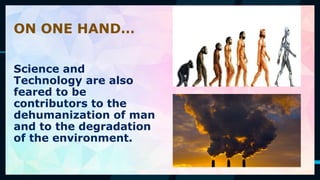
ON ONE HAND…
Scienceand
Technology are also
feared to be
contributors to the
dehumanization of man
and to the degradation
of the environment.
53.
53
The role ofscience and technology
in development should be directed
towards the reduction of the
inequalities between advanced and
developing countries, and between
various sections of the population
in a country.
54.
54
• Through breakthroughsin health services and education, these
technologies have the power to better the lives of poor people in
developing countries.
• Eradicating malaria, a scourge of the African continent for
centuries is now possible.
• Cures for other diseases which are endemic in developing
countries are also now possible, allowing people with
debilitating conditions to healthy and productive lives.
• The extent to which developing economies emerge as economic
powerhouses depends on their ability to grasp and apply
insights from science and technology and use them creatively.
Innovation is the primary driver of technological growth and
drives higher living standards.
55.
55
• Certain innovationsand discoveries will
raise bio-ethical issues
➤ genetic modification of food crops
➤ cloning of human embryos
MANAGING TECHNOLOGICAL
REVOLUTIONS POSES CHALLENGES
56.
56
• Cost ofhealth care will worsen the present
inequality by limiting health care access to wealthy
individuals.
➤ health care in certain countries, where the
demand for very high cost diagnostic equipment and
surgical interventions enabling longevity and better
quality of life for older wealthy people overstretches
public health care budgets, and lowers service quality
in poor neighborhoods.
MANAGING TECHNOLOGICAL
REVOLUTIONS POSES CHALLENGES
57.
57
• Resource-intensive technologies,
focusedon satisfying high
consumption demand, like holidays
abroad in costal resorts,
wilderness areas, or iconic cities,
increase carbon emissions and
environmental damage.
MANAGING TECHNOLOGICAL
REVOLUTIONS POSES CHALLENGES
58.
58
invest inquality education for youth,
invest in continuous skills training for
workers and managers
ensure that knowledge is shared as widely
as possible across society.
TO PROMOTE TECHNOLOGICAL
ADVANCES…
Developing countries should
59.
59
Chapter Requirements
• Preparea 3-page essay on:
• 1. The history of Science and Technology in the Philippines. ( Ref.
Olivia Caoili’s piece)
• 2. Current issues faced by the Philippines (i.e., brain drain,
• poverty, colonial mentality, disaster risk reduction)
• 3. Among the issues mentioned, what field should the
• government concentrate / put emphasis on in relation to
• nation-building?
60.
60
Assignment:
1. Read about
•The Human Person flourishing in terms of science and technology.
- Technology as a way of Revealing
• The philosophy of Martin Heidegger – The Question
Concerning Technology
2. What is a good life?

![31
Under Pres. Joseph Estrada
• Philippine Clean Air Act of 1999 (Republic Act No.
8749[33]) - to protect and preserve the
environment and ensure the sustainable
development of the country’s natural resources
• Electronic Commerce Act of 2000 (Republic Act
No. 8792)[34] which outlaws computer hacking
and provides opportunities for new businesses
emerging from the Internet-driven New Economy](https://image.slidesharecdn.com/scienceandtechnologyinthephilippines-250406092636-7cfb6763/85/SCIENCE-AND-TECHNOLOGY-IN-THE-PHILIPPINES-pptx-31-320.jpg)