How AAA transformed their business process improving the customer experience April 16, 2009 Andrew Kramer, PMG Evan Maxey, AAA
Agenda Business Context Problem:  Service Request Fulfillment Solution:  Service Catalog Steps to Implement a Service Catalog Service Catalog in Action – AAA Summary/Questions
Business Context Problem:  Service Request Fulfillment Solution:  Service Catalog Steps to Implement a Service Catalog Service Catalog in Action – AAA Summary/Questions
The Economic Imperative 2009 will be a year of “Do More With Less” Projects with and without capital expense will be subject to intense scrutiny Only projects that will show ROI (save money) will be green-lighted What can Business Process Management practitioners do to maximize results in this environment? Than Ever! ^ Than Ever! ^
Business Context Problem:  Service Request Fulfillment Solution:  Service Catalog Steps to Implement a Service Catalog Service Catalog in Action – AAA Summary/Questions
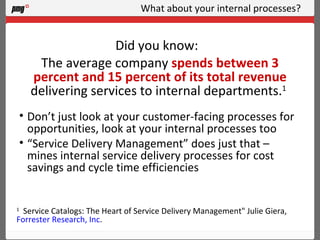
What about your internal processes? Did you know:  The average company  spends between 3 percent and 15 percent of its total revenue  delivering services to internal departments. 1   1   Service Catalogs: The Heart of Service Delivery Management" Julie Giera,  Forrester Research, Inc .  Don’t just look at your customer-facing processes for opportunities, look at your internal processes too “ Service Delivery Management” does just that – mines internal service delivery processes for cost savings and cycle time efficiencies
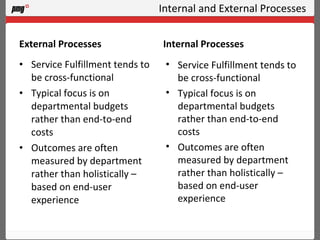
Internal and External Processes External Processes Service Fulfillment tends to be cross-functional Typical focus is on departmental budgets rather than end-to-end costs Outcomes are often measured by department rather than holistically – based on end-user experience Internal Processes Service Fulfillment tends to be cross-functional Typical focus is on departmental budgets rather than end-to-end costs Outcomes are often measured by department rather than holistically – based on end-user experience
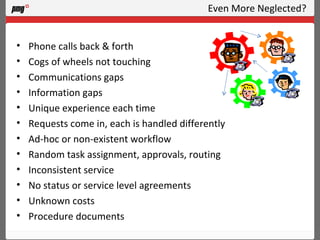
Even More Neglected?  Phone calls back & forth Cogs of wheels not touching Communications gaps Information gaps Unique experience each time Requests come in, each is handled differently Ad-hoc or non-existent workflow Random task assignment, approvals, routing Inconsistent service No status or service level agreements Unknown costs Procedure documents
Common Example – Employee Onboarding What are the steps?  What has to happen when a new person comes on board? What functional groups are responsible for each of these steps? How does the process start?  Who owns initiating the process?  How do groups signal to each other that they’re done and ready for someone to take the next step? How does the process end? Describe Employee Onboarding at your Company
Mining for Savings Staple yourself to the process? How many e-mails and phone calls back and forth? How much paperwork?  How long does it take?  Are some parts overly controlled by a few people? What kind of benefits could your organization realize by improving on this process? Show me the money!  Identify cost and cycle time opportunities in the onboarding example
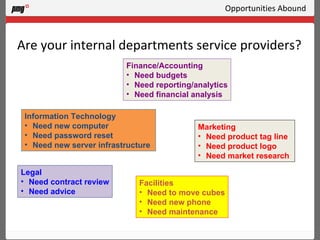
Opportunities Abound Are your internal departments service providers? Information Technology Need new computer Need password reset Need new server infrastructure  Finance/Accounting Need budgets Need reporting/analytics Need financial analysis Marketing Need product tag line Need product logo Need market research  Legal Need contract review Need advice Facilities Need to move cubes Need new phone Need maintenance
Business Context Opportunity:  Service Delivery Solution:  Service Catalog Steps to Implement a Service Catalog Service Catalog in Action – AAA Summary/Questions
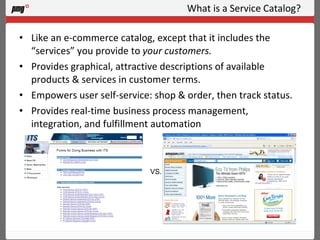
What is a Service Catalog? Like an e-commerce catalog, except that it includes the “services” you provide to  your customers.  Provides graphical, attractive descriptions of available products & services in customer terms.  Empowers user self-service: shop & order, then track status.  Provides real-time business process management, integration, and fulfillment automation VS.
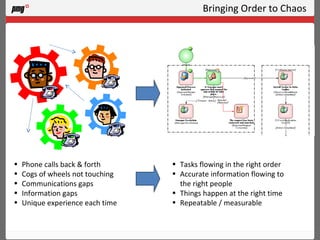
Bringing Order to Chaos  Phone calls back & forth Cogs of wheels not touching Communications gaps Information gaps Unique experience each time Tasks flowing in the right order Accurate information flowing to the right people Things happen at the right time Repeatable / measurable
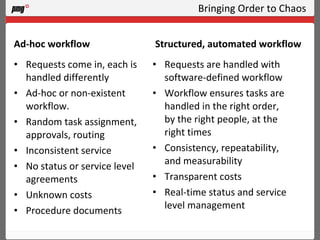
Bringing Order to Chaos Ad-hoc workflow Requests come in, each is handled differently Ad-hoc or non-existent workflow.  Random task assignment, approvals, routing Inconsistent service No status or service level agreements Unknown costs Procedure documents Structured, automated workflow Requests are handled with software-defined workflow Workflow ensures tasks are handled in the right order, by the right people, at the right times Consistency, repeatability, and measurability Transparent costs Real-time status and service level management
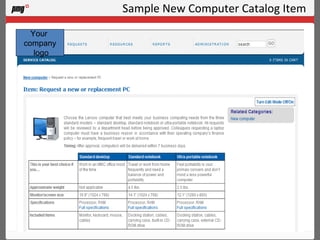
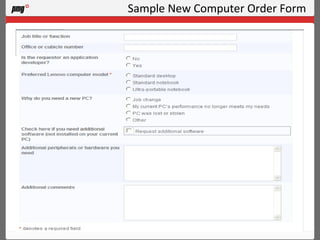
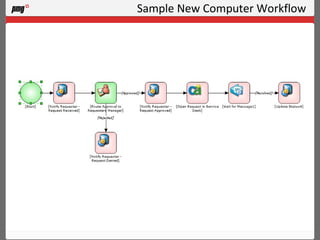
Exercise Designing a Service Catalog The user-facing front end: What would a user want to know/see? What do you as the process owner want the user to know about the service? When they decide to place an order: What information do you need to capture from the requester? Then what?  What are the fulfillment steps? At what points during fulfillment do we want to/need to communicate back to the user? Ordering a New Computer
Sample New Computer Catalog Item Your  company logo
Sample New Computer Order Form Your  company logo
Sample New Computer Workflow
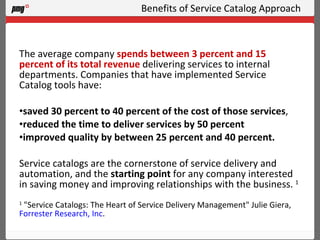
Benefits of Service Catalog Approach The average company  spends between 3 percent and 15 percent of its total revenue  delivering services to internal departments. Companies that have implemented Service Catalog tools have: saved 30 percent to 40 percent of the cost of those services ,  reduced the time to deliver services by 50 percent improved quality by between 25 percent and 40 percent.   Service catalogs are the cornerstone of service delivery and automation, and the  starting point  for any company interested in saving money and improving relationships with the business.  1 1  "Service Catalogs: The Heart of Service Delivery Management" Julie Giera,  Forrester Research, Inc .
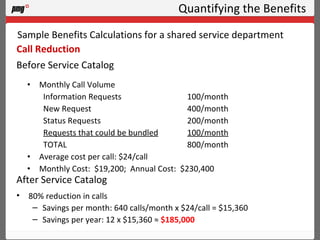
Quantifying the Benefits Monthly Call Volume Information Requests 100/month New Request 400/month Status Requests 200/month Requests that could be bundled 100/month TOTAL 800/month Average cost per call: $24/call Monthly Cost:  $19,200;  Annual Cost:  $230,400 Sample Benefits Calculations for a shared service department Call Reduction Before Service Catalog 80% reduction in calls Savings per month: 640 calls/month x $24/call = $15,360 Savings per year: 12 x $15,360 ≈  $185,000 After Service Catalog
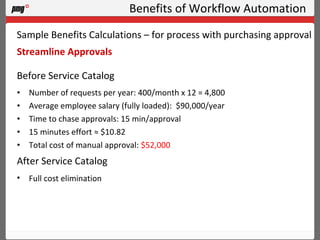
Benefits of Workflow Automation Number of requests per year: 400/month x 12 = 4,800 Average employee salary (fully loaded):  $90,000/year Time to chase approvals: 15 min/approval 15 minutes effort ≈ $10.82 Total cost of manual approval:  $52,000 Sample Benefits Calculations – for process with purchasing approval Streamline Approvals Before Service Catalog After Service Catalog Full cost elimination
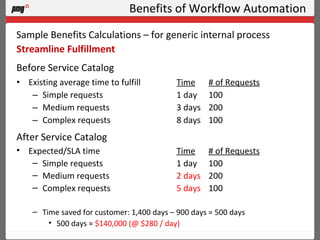
Benefits of Workflow Automation Existing average time to fulfill Time # of Requests Simple requests 1 day 100 Medium requests 3 days 200 Complex requests 8 days 100 Sample Benefits Calculations – for generic internal process Streamline Fulfillment Before Service Catalog Expected/SLA time Time # of Requests Simple requests 1 day 100 Medium requests 2 days 200 Complex requests 5 days 100 Time saved for customer: 1,400 days – 900 days = 500 days 500 days ≈  $140,000 (@ $280 / day) After Service Catalog
Additional Intangible Benefits What additional “soft” or intangible benefits would be attractive within your company? Improved relationships between departments Improved predictability for internal service delivery Reduced frustration = increased employee satisfaction Promotes culture of quality and accountability
Business Context Opportunity:  Service Delivery Solution:  Service Catalog Steps to Implement a Service Catalog Service Catalog in Action – AAA Summary/Questions
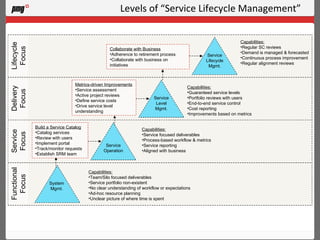
Levels of “Service Lifecycle Management” Functional Focus Service Focus Delivery Focus Lifecycle Focus Capabilities: Team/Silo focused deliverables Service portfolio non-existent No clear understanding of workflow or expectations Ad-hoc resource planning Unclear picture of where time is spent Build a Service Catalog Catalog services Review with users Implement portal Track/monitor requests Establish SRM team Capabilities: Service focused deliverables Process-based workflow & metrics Service reporting Aligned with business Metrics-driven Improvements Service assessment Active project reviews Define service costs Drive service level understanding Capabilities: Guaranteed service levels Portfolio reviews with users End-to-end service control Cost reporting Improvements based on metrics Collaborate with Business   Adherence to retirement process Collaborate with business on initiatives Capabilities: Regular SC reviews Demand is managed & forecasted Continuous process improvement Regular alignment reviews System Mgmt. Service Operation Service Level Mgmt. Service Lifecycle Mgmt.
Business Context Opportunity:  Service Delivery Solution:  Service Catalog Steps to Implement a Service Catalog Service Catalog in Action – AAA Summary/Questions
AAA Before Service Request Fulfillment Unorganized approach to working requests No metrics for productivity beyond Approved Queue SLA No metrics for quality No automation Limited knowledge base
Quick Wins – Immediate Improvements Unorganized approach to working requests Established new queues that allowed for a continuity in work effort and faster processing “ New Hire Class Provisioning” for project based requests “ Wireless Requests” for wireless and handheld devices Retired “Verify to Close” -obsolete approach Closing old requests to clear out noise making it easier to work in queues Regular monitoring of all queues for aging by team lead Result: In progress queue aging down from 11 days to 1 day
Improvements continued No metrics for productivity beyond Approved Queue SLA Set forth expectation that near real time handling is both possible and expected Began measuring and discussing time allocation and tracking to phone logs Began measuring number of requests worked per day Result:  ~21% productivity improvement
Improvements continued No automation Automated Blackberry Approval process Automated BlackBerry Security work with Annual Security Awareness Training Result:  Removed an entire category of work Improved the customer experience with single activity request and approval Reduced time to fulfill orders by days
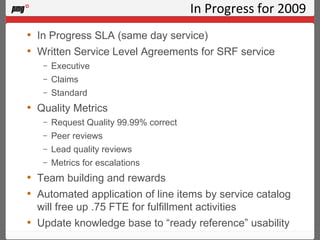
In Progress for 2009 In Progress SLA (same day service) Written Service Level Agreements for SRF service Executive Claims Standard Quality Metrics Request Quality 99.99% correct Peer reviews Lead quality reviews Metrics for escalations Team building and rewards Automated application of line items by service catalog will free up .75 FTE for fulfillment activities Update knowledge base to “ready reference” usability
Summary: Improved Service Requests Initial assessment of SRF execution shows a working approach but with low productivity and significant team issues Preliminary changes to improve process execution and morale have resulted in significant improvements ~21% productivity improvement SRF request aging Reduced from 11 days to same day
How AAA Improved Service Requests Improved individual performance and team camaraderie  Claims Phone & Executive requests being processed same day* Future changes including process approaches, knowledge sharing and automation will: Continue to improve productivity (10% target) Reduce aging to near real time service  Improve service quality to a 4 nines level of service (99.99% correct fulfillment) *In by 3PM, out same day
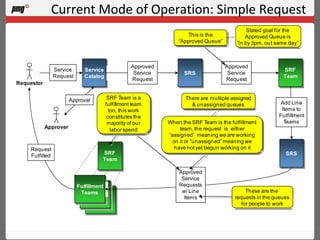
Current Mode of Operation: Simple Request
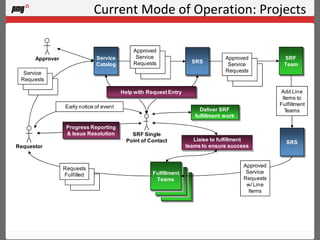
Current Mode of Operation: Projects
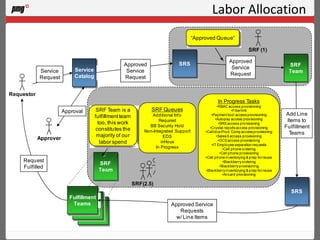
Labor Allocation
High Level Steps in Service Catalog Project Consider your internal opportunities Identify internal process for transition to SC Get green light Appoint cross-functional project team Use BPM best practices to streamline fulfillment process Implement user front end and fulfillment backend to support process
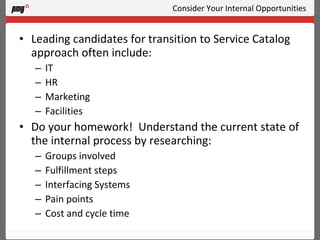
Consider Your Internal Opportunities Leading candidates for transition to Service Catalog approach often include: IT HR Marketing Facilities Do your homework!  Understand the current state of the internal process by researching: Groups involved Fulfillment steps Interfacing Systems Pain points Cost and cycle time
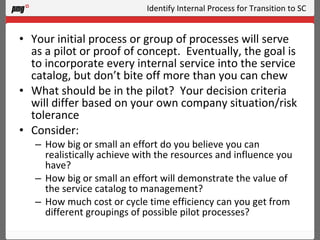
Identify Internal Process for Transition to SC Your initial process or group of processes will serve as a pilot or proof of concept.  Eventually, the goal is to incorporate every internal service into the service catalog, but don’t bite off more than you can chew What should be in the pilot?  Your decision criteria will differ based on your own company situation/risk tolerance Consider: How big or small an effort do you believe you can realistically achieve with the resources and influence you have? How big or small an effort will demonstrate the value of the service catalog to management? How much cost or cycle time efficiency can you get from different groupings of possible pilot processes?
Get Green Light You will need dedicated resources, executive sponsorship, and financial backing to start the pilot How can you get the green light? Handout:  “Benefits Calculator Worksheet”
Appoint Cross-Functional Project Team You will need advocates and decision-makers from each impacted department Make sure to involve enough people but keep the team as small as possible
Use BPM Best Practices to Streamline Fulfillment Processes Don’t simply automate your existing messy process Look for opportunities to eliminate non-value-added steps, re-order steps to improve cycle times, push responsibility lower in hierarchy, etc. This is where you shine!
Implement User Front-End and Fulfillment Back End You may need new tools to support your improved process Don’t be afraid to continue refining your process in the context of your new chosen toolset Apply all software implementation best practices to ensure a smooth launch
Business Context Opportunity:  Service Delivery Solution:  Service Catalog Steps to Implement a Service Catalog Service Catalog in Action – AAA Summary/Questions

PMG TAG BPM_presentation

  • 1.
    How AAA transformedtheir business process improving the customer experience April 16, 2009 Andrew Kramer, PMG Evan Maxey, AAA
  • 2.
    Agenda Business ContextProblem: Service Request Fulfillment Solution: Service Catalog Steps to Implement a Service Catalog Service Catalog in Action – AAA Summary/Questions
  • 3.
    Business Context Problem: Service Request Fulfillment Solution: Service Catalog Steps to Implement a Service Catalog Service Catalog in Action – AAA Summary/Questions
  • 4.
    The Economic Imperative2009 will be a year of “Do More With Less” Projects with and without capital expense will be subject to intense scrutiny Only projects that will show ROI (save money) will be green-lighted What can Business Process Management practitioners do to maximize results in this environment? Than Ever! ^ Than Ever! ^
  • 5.
    Business Context Problem: Service Request Fulfillment Solution: Service Catalog Steps to Implement a Service Catalog Service Catalog in Action – AAA Summary/Questions
  • 6.
    What about yourinternal processes? Did you know: The average company spends between 3 percent and 15 percent of its total revenue delivering services to internal departments. 1 1 Service Catalogs: The Heart of Service Delivery Management" Julie Giera, Forrester Research, Inc . Don’t just look at your customer-facing processes for opportunities, look at your internal processes too “ Service Delivery Management” does just that – mines internal service delivery processes for cost savings and cycle time efficiencies
  • 7.
    Internal and ExternalProcesses External Processes Service Fulfillment tends to be cross-functional Typical focus is on departmental budgets rather than end-to-end costs Outcomes are often measured by department rather than holistically – based on end-user experience Internal Processes Service Fulfillment tends to be cross-functional Typical focus is on departmental budgets rather than end-to-end costs Outcomes are often measured by department rather than holistically – based on end-user experience
  • 8.
    Even More Neglected? Phone calls back & forth Cogs of wheels not touching Communications gaps Information gaps Unique experience each time Requests come in, each is handled differently Ad-hoc or non-existent workflow Random task assignment, approvals, routing Inconsistent service No status or service level agreements Unknown costs Procedure documents
  • 9.
    Common Example –Employee Onboarding What are the steps? What has to happen when a new person comes on board? What functional groups are responsible for each of these steps? How does the process start? Who owns initiating the process? How do groups signal to each other that they’re done and ready for someone to take the next step? How does the process end? Describe Employee Onboarding at your Company
  • 10.
    Mining for SavingsStaple yourself to the process? How many e-mails and phone calls back and forth? How much paperwork? How long does it take? Are some parts overly controlled by a few people? What kind of benefits could your organization realize by improving on this process? Show me the money! Identify cost and cycle time opportunities in the onboarding example
  • 11.
    Opportunities Abound Areyour internal departments service providers? Information Technology Need new computer Need password reset Need new server infrastructure Finance/Accounting Need budgets Need reporting/analytics Need financial analysis Marketing Need product tag line Need product logo Need market research Legal Need contract review Need advice Facilities Need to move cubes Need new phone Need maintenance
  • 12.
    Business Context Opportunity: Service Delivery Solution: Service Catalog Steps to Implement a Service Catalog Service Catalog in Action – AAA Summary/Questions
  • 13.
    What is aService Catalog? Like an e-commerce catalog, except that it includes the “services” you provide to your customers. Provides graphical, attractive descriptions of available products & services in customer terms. Empowers user self-service: shop & order, then track status. Provides real-time business process management, integration, and fulfillment automation VS.
  • 14.
    Bringing Order toChaos Phone calls back & forth Cogs of wheels not touching Communications gaps Information gaps Unique experience each time Tasks flowing in the right order Accurate information flowing to the right people Things happen at the right time Repeatable / measurable
  • 15.
    Bringing Order toChaos Ad-hoc workflow Requests come in, each is handled differently Ad-hoc or non-existent workflow. Random task assignment, approvals, routing Inconsistent service No status or service level agreements Unknown costs Procedure documents Structured, automated workflow Requests are handled with software-defined workflow Workflow ensures tasks are handled in the right order, by the right people, at the right times Consistency, repeatability, and measurability Transparent costs Real-time status and service level management
  • 16.
    Exercise Designing aService Catalog The user-facing front end: What would a user want to know/see? What do you as the process owner want the user to know about the service? When they decide to place an order: What information do you need to capture from the requester? Then what? What are the fulfillment steps? At what points during fulfillment do we want to/need to communicate back to the user? Ordering a New Computer
  • 17.
    Sample New ComputerCatalog Item Your company logo
  • 18.
    Sample New ComputerOrder Form Your company logo
  • 19.
  • 20.
    Benefits of ServiceCatalog Approach The average company spends between 3 percent and 15 percent of its total revenue delivering services to internal departments. Companies that have implemented Service Catalog tools have: saved 30 percent to 40 percent of the cost of those services , reduced the time to deliver services by 50 percent improved quality by between 25 percent and 40 percent. Service catalogs are the cornerstone of service delivery and automation, and the starting point for any company interested in saving money and improving relationships with the business. 1 1 "Service Catalogs: The Heart of Service Delivery Management" Julie Giera, Forrester Research, Inc .
  • 21.
    Quantifying the BenefitsMonthly Call Volume Information Requests 100/month New Request 400/month Status Requests 200/month Requests that could be bundled 100/month TOTAL 800/month Average cost per call: $24/call Monthly Cost: $19,200; Annual Cost: $230,400 Sample Benefits Calculations for a shared service department Call Reduction Before Service Catalog 80% reduction in calls Savings per month: 640 calls/month x $24/call = $15,360 Savings per year: 12 x $15,360 ≈ $185,000 After Service Catalog
  • 22.
    Benefits of WorkflowAutomation Number of requests per year: 400/month x 12 = 4,800 Average employee salary (fully loaded): $90,000/year Time to chase approvals: 15 min/approval 15 minutes effort ≈ $10.82 Total cost of manual approval: $52,000 Sample Benefits Calculations – for process with purchasing approval Streamline Approvals Before Service Catalog After Service Catalog Full cost elimination
  • 23.
    Benefits of WorkflowAutomation Existing average time to fulfill Time # of Requests Simple requests 1 day 100 Medium requests 3 days 200 Complex requests 8 days 100 Sample Benefits Calculations – for generic internal process Streamline Fulfillment Before Service Catalog Expected/SLA time Time # of Requests Simple requests 1 day 100 Medium requests 2 days 200 Complex requests 5 days 100 Time saved for customer: 1,400 days – 900 days = 500 days 500 days ≈ $140,000 (@ $280 / day) After Service Catalog
  • 24.
    Additional Intangible BenefitsWhat additional “soft” or intangible benefits would be attractive within your company? Improved relationships between departments Improved predictability for internal service delivery Reduced frustration = increased employee satisfaction Promotes culture of quality and accountability
  • 25.
    Business Context Opportunity: Service Delivery Solution: Service Catalog Steps to Implement a Service Catalog Service Catalog in Action – AAA Summary/Questions
  • 26.
    Levels of “ServiceLifecycle Management” Functional Focus Service Focus Delivery Focus Lifecycle Focus Capabilities: Team/Silo focused deliverables Service portfolio non-existent No clear understanding of workflow or expectations Ad-hoc resource planning Unclear picture of where time is spent Build a Service Catalog Catalog services Review with users Implement portal Track/monitor requests Establish SRM team Capabilities: Service focused deliverables Process-based workflow & metrics Service reporting Aligned with business Metrics-driven Improvements Service assessment Active project reviews Define service costs Drive service level understanding Capabilities: Guaranteed service levels Portfolio reviews with users End-to-end service control Cost reporting Improvements based on metrics Collaborate with Business Adherence to retirement process Collaborate with business on initiatives Capabilities: Regular SC reviews Demand is managed & forecasted Continuous process improvement Regular alignment reviews System Mgmt. Service Operation Service Level Mgmt. Service Lifecycle Mgmt.
  • 27.
    Business Context Opportunity: Service Delivery Solution: Service Catalog Steps to Implement a Service Catalog Service Catalog in Action – AAA Summary/Questions
  • 28.
    AAA Before ServiceRequest Fulfillment Unorganized approach to working requests No metrics for productivity beyond Approved Queue SLA No metrics for quality No automation Limited knowledge base
  • 29.
    Quick Wins –Immediate Improvements Unorganized approach to working requests Established new queues that allowed for a continuity in work effort and faster processing “ New Hire Class Provisioning” for project based requests “ Wireless Requests” for wireless and handheld devices Retired “Verify to Close” -obsolete approach Closing old requests to clear out noise making it easier to work in queues Regular monitoring of all queues for aging by team lead Result: In progress queue aging down from 11 days to 1 day
  • 30.
    Improvements continued Nometrics for productivity beyond Approved Queue SLA Set forth expectation that near real time handling is both possible and expected Began measuring and discussing time allocation and tracking to phone logs Began measuring number of requests worked per day Result: ~21% productivity improvement
  • 31.
    Improvements continued Noautomation Automated Blackberry Approval process Automated BlackBerry Security work with Annual Security Awareness Training Result: Removed an entire category of work Improved the customer experience with single activity request and approval Reduced time to fulfill orders by days
  • 32.
    In Progress for2009 In Progress SLA (same day service) Written Service Level Agreements for SRF service Executive Claims Standard Quality Metrics Request Quality 99.99% correct Peer reviews Lead quality reviews Metrics for escalations Team building and rewards Automated application of line items by service catalog will free up .75 FTE for fulfillment activities Update knowledge base to “ready reference” usability
  • 33.
    Summary: Improved ServiceRequests Initial assessment of SRF execution shows a working approach but with low productivity and significant team issues Preliminary changes to improve process execution and morale have resulted in significant improvements ~21% productivity improvement SRF request aging Reduced from 11 days to same day
  • 34.
    How AAA ImprovedService Requests Improved individual performance and team camaraderie Claims Phone & Executive requests being processed same day* Future changes including process approaches, knowledge sharing and automation will: Continue to improve productivity (10% target) Reduce aging to near real time service Improve service quality to a 4 nines level of service (99.99% correct fulfillment) *In by 3PM, out same day
  • 35.
    Current Mode ofOperation: Simple Request
  • 36.
    Current Mode ofOperation: Projects
  • 37.
  • 38.
    High Level Stepsin Service Catalog Project Consider your internal opportunities Identify internal process for transition to SC Get green light Appoint cross-functional project team Use BPM best practices to streamline fulfillment process Implement user front end and fulfillment backend to support process
  • 39.
    Consider Your InternalOpportunities Leading candidates for transition to Service Catalog approach often include: IT HR Marketing Facilities Do your homework! Understand the current state of the internal process by researching: Groups involved Fulfillment steps Interfacing Systems Pain points Cost and cycle time
  • 40.
    Identify Internal Processfor Transition to SC Your initial process or group of processes will serve as a pilot or proof of concept. Eventually, the goal is to incorporate every internal service into the service catalog, but don’t bite off more than you can chew What should be in the pilot? Your decision criteria will differ based on your own company situation/risk tolerance Consider: How big or small an effort do you believe you can realistically achieve with the resources and influence you have? How big or small an effort will demonstrate the value of the service catalog to management? How much cost or cycle time efficiency can you get from different groupings of possible pilot processes?
  • 41.
    Get Green LightYou will need dedicated resources, executive sponsorship, and financial backing to start the pilot How can you get the green light? Handout: “Benefits Calculator Worksheet”
  • 42.
    Appoint Cross-Functional ProjectTeam You will need advocates and decision-makers from each impacted department Make sure to involve enough people but keep the team as small as possible
  • 43.
    Use BPM BestPractices to Streamline Fulfillment Processes Don’t simply automate your existing messy process Look for opportunities to eliminate non-value-added steps, re-order steps to improve cycle times, push responsibility lower in hierarchy, etc. This is where you shine!
  • 44.
    Implement User Front-Endand Fulfillment Back End You may need new tools to support your improved process Don’t be afraid to continue refining your process in the context of your new chosen toolset Apply all software implementation best practices to ensure a smooth launch
  • 45.
    Business Context Opportunity: Service Delivery Solution: Service Catalog Steps to Implement a Service Catalog Service Catalog in Action – AAA Summary/Questions

Editor's Notes

  • #8 Make the point that external processes are often ripe for BPM because of their tendency to be stuck in silos rather than managed across an entire end to end process. When done going through this list, pop up the same list for the internal processes, making the point that the very same principles apply to internal processes that do for external processes.
  • #9 Talk about how internal processes may be even more neglected since they are not customer-facing. Ask audience if any of this sounds familiar. Are there examples in their own companies of internal processes that work this way?
  • #10 Audience participation. Ask the audience.
  • #11 Again, take notes on flip charts
  • #12 Consistency / single interface, standardization.
  • #14 If Service Delivery Management is the opportunity, a Service Catalog is the solution
  • #15 Either use this or the next slide. Probably don’t need both.
  • #17 Take audience through the exercise of high level design of a service catalog for “Request a New Computer” Jot down notes on flip chart – keep it moving really fast. If they have trouble coming up with anything, prime them with some ideas.
  • #21 Mention that you are going back to the Forrester article….
  • #25 Ask participants for their own ideas first – then show them our list after they have already brainstormed 5-10 intangibles
  • #27 Talk through the model – let participants know that they should not focus on getting from the bottom to the top – take one step at a time. For most companies, this means starting a transition from a functional focus to a service focus.
  • #29 History of requests Short version of vetting
  • #42 At this point, distribute the “Benefits Calculator” worksheets