Sustainable Trends for Data
                   Center Facilities
• Increasing energy efficiencies and reducing other
  resource use and impact on the environment,
• Increased operating temperatures to equipment
  with goal of eliminating compressor based cooling
• Use and increased use of various software and
  controls for monitoring, control and simulation of
  Data Centers, including DCIM, BIM ,Virtual
  Memory Managers and CFD.
Increasing Energy and
                Resource Efficiencies
• Use of Variable speed equipment to match load
  changes including ECM fan motors.
• Consolidate and concentrate heat sources for increasing
  efficiencies of heat rejection equipment, including hot
  and cold isle containment, and high Delta T fluid and
  pumped refrigerant based systems.
• Higher voltages in equipment, eliminating one or more
  transformers.
• Increasing computations per watt at the server.
• RoHAS complient IT Equipment.
Increasing Energy and
                    Resource Efficiencies
• Use of harvested water such as Rain and Condensate to
  reduce energy required from infrastructure, reduce water
  treatment costs and increase efficiency of air cooled
  equipment.
• Use of Photo V and Thermal V for reducing energy
  required from regional power plants
• Use of evaporative media and spray systems for non-
  electric humidification and compressor less cooling
• Larger more efficient pieces of mechanical equip.
• Extensive use of natural cooling sources.
Increasing Operating
                   Temperatures for
                 Air cooled equipment
• ASHRAE TC9.9 new classes for recommended and
  allowable air temperatures for DataCom equipment
• Increased temperatures create greater heat transfer
  rates and more efficient heat rejection equipment.
• Increased temperatures create greater use and
  opportunity for free cooling form air and water side
  economizers
Increasing Operating
                 Temperatures for
              Water cooled equipment
• ASHRAE TC9.9 new classes for water cooled DataCom
  equipment
• Tremendous power and energy reduction for water vs.
  air cooled equipment.
• Increased temperatures create greater use and
  opportunity for free cooling from water side economizers
  and heat recovery up to over 115 deg F.
• Water cooled equipment expected to replace air
  cooled equipment
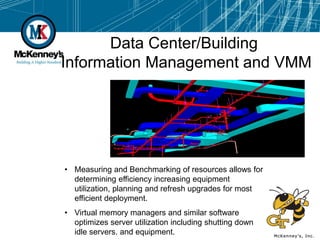
Data Center/Building
Information Management and VMM


• Measuring and Benchmarking of resources allows for
  determining efficiency increasing equipment
  utilization, planning and refresh upgrades for most
  efficient deployment.
• Virtual memory managers and similar software
  optimizes server utilization including shutting down
  idle servers. and equipment.
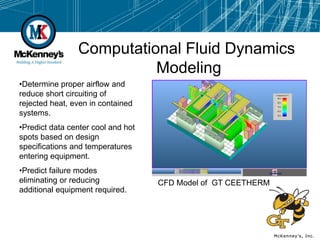
Computational Fluid Dynamics
                          Modeling
•Determine proper airflow and
reduce short circuiting of
rejected heat, even in contained
systems.
•Predict data center cool and hot
spots based on design
specifications and temperatures
entering equipment.
•Predict failure modes
eliminating or reducing             CFD Model of GT CEETHERM
additional equipment required.

Mc kenneys gatech

  • 1.
    Sustainable Trends forData Center Facilities • Increasing energy efficiencies and reducing other resource use and impact on the environment, • Increased operating temperatures to equipment with goal of eliminating compressor based cooling • Use and increased use of various software and controls for monitoring, control and simulation of Data Centers, including DCIM, BIM ,Virtual Memory Managers and CFD.
  • 2.
    Increasing Energy and Resource Efficiencies • Use of Variable speed equipment to match load changes including ECM fan motors. • Consolidate and concentrate heat sources for increasing efficiencies of heat rejection equipment, including hot and cold isle containment, and high Delta T fluid and pumped refrigerant based systems. • Higher voltages in equipment, eliminating one or more transformers. • Increasing computations per watt at the server. • RoHAS complient IT Equipment.
  • 3.
    Increasing Energy and Resource Efficiencies • Use of harvested water such as Rain and Condensate to reduce energy required from infrastructure, reduce water treatment costs and increase efficiency of air cooled equipment. • Use of Photo V and Thermal V for reducing energy required from regional power plants • Use of evaporative media and spray systems for non- electric humidification and compressor less cooling • Larger more efficient pieces of mechanical equip. • Extensive use of natural cooling sources.
  • 4.
    Increasing Operating Temperatures for Air cooled equipment • ASHRAE TC9.9 new classes for recommended and allowable air temperatures for DataCom equipment • Increased temperatures create greater heat transfer rates and more efficient heat rejection equipment. • Increased temperatures create greater use and opportunity for free cooling form air and water side economizers
  • 5.
    Increasing Operating Temperatures for Water cooled equipment • ASHRAE TC9.9 new classes for water cooled DataCom equipment • Tremendous power and energy reduction for water vs. air cooled equipment. • Increased temperatures create greater use and opportunity for free cooling from water side economizers and heat recovery up to over 115 deg F. • Water cooled equipment expected to replace air cooled equipment
  • 6.
    Data Center/Building Information Managementand VMM • Measuring and Benchmarking of resources allows for determining efficiency increasing equipment utilization, planning and refresh upgrades for most efficient deployment. • Virtual memory managers and similar software optimizes server utilization including shutting down idle servers. and equipment.
  • 7.
    Computational Fluid Dynamics Modeling •Determine proper airflow and reduce short circuiting of rejected heat, even in contained systems. •Predict data center cool and hot spots based on design specifications and temperatures entering equipment. •Predict failure modes eliminating or reducing CFD Model of GT CEETHERM additional equipment required.