Resource
Allocation
Presenters:
Maryam Imran 507
Amna Arshad 510
Table of contents
01
04
02
05
03
06
Introduction Nature of
Resources
Identifying Resource
Requirements
Scheduling
Resources
Creating
Critical Paths
Counting the
Cost
Introduction
• Resource allocation is the process of scheduling
resources such as labor, materials or equipment for the
completion of project tasks.
• Resource allocation is a step of project resource
management that involves estimating resources,
procuring resources, allocating resources and tracking
resources until the project is completed.
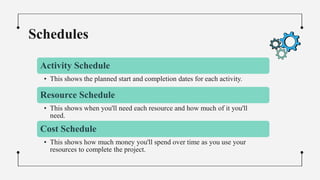
Schedules
Activity Schedule
• This shows the planned start and completion dates for each activity.
Resource Schedule
• This shows when you'll need each resource and how much of it you'll
need.
Cost Schedule
• This shows how much money you'll spend over time as you use your
resources to complete the project.
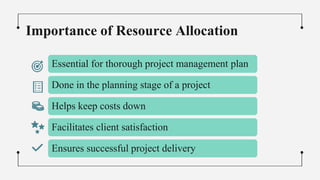
Importance of Resource Allocation
Essential for thorough project management plan
Done in the planning stage of a project
Helps keep costs down
Facilitates client satisfaction
Ensures successful project delivery
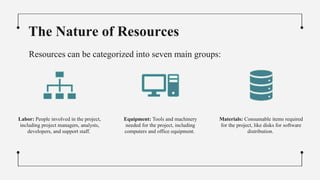
Resources can be categorized into seven main groups:
The Nature of Resources
Labor: People involved in the project,
including project managers, analysts,
developers, and support staff.
Equipment: Tools and machinery
needed for the project, including
computers and office equipment.
Materials: Consumable items required
for the project, like disks for software
distribution.
The Nature of Resources (Con't)
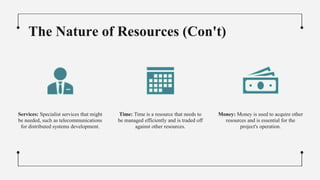
Services: Specialist services that might
be needed, such as telecommunications
for distributed systems development.
Time: Time is a resource that needs to
be managed efficiently and is traded off
against other resources.
Money: Money is used to acquire other
resources and is essential for the
project's operation.
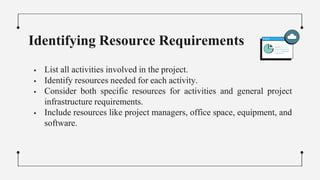
 List all activities involved in the project.
 Identify resources needed for each activity.
 Consider both specific resources for activities and general project
infrastructure requirements.
 Include resources like project managers, office space, equipment, and
software.
Identifying Resource Requirements
 Activity: Install Network Hardware for 20 computers.
 Work units: 20.
 Basic Skill: Bachelor's Degree in related field.
 Task Complexity: 5.
 Task Category: Skilled (other categories may be Management,
Leadership, Expert)
Example
 Project manager is responsible for resource allocation during a
project.
 They identify resource needs and align skills with project
requirements.
 They adjust resources as project needs change.
 They communicate with team members and stakeholders about
resource availability.
Responsibility of resource allocation
 Scheduling resources in software project management involves
allocating human, material, and financial resources to tasks and
activities within a project plan.
 This process typically includes identifying resource requirements,
estimating resource availability, to ensure efficient project
execution.
Scheduling resources
 Various techniques such as Gantt charts, resource leveling, and critical
path method (CPM) are commonly used to manage and optimize
resource schedules.
Gantt Chart:
 This is best done by representing the activity plan as a bar chart and
using this to produce a resource histogram for each resource.
 In practice, resources have to be allocated to a project on an activity-by-
activity basis and finding the ‘best’ allocation can be time consuming and
difficult.
Techniques
Prioritizing activities
Total Float Priority
• Activities are ordered according
to their total float, those with
the smallest total float having
the highest priority.
Ordered List Priority
• With this method, activities that
can proceed at the same time are
ordered according to a set of
simple criteria. An example of
this is Burman’s priority list.
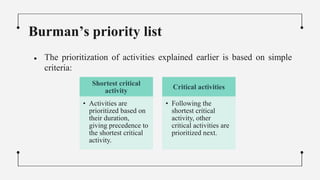
● The prioritization of activities explained earlier is based on simple
criteria:
Burman’s priority list
Shortest critical
activity
• Activities are
prioritized based on
their duration,
giving precedence to
the shortest critical
activity.
Critical activities
• Following the
shortest critical
activity, other
critical activities are
prioritized next.
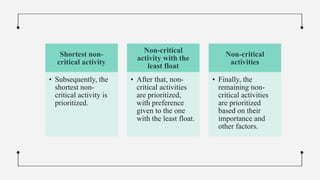
Shortest non-
critical activity
• Subsequently, the
shortest non-
critical activity is
prioritized.
Non-critical
activity with the
least float
• After that, non-
critical activities
are prioritized,
with preference
given to the one
with the least float.
Non-critical
activities
• Finally, the
remaining non-
critical activities
are prioritized
based on their
importance and
other factors.
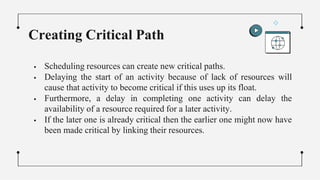
 Scheduling resources can create new critical paths.
 Delaying the start of an activity because of lack of resources will
cause that activity to become critical if this uses up its float.
 Furthermore, a delay in completing one activity can delay the
availability of a resource required for a later activity.
 If the later one is already critical then the earlier one might now have
been made critical by linking their resources.
Creating Critical Path
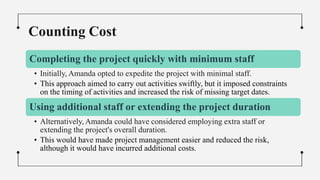
Counting Cost
Completing the project quickly with minimum staff
• Initially, Amanda opted to expedite the project with minimal staff.
• This approach aimed to carry out activities swiftly, but it imposed constraints
on the timing of activities and increased the risk of missing target dates.
Using additional staff or extending the project duration
• Alternatively, Amanda could have considered employing extra staff or
extending the project's overall duration.
• This would have made project management easier and reduced the risk,
although it would have incurred additional costs.
Thanks!!

Software SPM Resource Allocation Group 6.pptx

  • 1.
  • 2.
    Table of contents 01 04 02 05 03 06 IntroductionNature of Resources Identifying Resource Requirements Scheduling Resources Creating Critical Paths Counting the Cost
  • 3.
    Introduction • Resource allocationis the process of scheduling resources such as labor, materials or equipment for the completion of project tasks. • Resource allocation is a step of project resource management that involves estimating resources, procuring resources, allocating resources and tracking resources until the project is completed.
  • 4.
    Schedules Activity Schedule • Thisshows the planned start and completion dates for each activity. Resource Schedule • This shows when you'll need each resource and how much of it you'll need. Cost Schedule • This shows how much money you'll spend over time as you use your resources to complete the project.
  • 5.
    Importance of ResourceAllocation Essential for thorough project management plan Done in the planning stage of a project Helps keep costs down Facilitates client satisfaction Ensures successful project delivery
  • 6.
    Resources can becategorized into seven main groups: The Nature of Resources Labor: People involved in the project, including project managers, analysts, developers, and support staff. Equipment: Tools and machinery needed for the project, including computers and office equipment. Materials: Consumable items required for the project, like disks for software distribution.
  • 7.
    The Nature ofResources (Con't) Services: Specialist services that might be needed, such as telecommunications for distributed systems development. Time: Time is a resource that needs to be managed efficiently and is traded off against other resources. Money: Money is used to acquire other resources and is essential for the project's operation.
  • 8.
     List allactivities involved in the project.  Identify resources needed for each activity.  Consider both specific resources for activities and general project infrastructure requirements.  Include resources like project managers, office space, equipment, and software. Identifying Resource Requirements
  • 9.
     Activity: InstallNetwork Hardware for 20 computers.  Work units: 20.  Basic Skill: Bachelor's Degree in related field.  Task Complexity: 5.  Task Category: Skilled (other categories may be Management, Leadership, Expert) Example
  • 10.
     Project manageris responsible for resource allocation during a project.  They identify resource needs and align skills with project requirements.  They adjust resources as project needs change.  They communicate with team members and stakeholders about resource availability. Responsibility of resource allocation
  • 11.
     Scheduling resourcesin software project management involves allocating human, material, and financial resources to tasks and activities within a project plan.  This process typically includes identifying resource requirements, estimating resource availability, to ensure efficient project execution. Scheduling resources
  • 12.
     Various techniquessuch as Gantt charts, resource leveling, and critical path method (CPM) are commonly used to manage and optimize resource schedules. Gantt Chart:  This is best done by representing the activity plan as a bar chart and using this to produce a resource histogram for each resource.  In practice, resources have to be allocated to a project on an activity-by- activity basis and finding the ‘best’ allocation can be time consuming and difficult. Techniques
  • 13.
    Prioritizing activities Total FloatPriority • Activities are ordered according to their total float, those with the smallest total float having the highest priority. Ordered List Priority • With this method, activities that can proceed at the same time are ordered according to a set of simple criteria. An example of this is Burman’s priority list.
  • 14.
    ● The prioritizationof activities explained earlier is based on simple criteria: Burman’s priority list Shortest critical activity • Activities are prioritized based on their duration, giving precedence to the shortest critical activity. Critical activities • Following the shortest critical activity, other critical activities are prioritized next.
  • 15.
    Shortest non- critical activity •Subsequently, the shortest non- critical activity is prioritized. Non-critical activity with the least float • After that, non- critical activities are prioritized, with preference given to the one with the least float. Non-critical activities • Finally, the remaining non- critical activities are prioritized based on their importance and other factors.
  • 16.
     Scheduling resourcescan create new critical paths.  Delaying the start of an activity because of lack of resources will cause that activity to become critical if this uses up its float.  Furthermore, a delay in completing one activity can delay the availability of a resource required for a later activity.  If the later one is already critical then the earlier one might now have been made critical by linking their resources. Creating Critical Path
  • 17.
    Counting Cost Completing theproject quickly with minimum staff • Initially, Amanda opted to expedite the project with minimal staff. • This approach aimed to carry out activities swiftly, but it imposed constraints on the timing of activities and increased the risk of missing target dates. Using additional staff or extending the project duration • Alternatively, Amanda could have considered employing extra staff or extending the project's overall duration. • This would have made project management easier and reduced the risk, although it would have incurred additional costs.
  • 18.