Near Falkirk in Scotland, the Forth &
 Clyde Canal meets with the Union
 Canal, however at their meeting
 point the two differ in height by
 approximately 115 feet.
Before the 1930s, travel between
 these canals was provided by a
 series of eleven conventional locks,
 but they became disused and were
 filled in about seventy-five years
 ago.
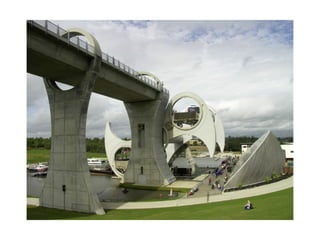
A brilliant, one-of-a-kind contraption
 was engineered which uses gravity
 and Archimedes’ principle to transfer
 boats between the two canals using
 very little electricity
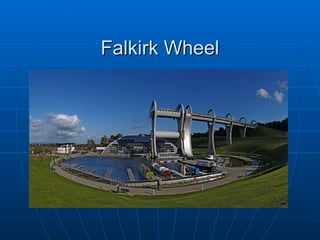
Falkirk Wheel
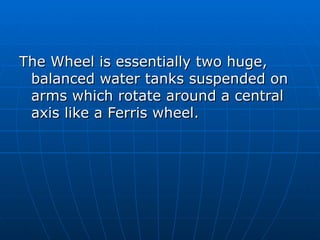
The Wheel is essentially two huge,
 balanced water tanks suspended on
 arms which rotate around a central
 axis like a Ferris wheel.
Each tank can support up to four
 twenty-meter-long boats at one
 time. Boats move into the tanks
 through the lock gates, which
 displaces a mass of water from each
 tank equal to the weight of the
 vessels.
Archimedes' principle
Floating objects displace their own
  weight in water, so when the boat
  enters, the amount of water leaving
  the caisson weighs exactly the same
  as the boat.
The tanks are thus always equalized in
  weight, allowing the pull of gravity
  on the descending tank to do most
  of the work elevating the rising
  tank.
This balance allows the wheel to
 consume very little electricity per
 turn despite the enormous weight
 involved. It uses a mere 1.5 kilowatt-
 hours, or roughly the equivalent
 power needed to boil eight kettles of
 water, each time it hefts a 600
 metric ton load. It does this in under
 four minutes per turn.
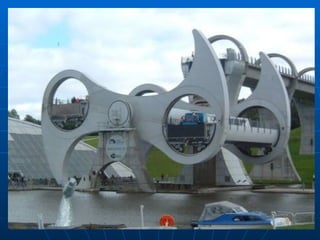
The Wheel’s design is truly
 revolutionary, as it is the only
 rotating boat lift in the world. Its
 beautiful form– reminiscent of a
 Celtic double-headed ax– and its
 graceful movement have made it a
 bit of a tourist destination, with a
 visitor’s center, a café, and
 landscaped grounds nestled in the
 natural amphitheater.
Features
    First structure of its kind in the
    world.
    Design life of at least 120 years.
    35 metres high.
    35 metres wide.
    30 metres long.
    Each gondola contains at least
    250,000 litres of water.
    Capable of carrying eight boats at a
    time.
    A single trip takes 15 minutes.
Show
PrevodnicaEn
Construction
   The wheel was constructed by
    Butterley Engineering at Ripley in
    Derbyshire under Millennium Plans to
    reconnect the Forth and Clyde Canal
    with the Union Canal, mainly for
    recreational use.
Operation
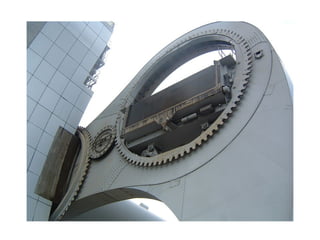
   The wheel rotates together with the axle, which is
    supported by four-metre-diameter slewing
    bearings that are constructed on top of piled
    foundations.
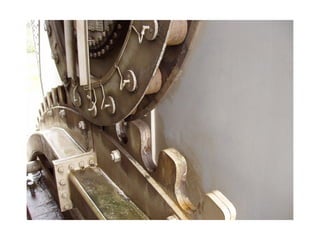
   The slewing bearing has an inner ring gear which
    acts as a rotating annulus.
   The rotating annulus is driven by ten hydraulic
    motors on the planet carrier.
   The drive-shafts of the motors have pinion gears
    which act as stationary planetary gears in this
    train of gears and engage the rotating annulus
    ring gear.
   An electric motor drives a hydraulic pump which
    is connected to the hydraulic motors by means of
    hoses and drive the wheel at 1/8 revolution per
    minute.
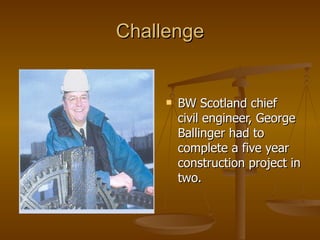
Challenge


        BW Scotland chief
         civil engineer, George
         Ballinger had to
         complete a five year
         construction project in
         two.
Planning
 Bachy/Soletanche and Morrison (BSM)
 Construction Joint Venture won the
 contract to design and construct a new
 section of canal, a tunnel beneath the
 Antonine wall, a section of aqueduct, the
 wheel and receiving basin.
Planning
 The exemplar design was perceived as
  unsuitable by British Waterways, therefore a
  series of design workshops took place under the
  direction of the architect RMJM to improve on
  the aesthetics of the design.
 Team members were instructed to attend these
  workshops with just blank paper and an open
  mind.
 Two weeks of this style of brainstorming
  developed the actual design
Controlling
   UK design codes for bridges, buildings and
    floating vessels were utilised, as well as
    Norwegian, German and American codes for
    such criteria as thin walled cylinder behaviour
    and constrained ice loading.
   A 1:50 scale model was used in a wind-tunnel
    for testing aerodynamic effects. Finite element
    analysis using LUSAS Bridge aided the structural
    design and included nonlinear solid continuum
    modelling of movement sensitive connections.
Controlling
   The various parts of The Falkirk Wheel
    were actually constructed and assembled,
    like one giant Meccano set, at Butterley
    Engineering’s Steelworks in Derbyshire. A
    team there carefully assembled the 1,200
    tonnes of steel, painstakingly fitting the
    pieces together to an accuracy of just 10
    mm to ensure a perfect final fit.
Controlling
   In the summer of 2001, the structure was
    then dismantled and transported on 35
    lorry loads to Falkirk, before all being
    bolted back together again on the ground,
    and finally lifted by crane in five large
    sections into position.
Controlling
   The total 600 tonne weight of the water
    and boat filled gondolas imposes immense
    and constantly changing stresses on the
    structure as it turns around the central
    spine.
Controlling
   Normal welded joints of steel would be
    susceptible to fatigue induced by these
    stresses, so to make the structure more
    robust, the steel sections were bolted
    together.
   Over 15,000 bolts were matched with
    45,000 bolt holes, and each bolt was hand
    tightened.
Cost and pricing
 The Falkirk Wheel cost £17.5 million, and the restoration
  project as a whole cost £84.5 million (of which £32
  million came from National Lottery funds).
 The Falkirk Wheel Visitor Centre offers scheduled one-
  hour, round trip boat tours, called "The Falkirk Wheel
  Experience", that include passage on the wheel. The
  tours start below the wheel in the Forth & Clyde Canal,
  ascend via the wheel to the Union Canal, visit nearby
  areas on the Union Canal, and then return.
 As of 2008, the boat tour costs £8 for adults, £4.25 for
  children aged 3-15 (free for children under 3), OAP
  concession £6.50, student/state benefits concession
  £6.50, and family price of £21.50 (2 adults and 2
  children) with a discount of 10% for a group of 20 or
  more.
Due to flooding caused by vandals, there
 was a month’s delay before going into
 operation, but on 24 May 2002 the Falkirk
 Wheel officially opened as part of Queen
 Elizabeth’s Golden Jubilee celebrations.
Thank you
The Zen of sarcasm

01) Do not walk behind me, for I may not lead. Do not walk ahead of me, for I may not follow.
    Do not walk beside me either. Just pretty much leave me alone.
02) Don't be irreplaceable. If you can't be replaced, you can't be promoted.
03) Always remember that you're unique. Just like everyone else.
04) Never test the depth of the water with both feet.
05) If you think nobody cares if you're alive, try missing a couple of car payments.
06) Before you criticize someone, you should walk a mile in their shoes. That way, when you
    criticize them, you're a mile away and you have their shoes.
07) Give a man a fish and he will eat for a day. Teach him how to fish, and he will sit in a boat
    and drink beer all day.
08) If you lend someone $20 and never see that person again, it was probably a wise
    investment.
09) If you tell the truth, you don't have to remember anything.
10) Some days you're the bug; some days you're the windshield.
11) Everyone seems normal until you get to know them.
12) The quickest way to double your money is to fold it in half and put it back in your pocket.
13) A closed mouth gathers no foot.
14) Duct tape is like 'The Force'. It has a light side and a dark side, and it holds the universe
    together.
16) Generally speaking, you aren't learning much when your lips are moving.
17) Experience is something you don't get until just after you need it.
18) Never miss a good chance to shut up.
AND FINALLY
19) Never, under any circumstances, take a sleeping pill and a laxative on the same night.
PM Case Study-Falkirk Wheel

  • 1.
    Near Falkirk inScotland, the Forth & Clyde Canal meets with the Union Canal, however at their meeting point the two differ in height by approximately 115 feet.
  • 2.
    Before the 1930s,travel between these canals was provided by a series of eleven conventional locks, but they became disused and were filled in about seventy-five years ago.
  • 3.
    A brilliant, one-of-a-kindcontraption was engineered which uses gravity and Archimedes’ principle to transfer boats between the two canals using very little electricity
  • 4.
  • 5.
    The Wheel isessentially two huge, balanced water tanks suspended on arms which rotate around a central axis like a Ferris wheel.
  • 7.
    Each tank cansupport up to four twenty-meter-long boats at one time. Boats move into the tanks through the lock gates, which displaces a mass of water from each tank equal to the weight of the vessels.
  • 8.
    Archimedes' principle Floating objectsdisplace their own weight in water, so when the boat enters, the amount of water leaving the caisson weighs exactly the same as the boat.
  • 9.
    The tanks arethus always equalized in weight, allowing the pull of gravity on the descending tank to do most of the work elevating the rising tank.
  • 10.
    This balance allowsthe wheel to consume very little electricity per turn despite the enormous weight involved. It uses a mere 1.5 kilowatt- hours, or roughly the equivalent power needed to boil eight kettles of water, each time it hefts a 600 metric ton load. It does this in under four minutes per turn.
  • 11.
    The Wheel’s designis truly revolutionary, as it is the only rotating boat lift in the world. Its beautiful form– reminiscent of a Celtic double-headed ax– and its graceful movement have made it a bit of a tourist destination, with a visitor’s center, a café, and landscaped grounds nestled in the natural amphitheater.
  • 12.
    Features  First structure of its kind in the world.  Design life of at least 120 years.  35 metres high.  35 metres wide.  30 metres long.  Each gondola contains at least 250,000 litres of water.  Capable of carrying eight boats at a time.  A single trip takes 15 minutes.
  • 13.
  • 14.
    Construction  The wheel was constructed by Butterley Engineering at Ripley in Derbyshire under Millennium Plans to reconnect the Forth and Clyde Canal with the Union Canal, mainly for recreational use.
  • 15.
    Operation  The wheel rotates together with the axle, which is supported by four-metre-diameter slewing bearings that are constructed on top of piled foundations.  The slewing bearing has an inner ring gear which acts as a rotating annulus.  The rotating annulus is driven by ten hydraulic motors on the planet carrier.  The drive-shafts of the motors have pinion gears which act as stationary planetary gears in this train of gears and engage the rotating annulus ring gear.  An electric motor drives a hydraulic pump which is connected to the hydraulic motors by means of hoses and drive the wheel at 1/8 revolution per minute.
  • 18.
    Challenge  BW Scotland chief civil engineer, George Ballinger had to complete a five year construction project in two.
  • 19.
    Planning  Bachy/Soletanche andMorrison (BSM) Construction Joint Venture won the contract to design and construct a new section of canal, a tunnel beneath the Antonine wall, a section of aqueduct, the wheel and receiving basin.
  • 20.
    Planning  The exemplardesign was perceived as unsuitable by British Waterways, therefore a series of design workshops took place under the direction of the architect RMJM to improve on the aesthetics of the design.  Team members were instructed to attend these workshops with just blank paper and an open mind.  Two weeks of this style of brainstorming developed the actual design
  • 21.
    Controlling  UK design codes for bridges, buildings and floating vessels were utilised, as well as Norwegian, German and American codes for such criteria as thin walled cylinder behaviour and constrained ice loading.  A 1:50 scale model was used in a wind-tunnel for testing aerodynamic effects. Finite element analysis using LUSAS Bridge aided the structural design and included nonlinear solid continuum modelling of movement sensitive connections.
  • 22.
    Controlling  The various parts of The Falkirk Wheel were actually constructed and assembled, like one giant Meccano set, at Butterley Engineering’s Steelworks in Derbyshire. A team there carefully assembled the 1,200 tonnes of steel, painstakingly fitting the pieces together to an accuracy of just 10 mm to ensure a perfect final fit.
  • 23.
    Controlling  In the summer of 2001, the structure was then dismantled and transported on 35 lorry loads to Falkirk, before all being bolted back together again on the ground, and finally lifted by crane in five large sections into position.
  • 24.
    Controlling  The total 600 tonne weight of the water and boat filled gondolas imposes immense and constantly changing stresses on the structure as it turns around the central spine.
  • 25.
    Controlling  Normal welded joints of steel would be susceptible to fatigue induced by these stresses, so to make the structure more robust, the steel sections were bolted together.  Over 15,000 bolts were matched with 45,000 bolt holes, and each bolt was hand tightened.
  • 26.
    Cost and pricing The Falkirk Wheel cost £17.5 million, and the restoration project as a whole cost £84.5 million (of which £32 million came from National Lottery funds).  The Falkirk Wheel Visitor Centre offers scheduled one- hour, round trip boat tours, called "The Falkirk Wheel Experience", that include passage on the wheel. The tours start below the wheel in the Forth & Clyde Canal, ascend via the wheel to the Union Canal, visit nearby areas on the Union Canal, and then return.  As of 2008, the boat tour costs £8 for adults, £4.25 for children aged 3-15 (free for children under 3), OAP concession £6.50, student/state benefits concession £6.50, and family price of £21.50 (2 adults and 2 children) with a discount of 10% for a group of 20 or more.
  • 27.
    Due to floodingcaused by vandals, there was a month’s delay before going into operation, but on 24 May 2002 the Falkirk Wheel officially opened as part of Queen Elizabeth’s Golden Jubilee celebrations.
  • 29.
  • 30.
    The Zen ofsarcasm 01) Do not walk behind me, for I may not lead. Do not walk ahead of me, for I may not follow. Do not walk beside me either. Just pretty much leave me alone. 02) Don't be irreplaceable. If you can't be replaced, you can't be promoted. 03) Always remember that you're unique. Just like everyone else. 04) Never test the depth of the water with both feet. 05) If you think nobody cares if you're alive, try missing a couple of car payments. 06) Before you criticize someone, you should walk a mile in their shoes. That way, when you criticize them, you're a mile away and you have their shoes. 07) Give a man a fish and he will eat for a day. Teach him how to fish, and he will sit in a boat and drink beer all day. 08) If you lend someone $20 and never see that person again, it was probably a wise investment. 09) If you tell the truth, you don't have to remember anything. 10) Some days you're the bug; some days you're the windshield. 11) Everyone seems normal until you get to know them. 12) The quickest way to double your money is to fold it in half and put it back in your pocket. 13) A closed mouth gathers no foot. 14) Duct tape is like 'The Force'. It has a light side and a dark side, and it holds the universe together. 16) Generally speaking, you aren't learning much when your lips are moving. 17) Experience is something you don't get until just after you need it. 18) Never miss a good chance to shut up. AND FINALLY 19) Never, under any circumstances, take a sleeping pill and a laxative on the same night.