4/30/2015
1
DR NOREEN NORFARAHEEN
BAGAN SPECIALIST CENTRE
JALAN BAGAN SATU
13400 BUTTERWORTH
PULAU PINANG
noreen_mater@yahoo.com.au
ANATOMY
PLEURA EFFUSION
PLEURAL LESIONS
PLEURAL THICKENING
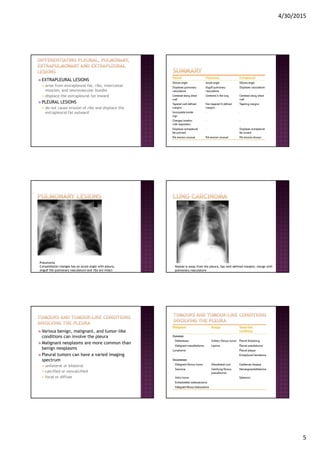
DIFFERENTIATING PLEURAL, PULMONARY AND
EXTRAPLEURAL LESIONS
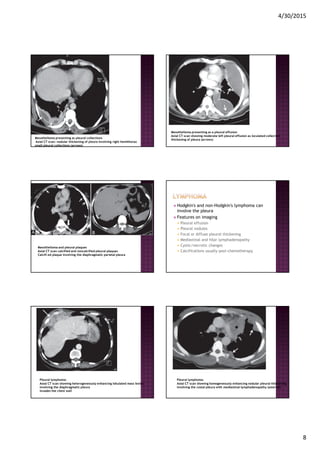
TUMOUR / TUMOUR LIKE CONDITIONS
INVOLVING THE PLEURA
FURTHER IMAGING
QUIZ
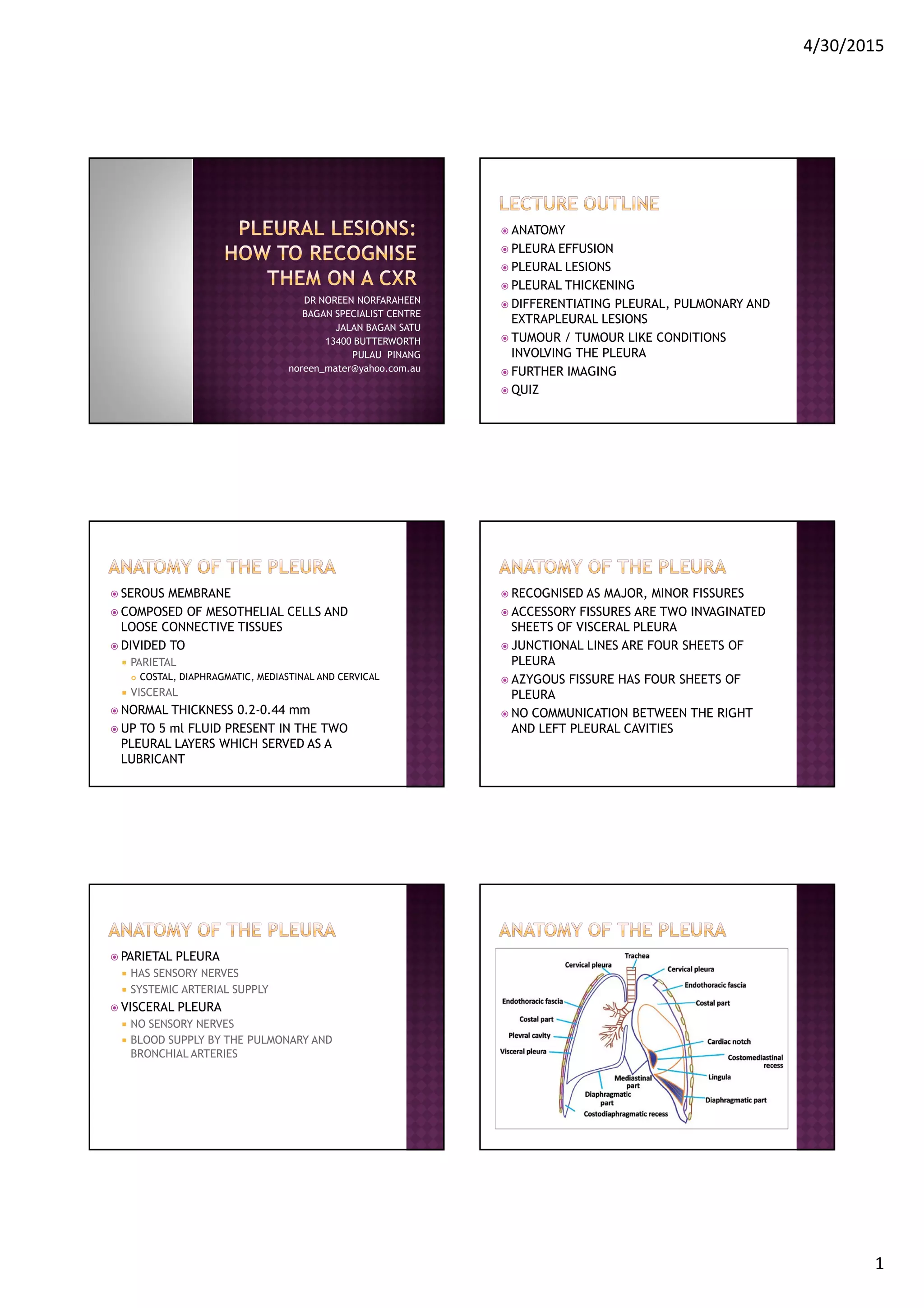
SEROUS MEMBRANE
COMPOSED OF MESOTHELIAL CELLS AND
LOOSE CONNECTIVE TISSUES
DIVIDED TO
PARIETAL
COSTAL, DIAPHRAGMATIC, MEDIASTINAL AND CERVICAL
VISCERAL
NORMAL THICKNESS 0.2-0.44 mm
UP TO 5 ml FLUID PRESENT IN THE TWO
PLEURAL LAYERS WHICH SERVED AS A
LUBRICANT
RECOGNISED AS MAJOR, MINOR FISSURES
ACCESSORY FISSURES ARE TWO INVAGINATED
SHEETS OF VISCERAL PLEURA
JUNCTIONAL LINES ARE FOUR SHEETS OF
PLEURA
AZYGOUS FISSURE HAS FOUR SHEETS OF
PLEURA
NO COMMUNICATION BETWEEN THE RIGHT
AND LEFT PLEURAL CAVITIES
PARIETAL PLEURA
HAS SENSORY NERVES
SYSTEMIC ARTERIAL SUPPLY
VISCERAL PLEURA
NO SENSORY NERVES
BLOOD SUPPLY BY THE PULMONARY AND
BRONCHIAL ARTERIES
4/30/2015
2
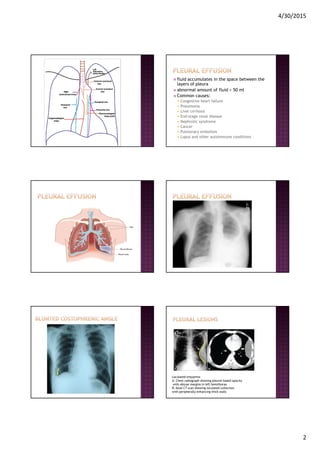
fluid accumulates in the space between the
layers of pleura
abnormal amount of fluid > 50 ml
Common causes:
Congestive heart failure
Pneumonia
Liver cirrhosis
End-stage renal disease
Nephrotic syndrome
Cancer
Pulmonary embolism
Lupus and other autoimmune conditions
Loculated empyema:
A: Chest radiograph showing pleural-based opacity
with obtuse margins in left hemithorax
B: Axial CT scan showing loculated collection
with peripherally enhancing thick walls
4/30/2015
3
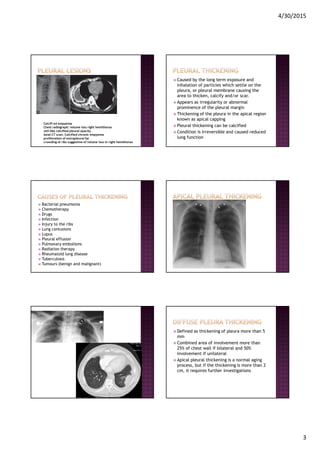
Calcifi ed empyema
Chest radiograph: volume loss right hemithorax
veil-like calcified pleural opacity
Axial CT scan: Calcified chronic empyema
proliferation of extrapleural fat
crowding of ribs suggestive of volume loss in right hemithorax
Caused by the long term exposure and
inhalation of particles which settle on the
pleura, or pleural membrane causing the
area to thicken, calcify and/or scar.
Appears as irregularity or abnormal
prominence of the pleural margin
Thickening of the pleura in the apical region
known as apical capping
Pleural thickening can be calcified
Condition is irreversible and caused reduced
lung function
Bacterial pneumonia
Chemotherapy
Drugs
Infection
Injury to the ribs
Lung contusions
Lupus
Pleural effusion
Pulmonary embolisms
Radiation therapy
Rheumatoid lung disease
Tuberculosis
Tumours (benign and malignant)
Defined as thickening of pleura more than 5
mm
Combined area of involvement more than
25% of chest wall if bilateral and 50%
involvement if unilateral
Apical pleural thickening is a normal aging
process, but if the thickening is more than 2
cm, it requires further investigations
4/30/2015
4
diffuse involvement of pleura
greater than 5 cm in width, 8 cm in
craniocaudal extent, and 3 mm in thickness
Causes : empyema, asbestosis, hemothorax,
pulmonary fibrosis, irradiation, previous
surgery, trauma, drugs, tuberculosis
In Asian countries, tuberculosis is an
important cause of pleural thickening
- rupture of subpleural caseous focus
- hematogenous dissemination
- involvement from an adjacent lymph node
- occurs in many forms
- pleural effusion
- pleural thickening
- Empyema
- Bronchopleural
- pleurocutaneous fistula
- calcifications
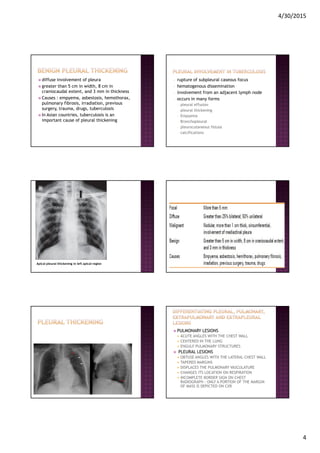
Apical pleural thickening in left apical region
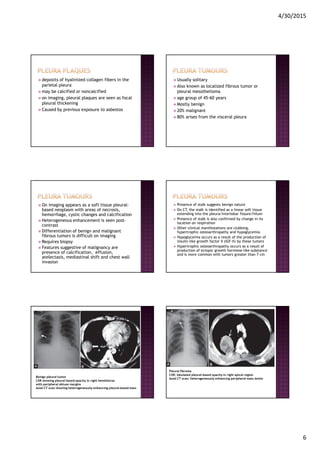
PULMONARY LESIONS
ACUTE ANGLES WITH THE CHEST WALL
CENTERED IN THE LUNG
ENGULF PULMONARY STRUCTURES
PLEURAL LESIONS
OBTUSE ANGLES WITH THE LATERAL CHEST WALL
TAPERED MARGINS
DISPLACES THE PULMONARY VASCULATURE
CHANGES ITS LOCATION ON RESPIRATION
INCOMPLETE BORDER SIGN ON CHEST
RADIOGRAPH - ONLY A PORTION OF THE MARGIN
OF MASS IS DEPICTED ON CXR
4/30/2015
5
EXTRAPLEURAL LESIONS
arise from extrapleural fat, ribs, intercostal
muscles, and neurovascular bundle
displace the extrapleural fat inward
PLEURAL LESIONS
do not cause erosion of ribs and displace the
extrapleural fat outward
Pneumonia
Consolidation changes has an acute angle with pleura,
engulf the pulmonary vasculature and ribs are intact
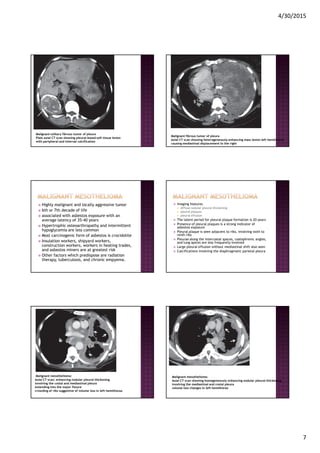
Nodule is away from the pleura, has well defined margins, merge with
pulmonary vasculature
Various benign, malignant, and tumor-like
conditions can involve the pleura
Malignant neoplasms are more common than
benign neoplasms
Pleural tumors can have a varied imaging
spectrum
unilateral or bilateral
calcified or noncalcified
focal or diffuse
4/30/2015
6
deposits of hyalinized collagen fibers in the
parietal pleura
may be calcified or noncalcified
on imaging, pleural plaques are seen as focal
pleural thickening
Caused by previous exposure to asbestos
Usually solitary
Also known as localized fibrous tumor or
pleural mesothelioma
age group of 45-60 years
Mostly benign
20% malignant
80% arises from the visceral pleura
On imaging appears as a soft tissue pleural-
based neoplasm with areas of necrosis,
hemorrhage, cystic changes and calcification
Heterogeneous enhancement is seen post-
contrast
Differentiation of benign and malignant
fibrous tumors is difficult on imaging
Requires biopsy
Features suggestive of malignancy are
presence of calcification, effusion,
atelectasis, mediastinal shift and chest wall
invasion
Presence of stalk suggests benign nature
On CT, the stalk is identified as a linear soft tissue
extending into the pleura/interlobar fissure/hilum
Presence of stalk is also confirmed by change in its
location on respiration
Other clinical manifestations are clubbing,
hypertrophic osteoarthropathy and hypoglycemia
Hypoglycemia occurs as a result of the production of
insulin-like growth factor II (IGF-II) by these tumors
Hypertrophic osteoarthropathy occurs as a result of
production of ectopic growth hormone-like substance
and is more common with tumors greater than 7 cm
Benign pleural tumor
CXR showing pleural-based opacity in right hemithorax
with peripheral obtuse margins
Axial CT scan showing heterogeneously enhancing pleural-based mass
Pleural fibroma
CXR: lobulated pleural-based opacity in right apical region
Axial CT scan: heterogeneously enhancing peripheral mass lesion
4/30/2015
7
Malignant solitary fibrous tumor of pleura
Plain axial CT scan showing pleural-based soft tissue lesion
with peripheral and internal calcification
Malignant fibrous tumor of pleura
Axial CT scan showing heterogeneously enhancing mass lesion left hemithorax
causing mediastinal displacement to the right
Highly malignant and locally aggressive tumor
6th or 7th decade of life
associated with asbestos exposure with an
average latency of 35-40 years
Hypertrophic osteoarthropathy and intermittent
hypoglycemia are less common
Most carcinogenic form of asbestos is crocidolite
Insulation workers, shipyard workers,
construction workers, workers in heating trades,
and asbestos miners are at greatest risk
Other factors which predispose are radiation
therapy, tuberculosis, and chronic empyema.
Imaging features
diffuse nodular pleural thickening
pleural plaques
pleural effusion
The latent period for pleural plaque formation is 20 years
Presence of pleural plaques is a strong indicator of
asbestos exposure
Pleural plaque is seen adjacent to ribs, involving sixth to
ninth ribs
Pleurae along the intercostal spaces, costophrenic angles,
and lung apices are less frequently involved
Large pleural effusion without mediastinal shift also seen
Calcifications involving the diaphragmatic parietal pleura
Malignant mesothelioma:
Axial CT scan: enhancing nodular pleural thickening
involving the costal and mediastinal pleura
extending into the major fissure
crowding of ribs suggestive of volume loss in left hemithorax
Malignant mesothelioma:
Axial CT scan showing homogeneously enhancing nodular pleural thickening
involving the mediastinal and costal pleura
volume loss changes in left hemithorax
4/30/2015
8
Mesothelioma presenting as pleural collections
Axial CT scan: nodular thickening of pleura involving right hemithorax
small pleural collections (arrows)
Mesothelioma presenting as a pleural effusion
Axial CT scan showing moderate left pleural effusion as loculated collection
thickening of pleura (arrows)
Mesothelioma and pleural plaques
Axial CT scan calcified and noncalcified pleural plaques
Calcifi ed plaque involving the diaphragmatic parietal pleura
Hodgkin's and non-Hodgkin's lymphoma can
involve the pleura
Features on imaging
Pleural effusion
Pleural nodules
Focal or diffuse pleural thickening
Mediastinal and hilar lymphadenopathy
Cystic/necrotic changes
Calcifications usually post-chemotherapy
Pleural lymphoma:
Axial CT scan showing heterogeneously enhancing lobulated mass lesion
involving the diaphragmatic pleura
invades the chest wall
Pleural lymphoma:
Axial CT scan showing homogeneously enhancing nodular pleural thickening
involving the costal pleura with mediastinal lymphadenopathy (asterisk)
4/30/2015
9
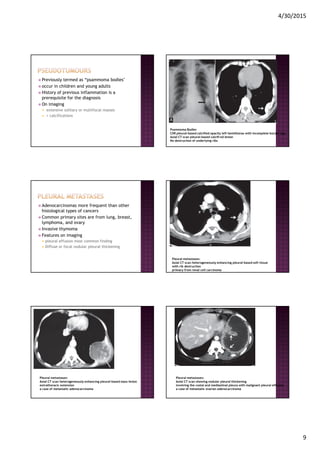
Previously termed as โ€œpsammoma bodies"
occur in children and young adults
History of previous inflammation is a
prerequisite for the diagnosis
On imaging
extensive solitary or multifocal masses
+ calcifications
Psammoma Bodies
CXR pleural-based calcified opacity left hemithorax with incomplete border sign
Axial CT scan pleural-based calcifi ed lesion
No destruction of underlying ribs
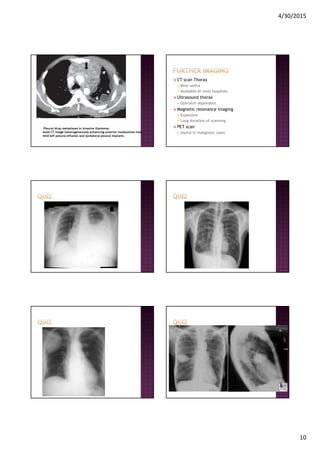
Adenocarcinomas more frequent than other
histological types of cancers
Common primary sites are from lung, breast,
lymphoma, and ovary
Invasive thymoma
Features on imaging
pleural effusion most common finding
Diffuse or focal nodular pleural thickening
Pleural metastases:
Axial CT scan heterogeneously enhancing pleural-based soft tissue
with rib destruction
primary from renal cell carcinoma
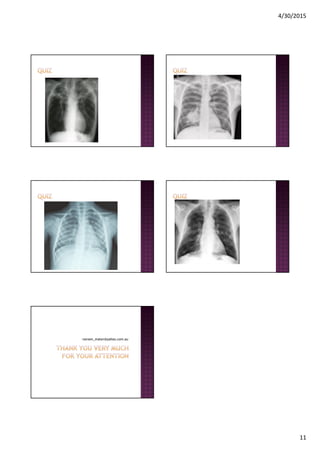
Pleural metastases:
Axial CT scan heterogeneously enhancing pleural-based mass lesion
extrathoracic extension
a case of metastatic adenocarcinoma
Pleural metastases:
Axial CT scan showing nodular pleural thickening
involving the costal and mediastinal pleura with malignant pleural effusion
a case of metastatic ovarian adenocarcinoma
4/30/2015
10
Pleural drop metastases in invasive thymoma:
Axial CT image heterogeneously enhancing anterior mediastinal mass
mild left pleural effusion and ipsilateral pleural implants
CT scan Thorax
Most useful
Available at most hospitals
Ultrasound thorax
Operator dependent
Magnetic resonance imaging
Expensive
Long duration of scanning
PET scan
Useful in malignant cases
4/30/2015
11
noreen_mater@yahoo.com.au

Pleural Lesions by Dr Noreen

  • 1.
    4/30/2015 1 DR NOREEN NORFARAHEEN BAGANSPECIALIST CENTRE JALAN BAGAN SATU 13400 BUTTERWORTH PULAU PINANG noreen_mater@yahoo.com.au ANATOMY PLEURA EFFUSION PLEURAL LESIONS PLEURAL THICKENING DIFFERENTIATING PLEURAL, PULMONARY AND EXTRAPLEURAL LESIONS TUMOUR / TUMOUR LIKE CONDITIONS INVOLVING THE PLEURA FURTHER IMAGING QUIZ SEROUS MEMBRANE COMPOSED OF MESOTHELIAL CELLS AND LOOSE CONNECTIVE TISSUES DIVIDED TO PARIETAL COSTAL, DIAPHRAGMATIC, MEDIASTINAL AND CERVICAL VISCERAL NORMAL THICKNESS 0.2-0.44 mm UP TO 5 ml FLUID PRESENT IN THE TWO PLEURAL LAYERS WHICH SERVED AS A LUBRICANT RECOGNISED AS MAJOR, MINOR FISSURES ACCESSORY FISSURES ARE TWO INVAGINATED SHEETS OF VISCERAL PLEURA JUNCTIONAL LINES ARE FOUR SHEETS OF PLEURA AZYGOUS FISSURE HAS FOUR SHEETS OF PLEURA NO COMMUNICATION BETWEEN THE RIGHT AND LEFT PLEURAL CAVITIES PARIETAL PLEURA HAS SENSORY NERVES SYSTEMIC ARTERIAL SUPPLY VISCERAL PLEURA NO SENSORY NERVES BLOOD SUPPLY BY THE PULMONARY AND BRONCHIAL ARTERIES
  • 2.
    4/30/2015 2 fluid accumulates inthe space between the layers of pleura abnormal amount of fluid > 50 ml Common causes: Congestive heart failure Pneumonia Liver cirrhosis End-stage renal disease Nephrotic syndrome Cancer Pulmonary embolism Lupus and other autoimmune conditions Loculated empyema: A: Chest radiograph showing pleural-based opacity with obtuse margins in left hemithorax B: Axial CT scan showing loculated collection with peripherally enhancing thick walls
  • 3.
    4/30/2015 3 Calcifi ed empyema Chestradiograph: volume loss right hemithorax veil-like calcified pleural opacity Axial CT scan: Calcified chronic empyema proliferation of extrapleural fat crowding of ribs suggestive of volume loss in right hemithorax Caused by the long term exposure and inhalation of particles which settle on the pleura, or pleural membrane causing the area to thicken, calcify and/or scar. Appears as irregularity or abnormal prominence of the pleural margin Thickening of the pleura in the apical region known as apical capping Pleural thickening can be calcified Condition is irreversible and caused reduced lung function Bacterial pneumonia Chemotherapy Drugs Infection Injury to the ribs Lung contusions Lupus Pleural effusion Pulmonary embolisms Radiation therapy Rheumatoid lung disease Tuberculosis Tumours (benign and malignant) Defined as thickening of pleura more than 5 mm Combined area of involvement more than 25% of chest wall if bilateral and 50% involvement if unilateral Apical pleural thickening is a normal aging process, but if the thickening is more than 2 cm, it requires further investigations
  • 4.
    4/30/2015 4 diffuse involvement ofpleura greater than 5 cm in width, 8 cm in craniocaudal extent, and 3 mm in thickness Causes : empyema, asbestosis, hemothorax, pulmonary fibrosis, irradiation, previous surgery, trauma, drugs, tuberculosis In Asian countries, tuberculosis is an important cause of pleural thickening - rupture of subpleural caseous focus - hematogenous dissemination - involvement from an adjacent lymph node - occurs in many forms - pleural effusion - pleural thickening - Empyema - Bronchopleural - pleurocutaneous fistula - calcifications Apical pleural thickening in left apical region PULMONARY LESIONS ACUTE ANGLES WITH THE CHEST WALL CENTERED IN THE LUNG ENGULF PULMONARY STRUCTURES PLEURAL LESIONS OBTUSE ANGLES WITH THE LATERAL CHEST WALL TAPERED MARGINS DISPLACES THE PULMONARY VASCULATURE CHANGES ITS LOCATION ON RESPIRATION INCOMPLETE BORDER SIGN ON CHEST RADIOGRAPH - ONLY A PORTION OF THE MARGIN OF MASS IS DEPICTED ON CXR
  • 5.
    4/30/2015 5 EXTRAPLEURAL LESIONS arise fromextrapleural fat, ribs, intercostal muscles, and neurovascular bundle displace the extrapleural fat inward PLEURAL LESIONS do not cause erosion of ribs and displace the extrapleural fat outward Pneumonia Consolidation changes has an acute angle with pleura, engulf the pulmonary vasculature and ribs are intact Nodule is away from the pleura, has well defined margins, merge with pulmonary vasculature Various benign, malignant, and tumor-like conditions can involve the pleura Malignant neoplasms are more common than benign neoplasms Pleural tumors can have a varied imaging spectrum unilateral or bilateral calcified or noncalcified focal or diffuse
  • 6.
    4/30/2015 6 deposits of hyalinizedcollagen fibers in the parietal pleura may be calcified or noncalcified on imaging, pleural plaques are seen as focal pleural thickening Caused by previous exposure to asbestos Usually solitary Also known as localized fibrous tumor or pleural mesothelioma age group of 45-60 years Mostly benign 20% malignant 80% arises from the visceral pleura On imaging appears as a soft tissue pleural- based neoplasm with areas of necrosis, hemorrhage, cystic changes and calcification Heterogeneous enhancement is seen post- contrast Differentiation of benign and malignant fibrous tumors is difficult on imaging Requires biopsy Features suggestive of malignancy are presence of calcification, effusion, atelectasis, mediastinal shift and chest wall invasion Presence of stalk suggests benign nature On CT, the stalk is identified as a linear soft tissue extending into the pleura/interlobar fissure/hilum Presence of stalk is also confirmed by change in its location on respiration Other clinical manifestations are clubbing, hypertrophic osteoarthropathy and hypoglycemia Hypoglycemia occurs as a result of the production of insulin-like growth factor II (IGF-II) by these tumors Hypertrophic osteoarthropathy occurs as a result of production of ectopic growth hormone-like substance and is more common with tumors greater than 7 cm Benign pleural tumor CXR showing pleural-based opacity in right hemithorax with peripheral obtuse margins Axial CT scan showing heterogeneously enhancing pleural-based mass Pleural fibroma CXR: lobulated pleural-based opacity in right apical region Axial CT scan: heterogeneously enhancing peripheral mass lesion
  • 7.
    4/30/2015 7 Malignant solitary fibroustumor of pleura Plain axial CT scan showing pleural-based soft tissue lesion with peripheral and internal calcification Malignant fibrous tumor of pleura Axial CT scan showing heterogeneously enhancing mass lesion left hemithorax causing mediastinal displacement to the right Highly malignant and locally aggressive tumor 6th or 7th decade of life associated with asbestos exposure with an average latency of 35-40 years Hypertrophic osteoarthropathy and intermittent hypoglycemia are less common Most carcinogenic form of asbestos is crocidolite Insulation workers, shipyard workers, construction workers, workers in heating trades, and asbestos miners are at greatest risk Other factors which predispose are radiation therapy, tuberculosis, and chronic empyema. Imaging features diffuse nodular pleural thickening pleural plaques pleural effusion The latent period for pleural plaque formation is 20 years Presence of pleural plaques is a strong indicator of asbestos exposure Pleural plaque is seen adjacent to ribs, involving sixth to ninth ribs Pleurae along the intercostal spaces, costophrenic angles, and lung apices are less frequently involved Large pleural effusion without mediastinal shift also seen Calcifications involving the diaphragmatic parietal pleura Malignant mesothelioma: Axial CT scan: enhancing nodular pleural thickening involving the costal and mediastinal pleura extending into the major fissure crowding of ribs suggestive of volume loss in left hemithorax Malignant mesothelioma: Axial CT scan showing homogeneously enhancing nodular pleural thickening involving the mediastinal and costal pleura volume loss changes in left hemithorax
  • 8.
    4/30/2015 8 Mesothelioma presenting aspleural collections Axial CT scan: nodular thickening of pleura involving right hemithorax small pleural collections (arrows) Mesothelioma presenting as a pleural effusion Axial CT scan showing moderate left pleural effusion as loculated collection thickening of pleura (arrows) Mesothelioma and pleural plaques Axial CT scan calcified and noncalcified pleural plaques Calcifi ed plaque involving the diaphragmatic parietal pleura Hodgkin's and non-Hodgkin's lymphoma can involve the pleura Features on imaging Pleural effusion Pleural nodules Focal or diffuse pleural thickening Mediastinal and hilar lymphadenopathy Cystic/necrotic changes Calcifications usually post-chemotherapy Pleural lymphoma: Axial CT scan showing heterogeneously enhancing lobulated mass lesion involving the diaphragmatic pleura invades the chest wall Pleural lymphoma: Axial CT scan showing homogeneously enhancing nodular pleural thickening involving the costal pleura with mediastinal lymphadenopathy (asterisk)
  • 9.
    4/30/2015 9 Previously termed asโ€œpsammoma bodies" occur in children and young adults History of previous inflammation is a prerequisite for the diagnosis On imaging extensive solitary or multifocal masses + calcifications Psammoma Bodies CXR pleural-based calcified opacity left hemithorax with incomplete border sign Axial CT scan pleural-based calcifi ed lesion No destruction of underlying ribs Adenocarcinomas more frequent than other histological types of cancers Common primary sites are from lung, breast, lymphoma, and ovary Invasive thymoma Features on imaging pleural effusion most common finding Diffuse or focal nodular pleural thickening Pleural metastases: Axial CT scan heterogeneously enhancing pleural-based soft tissue with rib destruction primary from renal cell carcinoma Pleural metastases: Axial CT scan heterogeneously enhancing pleural-based mass lesion extrathoracic extension a case of metastatic adenocarcinoma Pleural metastases: Axial CT scan showing nodular pleural thickening involving the costal and mediastinal pleura with malignant pleural effusion a case of metastatic ovarian adenocarcinoma
  • 10.
    4/30/2015 10 Pleural drop metastasesin invasive thymoma: Axial CT image heterogeneously enhancing anterior mediastinal mass mild left pleural effusion and ipsilateral pleural implants CT scan Thorax Most useful Available at most hospitals Ultrasound thorax Operator dependent Magnetic resonance imaging Expensive Long duration of scanning PET scan Useful in malignant cases
  • 11.