PlayingHide-And-Seek: An Abstract Game for Cyber Security
1
Martin Chapman
Gareth Tyson
Simon Parsons
Michael Luck
Peter McBurney
2
3
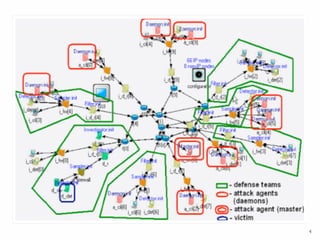
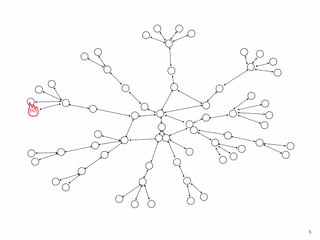
Issue:The complexity of research at the
intersection of ABM and Cyber Security
3
4
4
4
5
6
6
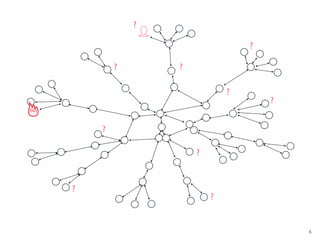
? ?
?
?
?
?
?
?
?
?
6
? ?
?
?
?
?
?
?
?
?
6
7
8
8
? ?
?
?
?
?
?
?
?
?
8
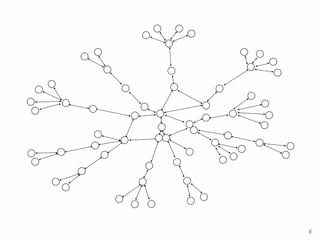
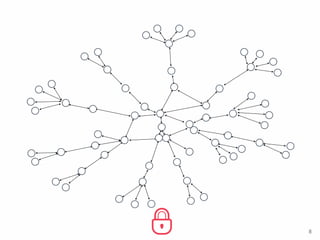
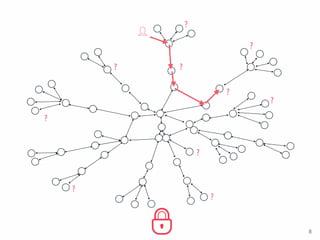
Claim: A number of different Cyber Security problems
can be abstracted to a simple game of ‘Hide-And-Seek’
9
Claim: A number of different Cyber Security problems
can be abstracted to a simple game of ‘Hide-And-Seek’
. . . therefore . . .
We are motivated to explore strategies for seeking (and,
ultimately, hiding) in this game.

9
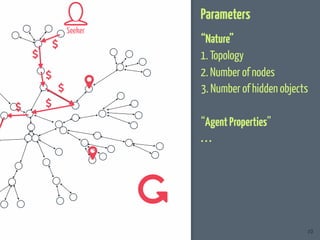
Parameters
1. Topology
2. Number of nodes
3. Number of hidden objects
“Nature”
“AgentProperties”
...
10
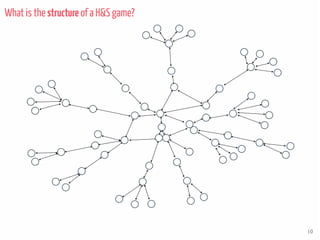
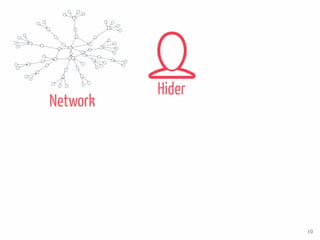
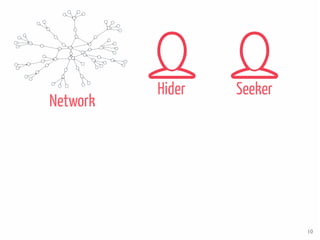
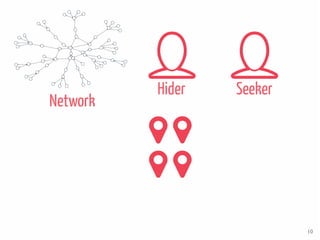
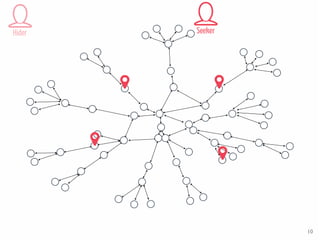
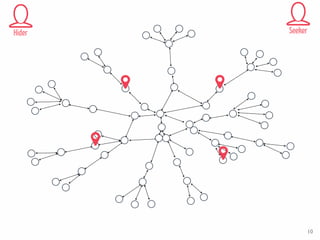
What is the structure of a H&S game?
Parameters
1. Topology
2. Number of nodes
3. Number of hidden objects
“Nature”
“AgentProperties”
...
10
What is the structure of a H&S game?
Parameters
1. Topology
2. Number of nodes
3. Number of hidden objects
“Nature”
“AgentProperties”
...
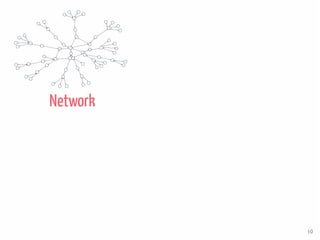
Network
10
Parameters
1. Topology
2. Number of nodes
3. Number of hidden objects
“Nature”
“AgentProperties”
...
Network
Hider
10
Parameters
1. Topology
2. Number of nodes
3. Number of hidden objects
“Nature”
“AgentProperties”
...
Network
Hider Seeker
10
Parameters
1. Topology
2. Number of nodes
3. Number of hidden objects
“Nature”
“AgentProperties”
...
Network
Hider Seeker
10
Parameters
1. Topology
2. Number of nodes
3. Number of hidden objects
“Nature”
“AgentProperties”
...
Hider Seeker
10
Parameters
1. Topology
2. Number of nodes
3. Number of hidden objects
“Nature”
“AgentProperties”
...
Hider Seeker
10
Parameters
1. Topology
2. Number of nodes
3. Number of hidden objects
“Nature”
“AgentProperties”
...
Hider Seeker
10
Parameters
1. Topology
2. Number of nodes
3. Number of hidden objects
“Nature”
“AgentProperties”
...
Hider Seeker
10
Parameters
1. Topology
2. Number of nodes
3. Number of hidden objects
“Nature”
“AgentProperties”
...
Hider Seeker
10
Parameters
1. Topology
2. Number of nodes
3. Number of hidden objects
“Nature”
“AgentProperties”
...
Seeker
10
Parameters
1. Topology
2. Number of nodes
3. Number of hidden objects
“Nature”
“AgentProperties”
...
Hider Seeker
10
Parameters
1. Topology
2. Number of nodes
3. Number of hidden objects
“Nature”
“AgentProperties”
...
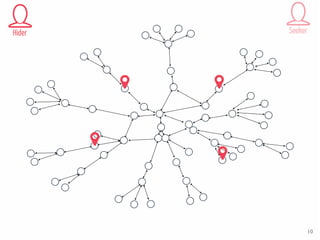
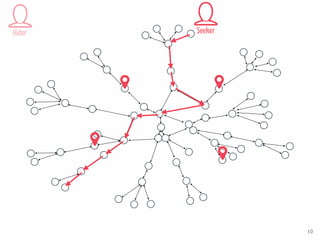
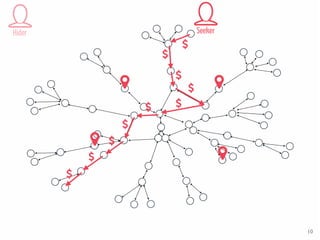
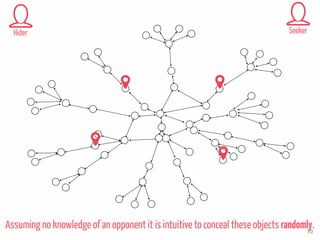
Assuming no knowledge of an opponent it is intuitive to conceal these objects randomly.
Hider Seeker
10
Parameters
1. Topology
2. Number of nodes
3. Number of hidden objects
“Nature”
“AgentProperties”
...
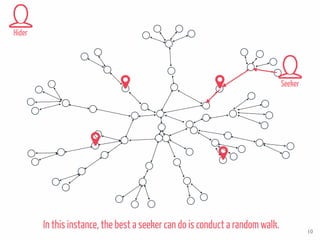
In this instance, the best a seeker can do is conduct a random walk.
Hider
Seeker
10
Sohowcanwestrategise?
11
Sohowcanwestrategise?
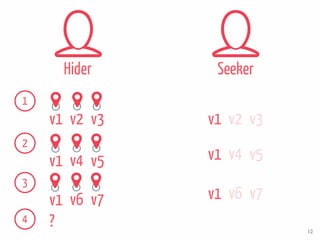
In reality, hiders (attackers) are either unable or unwillingto

express randomness [Rubinstein, 1999]
11
Sohowcanwestrategise?
In reality, hiders (attackers) are either unable or unwillingto
express randomness [Rubinstein, 1999]
- Bug’s in code
- Human fallibility
- Infrastructure constraints
- Perceived ‘secrecy’ of locations
11
Sohowcanwestrategise?
In reality, hiders (attackers) are either unable or unwillingto
express randomness [Rubinstein, 1999]
- Bug’s in code
- Human fallibility
- Infrastructure constraints
- Perceived ‘secrecy’ of locations
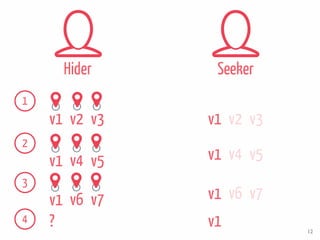
Repeatbehaviour
11
Hider Seeker
12
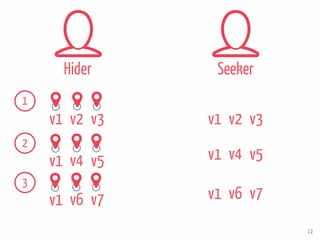
Hider Seeker
1
v1 v2 v3
2
v5v1 v4
3
v1 v6 v7
v1 v2 v3
v5v1 v4
v1 v6 v7
12
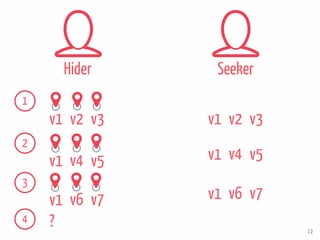
Hider Seeker
1
v1 v2 v3
2
v5v1 v4
3
v1 v6 v7
4 ?
v1 v2 v3
v5v1 v4
v1 v6 v7
12
Hider Seeker
1
v1 v2 v3
2
v5v1 v4
3
v1 v6 v7
4 ?
v1 v2 v3
v5v1 v4
v1 v6 v7
12
Hider Seeker
1
v1 v2 v3
2
v5v1 v4
3
v1 v6 v7
4 ?
v1 v2 v3
v5v1 v4
v1 v6 v7
v1 12
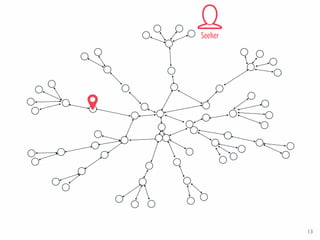
Seeker
13
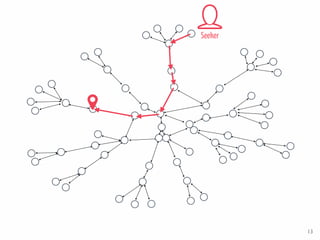
Seeker
13
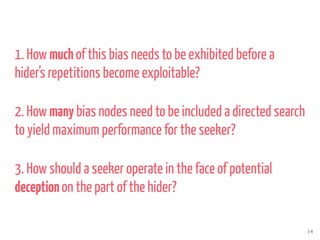
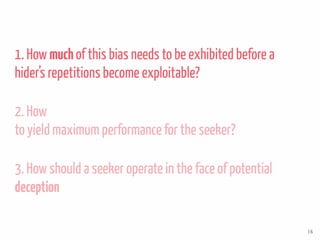
1. How muchof this bias needs to be exhibited before a
hider’s repetitions become exploitable?
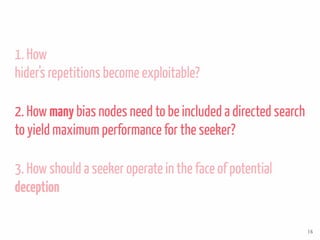
2. How many bias nodes need to be included a directed search
to yield maximum performance for the seeker?
3. How should a seeker operate in the face of potential
deceptionon the part of the hider?
14
1. How muchof this bias needs to be exhibited before a
hider’s repetitions become exploitable?
2. How
to yield maximum performance for the seeker?
3. How should a seeker operate in the face of potential
deception
14
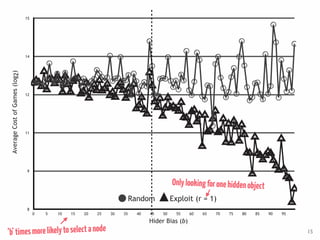
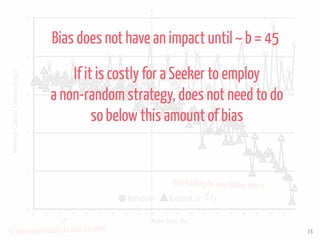
15‘b’timesmorelikelytoselectanode
8
9
11
12
14
15
0 5 10 15 20 25 30 35 40 45 50 55 60 65 70 75 80 85 90 95
Hider Bias (b)
Random Exploit (r = 1)
AverageCostofGames(log2)
Onlylookingforonehiddenobject
15
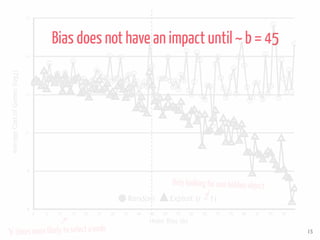
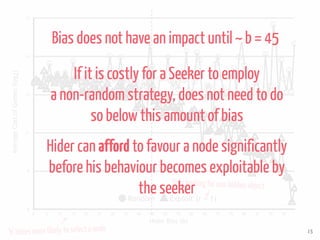
Bias does not have an impact until ~ b = 45
‘b’timesmorelikelytoselectanode
8
9
11
12
14
15
0 5 10 15 20 25 30 35 40 45 50 55 60 65 70 75 80 85 90 95
Hider Bias (b)
Random Exploit (r = 1)
AverageCostofGames(log2)
Onlylookingforonehiddenobject
15
Bias does not have an impact until ~ b = 45
‘b’timesmorelikelytoselectanode
8
9
11
12
14
15
0 5 10 15 20 25 30 35 40 45 50 55 60 65 70 75 80 85 90 95
Hider Bias (b)
Random Exploit (r = 1)
AverageCostofGames(log2)
Onlylookingforonehiddenobject
If it is costly for a Seeker to employ
a non-random strategy, does not need to do
so below this amount of bias
15
Bias does not have an impact until ~ b = 45
‘b’timesmorelikelytoselectanode
8
9
11
12
14
15
0 5 10 15 20 25 30 35 40 45 50 55 60 65 70 75 80 85 90 95
Hider Bias (b)
Random Exploit (r = 1)
AverageCostofGames(log2)
Onlylookingforonehiddenobject
Hider can afford to favour a node significantly
before his behaviour becomes exploitable by
the seeker
If it is costly for a Seeker to employ
a non-random strategy, does not need to do
so below this amount of bias
1. How muchof this bias needs to be exhibited before a
hider’s repetitions become exploitable?
2. How
to yield maximum performance for the seeker?
3. How should a seeker operate in the face of potential
deception
16
1. How
hider’s repetitions become exploitable?
2. How many bias nodes need to be included a directed search
to yield maximum performance for the seeker?
3. How should a seeker operate in the face of potential
deception
16
17
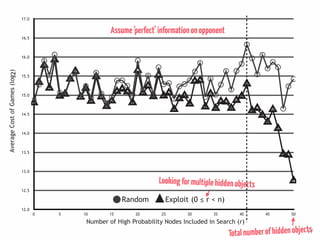
Lookingformultiplehiddenobjects
12.0
12.5
13.0
13.5
14.0
14.5
15.0
15.5
16.0
16.5
17.0
0 5 10 15 20 25 30 35 40 45 50
Number of High Probability Nodes Included in Search (r)
Random Exploit (0 ≤ r < n)
AverageCostofGames(log2)
Assume‘perfect’informationonopponent
Totalnumberofhiddenobjects
17
Lookingformultiplehiddenobjects
12.0
12.5
13.0
13.5
14.0
14.5
15.0
15.5
16.0
16.5
17.0
0 5 10 15 20 25 30 35 40 45 50
Number of High Probability Nodes Included in Search (r)
Random Exploit (0 ≤ r < n)
AverageCostofGames(log2)
Assume‘perfect’informationonopponent
Totalnumberofhiddenobjects
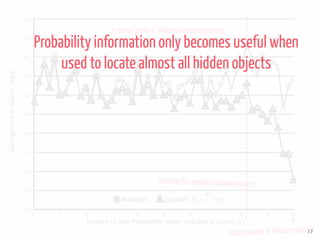
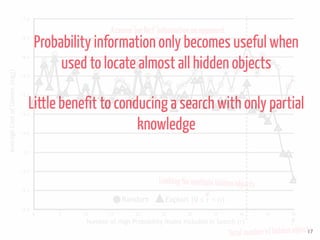
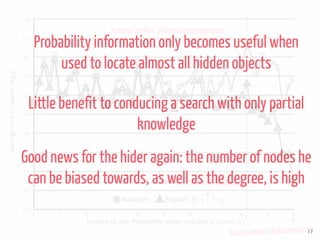
Probability information only becomes useful when
used to locate almost all hidden objects
17
Little benefit to conducing a search with only partial
knowledge
Lookingformultiplehiddenobjects
12.0
12.5
13.0
13.5
14.0
14.5
15.0
15.5
16.0
16.5
17.0
0 5 10 15 20 25 30 35 40 45 50
Number of High Probability Nodes Included in Search (r)
Random Exploit (0 ≤ r < n)
AverageCostofGames(log2)
Assume‘perfect’informationonopponent
Totalnumberofhiddenobjects
Probability information only becomes useful when
used to locate almost all hidden objects
17
Little benefit to conducing a search with only partial
knowledge
Good news for the hider again: the number of nodes he
can be biased towards, as well as the degree, is highLookingformultiplehiddenobjects
12.0
12.5
13.0
13.5
14.0
14.5
15.0
15.5
16.0
16.5
17.0
0 5 10 15 20 25 30 35 40 45 50
Number of High Probability Nodes Included in Search (r)
Random Exploit (0 ≤ r < n)
AverageCostofGames(log2)
Assume‘perfect’informationonopponent
Totalnumberofhiddenobjects
Probability information only becomes useful when
used to locate almost all hidden objects
1. How
hider’s repetitions become exploitable?
2. How many bias nodes need to be included a directed search
to yield maximum performance for the seeker?
3. How should a seeker operate in the face of potential
deception
18
1. How
hider’s repetitions become exploitable?
2. How
to yield maximum performance for the seeker?
3. How should a seeker operate in the face of potential
deceptionon the part of the hider?
18
19
14
15
16
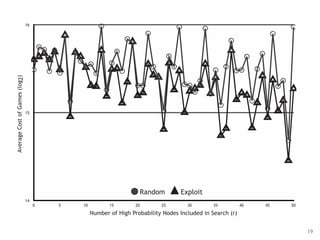
0 5 10 15 20 25 30 35 40 45 50
AverageCostofGames(log2)
Number of High Probability Nodes Included in Search (r)
Random Exploit
19
14
15
16
0 5 10 15 20 25 30 35 40 45 50
AverageCostofGames(log2)
Number of High Probability Nodes Included in Search (r)
Random Exploit
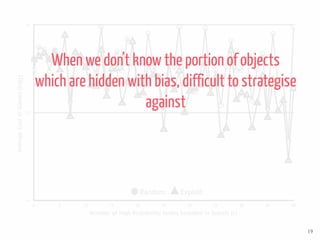
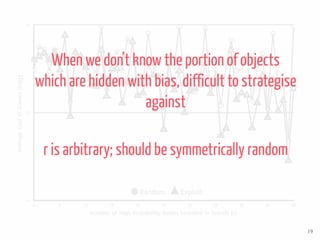
When we don’t know the portion of objects
which are hidden with bias, difficult to strategise
against
19
14
15
16
0 5 10 15 20 25 30 35 40 45 50
AverageCostofGames(log2)
Number of High Probability Nodes Included in Search (r)
Random Exploit
When we don’t know the portion of objects
which are hidden with bias, difficult to strategise
against
r is arbitrary; should be symmetrically random
20
1. Results as heuristics; importance of verification
20
1. Results as heuristics; importance of verification
20
2. Impact of parameters
1. Results as heuristics; importance of verification
20
2. Impact of parameters
3. Importance of data-driven simulation
21
1. The performance of both Hiders and Seekers when
there are a varying number of items to find.
21
1. The performance of both Hiders and Seekers when
there are a varying number of items to find.
21
2. Performance of agents on different topologies (fully
connected, so movement not constrained).
22
1. Hiders who are also constrained by the topology.
22
1. Hiders who are also constrained by the topology.
22
2. ‘Intelligent’ hiders who also track seeker’s
behaviour, if repetitions exist (i.e. start point).
3. Edge by edge probability scores for boththe Seeker
and Hider.
1. Hiders who are also constrained by the topology.
22
2. ‘Intelligent’ hiders who also track seeker’s
behaviour, if repetitions exist (i.e. start point).
23
1. Agents with a ‘strategy portfolio’ who are able to
switch between these strategies on-the-fly.
23
2. Agents with a self-analysis component, allowing
them to judge their own performance, and change
strategy as appropriate.
1. Agents with a ‘strategy portfolio’ who are able to
switch between these strategies on-the-fly.
23
PlayingHide-And-Seek: An Abstract Game for Cyber Security
24
martin.chapman@kcl.ac.uk
www.martin-chapman.com

Playing Hide-and-Seek: An Abstract Game for Cyber Security

  • 1.
    PlayingHide-And-Seek: An AbstractGame for Cyber Security 1 Martin Chapman Gareth Tyson Simon Parsons Michael Luck Peter McBurney
  • 2.
  • 3.
  • 4.
    Issue:The complexity ofresearch at the intersection of ABM and Cyber Security 3
  • 5.
  • 6.
  • 7.
  • 8.
  • 9.
  • 10.
  • 11.
  • 12.
  • 13.
  • 14.
  • 15.
  • 16.
  • 17.
    Claim: A numberof different Cyber Security problems can be abstracted to a simple game of ‘Hide-And-Seek’ 9
  • 18.
    Claim: A numberof different Cyber Security problems can be abstracted to a simple game of ‘Hide-And-Seek’ . . . therefore . . . We are motivated to explore strategies for seeking (and, ultimately, hiding) in this game. 9
  • 19.
    Parameters 1. Topology 2. Numberof nodes 3. Number of hidden objects “Nature” “AgentProperties” ... 10 What is the structure of a H&S game?
  • 20.
    Parameters 1. Topology 2. Numberof nodes 3. Number of hidden objects “Nature” “AgentProperties” ... 10 What is the structure of a H&S game?
  • 21.
    Parameters 1. Topology 2. Numberof nodes 3. Number of hidden objects “Nature” “AgentProperties” ... Network 10
  • 22.
    Parameters 1. Topology 2. Numberof nodes 3. Number of hidden objects “Nature” “AgentProperties” ... Network Hider 10
  • 23.
    Parameters 1. Topology 2. Numberof nodes 3. Number of hidden objects “Nature” “AgentProperties” ... Network Hider Seeker 10
  • 24.
    Parameters 1. Topology 2. Numberof nodes 3. Number of hidden objects “Nature” “AgentProperties” ... Network Hider Seeker 10
  • 25.
    Parameters 1. Topology 2. Numberof nodes 3. Number of hidden objects “Nature” “AgentProperties” ... Hider Seeker 10
  • 26.
    Parameters 1. Topology 2. Numberof nodes 3. Number of hidden objects “Nature” “AgentProperties” ... Hider Seeker 10
  • 27.
    Parameters 1. Topology 2. Numberof nodes 3. Number of hidden objects “Nature” “AgentProperties” ... Hider Seeker 10
  • 28.
    Parameters 1. Topology 2. Numberof nodes 3. Number of hidden objects “Nature” “AgentProperties” ... Hider Seeker 10
  • 29.
    Parameters 1. Topology 2. Numberof nodes 3. Number of hidden objects “Nature” “AgentProperties” ... Hider Seeker 10
  • 30.
    Parameters 1. Topology 2. Numberof nodes 3. Number of hidden objects “Nature” “AgentProperties” ... Seeker 10
  • 31.
    Parameters 1. Topology 2. Numberof nodes 3. Number of hidden objects “Nature” “AgentProperties” ... Hider Seeker 10
  • 32.
    Parameters 1. Topology 2. Numberof nodes 3. Number of hidden objects “Nature” “AgentProperties” ... Assuming no knowledge of an opponent it is intuitive to conceal these objects randomly. Hider Seeker 10
  • 33.
    Parameters 1. Topology 2. Numberof nodes 3. Number of hidden objects “Nature” “AgentProperties” ... In this instance, the best a seeker can do is conduct a random walk. Hider Seeker 10
  • 34.
  • 35.
    Sohowcanwestrategise? In reality, hiders(attackers) are either unable or unwillingto express randomness [Rubinstein, 1999] 11
  • 36.
    Sohowcanwestrategise? In reality, hiders(attackers) are either unable or unwillingto express randomness [Rubinstein, 1999] - Bug’s in code - Human fallibility - Infrastructure constraints - Perceived ‘secrecy’ of locations 11
  • 37.
    Sohowcanwestrategise? In reality, hiders(attackers) are either unable or unwillingto express randomness [Rubinstein, 1999] - Bug’s in code - Human fallibility - Infrastructure constraints - Perceived ‘secrecy’ of locations Repeatbehaviour 11
  • 38.
  • 39.
    Hider Seeker 1 v1 v2v3 2 v5v1 v4 3 v1 v6 v7 v1 v2 v3 v5v1 v4 v1 v6 v7 12
  • 40.
    Hider Seeker 1 v1 v2v3 2 v5v1 v4 3 v1 v6 v7 4 ? v1 v2 v3 v5v1 v4 v1 v6 v7 12
  • 41.
    Hider Seeker 1 v1 v2v3 2 v5v1 v4 3 v1 v6 v7 4 ? v1 v2 v3 v5v1 v4 v1 v6 v7 12
  • 42.
    Hider Seeker 1 v1 v2v3 2 v5v1 v4 3 v1 v6 v7 4 ? v1 v2 v3 v5v1 v4 v1 v6 v7 v1 12
  • 43.
  • 44.
  • 45.
    1. How muchofthis bias needs to be exhibited before a hider’s repetitions become exploitable? 2. How many bias nodes need to be included a directed search to yield maximum performance for the seeker? 3. How should a seeker operate in the face of potential deceptionon the part of the hider? 14
  • 46.
    1. How muchofthis bias needs to be exhibited before a hider’s repetitions become exploitable? 2. How to yield maximum performance for the seeker? 3. How should a seeker operate in the face of potential deception 14
  • 47.
    15‘b’timesmorelikelytoselectanode 8 9 11 12 14 15 0 5 1015 20 25 30 35 40 45 50 55 60 65 70 75 80 85 90 95 Hider Bias (b) Random Exploit (r = 1) AverageCostofGames(log2) Onlylookingforonehiddenobject
  • 48.
    15 Bias does nothave an impact until ~ b = 45 ‘b’timesmorelikelytoselectanode 8 9 11 12 14 15 0 5 10 15 20 25 30 35 40 45 50 55 60 65 70 75 80 85 90 95 Hider Bias (b) Random Exploit (r = 1) AverageCostofGames(log2) Onlylookingforonehiddenobject
  • 49.
    15 Bias does nothave an impact until ~ b = 45 ‘b’timesmorelikelytoselectanode 8 9 11 12 14 15 0 5 10 15 20 25 30 35 40 45 50 55 60 65 70 75 80 85 90 95 Hider Bias (b) Random Exploit (r = 1) AverageCostofGames(log2) Onlylookingforonehiddenobject If it is costly for a Seeker to employ a non-random strategy, does not need to do so below this amount of bias
  • 50.
    15 Bias does nothave an impact until ~ b = 45 ‘b’timesmorelikelytoselectanode 8 9 11 12 14 15 0 5 10 15 20 25 30 35 40 45 50 55 60 65 70 75 80 85 90 95 Hider Bias (b) Random Exploit (r = 1) AverageCostofGames(log2) Onlylookingforonehiddenobject Hider can afford to favour a node significantly before his behaviour becomes exploitable by the seeker If it is costly for a Seeker to employ a non-random strategy, does not need to do so below this amount of bias
  • 51.
    1. How muchofthis bias needs to be exhibited before a hider’s repetitions become exploitable? 2. How to yield maximum performance for the seeker? 3. How should a seeker operate in the face of potential deception 16
  • 52.
    1. How hider’s repetitionsbecome exploitable? 2. How many bias nodes need to be included a directed search to yield maximum performance for the seeker? 3. How should a seeker operate in the face of potential deception 16
  • 53.
    17 Lookingformultiplehiddenobjects 12.0 12.5 13.0 13.5 14.0 14.5 15.0 15.5 16.0 16.5 17.0 0 5 1015 20 25 30 35 40 45 50 Number of High Probability Nodes Included in Search (r) Random Exploit (0 ≤ r < n) AverageCostofGames(log2) Assume‘perfect’informationonopponent Totalnumberofhiddenobjects
  • 54.
    17 Lookingformultiplehiddenobjects 12.0 12.5 13.0 13.5 14.0 14.5 15.0 15.5 16.0 16.5 17.0 0 5 1015 20 25 30 35 40 45 50 Number of High Probability Nodes Included in Search (r) Random Exploit (0 ≤ r < n) AverageCostofGames(log2) Assume‘perfect’informationonopponent Totalnumberofhiddenobjects Probability information only becomes useful when used to locate almost all hidden objects
  • 55.
    17 Little benefit toconducing a search with only partial knowledge Lookingformultiplehiddenobjects 12.0 12.5 13.0 13.5 14.0 14.5 15.0 15.5 16.0 16.5 17.0 0 5 10 15 20 25 30 35 40 45 50 Number of High Probability Nodes Included in Search (r) Random Exploit (0 ≤ r < n) AverageCostofGames(log2) Assume‘perfect’informationonopponent Totalnumberofhiddenobjects Probability information only becomes useful when used to locate almost all hidden objects
  • 56.
    17 Little benefit toconducing a search with only partial knowledge Good news for the hider again: the number of nodes he can be biased towards, as well as the degree, is highLookingformultiplehiddenobjects 12.0 12.5 13.0 13.5 14.0 14.5 15.0 15.5 16.0 16.5 17.0 0 5 10 15 20 25 30 35 40 45 50 Number of High Probability Nodes Included in Search (r) Random Exploit (0 ≤ r < n) AverageCostofGames(log2) Assume‘perfect’informationonopponent Totalnumberofhiddenobjects Probability information only becomes useful when used to locate almost all hidden objects
  • 57.
    1. How hider’s repetitionsbecome exploitable? 2. How many bias nodes need to be included a directed search to yield maximum performance for the seeker? 3. How should a seeker operate in the face of potential deception 18
  • 58.
    1. How hider’s repetitionsbecome exploitable? 2. How to yield maximum performance for the seeker? 3. How should a seeker operate in the face of potential deceptionon the part of the hider? 18
  • 59.
    19 14 15 16 0 5 1015 20 25 30 35 40 45 50 AverageCostofGames(log2) Number of High Probability Nodes Included in Search (r) Random Exploit
  • 60.
    19 14 15 16 0 5 1015 20 25 30 35 40 45 50 AverageCostofGames(log2) Number of High Probability Nodes Included in Search (r) Random Exploit When we don’t know the portion of objects which are hidden with bias, difficult to strategise against
  • 61.
    19 14 15 16 0 5 1015 20 25 30 35 40 45 50 AverageCostofGames(log2) Number of High Probability Nodes Included in Search (r) Random Exploit When we don’t know the portion of objects which are hidden with bias, difficult to strategise against r is arbitrary; should be symmetrically random
  • 62.
  • 63.
    1. Results asheuristics; importance of verification 20
  • 64.
    1. Results asheuristics; importance of verification 20 2. Impact of parameters
  • 65.
    1. Results asheuristics; importance of verification 20 2. Impact of parameters 3. Importance of data-driven simulation
  • 66.
  • 67.
    1. The performanceof both Hiders and Seekers when there are a varying number of items to find. 21
  • 68.
    1. The performanceof both Hiders and Seekers when there are a varying number of items to find. 21 2. Performance of agents on different topologies (fully connected, so movement not constrained).
  • 69.
  • 70.
    1. Hiders whoare also constrained by the topology. 22
  • 71.
    1. Hiders whoare also constrained by the topology. 22 2. ‘Intelligent’ hiders who also track seeker’s behaviour, if repetitions exist (i.e. start point).
  • 72.
    3. Edge byedge probability scores for boththe Seeker and Hider. 1. Hiders who are also constrained by the topology. 22 2. ‘Intelligent’ hiders who also track seeker’s behaviour, if repetitions exist (i.e. start point).
  • 73.
  • 74.
    1. Agents witha ‘strategy portfolio’ who are able to switch between these strategies on-the-fly. 23
  • 75.
    2. Agents witha self-analysis component, allowing them to judge their own performance, and change strategy as appropriate. 1. Agents with a ‘strategy portfolio’ who are able to switch between these strategies on-the-fly. 23
  • 76.
    PlayingHide-And-Seek: An AbstractGame for Cyber Security 24 martin.chapman@kcl.ac.uk www.martin-chapman.com