An Introduction to 
Artificial Intelligence 
An Interpretive Dance Approach 
Seth Juarez 
Analytics Program Manager 
sethj@devexpress.com 
@sethjuarez
overview 
introduction 
• hard vs soft AI 
setting up the problem 
• puzzles, games 
uninformed search 
• bfs, dfs, depth limited 
heuristic search (informed search) 
• heuristic function (triangle inequality) 
• best-first 
• A* 
adversarial search 
• minimax 
• alpha-beta
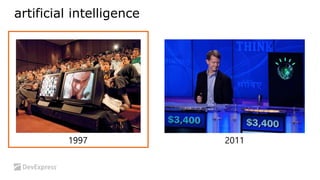
artificial intelligence 
1997 2011
search 
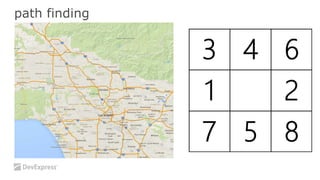
path finding
path finding
search problem 
a well defined problem has 5 components: 
• states – what does our world look like? 
• initial state – where do we start? 
• successor function – where can we go / what can we do? 
• goal test – are we there yet? 
• path cost – how long is this taking?
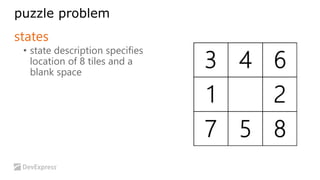
puzzle problem 
states 
• state description specifies 
location of 8 tiles and a 
blank space
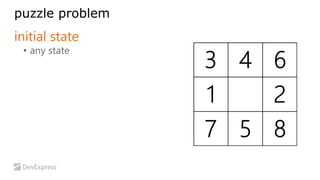
puzzle problem 
initial state 
• any state
puzzle problem 
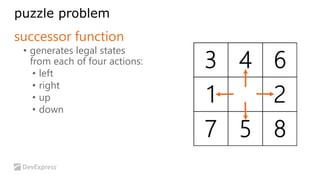
successor function 
• generates legal states 
from each of four actions: 
• left 
• right 
• up 
• down
puzzle problem 
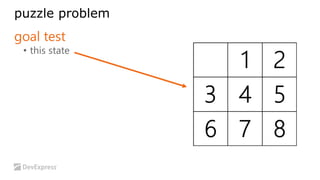
goal test 
• this state
puzzle problem 
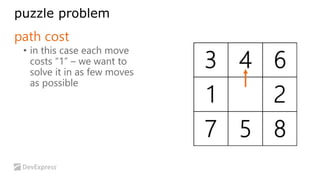
path cost 
• in this case each move 
costs “1” – we want to 
solve it in as few moves 
as possible
uninformed search – exploring the state 
space 
which node do we explore next? 
• breadth first search – fifo queue 
• uniform cost search – priority queue 
• depth first search – lifo queue 
• depth limited search – lifo queue (bounded recursion) 
measuring 
• completeness – will it find a solution if one exists? 
• optimality – will it find the lowest cost path? 
• time complexity – how long will it take? 
• space complexity – how much space does it take?
demo 
uninformed search
informed search 
expand the state space and find a path (but be smarter) 
• using a heuristic function 
• greedy best-first search – pick the one we think is closest 
• A* – pick the one we think will produce the best overall cost
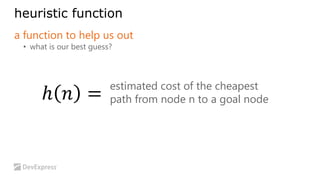
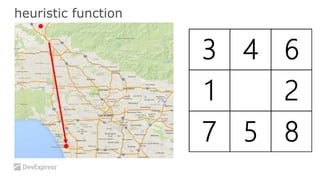
heuristic function 
a function to help us out 
• what is our best guess? 
ℎ 푛 = estimated cost of the cheapest 
path from node n to a goal node
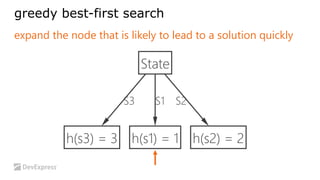
greedy best-first search 
expand the node that is likely to lead to a solution quickly
A* 
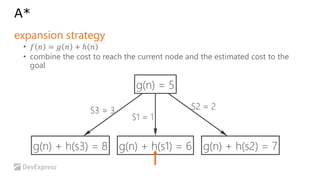
expansion strategy 
• 푓 푛 = 푔 푛 + ℎ 푛 
• combine the cost to reach the current node and the estimated cost to the 
goal
heuristic function 
A* is both complete and optimal… 
• if there is an admissible heuristic function 
• or, provided that h(n) never overestimates the cost to reach the goal 
creating admissible heuristic functions 
• relax the problem
heuristic function
demo 
informed search (A*)
adversarial search 
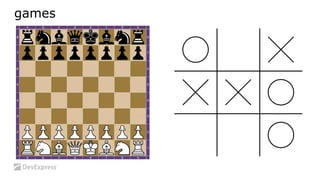
games
games
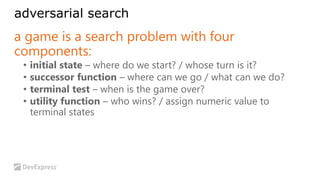
adversarial search 
a game is a search problem with four 
components: 
• initial state – where do we start? / whose turn is it? 
• successor function – where can we go / what can we do? 
• terminal test – when is the game over? 
• utility function – who wins? / assign numeric value to 
terminal states
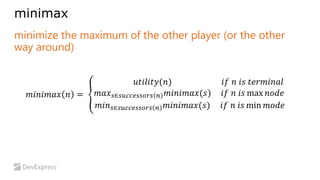
minimax 
minimize the maximum of the other player (or the other 
way around) 
푚푖푛푖푚푎푥 푛 = 
푢푡푖푙푖푡푦(푛) 푖푓 푛 푖푠 푡푒푟푚푖푛푎푙 
푚푎푥푠∈푠푢푐푐푒푠푠표푟푠 푛 푚푖푛푖푚푎푥(푠) 푖푓 푛 푖푠 max 푛표푑푒 
푚푖푛푠∈푠푢푐푐푒푠푠표푟푠 푛 푚푖푛푖푚푎푥(푠) 푖푓 푛 푖푠 min 푚표푑푒
minimax demo 
tic-tac-toe
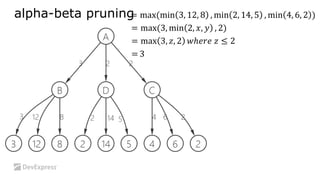
alpha-beta pruning= max(min 3, 12, 8 , min 2, 14, 5 , min 4, 6, 2 ) 
= max(3, min 2, 푥, 푦 , 2) 
= max 3, 푧, 2 푤ℎ푒푟푒 푧 ≤ 2 
= 3
alpha-beta pruning 
intuition 
• if we have a choice, always take the best outcome the earliest 
possible 
• we can remove consideration of the other nodes
alpha-beta demo 
tic-tac-toe
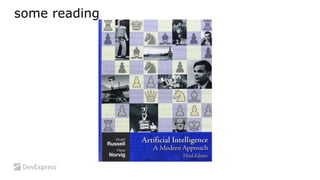
some reading
questions? 
sethj@devexpress.com 
@sethjuarez

An Introduction to Artificial Intelligence

  • 1.
    An Introduction to Artificial Intelligence An Interpretive Dance Approach Seth Juarez Analytics Program Manager sethj@devexpress.com @sethjuarez
  • 3.
    overview introduction •hard vs soft AI setting up the problem • puzzles, games uninformed search • bfs, dfs, depth limited heuristic search (informed search) • heuristic function (triangle inequality) • best-first • A* adversarial search • minimax • alpha-beta
  • 4.
  • 5.
  • 6.
  • 7.
    search problem awell defined problem has 5 components: • states – what does our world look like? • initial state – where do we start? • successor function – where can we go / what can we do? • goal test – are we there yet? • path cost – how long is this taking?
  • 8.
    puzzle problem states • state description specifies location of 8 tiles and a blank space
  • 9.
    puzzle problem initialstate • any state
  • 10.
    puzzle problem successorfunction • generates legal states from each of four actions: • left • right • up • down
  • 11.
    puzzle problem goaltest • this state
  • 12.
    puzzle problem pathcost • in this case each move costs “1” – we want to solve it in as few moves as possible
  • 13.
    uninformed search –exploring the state space which node do we explore next? • breadth first search – fifo queue • uniform cost search – priority queue • depth first search – lifo queue • depth limited search – lifo queue (bounded recursion) measuring • completeness – will it find a solution if one exists? • optimality – will it find the lowest cost path? • time complexity – how long will it take? • space complexity – how much space does it take?
  • 14.
  • 15.
    informed search expandthe state space and find a path (but be smarter) • using a heuristic function • greedy best-first search – pick the one we think is closest • A* – pick the one we think will produce the best overall cost
  • 16.
    heuristic function afunction to help us out • what is our best guess? ℎ 푛 = estimated cost of the cheapest path from node n to a goal node
  • 17.
    greedy best-first search expand the node that is likely to lead to a solution quickly
  • 18.
    A* expansion strategy • 푓 푛 = 푔 푛 + ℎ 푛 • combine the cost to reach the current node and the estimated cost to the goal
  • 19.
    heuristic function A*is both complete and optimal… • if there is an admissible heuristic function • or, provided that h(n) never overestimates the cost to reach the goal creating admissible heuristic functions • relax the problem
  • 20.
  • 21.
  • 22.
  • 23.
  • 24.
    adversarial search agame is a search problem with four components: • initial state – where do we start? / whose turn is it? • successor function – where can we go / what can we do? • terminal test – when is the game over? • utility function – who wins? / assign numeric value to terminal states
  • 25.
    minimax minimize themaximum of the other player (or the other way around) 푚푖푛푖푚푎푥 푛 = 푢푡푖푙푖푡푦(푛) 푖푓 푛 푖푠 푡푒푟푚푖푛푎푙 푚푎푥푠∈푠푢푐푐푒푠푠표푟푠 푛 푚푖푛푖푚푎푥(푠) 푖푓 푛 푖푠 max 푛표푑푒 푚푖푛푠∈푠푢푐푐푒푠푠표푟푠 푛 푚푖푛푖푚푎푥(푠) 푖푓 푛 푖푠 min 푚표푑푒
  • 26.
  • 27.
    alpha-beta pruning= max(min3, 12, 8 , min 2, 14, 5 , min 4, 6, 2 ) = max(3, min 2, 푥, 푦 , 2) = max 3, 푧, 2 푤ℎ푒푟푒 푧 ≤ 2 = 3
  • 28.
    alpha-beta pruning intuition • if we have a choice, always take the best outcome the earliest possible • we can remove consideration of the other nodes
  • 29.
  • 30.
  • 31.

Editor's Notes

  • #14 bfs – complete, optimal if non-decreasing function in depth of the node (if the shallowest node is not the optimal one, all bets are off) ucs – same as above dfs – complete (maybe…), not optimal if it starts down a suboptimal path, dls – complete if correct depth (or correct assessment of problem diameter), optimal - maybe
  • #18 resembles depth first not optimal not complete
  • #19 complete and optimal if the heuristic function is admissible