Play & Pedagogical Documentation
28-Mar-11CHCPR14B CHCPR9C & CHCPR10CCHCPR14BObserve Children andInterpret ObservationsCHCPR9CDocument, Interpret andUse Information About ChildrenCHCPR10CDesign, Implement AndEvaluate Programs Of The Service
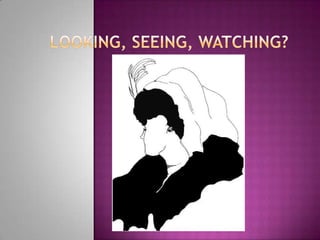
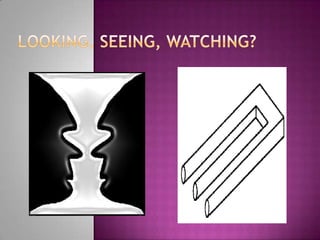
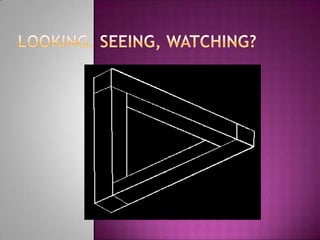
Looking, Seeing, Watching?
Looking, Seeing, Watching?What does observing mean to you?What purpose does it serve?How well do you know the people or situations you have observed?28-Mar-11CHCPR14B CHCPR9C & CHCPR10C
Looking, Seeing, Watching?What are some of the difficulties that arise when observing?How might you overcome these?What can you do to assist, extend or resolve the situations you have observed?28-Mar-11CHCPR14B CHCPR9C & CHCPR10C
Looking, Seeing, Watching?Own observations of children are significant, valid and	conciseInterpretations of behaviour, needs and interests are	clearly linked to evidence in observationsThe intensity/detail of the observation is appropriate to the purpose and the contextInterpretations of observations demonstrate inclusive	principles and understanding28-Mar-11CHCPR14B CHCPR9C & CHCPR10C
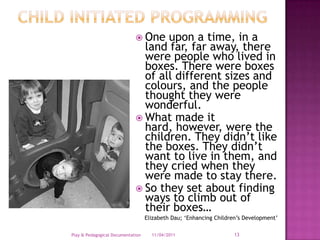
Child Initiated ProgrammingOne upon a time, in a land far, far away, there were people who lived in boxes. There were boxes of all different sizes and colours, and the people thought they were wonderful. What made it hard, however, were the children. They didn’t like the boxes. They didn’t want to live in them, and they cried when they were made to stay there. So they set about finding ways to climb out of their boxes…Elizabeth Dau; ‘Enhancing Children’s Development’28/03/2011Play & Pedagogical Documentation13
Child Initiated ProgrammingEducators responsibility Reliance and Comfort IdentityQuestionExploreRethink28/03/2011Play & Pedagogical Documentation14
Confucius‘To Hear is to forget	To see is to remember	To do is to understand’1960’s – Two important changesFocus from teacher to the childFocus from teaching to learning28/03/2011Play & Pedagogical Documentation15
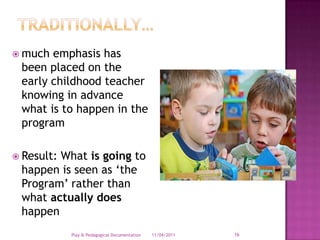
TRADITIONALLY…much emphasis has been placed on the early childhood teacher knowing in advance what is to happen in the program Result: What is going to happen is seen as ‘the Program’ rather than what actually does happen28/03/2011Play & Pedagogical Documentation16
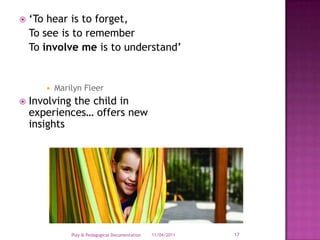
‘To hear is to forget,	To see is to remember	To involve me is to understand’Marilyn FleerInvolving the child in experiences… offers new insights28/03/2011Play & Pedagogical Documentation17
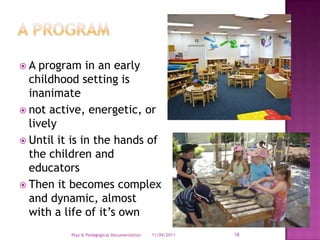
A programA program in an early childhood setting is inanimate not active, energetic, or livelyUntil it is in the hands of the children and educatorsThen it becomes complex and dynamic, almost with a life of it’s own28/03/2011Play & Pedagogical Documentation18
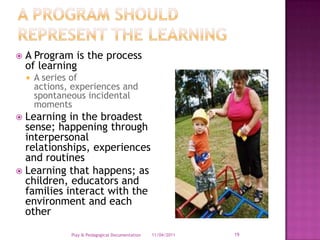
A program should represent the learningA Program is the process of learningA series of actions, experiences and spontaneous incidental momentsLearning in the broadest sense; happening through interpersonal relationships, experiences and routinesLearning that happens; as children, educators and families interact with the environment and each other28/03/2011Play & Pedagogical Documentation19
What do we really want?The starting point for educators must be:What Do We Want For Children?To continue struggling to be free of the boxes                 or to have guided and meaningful opportunities to explore their world at their pace, linked to their interests along with supporting and progressing their current level of development28/03/2011Play & Pedagogical Documentation20
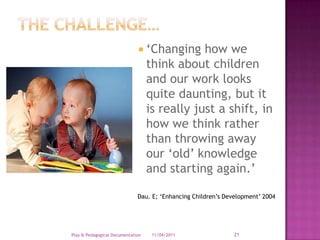
‘Changing how we think about children and our work looks quite daunting, but it is really just a shift, in how we think rather than throwing away our ‘old’ knowledge and starting again.’Dau. E; ‘Enhancing Children’s Development’ 200428/03/2011Play & Pedagogical Documentation21The challenge…
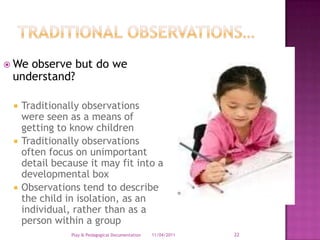
Traditional observations…We observe but do we understand?Traditionally observations were seen as a means of getting to know childrenTraditionally observations often focus on unimportant detail because it may fit into a developmental boxObservations tend to describe the child in isolation, as an individual, rather than as a person within a group28/03/2011Play & Pedagogical Documentation22
Or…Alternatively we can watch children with the intention of understanding what interests them and support them beyond the boxMoving away from traditional methods of observation enables us to see children working in a social setting and the complex interrelationships they have with other children and staff28/03/2011Play & Pedagogical Documentation23
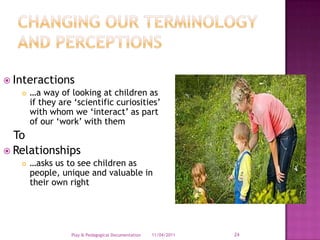
Changing our terminology and perceptions Interactions…a way of looking at children as if they are ‘scientific curiosities’ with whom we ‘interact’ as part of our ‘work’ with them   ToRelationships…asks us to see children as people, unique and valuable in their own right28/03/2011Play & Pedagogical Documentation24
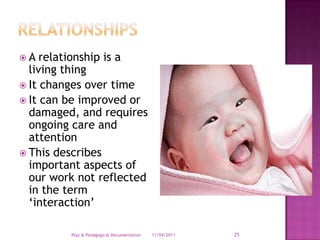
RelationshipsA relationship is a living thingIt changes over timeIt can be improved or damaged, and requires ongoing care and attentionThis describes important aspects of our work not reflected in the term ‘interaction’28/03/2011Play & Pedagogical Documentation25
The whole childAs suggested previouslyTraditional methods of observation and recording, break the child up into a series of boxesThe names and numbers of these boxes variesThey range through physical, intellectual, emotional and social development Add to the mix creativity, language or communicationFragmenting children inhibits our ability to see children as a whole 28/03/2011Play & Pedagogical Documentation26
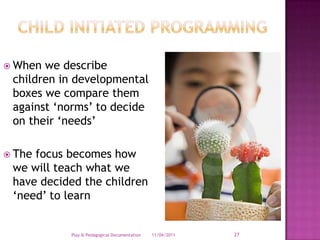
Child Initiated ProgrammingWhen we describe children in developmental boxes we compare them against ‘norms’ to decide on their ‘needs’The focus becomes how we will teach what we have decided the children ‘need’ to learn28/03/2011Play & Pedagogical Documentation27
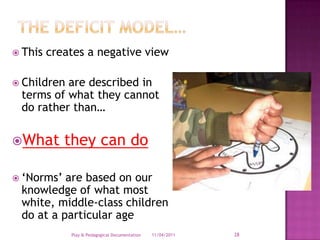
The deficit model…This creates a negative viewChildren are described in terms of what they cannot do rather than…What they can do‘Norms’ are based on our knowledge of what most white, middle-class children do at a particular age28/03/2011Play & Pedagogical Documentation28
Doesn’t consider genderDoesn’t consider cultural differences even with in white middle-classDoesn’t account for huge variations in the times children learn particular skillsDoesn’t account for children sitting above or below the ‘norm’28/03/2011Play & Pedagogical Documentation29Limitations
Hhhmmmm?How do we resolve this conundrum? How do we work with those who sit outside the norm?28/03/2011Play & Pedagogical Documentation30
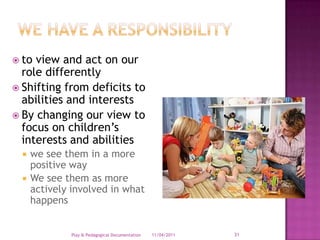
to view and act on our role differentlyShifting from deficits to abilities and interestsBy changing our view to focus on children’s interests and abilitieswe see them in a more positive wayWe see them as more actively involved in what happens28/03/2011Play & Pedagogical Documentation31We have a responsibility
Child Initiated ProgrammingWe are able to see children being involved in the construction of their own understandings of the worldWe respect the knowledge that children enter our worlds withIf we do all  this we are in a far better position to help their learning through the program28/03/2011Play & Pedagogical Documentation32

Play and pedagogical_documentation

  • 1.
    Play & PedagogicalDocumentation
  • 2.
    28-Mar-11CHCPR14B CHCPR9C &CHCPR10CCHCPR14BObserve Children andInterpret ObservationsCHCPR9CDocument, Interpret andUse Information About ChildrenCHCPR10CDesign, Implement AndEvaluate Programs Of The Service
  • 3.
  • 4.
  • 5.
  • 10.
    Looking, Seeing, Watching?Whatdoes observing mean to you?What purpose does it serve?How well do you know the people or situations you have observed?28-Mar-11CHCPR14B CHCPR9C & CHCPR10C
  • 11.
    Looking, Seeing, Watching?Whatare some of the difficulties that arise when observing?How might you overcome these?What can you do to assist, extend or resolve the situations you have observed?28-Mar-11CHCPR14B CHCPR9C & CHCPR10C
  • 12.
    Looking, Seeing, Watching?Ownobservations of children are significant, valid and conciseInterpretations of behaviour, needs and interests are clearly linked to evidence in observationsThe intensity/detail of the observation is appropriate to the purpose and the contextInterpretations of observations demonstrate inclusive principles and understanding28-Mar-11CHCPR14B CHCPR9C & CHCPR10C
  • 13.
    Child Initiated ProgrammingOneupon a time, in a land far, far away, there were people who lived in boxes. There were boxes of all different sizes and colours, and the people thought they were wonderful. What made it hard, however, were the children. They didn’t like the boxes. They didn’t want to live in them, and they cried when they were made to stay there. So they set about finding ways to climb out of their boxes…Elizabeth Dau; ‘Enhancing Children’s Development’28/03/2011Play & Pedagogical Documentation13
  • 14.
    Child Initiated ProgrammingEducatorsresponsibility Reliance and Comfort IdentityQuestionExploreRethink28/03/2011Play & Pedagogical Documentation14
  • 15.
    Confucius‘To Hear isto forget To see is to remember To do is to understand’1960’s – Two important changesFocus from teacher to the childFocus from teaching to learning28/03/2011Play & Pedagogical Documentation15
  • 16.
    TRADITIONALLY…much emphasis hasbeen placed on the early childhood teacher knowing in advance what is to happen in the program Result: What is going to happen is seen as ‘the Program’ rather than what actually does happen28/03/2011Play & Pedagogical Documentation16
  • 17.
    ‘To hear isto forget, To see is to remember To involve me is to understand’Marilyn FleerInvolving the child in experiences… offers new insights28/03/2011Play & Pedagogical Documentation17
  • 18.
    A programA programin an early childhood setting is inanimate not active, energetic, or livelyUntil it is in the hands of the children and educatorsThen it becomes complex and dynamic, almost with a life of it’s own28/03/2011Play & Pedagogical Documentation18
  • 19.
    A program shouldrepresent the learningA Program is the process of learningA series of actions, experiences and spontaneous incidental momentsLearning in the broadest sense; happening through interpersonal relationships, experiences and routinesLearning that happens; as children, educators and families interact with the environment and each other28/03/2011Play & Pedagogical Documentation19
  • 20.
    What do wereally want?The starting point for educators must be:What Do We Want For Children?To continue struggling to be free of the boxes or to have guided and meaningful opportunities to explore their world at their pace, linked to their interests along with supporting and progressing their current level of development28/03/2011Play & Pedagogical Documentation20
  • 21.
    ‘Changing how wethink about children and our work looks quite daunting, but it is really just a shift, in how we think rather than throwing away our ‘old’ knowledge and starting again.’Dau. E; ‘Enhancing Children’s Development’ 200428/03/2011Play & Pedagogical Documentation21The challenge…
  • 22.
    Traditional observations…We observebut do we understand?Traditionally observations were seen as a means of getting to know childrenTraditionally observations often focus on unimportant detail because it may fit into a developmental boxObservations tend to describe the child in isolation, as an individual, rather than as a person within a group28/03/2011Play & Pedagogical Documentation22
  • 23.
    Or…Alternatively we canwatch children with the intention of understanding what interests them and support them beyond the boxMoving away from traditional methods of observation enables us to see children working in a social setting and the complex interrelationships they have with other children and staff28/03/2011Play & Pedagogical Documentation23
  • 24.
    Changing our terminologyand perceptions Interactions…a way of looking at children as if they are ‘scientific curiosities’ with whom we ‘interact’ as part of our ‘work’ with them ToRelationships…asks us to see children as people, unique and valuable in their own right28/03/2011Play & Pedagogical Documentation24
  • 25.
    RelationshipsA relationship isa living thingIt changes over timeIt can be improved or damaged, and requires ongoing care and attentionThis describes important aspects of our work not reflected in the term ‘interaction’28/03/2011Play & Pedagogical Documentation25
  • 26.
    The whole childAssuggested previouslyTraditional methods of observation and recording, break the child up into a series of boxesThe names and numbers of these boxes variesThey range through physical, intellectual, emotional and social development Add to the mix creativity, language or communicationFragmenting children inhibits our ability to see children as a whole 28/03/2011Play & Pedagogical Documentation26
  • 27.
    Child Initiated ProgrammingWhenwe describe children in developmental boxes we compare them against ‘norms’ to decide on their ‘needs’The focus becomes how we will teach what we have decided the children ‘need’ to learn28/03/2011Play & Pedagogical Documentation27
  • 28.
    The deficit model…Thiscreates a negative viewChildren are described in terms of what they cannot do rather than…What they can do‘Norms’ are based on our knowledge of what most white, middle-class children do at a particular age28/03/2011Play & Pedagogical Documentation28
  • 29.
    Doesn’t consider genderDoesn’tconsider cultural differences even with in white middle-classDoesn’t account for huge variations in the times children learn particular skillsDoesn’t account for children sitting above or below the ‘norm’28/03/2011Play & Pedagogical Documentation29Limitations
  • 30.
    Hhhmmmm?How do weresolve this conundrum? How do we work with those who sit outside the norm?28/03/2011Play & Pedagogical Documentation30
  • 31.
    to view andact on our role differentlyShifting from deficits to abilities and interestsBy changing our view to focus on children’s interests and abilitieswe see them in a more positive wayWe see them as more actively involved in what happens28/03/2011Play & Pedagogical Documentation31We have a responsibility
  • 32.
    Child Initiated ProgrammingWeare able to see children being involved in the construction of their own understandings of the worldWe respect the knowledge that children enter our worlds withIf we do all this we are in a far better position to help their learning through the program28/03/2011Play & Pedagogical Documentation32