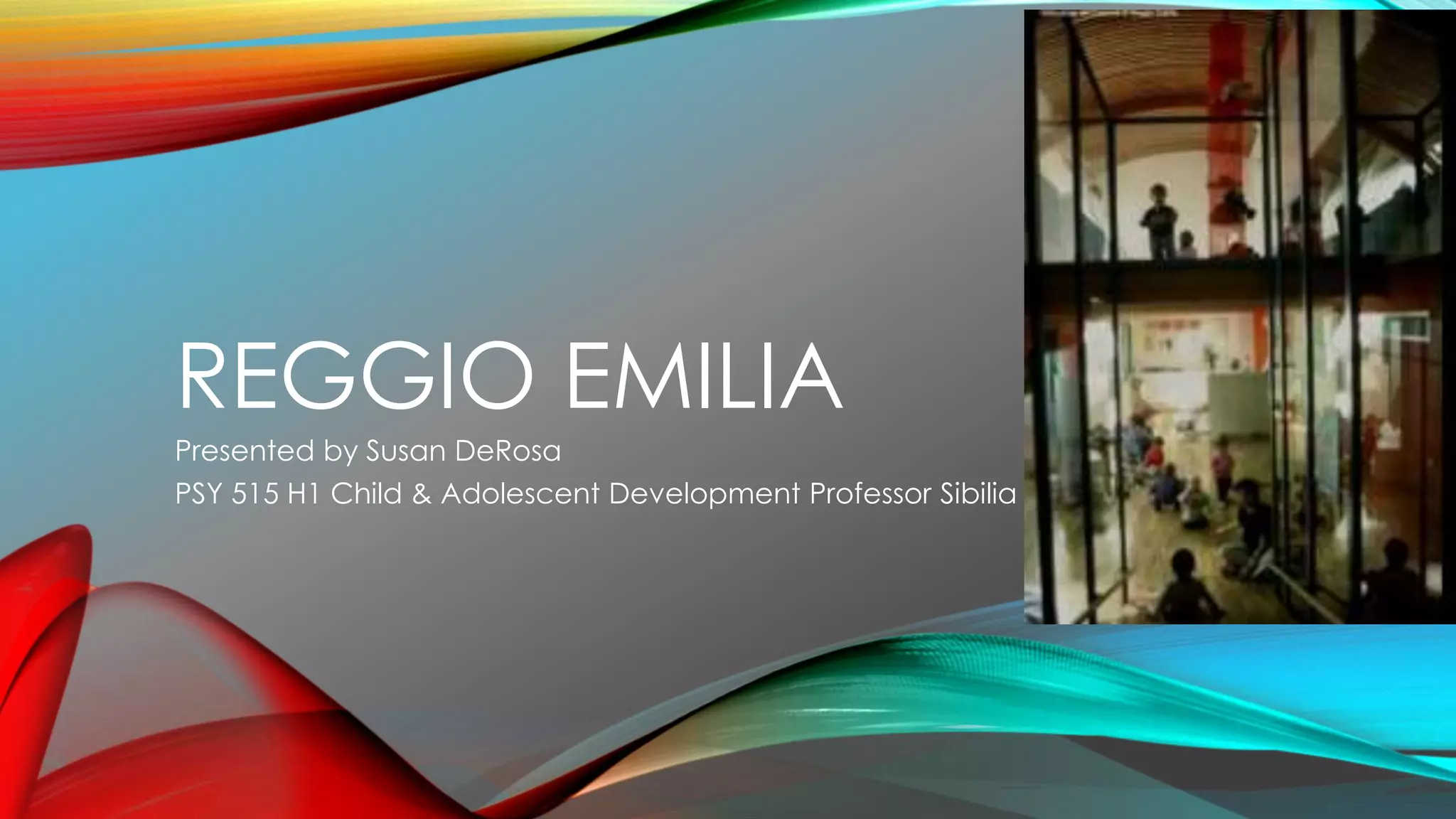
REGGIO EMILIA
Presented by Susan DeRosa
PSY 515 H1 Child & Adolescent Development Professor Sibilia
HISTORY
• Founded in Reggio Emilia, Italy after WWII
• Developed by Loris Malaguzzi an area
teacher who assisted and guided parents
with his constructivist philosophy as the
school was established.
• Early Childhood Education Focus (0-6 y/o)
• An Approach, not a model
• Content Specific
“They [children] are autonomously capable of
making meaning from their daily life
experiences through mental acts involving
planning, coordination of ideas, and
abstraction.... The central act of adults,
therefore, is to activate, especially indirectly,
the meaning-making competencies of children
as a basis of all learning. They must try to
capture the right moments, and then find the
right approaches, for bringing together, into a
fruitful dialogue, their meanings and
interpretations with those children.”
REGGIO EMILIA 8 PRINCIPLES
1. The image of the child: all children have potential, construct their own learning
and are capable.
2. Community and system: children, family, teachers, parents, and community are
interactive and work together.
3. Interest in environment and beauty: school and classrooms are beautiful places
4. Collaboration by teachers: team, partners, working together, sharing
information, sharing in projects.
5. Time not set by clock: respect for children’s pace, time table, stay with teachers
for several years, and relationships remain constant
6. Emergent curriculum/projects: child-centered, following their interest, returning
again and again to add new insights.
7. Environmental stimulation: encourages activity, involvement, discovery, and
using a variety of media.
8. Documentation: observing, recording, thinking and showing children’s learning.
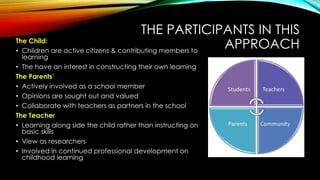
THE PARTICIPANTS IN THIS
APPROACHThe Child:
• Children are active citizens & contributing members to
learning
• The have an interest in constructing their own learning
The Parents’
• Actively involved as a school member
• Opinions are sought out and valued
• Collaborate with teachers as partners in the school
The Teacher
• Learning along side the child rather than instructing on
basic skills
• View as researchers
• Involved in continued professional development on
childhood learning
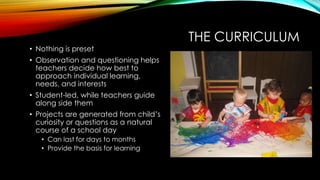
THE CURRICULUM
• Nothing is preset
• Observation and questioning helps
teachers decide how best to
approach individual learning,
needs, and interests
• Student-led, while teachers guide
along side them
• Projects are generated from child’s
curiosity or questions as a natural
course of a school day
• Can last for days to months
• Provide the basis for learning
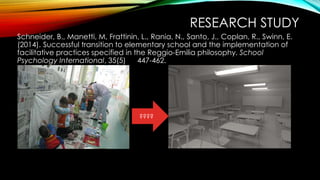
RESEARCH STUDY
Schneider, B., Manetti, M, Frattinin, L., Rania, N., Santo, J., Coplan, R., Swinn, E.
(2014). Successful transition to elementary school and the implementation of
facilitative practices specified in the Reggio-Emilia philosophy. School
Psychology International, 35(5) 447-462.
????
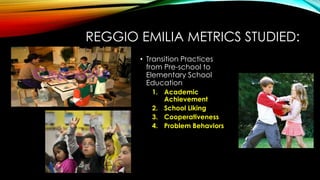
REGGIO EMILIA METRICS STUDIED:
• Transition Practices
from Pre-school to
Elementary School
Education
1. Academic
Achievement
2. School Liking
3. Cooperativeness
4. Problem Behaviors
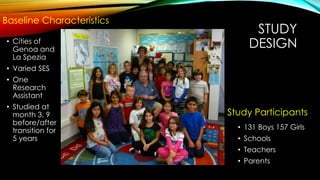
STUDY
DESIGN
Baseline Characteristics
• Cities of
Genoa and
La Spezia
• Varied SES
• One
Research
Assistant
• Studied at
month 3, 9
before/after
transition for
5 years
Study Participants
• 131 Boys 157 Girls
• Schools
• Teachers
• Parents
RESULTS
Metric1:Academic Achievement
• Significantly decreased year one
• Increased year two
• Overall not statistically significant by
year 5
Metric 2: School Liking
• Pupil rated: no significant effect
• Teacher school liking decreased year 1
and year 2
• Girls higher rated vs. boys
• High implementation schools- higher
school liking in year 2
• Medium implementation schools-lowered
in year 2
• Low Implementation schools-decreased
over transitioned
• No significant differences by year 5
RESULTSMetric 3: Cooperativeness
• Significant increases over first year and
continued into the second
• Degree of mother’s education
correlated to drop in cooperativeness
during transition
• Girls showed higher cooperativeness
than boys
• Between school variation significantly
associated with cooperativeness
Metric 4: Problem Behavior
• Significant decrease in year one
• Mother’s education level negatively
correlated to increased problem
behavior
• School level of implementation directly
correlated to increased problem
behavior
• Low=greatest problem behavior
• Middle= less than low schools
• High= significantly less than middle
CONCLUSION
• The degree of implementation of REA transition
strategies were directly associated with better
adjustment after transition from preschool to
elementary school.
• There were startling differences in how REA schools
approached transition practices.
• Even though Italy mandates facilitation of school
transition practices, there is a great deal of latitude in
how schools should execute practices.
• This study further supports the importance of placing
systematic, effective procedures in place to facilitate
school transitions.
• More studies are needed to identify which interventions
have the greatest potential for success.
• School psychologists are encouraged to facilitate
transition practices with the student, parents, teachers
and school; especially for those students at risk for
unsuccessful transition.

ReggioEmeliaApproach_DeRosa_Slidesl

  • 1.
    REGGIO EMILIA Presented bySusan DeRosa PSY 515 H1 Child & Adolescent Development Professor Sibilia
  • 2.
    HISTORY • Founded inReggio Emilia, Italy after WWII • Developed by Loris Malaguzzi an area teacher who assisted and guided parents with his constructivist philosophy as the school was established. • Early Childhood Education Focus (0-6 y/o) • An Approach, not a model • Content Specific “They [children] are autonomously capable of making meaning from their daily life experiences through mental acts involving planning, coordination of ideas, and abstraction.... The central act of adults, therefore, is to activate, especially indirectly, the meaning-making competencies of children as a basis of all learning. They must try to capture the right moments, and then find the right approaches, for bringing together, into a fruitful dialogue, their meanings and interpretations with those children.”
  • 3.
    REGGIO EMILIA 8PRINCIPLES 1. The image of the child: all children have potential, construct their own learning and are capable. 2. Community and system: children, family, teachers, parents, and community are interactive and work together. 3. Interest in environment and beauty: school and classrooms are beautiful places 4. Collaboration by teachers: team, partners, working together, sharing information, sharing in projects. 5. Time not set by clock: respect for children’s pace, time table, stay with teachers for several years, and relationships remain constant 6. Emergent curriculum/projects: child-centered, following their interest, returning again and again to add new insights. 7. Environmental stimulation: encourages activity, involvement, discovery, and using a variety of media. 8. Documentation: observing, recording, thinking and showing children’s learning.
  • 4.
    THE PARTICIPANTS INTHIS APPROACHThe Child: • Children are active citizens & contributing members to learning • The have an interest in constructing their own learning The Parents’ • Actively involved as a school member • Opinions are sought out and valued • Collaborate with teachers as partners in the school The Teacher • Learning along side the child rather than instructing on basic skills • View as researchers • Involved in continued professional development on childhood learning
  • 5.
    THE CURRICULUM • Nothingis preset • Observation and questioning helps teachers decide how best to approach individual learning, needs, and interests • Student-led, while teachers guide along side them • Projects are generated from child’s curiosity or questions as a natural course of a school day • Can last for days to months • Provide the basis for learning
  • 6.
    RESEARCH STUDY Schneider, B.,Manetti, M, Frattinin, L., Rania, N., Santo, J., Coplan, R., Swinn, E. (2014). Successful transition to elementary school and the implementation of facilitative practices specified in the Reggio-Emilia philosophy. School Psychology International, 35(5) 447-462. ????
  • 7.
    REGGIO EMILIA METRICSSTUDIED: • Transition Practices from Pre-school to Elementary School Education 1. Academic Achievement 2. School Liking 3. Cooperativeness 4. Problem Behaviors
  • 8.
    STUDY DESIGN Baseline Characteristics • Citiesof Genoa and La Spezia • Varied SES • One Research Assistant • Studied at month 3, 9 before/after transition for 5 years Study Participants • 131 Boys 157 Girls • Schools • Teachers • Parents
  • 9.
    RESULTS Metric1:Academic Achievement • Significantlydecreased year one • Increased year two • Overall not statistically significant by year 5 Metric 2: School Liking • Pupil rated: no significant effect • Teacher school liking decreased year 1 and year 2 • Girls higher rated vs. boys • High implementation schools- higher school liking in year 2 • Medium implementation schools-lowered in year 2 • Low Implementation schools-decreased over transitioned • No significant differences by year 5
  • 10.
    RESULTSMetric 3: Cooperativeness •Significant increases over first year and continued into the second • Degree of mother’s education correlated to drop in cooperativeness during transition • Girls showed higher cooperativeness than boys • Between school variation significantly associated with cooperativeness Metric 4: Problem Behavior • Significant decrease in year one • Mother’s education level negatively correlated to increased problem behavior • School level of implementation directly correlated to increased problem behavior • Low=greatest problem behavior • Middle= less than low schools • High= significantly less than middle
  • 11.
    CONCLUSION • The degreeof implementation of REA transition strategies were directly associated with better adjustment after transition from preschool to elementary school. • There were startling differences in how REA schools approached transition practices. • Even though Italy mandates facilitation of school transition practices, there is a great deal of latitude in how schools should execute practices. • This study further supports the importance of placing systematic, effective procedures in place to facilitate school transitions. • More studies are needed to identify which interventions have the greatest potential for success. • School psychologists are encouraged to facilitate transition practices with the student, parents, teachers and school; especially for those students at risk for unsuccessful transition.