PLATFORMS FOR SMART
ECONOMIC GROWTH
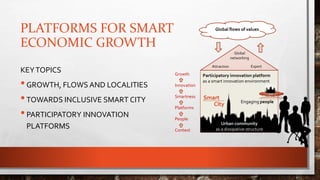
KEYTOPICS
•GROWTH, FLOWS AND LOCALITIES
•TOWARDS INCLUSIVE SMART CITY
•PARTICIPATORY INNOVATION
PLATFORMS
Global flows of values
Global
networking
Attraction Export
Participatory innovation platform
as a smart innovation environment
Engaging people
Growth
Innovation
Smartness
Platforms
People
Context
Urban community
as a dissipative structure
Smart
City
FACTORS
AFFECTING
ECONOMIC
GROWTH
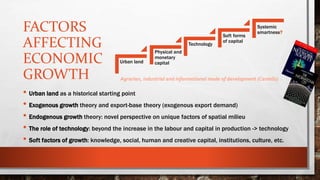
• Urban land as a historical starting point
• Exogenous growth theory and export-base theory (exogenous export demand)
• Endogenous growth theory: novel perspective on unique factors of spatial milieu
• The role of technology: beyond the increase in the labour and capital in production -> technology
• Soft factors of growth: knowledge, social, human and creative capital, institutions, culture, etc.
Urban land
Physical and
monetary
capital
Technology
Soft forms
of capital
Systemic
smartness?
Agrarian, industrial and informational mode of development (Castells)
GLOBAL FLOWS OF VALUES
Source: Manyika et al. 2014. Global flows in a digital age. McKinsey Global Institute (MGI).
Business
Public
Civic
Frictional human and material flows
Frictionless flows
Local attraction and value-
generation processes (city
as a dissipative structure)
Production sphereConsumption sphere
Cultural
values
Knowledge
Innovation
Technology
Know-how
Capital
FDIs
BUSINESS
CONSUMERS SOFT FACTORS
HARD FACTORS
Global markets
CITY
Natural resources
Technology
Capital
Labour
Knowledge
Creativity
Entrepreneurship
Social capital
Shopping
Fashion
Sports
Culture
Tourism
Education
Innovation milieux
Business services
Fairs
Logistics
PC
Irreducible
services
Online
services
Goods and
materials
Enterpreneurs
Business travelers
Professionals
Public authorities
Tourists
Hybrid
services
Productive
actor and
institution
flows
Talent
Labor
Raw materials
Intermediate goods
Exports Imports
Client
flows
Firms
Students
Immigration
Local leadership / Governance / Policies
Community characteristics
Urban design
Logistics
Fairs
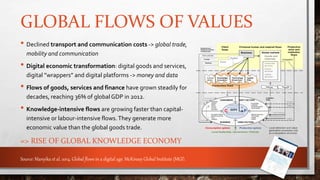
• Declined transport and communication costs -> global trade,
mobility and communication
• Digital economic transformation: digital goods and services,
digital ”wrappers” and digital platforms -> money and data
• Flows of goods, services and finance have grown steadily for
decades, reaching 36% of global GDP in 2012.
• Knowledge-intensive flows are growing faster than capital-
intensive or labour-intensive flows.They generate more
economic value than the global goods trade.
=> RISE OF GLOBAL KNOWLEDGE ECONOMY
LOCALITY AS A DISSIPATIVE
STRUCTURE
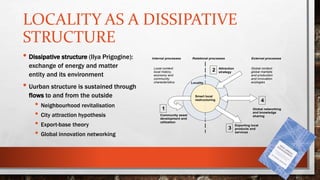
• Dissipative structure (Ilya Prigogine):
exchange of energy and matter
entity and its environment
• Uurban structure is sustained through
flows to and from the outside
• Neighbourhood revitalisation
• City attraction hypothesis
• Export-base theory
• Global innovation networking
1
3
2
4
Internal processes External processes
Smart local
restructuring
Locality
Community asset
development and
utilization
Exporting local
products and
services
Attraction
strategy
Global networking
and knowledge
sharing
Global context:
global markets
and production
and innovation
ecologies
Relational processes
Local context:
local history,
economy and
community
characteristics
SMART URBAN RESPONSE
TO THE CHALLENGES OF A DIGITAL AGE
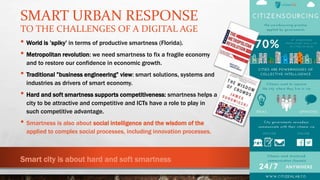
• World is ’spiky’ in terms of productive smartness (Florida).
• Metropolitan revolution: we need smartness to fix a fragile economy
and to restore our confidence in economic growth.
• Traditional ”business engineering” view: smart solutions, systems and
industries as drivers of smart economy.
• Hard and soft smartness supports competitiveness: smartness helps a
city to be attractive and competitive and ICTs have a role to play in
such competitive advantage.
• Smartness is also about social intelligence and the wisdom of the
applied to complex social processes, including innovation processes.
Smart city is about hard and soft smartness
SMART CITY AS A LOCUS OF
ECONOMIC DEVELOPMENT
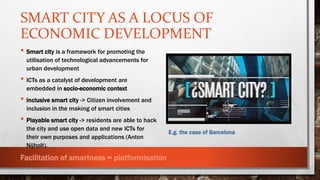
E.g. the case of Barcelona
• Smart city is a framework for promoting the
utilisation of technological advancements for
urban development
• ICTs as a catalyst of development are
embedded in socio-economic context
• Inclusive smart city -> Citizen involvement and
inclusion in the making of smart cities
• Playable smart city -> residents are able to hack
the city and use open data and new ICTs for
their own purposes and applications (Anton
Nijholt).
Facilitation of smartness = platformisation
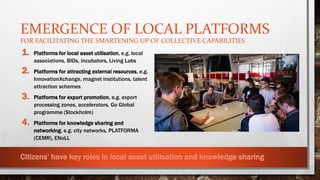
EMERGENCE OF LOCAL PLATFORMS
FOR FACILITATING THE SMARTENING UP OF COLLECTIVE CAPABILITIES
1. Platforms for local asset utilisation, e.g. local
associations, BIDs, incubators, Living Labs
2. Platforms for attracting external resources, e.g.
InnovationXchange, magnet institutions, talent
attraction schemes
3. Platforms for export promotion, e.g. export
processing zones, accelerators, Go Global
programme (Stockholm)
4. Platforms for knowledge sharing and
networking, e.g. city networks, PLATFORMA
(CEMR), ENoLL
1
3
2
4
Internal processes External processes
Smart local
restructuring
Locality
Community asset
development and
utilization
Exporting local
products and
services
Attraction
strategy
Global networking
and knowledge
sharing
Global context:
global markets
and production
and innovation
ecologies
Relational processes
Local context:
local history,
economy and
community
characteristics
Citizens’ have key roles in local asset utilisation and knowledge sharing
PARTICIPATORY INNOVATION
PLATFORMS
Participatory = inviting, inclusive, open, appreciative, democratic, fair
• Examples: Quadruple Helix, PPPP, Crowdsourcing, Citizensourcing,
open and user innovation and innovation events
• Participatory platforms match business, academia and government
• Platform offer structured and enabling environment for citizen
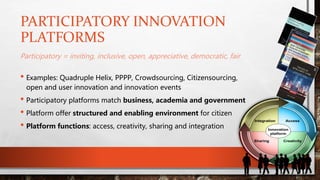
• Platform functions: access, creativity, sharing and integration
Access
Sharing
Integration
Creativity
Innovation
platform
CITIZEN PARTICIPATION
• Local people are much more than just users or
customers serving firms’ product development
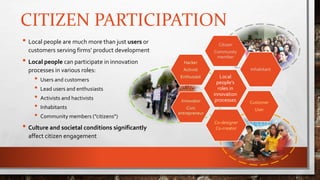
• Local people can participate in innovation
processes in various roles:
• Users and customers
• Lead users and enthusiasts
• Activists and hactivists
• Inhabitants
• Community members (”citizens”)
• Culture and societal conditions significantly
affect citizen engagement
Local
people’s
roles in
innovation
processes
Citizen
Community
member
Inhabitant
Customer
User
Co-designer
Co-creator
Innovator
Civic
entrepreneur
Hacker
Activist
Enthusiast
FORMS OF PARTICIPATION
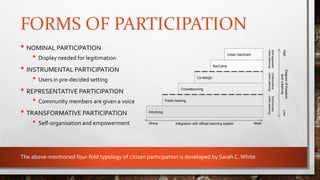
• NOMINAL PARTICIPATION
• Display needed for legitimation
• INSTRUMENTAL PARTICIPATION
• Users in pre-decided setting
• REPRESENTATIVE PARTICIPATION
• Community members are given a voice
• TRANSFORMATIVE PARTICIPATION
• Self-organisation and empowerment
Informing
Public hearing
Crowdsourcing
Co-design
BarCamp
Integration with official planning system
Degreeoffreedom
andcreativity
Strong Weak
LowHigh
Urban hactivism
Self-organized
urbanplanning
Collaborative
urbanplanning
Technocratic
urbanplanning
The above-mentioned four-fold typology of citizen participation is developed by Sarah C.White
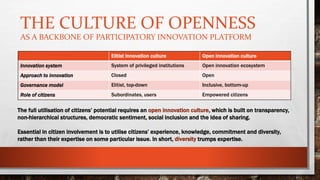
THE CULTURE OF OPENNESS
AS A BACKBONE OF PARTICIPATORY INNOVATION PLATFORM
Elitist innovation culture Open innovation culture
Innovation system System of privileged institutions Open innovation ecosystem
Approach to innovation Closed Open
Governance model Elitist, top-down Inclusive, bottom-up
Role of citizens Subordinates, users Empowered citizens
The full utilisation of citizens’ potential requires an open innovation culture, which is built on transparency,
non-hierarchical structures, democratic sentiment, social inclusion and the idea of sharing.
Essential in citizen involvement is to utilise citizens’ experience, knowledge, commitment and diversity,
rather than their expertise on some particular issue. In short, diversity trumps expertise.
DIGITAL SMARTNESS
• ICTs enable new ways of tapping into the collective intelligence
• Most of the crowdsourcing excercises today are web-based or
computer-assisted processes
• Digital tools can be used to support ’soft smartness’ associated
with complex knowledge processes, such as innovation process
• Interfaces between digital and innovation systems (Komninos):
[1] digital disruption in industries, [2] digital platforms (living
virtual marketplaces etc.), and [3] co-design and co-creation with
lead users, customers, crowds and user communities.
Communicative
intelligence
Content
intelligence
Collaborative
intelligence
Collective
intelligence
Aggregating
Interacting Analyzing
Communicating
Aspects of
digital
smartness
4Cs of social
intelligence
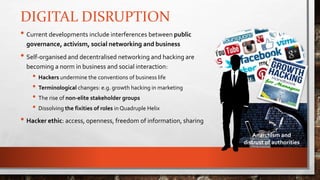
DIGITAL DISRUPTION
• Current developments include interferences between public
governance, activism, social networking and business
• Self-organised and decentralised networking and hacking are
becoming a norm in business and social interaction:
• Hackers undermine the conventions of business life
• Terminological changes: e.g. growth hacking in marketing
• The rise of non-elite stakeholder groups
• Dissolving the fixities of roles in Quadruple Helix
• Hacker ethic: access, openness, freedom of information, sharing
Anarchism and
distrust of authorities
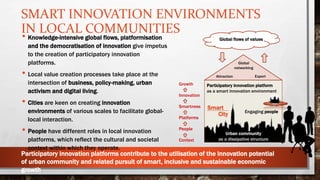
SMART INNOVATION ENVIRONMENTS
IN LOCAL COMMUNITIES
Global flows of values
Global
networking
Attraction Export
Participatory innovation platform
as a smart innovation environment
Engaging people
Growth
Innovation
Smartness
Platforms
People
Context
Urban community
as a dissipative structure
Smart
City
• Knowledge-intensive global flows, platformisation
and the democratisation of innovation give impetus
to the creation of participatory innovation
platforms.
• Local value creation processes take place at the
intersection of business, policy-making, urban
activism and digital living.
• Cities are keen on creating innovation
environments of various scales to facilitate global-
local interaction.
• People have different roles in local innovation
platforms, which reflect the cultural and societal
context within which they operate.
Participatory innovation platforms contribute to the utilisation of the innovation potential
of urban community and related pursuit of smart, inclusive and sustainable economic
growth.

Platforms for smart economic growth

  • 2.
    PLATFORMS FOR SMART ECONOMICGROWTH KEYTOPICS •GROWTH, FLOWS AND LOCALITIES •TOWARDS INCLUSIVE SMART CITY •PARTICIPATORY INNOVATION PLATFORMS Global flows of values Global networking Attraction Export Participatory innovation platform as a smart innovation environment Engaging people Growth Innovation Smartness Platforms People Context Urban community as a dissipative structure Smart City
  • 3.
    FACTORS AFFECTING ECONOMIC GROWTH • Urban landas a historical starting point • Exogenous growth theory and export-base theory (exogenous export demand) • Endogenous growth theory: novel perspective on unique factors of spatial milieu • The role of technology: beyond the increase in the labour and capital in production -> technology • Soft factors of growth: knowledge, social, human and creative capital, institutions, culture, etc. Urban land Physical and monetary capital Technology Soft forms of capital Systemic smartness? Agrarian, industrial and informational mode of development (Castells)
  • 4.
    GLOBAL FLOWS OFVALUES Source: Manyika et al. 2014. Global flows in a digital age. McKinsey Global Institute (MGI). Business Public Civic Frictional human and material flows Frictionless flows Local attraction and value- generation processes (city as a dissipative structure) Production sphereConsumption sphere Cultural values Knowledge Innovation Technology Know-how Capital FDIs BUSINESS CONSUMERS SOFT FACTORS HARD FACTORS Global markets CITY Natural resources Technology Capital Labour Knowledge Creativity Entrepreneurship Social capital Shopping Fashion Sports Culture Tourism Education Innovation milieux Business services Fairs Logistics PC Irreducible services Online services Goods and materials Enterpreneurs Business travelers Professionals Public authorities Tourists Hybrid services Productive actor and institution flows Talent Labor Raw materials Intermediate goods Exports Imports Client flows Firms Students Immigration Local leadership / Governance / Policies Community characteristics Urban design Logistics Fairs • Declined transport and communication costs -> global trade, mobility and communication • Digital economic transformation: digital goods and services, digital ”wrappers” and digital platforms -> money and data • Flows of goods, services and finance have grown steadily for decades, reaching 36% of global GDP in 2012. • Knowledge-intensive flows are growing faster than capital- intensive or labour-intensive flows.They generate more economic value than the global goods trade. => RISE OF GLOBAL KNOWLEDGE ECONOMY
  • 5.
    LOCALITY AS ADISSIPATIVE STRUCTURE • Dissipative structure (Ilya Prigogine): exchange of energy and matter entity and its environment • Uurban structure is sustained through flows to and from the outside • Neighbourhood revitalisation • City attraction hypothesis • Export-base theory • Global innovation networking 1 3 2 4 Internal processes External processes Smart local restructuring Locality Community asset development and utilization Exporting local products and services Attraction strategy Global networking and knowledge sharing Global context: global markets and production and innovation ecologies Relational processes Local context: local history, economy and community characteristics
  • 6.
    SMART URBAN RESPONSE TOTHE CHALLENGES OF A DIGITAL AGE • World is ’spiky’ in terms of productive smartness (Florida). • Metropolitan revolution: we need smartness to fix a fragile economy and to restore our confidence in economic growth. • Traditional ”business engineering” view: smart solutions, systems and industries as drivers of smart economy. • Hard and soft smartness supports competitiveness: smartness helps a city to be attractive and competitive and ICTs have a role to play in such competitive advantage. • Smartness is also about social intelligence and the wisdom of the applied to complex social processes, including innovation processes. Smart city is about hard and soft smartness
  • 7.
    SMART CITY ASA LOCUS OF ECONOMIC DEVELOPMENT E.g. the case of Barcelona • Smart city is a framework for promoting the utilisation of technological advancements for urban development • ICTs as a catalyst of development are embedded in socio-economic context • Inclusive smart city -> Citizen involvement and inclusion in the making of smart cities • Playable smart city -> residents are able to hack the city and use open data and new ICTs for their own purposes and applications (Anton Nijholt). Facilitation of smartness = platformisation
  • 8.
    EMERGENCE OF LOCALPLATFORMS FOR FACILITATING THE SMARTENING UP OF COLLECTIVE CAPABILITIES 1. Platforms for local asset utilisation, e.g. local associations, BIDs, incubators, Living Labs 2. Platforms for attracting external resources, e.g. InnovationXchange, magnet institutions, talent attraction schemes 3. Platforms for export promotion, e.g. export processing zones, accelerators, Go Global programme (Stockholm) 4. Platforms for knowledge sharing and networking, e.g. city networks, PLATFORMA (CEMR), ENoLL 1 3 2 4 Internal processes External processes Smart local restructuring Locality Community asset development and utilization Exporting local products and services Attraction strategy Global networking and knowledge sharing Global context: global markets and production and innovation ecologies Relational processes Local context: local history, economy and community characteristics Citizens’ have key roles in local asset utilisation and knowledge sharing
  • 9.
    PARTICIPATORY INNOVATION PLATFORMS Participatory =inviting, inclusive, open, appreciative, democratic, fair • Examples: Quadruple Helix, PPPP, Crowdsourcing, Citizensourcing, open and user innovation and innovation events • Participatory platforms match business, academia and government • Platform offer structured and enabling environment for citizen • Platform functions: access, creativity, sharing and integration Access Sharing Integration Creativity Innovation platform
  • 10.
    CITIZEN PARTICIPATION • Localpeople are much more than just users or customers serving firms’ product development • Local people can participate in innovation processes in various roles: • Users and customers • Lead users and enthusiasts • Activists and hactivists • Inhabitants • Community members (”citizens”) • Culture and societal conditions significantly affect citizen engagement Local people’s roles in innovation processes Citizen Community member Inhabitant Customer User Co-designer Co-creator Innovator Civic entrepreneur Hacker Activist Enthusiast
  • 11.
    FORMS OF PARTICIPATION •NOMINAL PARTICIPATION • Display needed for legitimation • INSTRUMENTAL PARTICIPATION • Users in pre-decided setting • REPRESENTATIVE PARTICIPATION • Community members are given a voice • TRANSFORMATIVE PARTICIPATION • Self-organisation and empowerment Informing Public hearing Crowdsourcing Co-design BarCamp Integration with official planning system Degreeoffreedom andcreativity Strong Weak LowHigh Urban hactivism Self-organized urbanplanning Collaborative urbanplanning Technocratic urbanplanning The above-mentioned four-fold typology of citizen participation is developed by Sarah C.White
  • 12.
    THE CULTURE OFOPENNESS AS A BACKBONE OF PARTICIPATORY INNOVATION PLATFORM Elitist innovation culture Open innovation culture Innovation system System of privileged institutions Open innovation ecosystem Approach to innovation Closed Open Governance model Elitist, top-down Inclusive, bottom-up Role of citizens Subordinates, users Empowered citizens The full utilisation of citizens’ potential requires an open innovation culture, which is built on transparency, non-hierarchical structures, democratic sentiment, social inclusion and the idea of sharing. Essential in citizen involvement is to utilise citizens’ experience, knowledge, commitment and diversity, rather than their expertise on some particular issue. In short, diversity trumps expertise.
  • 13.
    DIGITAL SMARTNESS • ICTsenable new ways of tapping into the collective intelligence • Most of the crowdsourcing excercises today are web-based or computer-assisted processes • Digital tools can be used to support ’soft smartness’ associated with complex knowledge processes, such as innovation process • Interfaces between digital and innovation systems (Komninos): [1] digital disruption in industries, [2] digital platforms (living virtual marketplaces etc.), and [3] co-design and co-creation with lead users, customers, crowds and user communities. Communicative intelligence Content intelligence Collaborative intelligence Collective intelligence Aggregating Interacting Analyzing Communicating Aspects of digital smartness 4Cs of social intelligence
  • 14.
    DIGITAL DISRUPTION • Currentdevelopments include interferences between public governance, activism, social networking and business • Self-organised and decentralised networking and hacking are becoming a norm in business and social interaction: • Hackers undermine the conventions of business life • Terminological changes: e.g. growth hacking in marketing • The rise of non-elite stakeholder groups • Dissolving the fixities of roles in Quadruple Helix • Hacker ethic: access, openness, freedom of information, sharing Anarchism and distrust of authorities
  • 15.
    SMART INNOVATION ENVIRONMENTS INLOCAL COMMUNITIES Global flows of values Global networking Attraction Export Participatory innovation platform as a smart innovation environment Engaging people Growth Innovation Smartness Platforms People Context Urban community as a dissipative structure Smart City • Knowledge-intensive global flows, platformisation and the democratisation of innovation give impetus to the creation of participatory innovation platforms. • Local value creation processes take place at the intersection of business, policy-making, urban activism and digital living. • Cities are keen on creating innovation environments of various scales to facilitate global- local interaction. • People have different roles in local innovation platforms, which reflect the cultural and societal context within which they operate. Participatory innovation platforms contribute to the utilisation of the innovation potential of urban community and related pursuit of smart, inclusive and sustainable economic growth.