Civic Hacking
Frank Kresin
Research Director
@kresin / frank@waag.org
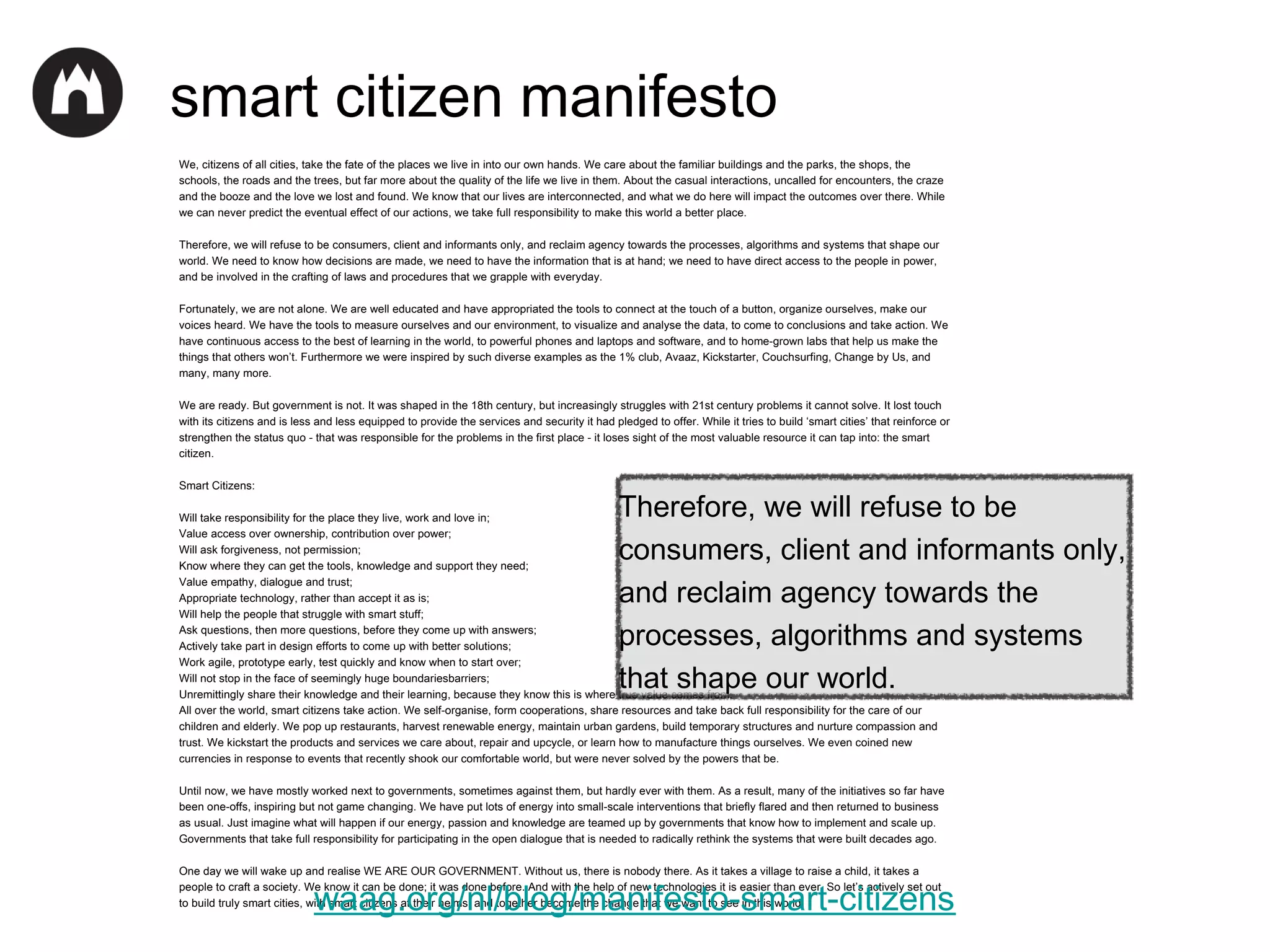
smart citizen manifesto
We, citizens of all cities, take the fate of the places we live in into our own hands. We care about the familiar buildings and the parks, the shops, the
schools, the roads and the trees, but far more about the quality of the life we live in them. About the casual interactions, uncalled for encounters, the craze
and the booze and the love we lost and found. We know that our lives are interconnected, and what we do here will impact the outcomes over there. While
we can never predict the eventual effect of our actions, we take full responsibility to make this world a better place.
Therefore, we will refuse to be consumers, client and informants only, and reclaim agency towards the processes, algorithms and systems that shape our
world. We need to know how decisions are made, we need to have the information that is at hand; we need to have direct access to the people in power,
and be involved in the crafting of laws and procedures that we grapple with everyday.
Fortunately, we are not alone. We are well educated and have appropriated the tools to connect at the touch of a button, organize ourselves, make our
voices heard. We have the tools to measure ourselves and our environment, to visualize and analyse the data, to come to conclusions and take action. We
have continuous access to the best of learning in the world, to powerful phones and laptops and software, and to home-grown labs that help us make the
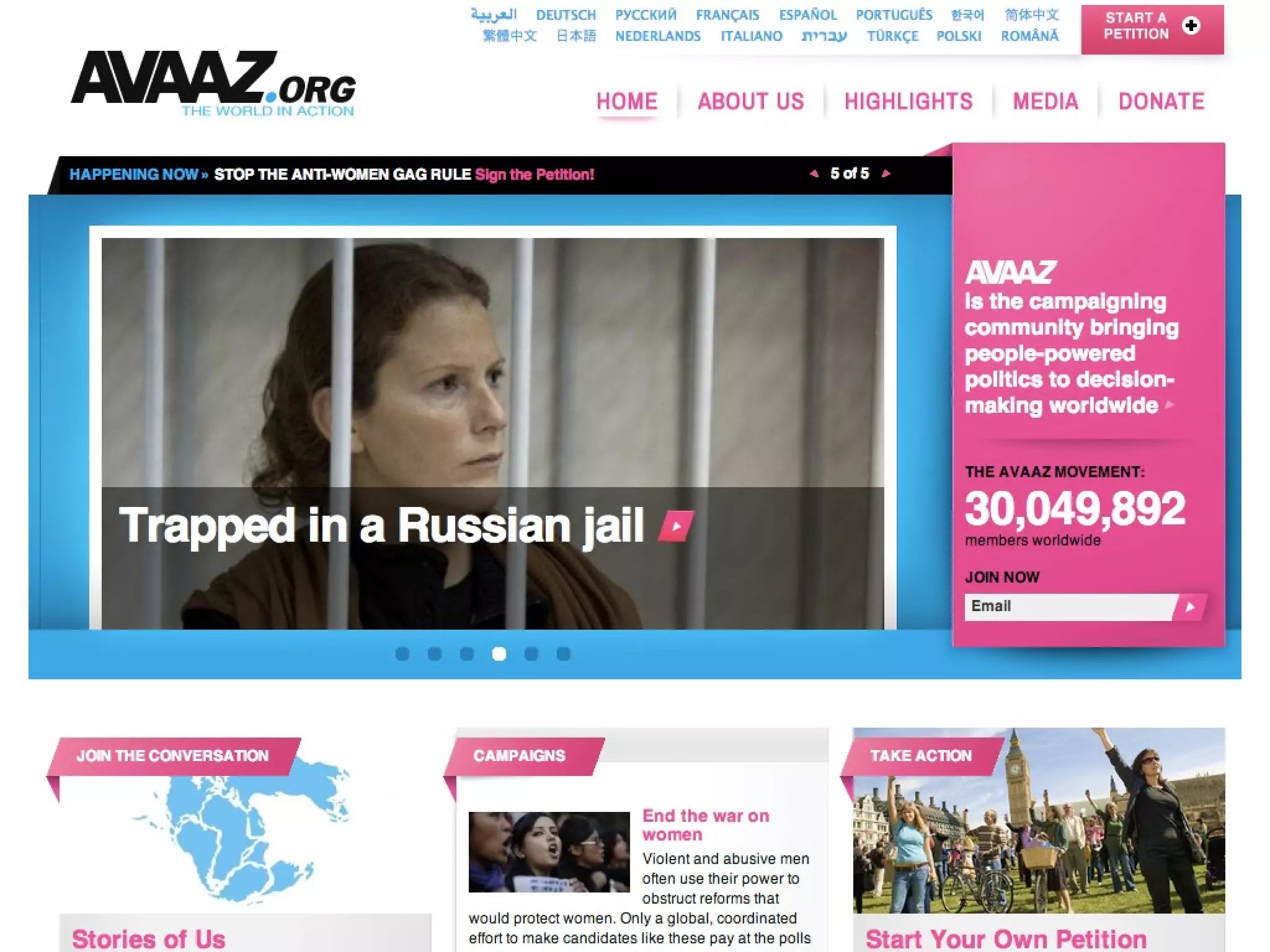
things that others won’t. Furthermore we were inspired by such diverse examples as the 1% club, Avaaz, Kickstarter, Couchsurfing, Change by Us, and
many, many more.
We are ready. But government is not. It was shaped in the 18th century, but increasingly struggles with 21st century problems it cannot solve. It lost touch
with its citizens and is less and less equipped to provide the services and security it had pledged to offer. While it tries to build ‘smart cities’ that reinforce or
strengthen the status quo - that was responsible for the problems in the first place - it loses sight of the most valuable resource it can tap into: the smart
citizen.
Smart Citizens:

Therefore, we will refuse to be
consumers, client and informants only,
and reclaim agency towards the
processes, algorithms and systems
that shape our world.

Will take responsibility for the place they live, work and love in;
Value access over ownership, contribution over power;
Will ask forgiveness, not permission;
Know where they can get the tools, knowledge and support they need;
Value empathy, dialogue and trust;
Appropriate technology, rather than accept it as is;
Will help the people that struggle with smart stuff;
Ask questions, then more questions, before they come up with answers;
Actively take part in design efforts to come up with better solutions;
Work agile, prototype early, test quickly and know when to start over;
Will not stop in the face of seemingly huge boundariesbarriers;
Unremittingly share their knowledge and their learning, because they know this is where true value comes from.
All over the world, smart citizens take action. We self-organise, form cooperations, share resources and take back full responsibility for the care of our
children and elderly. We pop up restaurants, harvest renewable energy, maintain urban gardens, build temporary structures and nurture compassion and
trust. We kickstart the products and services we care about, repair and upcycle, or learn how to manufacture things ourselves. We even coined new
currencies in response to events that recently shook our comfortable world, but were never solved by the powers that be.

Until now, we have mostly worked next to governments, sometimes against them, but hardly ever with them. As a result, many of the initiatives so far have
been one-offs, inspiring but not game changing. We have put lots of energy into small-scale interventions that briefly flared and then returned to business
as usual. Just imagine what will happen if our energy, passion and knowledge are teamed up by governments that know how to implement and scale up.
Governments that take full responsibility for participating in the open dialogue that is needed to radically rethink the systems that were built decades ago.
One day we will wake up and realise WE ARE OUR GOVERNMENT. Without us, there is nobody there. As it takes a village to raise a child, it takes a
people to craft a society. We know it can be done; it was done before. And with the help of new technologies it is easier than ever. So let’s actively set out
to build truly smart cities, with smart citizens at their helms, and together become the change that we want to see in this world.

waag.org/nl/blog/manifesto-smart-citizens
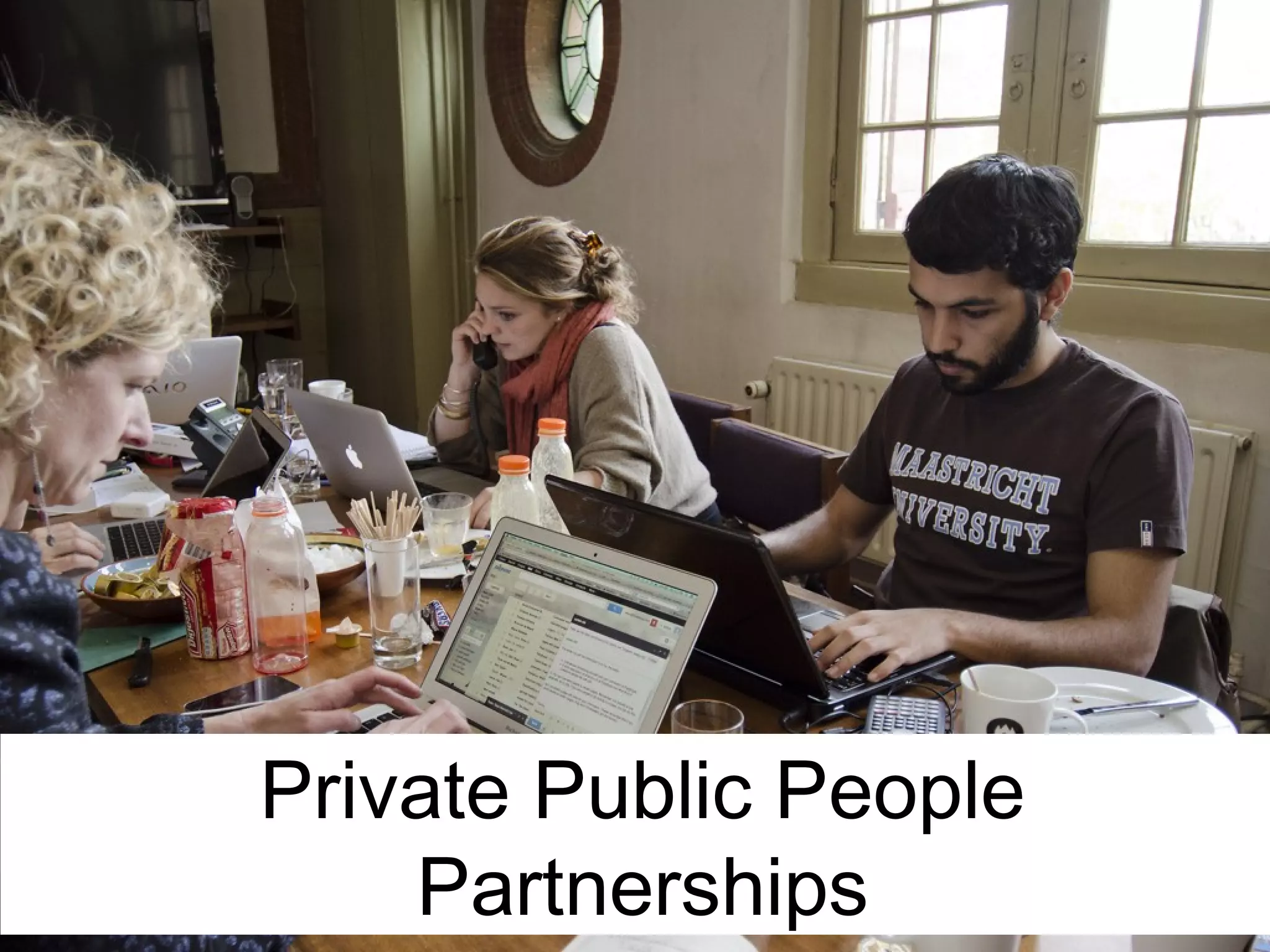
Private Public
Partnerships
Private Public People
Partnerships
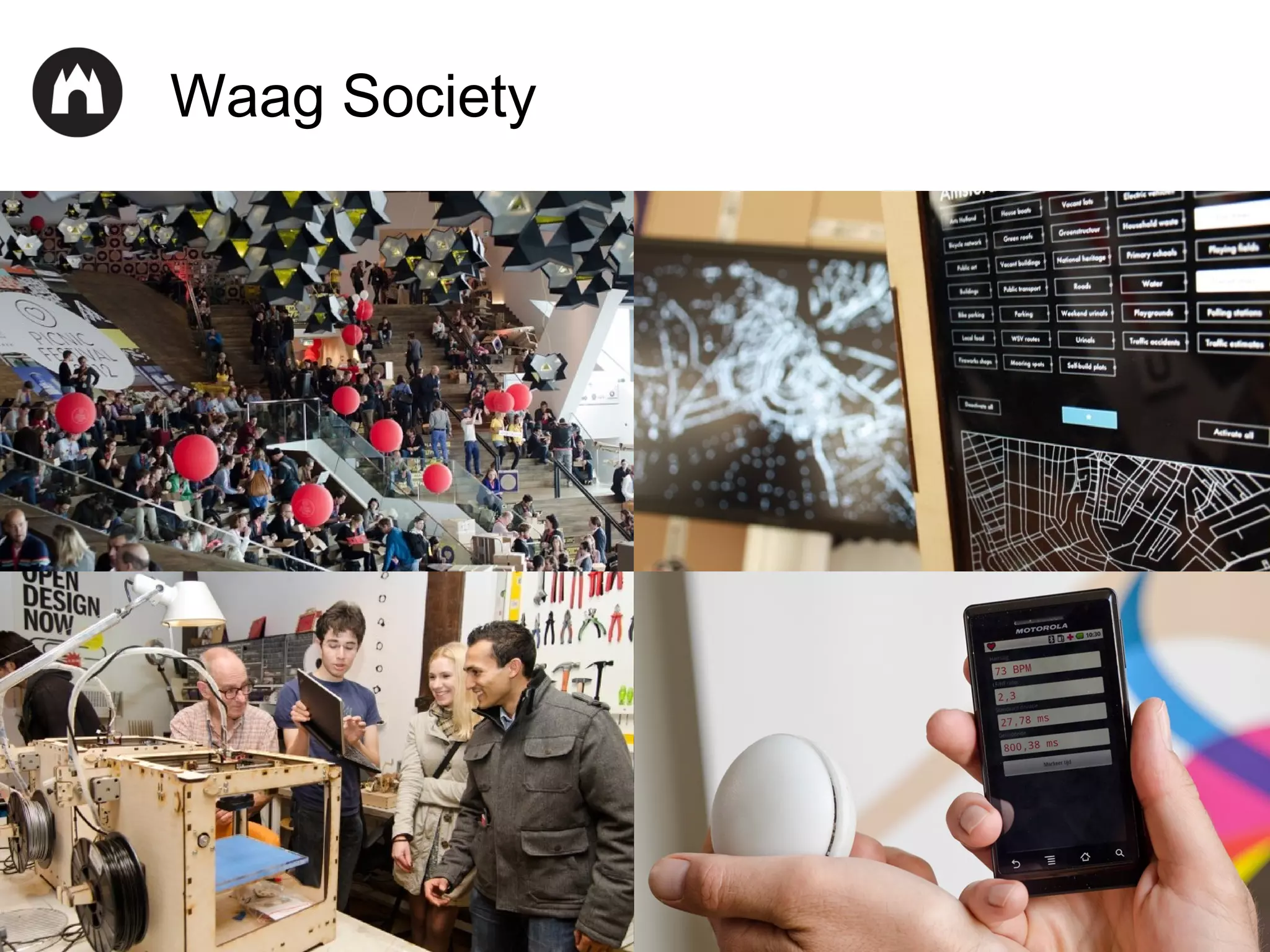
Waag Society
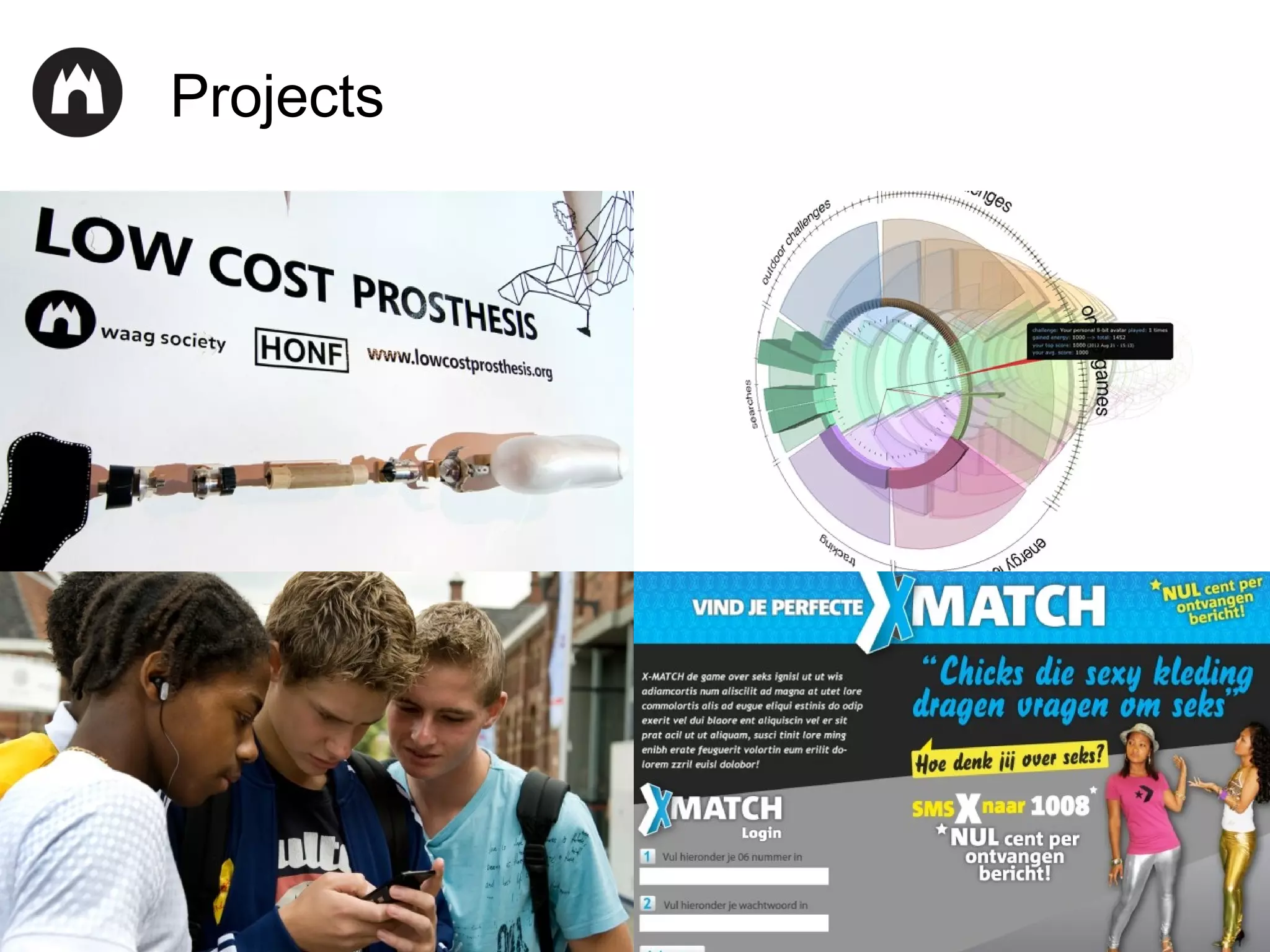
Projects
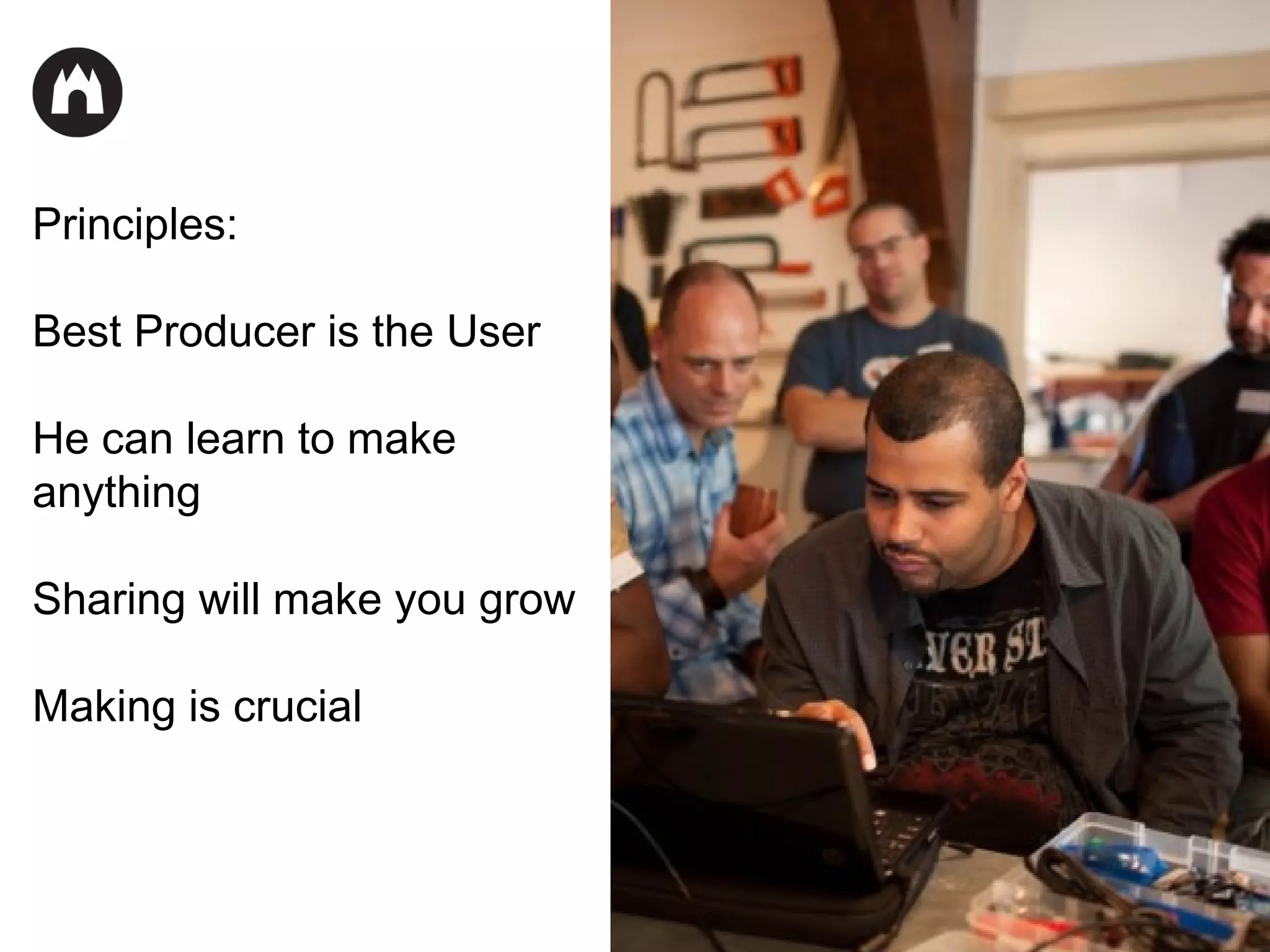
Principles:
Best Producer is the User
He can learn to make
anything
Sharing will make you grow
Making is crucial
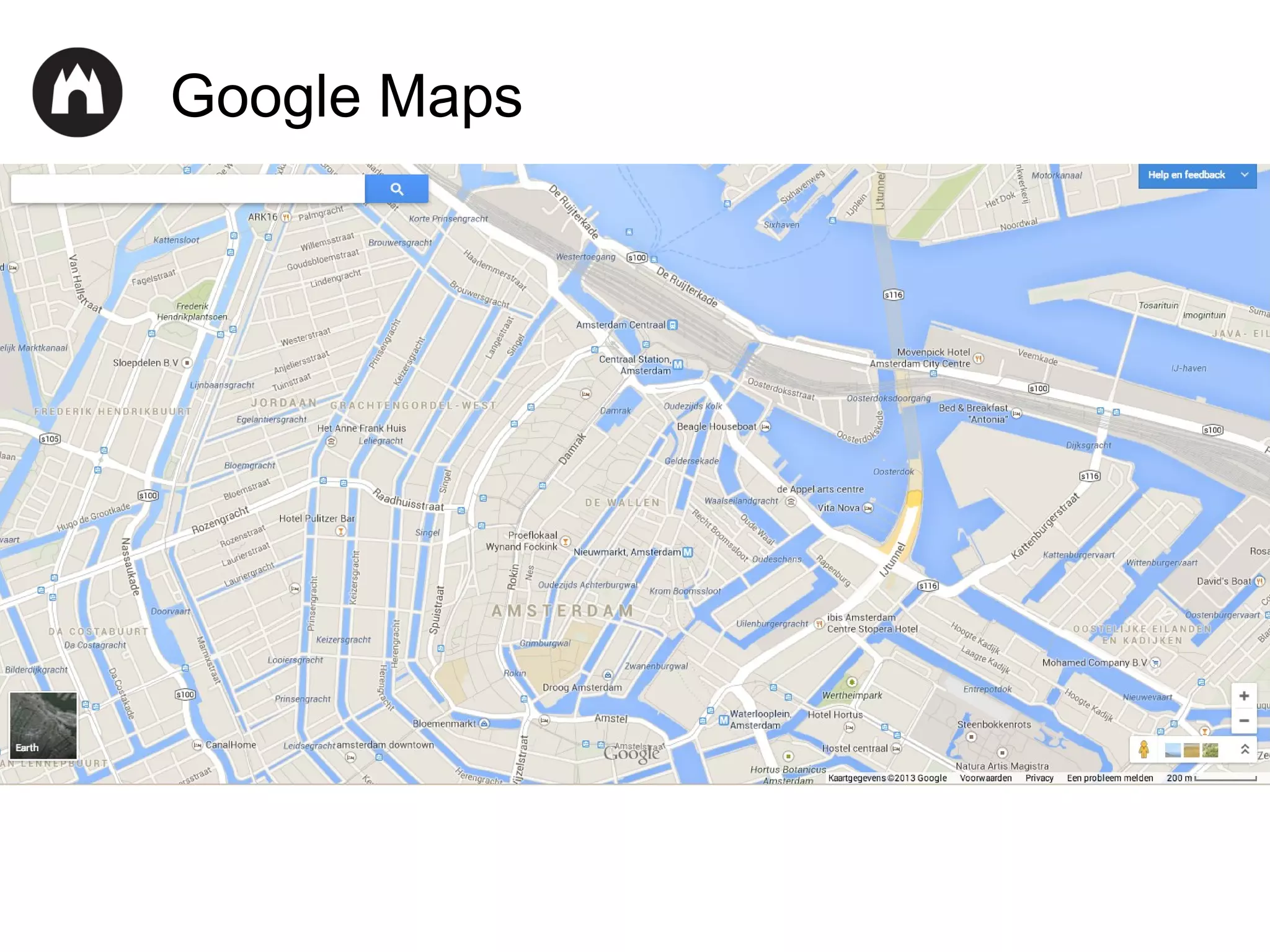
Google Maps
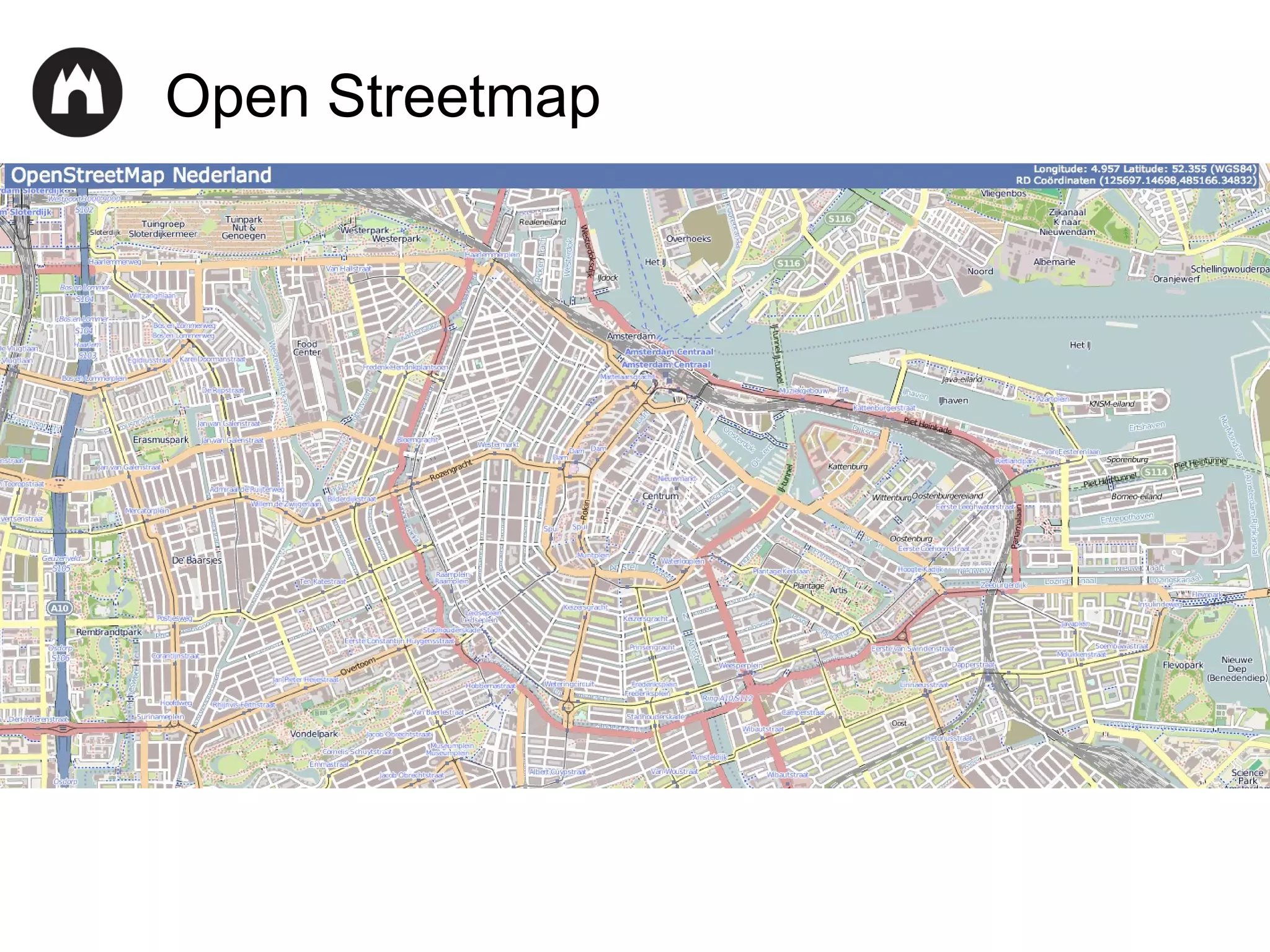
Open Streetmap
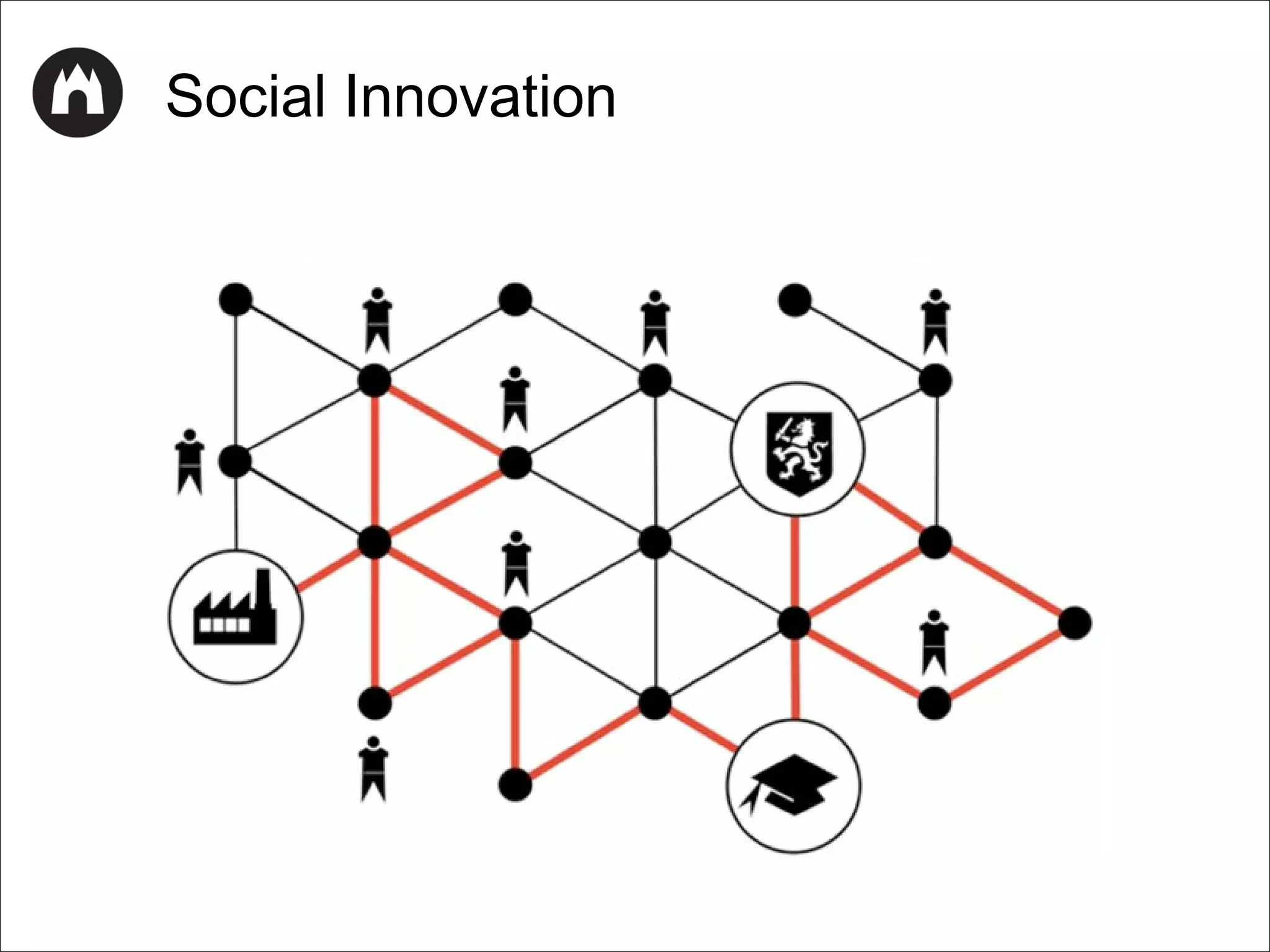
Social Innovation
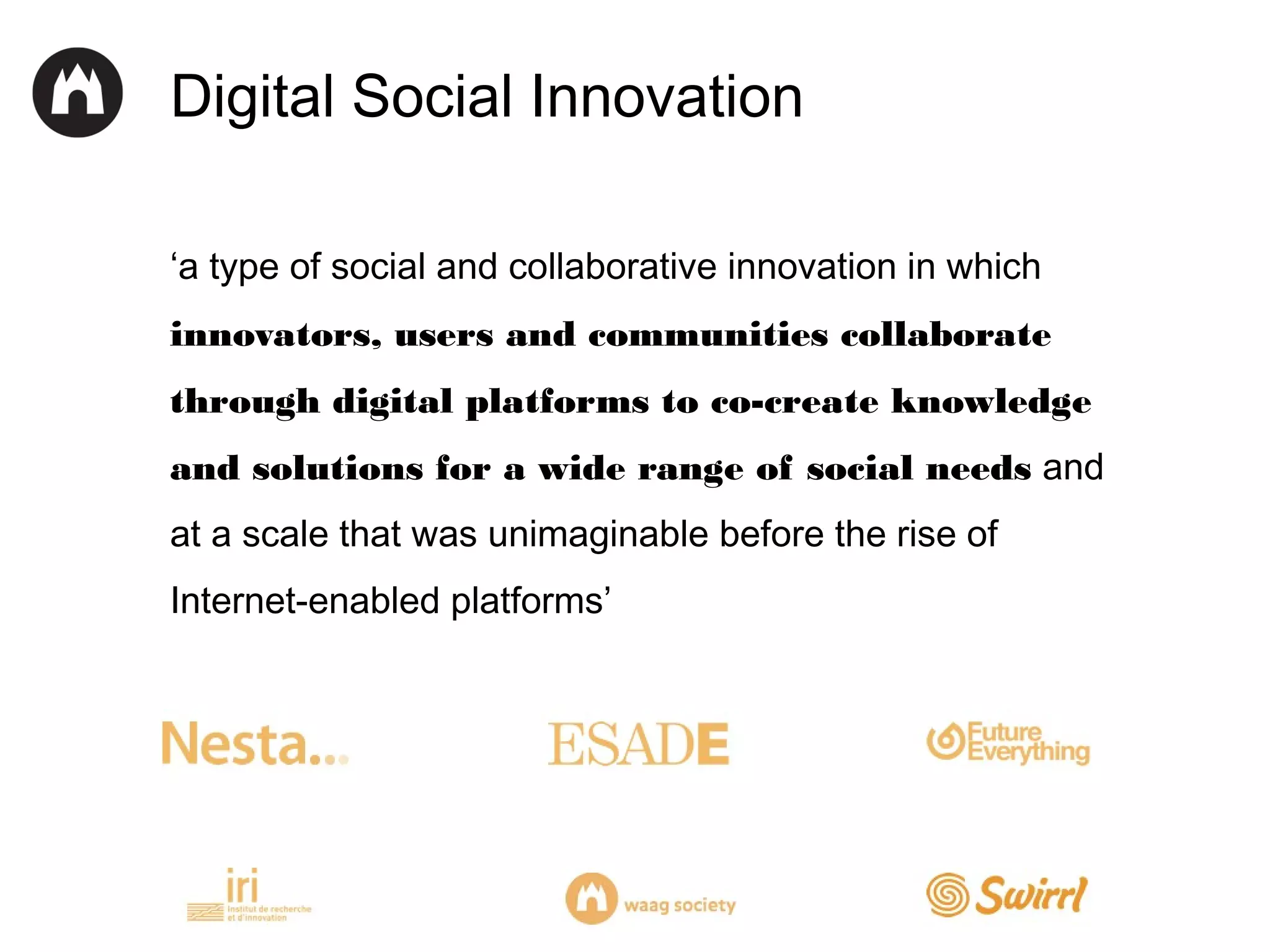
Digital Social Innovation
‘a type of social and collaborative innovation in which
innovators, users and communities collaborate
through digital platforms to co-create knowledge
and solutions for a wide range of social needs and
at a scale that was unimaginable before the rise of
Internet-enabled platforms’
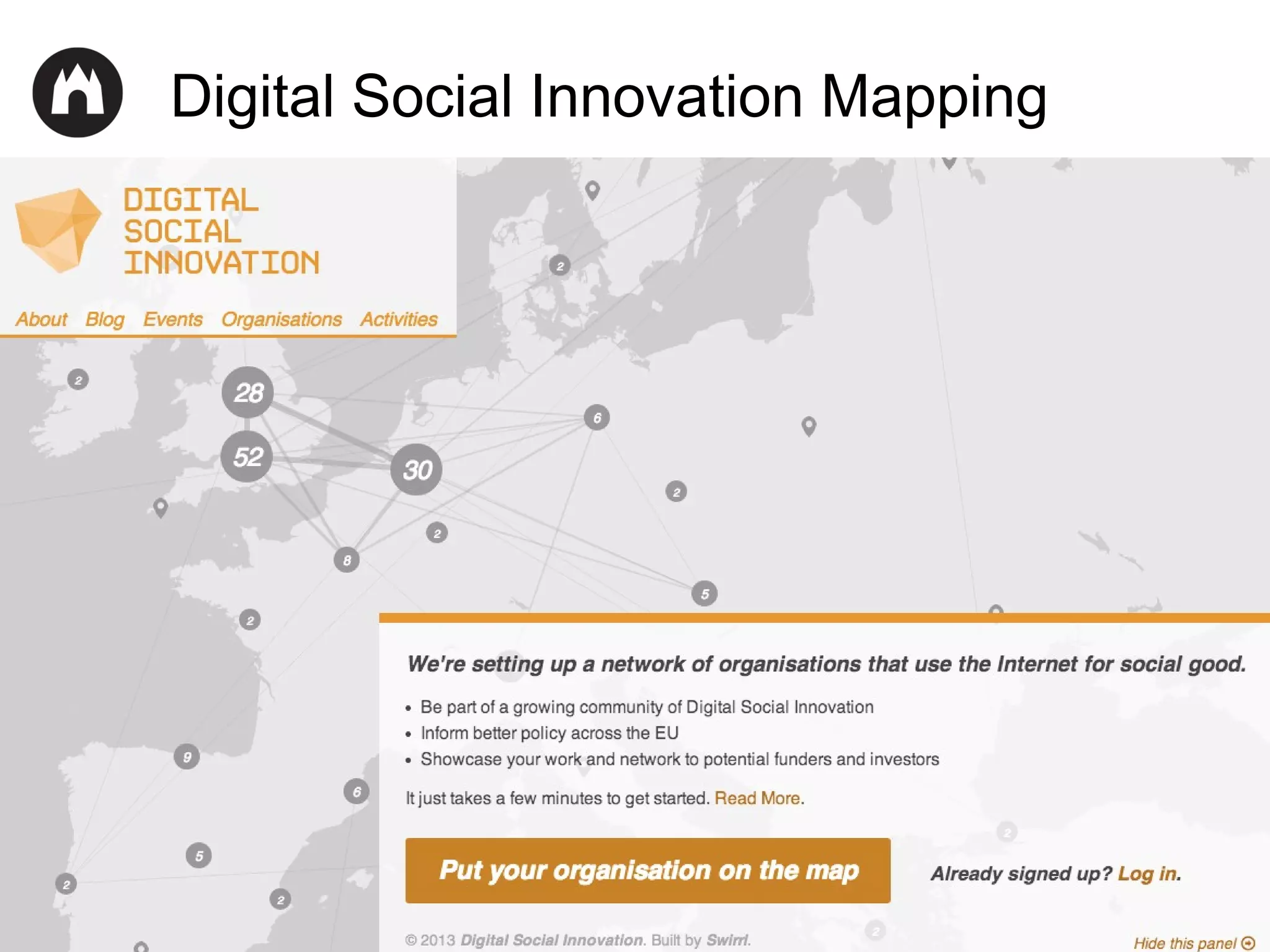
Digital Social Innovation Mapping
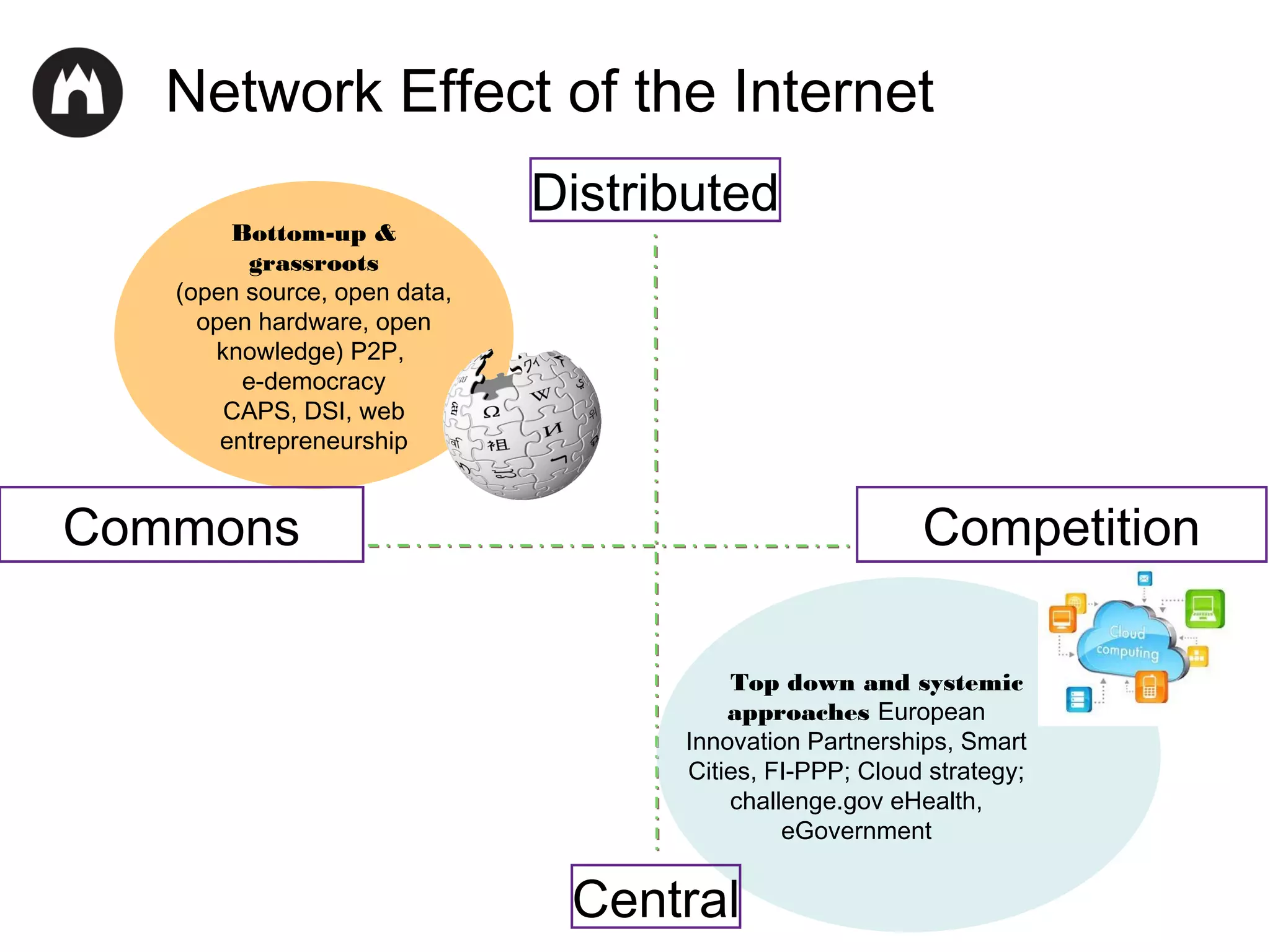
Network Effect of the Internet
Bottom-up &
grassroots
(open source, open data,
open hardware, open
knowledge) P2P,
e-democracy
CAPS, DSI, web
entrepreneurship

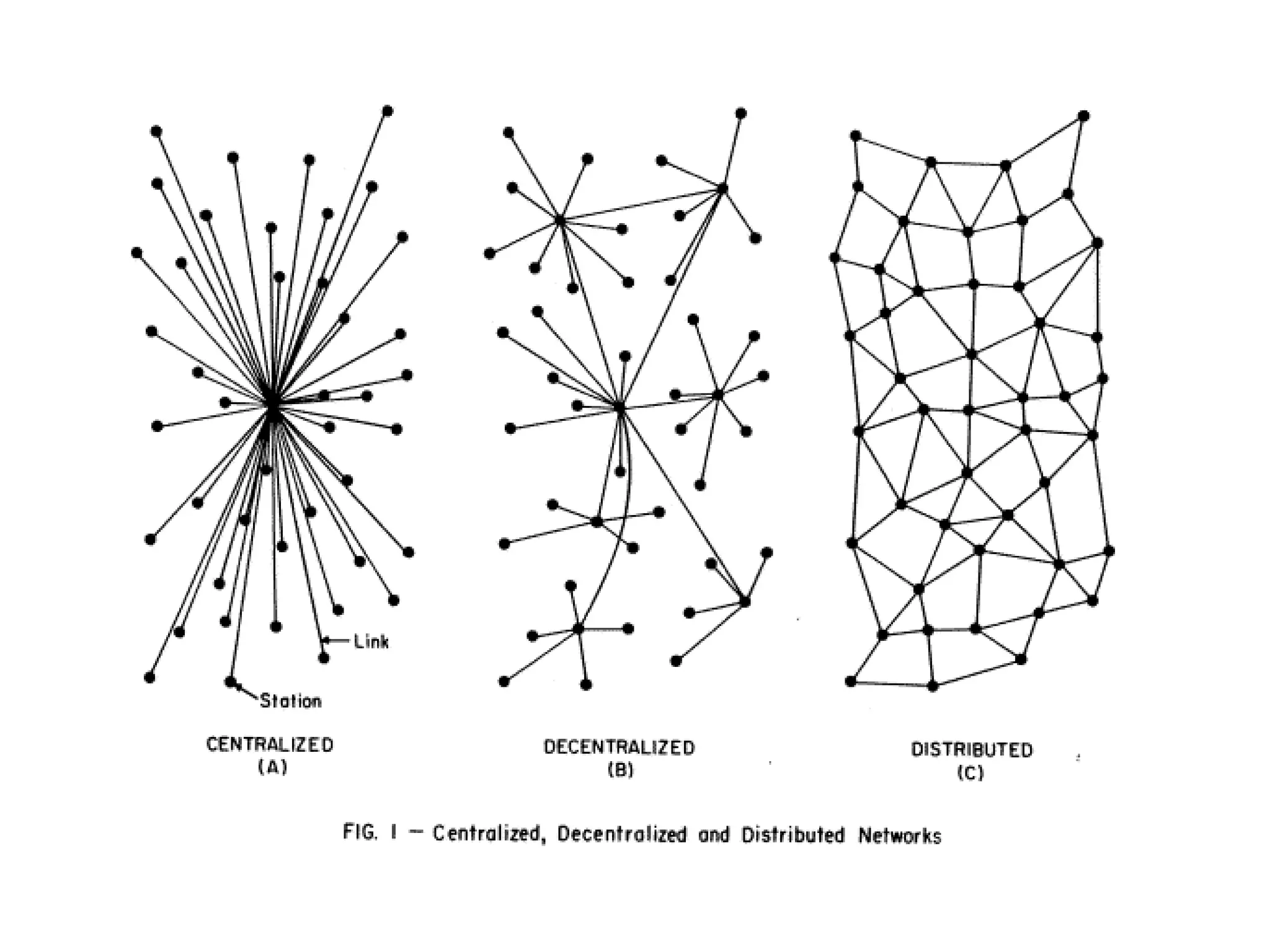
Distributed

Commons

Competition
Top down and systemic
approaches European
Innovation Partnerships, Smart
Cities, FI-PPP; Cloud strategy;
challenge.gov eHealth,
eGovernment

Central
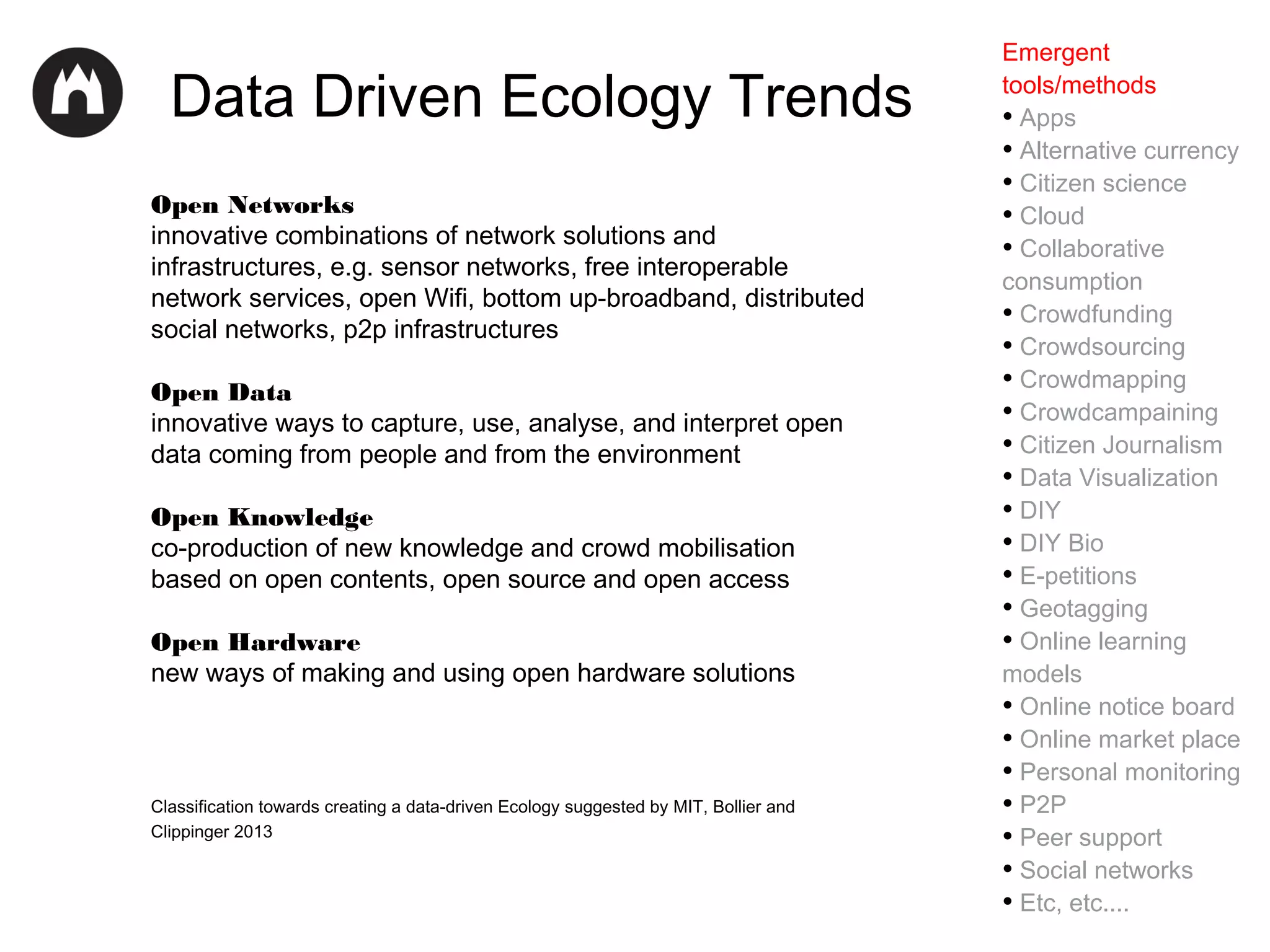
Data Driven Ecology Trends
Open Networks
innovative combinations of network solutions and
infrastructures, e.g. sensor networks, free interoperable
network services, open Wifi, bottom up-broadband, distributed
social networks, p2p infrastructures
Open Data
innovative ways to capture, use, analyse, and interpret open
data coming from people and from the environment
Open Knowledge
co-production of new knowledge and crowd mobilisation
based on open contents, open source and open access
Open Hardware
new ways of making and using open hardware solutions

Classification towards creating a data-driven Ecology suggested by MIT, Bollier and
Clippinger 2013

Emergent
tools/methods
• Apps
• Alternative currency
• Citizen science
• Cloud
• Collaborative
consumption
• Crowdfunding
• Crowdsourcing
• Crowdmapping
• Crowdcampaining
• Citizen Journalism
• Data Visualization
• DIY
• DIY Bio
• E-petitions
• Geotagging
• Online learning
models
• Online notice board
• Online market place
• Personal monitoring
• P2P
• Peer support
• Social networks
• Etc, etc....
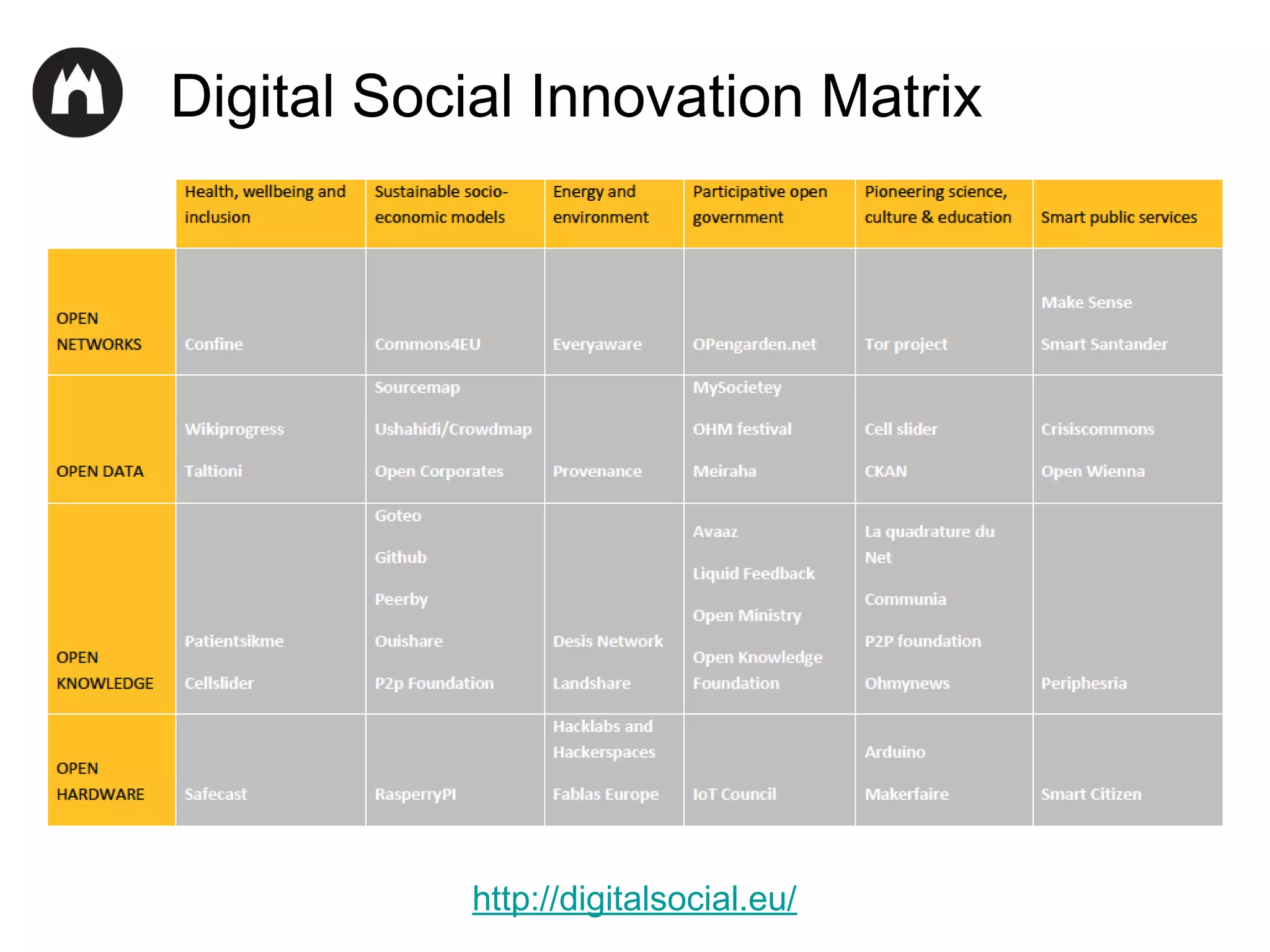
Digital Social Innovation Matrix

http://digitalsocial.eu/
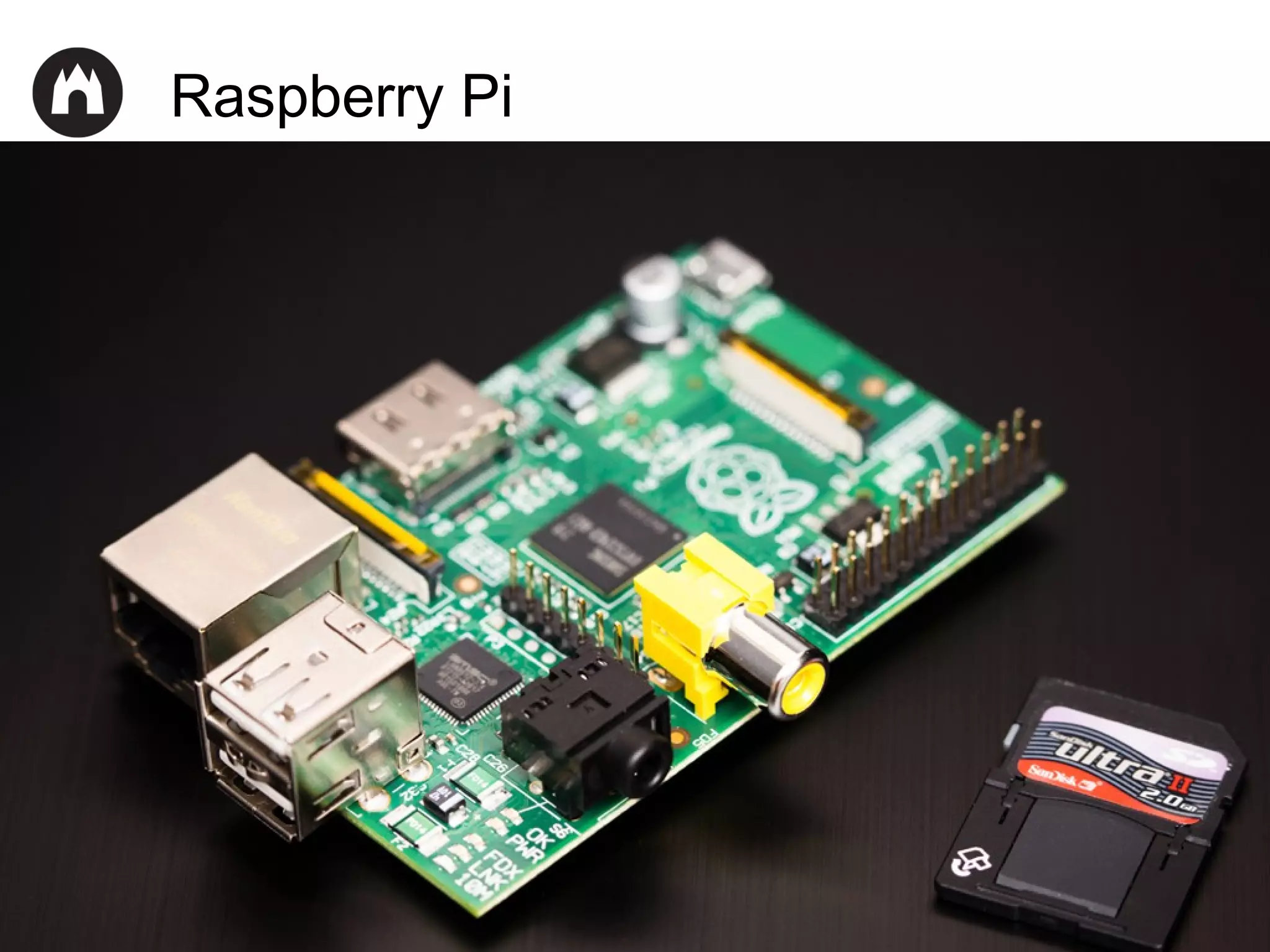
Raspberry Pi
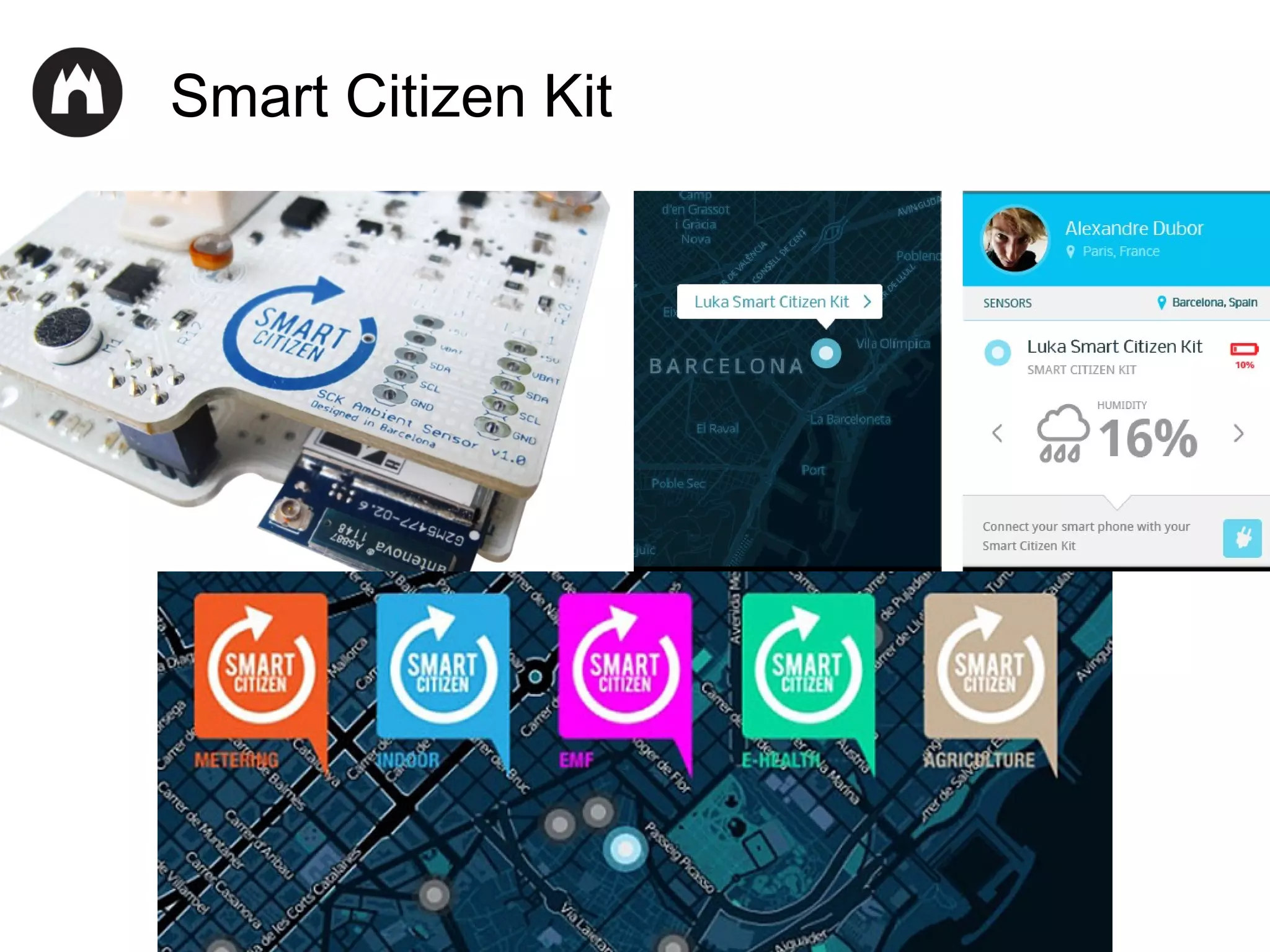
Smart Citizen Kit
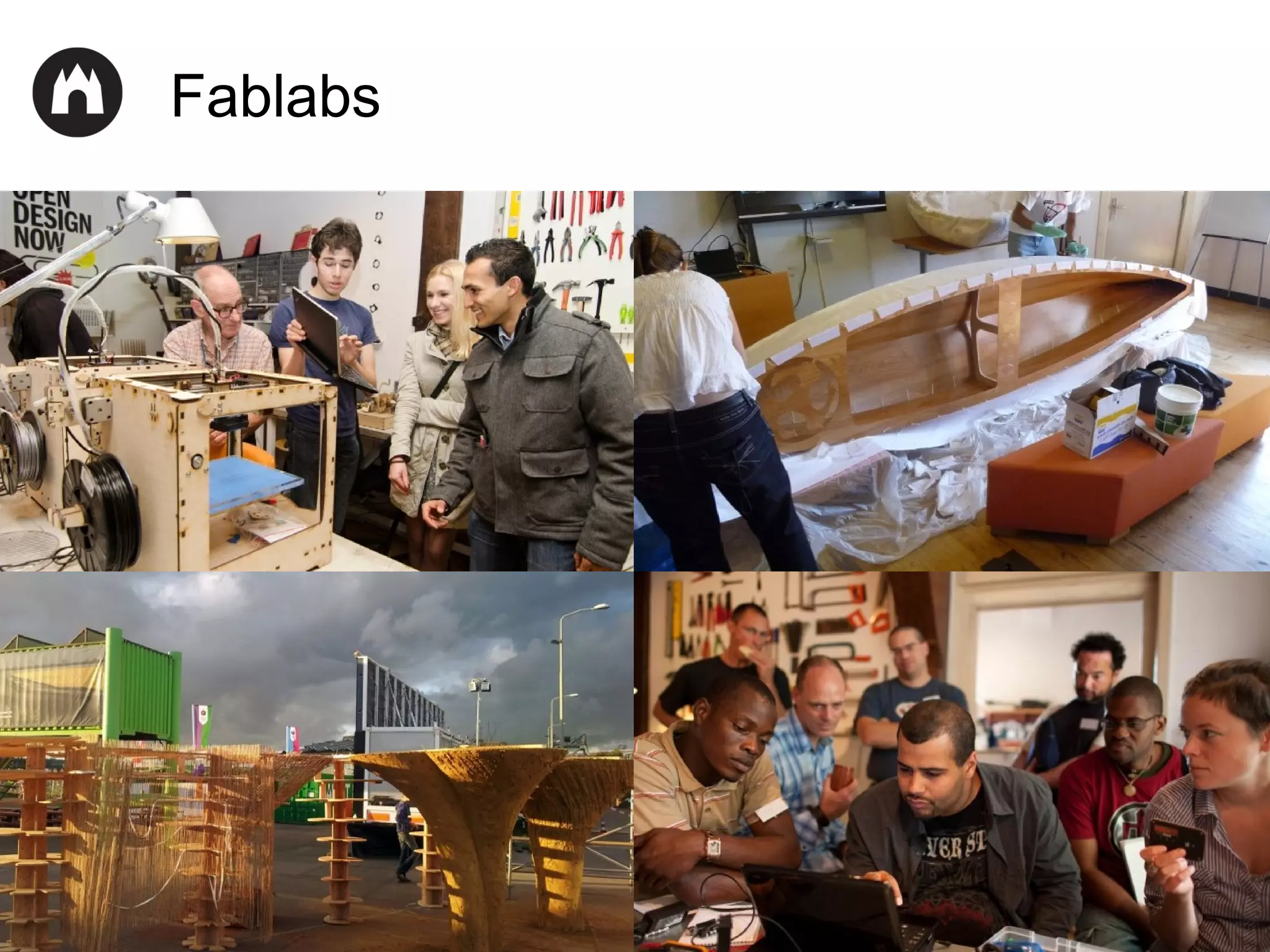
Fablabs
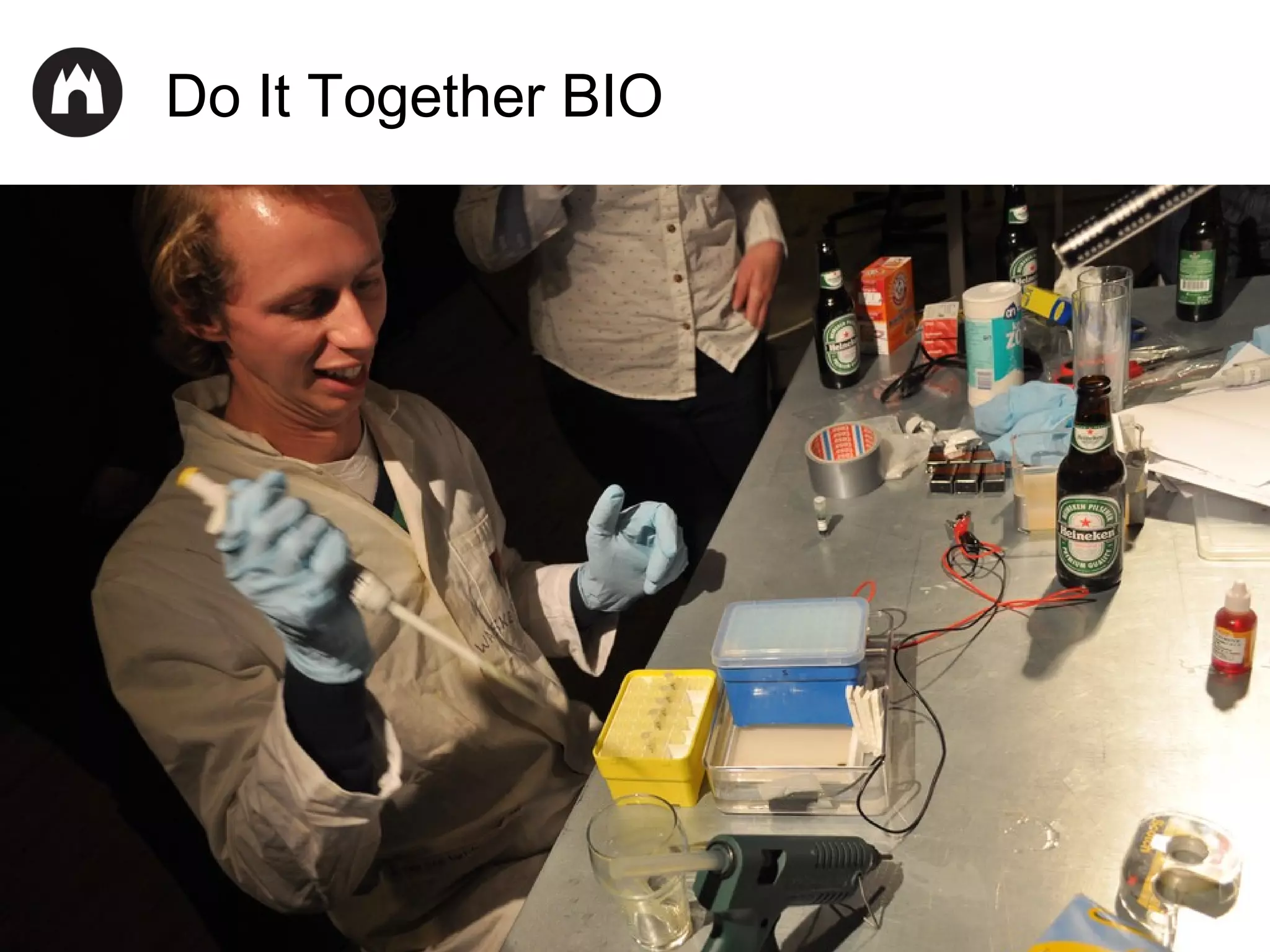
Do It Together BIO
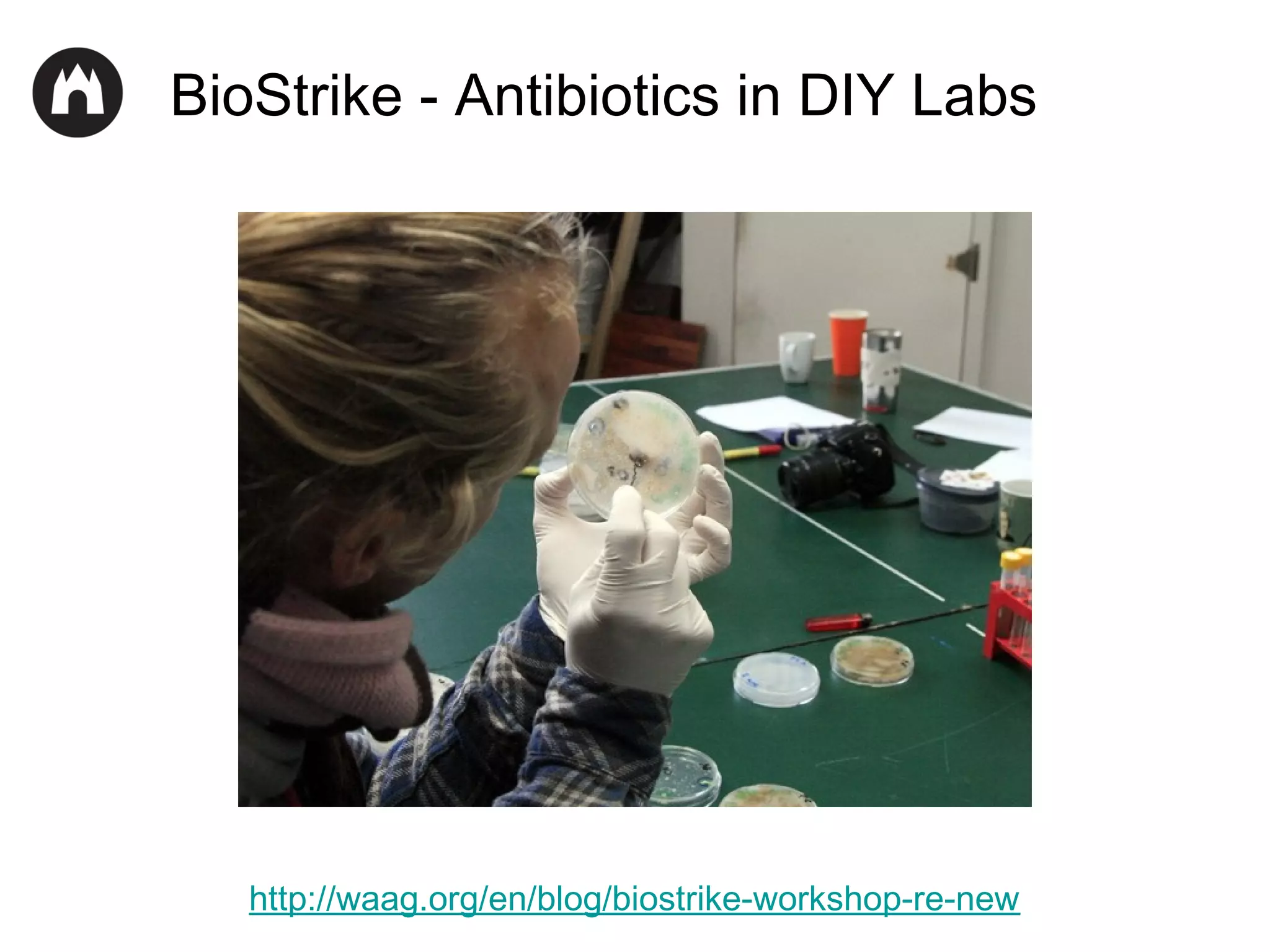
BioStrike - Antibiotics in DIY Labs

http://waag.org/en/blog/biostrike-workshop-re-new
What Should Cities Do?
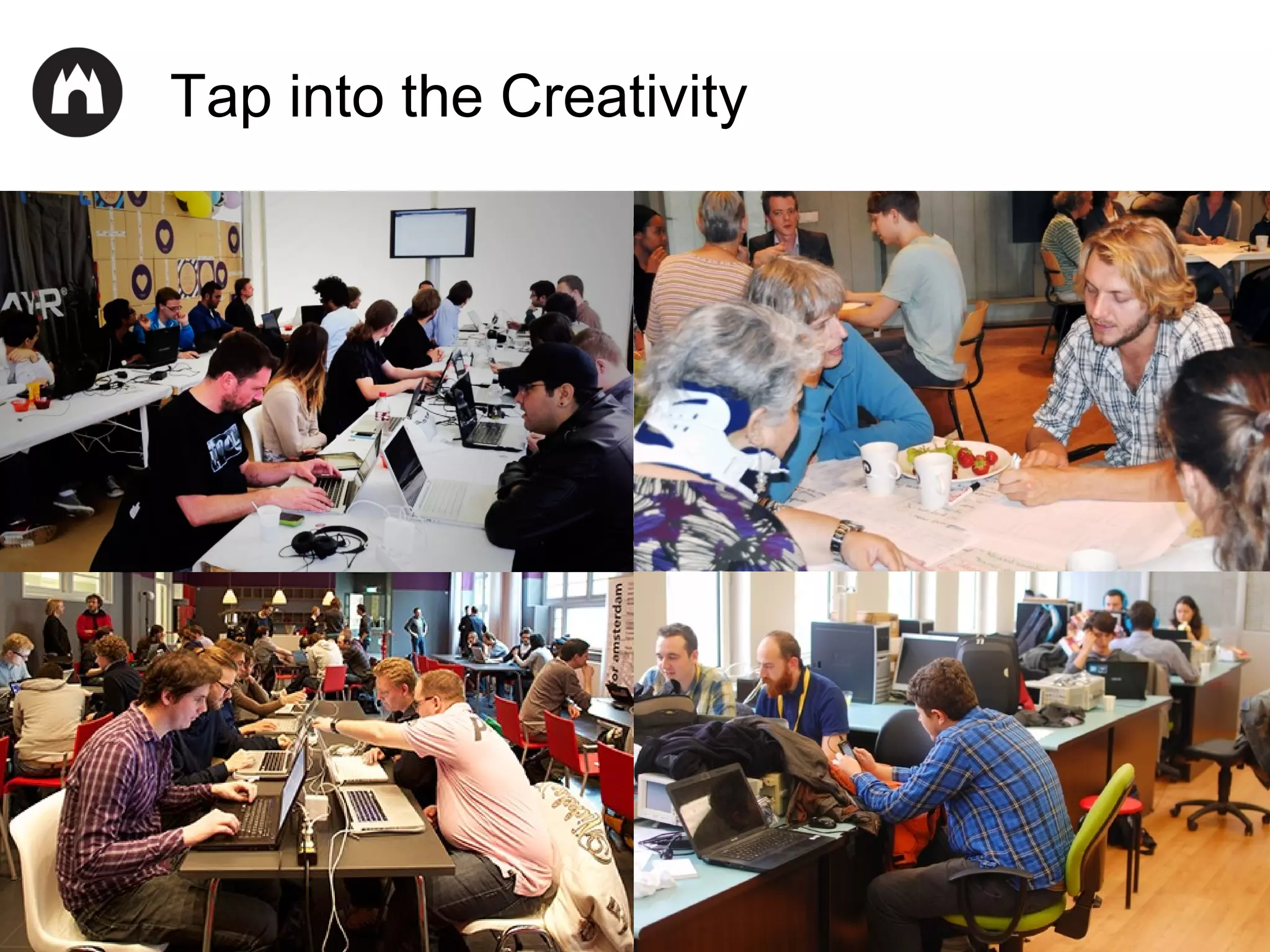
Tap into the Creativity
Design Rules for Smarter Cities
• Your citizens know more than you.
• Prototype early and fast, engage the stakeholders, iterate quickly and be
prepared to start all over.
• Embrace self-organisation and civic initiative, but help to make the
results sustainable and scalable.
• Know what you are talking about in the face of technology. Never rely
on consultants that will sell you consultancy, not solutions.
• Have binding decisions made at the lowest level possible and actively
preach self-governance.
• Favor loosely coupled, smaller systems over monoliths and mastodons,
and use peer-defined standards to glue together the parts. Small systems
tend to fail sometimes; large systems fail for sure.
• To raise and deserve trust, build systems based on data reciprocity and
transparency.
• Reuse existing parts and design your additions for reuse, adding to the
public domain and thereby strengthening its capacity to act and learn.
http://waag.org/nl/blog/design-rules-smarter-cities
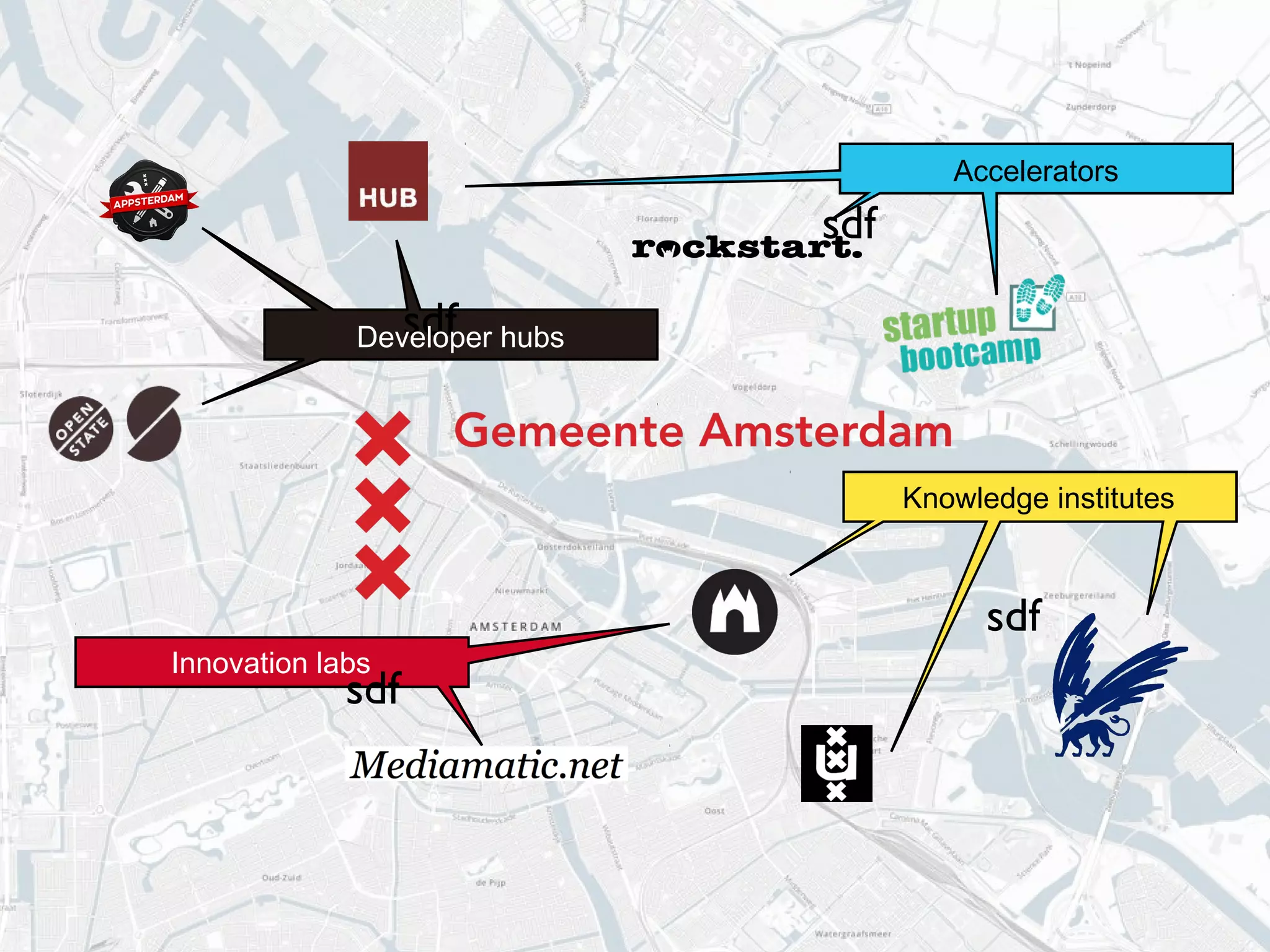
Accelerators

sdf
sdf
Developer hubs

Knowledge institutes

Innovation labs

sdf

sdf
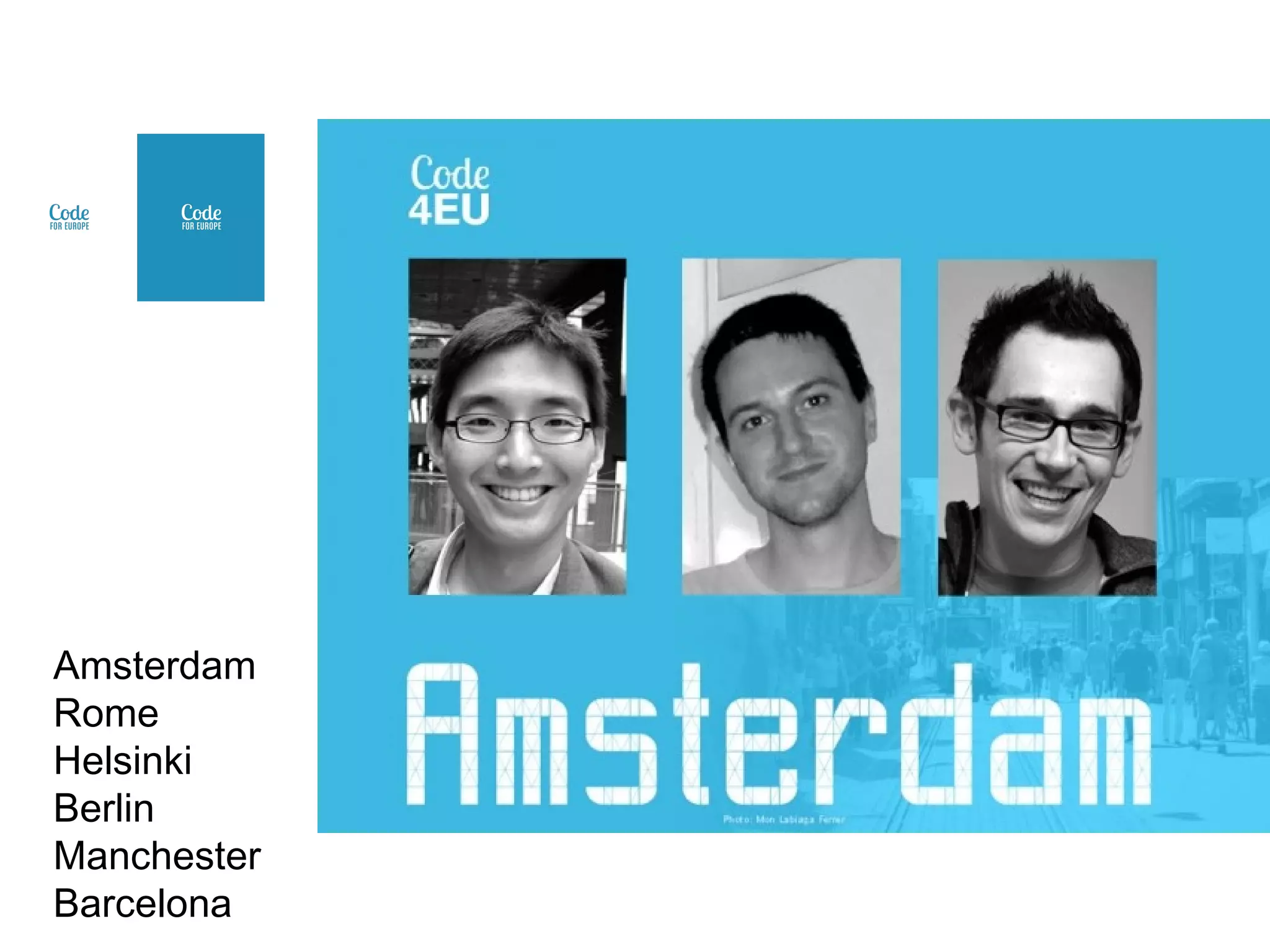
Amsterdam
Rome
Helsinki
Berlin
Manchester
Barcelona
Users as Designers

http://waag.org/en/project/users-designers
Embrace Civic Hacking.
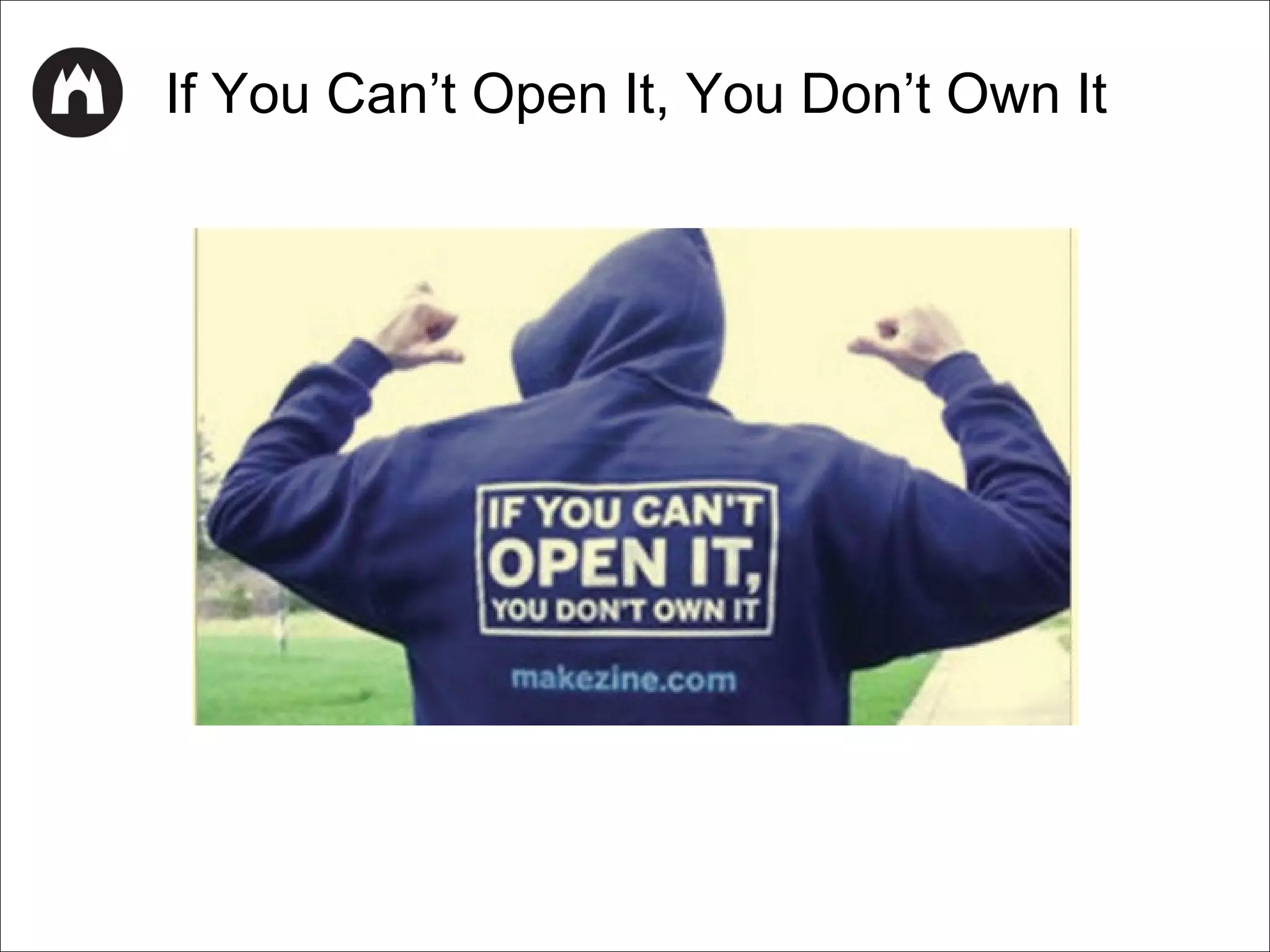
If You Can’t Open It, You Don’t Own It
Pointers
• Design Rules for Smarter Cities
http://waag.org/nl/blog/design-rules-smarter-cities
• Smart Citizens Publication
http://futureeverything.org/publications/smart-citizens/
• Digital Social Innovation
http://digitalsocial.eu/
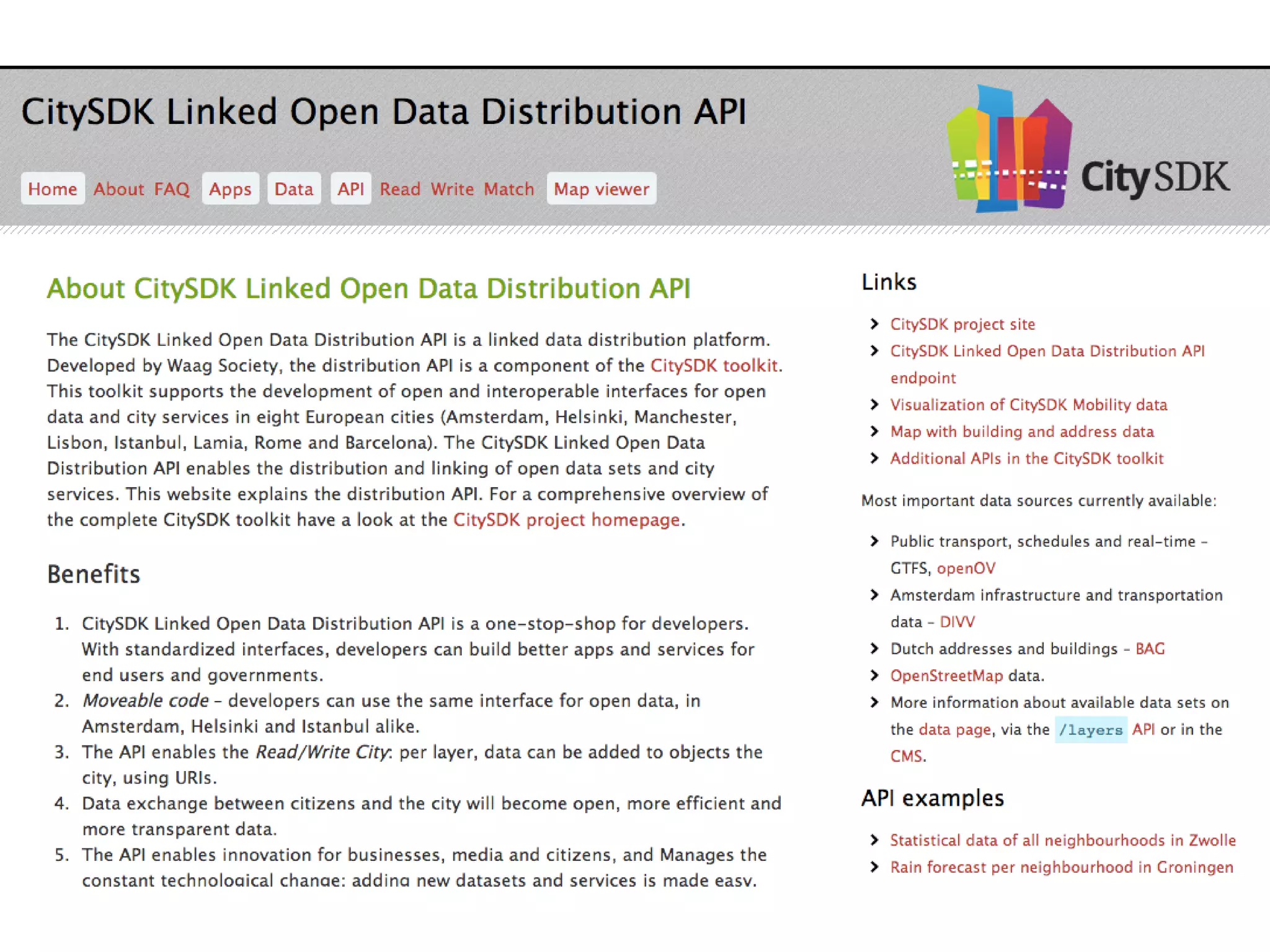
• CitySDK
http://www.citysdk.eu/
• Users as Designers
http://waag.org/nl/project/users-designers
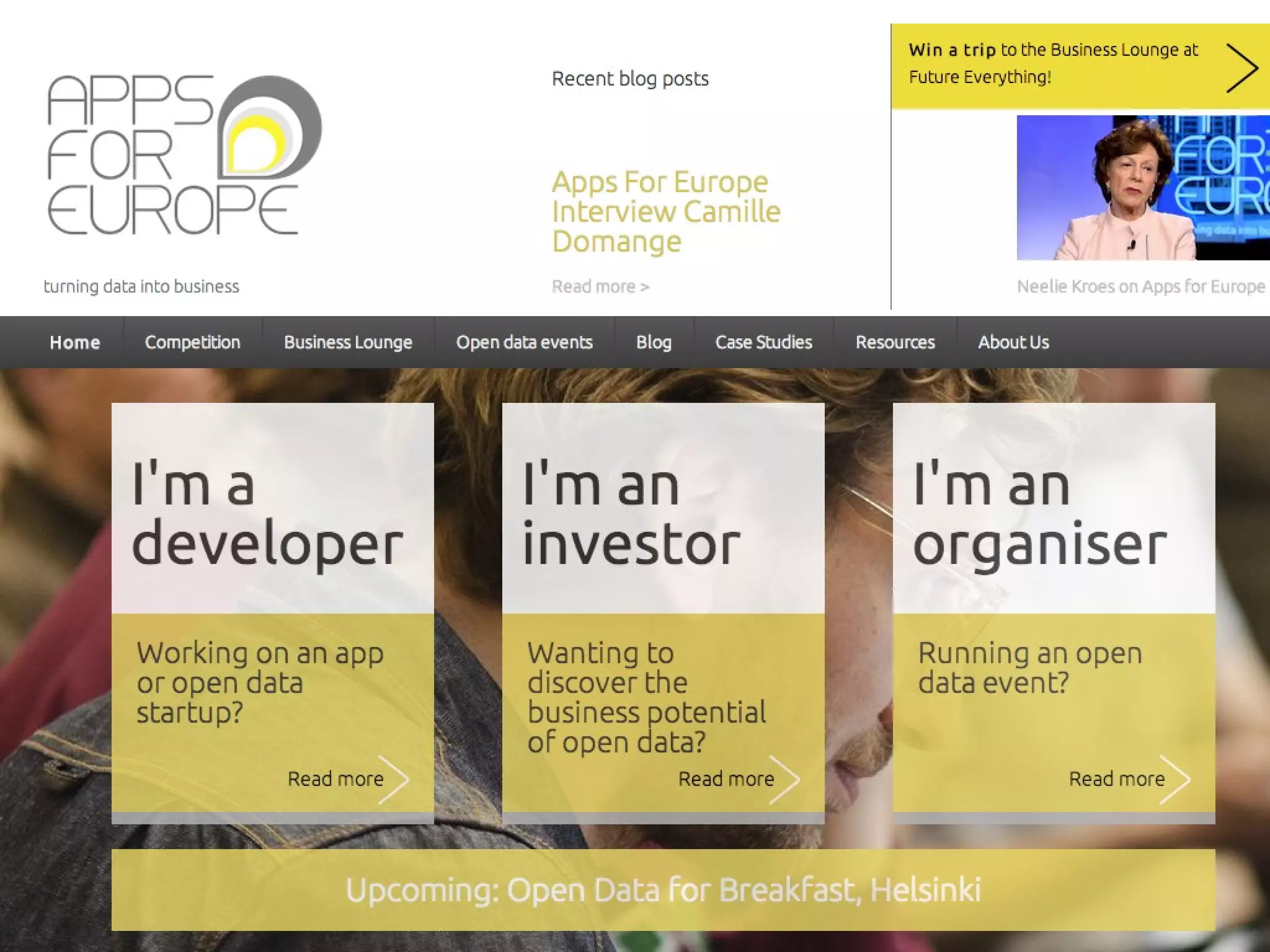
• Apps for Europe - Turning Data into Business
http://www.appsforeurope.eu/
Thanks!
Frank Kresin - @kresin

Piet Heinkade 181 a
1019 HC Amsterdam
waag.org

Civic Hacking & Digital Social Innovation

  • 1.
    Civic Hacking Frank Kresin ResearchDirector @kresin / frank@waag.org
  • 3.
    smart citizen manifesto We,citizens of all cities, take the fate of the places we live in into our own hands. We care about the familiar buildings and the parks, the shops, the schools, the roads and the trees, but far more about the quality of the life we live in them. About the casual interactions, uncalled for encounters, the craze and the booze and the love we lost and found. We know that our lives are interconnected, and what we do here will impact the outcomes over there. While we can never predict the eventual effect of our actions, we take full responsibility to make this world a better place. Therefore, we will refuse to be consumers, client and informants only, and reclaim agency towards the processes, algorithms and systems that shape our world. We need to know how decisions are made, we need to have the information that is at hand; we need to have direct access to the people in power, and be involved in the crafting of laws and procedures that we grapple with everyday. Fortunately, we are not alone. We are well educated and have appropriated the tools to connect at the touch of a button, organize ourselves, make our voices heard. We have the tools to measure ourselves and our environment, to visualize and analyse the data, to come to conclusions and take action. We have continuous access to the best of learning in the world, to powerful phones and laptops and software, and to home-grown labs that help us make the things that others won’t. Furthermore we were inspired by such diverse examples as the 1% club, Avaaz, Kickstarter, Couchsurfing, Change by Us, and many, many more. We are ready. But government is not. It was shaped in the 18th century, but increasingly struggles with 21st century problems it cannot solve. It lost touch with its citizens and is less and less equipped to provide the services and security it had pledged to offer. While it tries to build ‘smart cities’ that reinforce or strengthen the status quo - that was responsible for the problems in the first place - it loses sight of the most valuable resource it can tap into: the smart citizen. Smart Citizens: Therefore, we will refuse to be consumers, client and informants only, and reclaim agency towards the processes, algorithms and systems that shape our world. Will take responsibility for the place they live, work and love in; Value access over ownership, contribution over power; Will ask forgiveness, not permission; Know where they can get the tools, knowledge and support they need; Value empathy, dialogue and trust; Appropriate technology, rather than accept it as is; Will help the people that struggle with smart stuff; Ask questions, then more questions, before they come up with answers; Actively take part in design efforts to come up with better solutions; Work agile, prototype early, test quickly and know when to start over; Will not stop in the face of seemingly huge boundariesbarriers; Unremittingly share their knowledge and their learning, because they know this is where true value comes from. All over the world, smart citizens take action. We self-organise, form cooperations, share resources and take back full responsibility for the care of our children and elderly. We pop up restaurants, harvest renewable energy, maintain urban gardens, build temporary structures and nurture compassion and trust. We kickstart the products and services we care about, repair and upcycle, or learn how to manufacture things ourselves. We even coined new currencies in response to events that recently shook our comfortable world, but were never solved by the powers that be. Until now, we have mostly worked next to governments, sometimes against them, but hardly ever with them. As a result, many of the initiatives so far have been one-offs, inspiring but not game changing. We have put lots of energy into small-scale interventions that briefly flared and then returned to business as usual. Just imagine what will happen if our energy, passion and knowledge are teamed up by governments that know how to implement and scale up. Governments that take full responsibility for participating in the open dialogue that is needed to radically rethink the systems that were built decades ago. One day we will wake up and realise WE ARE OUR GOVERNMENT. Without us, there is nobody there. As it takes a village to raise a child, it takes a people to craft a society. We know it can be done; it was done before. And with the help of new technologies it is easier than ever. So let’s actively set out to build truly smart cities, with smart citizens at their helms, and together become the change that we want to see in this world. waag.org/nl/blog/manifesto-smart-citizens
  • 4.
  • 5.
  • 6.
  • 7.
    Principles: Best Producer isthe User He can learn to make anything Sharing will make you grow Making is crucial
  • 9.
  • 10.
  • 12.
  • 13.
    Digital Social Innovation ‘atype of social and collaborative innovation in which innovators, users and communities collaborate through digital platforms to co-create knowledge and solutions for a wide range of social needs and at a scale that was unimaginable before the rise of Internet-enabled platforms’
  • 14.
  • 15.
    Network Effect ofthe Internet Bottom-up & grassroots (open source, open data, open hardware, open knowledge) P2P, e-democracy CAPS, DSI, web entrepreneurship Distributed Commons Competition Top down and systemic approaches European Innovation Partnerships, Smart Cities, FI-PPP; Cloud strategy; challenge.gov eHealth, eGovernment Central
  • 16.
    Data Driven EcologyTrends Open Networks innovative combinations of network solutions and infrastructures, e.g. sensor networks, free interoperable network services, open Wifi, bottom up-broadband, distributed social networks, p2p infrastructures Open Data innovative ways to capture, use, analyse, and interpret open data coming from people and from the environment Open Knowledge co-production of new knowledge and crowd mobilisation based on open contents, open source and open access Open Hardware new ways of making and using open hardware solutions Classification towards creating a data-driven Ecology suggested by MIT, Bollier and Clippinger 2013 Emergent tools/methods • Apps • Alternative currency • Citizen science • Cloud • Collaborative consumption • Crowdfunding • Crowdsourcing • Crowdmapping • Crowdcampaining • Citizen Journalism • Data Visualization • DIY • DIY Bio • E-petitions • Geotagging • Online learning models • Online notice board • Online market place • Personal monitoring • P2P • Peer support • Social networks • Etc, etc....
  • 17.
    Digital Social InnovationMatrix http://digitalsocial.eu/
  • 23.
  • 24.
  • 25.
  • 26.
  • 27.
    BioStrike - Antibioticsin DIY Labs http://waag.org/en/blog/biostrike-workshop-re-new
  • 28.
  • 29.
    Tap into theCreativity
  • 30.
    Design Rules forSmarter Cities • Your citizens know more than you. • Prototype early and fast, engage the stakeholders, iterate quickly and be prepared to start all over. • Embrace self-organisation and civic initiative, but help to make the results sustainable and scalable. • Know what you are talking about in the face of technology. Never rely on consultants that will sell you consultancy, not solutions. • Have binding decisions made at the lowest level possible and actively preach self-governance. • Favor loosely coupled, smaller systems over monoliths and mastodons, and use peer-defined standards to glue together the parts. Small systems tend to fail sometimes; large systems fail for sure. • To raise and deserve trust, build systems based on data reciprocity and transparency. • Reuse existing parts and design your additions for reuse, adding to the public domain and thereby strengthening its capacity to act and learn. http://waag.org/nl/blog/design-rules-smarter-cities
  • 31.
  • 34.
  • 37.
  • 38.
  • 40.
    If You Can’tOpen It, You Don’t Own It
  • 41.
    Pointers • Design Rulesfor Smarter Cities http://waag.org/nl/blog/design-rules-smarter-cities • Smart Citizens Publication http://futureeverything.org/publications/smart-citizens/ • Digital Social Innovation http://digitalsocial.eu/ • CitySDK http://www.citysdk.eu/ • Users as Designers http://waag.org/nl/project/users-designers • Apps for Europe - Turning Data into Business http://www.appsforeurope.eu/
  • 42.
    Thanks! Frank Kresin -@kresin Frank Kresin - @kresin Frank Kresin - @kresin Piet Heinkade 181 a 1019 HC Amsterdam waag.org

Editor's Notes

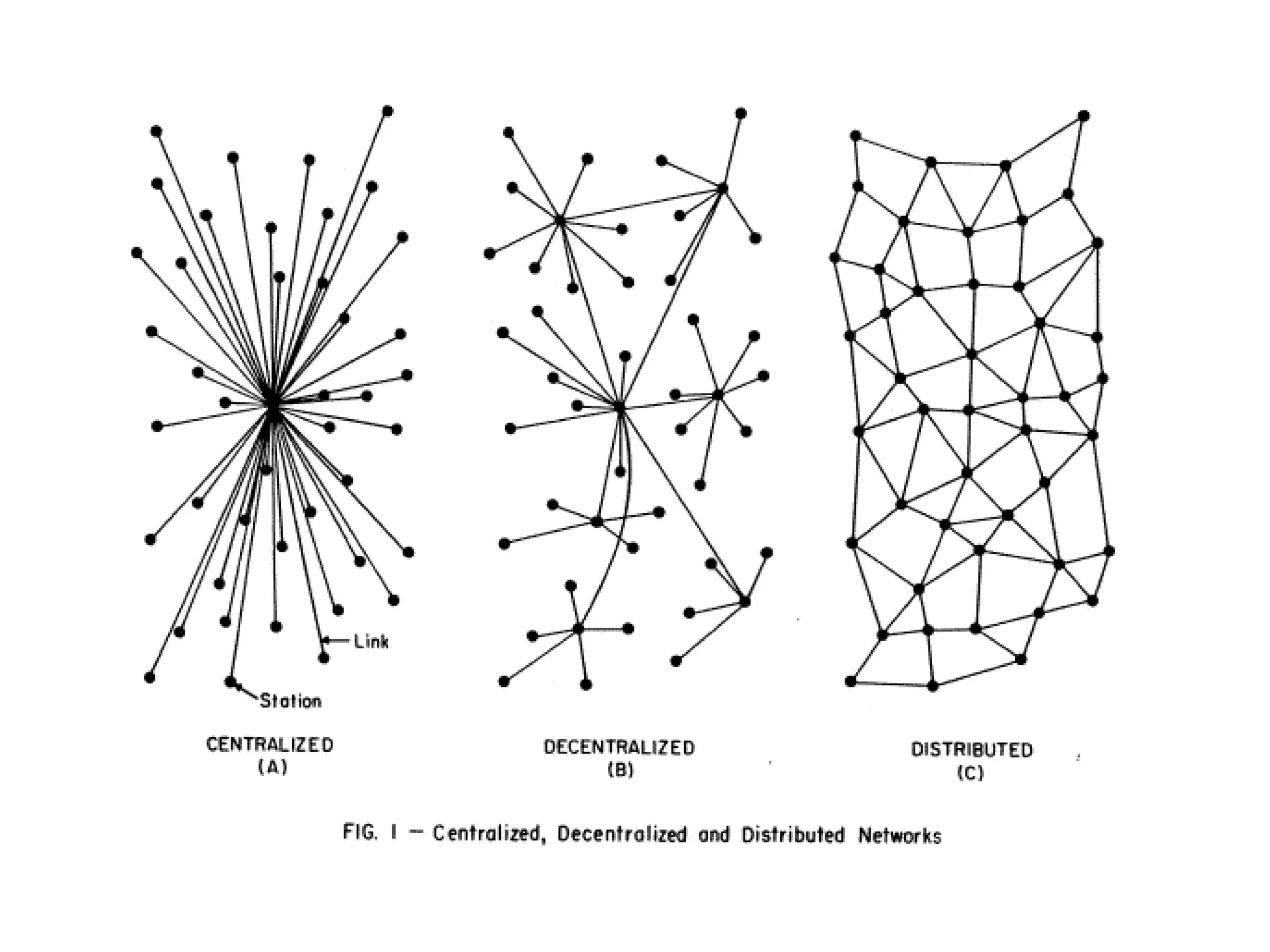
  • #12 1964 RAND study by Paul Baran http://cyberingdemocracy.com/technology/w3c-real-time-comm-group
  • #40 1964 RAND study by Paul Baran http://cyberingdemocracy.com/technology/w3c-real-time-comm-group