PLASTIC SURGERY
Prepared By
Mrs. LITHA THOMAS
M.Sc {N}
By :- Ms. Litha Thomas, Asst Prof,
Sumandeep Nursing College, SVDU
Definition
• Plastic surgery is a medical speciality
concerned with the correction or
restoration of form and function of the
body structures damaged by trauma,
disease process, aging, or congenital
defects
By :- Ms. Litha Thomas, Asst Prof,
Sumandeep Nursing College, SVDU
GOALS
• Correction of perceived disfigurement
• Restoration of impaired function
• Improvement of physical Appearance
• Correction of congenital or acquired
deformity
• Psychological benefits
By :- Ms. Litha Thomas, Asst Prof,
Sumandeep Nursing College, SVDU
Can be divided into 2 major areas
1] Reconstructive Surgery
2] Cosmetic (Aesthetic) Surgery
By :- Ms. Litha Thomas, Asst Prof,
Sumandeep Nursing College, SVDU
1] Reconstructive Surgery
• Reconstructive Surgery is use of surgery to
restore the form and function of the body
and to approximate a normal appearance
• Eg :-
–in burns,
–congenital deformities like cleft palate,
cleft lip
–Infection, disease
–Removal of cancer or tumours.
By :- Ms. Litha Thomas, Asst Prof,
Sumandeep Nursing College, SVDU
Reconstructive modalities
1) SKIN GRAFTING
By :- Ms. Litha Thomas, Asst Prof,
Sumandeep Nursing College, SVDU
1) SKIN GRAFTING
• It is a type of medical grafting involving the
transfer or the transplantation of a section of
skin from one place and transferring it as free
tissue to the recipient site or injured site.
By :- Ms. Litha Thomas, Asst Prof,
Sumandeep Nursing College, SVDU
Indications
 Extensive wounds or trauma
 Burns
 Specific surgeries that may require
skin grafting for healing
 Cosmetic reasons
 Areas of infection with skin loss
By :- Ms. Litha Thomas, Asst Prof,
Sumandeep Nursing College, SVDU
Classification
A) BY SOURCE OF GRAFT
1. Autograft
2. Allograft
3. XenoGraft
B) BY THICKNESS
1. Split Thickness Graft
2. Full Thickness Graft
3. Composite Graft
By :- Ms. Litha Thomas, Asst Prof,
Sumandeep Nursing College, SVDU
C) OTHER AUTOGRAFTS
1. Sheet AutoGraft
2. Meshed Autograft
3. Cultured Epithelial Autograft
By :- Ms. Litha Thomas, Asst Prof,
Sumandeep Nursing College, SVDU
1. Autograft
• It is a tissue or a skin obtained from the
patients own body from any other healthy
or unburned area
2. Allograft
• It is a tissue or a skin obtained from a donor
of the same species, like from another
human being
3. XenoGraft
• It is a tissue or a skin obtained from a donor
of the different species, like from a pig etc
By :- Ms. Litha Thomas, Asst Prof,
Sumandeep Nursing College, SVDU
Based on
thickenss
 STSG
 FTSG
doctoraroju@yahoo.com
By :- Ms. Litha Thomas, Asst Prof,
Sumandeep Nursing College, SVDU
Based of Thickness
1. Split Thickness Graft (STG) :-
STG is a skin graft including the epidermis and
part of the dermis
The epidermis is split in layers rather than
taken as full
Thickness depends on donor site and need of
patient
By :- Ms. Litha Thomas, Asst Prof,
Sumandeep Nursing College, SVDU
• They are used frequently because they can
cover large areas and rate of auto rejection is
low
• STG is taken by shaving the surface layer of
the skin with a large knife called as a
‘Dermatome”
By :- Ms. Litha Thomas, Asst Prof,
Sumandeep Nursing College, SVDU
• 2) Full Thickness Graft (FTG) :-
• FTG consist of a thick layer of skin, including
the epidermis and dermis
• The donor site is either sutured, closed
directly or covered by STG
By :- Ms. Litha Thomas, Asst Prof,
Sumandeep Nursing College, SVDU
DIFFERENCE
doctoraroju@yahoo.com
By :- Ms. Litha Thomas, Asst Prof,
Sumandeep Nursing College, SVDU
3) Composite Graft
• It consists of combination of skin and fat, skin
and cartilage or dermis and fat.
• Mainly used for 3D reconstruction
• Eg :- Skin and cartilage of ear may be used
for reconstruction of the nose
By :- Ms. Litha Thomas, Asst Prof,
Sumandeep Nursing College, SVDU
Types…
Composite graft
 2 tissue elements
 Skin & cartilage
doctoraroju@yahoo.com
By :- Ms. Litha Thomas, Asst Prof,
Sumandeep Nursing College, SVDU
C) OTHER AUTOGRAFTS
1) Sheet Autograft :-
• It is applied to the excised wound bed
without any alteration in its integrity.
• Used to graft in visible areas such as hands,
face,neck etc.
By :- Ms. Litha Thomas, Asst Prof,
Sumandeep Nursing College, SVDU
Sheet autograft
By :- Ms. Litha Thomas, Asst Prof,
Sumandeep Nursing College, SVDU
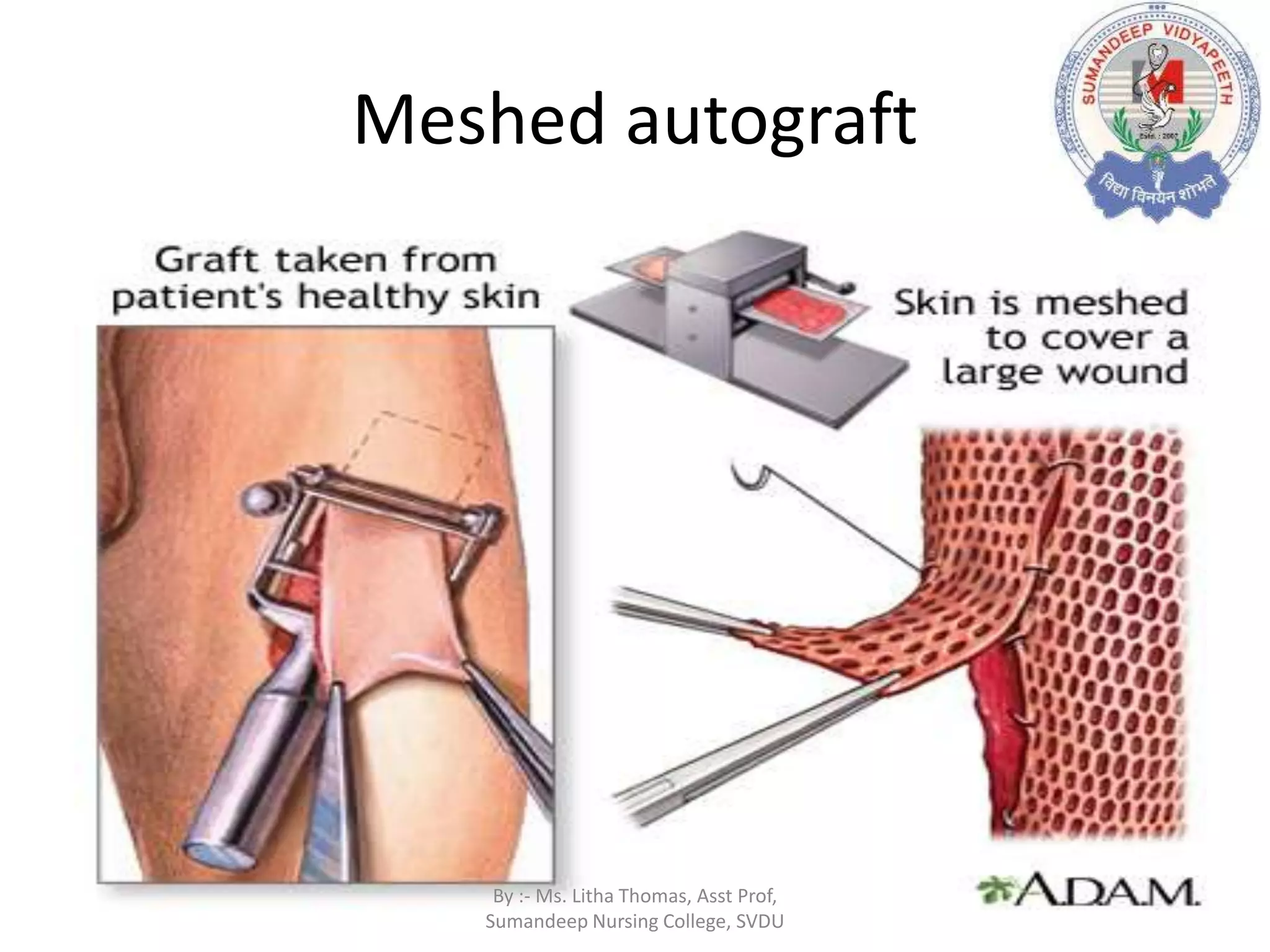
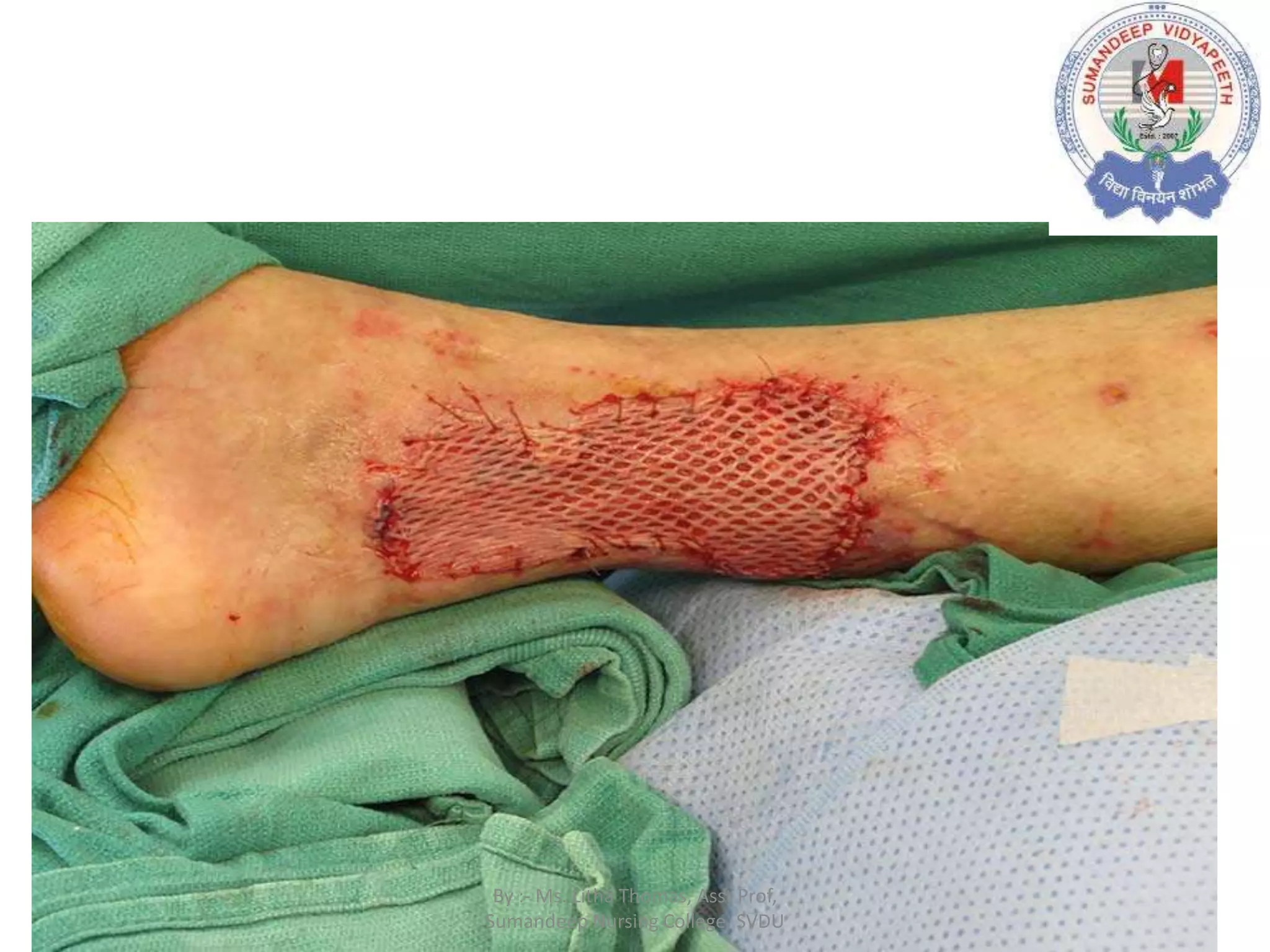
2) Meshed Autograft :-
• It contains many little slits that allow for the
expansion of donor skin.
• Meshing permits coverage of larger areas of
irregularly shaped wounds and allows for
drainage from a bleeding wound bed
• After healing the pattern of the meshed
autograft remains visible. So it is used on
hidden body areas.
By :- Ms. Litha Thomas, Asst Prof,
Sumandeep Nursing College, SVDU
Meshed autograft
By :- Ms. Litha Thomas, Asst Prof,
Sumandeep Nursing College, SVDU
By :- Ms. Litha Thomas, Asst Prof,
Sumandeep Nursing College, SVDU
By :- Ms. Litha Thomas, Asst Prof,
Sumandeep Nursing College, SVDU
By :- Ms. Litha Thomas, Asst Prof,
Sumandeep Nursing College, SVDU
3) Cultured Epithelial Autografting
• Technique used for closing massive burn
wound
• A full thickness skin specimen is taken from
an uninjured body site.
• The specimen is sent to laboratory for culture
and growth
• Typically in 3 to 4 weeks several sheets of
cultured epithelial autografts are ready to
application.
• It is applied and secured with staples
By :- Ms. Litha Thomas, Asst Prof,
Sumandeep Nursing College, SVDU
THE DONOR SITE
• The area from which the normal healthy
unburned skin is removed for grafting is
called as donor site
• Main donor sites are buttocks, thighs and
upper arm
• In case of FTG, sutures are taken, and in case
of STG, dressing is applied
• Donor site will be painful, so pain Mx is done
• After healing,some lubrication lotions can be
applied.
By :- Ms. Litha Thomas, Asst Prof,
Sumandeep Nursing College, SVDU
PROCEDURE OF STG
• Donor and reciepient site is prepared
• Donor skin is harvested.
• The harvesting area is layered with liquid
paraffin, mineral oil or surgical water-based
lubricating gel to reduce friction and facilitate
harvesting.
• The donor site is put on tension by the assistant
and the dermatome engaged on the skin surface
at an angle of approximately 45 degrees and
gently pushed forward while exerting a modest
amount of downward pressure on the
dermatome. By :- Ms. Litha Thomas, Asst Prof,
Sumandeep Nursing College, SVDU
• The skin will come off the blade as the
dermatome is moved forward. At the
completion of the harvest, the dermatome is
lifted, which usually severs the graft.
• If the graft does not come completely off the
donor site, a scalpel can be used to complete the
final cut. The graft is then transferred to the
recipient site or meshed prior to transfer.
• The grafts can be secured at recipient site using
staples, sutures, or tissue glue. ,
By :- Ms. Litha Thomas, Asst Prof,
Sumandeep Nursing College, SVDU
• Intraoperatively, while the graft is being
meshed and inset into the recipient site,
hemostasis at the donor site can be achieved
using gauze soaked in a solution of one liter
normal saline and one ampoule of 1:1000
epinephrine.
• Local anesthesia (generally bupivacaine 0.5%
with epinephrine) can be infiltrated at the
donor site to provide pain relief in the
perioperative period.
• STSG donor sites are subsequently covered
with a nonadherent dressing.
By :- Ms. Litha Thomas, Asst Prof,
Sumandeep Nursing College, SVDU
PROCEDURE OF FTG
• Harvesting can be performed using local
anesthesia if the size of the graft harvesting is
small. Otherwise, the procedure is performed
with additional sedation or under general
anesthesia.
• The area is shaved and marked, and
tumescent infiltration with a local anesthetic
and/or epinephrine mixed with saline is
performed at the donor and burn wound sites
By :- Ms. Litha Thomas, Asst Prof,
Sumandeep Nursing College, SVDU
• A full-thickness skin graft is
harvested free-hand using a
scalpel, without the use of a
dermatome.
• The incision is made with a scalpel,
and sharp dissection of the full
thickness of skin is performed. The
use of electrocautery during graft
harvest should be minimized to
minimize thermal injury to the
graft.
By :- Ms. Litha Thomas, Asst Prof,
Sumandeep Nursing College, SVDU
• The wound is debrided and must be
free of a hematoma, exudate, or
infection.
• The full-thickness skin graft is inset
into the recipient site and sutured into
place using fine, rapidly absorbable
sutures
• Full-thickness skin graft donor sites are
managed by meticulous hemostasis
and primary closure with absorbable
or nonabsorbable sutures, ensuring
there is no tension on the wound.
By :- Ms. Litha Thomas, Asst Prof,
Sumandeep Nursing College, SVDU
• If the application of the skin graft to the
wound is delayed, usually because of an
infected wound bed, the skin graft may be
stored for up to seven days at 4°C after being
wrapped in saline-soaked gauze
By :- Ms. Litha Thomas, Asst Prof,
Sumandeep Nursing College, SVDU
By :- Ms. Litha Thomas, Asst Prof,
Sumandeep Nursing College, SVDU
By :- Ms. Litha Thomas, Asst Prof,
Sumandeep Nursing College, SVDU
The graft is harvested
by applying steady
pressure to the skin
with the dermatome
while advancing it
forward.
The assistant retracts
the skin to optimize
contact between
blade and skin
doctoraroju@yahoo.com
By :- Ms. Litha Thomas, Asst Prof,
Sumandeep Nursing College, SVDU
GRAFT ADHERANCE
• It is dependent on formation of fibrin
bond between the recipient area and the
graft
• There is no vascular connection between
the graft and recipient site
• Graft held in place only by weak fibrin
bonds and is nourished by the diffusion
of serum from the wound bed
• A pressure bandage is applied over the
graft recipient area
By :- Ms. Litha Thomas, Asst Prof,
Sumandeep Nursing College, SVDU
• Special vaccum apparatus (NPWT) or a
needle is used to aspirate or remove
the drainage for first 3 to 5 days to
increase grafts chance of survival
• Simultaneously, serous fluid containing
erythrocytes(red blood cells) and
polymorphonucleocytes (whitecells),
accumulates betweenthe skin graft and
the woundbed, leaked from the
smallestveins (venules) in the wound
bed.
By :- Ms. Litha Thomas, Asst Prof,
Sumandeep Nursing College, SVDU
• There are severed vessels within the
skin graft which dilate and capillary
action draws this serous fluid into
them to provide nutrition for the graft
tissues.
• This process is known as plasmatic
(serous) imbibition.
• Capillary inosculation (growth of new
blood vessels) start in first 36 hours
By :- Ms. Litha Thomas, Asst Prof,
Sumandeep Nursing College, SVDU
• Innosculation occurs when severed
blood vessels in the skin graft
anastomose or unite with the severed
ends of vessels of approximately the
same diameter in the wound bed.
• Followed by formation of new skin
cells
• Graft begins to stabilize after 3 days as
fibrovascular and collagen network
form and provide durability to the graft
By :- Ms. Litha Thomas, Asst Prof,
Sumandeep Nursing College, SVDU
POST OPERATIVE CARE
• Frequent assessment of donor and
recipient site for healing, signs of graft
adherance, bleeding, infection.
• Pain control
• Keep donor site dry
• Regular dressing of recipient and donor site
• Immobilization of recipient site
• Increase intake of protein and calories
especially for recipients.
By :- Ms. Litha Thomas, Asst Prof,
Sumandeep Nursing College, SVDU
• Prevent Infection at both sites
• Avoid Strenious activities, stretching, itching
or scratching of the area.
• Protect the donor and recipient site from sun
exposure
• Use pressure garments in recipients to
prevent scarring
By :- Ms. Litha Thomas, Asst Prof,
Sumandeep Nursing College, SVDU
THANK YOU
VERY MUCH
By :- Ms. Litha Thomas, Asst Prof,
Sumandeep Nursing College, SVDU

Plastic surgery

  • 1.
    PLASTIC SURGERY Prepared By Mrs.LITHA THOMAS M.Sc {N} By :- Ms. Litha Thomas, Asst Prof, Sumandeep Nursing College, SVDU
  • 2.
    Definition • Plastic surgeryis a medical speciality concerned with the correction or restoration of form and function of the body structures damaged by trauma, disease process, aging, or congenital defects By :- Ms. Litha Thomas, Asst Prof, Sumandeep Nursing College, SVDU
  • 3.
    GOALS • Correction ofperceived disfigurement • Restoration of impaired function • Improvement of physical Appearance • Correction of congenital or acquired deformity • Psychological benefits By :- Ms. Litha Thomas, Asst Prof, Sumandeep Nursing College, SVDU
  • 4.
    Can be dividedinto 2 major areas 1] Reconstructive Surgery 2] Cosmetic (Aesthetic) Surgery By :- Ms. Litha Thomas, Asst Prof, Sumandeep Nursing College, SVDU
  • 5.
    1] Reconstructive Surgery •Reconstructive Surgery is use of surgery to restore the form and function of the body and to approximate a normal appearance • Eg :- –in burns, –congenital deformities like cleft palate, cleft lip –Infection, disease –Removal of cancer or tumours. By :- Ms. Litha Thomas, Asst Prof, Sumandeep Nursing College, SVDU
  • 6.
    Reconstructive modalities 1) SKINGRAFTING By :- Ms. Litha Thomas, Asst Prof, Sumandeep Nursing College, SVDU
  • 7.
    1) SKIN GRAFTING •It is a type of medical grafting involving the transfer or the transplantation of a section of skin from one place and transferring it as free tissue to the recipient site or injured site. By :- Ms. Litha Thomas, Asst Prof, Sumandeep Nursing College, SVDU
  • 8.
    Indications  Extensive woundsor trauma  Burns  Specific surgeries that may require skin grafting for healing  Cosmetic reasons  Areas of infection with skin loss By :- Ms. Litha Thomas, Asst Prof, Sumandeep Nursing College, SVDU
  • 9.
    Classification A) BY SOURCEOF GRAFT 1. Autograft 2. Allograft 3. XenoGraft B) BY THICKNESS 1. Split Thickness Graft 2. Full Thickness Graft 3. Composite Graft By :- Ms. Litha Thomas, Asst Prof, Sumandeep Nursing College, SVDU
  • 10.
    C) OTHER AUTOGRAFTS 1.Sheet AutoGraft 2. Meshed Autograft 3. Cultured Epithelial Autograft By :- Ms. Litha Thomas, Asst Prof, Sumandeep Nursing College, SVDU
  • 11.
    1. Autograft • Itis a tissue or a skin obtained from the patients own body from any other healthy or unburned area 2. Allograft • It is a tissue or a skin obtained from a donor of the same species, like from another human being 3. XenoGraft • It is a tissue or a skin obtained from a donor of the different species, like from a pig etc By :- Ms. Litha Thomas, Asst Prof, Sumandeep Nursing College, SVDU
  • 12.
    Based on thickenss  STSG FTSG doctoraroju@yahoo.com By :- Ms. Litha Thomas, Asst Prof, Sumandeep Nursing College, SVDU
  • 13.
    Based of Thickness 1.Split Thickness Graft (STG) :- STG is a skin graft including the epidermis and part of the dermis The epidermis is split in layers rather than taken as full Thickness depends on donor site and need of patient By :- Ms. Litha Thomas, Asst Prof, Sumandeep Nursing College, SVDU
  • 14.
    • They areused frequently because they can cover large areas and rate of auto rejection is low • STG is taken by shaving the surface layer of the skin with a large knife called as a ‘Dermatome” By :- Ms. Litha Thomas, Asst Prof, Sumandeep Nursing College, SVDU
  • 15.
    • 2) FullThickness Graft (FTG) :- • FTG consist of a thick layer of skin, including the epidermis and dermis • The donor site is either sutured, closed directly or covered by STG By :- Ms. Litha Thomas, Asst Prof, Sumandeep Nursing College, SVDU
  • 16.
    DIFFERENCE doctoraroju@yahoo.com By :- Ms.Litha Thomas, Asst Prof, Sumandeep Nursing College, SVDU
  • 17.
    3) Composite Graft •It consists of combination of skin and fat, skin and cartilage or dermis and fat. • Mainly used for 3D reconstruction • Eg :- Skin and cartilage of ear may be used for reconstruction of the nose By :- Ms. Litha Thomas, Asst Prof, Sumandeep Nursing College, SVDU
  • 18.
    Types… Composite graft  2tissue elements  Skin & cartilage doctoraroju@yahoo.com By :- Ms. Litha Thomas, Asst Prof, Sumandeep Nursing College, SVDU
  • 19.
    C) OTHER AUTOGRAFTS 1)Sheet Autograft :- • It is applied to the excised wound bed without any alteration in its integrity. • Used to graft in visible areas such as hands, face,neck etc. By :- Ms. Litha Thomas, Asst Prof, Sumandeep Nursing College, SVDU
  • 20.
    Sheet autograft By :-Ms. Litha Thomas, Asst Prof, Sumandeep Nursing College, SVDU
  • 21.
    2) Meshed Autograft:- • It contains many little slits that allow for the expansion of donor skin. • Meshing permits coverage of larger areas of irregularly shaped wounds and allows for drainage from a bleeding wound bed • After healing the pattern of the meshed autograft remains visible. So it is used on hidden body areas. By :- Ms. Litha Thomas, Asst Prof, Sumandeep Nursing College, SVDU
  • 22.
    Meshed autograft By :-Ms. Litha Thomas, Asst Prof, Sumandeep Nursing College, SVDU
  • 23.
    By :- Ms.Litha Thomas, Asst Prof, Sumandeep Nursing College, SVDU
  • 24.
    By :- Ms.Litha Thomas, Asst Prof, Sumandeep Nursing College, SVDU
  • 25.
    By :- Ms.Litha Thomas, Asst Prof, Sumandeep Nursing College, SVDU
  • 26.
    3) Cultured EpithelialAutografting • Technique used for closing massive burn wound • A full thickness skin specimen is taken from an uninjured body site. • The specimen is sent to laboratory for culture and growth • Typically in 3 to 4 weeks several sheets of cultured epithelial autografts are ready to application. • It is applied and secured with staples By :- Ms. Litha Thomas, Asst Prof, Sumandeep Nursing College, SVDU
  • 27.
    THE DONOR SITE •The area from which the normal healthy unburned skin is removed for grafting is called as donor site • Main donor sites are buttocks, thighs and upper arm • In case of FTG, sutures are taken, and in case of STG, dressing is applied • Donor site will be painful, so pain Mx is done • After healing,some lubrication lotions can be applied. By :- Ms. Litha Thomas, Asst Prof, Sumandeep Nursing College, SVDU
  • 28.
    PROCEDURE OF STG •Donor and reciepient site is prepared • Donor skin is harvested. • The harvesting area is layered with liquid paraffin, mineral oil or surgical water-based lubricating gel to reduce friction and facilitate harvesting. • The donor site is put on tension by the assistant and the dermatome engaged on the skin surface at an angle of approximately 45 degrees and gently pushed forward while exerting a modest amount of downward pressure on the dermatome. By :- Ms. Litha Thomas, Asst Prof, Sumandeep Nursing College, SVDU
  • 29.
    • The skinwill come off the blade as the dermatome is moved forward. At the completion of the harvest, the dermatome is lifted, which usually severs the graft. • If the graft does not come completely off the donor site, a scalpel can be used to complete the final cut. The graft is then transferred to the recipient site or meshed prior to transfer. • The grafts can be secured at recipient site using staples, sutures, or tissue glue. , By :- Ms. Litha Thomas, Asst Prof, Sumandeep Nursing College, SVDU
  • 30.
    • Intraoperatively, whilethe graft is being meshed and inset into the recipient site, hemostasis at the donor site can be achieved using gauze soaked in a solution of one liter normal saline and one ampoule of 1:1000 epinephrine. • Local anesthesia (generally bupivacaine 0.5% with epinephrine) can be infiltrated at the donor site to provide pain relief in the perioperative period. • STSG donor sites are subsequently covered with a nonadherent dressing. By :- Ms. Litha Thomas, Asst Prof, Sumandeep Nursing College, SVDU
  • 31.
    PROCEDURE OF FTG •Harvesting can be performed using local anesthesia if the size of the graft harvesting is small. Otherwise, the procedure is performed with additional sedation or under general anesthesia. • The area is shaved and marked, and tumescent infiltration with a local anesthetic and/or epinephrine mixed with saline is performed at the donor and burn wound sites By :- Ms. Litha Thomas, Asst Prof, Sumandeep Nursing College, SVDU
  • 32.
    • A full-thicknessskin graft is harvested free-hand using a scalpel, without the use of a dermatome. • The incision is made with a scalpel, and sharp dissection of the full thickness of skin is performed. The use of electrocautery during graft harvest should be minimized to minimize thermal injury to the graft. By :- Ms. Litha Thomas, Asst Prof, Sumandeep Nursing College, SVDU
  • 33.
    • The woundis debrided and must be free of a hematoma, exudate, or infection. • The full-thickness skin graft is inset into the recipient site and sutured into place using fine, rapidly absorbable sutures • Full-thickness skin graft donor sites are managed by meticulous hemostasis and primary closure with absorbable or nonabsorbable sutures, ensuring there is no tension on the wound. By :- Ms. Litha Thomas, Asst Prof, Sumandeep Nursing College, SVDU
  • 34.
    • If theapplication of the skin graft to the wound is delayed, usually because of an infected wound bed, the skin graft may be stored for up to seven days at 4°C after being wrapped in saline-soaked gauze By :- Ms. Litha Thomas, Asst Prof, Sumandeep Nursing College, SVDU
  • 35.
    By :- Ms.Litha Thomas, Asst Prof, Sumandeep Nursing College, SVDU
  • 36.
    By :- Ms.Litha Thomas, Asst Prof, Sumandeep Nursing College, SVDU
  • 37.
    The graft isharvested by applying steady pressure to the skin with the dermatome while advancing it forward. The assistant retracts the skin to optimize contact between blade and skin doctoraroju@yahoo.com By :- Ms. Litha Thomas, Asst Prof, Sumandeep Nursing College, SVDU
  • 38.
    GRAFT ADHERANCE • Itis dependent on formation of fibrin bond between the recipient area and the graft • There is no vascular connection between the graft and recipient site • Graft held in place only by weak fibrin bonds and is nourished by the diffusion of serum from the wound bed • A pressure bandage is applied over the graft recipient area By :- Ms. Litha Thomas, Asst Prof, Sumandeep Nursing College, SVDU
  • 39.
    • Special vaccumapparatus (NPWT) or a needle is used to aspirate or remove the drainage for first 3 to 5 days to increase grafts chance of survival • Simultaneously, serous fluid containing erythrocytes(red blood cells) and polymorphonucleocytes (whitecells), accumulates betweenthe skin graft and the woundbed, leaked from the smallestveins (venules) in the wound bed. By :- Ms. Litha Thomas, Asst Prof, Sumandeep Nursing College, SVDU
  • 40.
    • There aresevered vessels within the skin graft which dilate and capillary action draws this serous fluid into them to provide nutrition for the graft tissues. • This process is known as plasmatic (serous) imbibition. • Capillary inosculation (growth of new blood vessels) start in first 36 hours By :- Ms. Litha Thomas, Asst Prof, Sumandeep Nursing College, SVDU
  • 41.
    • Innosculation occurswhen severed blood vessels in the skin graft anastomose or unite with the severed ends of vessels of approximately the same diameter in the wound bed. • Followed by formation of new skin cells • Graft begins to stabilize after 3 days as fibrovascular and collagen network form and provide durability to the graft By :- Ms. Litha Thomas, Asst Prof, Sumandeep Nursing College, SVDU
  • 42.
    POST OPERATIVE CARE •Frequent assessment of donor and recipient site for healing, signs of graft adherance, bleeding, infection. • Pain control • Keep donor site dry • Regular dressing of recipient and donor site • Immobilization of recipient site • Increase intake of protein and calories especially for recipients. By :- Ms. Litha Thomas, Asst Prof, Sumandeep Nursing College, SVDU
  • 43.
    • Prevent Infectionat both sites • Avoid Strenious activities, stretching, itching or scratching of the area. • Protect the donor and recipient site from sun exposure • Use pressure garments in recipients to prevent scarring By :- Ms. Litha Thomas, Asst Prof, Sumandeep Nursing College, SVDU
  • 44.
    THANK YOU VERY MUCH By:- Ms. Litha Thomas, Asst Prof, Sumandeep Nursing College, SVDU