Inquiry is the investigation into an
idea, question, problem or issue. It
involves gathering information,
building knowledge and developing
deep understanding. Inquiry-based
learning encompasses the
processes of posing problems,
gathering information, thinking
creatively about possibilities,
making decisions and justifying
conclusions.
Information Literacy skills -
searching skills, communicating and sharing, finding and interpreting
information in print and electronic environments. Becoming selective and
discriminating.


Questioning skills
Sorting out “what I need to find out”, sub-questions, eliciting questions that
are deeper and more powerful


Thinking skills
Critical and analytical, creative and reflective
An information literate
       person...
•   Knows the question to ask to find the information

•   Knows how to access that information

•   Can sift and discern that information for relevance
    and reliability

•   Has a hunger and motivation to find things out

•   Can evaluate and use their new understanding
In an inquiry based classroom the children will
learn skills that are transferable to any context.
They will learn questioning skills, information
literacy skills, critical, creative and
metacognitive thinking skills, problem solving
and communication skills.
In such an environment children will have the
opportunity to ask questions, explore, discover,
analyse, understand, apply and communicate
understanding.
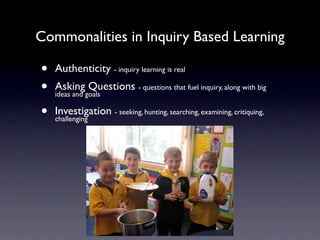
Commonalities in Inquiry Based Learning

•   Authenticity - inquiry learning is real
•   Asking Questions - questions that fuel inquiry, along with big
    ideas and goals

•   Investigation - seeking, hunting, searching, examining, critiquing,
    challenging
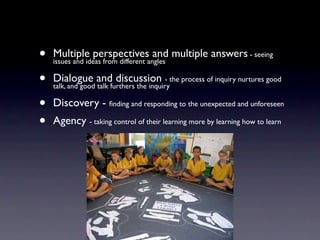
•   Multiple perspectives and multiple answers - seeing
    issues and ideas from different angles

•   Dialogue and discussion - the process of inquiry nurtures good
    talk, and good talk furthers the inquiry

•   Discovery - finding and responding to the unexpected and unforeseen
•   Agency - taking control of their learning more by learning how to learn
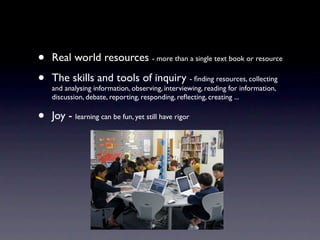
•   Real world resources - more than a single text book or resource

•   The skills and tools of inquiry - finding resources, collecting
    and analysing information, observing, interviewing, reading for information,
    discussion, debate, reporting, responding, reflecting, creating ...


•   Joy - learning can be fun, yet still have rigor
Supporting this approach at home

•   Share the “how to find out” with your children

•   Discourage copying and pasting or printing of large
    amounts of information

•   Ask questions that promote thinking

•   If children are asked to research at home, help them focus
    on the sub questions

•   Encourage them to use the search skills they have been
    taught

•   Keep in touch with their learning through Knowledge Net

Plastic f il for parents

  • 2.
    Inquiry is theinvestigation into an idea, question, problem or issue. It involves gathering information, building knowledge and developing deep understanding. Inquiry-based learning encompasses the processes of posing problems, gathering information, thinking creatively about possibilities, making decisions and justifying conclusions.
  • 3.
    Information Literacy skills- searching skills, communicating and sharing, finding and interpreting information in print and electronic environments. Becoming selective and discriminating. Questioning skills Sorting out “what I need to find out”, sub-questions, eliciting questions that are deeper and more powerful Thinking skills Critical and analytical, creative and reflective
  • 4.
    An information literate person... • Knows the question to ask to find the information • Knows how to access that information • Can sift and discern that information for relevance and reliability • Has a hunger and motivation to find things out • Can evaluate and use their new understanding
  • 6.
    In an inquirybased classroom the children will learn skills that are transferable to any context. They will learn questioning skills, information literacy skills, critical, creative and metacognitive thinking skills, problem solving and communication skills. In such an environment children will have the opportunity to ask questions, explore, discover, analyse, understand, apply and communicate understanding.
  • 7.
    Commonalities in InquiryBased Learning • Authenticity - inquiry learning is real • Asking Questions - questions that fuel inquiry, along with big ideas and goals • Investigation - seeking, hunting, searching, examining, critiquing, challenging
  • 8.
    Multiple perspectives and multiple answers - seeing issues and ideas from different angles • Dialogue and discussion - the process of inquiry nurtures good talk, and good talk furthers the inquiry • Discovery - finding and responding to the unexpected and unforeseen • Agency - taking control of their learning more by learning how to learn
  • 9.
    Real world resources - more than a single text book or resource • The skills and tools of inquiry - finding resources, collecting and analysing information, observing, interviewing, reading for information, discussion, debate, reporting, responding, reflecting, creating ... • Joy - learning can be fun, yet still have rigor
  • 10.
    Supporting this approachat home • Share the “how to find out” with your children • Discourage copying and pasting or printing of large amounts of information • Ask questions that promote thinking • If children are asked to research at home, help them focus on the sub questions • Encourage them to use the search skills they have been taught • Keep in touch with their learning through Knowledge Net