Searching over the past, present and 
future 
Roi Blanco (roi@yahoo-inc.com) 
http://labs.yahoo.com/Yahoo_Labs_Barcelona
Yahoo! Research Barcelona 
Established January, 2006 
Led by Ricardo Baeza-Yates 
Research areas 
• Web Mining 
• Social Media 
• Distributed Web retrieval 
• Geo information retrieval 
• NLP and Semantics
Agenda 
• Natural Language retrieval 
• Time and search engines 
• Searching over web archives 
• Searching on real time information 
• Caching! 
• Time-based exploratory search 
• Searching over future events 
• Future directions
Natural Language Retrieval 
• How to exploit the structure and meaning of 
natural language text to improve search 
• Current search engines perform only limited NLP 
(tokenization, stemming) 
• Automated tools exist for deeper analysis 
• Applications to diversity-aware search 
• Source, Location, Time, Language, Opinion, Ranking… 
• Search over semi-structured data, semantic search 
• Roll-out user experiences that use higher layers of 
the NLP stack 
• In this talk, focus on the time dimension
High-level Architecture of WSEs 
Cache Query 
results 
Runtime system 
Parser/ 
Tokenizer 
Index 
terms 
Engine 
queries 
Indexing pipeline 
W WWWWW
Web Search and time 
• Information freshness adds constraints/tensions in 
every layer of WSE 
• Architecture 
• Crawling 
• Indexing 
• Caching 
• Serving system 
• Modeling 
• Time-dependent user intent 
• UI (how to let the user take control) 
7
Adding the time dimension 
• Some solutions don’t scale up anymore 
Review your architecture 
Review your algorithms 
Add more machines (~$$$) 
• Some solutions don’t apply anymore 
Caching 
8
Evolution 
• 1999 
• Index updated ~once per month 
• Disk-based updates/indexing 
• 2001 
• In-memory indexes 
• Changes the whole-game! 
• 2007 
• Indexing time < 1 minute 
• Accept updates while serving 
• Now 
• Focused crawling, delayed transactions, etc. 
• Batch Updates -> Incremental processing 
9
Some landmarks 
• Reliable distributed storage 
• Some models/processes require millions of accesses 
• Massive parallelization 
• Map/Reduce – Hadoop 
• Semi-structured storage systems 
• Asynchronous item updates 
10
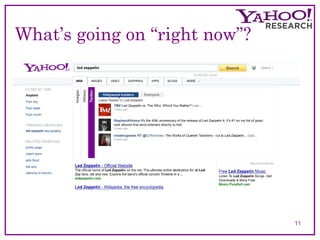
What’s going on “right now”? 
11
Query temporal profiles 
• Modeling 
• Time-dependent user intent 
• Implicitly time-qualified search queries 
• SIGIR 
• Dream theater barcelona 
• Barcelona vs Madrid 
• …. 
12
Caching for Real-Time Indexes 
• Queries are redundant (heavy-tail) and bursty 
• Caching search results saves up executing ~30/60% of the queries 
• Tens of machines do the work of 1000s 
• Dilemma: Freshness versus Computation 
• Extreme #1: do not cache at all – evaluate all queries 
• 100% fresh results, lots of redundant evaluations 
• Extreme #2: never invalidate the cache 
• A majority of stale results – results refreshed only due to 
cache replacement, no redundant work 
• Middle ground: invalidate periodically (TTL) 
• A time-to-live parameter is applied to each cached entry
•Problem: 
•In fast crawling, cache not always up-to-date (stale) 
•Solution: 
• Cache Invalidator Predictor - looks into new documents and 
invalidates queries accordingly 
• Using synopsis reduces 
the number of refreshes up 
to 30% compared to a time-to- 
live baseline 
14 
CACHING FOR INCREMENTAL INDEXES
Time(ly) opportunities 
Can we create new user experiences based on a deeper 
analysis and exploration of the time dimension? 
Goals: 
Build an application that helps users to explore, interact 
and ultimately understand existing information about 
the past and the future. 
Help the user cope with the information overload and 
eventually find/learn about what she’s looking for
Original Idea 
R. Baeza-Yates, Searching the Future, MF/IR 2005 
On December 1st 2003, on Google News, there were more than 100K 
references to 2004 and beyond. 
E.g. 2034: 
The ownership of Dolphin Square in London must revert to an 
insurance company. 
Voyager 2 should run out of fuel. 
Long-term care facilities may have to house 2.1 million people 
in the USA. 
A human base in the moon would be in operation.
17 
Time Explorer 
• Public demo since August 2010 
• For exploring news through time and into the 
future 
• Using a 1.8M news articles from New York Times 
Annotated Corpus 
• Try it at 
http://fbmya01.barcelonamedia.org:8080/future/
Time Explorer
19 
Time Explorer - Motivation 
 Time is important to search 
 Recency, particularly in news is highly related to 
relevancy 
 But, what about evolution over time? 
 How has a topic evolved over time? 
 How did the entities (people, place, etc) evolve with respect to the 
topic over time? 
 How will this topic continue to evolve over the future? 
 How does bias and sentiment in blogs and news change over time? 
 Google Trends, Yahoo! Clues, RecordedFuture … 
 Great research playground
20 
Time Explorer
21 
Collections 
 New York Times (1.8 million document) 
 Well structured 
 manual annotations 
 publically available 
 but, not diverse 
 Web Crawl Collection (100 news source and 500 
blogs sites) 
 Great for diversity 
 Challenge because of format, languages, structure, etc 
 Custom Collections 
 Yahoo! News
22 
Analysis Pipeline 
 Tokenization, Sentence Splitting, Part-of-speech 
tagging, chunking with OpenNLP 
 Entity extraction with SuperSense tagger 
 Time expressions extracted with TimeML 
 Explicit dates (August 23rd, 2008) 
 Relative dates (Next year, resolved with Pub Date) 
 Sentiment Analysis with LivingKnowledge 
 Ontology matching with Yago 
 Image Analysis – sentiment and face detection
23 
Indexing/Search 
• Lucene/Solr search platform to index and search 
– Sentence level 
– Document level 
• Facets for entity types 
• Index publication date and content date –extracted dates if 
they exists or publication date 
• Solr Faceting allows aggregation over query entity ranking 
and allowing for aggregating counts over time 
• Content date allows searching into the future
UI - Demo 
Time Explorer
UI - Demo
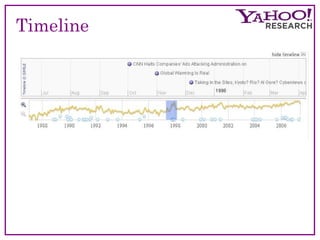
Timeline
Timeline - Document
Facets
Timeline – Facet Trend
Timeline – Future
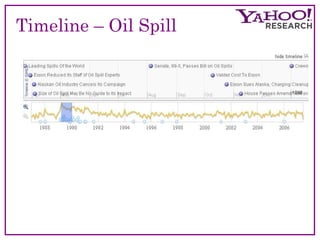
Timeline – Oil Spill
Oil Spill – Gulf of Mexico
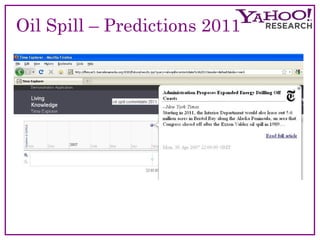
Oil Spill – Predictions 2011
UI - Snippets 
Snippet – With Source Summary 
Snippet – With image support – Negative Image
Ongoing Work 
• Better Sentiment Detection 
– How has sentiment towards a particular topic changed 
over time 
• Better Bias Detection 
– How does Fox News differ from NYT on presenting global 
warming 
• Future Mentions to Future Prediction 
– Which opinions to trust? 
– How to aggregate? 
• Move to web dataset 
– Domain shift – news to blogs 
– Noisy data – boilerplate, more date format, etc 
• Integrating multimedia data
36 
Any Questions? 
Thanks for your attention 
Joint work with Mike 
Matthews, Peter Mika, Jordi 
Atserias, Hugo Zaragoza and 
many others
References 
37 
•Caching Search Engine Results over Incremental Indices 
Roi Blanco; Edward Bortnikov; Flavio Junqueira; Ronny 
Lempel; Luca Telloli; Hugo Zaragoza, SIGIR'2010, 
•Searching through time in the New York Times Michael 
Matthews; Pancho Tolchinsky; Roi Blanco; Jordi 
Atserias; Peter Mika; Hugo Zaragoza, HCIR 2010, 2010 
•Ranking Related News Predictions Nattiya Kanhabua; 
Roi Blanco; Michael Matthews, SIGIR, 2011 
•Searching the future. Ricardo Baeza-Yates, MF/IR 
workshop 2005

Searching over the past, present and future

  • 1.
    Searching over thepast, present and future Roi Blanco (roi@yahoo-inc.com) http://labs.yahoo.com/Yahoo_Labs_Barcelona
  • 2.
    Yahoo! Research Barcelona Established January, 2006 Led by Ricardo Baeza-Yates Research areas • Web Mining • Social Media • Distributed Web retrieval • Geo information retrieval • NLP and Semantics
  • 3.
    Agenda • NaturalLanguage retrieval • Time and search engines • Searching over web archives • Searching on real time information • Caching! • Time-based exploratory search • Searching over future events • Future directions
  • 4.
    Natural Language Retrieval • How to exploit the structure and meaning of natural language text to improve search • Current search engines perform only limited NLP (tokenization, stemming) • Automated tools exist for deeper analysis • Applications to diversity-aware search • Source, Location, Time, Language, Opinion, Ranking… • Search over semi-structured data, semantic search • Roll-out user experiences that use higher layers of the NLP stack • In this talk, focus on the time dimension
  • 6.
    High-level Architecture ofWSEs Cache Query results Runtime system Parser/ Tokenizer Index terms Engine queries Indexing pipeline W WWWWW
  • 7.
    Web Search andtime • Information freshness adds constraints/tensions in every layer of WSE • Architecture • Crawling • Indexing • Caching • Serving system • Modeling • Time-dependent user intent • UI (how to let the user take control) 7
  • 8.
    Adding the timedimension • Some solutions don’t scale up anymore Review your architecture Review your algorithms Add more machines (~$$$) • Some solutions don’t apply anymore Caching 8
  • 9.
    Evolution • 1999 • Index updated ~once per month • Disk-based updates/indexing • 2001 • In-memory indexes • Changes the whole-game! • 2007 • Indexing time < 1 minute • Accept updates while serving • Now • Focused crawling, delayed transactions, etc. • Batch Updates -> Incremental processing 9
  • 10.
    Some landmarks •Reliable distributed storage • Some models/processes require millions of accesses • Massive parallelization • Map/Reduce – Hadoop • Semi-structured storage systems • Asynchronous item updates 10
  • 11.
    What’s going on“right now”? 11
  • 12.
    Query temporal profiles • Modeling • Time-dependent user intent • Implicitly time-qualified search queries • SIGIR • Dream theater barcelona • Barcelona vs Madrid • …. 12
  • 13.
    Caching for Real-TimeIndexes • Queries are redundant (heavy-tail) and bursty • Caching search results saves up executing ~30/60% of the queries • Tens of machines do the work of 1000s • Dilemma: Freshness versus Computation • Extreme #1: do not cache at all – evaluate all queries • 100% fresh results, lots of redundant evaluations • Extreme #2: never invalidate the cache • A majority of stale results – results refreshed only due to cache replacement, no redundant work • Middle ground: invalidate periodically (TTL) • A time-to-live parameter is applied to each cached entry
  • 14.
    •Problem: •In fastcrawling, cache not always up-to-date (stale) •Solution: • Cache Invalidator Predictor - looks into new documents and invalidates queries accordingly • Using synopsis reduces the number of refreshes up to 30% compared to a time-to- live baseline 14 CACHING FOR INCREMENTAL INDEXES
  • 15.
    Time(ly) opportunities Canwe create new user experiences based on a deeper analysis and exploration of the time dimension? Goals: Build an application that helps users to explore, interact and ultimately understand existing information about the past and the future. Help the user cope with the information overload and eventually find/learn about what she’s looking for
  • 16.
    Original Idea R.Baeza-Yates, Searching the Future, MF/IR 2005 On December 1st 2003, on Google News, there were more than 100K references to 2004 and beyond. E.g. 2034: The ownership of Dolphin Square in London must revert to an insurance company. Voyager 2 should run out of fuel. Long-term care facilities may have to house 2.1 million people in the USA. A human base in the moon would be in operation.
  • 17.
    17 Time Explorer • Public demo since August 2010 • For exploring news through time and into the future • Using a 1.8M news articles from New York Times Annotated Corpus • Try it at http://fbmya01.barcelonamedia.org:8080/future/
  • 18.
  • 19.
    19 Time Explorer- Motivation  Time is important to search  Recency, particularly in news is highly related to relevancy  But, what about evolution over time?  How has a topic evolved over time?  How did the entities (people, place, etc) evolve with respect to the topic over time?  How will this topic continue to evolve over the future?  How does bias and sentiment in blogs and news change over time?  Google Trends, Yahoo! Clues, RecordedFuture …  Great research playground
  • 20.
  • 21.
    21 Collections New York Times (1.8 million document)  Well structured  manual annotations  publically available  but, not diverse  Web Crawl Collection (100 news source and 500 blogs sites)  Great for diversity  Challenge because of format, languages, structure, etc  Custom Collections  Yahoo! News
  • 22.
    22 Analysis Pipeline  Tokenization, Sentence Splitting, Part-of-speech tagging, chunking with OpenNLP  Entity extraction with SuperSense tagger  Time expressions extracted with TimeML  Explicit dates (August 23rd, 2008)  Relative dates (Next year, resolved with Pub Date)  Sentiment Analysis with LivingKnowledge  Ontology matching with Yago  Image Analysis – sentiment and face detection
  • 23.
    23 Indexing/Search •Lucene/Solr search platform to index and search – Sentence level – Document level • Facets for entity types • Index publication date and content date –extracted dates if they exists or publication date • Solr Faceting allows aggregation over query entity ranking and allowing for aggregating counts over time • Content date allows searching into the future
  • 24.
    UI - Demo Time Explorer
  • 25.
  • 26.
  • 27.
  • 28.
  • 29.
  • 30.
  • 31.
  • 32.
    Oil Spill –Gulf of Mexico
  • 33.
    Oil Spill –Predictions 2011
  • 34.
    UI - Snippets Snippet – With Source Summary Snippet – With image support – Negative Image
  • 35.
    Ongoing Work •Better Sentiment Detection – How has sentiment towards a particular topic changed over time • Better Bias Detection – How does Fox News differ from NYT on presenting global warming • Future Mentions to Future Prediction – Which opinions to trust? – How to aggregate? • Move to web dataset – Domain shift – news to blogs – Noisy data – boilerplate, more date format, etc • Integrating multimedia data
  • 36.
    36 Any Questions? Thanks for your attention Joint work with Mike Matthews, Peter Mika, Jordi Atserias, Hugo Zaragoza and many others
  • 37.
    References 37 •CachingSearch Engine Results over Incremental Indices Roi Blanco; Edward Bortnikov; Flavio Junqueira; Ronny Lempel; Luca Telloli; Hugo Zaragoza, SIGIR'2010, •Searching through time in the New York Times Michael Matthews; Pancho Tolchinsky; Roi Blanco; Jordi Atserias; Peter Mika; Hugo Zaragoza, HCIR 2010, 2010 •Ranking Related News Predictions Nattiya Kanhabua; Roi Blanco; Michael Matthews, SIGIR, 2011 •Searching the future. Ricardo Baeza-Yates, MF/IR workshop 2005

Editor's Notes

  • #11 And now that we have the data online, what do we do with it