Plasma Processing in
Extractive Metallurgy

DEPARTMENT OF METALLURGUCAL AND
      MATERIALS ENGINEERING
 INDIAN INSTITUTE OF TECHNOLOGY
            KHARAGPUR
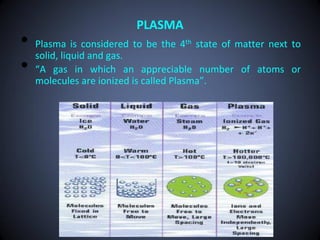
PLASMA
•   Plasma is considered to be the 4th state of matter next to
    solid, liquid and gas.
•   “A gas in which an appreciable number of atoms or
    molecules are ionized is called Plasma”.
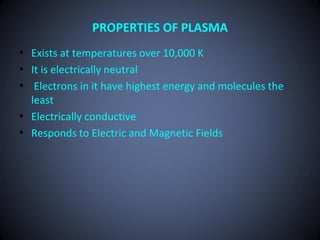
PROPERTIES OF PLASMA
• Exists at temperatures over 10,000 K
• It is electrically neutral
• Electrons in it have highest energy and molecules the
  least
• Electrically conductive
• Responds to Electric and Magnetic Fields
UTILIZATION OF PLASMA

      1. As a heat source and
      2. As a carrier medium.


In material processing plasma is used both as a heat source
and a carrier medium.
Plasma Furnace Design
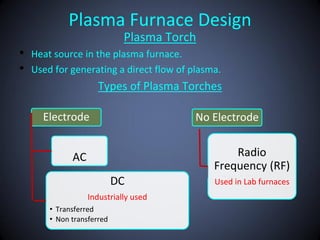
                             Plasma Torch
•   Heat source in the plasma furnace.
•   Used for generating a direct flow of plasma.
                      Types of Plasma Torches

      Electrode                           No Electrode


              AC                                  Radio
                                              Frequency (RF)
                            DC                Used in Lab furnaces
                   Industrially used
        • Transferred
        • Non transferred
Plasma furnace design
               DC Plasma Torch
• Electric arc is formed between electrodes
  made up of Cu, W, Mo, graphite etc.
• Carrier gas used is Oxygen, Hydrogen, Helium,
  Nitrogen etc along with Ar or He.
• The electrodes are continuously cooled.
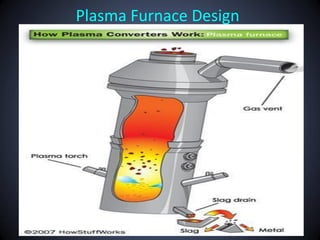
Plasma Furnace Design
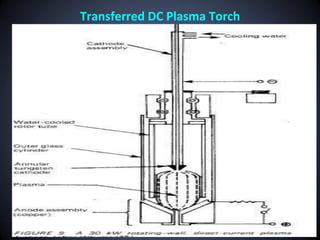
Transferred DC Plasma Torch
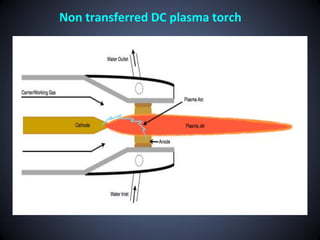
Non transferred DC plasma torch
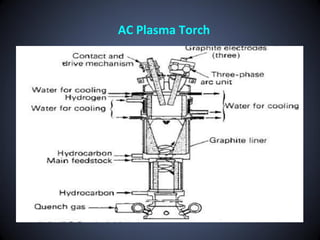
AC Plasma Torch
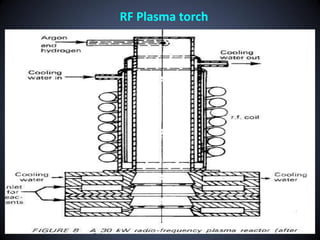
RF Plasma torch
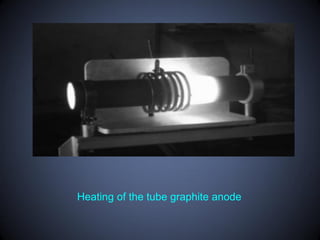
Heating of the tube graphite anode
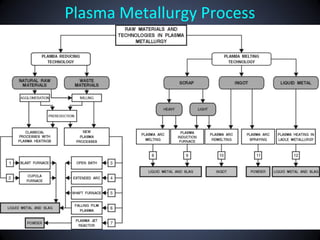
Plasma Metallurgy Process
PLASMA REDUCING TECHNOLOGY

•   SHAFT FURNACE
•   FALLING FILM PLASMA FURNACE
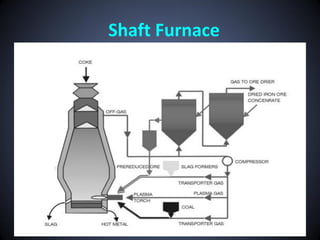
Shaft Furnace
Mechanism of Shaft Furnace

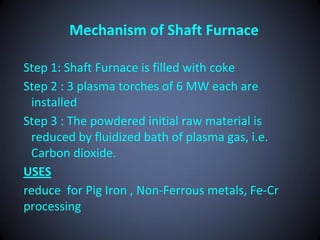
Step 1: Shaft Furnace is filled with coke
Step 2 : 3 plasma torches of 6 MW each are
 installed
Step 3 : The powdered initial raw material is
 reduced by fluidized bath of plasma gas, i.e.
 Carbon dioxide.
USES
reduce for Pig Iron , Non-Ferrous metals, Fe-Cr
processing
Falling Film Plasma Furnace
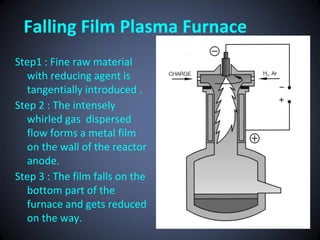
Step1 : Fine raw material
  with reducing agent is
  tangentially introduced .
Step 2 : The intensely
  whirled gas dispersed
  flow forms a metal film
  on the wall of the reactor
  anode.
Step 3 : The film falls on the
  bottom part of the
  furnace and gets reduced
  on the way.
Falling Film Plasma Furnace
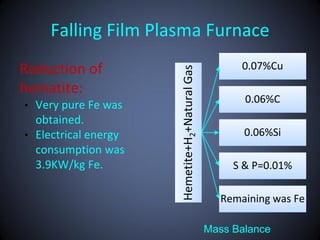
Reduction of                                           0.07%Cu


                      Hemetite+H2+Natural Gas
hematite:
                                                       0.06%C
• Very pure Fe was
  obtained.
• Electrical energy                                    0.06%Si
  consumption was
  3.9KW/kg Fe.                                       S & P=0.01%

                                                   Remaining was Fe

                                                Mass Balance
PLASMA MELTING TECHNOLOGY
•   PLASMA ARC MELTING
•   PLASMA INDUCTION FURNACE
•   PLASMA ARC REMELTING
Plasma Arc Melting
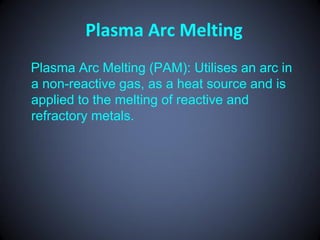
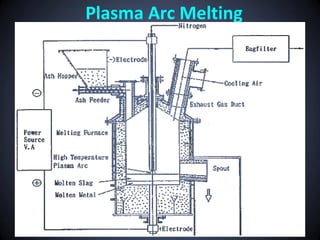
Plasma Arc Melting (PAM): Utilises an arc in
a non-reactive gas, as a heat source and is
applied to the melting of reactive and
refractory metals.
Plasma Arc Melting
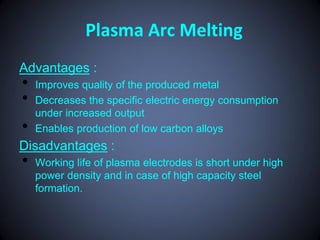
Advantages :
•   Improves quality of the produced metal
•   Decreases the specific electric energy consumption
    under increased output
•   Enables production of low carbon alloys
Disadvantages :
•   Working life of plasma electrodes is short under high
    power density and in case of high capacity steel
    formation.
Plasma Arc Melting
Plasma Induction Melting
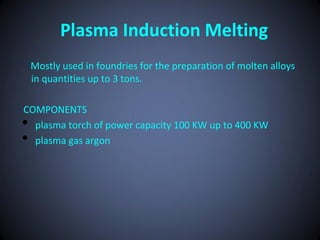
    Mostly used in foundries for the preparation of molten alloys
    in quantities up to 3 tons.

COMPONENTS
• plasma torch of power capacity 100 KW up to 400 KW
• plasma gas argon
Applications
•   Scrap Recycling
•   Production of Special alloys
•   Ultra low Carbon Stainless Steels
•   Production of alloys used in High Temperature or Cryogenic
    Conditions
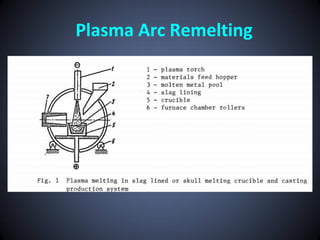
Plasma Arc Remelting
Plasma remelting furnaces are multi—duty systems.
Utilized for :

 Simple and complex castings
 Near—net shapes
 Finished shapes.
Applications

•
•
  Production of high temperature alloys
  Processing of high melting and reactive metal alloys.
• Melting ceramic materials and glass.
Plasma Arc Remelting
Fundamental studies of plasma heat generation
                and application
(a) Investigation of physical problems of plasma arc in the power range 1 MW to 10
   MW;
(b) Pilot scale investigations of kinetics, thermodynamics of gas exchange processes,
  evaporation processes, deoxidation , decarburization, during plasma heating;
(c) Investigations of electrode erosion, process and methods of extending electrode
   life or improving its thermal stability in industrial scale systems;
(d) Reduction of cooling requirements of the bottom electrode in transferred arc
  plasma melting systems for overall improvement of electrical efficiency and
  maintenance requirements;
(e) Development of methods for the intensification of energy—mass exchange
  between the plasma arc and the heated body;
(f) Design, development of high response plasma power sources for plasma torch
   operations in a wider voltage range,different gas atmospheres and pressure
   conditions within the melting chambers.
Advantages
• The atmosphere can be controlled to meet any process
  requirement.
• No need for pelletization or agglomeration as fine ore
  particles can be used.
• More efficient than other processes at Higher
  Temperatures
• Processing rate is very high.
• Total enclosure: avoids contamination.
• High value metals can be recovered from waste.
• Can process low grade complex minerals.
Disadvantages and Scope for
           Improvement
•Heat recovery: Products have a high latent
heat.
•Electrode life: Electrodes have to be
regularly replaced thus inhibiting continuous
operation.
•High cost of maintenance.
THANK YOU
LET’S SHARE AND MAKE KNOWLEDGE FREE

Plasma processing in extractive metallurgy

  • 1.
    Plasma Processing in ExtractiveMetallurgy DEPARTMENT OF METALLURGUCAL AND MATERIALS ENGINEERING INDIAN INSTITUTE OF TECHNOLOGY KHARAGPUR
  • 2.
    PLASMA • Plasma is considered to be the 4th state of matter next to solid, liquid and gas. • “A gas in which an appreciable number of atoms or molecules are ionized is called Plasma”.
  • 3.
    PROPERTIES OF PLASMA •Exists at temperatures over 10,000 K • It is electrically neutral • Electrons in it have highest energy and molecules the least • Electrically conductive • Responds to Electric and Magnetic Fields
  • 4.
    UTILIZATION OF PLASMA 1. As a heat source and 2. As a carrier medium. In material processing plasma is used both as a heat source and a carrier medium.
  • 5.
    Plasma Furnace Design Plasma Torch • Heat source in the plasma furnace. • Used for generating a direct flow of plasma. Types of Plasma Torches Electrode No Electrode AC Radio Frequency (RF) DC Used in Lab furnaces Industrially used • Transferred • Non transferred
  • 6.
    Plasma furnace design DC Plasma Torch • Electric arc is formed between electrodes made up of Cu, W, Mo, graphite etc. • Carrier gas used is Oxygen, Hydrogen, Helium, Nitrogen etc along with Ar or He. • The electrodes are continuously cooled.
  • 7.
  • 8.
  • 9.
    Non transferred DCplasma torch
  • 10.
  • 11.
  • 12.
    Heating of thetube graphite anode
  • 13.
  • 14.
    PLASMA REDUCING TECHNOLOGY • SHAFT FURNACE • FALLING FILM PLASMA FURNACE
  • 15.
  • 16.
    Mechanism of ShaftFurnace Step 1: Shaft Furnace is filled with coke Step 2 : 3 plasma torches of 6 MW each are installed Step 3 : The powdered initial raw material is reduced by fluidized bath of plasma gas, i.e. Carbon dioxide. USES reduce for Pig Iron , Non-Ferrous metals, Fe-Cr processing
  • 17.
    Falling Film PlasmaFurnace Step1 : Fine raw material with reducing agent is tangentially introduced . Step 2 : The intensely whirled gas dispersed flow forms a metal film on the wall of the reactor anode. Step 3 : The film falls on the bottom part of the furnace and gets reduced on the way.
  • 18.
    Falling Film PlasmaFurnace Reduction of 0.07%Cu Hemetite+H2+Natural Gas hematite: 0.06%C • Very pure Fe was obtained. • Electrical energy 0.06%Si consumption was 3.9KW/kg Fe. S & P=0.01% Remaining was Fe Mass Balance
  • 19.
    PLASMA MELTING TECHNOLOGY • PLASMA ARC MELTING • PLASMA INDUCTION FURNACE • PLASMA ARC REMELTING
  • 20.
    Plasma Arc Melting PlasmaArc Melting (PAM): Utilises an arc in a non-reactive gas, as a heat source and is applied to the melting of reactive and refractory metals.
  • 21.
    Plasma Arc Melting Advantages: • Improves quality of the produced metal • Decreases the specific electric energy consumption under increased output • Enables production of low carbon alloys Disadvantages : • Working life of plasma electrodes is short under high power density and in case of high capacity steel formation.
  • 22.
  • 23.
    Plasma Induction Melting Mostly used in foundries for the preparation of molten alloys in quantities up to 3 tons. COMPONENTS • plasma torch of power capacity 100 KW up to 400 KW • plasma gas argon
  • 24.
    Applications • Scrap Recycling • Production of Special alloys • Ultra low Carbon Stainless Steels • Production of alloys used in High Temperature or Cryogenic Conditions
  • 25.
    Plasma Arc Remelting Plasmaremelting furnaces are multi—duty systems. Utilized for : Simple and complex castings Near—net shapes Finished shapes.
  • 26.
    Applications • • Productionof high temperature alloys Processing of high melting and reactive metal alloys. • Melting ceramic materials and glass.
  • 27.
  • 28.
    Fundamental studies ofplasma heat generation and application (a) Investigation of physical problems of plasma arc in the power range 1 MW to 10 MW; (b) Pilot scale investigations of kinetics, thermodynamics of gas exchange processes, evaporation processes, deoxidation , decarburization, during plasma heating; (c) Investigations of electrode erosion, process and methods of extending electrode life or improving its thermal stability in industrial scale systems; (d) Reduction of cooling requirements of the bottom electrode in transferred arc plasma melting systems for overall improvement of electrical efficiency and maintenance requirements; (e) Development of methods for the intensification of energy—mass exchange between the plasma arc and the heated body; (f) Design, development of high response plasma power sources for plasma torch operations in a wider voltage range,different gas atmospheres and pressure conditions within the melting chambers.
  • 29.
    Advantages • The atmospherecan be controlled to meet any process requirement. • No need for pelletization or agglomeration as fine ore particles can be used. • More efficient than other processes at Higher Temperatures • Processing rate is very high. • Total enclosure: avoids contamination. • High value metals can be recovered from waste. • Can process low grade complex minerals.
  • 30.
    Disadvantages and Scopefor Improvement •Heat recovery: Products have a high latent heat. •Electrode life: Electrodes have to be regularly replaced thus inhibiting continuous operation. •High cost of maintenance.
  • 31.
    THANK YOU LET’S SHAREAND MAKE KNOWLEDGE FREE