Group No. 2 : Mohd Shafwan
              Aqil Fikry
              Nurul Jannah
              Farzana Afiqah
Contents:

• Int roduc t i on
• P nc i pl e of
   ri
  Operat i on
• Advant ages
• D s advant ages
   i
Introduction
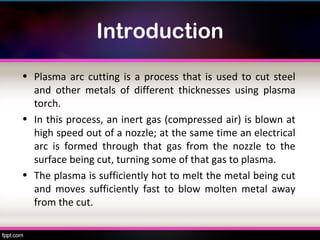
• Plasma arc cutting is a process that is used to cut steel
  and other metals of different thicknesses using plasma
  torch.
• In this process, an inert gas (compressed air) is blown at
  high speed out of a nozzle; at the same time an electrical
  arc is formed through that gas from the nozzle to the
  surface being cut, turning some of that gas to plasma.
• The plasma is sufficiently hot to melt the metal being cut
  and moves sufficiently fast to blow molten metal away
  from the cut.
Principle of Operation
• The plasma is tied up by a water-cooled nozzle because of the high
  temperature, the plasma expands and flows with supersonic velocity
  speed to the workpiece.
• Inside the plasma arc, temperature of 30000 ᵒC can arise, that realize in
  connection with the high kinetic energy of the plasma beam and
  depending on the material thickness very high cutting speeds on all
  electrically conductive materials.
• In this process, the stability of arc is needed to keep the plasma in desired
  form.
• For cutting process, first of all a pilot arc ignition by high voltage between
  nozzle and cathode takes place.
• This low-energy pilot arc prepares by ionization in parts the way between
  plasma arc are touches the workpiece (flying cutting, flying piercing),the
  main arc will start by an automatic increase in power.
ADVANTAGES

• Low cost alternative to oxy-fuel and laser profiling.

• More versatile and accurate option.

• Rapid cutting speed.
• Wide range of material and thickness – can yield quality cuts
  on both ferrous and non-ferrous metals.
• Easy to use – only require minimal operator training.
• Economical than oxy-fuel for thickness under 25mm and
  comparable up to about 50mm.
DISADVANTAGES

• High equipment expense.

• Need more operator skills.

• Complex welding procedures.

• Producing heavy noise level.

• Producing higher ozone production.
DISADVANTAGES

• High equipment expense.

• Need more operator skills.

• Complex welding procedures.

• Producing heavy noise level.

• Producing higher ozone production.

Workshop

  • 1.
    Group No. 2: Mohd Shafwan Aqil Fikry Nurul Jannah Farzana Afiqah
  • 2.
    Contents: • Int roduct i on • P nc i pl e of ri Operat i on • Advant ages • D s advant ages i
  • 3.
    Introduction • Plasma arccutting is a process that is used to cut steel and other metals of different thicknesses using plasma torch. • In this process, an inert gas (compressed air) is blown at high speed out of a nozzle; at the same time an electrical arc is formed through that gas from the nozzle to the surface being cut, turning some of that gas to plasma. • The plasma is sufficiently hot to melt the metal being cut and moves sufficiently fast to blow molten metal away from the cut.
  • 4.
    Principle of Operation •The plasma is tied up by a water-cooled nozzle because of the high temperature, the plasma expands and flows with supersonic velocity speed to the workpiece. • Inside the plasma arc, temperature of 30000 ᵒC can arise, that realize in connection with the high kinetic energy of the plasma beam and depending on the material thickness very high cutting speeds on all electrically conductive materials. • In this process, the stability of arc is needed to keep the plasma in desired form. • For cutting process, first of all a pilot arc ignition by high voltage between nozzle and cathode takes place. • This low-energy pilot arc prepares by ionization in parts the way between plasma arc are touches the workpiece (flying cutting, flying piercing),the main arc will start by an automatic increase in power.
  • 5.
    ADVANTAGES • Low costalternative to oxy-fuel and laser profiling. • More versatile and accurate option. • Rapid cutting speed. • Wide range of material and thickness – can yield quality cuts on both ferrous and non-ferrous metals. • Easy to use – only require minimal operator training. • Economical than oxy-fuel for thickness under 25mm and comparable up to about 50mm.
  • 6.
    DISADVANTAGES • High equipmentexpense. • Need more operator skills. • Complex welding procedures. • Producing heavy noise level. • Producing higher ozone production.
  • 7.
    DISADVANTAGES • High equipmentexpense. • Need more operator skills. • Complex welding procedures. • Producing heavy noise level. • Producing higher ozone production.