Benjamin Culpepper
December 16, 2013
Space Plasma Physics
Purpose:
• To present the basics of magnetic storm and substorm physics while
providing real-world representations of the subject matter.
• Will present example graphs of magnetic storms and substorms while
providing a background for those uneducated - or for those a bit rusty
- in the science.
• Will present data collected from satellites along with the appropriate
analysis.
Outline:
1) Magnetic Storm Basics
2) Substorm Basics
3) Examples of Magnetic Storms
• Analysis Incorporated
4) Examples of Substorms
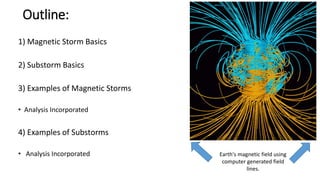
• Analysis Incorporated Earth's magnetic field using
computer generated field
lines.
Magnetic Storm Basics
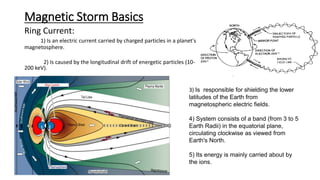
Ring Current:
1) Is an electric current carried by charged particles in a planet's
magnetosphere.
2) Is caused by the longitudinal drift of energetic particles (10-
200 keV).
3) Is responsible for shielding the lower
latitudes of the Earth from
magnetospheric electric fields.
4) System consists of a band (from 3 to 5
Earth Radii) in the equatorial plane,
circulating clockwise as viewed from
Earth's North.
5) Its energy is mainly carried about by
the ions.
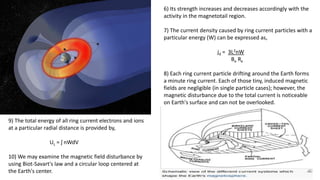
6) Its strength increases and decreases accordingly with the
activity in the magnetotail region.
7) The current density caused by ring current particles with a
particular energy (W) can be expressed as,
jd = 3L2nW
Be Re
8) Each ring current particle drifting around the Earth forms
a minute ring current. Each of those tiny, induced magnetic
fields are negligible (in single particle cases); however, the
magnetic disturbance due to the total current is noticeable
on Earth's surface and can not be overlooked.
9) The total energy of all ring current electrons and ions
at a particular radial distance is provided by,
UL = ʃ nWdV
10) We may examine the magnetic field disturbance by
using Biot-Savart's law and a circular loop centered at
the Earth's center.
Ring Current Examples:
Consists of L-shell and
electron density values
used in calculating current
density. [3]
High energy neutral atom image
collected at a certain time. [3]
Ring Current Examples continued:
Collection of High Energy Neutral Atoms over a specific length of time (several hours
or several days).This should be viewed vertically, but it was altered so visibility of the
entire graph could be possible. [3]
Extreme Ultraviolet (EUV) Image.
These EUV photons are resonantly scattered by
singly ionized helium in the plasmasphere. [3]
Energetic neutral atom (ENA) emissions from the Earth's
ring current. [1]
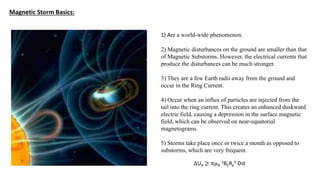
Magnetic Storm Basics:
1) Are a world-wide phenomenon.
2) Magnetic disturbances on the ground are smaller than that
of Magnetic Substorms. However, the electrical currents that
produce the disturbances can be much stronger.
3) They are a few Earth radii away from the ground and
occur in the Ring Current.
4) Occur when an influx of particles are injected from the
tail into the ring current. This creates an enhanced duskward
electric field, causing a depression in the surface magnetic
field, which can be observed on near-equatorial
magnetograms.
5) Storms take place once or twice a month as opposed to
substorms, which are very frequent.
∆UR ≥ π𝜇0
-1BERE
3 Dst
Magnetic Substorm Basics:
1) Were discovered much later than Magnetic Storms due to their ease of observation from the ground at auroral zones.
2) Substorm strength can be measured by examining particle densities in space. Due to an influx of particles there will
me a measurable change in the Earth's magnetic field, giving further rise to a substorm occurring.
3) Magnetospheric substorms occur in stages: growth, onset and expansion, and recovery. The stages may be completed
in a matter of a few hours.
4) The recovery of one substorm may coincide with the growth phase of another substorm. Hence, substorms occur in a
time frame of hours while storms take weeks and months.
Image captured by NASA's
Polar satellite. This is an
auroral substorm over
northern Asia. [6]
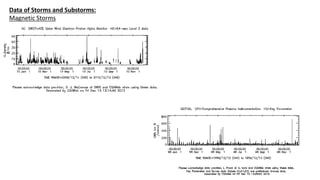
Data of Storms and Substorms:
Magnetic Storms
Low-Energy Particles
detected through GEOTAIL
satellite for analysis of the
solar wind. [8]
Substorms:
Northward and Southward
poles with aurora detected
at a specific time. [3]
Magnetic field for one day.
[9]
Magnetic field for a span of
days. [9] Electric field for a 24-hour
period. [9]
Hydrogen and Oxygen
number densities. [9]
Ion and Electron energy
flux. [9]
Ultraviolet image of a polar
region. [9]
Another ultraviolet image
from POLAR. [9]
POLAR's visible imaging
system.
A clearer, mapped region
of Earth using POLAR's
ultraviolet image.
Acknowledgments:
[1] "Earth: Ring Current." Cosmos Portal. Digital Universe, November 25, 2007. Web. December 1, 2013.
[2] Baumjohann, Wolfgang. Treumann, Rudolf A. Basic Space Plasma Physics. London: Imperial College Press, 1997. Pages 43-45. Print.
[3] Mitchell, Don at APL. Reinisch, B. W. at UMLCAR. Sandel, Bill at University of Arizona. Mends, S. at UC Berkely and SSL. CDAWeb.
[4] "EUV Imaging: Introduction." Image. Web. December 1, 2013.
[5] "Earth: Ring Current." Cosmos Portal. Digital Universe, November 25, 2007. Web. Image. December 1, 2013.
[6] "Polar Substorm." Science News. National Aeronautics and Space Administration, March 2, 2000. Web. December 1, 2013.
[7] " Substorms." Stern, David P. Peredo, Mauricio. National Aeronautics and Space Administration, 25 November 2001. Web. Decebmber 1, 2013.
[8] Frank, L. at University of Iowa. Mukal, T. at ISAS. McComas, D.J. at SWRI. Szabo, A. at NASA/CSFC. Nese, N. at Bartol Research Institute. CDAWeb.
[9] Russell, C. T. at UCLA. Mozer at UC Berkely. Scudder, J. at University of Iowa. Peterson, W. K. at LASP. Parka, G. at University of Washington. Frank, A. at
University of Iowa. CDAWeb.

Plasma Presentation2

  • 1.
    Benjamin Culpepper December 16,2013 Space Plasma Physics
  • 2.
    Purpose: • To presentthe basics of magnetic storm and substorm physics while providing real-world representations of the subject matter. • Will present example graphs of magnetic storms and substorms while providing a background for those uneducated - or for those a bit rusty - in the science. • Will present data collected from satellites along with the appropriate analysis.
  • 3.
    Outline: 1) Magnetic StormBasics 2) Substorm Basics 3) Examples of Magnetic Storms • Analysis Incorporated 4) Examples of Substorms • Analysis Incorporated Earth's magnetic field using computer generated field lines.
  • 4.
    Magnetic Storm Basics RingCurrent: 1) Is an electric current carried by charged particles in a planet's magnetosphere. 2) Is caused by the longitudinal drift of energetic particles (10- 200 keV). 3) Is responsible for shielding the lower latitudes of the Earth from magnetospheric electric fields. 4) System consists of a band (from 3 to 5 Earth Radii) in the equatorial plane, circulating clockwise as viewed from Earth's North. 5) Its energy is mainly carried about by the ions.
  • 5.
    6) Its strengthincreases and decreases accordingly with the activity in the magnetotail region. 7) The current density caused by ring current particles with a particular energy (W) can be expressed as, jd = 3L2nW Be Re 8) Each ring current particle drifting around the Earth forms a minute ring current. Each of those tiny, induced magnetic fields are negligible (in single particle cases); however, the magnetic disturbance due to the total current is noticeable on Earth's surface and can not be overlooked. 9) The total energy of all ring current electrons and ions at a particular radial distance is provided by, UL = ʃ nWdV 10) We may examine the magnetic field disturbance by using Biot-Savart's law and a circular loop centered at the Earth's center.
  • 6.
    Ring Current Examples: Consistsof L-shell and electron density values used in calculating current density. [3] High energy neutral atom image collected at a certain time. [3]
  • 7.
    Ring Current Examplescontinued: Collection of High Energy Neutral Atoms over a specific length of time (several hours or several days).This should be viewed vertically, but it was altered so visibility of the entire graph could be possible. [3]
  • 8.
    Extreme Ultraviolet (EUV)Image. These EUV photons are resonantly scattered by singly ionized helium in the plasmasphere. [3] Energetic neutral atom (ENA) emissions from the Earth's ring current. [1]
  • 9.
    Magnetic Storm Basics: 1)Are a world-wide phenomenon. 2) Magnetic disturbances on the ground are smaller than that of Magnetic Substorms. However, the electrical currents that produce the disturbances can be much stronger. 3) They are a few Earth radii away from the ground and occur in the Ring Current. 4) Occur when an influx of particles are injected from the tail into the ring current. This creates an enhanced duskward electric field, causing a depression in the surface magnetic field, which can be observed on near-equatorial magnetograms. 5) Storms take place once or twice a month as opposed to substorms, which are very frequent. ∆UR ≥ π𝜇0 -1BERE 3 Dst
  • 10.
    Magnetic Substorm Basics: 1)Were discovered much later than Magnetic Storms due to their ease of observation from the ground at auroral zones. 2) Substorm strength can be measured by examining particle densities in space. Due to an influx of particles there will me a measurable change in the Earth's magnetic field, giving further rise to a substorm occurring. 3) Magnetospheric substorms occur in stages: growth, onset and expansion, and recovery. The stages may be completed in a matter of a few hours. 4) The recovery of one substorm may coincide with the growth phase of another substorm. Hence, substorms occur in a time frame of hours while storms take weeks and months. Image captured by NASA's Polar satellite. This is an auroral substorm over northern Asia. [6]
  • 11.
    Data of Stormsand Substorms: Magnetic Storms
  • 12.
    Low-Energy Particles detected throughGEOTAIL satellite for analysis of the solar wind. [8]
  • 14.
    Substorms: Northward and Southward poleswith aurora detected at a specific time. [3]
  • 15.
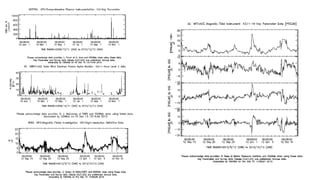
    Magnetic field forone day. [9] Magnetic field for a span of days. [9] Electric field for a 24-hour period. [9]
  • 16.
    Hydrogen and Oxygen numberdensities. [9] Ion and Electron energy flux. [9] Ultraviolet image of a polar region. [9]
  • 17.
    Another ultraviolet image fromPOLAR. [9] POLAR's visible imaging system. A clearer, mapped region of Earth using POLAR's ultraviolet image.
  • 18.
    Acknowledgments: [1] "Earth: RingCurrent." Cosmos Portal. Digital Universe, November 25, 2007. Web. December 1, 2013. [2] Baumjohann, Wolfgang. Treumann, Rudolf A. Basic Space Plasma Physics. London: Imperial College Press, 1997. Pages 43-45. Print. [3] Mitchell, Don at APL. Reinisch, B. W. at UMLCAR. Sandel, Bill at University of Arizona. Mends, S. at UC Berkely and SSL. CDAWeb. [4] "EUV Imaging: Introduction." Image. Web. December 1, 2013. [5] "Earth: Ring Current." Cosmos Portal. Digital Universe, November 25, 2007. Web. Image. December 1, 2013. [6] "Polar Substorm." Science News. National Aeronautics and Space Administration, March 2, 2000. Web. December 1, 2013. [7] " Substorms." Stern, David P. Peredo, Mauricio. National Aeronautics and Space Administration, 25 November 2001. Web. Decebmber 1, 2013. [8] Frank, L. at University of Iowa. Mukal, T. at ISAS. McComas, D.J. at SWRI. Szabo, A. at NASA/CSFC. Nese, N. at Bartol Research Institute. CDAWeb. [9] Russell, C. T. at UCLA. Mozer at UC Berkely. Scudder, J. at University of Iowa. Peterson, W. K. at LASP. Parka, G. at University of Washington. Frank, A. at University of Iowa. CDAWeb.