CELL BIOLOGY, GENETICS AND EVOLUTION
BOT-401
BOT-401 4(3-1)
4(3-1)
Chromosomal Mutations -I
By: Shozab Seemab Khan (PhD Scholar)
Abaidullah College Pakpattan
Chromosomal Mutations
• The chromosomes of each species has a characteristic
The chromosomes of each species has a characteristic
morphology
morphology (
(structure)
structure) and
and number
number
• But, sometimes due to certain
But, sometimes due to certain accidents
accidents at the time of
at the time of cell
cell
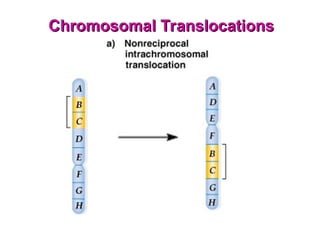
division
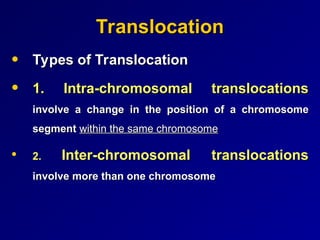
division,
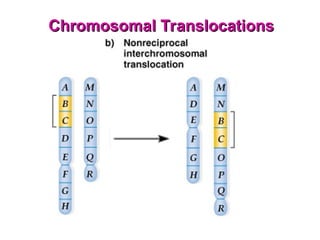
, crossing over
crossing over or
or fertilization
fertilization some
some alterations
alterations in
in
the
the morphology
morphology and
and number
number of chromosomes take place
of chromosomes take place
• The changes in
The changes in chromosome parts
chromosome parts,
, whole chromosomes
whole chromosomes,
,
or whole chromosome sets are called
or whole chromosome sets are called chromosome
chromosome
aberrations or chromosome mutations
aberrations or chromosome mutations.
.
Chromosomal Mutations
• Structural changes in chromosomes
Structural changes in chromosomes
• Changes in number of chromosomes
Changes in number of chromosomes
Chromosomal Mutations
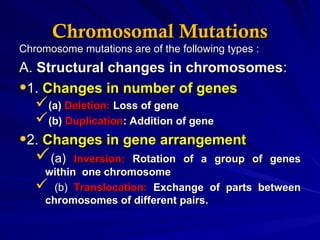
Chromosome mutations are of the following types :
A.
A. Structural changes in chromosomes
Structural changes in chromosomes:
:
•1.
1. Changes in number of genes
Changes in number of genes
(a)
(a) Deletion:
Deletion: Loss of gene
Loss of gene
(b)
(b) Duplication
Duplication: Addition of gene
: Addition of gene
•2.
2. Changes in gene arrangement
Changes in gene arrangement
(a)
(a) Inversion:
Inversion: Rotation of a group of genes
Rotation of a group of genes
within one chromosome
 (b)
(b) Translocation:
Translocation: Exchange of parts between
Exchange of parts between
chromosomes of different pairs.
Chromosomal Mutations
B.
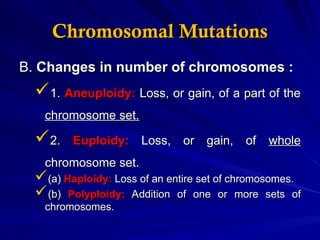
B. Changes in number of chromosomes :
Changes in number of chromosomes :
1.
1. Aneuploidy:
Aneuploidy: Loss, or gain, of a part of the
Loss, or gain, of a part of the
chromosome set.
chromosome set.
2.
2. Euploidy:
Euploidy: Loss, or gain, of
Loss, or gain, of whole
whole
chromosome set.
chromosome set.
(a)
(a) Haploidy:
Haploidy: Loss of an entire set of chromosomes.
Loss of an entire set of chromosomes.
(b)
(b) Polyploidy:
Polyploidy: Addition of one or more sets of
Addition of one or more sets of
chromosomes.
chromosomes.
VARIATIONS IN CHROMOSOME
STRUCTURE
STRUCTURE
• Deletion
Deletion
• Duplication
Duplication
• Inversion
Inversion
• Translocation
Translocation
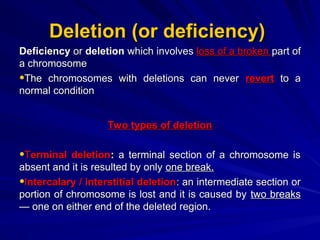
Deletion (or deficiency)
Deficiency
Deficiency or
or deletion
deletion which involves
which involves loss of a broken
loss of a broken part of
part of
a chromosome
a chromosome
•The chromosomes with deletions can never
The chromosomes with deletions can never revert
revert to a
to a
normal condition
normal condition
Two types of deletion
•T
Terminal deletion
erminal deletion:
: a terminal section of a chromosome is
a terminal section of a chromosome is
absent and it is resulted by only
absent and it is resulted by only one break.
one break.
•I
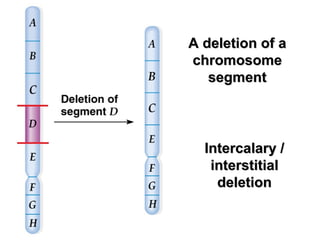
Intercalary / interstitial deletion
ntercalary / interstitial deletion: an intermediate section or
: an intermediate section or
portion of chromosome is lost and it is caused by
portion of chromosome is lost and it is caused by two breaks
two breaks
— one on either end of the deleted region.
A deletion of a
A deletion of a
chromosome
chromosome
segment
segment
Terminal
Terminal
deletion
deletion
A deletion of a
A deletion of a
chromosome
chromosome
segment
segment
Intercalary /
Intercalary /
interstitial
interstitial
deletion
deletion
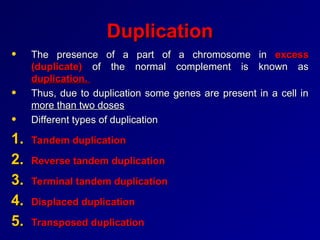
Duplication
Duplication
• The presence of a part of a chromosome in
The presence of a part of a chromosome in excess
excess
(duplicate)
(duplicate) of the normal complement is known as
of the normal complement is known as
duplication.
duplication.
• Thus, due to duplication some genes are present in a cell in
Thus, due to duplication some genes are present in a cell in
more than two doses
more than two doses
• Different types of duplication
Different types of duplication
1.
1. Tandem duplication
Tandem duplication
2.
2. Reverse tandem duplication
Reverse tandem duplication
3.
3. Terminal tandem duplication
Terminal tandem duplication
4.
4. Displaced duplication
Displaced duplication
5.
5. Transposed duplication
Transposed duplication
Tandem duplication
Tandem duplication
• In this case the
In this case the duplicated region
duplicated region is situated
is situated just by the side of
just by the side of
the norma
the normal
l corresponding section of the chromosome
corresponding section of the chromosome
• and the sequences of genes are the
and the sequences of genes are the same
same in normal and duplicated
in normal and duplicated
region.
region.
• For example, if the sequence of genes in a chromosome is
For example, if the sequence of genes in a chromosome is
ABC.DEFGH (The full stop depicts the centromere)
• and if the chromosomal segment containing the genes
and if the chromosomal segment containing the genes DEF
DEF is
is
duplicated
duplicated,
,
• the sequence of genes in tandem duplication will be
the sequence of genes in tandem duplication will be
ABC.
ABC.DEF
DEFDEF
DEFGH
GH
Reverse tandem duplication
• Here, the sequence of genes in the duplicated
Here, the sequence of genes in the duplicated
region of a chromosome is just the reverse of a
normal sequence
normal sequence
• In the above mentioned example, therefore, the
In the above mentioned example, therefore, the
sequence of genes due to reverse tandem
duplication will be ABC.
duplication will be ABC.DEF
DEFFED
FEDGH
GH
Terminal tandem duplication
• Here, the sequence of genes in the duplicated
Here, the sequence of genes in the duplicated
region of a chromosome is the terminal region
• ABC.DEFGH (Normal)
ABC.DEFGH (Normal)
• AB
ABAB
ABC.DEFGH (Duplicated)
C.DEFGH (Duplicated)
Displaced duplication
• In this case the
In this case the duplicated region
duplicated region is
is not situated adjacent
not situated adjacent
to the normal section
to the normal section.
.
• Depending on whether the
Depending on whether the duplicated portion
duplicated portion is on the
is on the
same side of the centromere
same side of the centromere as the original section
as the original section
• or
or on the other side
on the other side, the displaced duplication can be
, the displaced duplication can be
termed either
termed either
1.
1. Homobranchial
Homobranchial (
(ABC.
ABC.DEF
DEFG
GDEF
DEFH
H)
)
2.
2. Heterobranchial
Heterobranchial (
(A
ADEF
DEFBC.
BC.DEF
DEFGH
GH)
)
Transposed duplication
• Here, the
Here, the duplicated portion of chromosome
duplicated portion of chromosome becomes
becomes
attached
attached to a
to a non-homologous
non-homologous chromosome.
chromosome.
• For example, if ABC.DEFGH and LMNOPQ.RST represent
For example, if ABC.DEFGH and LMNOPQ.RST represent
the
the gene sequences
gene sequences of two non-homologous
of two non-homologous
chromosomes,
chromosomes,
• a
a transposed duplication
transposed duplication will result into chromosomes with
will result into chromosomes with
gene sequence ABC.GH and LMN
gene sequence ABC.GH and LMNDEF
DEFOPQ. RST.
OPQ. RST.
• Such a transposed duplication may be either
Such a transposed duplication may be either
1.
1. interstitial
interstitial (
(e.g.,
e.g., LMN
LMNDEF
DEFOPQ. RST)
OPQ. RST)
2.
2. terminal
terminal (
(i.e.,
i.e., LMNOPQ. RST
LMNOPQ. RSTDEF
DEF).
).
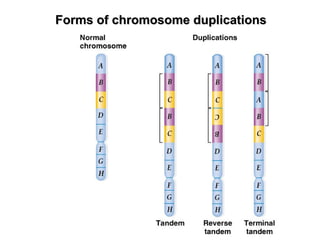
Forms of chromosome duplications
Inversion
Inversion
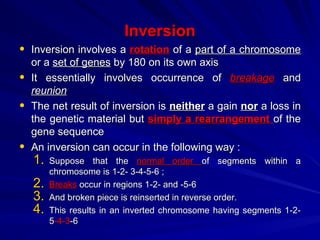
• Inversion involves a
Inversion involves a rotation
rotation of a
of a part of a chromosome
part of a chromosome
or a
or a set of genes
set of genes by 180 on its own axis
by 180 on its own axis
• It essentially involves occurrence of
It essentially involves occurrence of breakage
breakage and
and
reunion
reunion
• The net result of inversion is
The net result of inversion is neither
neither a gain
a gain nor
nor a loss in
a loss in
the genetic material but
the genetic material but simply a rearrangement
simply a rearrangement of the
of the
gene sequence
gene sequence
• An inversion can occur in the following way :
An inversion can occur in the following way :
1.
1. Suppose that the
Suppose that the normal order
normal order of segments within a
of segments within a
chromosome is 1-2- 3-4-5-6 ;
2.
2. Breaks
Breaks occur in regions 1-2- and -5-6
occur in regions 1-2- and -5-6
3.
3. And broken piece is reinserted in reverse order.
And broken piece is reinserted in reverse order.
4.
4. This results in an inverted chromosome having segments 1-2-
This results in an inverted chromosome having segments 1-2-
5
5-4-3
-4-3-6
-6
Inversion
Inversion
• An
An inversion heterozygote
inversion heterozygote has one chromosome in the
has one chromosome in the
inverted order and its homologue in the normal order
The location of the
The location of the centromere
centromere relative to inverted segment
relative to inverted segment
determines the genetic behaviour of the chromosomes
determines the genetic behaviour of the chromosomes.
.
• If
If inversion includes
inversion includes the centromere it is called
the centromere it is called pericentric
pericentric
inversion
inversion
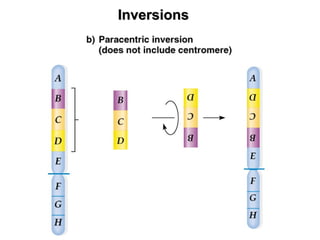
• If the
If the centromere is not included
centromere is not included in the inversion it is called
in the inversion it is called
paracentric inversion
Inversions
Inversions
Inversions
Inversions
Translocation
Translocation
• A translocation is a chromosomal
A translocation is a chromosomal
mutation in which there is a
mutation in which there is a change in
change in
the position
the position of
of particular chromosome
particular chromosome
segment
segment
• No genetic material is lost or gained (
No genetic material is lost or gained (in
in
a population of chromosomes
a population of chromosomes) due to
) due to
translocation
translocation
• Intra-chromosomal translocations
Intra-chromosomal translocations involve
involve
a change in the position of a chromosome segment
within the same chromosome
Translocation
Translocation
• Types of Translocation
Types of Translocation
• 1. Intra-chromosomal translocations
1. Intra-chromosomal translocations
involve a change in the position of a chromosome
segment
segment within the same chromosome
within the same chromosome
• 2.
2. Inter-chromosomal translocations
Inter-chromosomal translocations
involve more than one chromosome
Translocation
Translocation
• Types of Inter-chomosomal Translocation
Types of Inter-chomosomal Translocation
• A) Non-Reciprocal Translocation :
A) Non-Reciprocal Translocation :
• Inter-chromosomal translocations that result in a one-
Inter-chromosomal translocations that result in a one-
way transfer of genetic material from one
chromosome to another are called
chromosome to another are called non-reciprocal
non-reciprocal
translocations
translocations
• B) Reciprocal Translocation:
B) Reciprocal Translocation:
• If segments are exchanged it is a
If segments are exchanged it is a reciprocal
reciprocal
translocation
translocation
Chromosomal Translocations

Chromosomal Mutations (Structure and Number)

  • 1.
    CELL BIOLOGY, GENETICSAND EVOLUTION CELL BIOLOGY, GENETICS AND EVOLUTION BOT-401 BOT-401 4(3-1) 4(3-1) Chromosomal Mutations -I Chromosomal Mutations -I By: Shozab Seemab Khan (PhD Scholar) By: Shozab Seemab Khan (PhD Scholar) Abaidullah College Pakpattan Abaidullah College Pakpattan
  • 2.
    Chromosomal Mutations Chromosomal Mutations •The chromosomes of each species has a characteristic The chromosomes of each species has a characteristic morphology morphology ( (structure) structure) and and number number • But, sometimes due to certain But, sometimes due to certain accidents accidents at the time of at the time of cell cell division division, , crossing over crossing over or or fertilization fertilization some some alterations alterations in in the the morphology morphology and and number number of chromosomes take place of chromosomes take place • The changes in The changes in chromosome parts chromosome parts, , whole chromosomes whole chromosomes, , or whole chromosome sets are called or whole chromosome sets are called chromosome chromosome aberrations or chromosome mutations aberrations or chromosome mutations. .
  • 3.
    Chromosomal Mutations Chromosomal Mutations •Structural changes in chromosomes Structural changes in chromosomes • Changes in number of chromosomes Changes in number of chromosomes
  • 4.
    Chromosomal Mutations Chromosomal Mutations Chromosomemutations are of the following types : Chromosome mutations are of the following types : A. A. Structural changes in chromosomes Structural changes in chromosomes: : •1. 1. Changes in number of genes Changes in number of genes (a) (a) Deletion: Deletion: Loss of gene Loss of gene (b) (b) Duplication Duplication: Addition of gene : Addition of gene •2. 2. Changes in gene arrangement Changes in gene arrangement (a) (a) Inversion: Inversion: Rotation of a group of genes Rotation of a group of genes within one chromosome within one chromosome  (b) (b) Translocation: Translocation: Exchange of parts between Exchange of parts between chromosomes of different pairs. chromosomes of different pairs.
  • 5.
    Chromosomal Mutations Chromosomal Mutations B. B.Changes in number of chromosomes : Changes in number of chromosomes : 1. 1. Aneuploidy: Aneuploidy: Loss, or gain, of a part of the Loss, or gain, of a part of the chromosome set. chromosome set. 2. 2. Euploidy: Euploidy: Loss, or gain, of Loss, or gain, of whole whole chromosome set. chromosome set. (a) (a) Haploidy: Haploidy: Loss of an entire set of chromosomes. Loss of an entire set of chromosomes. (b) (b) Polyploidy: Polyploidy: Addition of one or more sets of Addition of one or more sets of chromosomes. chromosomes.
  • 6.
    VARIATIONS IN CHROMOSOME VARIATIONSIN CHROMOSOME STRUCTURE STRUCTURE • Deletion Deletion • Duplication Duplication • Inversion Inversion • Translocation Translocation
  • 7.
    Deletion (or deficiency) Deletion(or deficiency) Deficiency Deficiency or or deletion deletion which involves which involves loss of a broken loss of a broken part of part of a chromosome a chromosome •The chromosomes with deletions can never The chromosomes with deletions can never revert revert to a to a normal condition normal condition Two types of deletion Two types of deletion •T Terminal deletion erminal deletion: : a terminal section of a chromosome is a terminal section of a chromosome is absent and it is resulted by only absent and it is resulted by only one break. one break. •I Intercalary / interstitial deletion ntercalary / interstitial deletion: an intermediate section or : an intermediate section or portion of chromosome is lost and it is caused by portion of chromosome is lost and it is caused by two breaks two breaks — one on either end of the deleted region. — one on either end of the deleted region.
  • 8.
    A deletion ofa A deletion of a chromosome chromosome segment segment Terminal Terminal deletion deletion
  • 9.
    A deletion ofa A deletion of a chromosome chromosome segment segment Intercalary / Intercalary / interstitial interstitial deletion deletion
  • 10.
    Duplication Duplication • The presenceof a part of a chromosome in The presence of a part of a chromosome in excess excess (duplicate) (duplicate) of the normal complement is known as of the normal complement is known as duplication. duplication. • Thus, due to duplication some genes are present in a cell in Thus, due to duplication some genes are present in a cell in more than two doses more than two doses • Different types of duplication Different types of duplication 1. 1. Tandem duplication Tandem duplication 2. 2. Reverse tandem duplication Reverse tandem duplication 3. 3. Terminal tandem duplication Terminal tandem duplication 4. 4. Displaced duplication Displaced duplication 5. 5. Transposed duplication Transposed duplication
  • 11.
    Tandem duplication Tandem duplication •In this case the In this case the duplicated region duplicated region is situated is situated just by the side of just by the side of the norma the normal l corresponding section of the chromosome corresponding section of the chromosome • and the sequences of genes are the and the sequences of genes are the same same in normal and duplicated in normal and duplicated region. region. • For example, if the sequence of genes in a chromosome is For example, if the sequence of genes in a chromosome is ABC.DEFGH (The full stop depicts the centromere) ABC.DEFGH (The full stop depicts the centromere) • and if the chromosomal segment containing the genes and if the chromosomal segment containing the genes DEF DEF is is duplicated duplicated, , • the sequence of genes in tandem duplication will be the sequence of genes in tandem duplication will be ABC. ABC.DEF DEFDEF DEFGH GH
  • 12.
    Reverse tandem duplication Reversetandem duplication • Here, the sequence of genes in the duplicated Here, the sequence of genes in the duplicated region of a chromosome is just the reverse of a region of a chromosome is just the reverse of a normal sequence normal sequence • In the above mentioned example, therefore, the In the above mentioned example, therefore, the sequence of genes due to reverse tandem sequence of genes due to reverse tandem duplication will be ABC. duplication will be ABC.DEF DEFFED FEDGH GH
  • 13.
    Terminal tandem duplication Terminaltandem duplication • Here, the sequence of genes in the duplicated Here, the sequence of genes in the duplicated region of a chromosome is the terminal region region of a chromosome is the terminal region • ABC.DEFGH (Normal) ABC.DEFGH (Normal) • AB ABAB ABC.DEFGH (Duplicated) C.DEFGH (Duplicated)
  • 14.
    Displaced duplication Displaced duplication •In this case the In this case the duplicated region duplicated region is is not situated adjacent not situated adjacent to the normal section to the normal section. . • Depending on whether the Depending on whether the duplicated portion duplicated portion is on the is on the same side of the centromere same side of the centromere as the original section as the original section • or or on the other side on the other side, the displaced duplication can be , the displaced duplication can be termed either termed either 1. 1. Homobranchial Homobranchial ( (ABC. ABC.DEF DEFG GDEF DEFH H) ) 2. 2. Heterobranchial Heterobranchial ( (A ADEF DEFBC. BC.DEF DEFGH GH) )
  • 15.
    Transposed duplication Transposed duplication •Here, the Here, the duplicated portion of chromosome duplicated portion of chromosome becomes becomes attached attached to a to a non-homologous non-homologous chromosome. chromosome. • For example, if ABC.DEFGH and LMNOPQ.RST represent For example, if ABC.DEFGH and LMNOPQ.RST represent the the gene sequences gene sequences of two non-homologous of two non-homologous chromosomes, chromosomes, • a a transposed duplication transposed duplication will result into chromosomes with will result into chromosomes with gene sequence ABC.GH and LMN gene sequence ABC.GH and LMNDEF DEFOPQ. RST. OPQ. RST. • Such a transposed duplication may be either Such a transposed duplication may be either 1. 1. interstitial interstitial ( (e.g., e.g., LMN LMNDEF DEFOPQ. RST) OPQ. RST) 2. 2. terminal terminal ( (i.e., i.e., LMNOPQ. RST LMNOPQ. RSTDEF DEF). ).
  • 16.
    Forms of chromosomeduplications Forms of chromosome duplications
  • 17.
    Inversion Inversion • Inversion involvesa Inversion involves a rotation rotation of a of a part of a chromosome part of a chromosome or a or a set of genes set of genes by 180 on its own axis by 180 on its own axis • It essentially involves occurrence of It essentially involves occurrence of breakage breakage and and reunion reunion • The net result of inversion is The net result of inversion is neither neither a gain a gain nor nor a loss in a loss in the genetic material but the genetic material but simply a rearrangement simply a rearrangement of the of the gene sequence gene sequence • An inversion can occur in the following way : An inversion can occur in the following way : 1. 1. Suppose that the Suppose that the normal order normal order of segments within a of segments within a chromosome is 1-2- 3-4-5-6 ; chromosome is 1-2- 3-4-5-6 ; 2. 2. Breaks Breaks occur in regions 1-2- and -5-6 occur in regions 1-2- and -5-6 3. 3. And broken piece is reinserted in reverse order. And broken piece is reinserted in reverse order. 4. 4. This results in an inverted chromosome having segments 1-2- This results in an inverted chromosome having segments 1-2- 5 5-4-3 -4-3-6 -6
  • 18.
    Inversion Inversion • An An inversionheterozygote inversion heterozygote has one chromosome in the has one chromosome in the inverted order and its homologue in the normal order inverted order and its homologue in the normal order The location of the The location of the centromere centromere relative to inverted segment relative to inverted segment determines the genetic behaviour of the chromosomes determines the genetic behaviour of the chromosomes. . • If If inversion includes inversion includes the centromere it is called the centromere it is called pericentric pericentric inversion inversion • If the If the centromere is not included centromere is not included in the inversion it is called in the inversion it is called paracentric inversion paracentric inversion
  • 19.
  • 20.
  • 21.
    Translocation Translocation • A translocationis a chromosomal A translocation is a chromosomal mutation in which there is a mutation in which there is a change in change in the position the position of of particular chromosome particular chromosome segment segment • No genetic material is lost or gained ( No genetic material is lost or gained (in in a population of chromosomes a population of chromosomes) due to ) due to translocation translocation • Intra-chromosomal translocations Intra-chromosomal translocations involve involve a change in the position of a chromosome segment a change in the position of a chromosome segment within the same chromosome within the same chromosome
  • 22.
    Translocation Translocation • Types ofTranslocation Types of Translocation • 1. Intra-chromosomal translocations 1. Intra-chromosomal translocations involve a change in the position of a chromosome involve a change in the position of a chromosome segment segment within the same chromosome within the same chromosome • 2. 2. Inter-chromosomal translocations Inter-chromosomal translocations involve more than one chromosome involve more than one chromosome
  • 23.
    Translocation Translocation • Types ofInter-chomosomal Translocation Types of Inter-chomosomal Translocation • A) Non-Reciprocal Translocation : A) Non-Reciprocal Translocation : • Inter-chromosomal translocations that result in a one- Inter-chromosomal translocations that result in a one- way transfer of genetic material from one way transfer of genetic material from one chromosome to another are called chromosome to another are called non-reciprocal non-reciprocal translocations translocations • B) Reciprocal Translocation: B) Reciprocal Translocation: • If segments are exchanged it is a If segments are exchanged it is a reciprocal reciprocal translocation translocation
  • 24.
  • 25.
  • 26.