TREES <3 <3 <3 <3
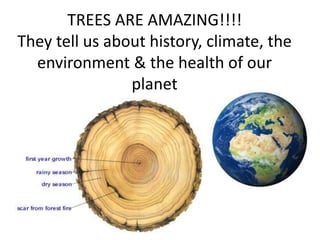
TREES ARE AMAZING!!!!
They tell us about history, climate, the
environment & the health of our
planet
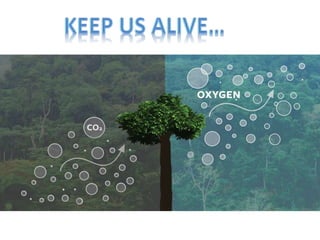
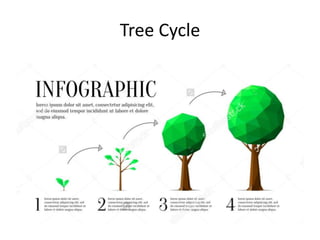
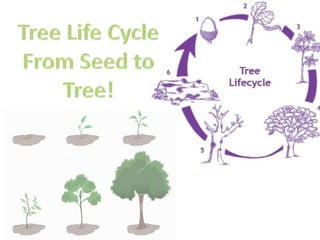
Tree Cycle
Benefits of Trees
1. Trees combat climate change - Excess carbon dioxide (CO2) caused by many factors is a building up in our atmosphere and
contributing to climate change. Trees clean the air
2. Trees absorb odors and pollutant gases (nitrogen oxides, ammonia, sulfur dioxide and ozone) and filter particulates out of
the air by trapping them on their leaves and bark.
3. Trees provide oxygen - In one year an acre of mature trees can provide enough oxygen for 18 people.
4. Trees cool the streets and the city
5. Trees cool the city by up to 10°F, by shading our homes and streets, breaking up urban “heat islands” and releasing water
vapor into the air through their leaves.
6. Trees conserve energy - Three trees placed strategically around a single-family home can cut summer air conditioning needs
by up to 50 percent. By reducing the energy demand for cooling our houses, we reduce carbon dioxide and other pollution
emissions from power plants.
7. Trees save water - Shade from trees slows water evaporation from thirsty lawns. Most newly planted trees need only fifteen
gallons of water a week. As trees transpire, they increase atmospheric moisture.
8. Trees help prevent water pollution
9. Trees reduce runoff by breaking rainfall thus allowing the water to flow down the trunk and into the earth below the
tree. This prevents storm water from carrying pollutants to the ocean. When mulched, trees act like a sponge that filters this
water naturally and uses it to recharge groundwater supplies.
10. Trees help prevent soil erosion - On hillsides or stream slopes, trees slow runoff and hold soil in place.
11. Trees shield children from ultra-violet rays - Skin cancer is the most common form of cancer in the United States. Trees
reduce UV-B exposure by about 50 percent, thus providing protection to children on school campuses and playgrounds -
where children spend hours outdoors.
12. Trees provide food - An apple tree can yield up to 15-20 bushels of fruit per year and can be planted on the tiniest urban
lot. Aside from fruit for humans, trees provide food for birds and wildlife.
13. Trees heal - Studies have shown that patients with views of trees out their windows heal faster and with less
complications. Children with ADHD show fewer symptoms when they have access to nature. Exposure to trees and nature
aids concentration by reducing mental fatigue.
More benefits
1. Trees reduce violence - Neighborhoods and homes that are barren have shown to have a greater incidence of violence in
and out of the home than their greener counterparts. Trees and landscaping help to reduce the level of fear.
2. Trees mark the seasons - Is it winter, spring, summer or fall? Look at the trees.
3. Trees create economic opportunities - Fruit harvested from community orchards can be sold, thus providing income.
Small business opportunities in green waste management and landscaping arise when cities value mulching and its water-
saving qualities. Vocational training for youth interested in green jobs is also a great way to develop economic
opportunities from trees.
4. Trees are teachers and playmates - Whether as houses for children or creative and spiritual inspiration for adults, trees
have provided the space for human retreat throughout the ages.
5. Trees bring diverse groups of people together
6. Tree plantings provide an opportunity for community involvement and empowerment that improves the quality of life
in our neighborhoods. All cultures, ages, and genders have an important role to play at a tree planting or tree care event.
7. Trees add unity
8. Trees as landmarks can give a neighborhood a new identity and encourage civic pride.
9. Trees provide a canopy and habitat for wildlife - Sycamore and oak are among the many urban species that provide
excellent urban homes for birds, bees, possums and squirrels.
10. Trees block things
11. Trees can mask concrete walls or parking lots, and unsightly views. They muffle sound from nearby streets and freeways,
and create an eye-soothing canopy of green. Trees absorb dust and wind and reduce glare.
12. Trees provide wood - In suburban and rural areas, trees can be selectively harvested for fuel and craft wood.
13. Trees increase property values - The beauty of a well-planted property and its surrounding street and neighborhood can
raise property values by as much as 15 percent.
14. Trees increase business traffic - Studies show that the more trees and landscaping a business district has, the more
business will flow in. A tree-lined street will also slow traffic – enough to allow the drivers to look at the store fronts
instead of whizzing by.
2. Sponges
A soft and squishy product like a sponge is made from
wood fibers? That’s right! Many household sponges
are made from cellulose wood fibers.
1. Latex Rubber Gloves Washing the dishes or a trip
to the dentist wouldn’t be the same without latex
rubber gloves. Both medical and household rubber
gloves are made from natural latex, a product that
comes from Hevea brasiliensis, better known as the
rubber tree. Latex is produced from the white and
cloudy fluid found under the bark. These trees can be
tapped for up to 30 years to create latex..
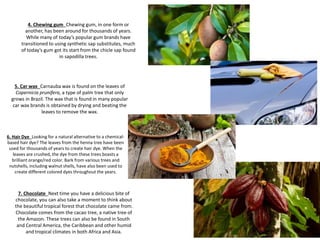
3. Wine Corks Did you know there’s a difference
between a cork tree and a cork oak? The cork used to
create wine stoppers, only comes from the cork oak.
These trees live for up to 250 years, and at age 25 and
every 10 years thereafter, these trees are stripped for
their cork to help create the stoppers used in wine
bottles around the world.
6. Hair Dye Looking for a natural alternative to a chemical-
based hair dye? The leaves from the henna tree have been
used for thousands of years to create hair dye. When the
leaves are crushed, the dye from these trees boasts a
brilliant orange/red color. Bark from various trees and
nutshells, including walnut shells, have also been used to
create different colored dyes throughout the years.
5. Car wax Carnauba wax is found on the leaves of
Copernicia prunifera, a type of palm tree that only
grows in Brazil. The wax that is found in many popular
car wax brands is obtained by drying and beating the
leaves to remove the wax.
4. Chewing gum Chewing gum, in one form or
another, has been around for thousands of years.
While many of today’s popular gum brands have
transitioned to using synthetic sap substitutes, much
of today’s gum got its start from the chicle sap found
in sapodilla trees.
7. Chocolate Next time you have a delicious bite of
chocolate, you can also take a moment to think about
the beautiful tropical forest that chocolate came from.
Chocolate comes from the cacao tree, a native tree of
the Amazon. These trees can also be found in South
and Central America, the Caribbean and other humid
and tropical climates in both Africa and Asia.
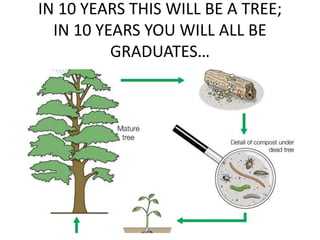
IN 10 YEARS THIS WILL BE A TREE;
IN 10 YEARS YOU WILL ALL BE
GRADUATES…
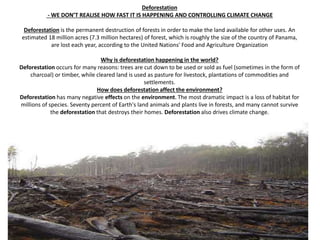
Deforestation
- WE DON’T REALISE HOW FAST IT IS HAPPENING AND CONTROLLING CLIMATE CHANGE
Deforestation is the permanent destruction of forests in order to make the land available for other uses. An
estimated 18 million acres (7.3 million hectares) of forest, which is roughly the size of the country of Panama,
are lost each year, according to the United Nations' Food and Agriculture Organization
Why is deforestation happening in the world?
Deforestation occurs for many reasons: trees are cut down to be used or sold as fuel (sometimes in the form of
charcoal) or timber, while cleared land is used as pasture for livestock, plantations of commodities and
settlements.
How does deforestation affect the environment?
Deforestation has many negative effects on the environment. The most dramatic impact is a loss of habitat for
millions of species. Seventy percent of Earth's land animals and plants live in forests, and many cannot survive
the deforestation that destroys their homes. Deforestation also drives climate change.
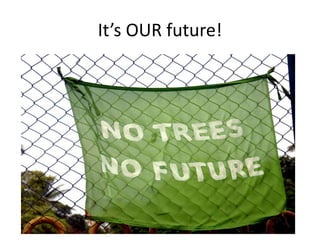
It’s OUR future!
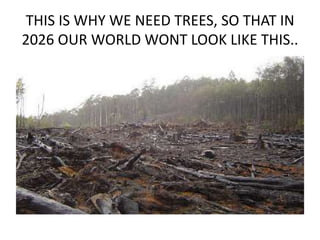
THIS IS WHY WE NEED TREES, SO THAT IN
2026 OUR WORLD WONT LOOK LIKE THIS..
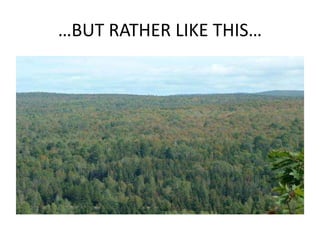
…BUT RATHER LIKE THIS…
THANK YOU AND REMEMBER
TO……..

Tree Presentation For Young Green Minds

  • 1.
  • 5.
    TREES ARE AMAZING!!!! Theytell us about history, climate, the environment & the health of our planet
  • 7.
  • 8.
    Benefits of Trees 1.Trees combat climate change - Excess carbon dioxide (CO2) caused by many factors is a building up in our atmosphere and contributing to climate change. Trees clean the air 2. Trees absorb odors and pollutant gases (nitrogen oxides, ammonia, sulfur dioxide and ozone) and filter particulates out of the air by trapping them on their leaves and bark. 3. Trees provide oxygen - In one year an acre of mature trees can provide enough oxygen for 18 people. 4. Trees cool the streets and the city 5. Trees cool the city by up to 10°F, by shading our homes and streets, breaking up urban “heat islands” and releasing water vapor into the air through their leaves. 6. Trees conserve energy - Three trees placed strategically around a single-family home can cut summer air conditioning needs by up to 50 percent. By reducing the energy demand for cooling our houses, we reduce carbon dioxide and other pollution emissions from power plants. 7. Trees save water - Shade from trees slows water evaporation from thirsty lawns. Most newly planted trees need only fifteen gallons of water a week. As trees transpire, they increase atmospheric moisture. 8. Trees help prevent water pollution 9. Trees reduce runoff by breaking rainfall thus allowing the water to flow down the trunk and into the earth below the tree. This prevents storm water from carrying pollutants to the ocean. When mulched, trees act like a sponge that filters this water naturally and uses it to recharge groundwater supplies. 10. Trees help prevent soil erosion - On hillsides or stream slopes, trees slow runoff and hold soil in place. 11. Trees shield children from ultra-violet rays - Skin cancer is the most common form of cancer in the United States. Trees reduce UV-B exposure by about 50 percent, thus providing protection to children on school campuses and playgrounds - where children spend hours outdoors. 12. Trees provide food - An apple tree can yield up to 15-20 bushels of fruit per year and can be planted on the tiniest urban lot. Aside from fruit for humans, trees provide food for birds and wildlife. 13. Trees heal - Studies have shown that patients with views of trees out their windows heal faster and with less complications. Children with ADHD show fewer symptoms when they have access to nature. Exposure to trees and nature aids concentration by reducing mental fatigue.
  • 9.
    More benefits 1. Treesreduce violence - Neighborhoods and homes that are barren have shown to have a greater incidence of violence in and out of the home than their greener counterparts. Trees and landscaping help to reduce the level of fear. 2. Trees mark the seasons - Is it winter, spring, summer or fall? Look at the trees. 3. Trees create economic opportunities - Fruit harvested from community orchards can be sold, thus providing income. Small business opportunities in green waste management and landscaping arise when cities value mulching and its water- saving qualities. Vocational training for youth interested in green jobs is also a great way to develop economic opportunities from trees. 4. Trees are teachers and playmates - Whether as houses for children or creative and spiritual inspiration for adults, trees have provided the space for human retreat throughout the ages. 5. Trees bring diverse groups of people together 6. Tree plantings provide an opportunity for community involvement and empowerment that improves the quality of life in our neighborhoods. All cultures, ages, and genders have an important role to play at a tree planting or tree care event. 7. Trees add unity 8. Trees as landmarks can give a neighborhood a new identity and encourage civic pride. 9. Trees provide a canopy and habitat for wildlife - Sycamore and oak are among the many urban species that provide excellent urban homes for birds, bees, possums and squirrels. 10. Trees block things 11. Trees can mask concrete walls or parking lots, and unsightly views. They muffle sound from nearby streets and freeways, and create an eye-soothing canopy of green. Trees absorb dust and wind and reduce glare. 12. Trees provide wood - In suburban and rural areas, trees can be selectively harvested for fuel and craft wood. 13. Trees increase property values - The beauty of a well-planted property and its surrounding street and neighborhood can raise property values by as much as 15 percent. 14. Trees increase business traffic - Studies show that the more trees and landscaping a business district has, the more business will flow in. A tree-lined street will also slow traffic – enough to allow the drivers to look at the store fronts instead of whizzing by.
  • 11.
    2. Sponges A softand squishy product like a sponge is made from wood fibers? That’s right! Many household sponges are made from cellulose wood fibers. 1. Latex Rubber Gloves Washing the dishes or a trip to the dentist wouldn’t be the same without latex rubber gloves. Both medical and household rubber gloves are made from natural latex, a product that comes from Hevea brasiliensis, better known as the rubber tree. Latex is produced from the white and cloudy fluid found under the bark. These trees can be tapped for up to 30 years to create latex.. 3. Wine Corks Did you know there’s a difference between a cork tree and a cork oak? The cork used to create wine stoppers, only comes from the cork oak. These trees live for up to 250 years, and at age 25 and every 10 years thereafter, these trees are stripped for their cork to help create the stoppers used in wine bottles around the world.
  • 12.
    6. Hair DyeLooking for a natural alternative to a chemical- based hair dye? The leaves from the henna tree have been used for thousands of years to create hair dye. When the leaves are crushed, the dye from these trees boasts a brilliant orange/red color. Bark from various trees and nutshells, including walnut shells, have also been used to create different colored dyes throughout the years. 5. Car wax Carnauba wax is found on the leaves of Copernicia prunifera, a type of palm tree that only grows in Brazil. The wax that is found in many popular car wax brands is obtained by drying and beating the leaves to remove the wax. 4. Chewing gum Chewing gum, in one form or another, has been around for thousands of years. While many of today’s popular gum brands have transitioned to using synthetic sap substitutes, much of today’s gum got its start from the chicle sap found in sapodilla trees. 7. Chocolate Next time you have a delicious bite of chocolate, you can also take a moment to think about the beautiful tropical forest that chocolate came from. Chocolate comes from the cacao tree, a native tree of the Amazon. These trees can also be found in South and Central America, the Caribbean and other humid and tropical climates in both Africa and Asia.
  • 14.
    IN 10 YEARSTHIS WILL BE A TREE; IN 10 YEARS YOU WILL ALL BE GRADUATES…
  • 15.
    Deforestation - WE DON’TREALISE HOW FAST IT IS HAPPENING AND CONTROLLING CLIMATE CHANGE Deforestation is the permanent destruction of forests in order to make the land available for other uses. An estimated 18 million acres (7.3 million hectares) of forest, which is roughly the size of the country of Panama, are lost each year, according to the United Nations' Food and Agriculture Organization Why is deforestation happening in the world? Deforestation occurs for many reasons: trees are cut down to be used or sold as fuel (sometimes in the form of charcoal) or timber, while cleared land is used as pasture for livestock, plantations of commodities and settlements. How does deforestation affect the environment? Deforestation has many negative effects on the environment. The most dramatic impact is a loss of habitat for millions of species. Seventy percent of Earth's land animals and plants live in forests, and many cannot survive the deforestation that destroys their homes. Deforestation also drives climate change.
  • 16.
  • 17.
    THIS IS WHYWE NEED TREES, SO THAT IN 2026 OUR WORLD WONT LOOK LIKE THIS..
  • 18.
  • 20.
    THANK YOU ANDREMEMBER TO……..