Production Planning and Trimming Optimization Software
Our mission Design and develop advanced production planning software, using innovative algorithms to improve performance and functionality. Provide complementary tools and services for an easy integration to existing systems.  Bring to our clients quality products and services offering a good return on investment.
Our   installations More than 35 installations Canada USA France Germany Spain Sweden Brazil
Who is in charge of what ? Directors and shareholders Performance and return objectives Salesmen Shipping dates and customers’ specifications. Production superintendent Output (machines and workers) Planner Production schedule Respect all constraints (Customer and production) Shipping department Shipping date and costs
Are all rules of action  clear ? Priority of Company rules vs. departmental vs. sectional vs. individual Realistic or budgetary objectives? In the event of conflict, which one should precede?   Are the rules known and applied equally by all? To ensure a perfect process homogeneity, we would need Siamese twins or telepaths
The planner Receives different instructions from many sources I want a minimum effectiveness of… It is necessary to minimize production time I do not want under-production and/or overproduction Not too much change of slitter, not too many small setups Not too many different orders on the same pattern Such customer must be made in priority […] If there is conflicts, he will apply the criteria on which he will be evaluated. Overproduction or effectiveness Late shipping or facilitated production Which order could be   late ,  preceded ,   overproduced ,  under-produced, etc.
The planner (continuation) Will always priorize one sector with the detriment of another: shipping vs.   production vs.   customer requirement vs. Company profitability If unable to respect all criteria, he might choose those which he prefers, sometimes out of context, for example:   Late delivering or minimizing pattern changes Reducing efficiency to minimize inventory Reducing machine width to improve statistics (efficiency)
To optimize performance and efficiency by taking account of all constraints To support Company priorities within each specific context To be more proactive (Using «What-If Simulations») instead of reactive  To increase productivity and profitability Please contact us for a free evaluation and a ROI report. Why a software of optimization?
Frequent perceptions We do not have problems of optimization because we have software in each factory. Is it used daily? If not, it is useless All optimization software are equivalent. In theory, using the same level of mathematical algorithms, this could be true However, the easiness to integrate all production constraints differs largely from one to another. It is of primary importance to have a software well adapted to your specific needs Production constraints are multiple, often requiring several contradictory but complementary mathematical formulas All customer and production constraints must be taken care of in order to generate the right patterns If the optimization software does not allows considering all required parameters, the planner will eliminate the least adapted patterns and will have to readjust them manually. When this happens frequently, the planners end up not using the optimization software anymore and always work by hand
Frequent perceptions (continuation) This kind of software is not applicable on our mills, because we have too many parameters On the contrary, the more constraints there are, the more usefull optimization software will be compared to manual operations Differences between manufacturing constraints and established rules must be defined in order to ease the manual calculation of a production schedule Optimization software is used a few months, then becomes useless, because the planner knows the patterns by heart Only if all orders could be repeated  without  change in time and quantities. Unfortunately, this utopist context of production rarely happens
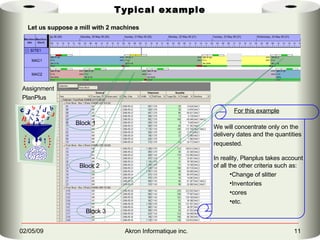
Typical example Let us suppose a mill with 2 machines Block 1 Block 2 Block 3 We will concentrate only on the delivery dates and the quantities requested.   In reality, Planplus takes account of all the other criteria such as: Change of slitter Inventories cores etc. For this example Assignment PlanPlus
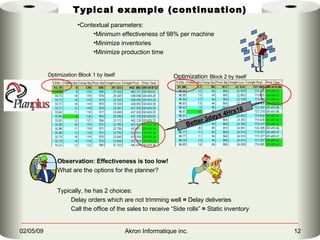
Typical example (continuation) Optimization Block 1 by itself Optimization   Block 2 by itself Contextual parameters: Minimum effectiveness of 98% per machine Minimize inventories Minimize production time Observation: Effectiveness is too low! What are the options for the planner? Typically, he has 2 choices: Delay orders which are not trimming well  =  Delay deliveries Call the office of the sales to receive “Side rolls”  =  Static inventory Better 3days 4Hrs16
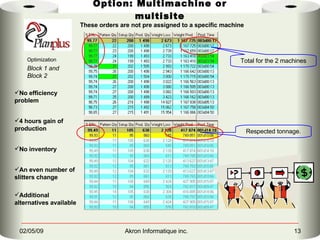
Option: Multimachine or multisite These orders are not pre assigned to a specific machine No efficiency problem 4 hours gain of production No inventory An even number of slitters change Additional alternatives available Total for the 2 machines Respected tonnage. Optimization Block 1 and Block 2
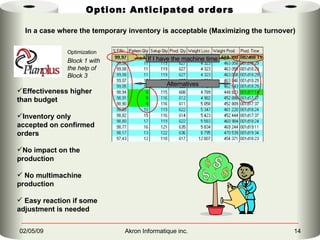
Option: Anticipated orders In a case where the temporary inventory is acceptable (Maximizing the turnover) Effectiveness higher than budget Inventory only accepted on confirmed orders No impact on the production No multimachine production Easy reaction if some adjustment is needed If I have the machine time Alternatives Optimization Block 1 with the help of Block 3
Our experiment shows that: The earlier in production planning a constraint is taken into consideration, the more restrictive it gets, bringing undesired effects and resulting in more work and less efficiency The planner might add some specific constraints, in order to support some repetitive contexts, for example: Those two customers always share the same pattern Such customer’s orders always go on machine X Such order is always self optimized We can under or overproduce the orders of this customer This customer allows late deliveries The main reasons leading a planner to stop using his software are: System not updated  Lack of training Inadequate support by supplier
A solution is valid only if it meets all parameters and constraints The concept of optimum must always be contextual Since it is almost impossible to envisage all the possibilities, our support must be able to react rapidly and efficiently Why so many people use a software such as Excel? Usually it is to complement a software that does not attends their needs Our philosophy
A solution without surprise, everything being included No additional cost for integration, adaptation, update,  specific  development All customer effective needs are fulfilled Time saving because we concentrate only on the effective needs Our guarantee
Continuous product development Brings greater flexibility to the software Eases all adaptations and integration to existing systems Requires a better knowledge of our customer’s needs which we even have to anticipate Results in efficiently optimized customization time and expenses, since specific adaptations are not charged
PlanPlus brings A versatile production optimization software and its related tools Solution to your specific needs: Optimization of cores Optimization of inventory use Optimization of the Master rolls to be produced Needs to come… (perhaps yours) Connection to your processing systems: Order entry Planning and production Optimization for loading and shipping Inventory control Direct support with the developers which allows: Specific customization (without charge) Influence on future improvements Free consultation
Memorandum An ally in your projects who respects your autonomy. To conclude, do not forget our motto,
Contact us 1-819-758-8453 [email_address]

PlanPlus (Trimplus)

  • 1.
    Production Planning andTrimming Optimization Software
  • 2.
    Our mission Designand develop advanced production planning software, using innovative algorithms to improve performance and functionality. Provide complementary tools and services for an easy integration to existing systems. Bring to our clients quality products and services offering a good return on investment.
  • 3.
    Our installations More than 35 installations Canada USA France Germany Spain Sweden Brazil
  • 4.
    Who is incharge of what ? Directors and shareholders Performance and return objectives Salesmen Shipping dates and customers’ specifications. Production superintendent Output (machines and workers) Planner Production schedule Respect all constraints (Customer and production) Shipping department Shipping date and costs
  • 5.
    Are all rulesof action clear ? Priority of Company rules vs. departmental vs. sectional vs. individual Realistic or budgetary objectives? In the event of conflict, which one should precede? Are the rules known and applied equally by all? To ensure a perfect process homogeneity, we would need Siamese twins or telepaths
  • 6.
    The planner Receivesdifferent instructions from many sources I want a minimum effectiveness of… It is necessary to minimize production time I do not want under-production and/or overproduction Not too much change of slitter, not too many small setups Not too many different orders on the same pattern Such customer must be made in priority […] If there is conflicts, he will apply the criteria on which he will be evaluated. Overproduction or effectiveness Late shipping or facilitated production Which order could be late , preceded , overproduced , under-produced, etc.
  • 7.
    The planner (continuation)Will always priorize one sector with the detriment of another: shipping vs. production vs. customer requirement vs. Company profitability If unable to respect all criteria, he might choose those which he prefers, sometimes out of context, for example: Late delivering or minimizing pattern changes Reducing efficiency to minimize inventory Reducing machine width to improve statistics (efficiency)
  • 8.
    To optimize performanceand efficiency by taking account of all constraints To support Company priorities within each specific context To be more proactive (Using «What-If Simulations») instead of reactive To increase productivity and profitability Please contact us for a free evaluation and a ROI report. Why a software of optimization?
  • 9.
    Frequent perceptions Wedo not have problems of optimization because we have software in each factory. Is it used daily? If not, it is useless All optimization software are equivalent. In theory, using the same level of mathematical algorithms, this could be true However, the easiness to integrate all production constraints differs largely from one to another. It is of primary importance to have a software well adapted to your specific needs Production constraints are multiple, often requiring several contradictory but complementary mathematical formulas All customer and production constraints must be taken care of in order to generate the right patterns If the optimization software does not allows considering all required parameters, the planner will eliminate the least adapted patterns and will have to readjust them manually. When this happens frequently, the planners end up not using the optimization software anymore and always work by hand
  • 10.
    Frequent perceptions (continuation)This kind of software is not applicable on our mills, because we have too many parameters On the contrary, the more constraints there are, the more usefull optimization software will be compared to manual operations Differences between manufacturing constraints and established rules must be defined in order to ease the manual calculation of a production schedule Optimization software is used a few months, then becomes useless, because the planner knows the patterns by heart Only if all orders could be repeated without change in time and quantities. Unfortunately, this utopist context of production rarely happens
  • 11.
    Typical example Letus suppose a mill with 2 machines Block 1 Block 2 Block 3 We will concentrate only on the delivery dates and the quantities requested. In reality, Planplus takes account of all the other criteria such as: Change of slitter Inventories cores etc. For this example Assignment PlanPlus
  • 12.
    Typical example (continuation)Optimization Block 1 by itself Optimization Block 2 by itself Contextual parameters: Minimum effectiveness of 98% per machine Minimize inventories Minimize production time Observation: Effectiveness is too low! What are the options for the planner? Typically, he has 2 choices: Delay orders which are not trimming well = Delay deliveries Call the office of the sales to receive “Side rolls” = Static inventory Better 3days 4Hrs16
  • 13.
    Option: Multimachine ormultisite These orders are not pre assigned to a specific machine No efficiency problem 4 hours gain of production No inventory An even number of slitters change Additional alternatives available Total for the 2 machines Respected tonnage. Optimization Block 1 and Block 2
  • 14.
    Option: Anticipated ordersIn a case where the temporary inventory is acceptable (Maximizing the turnover) Effectiveness higher than budget Inventory only accepted on confirmed orders No impact on the production No multimachine production Easy reaction if some adjustment is needed If I have the machine time Alternatives Optimization Block 1 with the help of Block 3
  • 15.
    Our experiment showsthat: The earlier in production planning a constraint is taken into consideration, the more restrictive it gets, bringing undesired effects and resulting in more work and less efficiency The planner might add some specific constraints, in order to support some repetitive contexts, for example: Those two customers always share the same pattern Such customer’s orders always go on machine X Such order is always self optimized We can under or overproduce the orders of this customer This customer allows late deliveries The main reasons leading a planner to stop using his software are: System not updated Lack of training Inadequate support by supplier
  • 16.
    A solution isvalid only if it meets all parameters and constraints The concept of optimum must always be contextual Since it is almost impossible to envisage all the possibilities, our support must be able to react rapidly and efficiently Why so many people use a software such as Excel? Usually it is to complement a software that does not attends their needs Our philosophy
  • 17.
    A solution withoutsurprise, everything being included No additional cost for integration, adaptation, update, specific development All customer effective needs are fulfilled Time saving because we concentrate only on the effective needs Our guarantee
  • 18.
    Continuous product developmentBrings greater flexibility to the software Eases all adaptations and integration to existing systems Requires a better knowledge of our customer’s needs which we even have to anticipate Results in efficiently optimized customization time and expenses, since specific adaptations are not charged
  • 19.
    PlanPlus brings Aversatile production optimization software and its related tools Solution to your specific needs: Optimization of cores Optimization of inventory use Optimization of the Master rolls to be produced Needs to come… (perhaps yours) Connection to your processing systems: Order entry Planning and production Optimization for loading and shipping Inventory control Direct support with the developers which allows: Specific customization (without charge) Influence on future improvements Free consultation
  • 20.
    Memorandum An allyin your projects who respects your autonomy. To conclude, do not forget our motto,
  • 21.