API presentation


The age of structural adjustments:
           1988 onwards
                    Team members:
  M.Shehmir                         Usman Azam
  Aun Rizvi                         Mujtaba Safri
  Updesh Thakwani
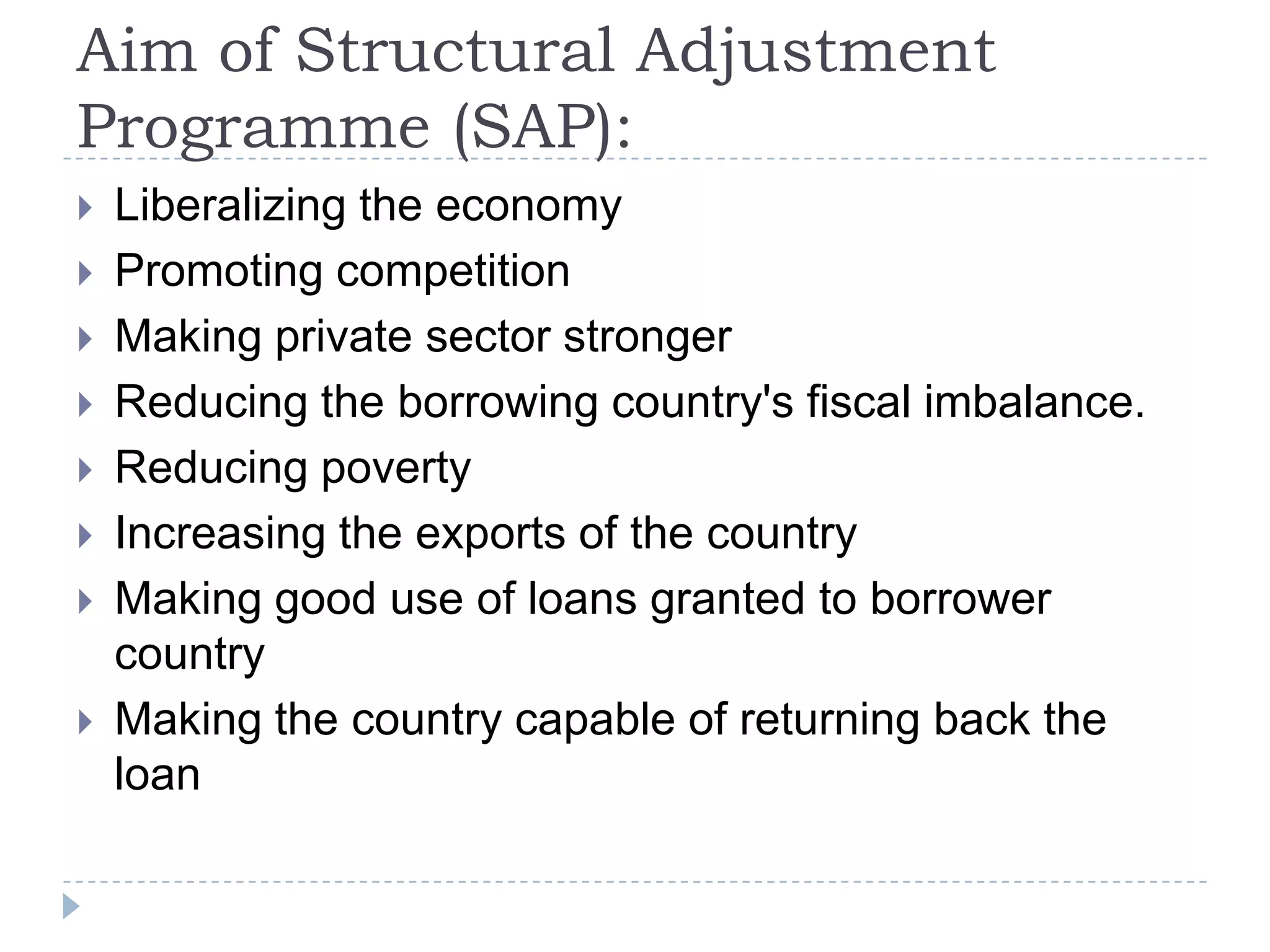
Aim of Structural Adjustment
Programme (SAP):
   Liberalizing the economy
   Promoting competition
   Making private sector stronger
   Reducing the borrowing country's fiscal imbalance.
   Reducing poverty
   Increasing the exports of the country
   Making good use of loans granted to borrower
    country
   Making the country capable of returning back the
    loan
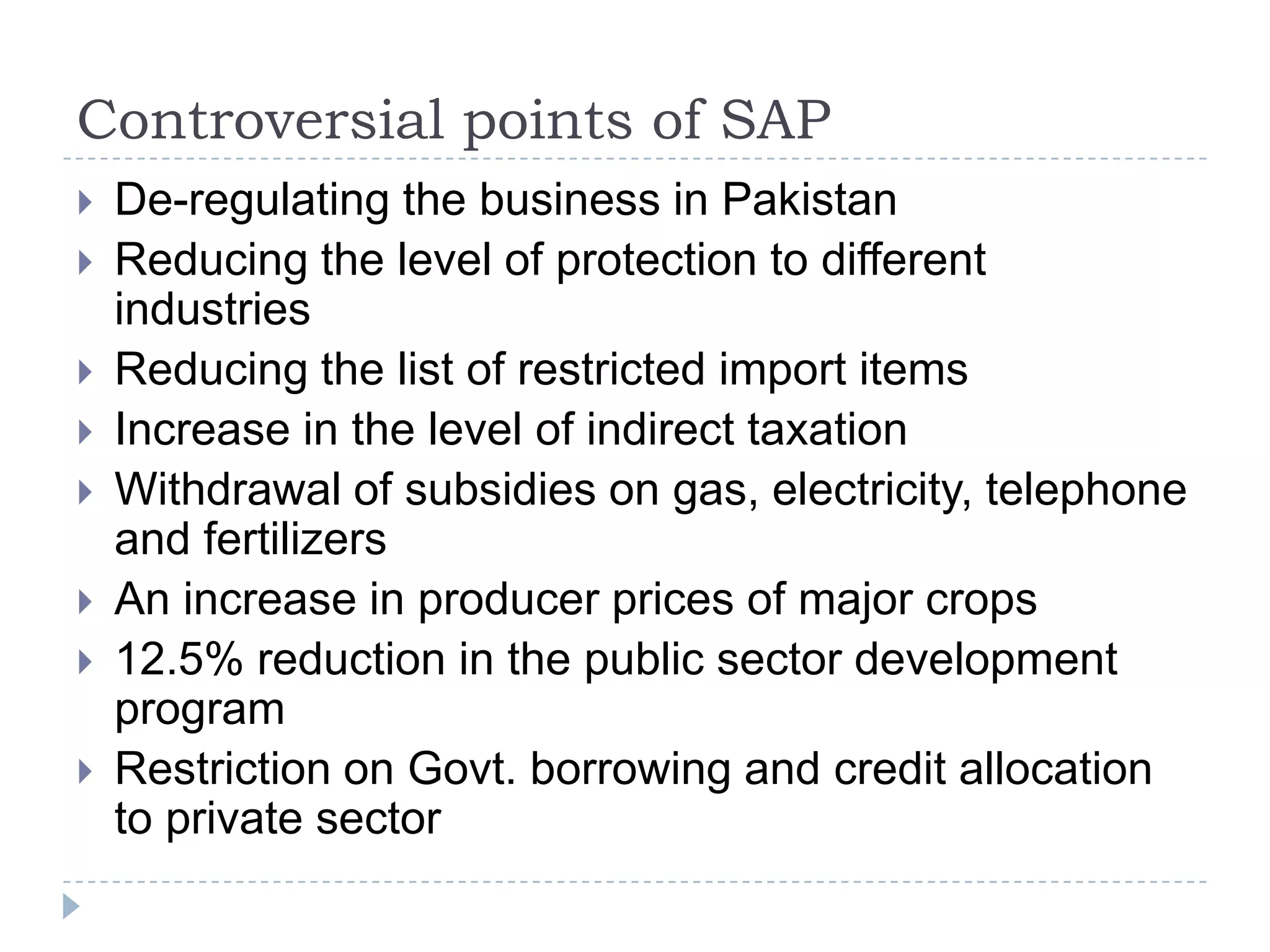
Controversial points of SAP
   De-regulating the business in Pakistan
   Reducing the level of protection to different
    industries
   Reducing the list of restricted import items
   Increase in the level of indirect taxation
   Withdrawal of subsidies on gas, electricity, telephone
    and fertilizers
   An increase in producer prices of major crops
   12.5% reduction in the public sector development
    program
   Restriction on Govt. borrowing and credit allocation
    to private sector
WORLD BANK’s REVIEW OF THE
 PROGRAMME

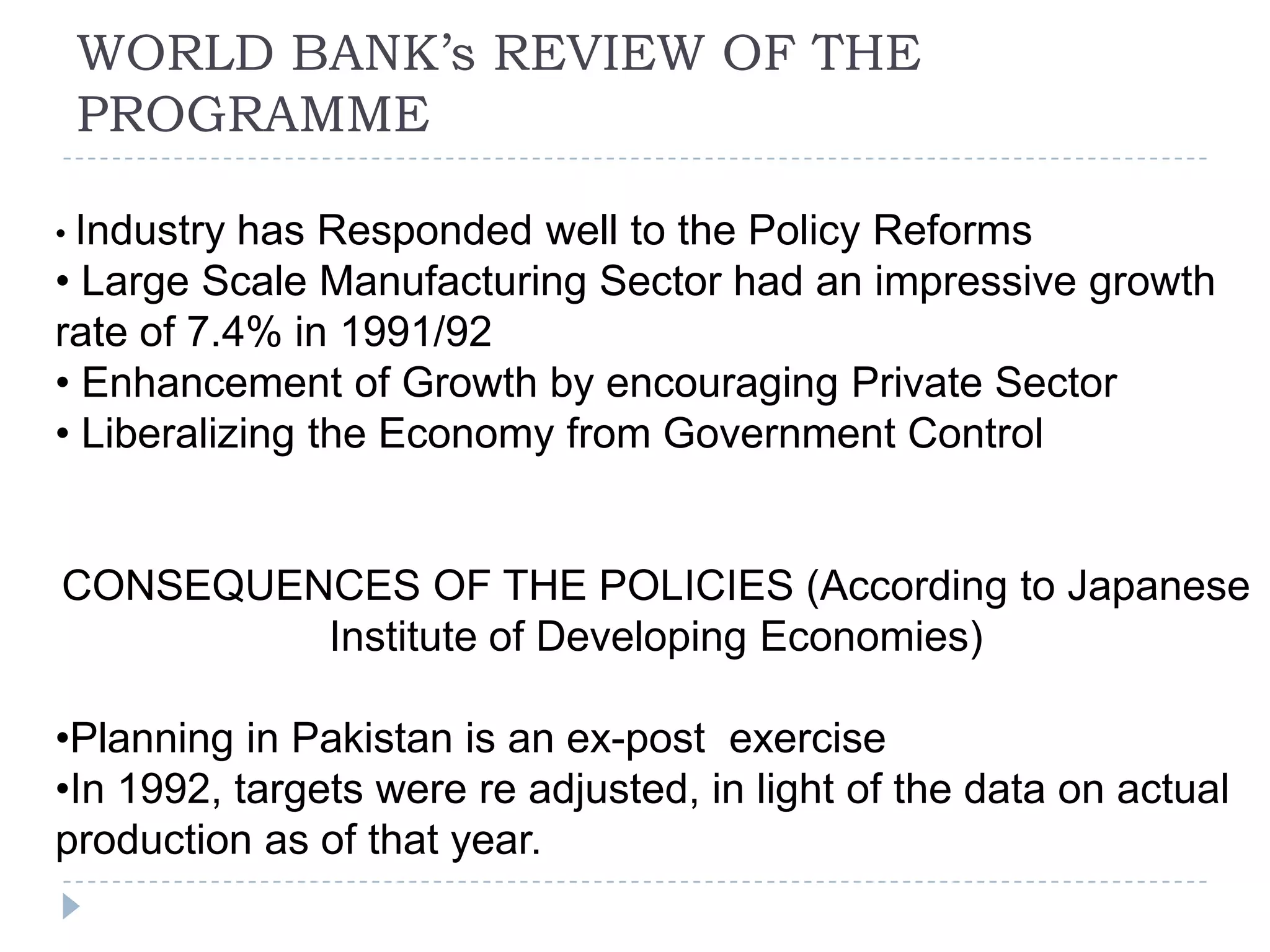
• Industry has Responded well to the Policy Reforms
• Large Scale Manufacturing Sector had an impressive growth
rate of 7.4% in 1991/92
• Enhancement of Growth by encouraging Private Sector
• Liberalizing the Economy from Government Control


CONSEQUENCES OF THE POLICIES (According to Japanese
         Institute of Developing Economies)

•Planning in Pakistan is an ex-post exercise
•In 1992, targets were re adjusted, in light of the data on actual
production as of that year.
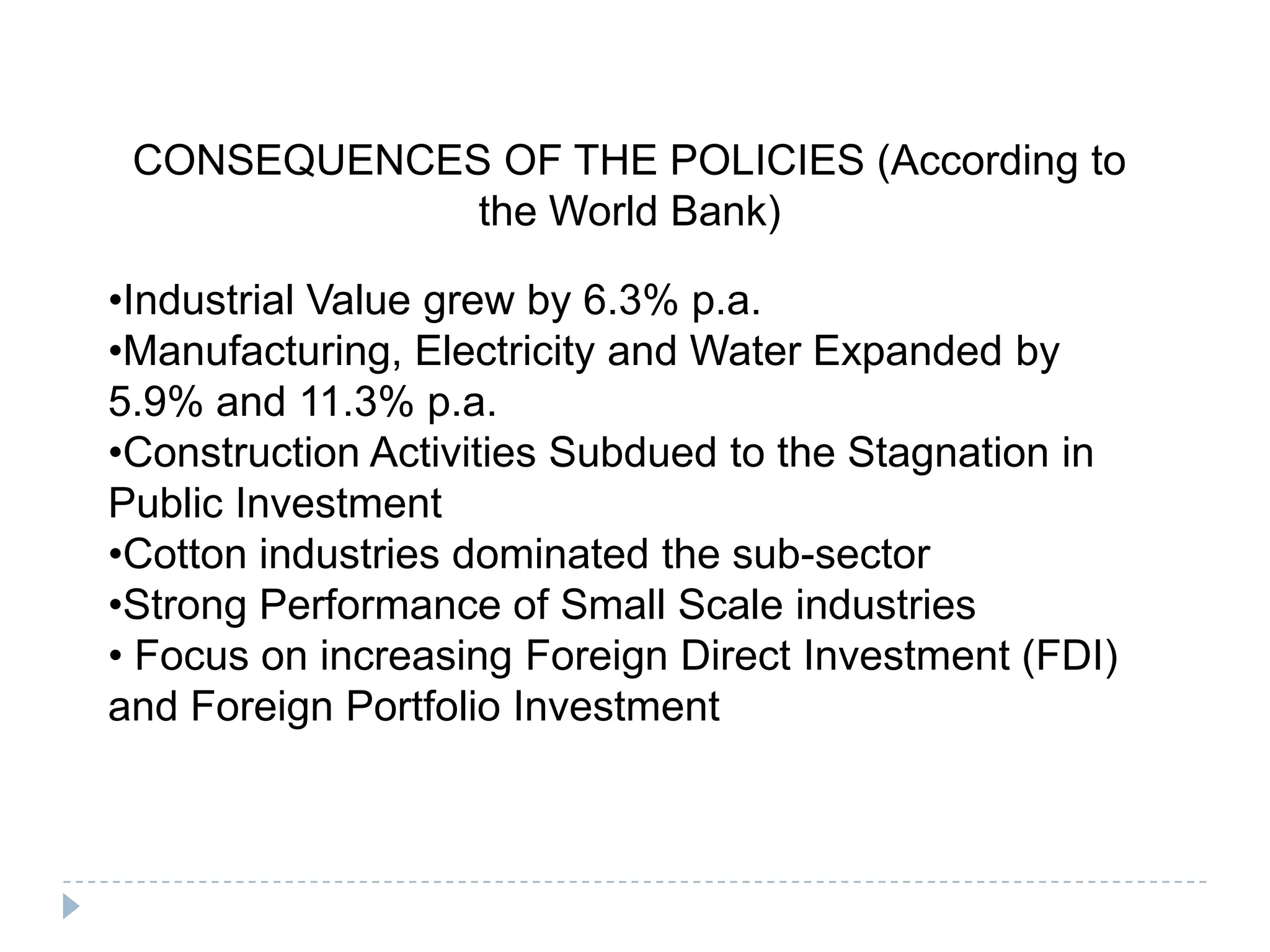
CONSEQUENCES OF THE POLICIES (According to
             the World Bank)

•Industrial Value grew by 6.3% p.a.
•Manufacturing, Electricity and Water Expanded by
5.9% and 11.3% p.a.
•Construction Activities Subdued to the Stagnation in
Public Investment
•Cotton industries dominated the sub-sector
•Strong Performance of Small Scale industries
• Focus on increasing Foreign Direct Investment (FDI)
and Foreign Portfolio Investment
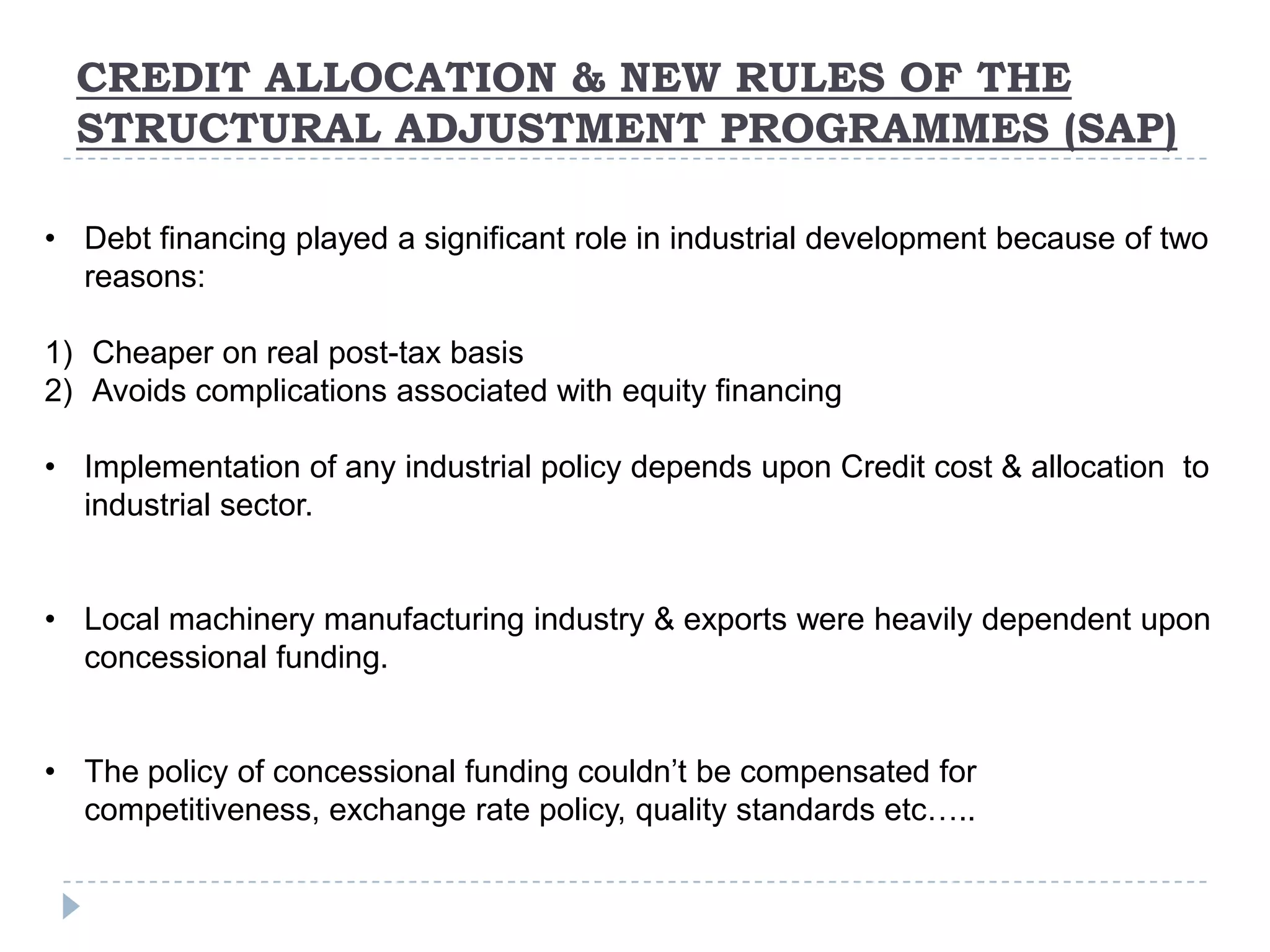
CREDIT ALLOCATION & NEW RULES OF THE
  STRUCTURAL ADJUSTMENT PROGRAMMES (SAP)

• Debt financing played a significant role in industrial development because of two
  reasons:

1) Cheaper on real post-tax basis
2) Avoids complications associated with equity financing

• Implementation of any industrial policy depends upon Credit cost & allocation to
  industrial sector.


• Local machinery manufacturing industry & exports were heavily dependent upon
  concessional funding.


• The policy of concessional funding couldn’t be compensated for
  competitiveness, exchange rate policy, quality standards etc…..
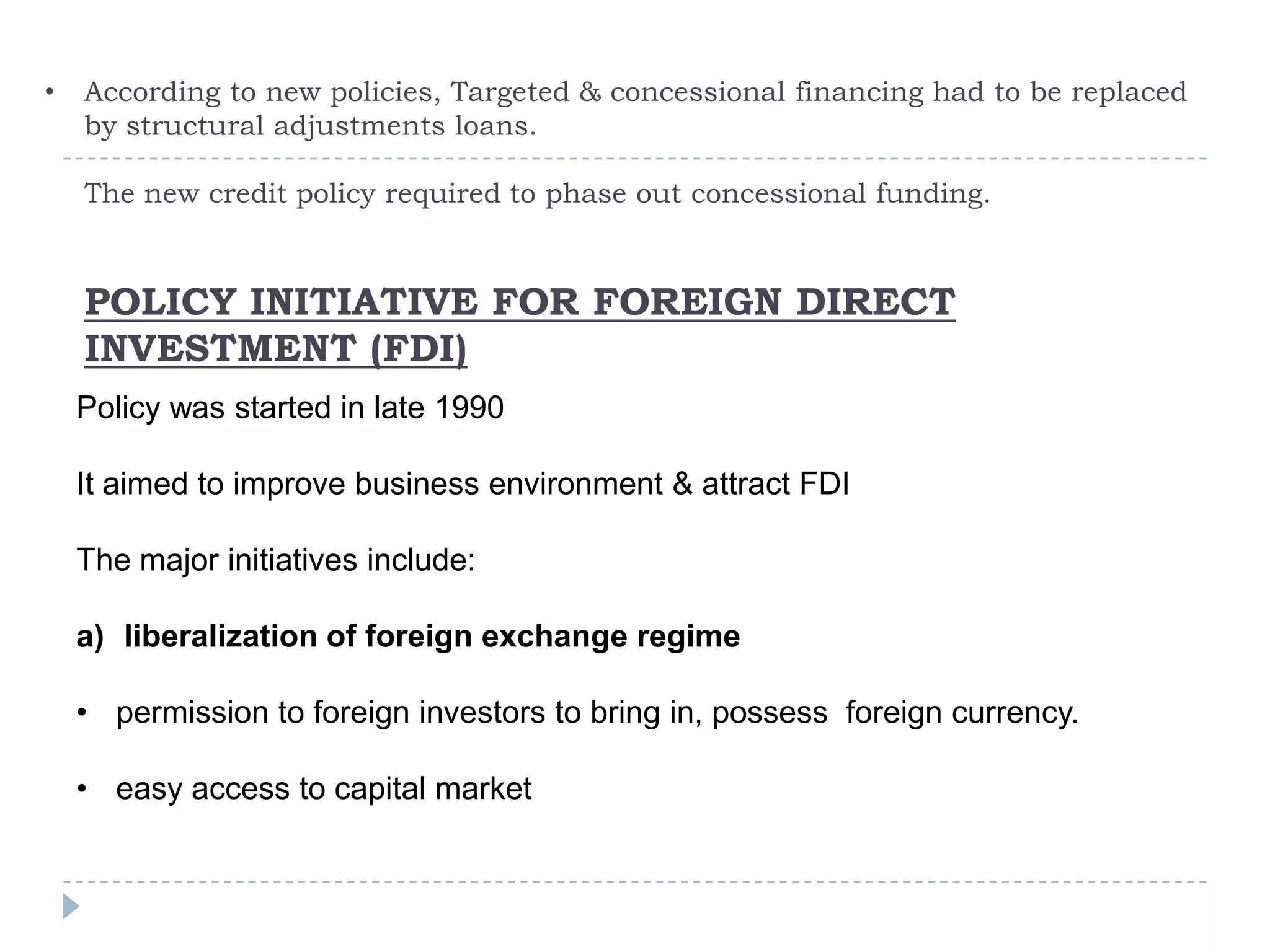
•   According to new policies, Targeted & concessional financing had to be replaced
    by structural adjustments loans.

    The new credit policy required to phase out concessional funding.


    POLICY INITIATIVE FOR FOREIGN DIRECT
    INVESTMENT (FDI)
    Policy was started in late 1990

    It aimed to improve business environment & attract FDI

    The major initiatives include:

    a) liberalization of foreign exchange regime

    • permission to foreign investors to bring in, possess foreign currency.

    • easy access to capital market
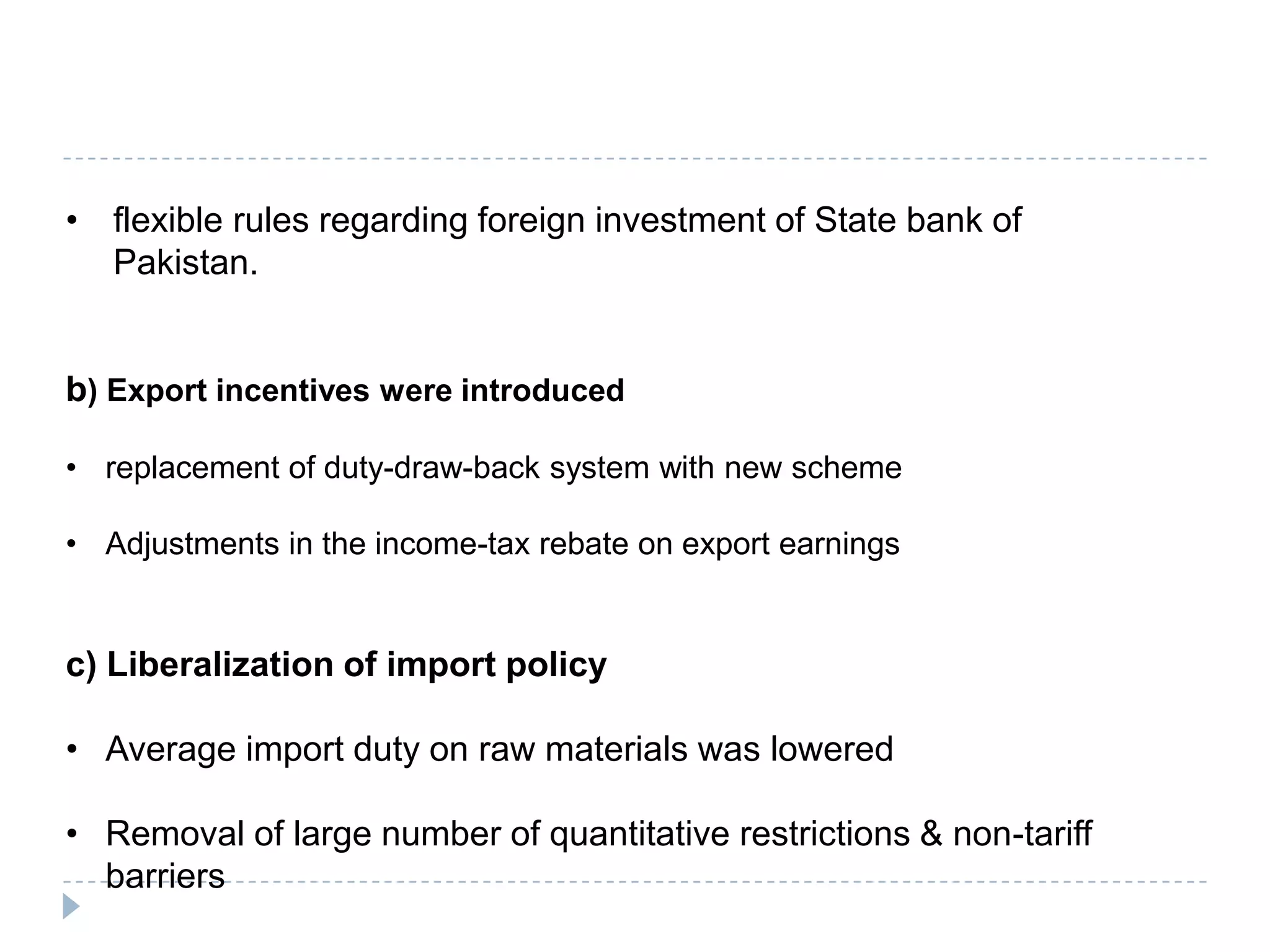
• flexible rules regarding foreign investment of State bank of
  Pakistan.


b) Export incentives were introduced

• replacement of duty-draw-back system with new scheme

• Adjustments in the income-tax rebate on export earnings


c) Liberalization of import policy

• Average import duty on raw materials was lowered

• Removal of large number of quantitative restrictions & non-tariff
  barriers
D) Introduction of the investment incentives
 Tax holidays for projects in rural areas.


   Exemption of import duties on imported machinery

   Other fiscal & monetary incentives offered in selected industries
Assessing the impact on industrial sector
                       Deteriorating condition of industry
• Growth rate of manufacturing falling from 8.21% in 1980s to 4.8% in
1990s
• Fixed investment, as a percentage of GDP in 2002/3 is only 13.1%,
down from 19% in 1992/3 falling each year
• The industrial sector after Structural Adjustment Program was
initiated in 1988 has suffered over the last decade and a half and
scholars show association and a clear link between the two.
• For example, cost of borrowing – the rate of interest – from an
average of 12% in 1990, the rate of interest for financing long term
industrial investment rose to an average of 20-23% by 1997
• Similarly, freeing up of the prices of utilities – forced prices up for
gas, electricity and petroleum inputs. Electricity prices rose by 14.7%
between 1991-2001, gas rose by 10% and price of petroleum above
Rs. 35 in 2003.
IMF Conditions derail Textile
Vision 2005
• First objective – Provide soft-term loans to the textile industry
but IMF wants elimination of all such credit
• With the advent of WTO Textile industry will face more
challenge in the global market due to unavailability of soft-term
loans.
• Second Objective – Enable the industry to acquire modern
technology, provide credit at exceptionally low mark-up and
fiscal incentives but domestic banking sector has refused to do
it.

• Central Board of Revenue has neither provided tax reliefs nor
has it paid billions of rupees in refund to the textile exporters.
• After approval of Stand-By Arrangements (SBA) by the IMF,
subsidies are phasing out to different sectors.
CHANGES IN THE NATURE OF
              ENTREPRENEURS
   Significant transformation in the industrial elite as
    a result of separation of East Pakistan and
    nationalization policy of Bhutto.

   Industrial elite still includes giants of the pre-
    nationalization phase.

   Some of the new groups are not listed so they’re
    not considered a part of the industrial elite.
   Significant focus on aggressive marketing and
    advertising strategies of the new entrepreneurs.

   Lifestyle of older entrepreneurs was much less
    pretentious than the entrepreneurs of the 80s.

   Financial expertise now only limited to protecting
    particulars of one’s financial worth.
   Labor laws changed the mode of operation of the
    industrial sector of the 80s.

   It introduced ‘hiring on contract’ in order to accumulate
    higher profits.

   Some of the new industries have distinguished
    themselves by investing heavily in hotel business,
    steel and light engineering.

   Industries of both the eras have been patronized by
    the state despite their numerous illicit practices.

Age of Structural Development in Pak: 1988 onwards

  • 1.
    API presentation The ageof structural adjustments: 1988 onwards Team members: M.Shehmir Usman Azam Aun Rizvi Mujtaba Safri Updesh Thakwani
  • 2.
    Aim of StructuralAdjustment Programme (SAP):  Liberalizing the economy  Promoting competition  Making private sector stronger  Reducing the borrowing country's fiscal imbalance.  Reducing poverty  Increasing the exports of the country  Making good use of loans granted to borrower country  Making the country capable of returning back the loan
  • 3.
    Controversial points ofSAP  De-regulating the business in Pakistan  Reducing the level of protection to different industries  Reducing the list of restricted import items  Increase in the level of indirect taxation  Withdrawal of subsidies on gas, electricity, telephone and fertilizers  An increase in producer prices of major crops  12.5% reduction in the public sector development program  Restriction on Govt. borrowing and credit allocation to private sector
  • 4.
    WORLD BANK’s REVIEWOF THE PROGRAMME • Industry has Responded well to the Policy Reforms • Large Scale Manufacturing Sector had an impressive growth rate of 7.4% in 1991/92 • Enhancement of Growth by encouraging Private Sector • Liberalizing the Economy from Government Control CONSEQUENCES OF THE POLICIES (According to Japanese Institute of Developing Economies) •Planning in Pakistan is an ex-post exercise •In 1992, targets were re adjusted, in light of the data on actual production as of that year.
  • 5.
    CONSEQUENCES OF THEPOLICIES (According to the World Bank) •Industrial Value grew by 6.3% p.a. •Manufacturing, Electricity and Water Expanded by 5.9% and 11.3% p.a. •Construction Activities Subdued to the Stagnation in Public Investment •Cotton industries dominated the sub-sector •Strong Performance of Small Scale industries • Focus on increasing Foreign Direct Investment (FDI) and Foreign Portfolio Investment
  • 6.
    CREDIT ALLOCATION &NEW RULES OF THE STRUCTURAL ADJUSTMENT PROGRAMMES (SAP) • Debt financing played a significant role in industrial development because of two reasons: 1) Cheaper on real post-tax basis 2) Avoids complications associated with equity financing • Implementation of any industrial policy depends upon Credit cost & allocation to industrial sector. • Local machinery manufacturing industry & exports were heavily dependent upon concessional funding. • The policy of concessional funding couldn’t be compensated for competitiveness, exchange rate policy, quality standards etc…..
  • 7.
    According to new policies, Targeted & concessional financing had to be replaced by structural adjustments loans. The new credit policy required to phase out concessional funding. POLICY INITIATIVE FOR FOREIGN DIRECT INVESTMENT (FDI) Policy was started in late 1990 It aimed to improve business environment & attract FDI The major initiatives include: a) liberalization of foreign exchange regime • permission to foreign investors to bring in, possess foreign currency. • easy access to capital market
  • 8.
    • flexible rulesregarding foreign investment of State bank of Pakistan. b) Export incentives were introduced • replacement of duty-draw-back system with new scheme • Adjustments in the income-tax rebate on export earnings c) Liberalization of import policy • Average import duty on raw materials was lowered • Removal of large number of quantitative restrictions & non-tariff barriers
  • 9.
    D) Introduction ofthe investment incentives  Tax holidays for projects in rural areas.  Exemption of import duties on imported machinery  Other fiscal & monetary incentives offered in selected industries
  • 10.
    Assessing the impacton industrial sector Deteriorating condition of industry • Growth rate of manufacturing falling from 8.21% in 1980s to 4.8% in 1990s • Fixed investment, as a percentage of GDP in 2002/3 is only 13.1%, down from 19% in 1992/3 falling each year • The industrial sector after Structural Adjustment Program was initiated in 1988 has suffered over the last decade and a half and scholars show association and a clear link between the two. • For example, cost of borrowing – the rate of interest – from an average of 12% in 1990, the rate of interest for financing long term industrial investment rose to an average of 20-23% by 1997 • Similarly, freeing up of the prices of utilities – forced prices up for gas, electricity and petroleum inputs. Electricity prices rose by 14.7% between 1991-2001, gas rose by 10% and price of petroleum above Rs. 35 in 2003.
  • 11.
    IMF Conditions derailTextile Vision 2005 • First objective – Provide soft-term loans to the textile industry but IMF wants elimination of all such credit • With the advent of WTO Textile industry will face more challenge in the global market due to unavailability of soft-term loans. • Second Objective – Enable the industry to acquire modern technology, provide credit at exceptionally low mark-up and fiscal incentives but domestic banking sector has refused to do it. • Central Board of Revenue has neither provided tax reliefs nor has it paid billions of rupees in refund to the textile exporters. • After approval of Stand-By Arrangements (SBA) by the IMF, subsidies are phasing out to different sectors.
  • 12.
    CHANGES IN THENATURE OF ENTREPRENEURS  Significant transformation in the industrial elite as a result of separation of East Pakistan and nationalization policy of Bhutto.  Industrial elite still includes giants of the pre- nationalization phase.  Some of the new groups are not listed so they’re not considered a part of the industrial elite.
  • 13.
    Significant focus on aggressive marketing and advertising strategies of the new entrepreneurs.  Lifestyle of older entrepreneurs was much less pretentious than the entrepreneurs of the 80s.  Financial expertise now only limited to protecting particulars of one’s financial worth.
  • 14.
    Labor laws changed the mode of operation of the industrial sector of the 80s.  It introduced ‘hiring on contract’ in order to accumulate higher profits.  Some of the new industries have distinguished themselves by investing heavily in hotel business, steel and light engineering.  Industries of both the eras have been patronized by the state despite their numerous illicit practices.