PLANNER 2008-09

“ Planner as a Conscience”
 trust/ethical /choices/value and moral
             responsibility”
•   Have we asked the right questions
•   Have we been ambitious for all our children?
•   Have we done ALL that it takes for our children?
•   Have we looked at our convenience when we planned or
    at the trust that our children brought with them….
•   Are we staying true to the beacon?
•   Did we make the journey ‘VISIBLE’....to all stakeholders
    ( students / parents / colleagues ) –twice a month – once
    for the journey to be made visible to the parents and
    once for an MLV
•   Have we put value to the choices we made….the 3 R’s
•   Has our common sense become common practice?
•   Am I more competent today than yesterday?
SUGGESTIONS

• -this should get reflected in the ‘daily planner. Write
    down the whys and the link to the
    bigger/understanding goal via the purposes of doing
    any activity –RELEVANCE.
•   Learning outcomes/milestones(Age group-
    before/current/after)
•   Blooms Taxonomy
•   Rubric page-for taking photographs/videos/planning
•   Non-negotiable page – thinking routines
•   Daily planner-space of DI’ing
•   Reflections for the practioner-learnings for the week
•   1 page for planning, 1 page for
    reflections
•   evidences for evidence file
•   Beacons with purpose – to be added per
    week + evidences (landscape)
•   Monthly framework-understanding goals
    and purpose + space for changes
•   Daily reflections as ongoing assessment
•   Weekly reflection as MY LEARNINGS –
    adult
•   Content          process product
•   Knowledge basestrategies evidence
•                    -languages of
•                     learnings
•   Monthly reflection – milestone based
•   Customized planner
•   ‘Site’ seeing
DETAILS

• 1st page - Overview
• 2nd page – Weekly planning with
  connections to the beacons.
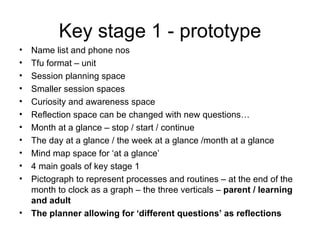
Key stage 1 - prototype
•   Name list and phone nos
•   Tfu format – unit
•   Session planning space
•   Smaller session spaces
•   Curiosity and awareness space
•   Reflection space can be changed with new questions…
•   Month at a glance – stop / start / continue
•   The day at a glance / the week at a glance /month at a glance
•   Mind map space for ‘at a glance’
•   4 main goals of key stage 1
•   Pictograph to represent processes and routines – at the end of the
    month to clock as a graph – the three verticals – parent / learning
    and adult
•   The planner allowing for ‘different questions’ as reflections
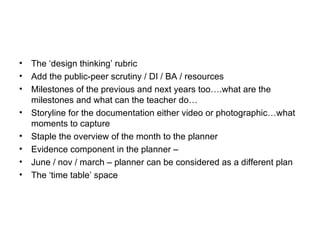
•   The ‘design thinking’ rubric
•   Add the public-peer scrutiny / DI / BA / resources
•   Milestones of the previous and next years too….what are the
    milestones and what can the teacher do…
•   Storyline for the documentation either video or photographic…what
    moments to capture
•   Staple the overview of the month to the planner
•   Evidence component in the planner –
•   June / nov / march – planner can be considered as a different plan
•   The ‘time table’ space
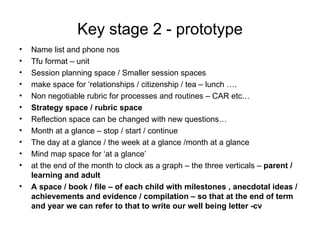
Key stage 2 - prototype
•   Name list and phone nos
•   Tfu format – unit
•   Session planning space / Smaller session spaces
•   make space for ‘relationships / citizenship / tea – lunch ….
•   Non negotiable rubric for processes and routines – CAR etc…
•   Strategy space / rubric space
•   Reflection space can be changed with new questions…
•   Month at a glance – stop / start / continue
•   The day at a glance / the week at a glance /month at a glance
•   Mind map space for ‘at a glance’
•   at the end of the month to clock as a graph – the three verticals – parent /
    learning and adult
•   A space / book / file – of each child with milestones , anecdotal ideas /
    achievements and evidence / compilation – so that at the end of term
    and year we can refer to that to write our well being letter -cv
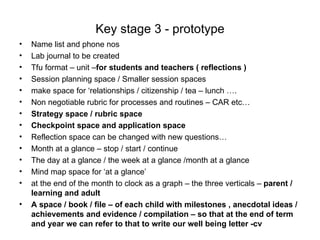
Key stage 3 - prototype
•   Name list and phone nos
•   Lab journal to be created
•   Tfu format – unit –for students and teachers ( reflections )
•   Session planning space / Smaller session spaces
•   make space for ‘relationships / citizenship / tea – lunch ….
•   Non negotiable rubric for processes and routines – CAR etc…
•   Strategy space / rubric space
•   Checkpoint space and application space
•   Reflection space can be changed with new questions…
•   Month at a glance – stop / start / continue
•   The day at a glance / the week at a glance /month at a glance
•   Mind map space for ‘at a glance’
•   at the end of the month to clock as a graph – the three verticals – parent /
    learning and adult
•   A space / book / file – of each child with milestones , anecdotal ideas /
    achievements and evidence / compilation – so that at the end of term
    and year we can refer to that to write our well being letter -cv
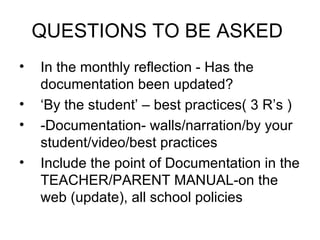
QUESTIONS TO BE ASKED
•   In the monthly reflection - Has the
    documentation been updated?
•   ‘By the student’ – best practices( 3 R’s )
•   -Documentation- walls/narration/by your
    student/video/best practices
•   Include the point of Documentation in the
    TEACHER/PARENT MANUAL-on the
    web (update), all school policies
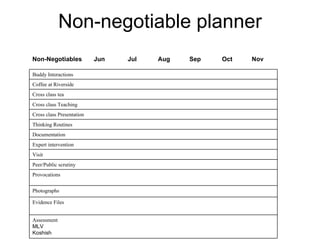
Non-negotiable planner
Non-Negotiables            Jun   Jul   Aug   Sep   Oct   Nov

Buddy Interactions
Coffee at Riverside
Cross class tea
Cross class Teaching
Cross class Presentation
Thinking Routines
Documentation
Expert intervention
Visit
Peer/Public scrutiny
Provocations


Photographs

Evidence Files


Assessment
MLV
Koshish

Planner

  • 1.
    PLANNER 2008-09 “ Planneras a Conscience” trust/ethical /choices/value and moral responsibility”
  • 2.
    Have we asked the right questions • Have we been ambitious for all our children? • Have we done ALL that it takes for our children? • Have we looked at our convenience when we planned or at the trust that our children brought with them…. • Are we staying true to the beacon? • Did we make the journey ‘VISIBLE’....to all stakeholders ( students / parents / colleagues ) –twice a month – once for the journey to be made visible to the parents and once for an MLV • Have we put value to the choices we made….the 3 R’s • Has our common sense become common practice? • Am I more competent today than yesterday?
  • 3.
    SUGGESTIONS • -this shouldget reflected in the ‘daily planner. Write down the whys and the link to the bigger/understanding goal via the purposes of doing any activity –RELEVANCE. • Learning outcomes/milestones(Age group- before/current/after) • Blooms Taxonomy • Rubric page-for taking photographs/videos/planning • Non-negotiable page – thinking routines • Daily planner-space of DI’ing • Reflections for the practioner-learnings for the week
  • 4.
    1 page for planning, 1 page for reflections • evidences for evidence file • Beacons with purpose – to be added per week + evidences (landscape) • Monthly framework-understanding goals and purpose + space for changes • Daily reflections as ongoing assessment
  • 5.
    Weekly reflection as MY LEARNINGS – adult • Content process product • Knowledge basestrategies evidence • -languages of • learnings
  • 6.
    Monthly reflection – milestone based • Customized planner • ‘Site’ seeing
  • 7.
    DETAILS • 1st page- Overview • 2nd page – Weekly planning with connections to the beacons.
  • 8.
    Key stage 1- prototype • Name list and phone nos • Tfu format – unit • Session planning space • Smaller session spaces • Curiosity and awareness space • Reflection space can be changed with new questions… • Month at a glance – stop / start / continue • The day at a glance / the week at a glance /month at a glance • Mind map space for ‘at a glance’ • 4 main goals of key stage 1 • Pictograph to represent processes and routines – at the end of the month to clock as a graph – the three verticals – parent / learning and adult • The planner allowing for ‘different questions’ as reflections
  • 9.
    The ‘design thinking’ rubric • Add the public-peer scrutiny / DI / BA / resources • Milestones of the previous and next years too….what are the milestones and what can the teacher do… • Storyline for the documentation either video or photographic…what moments to capture • Staple the overview of the month to the planner • Evidence component in the planner – • June / nov / march – planner can be considered as a different plan • The ‘time table’ space
  • 10.
    Key stage 2- prototype • Name list and phone nos • Tfu format – unit • Session planning space / Smaller session spaces • make space for ‘relationships / citizenship / tea – lunch …. • Non negotiable rubric for processes and routines – CAR etc… • Strategy space / rubric space • Reflection space can be changed with new questions… • Month at a glance – stop / start / continue • The day at a glance / the week at a glance /month at a glance • Mind map space for ‘at a glance’ • at the end of the month to clock as a graph – the three verticals – parent / learning and adult • A space / book / file – of each child with milestones , anecdotal ideas / achievements and evidence / compilation – so that at the end of term and year we can refer to that to write our well being letter -cv
  • 11.
    Key stage 3- prototype • Name list and phone nos • Lab journal to be created • Tfu format – unit –for students and teachers ( reflections ) • Session planning space / Smaller session spaces • make space for ‘relationships / citizenship / tea – lunch …. • Non negotiable rubric for processes and routines – CAR etc… • Strategy space / rubric space • Checkpoint space and application space • Reflection space can be changed with new questions… • Month at a glance – stop / start / continue • The day at a glance / the week at a glance /month at a glance • Mind map space for ‘at a glance’ • at the end of the month to clock as a graph – the three verticals – parent / learning and adult • A space / book / file – of each child with milestones , anecdotal ideas / achievements and evidence / compilation – so that at the end of term and year we can refer to that to write our well being letter -cv
  • 12.
    QUESTIONS TO BEASKED • In the monthly reflection - Has the documentation been updated? • ‘By the student’ – best practices( 3 R’s ) • -Documentation- walls/narration/by your student/video/best practices • Include the point of Documentation in the TEACHER/PARENT MANUAL-on the web (update), all school policies
  • 13.
    Non-negotiable planner Non-Negotiables Jun Jul Aug Sep Oct Nov Buddy Interactions Coffee at Riverside Cross class tea Cross class Teaching Cross class Presentation Thinking Routines Documentation Expert intervention Visit Peer/Public scrutiny Provocations Photographs Evidence Files Assessment MLV Koshish